Shadow augmented as Organic body
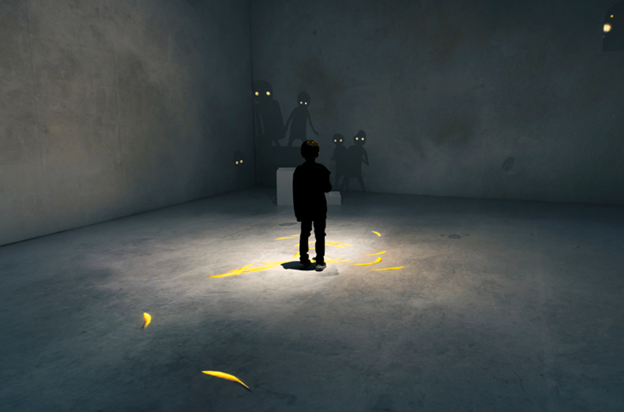
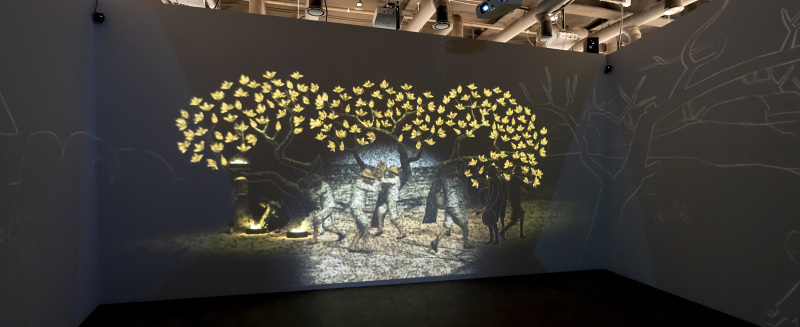
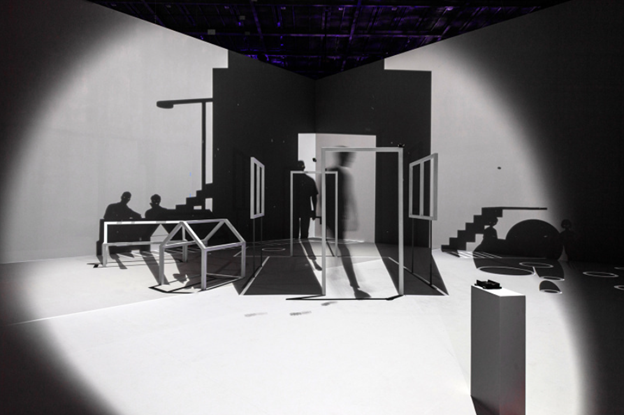
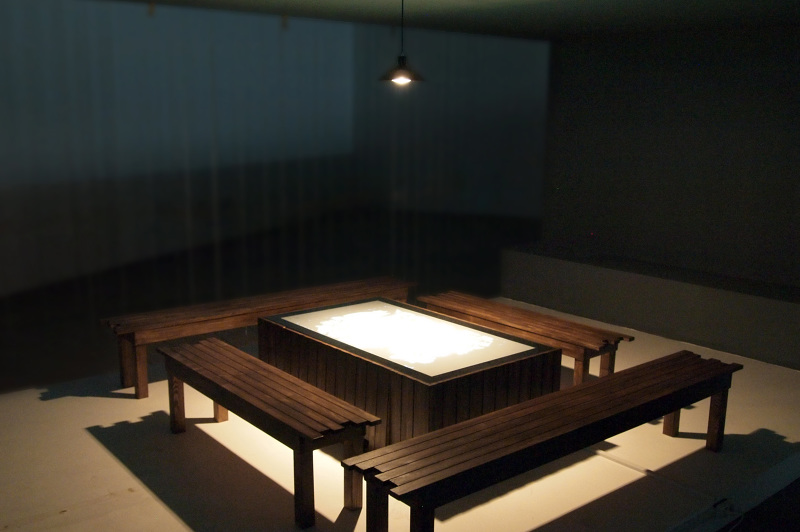
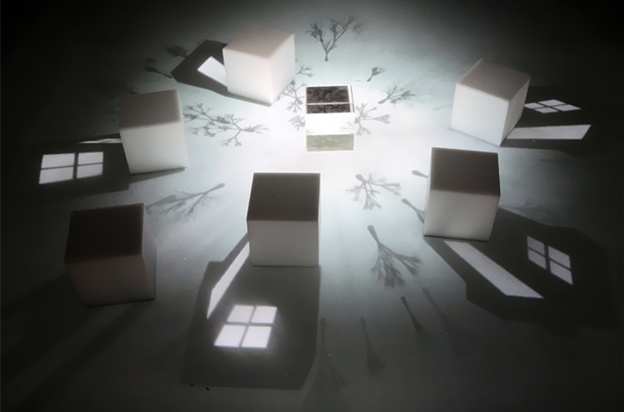
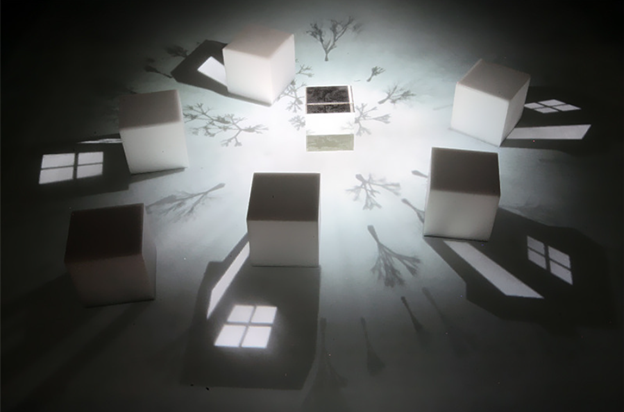
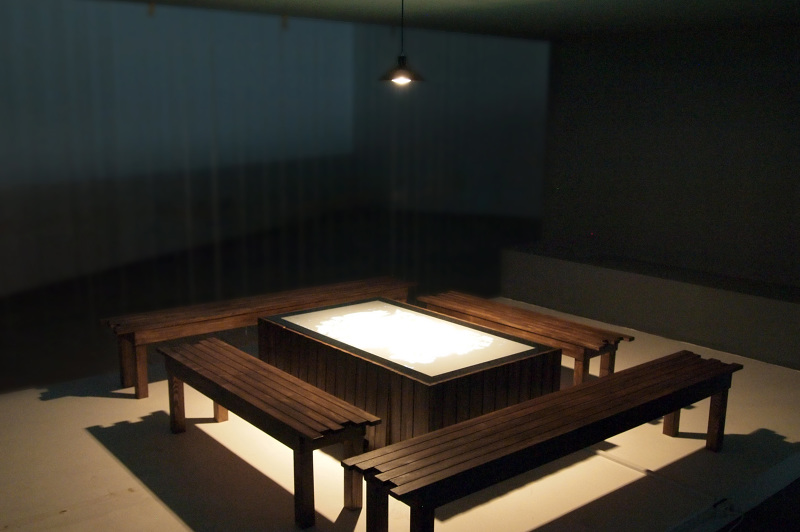
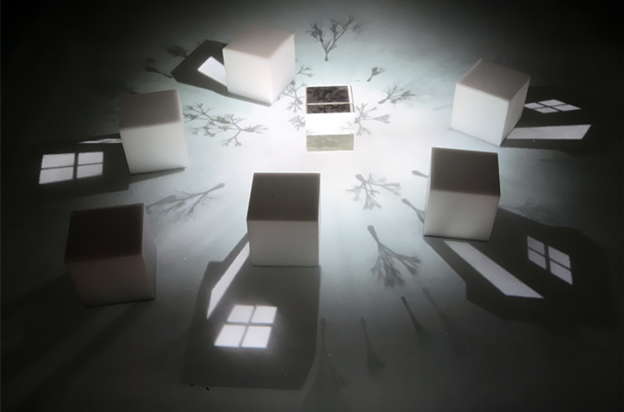
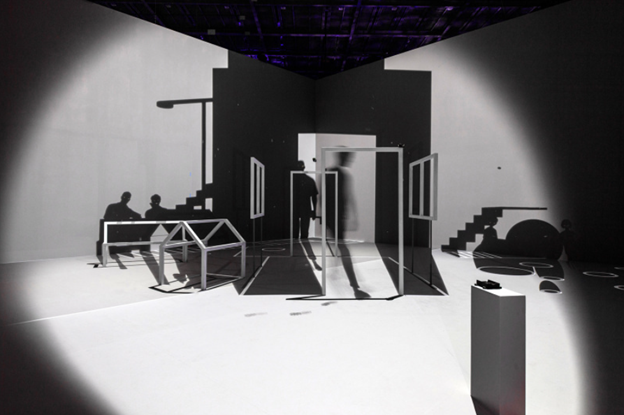
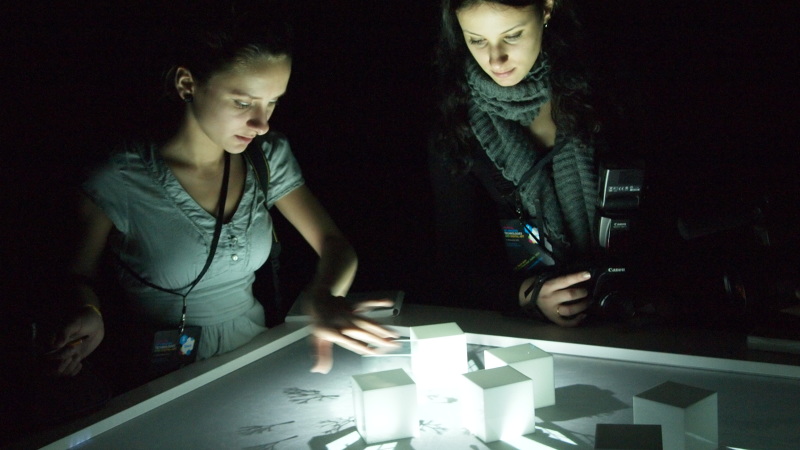
A white table lying on the floor is rectangular. Its top is made with material like semi-translucent acrylic, and it's high enough for an adult, with bending the body, to touch it. White, translucent cubes are scattered on it, as if they were laid with no planning. Birds, small houses, people looking like symbols, and trees, which occupy the empty space between them, exist as a form of shadow.
They are so-called icons of virtual reality. These icons, with a quiet, still silhouette, stimulate a spectator's curiosity, as if they came out of a fairy tale set on Christmas day. Like this, Joon Moon's work, Augmented Shadow(2010), is laid with the icons in a quiet, still image, as if he drew it.
We approach the work. We try to move the cubes on the table here and there. Then, we meet a wonderful moment of change. The silhouettes which were quiet still begin to move naively all at once.
As if by correspondence to the gliding cubes along the table, the people, coming out of the houses, begin to walk, the trees, rapidly growing, do to move, the birds do to fly as if they returned into their nests on a very cold day, and the shadows of the houses hidden behind other cubes do to move in different angles as if they were alive.
All the elements have relations with each other, like an organic body, farness intervenes in nearness and nearness does in farness, repeating to permeate each other. When the cubes move quietly, all the things do in silence, and a rapid movement of the cubes call invokes a sudden movement of the elements.
But a movement of the cubes(tool) and the one of the elements(image) are connected, as if they moved by a link. Spectators talk with works of art like that, and vice versa.
Joon Moon & Remediation
J. D. Bolter and R. Grusin, representative American researchers for new media, explain the attributes of new media art with concepts of remediation, immediacy and hypermediacy. Bolter·Grusin, tranlated by Lee Jae-hyun, 『Remediation; Understanding New Media』, Communication Books, 2006.
Though these concepts can sound a little strange to people who aren't familiar to the terms, actually, they only explain the attributes of art we all already know. The indistinct characteristics of new media art, which are differentiated from existing, traditional methods of art form, are an active interactivity between media and spectators, and an immediate feedback made by the interactivity.
That is, the attributes which make them possible are the three mentioned above, and all new media art is produced based on existing form of art work, narrative structure of literature·film work and lyricism of music. Bolter and Grusin call this concept remediation, in other words, this means that the form and contents of an art with completely new form don't exist originally, and it's a part of postmodern thinking and an existence base of new media art.
That's a paradoxical, interesting point. The fact that, for New media art based on cutting-edge technology, there is no differentiation in contents and form, contrary to progressivity in material and technique, from an institutionalized art seems to refer to Joon Moon's work with computer vision utilized, mentioned above.
And also in a work called Image Processing Application(2009), a digital image processing application he's tried for a photographer KIM Ata's 'Indala' Project, he shows a process of remediation. The process in which, by his utilizing a large sized image sheet, it is reproduced, generated and overlapped by itself and finally shows pictorial image is entry to a 'digital painting' based on remediation.
This work reminds, at a glance, us of a famous Monaleo(1987) by Lillian Schwartz. But, while Monaleo shows a possibility of an elementary digital painting synthesized by digital technique, "Image Processing Application" by Joon Moon is a trial to an approach to the dimension of a genuine digital painting created by making a photo itself original, based on self reproduction technique, and by going through a process of constant cell division.
This strange digital painting, in which a photo functions as original and also its reproductions are numerously overlapped and generated on a same surface, is a coexistence of original and reproductions, and it itself becomes another text.
This is a trend continued to a consecutive work, Parsons Thesis Symposium ID(2009), and also in this work, he creates his own visual environment by utilizing motion graphics in sound analysis and visualization.
Like this, though Joon Moon utilizes the computer vision based on movement recognition unfamiliar to ordinary persons and the tool of image analysis & creation called self reproduction, a world realized by them supports a narrative structure in which a warm-hearted sensitivity plays the most active part.
This fact explains that Joon Moon's work is of the conjunctive form of a narrative structure of literature and a representative attribute of formative arts. What spectators (a 'participant' would be a more proper term rather than a 'spectator' in Interactive art) get to take, by handling the cubes in various angles, in different strength and speed, isn't the understanding of movement recognition technique.
That may be an image finally represented to a spectator's eyes and its narrative structure, separately from a technical, progressive process which makes it possible. So, here, the cubes are devoted to their role as a tool to embody a narrative a 'participant' wants to express with by being combined in his or her mind.
This is one of the interesting points, that is, the cubes function as a medium to arouse a particular emotional inspiration by spectators handling them, not as an object of appreciation due to their existence. It could be explained by an attribute of immediacy. That is, a tool of handling has to end up as a tool to get the results of specific image, sound and movement with, not as an object of appreciation, and this is an essential attribute all arts aim for.
It's like that when appreciating a painting work, we see its contents, not its frame, or that when watching TV or its monitor, we focus on the contents it embodies, not looking at its LCD or LCD vessel. Like this, Joon Moon's new media art is on the cutting edge in an aspect of tool, but its contents are oriented toward an emotional dimension of arts guaranteed by a representation of image or icons of mimesis.
Joon Moon seems to have made an appropriate choice, from the point that the realm new media art eventually has to aim for and to be incorporated into is arts, although it attracts people's attention in an aspect of tool. And we have to observe carefully what makes remediation and immediacy, mentioned above, possible is hypermediacy.
While remediation and immediacy are an argument of aesthetic dimension, a concept of hypermediacy is the one of technical dimension which makes it possible. This concept is for explaining an attribute of new media art of moving from a point to a differently different one, free from the linear narrative structure shown in usual works of art, especially in works of film or literature.
It could be a concept to explain, in Joon Moon's work, seen above, the aspects in which completely different narratives are generated and modified in accordance with the computer vision he utilizes and each participant's handling.
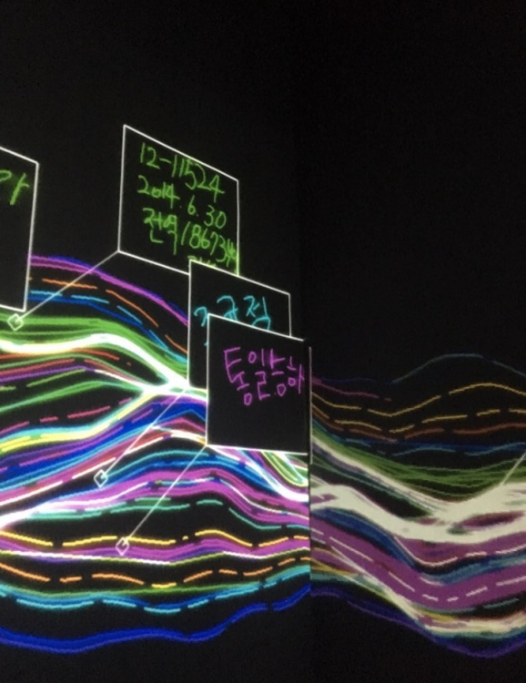
Hypermediacy is, in fact, a principle which functions outside the consciousness of a spectator or a participant, and an attribute of new media art of making the other two concepts, remediation and immediacy, possible and a concept to be also applied to Joon Moon's work. For instance, in his work Medusa, generative graphics(algorithmic graphics) are utilized as a principle which makes hypermediacy possible.
These are a technology to constantly produce images in real time, not by an existing method to show the images recorded on a digital camera, and they have a comprehensive mediacy, with music and image unified.
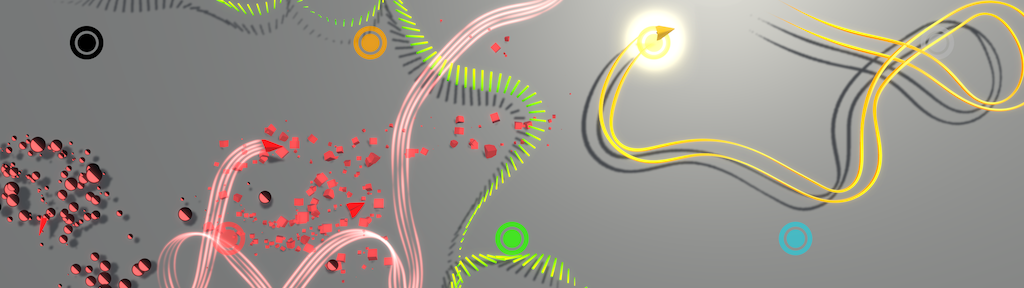
Joon Moon's Body Pen, in which participants can draw a picture according to the angle of moving when they move their body with spreading out their arms in front of the screen, can be also a work which makes hypermediacy possible by utilizing generative graphics.
Joon Moon's Light, Spiritual Fantasy
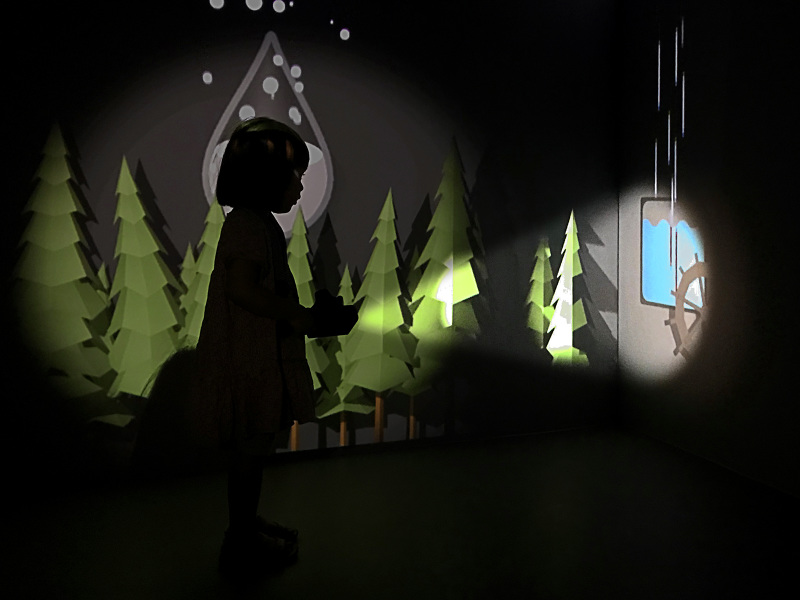
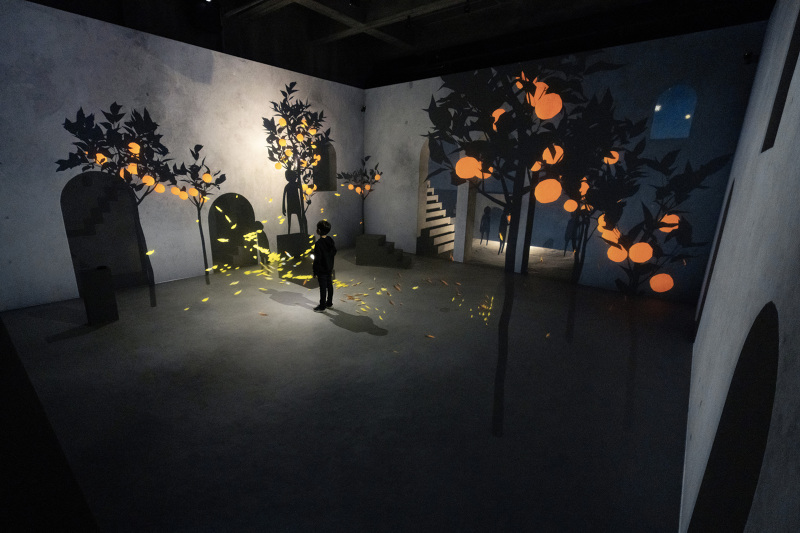
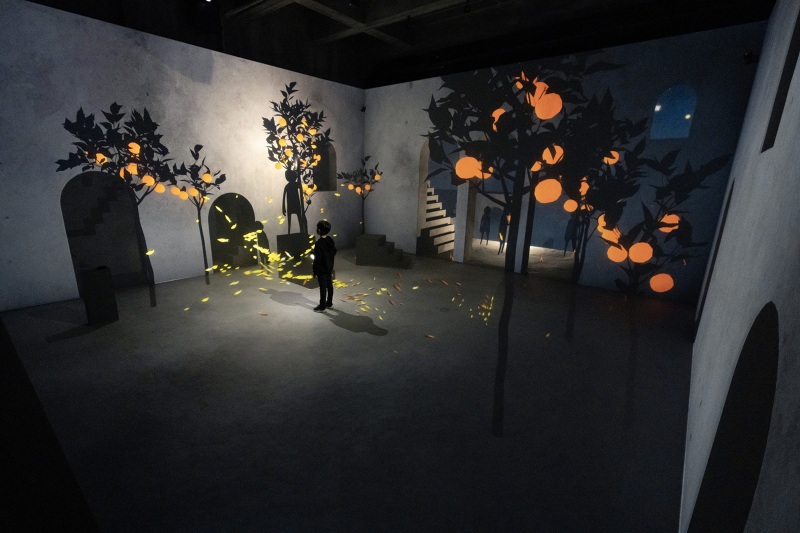
If there is an interesting element, separate from or interlinked with computer vision or generative graphics embodied in Joon Moon's new media art, it is light. The light is, of course, a general attribute of new media art. A concept of immateriality has appeared in the West since the 1970s, and light or beam has been introduced to formative arts as a generalized material. Joon Moon makes light material, but the light he deals with doesn't stop there.
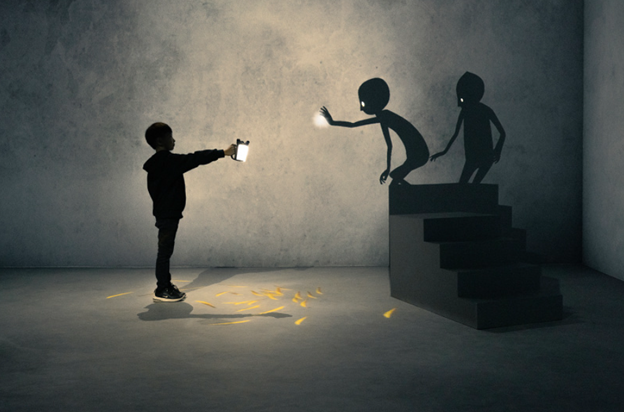
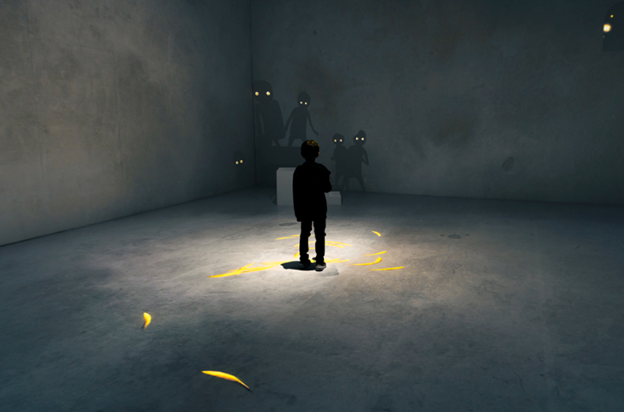
Light is, for him, as mentioned above, situated at the boundary of remediation and immediacy, working as an element to arouse a participant's psychological motive very actively. More concretely, Joon Moon's light is a 'sort of electromagnetic wave to stimulate the visual nerve, making one's eyes see things' and is close to an 'ambience to make something felt' or a 'look or attitude showed in facial expression, eyes or demeanor'.
This is the characteristics we have read and felt in Joon Moon's work, and it is to reveal his own uniqueness of a remediation based on emotion.