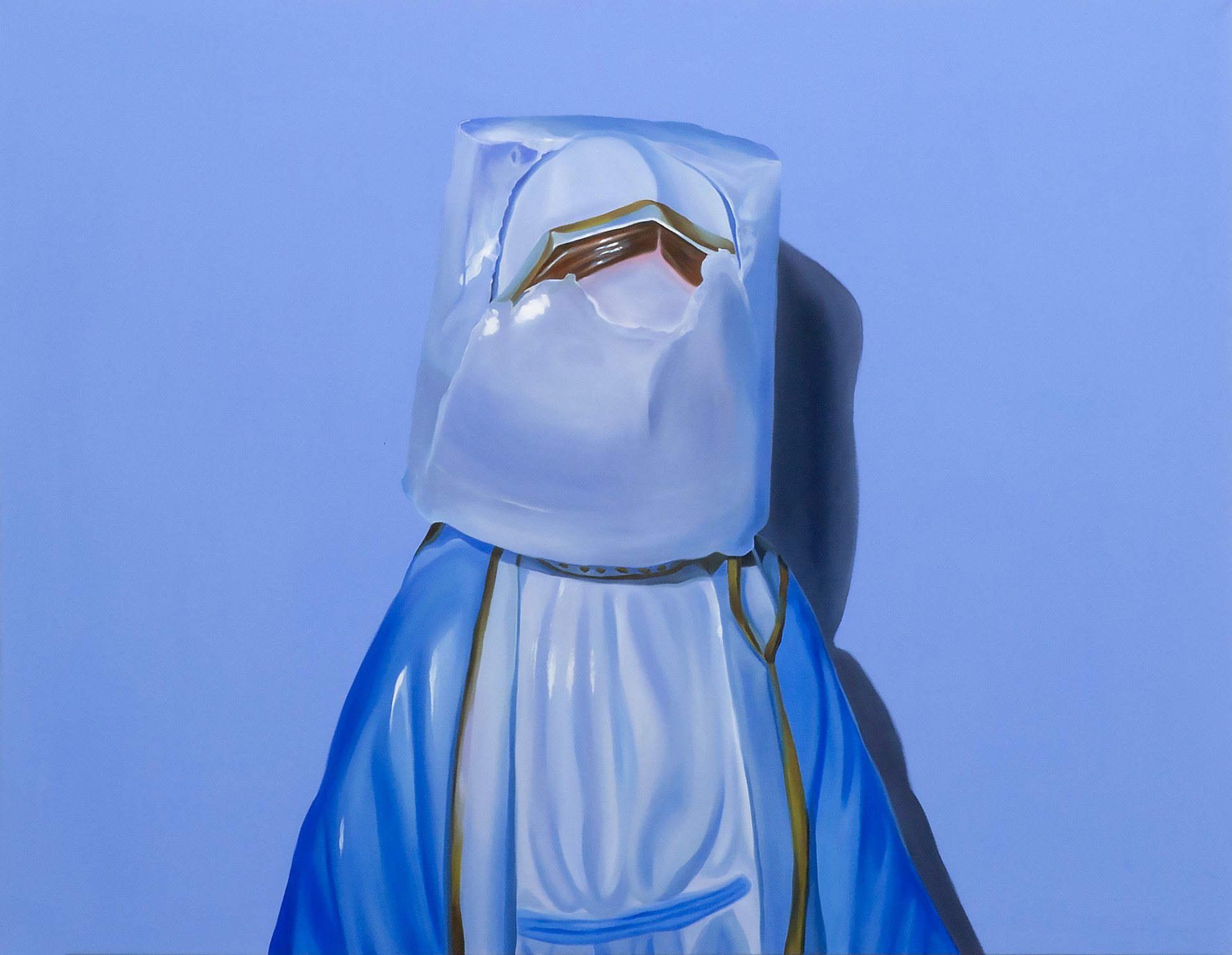
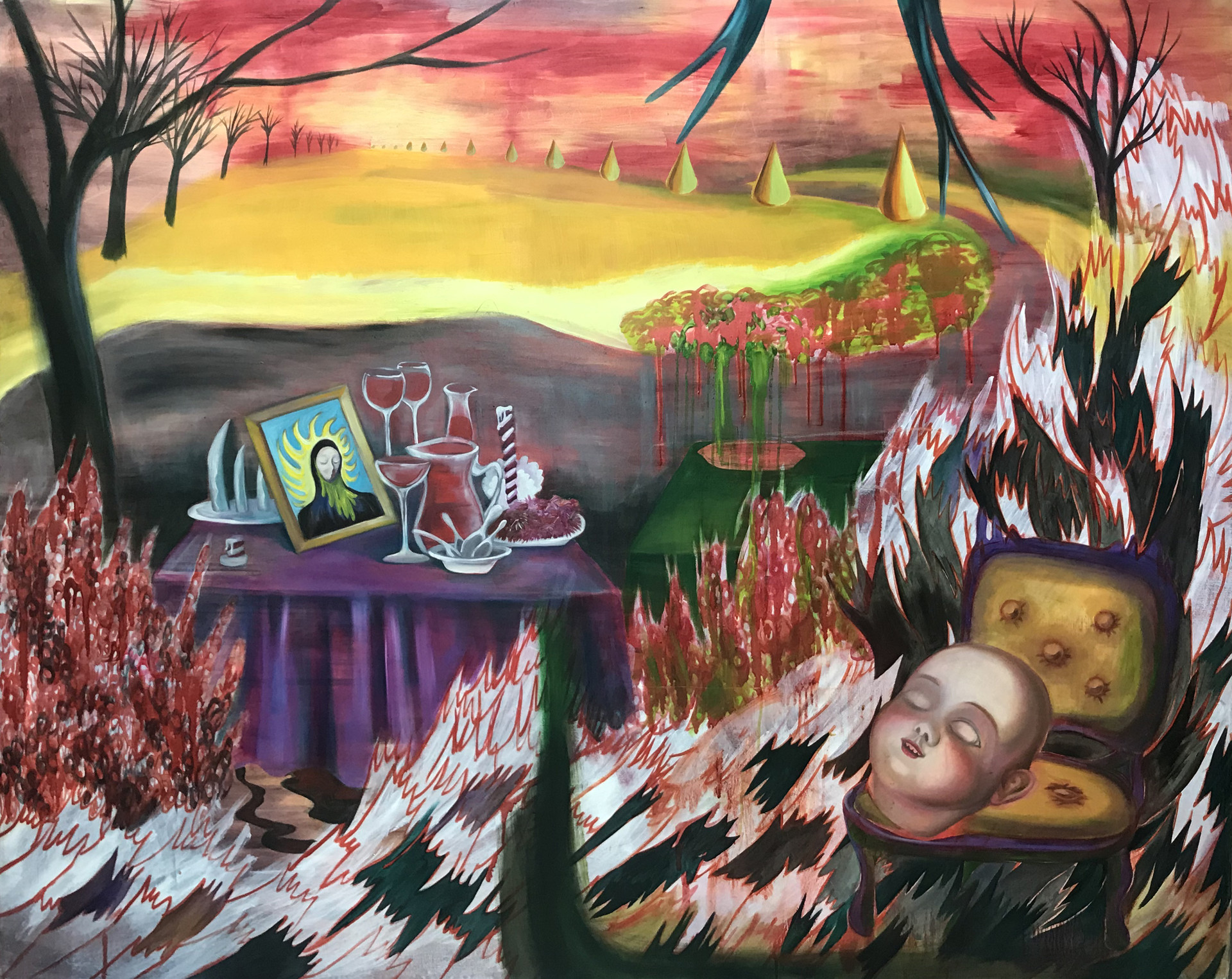
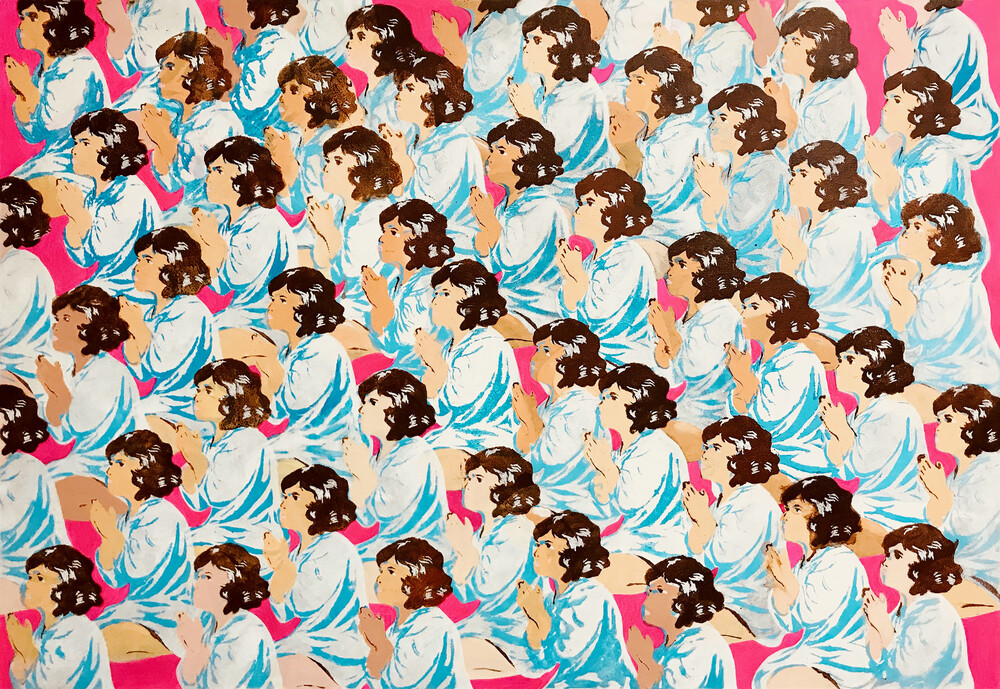
Hee Vaak, Hoping for a Safe Day, 2009, Acrylic stencil on canvas, 91x116.8cm © Hee Vaak

Hoping for a Safe Day begins from the image of the “praying girl,” commonly seen in the 1970s and 1980s. Joshua Reynolds’s The Infant Samuel(1776) one day crossed over to Korea, was copied by an anonymous person, and, with the phrase “Hoping for a Safe Day” added to it, the Korean-style “praying girl” was completed. ¹

The English painter Joshua Reynolds studied the paintings of classical masters and was especially absorbed in Rembrandt’s portraits, and by applying Rembrandt’s use of light and shade, he painted the figure of a child named Samuel from the Old Testament. Through Samuel, he put forward the purity of a child rather than that of a mature adult.

The young Samuel was transplanted to Korea in a peculiar way and was frequently hung and placed in taxis, restaurants, and homes in long-ago memory. There is a generation familiar with this image transformed from boy to girl, and perhaps its power is faint for later generations. An era in which prayers for blessings had implicitly and deeply infiltrated could not help but be closely woven with the mood of that era.

Even today, prayers for blessings are faintly draped over life, but changed sensibilities no longer permit them to circulate so piercingly as an image of the era, as did the praying girl. The earnest yet modest wish for safety and well-being is only rough-hewn against the emotional climate of an era that foregrounds hype. What is there to pray for by proxy?

There is already an overflow of glittering fetishes, and we are already overwhelmed with praising them. Yet Hee Vaak, instead of competing with the latest things, chose(or chose again) the praying girl, or the young Samuel. Whether girl or boy, she retraces the nature of a somewhat twisted wish projected through a being who atones by proxy and prays earnestly.


The Exhibition Space as a Pseudo-Chapel

During a conversation with her, the phrase that left the strongest impression on me was, “Faith becomes prejudice and also becomes a lifestyle.” While faith is usually elevated and prejudice spreads thinly and widely, this faith, prejudice, and synthesized lifestyle refined into a specific form at a specific time entered the exhibition space with a visually taut tension.
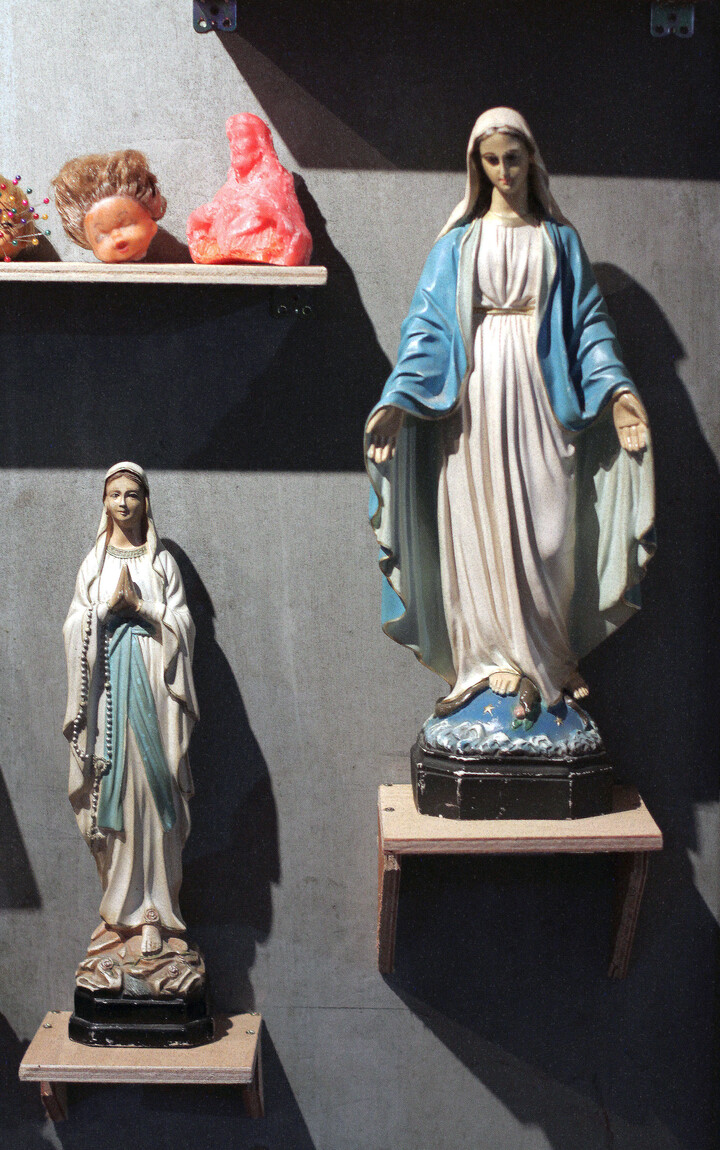
Devices reminiscent of a dedication ceremony for a lifestyle were placed along the visitor’s route, forming something like a pseudo-chapel. The exhibition space has two entrances, but A Life without Courage(2017), hanging at the main entrance, has collected words embroidered in thread on tulle in “the form of a stole² worn by clergy during confession and Mass.”
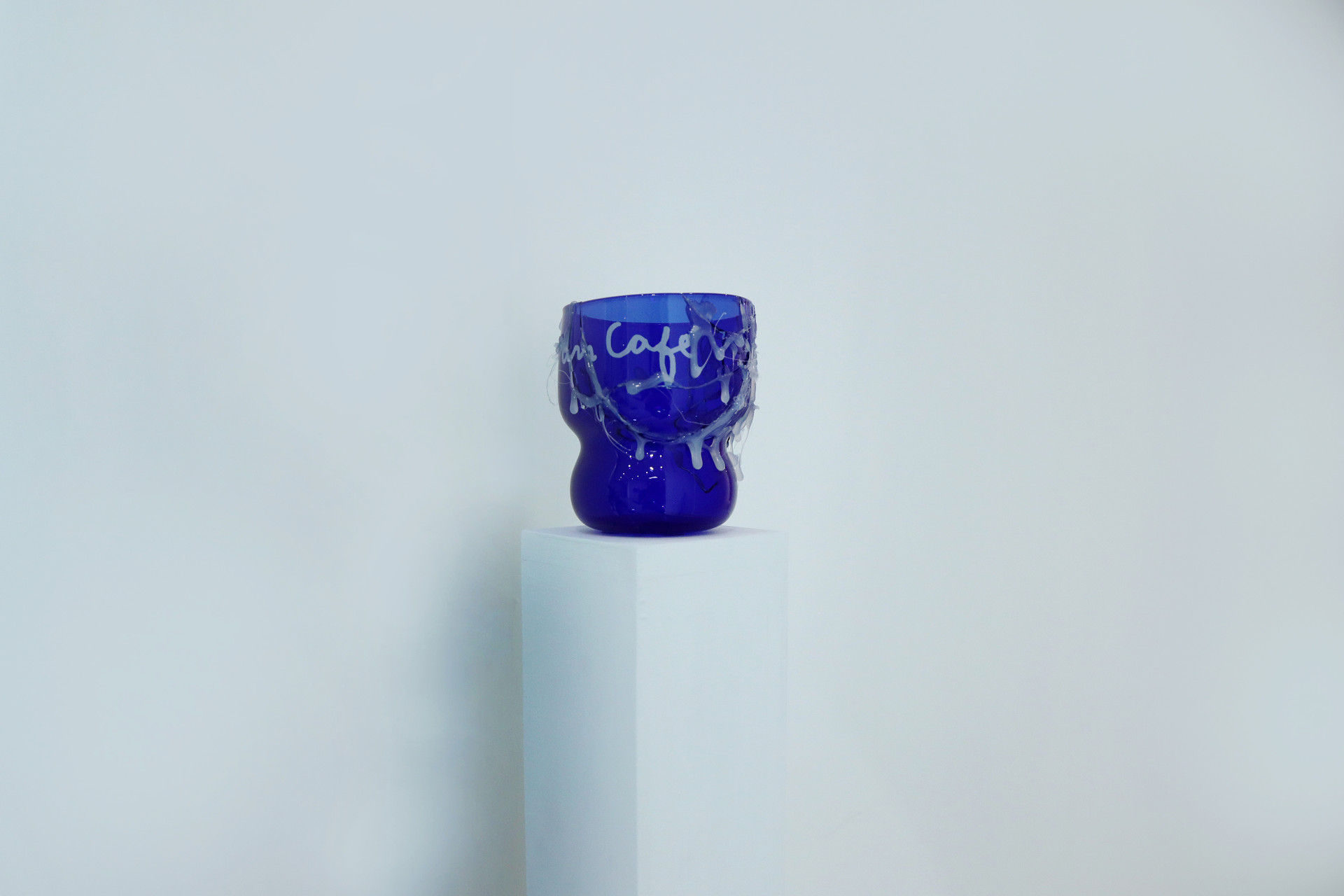
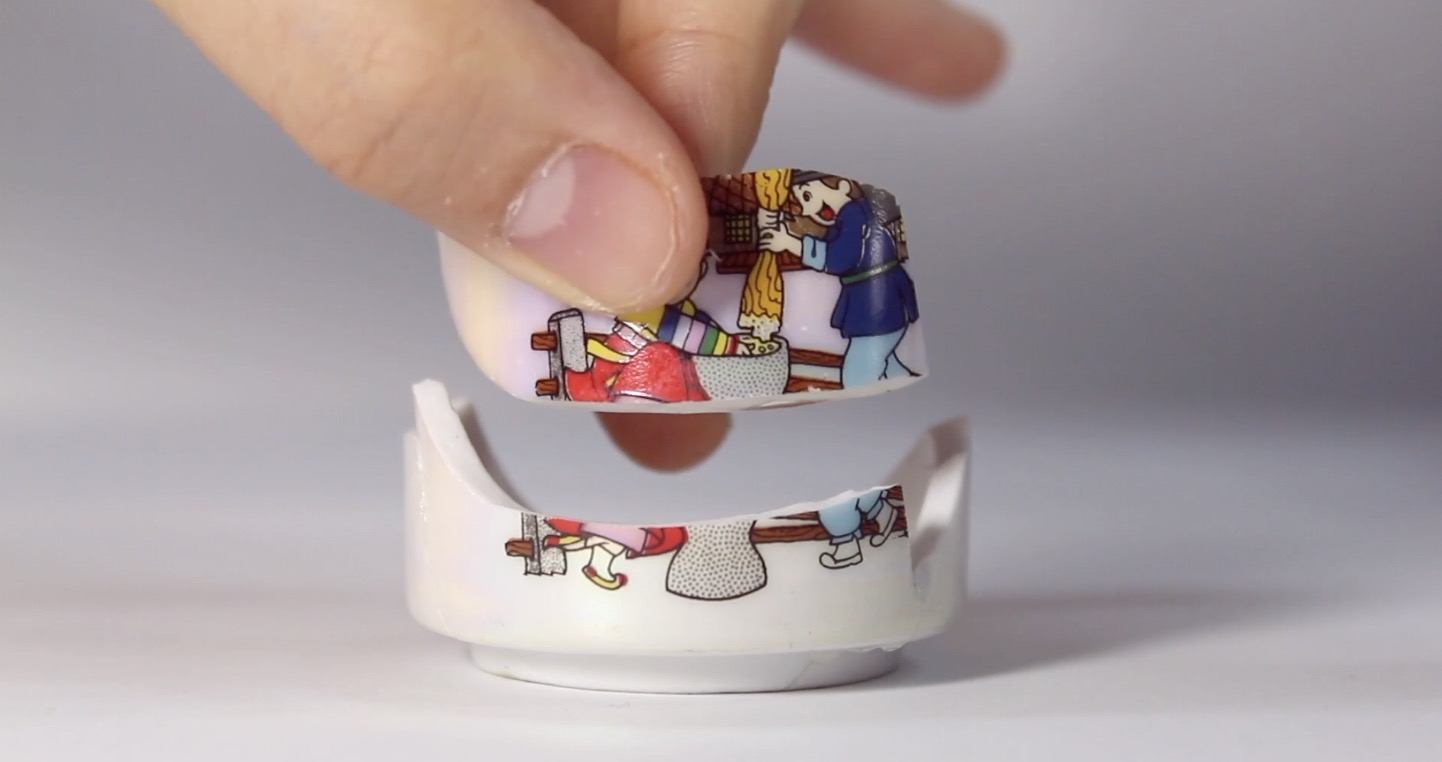
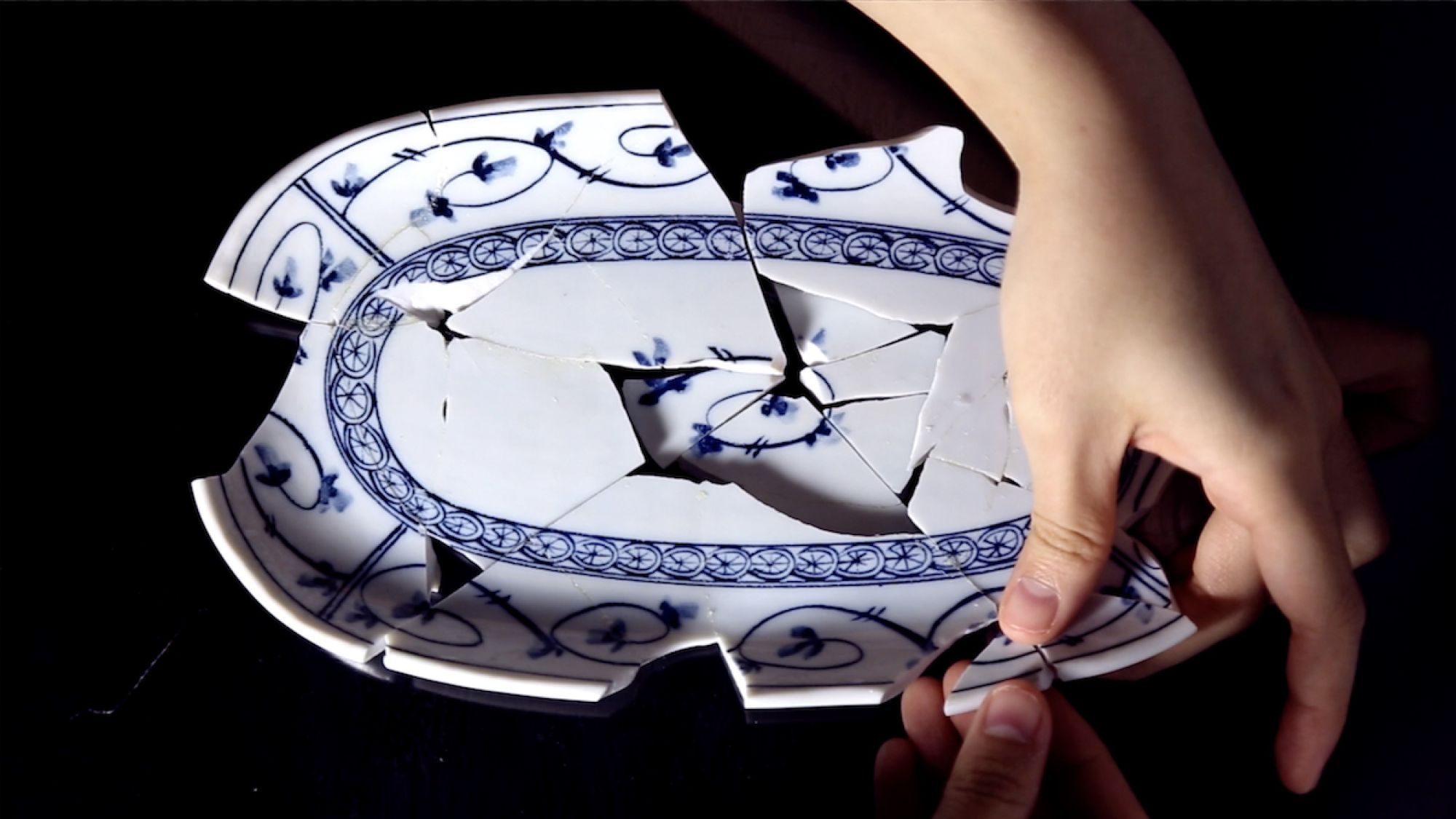
Secular words are being uttered all over the vertical cloth that should have cut off the profane and reached the sacred. Phrases such as “I hate you, Mom, I’m sorry, Mom” and “I felt invisible even on this birthday” place hatred and apology side by side, entangling the relational terms of mother and child. Beneath it, on two pedestals symmetrically placed by the entrance, broken glass cups are roughly attached together with silicone.

Reattaching has been an attempt Hee Vaak has repeated several times. Through Five Cups Collected in Bugae-dong(2015), she reorganized old ways of life, and in Nameless Memory(2015), she desired an ultimately powerless act of retracing scattered memories. These cups, placed on pedestals like sacred objects, have gained meaning instead of losing function.

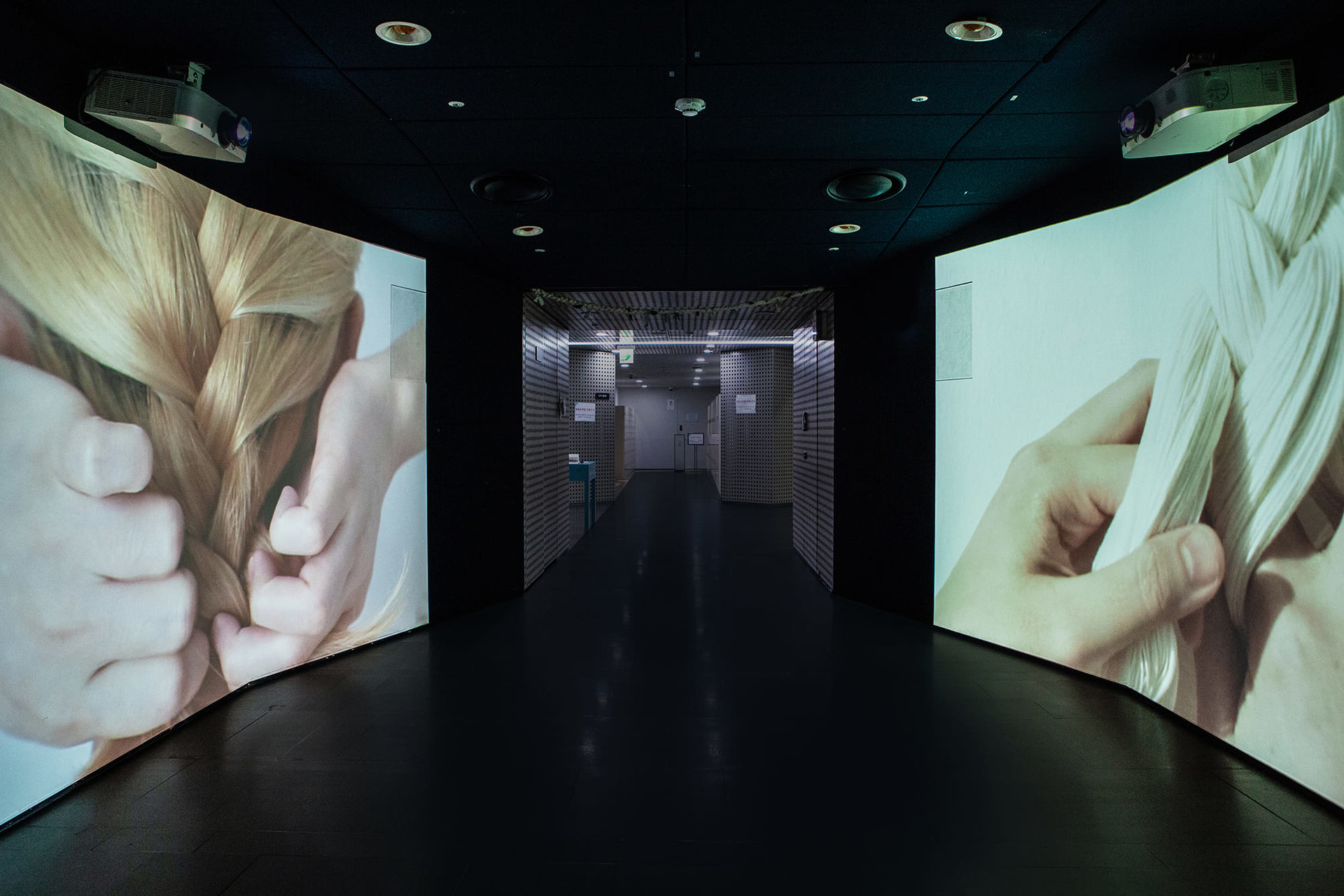
Yet how frail and vulnerable is a life that earnestly elevates wishes. Entering through the main entrance, inside the divided small exhibition room on the left, there is a two-channel video showing how these sacred objects were restored, and on one side are colorful cut-out plywood pieces leaning on one another for support.

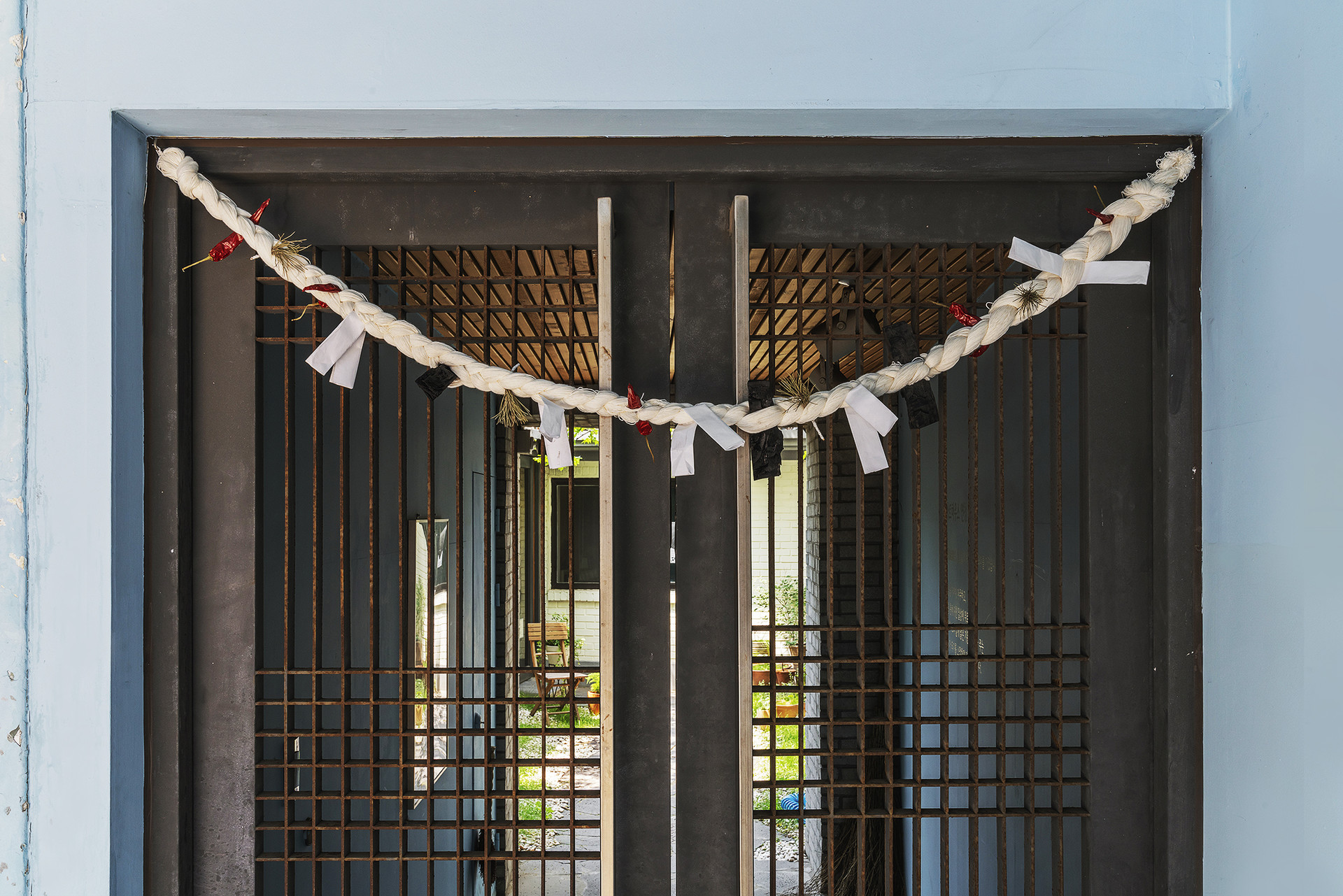
Placed like temporary equipment rather than through a solid installation method, these wood fragments are provisional and arbitrary. The early space of the exhibition, composed like a side altar rather than the main altar of a church, seems to prepare from the outskirts for the betrayal of belief that will soon unfold in earnest.


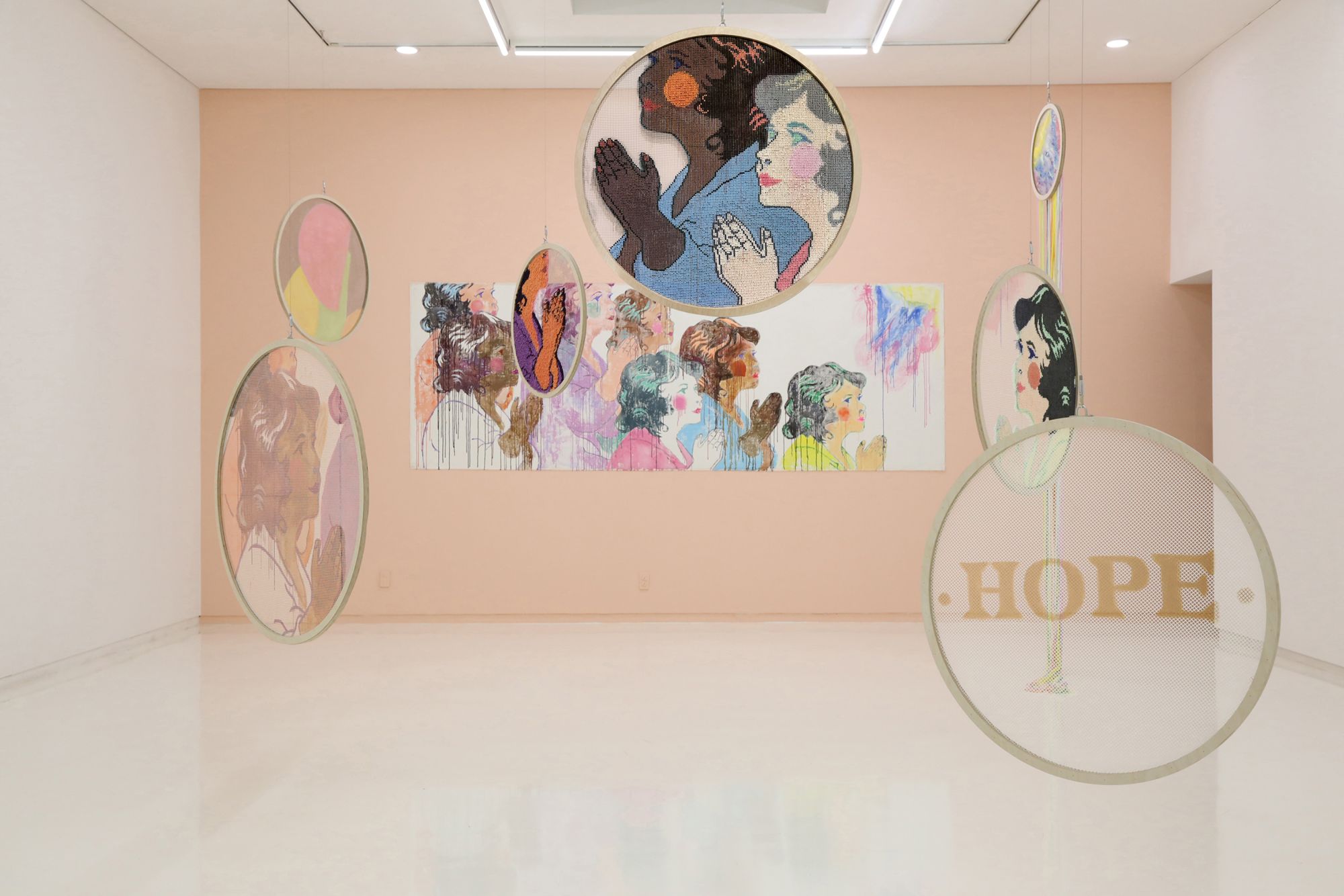
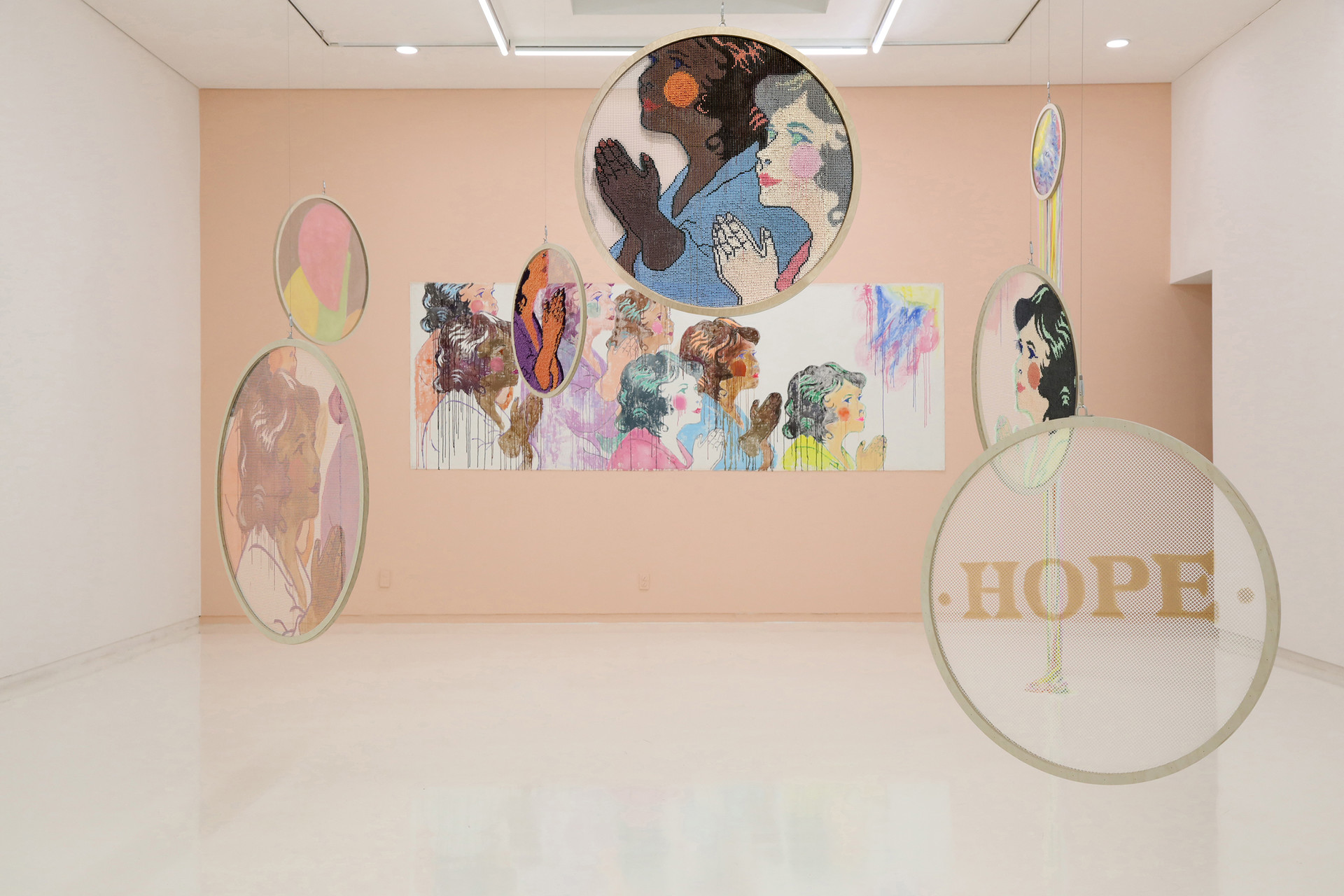
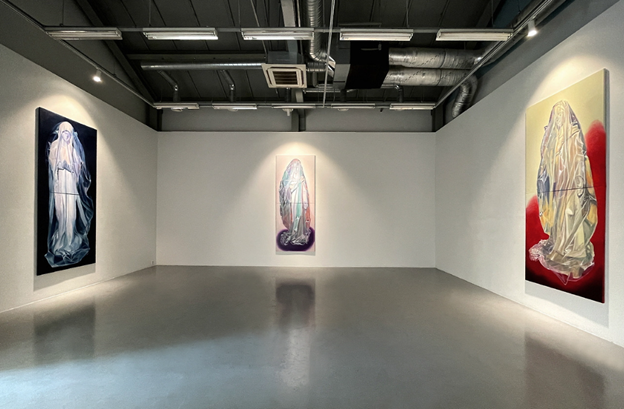
Installation view of 《Hoping for a Safe Day》 (Cheongju Art Studio, 2022) © Hee Vaak

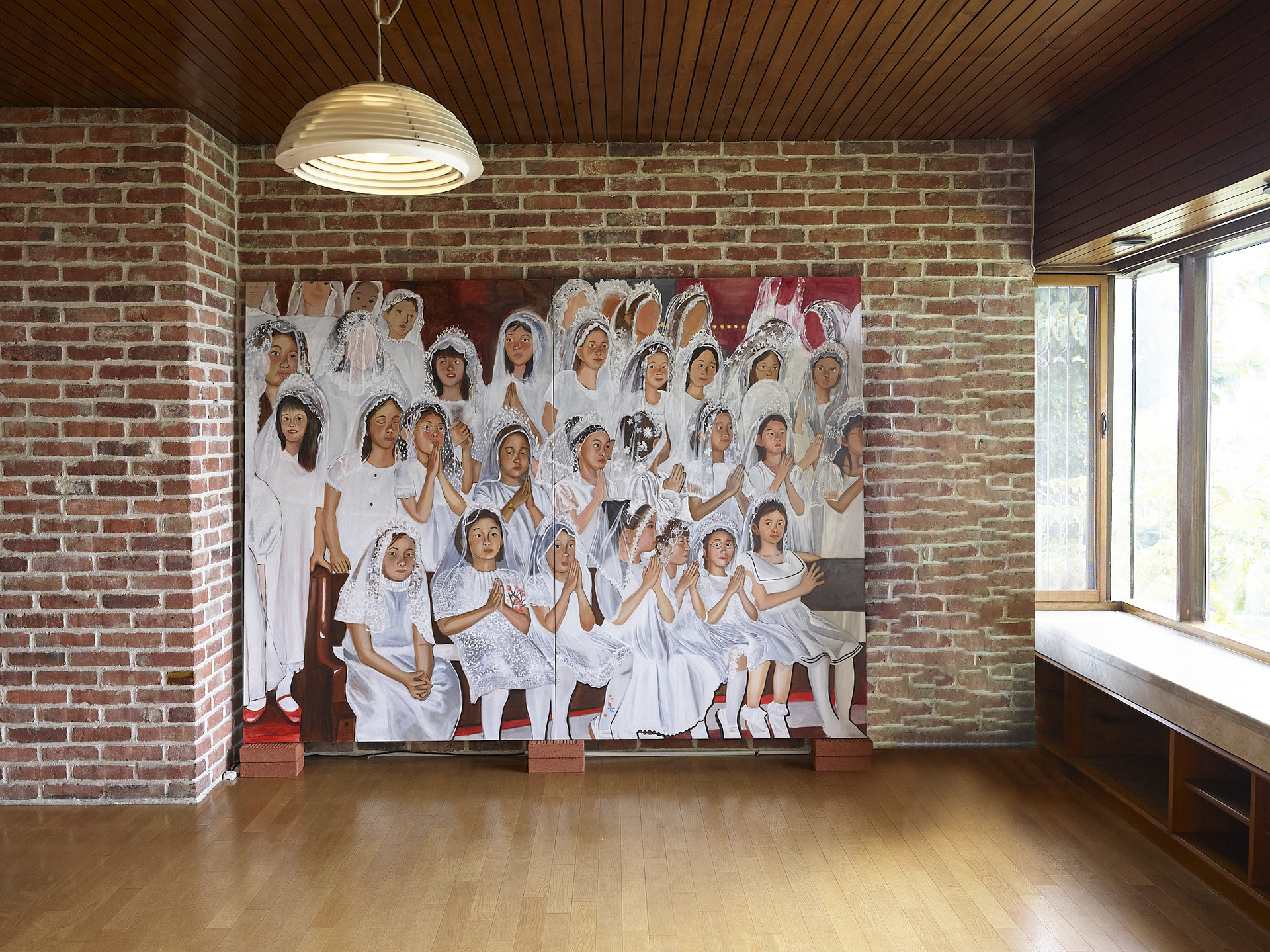
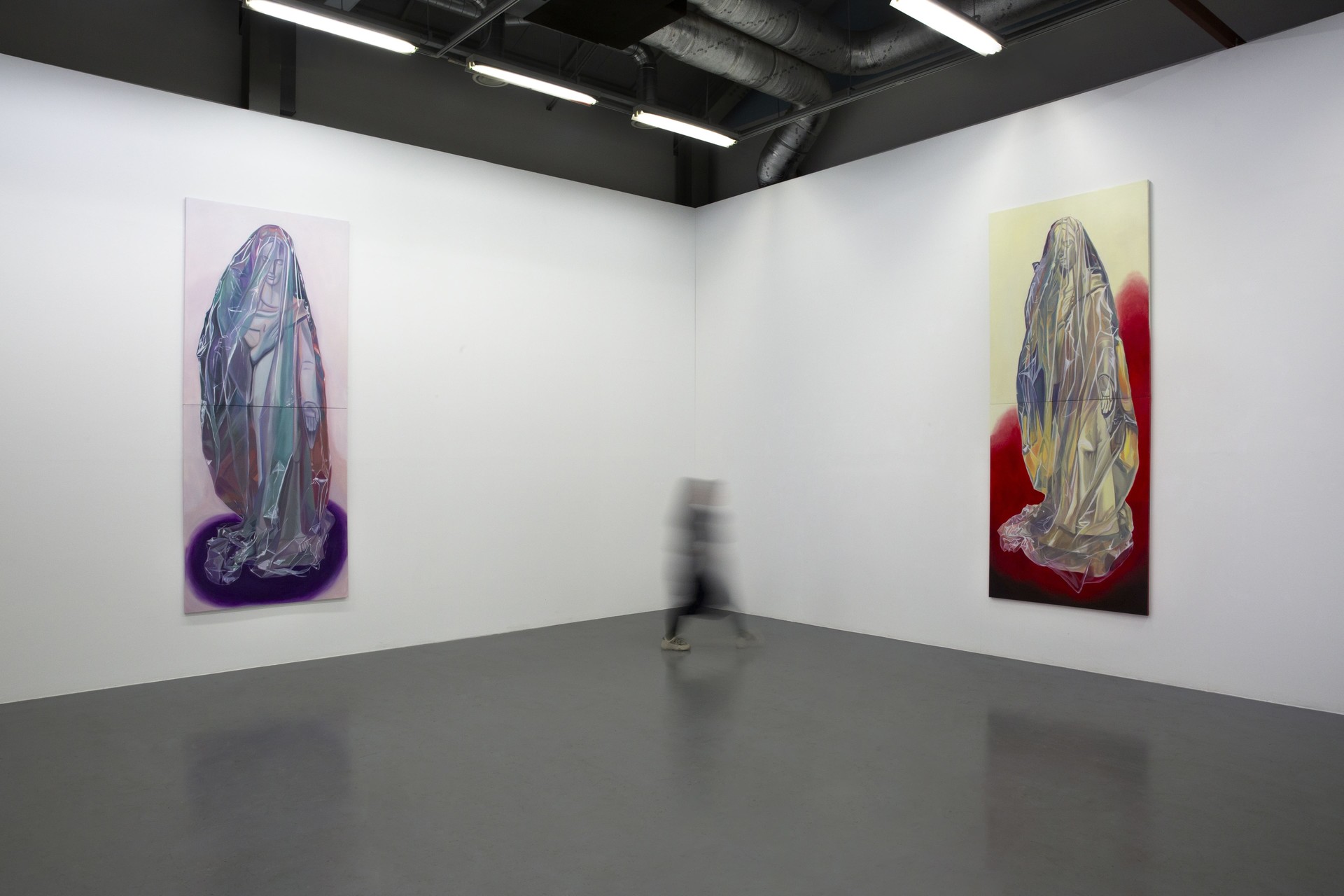
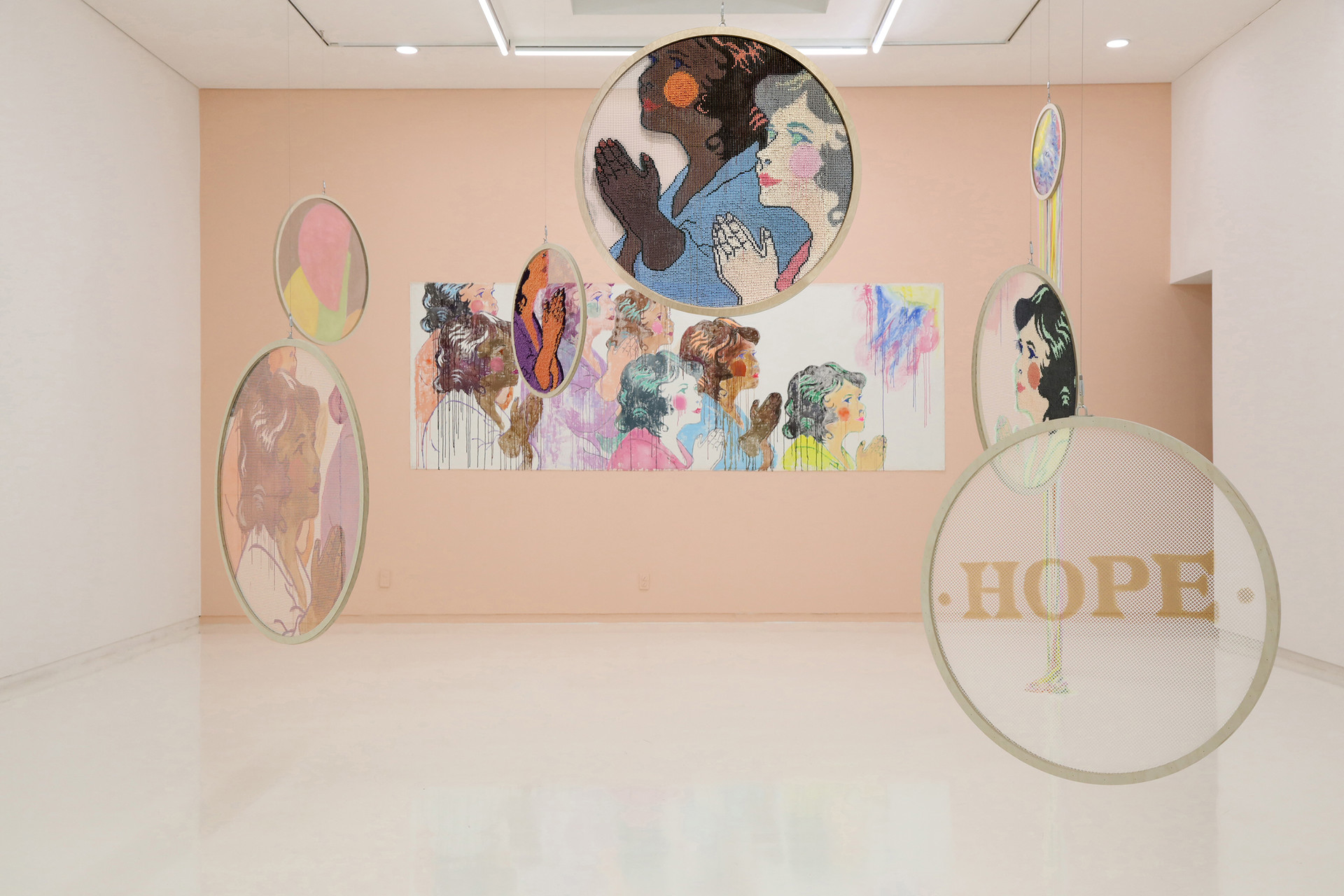
The main exhibition space was created by varying the main attributes of a chapel. Whereas an altarpiece unfolds the major narratives of Christianity grandly across multiple panels, Hee Vaak places A world that works by faith(2022), which depicts praying girl(s) repeatedly treated in acrylic on canvas, in the position of an altarpiece.

In the place where sacred light should pour down through the sky, red, blue, and yellow paint marks take its place. The three primary colors, by “choosing” not the three primary colors of light but the three primary colors of pigment, utter that her vocation is not clergy but artist. (This point is important to Hee Vaak. I will discuss it later.) 

Hoping for a Safe Day, made in 2013, which covers in the three primary colors the image of the praying girl hung modestly high on the ceiling space opposite the painting functioning as an altarpiece, proves how the exhibition 《Hoping for a Safe Day》, realized in 2022, is in fact a world built over a long period of time.

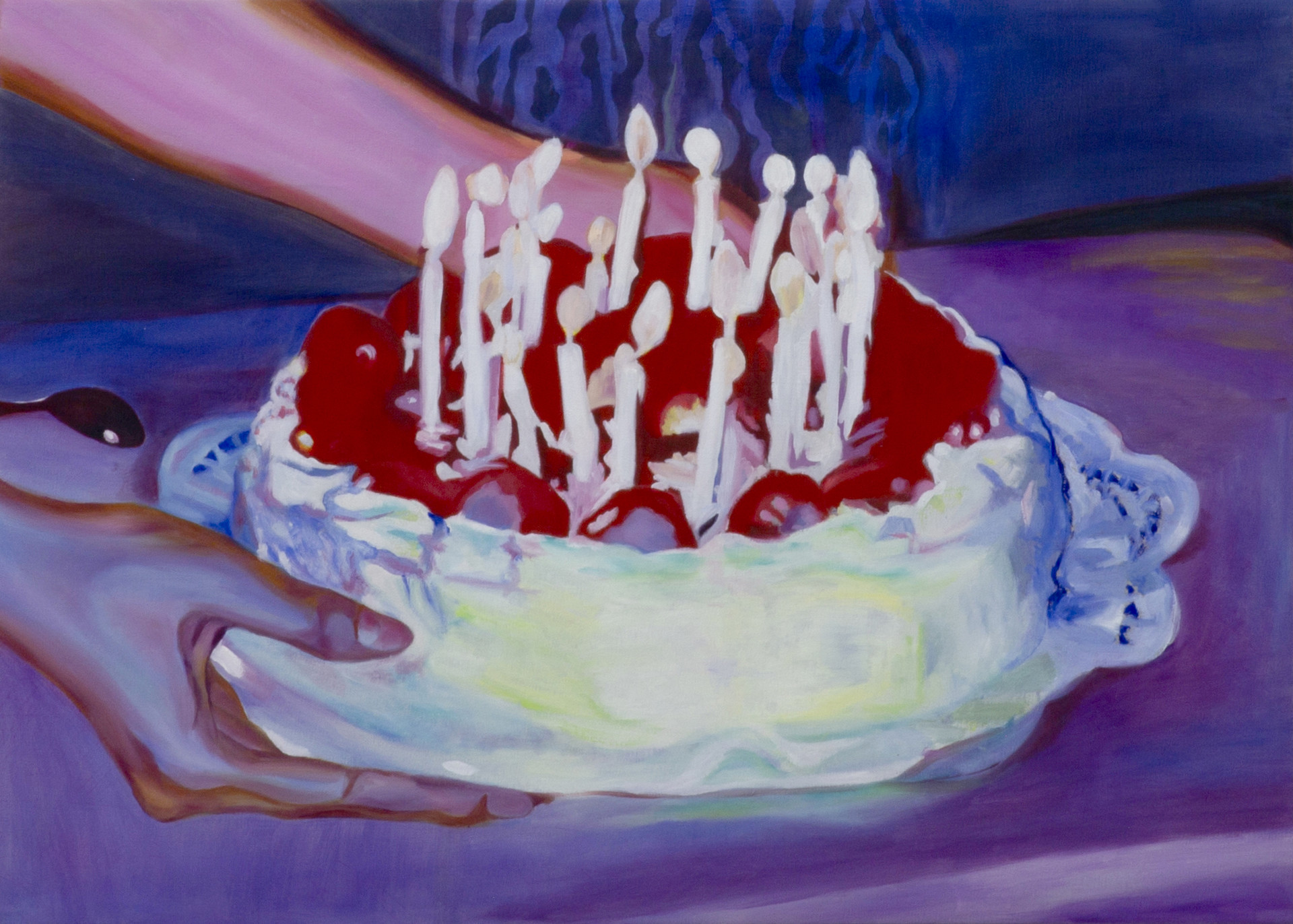
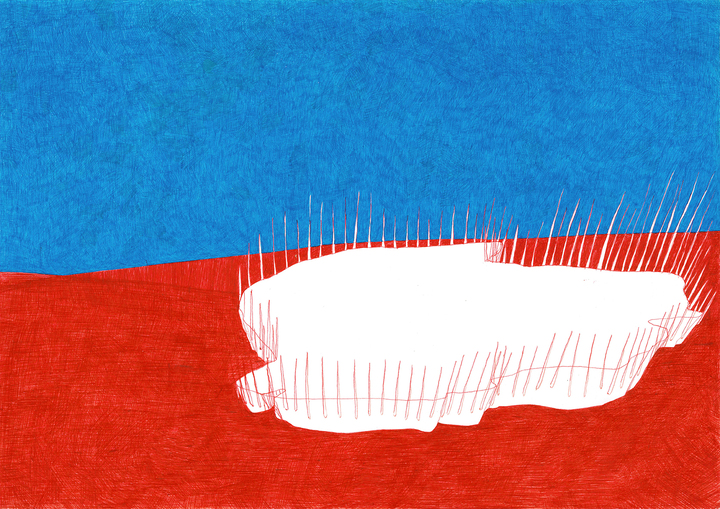
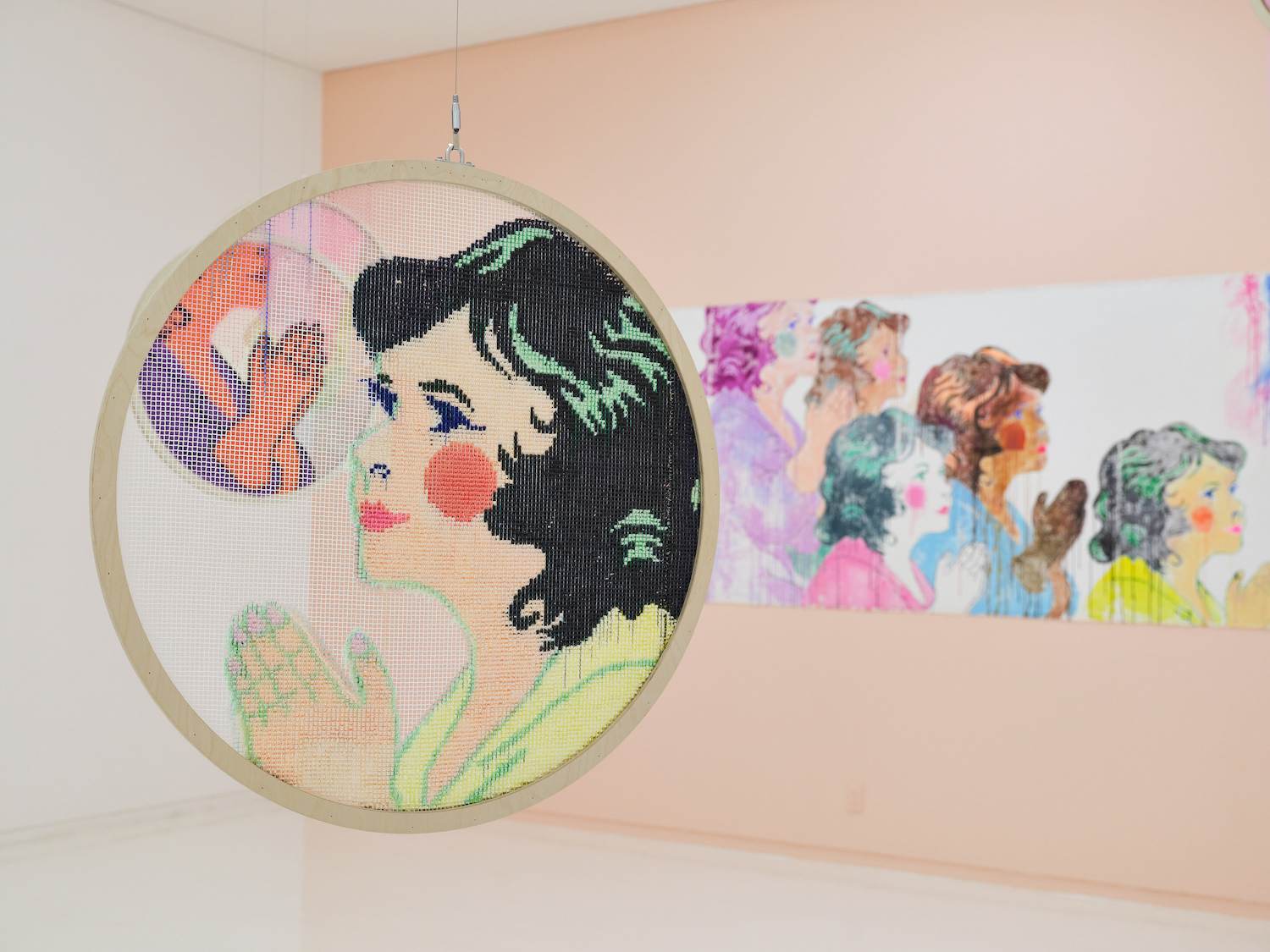
The 'Hoping for a Safe Day' series, made by layering acrylic stencils, was also produced in 2009 and 2019, reminding us once again that the praying girl is not a one-off project. The installation works filling the space are various Praying Girl works made with acrylic and punch-needle embroidery, and the circular punch-needle embroidery frames rotate slightly at different angles in response to the faint wind.

From one of the punch-needle embroidery frames rising high, threads of all colors repeat in three-dimensional space the dripping paint marks in A world that works by faith. Placed on a circular pedestal in opposition to the vertical arrangement of all the praying girls, The World One Wishes For(2022), with objects such as five-colored thread and red beans, is sufficient to recall the traces of superstition that occupy broad parts of Korean life.

How much the life of the Holy Spirit, for which one prays while looking upward, and the worldly wishes that swell when one bows one’s head in prayer are arranged in such contrast, and yet how often they resonate. Although Hee Vaak visually retraces this, no one can fail to know that it is already a mass of faith and prejudice firmly occupying the inside of oneself.


Hee Vaak, A world that works by faith, 2022, Acrylic on canvas, 142x408cm © Hee Vaak

Art That Stirs Through the Sacred and the Secular

For Hee Vaak, proving through her existence that her vocation is that of an artist is a more particular task than the existential proof demanded of all artists. This is evident both through conversation and through her portfolio. The praying girl, who lived knowing that becoming a nun in the future was the natural course according to the wishes of a grandmother “whose dream was to have a clergy member in the family,” carried out resistance as she passed through her teenage years.

Was Reynolds’s painting of the young Samuel, fascinated by the purity of a child rather than a mature adult, ultimately intended to(temporarily) seal an innocence that would eventually be overturned when the time came? Without breakage or the violation of a promise, countless seals cannot acquire true meaning. If a seal verbalized is an oath, the following words are worth listening to carefully.

The words of ancient philosophers are meaningful: “Preserving all things(states of affairs) in the same condition according to law(rule) and stabilizing them is what we call an oath,” and “an oath creates nothing and gives birth to nothing, but binds into one and preserves what something else has given birth to³.”

The life of prayer assigned to Samuel in the Old Testament and to the girl who wandered through Korea in the 1970s and 1980s is not far from the life as a nun assigned to Hee Vaak. How harsh is a wish that can only be realized through a proxy and the icon of that proxy? I am not writing this description provocatively in order to foreground Hee Vaak’s personal history.

As faith and oath are closely connected, oath and false oath are tense within life, and this very logic interlocks with Hee Vaak’s statement that “faith becomes prejudice and also becomes a lifestyle.”

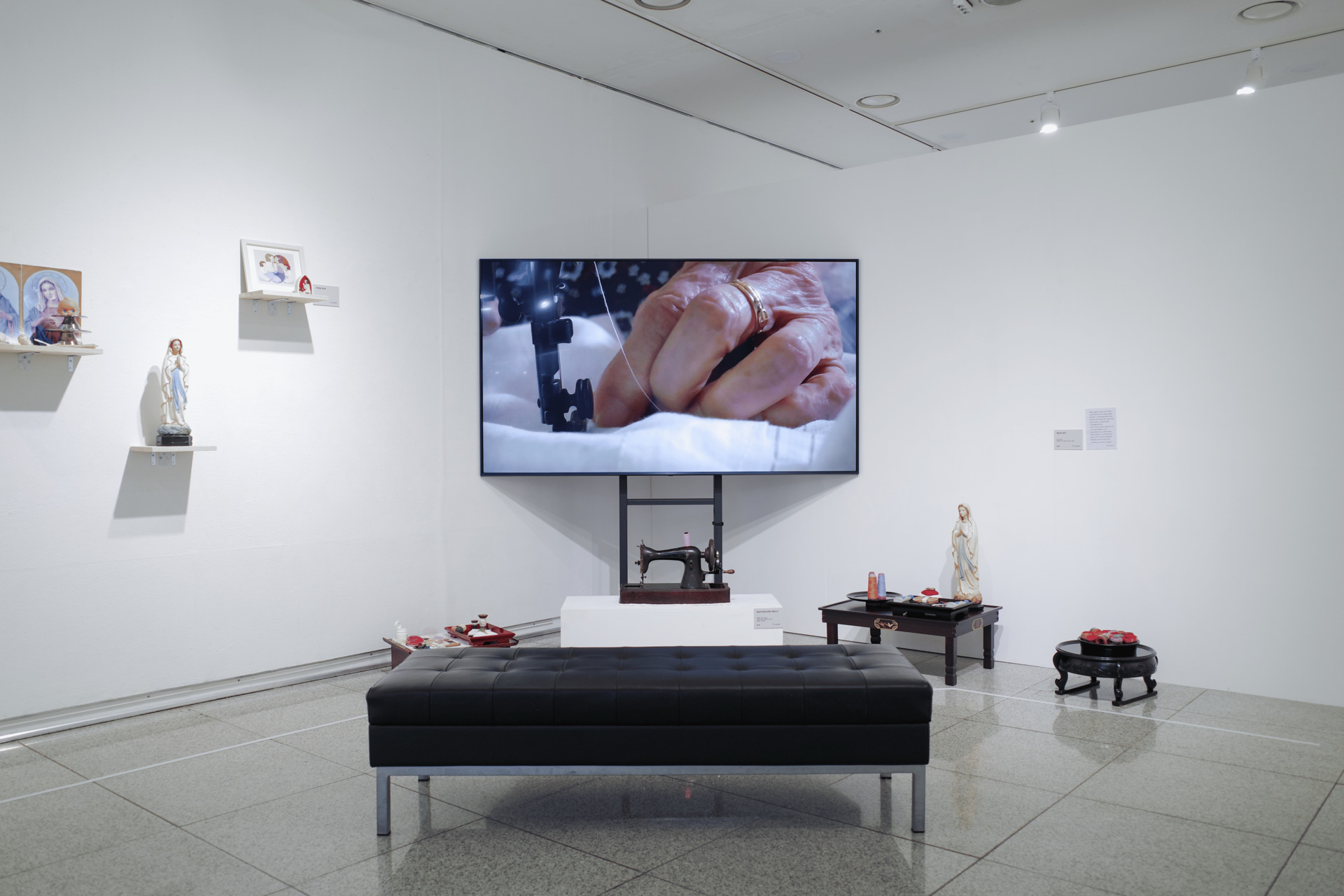
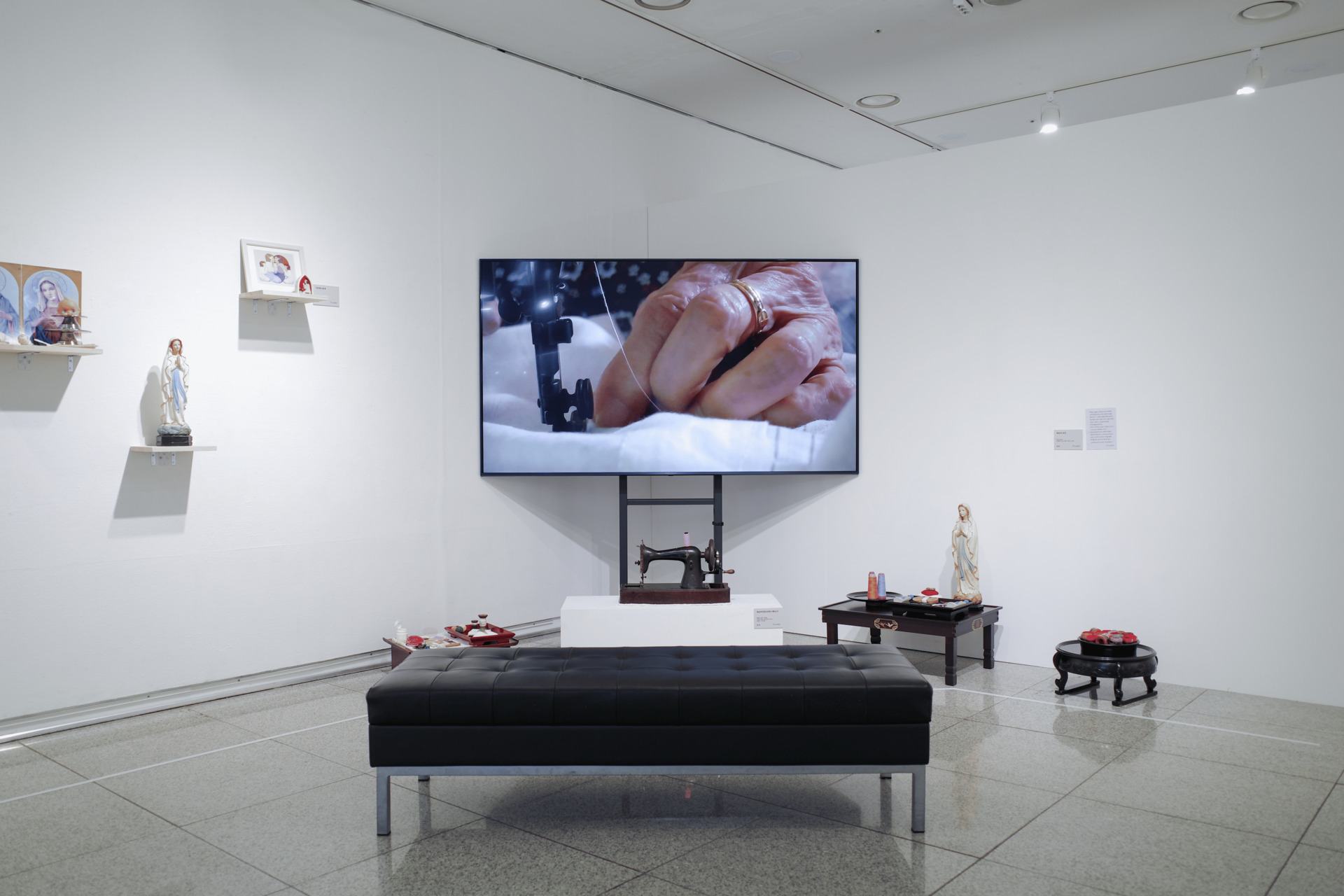
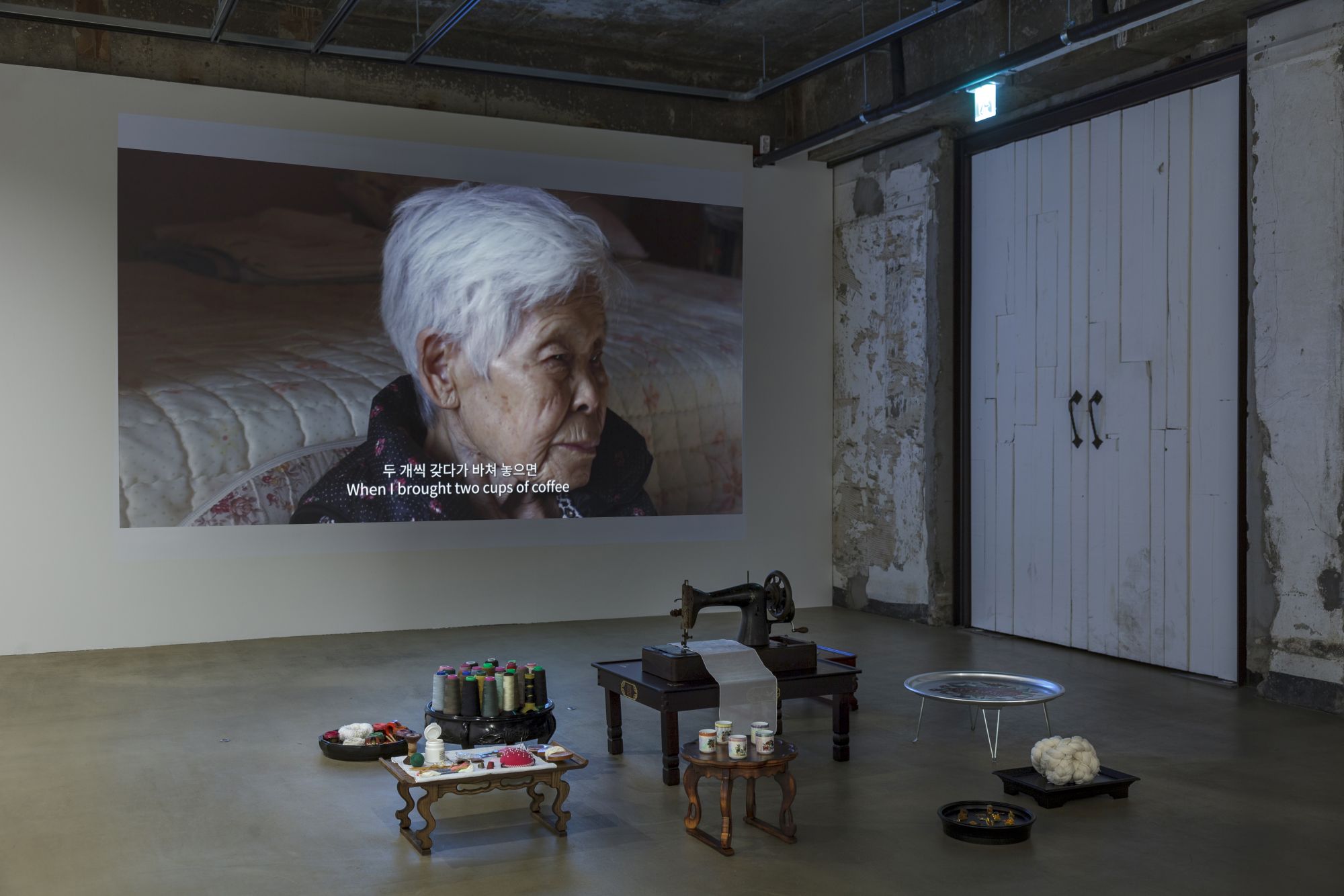
Whether or not Hee Vaak was conscious of it, in the 2022 exhibition 《Hoping for a Safe Day》, her presence does not directly reveal its position “inside” the exhibition, but by analogizing herself with the praying girl(s), she constructs the realm of her own movement. Here, one comes to think about the artist’s changed position compared to her previous works Oksoon’s Room(2015) and Oksoon’s Thread(2021).

Within the narrative of family women that extends from grandmother to mother to the artist’s own generation, the fragments of Oksoon’s narrative reconstructed through Hee Vaak’s gaze were made while erasing the possibility of easily converging into a universal female narrative, even though they are part of Korean modern and contemporary women’s history in which hardship had to continue, through the artist’s intervention and gaze that are handled with composure.

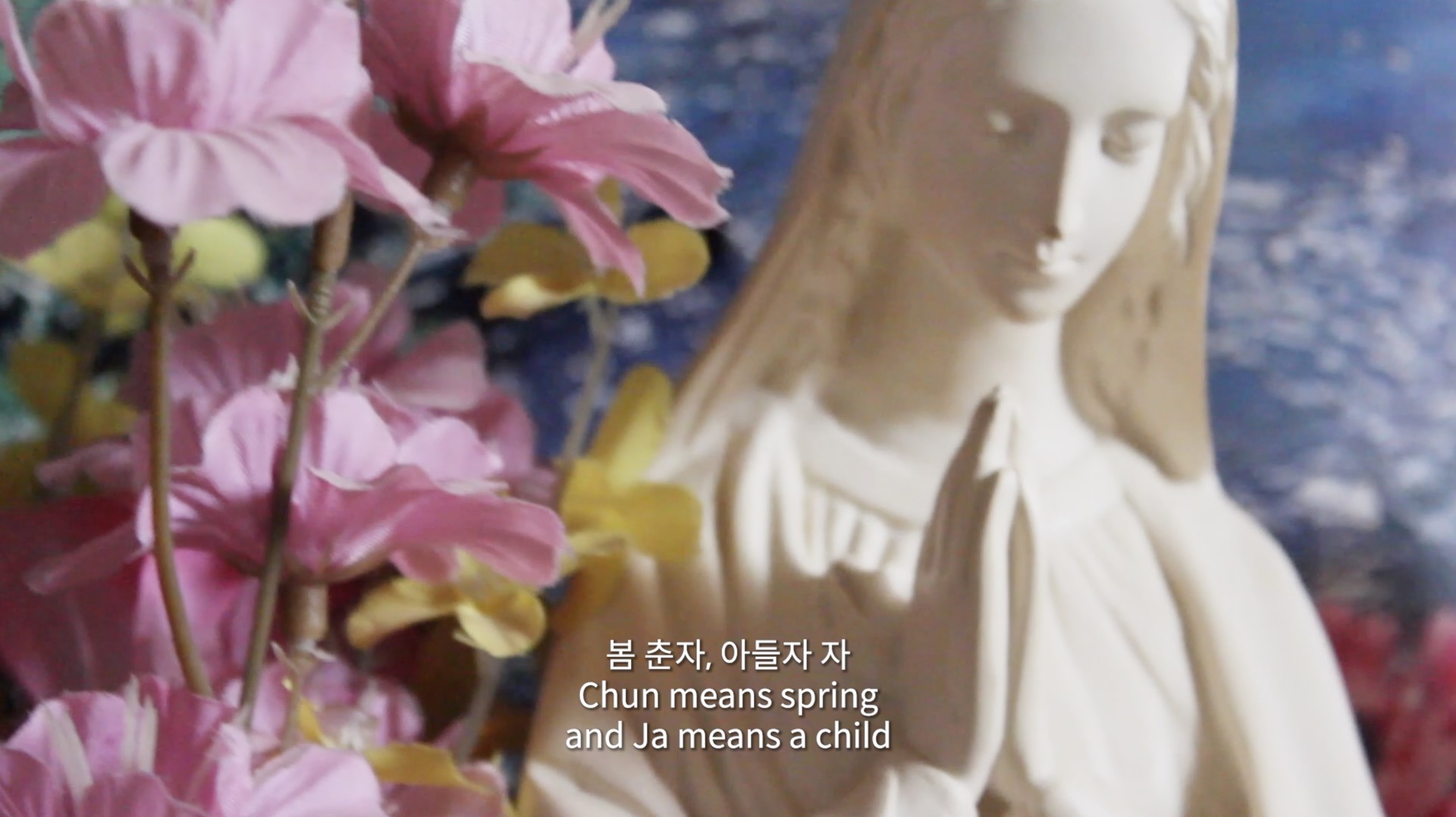
Indeed, the narrative of the grandmother who had two names, Oksoon/Chunja, is interesting. The grandmother who ran coffee errands three times a day for a “French” priest, and the firm faith and devotion to religion that began precisely from those errands for the French priest, must have removed any hesitation in assigning Hee Vaak the life of a nun.

In addition, the tactile sense of thread as an archetype, derived from the sewing box and sewing machine left by the grandmother who made a living through sewing, is a memory shared by the entire family. 

Oksoon’s Room and Oksoon’s Thread are structurally divided into the grandmother’s life and what came after her life, yet within them Hee Vaak could not help but firmly maintain family ties. When the subject binding these ties questions the ties and carries out epoché, and when this is unfolded through visual art, Hee Vaak’s life, which resisted the life of a nun, emerges as an artistic decision.

There was a decision in life, and only when the reason for that decision, and the reflection and doubt in that process, are translated into visual language can the decision of that child, who cleared away obstacles and slowly moved forward, finally be established. Although she describes a wish as “rather wanting a purposeless state of doing nothing,”

what did we see? Who made us look again at the praying girl that had become trivial because we had seen it too much? Her monologue about hoping to float quietly, paradoxically, strikes the whole body coldly and fiercely. Yet the reason one feels heat rather than chill is because of 《Hoping for a Safe Day》, which offered more to think about than what was seen.


¹ Excerpted from the artist’s note for Hee Vaak, 《Hoping for a Safe Day》(Cheongju Art Studio, 2022.9.14.-9.25.)
² Quoted from A Life without Courage in Hee Vaak’s portfolio(2023).
³ Giorgio Agamben, 『The Sacrament of Language』, translated by Jung Moonyoung, Saemulgyeol, 2012, p. 16.

References