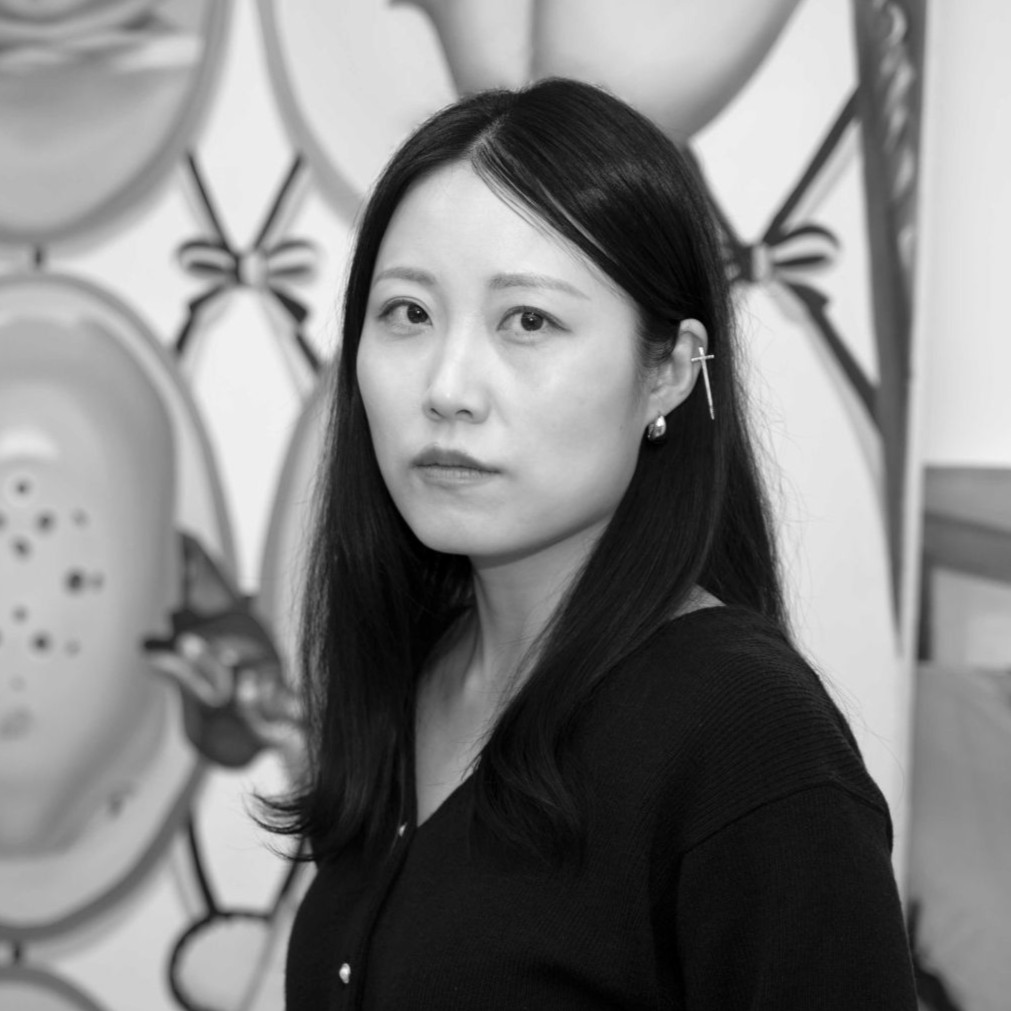
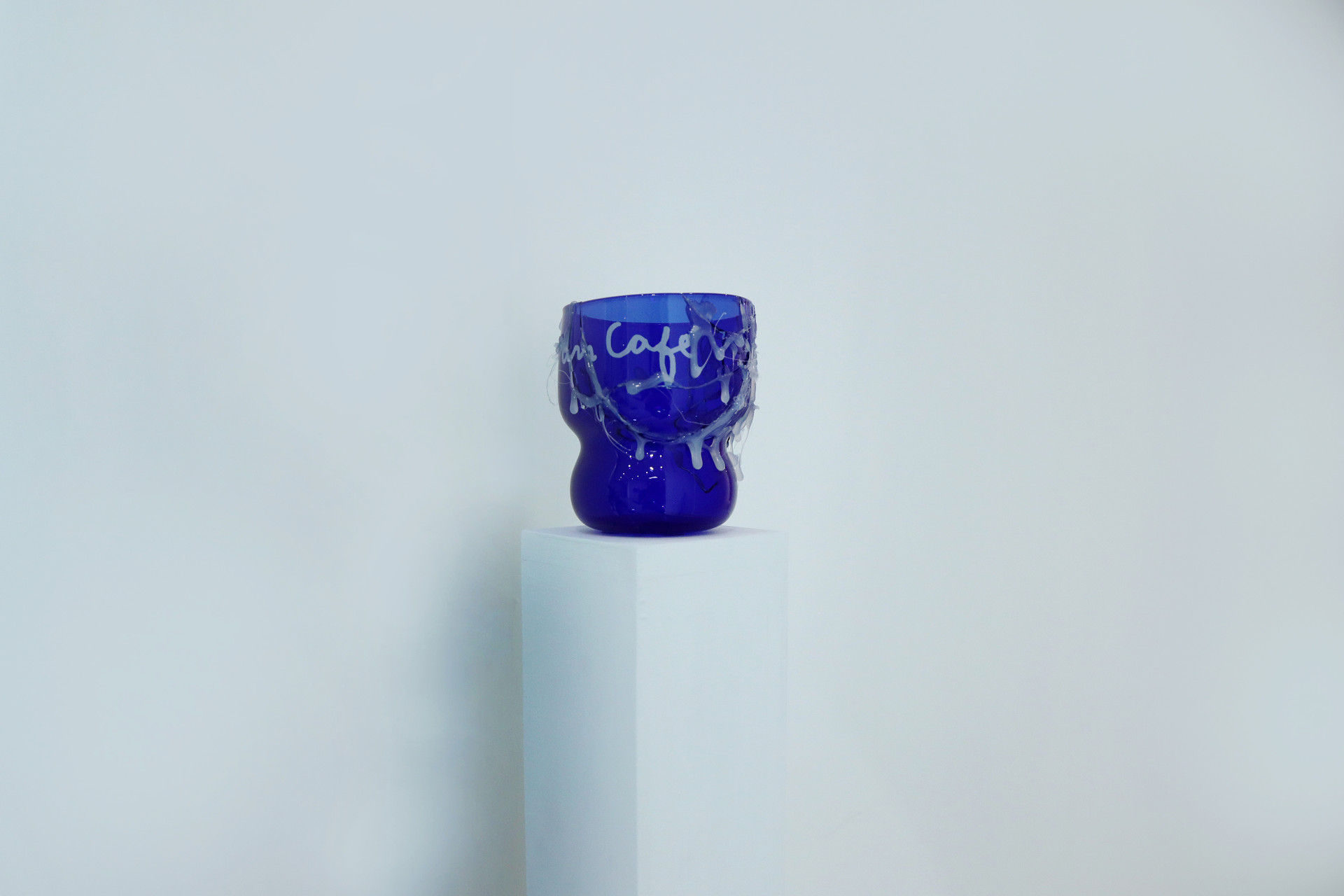
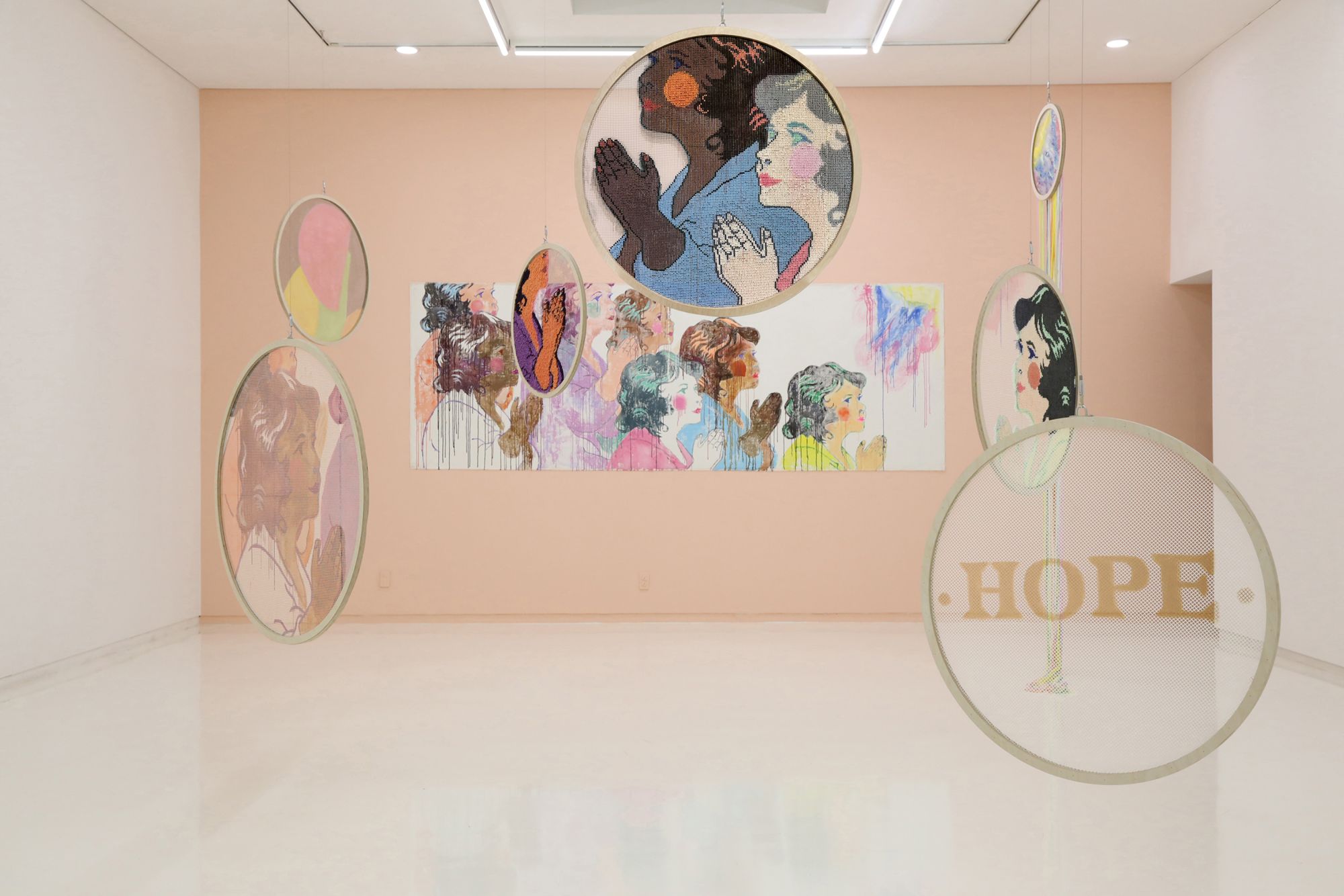
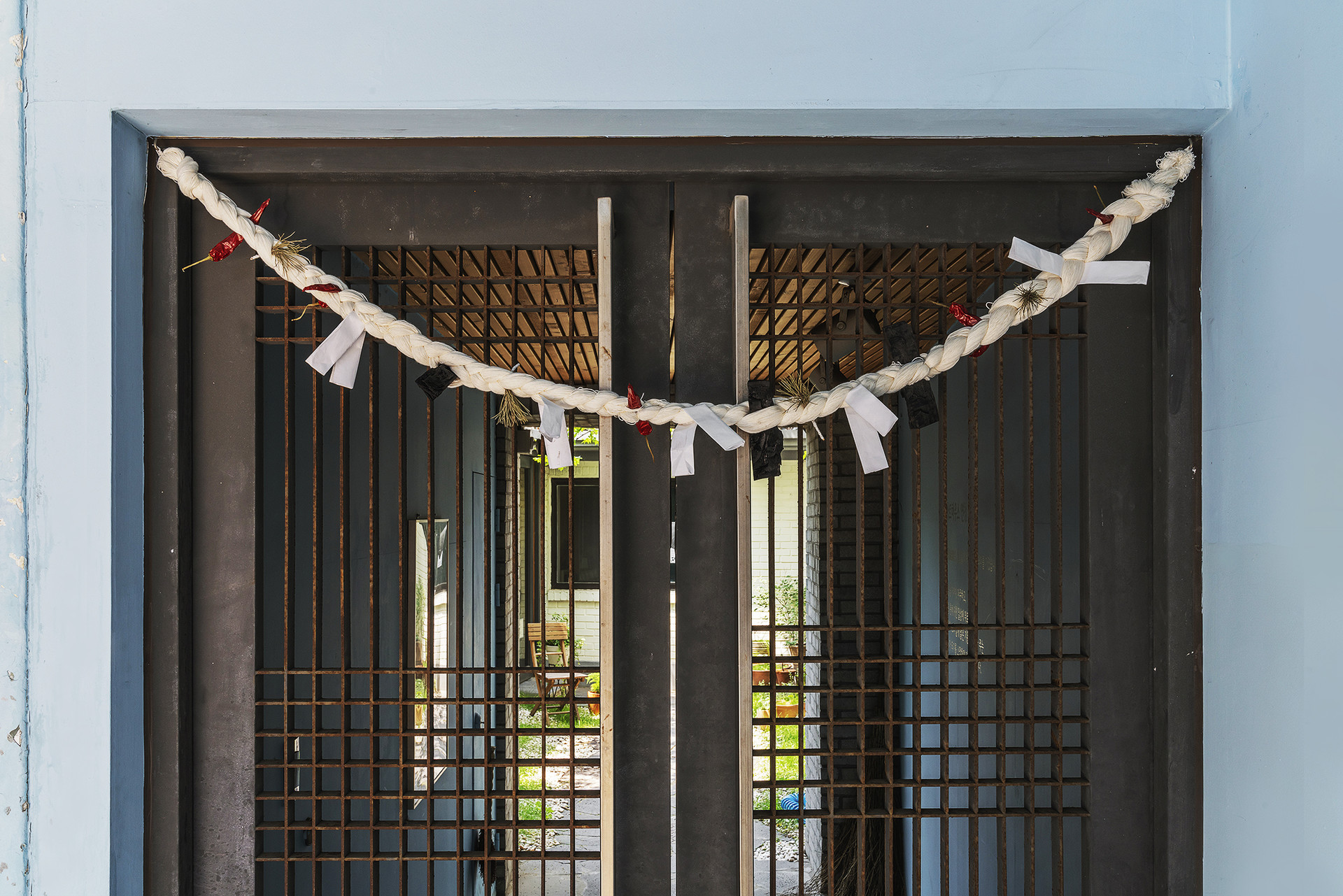
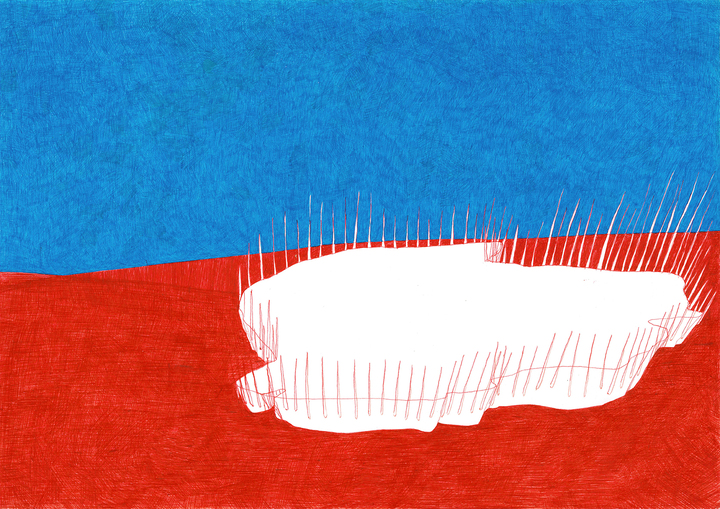
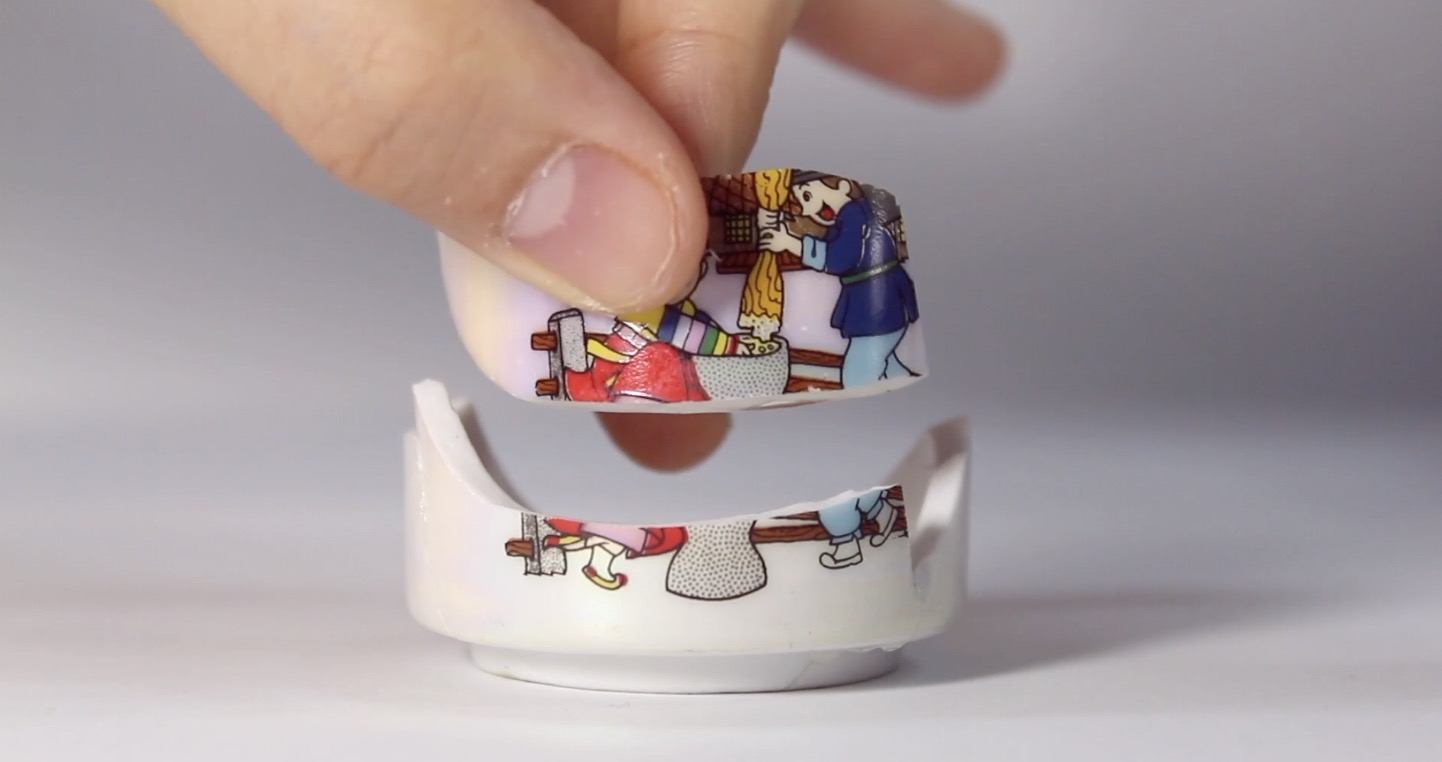
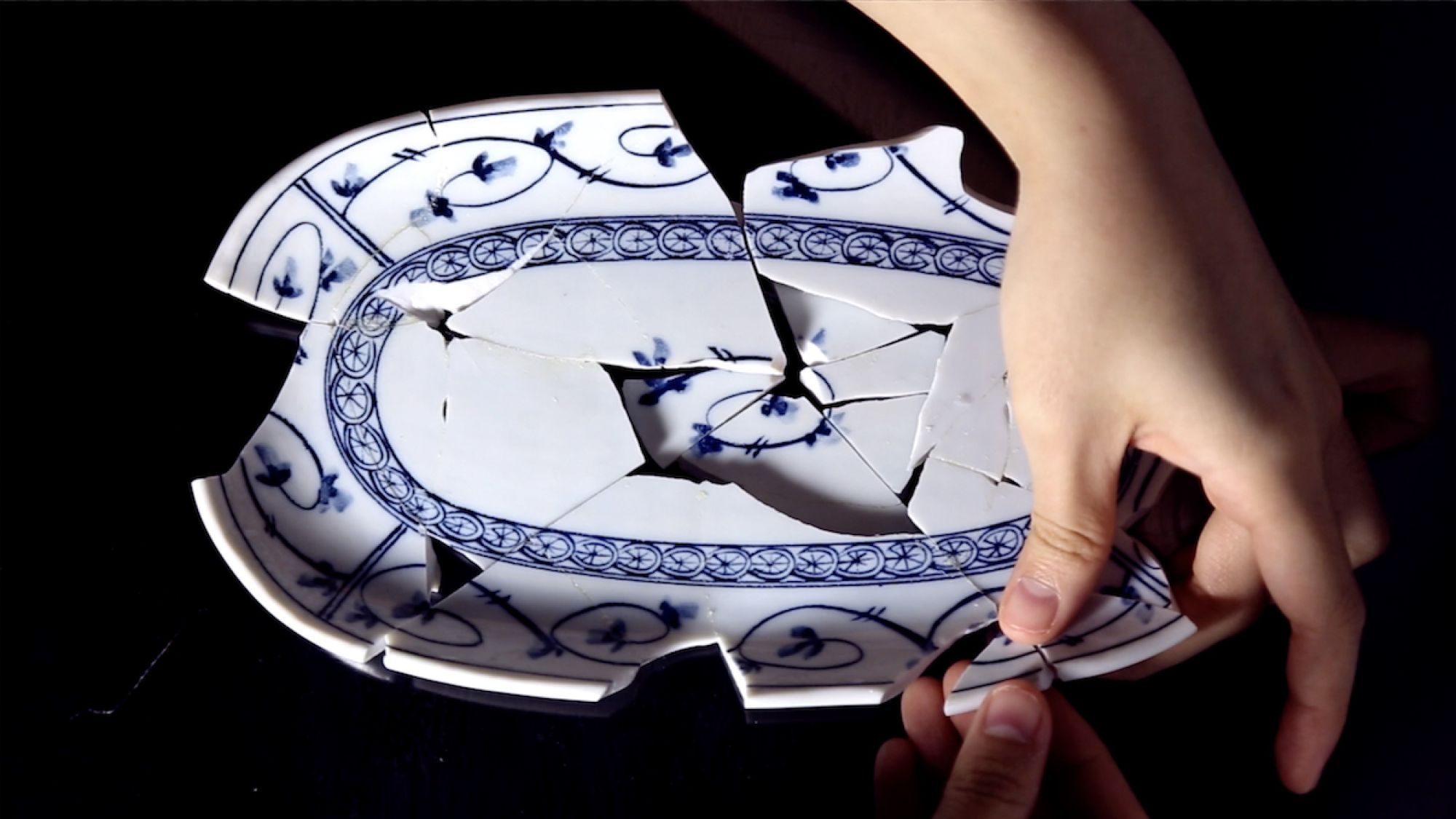
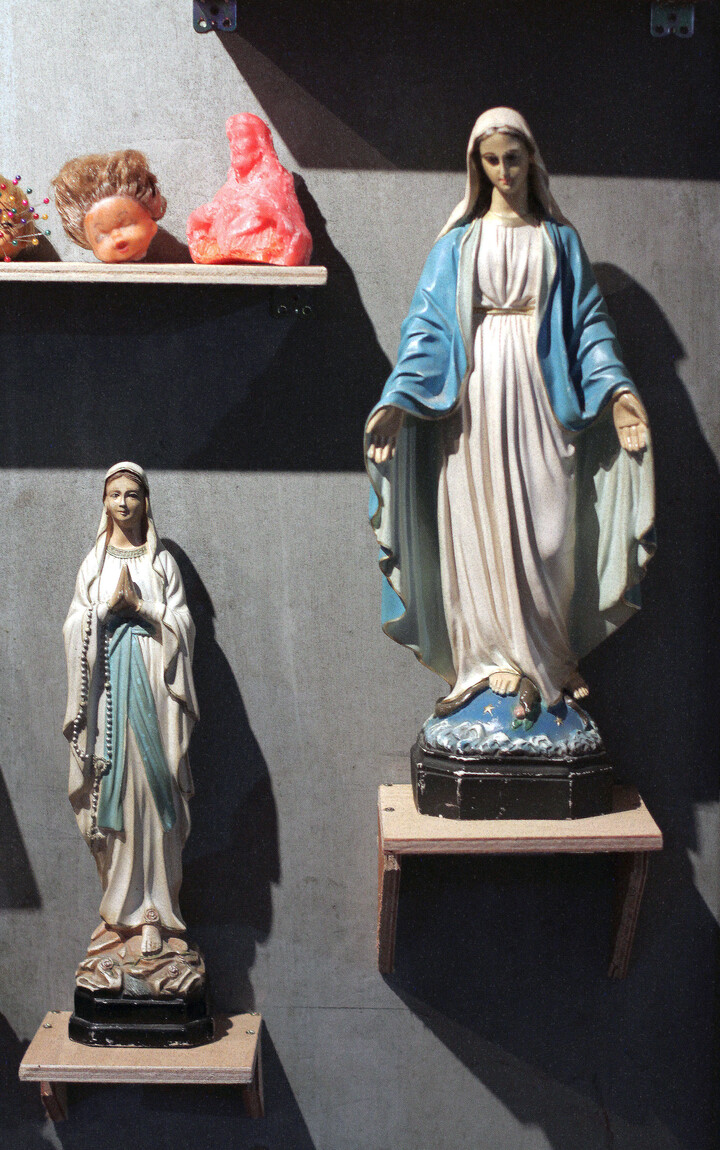
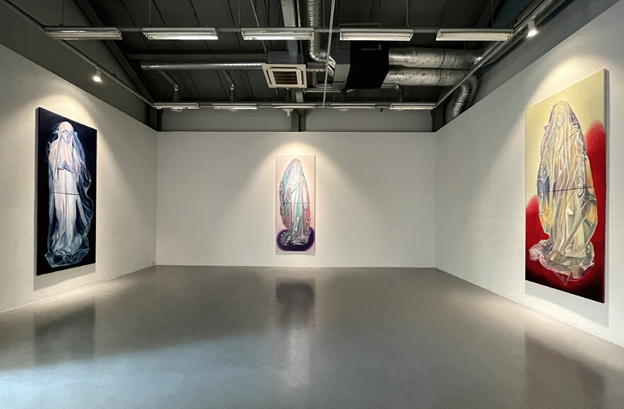
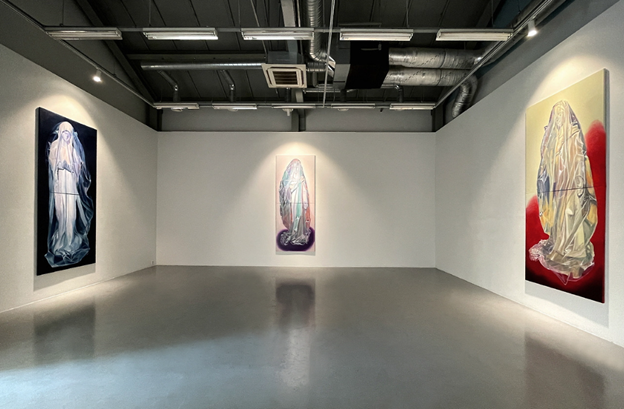
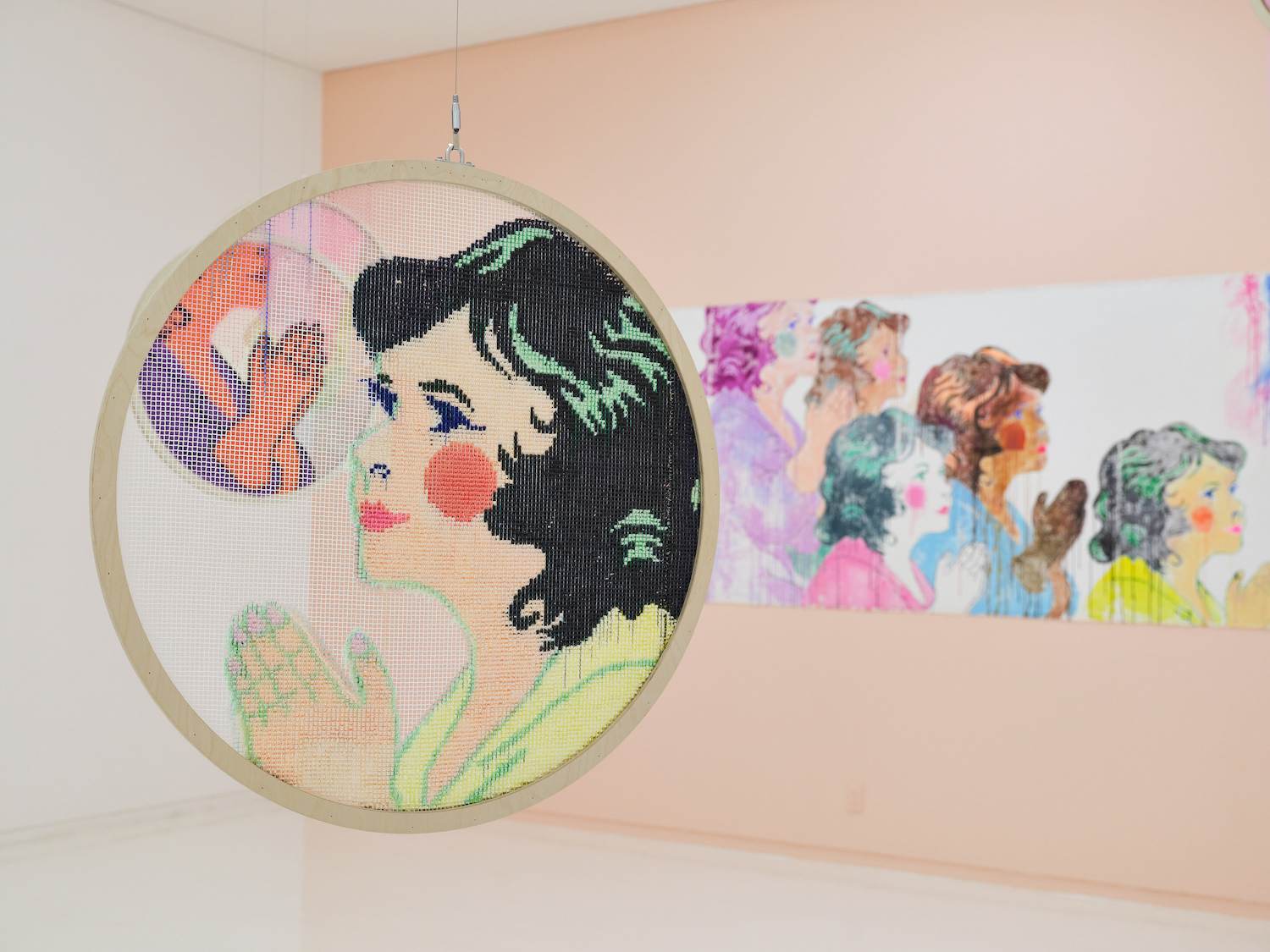
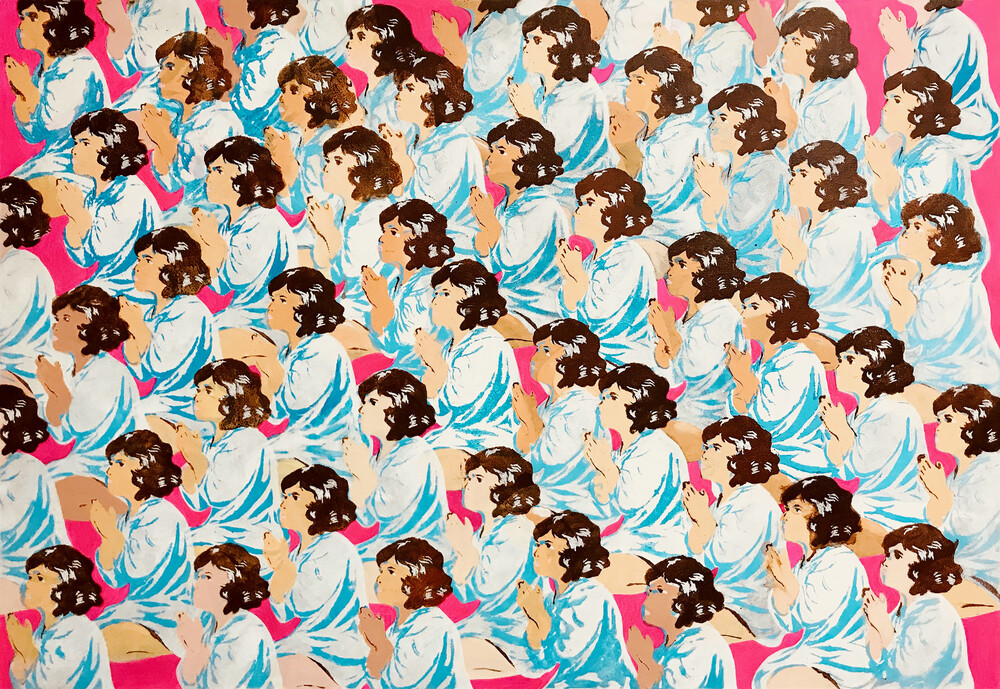
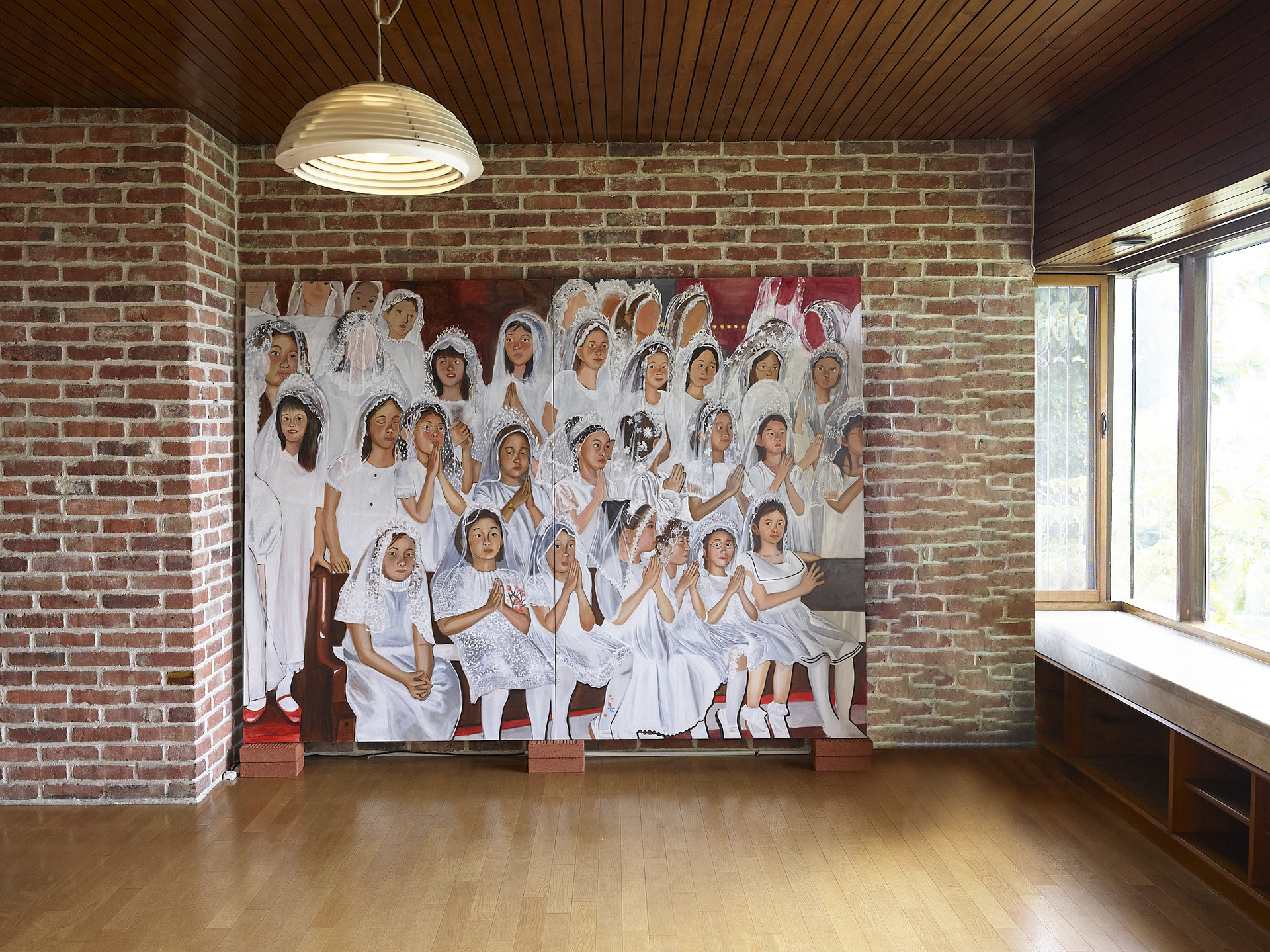
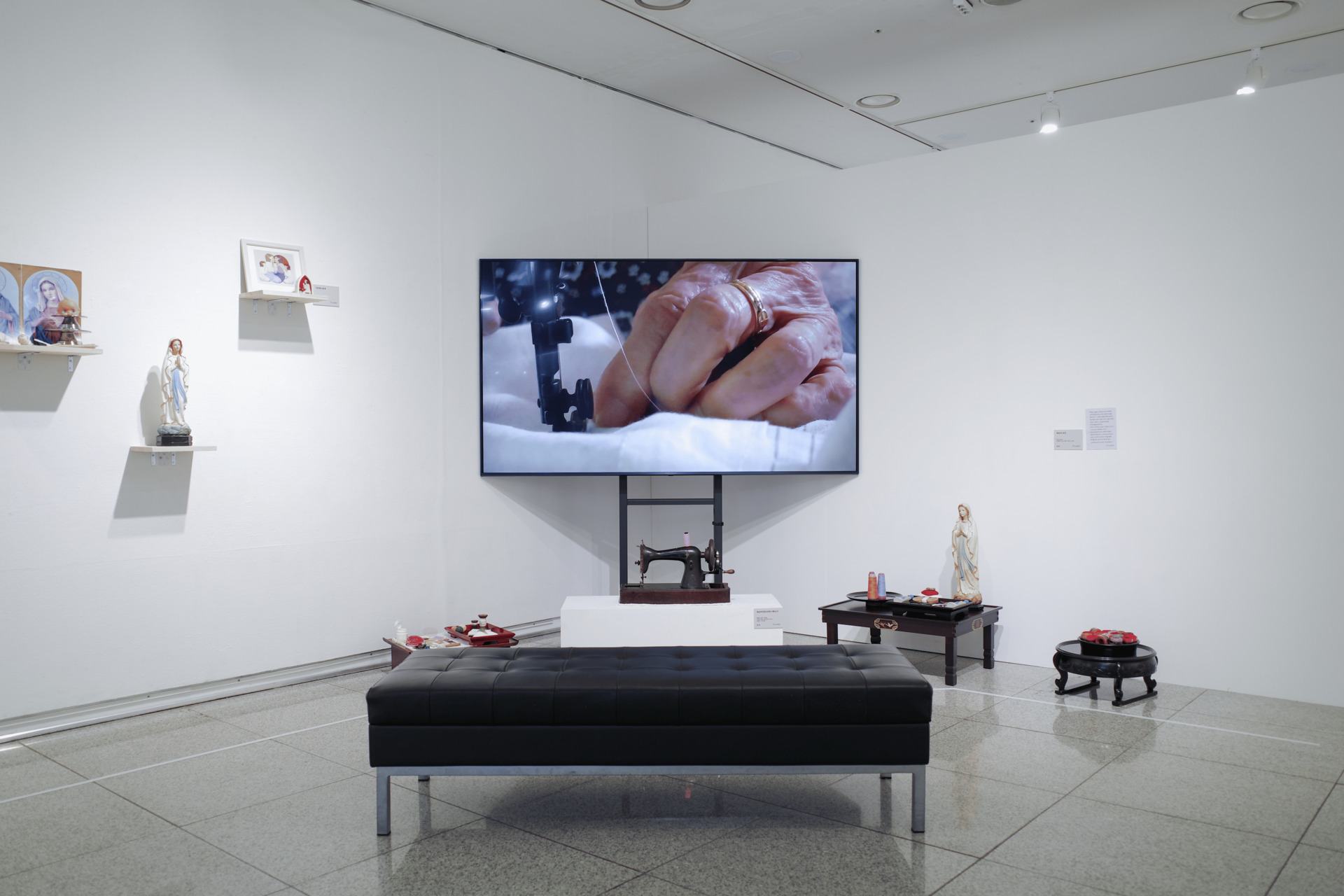
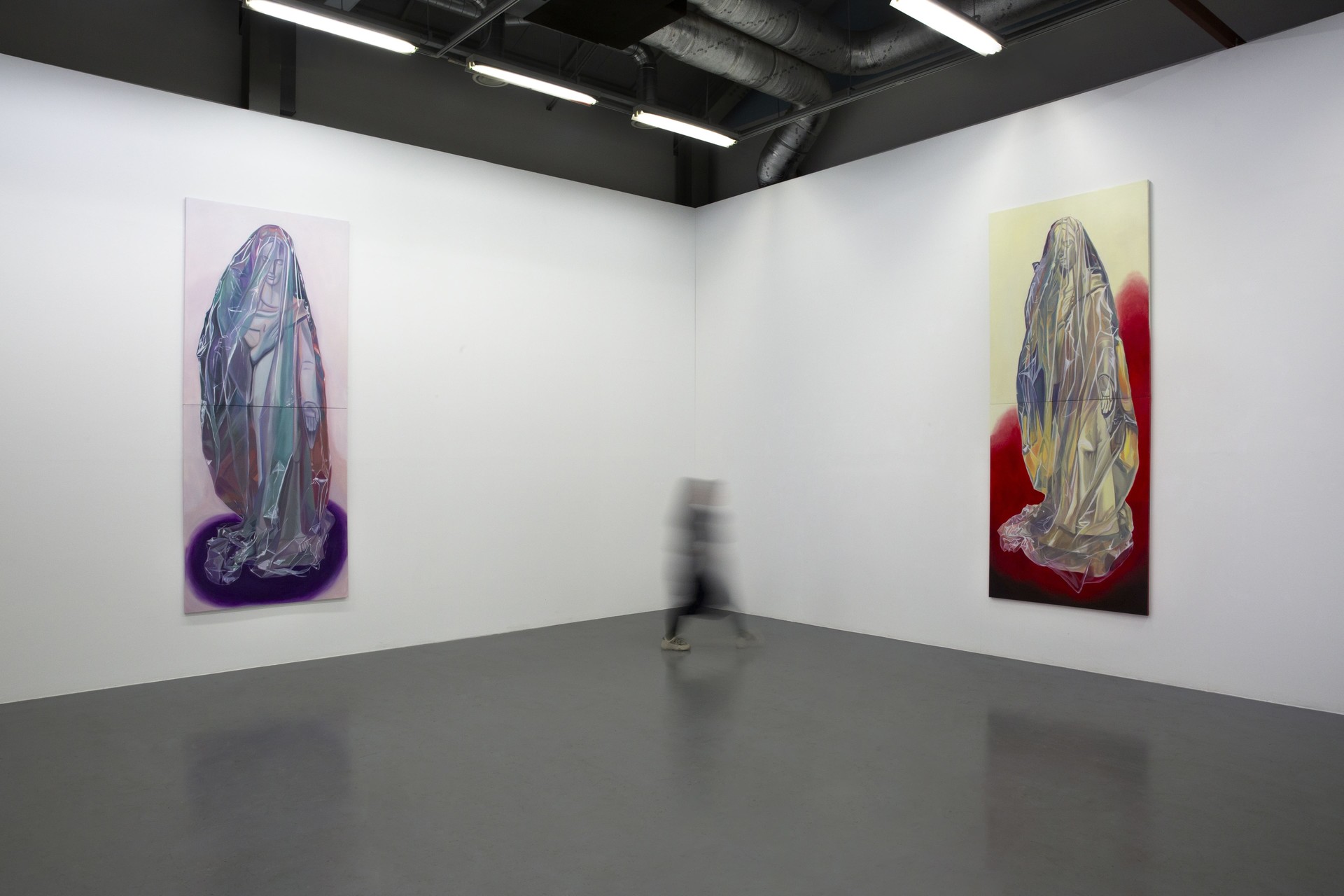
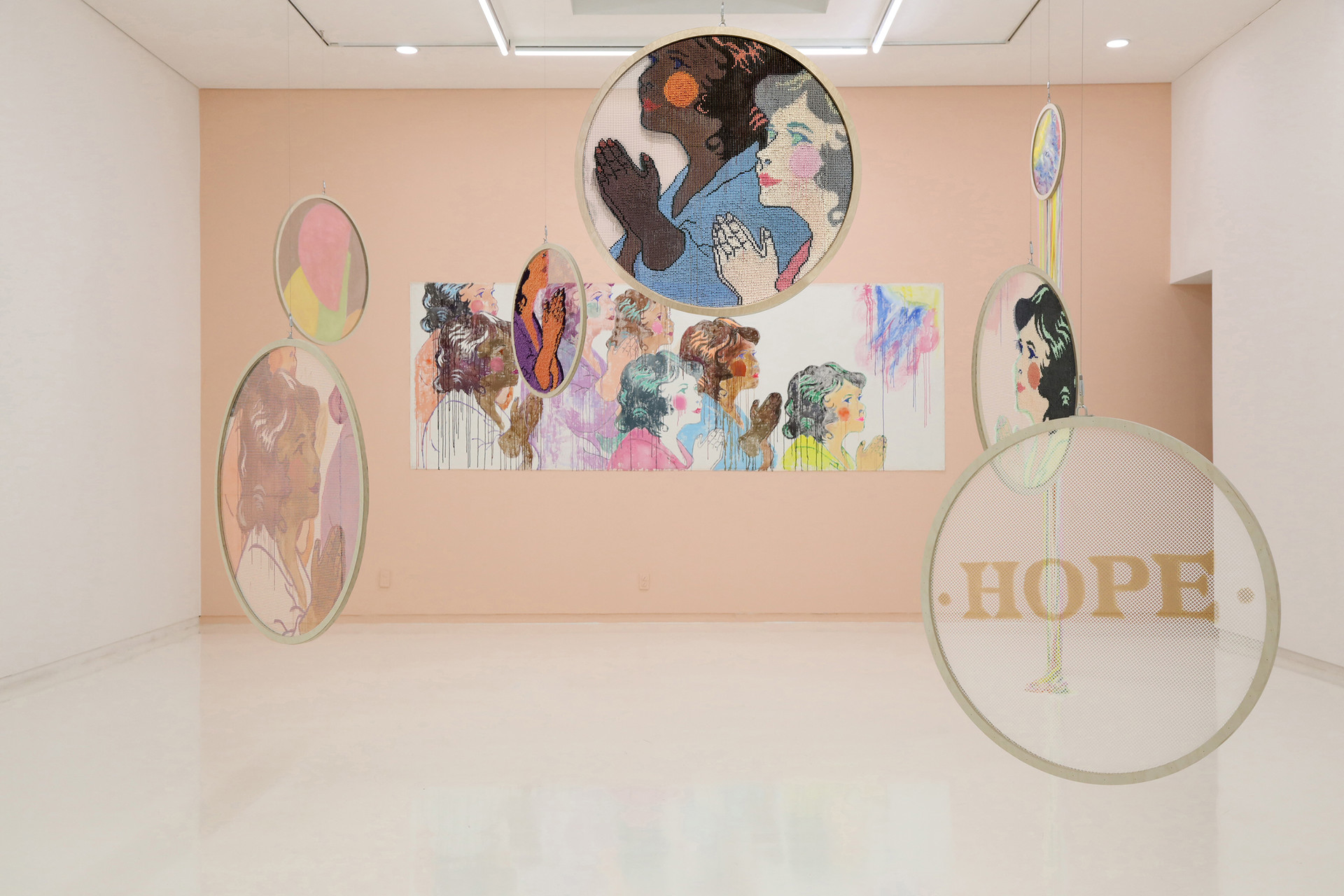
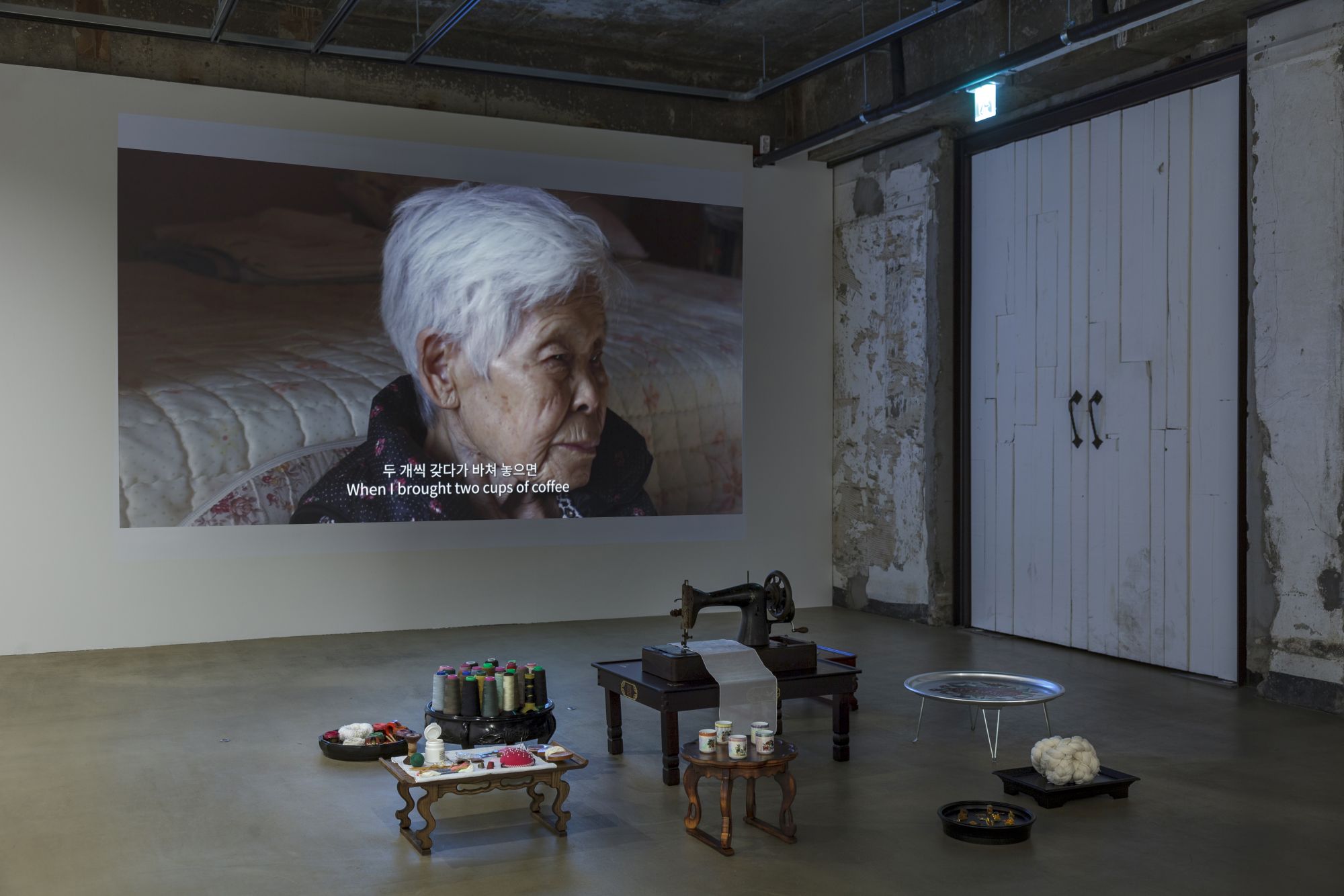
Installation view of 《There is no gold that does not decay》 (Incheon Art Platform, 2025) © Hee Vaak

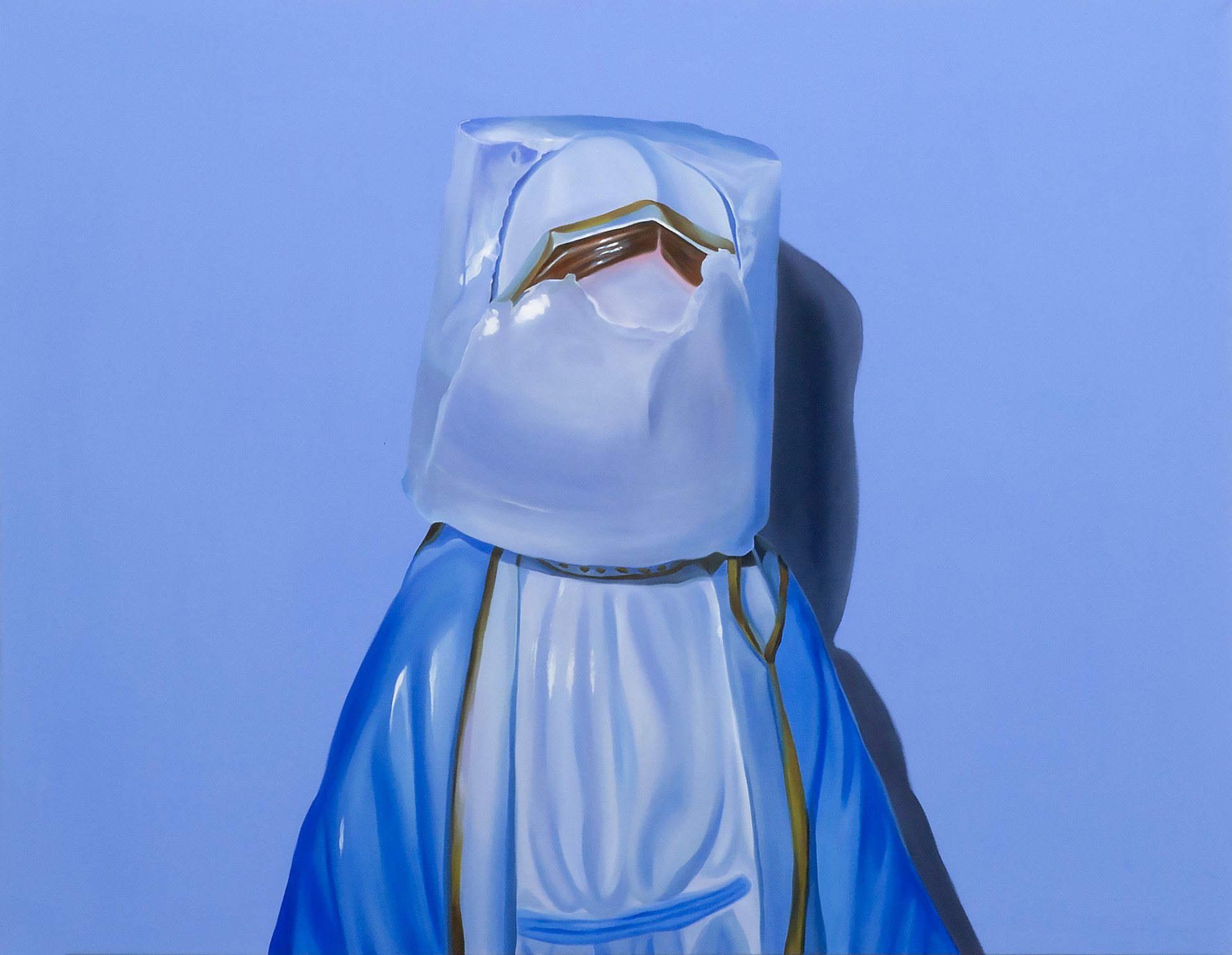
Hee Vaak’s 《There is no gold that does not decay》 consists of seven paintings. In the small cube-like space, there are three large-scale works that correspond to the high ceiling, depicting Our Lady of Banneux wrapped in plastic, and four relatively smaller works with varied subjects. A common foundation, including the central icon of the Virgin Mary, is the background.

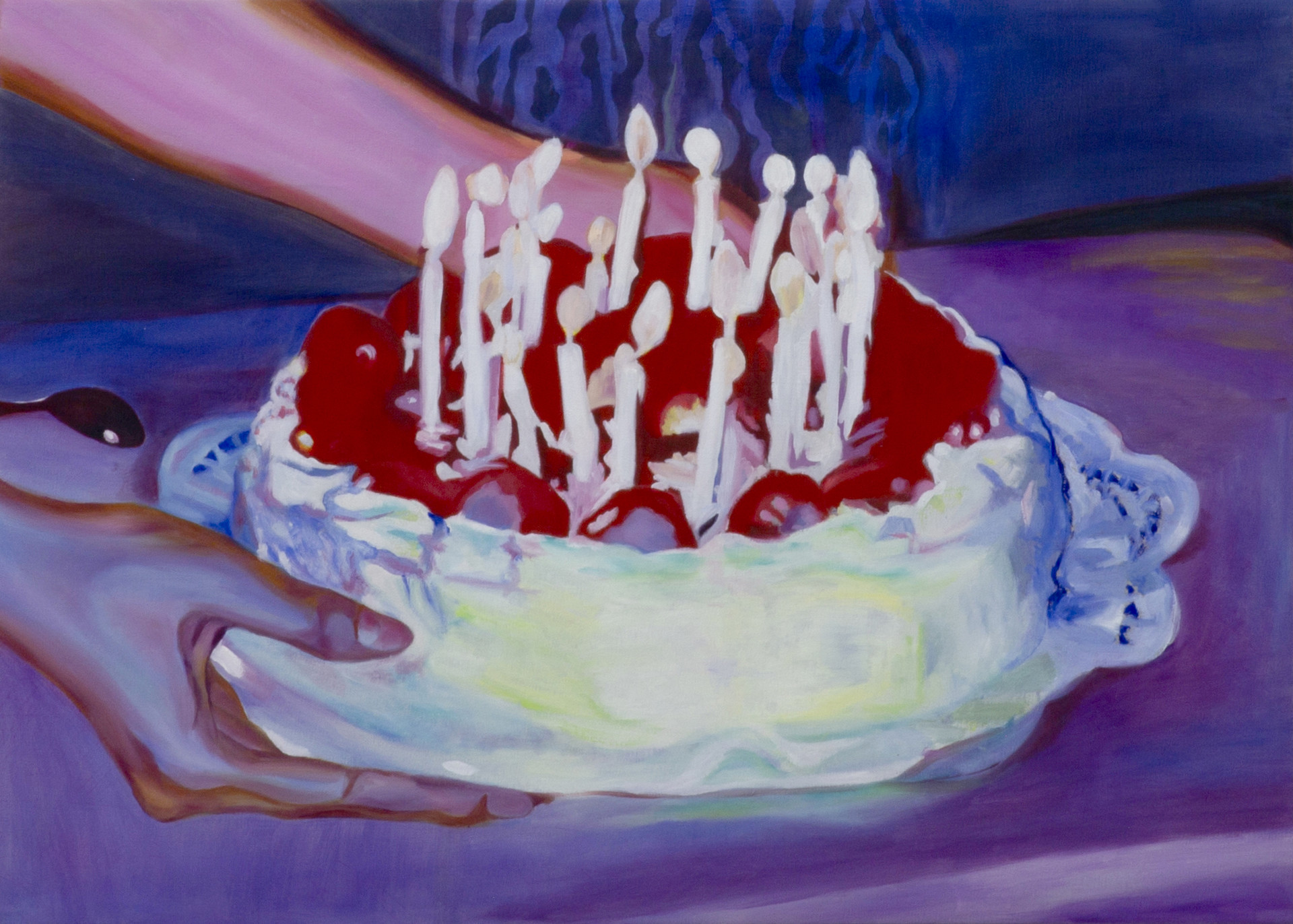
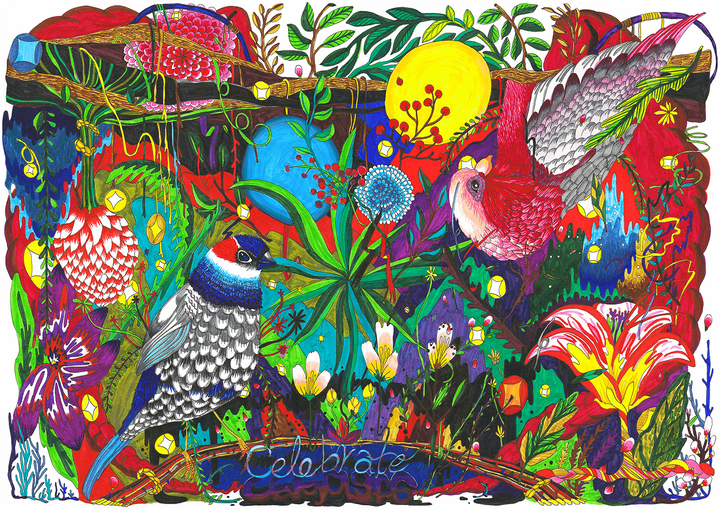
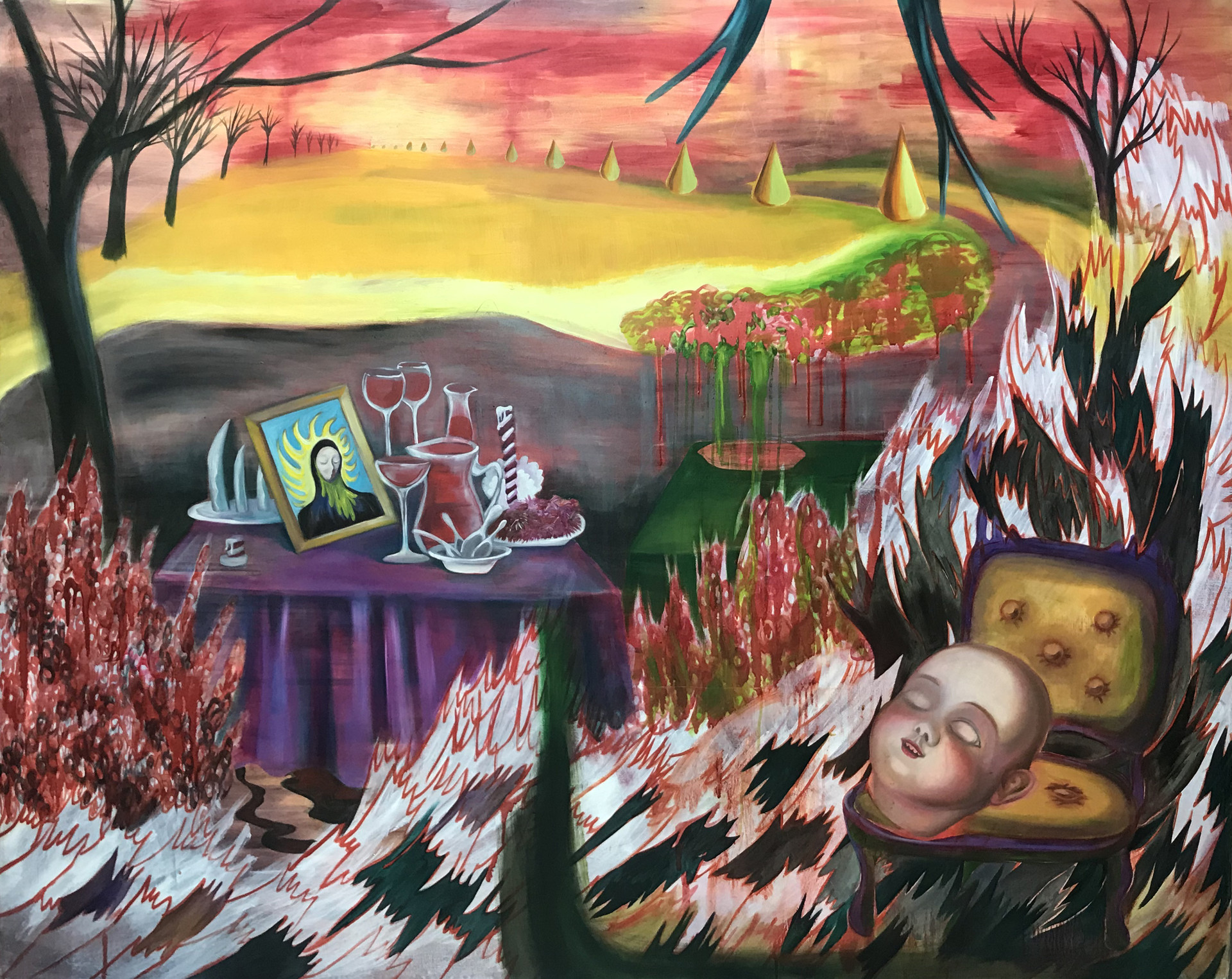
There are no objects in the background, and it forms a consistent tone — Celebratory Cake(2025. Oil on canvas, 65.1×90.9cm.) is the exception, and this exceptional quality is also manifested in the fact that it was exhibited separately in the window outside the exhibition space. The background, first, erases, reduces, or conceals the reality in which the subject is placed, and second, removes the temporality in which that reality is situated.

This of course implies an intention to emphasize the subject, and further recalls a medium-specific route — like taking a kind of photograph — created by the formation of a special environment such as an indoor space or studio. If the entire pictorial surface is presumed as a single representational outflow, and if we pass through the long-standing relationship between photography and painting, it would also be possible to infer this to some extent.

In the lineage of realist figurative painting, such a background setting extends into concentration on the object and the aura of the object itself. Between the expectations placed on this object and the fact that it is merely an object, the objects reveal a split subject. There is the plastic that wraps the Virgin Mary, objectifying and crystallizing her.

The intermediate layer of plastic, which protects or blocks the subject branching off from the background from that very background, preserves and visualizes the sacredness of the statue of the Virgin Mary precisely through “packaging.” The statue of the Virgin Mary is packaged as an object of value.
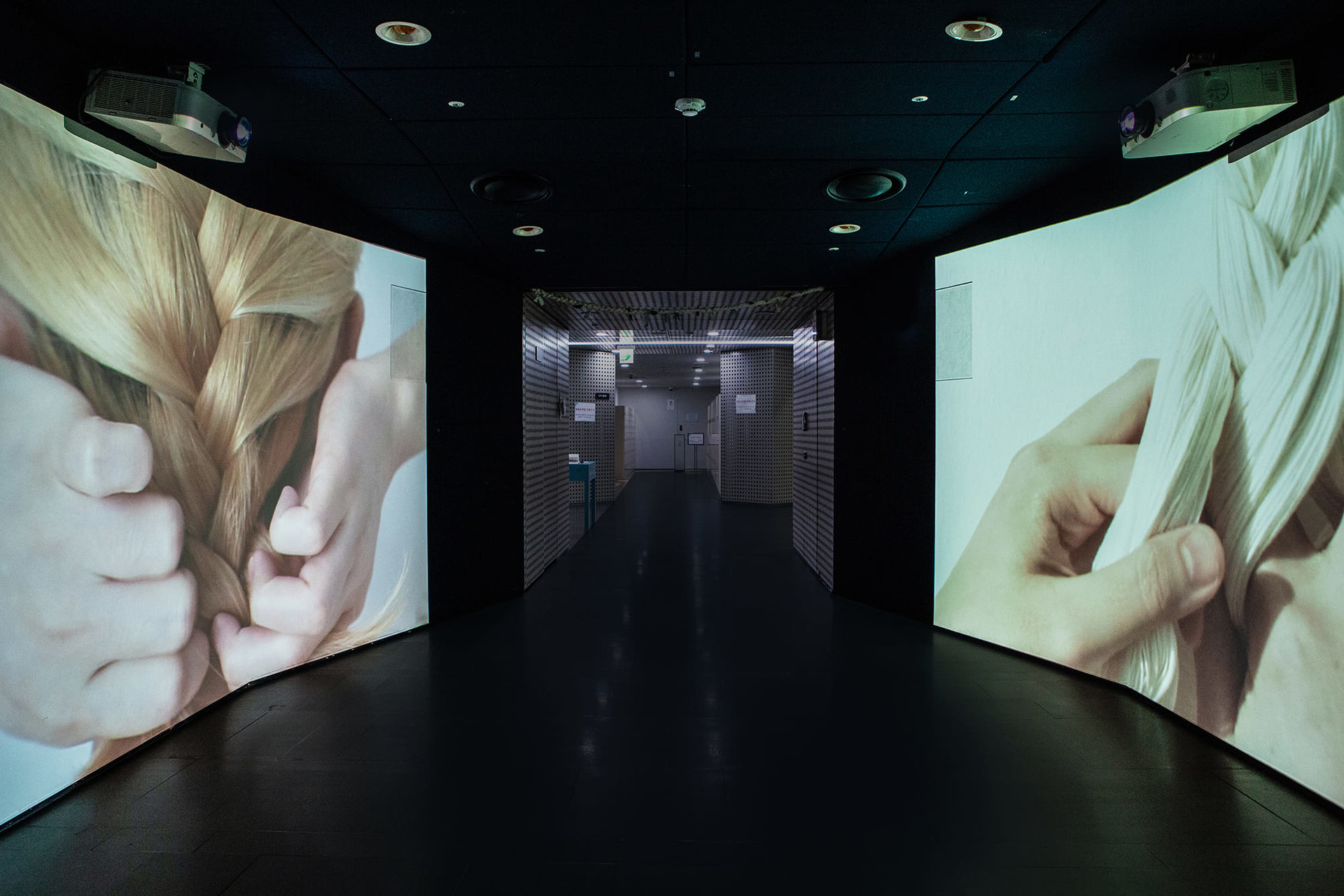
Just as the statue of the Virgin Mary, which embodies the value of gold, will decay, the plastic will also decay. Nevertheless, the sign of this “decaying” seems to come from the plastic, because the statue of the Virgin Mary, an object of value, is bound to the plastic, and because the plastic appears to occupy a superior position as a sign of association/evocation with decomposition.

This plastic plays a special role in the painting, and the fact that it wraps the statue of the Virgin Mary means that we cannot see the body of the statue without this plastic.

Indeed, the statue of the Virgin Mary is captured by the plastic. This plastic divides the body of the statue, through which light passes, into inner and outer spaces, while also creating a boundary between the statue and the plastic.

In other words, while penetrating(and distinguishing) the inner body, the plastic adds traces of boundary lines that do not coincide with that body; at the same time, while penetrating the body, it newly sculpts it with layers of crystals of its own — this world of fragments forms a stratum similar to a kind of mosaic. 

It constructs its own corporeality, stained with each color that comes from within. Here, the inner body is no longer discernible, and the lines come to point to the plastic’s own body. A boundary where the colors inside and the light outside meet crystallizes into its own division — this is applied exceptionally in the three paintings.


Installation view of 《There is no gold that does not decay》 (Incheon Art Platform, 2025) © Hee Vaak

The wrapped body unfolds from inside to outside, while at the same time half-folding inward from outside to inside. Meanwhile, the plastic wraps the body, simultaneously penetrating it and sealing it through that penetration.

Therefore, it is impossible for the body to unfold absolutely, and it exists under the realm of inference and imagination. This constitutes a realm of a mysterious being. In Butter(2025. Oil on canvas, 325×130.3cm.), the body emerges slightly to the left, and centered on the clearly revealed left palm, only the bowed face and the left part of the hem of the skirt allow its form to be roughly discerned.

In Butter, compared to Pink to Purple(2025. Oil on canvas, 325×130.3cm.) and Prussian(2025. Oil on canvas, 325×130.3cm.), the plastic and the body are more tightly bound together, and their mutual entanglement is maximized.

The plastic wraps the body as if binding it tightly, and the body is determined as it extends into that plastic — by comparison, in the other two works, the body is revealed more transparently, while the plastic appears as something that can be separated and distinguished in itself(the part where it is bound to the body and appears as complete crystals is toward the lower part of the body in Pink to Purple, and in the case of Prussian, it applies only to part of the left side of the arm.).

The face, from the transparent part of the plastic through which light passes, from pure folds that do not reflect color, and from areas close to a single line, positions the left eye as an extension and segmentation of that line, giving the illusion that light-line-matter has gathered in that eye.

It is transformed into tears that pierce the eye and flow downward. And this is also a repeated part in Pink to Purple and Prussian; the transformation on the face attached as an effect to the mystified being appears, in Maria(2025. Oil on canvas, 112.1×145.5cm.), as a face that is covered/worn.

As a result, the eyes, nose, and mouth become impossible to identify, and the torn upper part hints at the symbolic meaning of a being that is bound. Mystery thus becomes the dimension of true reality, and the gaze, instead of subtly dominating the outside, is reversed into something that pierces the depths of the inside.

In terms of coloration, this painting, which most coolly and distinctly calls forth the transition of light, corresponds to the image of a newborn baby in 1989(2025. Oil on canvas, 116.8×91cm.), who fully reveals its body in the form of a cross against a blue background and wearing white clothes.

Yet the latter seems closer to something that seeps out from the former — the religious or the mysterious — and in fact inscribes and presents the statue of the Virgin Mary in another dimension.

Returning to Butter, presented as an original form, the red background from the middle to the lower part expresses a spreading that is somewhat disharmonious in terms of color and also unstable in terms of form. This is clearly different from the stable purple that appears as the shadow of the statue of the Virgin Mary at the lower part of Pink to Purple and from Prussian, which covers the pictorial surface entirely in black.

These latter two paintings also differ in that the plastic covering the statue of the Virgin Mary is relatively transparent and reveals the body of the Virgin Mary well, so the areas where the plastic and the Virgin Mary overlap to form one crystal, and further where the plastic itself forms its own crystals, are reduced.

Accordingly, Butter, which is wrapped the most tightly, feels more interesting in many parts — in the dimension of its immediate material form, and in the narrative dimension of inferring the consciousness of that being.

That being is the most unclear, also object-like and impossible to know in its intention, and this is unconsciously connected to and manifested in the hidden face, Maria. As great as the gap is between these two works — in fact, as irreducibly great as that gap is — this exhibition should have been a larger room filled with many more things.

References