Yun Choi’s portfolio begins with a
photographic work titled Saengshow (“raw show”),
and “raw show” remains the consistent ethos of her practice to this day. Apart
from Saengshow itself, Choi’s works are, by and
large, “raw shows.” The content she stages tends to be vivid yet pitiable
events—objects of contempt that are nonetheless entertaining, absurd happenings
that nonetheless merit a look. It is “real” yet ultimately a show, and only at
the level of a show can it render reality convincingly. To borrow the current
idiom, it could be called “byung-mat” (a kind of glorious bad taste), but with
an added destructive force.
Saengshow, Part 1 is
a photographic work linked to performance. Its caption notes that it was shot
using a “self-timer” set to a ten-second delay. The viewer thus imagines the
artist—both author and subject—performing a “raw show” for ten seconds in front
of the camera. The result looks like the failed portfolio of an aspiring actor
who tries pathetically hard in front of the lens, decked in atrocious costumes
and lacking in acting chops. The delight of intended failure—of such futile
acts—is crucial in Choi’s work. Whether one reads it in relation to the proudly
high youth unemployment rate of the Republic of Korea or as a defiant gesture
by an art student with poor prospects, we could say that “heading headfirst
into the ground” is the core of Choi’s “raw show aesthetics.” (It faintly
recalls Ko Seung-wook’s performance video series.)
Saengshow, Part 2 is
a video composed of photographs and sounds recorded at a racetrack. Although it
bears the same title, this time the work has nothing to do with the artist
herself; rather, it shows the strange, desolate landscape of the racetrack.
Those who dream of a quick fortune seem devoid of passion. The racetrack is
depicted as an indeterminate space saturated with the atmosphere of “surplus.”
It is not a crisp, high-definition video. The low-tech, sideways transitions
between casually shot photographs heighten the “bad-taste” register of this
video-place. Because it is unclear whether the gaze is cynical or coolly
objective, the fervent voice of the race commentator floats hollowly outside
the images. The Saengshow series shows spaces
where, for both the individual and society, grand ideologies of economic growth
and industrious productivity fail.
Through such hollow actions and their
records—especially by accentuating their rawness—Choi conveys situations that
are unspoken or difficult to articulate. The performance-video NNN likewise
lays bare the absurdities faced by art students, or by artists more generally.
The performance consists of carrying a roughly size-100 nude painting on canvas
from the Korea National University of Arts studios to Deoksugung Palace,
Gwanghwamun, and on to the Blue House, and photographing it along the way.
As
one might imagine, this stereotypical academic painting, when paraded through
emblematic spaces of Seoul, splits the experience of the artist into two
opposed spaces—art and reality, the studio and the city, the nude and the gaze,
the cumbersome bulk of the canvas and the busily moving urban flows. In this
way, academic art education becomes not a target of satire but rather performs
its most progressive function: the nude canvas becomes an accurate metaphor for
the absurdity of the situation, revealing the realities of both art and Seoul.
The juxtaposition of the nude painting with the statue of Admiral Yi Sun-sin,
or the restless comportment of the Blue House security officers confronting the
nude, makes both art and reality come alive.
The scenes Choi stages thus place herself—or
a drifting young person of her generation, or “the surplus”—in a “destructive”
situation. Such a situation might literally be the demolition sites of
residential neighborhoods in Seoul, as in Devil’s Triangle;
or the makeshift, repaired, recycled spaces cobbled together by residents, as
in Unknown Gathering or Human
Mutants; or, more simply, a high-speed train, as in Rock,
Scissors, Paper; or, as in Kookmin Manifesto,
the overly sublime images of the national anthem broadcast.
A destructive
situation may be one in which things simply do not add up, or a place like a
time machine that transports one from one space to another, or a space where
the fantastical and the real coexist. One could hastily link Choi’s transient,
improvisatory, and restless methods to contemporary web-surfing culture, or
view them as another mode of representation in an age governed by metonymy
since “postmodernism.” Yet Choi’s interest lies, above all, in resistance to
dominant cultures and codes; it is thus wholly different from a mere play of
image relay, or a sequence of fickle forgettings. Her anti-image
gestures—puncturing images, throwing stones, reducing images back to
walls—constitute a rough attempt, even an animistic one, to convert things and
environments into living activities and processes of life—performatively.
According to Choi’s own descriptions, the
garden fence she found in Ihwa-dong made of discarded electrical cables, the
parking deterrents made by embedding shards of broken bottles in lumps of
concrete, the drains and mailboxes assembled from assorted refuse, the iron
bars fashioned from reworked mattress springs—these are open spaces of creative
destruction, or destructive creation, spaces “in process” and “in change.” What
Choi learned from Seoul’s old neighborhoods is something that cannot be learned
in the enervated museum. As Paul Chan once said somewhere: if Marcel Duchamp
turned usable things into unusable ones, the residents did the opposite.
Of
course, Choi does not transform useful objects into something useful “like
public art.” The interest of Choi’s work lies rather in how the residents’
recycling and “vernacular aesthetics” of collage, when passing through her
hands, vault into a kind of outlandish leap. Reading her project statements,
one might first think they resemble public art or urban art interventions that
address a district’s history or characteristics. Yet projects such as Unknown
Gathering, Human Mutants, and Devil’s
Triangle suddenly jump to spaces on an entirely different
plane—like the solar system, the Bermuda Triangle, a haunted park, or a fairy
forest.
This teleportation to imaginary spaces can be
seen particularly in Human Mutants, which posits
figures wearing things on their heads, or things themselves, as actors in a
play. The content runs roughly as follows. In truth, more than this somewhat
literary mode of expression itself, I am drawn to Choi’s improvisatory
substitutability among things, their adhesiveness, and her provocatively blithe
indifference to political correctness—an appealing naiveté in the good sense.
This anti-aesthetic, liberal disposition also appears in the reuse of the same
things across different works, or in nonchalantly recycling one work into
another.
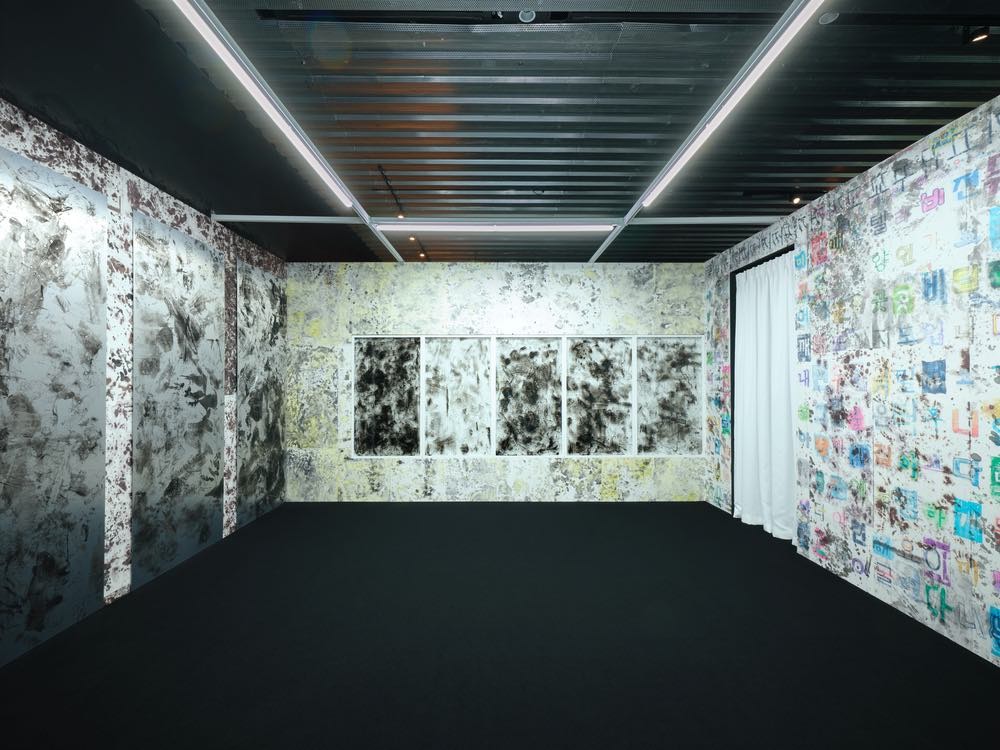
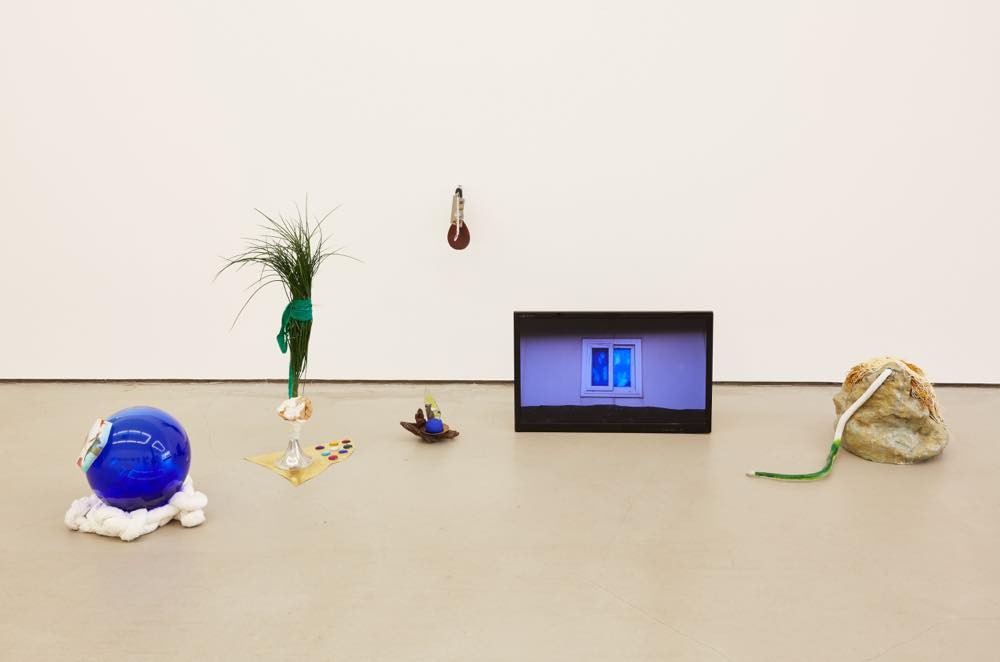
The globe pictured above turns up elsewhere, and the picture-wall
titled Image Wall is one of Choi’s favorite props
deployed here and there. Such “using” is the very economy of a “vernacular
aesthetics,” and makeshift facilities correspond to the “well-display” of an
“exhibition.” Because the same materials are used across contexts, one may even
become unsure where one work ends and another begins. This attenuated sense of
the “oeuvre” and of the “work” is a justifiable response to the general milieu
of (Korean) art, which incessantly demands the pursuit of a “private artist’s
world.”
Choi’s recent works are moving from playing
with the mismatches between art and society toward parsing the spectrum of art
and society more finely and raising consciously critical issues. In Citizens’
Forest, for instance, she reveals the perfectly twisted relationship
between public spaces, studded with national monuments, and the cosplay
enthusiasts who occupy them. “Citizens’ forest” and “fairy forest” coexist and
play together while remaining perfectly separate within a single space. So too
in Kookmin Manifesto: because the government
understands the Korean Wave as an export commodity or a national propaganda
tool, K-pop is, in effect, no different from the national anthem. The charm of
Choi’s work lies in its unflinching disregard for political correctness; does
the inclusion of such didactic messages diminish that charm? Let the
fainthearted teachers think so. For now, the work still brims with energy.
One common problem we sense in the art world
is the arbitrariness of discursive conditions. Discourse is neither squarely
present nor entirely absent; similar discursive states persist without a
history. It may be a luxury to lament that one cannot reflect on one’s practice
within an art-historical lineage. In a place like Korea—both cultural colony
and empire—where the colonial/imperial condition has been externally imposed
and internally adopted, and where hybridity, rapid change, the codification of politics,
aesthetic improvisation, and formal modernity produce all manner of
disjunctions, the dissolution of norms, identities, and issues hurls us into
the extreme difficulty of linguistic communication.
I think that the particular
problem faced by artists of Choi’s generation is how to speak at all in a time
when it is difficult to say what anything is. Of course this is not unique to
her generation, but I suspect that the surrealism of Korean society after
“democratization,” or its “postmodernity,” is even more extreme. If I sense a
possibility in Choi’s practice, it is because she throws herself bodily into
that conflict and, by unabashedly exposing the arbitrariness of discursive
conditions, smashes sentimental art discourse with the richer energy of actuality—if
words fail, the body shows the way. In Korea, as ever, art without pedigree
makes art history.
—Excerpted from the HITE Collection catalog 《When the Future Ended》