There is a photograph. I glimpsed
it on Twitter years ago, and I have never been able to find it since. Perhaps
it is an image without substance, a product of my imagination. The photo
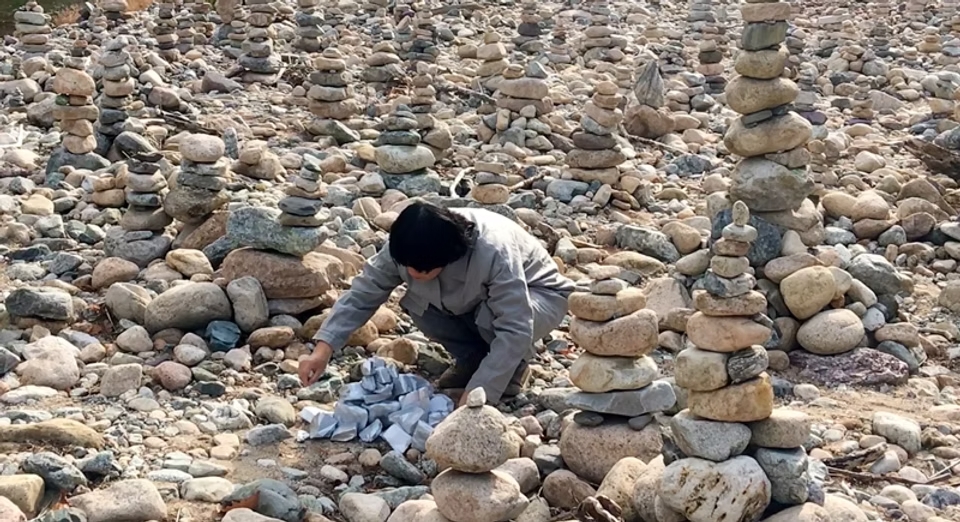
depicted various stones—large and small—on a beach, wet and glistening:
pebbles, gravel, and round cobbles. The photographer, presumably on a walk,
must have crouched down to capture something. At first glance, the image
appeared to be a harmonious composition of colorful, naturally shaped stones.
Only upon closer inspection could one notice a fragment of a printed plastic
panel—flooring material designed to resemble stones—camouflaged beneath them.
The synthetic stone pattern was seamlessly integrated among the natural rocks,
forming an uncanny unity. Judging by its slightly faded color and irregular
edges, it was not something deliberately placed. Rather, it seemed to have
drifted ashore after floating on the sea—an authentic found object. This image
can be seen as an episode or allegory of contemporary visual culture that illustrates
the hybrid harmony between nature and the artificial.
For modern viewers, witnessing
artificial objects blend seamlessly into natural ones to form a harmonious new assemblage
has become a familiar sight. To borrow the language of Bruno Latour, this may
be just a simple example of the proliferating hybrids of modernity. Over tens
of millions of years, massive rocks break down into beach pebbles, while
remnants of organisms buried underground over similarly vast periods are
transformed into petroleum, which in turn becomes plastic fragments. Today,
these two materials lie side by side, providing an indistinguishably similar
visual experience. The everyday presence of artificial objects like computers,
mobile phones, and electric vehicles often obscures the fact that they are
composed of natural materials. Nature and culture are already so entangled that
even the binary distinction between them holds little inherent meaning.
Like any other natural substance,
rocks neither despair nor harbor vague hope; they endure the Earth's timeline
that spans billions of years. Over the course of deep time, a single boulder
may have undergone multiple cycles—transforming from rock to pebble to sand to
clay and back to rock again. Even if we worry about acid rain corroding it, the
rock will likely retain its solidity long after humanity has gone extinct,
perhaps until a new form of life—potentially non-biological—dominates the
Earth. But perhaps such a judgment is too hasty, too modern. What if rocks and
stones are not so enduring after all? What if all of Earth’s stones are
mined—used up either for extracting the materials necessary for digital media
devices or as sources of energy? Then the natural rocks might be replaced by
synthetic ones, or merely images resembling them. In contrast to the time of
the Earth and stones, humanity has, in just a couple of hundred years,
accelerated and compressed the vast geological process of “deep time” through
development, mining, and consumption. In pursuit of energy, modern humans have
indiscriminately mined fossil fuels such as coal and oil, along with minerals
like copper, aluminum, cobalt, silicon, nickel, and lithium for manufacturing
and powering all kinds of industrial products and digital devices.
Between Data Extraction and
Resource Mining
Recently, many have referred to
data as a “new natural resource,” and this is more than just a metaphor. While
data isn’t literally mined from the ground, it serves as the raw material that
feeds global digital platforms and algorithmic networks—keeping them alive and
functioning. Data is omnipresent, and once its necessity is recognized and
measurement devices (sensors) are developed, it becomes an infinitely mineable
substance. Although the very existence of data—whether it is an object, a
concept, or an event—remains ambiguous, there is no doubt that anything in the
world can be turned into data, making it an exceptionally plastic resource.
Just as the fusion of natural
stones and artificial stone patterns has become “natural” to us, so too has the
combination of silicon (as material) and algorithms (as data). The transition
from industrial capitalism to cognitive capitalism has occurred through the
inevitable linkage between rare minerals extracted from rocks and the data that
can be extracted from every facet of the world. While digital or cognitive
capitalism seems to reduce everything into the immaterial and intangible—such
as data—detached from the physical earth and matter, in truth, it demands even
deeper entanglement with rocks and the planet.
Matteo Pasquinelli summarizes
this technological and social condition with the concepts of the “carbosilicon
machine” and “cyberfossil capital.”¹ Our society
is moving toward a cybernetic world where everything is automated through the
integration of energy-producing fuels, materials that make up semiconductors,
and information that gives form to things and energy alike.
Critical AI researcher Kate
Crawford begins her book Atlas of AI² from the foundational
layer—“Earth”⁴—drawing on Benjamin Bratton’s planetary-scale platform model in The
Stack.³ The computational reality in which everything has become
calculable is built across multiple layers and scales: energy and minerals,
cloud infrastructure, smart cities, the Internet of Things, user interfaces,
and AI algorithms. The abstract and immaterial systems of software and
algorithms are layered directly above and below the strata where energy and
minerals are mined. In Crawford’s collaborative project with Vladan Joler, Anatomy
of an AI System,⁵ their holistic analysis of AI also begins and ends with the
Earth. “Each
product included in the extended network of an AI system—from network routers to batteries
to microphones—is
made of elements formed over billions of years. From the perspective of deep
time, we are squeezing the history of the Earth to manufacture technological
artifacts used for mere years. […] Geological processes mark both the beginning
and end of the entire lifecycle, from ore extraction to disposal in electronic
waste dumps.”
From this perspective, Sandro
Mezzadra and Brett Neilson attempt to redefine the dominant paradigm of
contemporary capitalism by expanding the meaning of “extractivism.”⁶ Historically, the term referred
to the imperialist process by which natural resources and living beings
(including humans) were forcibly displaced and exploited—mainly in the Global South—for value production and
accumulation. But now, the scope of “extraction”
is being broadened to encompass practices like data mining and the commodification
of human life itself in the era of biocapitalism.
In other words, from the
extraction of natural resources for manufacturing and sustaining AI devices, to
the mining of data for training and refining AI algorithms, and further to the
exploitation of human data labor that enables AI’s completion, the mechanisms
of contemporary capitalism are all fundamentally extractivist in nature.
Furthermore, given that today’s mining, extraction, and exploitation still
overwhelmingly take place in the Global South and peripheral regions, it must
be emphasized that the global inequality of capitalism remains historically
unchanged.
The expanded notion of
“extractivism” proposed by Mezzadra and Neilson is vividly visualized through
the maps meticulously rendered by Joler and Crawford. In Anatomy of an
AI System, they trace the macro and micro pathways of a small AI
speaker device—Amazon’s Echo (equipped with the Alexa system)—from the mineral
elements it is made of, to how its algorithms are trained and operated through
human labor, and finally to how it is dismantled and buried in the earth after
disposal.⁷
Through this comprehensive
diagram, we come to realize a crucial, yet often overlooked fact: even
something as seemingly immaterial and abstract as data—or AI
algorithms—requires a material (mineral-based) foundation to exist, function,
and circulate in digital form. This includes everything from generation,
storage, computation, measurement, to mobility. The diagram reveals that mining
and disposal are unavoidable components of the data-AI cycle.
Within a single AI system, the
extraction of resources, labor, and data occurs simultaneously, generating
value through a multi-layered process of exploitation and extraction. This
structure mirrors the Marxist dialectical triangle of labor force, means of
production, and product—a fractal pattern akin to a Sierpiński triangle, repeating complexity at every level. Whether at a
rare earth mineral mining site in the Congo, an Amazon voice AI manufacturing
plant in China, or a household using digital devices, it is impossible to
escape this triangular dialectic.
Extraction of Knowledge and the
Mind