1.
The world may be thought of as a huge mass made up of countless translucent
layers. We each live and die alone in our own thin little layer, widely
separated from people living different lives around the world. Perhaps the
notion of a shared existence is merely a figment of our imagination.
What
divides us from others is not merely physical distance; we often seem to be
living at entirely different speeds, in different times. Some people, citing
the global triumph of democracy and the market economy, might believe that we
are in the final stages of our historical development, but that seems like a
distant future for many others. Across the globe, many people spend their lives
in extreme poverty, or wear military fatigues and engage in guerrilla warfare
in the mountains or desert.
For them, contemporary life remains a
back-breaking, nightmarish ordeal, no different from life in the eighteenth or
nineteenth century during the so-called ‘age of modernity’. For some people,
time flies at the speed of light, while for others, time sluggishly slinks
along at a snail’s pace, continually pausing to look back. People’s burning
desire to move faster and their fear of getting left behind continues to
produce more and more divergent times within the present. All these differing
time trajectories overlap and interweave in complex ways to form the world of
the ‘here and now’.
Our
daily lives are as fragile as a cracked wine glass, ready to shatter into
pieces at the slightest nudge. Nonetheless, even with horrific tragedies
happening all the time in different parts of the world, we continue to go about
our daily lives unfazed. We must repeat our daily routine—going to work or
school just like the day before, and the day before that—and pretend that we
cannot hear the screams and cries of pain beyond the wall.
Despite
such isolation, we dare to speak of contemporaneity because we are now able to
‘see’ the outside world with fascination. One of the most important tasks
assigned to photography since its inception has been to infiltrate and bring
back images from the other layers of our fractured world. For some people, the
world is bright, warm, and brilliant, but others live in a world of suffocating
darkness. The bravest and boldest photographers—those with fire in their
blood—relentlessly break into others’ time and space, allowing us to ‘see’ into
their world. If it is possible for some of us to sacrifice a bit of our
peaceful lives in order to help those in distress, then it is possible for
photography—and photographers—to change the world.
Photographers
who strive to connect the severed layers of the world and who use their cameras
to help the weak oppose the mighty often develop a reputation of being rather
proud, or even arrogant. We eagerly consume the legends of these heroic
photographers and the tales of their fiery passion that the media delivers.
Certainly, they do sometimes risk their lives, and they are often quite
deserving of our praise and enthusiasm. And some of their photos have indeed
changed the world. The subject of this article—Noh Suntag—can certainly be
included among these fiery photographers. But despite the fact that Noh spends
his life on the run, striving to stay ahead of the pack, he cannot help
incessantly doubting himself and his photography.
2.
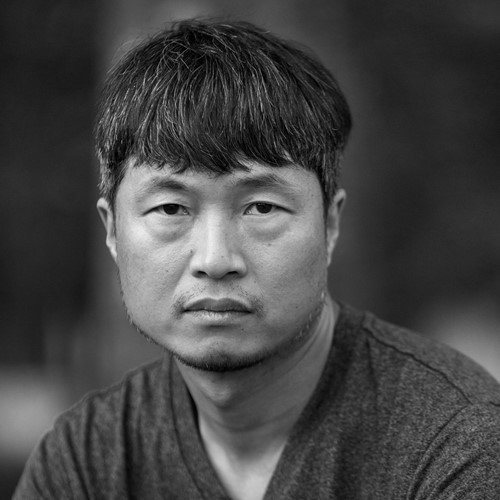
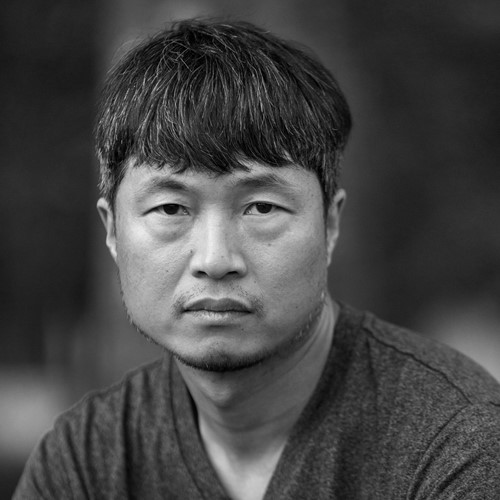
Noh Suntag (b. 1971) is the rare photographer who began his career as a
journalist before transitioning to become an artist, whose ‘artworks’ can now
be seen in renowned international museums and art biennales. Fate certainly had
a hand in this, but that is not something he could have controlled.
About
two years ago, one critic wrote that Noh ‘signifies the pinnacle of what Korean
photography can achieve in its history’. Almost immediately thereafter,
however, he took him off this pedestal in an article written just two months
later. Looking back at that particular article, the words are quite lofty and
verbose:
“The
words of Jesus are the best source for contemplating the meaning of faith over
the last 2000 years. Faith is the truth of one’s wishes, and the proof of what
one cannot see. People often hope that their faith might lead them home, but
many have died by following their belief. They may not receive the promise of
their faith in this life, but they will find their home in heaven. Therefore,
those with faith can never lose their way….People like Noh Suntag, however, who
do not have faith and who constantly doubt, can never find their home. By
trying to be both activist and artist, Noh will continue to be tormented,
unable to give up either the political or the photographic. While some have
crowned him as a “social-minded artist,” others point their finger and accuse
him of using political images to sell his “art.” While some hands elevate him
to artistic greatness, others throw him down to the ground. Noh Suntag is
doomed to wander, never to find serenity. But of course, he is simply reaping
what he himself has sown.”
As
often the case with weak-minded critics, he must have given in to the reckless
desire to capture the artist through his own grandiloquence. But now, two years
later, nothing has changed, and it is time to pick up where those words left
off. As seen in the photos of this exhibition, Noh remains as tenacious as ever
in his photography. The world is still dark, with the sun hidden behind the
clouds. Water drops from water cannons spread and sparkle like snowflakes, as
Noh Suntag still takes his photos at a full sprint. The flashlight of his
camera sporadically penetrates the darkness, uncovering people with bizarre
expressions, who seem to be laughing and crying at the same time. When he
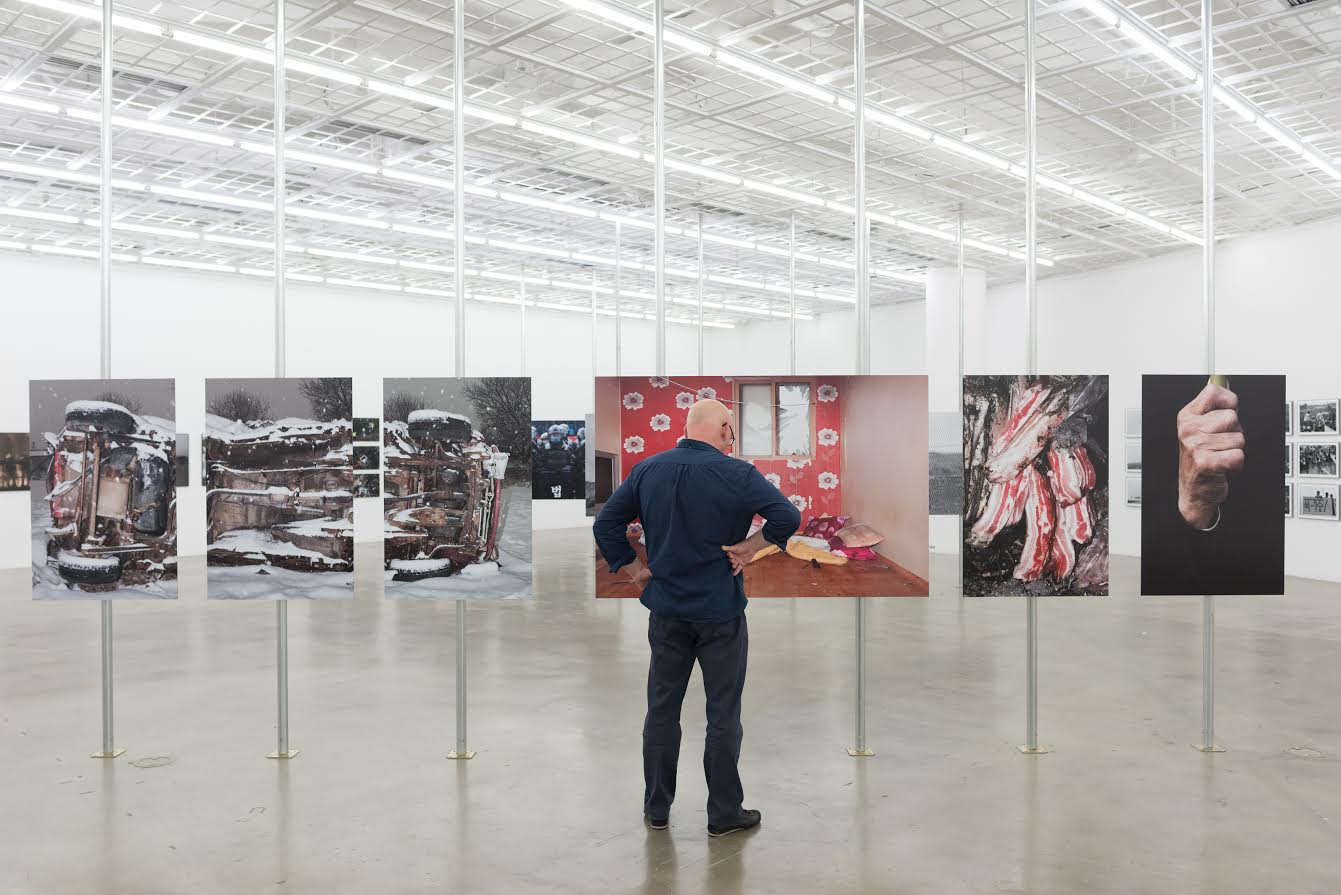
elaborately arranges his photos on the walls of the museum, he seems to be
categorizing specimens.
Nonetheless,
despite the occasional trivial victory as an artist, Noh’s career as an
activist has been marked by a seemingly endless series of setbacks. His front
has been pushed back further and further, as Noh and his colleagues have been
defeated in Maehyang-ri, Daechu-ri, Yongsan, and Gangjeong. In both politics
and photography, the world two years ago is not much different from the world
today. Perhaps that is why my vocabulary for discussing his work also has not
changed. Can we truly make any progress? I have my doubts, but I will write as
if my life depends on it.
3.
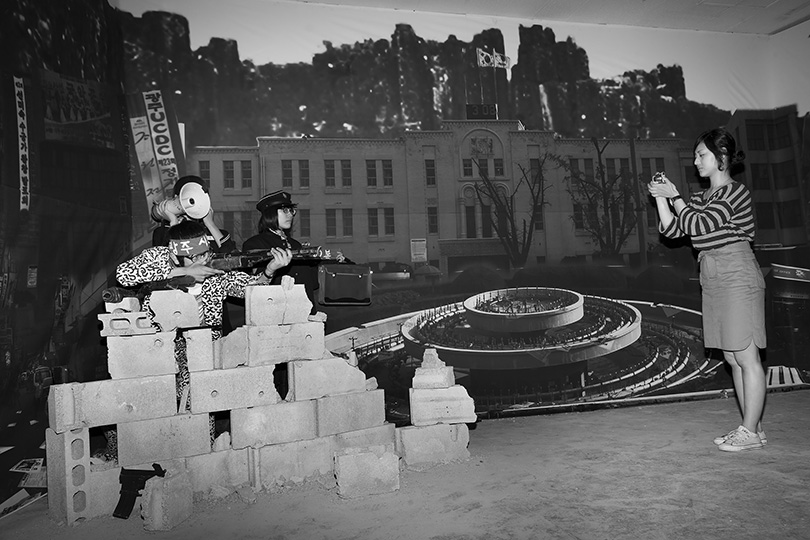
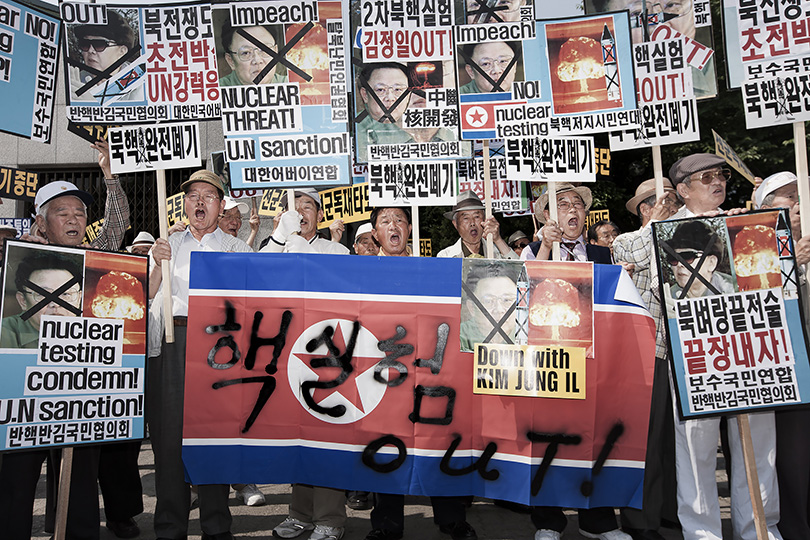
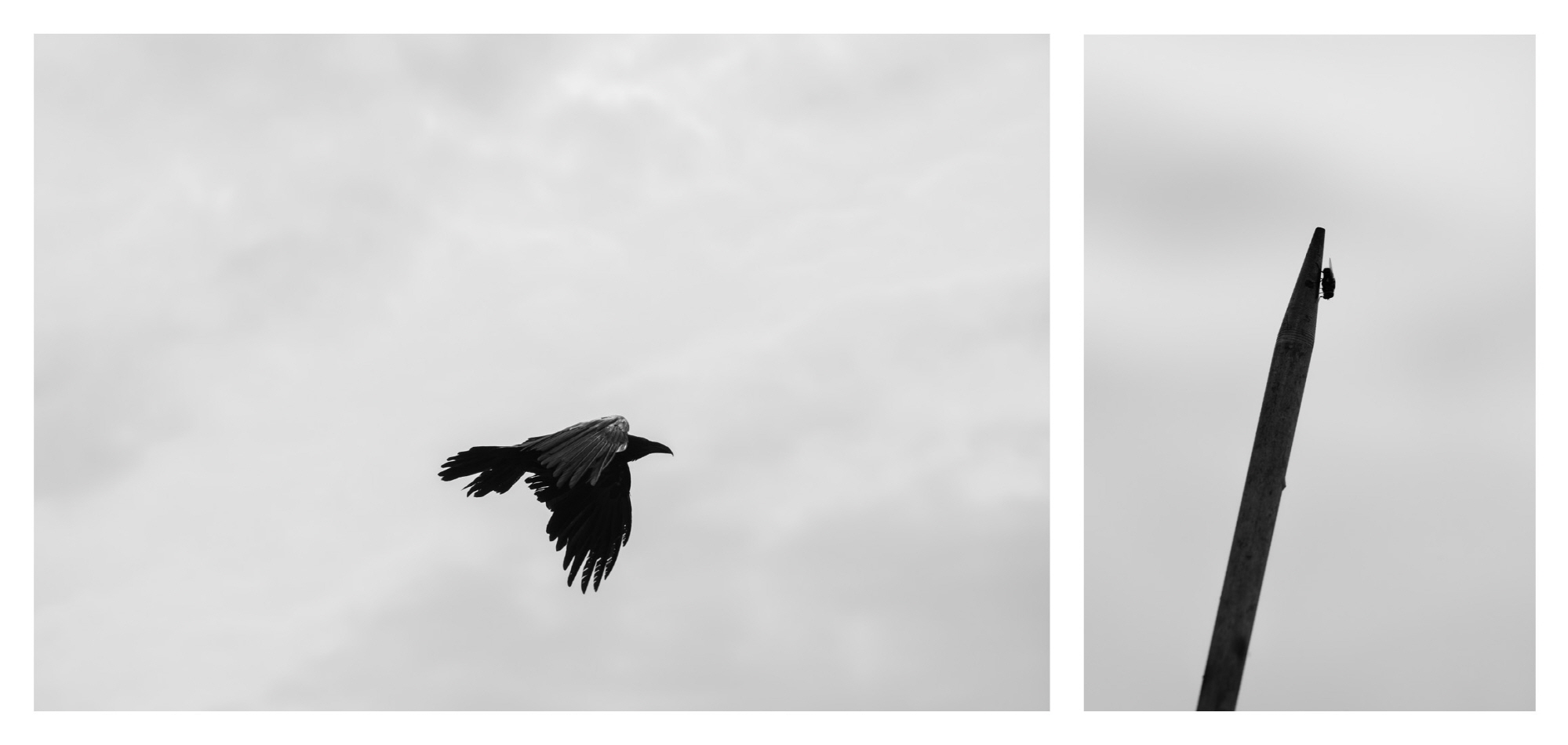
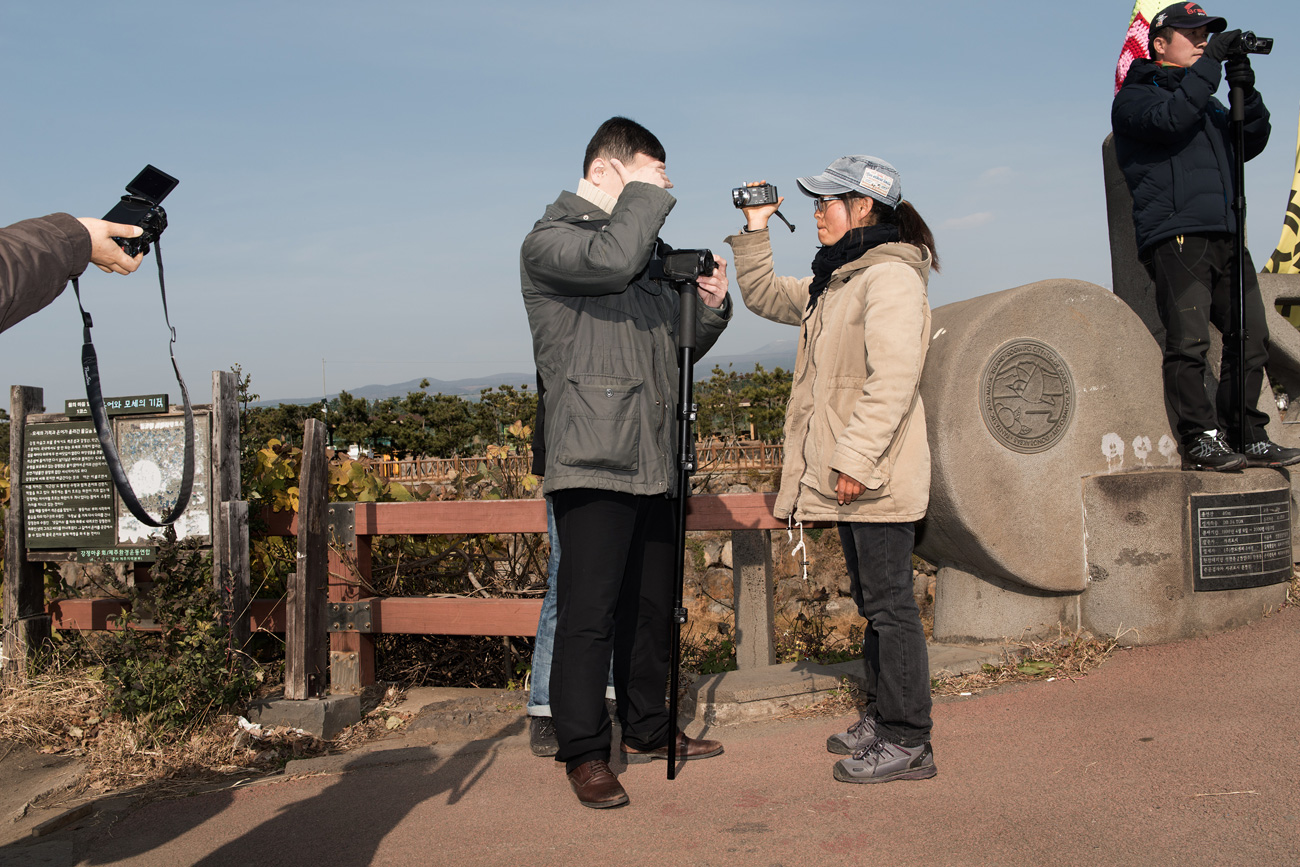
For this exhibition, Noh Suntag presents photos of people taking photos. His
subjects come from various walks of life: Noh’s fellow photojournalists on the
spot covering various news events; police taking photos of protesters as
evidence; people taking commemorative photos; elderly people taking “selfies”;
children playfully snapping pictures of someone lying in the street. The title
of the series is Sneaky Snakes in Scenes of Incompetence,
hinting at the vast difference between the actual moment of taking a photo and
the final image in the frame. For every ‘decisive moment’ that the audience
passively observes within their comfortable surroundings, the photographer must
peer through the lens while contorting his or her body into various awkward
positions, extending an arm or lifting a leg.
More
than any other photographer, Noh Suntag excels at extracting certain moments
from the flow of time, so that we may perceive their inherent distortion and
grotesqueness. One of Noh’s predecessors with a similar knack for capturing the
bizarre moments hidden within everyday life in capitalist society was Martin
Parr, who delivered unforgettable imagery by artfully distorting scenes of
tourists taking photos in front of famous sites, such as the Leaning Tower of
Pisa or the Parthenon.
The photos of Sneaky Snakes in Scenes of Incompetence
may lack the instant gratification of Parr’s works, but that is because they
cover a much wider span of time and space. Noh’s series consists of disparate
shots taken throughout his career at many different sites and events. As such,
they defy easy categorization with an obvious theme, and they lack the
consistent aesthetic style of his other series (e.g., the strAnge
ball, State of Emergency, and ReallyGood, Murder). However, what
they lack in lucidity and concision is more than made up for by their expansive
range and depth, which provoke more profound and rewarding reactions in the
viewer.
Originally
created for the series entitled Bird Guide,
these photos represent the longest lasting works of Noh Suntag. Notably, he has
re-titled the photos for this exhibition, but what is he trying to imply with
this new title? Does he mean that the people taking the photos must crawl into
every nook and cranny, with the flexibility and stealth of a snake? What can he
possibly mean by conjuring images of serpentine people taking photos of one
another? I cannot say for sure, and people with a lot on their minds are sure
to reach different conclusions that are hard to communicate or comprehend. At
any rate, I have never known another photographer who is constantly agonized
over the act of photography as much as Noh Suntag. In order to better understand
his work, we must first backtrack a little bit.
From
the beginning of his career, Noh has been deeply concerned with investigating
the act of photography. His ‘official’ career as a full-fledged artist began in
the summer of 2004, when he presented an exhibition and book, both
entitled Smells like the Division of Korean peninsula.
His debut was not exactly a sensation, as the photos of this series were a
motley mix. While Noh’s unique aesthetics and distinctive black humor were
present in some of the photos, others remained stuck in the straightforward
framing of media photography. The series of Smells like the
Division of Korean peninsula certainly contains the DNA of
the artist: political themes, a unique aesthetic sense, an obsession with
ethics, and a working method of a photojournalist. All of these elements would
be further developed to later reveal Noh Suntag the ‘artist’ who we would come
to know in the future.
Noh
Suntag had quit working as a photojournalist about three years prior to Smells
like the Division of Korean peninsula, but the works of that
series still look like those of a media photographer. The photos convey an
intense criticism of reality, an obsession to understand the historical context
of contemporary social phenomena, and a tenacious desire to expose social contradictions
and enact social participation. Already, however, Noh seemed to feel a strange
sense of incompatibility with his photography. Some doubts began to emerge
within the photos, like the larva of Ammophila sabulosa
infesta, a wasp that grows inside the body of a host. It was as
if the photographer himself was openly questioning his own efforts: ‘There’s
something awry with these photos. Can I really believe what I photographed?’
Then
and now, Noh’s working method has always worked like a photojournalist. When
taking his photos, he probably stands alongside other photojournalists without
feeling out of place. Like all photojournalists, Noh ventures into areas where
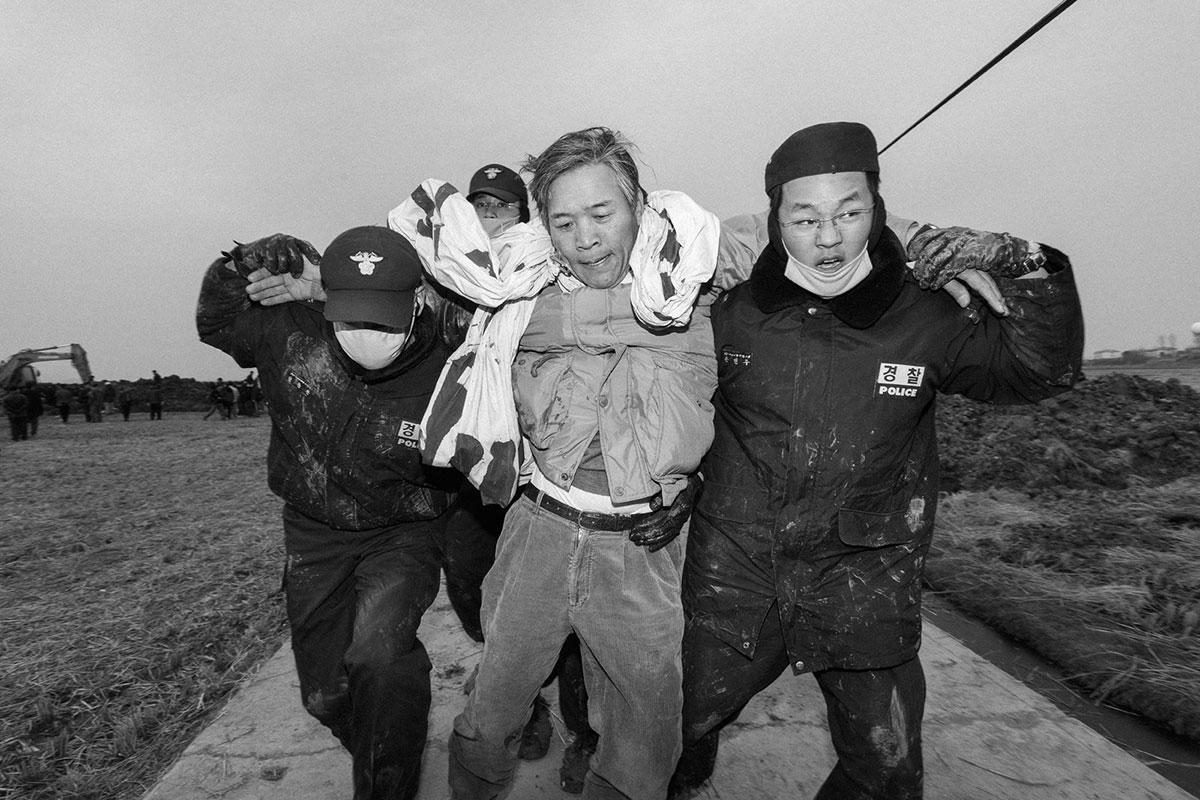
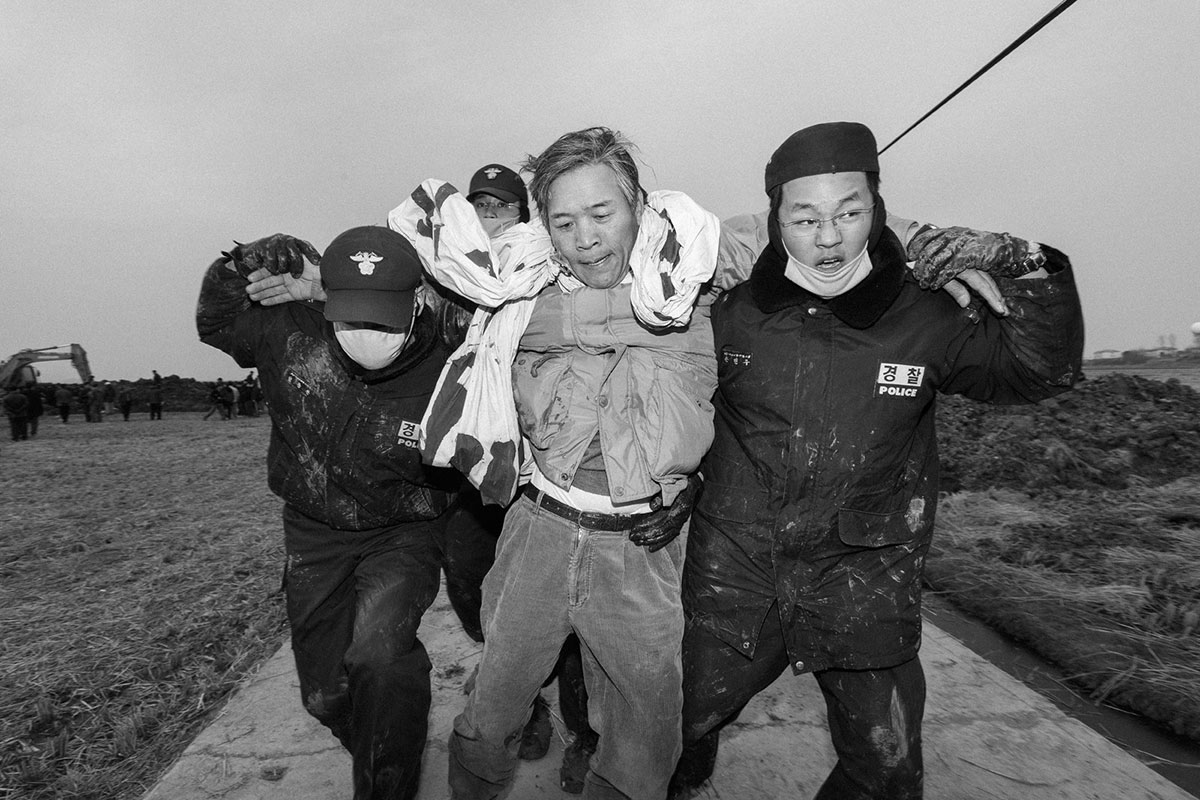
the social fabric is being torn by explosive problems and conflicts. The
fingers that press the shutter on his camera are often trembling with rage. His
photos are sent to the world directly from the night time streets of Seoul,
where protests are being violently suppressed; from Daechu-ri, Pyeongtaek,
where the residents were forcibly relocated due to the U.S. military; and from
Gangjeong village, Jeju Province, where a gray-haired priest is forced to
defend himself against combat police. Through Noh’s photos, we come to know
what happened in these places; as such, his works fulfill a fundamental
function of photojournalism.
However,
Noh Suntag is unique as a photographer who constantly doubts the things that he
photographs. He delves deeper into his subjects, even beyond doubt, to ask
whether the viewers truly believe what he photographs. The distance between the
fiery events captured by photojournalism and the cold doubts of photography is
much further than we think. Constantly maintaining such incompatibilities
within one mind and body must be extremely painful and difficult.
In
fact, the identities of a ‘photojournalist’ and an ‘art photographer’ are quite
different. Believing in the power of the camera, photojournalists are
constantly rushing into the world of others without hesitation. But the dynamic
photos of these fire-blooded photographers cannot immediately be considered as
artworks. In the realm of art, only a real conservative still believes that
photography is capable of directly representing the objective ‘truth’. Unlike
photojournalists, art photographers are continually contemplating the
limitations of the medium of photography. In other words, they inherently doubt
the type of truth produced by photography. Thus, it is only by doubting his own
photos and forcing the viewers to consider them more deeply that Noh Suntag the
photojournalist becomes Noh Suntag the artist.
For two or three years after Smells like the division of
Korean peninsula, Noh Suntag constantly spewed out photos, like
the wild and violent spray of an unmanned fire hose. He produced vast quantities
of work, including series such as Bird Guide and National Flag
User Guide, and numerous other works that cannot be neatly tied
together as one series. Moreover, it was during this period that Noh took many
of the primary photos from several of his finest series, including The
strAnge ball, State of Emergency, and Red House. All
of these works ambiguously hover around the boundary between art photography
and photojournalism.
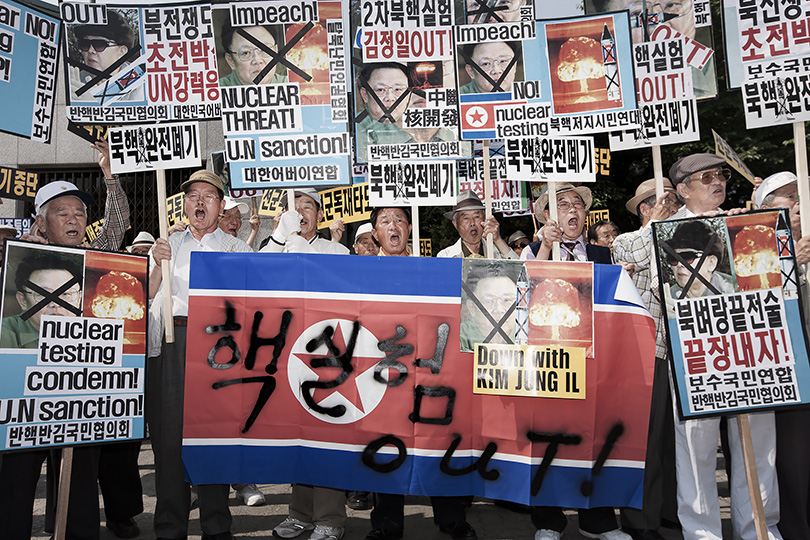
Both The
strAnge ball and State of Emergency focus
on the unfortunate events that occurred in Daechu-ri, Pyeongtaek in 2005 and
2006. Following the prolonged negotiations between Korea and the United States,
and ratification by the Korean National Assembly, some U.S. military bases were
relocated to Daechu-ri. The residents who had lived in Daechu-ri for
generations were evicted from their homes and farms overnight. Most of the
residents were farmers who knew no other way of life, so they intensely
resisted the seizure of their land. But they could do little to oppose the
Ministry of Defense, which automatically dispensed compensation for the land
through the court system and then put up wire fences around the seized
properties.
The government came in with forklifts to uproot crops and throw the
residents out. When the farmers resisted by tying bands around their heads,
standing in lines to guard their land, they were labeled as ‘seditious’ to
society due to their ‘frontal attack on governmental authority’. Since the
Korean War, many of the residents’ had arduously struggled to create tiny
patches of farmland by painstakingly digging out the flats, hauling and
spreading fresh dirt, and removing the salt with their own hands. Through their
long struggles, they had finally succeeded in turning the tidal flats into
rich, arable land, so it was little surprise that they fought tooth and nail to
hold onto it.
But
their tiny, isolated resistance proved futile against the massive united front
of the military and police. On May 4 and 5, 2006, soldiers and police swarmed
into Daechu-ri and arrested 600 people. Unbelievably, to combat a handful of
farmers armed with bamboo sticks, the government sent a fighting force that
included more than ten Blackhawk helicopters. Hired mercenaries and a battalion
of engineers attacked and demolished the village with forklifts and bulldozers.
Ironically, May 5th is National Children’s Day in Korea. While children in
other parts of the country were gleefully smiling with presents, children in
Daechu-ri watched helplessly as their fathers and uncles were brutally beaten.
Such is the separation that divides our world. A month later, the whole
incident was forgotten as our nation turned its eyes to the World Cup in
Germany, enthusiastically cheering on the ‘Red Devils’ for the Korean team at
the top of our lungs.
How
would Noh Suntag choose to photograph this type of environment? If he was a
straightforward documentary photographer, he would have taken photos of the
abhorrent violence of the state, the impotent rage of the righteous farmers,
and the tear-filled eyes and shocked expressions of the innocent mothers and
children. Then we could have fully indulged in our anger, and perhaps shed
tears of our own over the photos.
Of course, such straightforward documentary photos have always been part of
Noh’s oeuvre. They were included in his past works, his present works, and will
continue to be included in the future. However, most of the photos from The
strAnge ball and State of Emergency do not evoke our
empathy. They almost seem to be freeze-frames taken from the most bizarre scene
of the darkest comedy. Images of explicit violence or tragedy rarely appear. In
fact, it is not even clear who is the assailant and who is the victim.
Looking
at these photos, we would have no idea what really happened in Daechu-ri. All
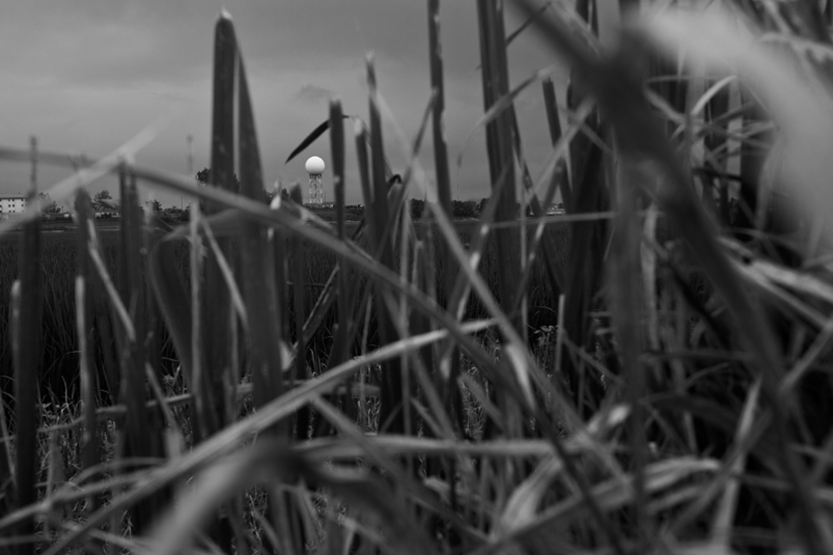
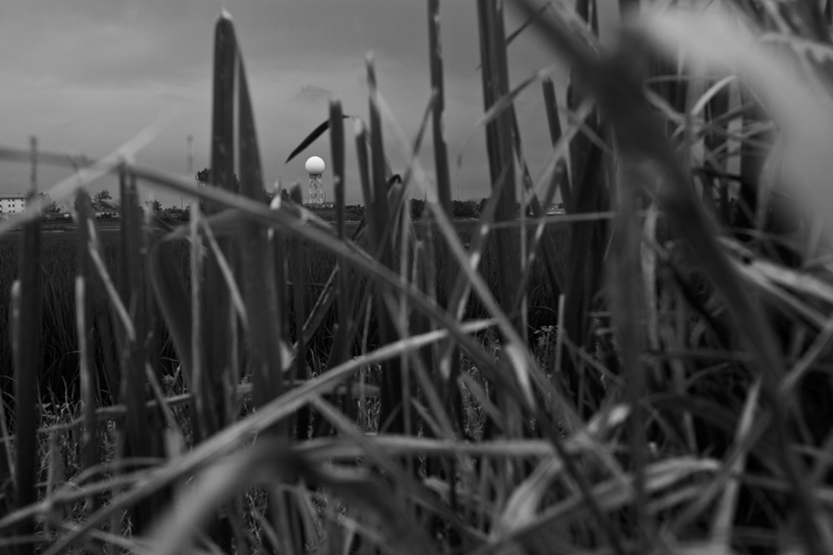
we could see is grotesque, bleak scenery. In The strAnge ball,
a round radar tower silently watches us from a distance, like the
moon. In State of Emergency, combat police
glitter and shine in the light, like a swarm of crustaceans. The farmers
besieged and knocked down by the police look so distinct that the whole thing
seems to have been theatrically staged.
For The
strAnge ball, Noh Suntag took a ‘roundabout’ way. Hovering
across the land, he took photos of the quiet countryside of Daechu-ri, always
sure to include the ubiquitous ‘Radome’ (radar + dome) of the U.S. military.
The resulting images are a distinctive mix of traditional Asian ink wash
paintings, with a theatrical touch. With his wife and young daughter, Noh
falsely registered as a resident in Daechu-ri and opened up a photo studio
there.
As a social activist, Noh takes portraits of the elderly to be used as
their funeral photo, and as a journalist, he trembles with rage while pounding
out sentences filled with incendiary curses and criticism. Strangely though,
once he gets a camera in his hands, he prefers a more ‘roundabout’ attitude.
With his characteristic self-deprecating manner, he grumbles, ‘this is not the
time to whine about the ball in Daechu-ri’. He makes excuses for his
‘roundabout’ way, saying, ‘The story of my photos begins with the white ball,
but I hope it finds its way to the farmers of Daechu-ri, who had lived a tough
life under the white ball’.
Maybe
Noh Suntag felt distressed. Although these photos resemble conventional
documentary photos, they are clearly meant to function in a completely
different way. Documentary photographers are typically guided by two
fundamental beliefs: that it is possible to capture the ‘truth’ through
photographs, and that photographs have the power to inspire people to act. By
carrying out these beliefs in reality, documentary photographers are practicing
their own brand of ethics. They seek to invade the complacent minds of people
who are comfortably ensconced in the narrow layers of their everyday lives. The
ultimate ethical goal of such photographers is to arouse our anger by forcing
us to look beyond our own peaceful lives and to unite against the disconnection
of the world.
However,
Noh Suntag’s ethics are much more complex and entangled, because they revolve
in two different orbits. Like most photojournalists, he is ethically driven to
document incendiary actions and events so that they can be seen by more people.
Guided by these ethics, Noh routinely rushes to various sites and takes his
camera directly into the conflict and the mud-flinging. At the same time,
however, Noh feels the ethics of an artist who incessantly doubts his own
actions and questions the limitations of photography as a medium.
Can
photography record reality of life? Isn’t photography just another tool and
excuse for remaining oblivious, causing us to remember only those fragmented
scenes we see in captured photograph? Is it really possible to understand
others’ lives simply by viewing photographs from our own safe perch? In truth,
don’t people just want to be emotionally moved by images? Can you really
believe what you see in a photograph?
These
doubts are hopeless. Yet, they have not been resolved, and they never will be.
It is this critical mind for probing the limitations of photography that makes
Noh Suntag an artist, but that mind is constantly at odds with Noh Suntag the
photojournalist. Indeed, it is this complex and even vicious ethical compulsion
that makes Noh’s works so captivating. Overall, the work of artists who are
driven by some ethical compulsion is generally more interesting than that of
artists with no such compulsion. This distinction goes beyond ‘boring’
explanations such as the social responsibility of art or the artist’s duty to
engage with society; it can be attributed more to the simple fact that the
works of artists with an ethical compulsion are usually much more peculiar.
Ethics
have a very powerful effect on works of art. If artists are completely immersed
in some ethical pursuit, their works tend to be rather boring and fragmentary.
But those artists who are driven in multiple directions by conflictive ethical
compulsions, who refuse to give up on any of their beliefs, often create works
that are bizarrely and often beautifully distorted.
The
beauty in Noh Suntag’s photographs comes from such conflicted ethics. Despite
the fact that he is addicted to photography, he simultaneously thinks that
photography should not be believed. Accordingly, he tries to keep people from
carelessly empathizing with his photos. Thus, he subverts the aesthetic
sensibility of conventional documentary photography, which emphasizes our
universal humanity and relies upon our ability to empathize with people whose
lives are very different from our own. Of course, Noh does not want his
photographs to serve as mere propaganda, subjugated to political and ethical
purposes. After all, as an artist, he must continually produce new aesthetics
and beauty.
Perhaps this is why Noh’s photographs of highly combustible sites have a beauty
that can only be described as chilling. As the gravitational pull of his social
ethics becomes stronger, he must overcompensate towards beauty in order to
avoid being dragged along. For example, Noh’s photographs from the
series, Namildang Design Olympic, which were
taken at the actual site of a crisis where people’s lives were being threatened
right before his eyes, have a desperate beauty, which is not present in
his Oh Bu Ba series with images of parents
and children. At the same time, however, the photos of Namildang
Design Olympic are much more inconsistent. While some of
them resonate with a transcendent, ominous beauty, others fail to escape the
gravitational pull and are thus no more than ordinary journalistic photographs.
With
his keen eye and sharp framing, Noh captures moments that reveal the awkward
and ludicrous bare face of the state, with its violence and contradiction. This
unsightly face is bared not only in news media, but also in museums. Repeatedly
murmuring the same questions, the artist Noh Suntag finds himself on an endless
treadmill. By now, every photographer is familiar with the writings of Susan
Sontag and John Berger, so they must certainly reflect on whether photography
is indeed ethical. But Noh seems particularly obsessed over this quandary. Most
photographers are able to reach a prompt conclusion with regard to the ethics
of photography. They either give up photography altogether, or become an
“artist” who freely experiments with aesthetics and the limitations of the
medium, and finally some become a documentary photographer who prioritizes the
need to inform the world of suffering.
Once
you have truly suffered from something, you cannot suffer from it again. Of
course, throughout your life, your thoughts might return to the heated problems
and questions that made you suffer, but they have already been settled. A minor
fever at an early age serves as immunity against more serious fevers in the
future. But Noh Suntag seems unable to get past his suffering. He seems to be
in a constant state of fever as he takes his photographs. He is in a perpetual
state of hesitation, hovering around the sites and shuttling back and forth
between art photographer and documentary photographer. In the midst of such
deep-rooted fever, the clichéd criticisms of documentary photography—‘If your
photographs aren’t good enough, you’re not close enough’—are merely empty
words.
As
mentioned above, I once wrote that Noh Suntag represents the pinnacle of what
Korean photography can achieve in its history, and I still believe this to be
true. There has never been a photographer like Noh Suntag, and there will never
be another one like him. Indeed, who would ever want to burden themselves with
the weight of his problems and predicaments? I also wrote that he was doomed to
wander and hover forever. In truth, anyone who refuses to surrender to
deception must wander. After so long, why would he now suddenly pretend to be
fooled by photography?
4.
Returning to Sneaky Snakes in Scenes of Incompetence,
we must consider the strangeness of the photographers who appear in Noh’s
photographs. Unlike the typical portrayal in the media, these photographers are
neither aesthetic nor heroic. They are often captured in ridiculous poses as
they maneuver for the best angle for their photograph. Of course, they
immediately strike the viewer as possible self-portraits of Noh Suntag, so
looking at them might make people feel a bit melancholy. The grain of these
works is quite different from that of Noh’s other works. Previously, Noh has
gone to great lengths to remind us that he is just on the other side of the
framed image, that he is not an impartial recorder, and that even photographs
documenting actual sites can lie and distort reality.
On the other hand,
in Sneaky Snakes in Scenes of Incompetence, he objectively presents
scenes of the moment when a photograph is produced, and forces us to
contemplate the strangeness of such moments. While his previous ‘roundabout’
works chart the limitations of photography through political scenes, these
photos describe photography directly, as if to encourage us to recognize the
inherent flaws with his previous on-site photographs. He is reminiscent of a
restaurant owner specializing in the Korean dish ‘sun-dae’ (pig
intestines stuffed with various ingredients), who eagerly grabs a disinterested
person and tries to give the gritty details of how the dish is made. It is as
if he wants to say, ‘Now that you know how it is made, can you still savor it?’
As such, the series seems to provide further evidence of Noh’s habitual doubt.
By
continuing to photograph even while openly doubting photography, Noh is
demonstrating the severity of his addiction to photography. Examining his
photo-essay Fur, I began to think that maybe
this doubt is what he likes most about photography. How fickle and capricious
photography is—but that’s what makes it so captivating! If he weren’t so drawn
to the doubt itself, then why would he continue to feverishly take photographs
and write like an addict?
For
an artist and photographer, one advantage of such an addiction is the sheer
amount of work one can produce. In photography, of course, it takes tremendous
effort and diligence to produce the huge number of shots needed to capture a
single moment of transcendence. While Noh’s photography operates very
differently from conventional photojournalism, he still benefits from the quick
hands and relentless work ethic of a photojournalist, which are rare qualities
in the art world.
Thus,
Noh will never become exhausted. So long as our disconnected and alienated
world continues to squeak with explosive bursts of social conflicts, Noh Suntag
will be able to run through the streets in hot pursuit. He will stay true to
his belief that he and his camera must wander due to the reality of the
division of the two Koreas, and he will continue to produce his bizarre but
beautiful photographs.
He
is not the type of person who can easily change. For example, in the preface of
his catalogue Oh Bu Ba (2013), he wrote
‘How strange it is, in Korea in the spring of 2013, to idly take photos of kids
whining for piggyback rides even as the fog of the nuclear war lingers in the
air’. He used almost the same wording in the preface for The
strAnge ball (2006), and this sentiment can be traced
further back to the worldview of Smells like the Division of
Korean peninsula (2004). In this belief, he remains as
stubborn as an ox, which sets him apart from the majority of Koreans who once
shared his feelings about the ‘reality of the division’ but now speak more
positively about ‘neoliberalism and globalization’ or the ‘structural
contradiction of capitalism’.
With
his stubborn consistency, the artist Noh Suntag will not be easily depleted.
Even if Korea were to be reunified, North and South Korea would quickly become
homogenized, and there would still be many world issues in need of our
attention. Now that the digital network allows photography to be distributed
and consumed at a lightning speed, both belief and disbelief seem to be
stronger than ever. All of this is ample material for the art of Noh Suntag.
The
question is, will the addict Noh be satisfied with such issues, or will he
continue to develop an increased tolerance, causing him to require more potent
stimuli? Could he ever really feel content taking the same type of photographs,
still rushing to the scenes with his gray hair? It seems somewhat ironic that
artists’ works usually change over time, because our thoughts and minds do not
change as much. Looking back, Noh’s photography has actually changed quite a
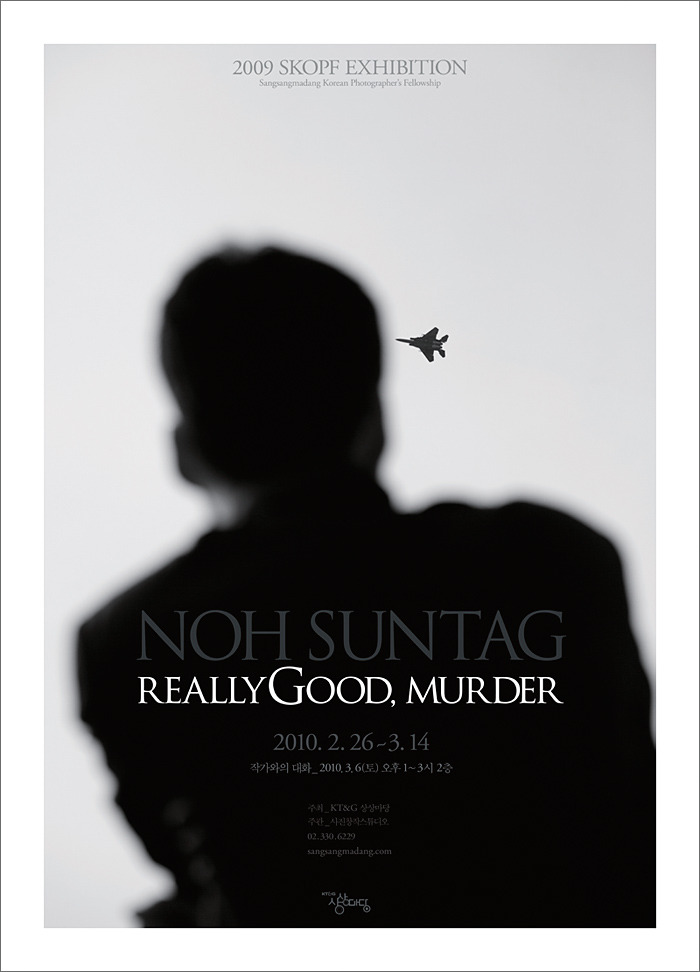
bit. In the wake of his series ReallyGood, Murder (quick
and sharp snapshots) and The Forgetting Machine (his unquestionable
masterpiece), he is not as playful as he once was. The tones and colors of his
photography have become lighter, and the dark humor of The
strAnge ball and State of Emergency are
nowhere to be seen. His most recent photography looks much more morose than
ever before.
Sneaky
Snakes in Scenes of Incompetence may be a card that he kept
up in his sleeves for a long time. But how many more cards does he have left?
After directly exposing the strange and uncanny nature of the act of taking
photographs, what is left for him to show us? Of course, Noh will not stop so
easily. Like any great card player will tell you, the real game begins when you
have no good cards left in your hand. Likewise, real travel begins when you
have nowhere left to go, and true addiction starts when you could not possibly
be any more addicted.
Originally,
I thought I would conclude this article by sharply rebuffing those
critics—myself included—who have commanded Noh to continuously advance in terms
of both form and content. Such things are easy for critics to suggest, but is
there really such thing as continuous advancement? Does any critic really
believe that such a thing is even possible? Critics simply love to point to
some ephemeral examples, like the Russian avant-garde, as evidence of such
moment, and then assume a haughty attitude in front of the artists.
But
in the course of writing, I changed my mind. If the artist himself wants it
this way, who I am to suggest otherwise? Noh himself is clearly addicted to
advancing the form and content of photography. So I say that we stragglers, who
quietly put down our cameras after reading Susan Sontag, should just silently
watch the ridiculous yet sorrowful back of the suffering artist, Noh Suntag.