Mire
Lee is on the opening of the 59th International Art Exhibition of La Biennale
di Venezia, curated by Director & Chief Curator of High Line Art, Cecilia
Alemani.
Lee
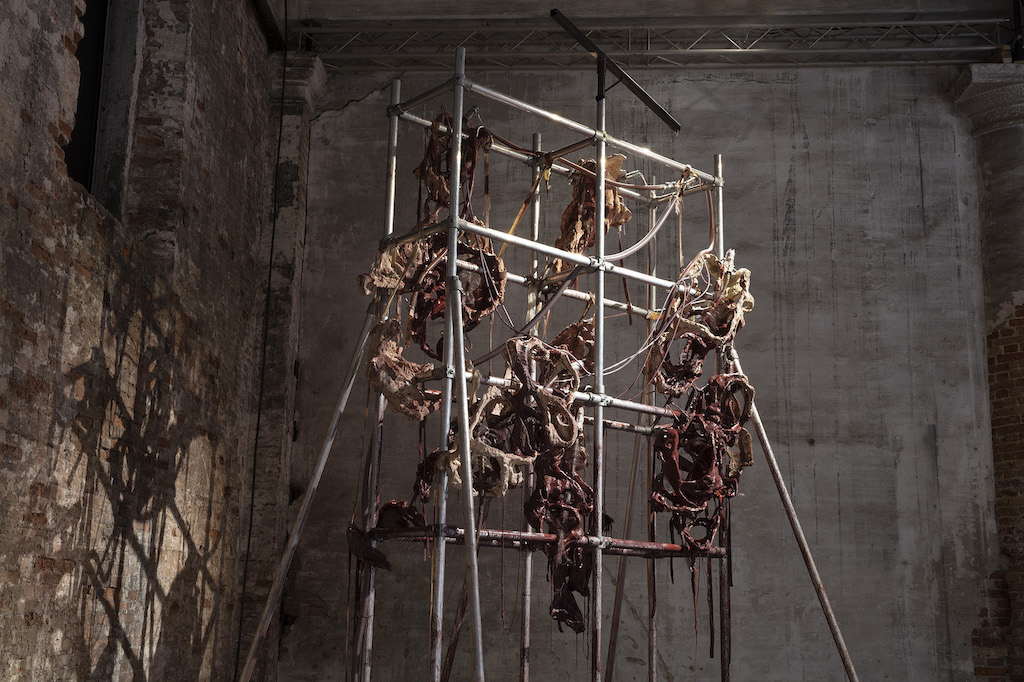
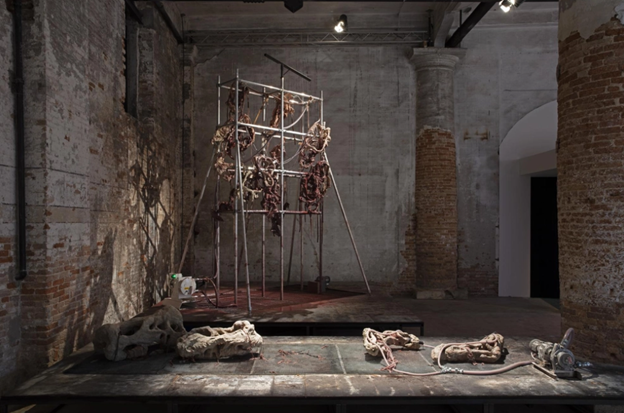
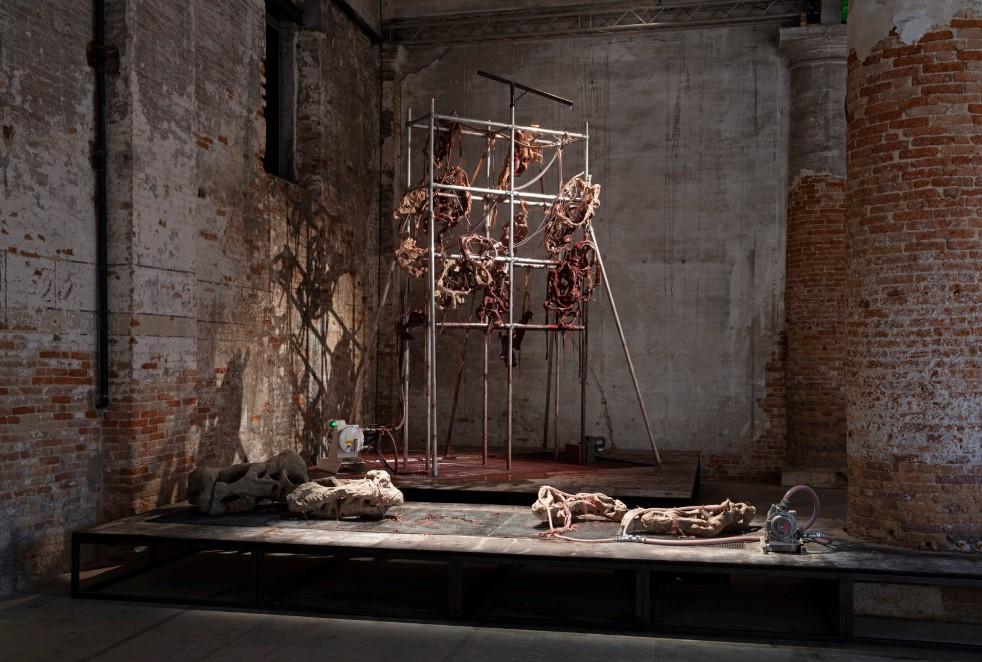
presents Endless House: Holes and Drips (2022) as
part of the 59th International. The work takes its name from the premise of
Fredrick Kiesler’s manifesto-like architectural drawings and models, exhibited
at MoMA in 1958-9, which offer a drastic, radical vision of reimagined
ecological thinking.
The Austrian architect, active in the Surrealist scene in
New York during the 1920’s, prized continuity, a pronounced endlessness that
involved spaces transitioning fluidly from inside to out, undulating light
without the sharp breaks of corners, and almost biomorphic spheroid forms that
emerged more clearly in Kiesler’s drawings than models.
Endlessness is defined
as a core condition of life in Kiesler’s attempt to think a re-worlding, a
proximate position to the marginal “lives” of Lee’s sculptures on view,
themselves the latest iteration of her ongoing Endless House series.
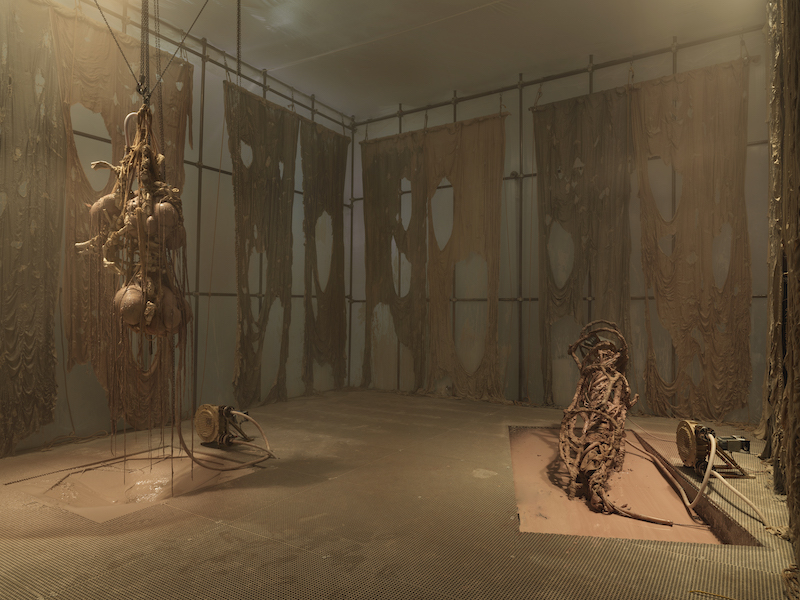
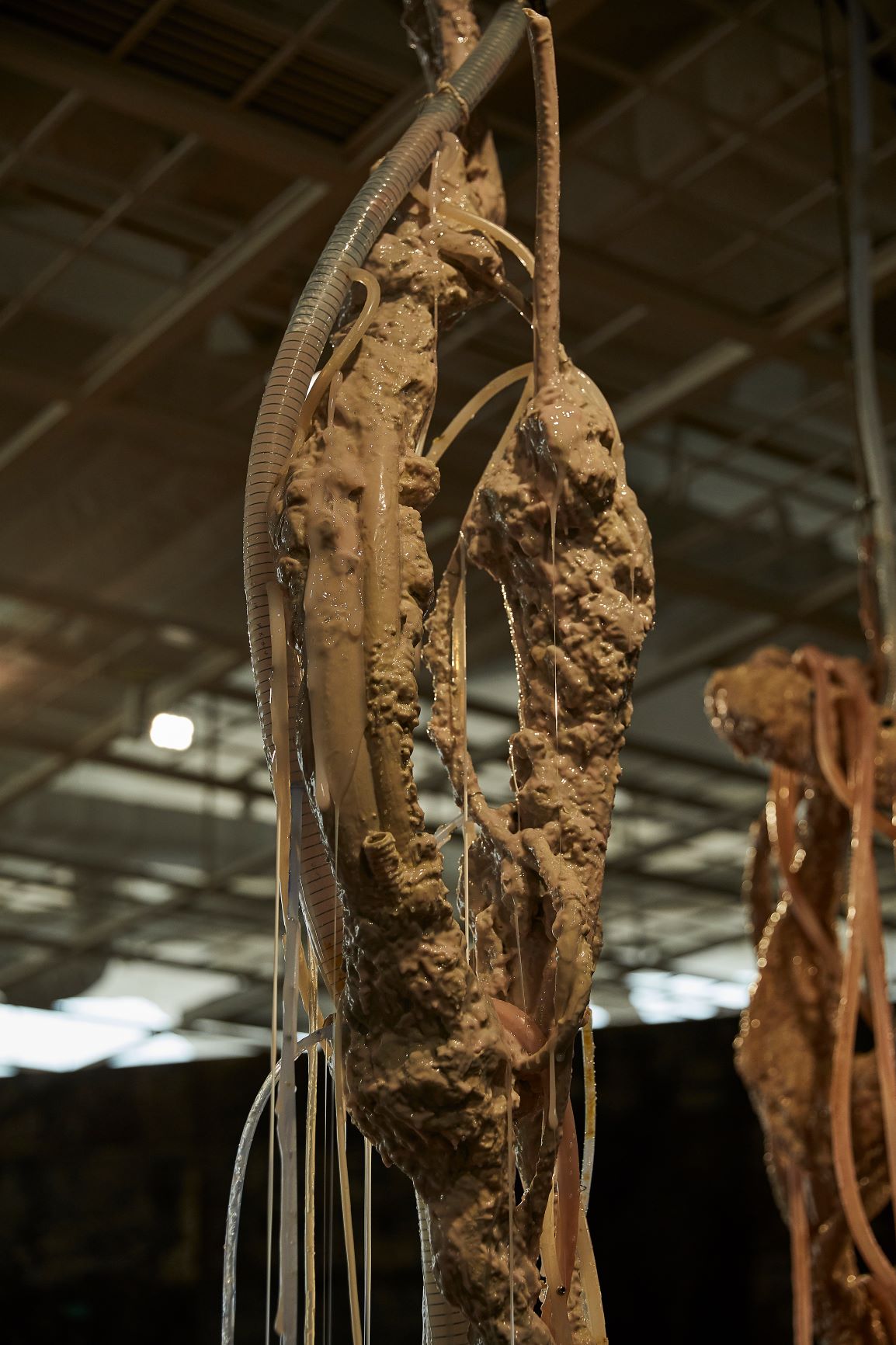
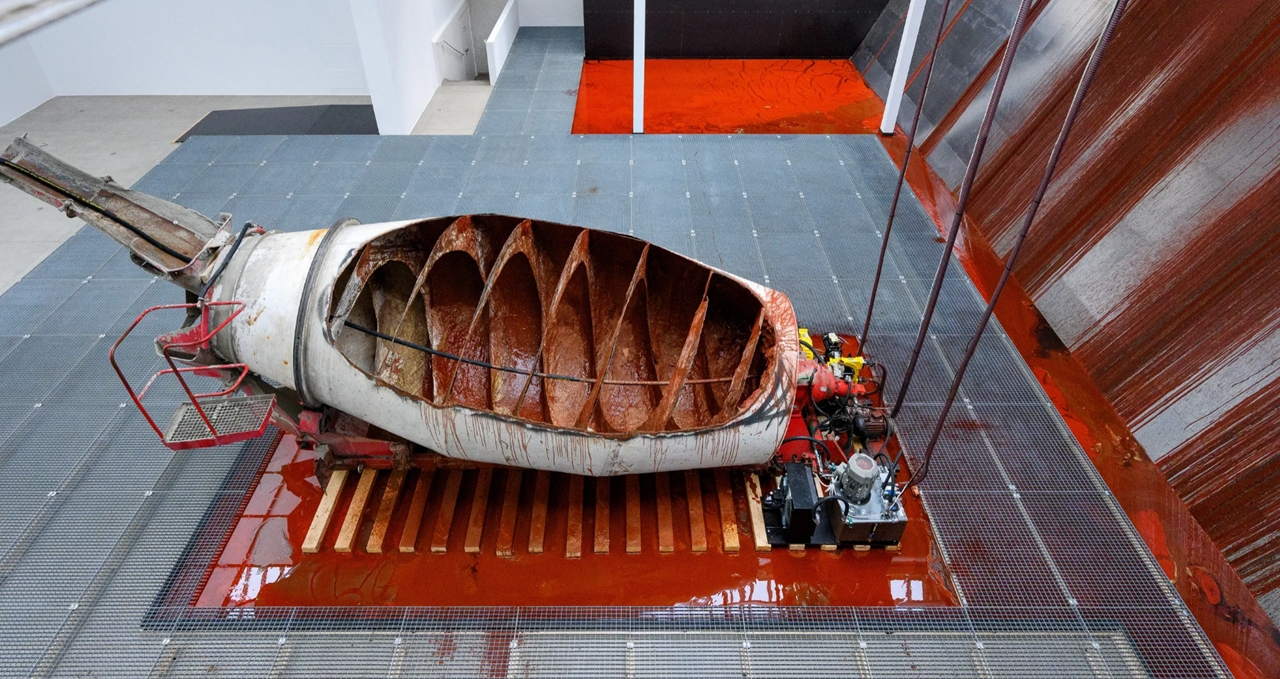
Lee’s forms evolve in state almost continuously - they undulate with rubber
tubes and motors, spitting liquids, in this case glaze, and sometimes contain
the recycled components of prior work.
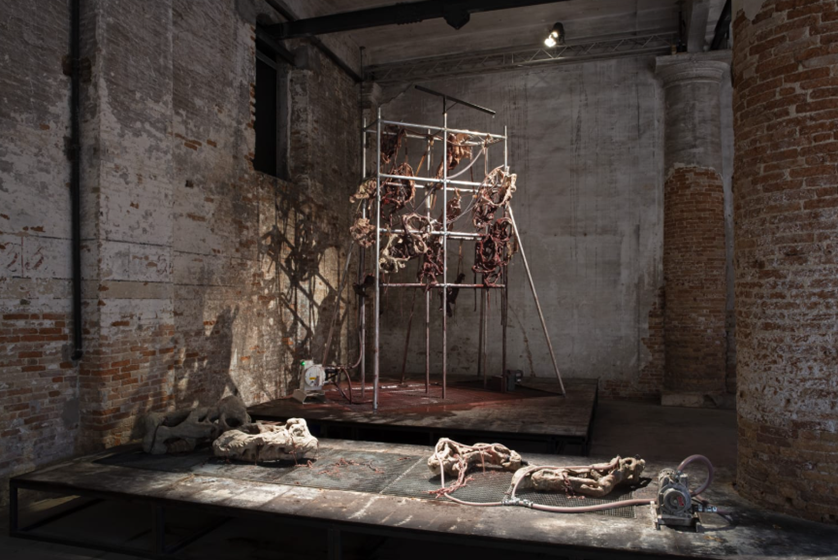
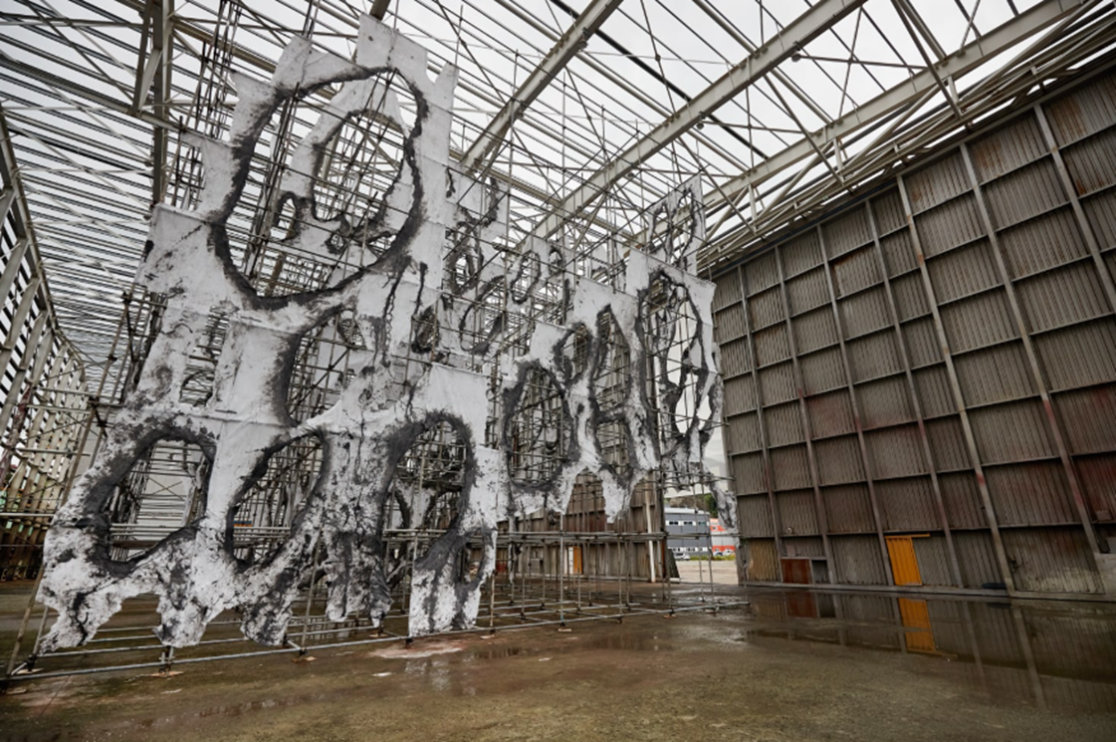
In
this current iteration of Endless House, glaze spurts over bisque-fired
ceramic pieces, tied with rope amongst a tall metal scaffolding, the sticky
liquid splashing into a metal repository below. Nearby, a pump akin to a
dialysis machine ensures a consistent flow of glaze. A form on the ground
writhes. Bisque-firing leaves ceramic brittle, yet hardened and a ready
recipient of glaze, which is applied before a final firing.
Endless House:
Holes and Drips exists in a liminal state, elongated throughout the
duration of the show - as time goes on, glaze will further accumulate over the
bone-like ceramic, until it is fired after the duration of the Biennale
exhibition.
In
the meantime, Lee’s alchemical forms hold on to the brink of their current
state, a sometimes agonizing elongation that is notable less in terms of the
technologies she uses to achieve her biomimicry but rather in the intense
affective responses her work offers. Lee has spoken eloquently on her
fascination with fetish cultures and taboo desire, particularly with vore, or
vorarephilia, a conspicuously violent, Utopic vision in which one desires to
consume another in their entirety.
While the desire is rooted in a relationship
to another, it conjures a grander wish for a shared, impossible experience, a
desire for continuity between self and other, inside and outside, through a
breaking of boundaries that it acknowledges would be necessarily violent.
Endless
House: Holes and Drips comes to its audience in fragments, constantly in
motion, accumulating new, sedimentary glaze without end: its relationship to a
grand form of violence is less clear, but in its partiality begins to fulfill
some of the leftover promise of both vore and Keiser’s own endless house, a
continuous state of becoming open and interlinked by being born into fragmented
openness. Lee’s work could be seen as growing its own skin without end by way
of a pump system normally used to sustain human life, echoing Keisler’s remark
that his own Endless House was “endless like the human body.”
That
the work will be later cast into a sedimentary form, left as a trace carcass,
is further evidence to its alternative relationship to time and the physics
which govern life as we know it, something akin to an ontological re-ordering,
a place with rules we can’t quite fathom and yet strewn with glimpses of the
familiar.
The
dawn of surrealism in the 1920’s, and Kiesler’s adjacency to its practices,
poses a counterpart context to the daily apocalypse of the world Lee’s
sculptures find themselves installed within, though her gestures are
intentionally flayed where a historical surrealist would perhaps lean into the
baroque. Kiesler writes, “the coming of the Endless House is
inevitable in a world coming to an end,” and yet Lee’s work demonstrates there
is no prized state in realization, only a glazing that looks forward, and a
fired shell which points backward, the house being truly endless, after all.