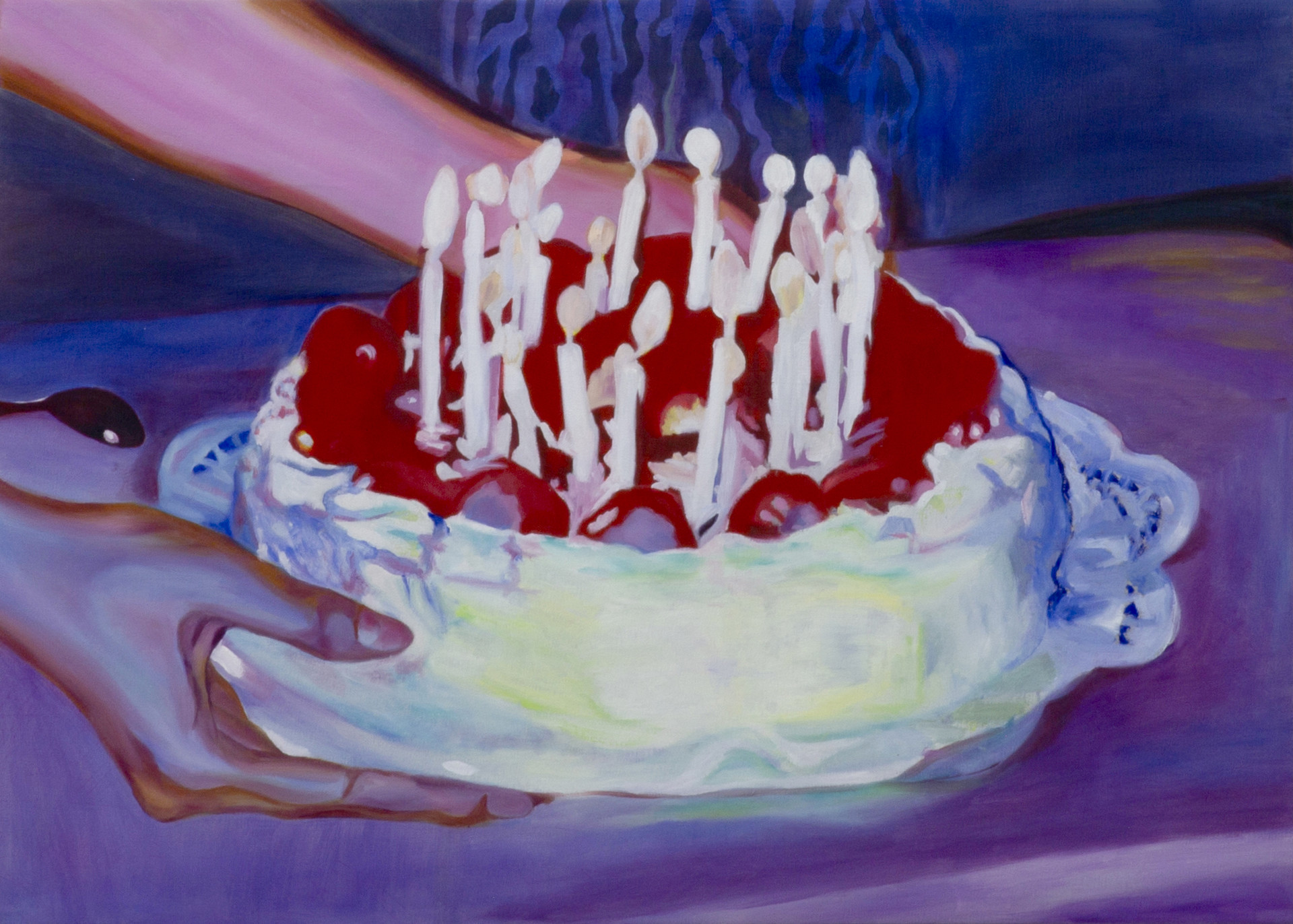
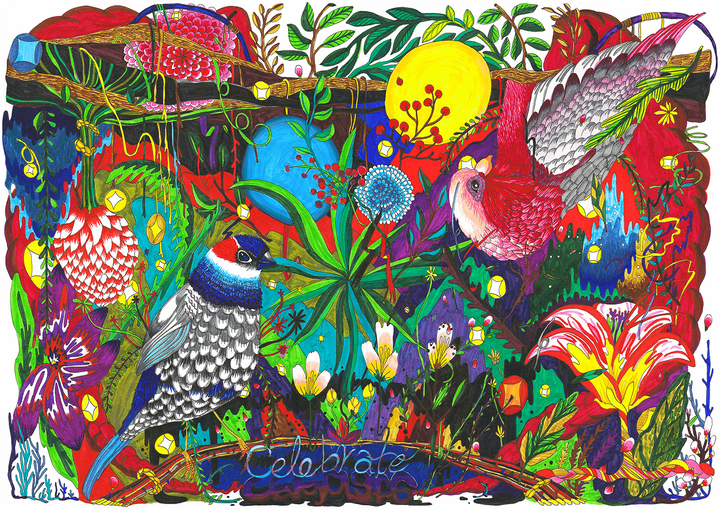
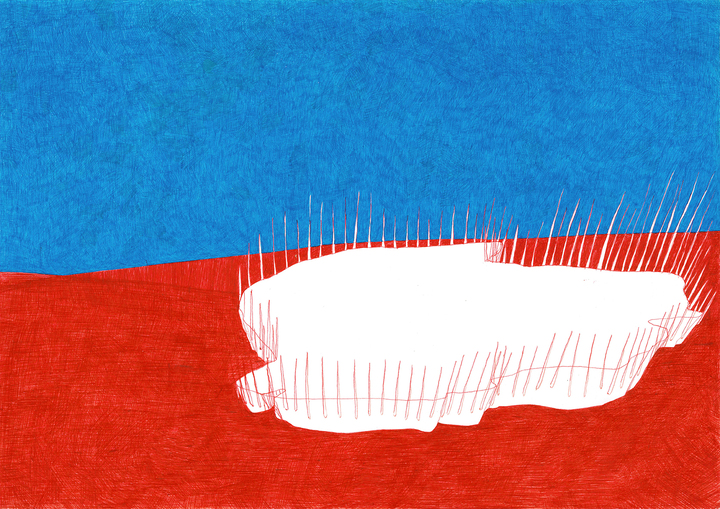
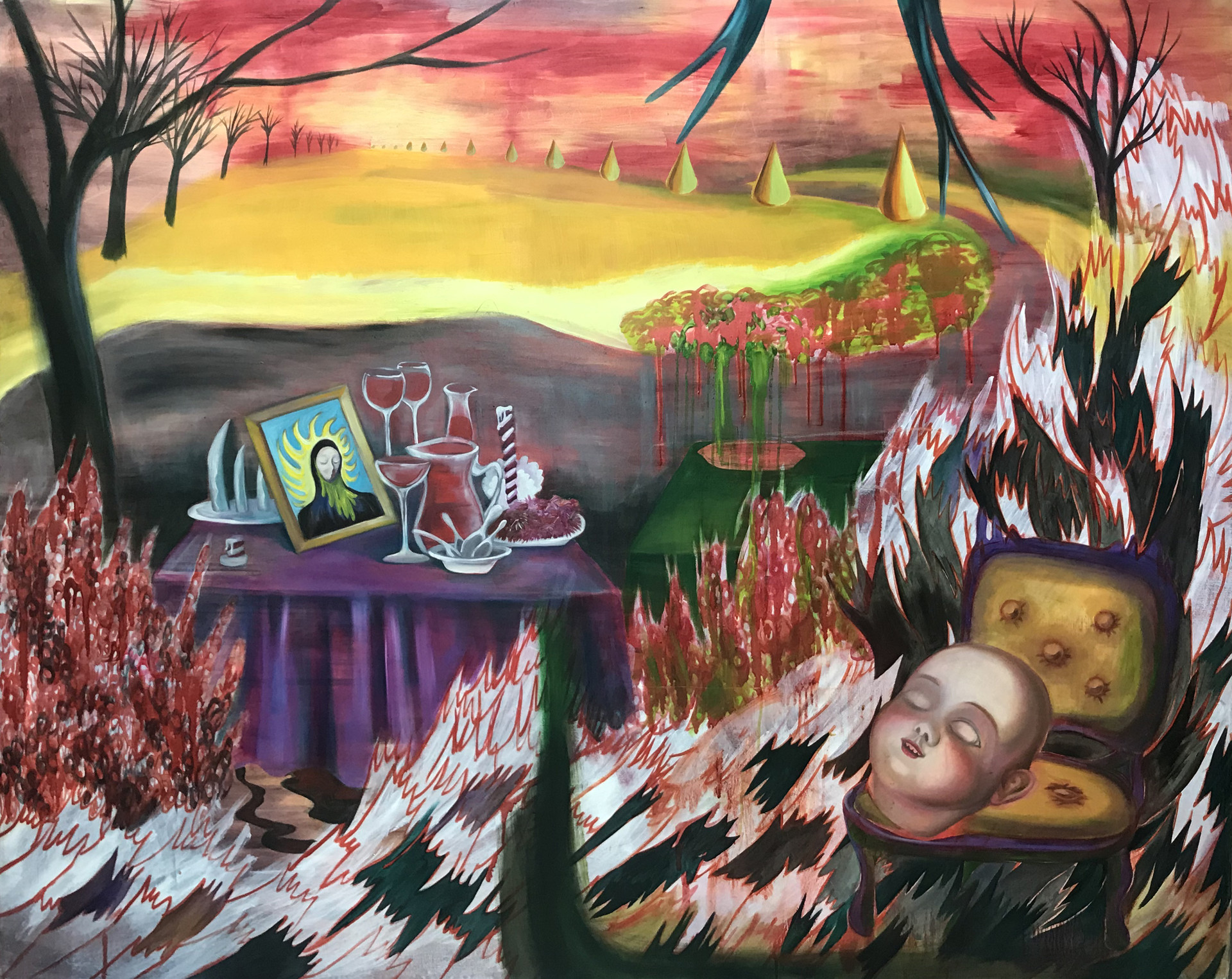
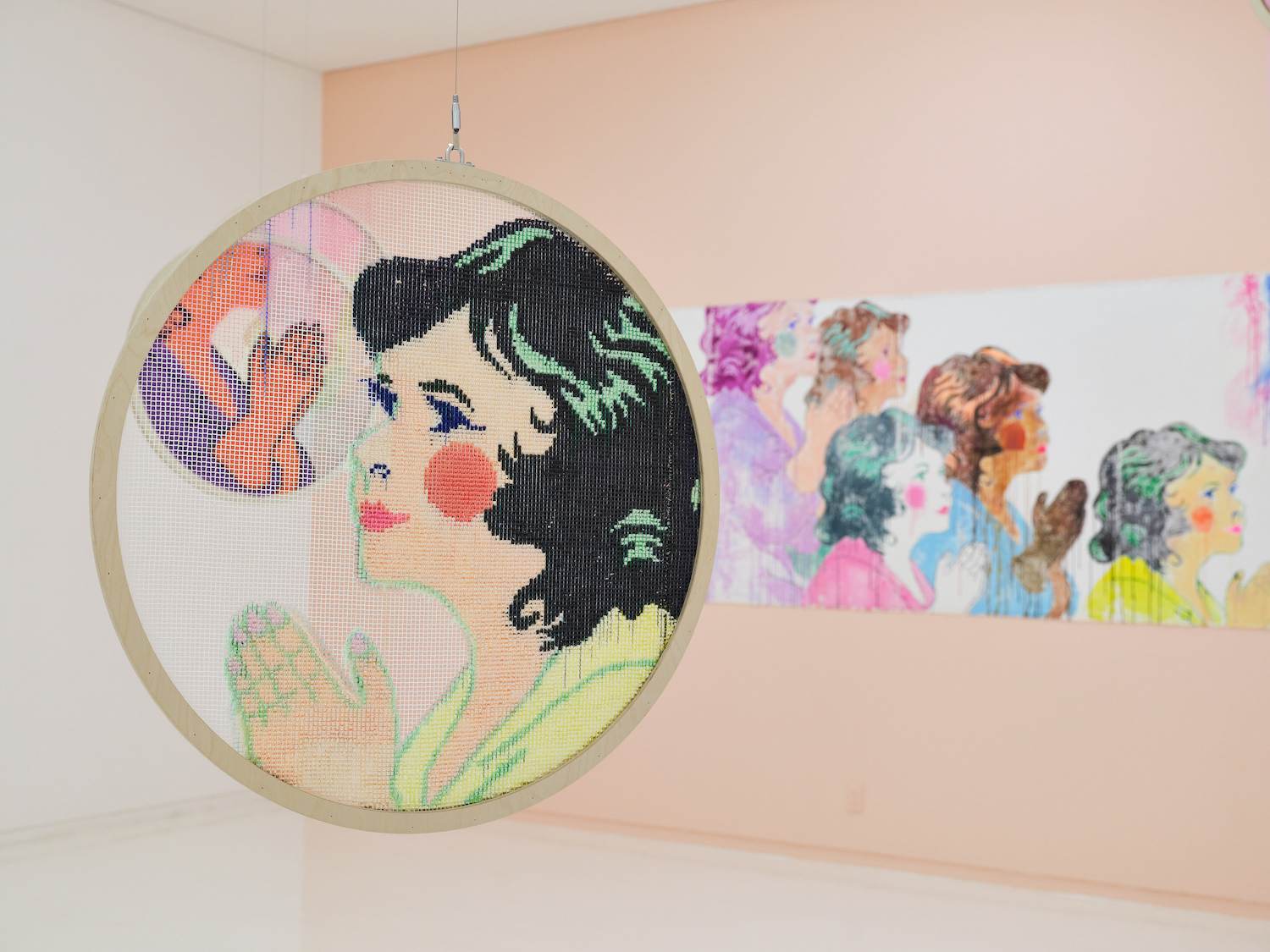
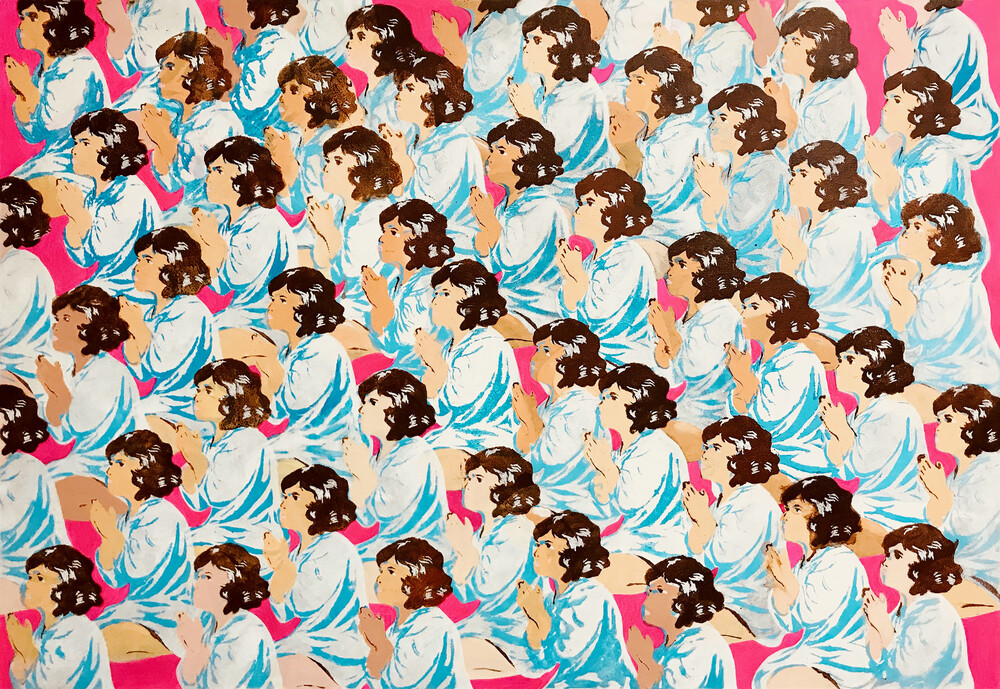
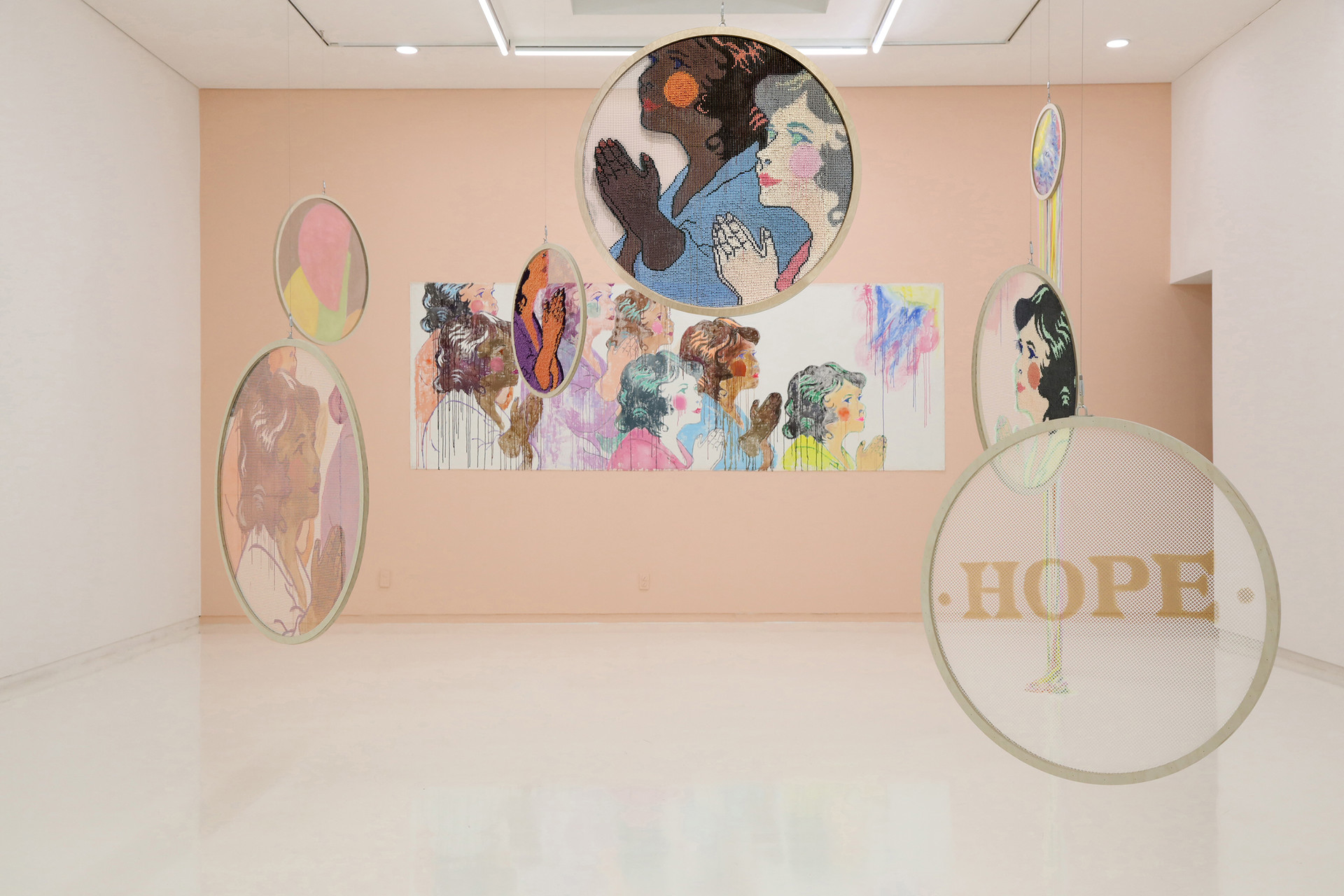
Kwon Bitsam paints emotions such as loneliness, fear, and anxiety felt in the relationship between oneself and others. The contradictory emotions that arise within the ambivalent structure between self-protection and mutual relationship are expressed as psychological boundaries within the artist’s own spaces on the canvas.
The psychological boundaries the artist paints repeatedly appear and disappear as they move through metaphorical spaces where inside and outside become ambiguous within overlapping times of darkness, such as mirrors, tents, fences, and doors. The complex emotions anxiously entangled between the desires that coexist within the self — the desire to enter one’s own world and the desire to form relationships with others — run through (2020), (2021), and (2022).
And these emotions circle around the deep layers of darkness that spread around small lights on the canvas. The vortex of emotions swirling within the artist is hidden behind submerged layers of darkness. And there is a gaze that encompasses these layers of emotion. The artist intends the gaze followed by a telescope, the prone back of a figure watching a departing boat, and the gaze of a viewer opening the outside(or inside) of a tent.
The artist places viewers in the position of observing the figures in the painting, while at the same time transforming them into objects of observation. A composition in which two owls looking around the exhibition space gaze at the viewer, the telescope observes the owls, and the viewer in turn gazes at the figure looking through the telescope appears repeatedly in Kwon Bitsam’s paintings.
The organic structure that connects multiple works through gazes applies equally to the “I” and “you” of this era, who protect their own worlds while not giving up on forming relationships.
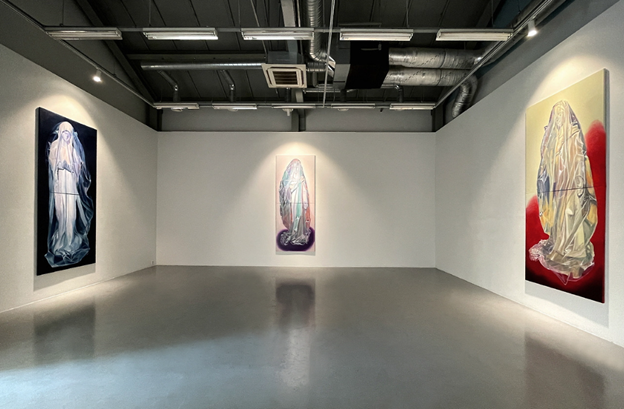
Kim Youngjin uses photograms as a medium, summoning abstract images captured through them, as well as the traces, memories, and emotions embedded in those images, and unfolds them before us. Unfinished Form(2021), made by folding articles on anonymous deaths that pour out daily on the internet into incomplete geometric forms and photographing them as photograms, and the Butterfly(2021) series, made by folding articles about children who died from child abuse into butterfly shapes and photographing them as photograms, project the artist’s mourning heart and actions.
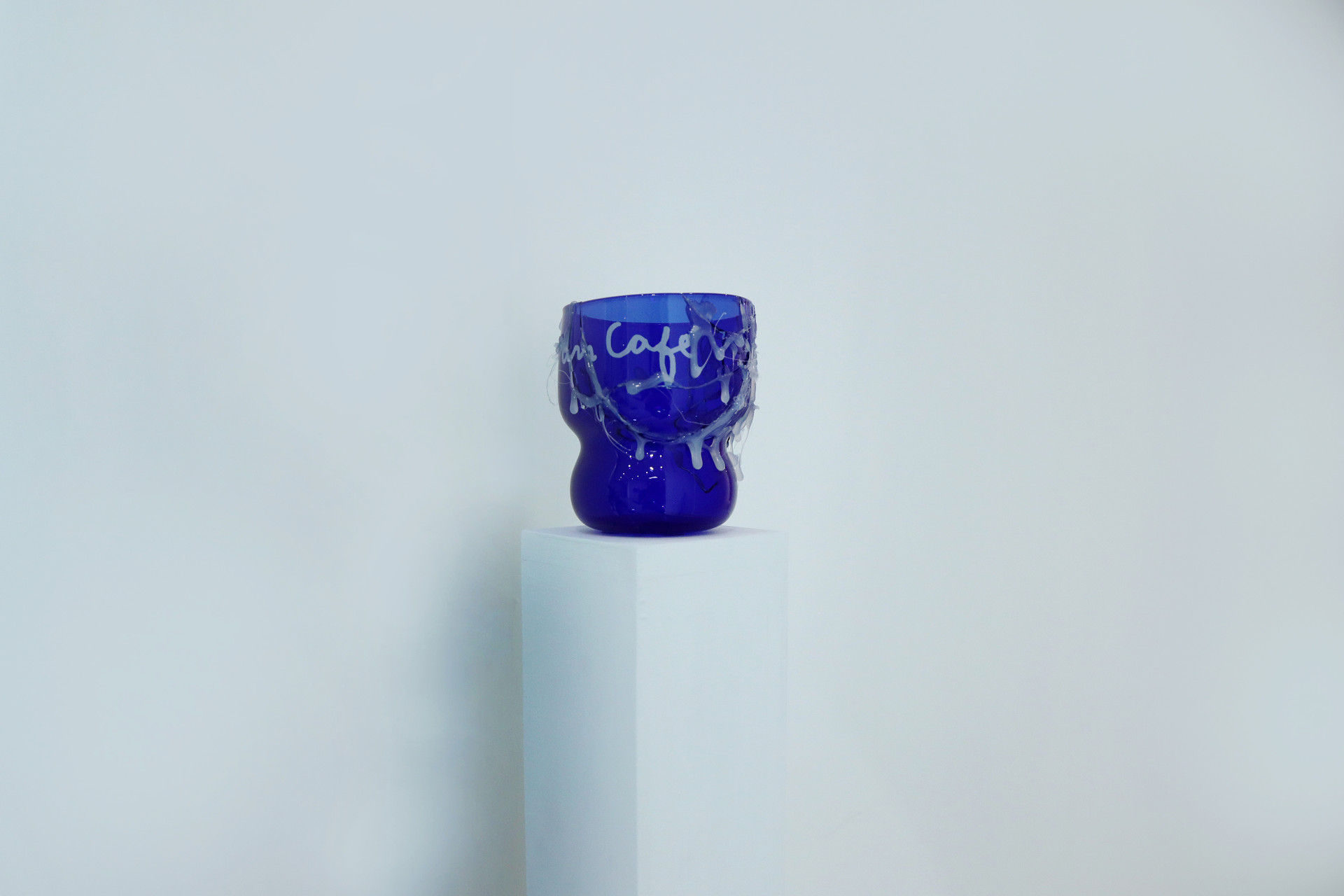
The artist, who once projected an island1 with a cup used by someone and the universe2 with glass fragments in the corner of an alleyway, now holds out online obituaries before us and tells us to look into them. The artist, who early on named fragile and forgotten things “transparent things” and placed them in her work, preserves the news of deaths that disappear so vainly.
Where do the emotions such as embarrassment, shame, and sadness that arise as one approaches the neatly arranged forms contained within clean black frames come from? One newly discovers that the beauty emitted by the contrast of darkness and light has seeped into news of deaths that have nothing to do with oneself, or may seem to have nothing to do with oneself.
Photogram, a process of photographing the light that illuminates an object and the shadow that arises from it, is far from works flooded with interpretation, representation, and symbolic images. The light that projects an object scans even the foreign substances and scratches inherent in the object itself without missing them.
Under that light, the artist maintains an intuitive and confident attitude, as if standing face to face with existence, and points to the current address of this era.
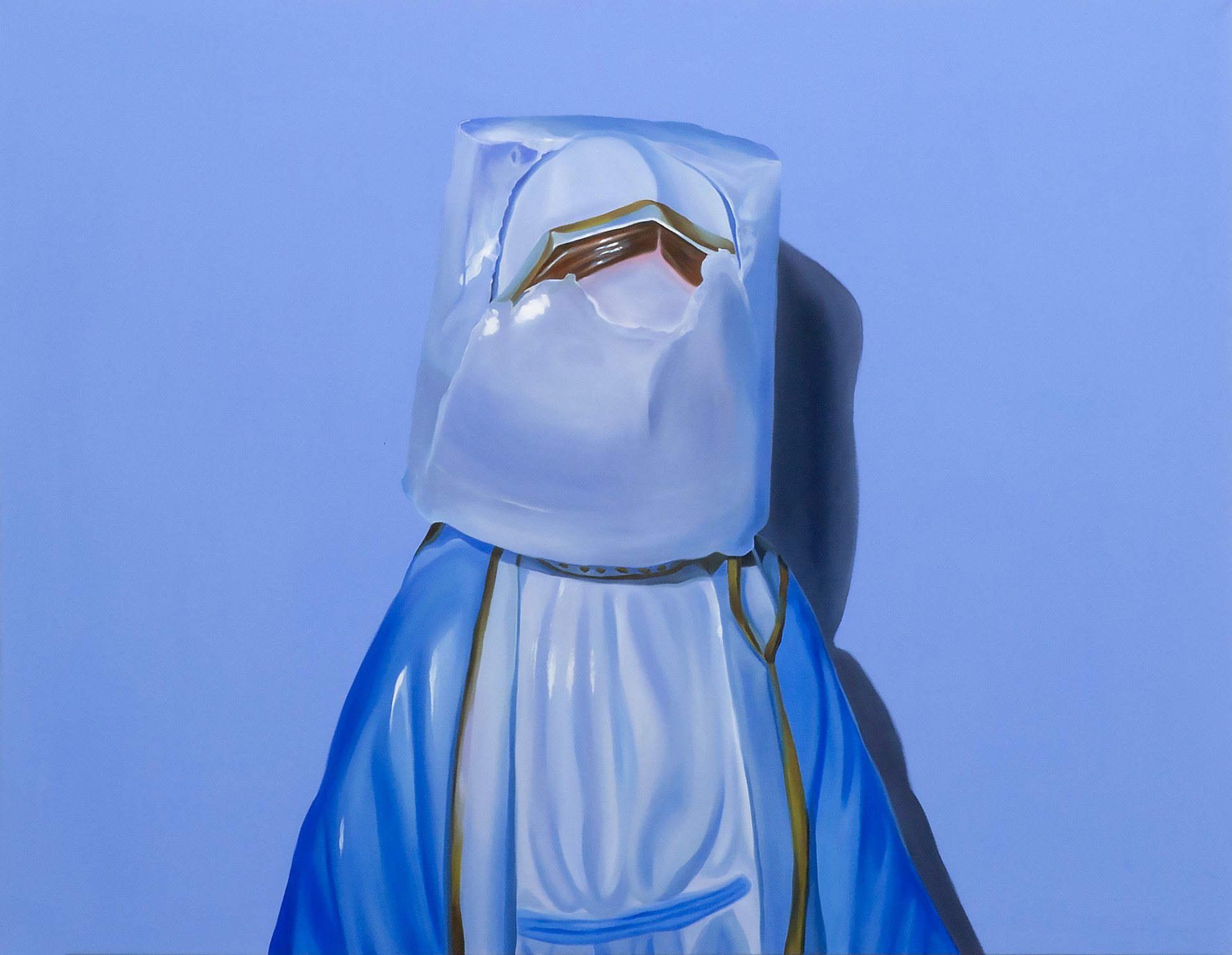
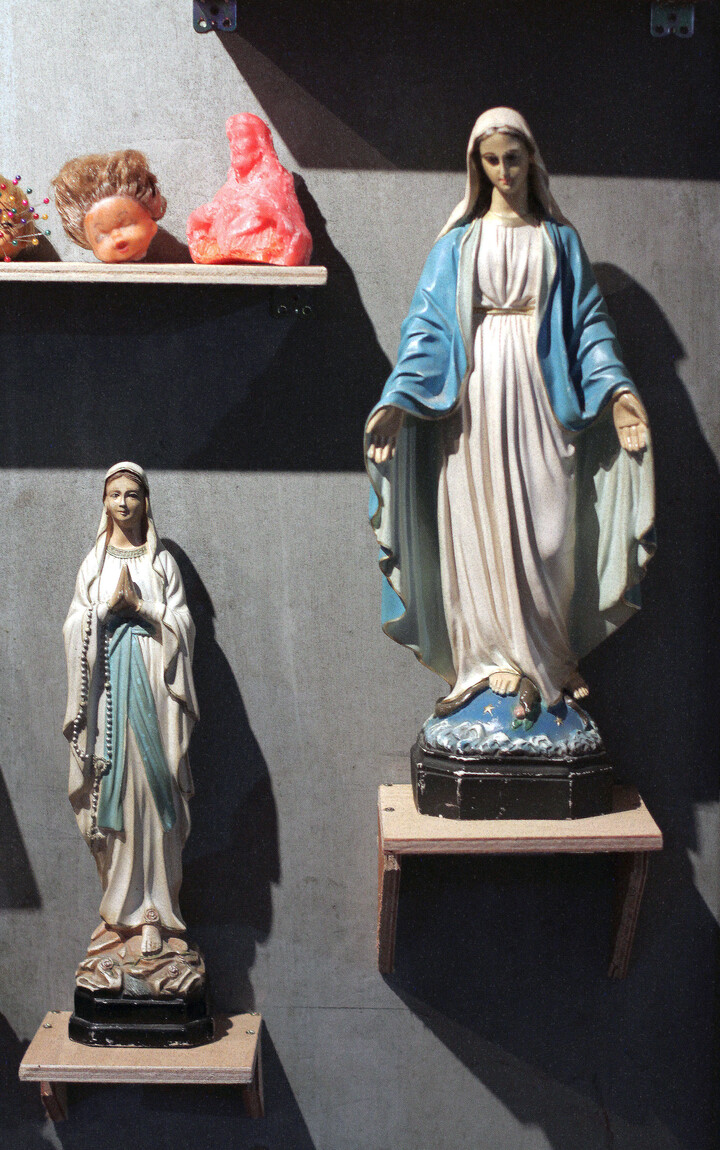
Kim Hanna observes things that have fallen away from the center and been pushed to the margins. At the ambiguous boundary between center and margin, the artist demonstrates a skill that makes us confused about what has actually fallen away from what.
The force that ambiguously disturbs center and margin, overturning the center into the margin and the margin back into the center, is revealed in plywood and timber pieces that are sharp yet contain soft curves. What the rough and incomplete pieces, which seem as if they might pierce the hand with splinters, hold within them are love, tears, seeds, and light.
In the process of recombining and rearranging the fallen fragments and covering them with sensuous colors, the artist grants them meanings and names that collapse the boundary between margin and center. Titles such as Bruise(2021), Wet Eyebrow(2021), Left Eye(2021), Right Eye(2021), and Gaze(2022) contain the artist’s distinctive sensory thinking toward the relationships among individual pieces.
And they assign roles so that the recombined works function as “something” or as “something that can show something.” In this respect, it becomes clear that the artist’s practice is grounded in an attitude of not doubting that what is clearly there exists even if it is not visible, and that what cannot be grasped by the hand certainly exists.
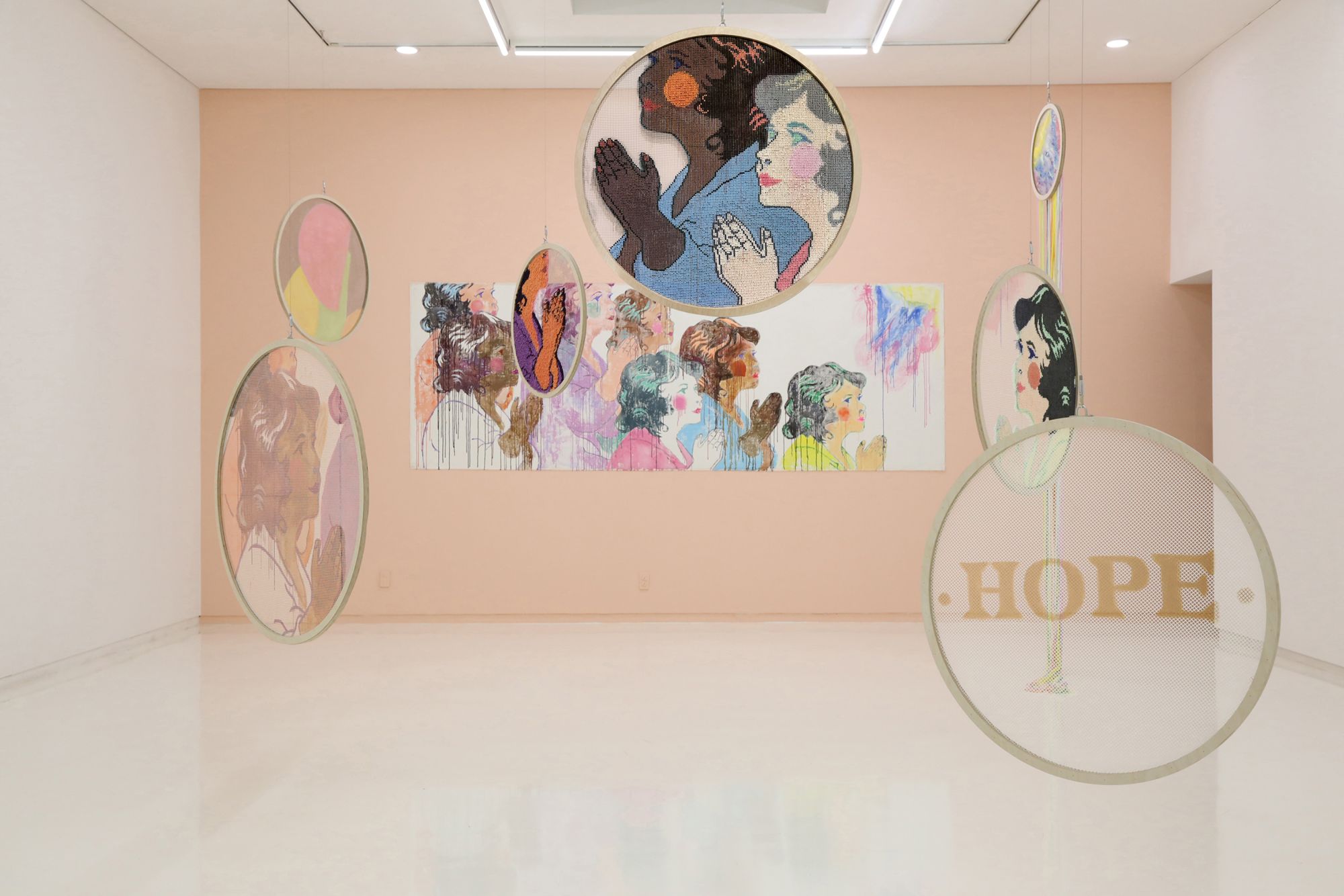
Pink Shade(2022) and Under the Pink Shade(2022), which are part of the recent works focused on “love,” also secure the uniqueness of the formative process and result by placing the artist’s critical concerns within the concept of “love.” Kim Hanna’s works contain a force accumulated in the process of connecting, combining, and generating, as well as an inherent will to break down boundaries in order to share that force. They seem to contain the portrait of the “young artist Kim Hanna” as it is.
Han Jaeseok visualizes by connecting through feedback the media that exist as individual entities within a mechanism. The artist uses feedback systems to show relationships between objects and objects, and between objects and humans, within digital mechanisms, and derives results through unpredictable interactions/feedback.
For example, Bouncing Ball(2022) reveals patterns created within an infinite feedback loop in which it is impossible to know which comes first or later, sunrise or sunset. It also leads us to imagine the reality hidden within it. In Mobilized(2022), one can witness the repeated process of opposing input-output being built into a system. The irregular repetition of on-off encounters between metal mobiles affects the entire mobile through vibration.
Sparks and sounds that occur when metal rods are connected(on), and the repetition of irregular feedback that occurs when they are pushed away(off), fill the exhibition space. (Please gently move the rods connected to the metal mobile and check the reactions that occur.) The two-way communication occurring between object and object gradually expands into feedback between object and human, and between human and human.
Feedback instantly expands into unpredictable variation taking place outside control. Feedback reveals its reality in various physical and non-physical forms, and Han Jaeseok’s work absorbs the viewer and the viewer’s environment itself into the mechanism of feedback. In this exhibition, Han Jaeseok fed back Kim Youngjin’s work, exhibited together on the fourth floor, as a sound work3, and digitally fed back4 part of the exhibition wall, bringing it back into the exhibition space.
The exhibition space becomes a world of feedback in which the algorithm repeatedly expands and reproduces itself. We will see how the feedback initiated by Han Jaeseok mediates all the entities that exist or drift within the exhibition space.
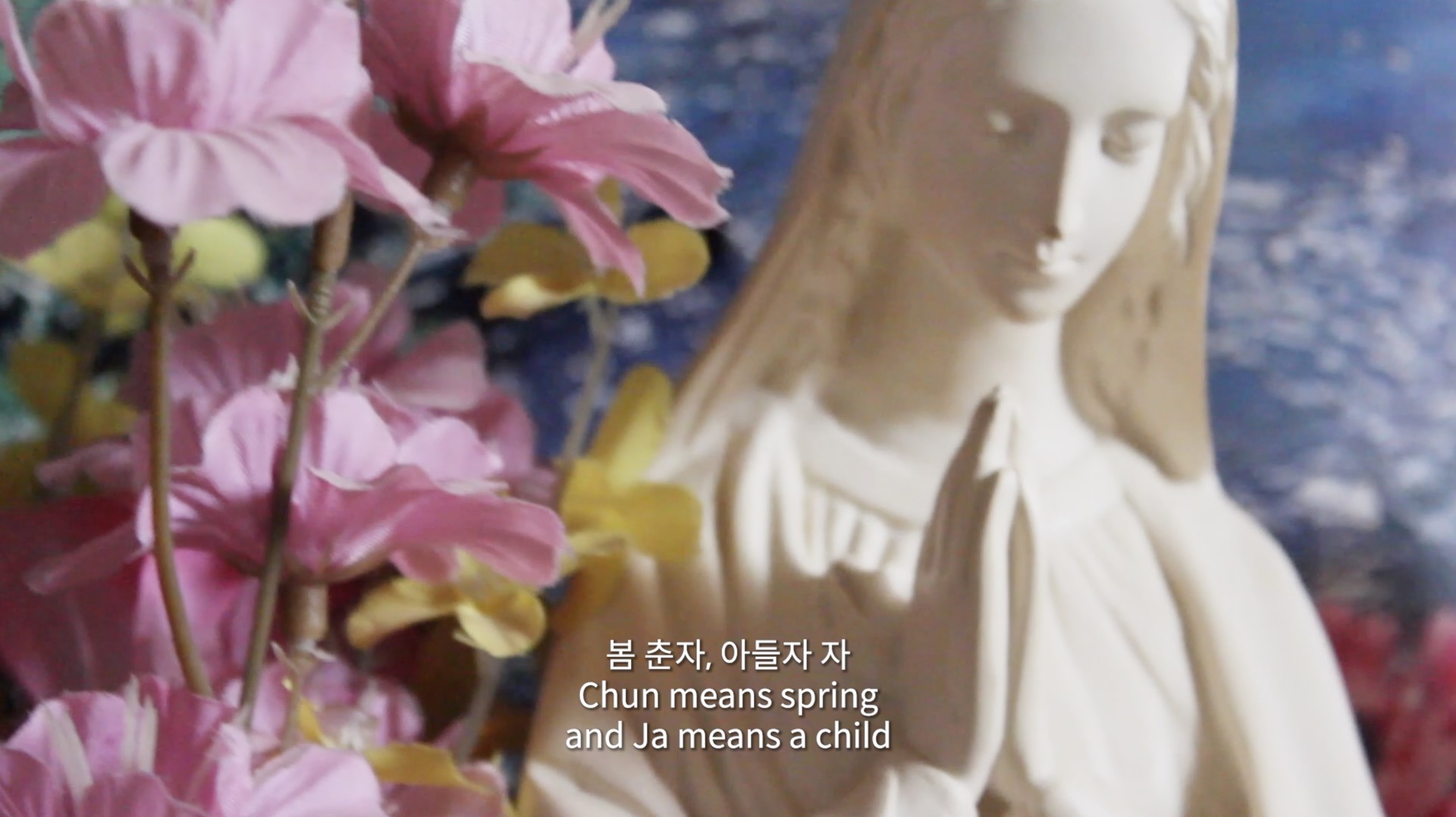
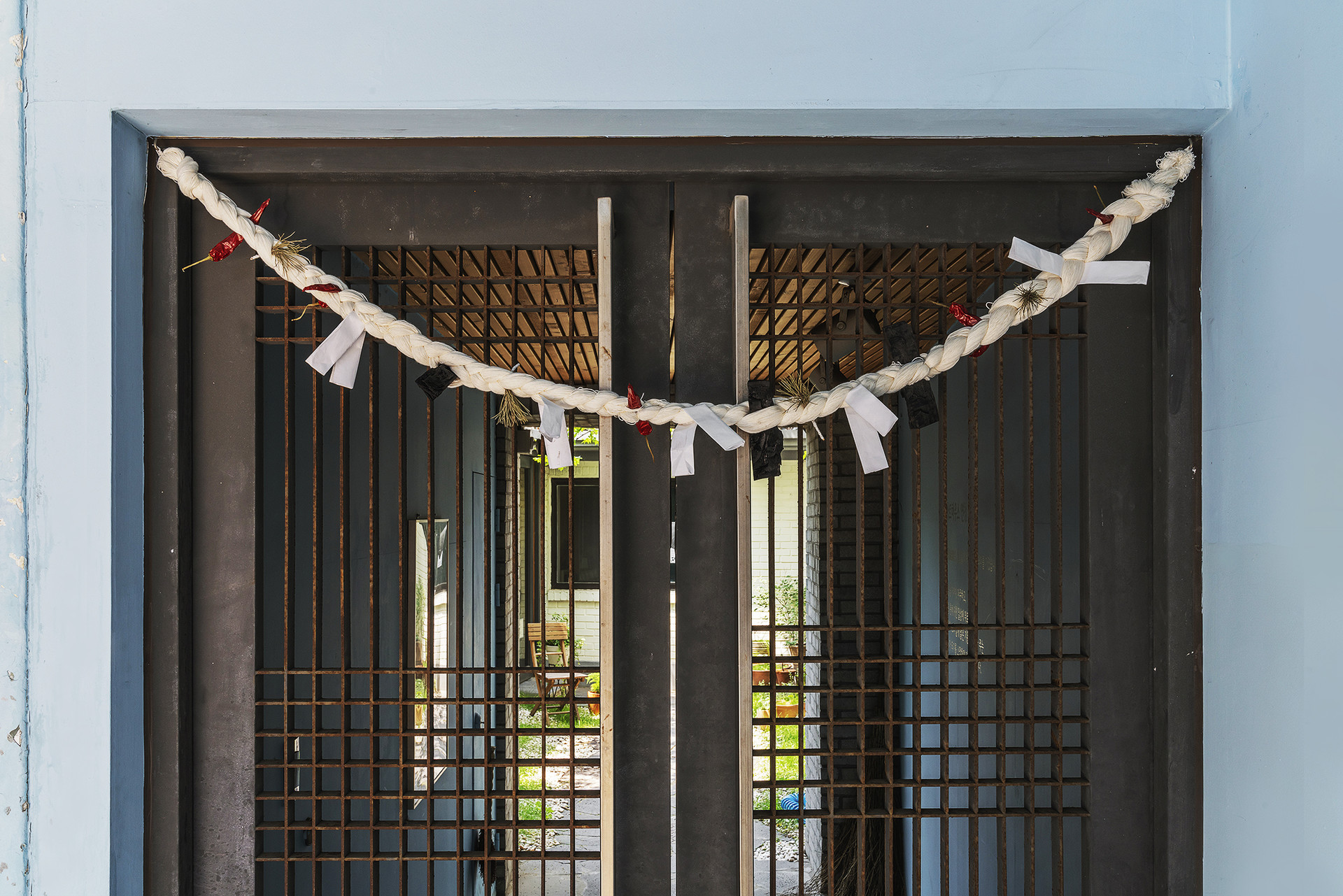
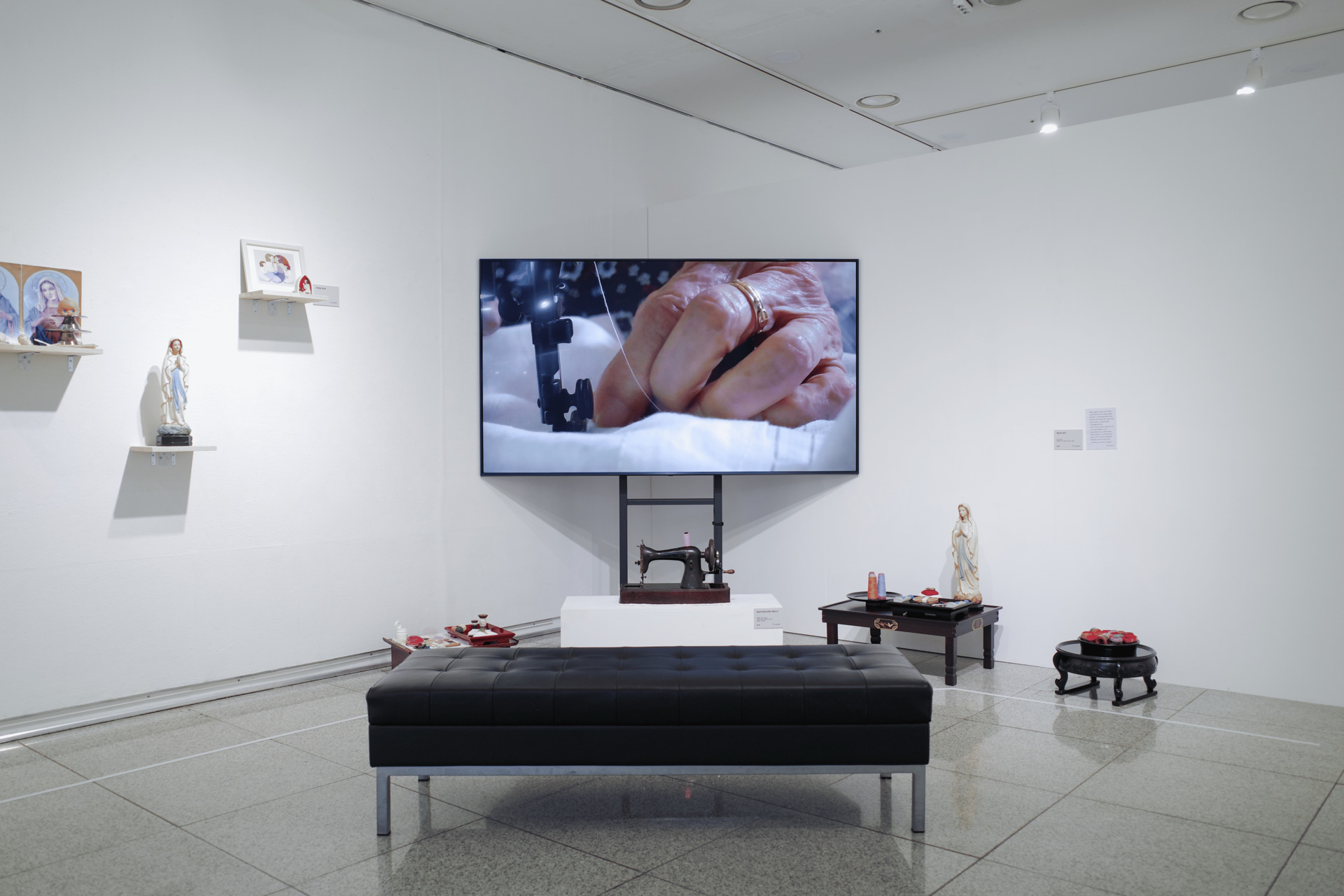
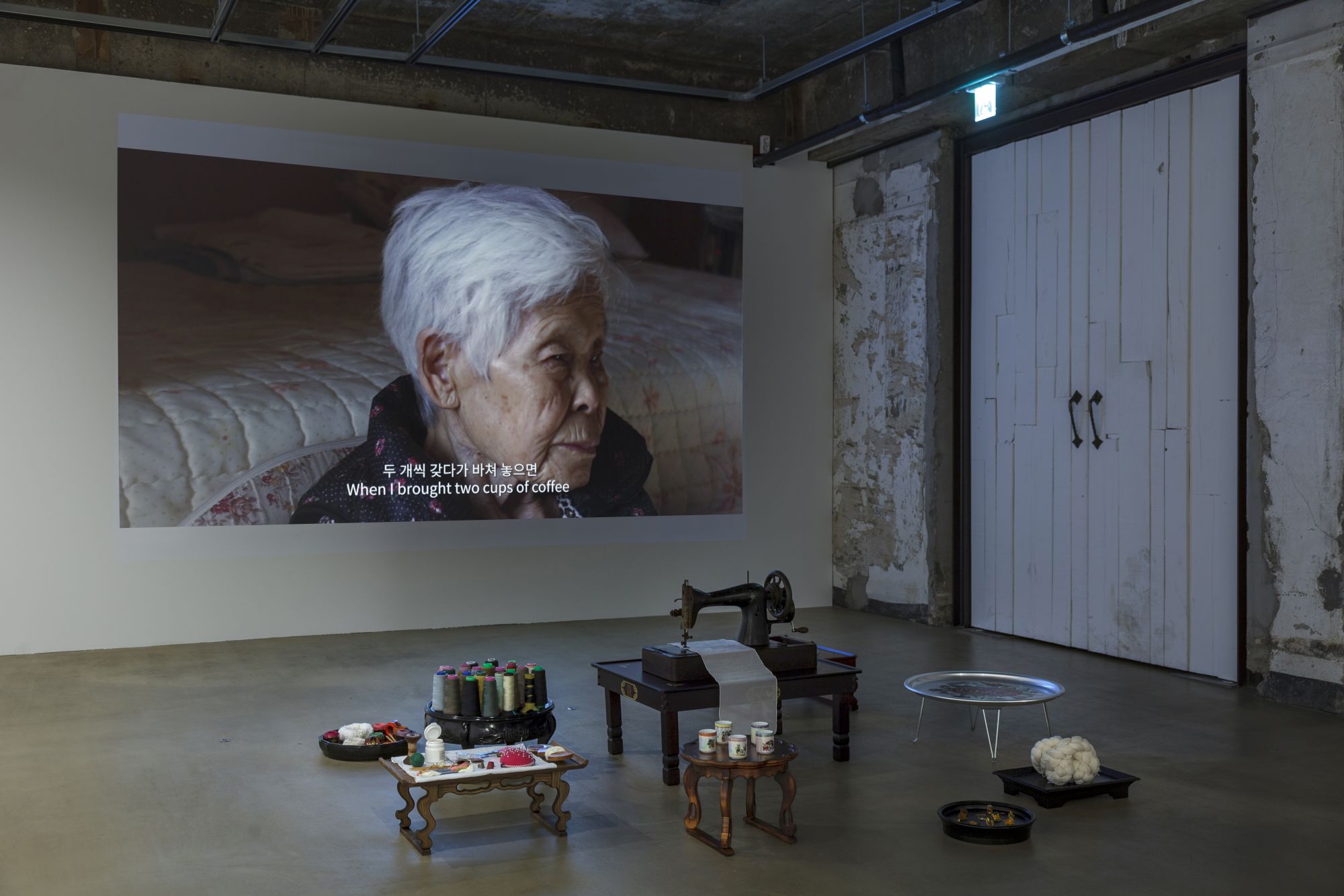
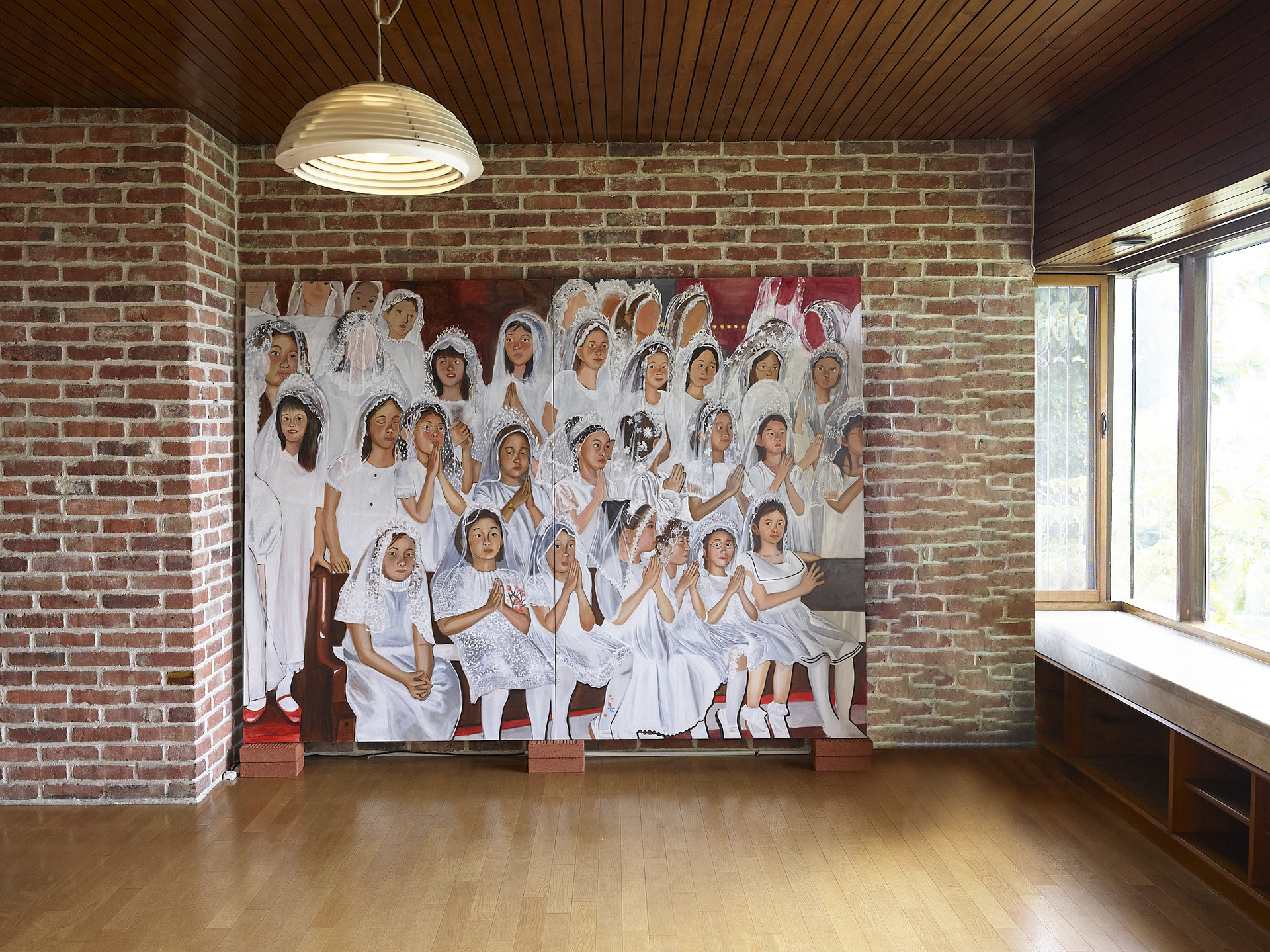
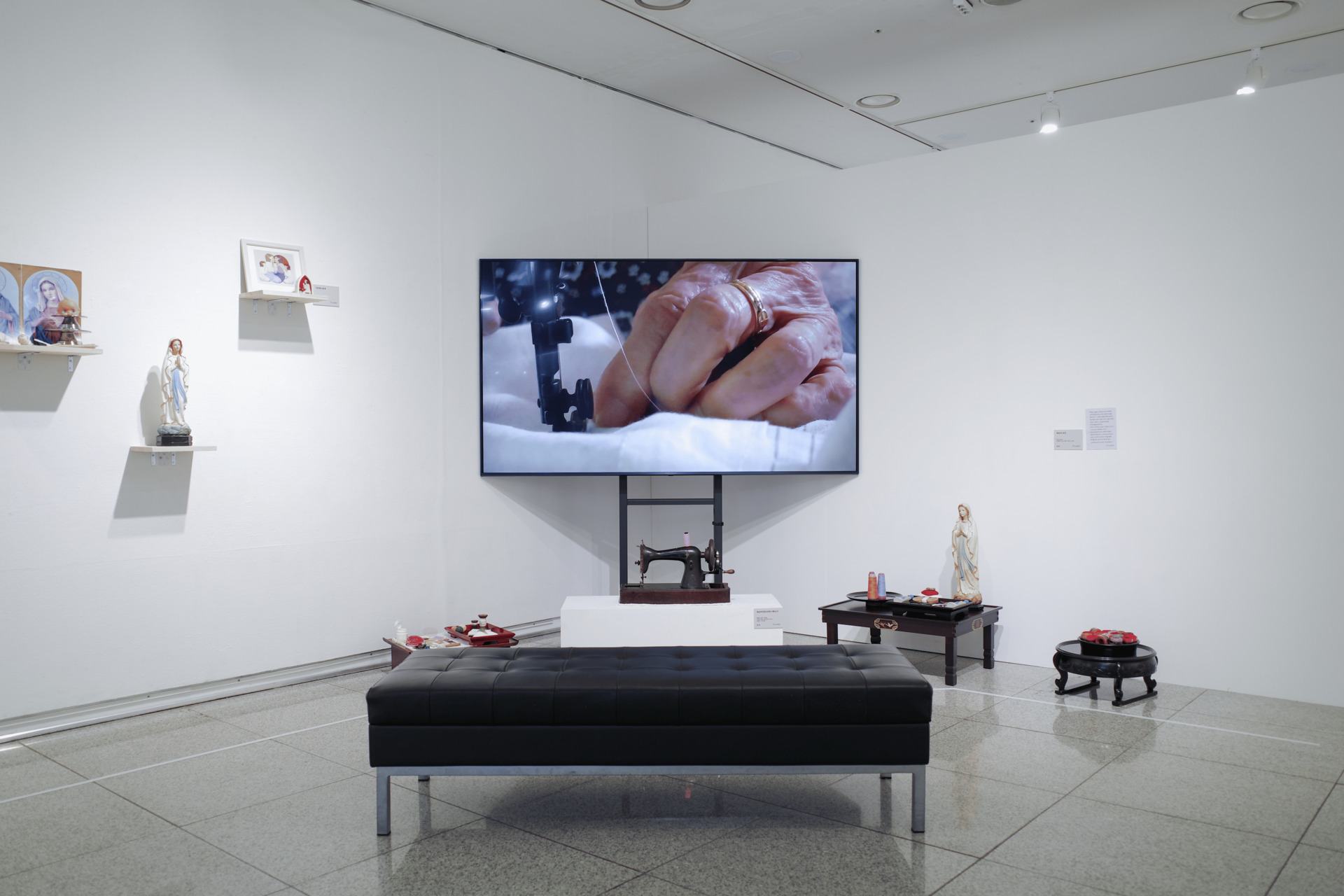
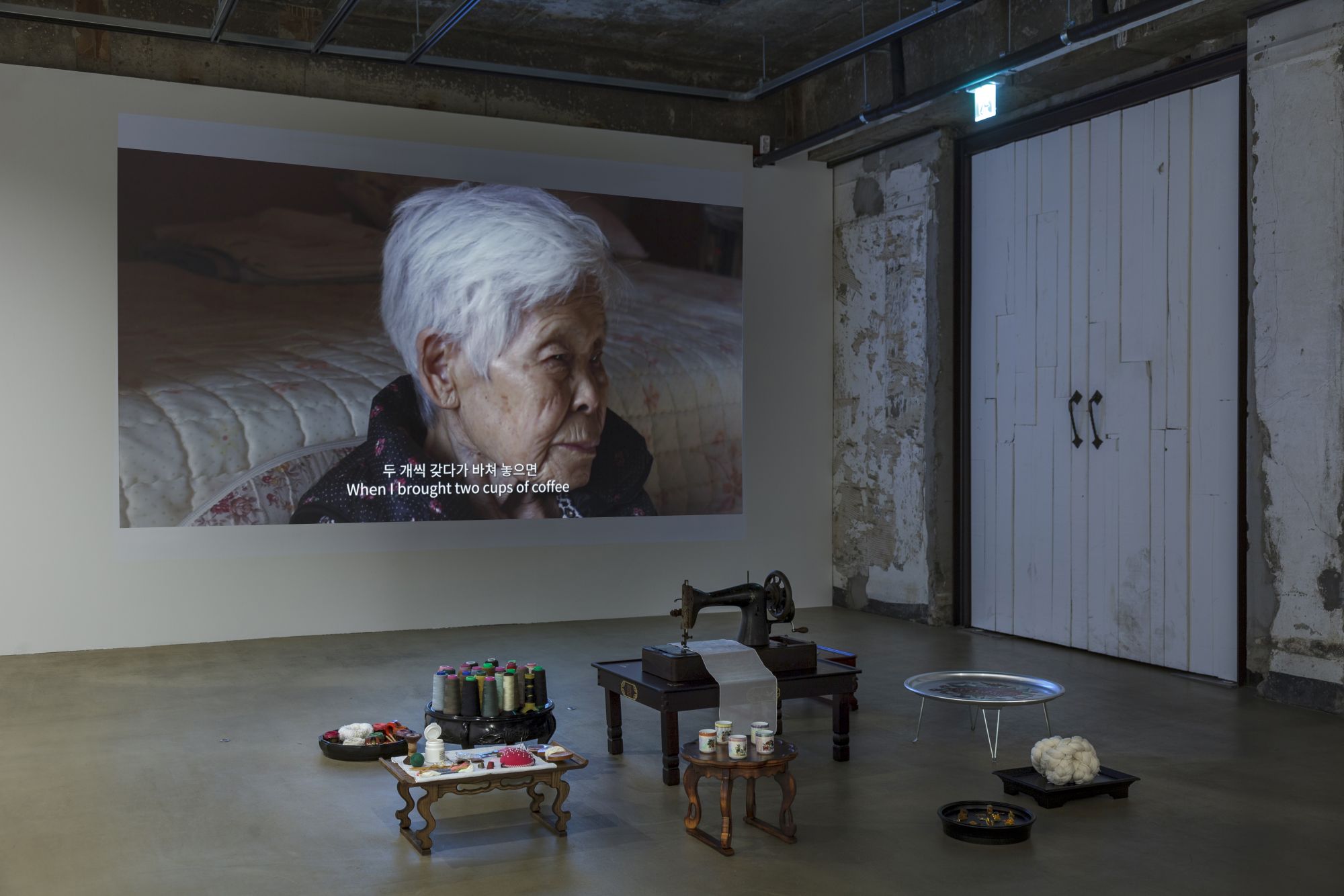
Hee Vaak is searching for the ultimate safety and well-being she hopes will come into her own life. To do so, she observes and records the lives around her. Oksoon’s Room(2015-2022) is a documentary video composed of four short videos — Coffee, Sesame Oil, Chunja, and Oksoon’s Pieces — filming the artist’s maternal grandmother, “Choi Oksoon(1918-2017).”
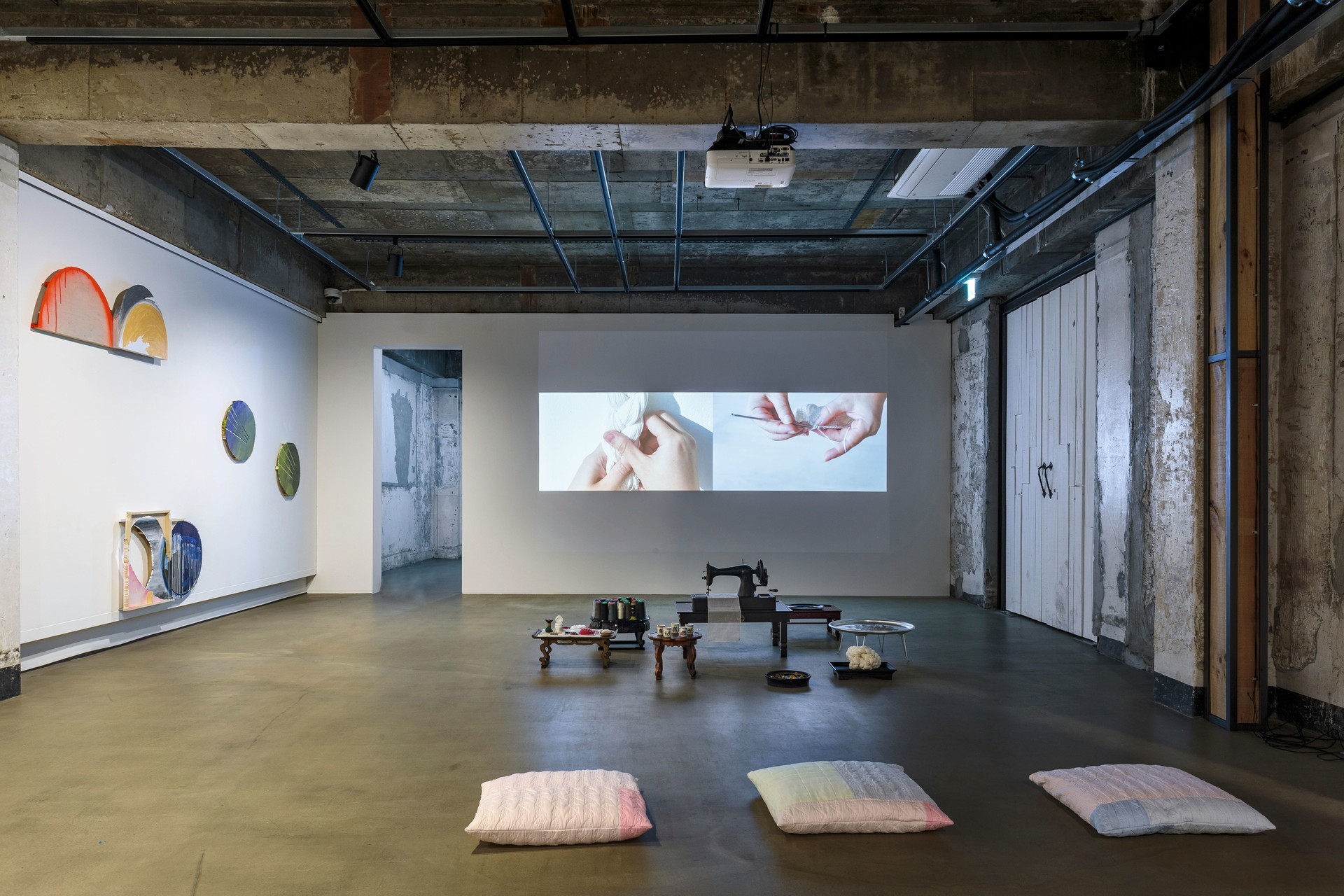
She later produced Oksoon’s Thread(2021), in which she visualized and arranged sensations that merge the silk thread left behind by her grandmother with memories from the artist’s childhood. The life woven by her grandmother, who lived from the Japanese colonial period to the present day, embraces a long span of time like a wide blanket laid on the warmest part of the floor.
The sewing machine, silk thread, small thimble, skeins, thread, buttons, and decorative faux pearls left behind by her grandmother are modestly placed before her. The cushion was made from a blanket the grandmother used during her lifetime. The indifferent yet firm presence of the grandmother in the video drifts among the objects.
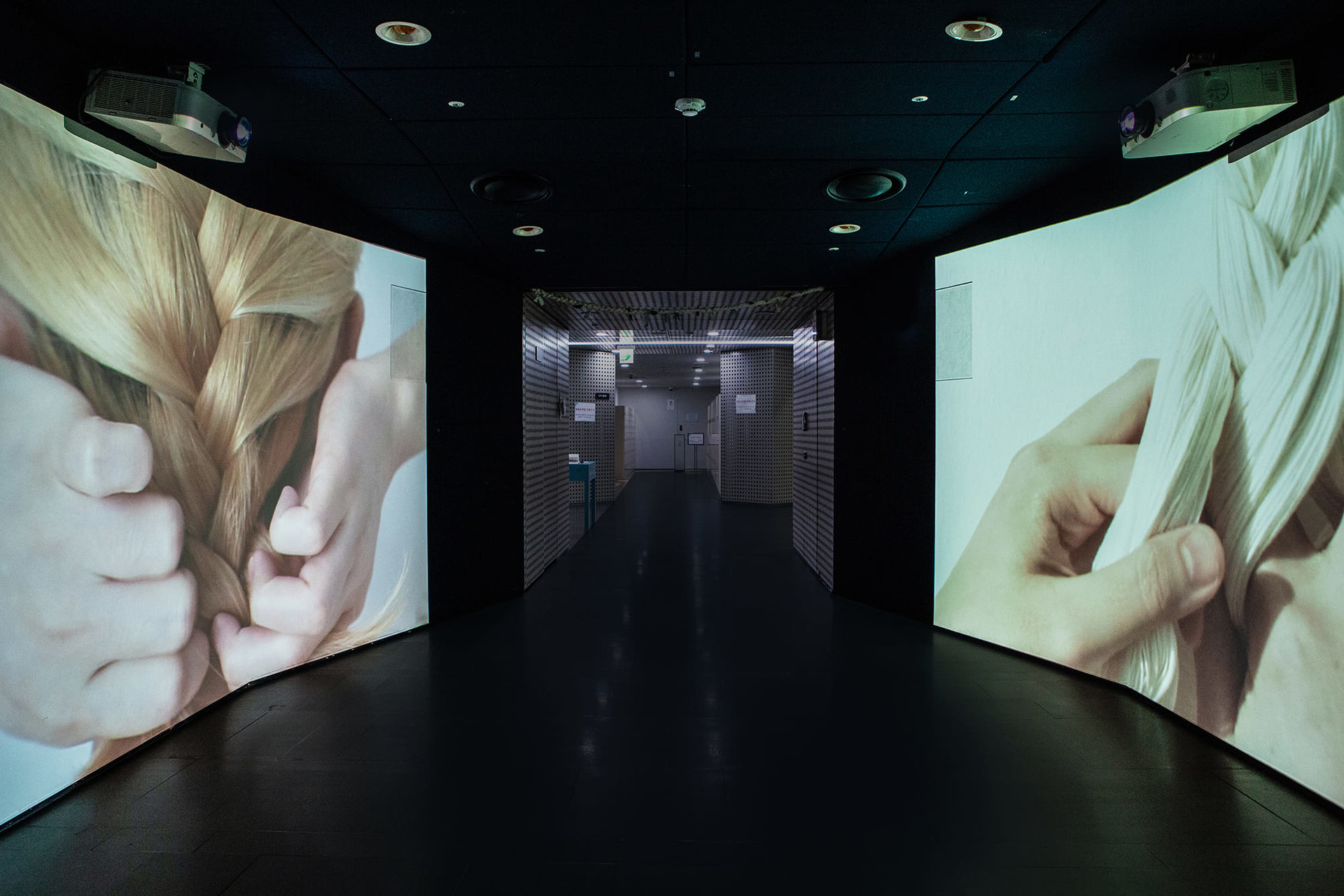
The relics left behind by the grandmother, who lived a life of lifelong labor, are traces of labor sustained over many years, and they connect to the artist’s working hands, which have inherited intact her grandmother’s technique. This unavoidable artistic hand skill, passed down from grandmother to mother and from mother to the artist herself, gives the artist a sense of safety and well-being through the process of sensuously recalling the “technique of braiding hair.”
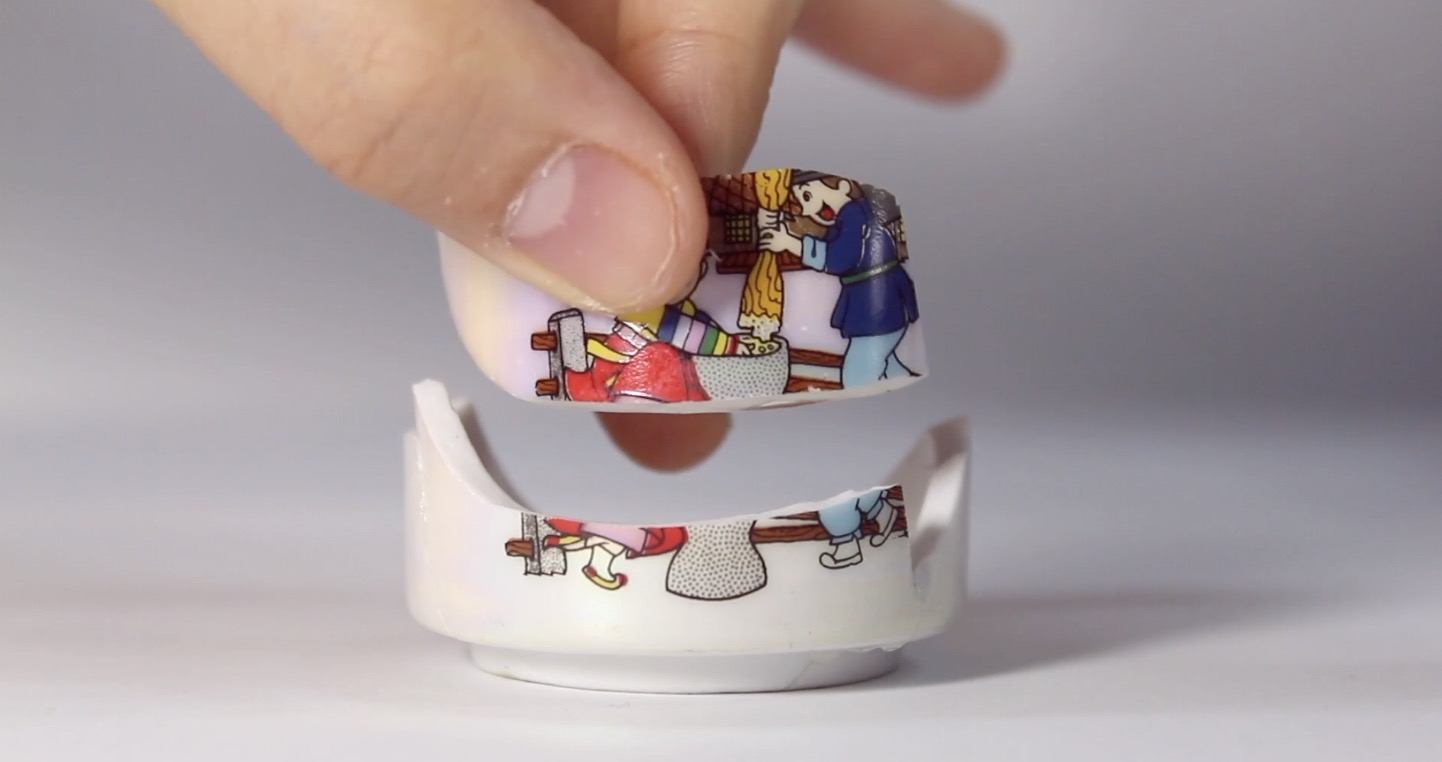
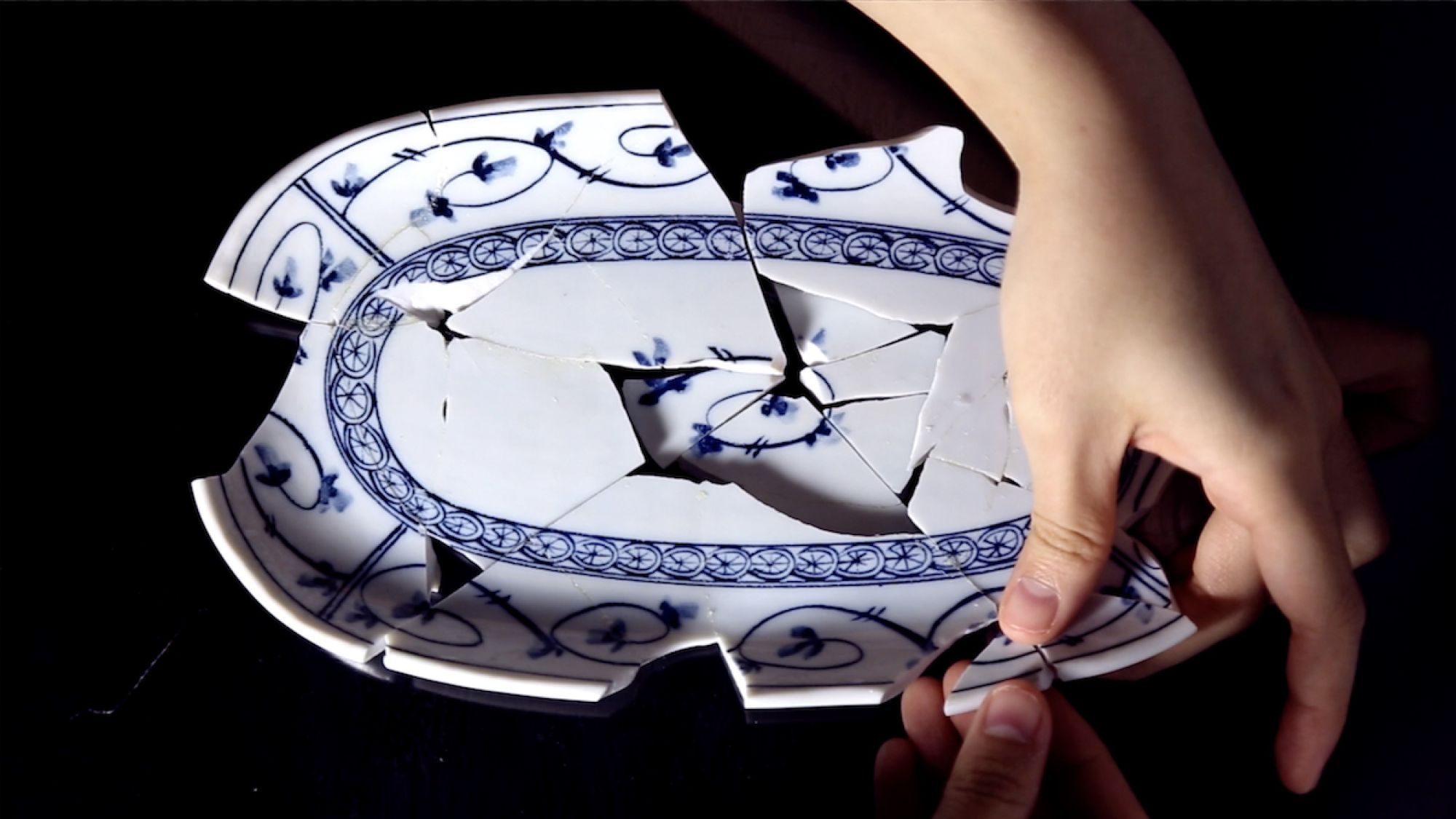
In this way, in Oksoon’s Thread, the artist fastens the final button of Oksoon’s safety and well-being and her own. Five Cups Collected in Bugae-dong(2015) records the process of matching the shapes of broken ceramic cups discarded along a railroad track. As images like folktales from her grandmother’s era are pieced together, the artist’s inner self is revealed, quietly holding discarded and fragmented precariousness while trying to enjoy peace. The attitude of the artist, who constantly asks about the safety and well-being of this era within a personal narrative, is already calm.
l. Island(2016-2017)
2. Milky Way: Fragments in the Shade Become Dust(2020)
3. Big-Small(2022)
4. To the Wall(2022)
/ Text: Joo Siyoung(Director, Art Centre Art Moment)