Bahc Yiso’s oeuvre is often understood
through two axes: the “politics of identity” of his New York period (1984–1994)
and the “inquiry toward universality” of his Seoul period (1995–2003). Yet much
scholarship tends to overinterpret the New York period—misreading him as a new
horizon of post-minjung art—or to mythologize him as a frustrated wanderer
through the romantic attitude perceived in his artistic world. Amid such
polarized appraisals, rigorous analysis of his work and art-historical
evaluation of his conceptualist stance remain insufficient. He clearly declared
a rupture with the concerns of his New York period through Homo
Identiturpus (1994) and crossed into another world. Seeking a path
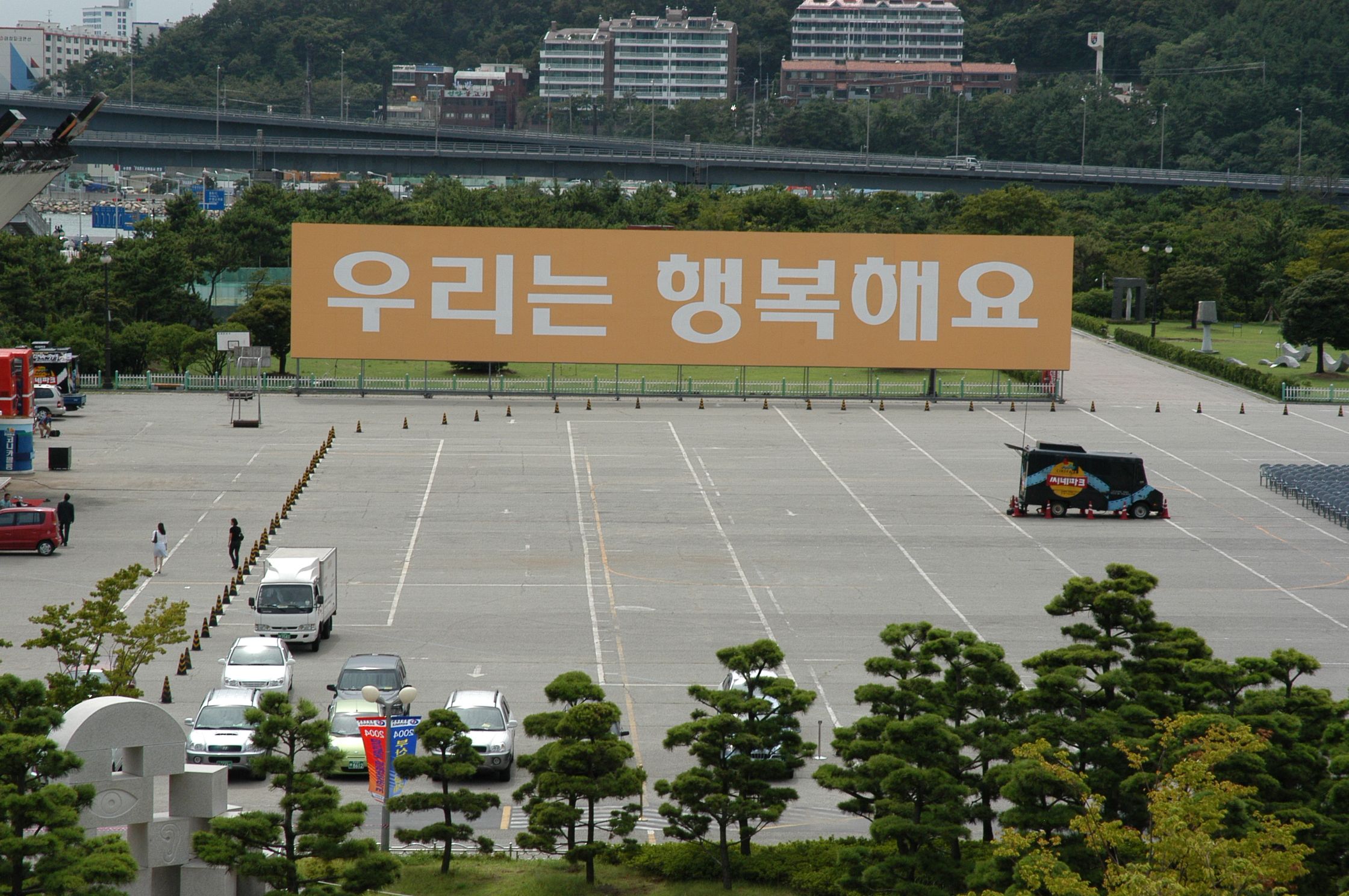
into that other world, he left an unfinished posthumous work, We Are
Happy, before dying in 2004.
While his New York period can be analyzed
with some clarity through the works that remain, it is not simple to interpret
the Seoul-period works with firm grounds for interpretation, to trace their
process, and to analyze their content and meaning. Formally, if the earlier
works moved from painting toward an expansion of media, the later works moved
toward a “way of activating a concept and letting its journey escape from the
existing world” through a malleable coupling of concept and medium, without clinging
to medium specificity.
What, then, enables us to precisely grasp
the turning point of his later practice without romanticizing it? Many
researchers point to the works presented at the 1997 Gwangju Biennale, the 1998
Taipei Biennial, and City and Moving Images – Clothing, Food, and
Shelter as the point of departure. Indeed, during this period he
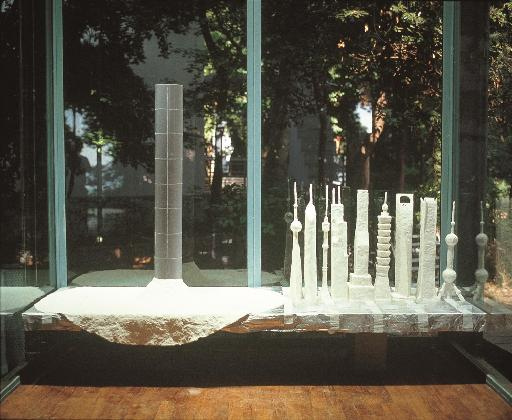
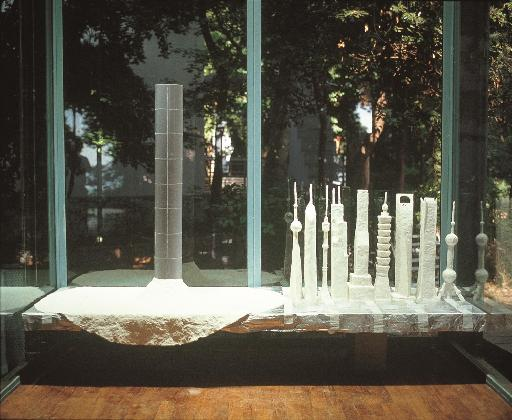
continued to critique power structures through UN Tower
(1997) and attempted a critique of globalization and consumer capitalism
through Don’t Look Back (1998).
He also began to pursue
formal shifts by allegorically mobilizing provisional structures suggestive of
corridors and rooms, natural elements such as minerals, wind, and light, and
industrial materials such as concrete and lumber. Yet these attempts did not,
thematically, surpass the horizon of thought formed in the New York period, and
formally they functioned largely as preliminary experiments for later works. It
is therefore more appropriate to view them as a transitional exploratory
process rather than a full-fledged declaration that opens the door to his later
world.
After passing through this transitional
exploration, Bahc Yiso’s later practice reaches a clear point of bifurcation
with his solo exhibition at ArtPace, San Antonio, in 2000. However, despite its
significance, this exhibition has not been sufficiently illuminated.
Accordingly, this text undertakes an in-depth examination of his 2000 solo
exhibition in order to consider how his conceptual practice moved toward a
universal world. For this inquiry, the artist’s final work statements alone are
somewhat insufficient.
This is because, as he developed works, he unfolded
ideas not as a linear conclusion but as a nonlinear process involving
multilayered differentiation and refraction. Thus, as key materials through
which we can more closely examine the complex trajectory of his conceptual
process, this text focuses on the records in volumes 16 and 17 of the artist’s
notebook “journals.” Based on these records, it analyzes how the political
utterances of the New York period transformed into a practice that posed fundamental
questions about institutions and the world, and in so doing asks what the
Seoul-period inquiry into universality signifies.
Bahc Yiso’s 2000 solo exhibition at
ArtPace, San Antonio ultimately resolved into an extremely abstract and
material landscape in which every work was titled “Untitled.” Three works were
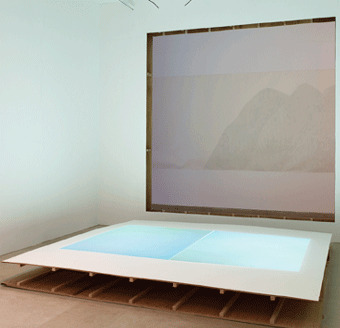
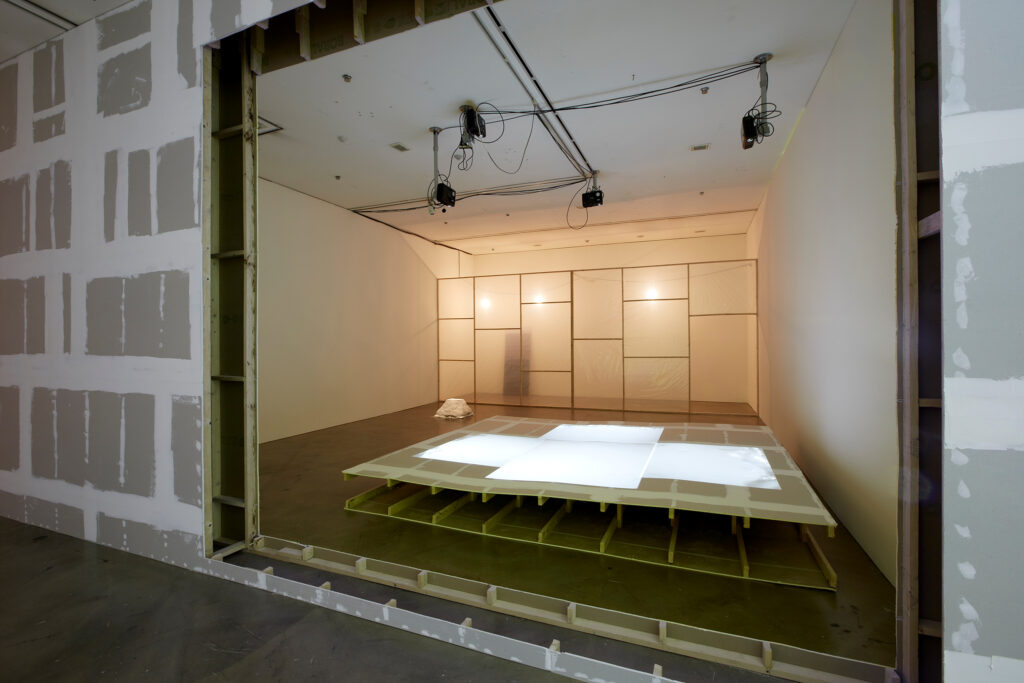
installed in the gallery. One was a video work that projected the San Antonio
sky in real time onto a screen made by dismantling part of a temporary gallery
wall (original title, Untitled(Sky of San Antonio),
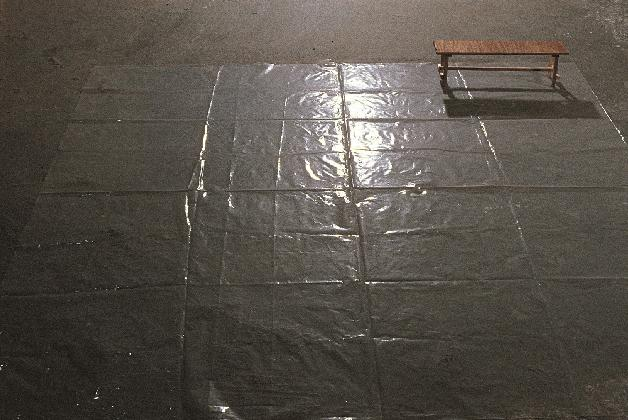
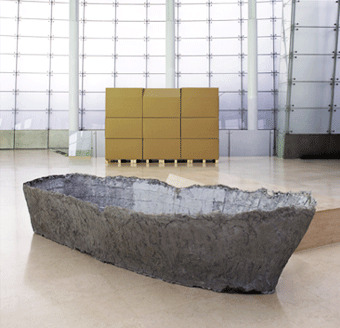
hereafter Sky). Another was a sculpture consisting of a low
cement embankment built around inexpensive linoleum flooring embossed with
auspicious patterns (original title Untitled, hereafter
Linoleum).
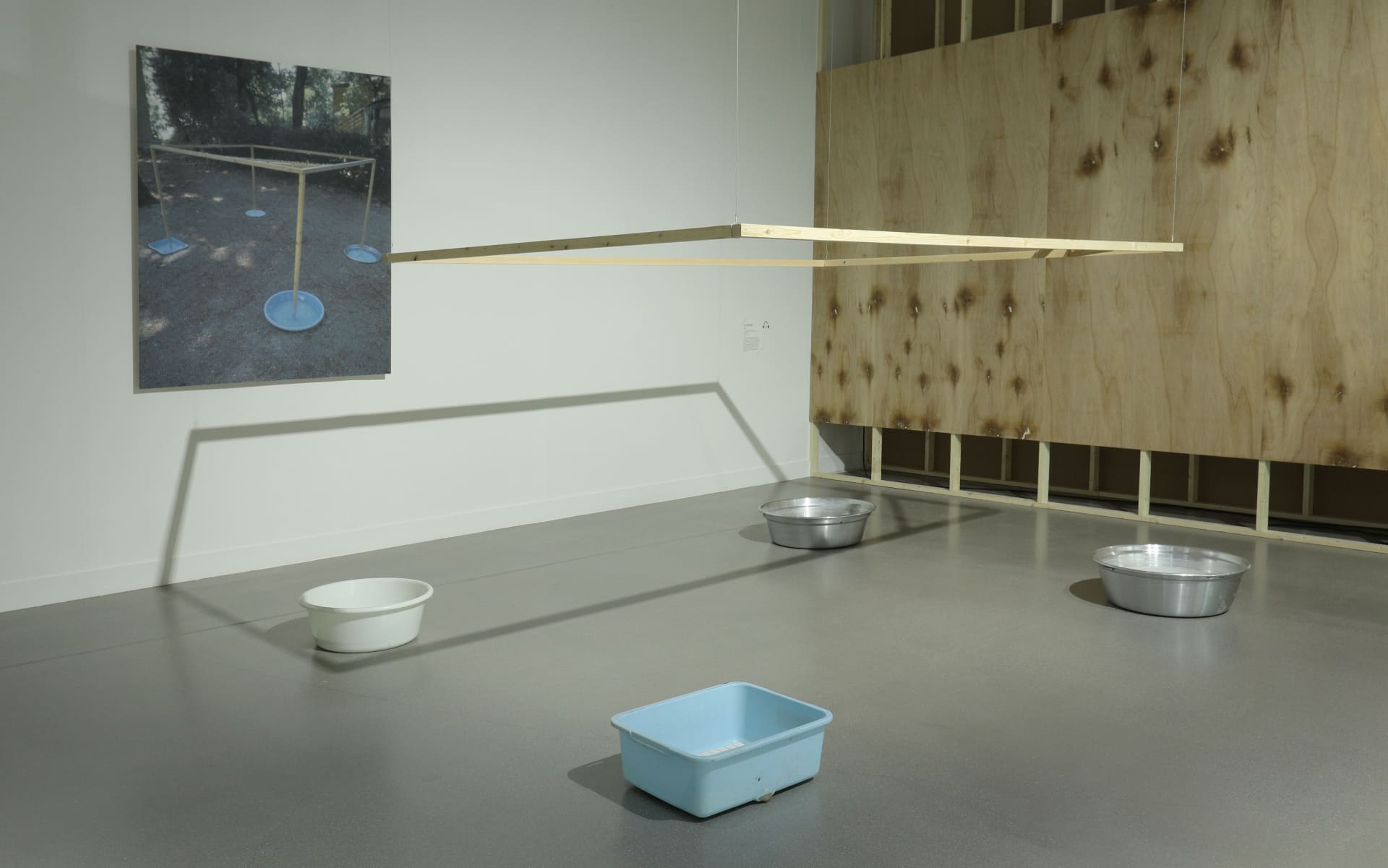
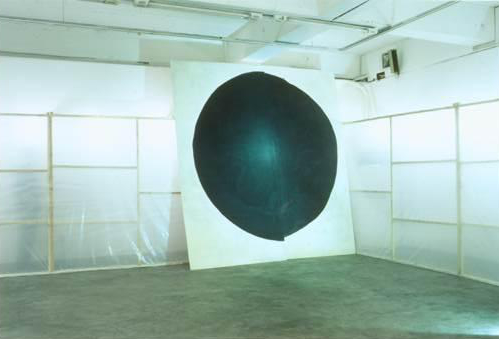
The last was an installation in which, inside a
provisional space made of opaque vinyl partitions, the artist hung a photograph
of the Gulf of Mexico, placed a GPS device in a bottle and set it adrift at
sea, and attempted to mark traces of its drift (original title
Untitled(Drift), hereafter Drift). In
this way, the final exhibition excluded the artist’s direct narratives and symbols,
instead confronting viewers—through the temporality of the sun’s flow and the
tide’s flow—with the materiality of things, the site-specificity of a
particular place, and an enforced anonymity produced by events, all
crystallized into a minimal form.
However, if we look at journal volume 16
and the concept drawing inscribed with “Higher than Art,” we can see that the
initial conception was entirely different. The original plan was to fill the
show with far more explanatory and symbolic works. Aside from
Sky, which was realized in the gallery, the exhibition was
to be populated by works with specific titles that recur across both plans,
such as Monumenta Me, Culture Mountain,
and Natural Drawing. There was even a proposal for an
outdoor project installing a neon sign reading “I COME TO SAN ANT” atop an
abandoned building. The initial plan, in other words, was composed of works far
removed from the abstraction of the final exhibition—works that directly
revealed the artist’s desire and introspection, as well as artistic ambition
and an ideal dimension of art.
How, then, can this gap be understood? The
key lies in the diagram and accompanying notes contained in the drawing
inscribed with “Higher than Art.” In this drawing, the artist visualizes his
system of thought as a peculiar “funnel”[깔때기] or a sideways
triangular flask-like schematic. The wide left axis is divided into upper and
lower zones: the upper zone contains the realm of nature, with terms such as
“Sky”[하늘], “Mountain”[산], and “Tree”[나무], while the lower zone contains the realm of civilization, with “Art”[예술], “Monument/Tower”[기념비/탑],
“Ceiling”[천장], and the like. These two realms converge
toward a narrow opening on the right, and at that open mouth are written
ultimate orientations: “Ideal”[이상적], “Life Goal”[삶의
목적], “Religion”[종교], and “Drug”[약물]. This structure shows that the artist wished elements from two
mutually antagonistic worlds—nature and civilization—to counteract one another
while converging and erupting toward a single goal.
Below the diagram, the artist specifies
the character of each term and concretizes his thought. For instance, if
“Mountain”[산] holds positive,
processual values such as “effort, growth, accumulation, evolution”[노력, 성장, 축적, 진화], “Monument”[기념비] is linked to secular,
result-oriented values such as “desire, development, anti-time, power”[욕망, 개발, 반-시간, 권력]. He names “Sky”[하늘] as
“ultimitum[sic], the other side”[궁극, 저편], implying a dimension that transcends both worlds. By contrast, next
to “Art”[예술] he leaves only an arrow, suggesting that he
either suspends definition or struggles to define art between these ambivalent
values. Accordingly, beyond art as an object of secular desire, he implies an
aspiration to move—together with “nature” such as sky and mountain—toward a
dimension “Higher than Art”[예술보다 더 높은]. His art aimed
toward something “higher” than (secular) art.
This inner conflict appears with
particular clarity in two works that he conceived but ultimately did not
exhibit. In the concept drawing for Monumenta Me
(1996–1997)—a form in which four sharp obelisks cluster together and rise as if
to pierce the sky—he writes directly, “(I) want to make a masterpiece that
rises up to the sky. I’d like to make a masterpiece that reaches up to the
sky.” He does not conceal the desire for secular success as an artist. At the
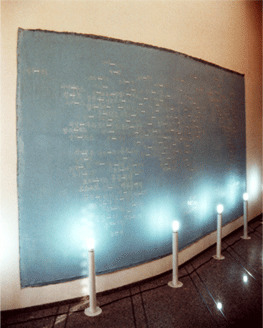
opposite pole stands Natural Drawing (1996–1999/2001). In
this work, the artist draws, in layers, four successive mountains across a vast
wall with pencil.
Here “mountain” symbolizes hardship and the sublime (mountain
as a cultural object) while also implicating nature in its own right (mountain
as a natural object). By naming it “natural drawing,” he reveals a longing not
merely to depict a landscape, but to reach a mode of “drawing naturally”—a
stance that seeks to escape all formal artifice and arrive at an originary
state of art. The monumental desire of Monumenta Me and the
sublime desire of Natural Drawing thus function as
emblematic cases that fully display the opposition between the two axes
identified in the diagram: “Culture”[문명] and “Nature”[자연].
In this way, Bahc Yiso’s early plan was
saturated with inner conflict between two axes: “monumental desire” and a
“longing for what is originary (nature).” Yet the final exhibition realized at
ArtPace in 2000 discarded all such narrative and symbolic works, presenting
instead an extremely mute and abstract landscape in which every work was titled
“Untitled.” The artist abandoned a mode of directly representing his inner
conflicts and instead presented the three sensorial and cognitive conditions
themselves—“floor,” “sky,” and “drift”—as tokens, attempting to articulate a
new worldview. Having declared in 1994 through Homo
Identiturpus a break with the “politics of identity,” he can be said
to have offered a concrete response to that declaration at the close of the
twentieth century through these three Untitled works.
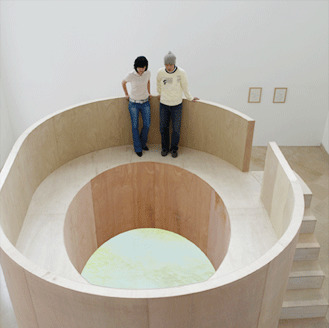
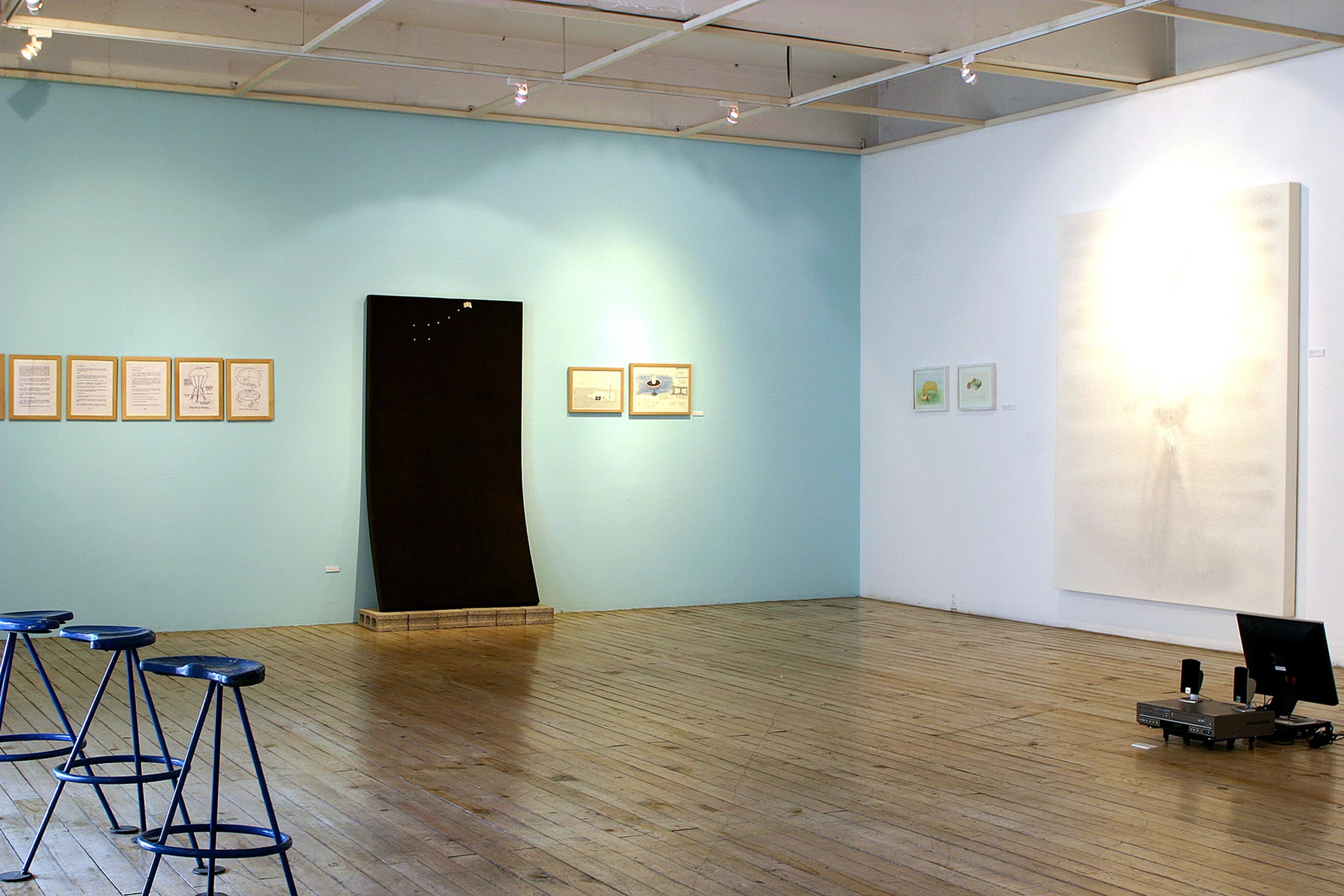
The first work in the ArtPace exhibition
is Linoleum, the only one among the three
Untitled works without a subtitle. It takes an extremely
minimal form: a piece of cheap linoleum flooring commonly used in Korean households
at the time, cut to the size of a folding cot for one person and placed on the
floor, with its boundary surrounded by a rough, low cement embankment.
According to the artist’s notes, this rectangular linoleum signifies the most
basic living space: a “room” or a “home.” The concrete embankment is installed
along all four sides as a boundary between the room and the outside; yet on
another page of journal volume 16 he also considers placing concrete blocks at
each corner and driving in lumber or steel beams to connect them, then setting
a cubic or rectangular frame atop the structure.
Notably, he writes the twelve
Earthly Branches beside these single pillar-like forms made by erecting lumber
or beams on concrete blocks, implying that these pillars condense what pillars
symbolize within the logic of saju. Meanwhile, the work extends beyond
symbolizing a room or home, expanding into a space in which an individual’s
fate and life unfold. Ultimately, this “floor” becomes a person’s ground of
life and stage of destiny—an abridged model of earth, world, and civilization
as a whole. It is where life begins, yet also where every finite life ends: a
space of death. In the darkened gallery, the low-lying work evokes a coffin (棺), visually amplifying this ambivalence.
Moving beyond this space of life and death
placed on the floor, we now turn to another token presented by the artist:
Sky. This work projects the San Antonio sky in the shape of
a Greek cross onto a section of the temporary wall that has been torn out and
dropped onto the floor. What is notable is that the artist’s intention shifts
from his initial conception of surveillance—like a CCTV control room—toward a
mode that leads the viewer to contemplate space-time itself.
For the artist, observing
the sky is also a way of looking for stars, a way of encountering something
unknown, and an unreachable realm that nevertheless must be approached and
achieved. The sky is thus presented as a Kantian “transcendent” object: an
“ultimum” and “the other side” beyond the world of experience. This longing
toward the sky is also visible in another drawing marked “Higher than Art,” in
which a sky image placed atop a tall structure clearly shows a desire for the
ideal.
Yet for Bahc Yiso, longing for the sky
always carried, like Icarus, the anxiety of “falling.” Indeed, alongside the
sky video he conceived a “falling video” for the ArtPace exhibition. This
unrealized video tells of debris from a crash in the desert and a film
containing images of a fall found within it. He sought to explore
simultaneously the act of gazing at what the sky signifies and the act of
falling from it. This reveals a deep reflection: the sublime goal symbolized by
the sky and secular desire may ultimately fall in vain.
The Sky that was
ultimately installed does not narrate the fall directly; instead, it makes the
result materially present on site. The very act of demolishing the wall and
dropping it to the floor executes “falling,” while the quiet sky projected onto
architectural fragments compresses the tension between ascent and descent. This
capture of presentness becomes even clearer in Today (at
Yokohama), presented at the 2001 Yokohama Triennale. Going beyond the
San Antonio version, the artist sought to show the changing sky of “today”
through a camera apparatus that tracks the movement of the rising and setting
sun in real time. If the San Antonio sky reveals the temporality of sky-time
itself, the Yokohama sky, by focusing more intensely on the sun’s movement,
heightens the meaning of the continuing “here and now” even within a destiny of
falling.
The two works examined above establish a
large conceptual axis in the exhibition space. If Linoleum
symbolizes “floor,” or earth—the ground on which civilization and the
conditions of finite life unfold—Sky presents “sky,” where
transcendent ideals and the destiny of falling intersect. Sky and earth are
placed diagonally across the gallery floor. Then what meaning does the final
work, Drift, hold and how does it operate within the world
of horizontally stretched sky and earth? According to the diagram mentioned
earlier, it does not represent an ideal state, but rather symbolizes the artist
himself, who departs in search of an ideal condition between civilization and
nature, earth and sky. The “drift” of drifting can be said to be an existential
confession of the subject called the artist.
This work begins from the romantic
narrative of a “message in a bottle”: placing a letter in a bottle, throwing it
into the sea, letting it reach someone and deliver news. Bahc Yiso, however,
transposes this romantic act through contemporary technology. Instead of a
letter he places a GPS device in a bottle and sets it adrift in the Gulf of
Mexico, intending to plot its signal as dots on one wall of the gallery
alongside a photograph of the Gulf taken after the bottle was sent—without any
information beyond the signal itself. In fact, on September 1, 2000, he
released a bottle containing a GPS device into the Gulf of Mexico; yet although
it was charged to last for over ten days, it transmitted signals for only 2
hours and 22 minutes before disappearing. The bottle, it seems, did not even
exit the Gulf and became missing.
Yet this abrupt disappearance is not
merely a technical failure; it is an event that completes the conceptual core
of the work. As he notes in journal volume 17, the work investigates
relationships between “knowledge of location”[위치의 지식] and “disappearance”[사라짐], and between “life”[삶] and “death”[죽음]. When the “signals”[신호] that seemed “as if it is alive”[살아있는 것처럼]
vanish, the “bottel”[병] returns to being a “lifeless
tool”[생명 없는 도구]. Ultimately, this work compresses the fate
of a subject who attempts to prove his location through “contemporary
technology”[동시대적 기술], yet becomes “powerless”[무력하고] and “aimless”[목적 없이], drifting and disappearing
before an “unpredictable”[예측 불가능] immense force.
Here Bahc Yiso’s “disappearance” differs
decisively from that of California conceptual artists. If the disappearances of
Jack Goldstein, Chris Burden, and Bas Jan Ader were elective acts of
self-erasure from the center, Drift reveals the structural
and existential condition experienced by a diasporic subject. That is, even as
the subject seeks to become “knowing”[알고 있는 것/알아가는 것] by proving his position, he nonetheless disappears from the map due
to something “unpredictable”[예측 불가능]. In this sense, the
work can be read as a metaphor for the fate of a postcolonial subject who never
fully belongs anywhere and must drift ceaselessly. His “drift,” therefore, is
not a romantic wandering, but should be understood as a kind of “ritual for
disappearance”—an acknowledgment and performance of having no fixed position.
It is precisely at this point that Bahc
Yiso’s thought moves beyond the particular problem of identity toward
universality. The “positionlessness” of the postcolonial subject that he
reveals is no longer the experience of a specific group alone, because under
neoliberal globalization anyone can lose their place and become a stranger at
any time. His ritual of disappearance thus becomes an act of thinking through
the universal condition of contemporaneity: a state in which we can be othered
without guarantee.