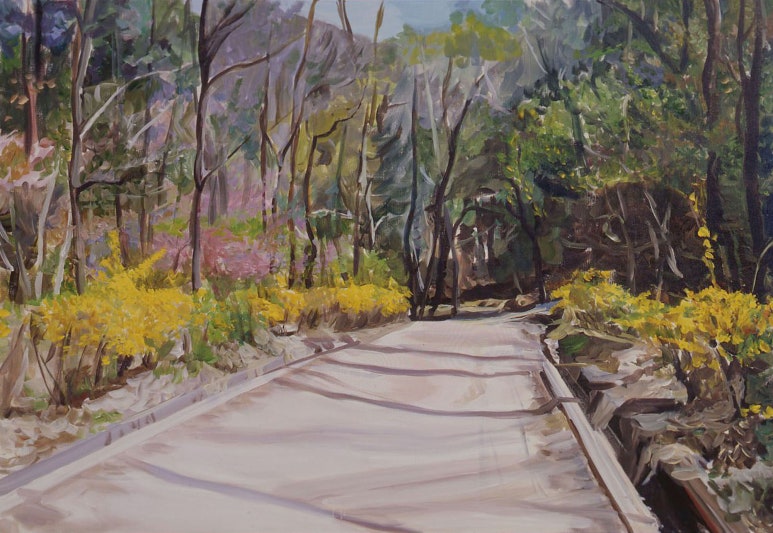
Like Beach–Studio, the work Love is
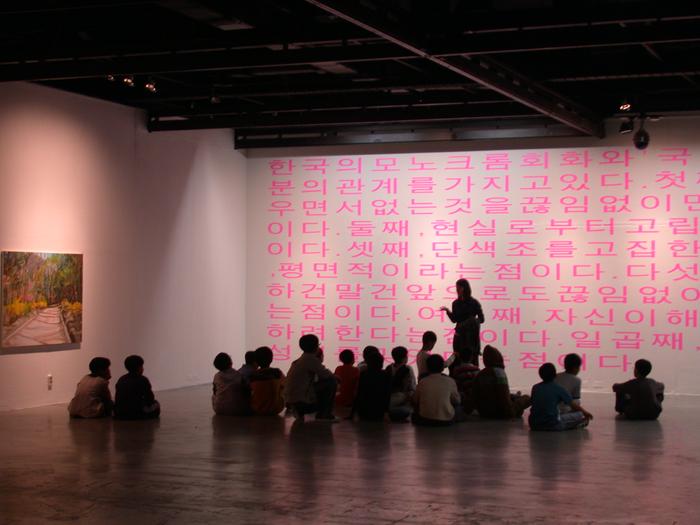
Real, hung against a neutral ground, is both the exhibition’s title
and a piece the artist himself describes as a successful work. Yet even in this
painting—whose ‘love’ and ‘real’ seem more affirmative than negative—the shadow
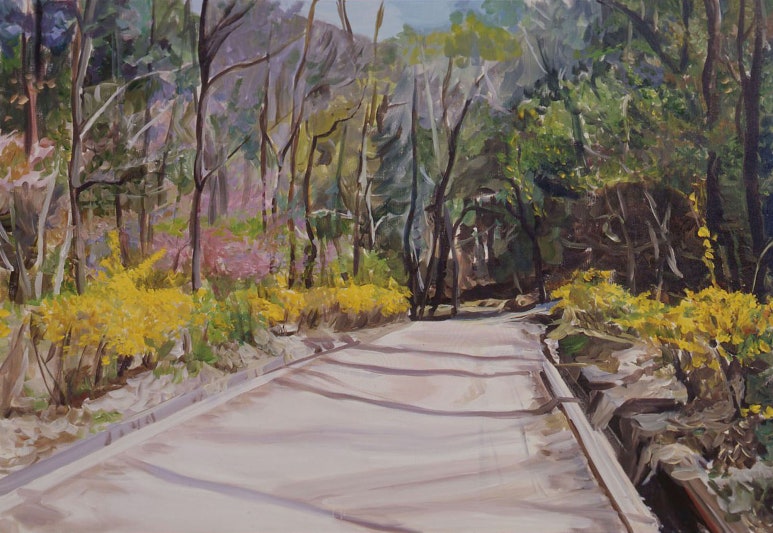
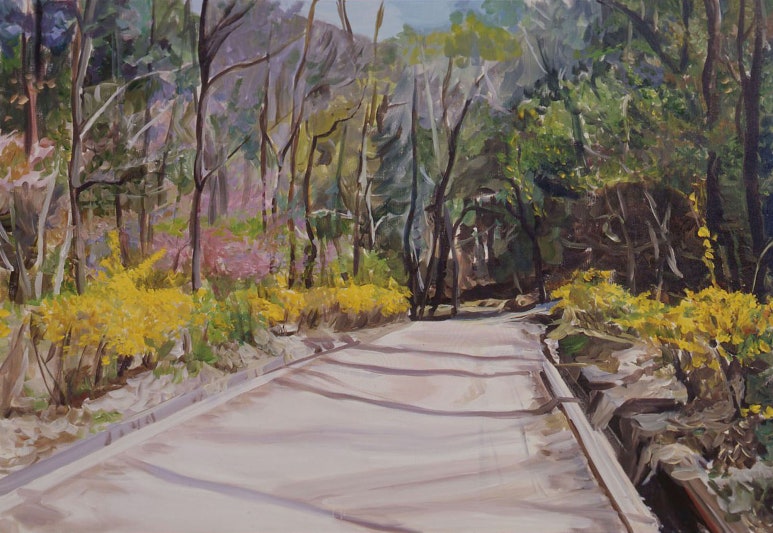
of cracking is cast. Love is Real, which is also a lyric
line from languid hippie music, depicts a flower-filled walking path. Though
neatly paved, the path does not seem to continue; it contains the unease of
spring, a season that demands something begin anew.
Foreshadowing that unease
are the tree shadows that split the pale ground like an abyss. The small path,
as if covered in untouched white snow, is segmented by lines that may have been
drawn unconsciously, but to the viewer they arrive as something more than mere
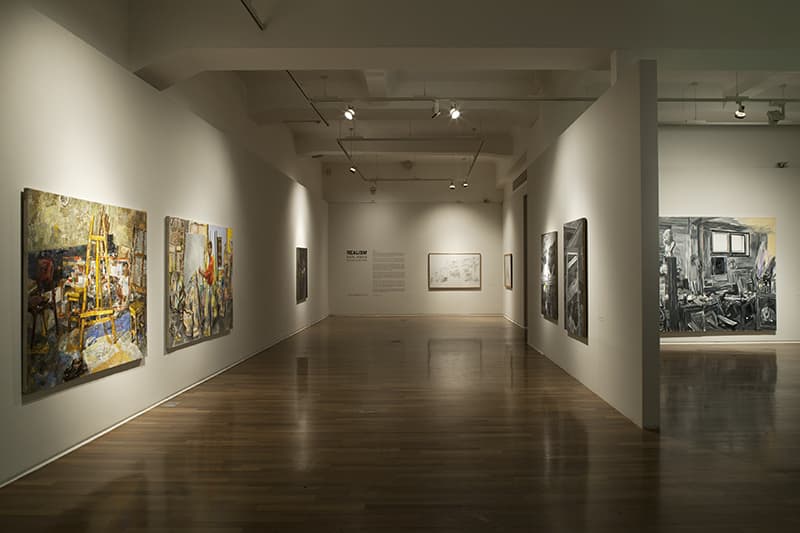
shadow. The fissures inside the work—which occupies half of the diagonal axis
cutting through the gallery—demand a certain hermeneutic imagination.
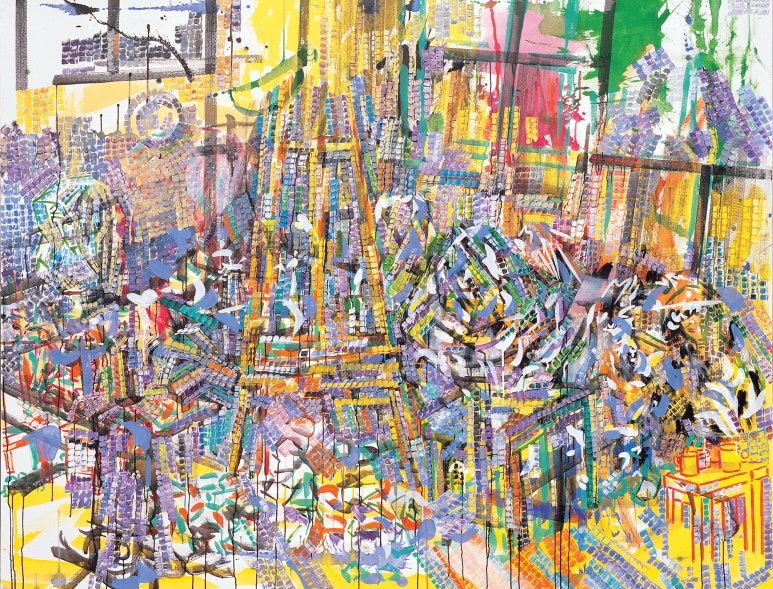
Especially because a dazzling work like Spring of Seoul, 1992
hangs nearby, the meaning of gaps and cracks becomes even stronger through the
contrast.
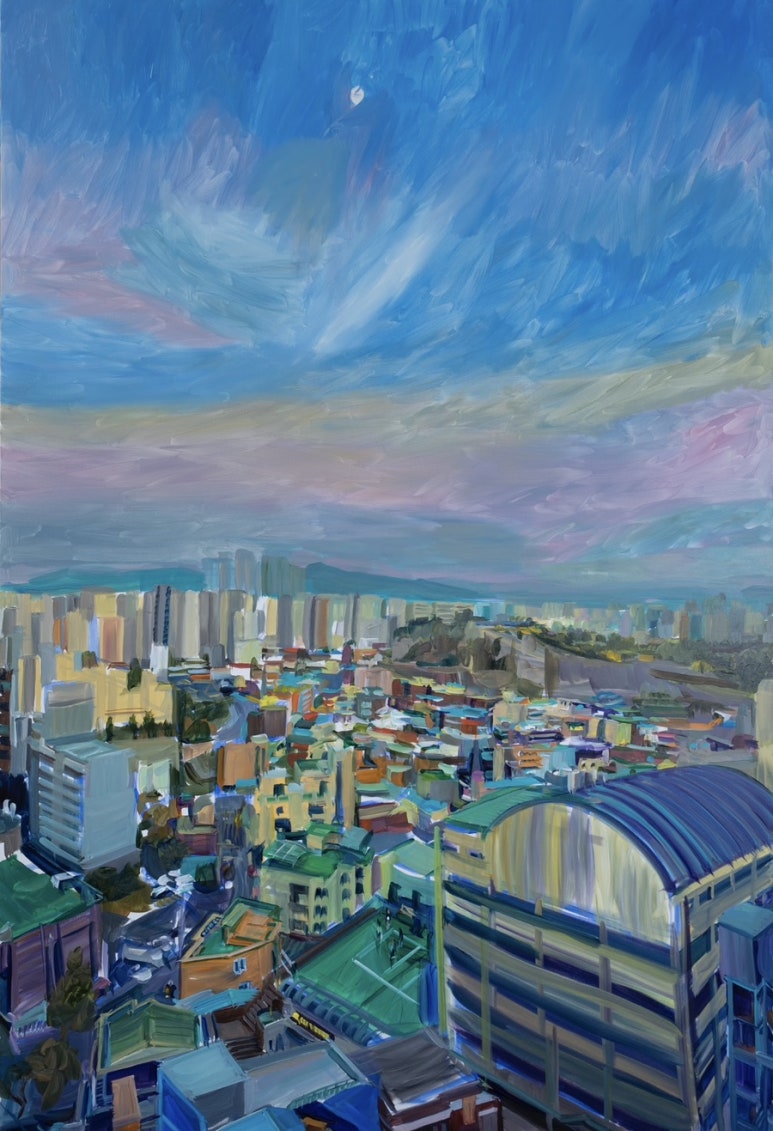
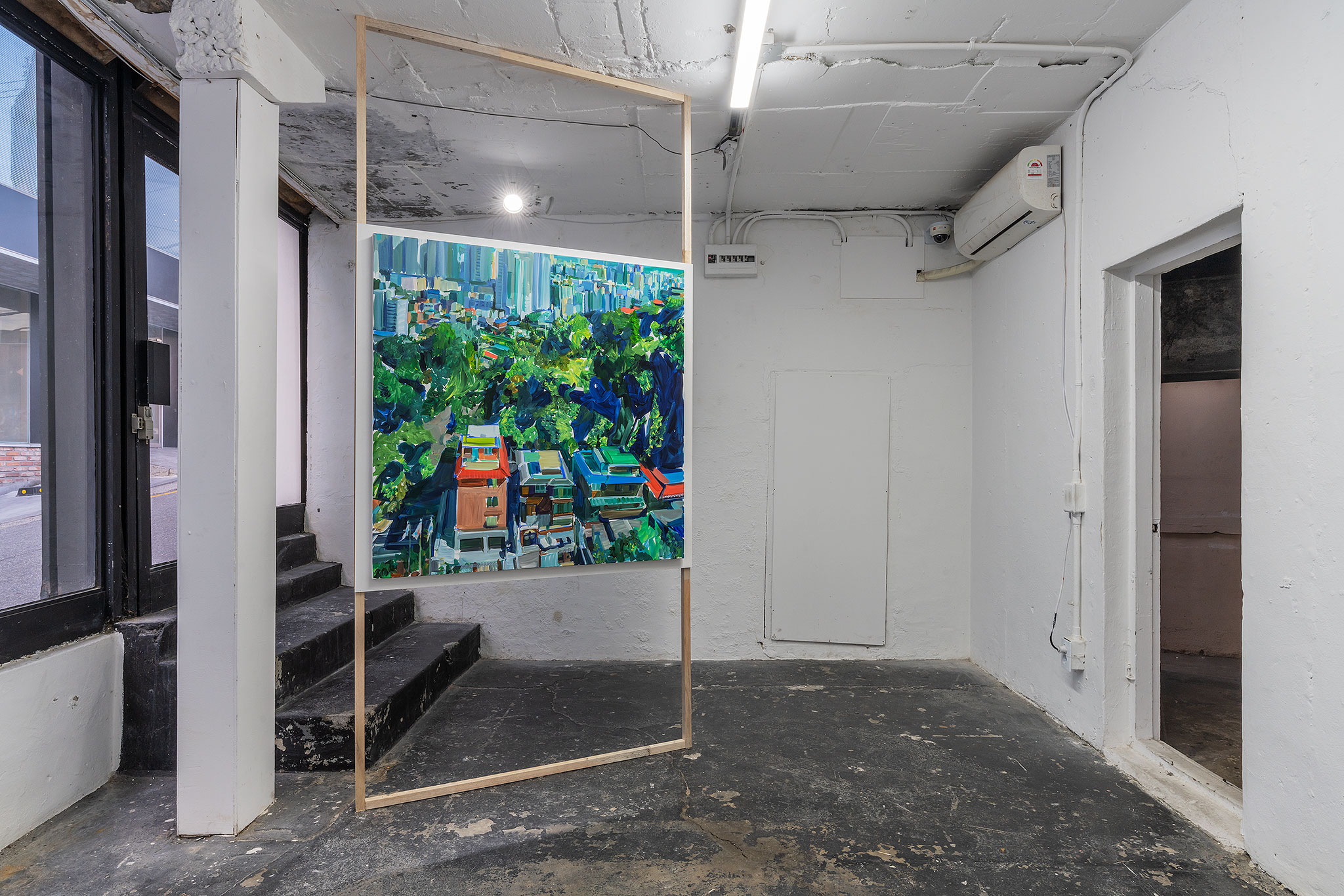
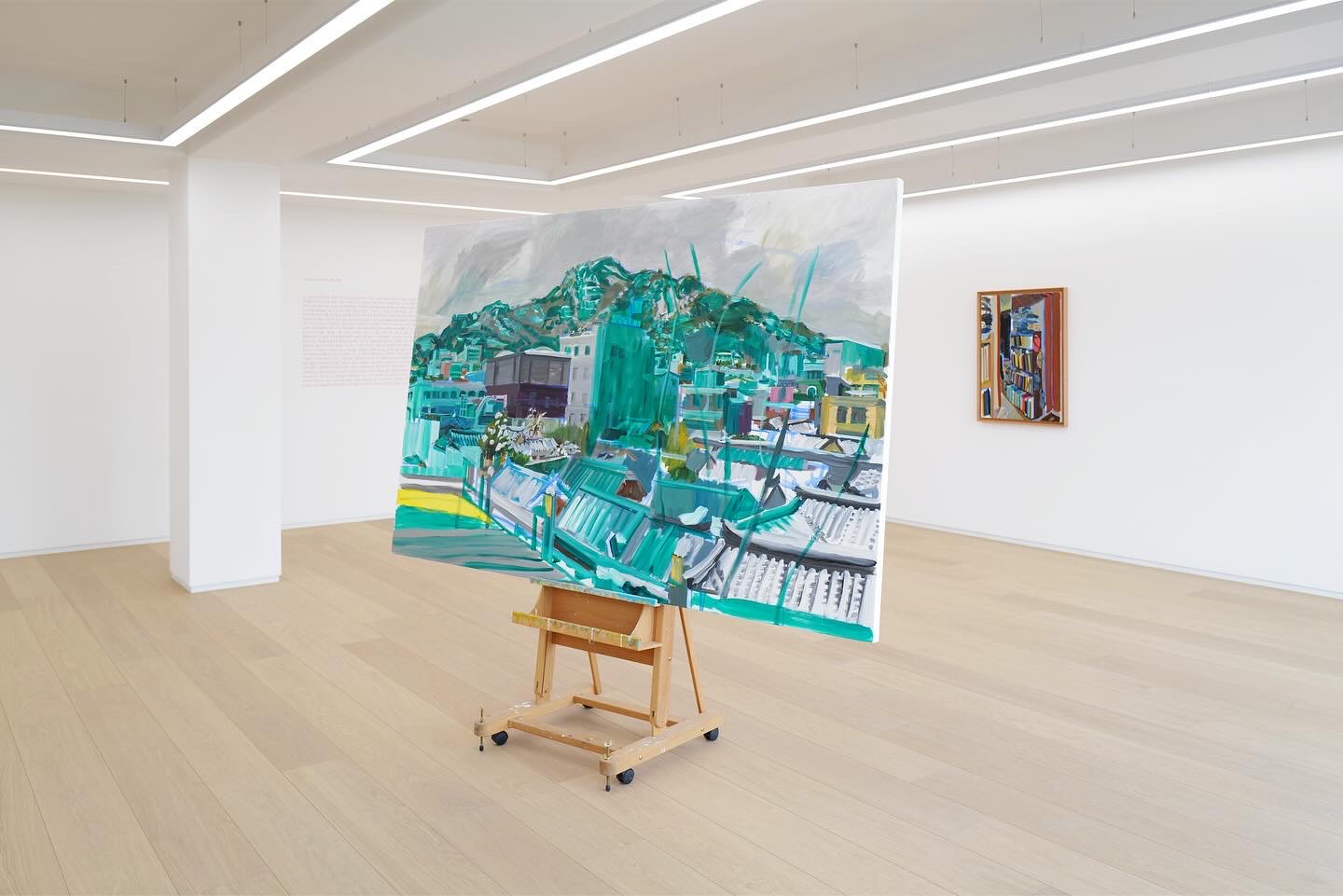
Of course, this work does not conceal that it is a reality assembled and
spliced together. Yet the urban view on the western side of the painting,
saturated with spring sunlight, unfolds as a scene of another dimension—beyond
simple representation or shabby everydayness—through swift and precise
placements of color planes carrying accurate information that make a scene a
scene. For the painter, such complete encounter and unity with this other
dimension may be what ‘real’ is, and what ‘love’ is.
Yet the frenzied hand that
seeks to capture that brief blessed moment of total fusion with the scene
cannot find firm ground on which to settle it. There may be many reasons, but
from an analytic standpoint it can first be attributed to the opacity of
painterly language. If conventional realism presupposes the transparency of
language, then Choi Gene Uk’s realism—just as he claims—is closer to the body
than to consciousness. Perhaps, moving forward, what may matter is the problem
of the flesh that has consciousness, beyond the mind/body binary.
In a book explaining post-structuralist theory, Catherine Belsey argues
that the hypothesis of modern linguistics, beginning with Saussure, maintains
that language is not transparent and is not a simple medium that delivers
messages about a world of independently constituted things. According to this
hypothesis, language is not an imitation of thought but the condition of
thought: it constitutes the world of individuals and objects and provides the
possibility of distinguishing them.
Terry Eagleton, in Criticism and
Ideology, adds a materialist interpretation to this
post-structuralist hypothesis, pointing out that without language there can be
no material production. Language is, above all, bodily and material reality and
thus becomes part of the material productive forces. Things cannot be thought
outside the system of differences that constitutes language. Signs detached
from referents and experience lead again to the separation of signifier and
signified. Language, as a system of differences, is itself made of gaps and
traces. It is not a single substance; reality is defined through difference
from other elements within the system, through cracks and blanks. In this
sense, the language Choi Gene Uk deploys is modern.
Ultimately, what the hypothesis of modern linguistics demonstrates is
that there is a gap between our direct experience and our use of (linguistic)
signifiers. When we speak or paint the world, the possibility of a direct
relationship between the self and experience is often damaged. The linguistic
concretization of experience is like scooping water with a basket full of
holes. As Eagleton notes, the artwork continually negates its own artificial
technique while trying to present itself as natural and clear, but this effort
always ends in frustration. In this way language obstructs the relationship
between the self and the world, yet it is also language that provides the
possibility of meaning.
At the same time, because language is not fixed and is
always in the process of change, texts are open to multiple interpretations.
Eagleton points out that the aesthetic integration of artworks is achieved not
on the myth of an organic community, but rather on the historical
self-divisions of bourgeois society. The more insistently the artist tracks the
real, the less firmly grounded reality becomes; it grows more unstable and
ambiguous. As in certain hypotheses of modern mathematics or physics,
uncertainty increases along with precision. Such is the case with Choi Gene
Uk’s paintings, which maintain representationality while continually trembling
and revealing an abyss.
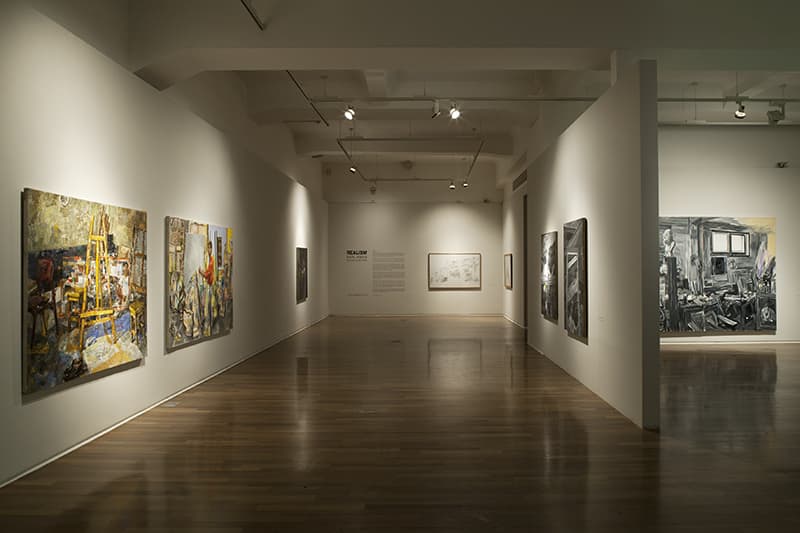
In this exhibition, where even unfinished works were hung, he implies
that incompletion is as important as completion. What matters is the artwork’s
unconscious—an unconscious the work neither knows nor can know. As Freud points
out, the split gaps within a text are where interpretation runs rampant; and
although interpretation is a product of the ego, it is also heterogeneous to
the ego. Choi Gene Uk’s paintings reveal internal division, and that division
is the artwork’s unconscious. As modern philosophers emphasize, such division
foregrounds contingency over universality, diversity over unity, defect over
foundation, difference over identity. Michel Foucault, one of those thinkers,
describes the elements of knowledge not as a sum of information or a unified
mode of thought, but as a space of deviation, gaps, and dispersal, placing his
cultural model at the center of an active interplay of differences.
By fragmenting a homogeneous, single canvas—or by fragmenting
scenes—Choi Gene Uk emphasizes the textuality of the work: its character as a
net that has been broken or stitched together. Through this, the text produces
polyphonic sounds, a clash of multiple voices. The text is multilingual from
the start. The viewer, denied decorative and comfortable scenes, must, through
the work’s gaps, ‘seek the omissions the works present but cannot explain, and
above all, their contradictions’ (Catherine Belsey). Within its absences and in
the collision among diverging meanings, the text implicitly critiques its own
ideology. Illusionism that reassures and consoles the viewer is rejected, as
are narratives that conclude with a precise message of where something begins
and where it ends.
Catherine Belsey notes that the subject’s coherence and continuity
provide the conceptual framework of classical realism. The use of the
grammatical subject establishes the subject. But the ‘I’ of discourse is always
a stand-in, because no one can remain identically the same across different
moments. The continuity of the self is a myth. The subject is constituted
within language and discourse, and within discursive practice the symbolic
order is closely linked to ideology. Thus one may say that the subject is
constituted in ideology. Ideology hails concrete individuals as subjects, and
middle-class ideology in particular stresses a fixed identity of the
individual.
Unlike such middle-class self-sameness, the actual subject is
always in the process of ongoing formation. Because subjectivity is grounded in
difference, an imaginary unity with the world is delayed indefinitely. Belsey
further argues that the idea of the primacy of language over subjectivity was
refined through Lacan’s interpretation of Freud: Lacan’s theory of the subject
as constituted in language secures the decentering of personal consciousness,
and as a result the subject is no longer regarded as the source of meaning,
knowledge, and action.
The Lacanian subject is constituted on the basis of an irreversible
split. The ego of the mirror stage is alienation—that is, the moment of
distinction between the perceiving ‘I’ and the perceived (imaged) ‘I.’ For
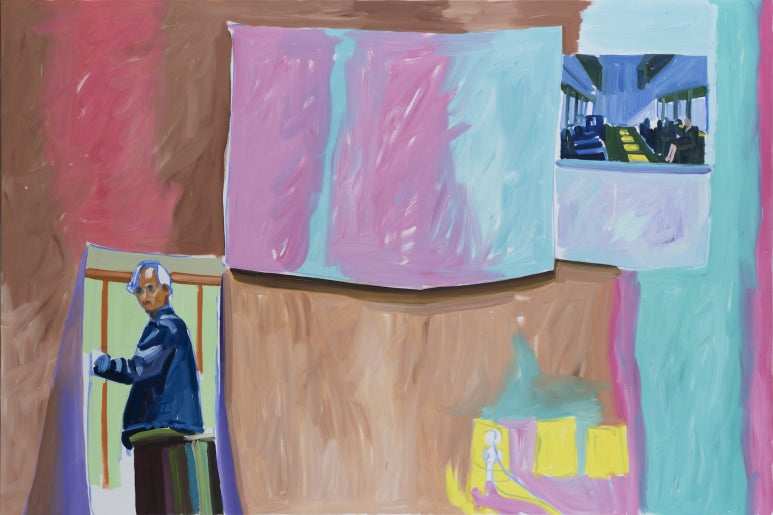
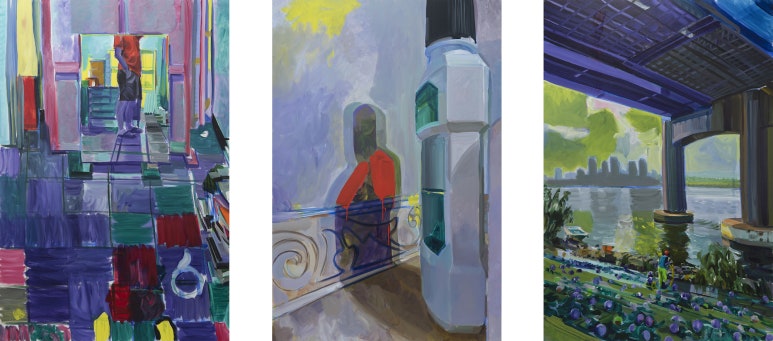
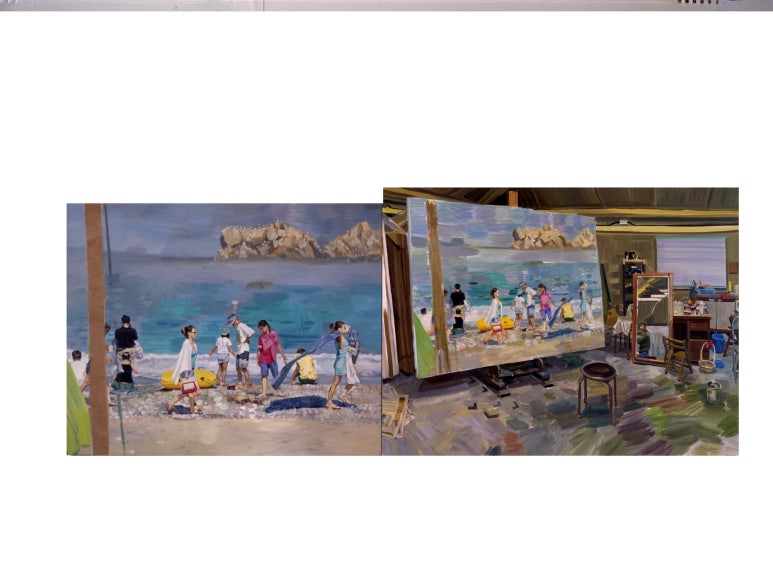
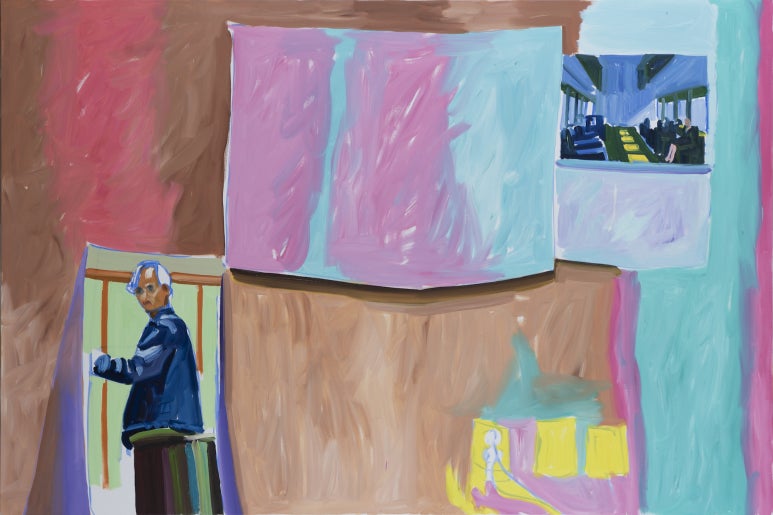
example, in Choi Gene Uk’s Beach–Studio, the artist is
absent, yet appears like a ghost in the broken mirror; he seems to exist within
the left-hand picture that depicts a photograph, and also to exist within the
small painting inside the right panel. The artist is everywhere, yet nowhere possesses
a secure presence.
Through a situation of multiple prismatic refractions, he
paints the subject’s absence and division. The subject is continually defined
through other frames—whether painting or mirror—yet also slips away toward
somewhere else. Like the subject in the Lacanian sense, the text is an unfixed
process. However, in Choi Gene Uk’s case, while he is cool and—just as the
foregoing citations and arguments suggest—‘split’ regarding the problem of
painting, he has something clear to say about the real-world institutions
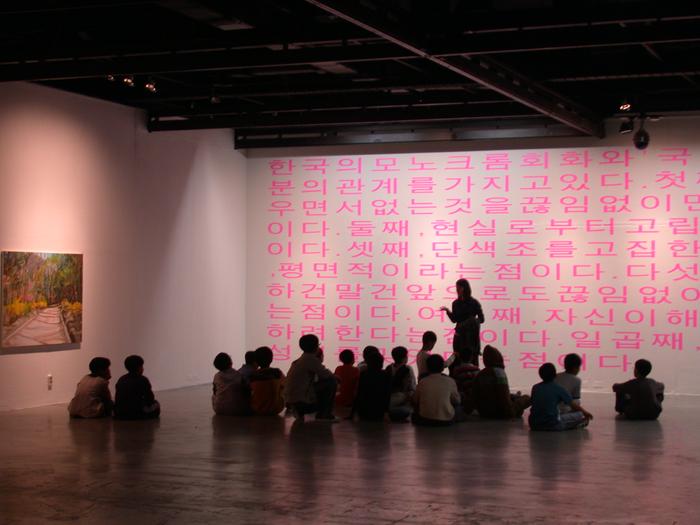
surrounding painting. This emerges in the works occupying the other half of the
exhibition’s diagonal axis, where the artist’s statements are more direct.
Today, painting may have entered a non-Euclidean dimension and, in the
thin air of that plateau, be producing high-level discourse about its meaning
and mode of existence; yet the world we live in clearly belongs to a
three-dimensional Euclidean reality. Even if contemporary
philosophy—post-structuralism or deconstruction—pursues rupture and
fragmentation of organic totality, this does not mean it collapses into
conservatism, as left critics have argued.
Terry Eagleton, in The
Function of Criticism, says that deconstruction is a liberalism
without a subject and thus, above all, becomes an ideological form suited to
late capitalist society: it thoroughly nullifies everything while leaving
everything as it is. Yet many post-structuralists were political activists. In
Choi Gene Uk’s work, however, the statements are not so much a politics of
division, or activism as an extension of division, as they are directed toward
something unmistakable. There is intention, a target of attack, and a certain
persuasiveness.