Dongju Kang (b.1988) delves into the essence of the world and perceives its transformations by sensing the passage of time and the forms of light and darkness. Distancing herself from an artistic outlook that approaches solely from familiar senses, the artist utilizes drawings to document the movement of the object she pursues, embodying its path while carefully approaching the existing things that surround her with the gazes of others.


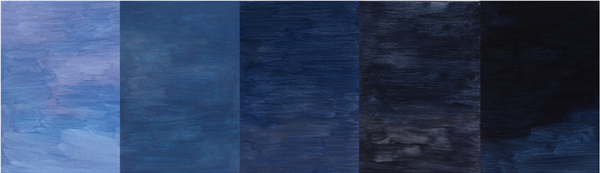
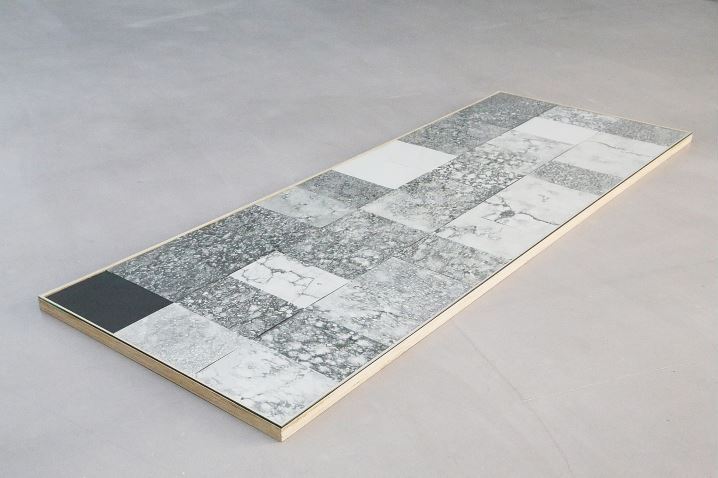
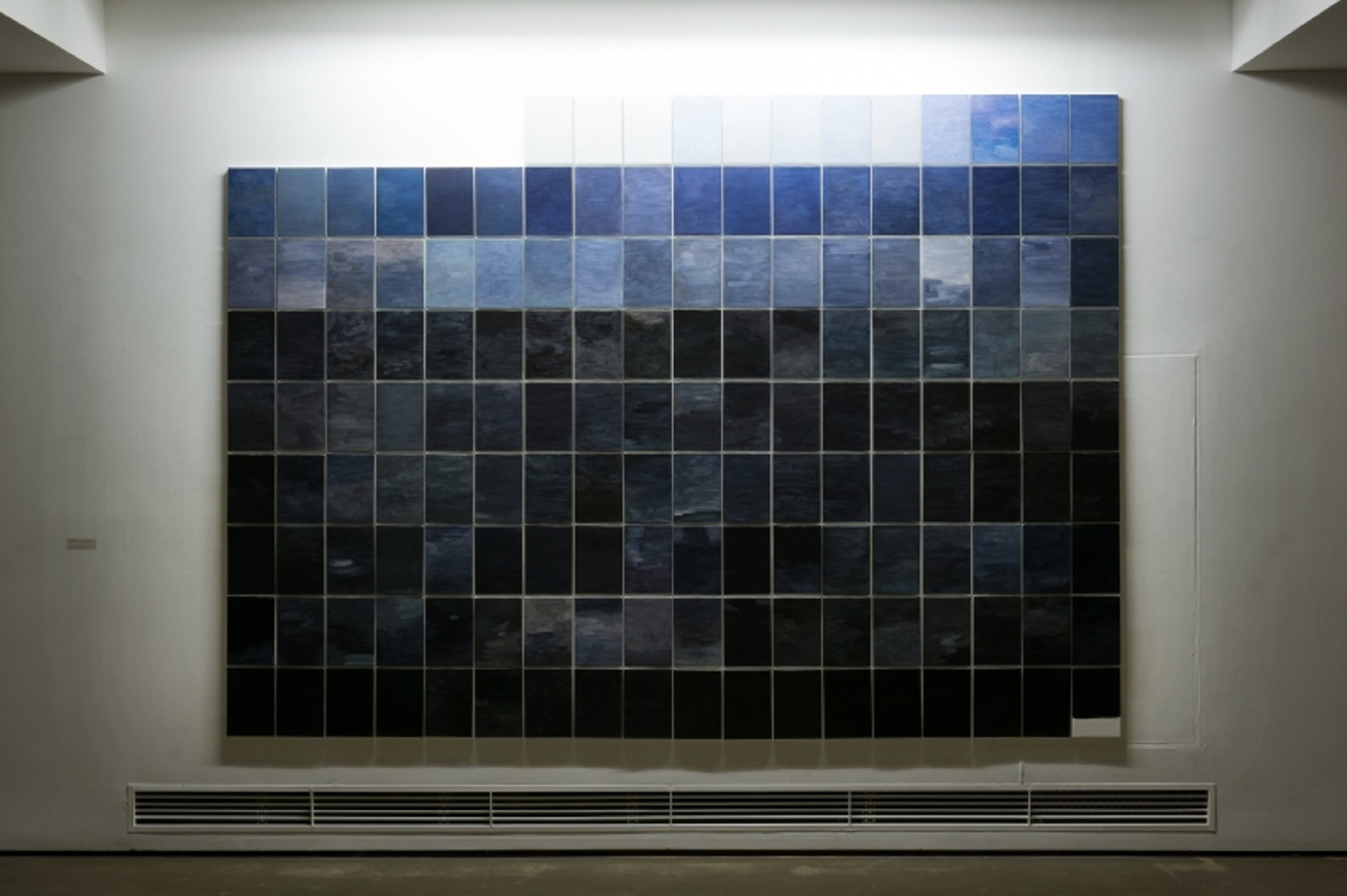
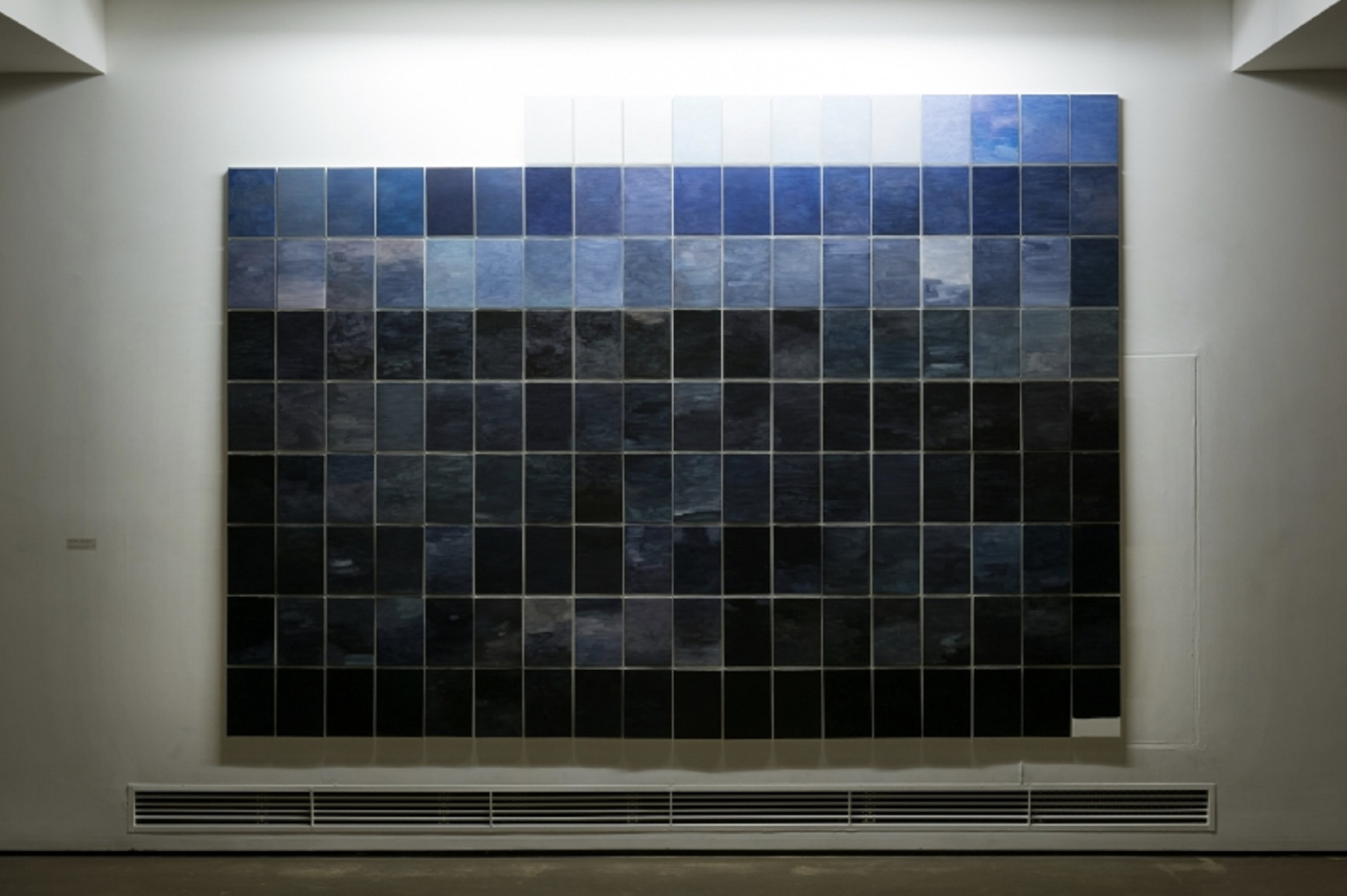
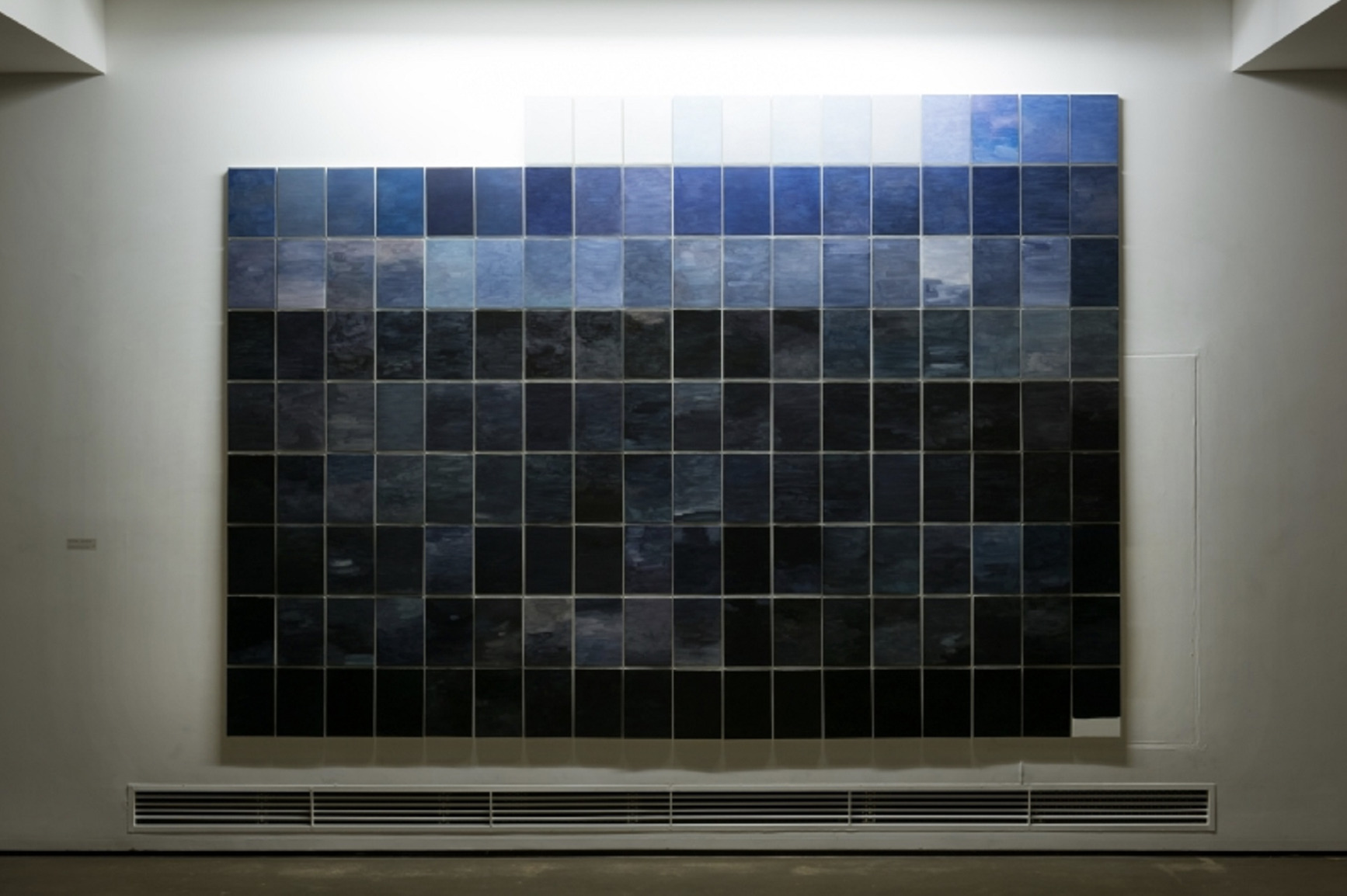
Dongju Kang, Sky of 155 minutes 37 seconds, 2013, Oil on canvas, each 22.7x15.8cm (156 pieces) ©DOOSAN Art Center

Dongju Kang’s practice begins with a fundamental question—what is painting?—and unfolds into a painterly language that functions as a means of communicating with the world. The focus shifts from the question of how to paint to that of what to see, a transition that naturally leads her to perceive and engage with the notions of time and space that surround her.
 
Accordingly, the artist began to pursue a painting practice that approaches the essence of a constantly changing world through the act of “drawing.” When encountering the shifting flow of time, changing seasons, weather, and transformations of place and terrain, Kang selects media and drawing methods suited to visualizing each experience. Through a blend of frottage, printmaking, pencil and graphite drawings, and color, she has faithfully and consistently recreated the world’s appearances.


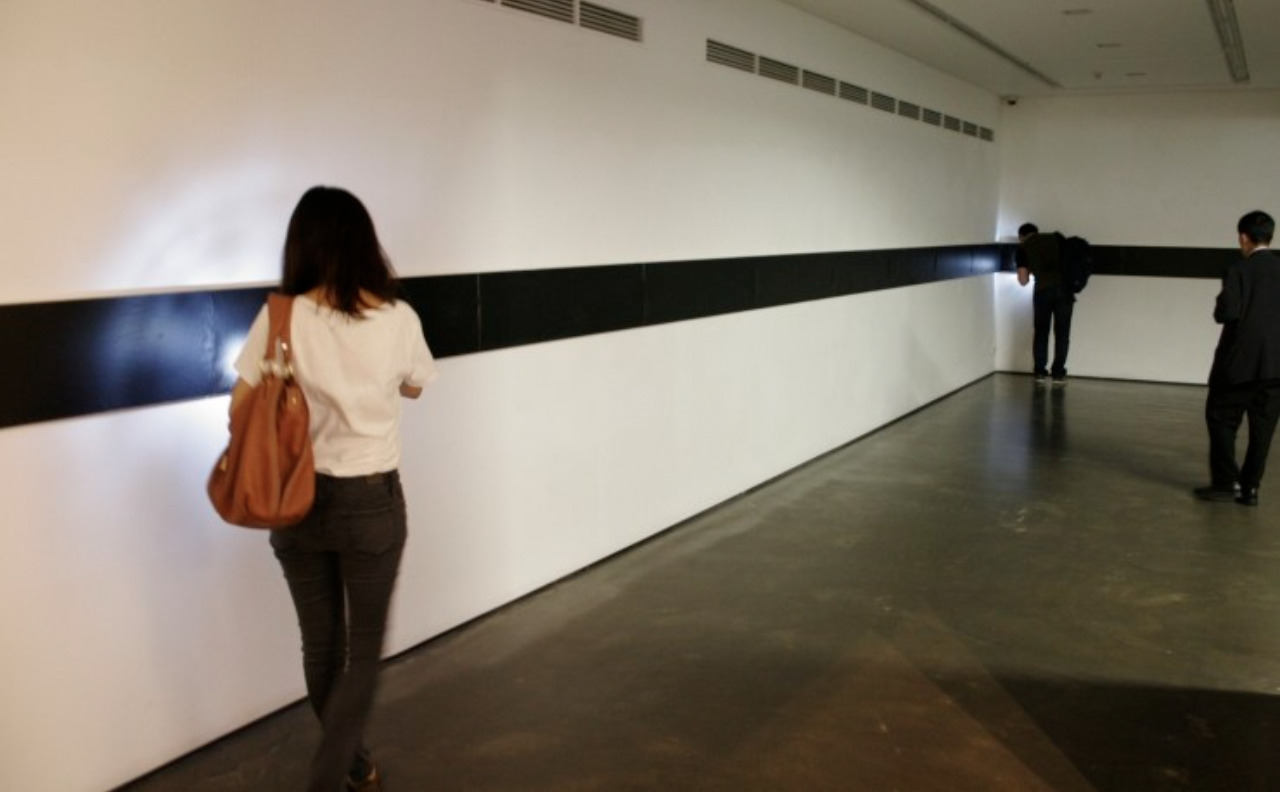
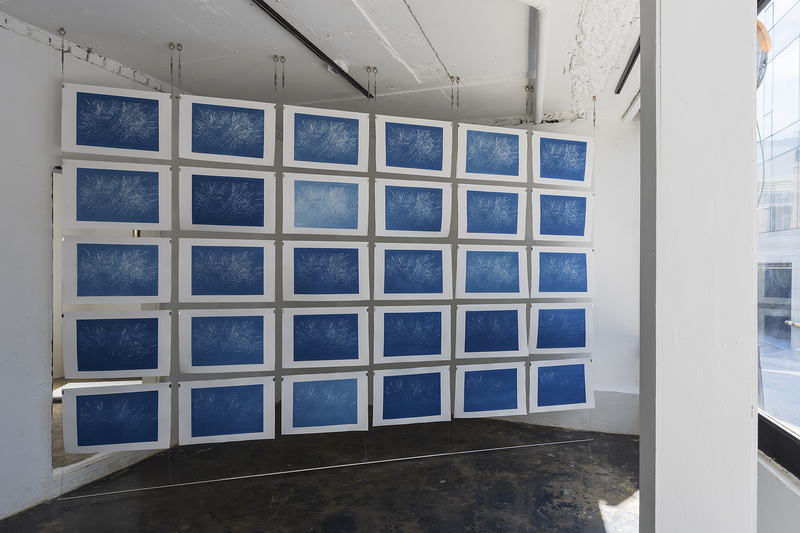
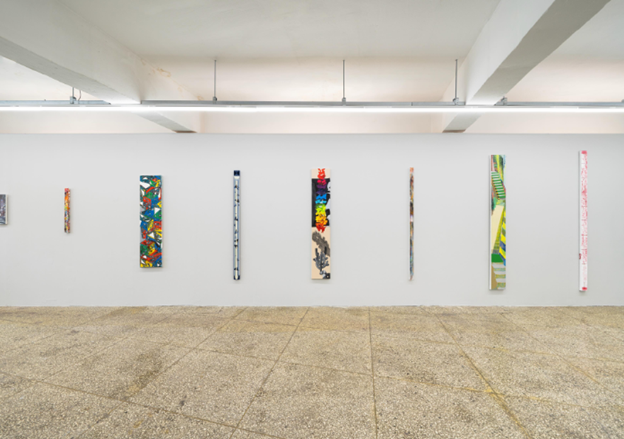
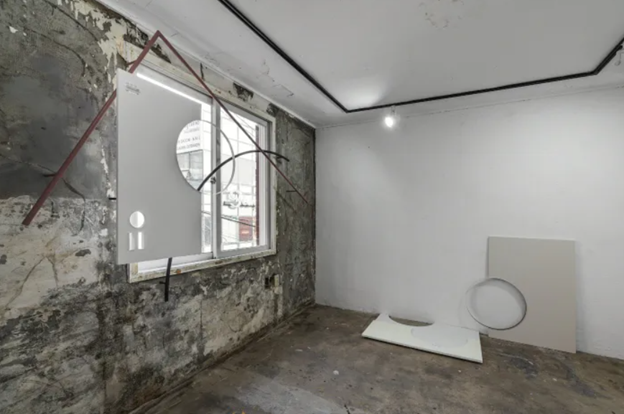
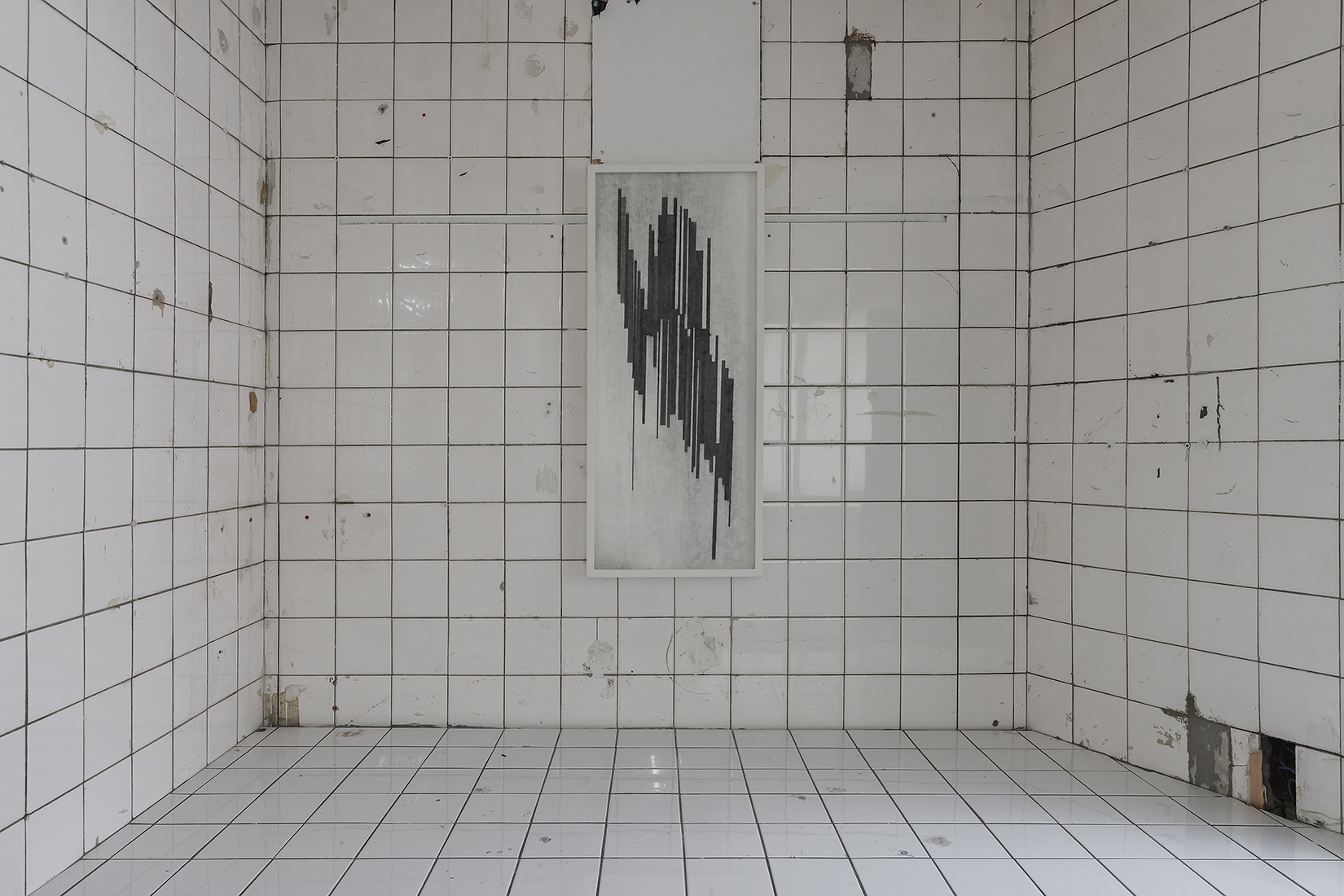
Installation view of 《At the Window》 (Tastehouse, 2018) ©Tastehouse

In her early works, grounded in this aesthetic methodology, Dongju Kang recorded fragments of Seoul—the city where she was born and raised—onto paper. In her first solo exhibition, 《Black-out》 (Nuha-dong 256, 2012), she sought to trace the time and space of the city through the tools of “light” and “carbon paper.”
 
Kang treated the glass window of the exhibition space, Nuha-dong 256, as an intermediary zone. Every hour, she observed the movements of the residential neighborhood reflected in the window and translated the trajectories of light into carbon paper drawings.
 
At the same time, the artist interpreted the wooden boards attached to the back of the glass as an interface of obstruction that produced invisibility. She removed these boards and incorporated them as part of the exhibition works. On the day the boards were dismantled, she engraved the day’s scenery and movements onto their surfaces using a carving knife and hammer.
 
Through this drawing practice, Dongju Kang engages with the threshold between visibility and invisibility, revealing the spatiotemporal structure of the city as a site where light and darkness coexist.


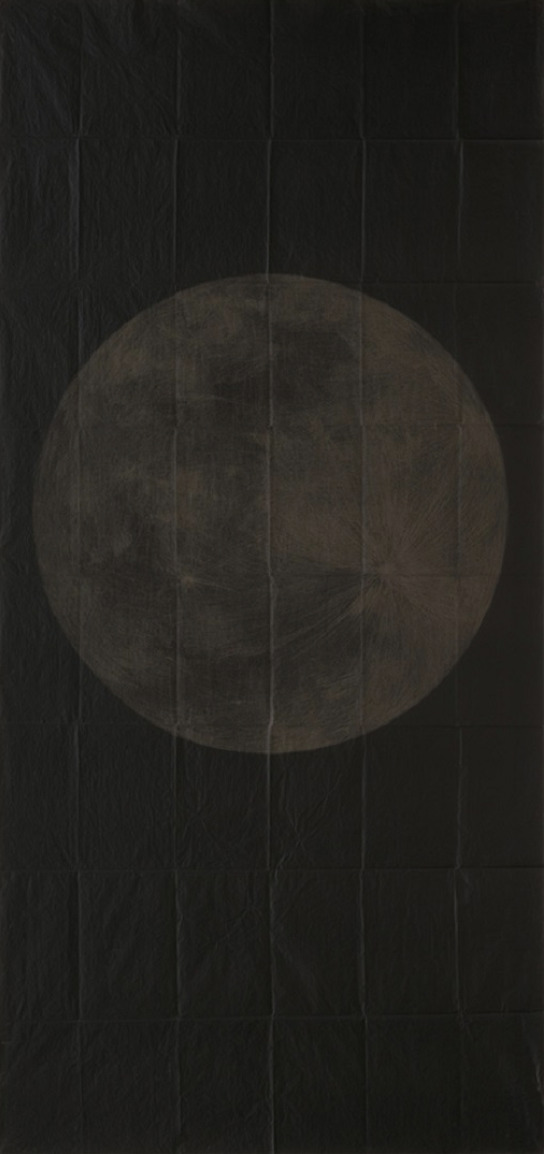
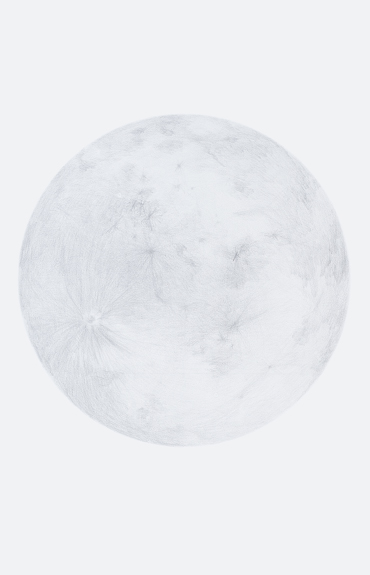
Dongju Kang, The Moon of 324 seconds, 2013, Carbon paper, 250x122cm ©DOOSAN Art Center

This line of inquiry continued the following year in her solo exhibition 《Subcenter》 at the OCI Museum of Art. Kang filmed nighttime scenes of Seoul’s secondary urban centers—such as Cheongnyangni and Yeongdeungpo, where she was born and raised—and recorded them onto carbon paper and canvas.
 
She chose the darkness of night, rather than daytime when everything is clearly revealed under light, in order to activate senses that remain less visible behind visual perception. Placing carbon paper beneath the drawing surface, she documented the process by which the faint lights of the night shift and transform across time and space.
 
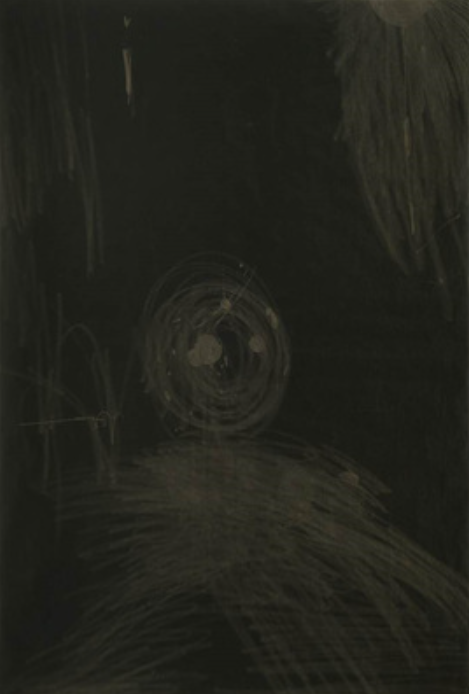
Carbon paper functions in her practice as an apt tool for transferring the landscape and sensibility of nighttime onto paper. In paper drawings, light is rendered as black pencil lines; by contrast, the lines she draws onto the carbon paper beneath the surface—tracing light itself—appear brighter.
 
Just as, in the darkness of night, one can perceive the surroundings only through limited amounts of light, her carbon paper drawings remain indistinct, leaving their forms faint and difficult to grasp at a single glance.

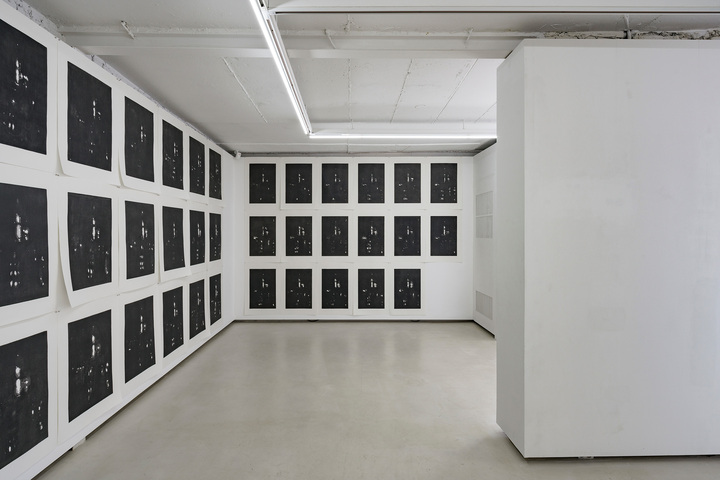
Installation view of 《Subcenter》 (OCI Museum of Art, 2013) ©OCI Museum of Art

The three series presented in the exhibition—'Light Drawings,’ ‘Moon Drawings,’ and ‘Sky Paintings’—are in fact a single project, based on video documentation of a car journey traversing Seoul’s secondary urban centers.
 
The artist planned a route that began in the Cheongnyangni redevelopment district, passed through Yeongdeungpo, and returned to Cheongnyangni. On February 25, 2013, the day of the full moon, she traveled by car from sunset at 6:28 p.m., recording the street scenes on both sides of the road and the sky above using three video cameras.


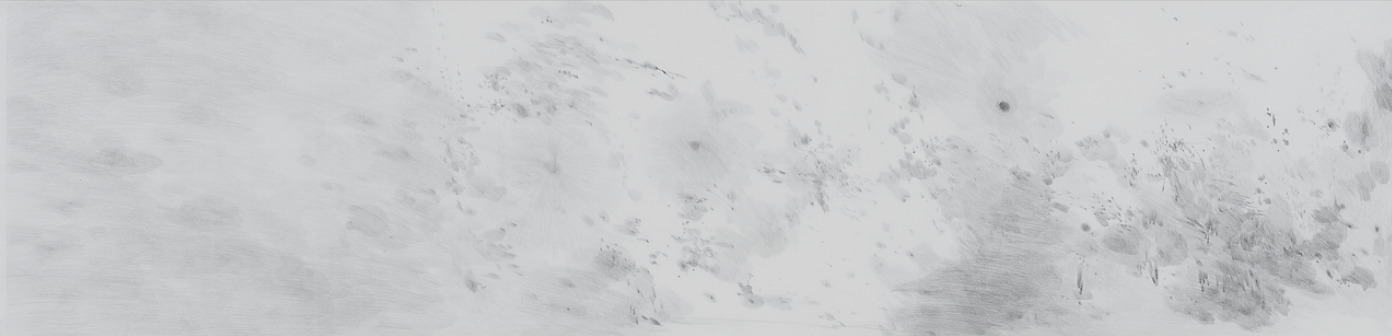
Dongju Kang, Light of Subcenters, 2013, Pencil on paper, 30x122cm (26 pieces) ©Dongju Kang

Among these, the ‘Light Drawings’ series results from transferring the trajectories of light onto carbon paper while viewing the video footage filmed on the left side of the road. In this process, three elements—the drawing made directly on the white sheet placed over the carbon paper, the drawing transferred onto its reverse, and the carbon paper drawing itself—are all considered integral works.
 
In ‘Light Drawings,’ images of each paused moment are drawn on a single sheet by repeatedly changing the carbon paper, allowing the flow of time to accumulate and overlap in layers on the surface. Rendered through movement and duration, the drawings each contain nightscapes of differing densities.


Dongju Kang, Sky of 155 minutes 37 seconds (detail), 2013, Oil on canvas, each 22.7x15.8cm (156 pieces) ©Dongju Kang

Meanwhile, the ‘Moon Drawings’ series is the result of tracking and recording the full moon as it appears in the video footage filmed on the left side of the road. Within the recorded video, the moon appears a total of 22 times, for a cumulative duration of 5 minutes and 24 seconds. In transferring the moon onto paper, one second of appearance time was converted into a diameter of 0.33 cm.
 
Finally, the ‘Sky Paintings’ series translates video footage that captures only the sky over a total duration of 2 hours, 35 minutes, and 37 seconds—from the moment the sun began to set through the journey that started in the Cheongnyangni redevelopment district, passed through Yeongdeungpo, and returned to Cheongnyangni—onto 156 canvases, each measuring 22.7 × 15.8 cm.


Dongju Kang, The Moon of 324 seconds, 2013, Carbon paper on paper, 180x122cm ©Dongju Kang

Whereas her previous solo exhibition 《Black-out》 presented works that inscribed light through the mediation of glass windows, the works introduced in 《Subcenter》 embody the coexistence of the sensations of inscribing and erasing. Through this approach, the artist captures moments of relational interplay at the threshold between light and darkness, enabling familiar time and space to be newly perceived through unfamiliar sensibilities.


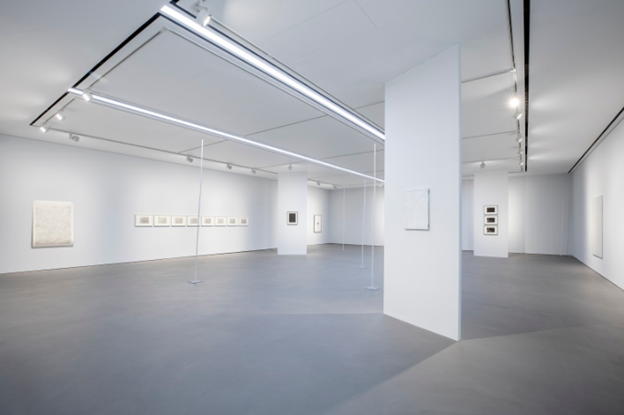
Installation view of 《A Glimpse of Light, Gaze upon Nowhere》 (A-Lounge Contemporary, 2022) ©A-Lounge Contemporary

Meanwhile, in her 2022 solo exhibition 《A Glimpse of Light, Gaze upon Nowhere》 at A-Lounge Contemporary, Kang carried out her drawing practice—long concerned with recording time and space—by giving form to the internal images of time and light that are not materially fixed.
 
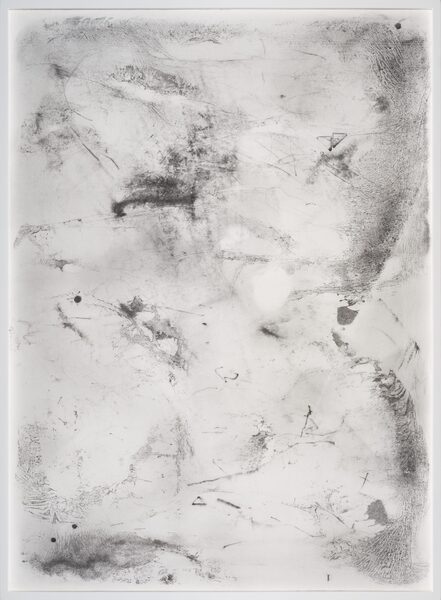
The exhibition was composed of the series ‘Leaning into the Light,’ modeled after windows, and ‘Over There.’ In ‘Leaning into the Light,’ the works were realized through a performative process in which the artist placed carbon paper against the windows of spaces she had inhabited for long periods, such as her home and studio, and rubbed the surface to transfer the traces left on the glass onto a two-dimensional plane.
 
By recording on paper the sites where light had once passed through the window, she sought to materialize the image of light that we have long imagined only vaguely.


Dongju Kang, Leaning into the Light (2017) #3, 2022, Gum Arabic, graphite powder, carbon paper on paper, 77.1x56.3cm ©A-Lounge Contemporary

For the artist, light has been understood as both a material that bears witness to darkness and a medium through which she can communicate with the world and exist, responding through contact with her surroundings. In this exhibition, she seeks to understand the operation of light from an ontological perspective and to metaphorically express that process by simulating its workings.
 
While the ‘Leaning into the Light’ series focuses on reproducing the accumulation of time, the ‘Over There’ series centers on the meanings of light as articulated by Dongju Kang.


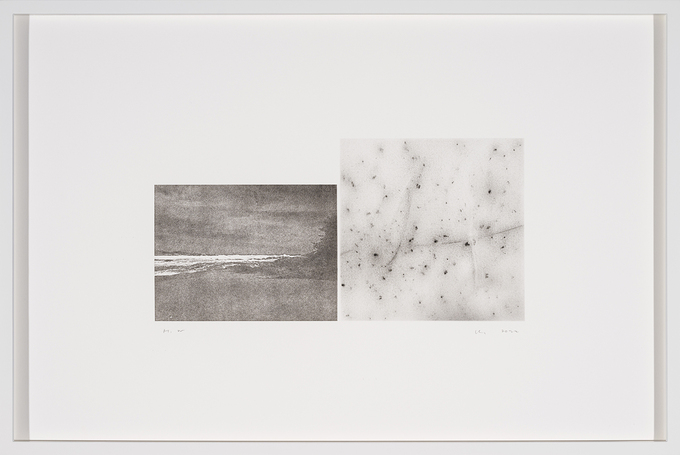
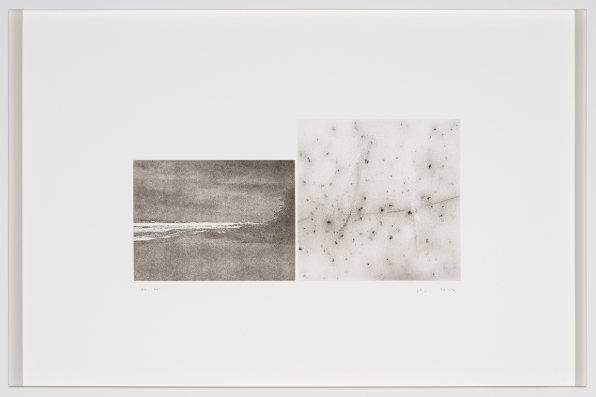
Dongju Kang, Over There #6, 2022, Graphite powder and photo transfer on paper, 35.8x54cm ©A-Lounge Contemporary

In the ‘Over There’ series, two images appear in juxtaposition within a single frame. One consists of landscape photographs sent by the artist’s parents and friends during the prolonged period of isolation; the other is a drawing that takes an imprint—using carbon paper and charcoal—of the ground from an indeterminate location randomly selected by the artist.
 
As fragments of unfamiliar landscapes are combined with images of the ground the artist directly touched, the two spaces are transformed into an ambiguous, unlocatable site—one that gestures toward a condition somewhere between presence and absence, existing yet imperceptible without the reach of light. At the same time, this space forms an emotional landscape that emerges between emptiness and memory as experienced by the artist.


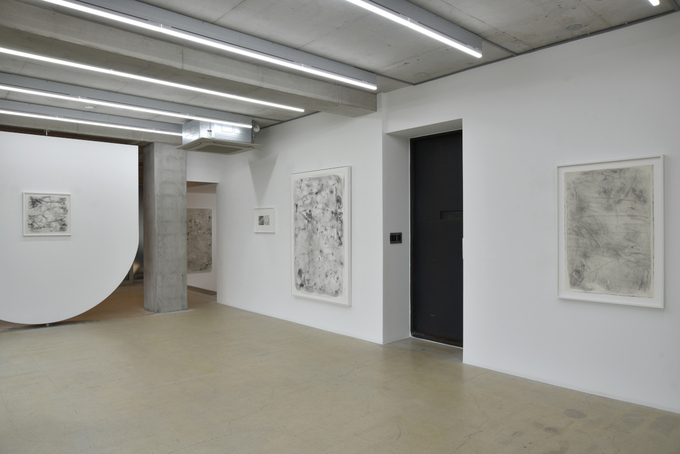
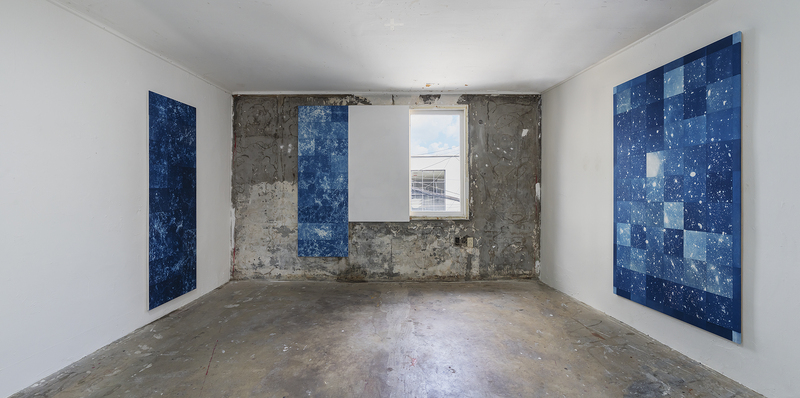
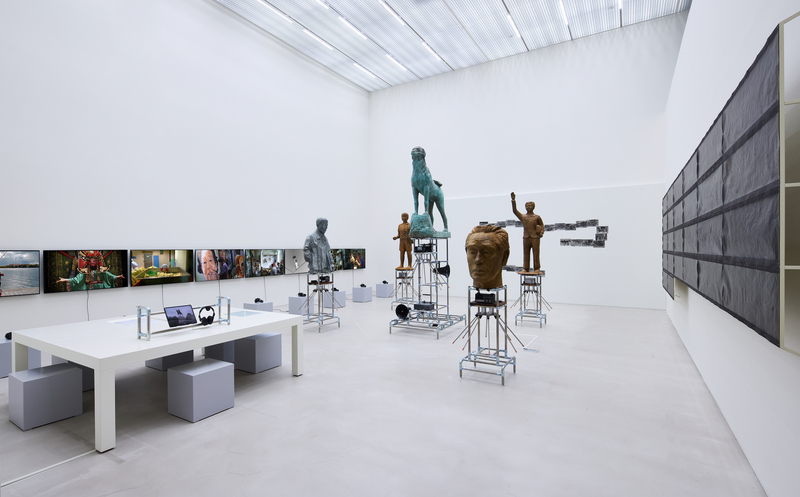
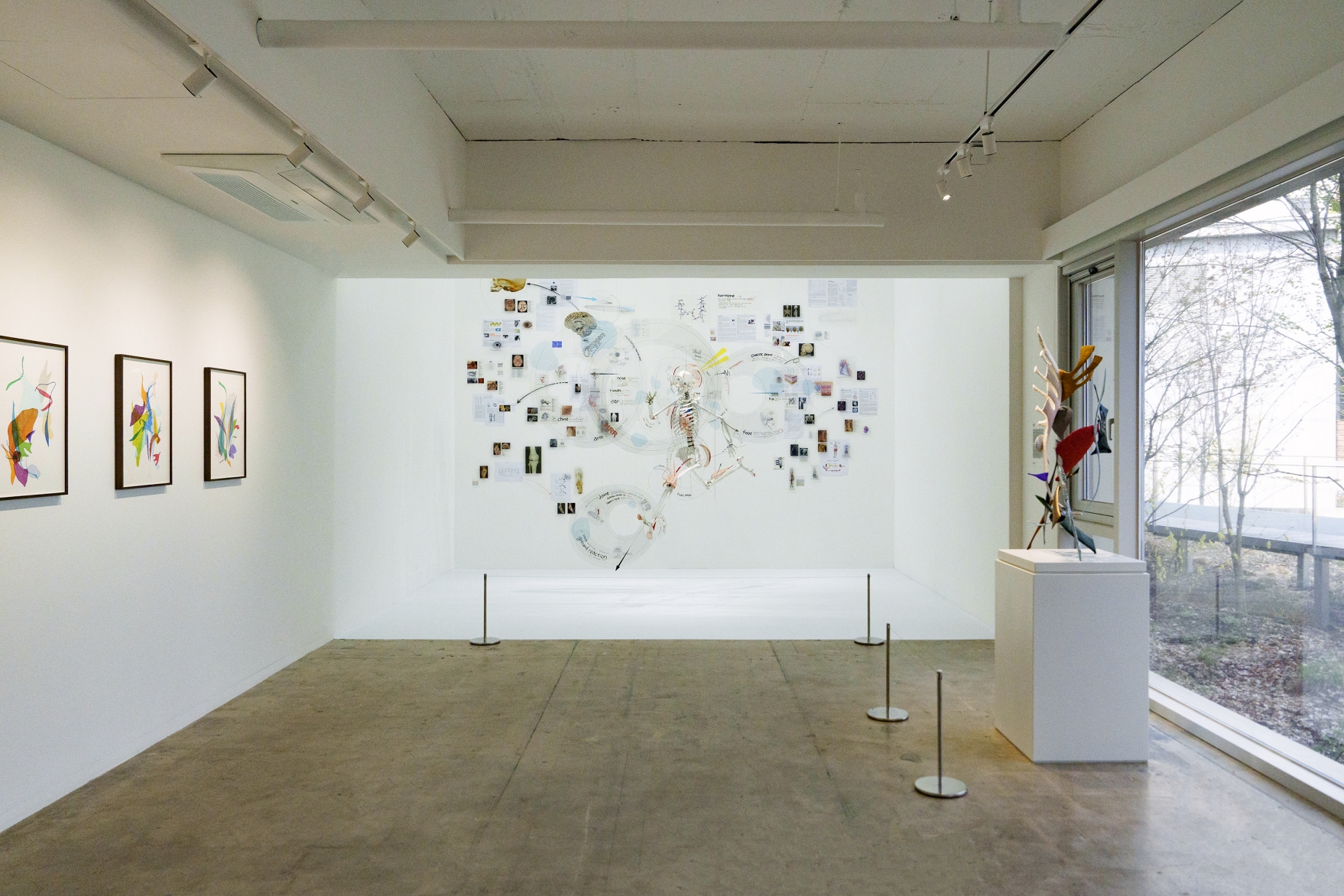
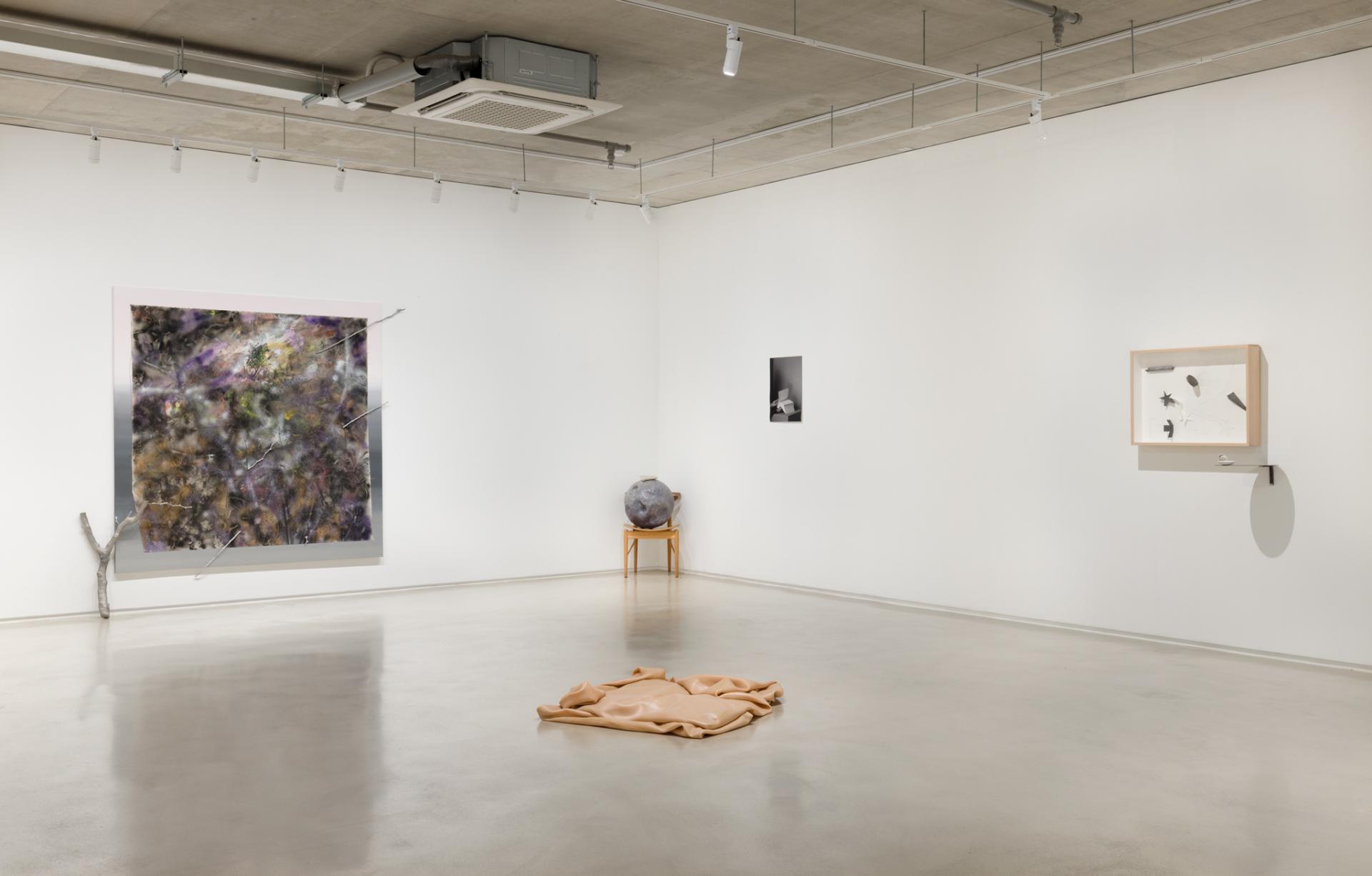
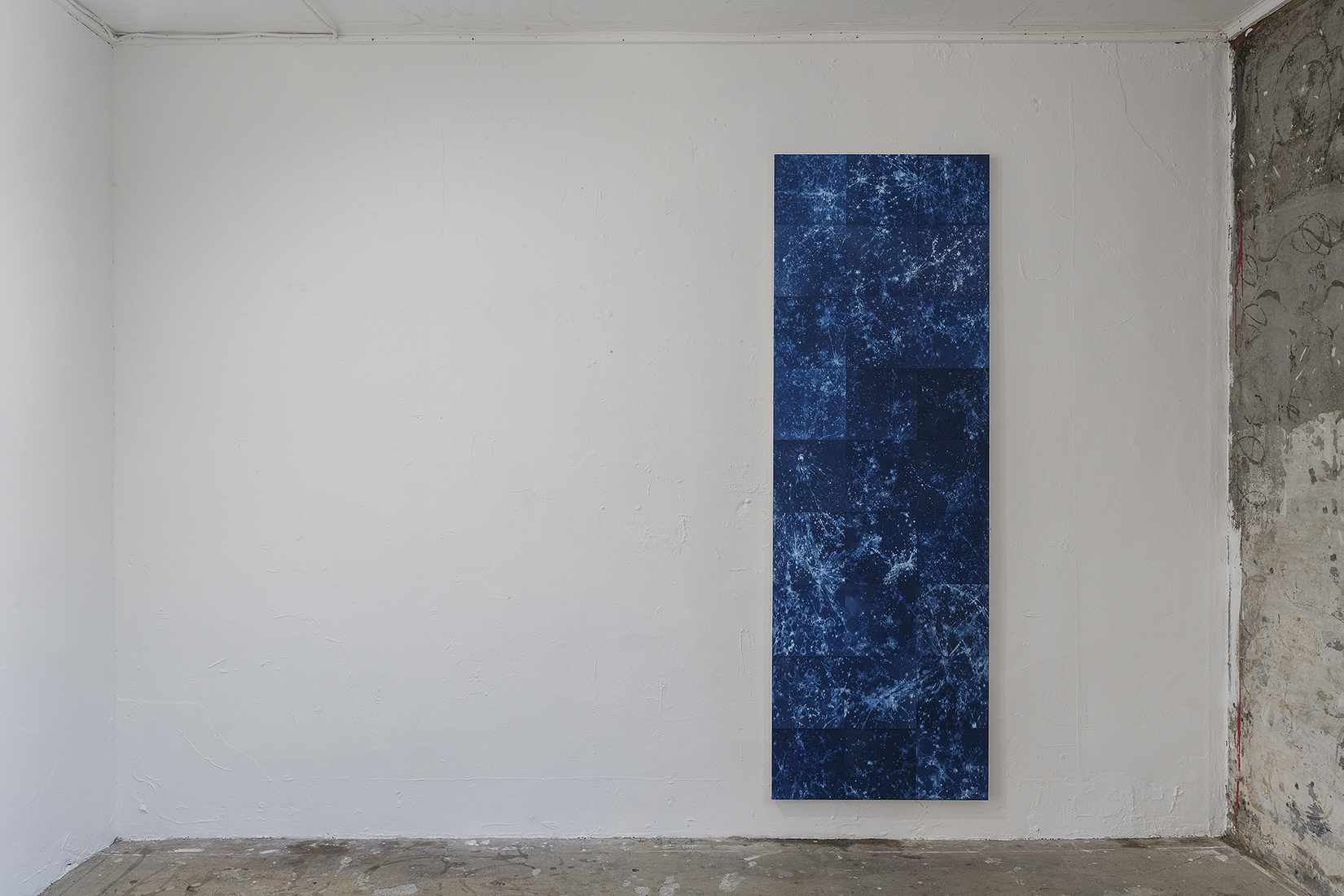
Installation view of 《Cast》 (Amado Art Space, 2025) ©Amado Art Space

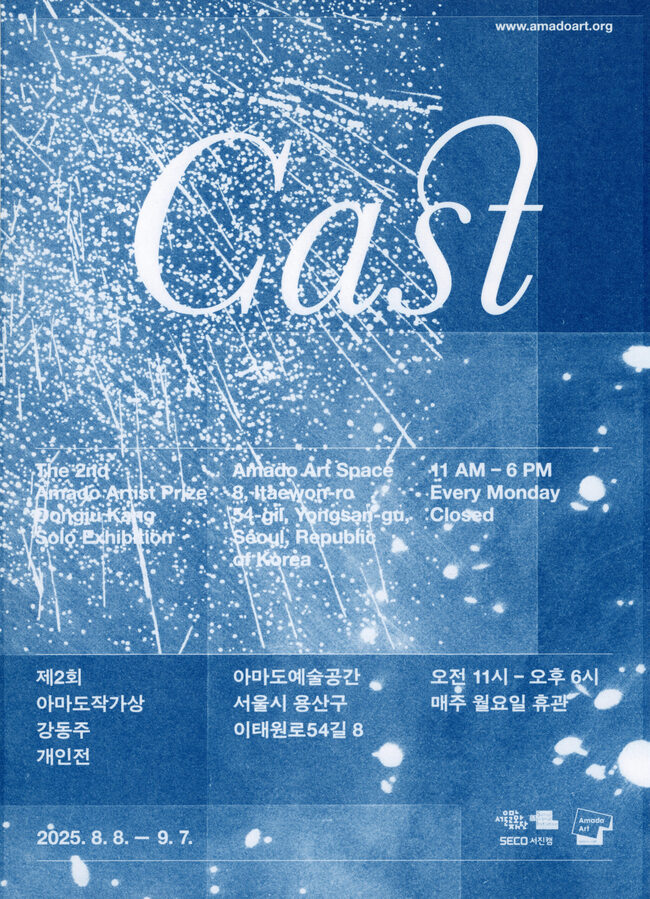
In this way, Dongju Kang repeatedly observes subjects through which the constantly shifting dimensions of time and space—and their flows—can be apprehended, sensing and actualizing them through the bodily act of “inscription.” This kinds of time and space, as traversed through the artist’s performative practice, is also revealed in her 2025 solo exhibition 《Cast》 at Amado Art Space.
 
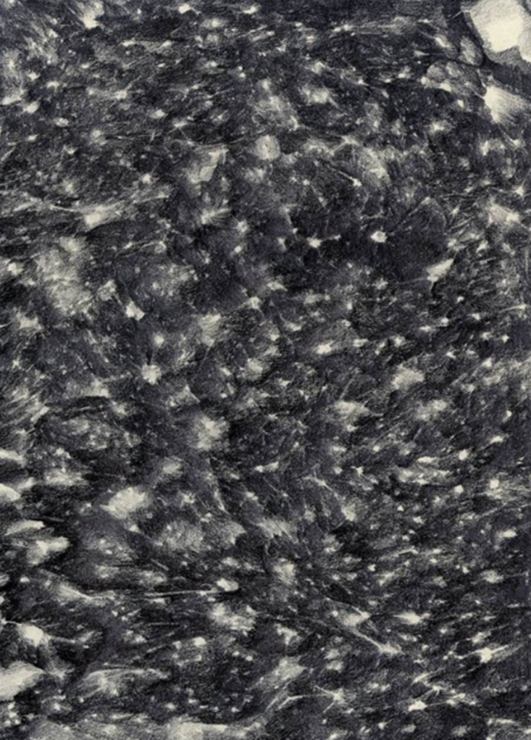
In 《Cast》, Kang addressed spaces we can neither directly encounter nor easily imagine—spaces conveyed through light and darkness. The cratered face of the moon, meteors met in a flash of orbit, galaxies crowding the void. These scenes, arrived at through a long desire to gaze beyond the visible realm and into distant space-time, are also watched over by the artist, who then transcribes them into the space-time of her own body.


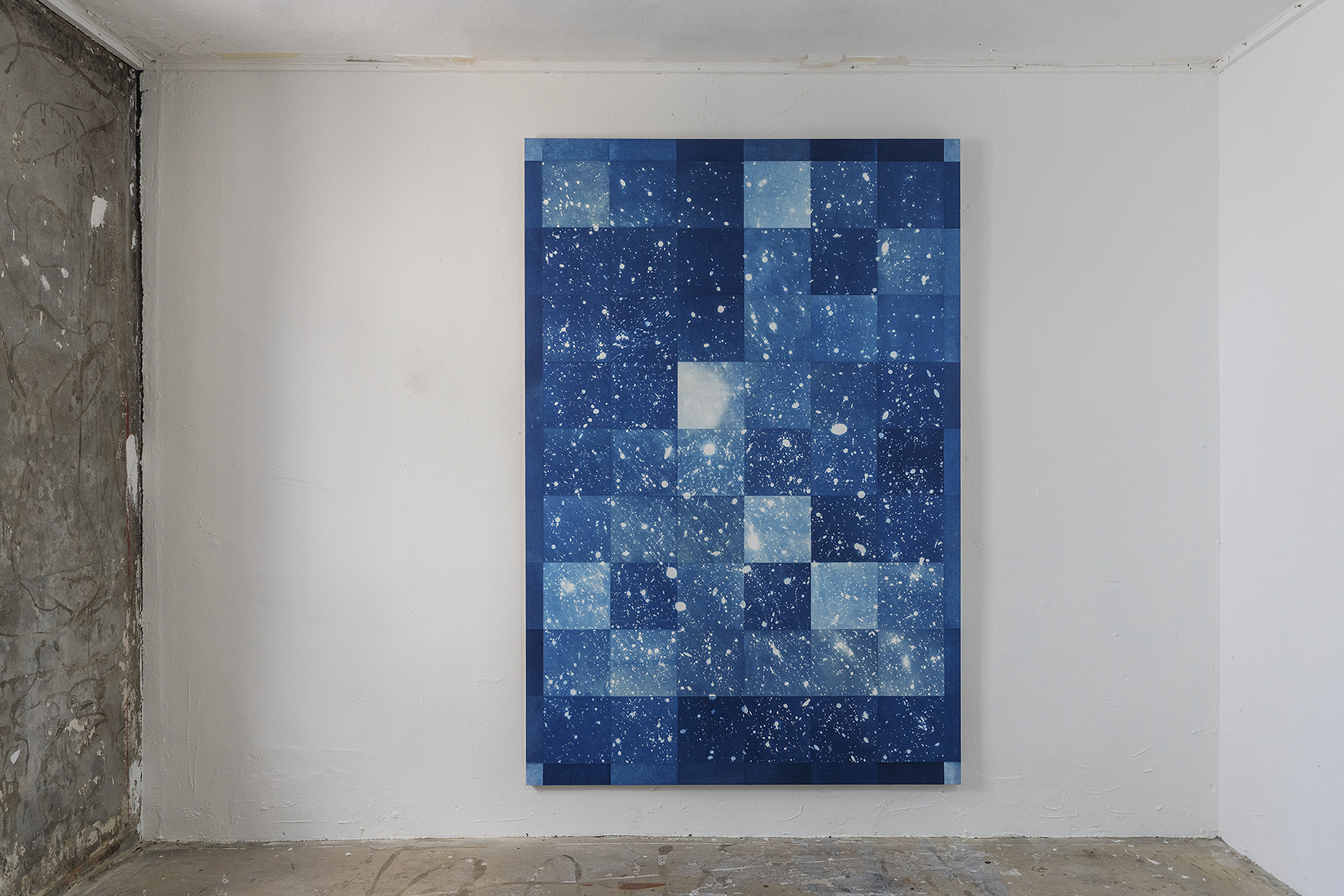
Installation view of 《Cast》 (Amado Art Space, 2025) ©Amado Art Space

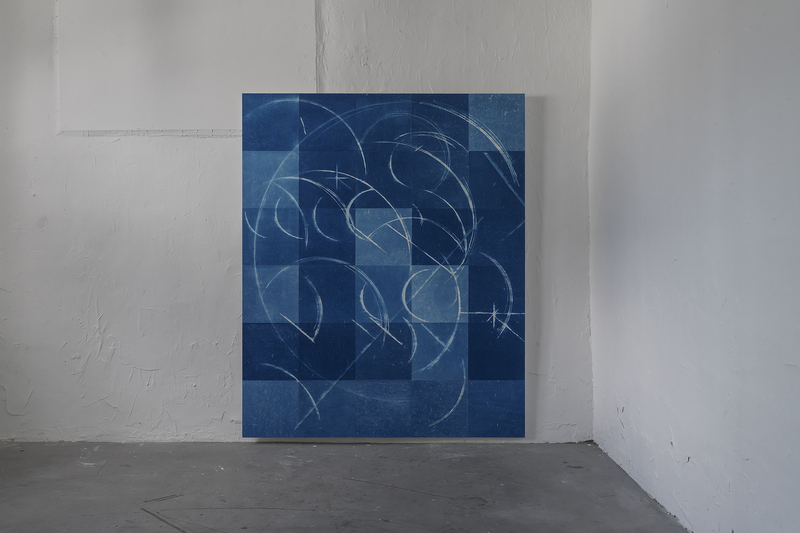
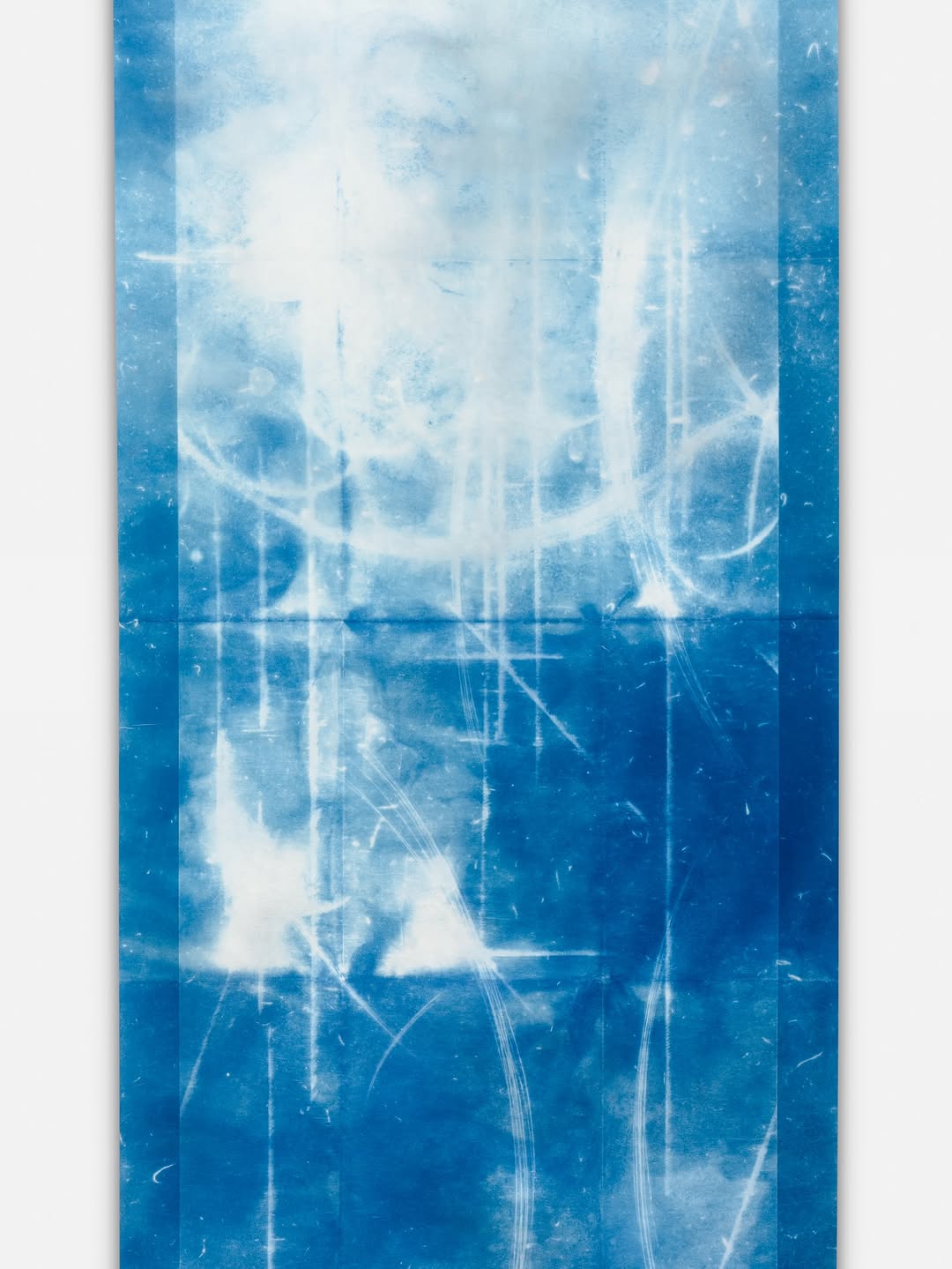
Yet now, another dimension enters the act of transcription—an external space-time that intervenes in the artist’s bodily engagement. The material evidence of this intrusion is found in the series of blue images. These are made using cyanotype, an early photographic printing technique. When a sensitized surface is exposed to ultraviolet light with an object or image placed upon it, the areas struck by light turn deep blue, while blocked areas remain pale, leaving the subject rendered in a blue-and-white imprint.
 
The subjects are segmented and transcribed like her previous works, with each fragment exposed to the day’s changing light and shadow over approximately a single day. For example, if an image is divided into 30 blue panels, the complete transcription would span roughly a month. This is why the assembled or layered blue scenes in the exhibition resemble a patchwork of fabrics—each dyed by a different concentration of pigment.


Dongju Kang, Blue Hour, 2025, Blueprint print on Korean mulberry paper, 141x117.5cm, Installation view of 《Cast》 (Amado Art Space, 2025) ©Amado Art Space

In the cyanotype process, the image’s brightness and depth of shadow are determined by the intensity and duration of light exposure. When the day is dim, the resulting imprint becomes paler (whiter); in strong light, it appears darker (bluer). The same applies when the ambient lighting shifts due to the changing season or the movement of objects within the space. Such interruptions too leave behind traces—blue or white.
 
In this way, what were once mere subjects or conditions—light and darkness, day and night, seasons and spacetime—now come to shape themselves.


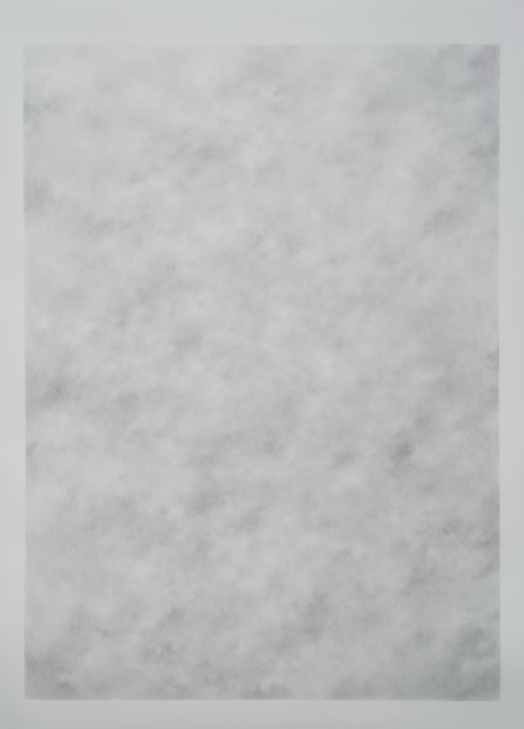
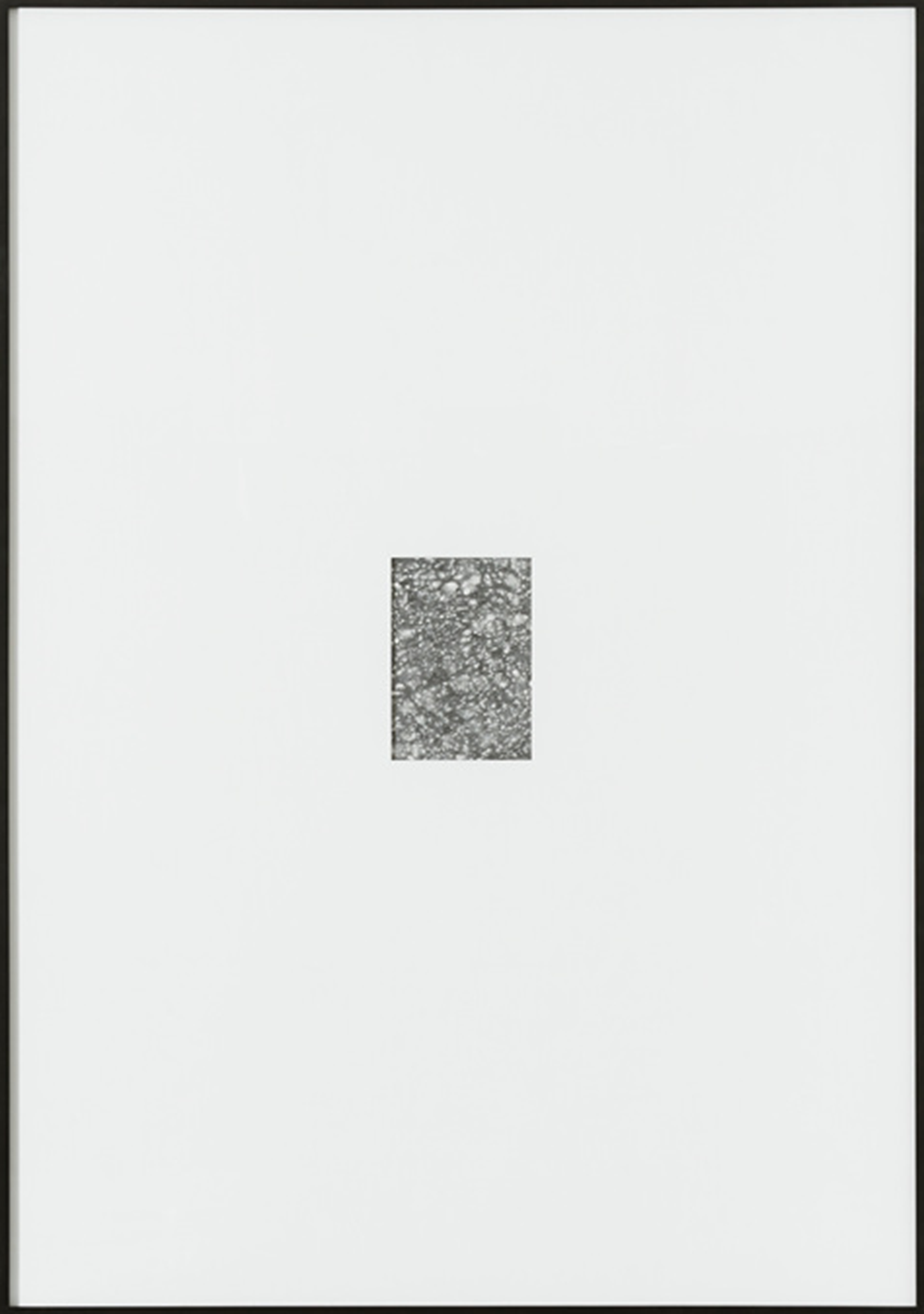
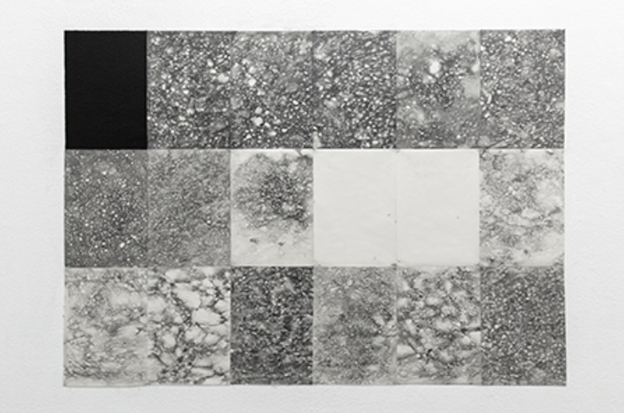
Dongju Kang, ground pieces of 1 hour 30 minutes 35 seconds(May 2014), 2014, Pencil on paper, each 23.5x16.5cm (36 pieces) ©Dongju Kang

In this way, Dongju Kang’s practice—marked by a sustained gaze toward subjects that may endure or disappear—seeks to leave behind a sense of being here and now, an attempt to arrive fully at the present. At the same time, through processes of restoration that engage with invisible time, she imagines futures yet unreached, beyond the images of the subjects that emerge.
 
This process reflects her aesthetic approach to understanding, responding to, and engaging with the world. By diligently recording her relationship with the outside world, she explores her place within it and the significance of that connection.

 ”Drawing is sometimes used as a metaphor for making a concrete plan for the future. In this way, we can think beyond the images of the spiritual value of a material form we want to possess.”    (Dongju Kang, Artist’s Note) 


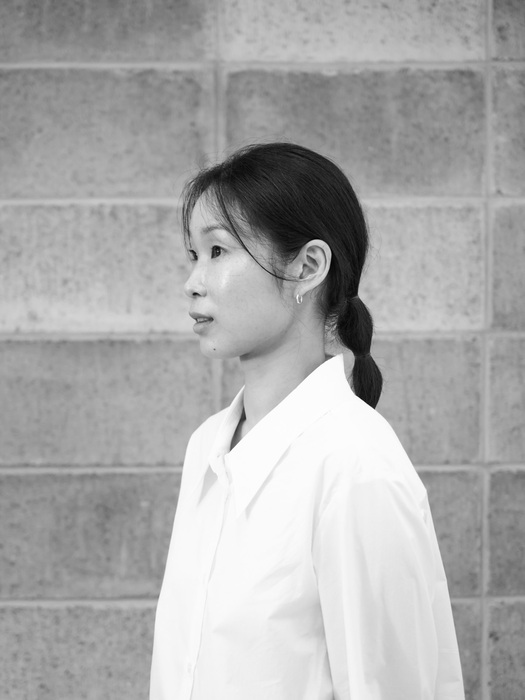
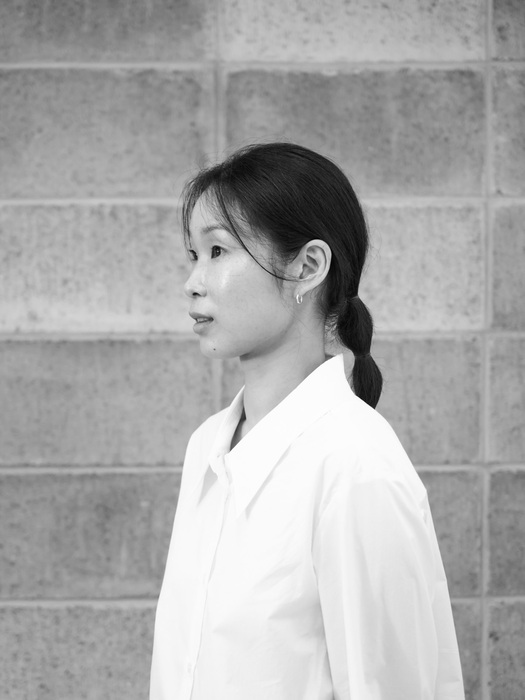
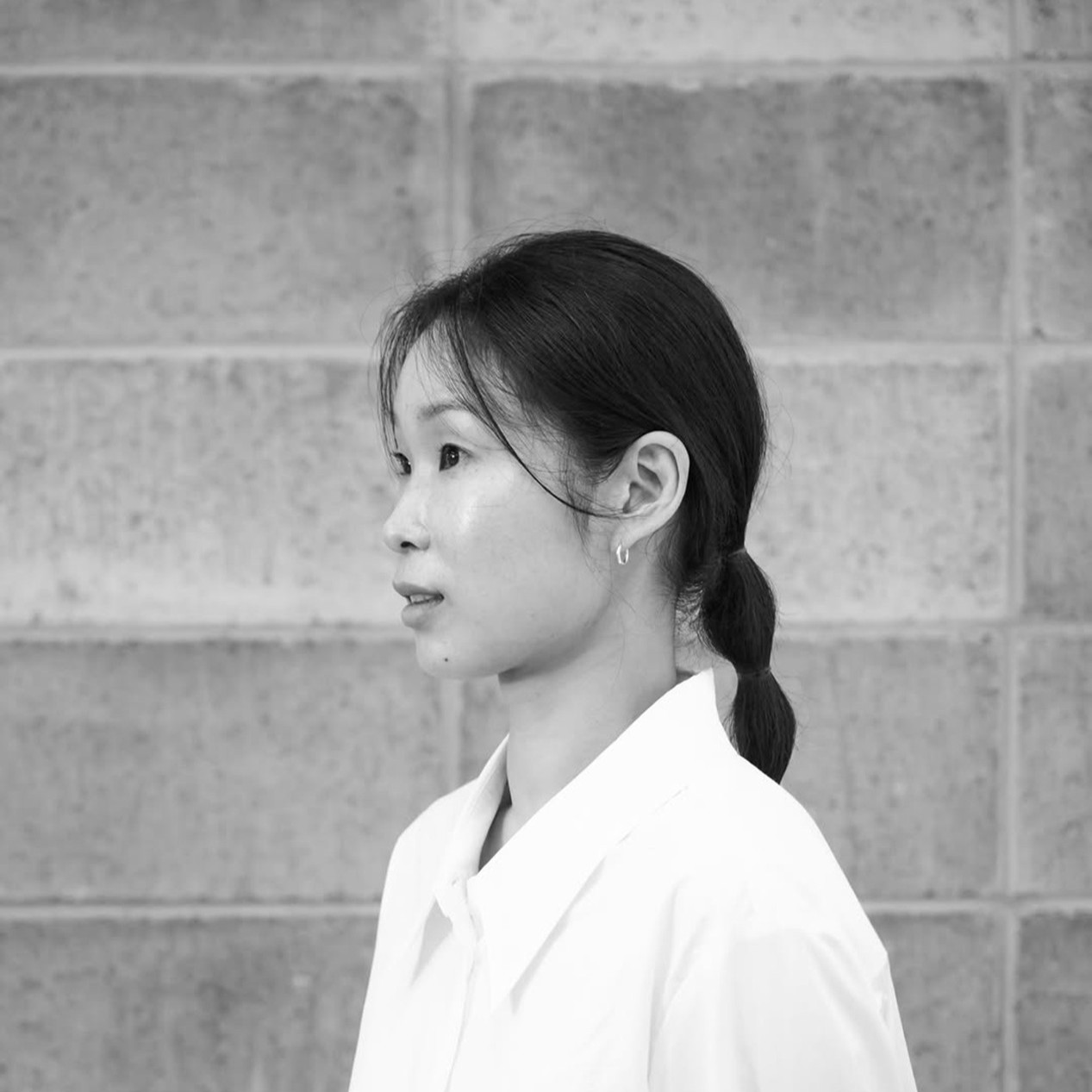
Artist Dongju Kang ©A-Lounge Contemporary

Dongju Kang received her B.F.A. and M.F.A. in Fine Arts from Seoul National University of Science and Technology. Her solo exhibitions include 《A Glimpse of Light, Gaze Upon Nowhere》 (A-Lounge Contemporary, Seoul, 2022), 《At the Window》 (Tastehouse, Seoul, 2018), and 《Seoul》 (DOOSAN Gallery, New York, USA, 2016).
 
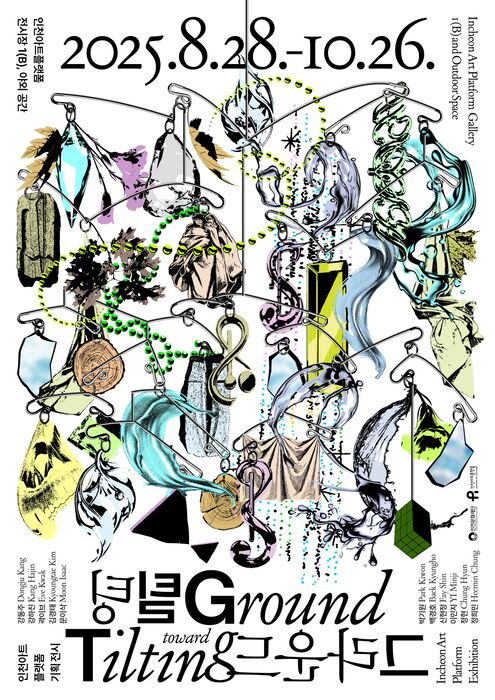
She has also participated in numerous group exhibitions, including 《Tilting toward Ground》 (Incheon Art Platform, Incheon, 2025), 《Open Corridor》 (Interim, Seoul, 2024), 《Walking, Wandering》(Asia Culture Center, Gwangju, 2023), 《Boogie Woogie Art Museum》 (Ulsan Art Museum, Ulsan, 2023), 《Minimalism-Maximalism-Mechanissmmm》 (Art Sonje Center, Seoul, Korea; Kunsthal Aarhus, Aarhus, Denmark, 2022), 《The Middle Land: When time unfolds into a land》 (ARKO Art Center, Seoul, 2021), and 《Prints, Printmaking, Graphic Art》 (MMCA, Gwacheon, 2020).
 
Kang received the 2nd Amado Artist Prize in 2025 and the 5th DOOSAN Yonkang Arts Award in 2014.
References