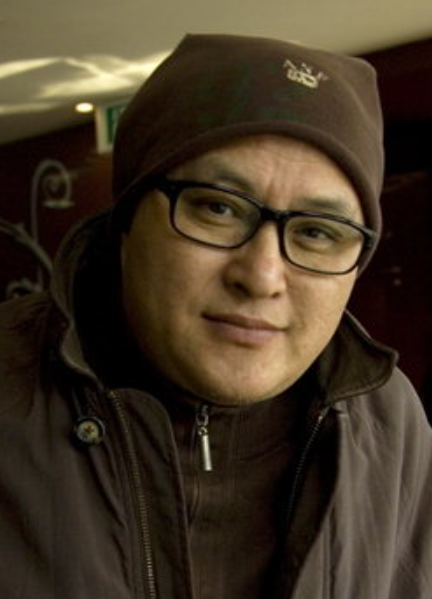
Kang
Hong-Goo’s works confront viewers with situations that feel incongruous and out
of place. They are awkward and unsettling, leaving the viewer at a loss as to
how they should be read or how they should be seen. In this way, Kang draws us
into his gaze and asks us to raise objections to reality itself.
This
exhibition presents works produced between 2004 and 2010. It includes selected
pieces from the series Landscape of Osoe-ri, Mickey’s
House, Trainee, Vanish Away,
and The House. It is an exhibition that allows one to
grasp, at a glance, the artist’s perspective and attitude toward understanding
the world. Out of personal desire, it would have been even better if a few
works from the Fugitive series or earlier pieces
had also been included. Unless an exhibition is focused solely on new works,
such attempts can be helpful in understanding an artist more fully.
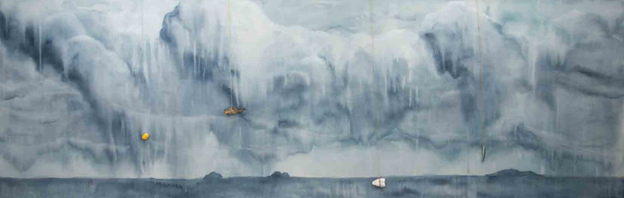
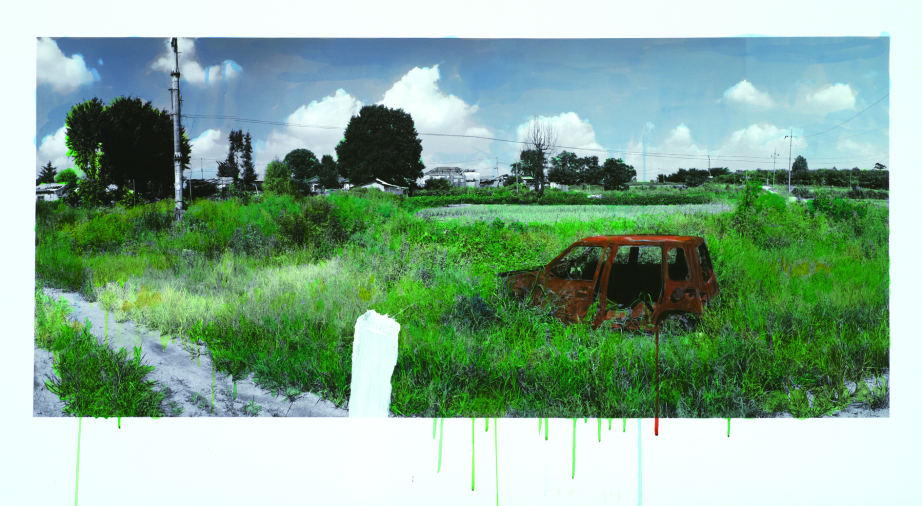
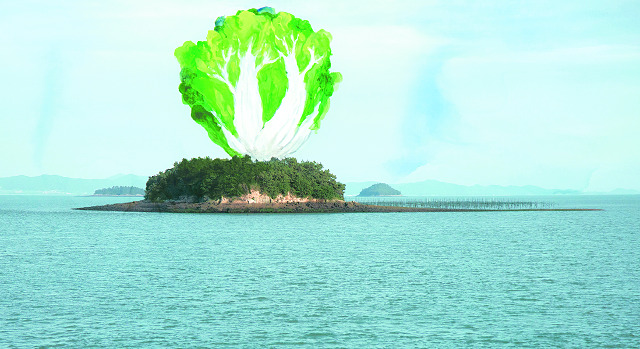
Suddenly,
clear white brushstrokes overlap here and there within his field of vision.
They resemble traces that seem to have been mistakenly smeared onto an
otherwise well-made photograph. The paint drips flowing downward subtly force a
sense of accidentality or suddenness. Yet these marks are artificial and
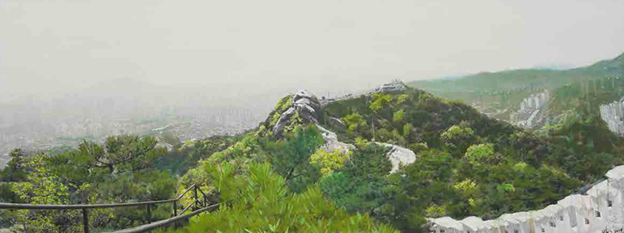
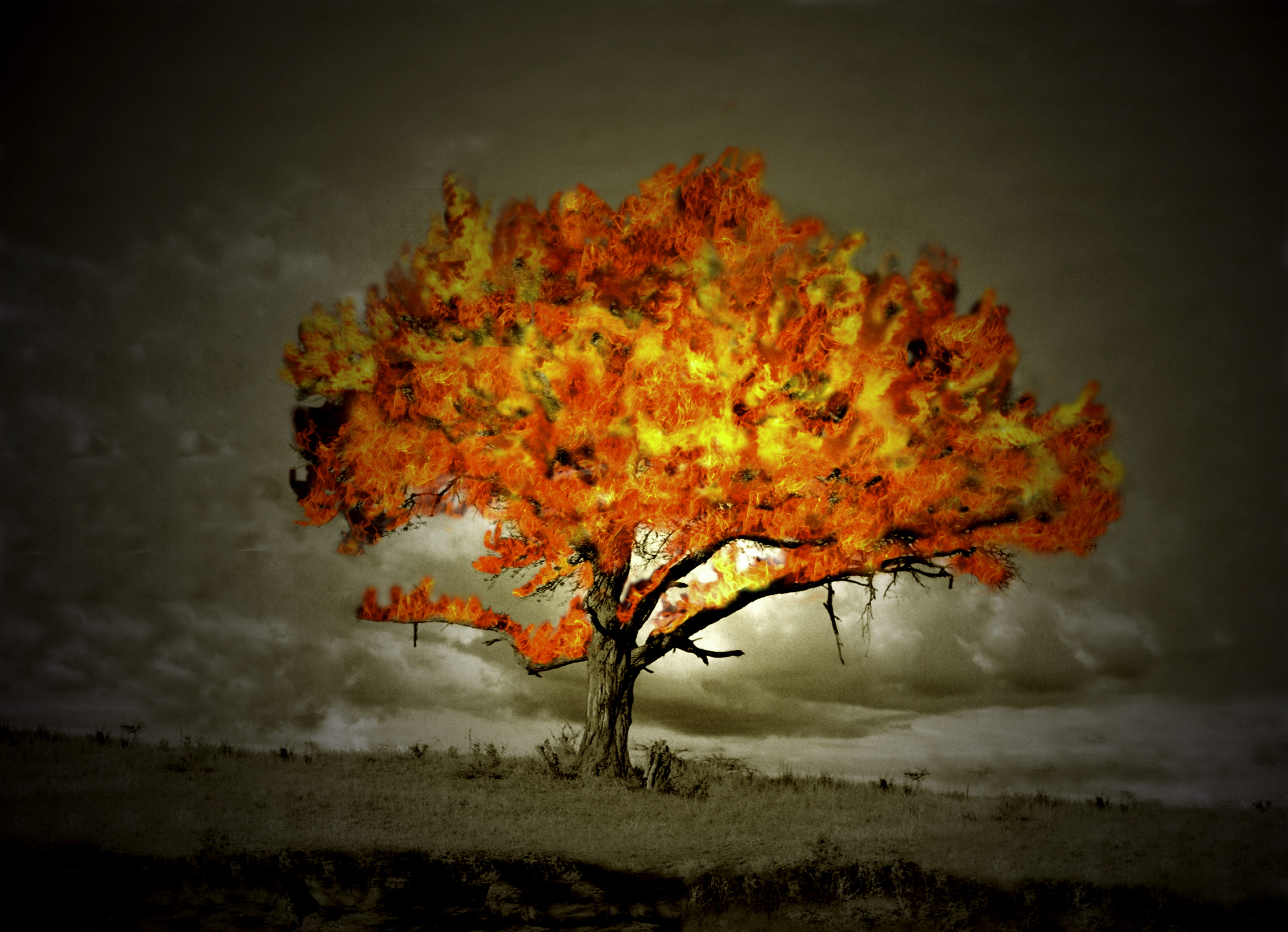
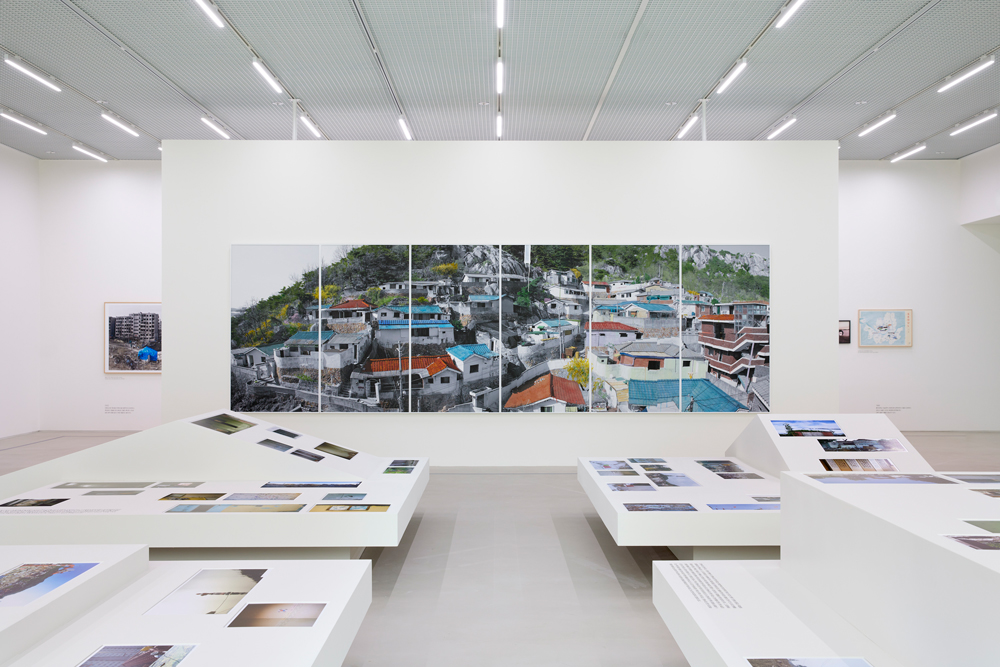
intentional acts of painting—acts of defacement. Works produced in 2010, such
as The House–Blue Roof, The House–Red
Roof, The House–Stairs, and The
House–Ginkgo Tree, all carry the added burden of a sudden brushstroke
on an otherwise intact landscape.
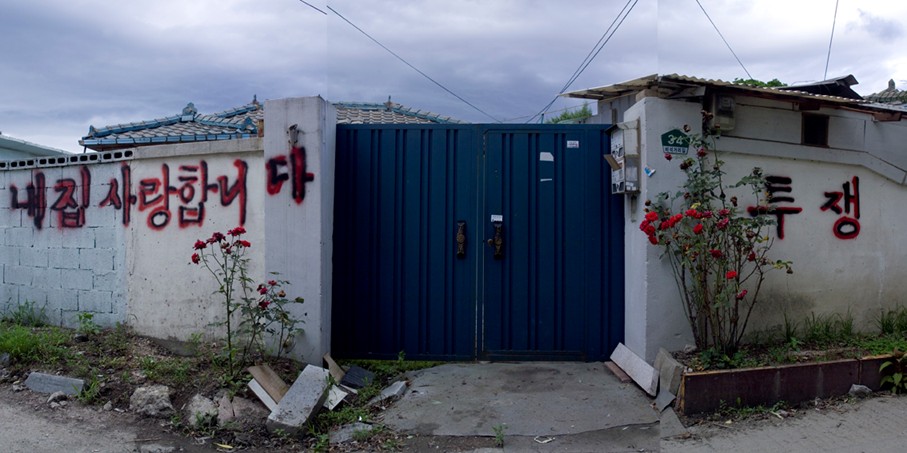
The
scenes reveal neighborhoods perched on steep hillsides, with broken windows and
many houses standing with doors ajar. It is difficult to find a house with an
intact gate or roof. Even when a gate remains, signs of life are hard to
detect. From these details, it becomes clear that the landscapes capture
moments just before demolition due to redevelopment.
Between
the brushstrokes and the landscapes, an unspoken distance—an unsettling gap—is
created. It is as if the brushstrokes occupy the space of reality in the
present moment, while the photographed landscapes belong to another place
altogether, another time and space, set at a remove. An ordinary landscape
suddenly becomes a defaced photograph. It resembles a view seen through a
window dirtied with grime. When one encounters a painted figure inside the
window of an empty house where no people remain, the moment is chilling—an
awkward and deeply embarrassing instant. A gaze that once captured an ordinary
house suddenly assumes an unexpected expression. It is an expression that
cannot be understood, an unreadable sign.
The
House–Lettuce, which captures a pile of lettuce growing abundantly
inside a plastic container placed atop a wall, draws the eye to the stark white
brushstroke clearly visible in the lower right corner. Within a single frame,
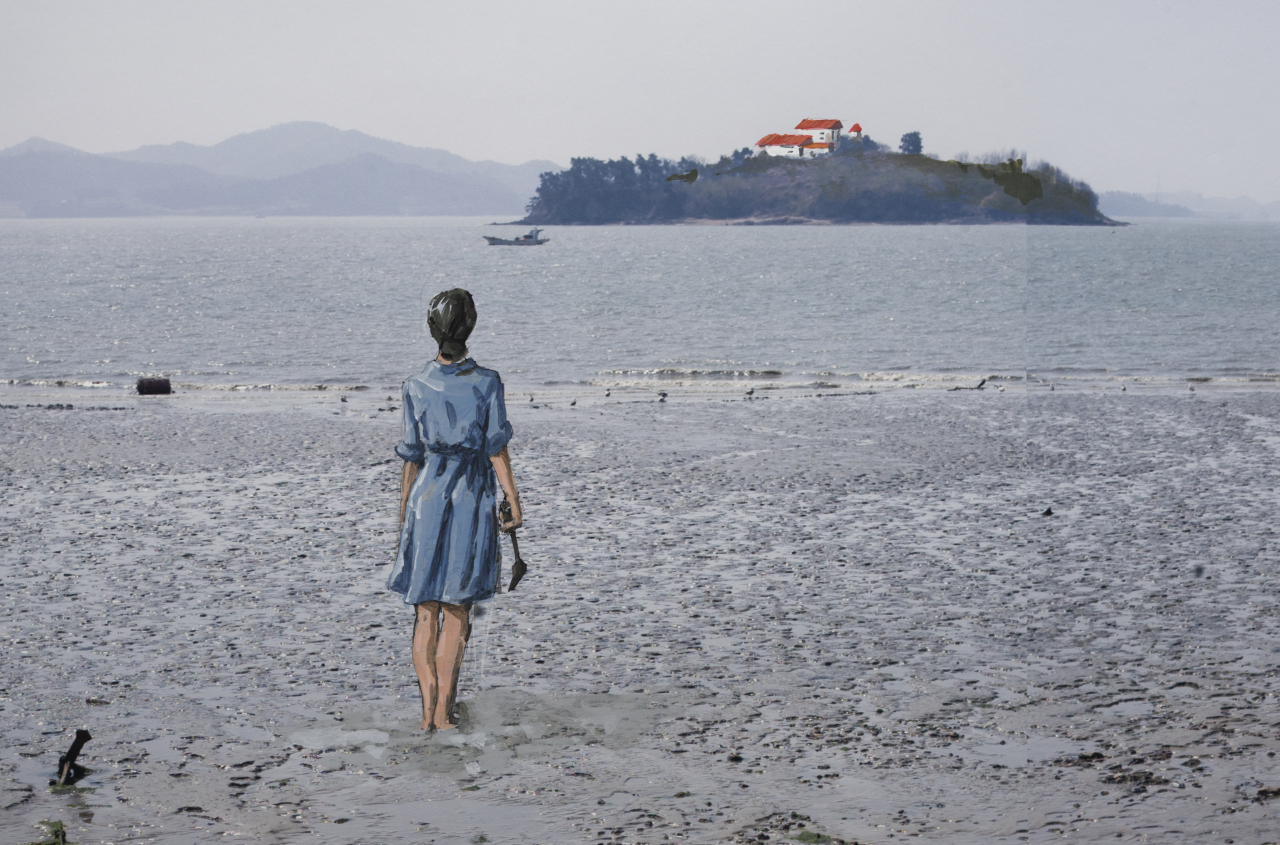
entirely different spaces come to coexist. In The House–Laundry,
the traces of brushwork and applied color are clearly visible on the hanging
laundry, with even the dripping paint marks rendered explicitly. In forests,
leaves, or walls, colors that do not belong there add further effect. By
painting and adding color, Kang leaves marks atop preexisting photographs,
reconfiguring intact images through acts of defacement and revealing traces of
post hoc intervention.
These
interventions are awkward because they do not belong, and embarrassing because
they are too seamless. They are interventions made to generate meaning.
Although meaning is often said to be a post-event phenomenon, here it is
forcibly imposed through a coercion of the gaze. While landscapes traditionally
function through their own symbolic roles and grammar, Kang attempts to
compensate for the deficiencies of landscape and photography through the act of
painting over them.
These
white brushstrokes—or colored marks—stand out through juxtaposition with the
original landscape, asserting themselves as actions and acquiring the
temporality of the present. Meanwhile, the spatial present of the landscape
recedes into temporal distance, becoming the past.
This
distance allows the landscape to be perceived as something that “is there,”
while the traces transform it into something that “was there.” That “there” now
signifies a place that no longer exists. “Being there” and “not being there”
are no longer presented as the materiality of the landscape, but as a duality
of recollection and fact. It is a response oscillating between reality, refusal
of reality, and negation of reality. The will to alter given reality emerges
through works such as Trainee, Mickey’s
House, and Landscape of Osoe-ri.
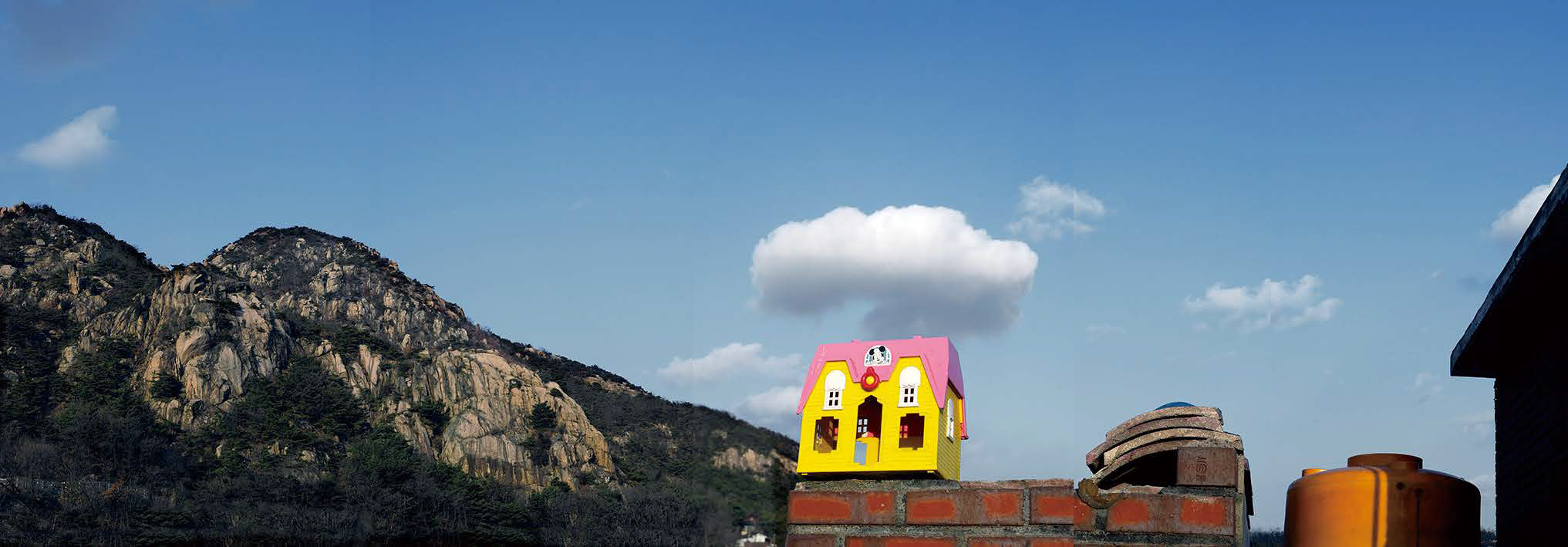
The Mickey’s
House series places a toy house in suitable locations within
demolition zones and photographs it together with the surrounding context. Yet
Mickey’s House cannot remain whole either as a toy or as part of a demolition
site. Its awkwardness arises from the intrusion of an alien element into the
landscape. This is where the peculiar unreality of Kang Hong-Goo’s photography
emerges. Perspectives, temporalities, and situations are misaligned, yet
presented boldly—sometimes even nonchalantly. Through comparison between the
existing landscape and Mickey’s House, a new landscape is revealed. As one
gazes at Mickey’s House, the demolished landscape comes into view; when looking
at the demolished landscape, one becomes aware of Mickey’s gaze. Gazes
circulate and intersect.
Mickey’s
House–Clouds causes roof tiles placed atop a wall to be mistaken
for a building, or evokes warmth and wholeness when placed inside the main room
of a half-demolished house. Set within desolate post-demolition spaces, it
becomes something surreal—a dream that once existed but is now gone. Mickey’s
House–Rebar and Mickey’s House–Door,
positioned among piles of discarded steel frames, preserve memories of place
and home. Through Mickey’s House, what no longer exists is shown to persist;
what has disappeared remains present. It is a gaze directed toward something
absent yet existing, gone yet not erased, remaining as lack. Mickey’s House
draws reality into fantasy and fantasy into the realm of real meaning. Fantasy,
as a mode of presentation, becomes a readable language system. Fantasy is
“fundamentally narrative in structure,”¹ a narrative of lack that compensates
for reality’s deficiencies. It is no different from the structure of reality
itself—a fantasy as painful fact.
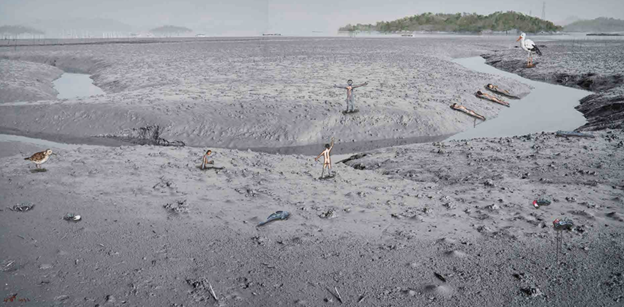
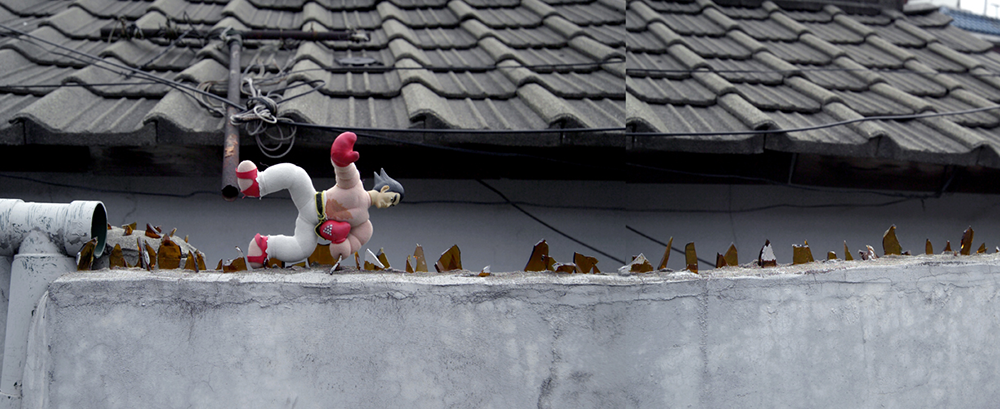
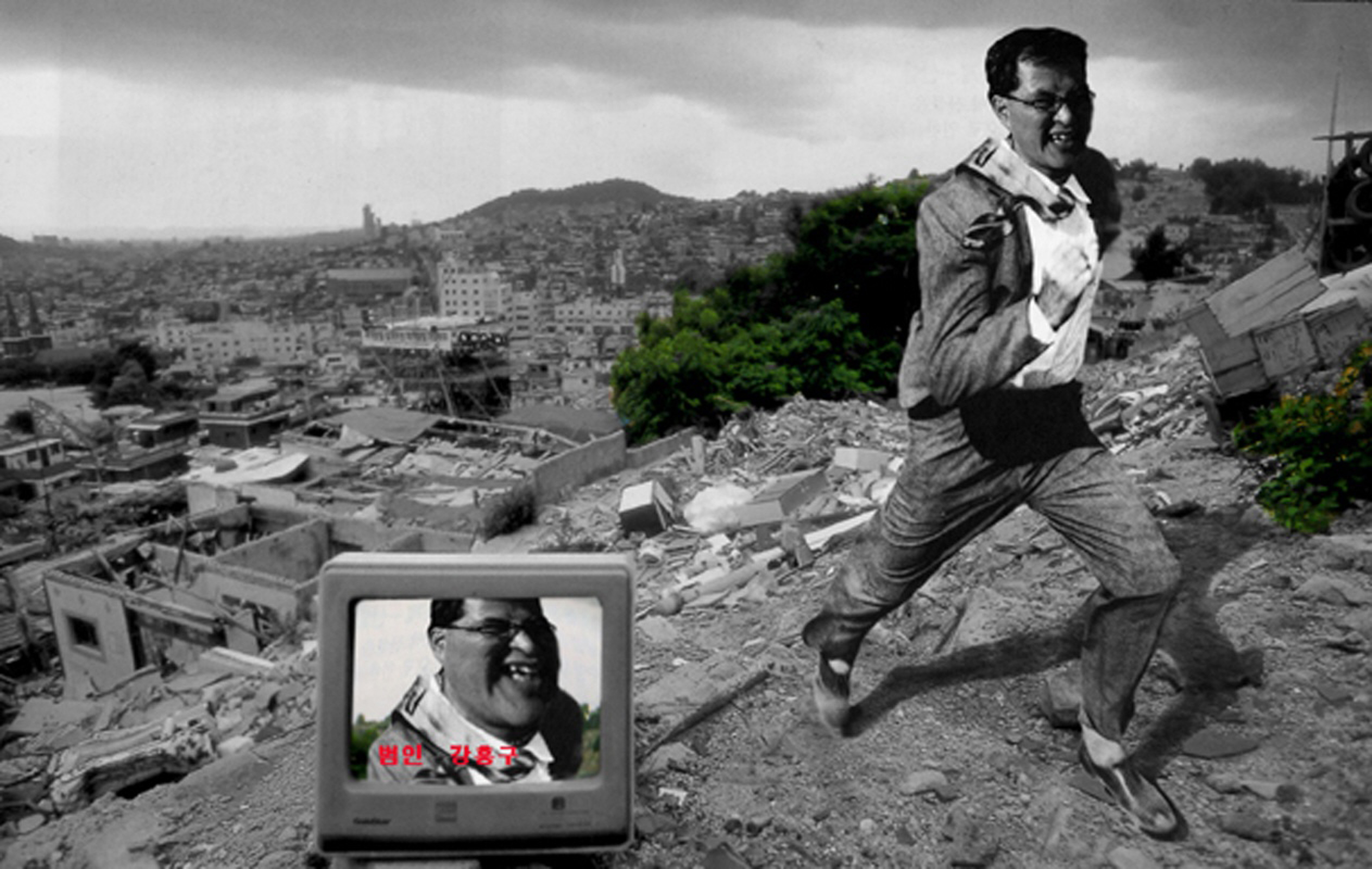
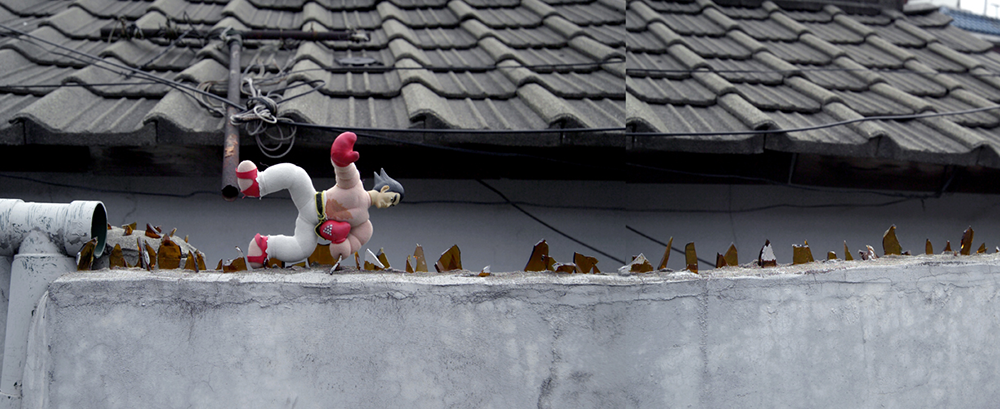
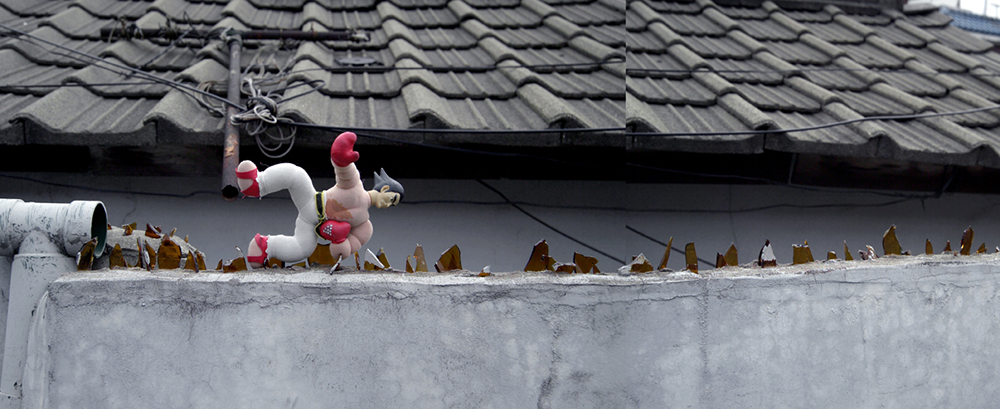
The Trainee series
stars a toy man wearing boxing gloves and no shirt. The appearance of a warrior
from a fighting game elicits bursts of laughter and cynicism, as well as
gestures of pity. It presents a contemporary Don Quixote—feinting emptiness to
conceal weakness. Scenes such as Trainee–Wall-Climbing Skill and Trainee–Training
for an Immortal Body, in which the figure scales walls or leaps over
glass-shard–lined fences, resemble ninjas from Japanese manga. Trainee–Feinting
Emptiness, evoking pole vaulting as the figure grips power lines,
stages a scene straight out of martial arts novels. It is like a pseudo–qi
master boasting before spectators. Yet this bravado does not feel entirely
false, leaving behind a bitter smile.
Scenes
such as Trainee–Circulating Energy and Regulating Breath in
a radish field, Trainee–Red Leaves Flying peering
into a house from atop withered vines, or Trainee–Leaving No
Trace on Snow standing in a snowfield, stand in for the
resistance Kang seeks—resistance that ultimately ends in futility. Actions
occur, yet leave no trace; traces remain, yet something real passes fleetingly
through them. Through this gaze, we encounter something unspeakable that
underlies human stories and guides our lives as reality.
These
works recall Zhuangzi’s parable of the mantis blocking a cart (螳螂拒轍), where the impossibility and unreal premise itself becomes a
source of strength. Through that strength, “fact” endures. Within today’s
photographic landscape, it is not easy to pinpoint where Kang’s maturity,
refinement, or innovation as photography or form resides. In that sense, it is
difficult to judge his works as “good photographs,” yet it is undeniable that
they produce compelling narratives. At the same time, despite his composite
imagery and post-photographic approaches, one cannot deny that his work remains
within the category of traditional photography’s “factual” representation.
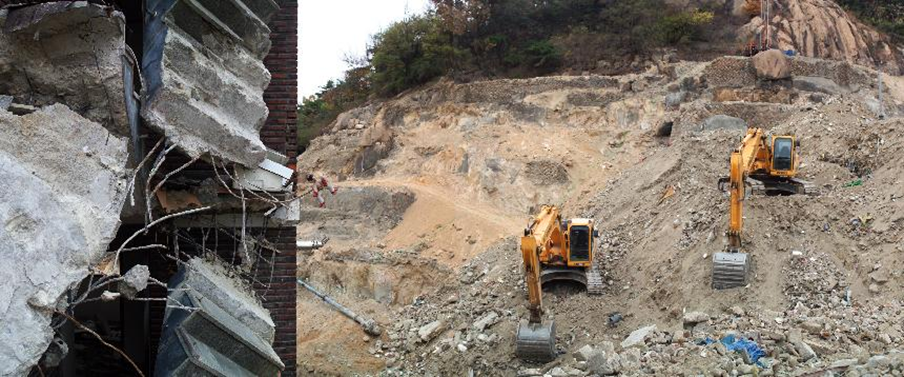
Vanish
Away largely avoids overt artifice. It simply depicts scenes
during or after demolition caused by redevelopment. Between partially
demolished conditions and the desolation of what remains, it reveals an awkward
encounter between memory and site. It shows what will remain as emptiness once
everything has truly disappeared—something absent yet present, erased yet still
there. These works avoid sentimental clinging and maintain a dry, documentary
gaze. Yet scenes such as white apricot blossoms blooming in the center of a
main road, or peach blossoms illuminating alleyways, evoke tenderness and quiet
sorrow.
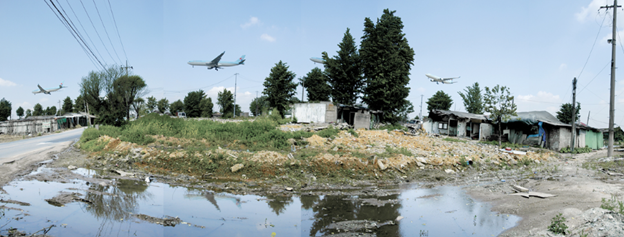
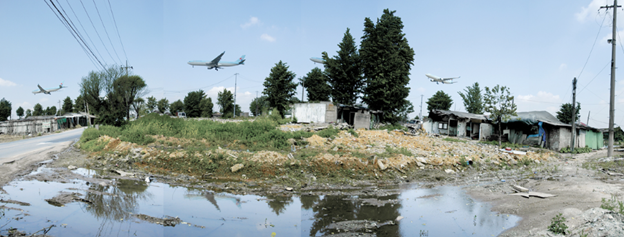
Compared
to this, Landscape of Osoe-ri operates
differently. It juxtaposes old and new, intact remnants amid collapse, and
speaks through stark contrasts. It compares the arbitrary violence of
low-flying airplanes to power exercised over human presence. Scenes such
as Landscape of Osoe-ri 12, with laundry hanging in
alleys inhabited by those unable to relocate, and Landscape of
Osoe-ri 10, showing a schoolgirl walking between ruined and intact
houses, exemplify this approach. The contrast is even clearer in Landscape
of Osoe-ri 5, where an orange excavator or red-roofed village
disrupts a gray-toned environment.
Kang insists on a clear gaze toward what
remains until the end—not as trace, but as reality to be remembered.
From Fugitive through Landscape
of Osoe-ri to The House, Kang continues
to narrate the absence of what “is there.” What is there flees, is abandoned,
or is interrupted by absurd wholeness, as in Mickey’s House.
The disappearing intervenes in what remains; traces push landscapes aside. What
“is there” suddenly intervenes as something real that was lost. In this way,
Kang unsettles both his own gaze and that of the viewer.
Through trace-based
intervention, the present defaces the given scene; traces become the present,
and landscapes become the past.
Through
this intervention of traces, Kang shifts landscapes into systems of meaning and
liberates photography from monotonous acts of capture or genre consciousness.
Through compositing and deviation, he reconstructs “fact” within photography.
This
awkward and embarrassing intervention demands a different perspective on
photography’s material immediacy and reveals photography as a composite domain.
In Kang’s work, photographed landscapes are recombined like linguistic
signs—nouns, adverbs, and verbs forming new sentences. His photographs are his
sentences. Like other media, they awaken us to the formation of new meanings
through combination. These sentences are not fiction; they reveal “fact.”
“We
know that there exists a world we do not know. Yet that unknown world does not
exist for us as ‘fact.’ Wittgenstein says: ‘The world is not the totality of
things, but the totality of facts.’ If no perception can be free from
experience, prejudice, and social context, then the perception of fact always
accompanies interpretation. In that sense, ‘fact’ is already interpreted
fact.”² Kang’s method is an interpretation of landscape, through which we come
to recognize the social reality we inhabit as “fact.”
However,
when photography becomes merely a medium of compositing, doubts remain as to
whether photography’s own domain may be dismantled or closed off. As seen
in The House, the passivity of composite
photographs—too conscious of traditional photographic grammar—renders the
digital transformation of images cautiously evaluated. Moreover, it is
difficult to articulate the difference between a single original object painted
upon and a photograph taken of that object. As the artist’s gaze shifts from
Osoe-ri to The House, it becomes more indirect, moving from concreteness toward
abstraction, growing gentler—a point worth observing further.
Art
expresses that something unexpressible exists in every expression, and the
critic’s task is to respond to the implications of that unexpressible by
challenging the forms and systems that have obstructed the presence of true
art. The task of thought is to respond reflectively to what is happening in the
present, thereby discovering new rules and modes of action. In this sense, Kang
Hong-Goo’s work presents us with a lucid stance. Yet whether our continued
expectations and doubts regarding composite realism and the existence of the
nonexistent stem from the obstinacy of photography as a medium remains an open
question—one that Kang himself must address, alongside his acts of painting
over photographs.
¹ Edited,
Jacques Lacan, The Adventure of Thought, Mati, 2010, p.193.
² Semiotics, Yonsei University Press, 2005, p.14.