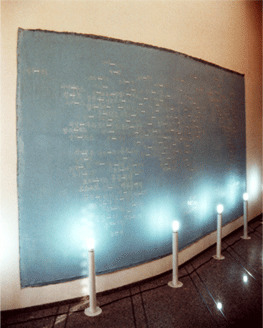
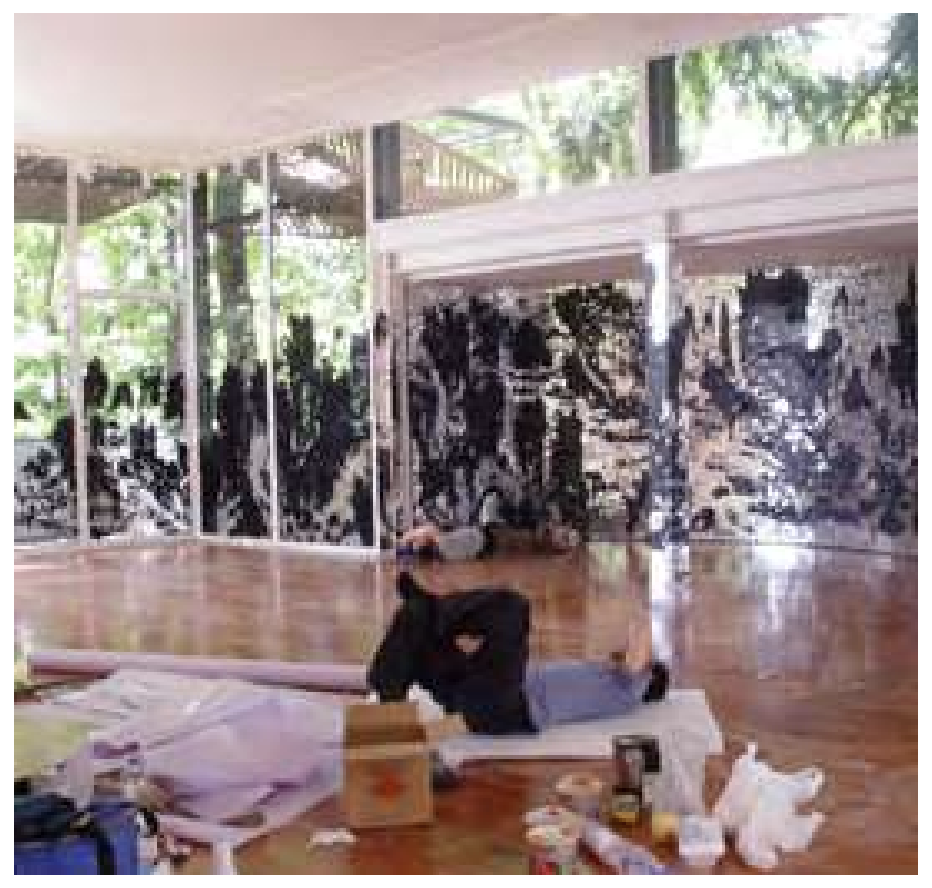
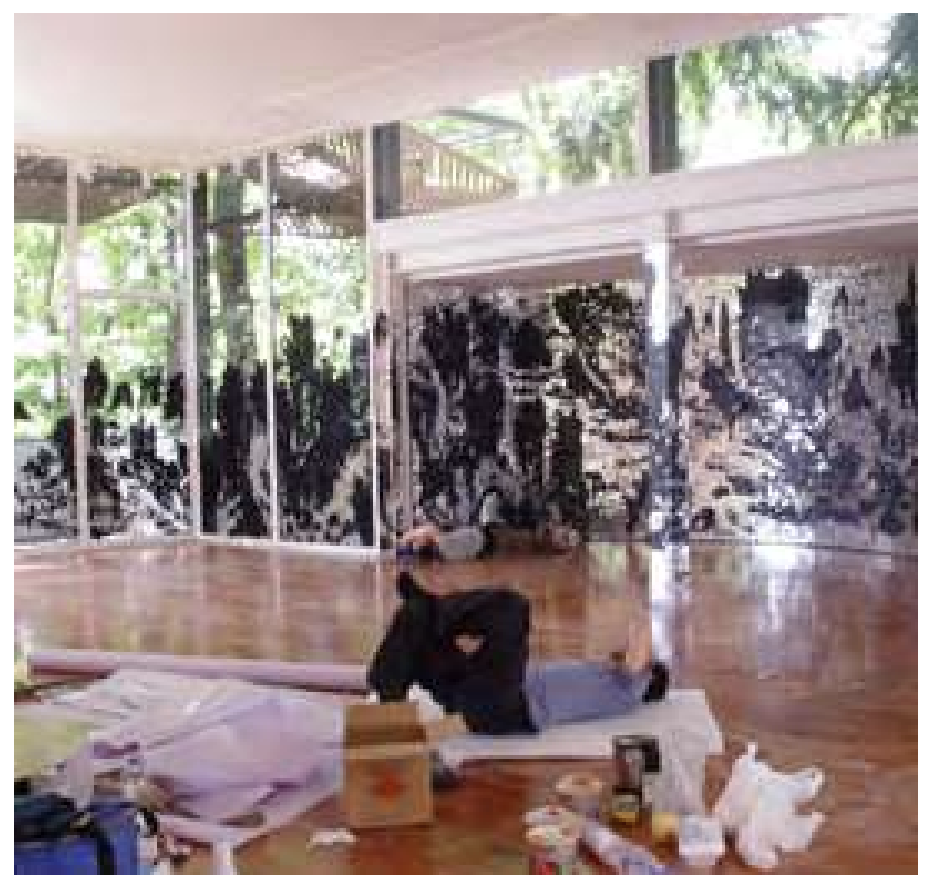
The work is part of a series that Whang
describes as “digital sansuhwa” for they are made by first scanning the
original image and then rendering that scan into a pixelated one without the
gradations of black and white found in the actual image. Following this initial
stage of binarizing the original image, the artist then converts the pixels
into dots, which he later prints out on A4-sized pieces of paper. In Like a
Breeze, the length of which spans two walls, Whang used almost 1,500 pieces of
paper which were attached upon an immense expanse of carbon film as large as
the actual gallery walls.
Afterwards, he punched holes into the white areas
around the black dots, and the carbon film was covered with a hard sponge and
directly attached to the walls. For the part to occupy the solid wall, the
negative space of the work is filled with tiny mirrored acrylic squares, and
the positive space, that is, the image, is represented by discarded black vinyl
salvaged from nearby farms near the artist’s residence in Okcheon. For the
glass wall, the negative space is simply the glass and the positive space is
filled by repeated lumps of sticky black silicon shot, or squeezed, directly
onto the wall’s surface.
Involving approximately 130,000 of these
mirrored acrylic squares measuring about 11 to 12 millimeters on each side and
60,000 silicon lumps measuring 12 by 12 millimeters, the enormous labor and
time demanded by this version of the digital sansuhwa practically renders
meaningless the ease and efficiency of digital technology. The power that this
work exudes comes not from the quality or quantity of the material, but from
the intensity of manual labor, the repetitive task of shooting the silicon or
attaching the acrylic pieces, the effort of which is comparable to the
practices of a Zen master.
In lieu of the rivets or crystals previously used in
earlier works, Whang has selected reflective acrylic for the solid, wave-like
wall to emphasize the non-materiality of the glass used in the pavilion
structure itself. Stemming from architectural and aesthetic considerations,
this selection of mirrored acrylic brings some very special effects; by
reflecting its surroundings, these mirrored shards also reflect light in such a
way that seems to transform the wall surface into the surface of water. The
wall’s surface appears to lose its claims to materiality. The tiny mirrors that
cause this dematerialization render visible, and then invisible the nondescript
pixels so that the abstract quality of Whang’s digital aesthetic is
intensified.
The epic scale of Like a
Breeze, which occupies more than half of the circumference of the
main exhibition space, also fulfills the imperatives of the digital aesthetic.
The floating image made by the movement of the electronic pixels not only
demands that the viewer contemplate the landscape produced, but also compels
the viewer to appreciate the work by walking alongside it. The work is an
installation, but one possessing a measure of the theatricality of performance
to the degree that the work enters the realm of time art.
Like electronic media
that treads intermediate ground between two- and three- dimensionality, the
introduction of a temporal element in Whang’s work elevates the pixelated
mirrored pieces on the surface to the relief-like quality of the mosaic so that
the landscape approaches the level of three-dimensional art. As stated by the
artist, “instead of faithfully communicating the text, I use the errors or
variations generated by computer processing,” and through this he is able to
generate a new response. This dual evocation produces a synaesthesis beyond the
visual, and this, along with the implied demand for a change in the system of
perception, constitute the epistemological meaning of Whang’s digital sansuhwa.
Whang’s digital sansuhwa approach the
level of allegory by recomposing old originals in a contemporary manner, not
only through computer technology, but also through the use of such industrial
materials as silicone, mirrors, discarded vinyl, and the like. His works become
metaphorical enactments of cultural legacies and metonymy-as-landscapes. In his
determination to recreate the image, Whang borrows past images so that they can
be resuscitated. In addition, the repetitive and linear arrangement forms a numerical
sequence which follows the concept of intertextuality. This is aggregated into
spontaneous fragmentation and deconstruction denoting a postmodern allegory,
and Like a Breeze is true to its title as it overcomes
boundaries between the traditional and the modern, past and present, East and
West, analog and the digital, and the complex and the fragmented. It is an
allegorical landscape that is meta-temporal, meta-spatial and metatechnological
in nature. Along with its meditative quality, the work evokes a restlessness
that argues for the redefinition of direct and straightforward ways of
thinking.
Like a Breeze is a
double landscape where the actual landscape of Venice is juxtaposed with the
valleys within the formal work. This juxtaposition is a strategy that
invalidates binaries such as the internal and the external, the real and the
fake, appearance and reappearance. Like a traditional pavilion, the Korean
Pavilion is not so much a building as a site that desires to be part of nature,
and a place that immediately reveals its site-specificity. The pavilion itself
operates as a landscape-like metonymy and rephrased, Like a
Breeze functions as a visual hint that, instead of representing
conflicts of nature, place, space, and positions, articulates a “landscape of
differences” with the works by the other two artists in its visualization of an
ideological, conceptual, abstract, deconstructive, meta-linguistic, and
discursive landscape.
4. Chung Seoyoung’s The New Pillar and A
New Life
For her contribution, Chung Seoyoung
presents works that humorously conflate the gaps and the incongruencies between
images and concepts, as well as words and objects. In these object-like works
resembling apparently useless pieces of furniture, they forge a relationship
between the interior and the body in a strange and unusual way. These works
share characteristics found in interior design, but in this exhibition where
the installation is symbiotic with the pavilion structure, that quality is
emphasized and strengthened through the architectural codification of the
works.
Directly to the left of the pavilion
center in the half-circle gallery is The New Pillar, a
gigantic, “fake” pillar measuring 2.24 meters in height and 1.1 meters in
diameter. Made by adding extra material onto the original pillar standing in
the pavilion, the body of the “fake” pillar is of a durable white cement. The
resulting image initially looks as if it is part of the original intended
structure. But this misconception, or rather, the optical fabrication
immediately comes to light as the viewer notices that this massive body of a
pillar seems to “float” about five centimeters above the floor.
From the window
of the gallery one can look out into the landscape outside, but this view
conflicts with the “fake” pillar that has no apparent use other than its mere
largeness. Within this disjunctive juxtaposition formed by the “real” outdoors
and the “fake” pillar, and the surreal landscape produced by the unbalanced
scale of the massive pillar that almost overwhelms the exhibition space, the
viewer experiences a shock from the resulting concurrence of visual pleasure
and discomfort.
A New Life is a
multi-part installation that uses the cube-shaped space formed by the brick
structure that was the previous tenant of the site upon which the Korean
Pavilion now stands. As if to underscore the positional and stylistic isolation
of this space compared to the rest of the pavilion, Chung unfolds a singular
drama upon this unlikely stage. Her production begins with an architectural
alteration of the space’s interior. A small door, whose fluorescent orange
color provides a shot of visual spark into the otherwise monochromatic
environment, bisects the entrance to this isolated space.
When opened, this
door shuts almost immediately as a result of the force from its physical
recoil. The door that closes almost as soon as it opens separates itself from
the rest of the pavilion is an ontological symbol of this space. It also
denotes the artist’s doubled attitude that wants the works to connect with, but
also distance themselves from the others included in the exhibition.
Furthermore, it implies the curatorial desire to both distinguish and conflate
the works of the three artists which serve, in turn, as a representation of
ambivalence and boundaries.
The orange door, which seems to guide the
viewer towards a new world, opens into an empty space disturbed only by the
intrusive presence of a single black motorbike standing in an exit. This space
is a strange and anxious kind of environment where the viewer is unsure as to
what could, or what might happen. The exit in which the motorbike stands was
originally the rear exit of the pavilion which had been walled up for some time
until Chung decided to reuse it by perforating a hole about 90 centimeters in
width. In the exit, the front half of a mid-sized black motorbike (about 2.5
meters long) stands inside the doorway while the rear half remains outside. In
order to more closely inspect this strange motorbike, viewers must walk along
the floor, which will feel different in comparison to the flooring in the other
galleries for their footprints will cause a slight creaking noise.
Such a
sensation is caused due to the overlay of the original floor with a makeshift
one of unfinished wood. As one draws closer to the motorbike, one further
notices that the front half looks like a regular motorbike while the rear seat
is a cart with two wheels. Upon even more scrupulous inspection, the cart, made
of planks, is not really a cart. Its bottom is an assemblage that looks like a
house whose roof in turn is made to look like part of an expressway. The
highway-cum-roof is drawn with some consideration of perspective so that the
viewer can absorb some sense of velocity and distance. The motorbike is a
hallucinatory object that is only possible in dreams and recalls the surreal
visions of Lautreamont and Magritte. Unlike the majestic Venetian landscape
visible through the glass wall that serves as the background for Whang’s Like a
Breeze, the outdoors that is visible through the rear exit is an abandoned
backyard full of weeds.
Like The New Pillar, the space in A New
Life is fake, fabricated, and a fiction. Although many works of contemporary
art increasingly approach duplication of the everyday and resemble what amounts
to the objectification of daily life, Chung’s works attempt to create art out
of that which seems like falsehoods. Her works are fictions that rebel without
a cause, or simply put, are lies. Like the pillar that floats above the
surface, the object that is neither a motorbike nor a cart happening to be a
house is as blatant a lie, and as pure a fiction, for it exists solely as an
objet d’ art. It becomes art, is art, for this reason. Yet the point from which
Chung posits her lies is not from somewhere within her own imagination but from
how she sees reality. Virtual reality and surreal fictitiousness are
concurrently produced.
An illustration in point is the roof of the house made
from what appears as part of a highway, as if there were a shortage of land for
housing as is common in Southeast Asia and other “Third World” countries. It is
a droll and surreal device, and the artist states that “it is a very particular
means through which the Third World or Asia uses in dealing with the present.”
The work is a meta-landscape that concerns a surreally “real” one. As if to
transport this peculiar “highway” house all the way to Venice, Chung has
attached it to the motorbike, but the altered motorbike relates to Venice
through the paradoxical fact that motorbikes cannot be operated through the
narrow Venetian streets, although carts are often used as a method of
transport. It is a site-specific, surreal object that itself is a means to
overcome the constraints of geography and nature. Chung fulfills the
exhibition’s premise of site-specificity by her strangeness of object and
method.
In addition, her objects are an embodiment
of the non-lingual, or that which denies the possibility of expression through
language or systems operating as languages. They capture the gaze of the
internal eye, the vision of the deja vu. In lieu of historical, conscious,
censorious, and totalizing language, or “discursive language,” the artist uses
“figurative language”, that is, language that is of an ahistorical,
unconscious, avaricious and ruptured sort.
Like Joyce and Proust, who
problematized the signifier and the signified, and evaded the identity of
language itself, Chung substitutes the meaning of universalism and conformity
with tropes that overcome both the boundaries of grammar and a discursive kind
of grammar infused with figurative rhetoric. Like the metaphorical condensation
that exists within the condition of synonymity as well as a strategy of
metonymic replacement contingent upon the spontaneous which produced the
complex, non-linear form of the “new essay,” the rhetorical resistance expounded
by Chung’s works is actually the point from which the operation of metaphor and
metonymy originates.
From this rejection of reality through
metaphor and metonymy, Chung’s objects possess the same allegorical quality as
Whang’s digitized wall works. But if Whang’s works could be described as “hot,”
Chung’s fictions are decidedly “cool,” and in contrast to the more immediate
reaction one supposes a viewer will have upon seeing the former, the latter has
a very low degree of interaction with the viewer. In contrast to Whang, Chung
replaces descriptive prose with abbreviated stanzas, and instead of narrative, she
expresses herself through symbols. “Instead of alluding to a complex route, in
the end it is my desire to express only a living kind of concentrated meaning
and tension,” she asserts. To Chung, communication is but a secondary problem.
Her difficult objects, which concurrently demand insightful tension but also
the mental respite found in contemplation, are mysterious ones and the allure
of her works can be found in the fact that they do not simply remain within the
domain of “objecthood,” but resonate instead as “art.”
5. Bahc Yiso’s Venice
Biennale and World’s Top Ten Tallest Structures in
2010
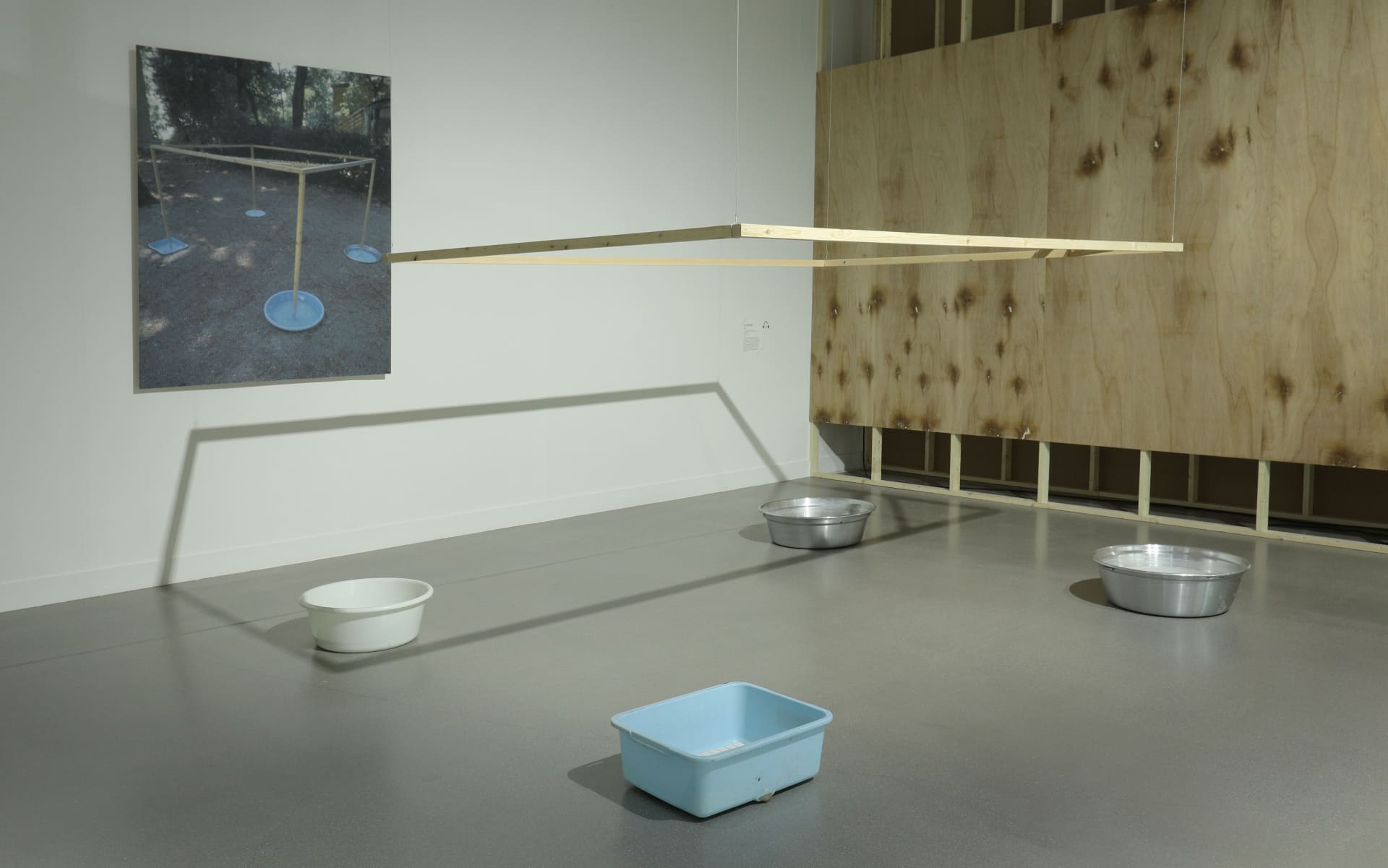
Charged with the task of creating outdoor
works for this exhibition, Bahc Yiso has installed Venice
Biennale on the front grounds of the Korean Pavilion. If seen from a
distance, this work appears simply as a quadrilateral wooden frame whose size
approximates that of a small room. But if one were to look more carefully, one
discovers that a corner of this frame supports two rods of wood which in turn
are made of tiny sculpted forms. These two rods are at the heart of this work
carved out of the longer of the two rods are miniature replicas of the
twenty-six national pavilions while the three Arsenale buildings are similarly
carved from the smaller rod.
Supporting each leg of this quadrilateral
frame are four plastic basins, all of which are lined with either colored tiles
or white pebbles. Bahc explains that the water filling the basins represents
that of Venice, and it could be said that the wooden frame supporting the
replicated models of the national pavilions is the city of Venice itself where
the biennale is also held in one corner of the city. Bahc has recreated the
national pavilions and the Arsenale structures almost as if in response to the
need to have the work perform the role of a site-specific outdoor work. Through
a reconstruction of the city and the Venice Biennale itself, Venice Biennale
could be described as a site-representationaI installation. Moreover, by
satirizing the biennale structures through their miniaturization, the artist
lightheartedly questions the authority of the biennale, as well as the
conventional role of the outdoor work as being necessarily monumental.
Although Bahc’s miniature pavilions are
not meticulously crafted, they faithfully copy the appearance of those
pavilions so that the viewer can easily recognize them as such. But the artist
has disregarded the differences in scale between the pavilions so that all are
each approximately two to three centimeters in size. He has simplified and
reduced the differences and multiplicities of each of the national pavilions
which otherwise contend with each other for the viewer’s attention. By making
the national pavilions more or less consistent with each other, Bahc emphasizes
the triviality of differences as well as the evanescence of human
accomplishment.
As an international venue for the promotion of national culture
and as an arena where national identity and cultural power may be asserted, the
Venice Biennale is a site where each nation can indulge in their desire to make
their pavilion the biggest and best site possible. The national pavilions
become an outlet for this desire as well as a representation of hegemonic
conflict. This said, Venice Biennale may be seen as a parody of the Venice
Biennale whose history is saturated by a history fraught with the remains of
battles for cultural supremacy, as evidenced through the persistence of the
national pavilion as the basic unit of organization.
Although Bahc’s critique
of the biennale should be more pronounced because of his status as a
participant, the intentionally careless or frail aspect of his work makes it
difficult for the viewer to read it as a simple institutional critique. As seen
in its size, format, and materials, this work, however, is non-authoritarian
and non-monumental in nature; in fact, its initial appearance as a plain and
tranquil landscape of a small town allows it to be read as a description of, as
the artist states, “a future world without competition where everyone can live
in peace.”
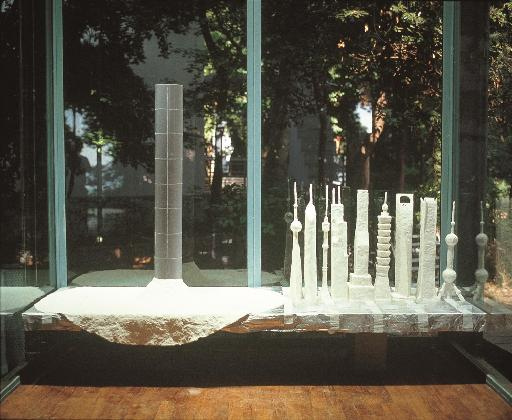
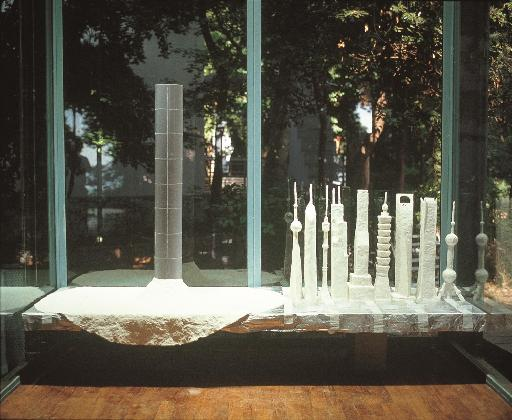
Inside the pavilion, Bahc presents the
grandly titled, World’s Top Ten Tallest Structures in 2010,
in a space resembling a display window. This work aligns plasticine models of
the top ten tallest structures as of 2010 on top of a low table, including the
Sola Tower in Australia at number one, the CN Tower in Toronto at number two,
the World Gardens in New York at number three all the way down to the Oriental
Pearl Tower in Shanghai at number ten.
The tallest structure, which is almost
twice the height of the others, is represented by a sewage pipe of 1.3 meters
set upright with white plasticine applied to the pipe so that the actual
structure’s cylindrical shape is replicated. Distinguished only by the smallest
of margins, the other nine structures are fairly similar in height, and the
artist has replicated their forms by creating caricature-like models with
hand-molded white plasticine. Because of the pliability of the plasticine,
these architectural models look like props on a movie set, and the effect is
both funny and strange.
The artist almost seems to be mocking
myths of greatness and vertical desire which have persisted throughout history
by rendering the tallest structures in the world in such materials as sewage
pipes and plasticine. He also appears to reduce the scale of human
accomplishment and historical legacy into miniatures so that they appear
non-virile and anti-heroic. This is made possible by the artist’s interest in
the peripheral, the useless, the lacking, the empty, and the weak, his
preference for cheap and everyday materials like plywood and concrete and his
artmaking process where works seem carelessly produced without deliberation.
Like Chung, Bahc’s works are visual jokes through which he reveals how we can
laugh at the objects or works, but their appeal does not come from any central
intensity or dramatic tension, but from a sense that they are, (to use the
American colloquialism), “lame.” It is the aestheticization of the shabby that
separates Bahc from Chung. While Inkie Whang and Chung Seoyoung create art by
using materials and techniques not ordinarily used according to either the
conventions of artmaking or those of tradition, Bahc Yiso wants to escape art
through a lighthearted treatment of everything and anything. He attempts to
escape the codes of “high” art or institutional art by pursuing a strategy of
satire that gently tweaks the gravity of portentous themes. Familiar realities
and real objects become strange to the viewer as Bahc depoliticizes notions of
antiartistic resistance and cultural critique through non-confrontational and
non-dramatic ways.
If Whang’s allegorical landscapes and Chung’s false dramas
transcend reality through artistic directness, Bahc’s unfamiliar realism could
be said to alter reality through artistic irony. Despite the conceptual,
formal, aesthetic, and strategic differences found in their works, however,
there is common ground from which the artists can come together in one
landscape: their abstract and conceptual approaches towards reality. What is
consequently produced is a singular “landscape of differences” composed of
multiple dimensions that these three artists represent, plus a meditative and
dynamic spectrum of differences, as well as contemplation and provocation.
6. Escaping the Constraints of Identity
Having lived in the United States and
Germany, respectively, Inkie Whang, Bahc Yiso, and Chung Seoyoung have all
experienced the life of immigrants and the conflicts surrounding the problem of
identity. Beginning in 1975, Whang lived in New York for ten years where he
experimented with Minimalism and hard-edged abstraction, as well as Abstract
Expressionism by painting the gaps existing between unraveled strands of linen.
But gradually he realized that the sensibilities of the West were different
from his and decided to return to South Korea in 1986. At that point, he began
to produce gestural drawings with his fingers, based upon the vigor of the
natural rhythm of the body’s movements. From these works, Whang began to find
his own sensibility, and while identity was not directly articulated, his
sensibility and excitement are palpable in these finger paintings.
After his return to South Korea in 1986,
Whang purchased a studio in Paju, and later in Okcheon, where he enjoyed the
comforts of rural life. He began to make works that reflected the scenery of
these surroundings, while also making works that reflected his experimentation
with different subject matter like honeycombs, ,staircases, and other
alchemical signs and languages. Through this, he acknowledged that Western
artistic legacies did form a part of his identity. In the mid-1990s, however,
Whang started to make unexpected versions of sansuhwa by affixing Lego blocks
or rivets onto the works and in 2000, he unveiled a new series of digital
sansuhwa by pixelating these scanned paintings. This combination of tradition
and digital technology enabled him to reach a happy compromise between his
allegorical spirit and the techniques he had learned. It was from this point
that Whang was able to escape from the constraints of identity by working in a
method that was based upon his own nature and temperament.
From 1989 to 1996, Chung lived in
Stuttgart, Germany, and she too was hardly immune to the problems posed by
identity. But as implied by her works which make motifs, or derive inspiration
from the Third World-like surreal landscapes, she compresses problems of the
self and of racial identity into those of art and the identity of the artist.
For Chung, art is more important than politics, form more than theory,
aesthetics more than philosophy, and fiction more than reality. The problem
concerns the essence of art; the question lies in how art differs from objects
or reality. Where can we locate the meaning of art? What should art be? In
order to separate art from non-art, the artist has created fictions of high
intensity, dimension, and density that reject reality. They are, however,
fictions of, and created by, the object. That which is produced from an
alchemical transformation of a confusion of identities, which in turn are
produced from navigating the divide between art and the object, and art and
non-art, defines Chung’s fiction as much as the art itself.
As a producer of fiction, Chung is an
artist that expresses through forms that cannot be expressed in language to
produce experiences of profound unease. Her works are familiar to herself but
for the outside viewer, they comprise a strange formal language that wants to
establish communication with the viewer but must also contend with the ar
tist’s doubled psychology and doubled identities. Despite the futility of such
communication, Chung tries to start a conversation with the viewer. Through a
matrix of complicated meanings that can be interpreted on many different
levels, the artist attempts to comment upon the chasm between the signifier and
the signified, or in broader terms, to attempt a critical comment on both
existential absurdity and structural irrationality.
While Chung’s interest in identity
operates on psychological and aesthetic levels, Bahc expands this interest with
regard to societal issues. During his time in New York from 1982 to 1994, he
produced work that expressed the experiences of immigrants along with related
linguistic and cultural conflicts through black humor and cynicism. In
addition, he raised issues pertaining to minority artists and problems relating
to the Third World through the self-directed alternative space “Minor Injury.”
In 1995, however, Bahc returned to South Korea: “I became uninterested in
themes of identity or cultural diversity and more interested in the lives of
people, the frailty and transience of objects, the shabbiness of the great, and
the triviality of accomplishment.”
If we consider the apolitical,
non-ideological and unconscious nature of Bahc’s works made after his return to
Seoul and the critical tendency of those works made prior to that return as
double sides of a single coin, it could be said that a will to change is still
embedded somewhere. The artist’s skeptical gaze is still concerned with the
proclivity of others to exoticize, along with the self-peripheralization
brought about by an internalized kind of Orientalism, as well as the trap laid
by the kind of traditionalism or regionalism promoted in the name of
globalization. But instead of the epic narrative, Bahc looks at the smaller
narratives, the gaps no one else pays much attention to. Although his works do
not reproduce identity per se, nor give voice to identity or use “Korean
motifs,” they argue for an aesthetic of the gap or abyss that corresponds with
Asian notions of the void, and of irregularity, and the indeterminate.
Through an investigation of Chung’s
aesthetic and meaning, both of which transcend region-specificity, we can see
how she reflexively and intuitively skirts the issue of Koreanness in a witty
manner, while Whang and Bahc instinctively absorb themselves into this problem.
In the case of Whang, this is addressed through the incorporation of his
temperamental affinity towards nature, while Bahc expresses an interest in
Koreanness through an attitude marked by its unchecked antipathy. In addition,
the former strives to be faithful to his own nature while the latter escapes
the oppressive constraints of identity but also resolves in an unforced manner,
the conflict between globalization and region-specificity.
However, both Whang
and Bahc consciously maintain an endless dialogue with the traditions of the
past and through a re-establishment with the past, they attempt to secure an
identity that cannot be Othered. As Whang states, “what I’ve learned in my ten
years of living in America is that you have to keep your principles. This is
not only so that one can preserve one’s dignity, but it’s the only way to avoid
becoming subordinated to the West.” Or as Bahc notes, “globalism is an order
which allows the strong to impose on the weak” a notion which he thinks should
be substituted with “worldism, in which the weak can tell their own stories and
if they later become tired of them, are free to talk nonsense or simply poke
fun at the world.”
7. Towards Glocalism Through a Landscape
of “Dreams and Conflicts”
The theme 《Landscape
of Differences》 not only pertains to the identity of the
Korean Pavilion, but is also a key thematic notion that expresses a
present-tense kind of Koreanness. Put otherwise, the identity of the Korean
Pavilion is not found in regional traditions or Other-ed Orientalism, but in a
state of the contemporary that is always produced so that the “here and now” is
made visible. Through this, an aspect of contemporary Korean art that can be
seen is one that is traditional yet modern, Korean yet international.
Through 《Dreams
and Conflicts》, the overall theme of the biennale set by
Francesco Bonami, the task of the biennale lies in the
“internationalism-versus-regionalism” issue that contemporary art is faced with
today. What is needed now is a survey of international artists that can unpack
a global vision that opens national and racial identities, and Dreams and
Conflicts endeavors to be this survey. From this perspective, Bonami’s Dreams
and Conflicts reflects the artistic, historical, and social frames of today
that are in turn produced in contemporary art. He seems convinced that it is
from these dreams and conflicts that future issues will be resolved.
By comparing 《Landscape of Differences》 with 《Dreams and Conflicts》 an analogy can be drawn
between landscapes and dreams, and differences and conflicts. When differences
and conflicts are interpreted from a Derridean view of différerence, it can be
said that the conflicts and contradictions generated by difference result in
the creation of an imagined, non-existent landscape. Thus, 《Landscape of Differences》 evokes a deconstructive
landscape that embodies meaning through the difference of the signified, and
through the chain of those differences. What is important here is not the
deconstruction itself, but what comes after it, that is, the new landscape that
emerges from, and after, that process of deconstructing.
This landscape goes
beyond the binaries of East/West, tradition/identity, or international/regional
and instead aims at a more catalytic integration via the merging of differences
between nature and art, art and its environment, as well as the difference
between the artists, and the difference between the works. Revolving around the
axis of difference, Landscape of Differences not only acts as a strategic
curatorial premise intended to distinguish Korean identity, but also serves as
a blueprint for a new globalism and a new regionalism—it is a landscape of
dreams and conflicts directed towards “glocalism.”
To many non-Western artists who, in
postcolonial contexts, associate modernization with Westernization and
understand modernism as imperialism, and especially young contemporary Korean
artists who are particularly sensitive to the demands imposed by globalization
and international activity, perhaps the most urgent issue is the task of having
to resolve or symbiose region-specificity and globalization. Notions of a new
globalism, or a new region-specificity, offer one solution to this problem.
Instead of a globalism that forces under-developed countries to meet Western
standards, this would be a new globalism based upon equality of gain and loss
which draws awareness to the means used and the roles played in Western
society. Likewise, this will contribute to the formation of a profound and
intellectual type of glocalism that puts aside the kind of regressive
traditionalism and regionalism that breeds collectivization and exoticization
derived from colonialism in favor of a productive tradition that will, through
a dynamic new regionalism, aid in the development of a cultural perspective in
the non-West that is open to other cultures.
The site-specificity upon which 《Landscape of Differences》 is based is deeply
rooted in considering these problems. In lieu of egocentric and egotistical
works that reject any relationship with reality, through an architectural,
environmental, and natural collaboration between the pavilion structure and
surrounding environment and landscapes, one can expect that this will be an
intertextual and interconnected exhibition able to actively engage with daily
and social realities. In addition, site-specificity makes this an exhibition
that is conceptual and progressive, as its emphasis is not on the external but
on the internal complexity and the necessity of process.
It is hoped that this will be a
contemplative and proactive exhibition where a singular image of the Korean
Pavilion will be produced. In conclusion, it is an exhibition that transcends
the format of a regular solo show where the exhibition space is merely an
individual venue for each of the participating artists by functioning as a site
where the curator may introduce social issues or problems and encourage the
artists to respond in a shared process. The pavilion offers a new exhibition
model whereby critical perspectives and timely discussions are included
together.
While I have tried to create a landscape
of differences through this curatorial proposal and the active participation of
the three artists by basing this exhibition on the Korean Pavilion itself as
well as the site of Venice, I have also tried to consolidate their differences
into one consistent landscape. Using the nature-friendly aspect of the Korean
Pavilion as a point of departure, the landscape of differences that emerges is
one that originates from the sitespecificity of the Venice Biennale within the
Giardini grounds and Venice itself so that the end result will be, as implied
by Whang’s Venetian landscape, Bahc’s Venice Biennale and Chung’s Venetian
motorbike, is an exhibition that can best be described as “Things That Happened
in Venice, Circa 2003.”