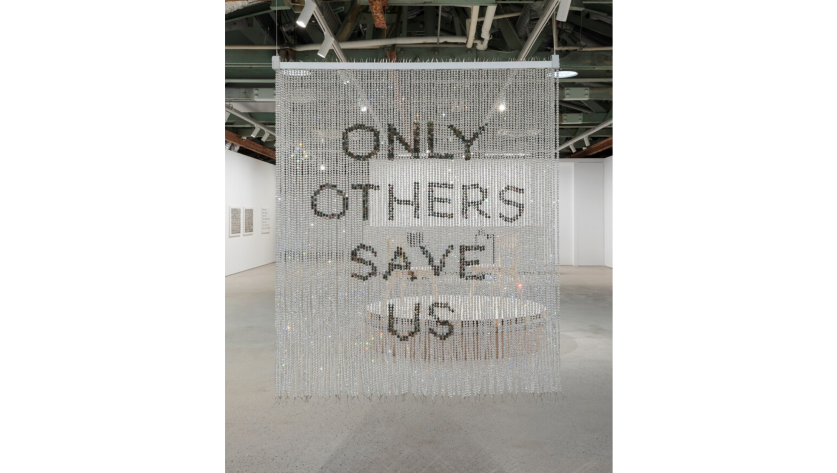
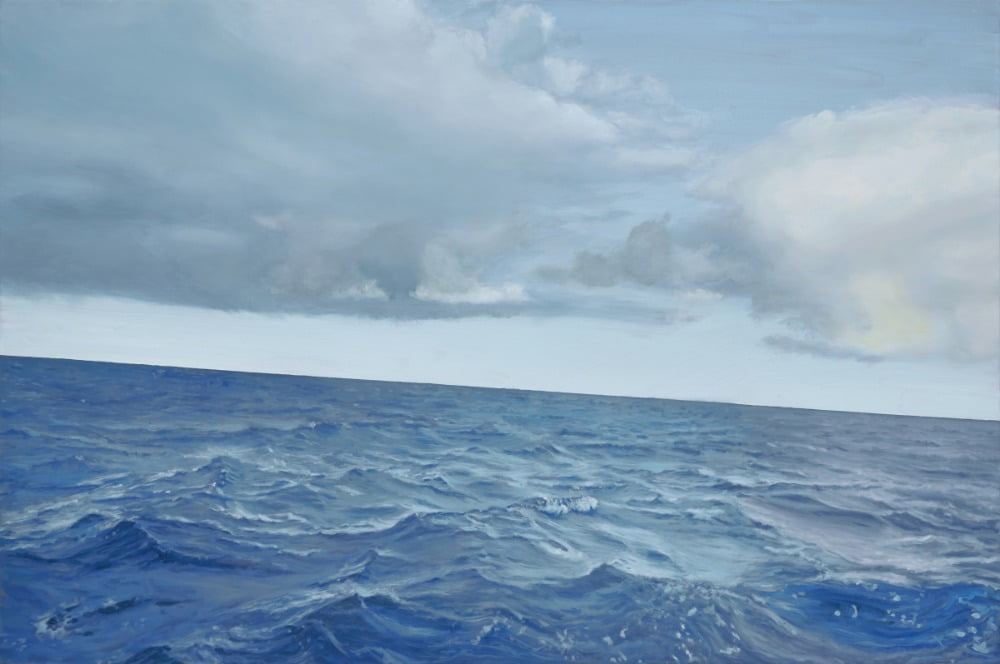
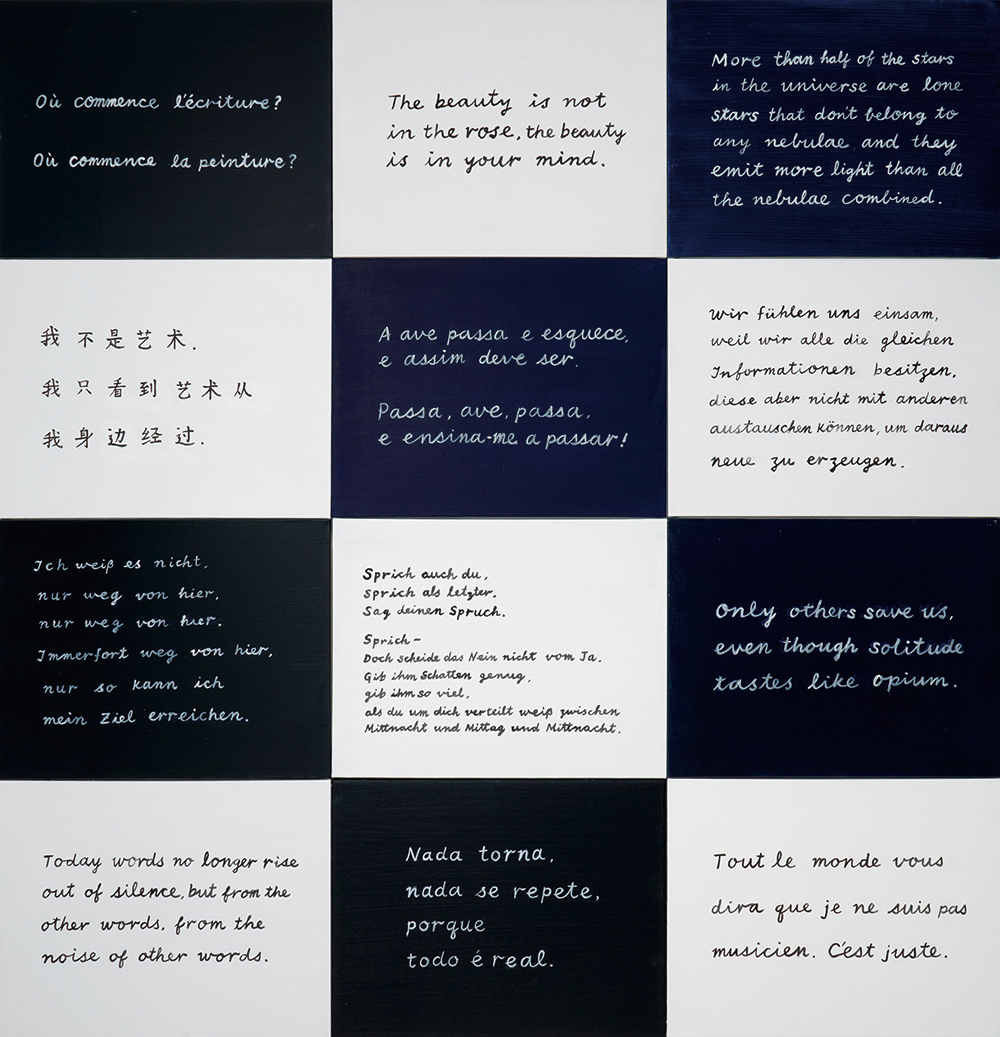
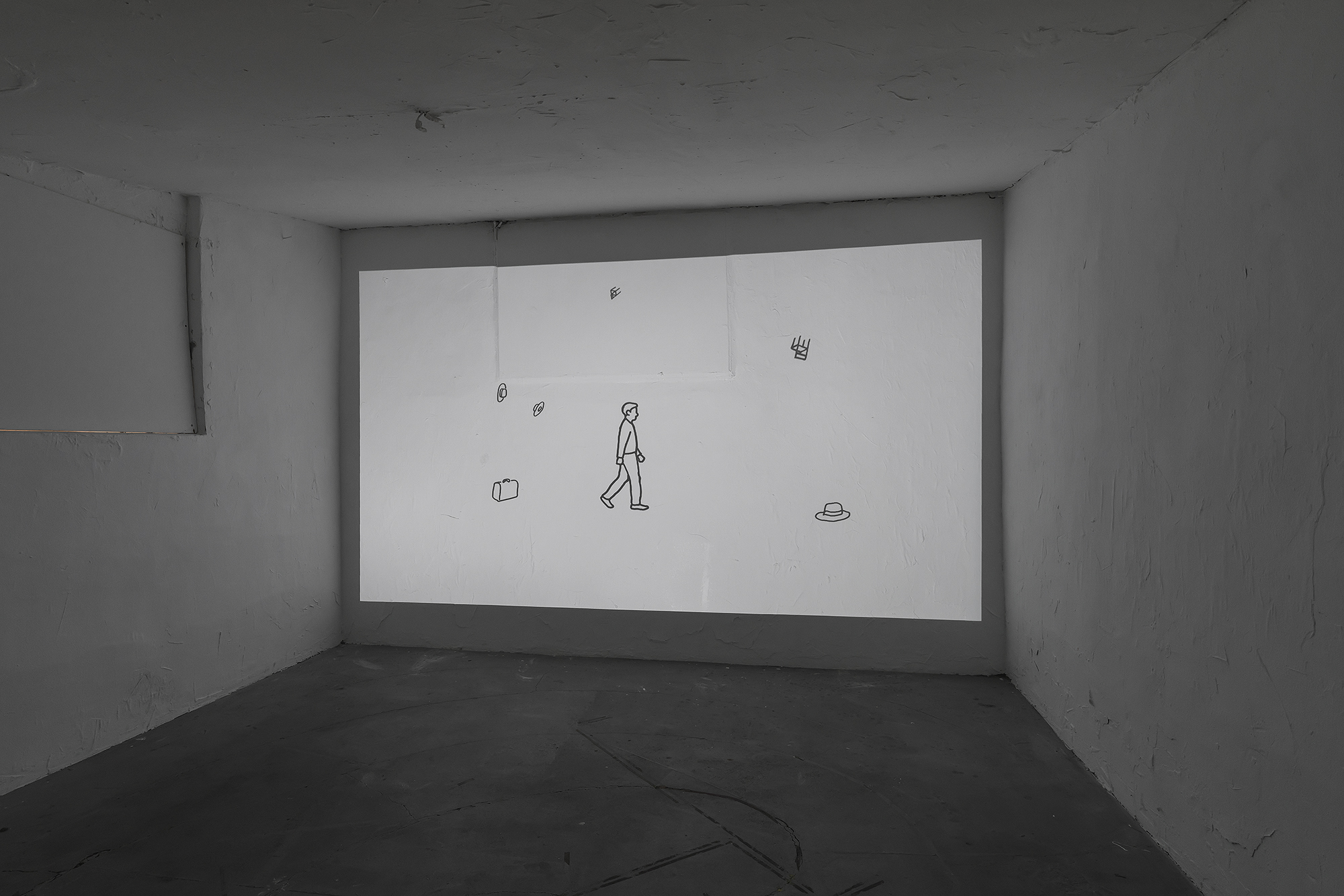
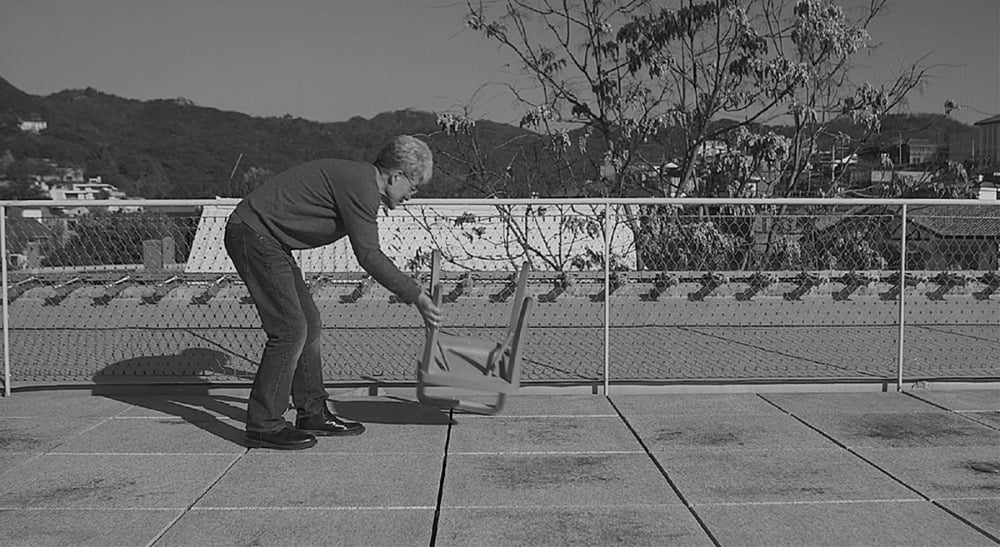
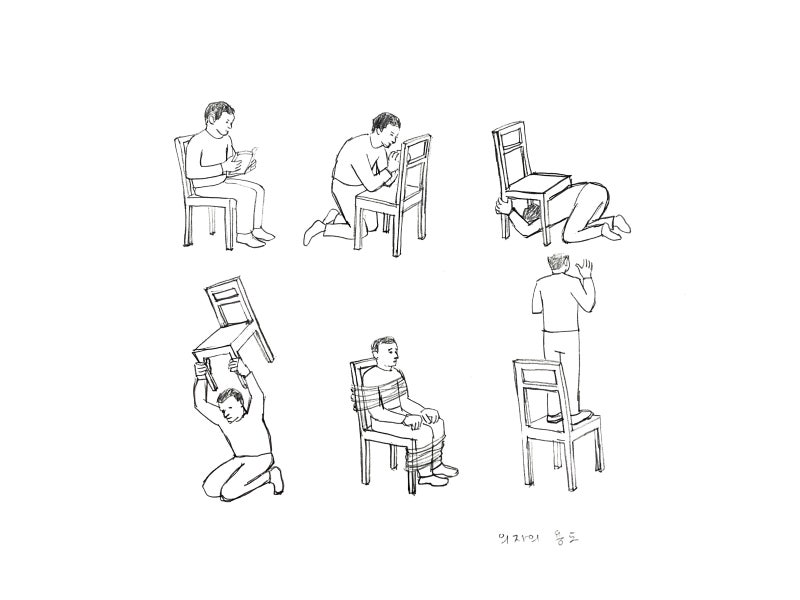
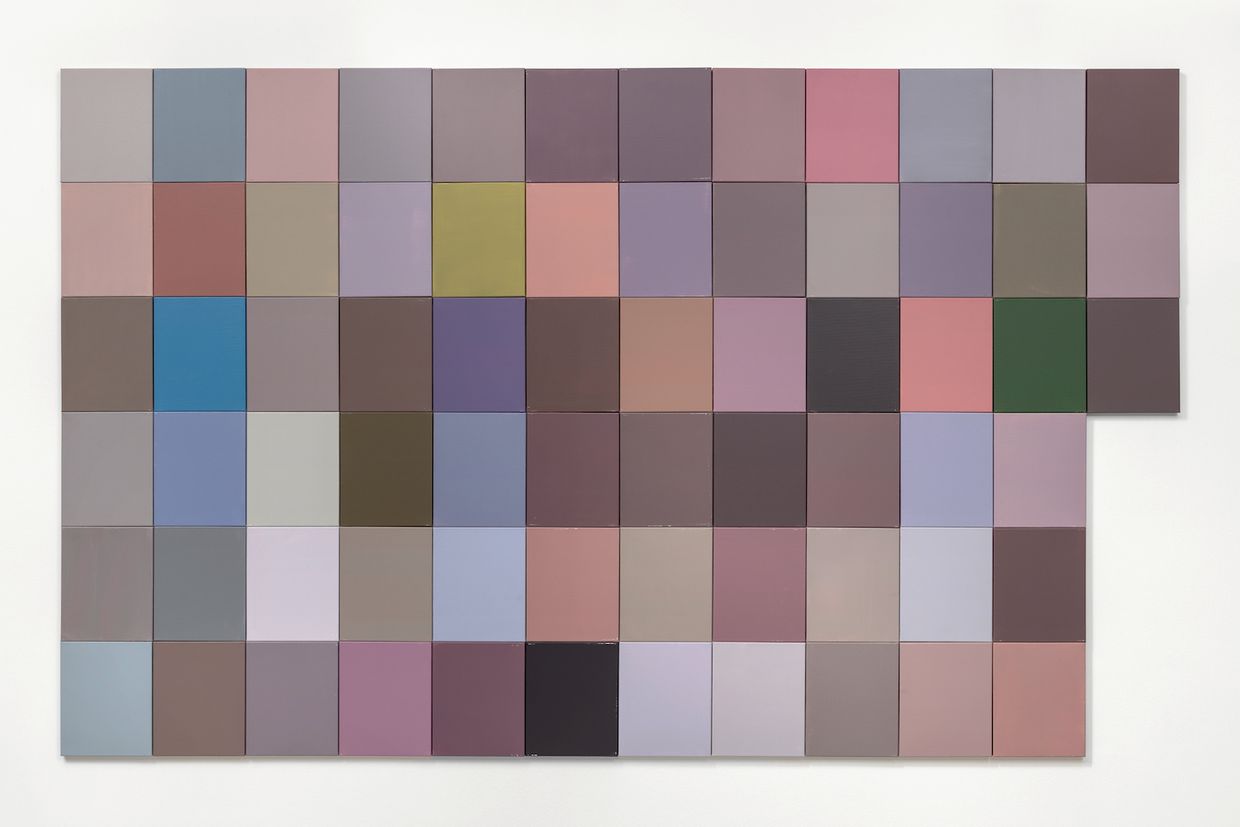
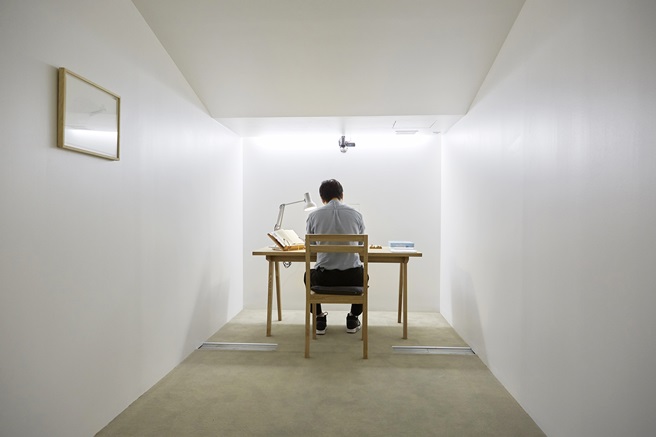
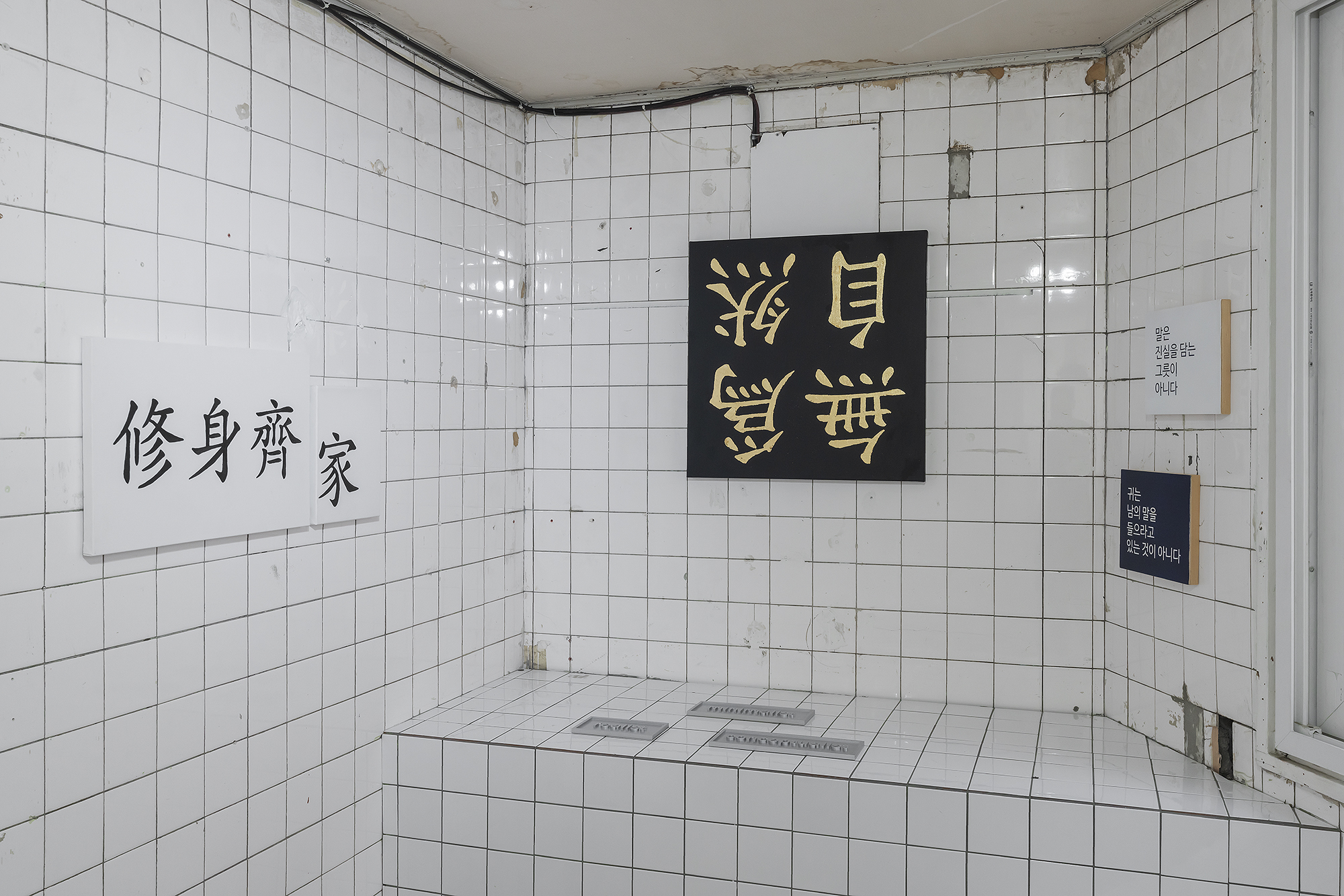
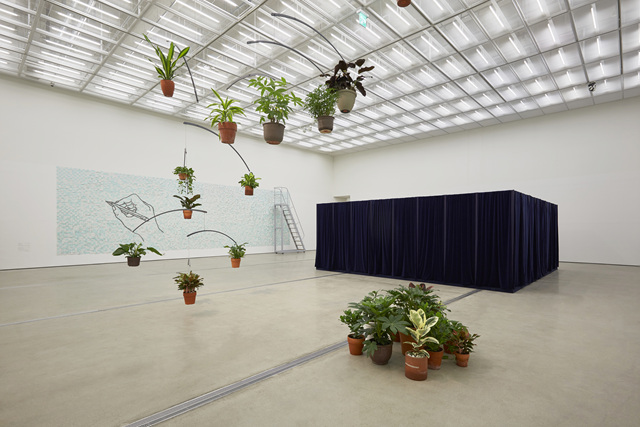
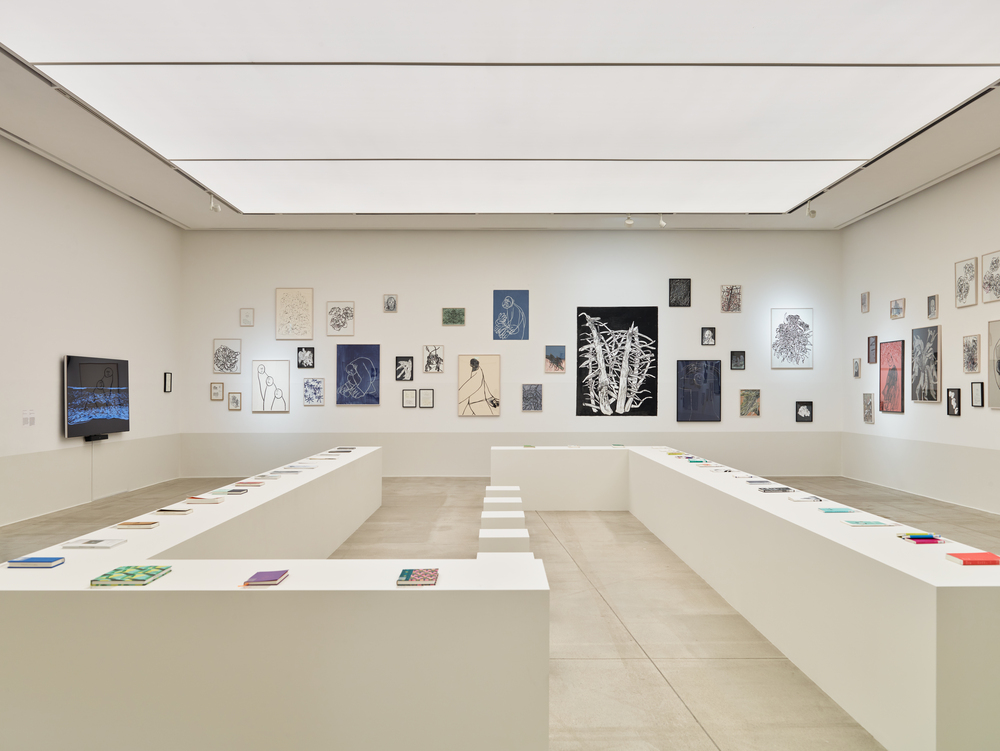
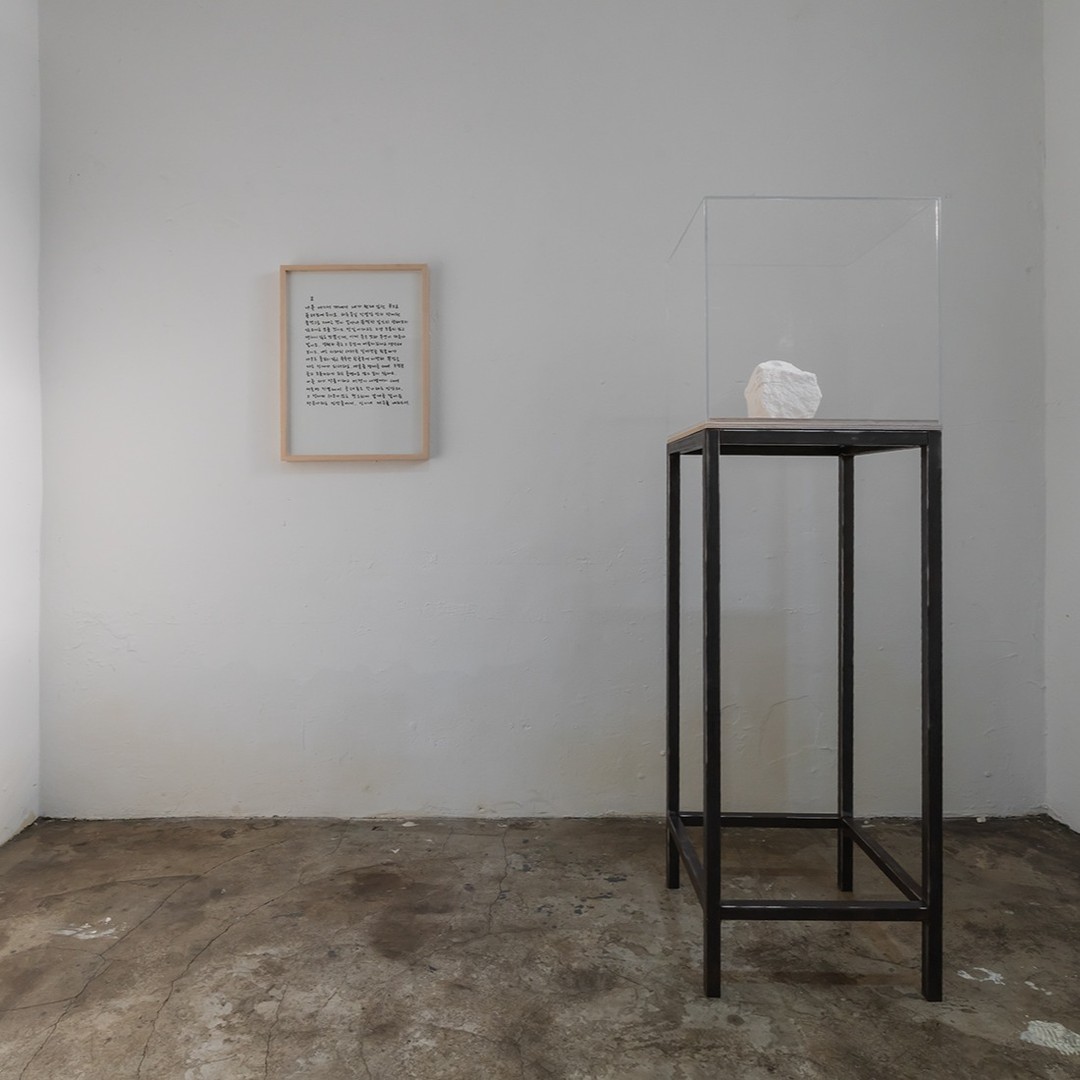
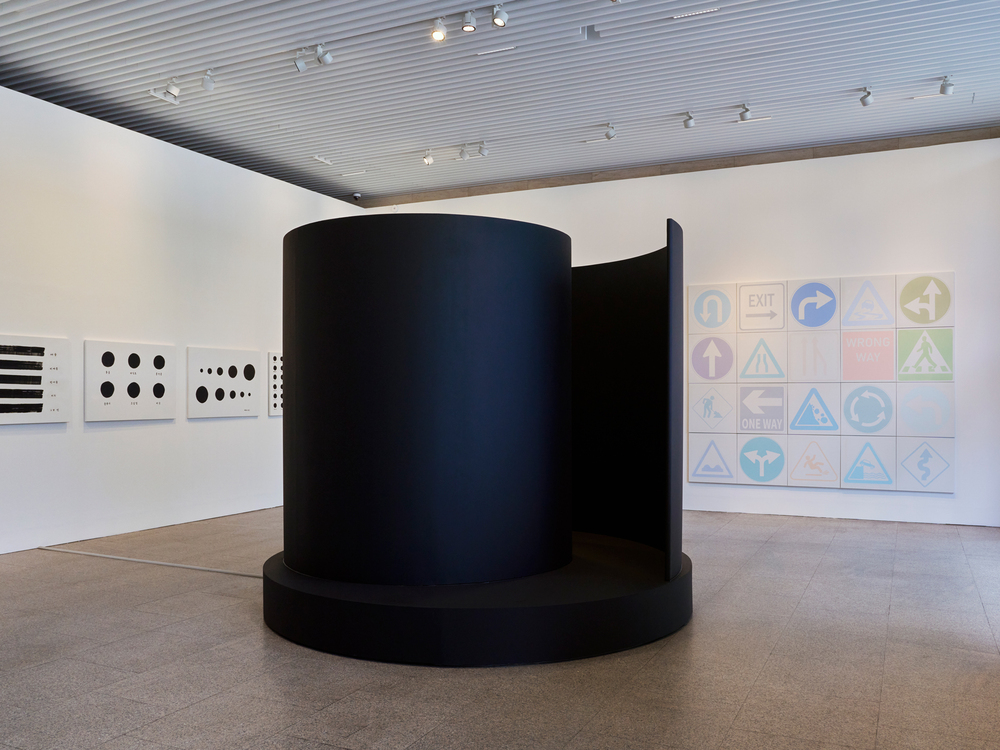
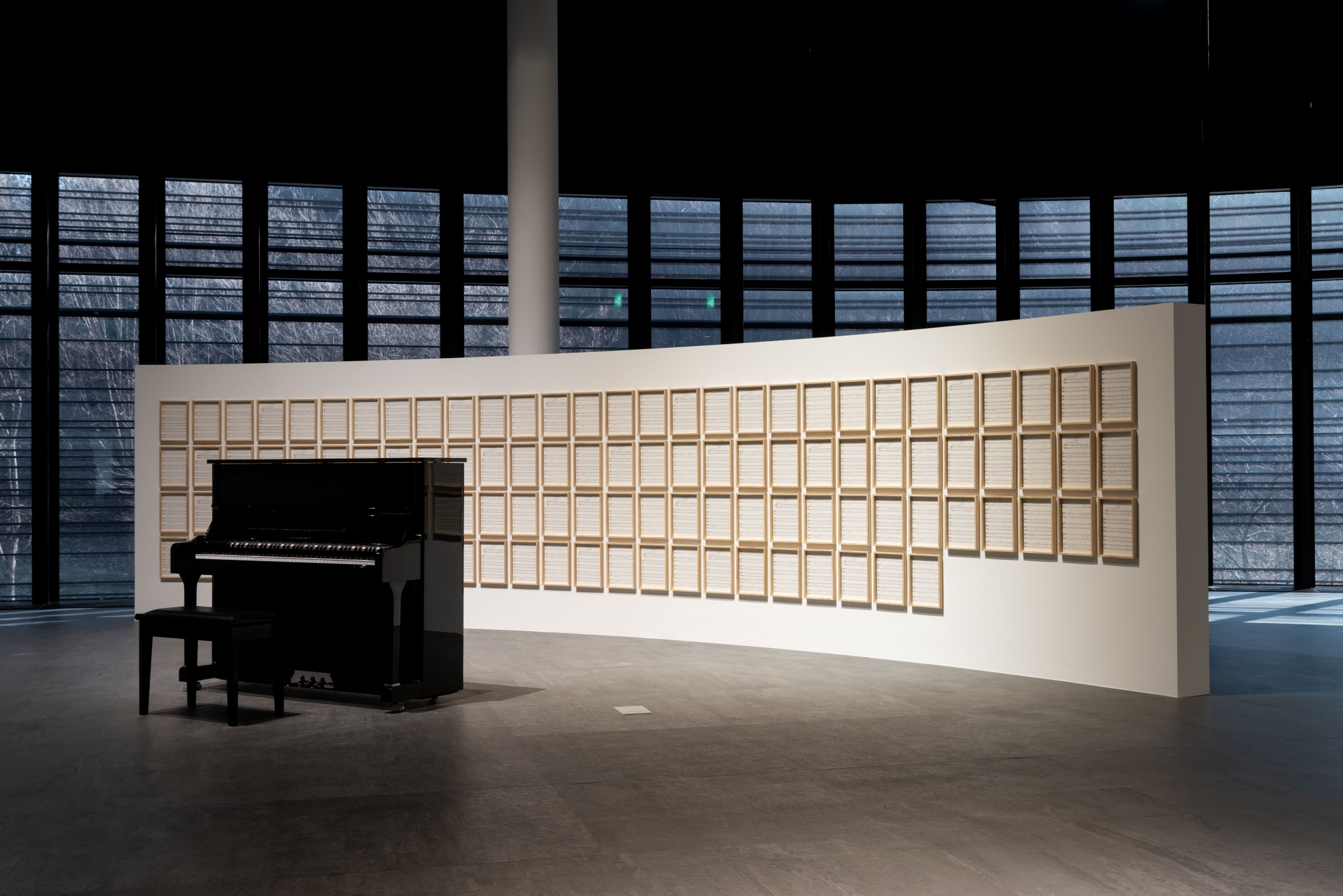
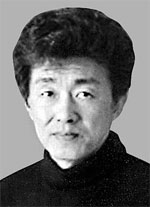
When I imitate objects and make them under the name of ‘artworks,’ there is always someone standing at the end of those paths. The paths branch outward from me. A chair, a room, a house, a forest come into being. And sometimes, someone traces those winding paths and comes toward me. Without knowing the map of those paths, without knowing my address, someone will come looking for me—even if I no longer live there. (Ahn Kyuchul, 1995)
 
I spent no less than six hours interviewing the artist for this text, devoting that time entirely to serious(?) discussion about his work. Yet the more we spoke, the stronger my sense grew that I did not truly know him. It felt less like failing to reach something that clearly existed than like pursuing something that was never there to begin with—or something that continually slipped away. Had I really encountered the “artist” through his works and words? Or does such an entity as ‘the artist’ even exist? And if it does, did I meet it directly? If so, is my voice faithfully conveying that encounter? If not, then is writing an essay titled ‘Special Artist’ anything more than a futile exercise?
 
Perhaps the artist does not exist. Or perhaps, even if he does, he remains forever unknowable. Ahn Kyuchul in particular provokes such doubts, likely because he himself relentlessly pursues them. By making objects in order to erase himself—or rather, by erasing himself through the making of objects—Ahn Kyuchul seems to enact Roland Barthes’ ‘death of the author’ or Michel Foucault’s view of literature as a form of suicide. Paradoxically, however, this ‘suicide’ enables me to write about him—freely, and therefore joyfully. Following Barthes’ invitation, I become a ‘reader’ born in the space vacated by the author, able to read ‘with pleasure the’ texts he has inscribed.
 
If the artist exists at all, it is within such acts of reading. His place of residence is not so much the work itself as the gaze of those who view it. If Ahn Kyuchul’s works encourage this kind of ‘reading’, it is because he actively accepts his own dwelling within such gazes. He performs a hybrid persona—an artist as reader, a reader as artist. Accordingly, what follows is not an attempt to track down the artist’s “true” identity, but to trace the personas he reveals.


Looking at Art

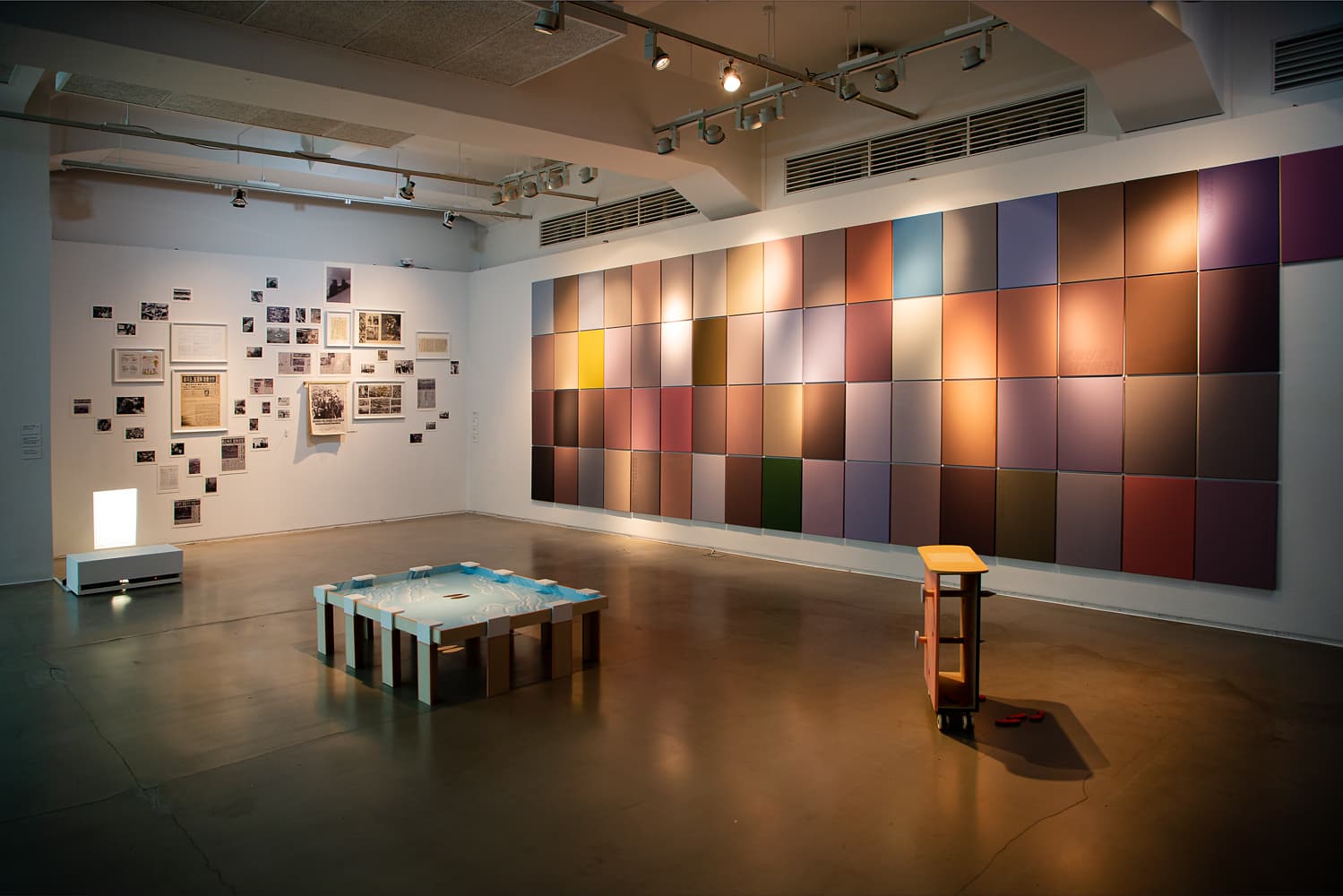
If there is a consistent theme in Ahn Kyuchul’s work, it is, above all, ‘art’ itself. What he has been looking at is neither the objective visual world, nor political reality, nor a transcendent realm—though it may encompass all of these—but rather the proposition of ‘art.’ As is well known, in the mid-1980s he was briefly affiliated with Reality and Utterance, turning his attention to social realities. The Green Table (1984) is a narrative sculpture that addresses such realities using what might be called “people’s” vocabulary—plain yet strikingly direct. The theatrical, stage-like structure of this narrative sculpture continues into his later works.
 
While the immediate subject here may be economic exploitation, his ultimate concern lay with art itself within that reality. His use of ‘humble’ materials such as paper clay and plaster, along with a deliberate amateurism in handling them, amounted to a pointed critique of the grand scales and expensive materials through which modernist sculpture of the time cloaked itself in hollow seriousness, as well as of the boom in environmental sculpture producing monuments for an era of art commodification. Even when he spoke with a socialist’s rhetoric, he never forgot that he was an artist.
 
His decision in 1987, at the age of thirty-three, to abandon journalism and return to Europe to study art was likely driven by this fundamental concern with art. After passing through France, he settled in Germany in 1988 and began art school again from the first year. From this point, his gaze shifted from looking at art from the outside to looking at it from within. The unpublished drawings Crocodile Stories (1989), still stored away in his studio drawers, are diary-like works from this period. By likening himself—adapting to a new civilization—to a crocodile, he began comparing Germany, where cynicism toward the 1968 generation prevailed, with Korea, where belief in art as a form of struggle still lingered.
 
This narrowing of focus toward the individual and toward art itself likely resulted from gaining enough distance to perceive the limits of art as a revolutionary tool or as topical illustration. Toward the Individual (1989), his first work shown in Germany, bears witness to this shift: a heavy, somber landscape installed in a darkened space. Phrases such as ‘Art knows no morality’ and ‘Art is capital,’ emerging from smoke rising from a chimney, question the meaning of art within society. A snake on the floor, carrying the phrase ‘toward the individual,’ paradoxically moves toward a wheeled cart bearing a flag—an emblem of collective history. It seems he sought to speak about the relationship between the individual and society, and the place of art within that dynamic.
 
As his stance shifted toward viewing art from within, his once dark and weighty tone gradually gave way to something lighter and more witty. This was not so much a lightening of subject matter as an ability to convey heavy themes through light narratives—a distinctive mode of expression that became his trademark from the early 1990s onward. In Five Questions for an Unknown Artist (1991), for instance, he embeds ‘serious’ questions within humorously transformed everyday objects. As he himself has said, this work signaled his departure from the shadow of political reality that had followed him, redirecting his gaze toward art and himself as an artist.
 
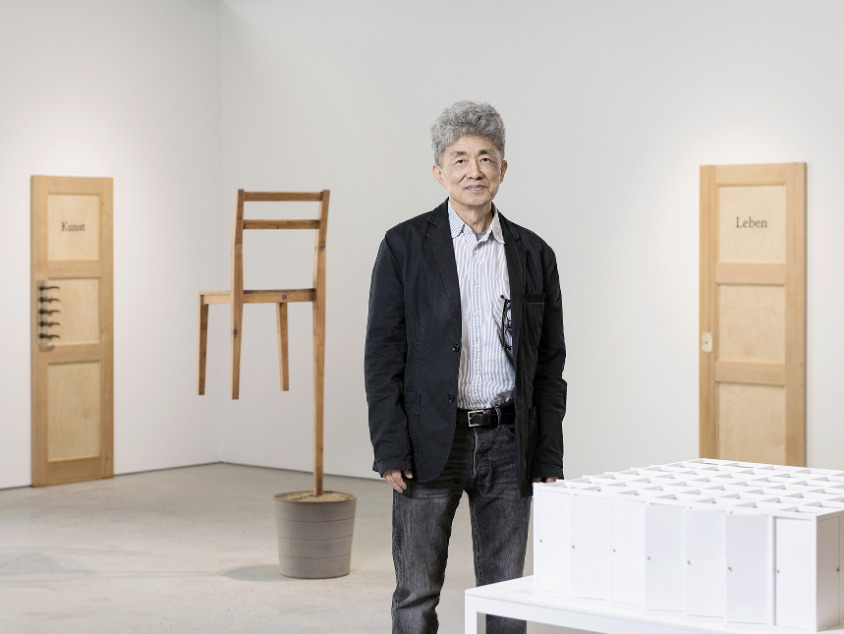
Regarding this work—composed of a door labeled ‘Art’ with five handles, a door labeled ‘Life’ with none, and a chair growing from a flowerpot—Ahn Kyuchul remarked:

“I have left the lives of ordinary people and must enter the door of art, but to open that door requires five hands. Inside, I find myself engaged in the futile act of watering a dead tree.” (Conversation with the author, 1999) Had he continued, he might have said: ‘What is art? Or what can it be?’ Surveying his work as a whole, one finds precisely this process of questioning and responding. What he practices is not art per se, but art about art—meta-art.
 
Yet unlike modernist assertions that define art by isolating its essence from the outside, Ahn Kyuchul’s reflections on art are inseparable from the contexts to which it belongs, namely life itself, and are therefore infinitely open. From this perspective, his early, socially explicit works and his later works are not fundamentally different; only the tone and emphasis have shifted. If he can be called a modernist, it is because he never abandons the proposition of art. If he can be called a postmodernist, it is because he regards not “art” itself but “art” as a text. In place of Ad Reinhardt’s “art-as-art-as-art,” Ahn Kyuchul proposes “art-called-art-called-art.”


The Theater of Objects

It is well known that Ahn Kyuchul writes as much as he makes—and does so remarkably well. His linguistic sensibility seems to operate even through his fingertips, endowing the objects he creates with the capacity to ‘speak.’ With these objects, he stages what Craig Owens identified as the postmodern ‘eruption of language into art,’ or the ‘dispersion of literature into the aesthetic field’ (Owens, 1979). For him, art is not a visual fact so much as a sign system akin to language. By reviving language buried by modernism, he explores the ‘theatricality’ so vehemently warned against by Michael Fried (Fried, 1967).
 
Stage-like sculpture has been present since his early works, but in recent years everyday objects have become protagonists delivering lines—what Shim Kwang-hyun has termed a ‘sculptural theater’ (Shim, 1996). In works such as The Eternal Bride (1994), The Sleeping House (1996), and A Guilty Brush (1992), objects are anthropomorphized, each performing its role. Ahn Kyuchul thus becomes both playwright and director, writing and staging their narratives.
 
In his works, images, objects, and written language function as equal components of a larger textual whole. Titles in particular have served to introduce thematic propositions, and over time written language has increasingly entered the works themselves, merging with images and objects.


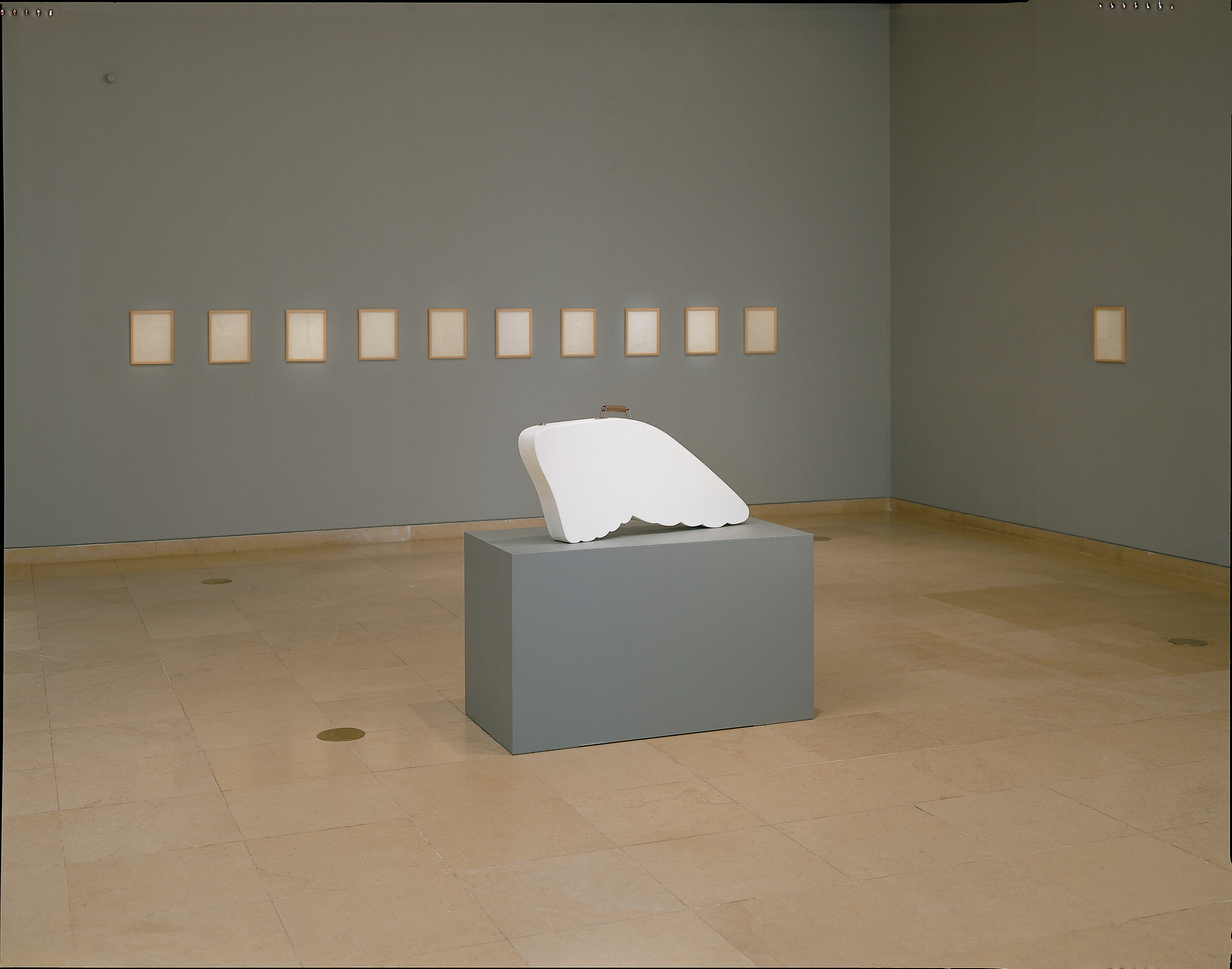
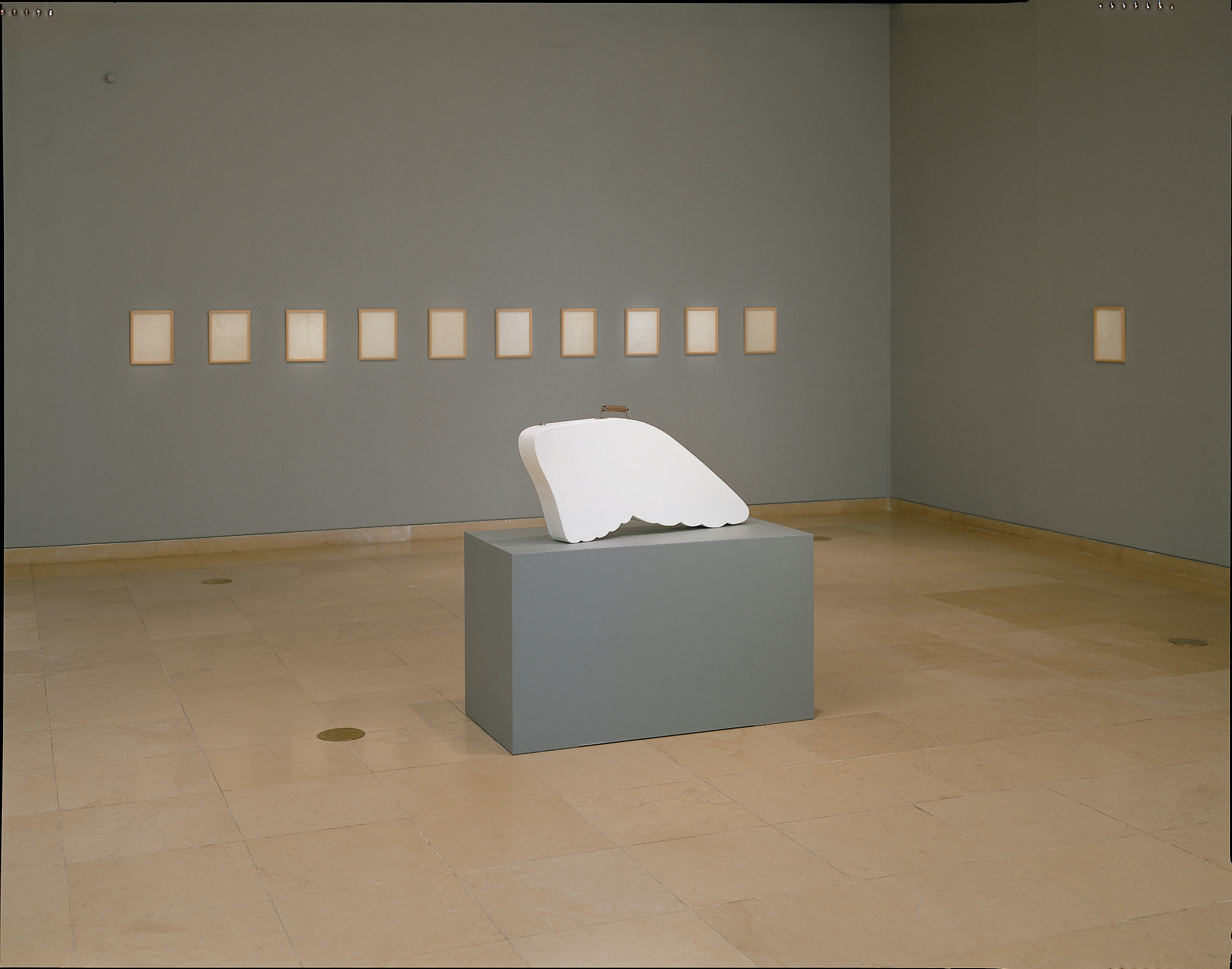
Ahn Kyuchul, The Man’s Suitcase, 1993, Pencil on paper, lacquer on board, 30 × 35 cm × (11), 50 × 98 × 11 cm © Ahn Kyuchul

In The Man’s Suitcase (1993), textual language comes to dominate the entire piece—an audacious attempt, as he notes, to incorporate storytelling he had previously restrained for fear of appearing “unsophisticated” (Conversation with the author, 1999).
 
Consisting of eleven drawings with corresponding texts and a physical reconstruction of the winged bag described in the story, the work functions as a kind of picture book. Yet its purpose is not simply to convey a narrative. Rather, it calls attention to the relationships among different sign systems—text, image, and object. Are all of these ‘the man’s suitcase’? If not, which one is real? The object most easily mistaken for the real bag may in fact be the furthest from it. Does a reality behind the signifier even exist at all…?
 
What Ahn Kyuchul scrutinizes is not the sign itself but semiosis—the process of signification. To foreground this, he exposes contradictions within sign systems. He creates signs that occupy an ambiguous zone between commodity and artwork, crafting everyday objects with artisanal care to produce individualized artworks bearing the appearance of anonymity.
 
He further disrupts conventional sign structures by nullifying function: doors that cannot open, or open only to close (The Eternal Bride); clothes that cannot be worn; shoes that cannot move forward; glasses for two-and-a-half people, or invisible glasses(made of marble).


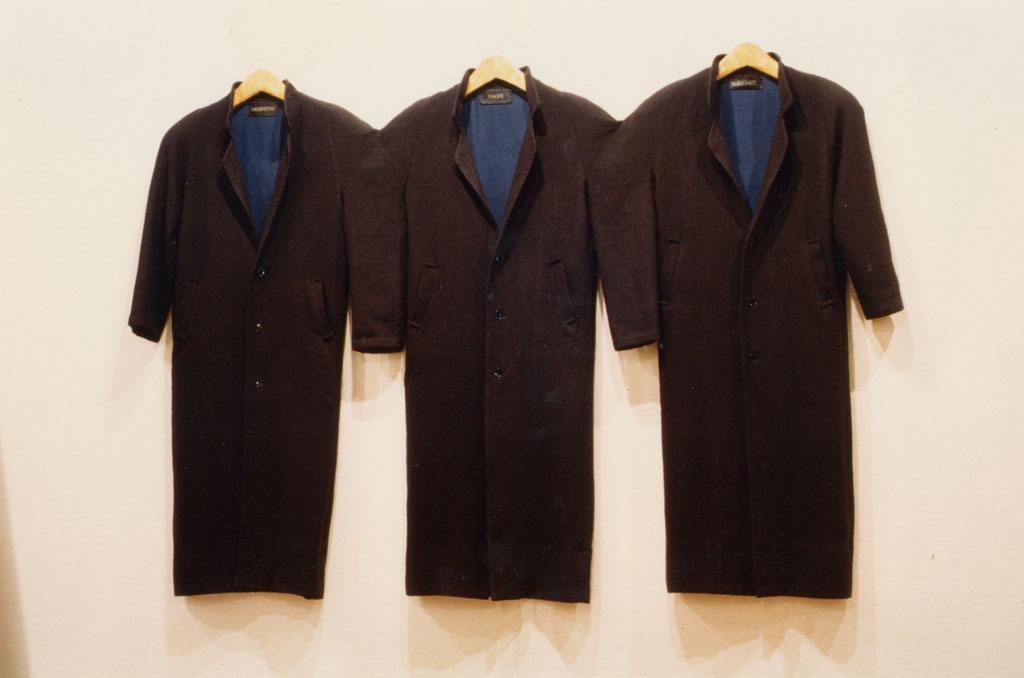
Ahn Kyuchul, Solidarity, Power, Freedom, 1992, Cloth, wood, and leather, 170 × 110 × 5 cm © Ahn Kyuchul

The polysemy of language is also his target. Solidarity, Power, Freedom references both George Bush’s justification of the Gulf War—’Solidarity makes freedom’—and the slogan of Poland’s Solidarity movement. In German, the verb ‘macht’ (‘makes’) also means ‘power,’ producing opposing meanings depending on interpretation. In visual signs, illusion likewise generates layered meanings. A house drawn in perspective and rendered as a black monochrome pattern can read as either a flat motif or a sequence of three-dimensional structures. Minimalism Exercise functions simultaneously as abstract cube, collective image of house, and specific narrative dwelling—multiple signifieds coexisting within a single signifier.
 
He also juxtaposes unexpected signifieds with familiar signifiers. In JaJaJa (1992), A Electrician’s Pantomime (1992), and I Live on Imagination Anyway (1993), gestures such as stamping, rubbing feet, or spooning imply an absent protagonist—not a human, but a machine. Their performances echo Beckettian theater: utterance detached from speaker, signifier isolated from signified as pure sound or movement. Jean Baudrillard’s declaration, “I live on imagination anyway,” dissolves beyond the spoon.
 
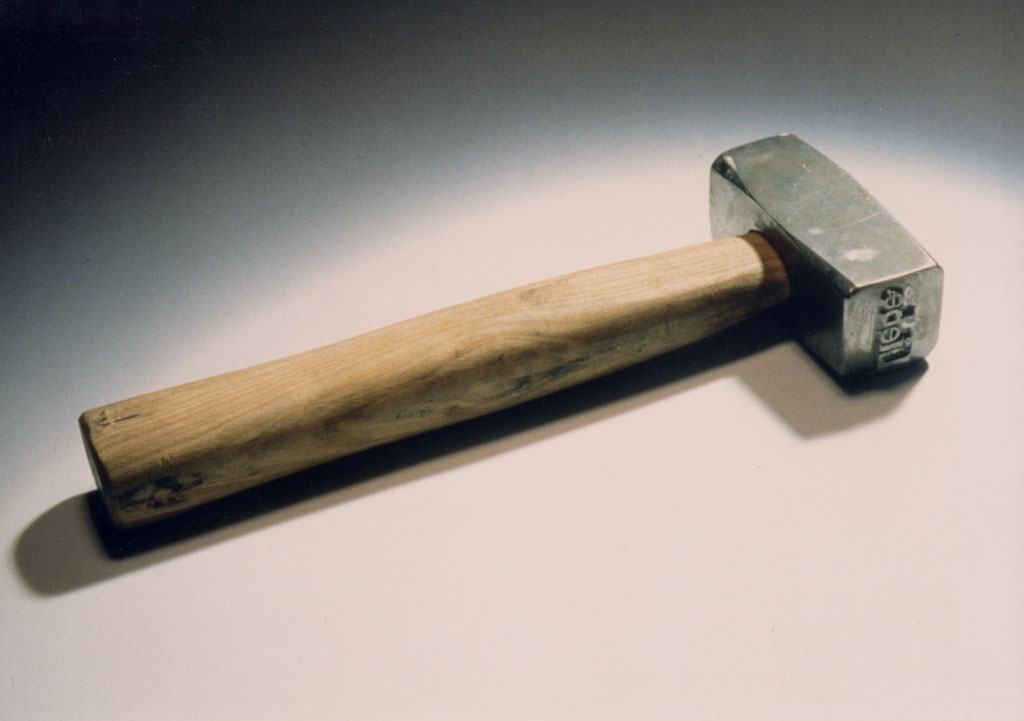
Within his works, different kinds of signs collide: in Love of Hammer (1991), the word
‘love’ meets a striking hammer; in A Guilty Brush, the word ‘guilt’ meets a scrubbing brush; in The Ladle of Memory (1995), perforated letters forming “memory” meet the ladle that scoops them. In I’m Not a Chalkboard (1992), the assertive ‘I’ conflicts with the chalkboard’s role as mere medium, while the raised word ‘chalkboard’ on its reverse contradicts the flatness the object demands.
 
In Teaching Flowers to Cast Iron (1994–96), the sensation evoked by the word ‘flower’ does not align with the physical qualities associated with cast iron. Here, different systems of signs—language and material—are brought into direct confrontation. In some works, this clash foregrounds the intrinsic gap between heterogeneous signs. In Water in the Distance (1992), image and object betray one another.
 
The painted fish appears to move from one vessel of water to another, yet the depicted fish and the actual water can never meet. Similarly, in Hat (1993), the hat in the image and the physical hat seem to indicate the same object, but in fact point to different referents.
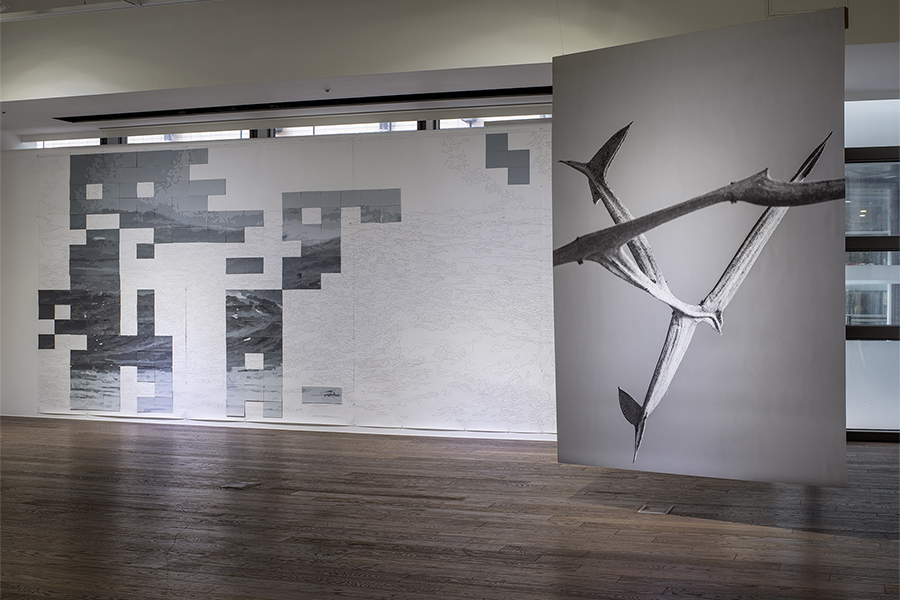
As one continues to engage with Ahn Kyuchul’s work, it becomes possible to enumerate numerous strategies through which familiar signs are rendered strange. Notably, however, these objects do more than merely expose the arbitrariness of signification through varied methods; they also propose a sustained reflection on linguistic space itself.
 
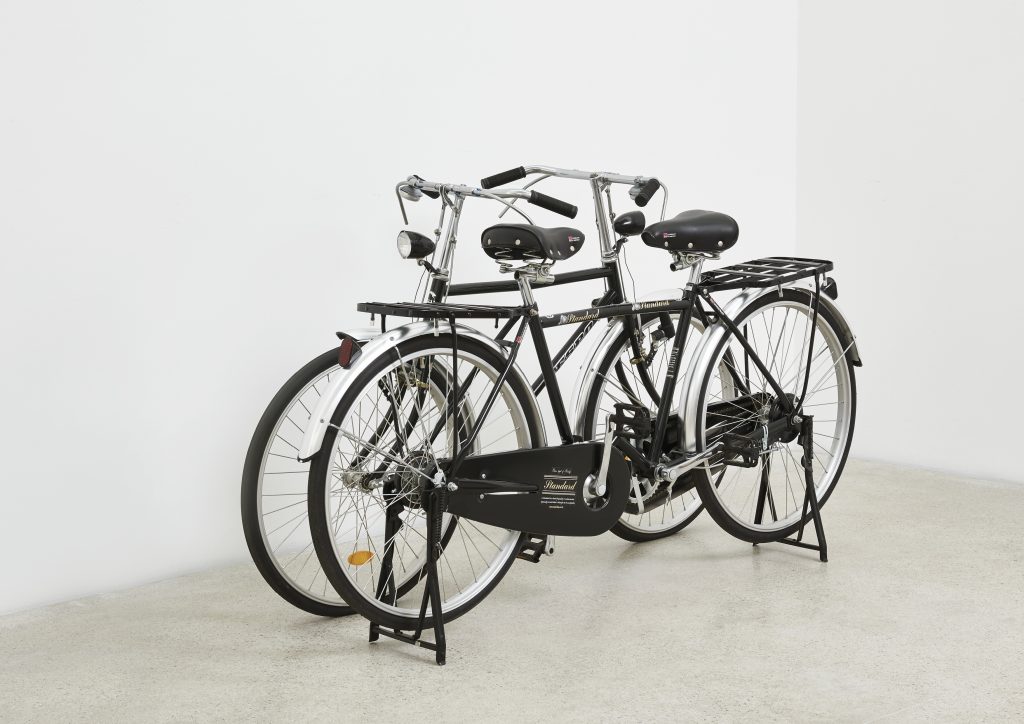
Through these works, Ahn Kyuchul continuously regenerates new signifieds: personal (Love of Hammer), political (Solidarity, Power, Freedom), media-critical (I’m Not a Chalkboard), linguistic (JaJaJa), or reflexive about art itself (Water in the Distance, Minimalism Exercise). The chorus of voices in this space ultimately delivers a bitter joke about the absence of the subject. His recent work Double Object (1999) speaks this even more forcefully, testifying to a world in which singular beings—including humans—face destinies of fragmentation and replication.


The Artist in the Audience

By foregrounding the linguistic space in which works circulate—the space between artist and work, between works, and between work and viewer—Ahn Kyuchul’s practice aligns with conceptual art. Yet rather than structuring this space through transparent conceptual frameworks, he emphasizes its opacity and resistance to penetration, placing his work in a distinctive position even within conceptual art.
 
What initially appears as simple narrative grows increasingly diffuse, spreading outward rather than converging on an inner core. Like the subtitle of Drawer (1994), ‘leaving a vacancy for objects,’ he collects discarded meanings and juxtaposes their contradictions rather than resolving them. His works resemble Barthes’ endless unraveling net, or Owens’ allegory of the palimpsest. He explores signs not to close meaning, but to open it. The viewer becomes implicated in a play of signs set adrift in an ambiguous and fluid state, drawn into their circulation through the montage-like effect of meanings.
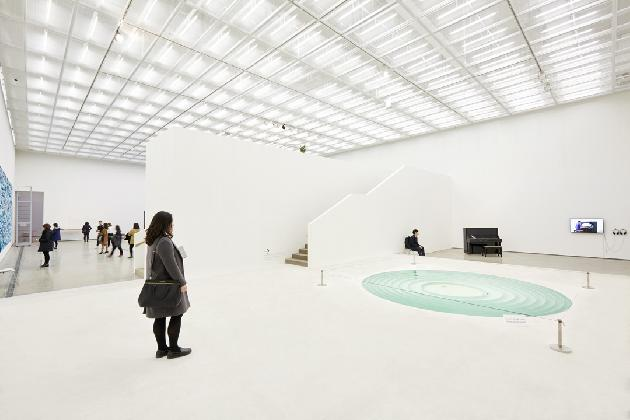
 
In seeking to verify the invisibility of language by scrutinizing it, Ahn Kyuchul enacts a paradox. His work, while directed toward linguistic space, persistently touches upon that which language fails to reach—perhaps because it departs, from the outset, from an acknowledgment of language’s opacity. The qualities of ‘formality, normativity, and uniformity’ identified by Park Chan-kyong (1996) as aesthetic characteristics of his work situate it within the realm of refined visual sensibility.
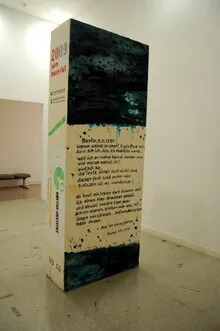
 
At the point where he explores a non-verbal domain belonging solely to the visual world, Ahn appears less a writer than an artist—and a modernist. Yet insofar as this non-verbal sensibility is not intended to facilitate transparent immersion in the work, but rather to sustain the object’s impenetrable material presence by stripping away the aura of the subject, his practice aligns more closely with a form of minimalism that betrays modernism.
 
The non-verbal sensibility permeating Ahn’s objects extends beyond vision to include touch. The tactile presence of meticulously sewn stitches in fabric, individual threads embroidered into the shape of goldfish, or densely planted strands of hair leaves no room for linguistic intervention. Yet even these traces of handcraft differ from the modernist pursuit of direct, unmediated immersion in the artwork devoid of language.
 
Rather than conveying the maker’s breath, as in the gestural mark of Abstract Expressionism, his craft—artisan-like, and at times approaching the precision of mechanical process—produces the opposite effect. It relies on the opacity of the body to push the self outside the process itself. His willingness to devote himself to the ‘trivial’ labor of making objects, rather than the ‘grand’ act of creating art, reflects a deliberate effort to escape the excessive seriousness artists attach to artistic production and the illusion of sovereign control over their creations. Through meticulous manual labor, he withdraws his own shadow from the object, imprinting instead its anonymous presence.
 
In this sense, Ahn positions himself as a spectator seated in the audience, watching the theater of objects he has made—a gesture that calls into question the supposed omnipotence of the cognitive subject that guarantees the transparency of signs.


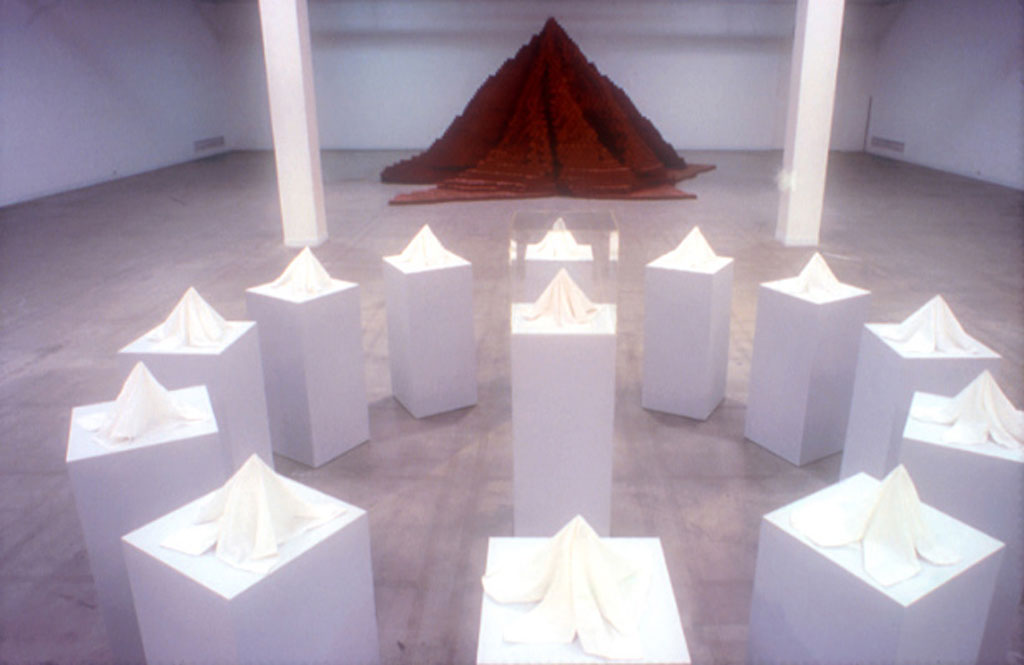
Ahn Kyuchul, Trivialities, 1999, Various material, Dimensions variable © Ahn Kyuchul

Trivialities, conceived by Ahn Kyuchul in the late 1990s, serves as a compelling example of such gestures. The work unfolds like a third-person narrative, narrated by the artist as an anonymous observer. Ahn takes the shape formed when a handkerchief accidentally falls to the ground and reproduces it through multiple media: he casts it repeatedly in plaster, translates it into bronze, renders it in oil painting, and enlarges it to a monumental scale, installing these iterations together. In doing so, he revisits a negligible, accidental event and endows it—almost ceremoniously—with a range of institutional conventions.
 
By observing an event that has been radically objectified—one in which the intervention of the subject is reduced to a minimum—with extraordinary delicacy, Ahn paradoxically measures the vast distance between the world and the subject. The surface of the signifier, emptied into a mere shell, is continuously adorned with something “like” the aura of the artist-subject; yet this very embellishment only makes its hollowness more starkly visible. In effect, Ahn stages an absurd drama that represents the absence of a narrator. By positioning himself as a spectator of this drama, he simultaneously becomes its author.
 
When Ahn remarks, “Ah, could it be that all things are constantly plotting to leave us behind?” he is in fact saying, “I want to see things exactly as they are—separate from myself.” From this attitude, he senses what might be called a ‘boundary of freedom.’ To return things, and the world, to their proper places—to leave their unknowable mysteries unknowable—is a freedom that arises from humility and insight.
 
Ahn Kyuchul’s practice constitutes a form of meta-art that speaks about art in an era in which the artist has withdrawn behind the stage. His perspective is, in this sense, vertical: he looks down upon art from a certain height. Some regret this shift, seeing it as a move away from the gaze of the people toward an elite viewpoint. Yet I believe that as long as the concept of ‘art’ exists, the artist’s gaze cannot—and should not—abandon this position. The gaze of Minjung artists was never truly the gaze of the people either, and thus Ahn’s perspective has not changed as drastically as it may seem. To avoid the errors and latent violence inherent in a vertical gaze, I believe an artist must constantly move back and forth among multiple horizontal perspectives—and it is precisely this movement of vision that I observe in Ahn’s work. His meta-perspective is neither prescriptive nor integrative in the manner of earlier metaphysical systems.
 
His work resembles a precarious balancing act of contradiction: a meta-position that contains ‘traces’ of what lies outside the meta, a meta that exists in order to negate itself. Consistently, he approaches art from the standpoint articulated in his own words: “Do not be afraid to stand at the periphery; when you are outside, the whole becomes more visible” (Ahn Kyuchul, 1990).
 
In this sense, Ahn produces what might be called ‘différances’ within the sign of ‘art’ itself. This is a political gesture insofar as it exposes the fiction of a single, unified logic and seeks liberation from the oppression such logic entails. He follows Jean-François Lyotard’s proposal to “declare war on totality through heterogeneous language games” (Lyotard, 1979). The reason Ahn’s wordplay exceeds mere self-indulgent expression lies precisely in this critical effect. In this respect, his work can be understood as another form of social realism. By speaking about art, he is ultimately speaking about life; by attending closely to the signs that permeate everyday existence, he exposes the hidden topography of power behind them, disrupting that space and hinting at the possibility of liberation from those forces.
 
Here, the artist performs the role of a subject that moves between texts. In Julia Kristeva’s terms, this marks a transition from a rigid subject to a pliant one. For Ahn, the death of the subject means accepting the other that resides within oneself—that is, the multiplication of the subject. He speaks while hiding behind constantly shifting personae, saying, “Do not trust what you see,” and “Gaze at what lies behind the shadow” (Ahn Kyuchul, 1996). These words are carried by anonymous voices emerging from behind masks. Perhaps Ahn Kyuchul exists only within such voices. Having arrived at this thought, I can finally say that I have met him—and that I have seen him within his work.

References