1.
Since his first solo exhibition in 1985, the roughly
450 paintings Choi Gene Uk has produced over the past 38 years can, in terms of
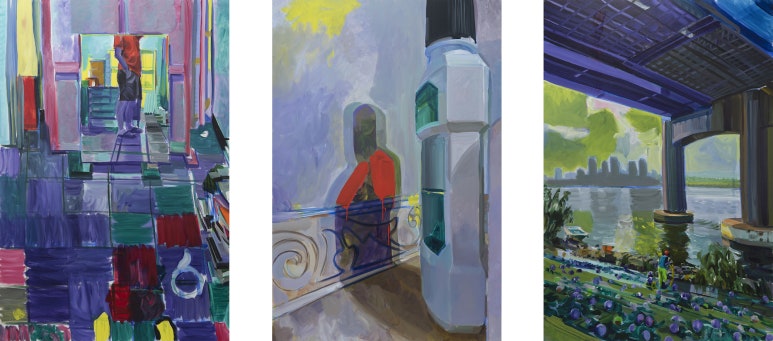
subject matter, be broadly divided into three types: works depicting the studio
interior (Type A), works depicting the outside world (Type B), and Type A
paintings that include Type B within them (Type C). In the 《Two-Person
Exhibition》 of
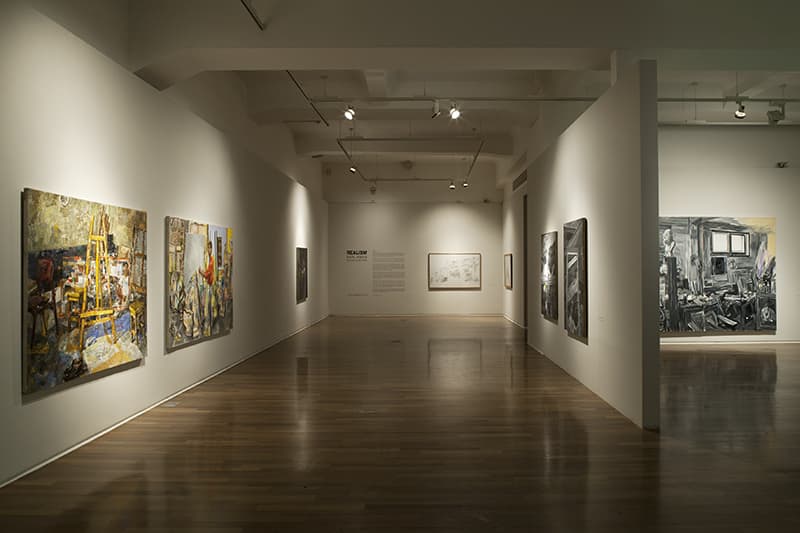
Choi Gene Uk and Lee Hyuk planned by Dooson Gallery, only twelve Type A works
are shown: two self-portraits from 1992 (a), eight interior paintings made
between 2020 and 2021 (b), and two studio paintings from 2023 (c).
This narrowly limited selection inevitably leaves one wishing to
encounter a fuller range of Choi Gene Uk’s representative works. At the same
time, however, it offers the advantage of allowing viewers to see his overall
typology as something like a ‘miniature,’ since more than half of the works
included—while belonging to Type A—also maintain certain points of contact with
Types B and C. What makes this arrangement even more intriguing is that it
encourages concentrated thought on two aspects that would have been difficult
to bring into focus through other modes of display.
1) First, although many of his paintings far exceed the 100-ho format,
this exhibition is largely composed of works in the 20-ho to 60-ho range, with
the two 100M works being the largest. This suggests that the exhibition does
not aim to foreground the ‘vital, spirited’ dynamism of Choi Gene Uk’s
brushwork—so vividly evident in his large-scale works. Instead, it allows a
particular feature of his painting to come into focus: his distinctive
pictorial methodology, which he describes as ‘painting the relationship between
himself and his subject.’
2) The works shown here cannot be said to represent the Type A paintings
that were produced intensively in his early period. Yet another key aspect lies
in the special effect generated by the encounter between two self-portraits
painted thirty years ago (a) and two present-day studio views that include his
own reflection in a mirror (c). Through that confrontation, a view of painting
unique to Choi Gene Uk comes fully to the fore: ‘an elliptical motion with two
centers—the painter himself and the painter’s workplace.’
These two aspects, moreover, interlock. In the methodology of ‘painting
the relationship between oneself and the subject,’ the term ‘subject’ can
encompass a range of categories: the self, the studio, the world beyond the
studio, and more. The ‘self’ is not fixed either. Over time, it has shifted in
content—from an upper or lower body reflected in a mirror, to the full figure,
to parts such as a hand or arm, to appearances from youth, middle age, or old
age, and so on. Even in self-portraiture, painting oneself as seen in a mirror
is an act of objectifying the self. Conversely, when painting an external
subject, traces of the self doing the painting are variously inscribed into the
picture plane—through dividing the canvas, misaligning forms, and other procedures.
The act of ‘painting a relationship’ thus takes on the aspect of an ‘elliptical
orbit’ with two centers: the self and the subject.
Accordingly, the most important feature that distinguishes Choi Gene
Uk’s painting from others does not lie in what content fills the category of
the self or the subject, but rather in the ‘peculiar relationship’ between the
categories of the self and the subject—categories that cannot help but change
incessantly. This is why his work cannot be easily classified under broad
currents such as realism, modernism, or postmodernism, nor neatly sorted into
categories such as figurative painting or abstraction.
Choi Gene Uk’s work can be called modernist in that it emphasizes
flatness, realist in that it depicts concrete subjects, and postmodern in that
it depicts the process by which those two aspects collide or overlap. Some
paintings belong to figurative art insofar as they render highly specific
forms, while others belong to abstraction insofar as they erase forms or depict
simple patterns. Indeed, his four decades of practice—where such tendencies are
complexly interwoven—can be understood as a process of practicing and
transforming virtually every movement and method in art history, while
experimenting toward a language of his own.
Interestingly, much of this multifaceted experimentation had already
been substantially achieved in the 1980s. Having passed through these
experiments, around 1990 he named the unique idiom he had acquired ‘emotional
realism’ and initiated the ‘Beginning of Painting’ series. This naming and
these paintings cut across the tangled terrain of the art world at the
time—shaken by fierce debates among realism, modernism, and postmodernism, and
by the polemics of Minjung art versus so-called pure art—stirring a fresh wind.
The encounter between the emotional and realism prompted a renewed look at the
entire artistic landscape that had been reductively divided.
“If you ask what my painting is, I feel a bit embarrassed. In my
painting there is no object. There is no theme I wish to represent, nor any
goal I wish to pursue. If a painter were like a boxer, there would be an
opponent to fight and the result would be the work, but for me it is as if
there is no opposing boxer. If everyone steps onto the stage to show something
to the audience, my work shows the back of the stage: the messy props, the
clothes left behind by actors, the lunchbox they were eating (···), and so on.
If you compare this to a painter, it leads directly to the studio scene: a
kettle, a chair, an easel, a plaster cast, and so forth.
Just as a play that
emphasizes the actor, a play whose subject is the actor, is tasteless, my
painting, too, could be called a tasteless painting whose subject is the
painter. In any case, I understand that more than 90% of artworks are presented
on stage, pushed out toward the audience. But I dislike this theatrical tension
and think it is hypocrisy. Still, even if I am painting the back of the stage
now, that does not mean I am satisfied. I will not stand on the stage, but
neither will I remain behind the stage forever. I will go outside this theater
and paint the wide world. But right now I cannot go out into the wide world. If
painting is an aesthetic elucidation of the world, then this world is too wide
for me to interpret with certainty. Too vast. First, I want to interpret with
certainty this place demarcated as a theater—this world that can be known with
certainty.” (Choi Gene Uk, work note, 1990.7.8)
At the time, without thinking more deeply, one might have assumed that
this claim concerned something beyond merely choosing what to paint—whether the
stage (modernism), the theater itself (the studio), or the outside world
(realism). Yet it also contained something more: a revolutionary
problem-setting concerning what the ‘act of painting’ itself is—an
‘epistemological Copernican revolution’ (Kant). Thereafter, whether he painted
the studio, the outside world, or paintings that contained both types within them,
this problem-setting of ‘revolution’ can be understood as a thread running
through his practice. To concretize the meaning of this problem-setting, let us
compare it with Kant’s own formulation.
Kant used Copernicus’s discovery as a metaphor for his philosophical
revolution: the stars do not revolve around the earth; rather, the earth orbits
the sun, and therefore, to grasp the stars fully, one must first grasp the
earth’s manner of orbiting. In order to grasp an object fully, Kant argued, we
must first grasp our own a priori structures of cognition. Just as, for Kant,
the issue was not first of all what an external object is, but the
‘relationship’ between the object and the epistemological act of constitution
carried out by the observer who apprehends it, so for Choi Gene Uk the issue
can be said to have been, prior to what subject he paints, the ‘relationship’
between the subject and the painter’s ‘sensory cognition and constructive act’
in painting it.
To explain this complex relationship—one that was not well understood at
the time and is still not well understood even by many Kantians today—Kant
proposed a distinctive methodology structured like a kind of matrix (or an
elliptical structure): ‘the combination of transcendental idealism (x) and
empirical materialism (y).’ The reason Choi Gene Uk referred to his painterly
methodology as ‘mysteriously scientific realism or emotional realism’ was
likewise to name the complex relationship between the subject and the ‘act of
painting.’ At the time, neither he himself nor the author who wrote about him
was able to probe deeply into the peculiar structure of this ‘relationship.’
Yet, in retrospect, we might newly interpret the phrase
‘mysterious–scientific–emotional’ as corresponding to Kant’s ‘transcendental
idealism’ (x), while the ‘realism’ that can be “inevitably felt through the
senses” corresponds to Kant’s ‘empirical materialism’ (y). To see how such an
analogy might be valid, let us examine Kant’s method in greater detail.
2.
For Kant, the combination of transcendental idealism and empirical
materialism that arises in our process of cognition is not a simple fusion or
compromise, but a dialectical conjunction. If we summarize the core of this
dialectical mode of combination—elaborated in complex terms in Part I, Chapter
3, “Transcendental Dialectic,” of Critique of Pure Reason—it
can be put as follows: Kant’s transcendental dialectic is an epistemological
method that explains the intense tension between two tendencies to which our
mind is prone when it seeks correct knowledge—an abstract longing directed
toward a ‘transcendent being,’ and scientific discoveries concerning concrete
phenomena. Cognition itself cannot be constituted unless a paradoxical
relationship is formed in which these opposing poles are drawn toward one
another. In essence, our cognition takes the form of an elliptical structure
with two centers: reason, which has a transcendental nature that strives toward
the abstract unconditioned, and understanding, which seeks to scientifically
elucidate concrete phenomena.
If one of these centers is lost, the elliptical structure with two
centers collapses and is transformed into a circle with a single center. The
continental rationalism and British empiricism that stood opposed to each other
in Kant’s time can be understood precisely as two such circles, each with only
one center. The reason Kant’s philosophy is difficult to understand and often
misunderstood lies in the fact that its core unfolded between these two fronts
of reductionism that persisted both before and after Kant.
“Every philosopher after Kant—even Kantians such as
Schopenhauer—rejected the concept of the thing-in-itself. As a result, Kant has
come to be regarded as the progenitor of a philosophy of subjectivity that
actively constitutes the world. This appears to follow the direction of what
Kant called the ‘Copernican turn.’ Yet Kant himself soon denied such idealism.
What, then, was Kant trying to do? Was Kant merely attempting a critical
compromise between rationalism and empiricism?
In order to understand Kant’s
Copernican turn accurately, one must first examine Copernicus’s own turn. (…)
What matters is not whether it is geocentrism or heliocentrism, but the fact
that Copernicus grasped the earth or the sun as terms within a relational
structure, apart from what is empirically observed. It is this alone that
brings about the ‘turn’ to heliocentrism. That is, Copernicus’s turn itself
possessed a double meaning. (…) What Kant brought about was an
unthematized—what Kant would call transcendental—structure, such as the forms
of sensibility or the categories of the understanding.” (Karatani Kojin,
Transcritique, trans. Song Tae-uk, Hangilsa, 2005, pp.
67–68)
In Critique of Pure Reason, this ‘unthematized’
transcendental structure takes the form of an elliptical orbit with two binary
pairs (sensibility–understanding, understanding–reason). Post-Kantian
philosophy, however, failed to grasp this elliptical orbit revealed through the
Copernican turn, and by choosing only one term of each binary according to
philosophical temperament, it split into two extremes: Hegelian absolute
idealism and Comtean empirical positivism. As a result, philosophical
epistemology itself became crippled.
“Kant has always been criticized as having opened a philosophy of
subjectivity. Yet what Kant did was to reveal the limits of human subjective
capacities and to regard metaphysics as an act of ‘overstepping’ beyond those
limits. (…) What Kant calls the ‘Copernican turn’ is not a turn toward a
philosophy of subjectivity, but rather a turn—achieved through it—toward
thinking centered on the ‘thing-in-itself.’ (…) What, then, is the
‘thing-in-itself’? Before it is directly addressed in Critique of Practical Reason,
the ‘thing-in-itself’ is fundamentally related to an ethical problem. In other
words, it is the problem of the ‘other.’” (Karatani Kojin, ibid., pp. 72–73)
In summary, Kant’s ‘transcendental dialectic’ demonstrates, through
concrete examples, what kinds of problems arise when multiple elliptical
structures with two centers—subjectivity and the thing-in-itself
(Critique of Pure Reason), self and other (Critique
of Practical Reason), nature and society (culture) (Critique
of Judgment)—are reduced to circles with a single center. The moment
one first realizes that the very structure of human cognition is characterized
by intense tension generated through an elliptical motion with two irreducible
centers, the self and the world, an exclamation of a “mysterious yet
scientific” discovery naturally emerges. This is akin to the sense of wonder
one feels upon learning that our normal vision depends on the ‘parallax’
produced between two eyes. This is precisely why Choi Gene Uk gave his
methodology of painting the relationship between the self and the subject the
name ‘mysteriously scientific and emotional realism.’
3.
Now, by taking Kant’s transcendental dialectics as a mediating
framework, let us examine the structure of Choi Gene Uk’s work in greater
detail. As noted earlier, the present exhibition is broadly composed of studio
paintings (Type A), yet within it are works that intersect with Types B and C.
These can be further categorized as follows.
1) 108. Self Portrait (1992) (50F), 109.
Self Portrait (1992) (60P), 361. Your World 4
(2020) (30F), and 362. Your World 5 (2020) (30F) may all be
regarded as self-portraits—if works no. 361 and 362 are read as depictions of
the artist’s lower body reflected in a mirror. In this case, the title ‘Your
World’ would imply the objectification of the self as an Other. By contrast,
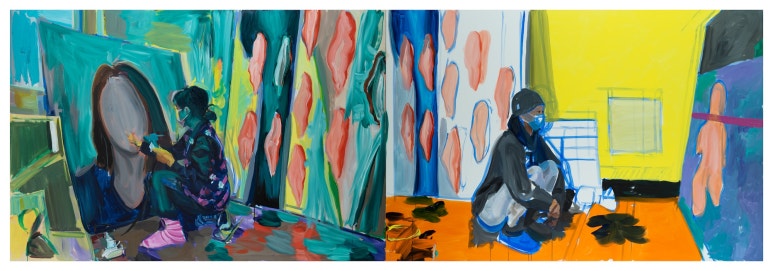
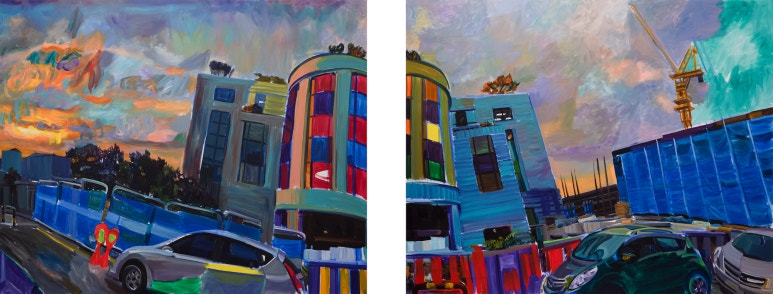
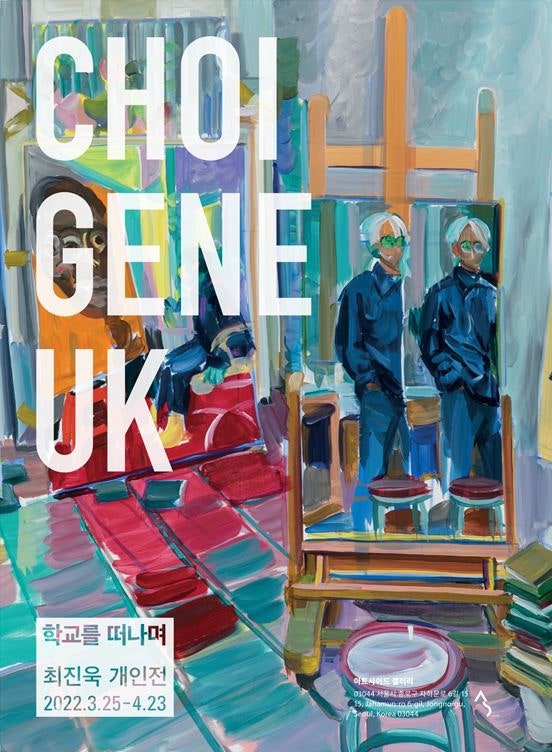
434. For the Two-Person Exhibition 1 (2023) (100M) and
435. For the Two-Person Exhibition 2 (2023), painted at the
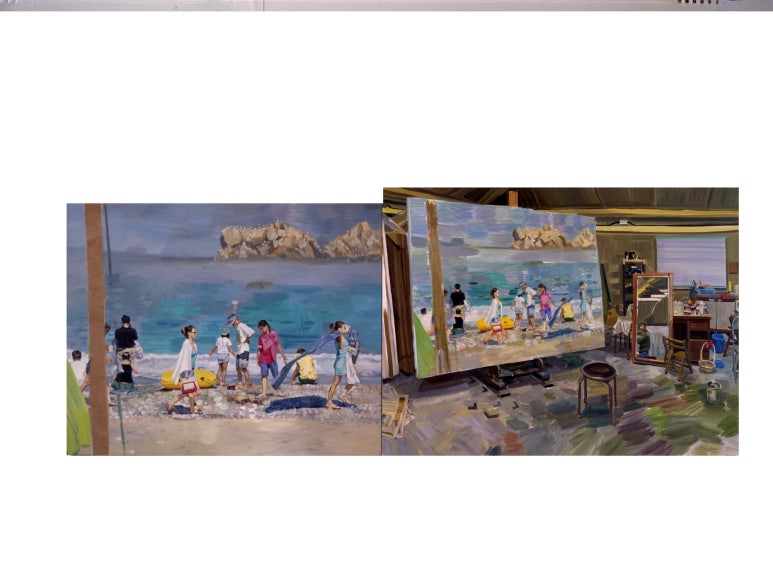
same scale, depict the overall view of the studio, with the artist’s own
arm—painting the studio—appearing as part of the pictorial field.
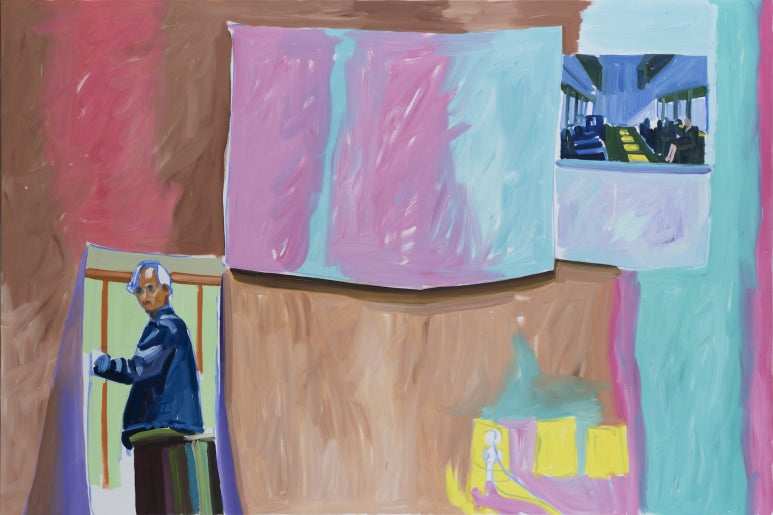
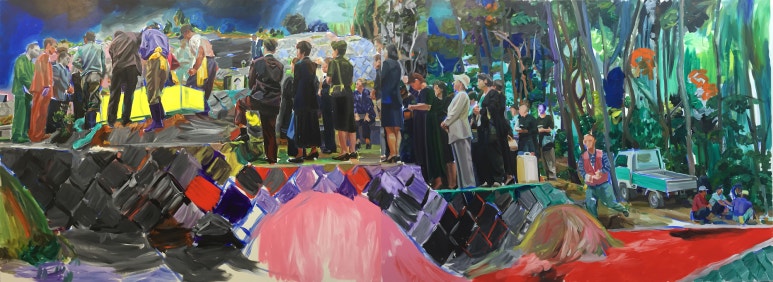
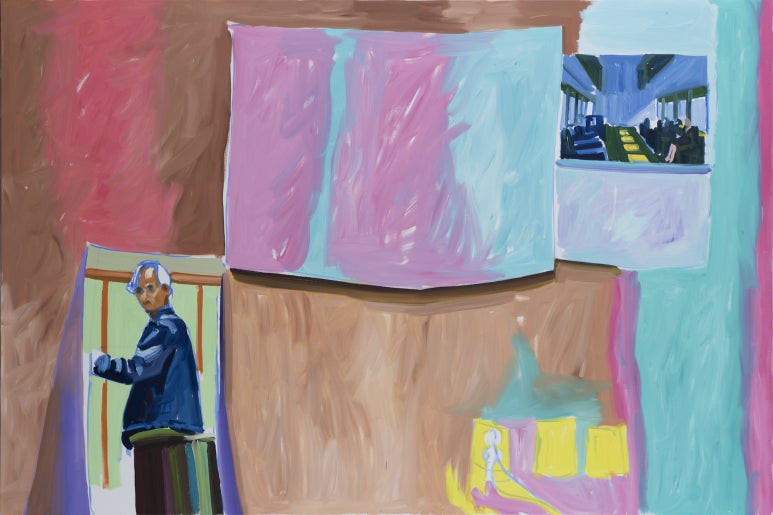
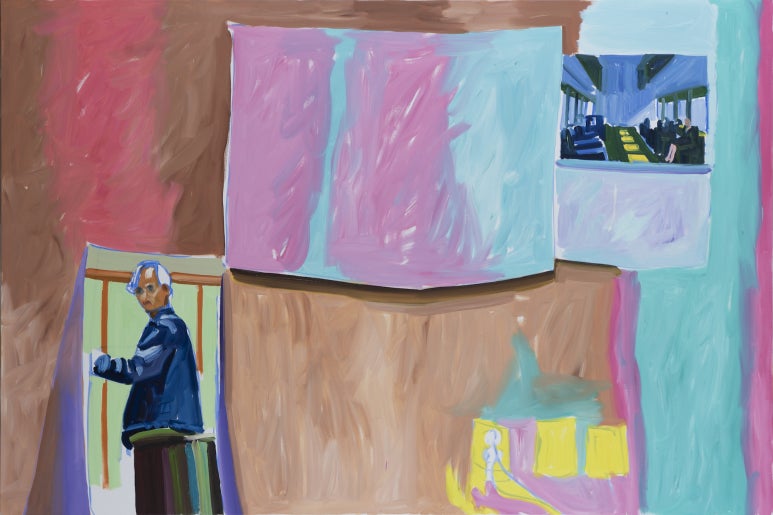
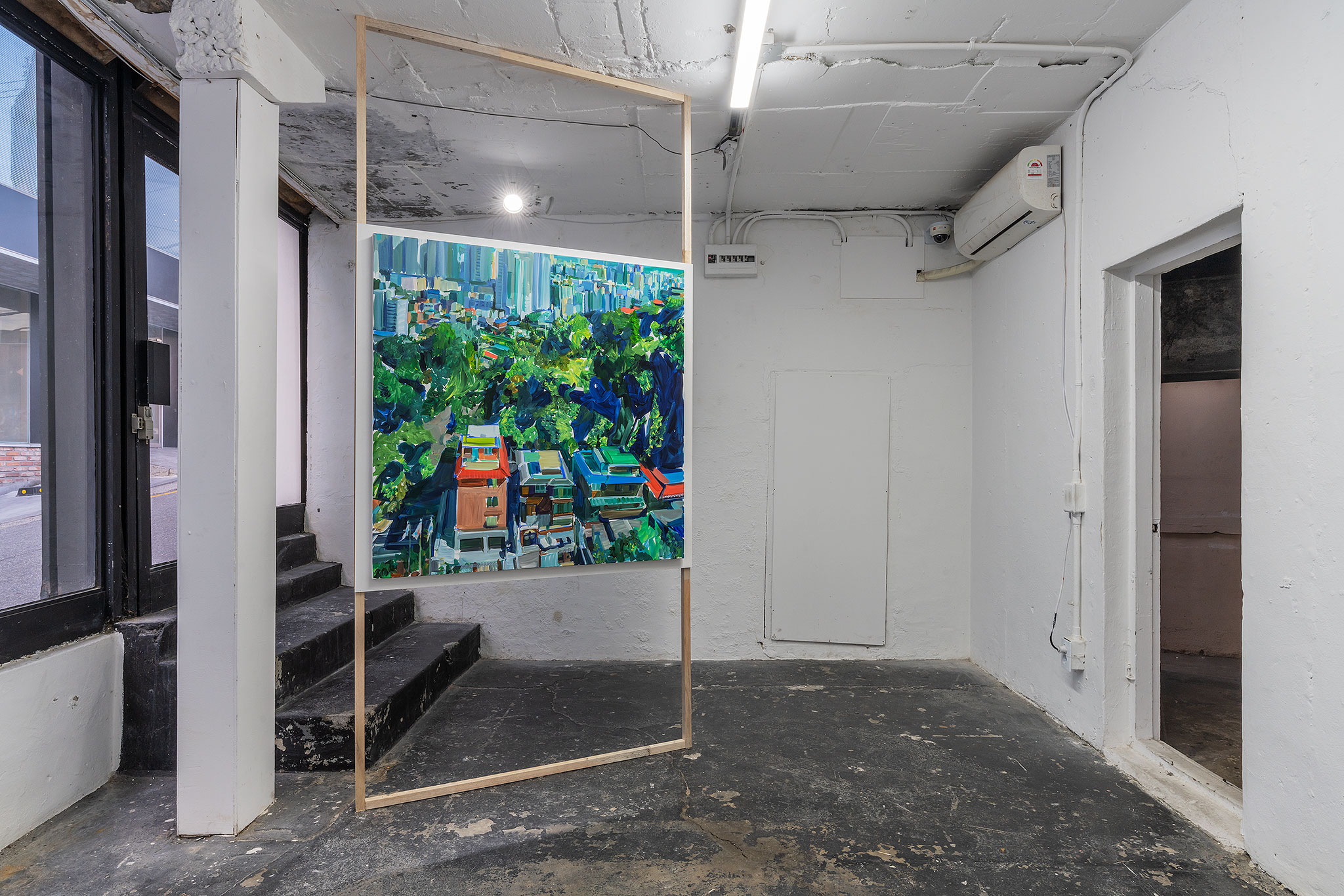
2) The remaining five works largely depict not the studio but portions of the
interior walls of the artist’s apartment, calendars hanging on those walls, or
canvases leaning against them, into which images of the external world are
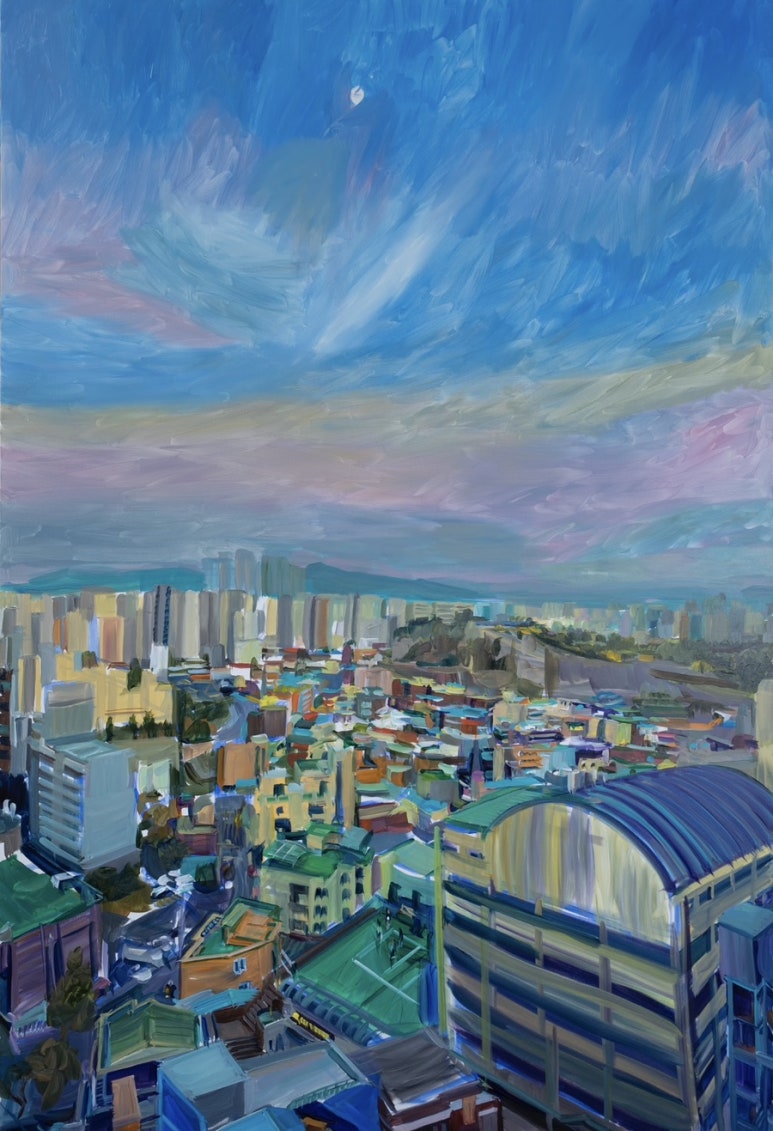
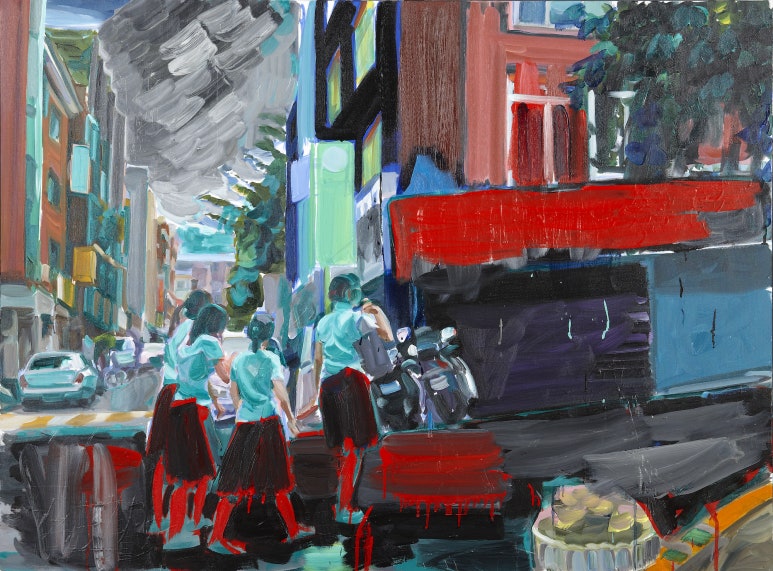
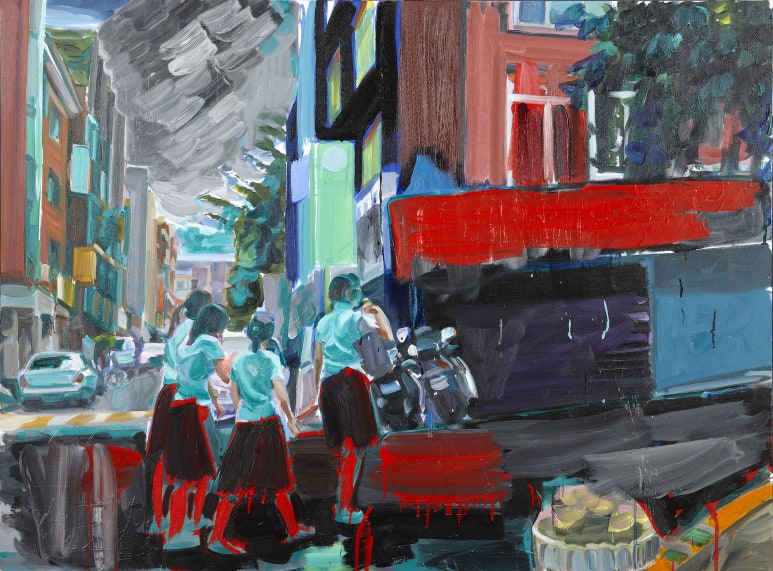
inserted (Type C = Type A including B). By contrast, the only work that fully
depicts the outside world is Leaving the School (Type B).
Yet even here, the school research office functions as an external studio,
thereby maintaining a point of contact with Type A.
Seen as a sequence of ‘A–B–C (A including B),’ these twelve works can be
regarded—if we bracket subject matter and focus solely on methodology—as a kind
of miniature condensation of Choi Gene Uk’s entire pictorial world. In terms of
chronology, two facial self-portraits from over thirty years ago (X) are set
against two recent studio paintings (Y), with the remaining eight works
arranged between them. This thirty-year progression traces a full revolution
along an elliptical orbit composed of one center, X, and another, Y. In terms
of content, it resembles a rotational movement that begins with the self, moves
outward into the external world, and then returns again to the self.
From the perspective of cognitive ecology, which studies the interaction
between living organisms and their environments, this structure resembles two
interrelated cognitive-ecological circuits, large and small.
1) First, there is the large circuit of interaction between organism and
environment: an elliptical orbit generated by the interplay between autopoiesis
(material–mental self-organization, X) and affordances (the various benefits
and hazards offered by the environment, Y), along which mimesis (processes of
positive and negative assimilation and dissimilation) circulates. This is the
cognitive-ecological relationship between the self and the object.
2) Corresponding to this is an internal neural circuit: the electrochemical
flow connecting the left and right hemispheres via the corpus callosum, and the
perceptual–emotional–desire circuit in which the human neocortex is linked to
the mammalian limbic system and the reptilian brainstem–hypothalamus.
From the perspective of the larger circuit (1), the smaller circuit (2)
is contained within it. From the perspective of (2), the circuit of (1) is
re-presented or reflected within it. The force that pushes and pulls the
various forms of the ‘movement-image’—the
‘perception–affect–impulse–action–reflection–relation image’ (Deleuze)—produced
and received through this dual cognitive-ecological circuitry is the dynamics
of unconscious energy. This is the vector of unconscious energy generated by
the resultant force of eros, which attracts, and thanatos, which repels—what
Freud called the ‘id.’
At the level of autopoiesis, this energy vector provides the primary
power that imbues the flow of perception, thought, and action in images with
feeling. Meanwhile, the flow of affordances offered by the environment provides
a secondary trigger for affective experience: weather, natural terrain, the
condition of plants and animals, urban structures, the circulation of people
and objects, conversations with others, and the affects or enduring moods that
arise in everyday encounters.
The encounter between these two states is never
fixed but constantly variable, yet broadly speaking it can be classified into
four cyclical phases: virtuous circulation, vicious circulation, impasse, and
stability. The act of painting and its results depend more directly than any
other activity on changes in emotional structures produced by these four
phases. Choi Gene Uk’s approximately 450 paintings, in fact, reveal a wide
range of emotional structures arising from these cycles.
What, then, is the emotional structure of the works shown in this
two-person exhibition? Broadly speaking, among the Type A paintings, four are
dominated by bluish-gray tones, six by pink, and the remaining two display
mixed palettes. Earlier it was noted that the curatorial selection frames the
latter with the former; seen this way, the bluish-gray envelops the pink, while
the two mixed-color works act as bridges between them.
Pink, a blend of red’s
passion and energy with white’s purity and innocence, evokes a soft yet
passionate energy and an openness associated with youth. Bluish-gray, by
contrast, conveys heaviness, dullness, and a sense of enclosure by surrounding
darkness. While viewing 381. A Painting Close to the
Ceiling, with its intensely applied pink brushstrokes floating amid
darker studio paintings, an unexpected association suddenly occurred to the
author: fragments of lyrics and imagery from the Eagles’ song ‘Hotel
California,’ which begins quietly after the pounding of heavy drums.
“On a dark desert highway (…) warm smell of colitas rising up through
the air (…) a shimmering light in the distance…” A place where one stops for
the night as “my head grew heavy and my sight grew dim,” a place that, once
entered, is “programmed” so that “you can check out any time you like, but you
can never leave.” Might the walls of that hotel room—where “mirrors on the
ceiling” appear—have been covered in pink wallpaper like 381. A
Painting Close to the Ceiling? Might this painting depict the ceiling
and walls of room no. 381, where a painter stayed, with an Edward Hopper
calendar hanging on the wall? Of course, unlike the song’s lyrics, there is no
mirror on the ceiling in this painting.