



◎ Coloring, Form, and Historical–Geographical Symbolism: Public Art and the Popularization of Fine Art, New Landmarks Anticipated
 
Subway art in Seoul is becoming increasingly diverse. Large-scale artworks scheduled to be unveiled at major stations of the second phase of the Seoul subway system, set to open in 1997, are being completed one after another. Once installation is finished, subway stations across Seoul are expected to emerge as new destinations for art appreciation. While artworks displayed in the first-phase subway lines (Lines 2–4) remained largely decorative, the second-phase projects are high-quality artworks, each produced at a cost of approximately 100 million won, focusing on the historical and geographical contexts and traditional aesthetics of their respective areas.
 
Following the installation of Wangsimni People by Choi Gene Uk (Professor at Chugye University for the Arts) at Wangsimni Station on Line 5 this past February, five additional works are scheduled for completion by the end of June. These include Images Seen by the Weaver Girl in a Dream by Sung Wan-kyung (Professor at Inha University) at Gimpo Airport Station; Fortress-Shaped Sculpture and Circular Celestial Map by Kim Jung-hun (Professor at Kongju National University) at Cheonho Station; Harmony by Yang Seung-chun (Professor at Seoul National University) at Hwagok Station; and Ground by Won In-jong (Professor at Ewha Womans University) at Olympic Park Station. These works are part of the “Subway Art Installation Plan,” initiated in 1991 by the Seoul Metropolitan Subway Construction Headquarters (Director Kim Hak-jae), targeting 24 stations among the 148 stations on Lines 5 through 8 selected for their strong regional symbolism or anticipated high passenger volume. The works are being installed along the Gangdong and Gangseo sections of Line 5.

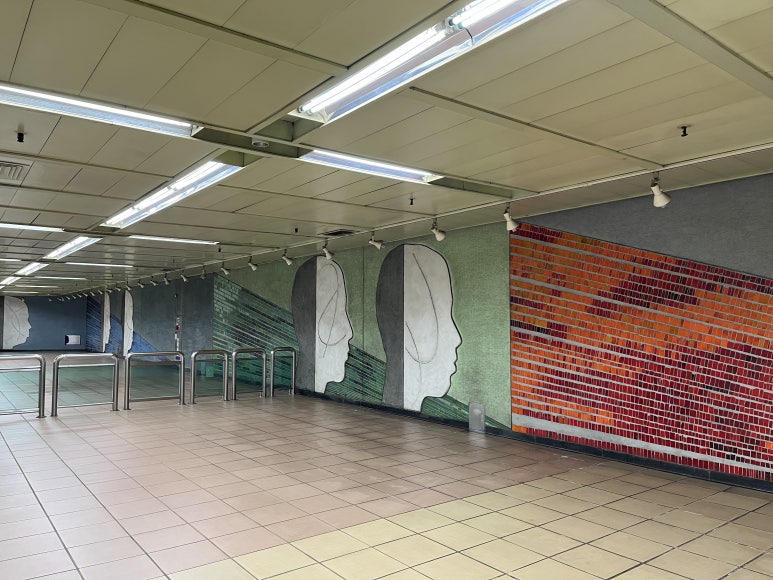
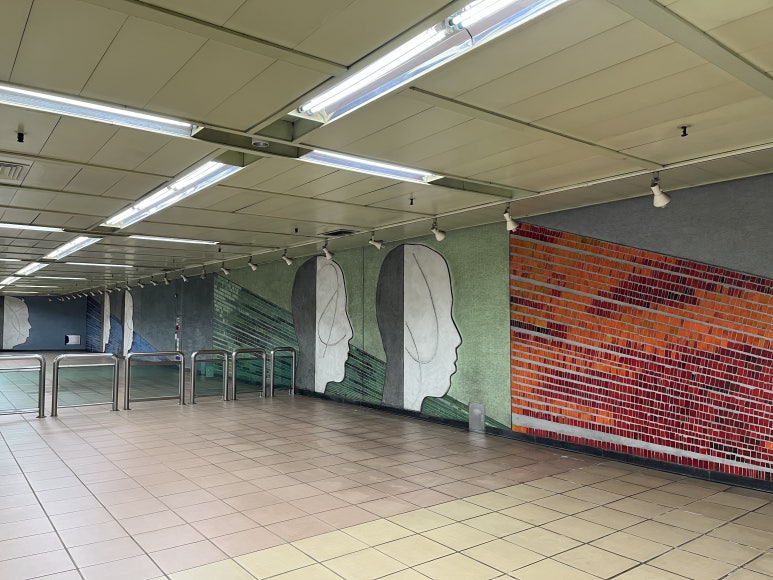
Choi Gene Uk, Wangsimni People, 1995 © Choi Gene Uk

The earliest installation, Wangsimni People, is a monumental relief installed along the U-shaped wall of the underground concourse on Basement Level 2, measuring 17.7 x 2.6 m, 48 x 2.6 m, and 19.1 x 2.6 m. Created over a period of approximately two months using black gravel, white cement, and glass mosaic tiles, the work visualizes a colloquial expression—“Wangsimni people have blackened the backs of their heads”—which refers to the notion that residents of Wangsimni, located east of the old city center, would tan the backs of their heads in the morning sun as they walked toward the city.
 
Against a background of triangular forms composed of red, blue, and green glass mosaic tiles, the artist renders human profiles in a concise manner, conveying an image that is both simple and energetic. Particularly distinctive is the use of white cement areas that invite graffiti, encouraging citizens to participate in completing the artwork.
 
The Subway Construction Headquarters plans to complete installations by the end of the year at six stations on Line 5, including Omokgyo Station; three stations on Line 7, including Nowon Station; and two stations on Line 8, including Jamsil Station. Additional installations at two stations on Line 7 and seven stations on Line 6 are scheduled for completion by 1997, to be unveiled simultaneously with the opening of the subway lines.
 
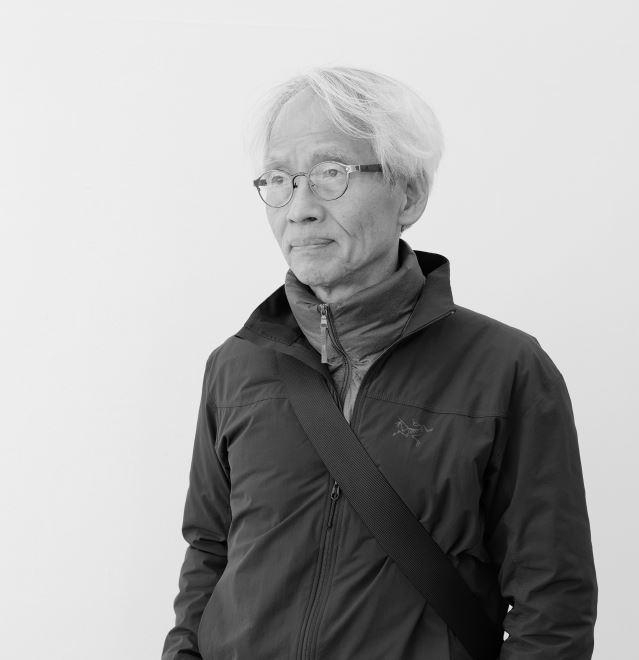
Choi Gene Uk, who participated in the project, commented: “Installing artworks in subway stations is highly encouraging in terms of the popularization of art. In the future, it would be worth considering a model—common overseas—in which artists participate from the station design stage, constructing the station itself as a single artwork.

References