

A Game that Satirizes Convention

In sum, Choi Jeonghwa had no ‘organized’ connection to the stream of socially critical art that continued through the late 1980s; rather, he merely left several progressive clues related to the operation of the art system. For example, he mixed Bauhaus pedagogy, Duchamp’s institutional theory, and Warhol’s Factory with purely Korean materials to produce a Choi Jeonghwa-style ‘budae-jjigae’, which continues to be supplied through the heterogeneous enterprises ‘Breast’ and ‘Flesh’ (as will be discussed later, the Korean materials here should be understood not as art-historical predecessors but as metaphors for geographically dispersed histories: Namdaemun Market, Pagoda Theater, Yeongdeungpo Cabaret, Gimpo Furniture Factory, Mia-ri, Cheonggyecheon, Nanjido, and so on).
 
However, his way of crossing applied art and fine art, or business and art, sometimes faltered as an artistic strategy. Business did not make as much money as expected and therefore did not sufficiently support the expansion of pure artistic imagination. The slogan of cultivating a host body of culture in the underground also often succumbed to the power of commodities, even if this was due to the particularity of our culture. Nevertheless, Choi Jeonghwa inwardly enjoys the current situation in which his works are frequently exhibited in foreign museums and international biennales. At the same time, he wonders:


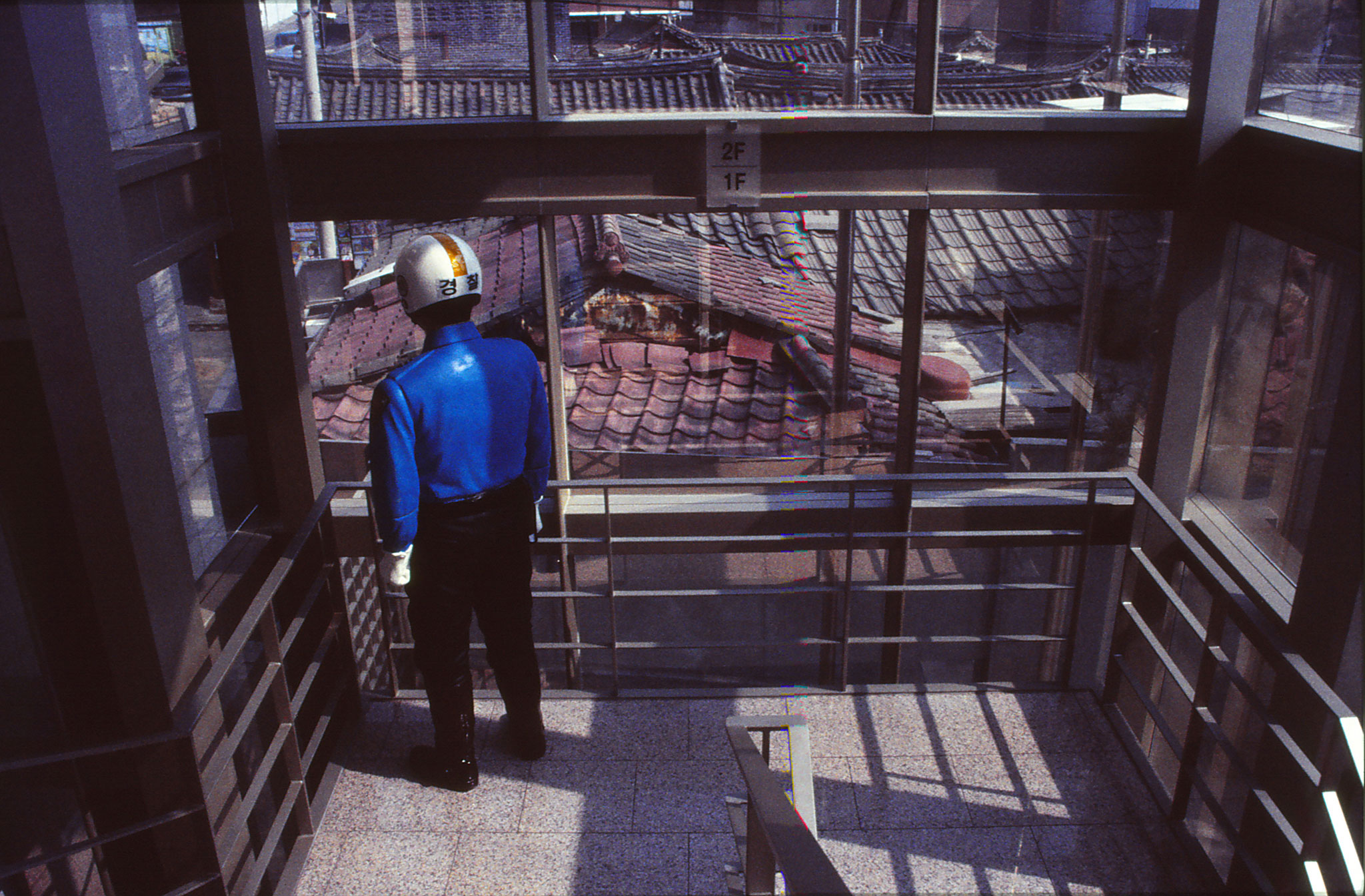
최정화, 〈퍼니 게임〉, 1997, 플라스틱 모델, 100 x 50 x 210 cm  © 최정화

―“Why have my works suddenly become popular everywhere?”
 
In that context, his work Funny Game is unexpected. At his solo exhibition held at Kukje Gallery in early 1998, he installed ‘real’ police mannequins and gave it this title. As is well known, these are decoy figures placed along roadsides to slow speeding vehicles.
 
Unlike incompetent officers disarmed by the escaped convict Shin Chang-won, corrupt officers receiving bribes from illegal businesses, or model officers awarded for faithfully serving the people, these policemen merely boast tall height, bulky physique, and handsome faces. If one claims that these ‘fake’ policemen standing “politely and courteously” in silence inside the museum simulate the ‘real’ police power operating the art institution, that would be too naive in the confused Korean context.
 
Unable even to evoke the iconic effect of the Kentucky Fried Chicken grandfather or the indexical associations of life-size standee photographs in front of DP shops or travel agencies, these policemen instead appear to me as entirely fictional — literally empty — symbols. They perfectly erase the overall state of inadequacy dominating Korean bureaucracy: irritatingly uneconomical practices, nearly familial illogical discourse, endless exhibition administration, and desperate careerism.
 
These dignified policemen ‘wash their hands’ of such complexity and proudly display their idiotic charm without a shred of shame, like a suddenly erected public cultural center building. Thus Funny Game was not warmly welcomed by audiences accustomed to museum language, but the ‘real’ ignorant police reacted sensitively. The artist reportedly had to visit the Seoul Metropolitan Police Agency to sign a written pledge and make several agreements.
 
This terrain of life, where games inside and outside the institution cannot be clearly separated, is visualized differently in spaces Choi Jeonghwa designed such as ‘Olo Olo’, ‘Ozone’, and ‘Sal’. Exposed concrete and formica, primitive murals and wire mesh, rusted steel plates and bare bulbs, artificial fur and chandeliers — these combinations hybrid-imitate the fusion of feudal consciousness and a Holocaust-like future, or the crossing of a New York back alley and a Garibong-dong living room.
 
Perhaps because of this ‘geopolitical’ position, in Wise Living and Essential Nutrients, where authority-signifying objects — officer caps, toy guns, military sneakers, commemorative statuettes — are arranged with name-tag-like titles, neither direct political message nor the context of critical art is easily identifiable. One merely senses the policeman-Choi Jeonghwa standing with folded arms behind viewers attempting to find associative permutations among the listed images. At this moment he is as exciting and as serious as a boy playing in a police uniform.
 
He then air-transports the police-like works to various places around the globe and feigns surprise at unexpected results produced by distance. If Encore Encore Encore, standing atop a 10-meter pedestal, appeared merely as a sleek golden angel in an Australian shopping mall, its full goddess form was revealed at the São Paulo Biennale, where a small disturbance occurred because its dull and vulgar posture obstructed the view of a three-story-high Giacometti masterpiece.
 
One imagines Choi Jeonghwa, afflicted with this ‘uniform fetish’, laughing mischievously even then. More complex combinations of distance produce further situations: at the National Gallery of Melbourne, Rodin’s Balzac connects in one circulation path with Choi Jeonghwa’s Funny Game, and his Encore… with Henry Moore’s Mother. If his other work Mother were added as background, the spiral narrative would twist once more.
 
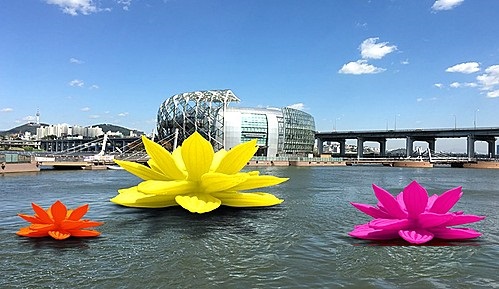
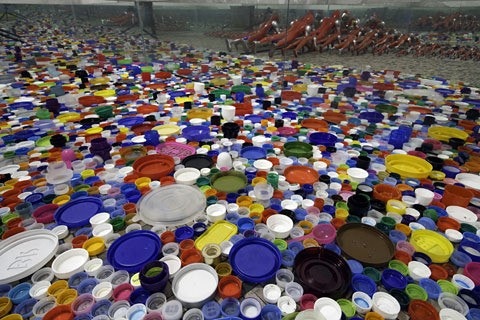
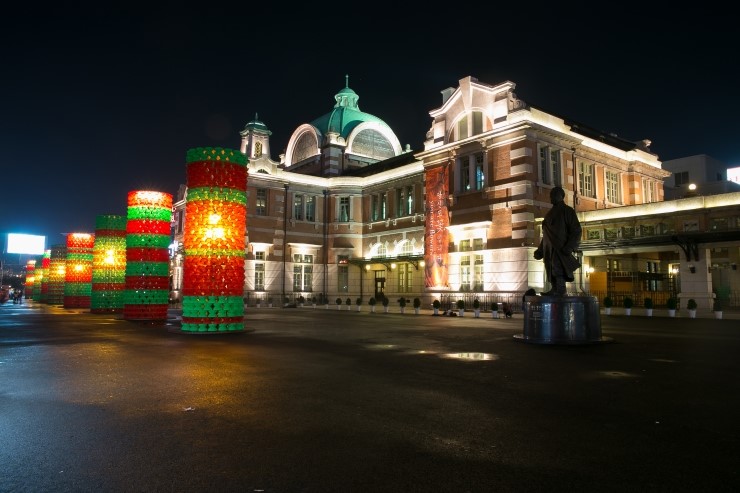
In an age ruled by the ‘simultaneity of the non-simultaneous’, the political power of non-politics — the politics of play — ensures more persistent vitality. The world of Choi Jeonghwa’s art, guaranteeing popularity and mass appeal, is as diverse as his range of activities. In museums and galleries, boutiques and bars, streets and films, we encounter his photographs, designs, and installations. Especially his transformation of cheap everyday market goods into inventive artworks resembles a contemporary visual totem.

References