“Schizoid knowledge is not so much knowledge subordinated to the logic of representation as it is the knowledge of ‘mapping.’ It is knowledge that incessantly circulates and moves, in search of singularities.”
– Gilles Deleuze
“Looking from the side. Breaking with every frontal and static effort. A way of slipping free from the persistent and conscientious footnotes of the real and representation—inside and outside, surface and depth, meaning and non-meaning, the visible and the invisible. Provided (旦) that this occurs under the guise of an even more intense stasis: self-reference and implosion (內破). Looking, simply, without thinking. Oblique vision (斜視) as a homomorphic repetition for truly enjoying trompe-l’œil and virtual reality.”
– From Lee Inhyeon’s work note, Banggwan (傍觀) and Pyeongyeon (偏見), The End of Love and Hate
Oblique Vision (斜視)
In Lee Inhyeon’s work notes, one often encounters expressions such as deviation, transgression, or overflow. Even in the passage cited above, alongside sa (斜) appear bang (傍) and pyeon (偏). Yet all of these are paired with words that mean seeing—si (視), gwan (觀), gyeon (見). This suggests his particular preoccupation with the act of looking. Accordingly, his doctoral dissertation also concerns a way of looking (he is a rigorous scholar who earned his doctorate at Tokyo University of the Arts, Graduate School of Fine Arts).
In that dissertation, he describes the ultimate mode of looking to which he aspires as the state of “seeing (觀) without seeing (見), and seeing (觀) without seeing (見): the alibi of gyeon–gwan (見–觀).”
After exposing an ink-wash underdrawing on hanji to several plates with varying exposure times, he prints them in exact registration, layering them precisely. In this sense, his “oblique vision (斜視)” first signifies a surpassing of conventional visual sense; further still, it becomes something “super-dialectical,” refusing even the reconciliation of gyeon–gwan (見–觀). Yet what this meta-gaze unexpectedly fixes upon is the inside and outside of painting—and its boundary.
His oblique vision, then, becomes a method for rendering a lucid perspectival view of painting from a state free of all prejudice, and this in turn becomes a motif that runs through his entire practice. Modernity, or modernism in art, is characterized by ocularcentrism. Its foundation is, of course, Cartesian perspective: a frontal vision, an exclusionary and self-centered monocular gaze. It concerns an abstracted and conceptualized space, expelling the body and foregoing narrative. That the most forceful critique of such ocularcentrism in the modern era originates with Sartre—who in fact had oblique vision (斜視)—is meaningfully suggestive.
In any case, if Lee Inhyeon’s oblique vision has taken concrete form as a newly articulated relationship between front and side, one may recall—albeit in a different context—a work that posed this problem long ago: Hans Holbein’s 〈The Ambassa-dors〉 (1533). Famous above all for the skull, this painting depicts figures well versed in secular knowledge of science and art, but its true focus gathers at their feet: a skull rendered as anamorphosis (歪像), impossible to decipher from the front. Intended as a memento mori—an admonition to all orthodox vision and knowledge—this image can be grasped only from the side, and only at a precise angle. For Lacan, naturally, this skull became an exemplary symbol of the fate of our gaze, bound to the symbolic order.
That is, just as an individual subordinated to an already socialized order of language is not the true subject of utterance, so too our gaze and our visual field cannot be free of the organizational network of existing signifiers—so his argument runs. Of course, this is his reading. Yet it is undeniable that Holbein challenged “the frontality of vision” through the boldness of placing an object like a UFO at the exact center of the picture plane—compelling the viewer to move to the side. Many paintings deal with anamorphosis, but few so richly, and so directly from the frontal position, challenge and mock the self-sufficiency, unity, and rationality that Renaissance single-point perspective established for the pictorial field.
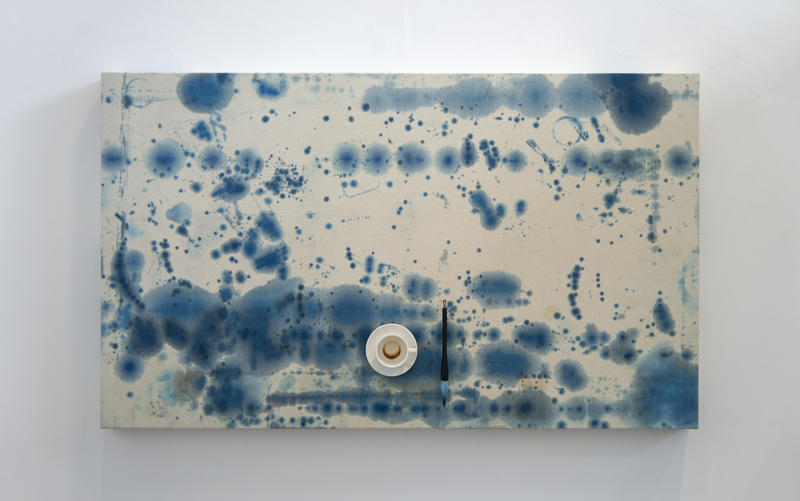
This is a work from Lee’s student years: he repeatedly folded hanji, dipped the overlapped corner edges into ink, and then unfolded the sheet. If the discourse on the gaze that begins with Sartre continues on to Lacan, Lee Inhyeon’s oblique vision occupies a realm unrelated to the aggression or sociality of the gaze they describe.
From the outset, he acknowledges the entanglement of the Other’s gaze and does not make an issue of it. Rather, he is concerned with the limits of vision and with ways to overcome them. If the total number of all possible gazes upon an object is expressed as n, he deliberately chooses an n+1 gaze—an open-world code that allows for a “tableau that slips sideways,” unlike the closed system defined by n.
Lee Inhyeon, broadly speaking, began as a printmaker. During nearly a decade of study in Japan after graduating from university, the medium he primarily studied was printmaking, and at the time his works and exhibitions were confined to prints. Although he has mainly worked on canvas since returning to Korea, there is something paradoxical in the fact that he—who would later become invested in thickness and depth in painting—chose printmaking as a primary medium.
Yet he is already accustomed to the reversibility of paradox and orthodoxy, and his way of engaging printmaking does not depart far from that perspective. Printmaking is an art of impressions: every condition is prepared and controlled in advance, yet once printed, the image is complete.
Accordingly, if one excludes overpainting and other “transformed prints” in the contemporary sense, printmaking presupposes meticulous preparation and acceptance of the result. Insofar as partial revisions are impossible, it is, in principle, a one-time medium. Moreover, as the convention of stating editions makes clear, strict reproducibility is not truly the domain of printmaking either.
Thus, Lee Inhyeon’s prints—serialized without producing multiples, maintaining minute differences from one image to the next—possess a duality that is at once the most traditional and the most unorthodox. One example that clearly demonstrates this stance is his ongoing series, planned for a total of fifty sheets: 〈Dalbam #n〉. These works are made by creating multiple plates from an ink-wash underdrawing on hanji, varying the exposure time, and then printing the plates in exact registration.
As a result, the one-time nature of ink wash is transformed through the printmaking process of layered impressions, while each edition remains a singular work. The series offers a compelling mediation of Lee’s interest in repetition and difference—common to both the natural phenomenon of moonlit night and the medium of printmaking. Another example, produced from a similar perspective though by a different technique, is Antipodal Thinking, made by repeatedly printing with the plate and paper slightly misregistered until the ink is exhausted.
Through such procedures, he does not overturn printmaking’s fundamental properties; rather, he chooses to push them “thoroughly forward—until they can overflow of themselves and empty themselves out.” Here, printmaking becomes an especially apt medium as a vehicle for deviation and difference, and this n+1 gaze—recalibrating the medium’s code—would later be carried over into his painting practice as well.
This trajectory can already be seen in his sustained attention to the materiality of hanji. A key point is that he used paper—especially hanji—as a fundamental material from early on, and that his continued interest in hanji’s material qualities, just before his shift to canvas, developed as far as works such as Thickness of Painting and Depth of Painting. Above all, hanji is an elastic material that, through its absorbency, can accommodate depth and volume even on a plane.
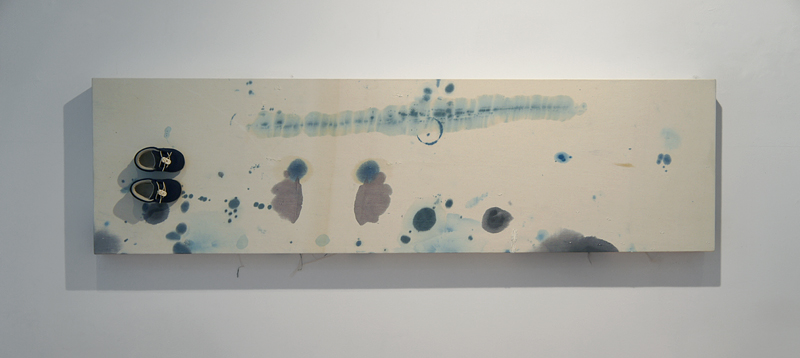
Ink-soaked hanji is neither two-dimensional nor three-dimensional; it is, so to speak, a fractal space of fractional dimensions, intuiting (類感) an n-dimensional field in becoming and change—that is, the dimension of n+1. Consider, for instance, the student work mentioned above, in which hanji was repeatedly folded, the overlapped corner edges briefly dipped into ink, and the sheet then unfolded. Against the backdrop of a grid’s repetition and regularity, the spread of ink vividly reveals hanji’s transformations as moisture is absorbed and evaporates: concave and convex, plane and volume, surface and reverse, depth and perspective.
In such works, Lee attends to the particulate continuity in which ink and paper permeate one another, believing that a painting is born through an exchange process between activity and passivity—between “painting” and “being painted.” For him, painting is less something one “does” than something that “becomes” through the entanglement of material and making; the work ultimately becomes a physical analogue of genesis. Process-friendly hanji is therefore an indispensable medium for him, and this concern naturally leads toward a pursuit of pictorial “depth” through canvas.
Strata (地層)
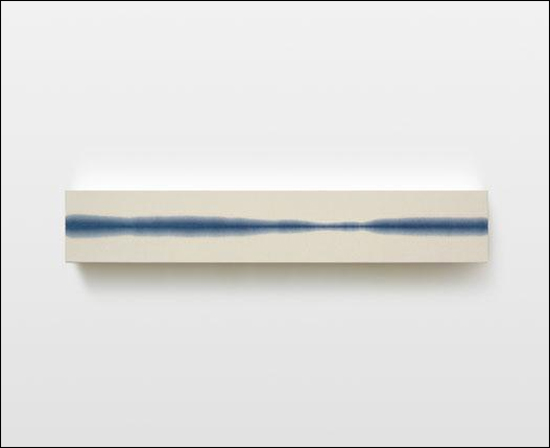
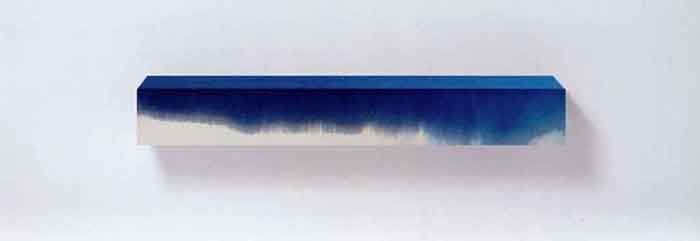
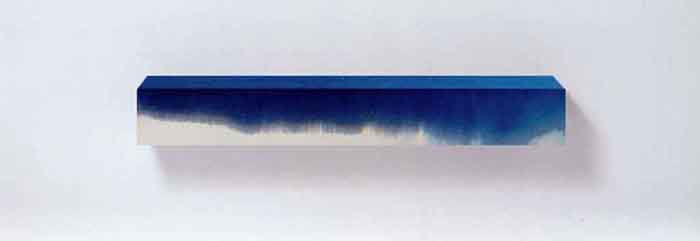
For Deleuze—whom Lee Inhyeon has both deeply influenced by and directly cited—strata (地層) are a process of coagulation and segmentation that gives matter its form, while stratification signifies the creation of a world that begins in chaos and is continuously sustained and renewed. After returning to Korea in the latter half of 1992, Lee began to call his signature elongated blue canvases by an overarching title that borrows this term: “the strata of painting.” Moreover, if one considers that he uses “episteme” as a translation of strata, it becomes clear that, through this concept, he investigates painting’s material ground and its process of formation—or its formal and epistemological basic conditions.
Strata connect to concepts such as thickness and depth in painting, presenting the side and, in effect, advancing a logic of the side that refuses the “tyranny” of the front.
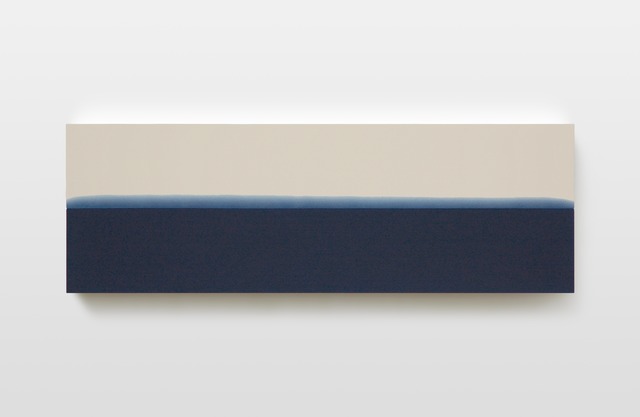
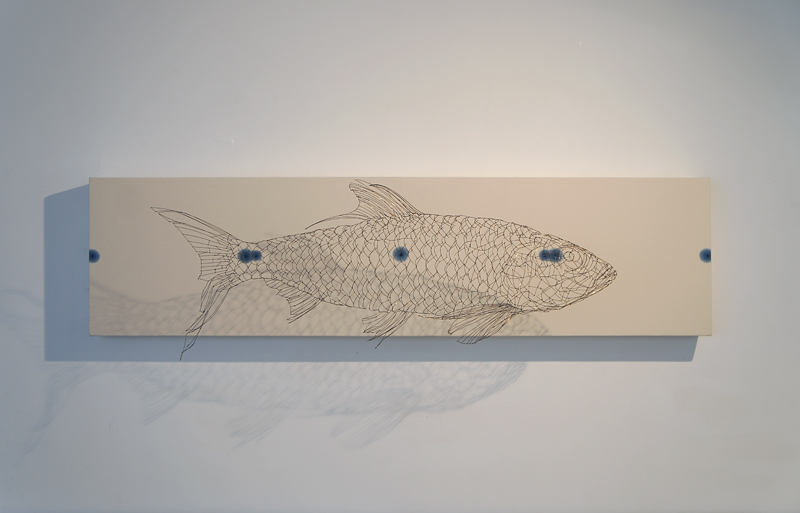
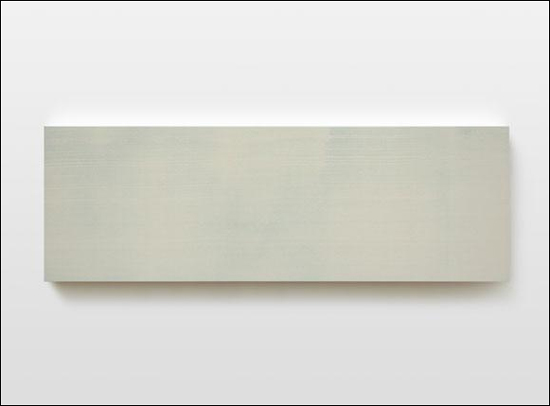
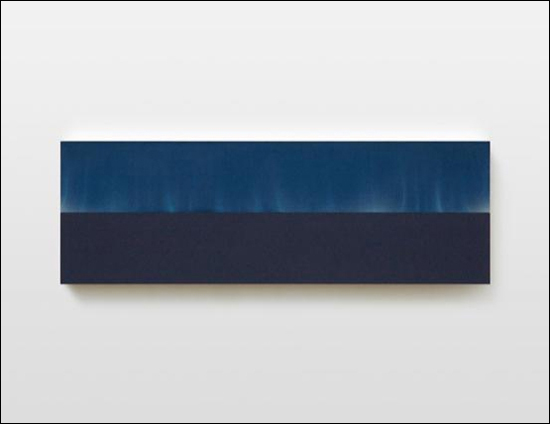
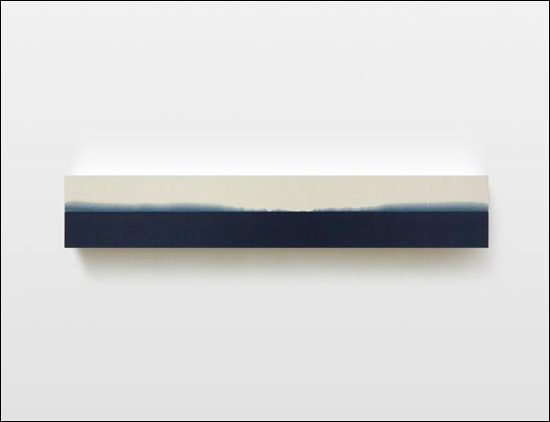
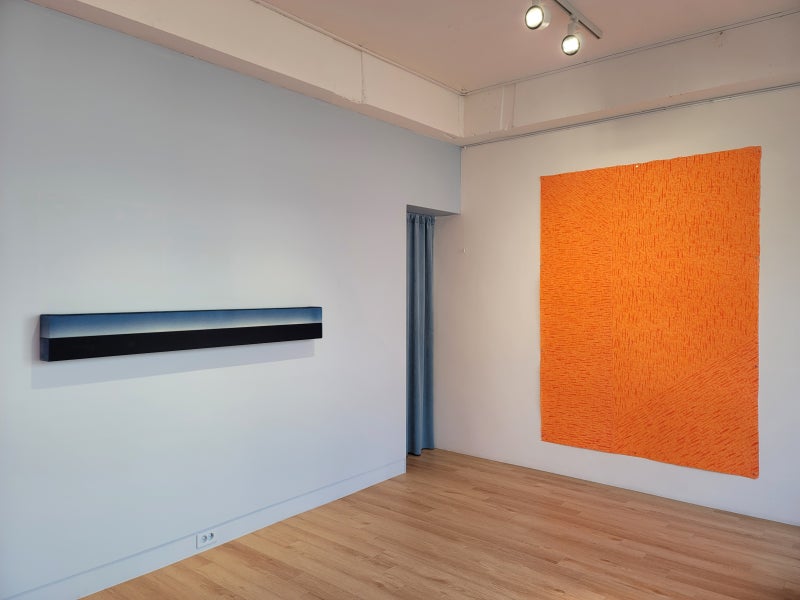
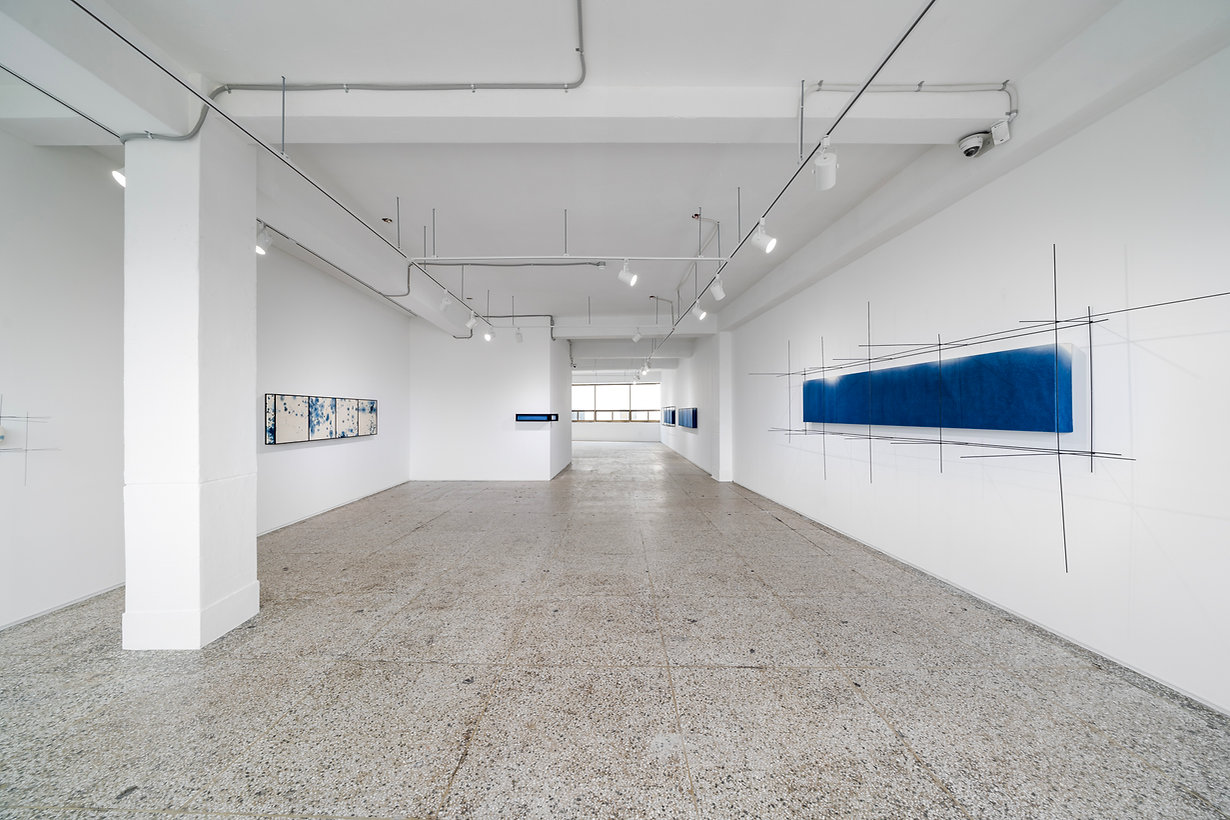
As is widely known, Lee’s painting practice divides the canvas’s front and side between “painting” and “bleeding”: the front is treated as a relatively uniform monochrome field, while the widened side allows illusion through the effects of paint that has flowed down, bled, and soaked through from the front. In this way, strata become visualized as paintings that show the side in connection with thickness and depth, and consequently a logic of the side emerges that rejects the “tyranny” of the front.
Yet Lee seeks to move beyond this simple binary opposition: he balances the two by applying delicate gradations that reduce materiality on the front, while controlling the bleed on the side—where illusion arises—in order to reinforce materiality. In either case, his work is the product of intense calculation and concentration. Finally, when the works are installed on the wall, a further twist once again intermixes and inverts front and side.
Through such operations, what he emphasizes is the reciprocal exchange between painting’s materiality and illusion—bringing forward the side, which had remained outside the viewer’s usual field, as the most effective means of making that exchange visible. To state what may seem obvious: painting is both object and image, both thing and sign (symbol), both state and event, and ultimately both being and change.
When we look at painting, we typically do not see both poles at once, though we remain aware of their boundary. Lee focuses on this reversibility, differentiating the boundary line while also unsettling it, by choosing a process that exposes strata and depth. The strata he treats, therefore, imply not only the literal material fault line but also the epistemological structure it entails.
The basic condition of painting to which we are accustomed is a colored rectangle. And for it to function as the social sign we call “a painting,” it must join with the material of a support, or require a boundary such as a frame. What proves decisive here is not the side itself so much as the point at which a plane bends or is severed—where polarization occurs; this is the singularity, or, in Deleuze’s terms, the simulacrum (simulacre) in which an event takes place.
On this discontinuous line where space and dimension diverge, matter undergoes a topological transformation into the dimension of meaning. Lee Inhyeon contrasts the front, associated with identity and stability, against the side, associated with motion and change, thereby foregrounding the point of catastrophe and clarifying painting’s singularity. What matters in this process are the shifts and movements that appear and vanish in the instant of passing from one to another; for him, these become metaphors for the ceaselessly sustained and renewed genesis of painting and art, and for their operations of meaning. Yet this is not all.
He ultimately removes the canvas from its stretcher and unfolds it like a plan drawing, placing the boundary line on trial once more. Confronted with the naked “body” of painting exposed in this way, we realize that painting’s ground is matter, and that our transcendent gaze is nothing more than illusion.
Further, we hesitate over whether the framed and enshrined should be called “works” at all—and such confusion persists even in works where the stripped canvas is loosely re-wrapped around a support. The unfolded canvas, with distinctions between front and side and even singularities erased, remains an ambiguous presence, at odds with an expanded “side” of background and the wall surface beyond it.
Point (点)
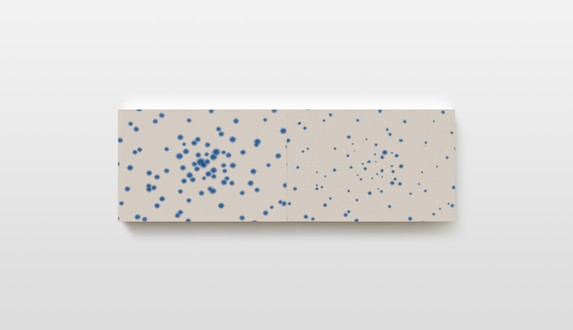
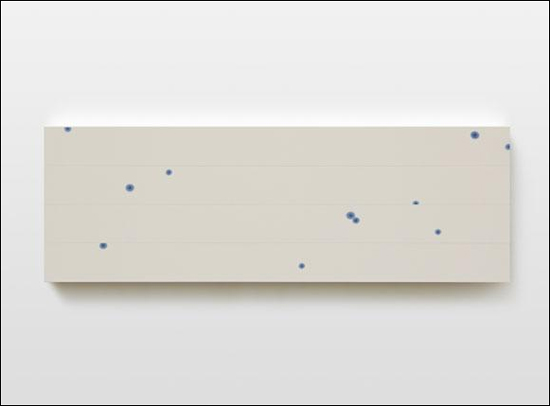
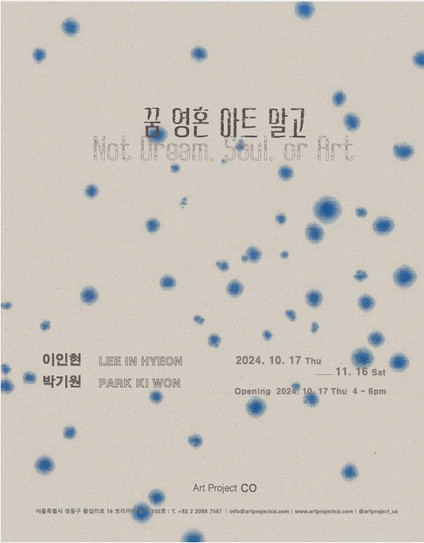
The emergence of the point marks a major turning point in Lee Inhyeon’s practice. It can be observed that this shift changes his vision from depth to distance, from space to time, and from near-sightedness (近視) to far-sightedness (遠視). He once explained this transformation by noting that even two utterly different works—by Dürer and Duchamp—appear as nothing more than the same single point when viewed from a mere fifty meters away. As he says, a plane seen from afar becomes a point, and within a point a plane unfolds; moreover, unlike the plane, the point can bleed sideways and enter into the thickness of the canvas without requiring the detour of a side-surface bleed.
In that sense, this may be understood as a re-materialization, through the point, of something already mastered in his early hanji works. Yet the fact that he has reduced strata from plane to point indicates no small transformation.
A contemporary interpretation of Cubist space and, one might say, a conceptualization of four-dimensional space. At first glance, the arrangement of points may evoke the seemingly random constellations of a night sky, yet it is grounded in consistent rules. The points are differentiated into sharp and blurred in order to suggest spatiality and depth, and they are deployed according to “hidden” principles such as symmetry, repetition, or inversion. Some reproduce a Möbius strip or depict actual constellations, but the forms themselves are not the point; what matters is the topological space occupied by the relational arrangement of continuity and discontinuity.
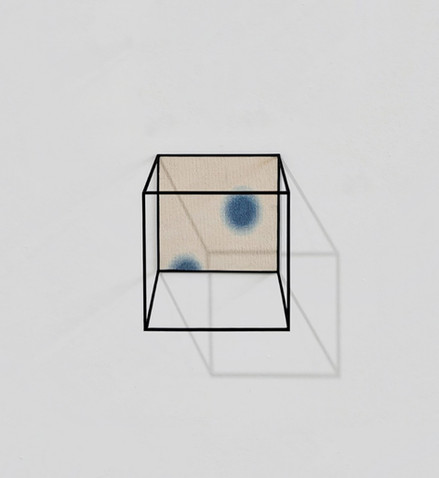
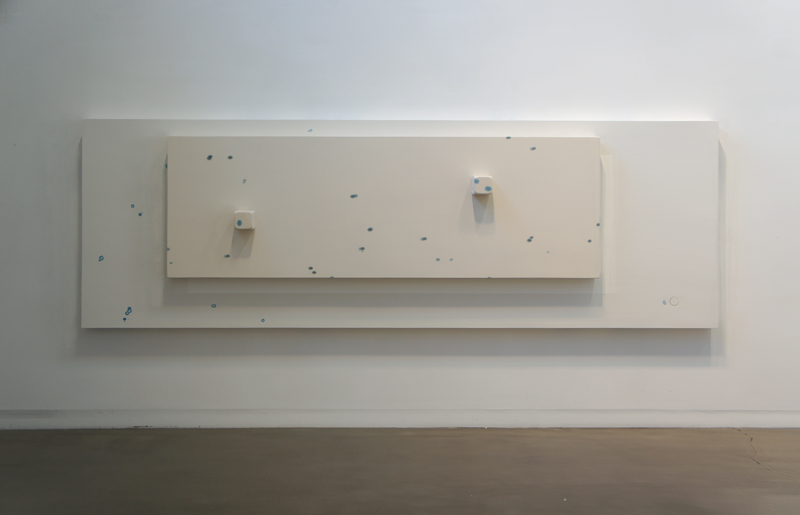
As a result, these point works become less objects of “seeing” than of “reading,” and can also be approached as a game of “finding constellations.” A distinct subgroup within the point works is the “dice.” In fact, small dice-shaped canvases and canvases within frames express space through the numbers of dice. For instance, a work in which groups of points are arranged as one, two, and three enumerates three faces of a die on a single plane; because six points exist on the same plane overall, it is as though four faces of the die are visible at once.
This is, in a sense, a contemporary interpretation of Cubist space and a conceptualization of a four-dimensional space we have yet to visualize. Yet upon reflection, because two or more numbers simultaneously indicate multiple faces—or dimensions—the same surface comes to encompass an almost infinite number of dimensions. The placing of points along a plane’s boundary line, or the juxtaposition of a canvas that is not visible at all, can also recall the “curved space” of modern physics. Ultimately, through a free movement in space using points, Lee Inhyeon leads our gaze far beyond Euclidean geometry toward an n-dimensional “cosmic” register.
Einstein left the famous line, “God does not play dice,” and Mallarmé and Nietzsche likewise made important references to dice. Yet Deleuze’s remark—likening it to thought—that “the cast die is a constellation, and the point forms the number born of the stars,” resonates seriously with these point works. Having carried the problem of strata as far as the dots of dice, might Lee Inhyeon, too, be joining in the game of dice through them?
Until It Grows Dark
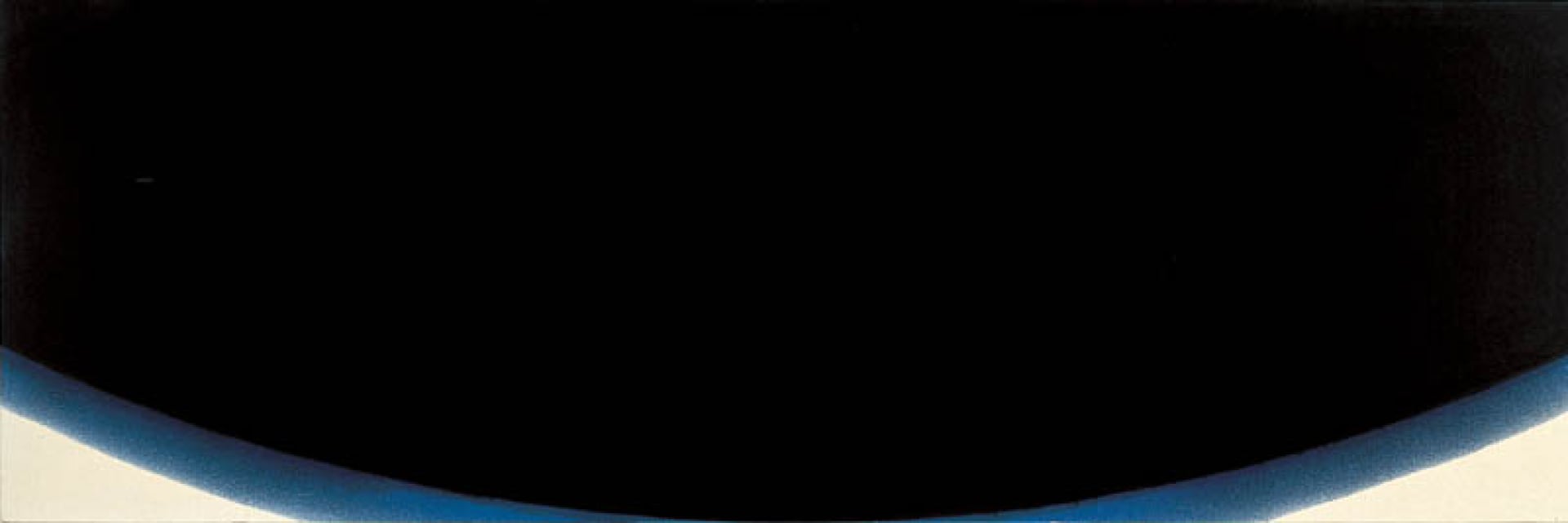
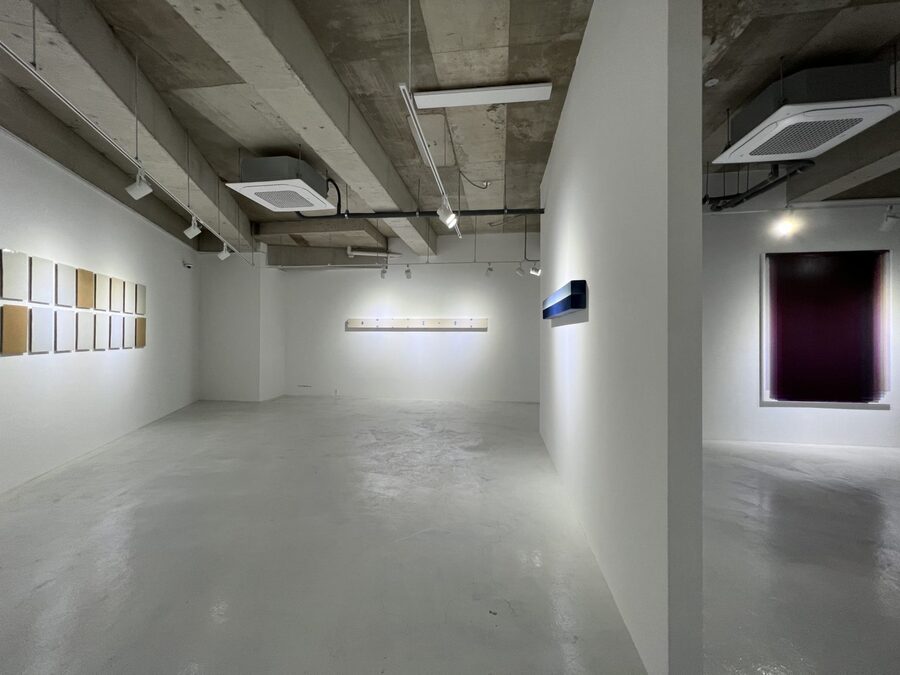
Since the point, Lee Inhyeon’s work has undergone changes both large and small. Tofu- or brick-shaped canvases have appeared; points and planes have been mixed; blank space has become more pronounced overall; curved surfaces have emerged; and more recently, he has experimented with stacking canvas blocks. These canvas blocks now focus less on presenting the side than on the overlap and arrangement of identical units, employing diverse syntaxes—horizontal stacking, vertical stacking, step-like stacking, diagonal compositions, and more.
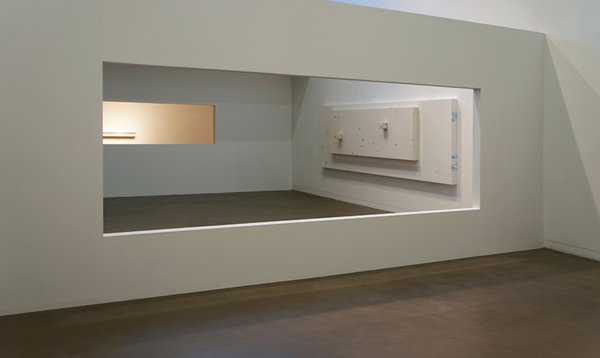
It seems that his interest has shifted away from relations such as front/side or materiality/image, toward what kinds of communication may be possible with these basic vocabularies, and further toward the possibilities of dialogue between painting and the space it inhabits, rather than the space within painting.
Showing a range of changes after the “point” works, one noteworthy recent development that suggests the direction his work may take is a series emphasizing the element of time.
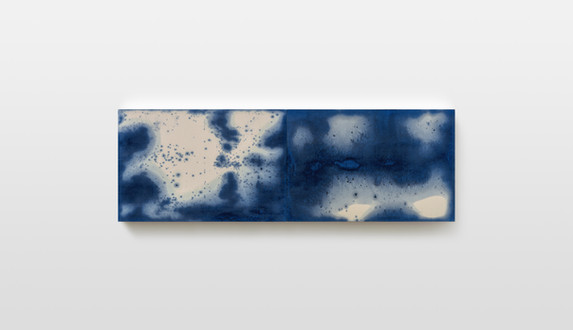
Bearing the subtitle 4D Perspective—Until It Grows Dark, these works still retain the title “the strata of painting,” yet they are images produced through printmaking and computers. In the 1997 print exhibition that forms Part I, rectangular fields numbered one by one show a process in which repeated plates gradually disperse ink more evenly, transforming gradation into monochrome. What matters here is the temporal dimension: the actual time of production is presented through the numbers of the repeated plates.
The subsequent work, 4D Perspective—Until It Grows Dark, Part II, made the following year, likewise presents a process in which rectangular images ultimately fade until they become almost invisible, as time changes.
What is crucial is that these were produced by computer—foretelling the limitless possibilities of expansion in his work. After the exhibition, these two works were further reconfigured into audience-participation pieces incorporating sound, and are now waiting for new viewers online. In addition, though it remains only as a project, there is an installation composed of thirty-four 14-inch LCD panels aligned side by side to display repeated variations of gradation.
In this installation, the image and the display speed change according to the passage of time, the viewing distance, or the number of viewers—Lee’s first attempt at a public-participation work.
Mapping
It is now time to summarize the significance of the changes in Lee Inhyeon’s practice and his primary concerns. Lee is an artist who draws a large diagram of his practice and then methodically solves problems one by one. To the casual viewer, he may even seem strangely concerned that his work has progressed too quickly. Although his works may look superficially similar, he is in fact handling the full range of art’s problems with exceptional meticulousness.
Insofar as his initial focus was painting’s flatness and materiality, his point of departure is minimalism; and insofar as he insists on the rectangle, the basic unit of painting, and examines it thoroughly, his method can be compared to Donald Judd. His canvas-block stacking focuses not on the side, but on the overlap and arrangement of identical units. Yet he chose to reduce the now tiresomely familiar discourse on flatness into strata, bringing depth and side to the fore.
Painting, being flat, cannot possess visible depth from the outset. It has only sides and backs that have been ignored or concealed. Through the side, Lee has examined painting’s process of genesis, and the entanglement between its material formation and its meaning as a sign. For him, this work may have become a kind of archaeological investigation into painting as knowledge and convention. What such investigation yields is the confirmation of singularity; yet even so, the status of painting’s icon—represented by the rectangle—remains unchanged.
With the help of the computer, he has now reached the point of translating this icon into movement itself, implying generation, change, and exchange. This marks an entry into a light and fluid world of images, unrelated to materiality or thickness. Even these images—glittering inside the computer like newly born stars—will not, of course, be everlasting, and their fate may well proceed in parallel with that of painting in general. Here, the true concern lies in the meaning of the rectangle he handles. As stated, he has been examining painting’s fundamental structure.
Yet this neat and exact rectangle belongs to the world of “abstraction,” with neither brushstroke nor the smell of sweat. Although he scrutinizes materiality, it remains an object of a “method of looking” rather than touch, and his presence as maker evaporates behind thought. Nowhere in these works—despite the considerable labor they require—does he leave a fingerprint. This is his unequivocal choice, and at once his strength and his limitation. His rectangle thus becomes a silent signifier—what one might today call a floating signifier—and consequently his gaze does not step even a single pace outside the logic or ethics internal to painting.
For Deleuze, mapping designates schizoid knowledge: knowledge of becoming and change, of creation and variation, set against the paranoid knowledge that seeks stability and eternity and opposes being to becoming. It is a knowledge that does not remain in place or stagnate, but wanders like a nomad, endlessly connecting and splitting.
This is why it connects to topology, which replaces traditional geometry with operations such as bending, pressing, and twisting. Lee Inhyeon sought to indicate singularities and to draw a new map of painting through topological space, and it may be judged that his attempts have achieved results to a certain extent. Yet what matters is what comes next. Mapping, after all, is unconcerned with the pursuit of essence—and computer images are no exception.
Emphasizing time through printmaking and computer work, one final remark about Lee Inhyeon’s practice itself is necessary. Whether on canvas, in print, or as computer image, his works are consistently made without flaw. Whether or not he intended to pursue beauty, they all display a composed, pristine beauty—evidence of his perfectionism.
Above all, the computer images left a powerful impression on me, because, contrary to his principal intention, they seem to speak of many things in life. The final sentence that follows was in fact written first at the beginning of this text, yet I will present it without revision, for beyond all of this “talk (說),” I, too, desire a kind of mapping. To add: what matters is my first impression—and it remains largely valid even now.
4D perspective—Until It Grows Dark is uploaded to the internet, where anyone can view and participate at any time. Adding the dimension of time, his work—exceeding three dimensions—flickers in and out within the virtual space of the computer screen. It enters a truly immaterial realm that transcends life and death: permanently alive, yet remaining in a latent state until someone calls it forth. Reduced from matter to particles, or to light, it changes continuously within minute vibrations, evoking the alibi of gyeon (見)–gwan (觀) and the futility of that dual system.
In the end, what remains for us is only an afterimage of things staging the process of birth and extinction. That the exhibition catalogue included NASA photographs of the birth and death of stars—since the stars we receive are themselves immense afterimages in which space-time is distorted—was therefore only natural.
Thus, where Lee Inhyeon’s gaze has arrived, in seeking to clarify painting’s essence by methods that surpass ordinary vision, is the dizzying cosmic space of chaos. That afterimage is what leaves behind a resonance that is not easily dispelled.