“No such thing as historical reality exists ready-made, so that science merely has to reproduce it faithfully.”
-Raymond Aron
Ⅰ. Prologue: How Do We Put the Order of Entangled Time Back in Place
A.D. 2002, August, six o’clock at dawn: with a shovel, I cut the ground into a perfect square. Around 2000 B.C., pottery shards appear, pig bones, goat bones; a dog made of clay appears; a wheel appears; and finally a rammed floor with only one corner left appears. The excavation is halted and cleaning begins. How much of that floor remains—two meters by one meter? We measure the height, we measure the orientation, we draw the floor on graph paper.
Two meters by one meter of around 2000 B.C.: after taking photographs, we dig again with the shovel. Going down about thirty centimeters, pottery shards again, pig bones, cow bones, a clay dog, a wheel—this time even grain kernels hardened like stone appear—and a collapsed wall from around 2100 B.C. appears. The wall is twenty centimeters high; further down, further down—we dig another meter in total. We sieve the soil and retrieve even the tiniest pottery fragments embedded in it.
I have come down one meter, yet the years I have excavated are only about five hundred; where I am standing is around 2500 B.C. While Abdullah goes to eat breakfast, I open a can of tuna. If someone were to excavate this tuna can five hundred years from now, how would they sort out the order of this entangled time—how would they decipher this hill of time?
Ⅱ. Lingering Before the Threshold Called “History”: In Search of “Unfamiliar Time”
One may think there can be doors that cannot be entered, but no one believes there is a threshold that cannot be crossed. Standing before a threshold, people assume a single large step would be enough to get over it. They also assume they might stumble if their toe catches on it by accident. They pay no attention to its height. In this way, a threshold is regarded as something trivial—something easily crossed. But the threshold I mean here is high. It is so high that one cannot cross it by one’s own strength, and therefore one stops there. One cannot turn back either; one simply hesitates and lingers before it. This is the threshold of history.
Beyond this threshold, the flow of time called history is in operation. It is therefore a space in which the temporal categories of past, present, and future can function. Yet for those who cannot cross the threshold and only linger, such categories are useless, because they are excluded from the flow of time. No—time does not exist there. There are only potential states of time, entangled, waiting for time to begin. If a blunt expression is permitted, could we not call the time that exists in such a space “unfamiliar time,” in the sense of being trans-temporal? A time so distant that even history cannot know it, concealed behind a threshold unimaginably high.
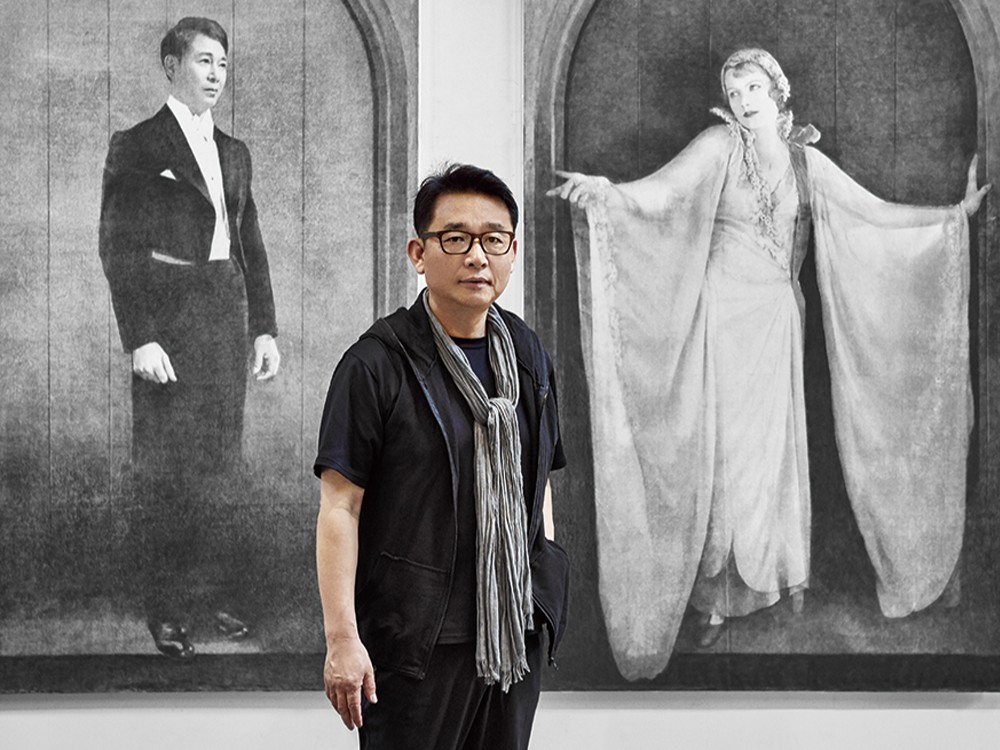
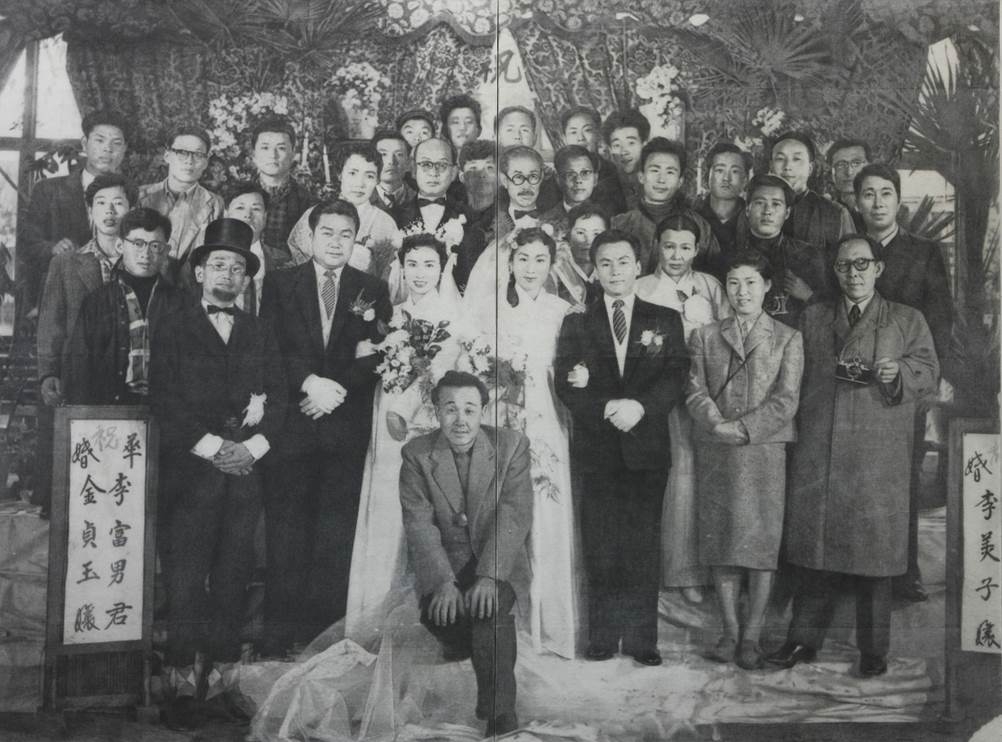
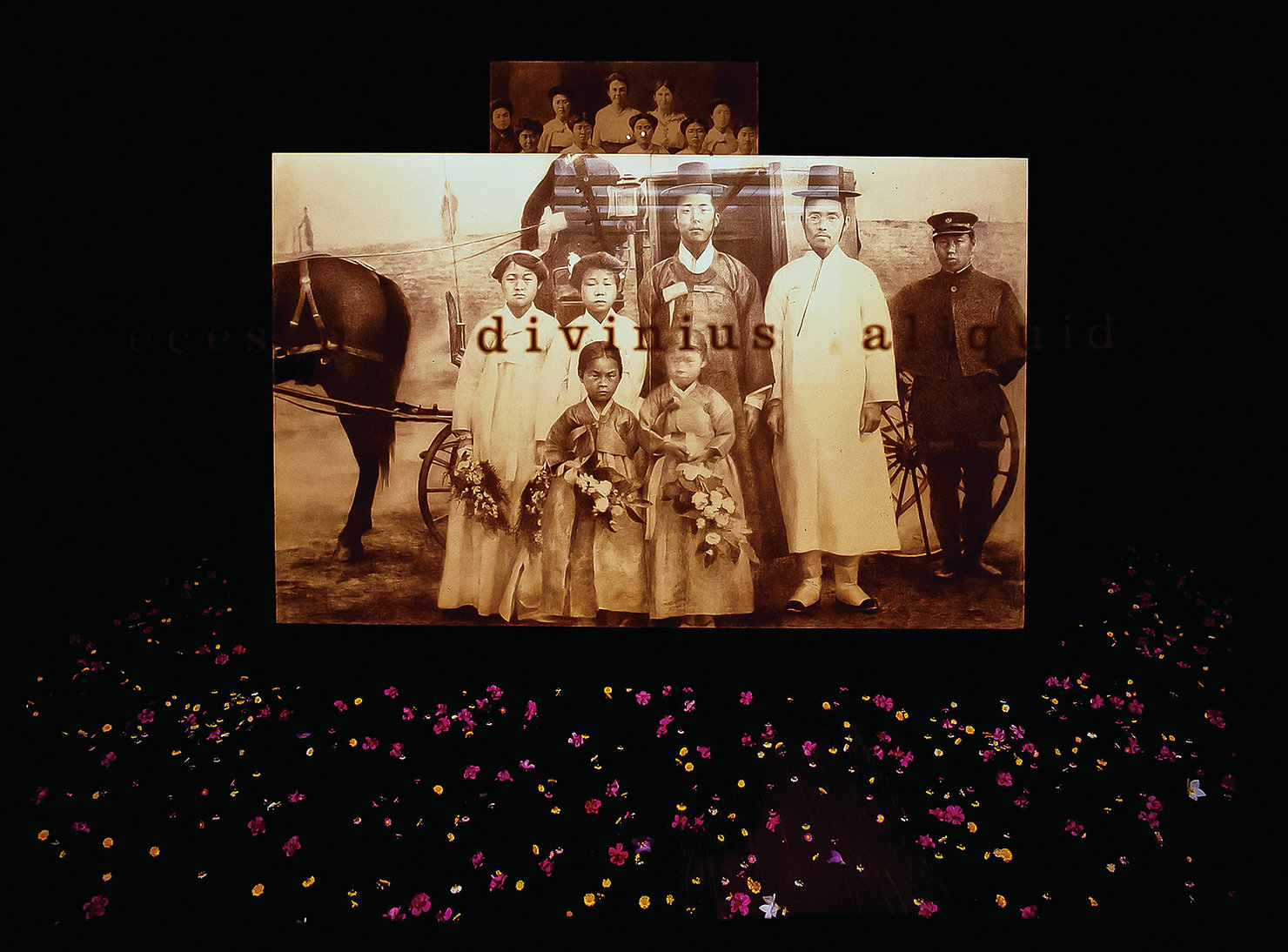
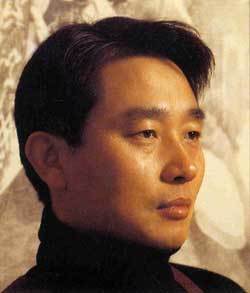
Cho Duck Hyun’s “excavation projects,” which include Dog of Ashkelon (2000), Gurim Village Project (2000), and Entering Yiseoguk (2002), are grounded in this “unfamiliar time.” He gives flesh to entangled time lingering at the threshold of history by attaching an empirical system—materials, records, relics—and thereby constructs a new context. This draws up what is situated in “unfamiliar time,” providing an occasion for it to cross the threshold of history. And within the framework of history, he finds for such things their own place—so that they may become a plausible, coherent story. Here, Cho Duck Hyun is the subject who authors that narrative. This is, in outline, the overall picture of the excavation projects he has pursued.
It is therefore beyond doubt that most discussions of Cho Duck Hyun take place “in the context of excavating an imaginary and mysterious past.” In art (whether contemporary or historical), there are countless cases in which events or figures of an era are retrospectively brought to light; and such acts draw past facts into the present in order to reevaluate them. Cho Duck Hyun, too, stands within this context. Yet the stratum of the past he handles is thick, in that it includes even “unfamiliar time.”
In this sense, his work is not only “consistently about looking at the history of the past from the vantage point of today,” but also shows the process by which something comes to take its place as history (a process excluded from what is commonly recognized as “history”). Thus, “history” becomes at once familiar and strange. Borrowing Susan Sontag’s words, “only when we do not see as we are shown to see does understanding (of history) begin.”
Ⅲ. A Tomb (No-Tomb) That Gestates Records and Materials: Excavation for Burial
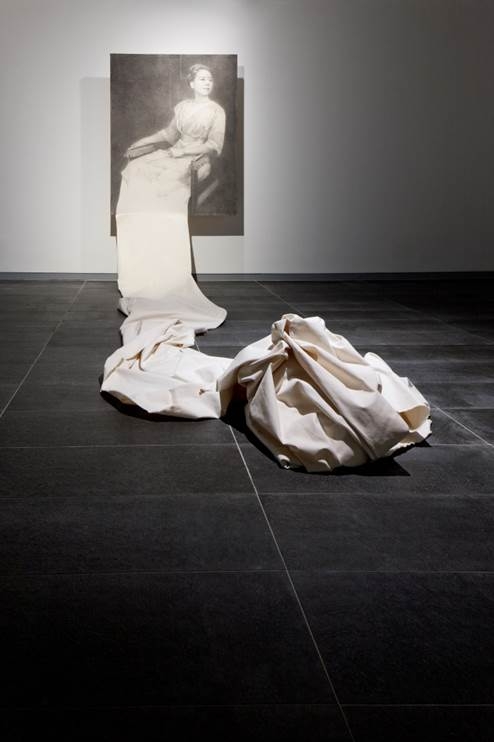
Then why did Cho Duck Hyun choose an excavation project (accompanied by burial) as a method of approaching “unfamiliar time”? The answer can be found within the web of meanings that the earth (the tomb) holds. For Cho Duck Hyun, the earth (the tomb) is “the point that holds the deceased body.” He buried about fifty bolts of plain cotton cloth near his father’s grave, hoping that his father’s energy, spread through the earth, would seep into the fabric.
But five months later he discovered that it remained only as the faintest trace, indistinguishable from the soil. Cho Duck Hyun says that here he felt the immense, irresistible force inherent in the earth (the tomb). And he carefully gathers it as though it were his father’s remains. This is how the exhibition 《Geneology on My Father》 (Kukje Gallery, 1996) began.
In Excavation for Burial, shown in that exhibition, Cho Duck Hyun deals with the father, the earth (the tomb), and “the son who resembles his father.” Looking at his father’s grave, he recalls a question from some thirty years earlier. At the time, the artist—then seven years old—wondered where his father, who had “passed away (故),” had “returned (回歸)” to. That question is resolved at the moment when “the father’s presence, sunk in the abyss, rises into a concrete form”—that is, when, thirty years later, the artist places his own son, who closely resembles his father, onto the earth imbued with his father’s energy.
The place his father returned (回歸) to was the earth (the tomb) on which the son who resembled him stood. The father at the site of death, the “I” (the artist) at the site of life, and the son at the site of birth: these three subjects draw, within the earth (the tomb), a personal genealogy, a family genealogy, and further, a universal (human) genealogy of life. For Cho Duck Hyun, the tomb is the space that bears these three genealogies.
Yet the title of this work is also unusual: Excavation for Burial. According to a linguistic structure that considers the sequentiality of time, the title should be “burial for excavation,” because burial must precede excavation in order for excavation to occur. To excavate without a prior burial would be nonsensical. And yet Cho Duck Hyun says “excavation for burial.” This reversal of sequence between excavation and burial places father and son on an equal plane; death, represented by the father, and birth, represented by the son, form a Möbius strip.
It reveals the endlessly circulating universal history of humankind. For the artist, therefore, it makes little difference whether it is “excavation for burial” or “burial for excavation.” The father returns (回歸) as the son; the son returns (回歸) as the father; and again, the point where the father “passed away (故).” That is the tomb.
For Cho Duck Hyun, the tomb is crucial, because the key act of the excavation project—“burial–excavation”—derives its meaning through the tomb. In order to newly excavate meaning, let us read differently the “tomb,” the field (場) of the genealogy of life. Might we read the tomb as a “no-tomb (無-덤),” as an “added meaning”? The act of burial is to cover with soil. This is not a method that substantively makes what exists disappear; it is only a form of concealment. Yet through weathering, the earth converts presence into absence (無)—as when the cotton cloth buried near the grave became indistinguishable from soil after five months, leaving only minimal traces.
Then what of “excavation”? It is the act of removing what covers. If we consider the aspect of absence (無) produced by burial, excavation can be understood as a procedure for confirming absence. But as we can see in Huh Su-kyung’s poem presented in the prologue, if one goes down, down, what one encounters is the accumulated inner history of time. If burial converts presence into absence within the tomb, excavation places—“as an added layer (덤)”—what had existed yet was perceived as absent into accumulated time. A space perceived as absence until excavation begins; but once excavation starts, the space becomes a “layer,” another “layer,” and yet another “layer,” accumulating until it even produces another presence.
When Cho Duck Hyun descended as deep as where the father had “returned (回歸)” and placed his son—who resembled the father—down there, the son became a being that was both father and son. This is what had been absent becoming present; moreover, as the son’s temporal inner history is added as a “layer (덤)” atop the father’s temporal inner history, it forms the family genealogy the father and son carry on. And if one goes further down, further down, one may encounter yet another genealogy that can be raised up as another “layer (덤)”—the genealogy of life.
This “burial–excavation” resembles the world of archaeology, where depth is equivalent to years. In other words, in archaeology, if you go down one meter you can encounter an earlier state; and if you go down another meter you can encounter a much earlier state. The major task of archaeology is to reveal the material modalities of a world accumulated over a long period.
Thus archaeological imagination rejects the horizontal and extends in a direction that complies with gravity—downward. Pottery shards, pig bones, cow bones, clay dogs, wheels, and so forth revealed by descending, down and down, hold intact the traces of time. They are entangled, because in the dark space before excavation, “unfamiliar time” encircles them. Yet once excavated, they enter into relation with the present, find their latent place within the flow of history, and moor there.
A father who “passed away (故)” through burial returns (回歸) as the son through excavation. And in Excavation for Burial, the son is wrapped in cotton cloth and placed inside a coffin (a wooden box, a plastic box), and beside it lie soil and a shovel for burial. The excavated son will be buried again. The accumulation of repetitive, circulating time centered on the tomb. The lives of countless people accumulated in this world—an end that is also not an end—have seeped wholly into the earth. In this sense, the earth (the tomb) can be said to be a repository of records and materials regarding the times of diverse lives. The earth is a womb that gestates those still hesitating at the threshold of history. They are waiting for birth (excavation).
Ⅳ. Unraveling the Tangled Thread of Time and Sewing the Fabric Called “History”: Entering Yiseoguk
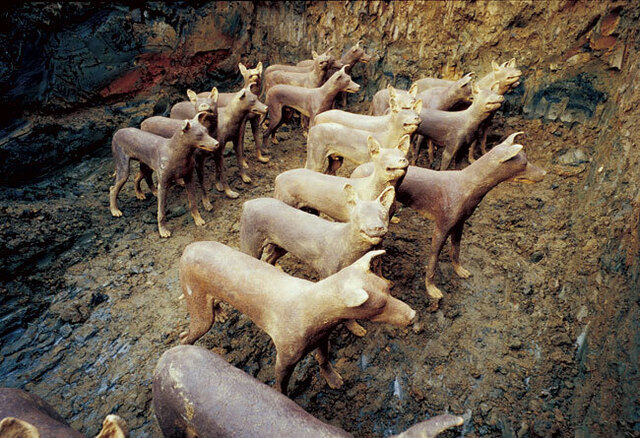
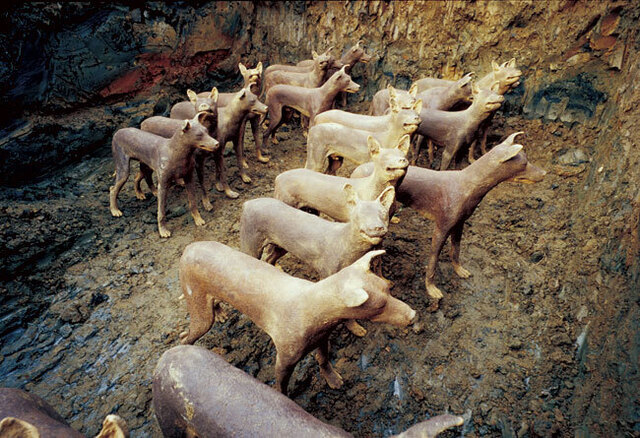
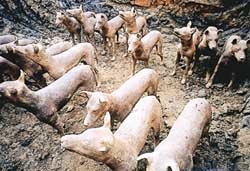
Cho Duck Hyun buries and excavates, and from there he draws up “unfamiliar time.” The results are as follows: Dog of Ashkelon (2000) at Jeu de Paume in France; Gurim Village Project (2000) in Gurim-ri, Gunseo-myeon, Yeongam-gun, Jeollanam-do; and Entering Yiseoguk (2002) in Baekgok-ri, Hwayang-eup, Cheongdo-gun, Gyeongsangbuk-do. In these projects, Cho Duck Hyun commonly digs into the ground and buries dog-shaped forms made of FRP. He places historical materials and grounds (literature, archaeology) there, then excavates them again, leaving behind diverse documents to produce a history—or rather, since it is ongoing, to say that he is producing one would be more accurate.
Among these, the work that draws the most attention is Entering Yiseoguk, entirely because of Choi Won-oh’s text, which wrote the project’s fictional scenario and states that “what was discovered in the Bomun area of Gyeongju and at Baekgoksanseong in Cheongdo is not only chronologically earlier than what was found in Gurim Village, but also…” (emphasis by the author). This provides a clue that allows works capable of existing independently to be bound together as an “excavation project.”
Gurim Village Project, too, is based on a fictional scenario: Cho Duck Hyun posits that the “Gu” in Gurim is not the dove character 鳩 but the dog character 狗, and by “discovering” iron dog-shaped relics in Gurim Village, writes a new—fictional—history. Yet in Entering Yiseoguk, that fiction appears not as fiction but as historical fact, used as empirical evidence. In this sense, Entering Yiseoguk shows not only the fragmentary aspects of the “excavation project” but its totality. This is why the shared structure—burying and re-excavating FRP dog forms—continues, and must continue.
Behind Entering Yiseoguk lies a poetry collection by Seo Rim with the same title. Seo Rim’s poems amplify imagination from a single line mentioned in Samguk Sagi and Samguk Yusa: that there was a tribal state called Yiseoguk in Baekgok-ri, Hwayang-eup, Cheongdo-gun, Gyeongsangbuk-do, and that it was destroyed by Geumseong (Silla). Seo Rim sees the spirit of Yiseoguk as still flowing among the people of Cheongdo even now, after long ages have passed. In this collection, Seo Rim does not treat ancient Yiseoguk merely as a retrospective object; he makes Yiseoguk reappear within the concrete reality of today’s Cheongdo. “For the people of Cheongdo, Yiseoguk has neither end nor beginning,” and “in Cheongdo, every object is the entrance to Yiseoguk and its end.”
Based on Seo Rim’s poems, Cho Duck Hyun establishes a hypothesis imbued with new imagination. He sets Yiseoguk—existing at the time of transition from the Bronze Age to the Iron Age—as a nation enjoying the most advanced iron culture of its time. In 1995 (the year Seo Rim’s poetry collection was published), construction of an annex to the Hilton Hotel was halted because iron artifacts were found there. Yet the excavation proceeded in secrecy, because there was no way to identify the artifacts.
Then, in 2002, the excavation team from the Yeungnam University Museum unearthed a large quantity of iron artifacts shaped like dogs. Because similar iron dog-shaped artifacts had been found in Gurim Village, Yeongam, in 2000, the claim is that what had begun to be excavated in 1995 could only be officially announced in 2002.
This plausible scenario is fiction. The only thing that can be called fact here is the existence of “Yiseoguk.” Cho Duck Hyun buries FRP dog forms at two sites: the location of Ilchujeong, a pavilion on the property of the Kim Ilson family in Baekgok-ri, Hwayang-eup, Cheongdo-gun; and an area near Bomun Lake within the Bomun complex in Gyeongju. The excavation team then excavates them just as in an actual archaeological site. They produce an archaeological report (Na Sunhwa) and a scenario related to the excavation (Choi Won-oh). Art (Cho Duck Hyun), archaeology (Na Sunhwa), and literature (Seo Rim, Choi Won-oh) acquire intertextuality within the overarching frame of Entering Yiseoguk, filling and weaving one another’s gaps.
Thread by thread, art, archaeology, and literature are woven to produce a dense fabric called history. Dog-shaped relics that had lain buried for over two thousand years without meaning are contextualized through this fictional archaeology and come to occupy a place in history. Viewers who directly see these newly made “evidences,” following them with their feet through on-site visits, believe them to be “history” grounded in fact rather than fiction—just as history has always been believed.
Cho Duck Hyun’s Entering Yiseoguk draws up iron dog-shaped relics that had remained for over two thousand years as nothing more than accumulated inner time—in other words, that had existed in “unfamiliar time”—and enables them to cross the threshold of history. What is important here is not merely the presentation of a past history, but that the viewer can witness the entire process by which “unfamiliar time,” generated through burial–excavation, transforms into history.
Further, through its interrelationship with another “fact” (Gurim Village Project)—a fact that is nonetheless fictional—it gives form to the folds and curvature of history. This does not remain at the level of reconstructing a history that has simply been believed, by means of fictional imagination. Cho Duck Hyun’s work goes further: by revealing, through fiction, truths that have worn the guise of “history” while systematically distorting and concealing them, it proceeds to “make” its own history. It is fiction, yet an imagination capable of overturning the system of the real. Cho Duck Hyun says: try believing the history I have made—believe it as you have simply believed history.
Is history fact? Is it something trustworthy? This question returns to the exhibition and waits for viewers. The mirror in the exhibition space is crucial. Dog-shaped forms installed in front of the mirror are repeated endlessly. The mirror nullifies the relation between inside and outside, infinitely repeating the iron dog-shaped relics. The iron dog-shaped relics, “made” of FRP yet occupying the exhibition space as if they were artifacts worthy of illustrating a page of history, are fiction.
But this fiction is projected in the mirror, producing yet another illusion. In this exhibition space, the question of which is real and which is fiction is unnecessary: whether an FRP dog or a dog reflected in the mirror, each is a lump of fiction. A perspective on history is not acquired through total reproduction of the past; it takes only a portion among countless things, and with the weapon of logical reason, rummages here and there, arranging the fragments of a puzzle to compose a whole.
Perfectly reproducing the past is impossible. Therefore records and relics function as crucial tools that complete the system of incomplete representation. History is not “science.” It rests only on “belief.” The historian composes the flow of history into a plausible story and demands “belief” from people. In this sense, Cho Duck Hyun is a historian. From the tangled thread of time within “unfamiliar time,” he unravels strand by strand, producing plausibility among them and making his own history.
He fills blank spaces and stitches history densely. Then is history fiction or fact? Cho Duck Hyun does not answer this directly. He reveals even the hidden parts of the process by which history is made, and shows them to viewers. Have we not seen burial–excavation, and the process of becoming history? Whether truth or lie, the process by which history is made—might that not be answer enough?
Ⅴ. Either a Historical “Fiction,” or a Fictional “History”: Parting with the Self-Evident
Cho Duck Hyun’s excavation projects, constructed through fictional scenarios, produce another edition of existing history. This means that history is not something self-evidently believed. As we can see in Cho Duck Hyun’s work, history is reconstructed as needed on the basis of “unfamiliar time.” According to the fictional scenario of Entering Yiseoguk, excavation work in Cheongdo began in 1995, but proceeded in secrecy because iron artifacts were appearing and there was no way to identify them. Then, in 2002, the discovery of iron dog forms made official announcement possible—because the excavation in Gurim-ri, Gunseo-myeon, Yeongam-gun, Jeollanam-do in 2000 had occurred.
Here two facts require attention. First, history is a story based on plausibility. Second, excavation itself is not directly incorporated into history. History is a kind of reconstruction grounded in plausibility. Seo Rim’s poetry collection, which became the basis of the Yiseoguk project, was published in 1995, and Cho Duck Hyun’s work began in 2002—leaving seven years “empty.” Cho Duck Hyun assigns plausibility to that gap, constructing a story that links the time and space of Gurim and Cheongdo.
In the positivist view of history formed around Ranke, history was said to be the description of facts as they were; yet under a historian’s judgment, there are facts that are selected and facts that are discarded. “No such thing as historical reality exists ready-made, so that science merely has to reproduce it faithfully.” (Raymond Aron) The absoluteness of events grounded in facts is no longer the basic premise of historiography. The binary of history and fiction collapses: history is fictionalized, and fiction is historicized. We will come to realize that, “moving a distance that is almost invisible, or seeming to stay almost in place, we have nonetheless crossed some vast boundary.”
Rejecting the meaning of the past in this way may appear to slide into nihilism. Yet Cho Duck Hyun offers the viewer something different from a postmodern tendency that arbitrarily fills empty spaces with fictional scenarios made of unrelated traces of the past. Again, we must borrow Susan Sontag’s words: “only when we do not see as we are shown to see does understanding (of history) begin.” Cho Duck Hyun is not speaking of nihilism. He is asking us not to see as we are shown to see a history regarded as self-evident, and thereby to understand the history that bears our lives.
Ⅵ. Epilogue: “We are here now, we are here now”
When the relic survey team from Yeungnam University / carefully dug beneath the Southern-style dolmen in the fields behind Cheongdo-eup / underground, the eastern sky had not yet opened its eyes / they quietly descended the steps / and stepped on the dark night streets of Yiseoguk at dawn / passing the checkpoint safely, they went past the police station, the fire station, the pharmacy / the securities company building, the pachinko, beside the tribal chief’s residence / into the museum surrounded by a forest thick with oak and pine / as in any museum of that era / there were displayed: a model of our satellite “Uribyeol-1,” fax machines, computers, Seo Taiji and Boys compact discs, various credit cards, gas masks, disposable diapers, condoms, fitness equipment, vegetable enzyme supplements for dieting / when the team arrived at a room in the museum-affiliated research institute / a female researcher, wearing tight “Jordache” jeans, having stayed up all night, was computer-graphing the 1992 redevelopment blueprint for downtown Cheongdo / the county office made of logs, mud, and reeds, stone-stacked ramparts, an armory filled with bamboo spears, stones, and bows, a dumping site, 馬舍, narrow alleyways, the county governor’s office and its rear garden, and earthen-walled houses for the townspeople / were arranged in perfect order
Do you not hear them—those voices? “We are here now, we are here now.” The cries of “unfamiliar time,” lingering before the threshold of history, unable to cross it, yet saying that they are here. When we hear this cry—audible only to those who understand history—history will widen. And art, too, will widen. Cho Duck Hyun now hears the cries coming from “unfamiliar time,” and busily stitches, strand by strand, the fabric called history, the fabric called art—densely.