SCULPTURE
AS “IT”
It’s challenging to talk about Chung Seoyoung’s
artistic universe, but it’s not impossible. Her world
does not disappear into some labyrinth. On the contrary, it is lucid and
precise. It is like a form of cross-studies that makes us confront two or more
schismatic realities. If there were a discipline that studied intersecting
times and spaces, might Chung be able to design its methodologies? The things
that she says about her work – flowing and fixity,
receding and approaching, “time that flows without gathering
in any one place” – are neither narratives nor direct
explanations of it.1 She is speaking of the work’s “performance,” as
it leaves the artist’s brain and hands and is left to
operate somewhere on its own, interacting with and reacting against the outside
world. Even after Chung’s artwork has achieved physical
completion, it continues to change as a result of the surrounding atmosphere,
the viewer, and the movements of the world itself.
Within
such a hypothesis (or evidence), we must put before ourselves a more concrete
notion of the “exhibition” – an “exhibition” as
part of a comprehensive world permitted by the artist. The exhibitions that
Chung Seoyoung creates are regions that are meticulously adjusted and
constrained. This is what makes her work appear to the outside. Within a series
of transformations, the artist’s work is left to stand
before the viewer. Chung’s method of freely “sculpting” her solo exhibition is a
technique that guides us to examine some of the issues that she presents. “Sculpting” her exhibition – what is that supposed to mean? This requires that we follow along
Chung’s method of conceptualizing sculpture itself.
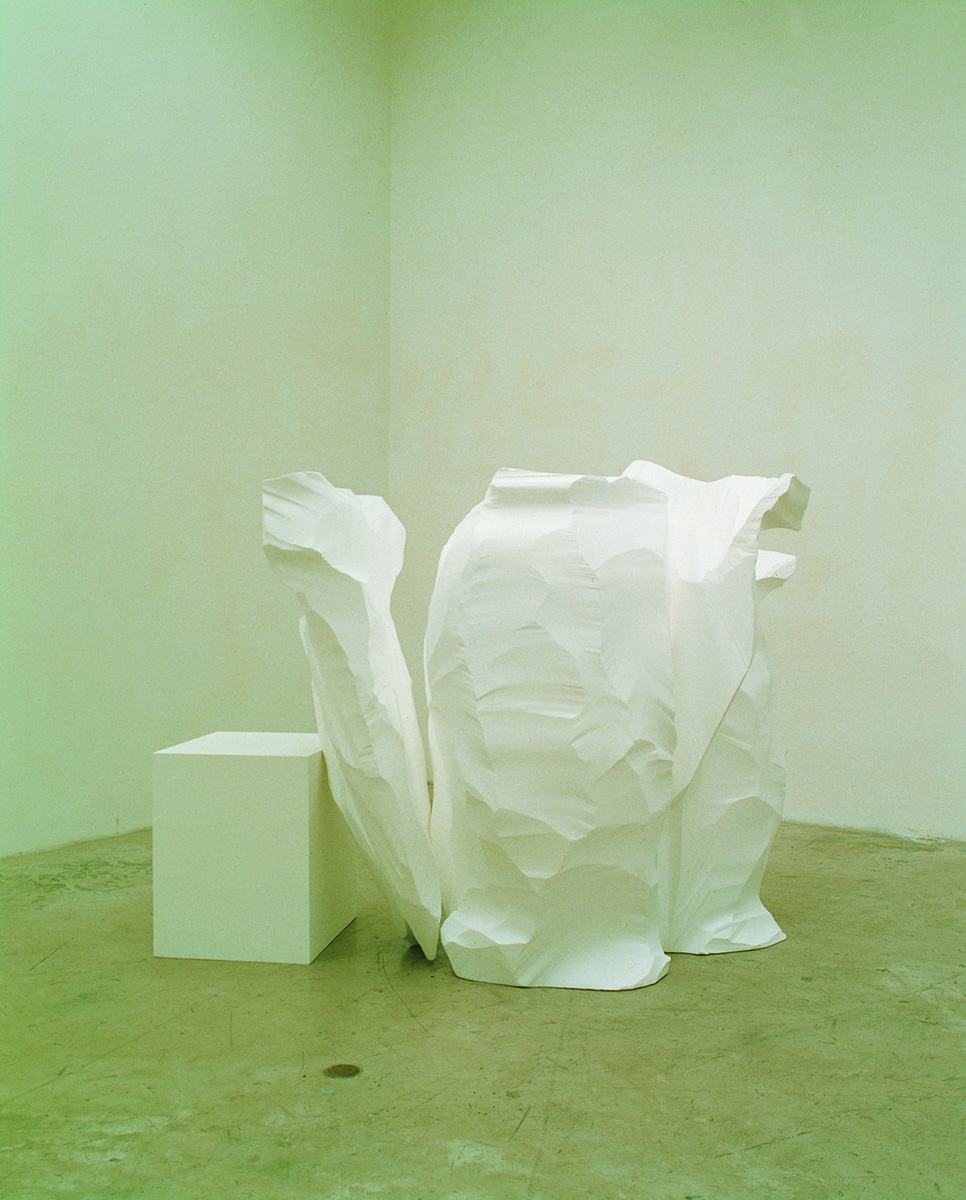
“This sculpture is a remaining part of an installation
work Ghost, Wave, Fire (1998). The intent is to create a sculpture,
which is endlessly moving without a predetermined form or size.”2 “Generally speaking, I am a sculptor. And that is truly too big and
loose of a question, as you said. Even so, I feel I can insert into the
looseness this statement: to proceed from objects to sculpture, you have to
break the “consensus” regarding
things.”3
Chung’s exhibitions are likewise about “fixing in
place things that move without stopping and do not even have a shape.” With her 2016 exhibition Chung Seoyoung (Audio Visual
Pavilion), where she found a new setting for a portion of her forgotten
sculpture that was given the title from Ghost, Wave, Fire (1998), the
matter that was being problematized by means of the artist was the very “instant” of appearance before our eyes and
the “situation” of movement
arising. The artist converts the exhibition setting into a “place where a situation arises” – something
made possible by an eye that detected how the space in question, ahead of its
being a “gallery,” was once an
assemblage of walls and floors, institutional choices, and various foretokens.
Consider the ways in which she has made use of the white walls of Art Sonje
Center or transformed the floors of Atelier Hermès, the high walls of this
gallery, or the space “once dubbed as the laundry room” at AVP.4 Chung Seoyoung’s exhibitions do not simply end. Double ventriloquism, the viewing
of conflicting things simultaneously, renewing the physical conditions of the
exhibition – the exhibition is a problematic time and
space where unfamiliar problems suddenly crop up.
Chung’s exhibitions force us to experience her decisions. As a moment when
the artist’s methodology coexists, the exhibition is a
world that is distinct from the outside. It is a place where we see the artist’s decisions – decisions that differentiate
her subjects, split and divide them. The objects here are physical materials
with captions such as “mixed media” and “dimensions variable,” and they also represent a dimension of “meaning” in which she provides drawings that seem to offer the occasional
hints. Chung’s capital letter “A” is minutely, endlessly divided into A’s and
A”s. Indeed, there actually are “A”s in Chung’s work:
there is her pigment print photography work A Didn’t Know B Would Do That (2014/2016) and her Table
A (2020), which consists of wood, glass, and pottery. Due to the condition
of “otherness” (B) and the
relationship of the surrounding context (the table set up by the artist), the
details of the work make it impossible for “A” to simply be an “A.” The artist controls it to the last. At the same time, the intricate
moments that she has extracted make it so that what the viewer sees is not a
splintered fragment, but rather “wholeness” as a moment grasped and temporarily set-in place by the artist.
The
aim of showing a “whole” was relegated to the background in the art of the late 20th
century. This sort of aesthetic achievement created by an artist exercising a
certain decision-making prerogative to the last was never fully manifested in
the history of contemporary Korean sculpture, with its attempts to achieve its
own form of 20th century modernist art. As the physical qualities of materials – embodied in large metal, wood, and stone sculptures – gave way over the course of the 1990s to the freedom of
indeterminacy granted by the spectacles of installation art, sculpture became
confused with installation. The original state of the material was rendered
secondary to the objective of the work and the attendant conferment of meaning.
In contrast, Chung Seoyoung emphasized an uncompromising side in her process
toward sculpture.
The decision-making authority that she exerted as an artist
inscribed the sense of “sculptureness” and “the sculptural” through a form of combat that involved increasing the bulk of the
sculpture while finely differentiating its moments. Chung’s inherent critical stance and attitude are thus the same one from
which she discussed materials, sculptures, and the moments of sculptural
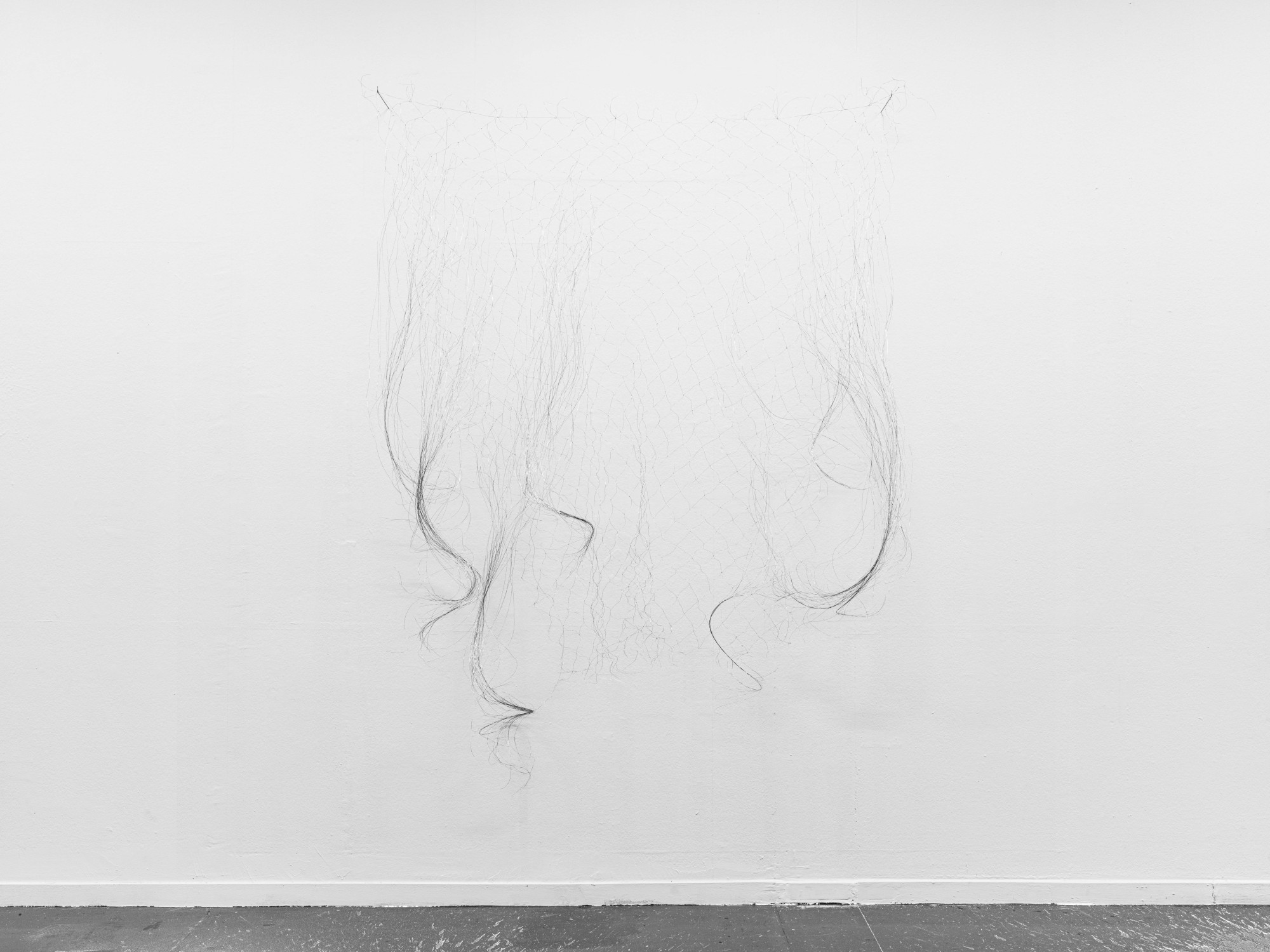
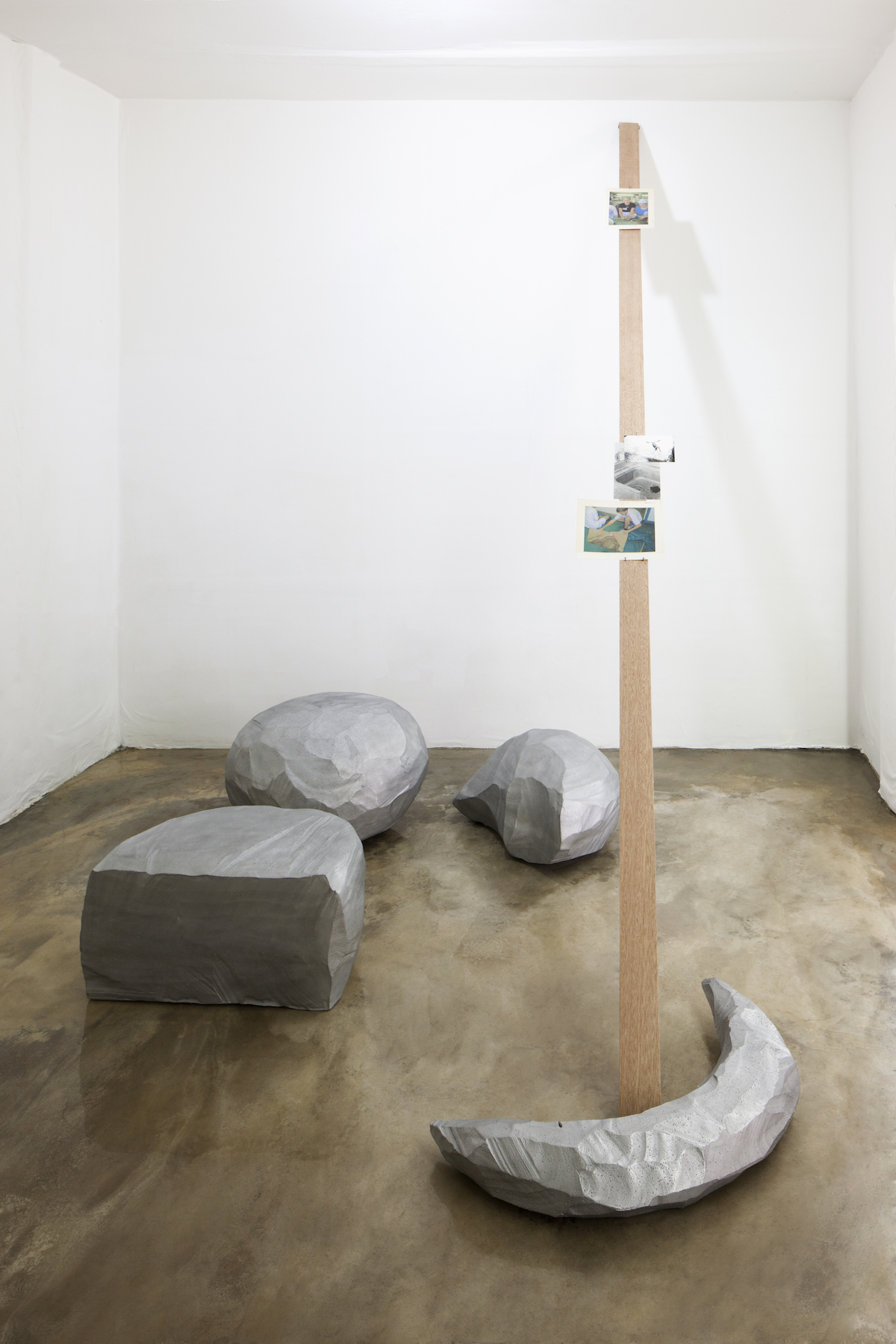
emergence during the 1990s. The physical materials seen in her Knocking
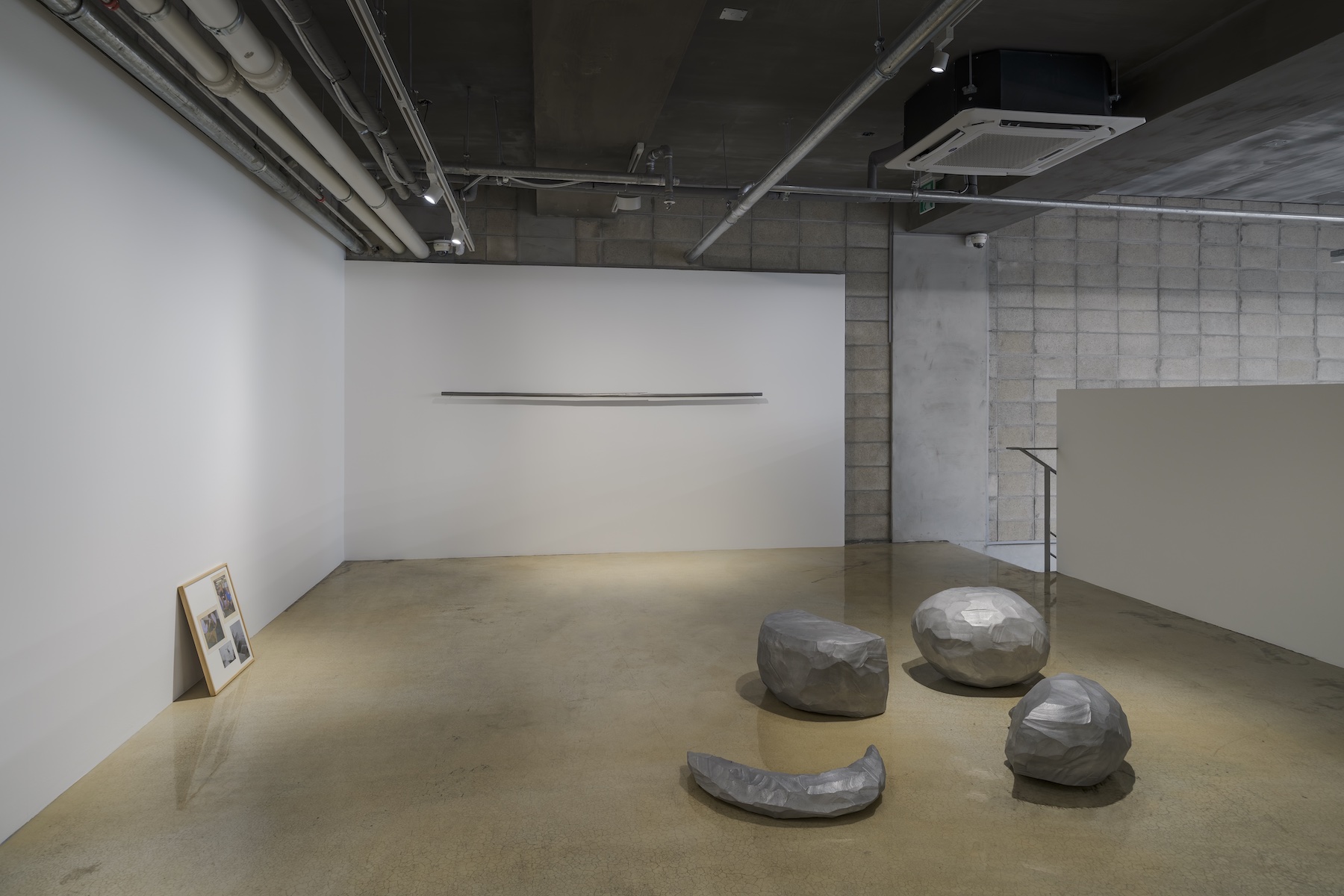
Air exhibition – the white pedestals, branches,
Jesmonite and aluminum castings, and nimble stainless-steel wire – ensure that dull “meaning” does not play the role of second fiddle to the artwork.5 Her artwork and exhibition in 2020 continue to forestall the
possibility of some vague functioning of outside meaning. The kind of “seeing” that has become habitual for viewers
looking to simply glance over the world in front of them becomes impossible.
The
reason has to do with the artist’s decision-making authority. Chung Seoyoung’s
power forces the viewer to experience disparate perceptions of the part and the
whole simultaneously.6 The materials that Chung produces may appear to question all
things, but they are also firm declarations. Her work presents moments that
argue the need for ongoing adjustment of the things our eyes encounter. They
are sharp, yet also spongy. Yet viewers cannot simply let these two or more
opposing states pass; they have to choose. From the changes that arise in bland
objects like ball pens and keys to the situation in Untitled (wood,
fabric), with its origins in the artist’s 1994 exhibition – Chung Seoyoung’s work still exists as material that manifests a certain orientation
as it leaves behind evidence of its properties.
SCULPTURE’S EMERGENCE AND THE PERCEPTION OF DISTANCE
Consider
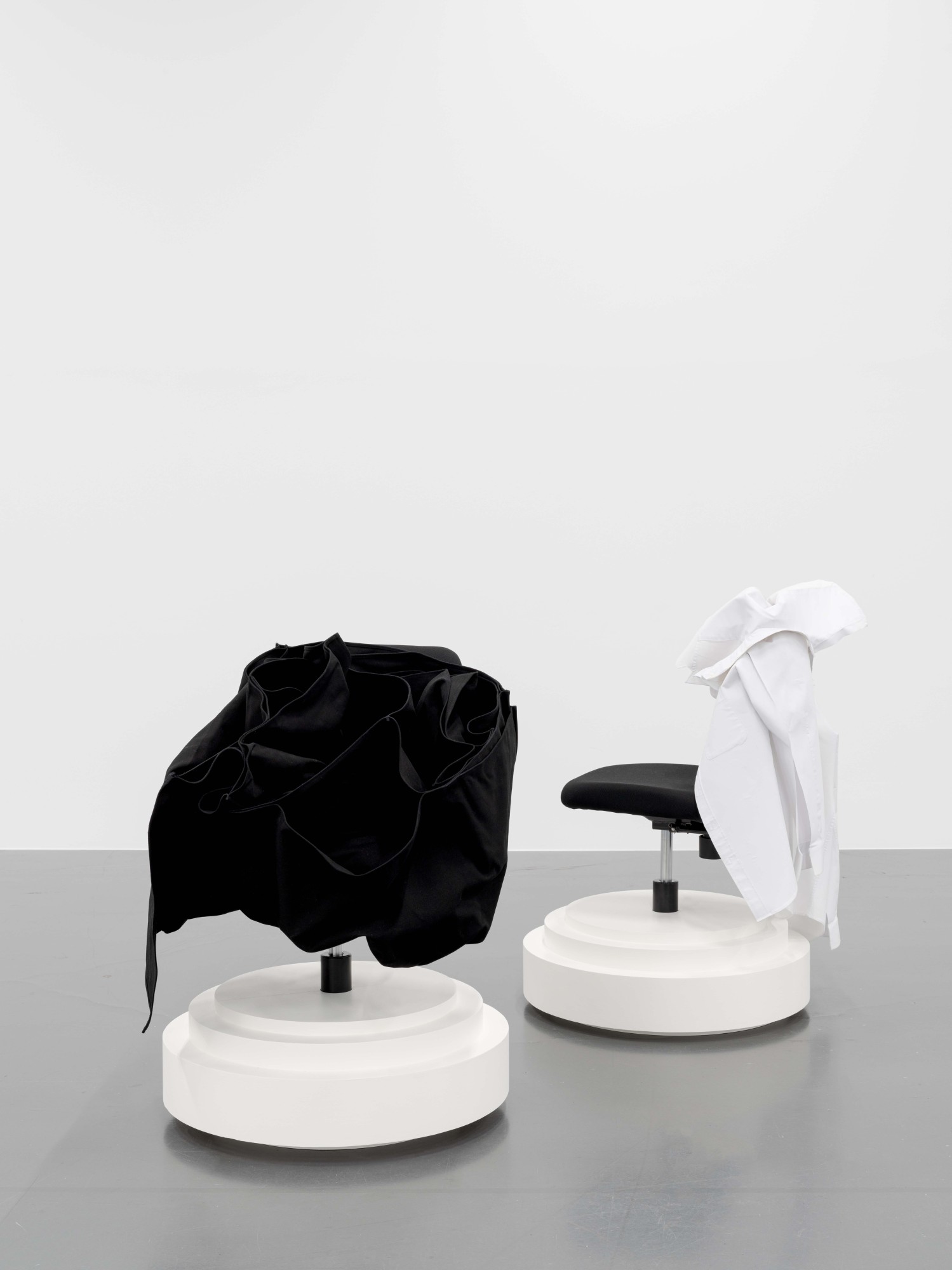
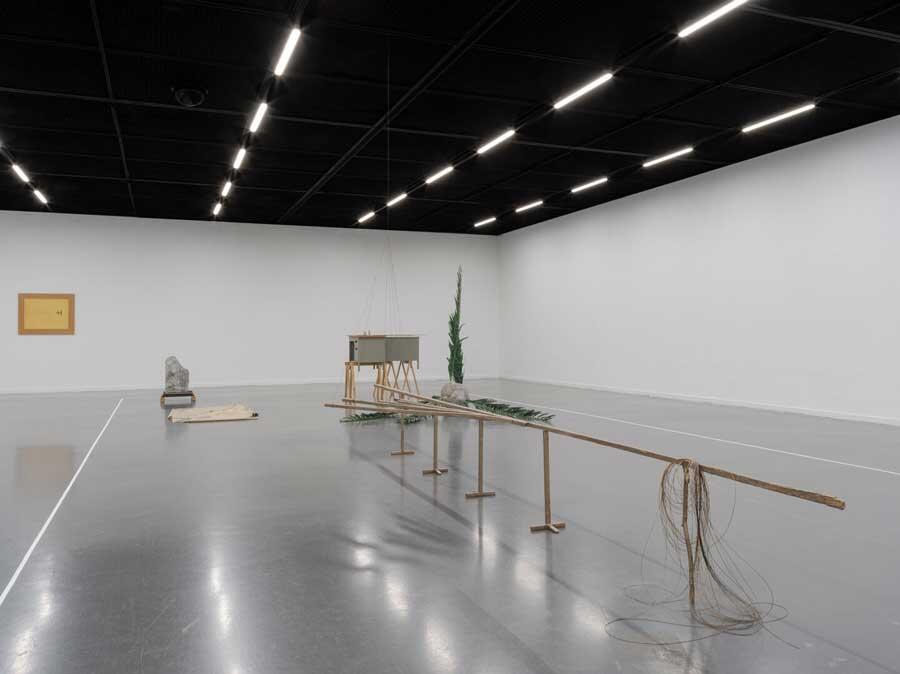
the work from the Knocking Air exhibition that consists of pedestals
and ceramic text. The characters inscribed in the ceramic on its pedestals are
lain flat. Chung’s pedestals are
not being used to effectively optimize the “viewing” experience (i.e., for display). Their painted plywood betrays that
function, with a bulk above and beyond that of a pedestal. There is also that
like a tiny bird’s nest, but the wrapping is sculpture,
and the sculpture’s wrapping is not paper (Two, 2020).
This reactive, uncompromising power in the artist’s
work modulates between paper and sculpture, the flat and the bulging, the hard
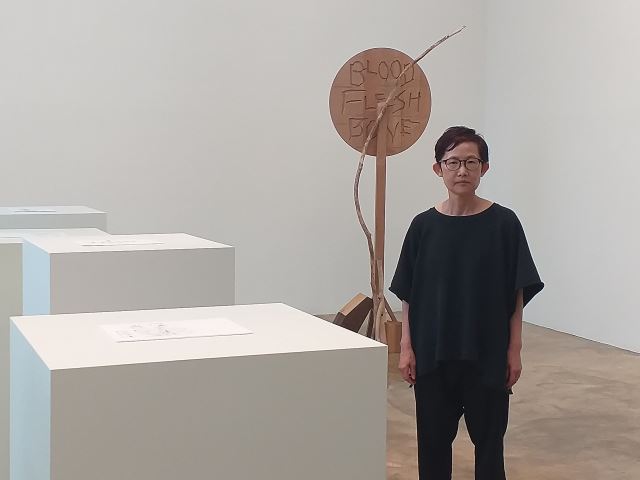
and the soft. Blood, Flesh, Bone (2019), which is located on the
first floor of the Knocking Air, is over two meters in height. It is
a “signboard” bearing the words
“blood,” “flesh,” and “bone” in
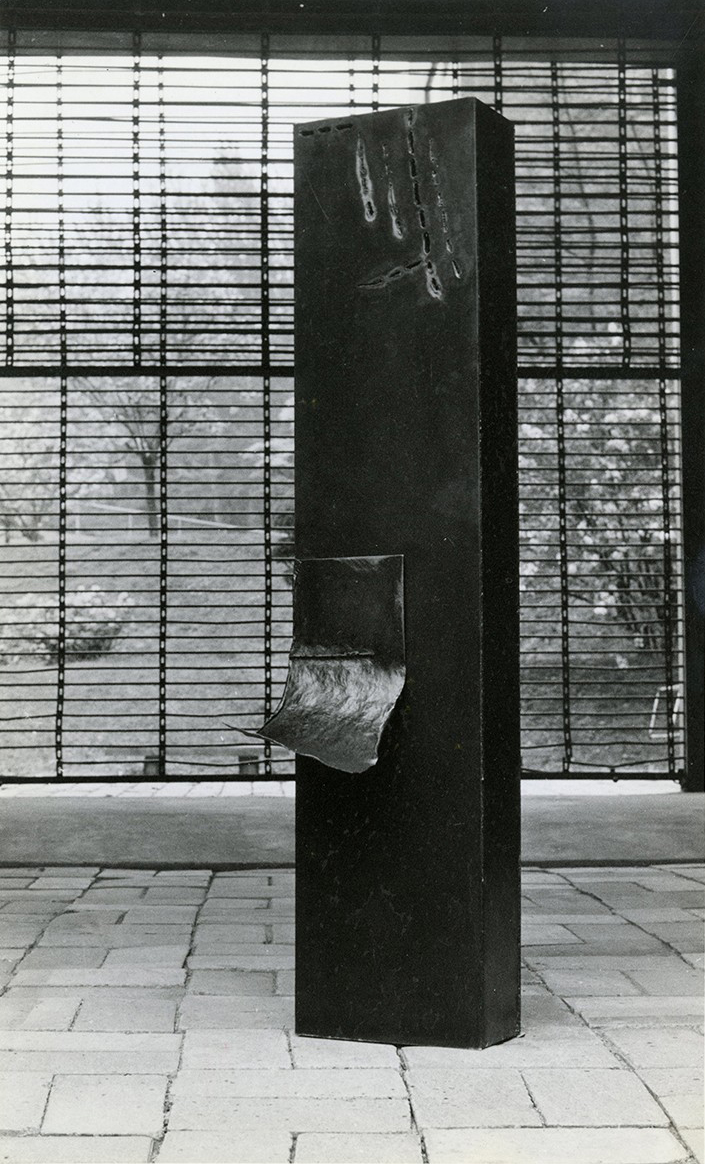
English. A vertical structure called Yellow, It (2020) has a small
rectangular mirror placed at its base. The mirror reflects different moments of
the exhibition venue atmosphere’s radiation without
sacrificing its original properties. It exists as an “it,” unintegrated with the whole.
The
uncompromising nature of the artist’s decisions gives rise to a sense of distance among the objects. The
exhibitions lack an exchange of stories among artworks or a continuous feeling
of heightening. Chung Seoyoung’s work creates a minute
separation between established conventions surrounding objects and our human
cognition. She makes sculptures, and at the same time she produces a
(perception of) distance that arises between two or more objects. Within that
distance, our field of vision narrows – then widens
again! The distance established within the exhibition setting intensifies or
disappears through the effects of time, which is the chief cause of change. At
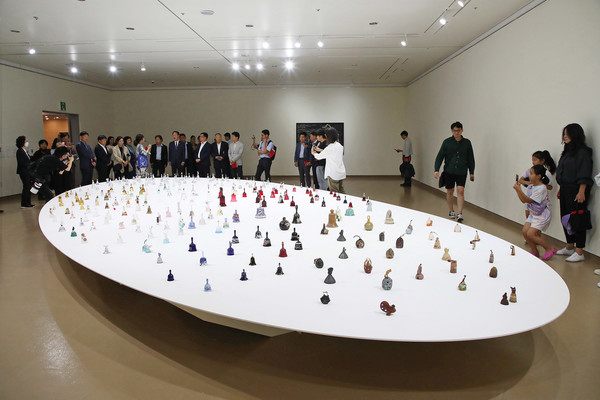
this moment, I am envisioning Chung’s works East
West South North (2007), Monster Map, 15 min. (2008), and A
Didn’t Know B Would Do That in my head. Like a
scientist holding two batons and modulating the world, the two or more objects
that she captures create a “formula for generating
distance.” If the viewers can observe the process of a
specific subject being represented or materials from the artistic process being
combined, they will perceive the artist’s work as less
difficult. In Chung Seoyoung’s work, however, there is
a “path” that is formed through
the process. It is a path that changes anew when we stand in front of the work,
one densely woven with limitless possibilities for surveying in new ways the
relationship between reality and artwork. If we view Chung’s sculpture through the lens of the dictum that “a path is a line whose beginning and end are distinguished,”7 then it generates a different power and tempo “on its own” each time.8
Chung
Seoyoung’s sculptures change with the surrounding
atmosphere, the viewer, and the movements of the world itself. Her sculptures
are not objects attributable to some change in this case, but dynamic subjects
that appear as unpersonified “things.” Recall how wheels (East West South North) and footsteps around a
neighborhood (Monster Map, 15 min.) have been used as part of her work. In
referring to the “beginnings”
and “endings” that surround
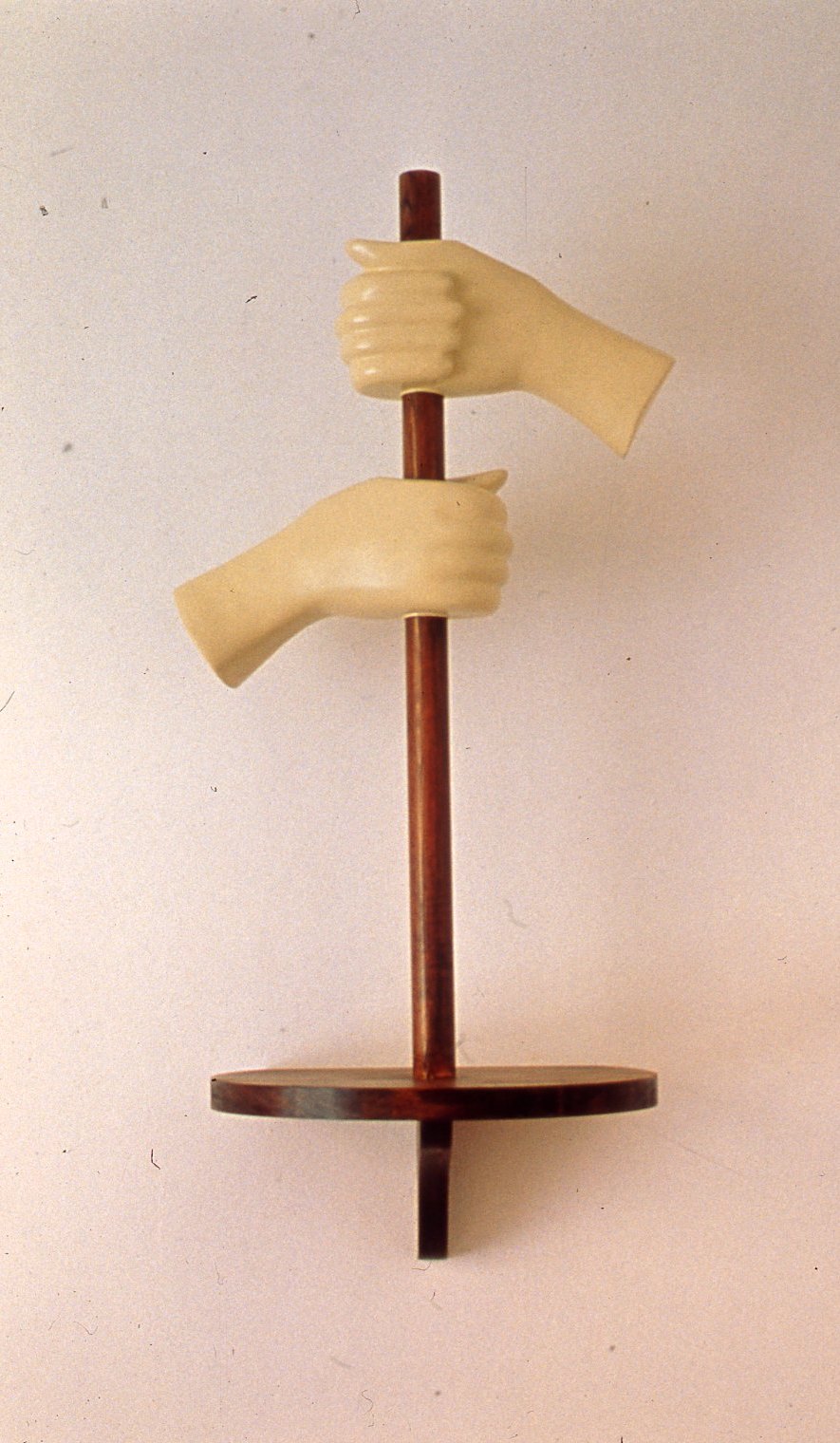
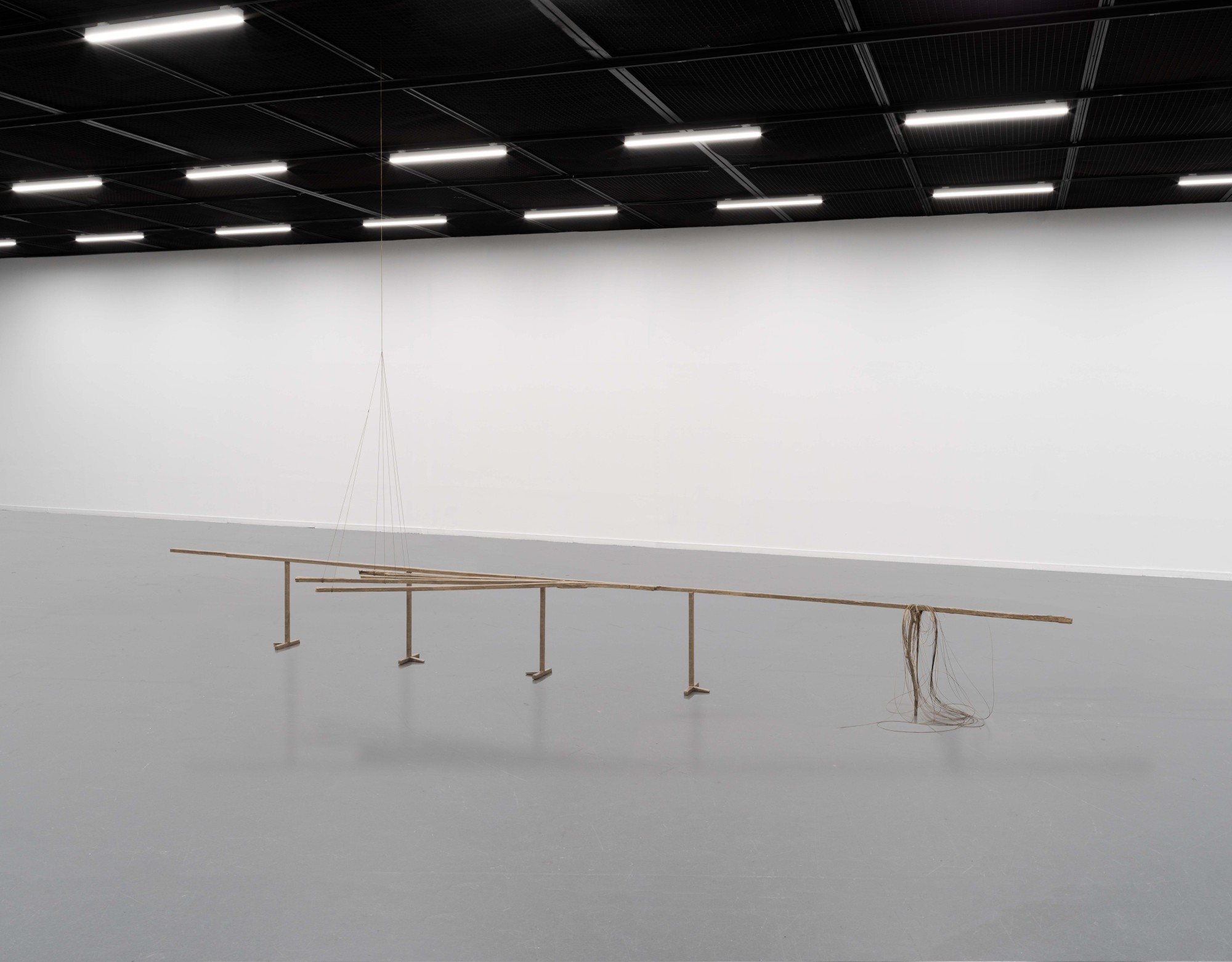
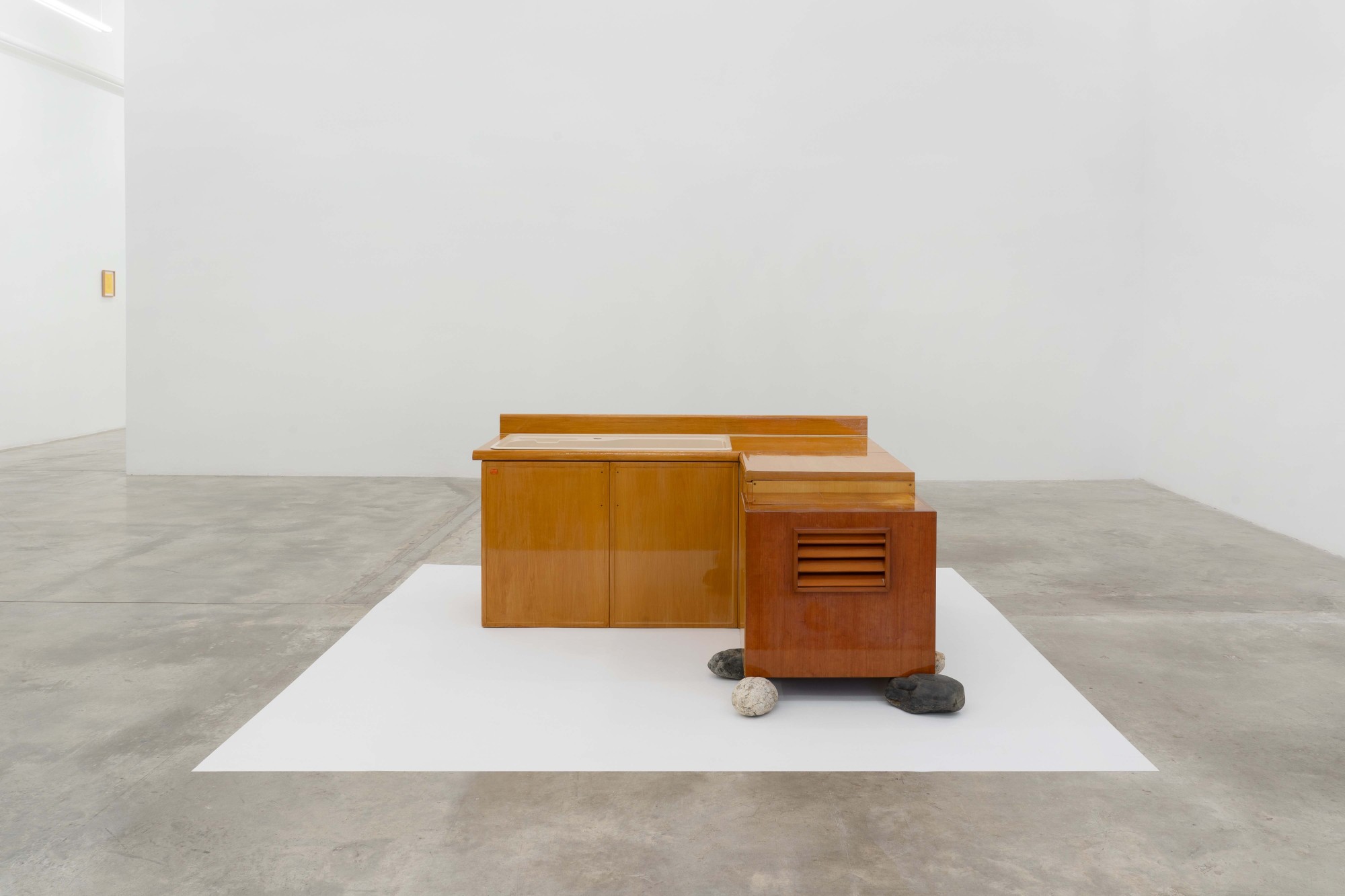
movement, one may think of Table A from the Knocking
Air exhibition. Its strange road seems like a “mass
of hand” combining both a left and right hand, or an
architectural structure stripped of its sense of tempo; it recalls an isolated
village that repudiates the very aim behind a path’s
emergence. It is also an exhibition that illustrates collection, juxtaposition,
and temporary coexistence, in the sense of having different things positioned
within a single space (on top of the table).
Seeming as though it might be
occupied by vague clues of indeterminate beginning or end, the work actually
proceeds in the opposite direction, becoming quite lucid indeed through the
author’s narration. “The
different sculptures have actually come together to form the table after being
thrust out by some unseen reason,” she explained. There
is something both interesting and important to note here, namely that the
artist’s explanation of the reason for the artwork
manifesting itself in its current form calls to mind innumerable “possibilities” prior to its completion,
rather than the current outcome. The presence of objects that harbor the
potential for different directions of movement appears before us as the product
of a differentiated combat. By emphasizing the “process” of these forms – at a time when we could
not yet predict what they might become – the work
establishes its own grounds for existence.
How
does the artist transport things that she witnessed with her eyes into actual
evidence? Chung’s process is
exceedingly independent in the way it rejects references that would be
secondary to the work itself. It problematizes the process whereby shapes
become “specific shapes.” The
Same (2020), which is located on the second floor of the Knocking
Air exhibition, is unquestionably an important work in our discussion of “exhibitions,” being a mechanism through
which Chung trenchantly addresses her own decision-making authority and
time. The Same begins out of the disappearance of once-certain
evidence, namely a 1997 photograph the artist took at her studio, which showed
a “small sculpture I had sort of made and then pushed
aside.” She uses the “installation
view” – a device for recording exhibitions and
mediating with the present – as an opportunity to
re-encounter a sculpture she had cast aside a long time before. Vanished
objects that had once been placed before her but had since been substituted
with something barely visible (a chanced-upon photograph) became sculptures
once again. This is the result of the artist attempting to shift and push
through the gap between lost time and the sculpture through which she is able
to create “it” again. Her
sculpture surfaces and disappears again in defiance of the linear
(horizontal/vertical) flow of time, harmonizing with the surrounding air,
sound, and light.
EXHIBITION
TIME
Let
us now consider the “exhibition time” that Chung Seoyoung called to mind for me. One of Chung’s accomplishments in Korean contemporary art has been to imbue time
into sculpture. In her sculptures, she has created not “form,” but “being.” This bears some relations to the invisible time that is “unconnected” with utility amidst the period
of the time of the dynamic industrialization process and democracy, with its
excessive pressure and emphasis on speed. Chung’s
sculptures distance themselves from the monumental qualities of masculine
modernist sculpture – their knocking, standing,
raising, stacking, and dividing. As she has emphasized, she strives to minutely
narrow down the questions that determine the “form” visible to the eye. Her sculptures are the evidence of time spent
shattering established preconceptions about sculpting from the mid to late 20th
century. Chung is confronting abstract time itself; she is addressing the world
as a whole.
There
are several time axis that we must trace. If what we are viewing is the time
axis at the level of the reality of the Republic of Korea since the 1990s, then
the materials – the plastic, plywood, sky
blue paint, resin, and so forth – may follow suit in
asserting their own “times.”9 Another issue concerns the stature of the exhibition’s own time. Chung has attempted to expand the very time surrounding
the exhibition to the pages of a leaflet – not simply
the opening and closing dates of the exhibition venue, or a viewing time that
relates to the exhibition course for the viewer or the connections among
artworks.10 The aim of this expansion is not expansion per se, and its
attendant broadening of volume; Chung is establishing a field of vision for
reexamining a preexisting tacit agreement. It is a lucid argument. The work
that the artist has positioned inside the exhibition becomes something
performative, varying its methods of emergence to suit the corresponding
spatial and temporal conditions.
For instance, Monster Map, 15 min.– one of Chung’s works that has involved
different media, such as drawing and performance – also
serves as a score “directing”
its exhibition. At one point, Monster Map, 15 min. transformed into
another work called Green Here and Green Yesterday (2016), which
corresponded to the AVP laundry room. Applying the Monster Map, 15
min. methodology to the AVP space that was “once
called the laundry room,” Chung sculpted the “situational space” that was Green Here
and Green Yesterday. Without the use of any separate fixation devices, the
bough was adjusted to suit a rectangular space possessing volume. Long,
tautly-spread bough sharply cut across that space.
Chung
uses exhibitions to determine the existence of her sculptures and the path of
viewing. The exhibition allows the work to change and reemerge. The artist’s reference to the “pale light of the
gallery” at the time of her 2000 solo
exhibition Lookout (Art Sonje Center) shows that the object she
sought to view in detail and control was the very reality of Korea, which was
something that could not be encompassed through the limited institution that is
“art.”11 Her methods in venturing inside a temporary model house
space to display her work in the Apple vs. Banana (an old model house
in the basement of Hyundai Cultural Center, Kim Kim Gallery, 2011), or in using
evidence from past works to recall the moment at which they became sculptures,
signify again that what she is focusing on is not only the exhibition in the
narrow sense originating from the context of contemporary art, but also the “exhibition” as the presentation of a world
in the broader sense. She sculpts “exhibitions” in the sense of “moments when an object
becomes visible to the eyes.” Chung applies a power
that determines not only the “moment when an object
becomes sculpture,” but also the temporal and spatial
circumstances. Through the exhibition of sculptures that manifest within
specific times and places, and through the opening-up of the vision behind the
creation of an artist’s solo exhibition, she
contemplates the “ways of seeing” the world.
Chung’s sculptures exist within the flow of time. She does not overproduce
materials or objects. The time of viewing her sculpture is added to the time it
takes for one to be produced. Once the exhibition as process-of-display is
completed, the time continues with the work being left behind in a different
set of circumstances. Chung’s ability to sculpt objects
without the use of violent verbs such as “smashing” or “hacking” stems
from her focus, which is on the endless motion of relationships surrounding the
sculpture and the world. Like the self-standing sculpture Blood, Flesh,
Bone, her objects are independent in the sense that they stand upon the ground,
viewing their own demise – independent ghosts.
An
exhibition is time-limited. Chung Seoyoung’s exhibitions capture fixed moments in a way that doesn’t stick, like taking a mold. She intricately sculpts momentary
circumstances. What she holds in her hand is not a weapon-as-tool (the
materials of making); she is confronting traces that remain as nothing, or
facing the vastness of the world itself. Chung’s
sculptures are “unending”
works, which have the ghostly quality of being alive while seeming dead. One
perceives the spirit inhabiting the formativeness, rendered as abstraction with
the bearing of the strict formalist. In addition, her objects bear modernized
animist properties. Objects that give off their own power appear poised to
travel outside even as they remain stationary; the realm of secularized reality
takes on the appearance of a sublime jewel, like the walnut that appears in her
video work The World (2019).
The exhibition setting that Chung has so
carefully organized has sometimes existed in the form of display as “atmosphere,”12 but over time it has become a variable rather than fixed
condition for the artist, giving rise to a “situation” and performance. Chung has said, “(The process of preparing the two exhibitions you mentioned) was fun
for me as it turned into a situation drama in each case; my thoughts
materialize into objects, and the objects thus created induced movements.”13 Due to the artist’s unconventional qualities, that direction leading from “idea” to “object” to “movement” is
not repeated at a definable speed. Times and spaces that flow in unpredictable
directions are incorporated as situations inherent to her sculpture.
In
her work, Chung goes beyond things that are proper to a particular era,
approaching installations in exhibitions that are situation-specific at every
moment. With her approach of touching on countless representational statements,
her sculptures may be said to be situated amid the interstices of the acts of
whittling and kneading and shaping. This situation-specificity lays bare the
impossibility of fixing a world in place through a single language or object.
The “flowing time” that Chung
often speaks of is not the opposite of “fixed time.” As I was finishing this piece, I saw the artist’s Light from a Bicycle (2007) at an exhibition of items
from the collection of the Gwacheon branch of the National Museum of Modern and
Contemporary Art, Korea. There was the bicycle-as-object, the light giving off
its beams, and a gallery wall to one side with a hole bored in it. The large
false wall used to produce the small hole is both part of the work and a
visualization of the excessive desolation and physical languor of the
exhibition setting. The light travels as a focused beam through the hole.
The
sculptures in Chung Seoyoung’s Knocking
Air exhibition are produced in such a way as to strip away the excess as
they reposition themselves down to their very framework. The artist’s work presents moments in such a way that “it” exists as “it,” and
the core as the core alone. The unpredictability, the simultaneous viewing of
different things, and the decision-making authority that narrows down the
pathways amid the battle – these represent arguments as
artistic language. The time of the exhibitions that Chung makes – or, more concretely, sculpts – clears away
a blind alley of seeing as an act. Consisting of the artist’s condensed choices, the path possesses a characteristically
hermetic quality, a more trenchant form of completeness. This is something has
been difficult to find in contemporary reality, which had appeared to be
endlessly expanding. Chung’s sculptures present the
whole of great concepts that were fading into oblivion – very concretely, or in detail. It is something that encompasses an
abstract world in and of itself.
Chung
Seoyoung’s work leads me to believe that there is a field
of vision that arises merely though facing an object. It is still very
important to us that we are led to harbor such expectations. Like the laws that
govern objects, which like steam and ice proceed toward an inherent condensed
state as the atmosphere changes, Chung’s sculptures
draw the viewer before them as core moments – creating
bodies for formless speech, texts, ideas, and being. As they create a sense of
distance, they walk and stop, looking simultaneously forward and backward.
After their brief rest before a given time, her decisions will venture off down
a different path.
- “Hopefully,
the piece created by this strange and preposterous combination could be
made to be able to predict the time that does not stay as it is in any
direction and flow ahead”. This text was written
about Bone and Walnut (2016) for the 2016 Audio Visual Pavilion
exhibition Chung Seoyoung. Quotes in the current piece that do not
include other bibliographic information were taken from the artist’s notes.
- Chung
Seoyoung, Chung Seoyoung, excerpt from the brochure
describing Wave.
- The
sentence is the artist’s response
to the question, “Are you a sculptor?”, Kim Hyunjin, Chung Seoyoung, “An
Interview with Chung Seoyoung of Ms.C,” The
Speed of the Large, the Small, and the Wide, Hyunsil Books, 2012, p.
139.
- “Place once
dubbed the laundry room” is a phrase used in the
artist’s notes and conversations with her during
preparations for her 2016 AVP exhibition.
- Chung
Seoyoung’s work seems to
possess an inviolable realm of artistic language that makes associations
possible without offering conclusions or symbols. Consider a critique of
her work from Lookout, her 2000 solo exhibition at Art Sonje Center.
The art historian Nanji Yoon wrote, “What she
hates, is not depth, but the terms that go with it.” Yoon also wrote, “She creates two
flowers out of squeezed sponges, and sculpts waves with the craft of a
traditional sculptor.” Nanji Yoon, “Hating ‘Depth’:
Reverse Perspective in the Work of Chung Seoyoung,” Lookout, Art Sonje Center, 2000, p. 17.
- Let’s toss out a few perceptions from Knocking Air. Piercing
yet frail. Weighty yet light. Slipping yet firm-backed. Halted yet in
motion. Moving vertically and horizontally yet within a circle. Within the
exhibition, the viewer constantly follows the signposts erected by Chung,
hoping to encounter a visual declaration. But within the coldness of
dividing, simultaneous perceptions, senses explode yet are isolated. Both
the sculptures and the viewers are moving toward the state
of jeongsu – a Korean word meaning “essence,” but with the dictionary
definition of “marrow.”
- Charles
Sanders Peirce, Peirce on Signs, Korean translation by Dongsik Kim
& Yuseon Lee, p. 294.
- The “on its own” and “tempo” here come from the writings of
curator Hyunjin Kim (“Objects and Language That
Shine and Vibrate on Their Own,” Art in
Culture, January 2008; “Chung Seoyoung’s Words and Objects: The Density of Ambiguity and Shining
Clarity,” The Speed of the Large, the Small,
and the Wide, Hyunsil Books, 2013, pp. 222–234.
- One
may also juxtapose the relationships in Chung’s work – which has employed Korea’s visual exteriors as material along with Styrofoam, linoleum,
plywood, and so forth – with the writings of the
sociologist Suk-Jung Han. Describing the military administration of 1960s
South Korea as a “regime that conspicuously
displayed masculinity with its swift penetrating and digging and filling
and covering up,” Han writes, “The reconstruction system vaunted its presence by developing
rugged terrain and exalting command over nature, transforming spaces with
simplicity, straight lines, rectangles, and vastness. Underlying this
pursuit of development, its speed, and the linear construction was a high
modern spirit that had flowed over from Manchuria.” Words such as “penetrating,” “filling,” “digging,” and “speed”
are used as headings in Chapter 5 (“The
Construction Era”) of Manchu Modern: Origins
of the South Korean Development Regime of the 1960s, Moonji, 2012, p.
297.
- Connect 1: Still Acts* (Art Sonje Center, Nov. 5, 2016). Quote from Chung Seoyoung during an artist talk program for the 2016 exhibition.
- This
brief interview with a weekly is also interesting in providing a rare
evidence of Chung’s humorous
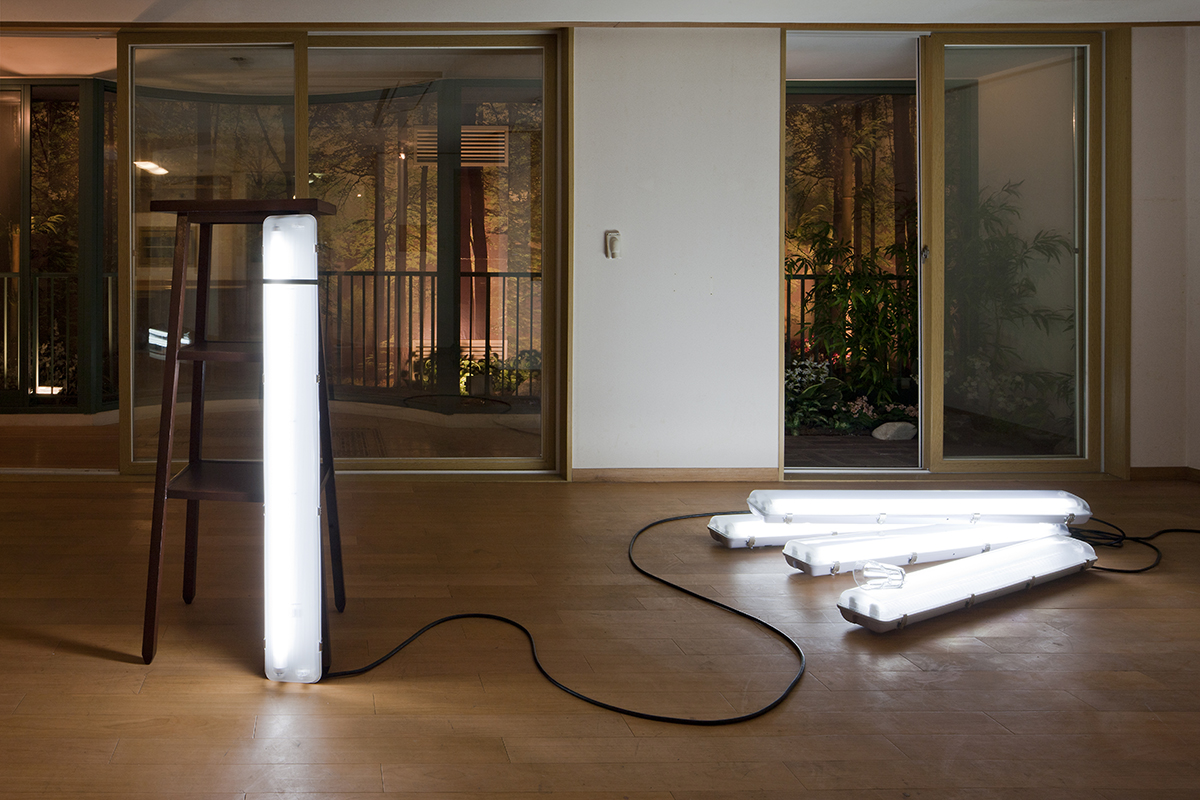
side throughout: “The gallery’s lighting was changed to white, because it made the works look
more ‘languorous’
underneath the pale light. The artist was still disappointed. ‘The fluorescent lighting is fine,’ she
said. The reason was that the yellow light in the gallery made the
sculptures look ‘artistic’
(expensive).” “Making Fun of ‘Sacred Art,’” Weekly Dong-A, Vol.
229, 2000, p. 90.
- Commenting
on The Work Made from Several Tens of Drawings and Some
Sculptures (1994), the artist Chan-kyong Park wrote that “the assemblage of objects is an outcome(display) that is an ‘atmosphere’” and “atmosphere (…) is appropriate to alert
us to the fact that the world where objects exist is ambiguous.” Chan-kyong Park, “Lookout; The Objects
of Chung Seoyoung,” Lookout, Art Sonje
Center, 2000, p. 7.
- Interview
with the artist. Sungwon Kim, On Top of the Table, Please Use
Ordinary Nails with Small Head. Do Not Use Screw, Atelier Hermès, 2007, p.
79.