The
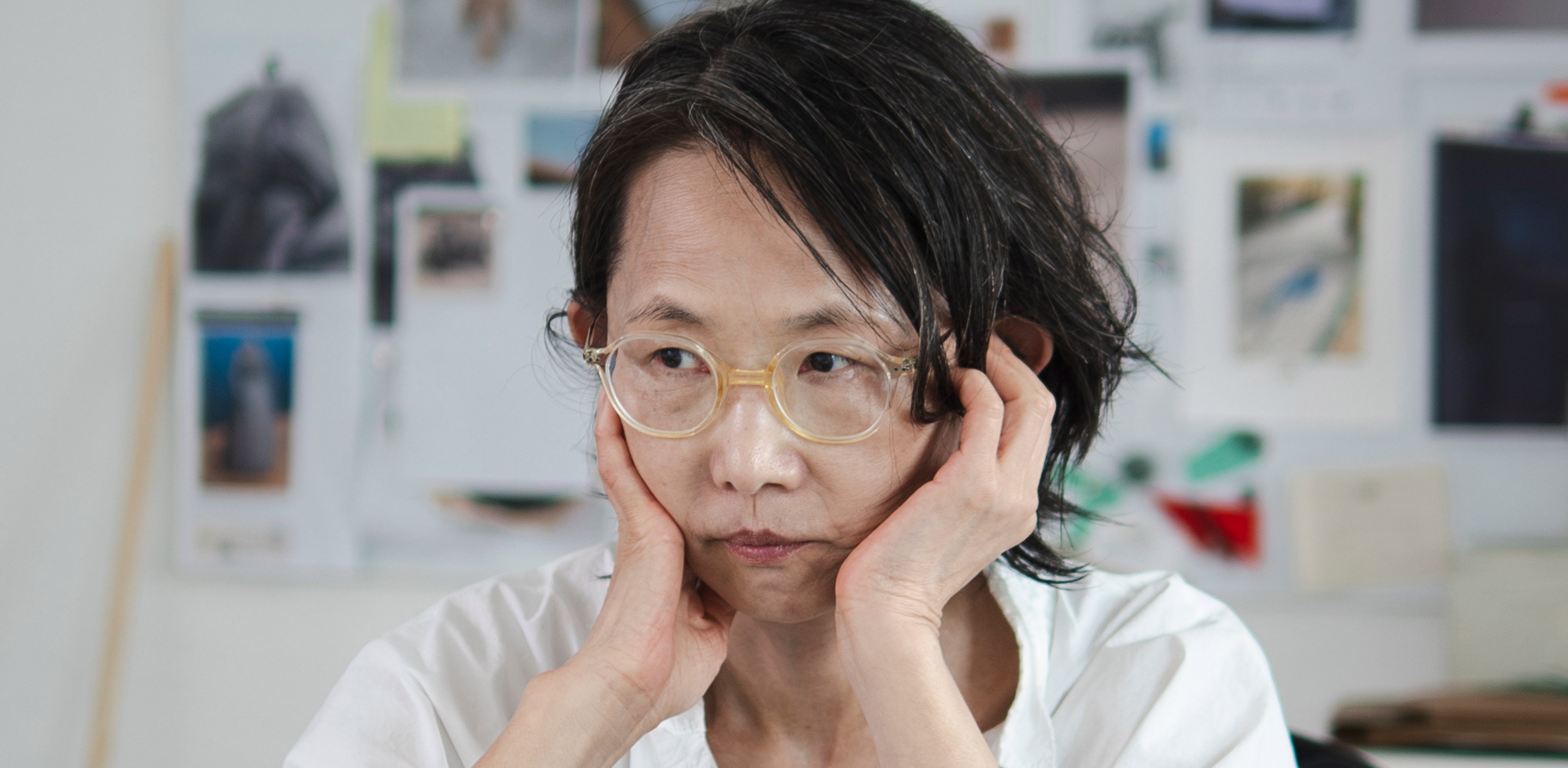
work of Chung Seoyoung asks fundamental questions: Can you do sculpture without
doing it? Is the life of objects independent of the materials from which they
are made? Are the forms and objects made by an artist sensical or absurd? Is
there a correlation between all the objects that exist? Appearing carefully
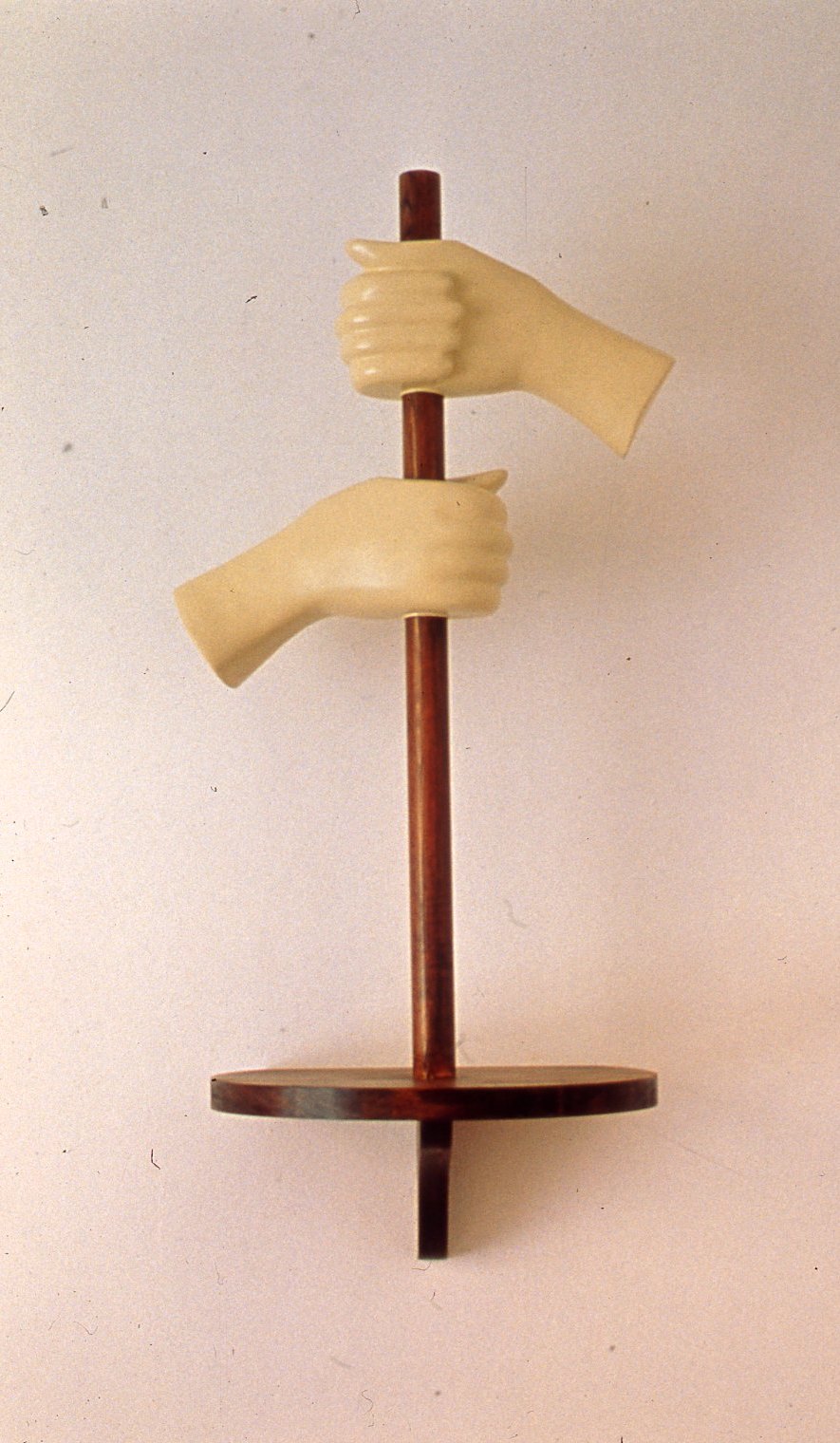
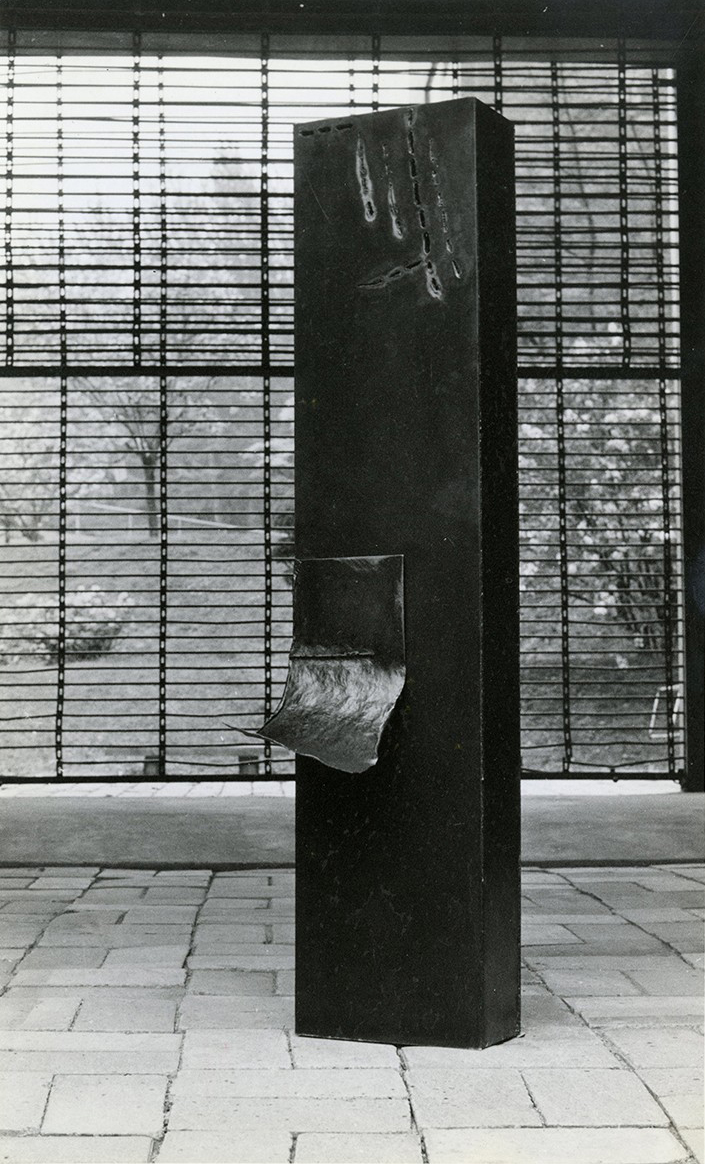
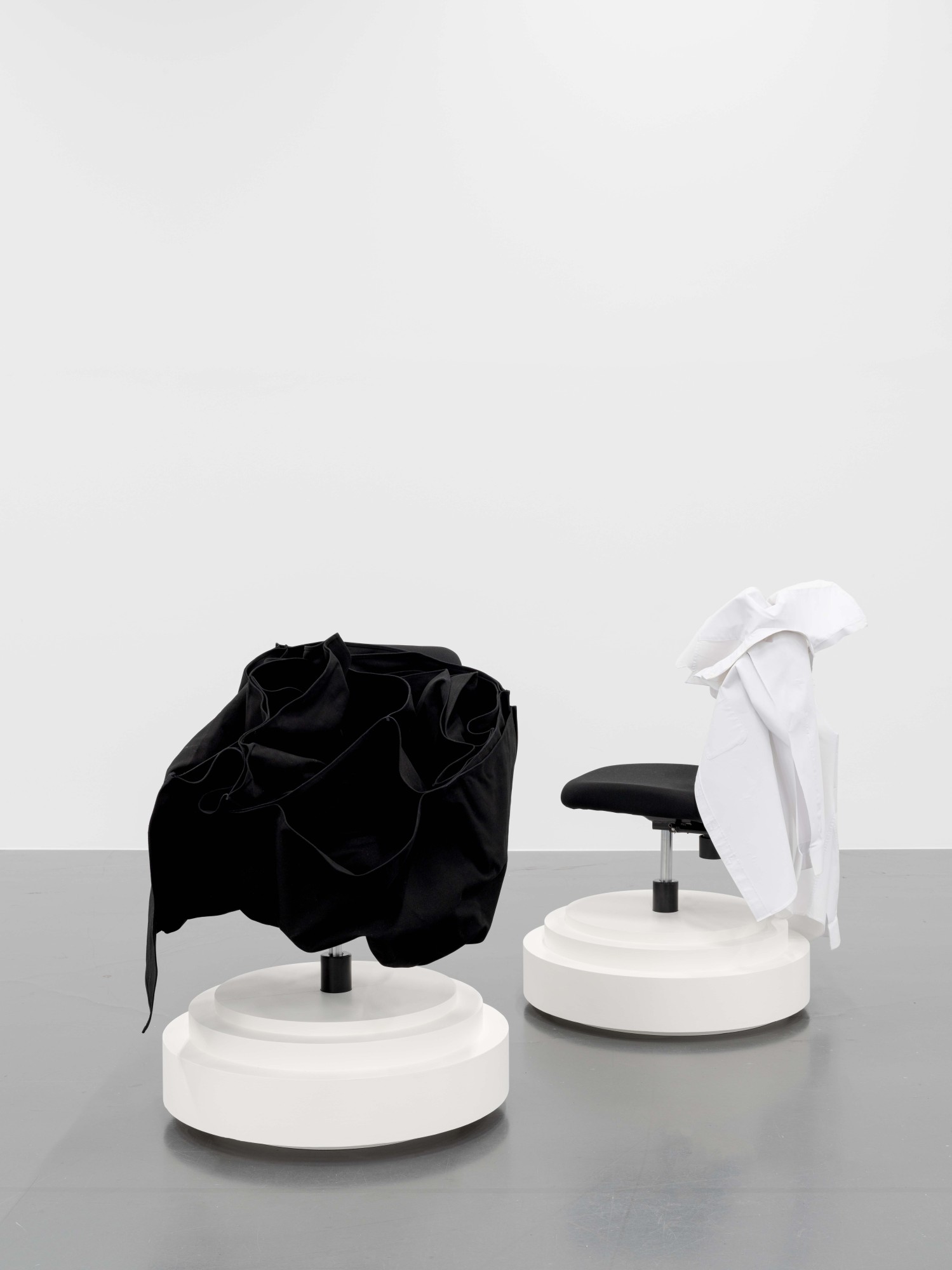
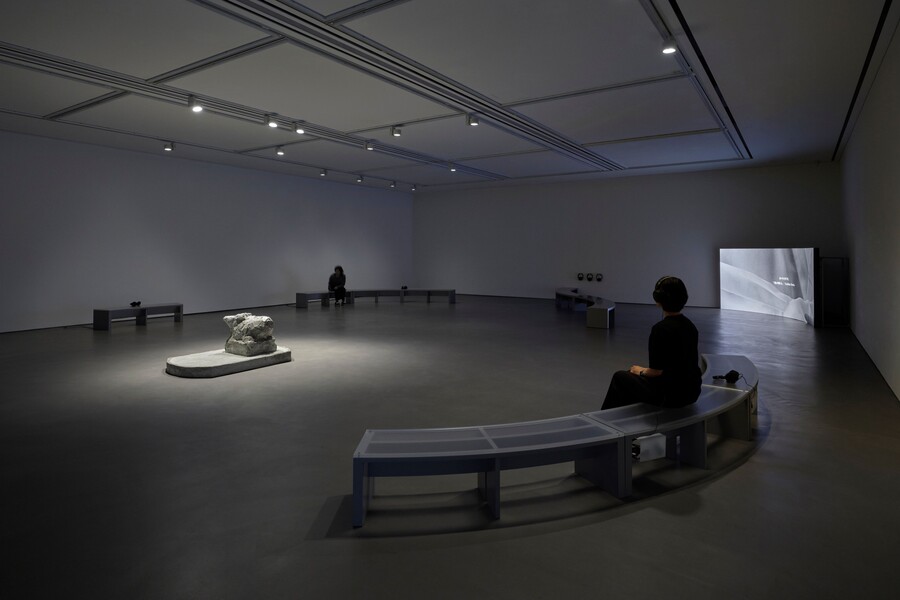
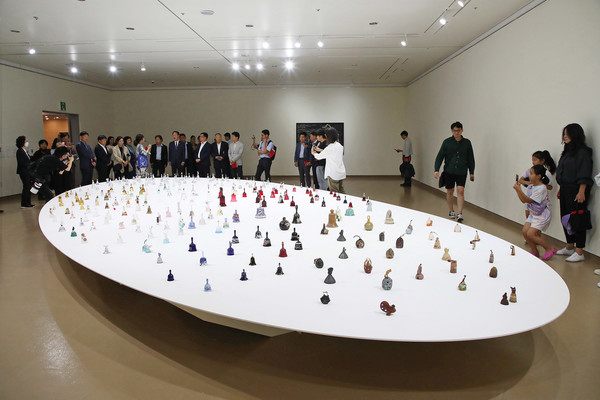
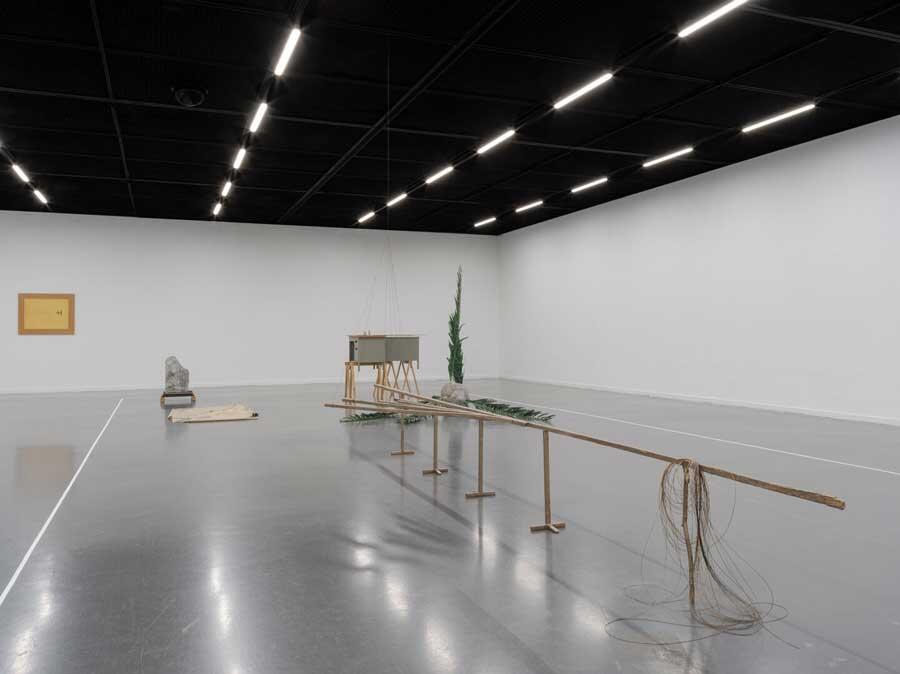
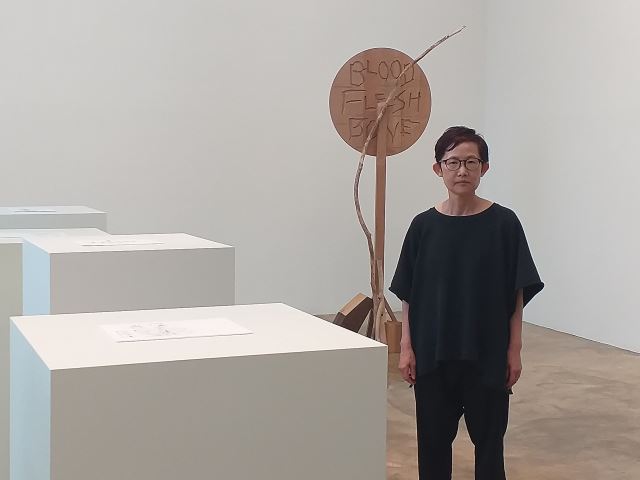
arranged, the thirty-three works presented at the artist’s semi-retrospective What I Saw Today in Seoul Museum of
Art (SeMA) could be seen as much more than an exhibition of her works, but as
an opportunity for all those works to be together and in the de-sublimating
manner of Chung’s philosophy –
activate our senses for future interpretations on objecthood and space in an
environment informed by conspicuous consumption and material cultures. For
instance, despite the artisanry that went into their fabrication, the works
transmit their industrial origins. The exhibition could be seen as a work by
Chung, a piece in which she addresses the mutable sociality of every material
and form she has created over the last three decades.
Figures
becoming forms, forms scaping figures
When
you encounter the work of Chung Seoyoung in the exhibition at SeMA, there is a
noticeable tension between figure and abstraction. The figures and forms of
each work – some of them naturalistic – stay in tension versus the form created by the whole composition of
the exhibition. The “exhibition” is an abstract notion and yet in seeing the works of Chung together
we are under the impression that all the works have long been waiting to be
part of What I Saw Today. It is legitimate to ask: is the exhibition a
work in itself? The way that Chung invites her works into the space possesses a
very powerful eloquence, and, for a second, we are tempted to see all as a new
large-scale installation, a new piece.
The works have found their place in the
space, so it is demanding for us to teach our senses to go back to every work,
to focus on every form, and to analyze the conditions that make each figure
emerge. And in this manner, we understand that for the artist sculpture is the
task of undoing the figure, of undoing sculpture itself. This tension indicates
that there is something else out there an artist needs to get to and that the
act of trying is what constitutes the practice even if one may never reach it.
Yes, the work of Chung implies that the making of sculpture entails a radical
re-positioning of one’s interpretative perspective of
the world we are in. Time; time and materials; time and materials and
experience; time, materials, experience, and thought …
All these dimensions collide in her works. This collision obliges us to start
reflecting.
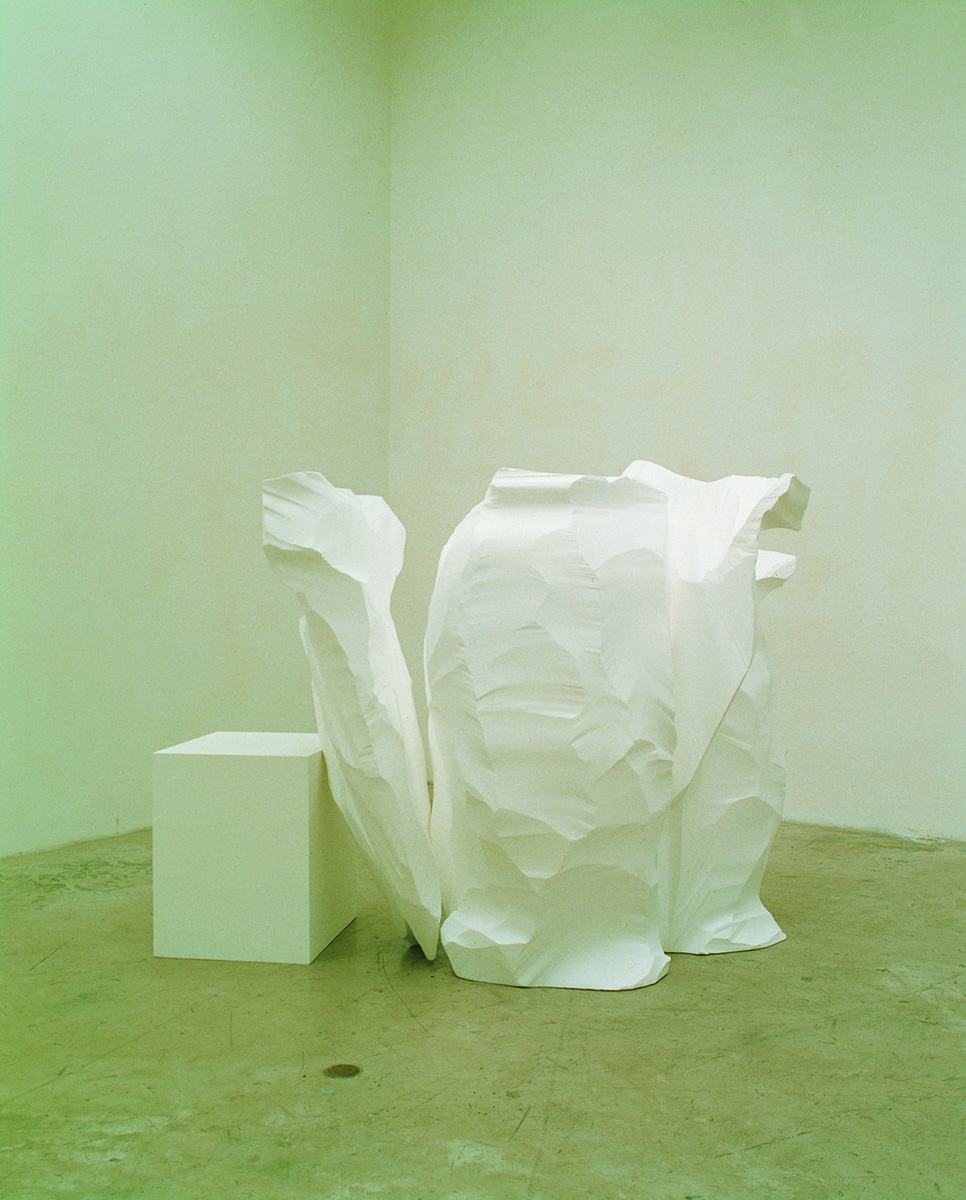
A wonderful way of seeing how Chung Seoyoung works out this tension is in her
work Wave (a remaining part of the installation work Ghost,
Wave, Fire, 1998–2022). The original plasticine work
has been recast into Jesmonite for the solo exhibition What I Saw Today.
How many waves are there in the ocean? Do all waves have a wave form? Or are
they just wind-and-water and, therefore, there is no such form as the form of a
wave? And yet the oceans are inhabited by the figures of waves, trillions of
waves. Wave modeling has been a subject of interest to a vast range of
characters, from ancient painters to oceanographers, mathematicians, and
meteorologists pertaining to both indigenous and coastal communities and
Western scientific ones. Why so? Because a holistic – a
global – state of the sea can often be illumined
through measures of its smallest component: a wave.
A wave, like a flame, has
never the same shape or figure, and therefore it possesses no form. It is only
a transient substance that constantly changes because of the factors that
affect it: the wind, the body mass of the ocean, and the heat in the case of
fire. For that reason, to do a work – a sculpture of a
wave – is like negating sculpture and waves, since for
it to be a wave it needs to be able to continue to change, oscillate, and have
its crest go down to the ocean to come up again, and again, and again. What is
then, the wave? Inside this wave are all the waves and the whole Earth as it
was originally made of clay. But later on, now, it is reproduced with a newly
invented material: Jesmonite, a combination of gypsum (a mineral created from
sedimentary rocks) and water-based acrylic resin. In this sense, this wave
embodies all climate futures, environments, and narratives that nature-culture
created to address the wisdom and miseries of our species in relation to our
planet.
Doing a wave makes us reflect on “limbic” experiences and emotions: experiences and feelings that form a
border around them. In seeing this wave, we want its energy to be maintained
and wish that this individual wave would not disappear into the ocean. This
wish has a primordial function in culture. It relates to our aspiration to keep
control of everything. In this sense, the wave offers us guidance to understand
this emotion and, also, to find a place for it within this work.
Models
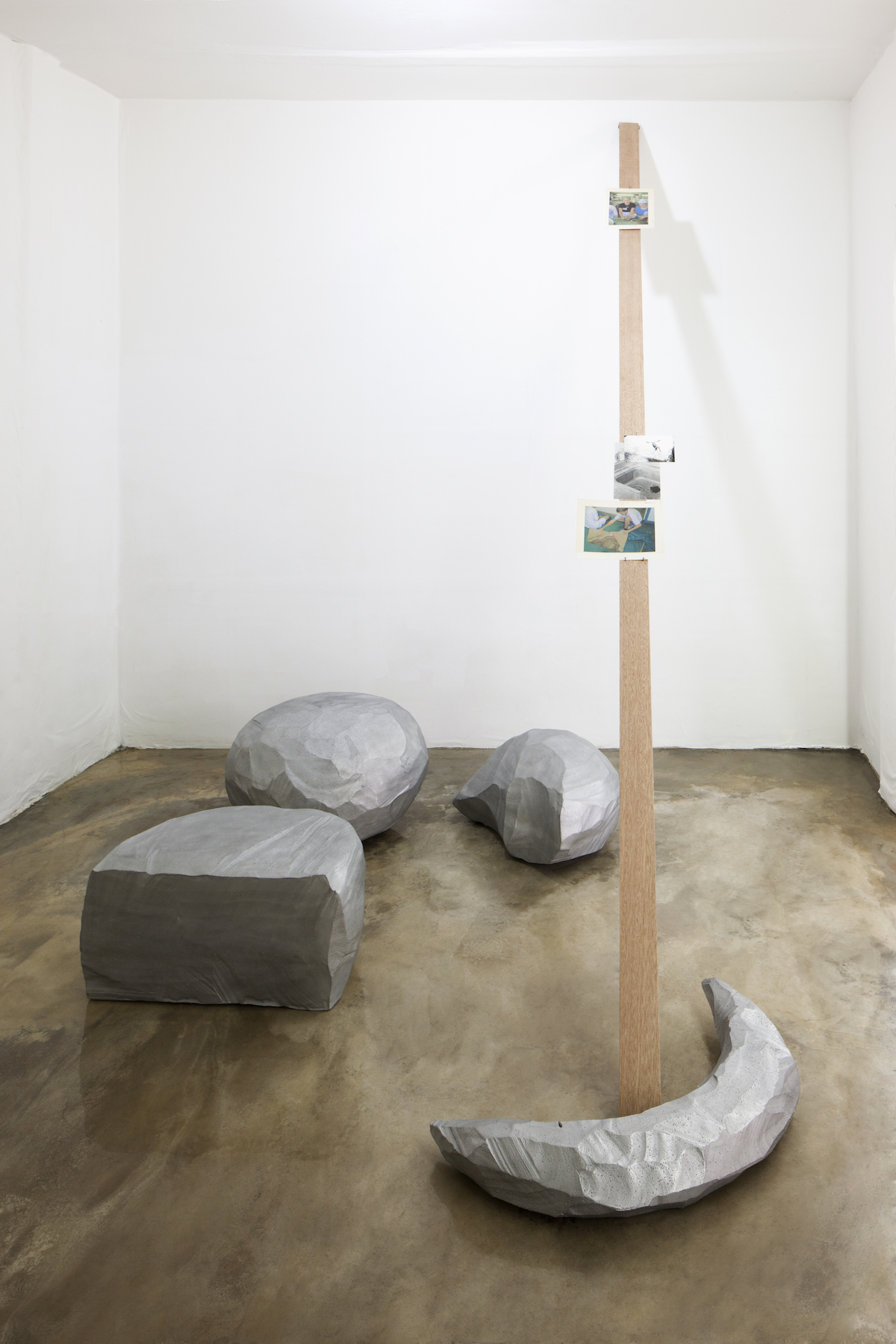
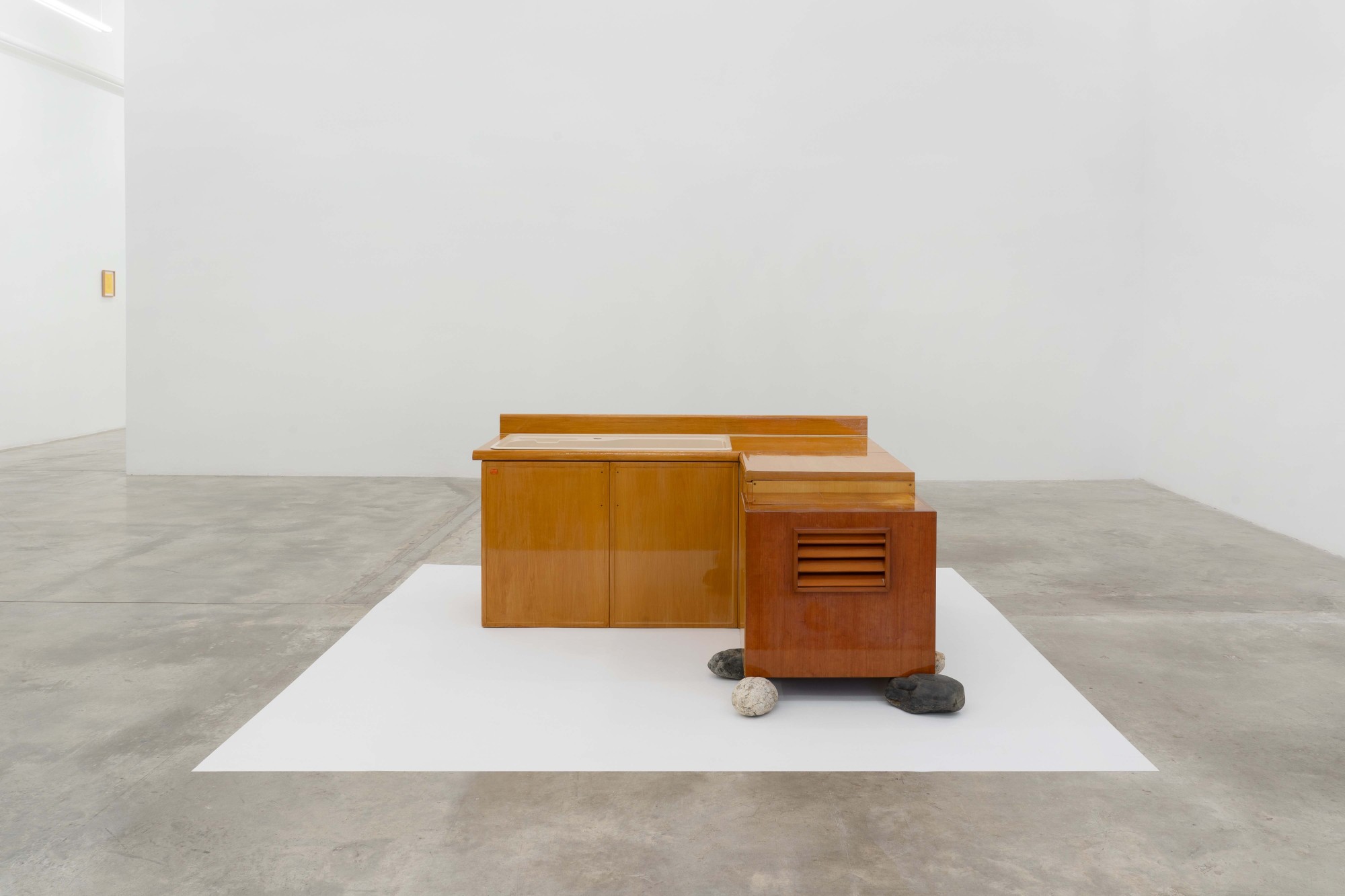
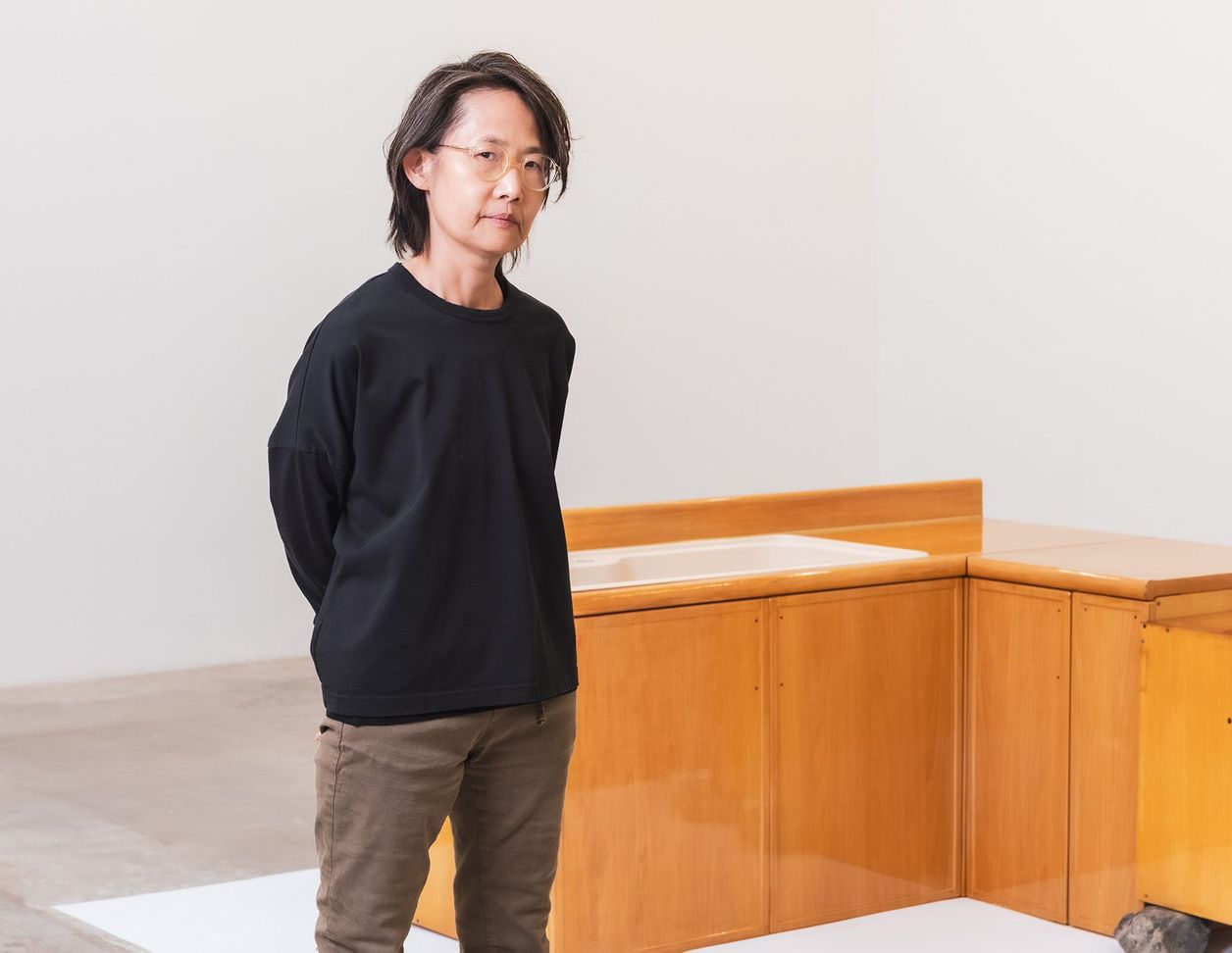
Take Sink, a work from 2011. An existing sink, originally part of a model
house, has now been re-arranged and presented as a work. A part of the piece is
situated on top of four rocks. The question of the model has been haunting
sculpture forever. And the best way to collapse this question of things that
resemble other things is by granting another life to the original things. In
the case of this piece, the question of the model goes into deeper trouble: the
sink belongs to a model house. A model house is a house that shows you how to
use a space exemplarily, it performs the fantasy of the best living practice.
Those spaces not only embody the norms of a certain society but also dramatize
them, creating a scenario for our happy co-existence inside those norms and
values. The space becomes the scenario in which we inscribe ourselves living
there for a few minutes, for a short while. That model sink was a part of this
model living. It was perceived and viewed inside that context of desire, it was
performing a moment of our lives where we wish we could be at home there, using
it, cleaning the plates that feed our loved ones. But it also performs all the
tensions of accepting this invitation and renouncing another life or lives that
have no place in this model place.
Actually, the problem with this sink is not that it is not real enough, but
that it is too real. Models of objects, rooms, and whole houses portray best
practices and uses while, at the same time, embodying a canonical approach to
life in those spaces with those objects. That’s probably why in the second life of this sink, there is a part,
which rests on top of four rocks. Rocks are never models. We only notice this
fact when we see them co-existing with an object produced by humans. A rock is
never a model of another rock or a mountain. Rocks sustaining a part of a model
sink on top are presenting two very different dimensions of time being simply
together.
The sink synchs with culture, with a culturally produced behavior,
with its norms and expectations. The rocks here add to the scene a sense of
time that has nothing to do with the biological time that determines the
finitude of all living creatures. It is true, our worlds lie upon the worlds of
nature and its laws. How many of these living models does a rock remember?
Stones, all through their geological lives, may have witnessed plenty of living
models, plenty of attempts to make matter do what we humans want.
Analogies
Analogies are very present in the working method of Chung Seoyoung (and so is
pain). In The Body in Pain, literary scholar Elaine Scarry begins with an
examination of the pre-articulate and private nature of pain – verbally inexpressible and yet absolutely certain for the one
experiencing it.2 After the pain, victims may offer analogies such as, “it was like a flame,” or “it was like a knife.” Scarry refers here to
the immediate incommunicability of pain as the locus for the destruction of
worlds. The work of Chung Seoyoung seems to see immense potential in the
destruction of worlds – and the pain – originated by fast capitalism. The frequent episodes of economic
collapse and recovery that society has been through leave traces in the social
and material cultures of a given community – and South Korea
is not an exception.
Chung’s work emanates a sense of
responsibility toward this transformation. The question of pain and loss (the
loss of traditions, materials, and ancient knowledge) is replaced with the need
to produce a dynamic method able to act and infuse energy into the materials
that exist under such conditions. The method, at first, is difficult to grasp
because of the subtility of the craftmanship and synthetic arrangement of the
formal elements, but it eventually breaks through, reshaping our perception and
igniting the emergence of other-than-capitalist values and behaviors. This is
one of the main impressions we get from Chung’s
exhibition.
Take, for example, Ice-Cream Refrigerator and Cake
Refrigerator (2007). Both look like ice refrigerators but there is no
point in comparing the actual ones that are in small convenience stores in the
streets of South Korea to the ones in the exhibition. They are simply related,
in pain and painful joy. These forms convey the persuasiveness behind an exploration
of embodied experience from the point of view of the objects, of the material
artifacts that usually contain ice cream: a certain type of capitalistically
produced, sweet happiness. Ice-Cream Refrigerator and Cake
Refrigerator omits the real refrigerator and yet the “real” is immediately perceived as the
obvious foundation of the work, the source, the origin. In her whole practice – so well unfolded in the exhibition What I Saw Today – she induces a discernment on how an “understanding” of a thing can be made by making use of another thing, and how an
understanding of materials works in the same way. And so, she also creates a
flow of shifting emotions from familiar objects and materials to their new
situations and lives.
But another interesting trait of analogies is that they tend to offer
oversimplifications. This is one of the most beautiful characteristics of the
philosophy and epistemology Chung sets at play: in her work, she produces a new
ground for all her objects, an ambiguity, which slowly makes us understand how
she has been through the years freeing her works from the conditions and even
the material culture they stem from.
Rhythms
To Clean Up Once a Year (2007) is a work made of cement and an artificial
plant. It seems at first the product of a surreal dream. Chung Seoyoung’s work can be read as an ongoing process of documentation, which
manifests itself in and through objects. Nature appears here already as a
spectrum, it seems to be here, but it is not. This plant is artificial, and so
is cement. Both entities are made. None of them has their real origin outside
the realm of humans. What is the work documenting? Ways of dealing with
production and how to re-animate dead matter. In the Western Romantic
tradition, one could say that she reaches the possibility of elevating inner
matter into a critical and epistemological realm. But this is through a careful
and deep understanding of the role of rhythm and not formal beauty – like in the Romantic tradition – which is
something that happens in Chung’s work.
Rhythm is a question that defines the relationship we establish with the real.
If the real possesses rhythm, we assume life. If the real is dispossessed of
rhythm, we assume inertness, lifeless matter. However, already around 1800,
poets such as Novalis started doubting this binary. The discourse around rhythm
emerged then to account for matter’s property that
never remains the self-same. For example, biological matter changes every
second – cells divide and even change – without us even noticing. However, over time, changes appear and we
are able to detect that those changes occur sequentially, and rhythmically. But
inorganic matter is also affected by a play of change. This reflection on
rhythm, as a property, which affects all that is around us, creates relations
and forces capable of producing dynamic winds. And these dynamic energies came
late to the world of philosophy.
In the West, French philosopher Gaston
Bachelard, and later Henri Lefebvre, were the first to pay attention to the
concept of rhythm, a notion important to understand time in a philosophical
context.3 Rhythm slowly arose as a concept different from duration.
Rhythm presents time not only as a continuous state but also as that which
contains tension perceivable when certain discontinuities appear. In Chung’s practice, a material that exists and has a life outside of art is
suddenly used to produce a work of art. Here its continuous life as an
industrial material, for example, is disrupted and another life, which embeds
another sense of time, emerges. The artist’s
methodology adds to the temporal life of normal matter the symbolic dimension
of time that art embodies. Her works reflect those temporal tensions.
Time is not seen as a fact, as a calm flow, or as a continuous state, which
simply happens to us or to things. Time in Chung’s
practice and works is the result of an infinite oscillation between continuity
and discontinuity that happens inside a work. Rhythm helps us to understand
that inorganic matter is sensitive to the specific connections an artist
establishes with it in giving it a form, giving it a place in the world, in
relating the work with other works – like in the case
of an exhibition such as What I Saw Today. We can say that rhythm makes us
aware that life is not a condition of organic beings, of biology, but a
condition we share with all that exists in the world. In the work of Chung
Seoyoung, rhythm, dynamic energies, and a non-static experience of the real are
very present. The work reminds us that not only humans are conscious of the
existence of things, of an object. But also, objects know about the life they
have been living in, about the contexts they have been exposed to.4
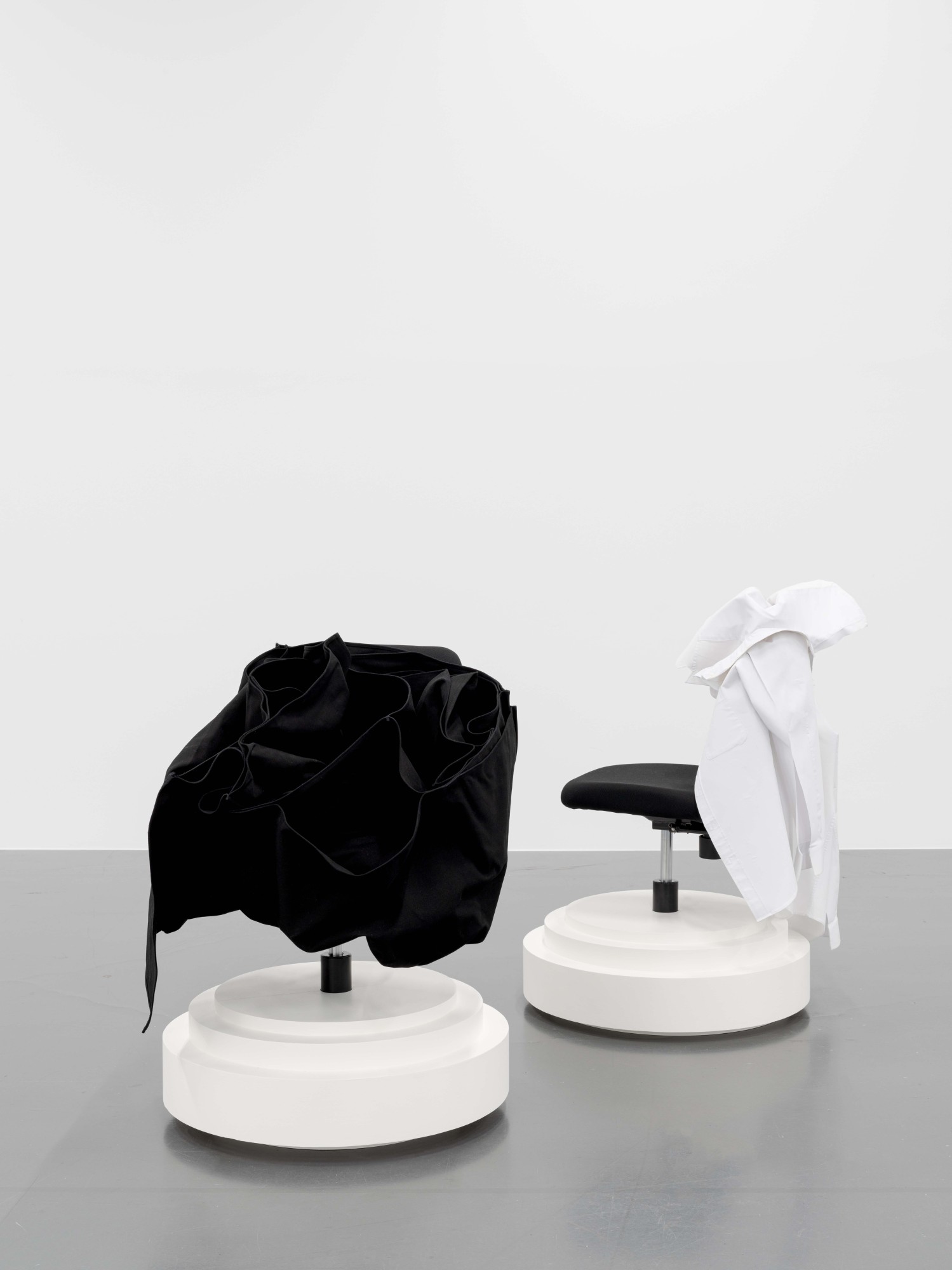
The Time Is Now (2012), where desks are placed (or displaced) on four
wooden trestles and several pieces of wood assist in keeping the balance
between these elements. A working desk, a desk where you were supposed to sit
down and work. On top of the desks, is a large sheet of glass, and below, the
trestles. A desk’s function
cannot be performed. The desk is synchronized with the thousands of desks at
which the desk workers of the world work. Now, one cannot perform. It is still
a desk, but more of a ballerina elevated in the air with the simple help of
those thin wooden legs. Up in the air, it can probably observe other desks
occupied by all those humans sitting in front for long hours. Desks and Fordist
capitalism are the subjects of many books, but I would say, a desk elevated
like this deserves a poem.
A desk on wooden legs exposes the contrast between
the desks oriented to support production in large-scale Fordist factories
versus the studio and home desks supporting creative labor. And so, one can say
desks also speak about male versus female work. Desks are gender markers. While
adult men have entered the factories en masse, only a small proportion of women
did so. The desk surface is the flat scenario of a social conflict, of a
specific form of labor that stays in opposition to field labor, unpaid domestic
labor, and the creative tasks performed on the tables of the studio by an
artist.
Fires
– and the imagination of matter
Campfire, a work from 2005, portrays a fire in the color blue. Fire is orange
and red and yellow and blue. But here, it is only blue. Could fire imagine
itself being different from what we believe it is? Fire, like water, belongs to
the elements that, in simple terms, explain the materiality of Earth. The work
of Chung Seoyoung is both philosophical and embodying poetics: while her works
demonstrate the need for systematization associated with rational thought, she
also insists on the collapse of any system in the face of an infinite richness
of experience. And experience is here to be understood as a deep experience,
one that is not satisfied on the surface of perception. Her notion of
experience demands an attempt to circumscribe existence with a profound
imagination – imbued with poetic experience – that transcends an individual imagination of a subject. That’s why the fire is blue. The birth of fire in human history as well
as the constant analogies of the libidinal components represented by fire gain
here an almost comic-like, humorous dimension: a blue, bubble-formed campfire.
Campfires are associated with youth culture, a certain moment in life in which
the mastery of fire is associated with the impulse to urinate on the flame to
extinguish it.
Like in many other works, Campfire becomes an opportunity for a
creative daydream where our mind oscillates between different possibilities and
scenarios the pieces may emerge from. A campfire is a primordial fire, the
first fire that ever gave … She first activates our
desire to “bracket” the work
and see it as alone, unique, and separated from her other works; then she
awakes in us the aspiration to apprehend its entirety inside her whole
practice. This calculated method could be called: the awakening of the creative
epiphany of an image. Chung’s poetics result from her
cross-fertilization of the general epistemologies at work in common objects
onto her metaphysic of the imagination of materials. Chung does imagine matter
imagining, dreaming, willing, and wanting. Matter is transformed not only by
industries or artists but also by itself. Matter possesses agency and this is
the energy that she rescues and channels in all her wonderful works.
Airy
solids
Words in the Flesh (2022) is a work on the floor where salt and wood glue
are directly applied to create a salt stain. Salt remains in the absence of
water, and yet we cannot but think of water when we see the piece. I once heard
marine biologist Diva Amon praising the centrality of salt in all creatures’ life.5 Salt is a mineral that entered the history of human life
since we are unable to live without it and yet salt water, like in this work by
Chung Seoyoung, is like the ocean, which can never be a source to calm our
thirst. Salt routes, salt mines, salt rituals, and salt religions – it is impossible not to think, at least for a moment, about all
those dimensions. Yet this piece – probably because of
its nearness to another work that is made of stainless steel wire, An
Ordinary Day (2022) – refers less to nature and
more to the possibility of adding a mineral layer to the exhibition. It gives
the impression of a leak, an accident, a pipe or an infrastructure unable to
perform causing an undesired trace on the floor. A trace always makes us go on
in our minds and create a story around their presence. Think about animal
tracks: when we see the paws on the ground of a field or the snow, we
immediately wonder about when. When was the animal there? When did the water
abandon the ground allowing the salt to remain seen?
This work will never
happen again in the same manner. It has a past and a future that will always be
different. Our mind, though, is very limited and cannot follow all these
processes with a vivid and detailed imagination of the many becomings the work
went through till it was dried and fixed to the floor. Our perception tends to
produce an isolated consciousness of processes and reduce change to a stable
form or state. We assume the important element of this work is salt – and glue – but it may be water that is
crucial, although is now absent. The relationship between what is there – and the random form salt and glue adopted on the floor – and what is not there forms the myth in this work. The myth is
always a story that reflects and revolves around the possibility of something
missing to return. A disappearance – here simply water,
one of the most fundamental elements of all that exists – can be imagined to return just in seeing the salt flakes on the
floor.
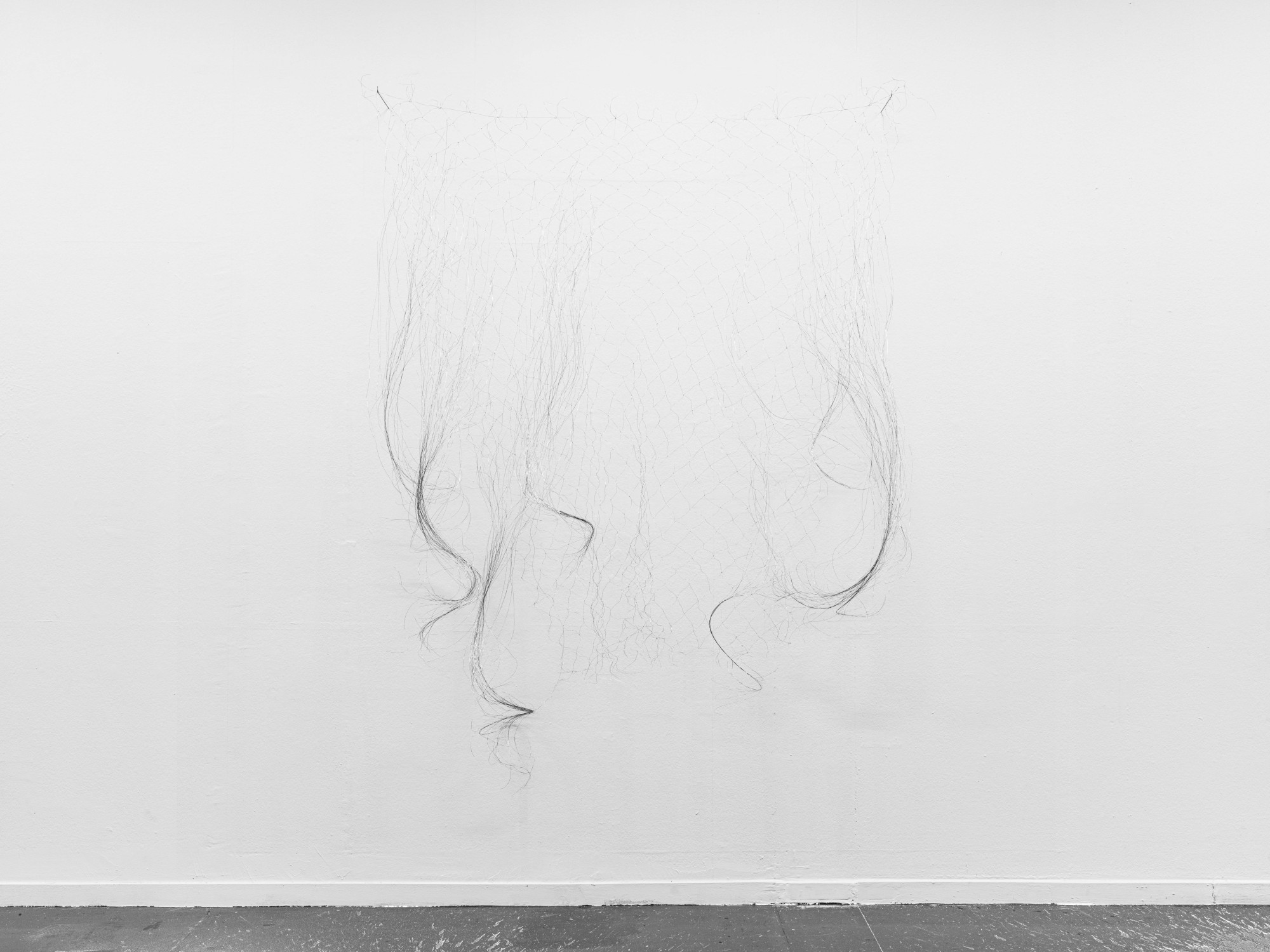
And talking about the creation of mythical energies, near that piece, hanging
from the wall is the work An Ordinary Day, made in stainless steel wire.
Steel wire carefully hand-produced poses a difficulty to vision. It is visible
but its faint color and material against the whiteness of the exhibition space
and the air pose difficulties for our eyes to fully grasp the details of the
piece. Like the salt on the floor, its form seems eager to escape our efforts
to fully retain it in our minds. Steel wire is solid, its form will not so
easily change, like salt. But An Ordinary Day leaves us under the
impression that every single thread has been separated from the steel plate in
a very laborious way, turning the original plate into hair, breaking the
continuous metal surface into single fibers as if they were combed and ready
for a future spinning. A material suddenly reminds us of something else, as if
metal could forget itself and become wool … Forming
presence is forming absence. This way we expand our imagination of the work
because we see more than what is there. Also, memory stops being a passive
function that recalls a past or a fact. Memory actively reconstructs the state
of the piece before the piece took its actual form, a stain of salt, a bundle
of wire. The game between the work and non-work makes us realize that the
non-piece comes into being through disappearance.
Organs
Carl
Sagan said, “The brain is like a muscle.”6 If we accept that premise, we would need to find a bone to
give that muscle support. Chung Seoyoung has built that bone through her very
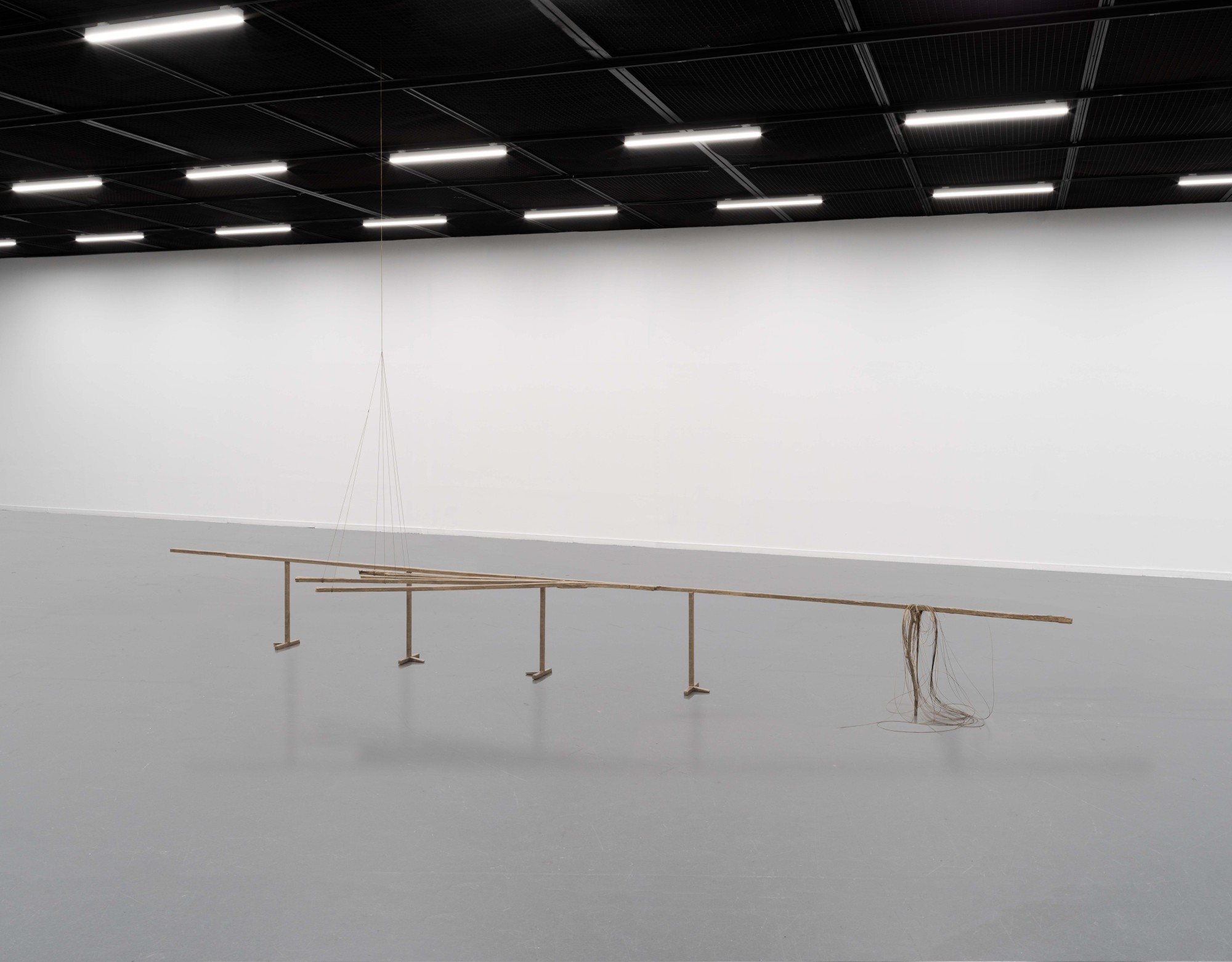
recent work, A Bone in the Brain (2022). First, it was an ensemble of
thin wood, nothing very solid, nothing very permanent. A form that reminds one
a little of a tree, or a plant. Then, that wood structure was transferred into
bronze, gaining a different strength. It brings to mind a ballet barre, at
first sight. Thinking about it, this image goes well with the title, A Bone
in the Brain. The barre was invented to support dancers performing a series of
protocol movements to discipline their bodies and posture. It is known as the
instrument that trains inexperienced dancers in the art of balance.
However, this barre, this thin, almost improvised, tree-like trunk
needs assistance itself since five branch-like arms have grown out of it. The
bodily expansion may have been an ambitious move, as it puts the entire work’s balance at risk.
And, indeed, the five branches are attached to
wires that connect to the ceiling to avoid the piece from losing its stability
and falling. Some extra wire is hanging at one end of the sculpture, as if more
wire assistance may be required in the near future. On one hand, the golden
patina of the piece somehow surprises us. The gold undertones a sense of
lightness, and also, warmth. As if the whole trial –
pursuing to give the brain a bone – was something that
could be realized with very simple means. But the golden color adds a symbolic
resonance: it refers to the material we know, wood, but now that it is
transferred in bronze with a golden patina it transcends its original precarity
and emanates durability. The piece has been self-accomplished in finding this
form after a long search.
Stand in the Middle, Lie Down in the Middle, Open the Middle, Go Out, and Never
Come Back (2022) is a piece of vegan leather folded on the floor. Like the
bone for the brain, here we are reminded of the skin. A skin made of inorganic
material, the same manner in which intelligence can be made of artificial
matter. As a form, it is neither organic nor mechanical. It is simple, and yet,
very difficult to formally describe. Words do not stay easily with this one.
This way, the work effectively delivers a forceful blow to the minimal
aesthetics. It resembles an accident or the remains of an action, which ended
up leaving behind this material as a trace. All through her work, Chung
Seoyoung has shown an incredible understanding of the life of materials.
Industry develops and uses materials that we then consume. Then, when these
materials are used in art, they are subject to a complex and paradoxical
judgment. They express the industrial reality they originate in, but due to
this, they may be perceived as in-noble.
Chung’s
epistemology of matter finds a place and role for all the materials she
encounters. Art gains in her practice the role of being compassionate with
materials otherwise excluded from a traditional understanding of sculpture. The
culturally formed materials are given a second life when she unforms their
cultural identity to create a work. To put it another way, the industry puts
materials at work, giving them a role, an aim, a function. And Chung puts the
materials to sleep. Like this piece – Stand in the
Middle, Lie Down in the Middle, Open the Middle, Go Out, and Never Come
Back – she allows it to just stand, lie, open the
center of the space for us, and disappear.
In such a way, her new works seem to contrast human intellectuality against
disappearance. It is as if the “weightiness” of earlier works that are very present in the exhibition is now
entering a new phase. Through the interaction between the condensed display
of What I Saw Today and its fluid spatial layout, we understand even
better this transition towards lightness and ease that liquidate the more
restrictive mechanisms of the conscious present in the earlier works. Indeed,
trying to control the real, and the materials that conform to it or the
determinative behaviors of certain practices, is not the aim of Chung’s work. But certainly, the work wants us to gain a sensibility to
observe and be aware of the processes that nourish our everyday lives, and
eventually – with training and time – achieve an almost unconscious ability, which could allow us to
co-exist with all that surrounds us.
What I Saw Today is therefore not a retrospective of Chung Seoyoung’s practice. It is an incredible opportunity to actualize all the
exhibited works at once and create a present moment –
an eternal today – for all the works and us. This today
needs to be taken very seriously as it cannot be swallowed by a “past,” any nostalgic impulse to think of the
decades behind or an escapist mood that sends the pieces into a near future. We
need to stay in the present. Facing the work this way, it transmits an
understanding of the multiple times they contain, and further gains a
transcendent energy. Within this community of works in the exhibition, we learn
to distinguish between observable and unobservable phenomena, as well as acquire
an epistemic bearing of observational evidence both in life and art. At once,
these two realms become intertwined. And so, through her work, we become more
capable of interpreting the world around us.
Chus
Martínez is currently the head of the Institute Art Gender Nature at the FHNW
Academy of Art and Design, Basel, where she also runs the lnstitute’s exhibition space Der Tank. Previously Martínez was the Chief
Curator at El Museo del Barrio, New York, and MACBA, Barcelona, and Head of
Department at dOCUMENTA (13). Recent publications are Like This. Natural
Intelligence As Seen by Art (Hatje Cantz Verlag, 2022); The Wild Book
of Inventions (Sternberg Press, 2020), Corona Tales. Let Life Happen
to You (Lenz, 2021).
- This
is a famous quote by poet Paul Celan (1920–1970).
- Elaine
Scany, The Body in Pain (New York: Oxford University Press,
1985).
- Gaston
Bachelard, La dialectique de la durée (Paris: Boivin et
Compagnie éditeurs, 1936); Henri Lefebvre, Rhythmanalysis: Space, Time, and Everyday
Life (London, New York: Bloomsbury Academic, An Imprint of Bloomsbury
Publishing Pic, 2004).
- I put
“know” in italics because it is a relative “knowing.” Objects do not have a mind, but many theories have been
developing in the last decades addressing consciousness as not only a
neuronal process, panpsychism, for example. It is not relevant here to go
into detail and yet it is important to note that a significant aspect of Chung Seoyoung’s work is to subtly make us reflect on the complex dynamics,
which define our interaction with matter and things in the world. Dynamics that defy commonsensical ideas of time and perception
moving away from evolutionary biology and coming closer to quantum
physics.
- Diva
Amon, panel discussion “Promoting
and Protecting a Healthy Ocean,” in person, Our
Ocean 2019, Oslo, 2019.
- Carl
Sagan, Broca’s Brain:
Reflections on the Romance of Science (New York: Random House, 1979),
14.