Chung
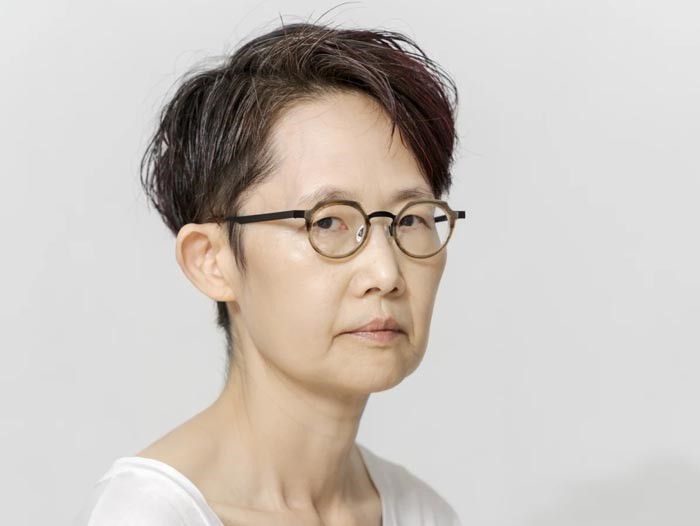
Seoyoung has always introduced herself as a sculptor, but the language required
to read her sculptures is far from those prescribed to modernist works of art.
It is the language of “objects,” above all else. Pedestals have been removed. The abstract form – considered thus far to represent the spirit of the subject – was replaced by relatively familiar objects, but these hardly
generated a storytelling that exceeded their own existence. When Chung started
to work as an artist during the mid-1990s, art biennales, among other indices
of globalization, began to be imported into the South Korean art world.
Interest in different forms of media also increased; these were given such
titles as installation and media art, whereas the realism of the 1980s had reached
its exhaustion point and become subject to the historicist demand to reinvent
the workings of politics in art.
In the midst of these transformations, on the
other hand, Chung’s objects remained silent. As
globally-minded curators traveled across regions to mobilize artworks for
historical retrospection, Chung’s objects refused to
create a single narrative that dramatized her temporal and spatial biography.
Even as artists lusting for the global network started to tinker with the image
as a symbol of lightness and fluidity – at the expense
of the object’s fixity – Chung’s sculptures continued to occupy space with their characteristic
obstinacy. It was impossible to attribute a specific territory to her objects,
but more so to inscribe the concurrent program of deterritorialization in
contemporary art.
The difficulty of assigning a territory is one explanation of the lack of
discursive engagement with Chung Seoyoung’s works in
the context of the post-1990s South Korean art. It is undeniable that Chung’s acumen has inspired her colleagues, curators, and artists of the
following generations alike. Familiar thematics like “history” and “identity,”
however, failed to find space in her works, nor did she let her works spiral
down the capitalist vortex. Her silence gave rise to misapprehensions:
particularly in the face of the imperatives for “meaning” and “narrative”
typical in contemporary art, her works were understood as submitting to a
certain kind of autonomy while also betraying the autonomy of modernist
sculpture. In curator Kim Hyunjin’s words, her works “do not subordinate objects to the meaning of words but instead
return to the objects themselves.”2
Upon considering how Chung’s objects do not extend themselves onto the worldly realm of
contextualization, one could interpret that their linguistic meanings close
down to the objects themselves. Yet this interpretation is not equivalent to
recovering the overlooked or suppressed sovereignty of objects. If art has
perpetrated the violence of trapping objects at the polar opposite of the human’s meaning-making status, Chung’s objects
hardly subvert. It is true that meanings in her objects refuse to be fixed, but
such refusal does not necessarily lead to the deconstruction or subversion of
the system of meanings. As a consequence, bodies that engage with Chung’s sculpture do not belong to the sphere of pure phenomenological
experiences untainted by language. Objects cannot stay forever under the aegis
of meanings, but that does not mean that they never manifest in our
consciousness as an idea. Chung always treated objects as if she were seeing
them for the first time; she also called the objects “something
[she] encounters one day.” At the same time, she deemed
the objects a space “to inscribe values subconsciously
yet inevitably,” that is, to “project.” This project was of course not a political one that restores the
sovereignty of things, but neither did she take things as a space to manifest
the unconscious. Rather, it implied a “tension of
thought” to the extent that she herself called the
process “antinomic.”³
Consisting of objects that were closed off to the objects themselves, Chung
Seoyoung’s sculptures also aroused critics’ desire to place them among various art historical terms. One
instance is to consider her works as “consciously
distancing from the art’s social turn,” that her project is that of “gazing back at
modernism” or “existing within
the language of modernist sculpture.”³ As such, even though it was apparent that Chung’s sculpture belonged to neither pure autonomy nor its exterior, some
did stand for the former. Others attempted to push the language of autonomy
further by claiming that her work does not simply “exist
within the sculptural language” but walks outside only
to trudge back. Curator Kim Jang Un writes,
“[Chung
Seoyoung] constantly reverts back to sculpture” by “deconstructing the historical weight of sculpture and reducing it to
an object, but it is then presented with the grammar of sculpture.”4 Whether it stays within the language of sculpture or goes
outside via the object and returns, Chung’s sculpture was considered to operate as an insurmountable “specter,” or that which pulls back the
objects’ attempts at transcendence to the point of
origin.
However, what Chung Seoyoung’s objects wanted to reject
was the “illusion” or the “virtual” which modernist sculptures
attempted to generate. As her sculptures straddled tight binaries between
silence and articulation of meanings, and even as they floated a strand of
ideas between those binaries, her objects allowed no other meanings than their
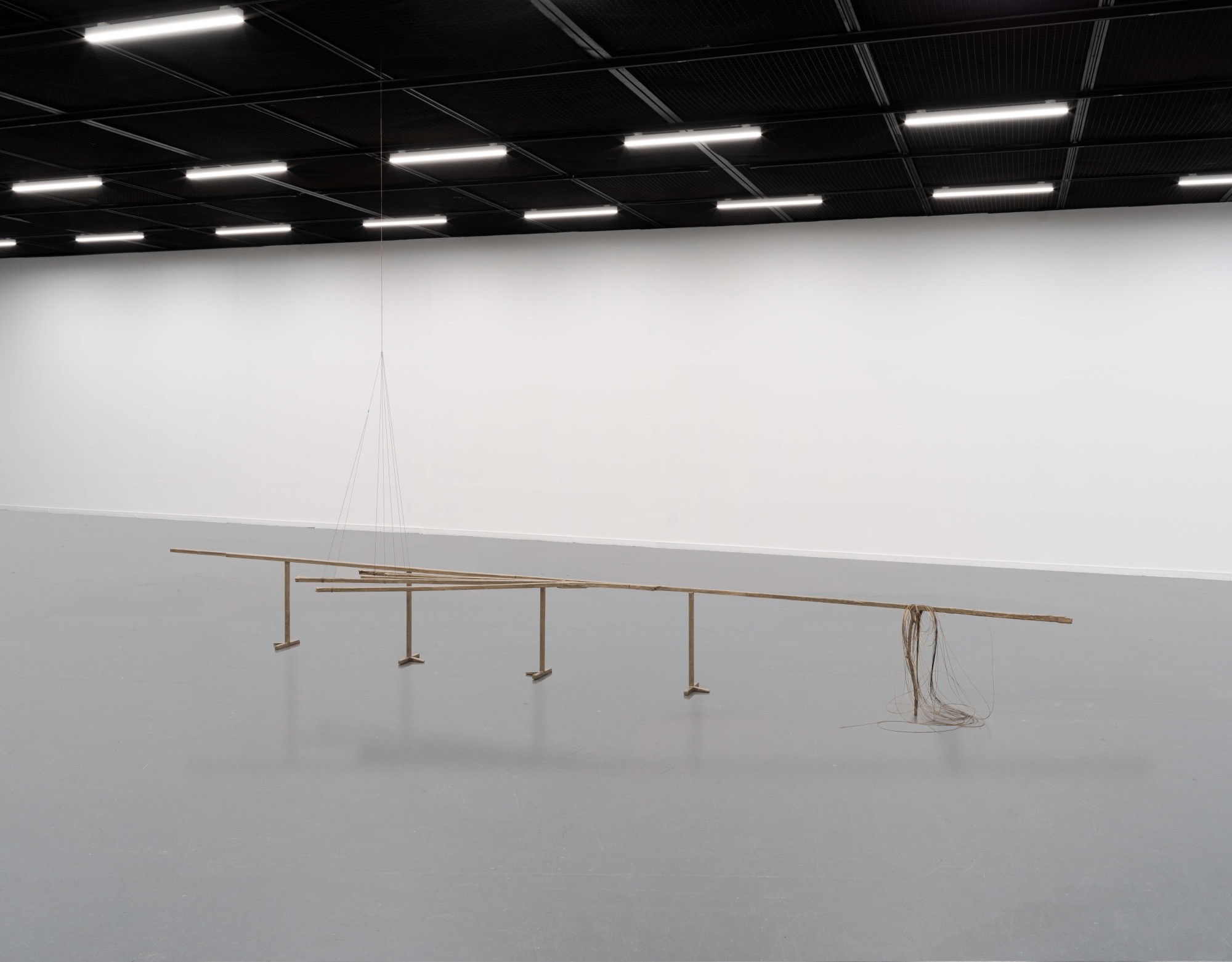
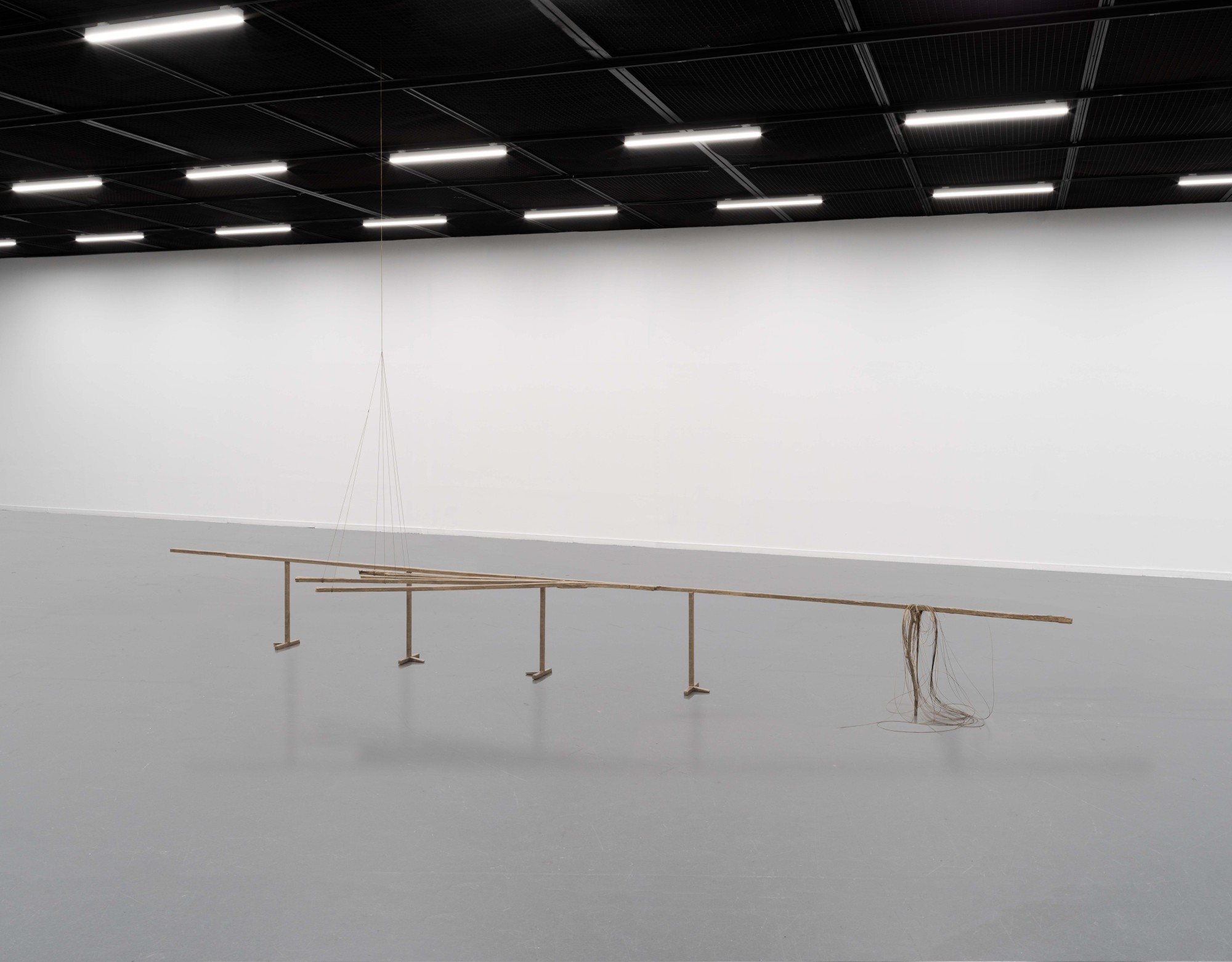
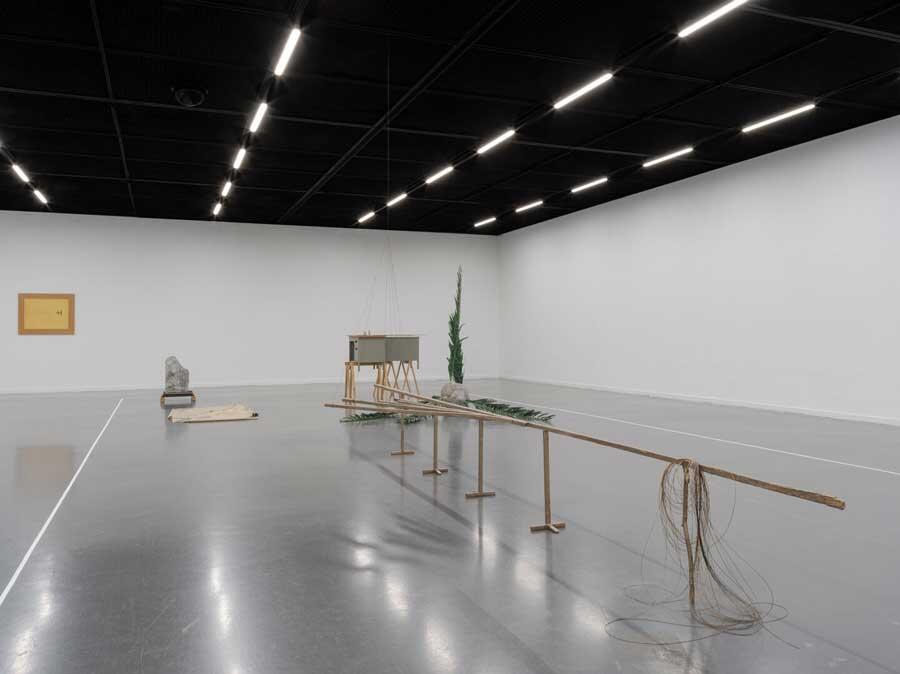
functions. One of her works, Lookout (1999), is an observatory just enough to
allow an outward gaze; Gatehouse (2000) is a security guard’s desk just enough to allow a certain surveilling gaze at the
viewer. Park Chan-kyong calls her objects “functionally
identical”: “what [Chung’s works] imitate is not the objects themselves but their functions,
or their proximity with bodies, both of which could be said to lie at the core
of all objects. Carpets and linoleum are nothing more than flooring; the
lookout does nothing but observe; flowers only decorate.”5
It is this sheer functionality that lies behind Chung’s decisions not to use pedestals or dramatic lighting, stripping
their attendant authority. Through this process, the artist takes her sculpture
from the transcendental or symbolic back to the experiential – that is, where bodies exist, encounter, or collide here and now.
Despite existing and functioning in the present, Chung Seoyoung’s objects seem to be taking a few steps back. They are definitely
not heading to modernist sculpture’s place of illusion,
but there nevertheless seems to be one more layer of sensibility between
spectator and object, something that exceeds the proximity with bodies. Chung
once explained the process of making the Lookout: it all started when she held
a certain postcard. It was from a friend on vacation, and it had “a picture of a Nordic swimming pool in the 70s style” with an “image of a fingernail-sized
observatory printed at one corner.” Her sculpture, in
this case, was in the middle of the process of pulling the miniscule observatory
into physical space.
Far from being a “lookout on a
palm” or “some far away
lookout,” it was a lookout that “creates a position of a certain physical distance from [herself].”6 Here, the “lookout on a
palm” might be what the artist encountered when holding
the postcard, which could be owned in the form of an image. The “some far away lookout” could likewise be an
image – in other words, more of an idea than a reality.
The observatory that Chung wanted after all was not the product or idea but the
“real.” As Park writes, this
urge for the real is what lies behind the artist’s
choice to produce the proximity with bodies by letting her sculpture imitate
the function of objects.
Chung’s sculpture does not merely carry out the work of
bringing images back into reality. She did not want the lookout to stay as an
image, but neither did she readily yield it as a part of reality. This twofold
hesitation might also be called the constant physical distance from herself.
Regarding her decision about the size of the observatory, she responded as
follows:
The
decision about the size of the lookout, in fact, reflects my worldview towards
this object. The most important thing is the moment, or the chance encounter
with this lookout that has flown to me from an irrelevant time and space – Northern Europe of the 70s – as a postcard.7
Here,
the artist is underscoring the importance of the moment of encounter with an
image. In other words, the desire to operate and function in reality – rather than as a product or idea – demands
an additional layer of sensibility in reading Chung’s
sculptural work. The artist attempted to overcome the lookout’s state as an image by turning it into a sculpture, yet this attempt
was via a serendipitous encounter with an image. As the artist acknowledged,
this paradox, through which the negation of image leads to the preservation of
the state of an image, could stem from its scale. The lookout is equipped with
four legs for stability in addition to a ladder to look out at the view. As
such, by imitating the object in ways that are faithful to its function, the
sculptural form brings back the promise of proximity to the subject’s body. While forming this corporeal relationship, however, Chung’s lookout pushes away the subject’s position
through scale. The scale, to elaborate, seems to be decided while hovering between
observability as a statement or question.
Also pertinent is the material choice. Chung’s lookout
is made with only wood; the structure’s simplicity
hinders the work from extending its meaning beyond the sheer act of looking
afar. The wooden lines, varying in width and length, do nothing but erect a
structure that observes. At the same time, it is that same simplicity that
magnifies the sensibility of minute differences slightly out of tune. The
window of the lookout, which faces the sculpture’s negative
space, is not made of wood but of glass, and the light of the surrounding space
is both refracted and inscribed on its surface. If the glass window is where
the negative space and sculpture correspond in the present, the wooden frame
absorbs light into its body and generates a difference of relative senses. This
difference in the material – and its attitude towards
light – gently pushes the observatory to face the here
and now. It further hinders the sculptural body from stepping on the ground
against gravity and pulls it back into the state of an image.
The
scale in Chung’s sculpture pulls the
object back to the state of an image, yet this scale is not just a matter
between the body and the sculpture. In the eponymous
exhibition Lookout (2000) held at Art Sonje Center, the artist placed
a single object and cleared out everything in its surroundings. The lookout
here achieves a similar level of aesthetic status to the postcard sent from a
faraway place. What is also preserved is the serendipity assumed in the chance
encounter between the viewers and the observatory in the postcard flown from
the irrelevant time and space of Northern Europe – the
lookout placed in a white cube encounters the viewers abruptly with no prior
notice. Last but not least, the lookout also stages the encounter of scales, in
which one faces the relatively tiny lookout amidst the vast landscape, similar
to that moment of coming across the fingernail-sized lookout printed on the
photo.
Images
incarnate into reality through Chung Seoyoung’s sculptures. Reality, on the other hand, hopes to revert into the
image. Her observatory marks this state of liminality –
it cannot achieve complete incarnation and precariously hovers around the state
of an image. There is a moment when her sculpture overlaps this encounter with
an image with the physical presence of the image in real time and space. This
overlap is far from being an equitable mix, or juxtaposition, of two planes of
equal status. The materialized presence threatens the state of the image and
vice versa; the two ontologies tightly confront one another with no possibility
of winning or losing. What the critics discovered in Chung’s sculpture could have precisely been this sensibility: curator Hyun
Seewon wrote that Chung’s work forms the “cross-studies that makes us confront two or more schismatic
realities”8; Park Chan-kyong also wrote on the “dialectic of the familiar and unfamiliar” in
the similar context.9
Above all, the artist herself has expressed her aversion to
anchoring her sculpture anywhere between objects and humans, let alone their
physical and universal meanings. What she underscored instead was the “imperative of their difference.”10 When speaking of the work Lookout as an example, the “universal meaning” would be the status of
the object that is thrown into reality while imitating its functions, while the
“physical meaning” would be the
object’s lonely presence in the space of reverted image
and obliterated functions, along with the resulting chance encounter between
the subject and its physical presence. It was in 1989 that the artist spoke of
the “imperative” of being
anchored nowhere. It might not be a coincidence that this was also the year
when the historical era, as it is known, announced its own end.
Having studied sculpture at Seoul National University and experienced the
stasis of modern sculptural language, Chung Seoyoung went abroad to study
sculpture in Germany. What she encountered there seems to have been closer to a
renewed awareness of the object existing in an unfamiliar space, rather than a
novel or cutting-edge methodology of contemporary sculpture. In one of her
early works entitled Berlin (1990), there lies an image that sheds
light on how, in the eyes of the artist, objects uncovered themselves while
being situated in the new world. A photocopied photograph is glued on one side
of a suitcase, with its inside filled with neatly folded white cloth. As the
work’s title insinuates, the photograph was taken by
the artist in Berlin in 1990, at the Pariser Platz in front of Brandenburg: the
historical site where the end of an era was announced in 1989.
People gathered
around the Berlin Wall, which penetrated the square and witnessed how the
bygone era, inscribed on the wall, was crumbling into pieces. And when Chung
arrived a year later, the heat of that moment had already evaporated and the
ruins of history only remained in fragments. Some made those shredded pieces of
the wall into earrings and sold them to tourists, and Chung chose to take a
photo of her friend wearing the very remnants of history-turned-ornament.
What led Chung Seoyoung to gravitate towards the object of residual history
would be the precise moment when these weighted symbols of history became
nothing but ornaments. Right when she was witnessing how the object completely
obliterated the significance of the past era inscribed within itself, the
artist pressed the shutter. Yet flattening the moment into an object with lost
meanings would not do justice to Chung’s intent. The
figure who wears an earring not only fills the right side of the image but also
has her eye cropped out. As the viewers’ gaze naturally
turns to the object, they notice another gaze coming from the left side of the
image. The former gaze rests upon the remnants outside of history, or upon the
object turned into an ornament and souvenir. Then, it faces the latter gaze of
the unknown other that arises from the interior of history. It is the gaze of
someone resting their chin on their hand. It is a gaze full of inscrutable
meanings, against all the other gazes that negate its meanings. It is the gaze
of residual history that lies opposite to the gaze of liberation.
The new epistemology of objects in Chung Seoyoung’s
snapshot could be traced back to the limits of modern sculptural practice that
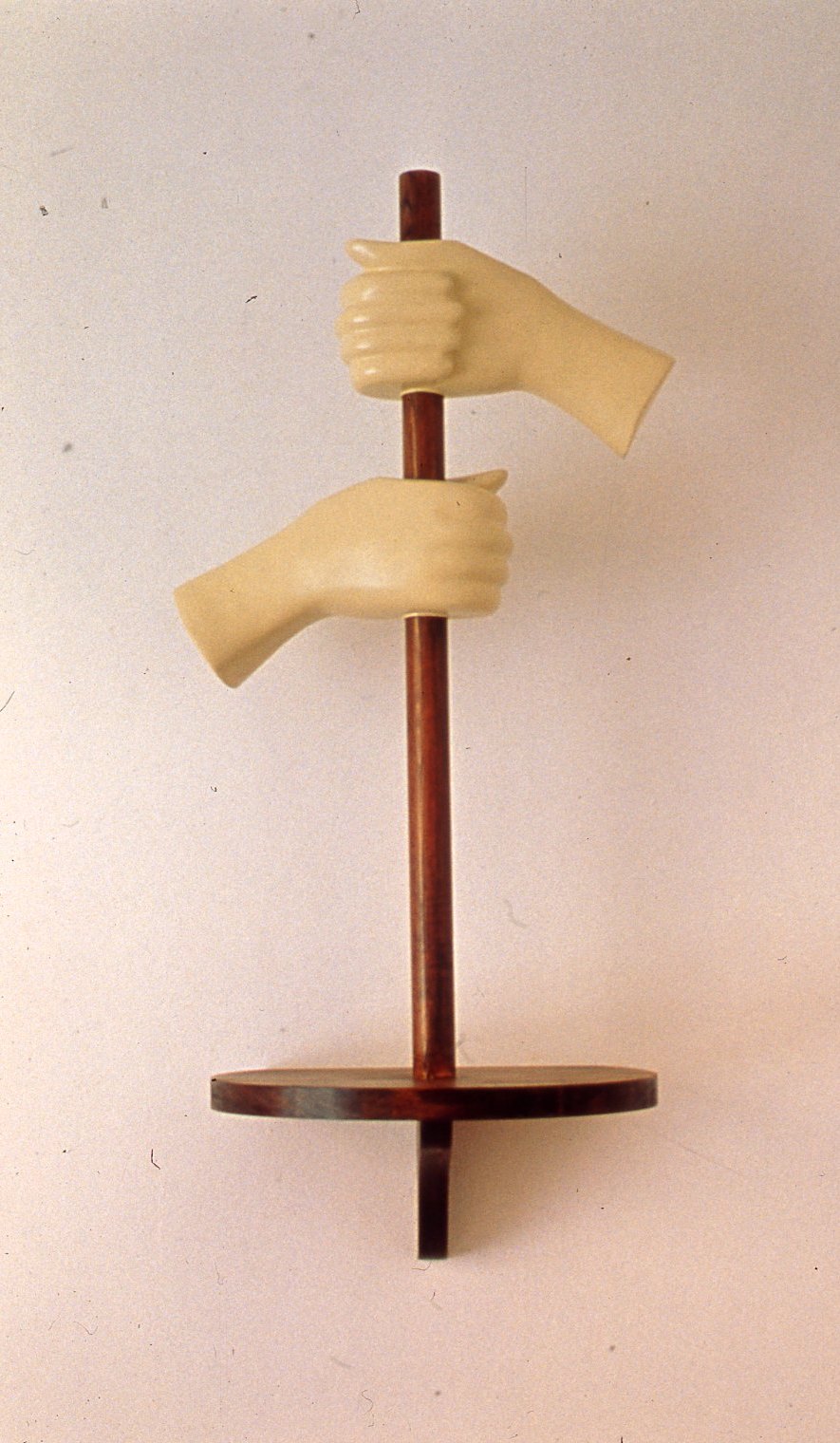
she faced as a sculptor. The two hands in Untitled (1994) are
separated from the body and wander in space; furthermore, despite holding a
wooden stick from both sides, the two hands create parallel forces that cancel
each other out to reach a state of inaction. Considering how the primacy of
hands has constituted a modern sculptural practice of “carnal
and spiritual carving,” the separation of hands from the
rest of the body suggests the sculptor’s own skepticism
towards the unity of the body and soul.11 This skepticism is further linked to how Chung preferred to
use words such as “task” or “labor” rather
than mind or practice.
In this sense, the fact that the image
in Berlin is an outcome of the optical unconsciousness of the camera,
rather than being mediated through hands, could be read as erasing the aura of
the body when capturing objects. Particularly considering the well-rehearsed
relationship between modernist sculpture and the subject’s mind, Chung’s sculpture could even be
considered radical: the disembodied two hands fail to generate any meaningful
incidents other than the labor of inaction – that is,
merely applying certain forces to an object. A modernist sculptor is said to
epitomize desires for “transcendence” towards the “truth of nature and universe.”12 He, in other words, attempts to unite with the mind of the
absolute. Such was the case for Kim Chong Yung who called sculpture a “conversation with the god.”13 Likewise, Choi Jong Tae’s sculpture of the Virgin Mary holds both hands together with
similar aspirations. Chung Seoyoung’s two disembodied
hands, on the other hand, articulate how her work is not directed to the
transcendental world but to the very moment when disparate forces are applied
to the object.
When located within the crevice of mind and matter, sculpture does not
represent the mind of the subject nor suggest its transcendental form. What
replaces the collapsed a priori system is the object. However, not
all objects equally caught Chung’s attention. As the
fragments of the demolished Berlin Wall attest, the objects that appealed to
the artist were ruins of history or remnants of the modern. Still, these
objects do not exist within the framework of meanings. Instead, she looks as if
she is seeing them for the first time. Earrings are worn on earlobes only
because they are earrings. Photos of souvenirs are taken at tourist
destinations because they are souvenirs. When the artist presses the shutter, objects
are nothing but functional, and historical and periodical narratives hold no
importance. As stated above, what matters is not the moment when the object’s meanings are negated but the unknown gaze that is caught
serendipitously, or that which confronts our presentist gazes at the object’s meanings, or that which appears only after the films are
developed. It is the gaze of the other, discovered a posteriori only
through the eyes of the tourist.
A
number of works by Chung Seoyoung exhibited in Germany can be read as an
attempt to translate the dynamics of gazes which intersect via the photographic
surface into the forces of objects. The plastic flower pots stacked in The
Sculpture with Rubber Band (1994), for instance, take the force between
one object and another as the sole generator of artistic form. Here, the
resulting work seems to indicate the object’s self-referentiality, yet there are still other relationships
beyond this seemingly aimless play. Using rubber bands attached to the surface
of objects, Chung turns our attention to the exterior forces that can tear down
the self-sufficient world of objects. This force exists prior to the form
created by the stack of plastic and intervenes in the objects’ equilibrium, yet remains unseen. Similar to the other gaze that is
only discovered in the negative’s transition into a
photograph, this force is only uncovered a posteriori. When Chung wrote in
an essay that “I can finally see the rubber bands; they
are seen either very well or very poorly,” the meaning
of “finally” would be closer to
this particular parallax that lies between the balance of objects and the
discovery of forces unseen.14
Chung
Seoyoung returned to South Korea from Germany in the mid-1990s. To the artist,
South Korea was a place full of intriguing objects. The world has always been
overflowing with things, but her comments that “objects fill up the world” and that she “cannot take her eyes off them” suggest that
the objects of her interest have slipped away from the symbolic world, vacated
of meanings and rushing towards the senses with their pure materiality. As with
the residues of the Berlin Wall, those objects were far from being symbols of a
bygone era but were disclosing themselves in utmost reality. Turned into
matter, they gushed into the artist’s retina with an
extremely charged reality of form, and the artist faced the brazenness of this
matter while recognizing it as a being that “brazenly
occupies the space and intrudes into [her] time.” It
was this phenomenological sense that comprised matter and form that functioned
as, according to Chung, “a kind of evidence.”15
Chung’s words could be interpreted as a statement that the object’s existence in front of her eyes was premised on the bygone presence
of a certain time – that is, the time that existed
before the object was pushed away from the past to the present. For the objects
possessing utmost reality, behind the veneer of materiality lies another
dimension of temporality that cannot be reduced into the present. Chung called
this temporality the “ghost”:
when she spoke of spending “365 days with ghosts,” she was hinting at the entanglement between the time and her
everyday life. The artist adds that this spectral being “occasionally appears in a concrete form.”16 Of course, this incarnation of the ghost that Chung
perceives in reality has nothing to do with the task of excavating the past and
reproducing memories.17
It
is not Chung Seoyoung’s job to imbue
new life into wandering souls and unfinished histories. In fact, she hardly
believes in the unity of absolute mind and matter, nor does she approve of
encounters between certain ideologies and matter. Looking back at the Korean
sculptural practice during the 1980s and seeking its alternatives, artist Ahn
Kyuchul wrote about “national memorial sculpture” as follows: “sculptors are nothing more
than slaves who obtain materials from the monarch and construct their terrestrial
Olympus.”18 For Chung, creating sculptures this way was equivalent to
extinguishing her spirit – she once
called such a sculptural practice “the dogma of the
spirit that seeks to overcome and overwhelm matter, or is bound by principles
of absolutism.”19
On the other hand, when she talks of the ghosts who
accompany her sculpture, they are not merely surreal beings found in everyday
life. Although her objects were not “materials obtained from the monarch,” Chung
was sensitive to their transformation into the illusory or surreal through
certain compositional principles. Matter in her sculpture had to live their
lives in reality. The lookout she created can only let viewers observe the
given space; it does not have to represent or reproduce the observatory as if
it is actually overlooking the DMZ. Likewise, as the carpet in her work was not
a concept but the carpet existing in real life, it had to be in the space as
such. In this context, it seems natural for Chung’s
carpet to roll itself up and spread its body on the floor, thereby transforming
the space and turning it into a locus.
As
the ghosts incarnate, Chung Seoyoung’s work no longer functions as an autonomous virtual reality or a
representation of memory on a pedestal. It is the very place where matter lives
its life, where the reality of matter materializes as itself.
In Carpet (1999), a tower erects from a reality upon which the object
rests. This erection is not due to the fact that the tower lies on the floor as
opposed to a temple. It is the very form of the tower that refuses to be
conceived and constructed in certain worldviews or styles; instead, the tower
erects as the carpet starts to live its own life. In a reality where the carpet
rolls up its own surface, reality is equal to the place and the tower. In this
process, there is no customary grammar nor secret weapon of the sculptor that
transforms the real object into a particular illusion or virtual image.
What
happens, in fact, is that the tower itself jumps out from the movement of
reality. Whether it is for commemoration, veneration, or prayer, the tower here
is an image that shies away from the reality occupied by the object. Yet it is
also important to note that the tower that rises from Chung’s carpet – or rather, the tower created by
the rising carpet – is bound to be an incomplete symbol
and a fractured image. The object, in this case, instead decides to live its
own life without allowing a chance to project and contain the transcendentalist
belief of the image imbued in the tower. In sum, the “reality” of the object here, called the carpet, incarnates the tower into
reality while simultaneously pushing it out of the state of an image into
reality. The reverse is also true.
The tower on the carpet brazenly ignores the
demand for a causal relationship; furthermore, by taking this very failure of
logic as a condition for existence, the image of the tower ends up spinning out
of reality. Let us note that although the tower rises from its own materiality
and incarnates into reality, there is no reason for the tower to be placed on
the carpet. Just like the lookout placed in a white cube, it is this unfamiliar
presence from a mismatch of time and place that the tower on the carpet
awakens. Rising abruptly from the place of reality and pushing the sculptural
state away from an object to an image, the tower evokes the tension between the
materialized presence and state of an image – all while
still choosing to incarnate in reality.
This unfolding of the sculptural form, which might be considered sensuous,
explains Chung Seoyoung’s discussion of the “moment” or “situation” rather than beauty or creation. This is a sensibility that the
artist meticulously constructs in space, while on the other hand, it is also an
awareness coming from the street. Regarding her experiences on the street, the
artist writes as follows:
Among
the signboards on the street, what catch my eyes are the square-shaped signs
with the word “flower” tightly inscribed in red. Whenever I see that sign I feel that
someone suddenly appears in front of my face, articulates the word, and then
walks away.20
The
word “flower” penetrates the
artist’s retina not as an idea but as matter that
possesses pure materiality. Locating itself far away from the rhetoric of
nature or lyricism driven by national consciousness, the word strikes our eyes
with its characteristic “reality of form” – in bold red that tightly fits around the four edges of the square.
The visuality of the image gets past our retina and into the body in the form
of waves, into the reality that clamors the word “flower” right in front of the artist’s face. Here
lies the reason the sign caught her eyes despite its modest size, much like the
observatory as small as a fingernail printed on a postcard. What has “caught the eyes” of the artist might be
small and remain in the state of an image, yet it strives to become a reality
with a force felt through the body as waves.
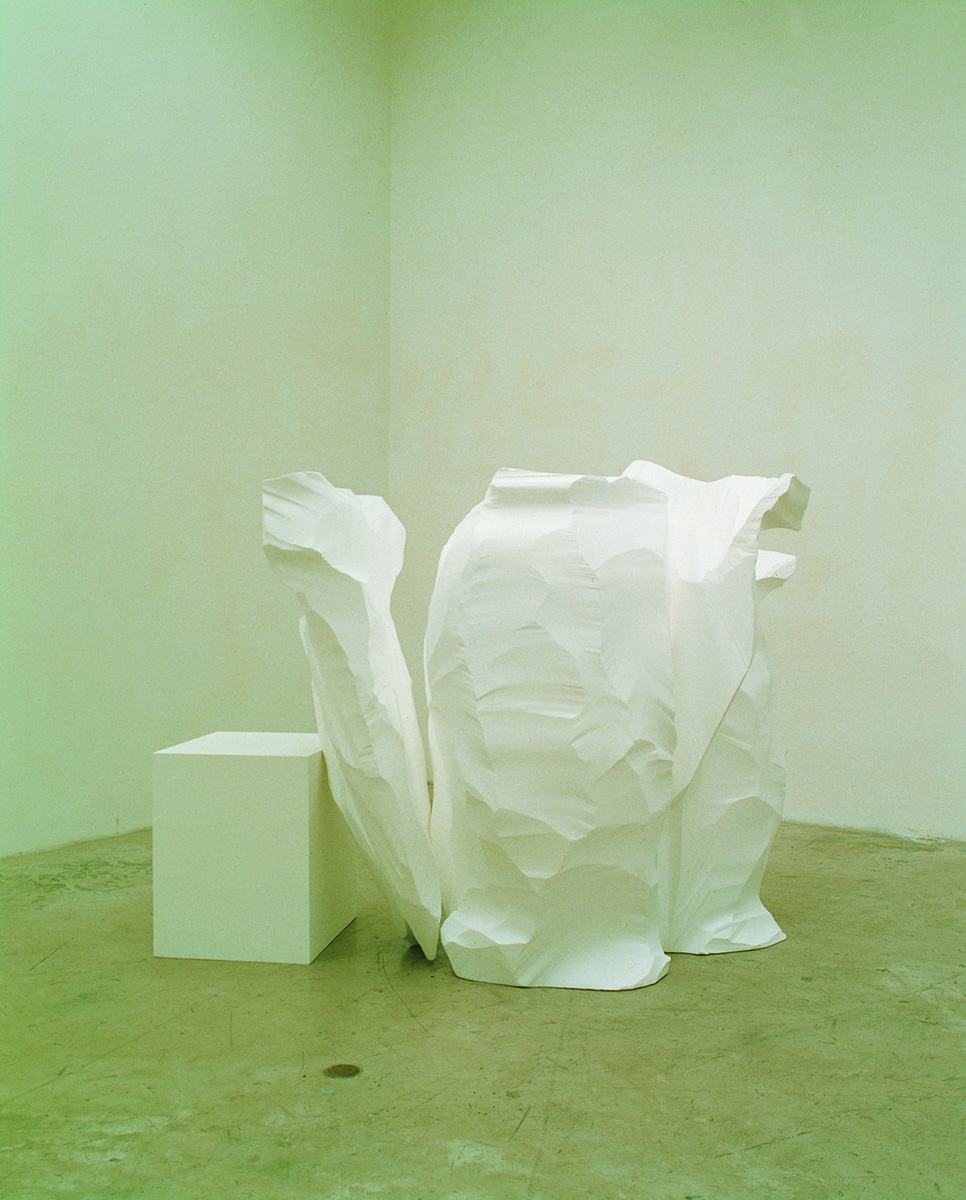
Made
mostly of Styrofoam, Flower (1999) does not sculpturally reproduce
the materiality of language encountered on the street. Chung Seoyoung takes a
block of Styrofoam as big as her body and starts carving without sculpting it
into a certain form. The fact that the physical labor solely consists of the
spur of the moment – devoid of any
transcendental interventions – is evocative of the
artist’s experience of walking down the street. The
surroundings turn opaque, and our attention converges. Just like the language
of signboards that approximates reality, the approximation of the floral form
emerges from the formless Styrofoam block. It could be said that the flower on
the signboard wants to turn itself from an image to a wave of reality.
The
Styrofoam, on the other hand, wants to become an image that sprouts the idea of
a flower from the materiality perceived by the body. Yet just as the flower
screams at our face and “walks away,” the Styrofoam does not remain in place as an image or an idea of
the flower. Notable in Flower, in fact, is the bare reality of the
Styrofoam block’s roughly exposed surface produced from
the artist’s labor. In the words of Rosalind Krauss,
the “idea of inner necessity has been removed”: in other words, “the idea that the
explanation for a particular configuration of forms or textures on the surface
of an object is to be looked for at its center.”21
As such, the necessary relationship between the image and
the surface of matter has collapsed. This is partly because the shape
resembling a flower emerged in the process of intuitive and experiential
carving. Yet this is also because there is an inexplicable logical void between
material an image, that is, between Styrofoam and flower. Despite the loss of
the center and the sudden leap of meaning, Flower is still able to
capture its ontology as an image from its relationship with Styrofoam
materiality – the artist, after all,
spoke of the flowers via the work’s title. Another
factor could also be the white wooden pedestal which, with its momentary
reliance on sculptural convention, gently pushes the industrial material into
autonomy.
Chung Seoyoung’s sculptures incarnate ghosts into
reality, but the central object of the sculpture remains silent despite the
spectral presence. These ghosts appear from time to time in the present, but
the objects just continue to live their lives. The floral form abruptly incarnates
in reality, yet the Styrofoam – once a psychic medium
that had summoned ghosts – “walks away” and continues its life as an industrial
material. Lookout exists right where there is a sculpture,
functioning as a real observatory while aspiring to return to its pre-incarnate
state as a tiny image printed on the postcard. There is a life in reality, but
there is also a life as a silent object in an image.
Such temporary incarnation
of ghosts in Chung’s sculpture means that flowers no
longer elevate the spirit of the subject as a symbol of lyricism. The image of
a flower does not constitute a modern subject through unity with nature or
formation of ethnic consciousness, but becomes a sensibility that approaches
the bodily reality through sculpture itself. It is notable that this
sensibility has more to do with the instantaneous encounter with a flash-like
image than a long-lasting afterimage, and the gaze created from such an
encounter is far from forging a modernist visuality or the gaze toward utopia.
The gaze from the lookout, for instance, operates in reality through bodily
interactions without offering any historical perspective or chance for empathy.
Then, it eventually dissipates. The lookout as an image, now silent, overlooks
the narrative and forecloses itself from the waves generated by its own.
Chung Seoyoung’s sculptures seem to straddle the border
between image and physical presence, or between ghost and reality. And it is
her text work that captures the sensibility of the sculptural object’s ontological transformation through these borders. According to the
artist, this movement is “the sum total of what
gradually becomes lumpier and what gradually becomes clearer,” resembling a “cheeky addition.” Upon looking at Chung’s sculpture, there is
a moment when the surroundings gradually blur out and our attention converges
into its image. There is also a moment when the image conversely blurs out and
the materiality of the real is felt through our bodies. The “sum total” of these two dimensions must skip
all processes of deduction and reasoning to the extent that it becomes
shameless.
In another text, Chung wrote, “Throw things
that flew from afar as hard as you can. If not, you may have to remember the
wrong things forever.” The sum of such texts should be “cheeky,” according to Chung, because if not
we might “forever remember” the
“wrong things.” If one could
say that the ghosts of modernity are only remembered in museums, those memories
are inevitably reconstructed.22 Memory in the case of Chung’s sculptures, on the other hand, consists of the very moments of the
ghosts’ incarnation like a flash of light. Just as the
ghost of modernity surfaces not from history museums nor archives but from a
postcard with a 1970s Nordic landscape, or from a tiny signboard on the street,
those memories have “flown from afar.” These could be the moments when the memories become clearer, but
she chooses not to remember them forever. Instead, she throws them “as hard as she can” in order to remember
only the flash of the moment.
In
Chung’s other work, -Awe (1996), it is this flash
of the moment that is captured by a word of hesitation – “awe” – written on traditional vinyl
linoleum. This object, which probably has not intrigued our close-looking thus
far, is just a linoleum-made imitation of the surface pattern of traditional
floor paper. This flooring material could symbolize the particular visual
culture that has penetrated into our lives during South Korea’s rapid industrialization. It could also be a subject of
sociological analysis by evoking imitation or kitsch. Yet it seems to be the
object’s pure materiality, or the utmost reality of its
form, that captures the artist’s attention.
Transferring a linoleum plate into a picture frame seems to be a shameless
presentation; at the same time, it could also be interpreted as an invitation
to the surface of reality that has been overlooked in the midst of all the
details in our lives. It was only during Chung’s era
that we could afford to contemplate on things that have supported our realities.
In other words, it was only due to the conscious distancing from our
challenging past that the modern objects could break away from ideologies and
meanings, and rush toward the retina with colorful, sloppy, yet meticulous
forms. It is this contemplative distance that -Awe generates from the audience,
relying on the age-old custom of a painting hung on the wall.
On the surface of the painting, Chung Seoyoung wrote a seemingly meaningless
exclamation: awe. This empty syllable may arise from the artist’s sudden encounter with an object; it could also be the sign of her
tentative refusal of things that cannot be said. A straight line, possibly
drawn with something similar to a ruler, prolongs a moment of delayed meanings.
At the same time, it could symbolize a few seconds of hesitation before one
utters the syllable. The absence of letters and figures in the painting
conversely preserves all possible senses and memories within the picture frame – amazement, discomfort, inutterability, or inexplicability – that we experience in reality.
The painting, in this case, becomes
an object that is at once a realistic matter and the evidence of the past. The
utterance in -Awe relies upon this aesthetic convention, imbuing certain
strength to the fleeting emotion that the syllable connotes. Its cursive font
further contrasts with the monotony of the straight line and temporarily
enables the word to represent the spirit of the subject. The object has thus
become a painting – its stiff linearity does not
reproduce or remember the past but still evokes a feeling of the indescribable
flash of encounter that sums up the long past. A painting that is not a
painting, -Awe eventually goes back and forth between the sensibility of
flash-like moments and the insignificance of the object in question. It is
because the effect of the aesthetic conventions on which the sculptor relies
might resemble a flashlight in the first place –
linoleum cannot make a good painting, just as cursive script hardly possesses
an aura apposite for our times.23 Here, the artist just chooses to throw what “flew from afar … as hard as she can.”
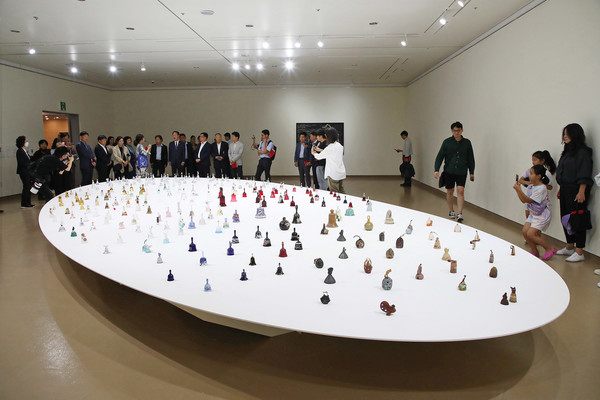
Like -Awe, Chung Seoyoung’s Wave (a remaining
part of the installation work Ghost, Wave, Fire, 1998–2022) has also flown from afar. As she summons waves to traditional
vinyl linoleum, they bring temporalities other than the here and now and the
real. It goes without a question that Wave does not merely reproduce waves in
the form of a sculpture. As clay mixes with oil and sways between gravity and
its own viscosity, the movement of matter becomes that of the waves. In the
eyes of the sculptor, this play of matter is itself a ritual dedicated to
another temporality. Perhaps since both movement and play overlap with the
ritual, the wave seems to arise from the linoleum floor despite coming from an
unrelated, faraway place.
As theatrical as this movement seems, however, it
also dies away. The waves in the work are closer to formless vibration than
objects – they glide on the surface of the slippery
floor, yet it is also natural to recognize them as a fixed object. They can
never construct a transcendental space on which the subject projects their mind
and emotions. Rather, they are the objects that have blocked those
possibilities from the start; they are images that already petrified the moment
of uncontrollable movement. The layers of temporalities put up by Chung
Seoyoung’s sculpture are thus indeterminably thick.
Throughout the passage of time, there is nothing that can comprise an identity
in Chung Seoyoung’s sculptural oeuvre. As the waves
arise, what flew from afar raises its head in the present, and ghosts incarnate
in reality. Yet nothing promises its eternity.
The temporality that features in
the movement of reality is nothing more than a flash of the moment. There are waves
that approximate reality, and at times there are images that make sudden
appearances in the present, but both revert back to a movement that dies out.
Like temporary and repetitive ripples on a serene waterfront, the ghost
engraves its face on the surface of reality only to sink back in. When Chung
brought up the phrase “what I saw today” in the title of the exhibition rather than “yesterday” or “back
then,” that is because her sculptures refuse to
reproduce sceneries of the past. To Chung, using sculpture to carve out a place
for bygone sceneries is only to embellish the past. It is also to flatten the
depths of the past as a simple sign. There is nothing more oppressive to the
artist than being eternally fixated on a certain sculptural system or grammar,
in addition to taking sculpture as a means to enshrine and elevate such
systems. Instead, Chung chooses to merely see – the day
before yesterday, and again yesterday, and then again today. “Today” for her is not a place where the past
is reduced to a readily retrievable sign of the permanent present. It is,
instead, a place where things once seen in the past reveal themselves again
today.
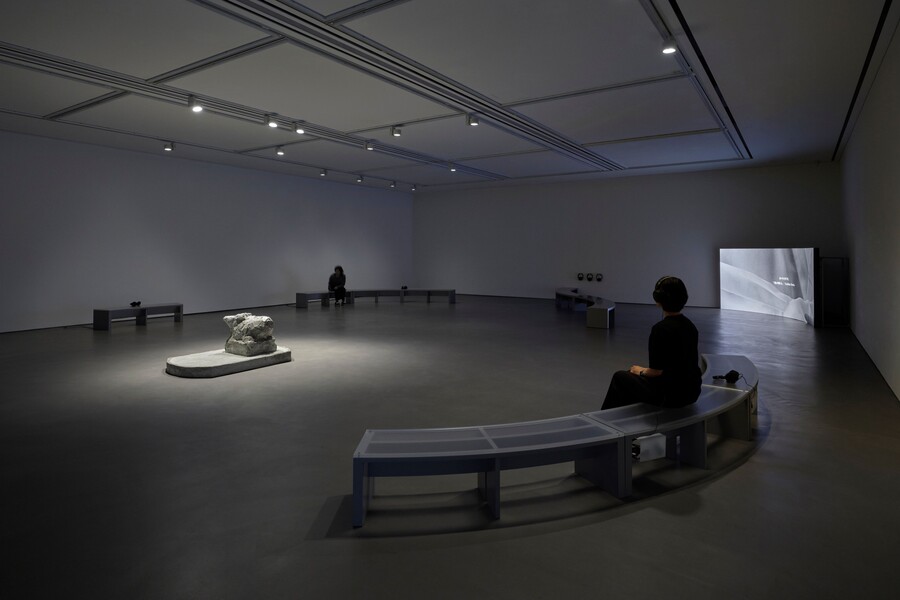
In this context, what constitutes the field of sculpture in A
Wanderer (2022) is the motion of cement. Just as soft clay brought waves
into reality, cement fails to fix its shape permanently, revealing its own
liquid-like properties. Furthermore, its matter guides our gaze to the surface
of the present where our bodies and sculpture meet. Beneath the rough and dull
surface emerges a shape resembling a stone statue of an animal. We might be
more familiar with a stone statue with a solid and even surface, but what
actually unravels in front of our eyes is a creature that is precariously
holding on to its form in its relationship with matter. Here, we are speaking
of cement as comprising an unstable combination between matter and form, but it
is important to note that cement has been regarded as a material that has
constructed our modernity with its particular solidity.
Stomping on the
pre-modern, cement erected a city by turning itself into concrete roads and
building blocks. In Chung’s sculpture, on the other
hand, this material features a statuesque form that could only be seen at sites
like a palace or tomb. The relationship between the stone statue and cement
thus goes beyond the coincidence or leap and reaches the paradox: the very
material that has erased the mythical worldview from our consciousness is,
conversely, unfolding the world of myth in front of our eyes. The statuesque
form in A Wanderer pushes this cement floor –
that which would have been seen yesterday, and day before yesterday, and today – away from the crevice of an unpolished city or the site of an
unfinished construction and onto a pedestal. Nevertheless, while this chain of
ideas momentarily provokes our attention, it soon dies out as we encounter the
actual surface of the matter. The square space that the sculptor has sharply
dug out between the stone statue and pedestal pushes each form back into its place.
Subsequently, the pre-modern sensibility of the modulated matter immediately
transitions into the undried materiality of cement. Rather than being a
pedestal that props up pre-modern time, it could be said that the place created
by the cement heads toward the unfinished modernity left in the present. Matter
can be perceived as something else when situated in the chain of ideas, but it
also vaporizes this very chain of ideas at a formidable speed. This is probably
because the statuesque object appears in reality through the denial of its
existence in the first place. The modern sense of applying cement engraves the
pre-modern time connoted by stone statues in the sculptural form, while also
erasing it. As the title implies, the form in the sculpture is a wanderer who
meanders the contemporary, modern, and pre-modern, and these three layers of
time unveil themselves as the artist applies the cement.
The
everyday objects in Chung Seoyoung’s works include not only a cement base and stone statues but also
inconspicuous objects that have filled up our surroundings for a considerable
period of time. There are objects that uncover concealed time and feature it in
the present, but there are also objects that have always been there in silence.
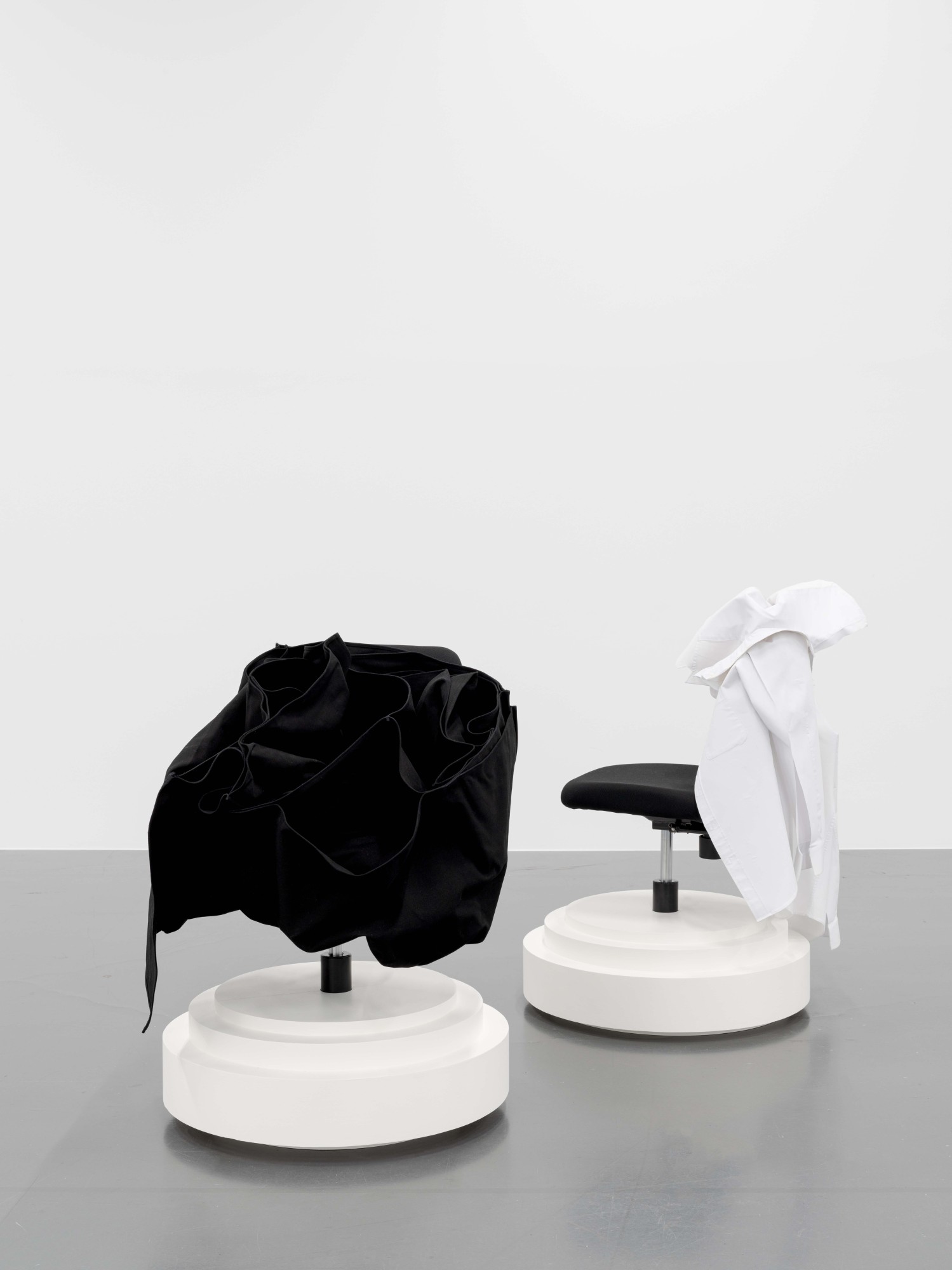
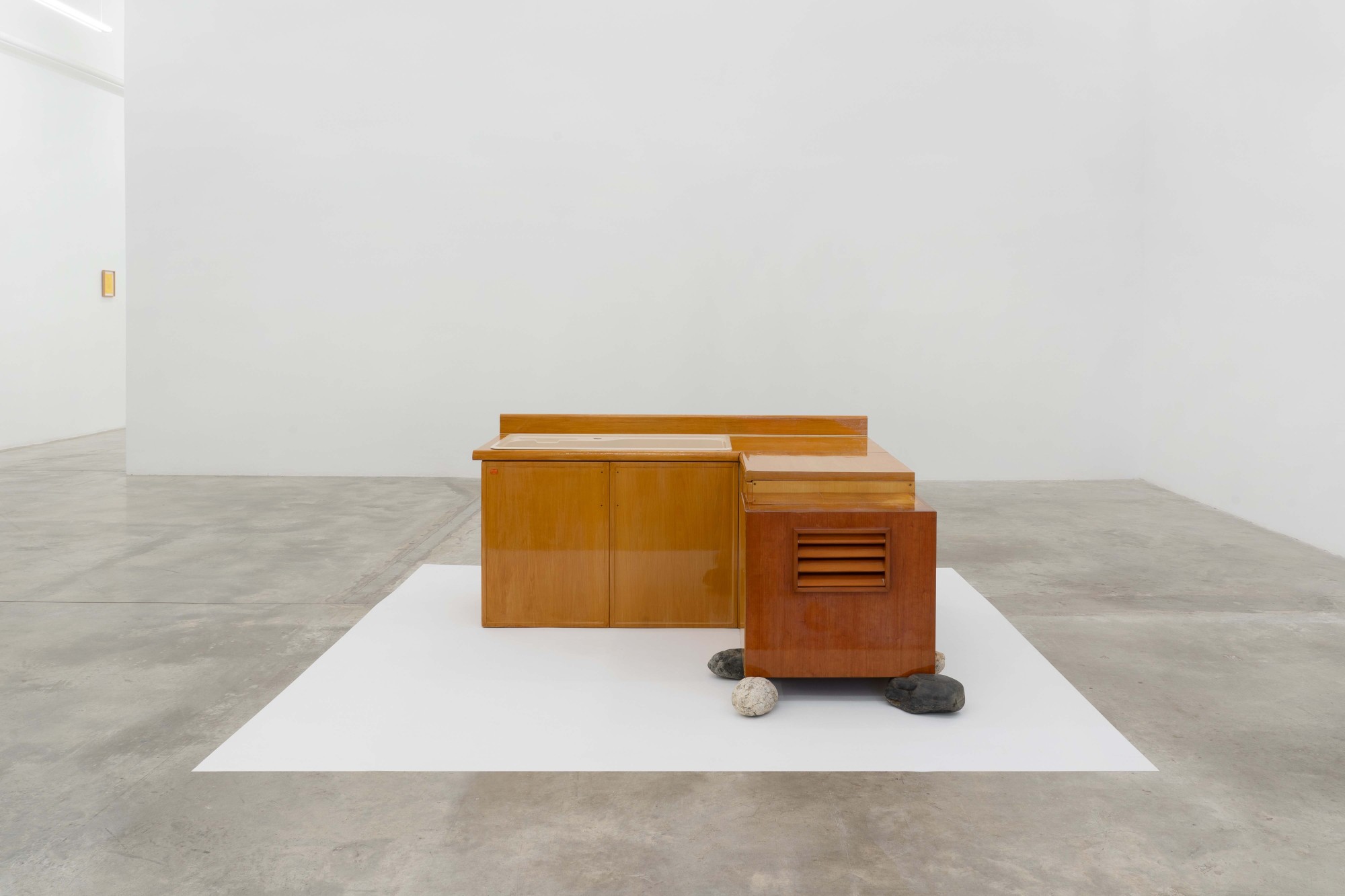
The chair in A Good Moment (2022) is one such object. An object that
we definitely have seen somewhere, while not special enough to remind us of
that particular moment of seeing, is pulled into the sculptural field and
exists in front of our eyes. It would be erroneous to call this object a stool
or chair; like a classical sculpture that unites with the pedestal and isolates
itself from the secular world, this everyday object is gently pushed away into
the autonomous sphere.
A yellowish color envelops the pedestal along with the
object in ways that evoke customary sculptural grammar, but it is difficult to
conclude that the object has turned into a sculpture. On the one hand, the
difficulty lies in the scale of the object: being life-sized, it still demands
a familiar relationship with the users’ bodies. But
above all, the difficulty is that the pedestal and object are in the
ontological relationship of being both together and separate at the same time.
The smoothness of the monotone pushes the pedestal and object away from the
secular and toward the sculptural, while the pedestal also does not support the
object but separates it. The four holes dug between the legs of the chair and
the pedestal preserve the sense of the everyday life of objects. The hidden
part of the chair leg, on the other hand, pushes the object away into a
slightly autonomous state, but then the black rim contrasts itself with the
overall yellow and brings the four legs together, bringing the chair back to
reality. Despite this formal juggling, the main reason that Chung’s sculpture can push the chair from everyday life into a sculptural
state lies in the physical presence of pieces of wood.
Placed on top of the
chair and attracting atmospheric light on its surface, the wood is devoid of
use value and is not an object that abides by intentions and regulations in
order to generate an idea. The square piece of wood, therefore, is just a
good-enough object to boast its physical, everyday-like presence in the
otherwise sculptural field. However, the wooden block does not merely perform
artistic autonomy using different relative senses. What it also performs is
everyday life, like the task of stacking well-trimmed wooden blocks one after
another without losing overall balance. The outcome of this performative act is
not the tampered chair that has turned into a sculpture through the pedestal,
but the familiar chair of reality on which the object is placed. Nevertheless,
the stack of wooden blocks cannot reduce the chair into a state of a daily
object. This is because the act of building each unit one by one intentionally
slides out the customs or systems that constitute the sculptural form.
The
object that sits on the chair, therefore, stays in a self-referential state – that is, the thing itself – rather than
being another piece of sculpture on the pedestal. In the end, the wood blocks
perform self-sufficiency through repetitive stacking, and the chair cannot
extend beyond its physical support and thus remains within its prescribed
artistic form.
In the midst of various performative events that occur around the chair, ideas
are suppressed while only traces of movement remain. What unfolds in front of
us in Chung’s sculptures are such moments of minor
adjustments. The “sculptural moment” that she proposes is a state in which only the rhythm between the
sculptural state and everyday existence remains. At the very moment when the
units that make up the sculpture vibrate between one reality and another,
without being fixed in their place, what is left on the other side is a
snapshot photo of flowers. In Barthesian terms, photography is an illogical
combination between layers of time that were “there
then” but not “here and now,” and I perceive Chung’s photograph of the
flowers as making another wave in this ontological commotion.
But that moment
will not last long: although the flowers do not exist here and now,
accompanying it is an envelope that blends with the surface of this silent
photograph. When the brown light reflected on the envelope’s surface corresponds to the color of the wooden block, our eyes can
rest on the surface of the objects, on the planes where one color meets
another. For a sculptor, wouldn’t that be nothing but “a good moment”?
Jihan
Jang is an art critic based in Seoul. He graduated from Korea National
University of Arts, Department of Art Theory, and is currently a doctoral
candidate at the Department of Art History, Binghamton University. He received
the 2019 SeMA-Hana Critic Award. His publications include That, There,
Then: The Writings and Drawings of Kim Beom and Chung Seoyoung (Seoul
Museum of Art, Mediabus, 2021).
- Chung
Seoyoung often used the expression “sculptural moments” in describing her
work.
- Chung
Seoyoung, “Samuleui
gadamgwa tusa’e euihan jogakjakpum jejakyeongu” (A Study on the Production of Sculptures through Participation
in and Projection of Objects), MA diss., Seoul National University
Graduate School (1989), 26-27.
- Ujeok, Ujeok,
no. 2-1 (2007), 33.
- Kim
Jang Un, “Chung
Seoyoung:Yuryeongwa deobureo” (Chung Seoyoung:
Along with Ghosts), in Chung Seoyoung: Gonggireul
dudeuryeoseo (Chung Seoyoung: Knocking Air) (Seoul: Barakat
Contemporary, 2021), 49.
- Park
Chan-kyong, “Jeonmangdae:
Chung Seoyoung’ui samul”
(Lookout: Chung Seoyoung’s Object) (Seoul: Art
Sonje Center, 2000), 4.
- Ju
Hye-jin and Chung Seoyoung, “Bulanhan jijeomeurobuteou umjigineun geosi soljikhangeot” (Honest Things Are What Moves from the Site of Anxiety), Kyunghyang Article (May 2014), 29.
- Ibid.
- Hyun
Seewon, “Jeonsi’ui sigan: Chung Seoyoung” (Exhibition
Time: Chung Seoyoung), in Chung Seoyoung: Knocking Air, 103.
- Park,
“Lookout: Chung
Seoyoung’s Object,”
4.
- Chung
Seoyoung, “Neul
gongireul bakkugoshipda” (I Always Want to Change
the Air), in Chung Seoyoung Jogakjeon (Chung Seoyoung’s Sculpture Exhibition), exh. cat. (Seoul: Han Gallery, 1989),
n.p.
- Choi
Jong Tae, “Gak,
bugak, geurigo chimmnuk” (Sculpture,
Non-Sculpture, and Silence), in Hyeongtaereul chajaseo: areumdaum’ui balgyeon geurigo changjoreul wihan girok (In Search of Form: Discovery of Beauty and Notes for Creation) (Paju: Yeolhwadang,
1990), 31. Choi also advised Chung Seoyoung’s MA
dissertation at the Department of Sculpture, Seoul National University
Graduate School.
- Choi
Jong Tae, “Jeoldaereul
hyanghan tamgu” (The Study towards the Absolute),
in In Search of Form, 148.
- Choi
Jong Tae, “Chimmuk’ui salm, georukan seongsang” (The Life
of Silence, Holy Icons), in In Search of Form, 162.
- Chung
Seoyoung, “GHOST WILL
BE BETTER,” Hyeondaemunhak, vol.530 (February
1999), n.p.
- Chung
Seoyoung, “Ms. C’ui Chung Seoyoung inteobyu” (An
Interview with Chung Seoyoung by Ms. C), in The Speed of the Large,
the Small, and the Wide, 151.
- Chung
Seoyoung, “GHOST WILL
BE BETTER,” n.p.
- For
instance, Park Chan-kyong finds the mannequins in the War Memorial of
Korea surreal. Although he takes a critical view at how every corner of
the War Memorial is inseparable from a certain political agenda, he still
senses that “the ghosts
of war have been reincarnated into a body.” What
Park suggests is that the concrete realism of representing the war had
flowed from the past to the present and subsequently gained physicality.
To quote his words again, “the long-term prisoner
called the Cold War has gained a new life as a mannequin in the War
Memorial.” See Park Chan-kyong, “Gukbangchohyeonsilju’ui: Bangmulgwan” (Defense Surrealism: The Museum), in Beullaekbakseu:
Naengjeon emoji’ui gieok (Blackbox: The
Memory of Cold War Images) (1997), 149.
- Ahn
Kyuchul, “80nyeondae Hangukjogak’ui daeaneul chajaseo” (In Search of the
Alternatives of the 80s Korean Sculpture,”
in Minjungmisureul hyanghayeo (Towards Minjung Art)
(Gwahakgwasasang, 1990), 149.
- Chung
Seoyoung, “Samuleui
gadamgwa tusa’e euihan jogakjakpum jejakyeongu,” 24.
- Chung
Seoyoung, “Dareunkkot
du gae” (Two Different
Flowers), Hyeondaemunhak, vol.532 (April 1999), n.p.
- Rosalind
E. Krauss, “The Double
Negative: a new syntax for sculpture,” Passages
in Modern Sculpture (New York: The Viking Press, 1977), 250.
- In “Defense Surrealism: The Museum,” 28,
Park Chan-kyong writes as follows: “Commemoration – that is, the reconstruction of memory – involves not only the interests, customs, and status of the
remembering individual but also the political agenda or preferred culture
of the remembering group. Although they may be diverse, the motives
involved in the case of the War Memorial could largely be called patriotic
war pathos.”
- Chung
Seoyoung once said as follows: ‘‘The ‘awe’ in
cursive itself is an imitation. I was not that skilled at calligraphy, so
all I did was to ‘imitate’
the calligraphic script.” See Hong Sun-myeong, “Cheoljeohamgwa heosulham’ui gongjon” (The Coexistence of Meticulousness and
Sloppiness), Weolganmisul (November 1999), 70.