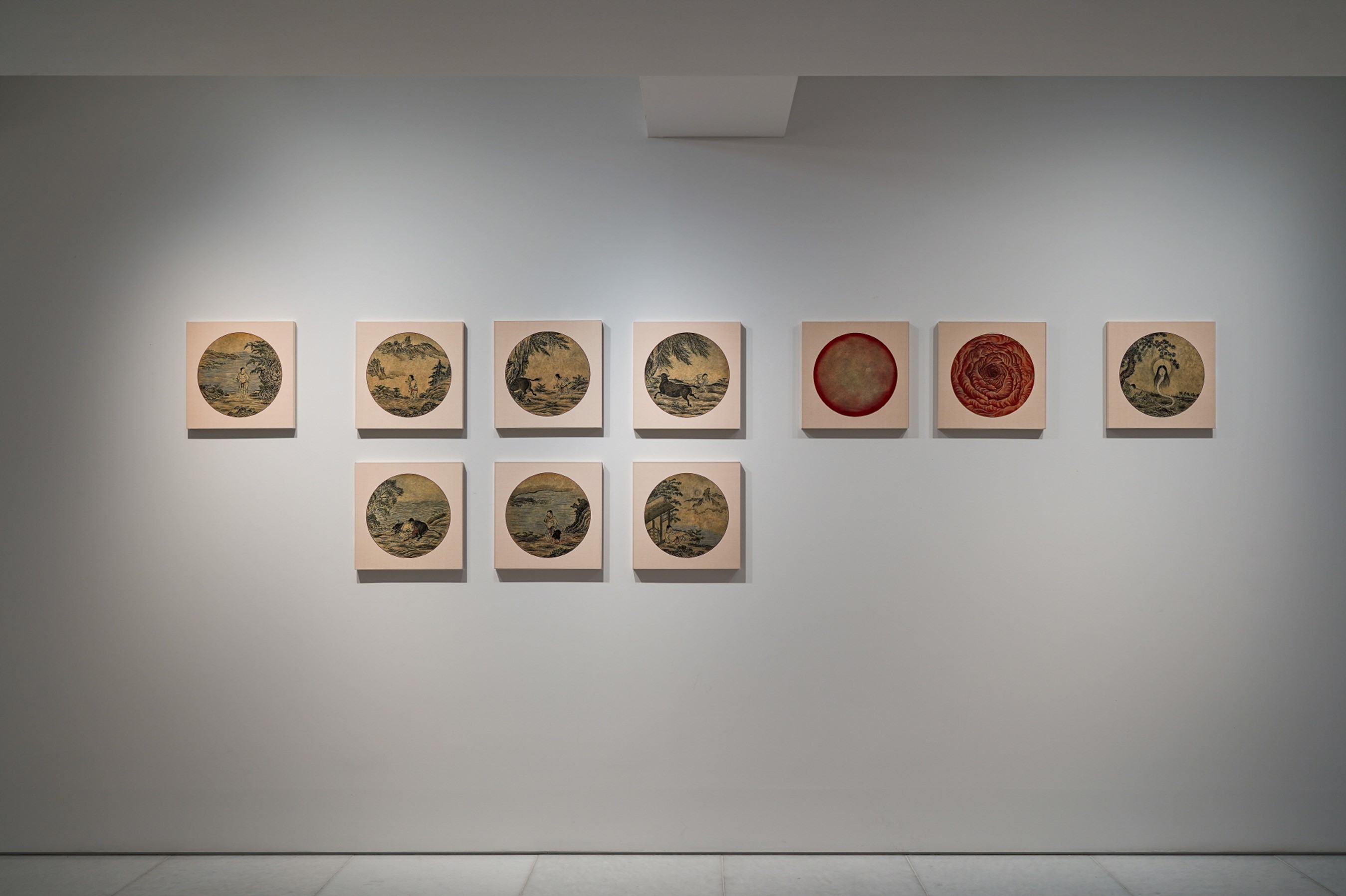
Park Wunggyu’s work has a strong image that originates from sacred
icons. To both religious and religionless people, a sacred icon is not just one
of numerous images in the world. Looking back on the history of image, we know
that there were myth and religious icons before art, and everything that has
become flat as a code of equivalence today is also serving as prototype. Julia
Kristeva said she does not locate nihil in the position of God as an atheist
but aims to confirm ‘essential deterioration of extra sensor’ and ending of
‘ideal(Heidegger) as extrasensory world with religious precepts and God’s
grace’ when she wrote [Au Commencement E'tait L'amour, Psychoanalysis of Love]
in which Nietzsche declared God is dead. Religion has diminished on the conscious
level, but still remains on the unconscious level and is even further expanded.
We don’t know if God exists but indeed there are God-related imagination and
system with thousands of years of wooden cross.
Religion has longer history than art, and it is more universal.
Therefore, humans become human beings through imagination and symbol and
sometimes become Homo Religiosus. Religion can belong to the real world, going
beyond imagination and symbol to someone, like the artist Park Wunggyu.
Religious images still form a certain conscious environment in system but
unconsciously appear as a bizarre shape. The roof of bizarre emotion in Park
Wunggyu’s work lies in religion as if he realizes himself, too. According to
Rosemary Jackson’s [Fantasy], Heidegger said ‘something bizarre may happen in
proportion to impossibility of truly locating himself in the God’s space’,
depicting something bizarre as an empty space caused by losing faith in sacred
images. Otto Rank’s [The Concept of Sacredness] interprets that fear is bizarre
when it is in supernatural phenomena.
Religious senses about mysterious secret are transformed into
bizarre senses undergoing the process of secularization. But, the psychological
origin of the two is same. Bizarreness is also noticed in feminism that has
challenged males considered to be right(regular). Women from Femme Enfant who
is like a pure child to ‘Femme Fatale’ who is like one plotting are bizarre. To
put it mildly, they are mysterious. As Freud said, female genitals looking like
a bleeding wound that reminds males of castration is the origin of bizarreness.
Bizarreness exists in the relationship between something familar and normal.
Because a house, female area is the prototype of intimacy and normality,
something bizarre is highly like to happen in this area. Bizarreness as a
relational signifier strongly argues one gap at the point ‘where we want to
ensure unity’(Helene Cixous). Bizarreness is linked to contemporary aesthetics
in that is not possible to be reproduced. Although it is not completely denied
in Park Wunggyus’ work, something under obliteration is religiously reproduced.
He moves the religious reproduction to the area impossible to recreate.
Of course, his work also lies in mysterious tradition that has
been considered to be a cult but is transforming through different methods from
existing religions types like Oriental painting techniques and animation. As
Oriental icons are added to Catholic, a gap and bizarreness resulting form
complexity gain more intensity. In contemporary art that is threatened with
loss of aura due to duplication, religion keeping the aura is still an area of
emotion enough to be reproduced. Of course, the content is more important no
matter what it is, but it forms network that can’t be disconnected because the
type itself contains its content. Park Wunggyu was born a Catholic and grew up
in a family with strict discipline until he became an adolescent. His house had
more than 200 sacred icons and felt guilty about forgetting pray before
bedtime. He doesn’t go to Catholic church now, but religious mood that he
experienced when young is still governing him. Since art and religion are
divided, artists have reduced the role of religion or been greatly inspired by
religion, but they kick away the ladder he climbs up or even suppress it.
Unlike this, Park Woong-gy who exposes the condition of his existence is honest
as an artist.
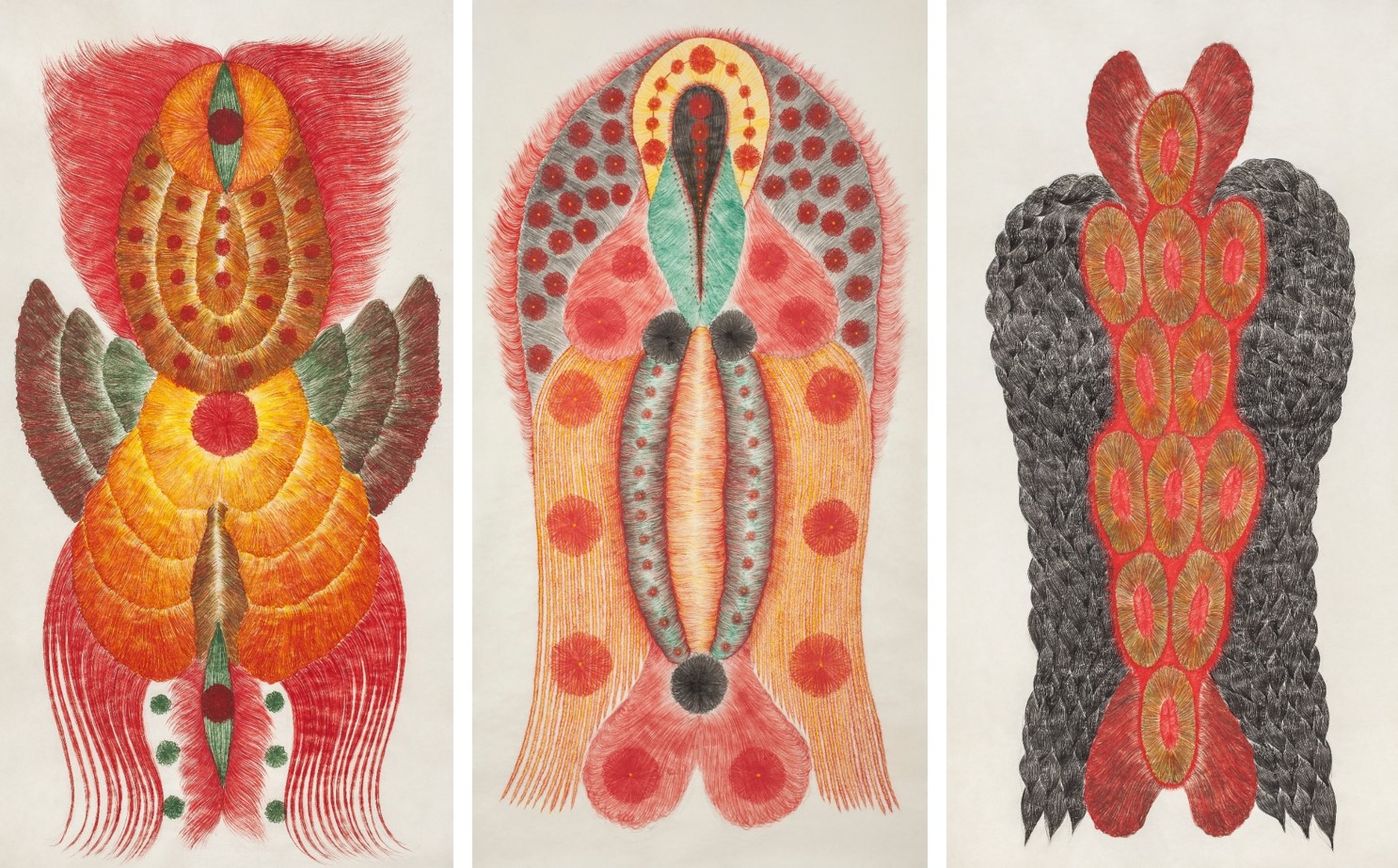
Of course, religions prototype or icon is changing in his work,
when boundaries or taboos required to become genuine sacred icons are being
violated. As honesty is included in dishonesty, his work contains the
religions’ unique ritualistic process that is dramatic such as original sin
consciousness, guilty conscience, pain and death, resurrection, chaos and
recovered order as well as its subsequent ambivalent values such as suppression
and fear, and mystery and joy. Recently, his work has been expanded to Oriental
religion—if there is no religion in the Orient, going beyond his born faith. He
who has wanted to mull over the important backdrop of his spirit and emotion
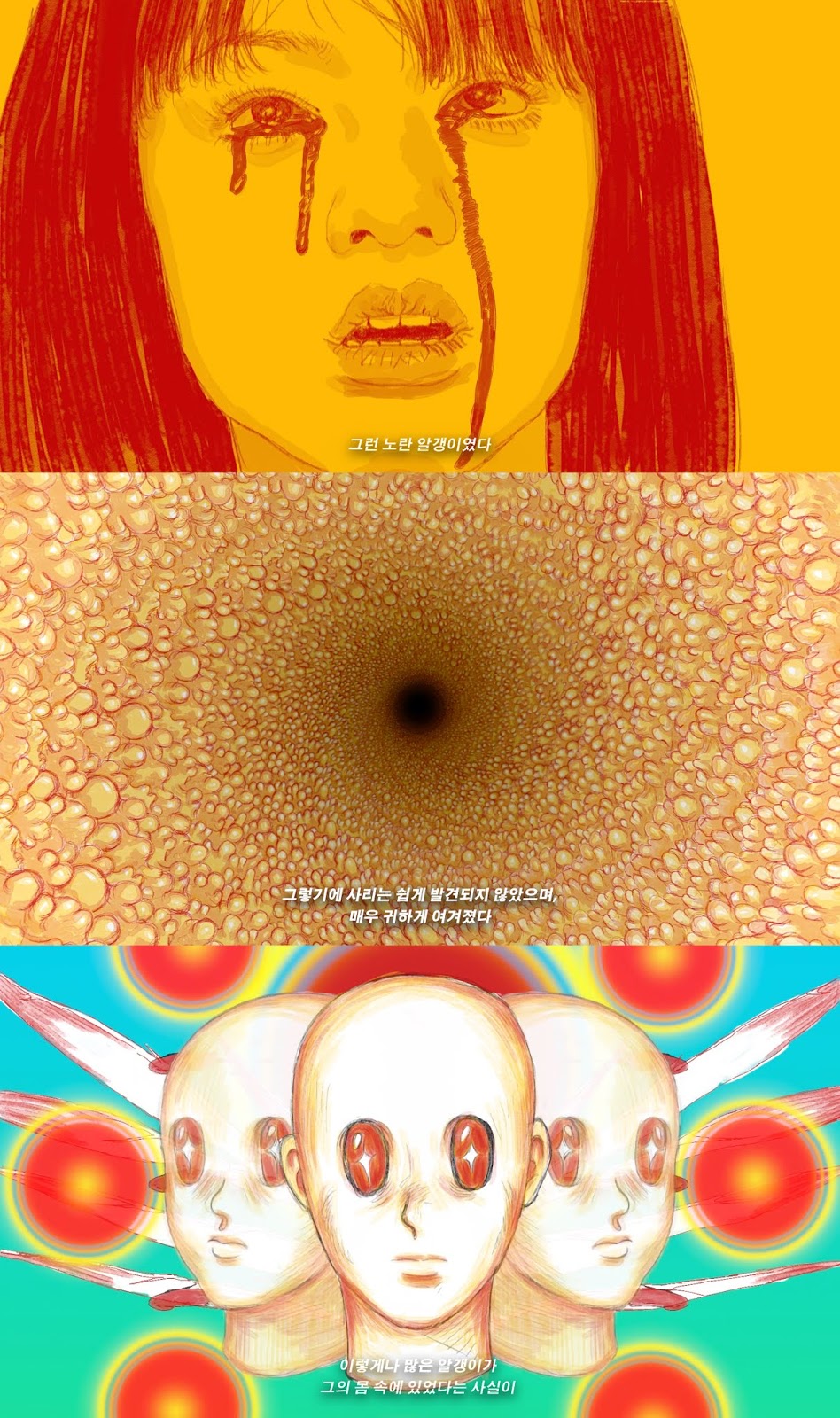
makes ‘monster-like icon by bringing the skin of icons’. The Virgin Mary Statue
in his 3-minute video installation work is a bizarre work in which a shadow
behind is flowing as a bizarre type of fluid. This work projects an image to
the statue, and the video consists of a series of profane scenes violating icon
that should keep its perfect shape.
Contaminated boundaries require purification and sublimation. The
statue of Virgin Mary was in his living room so his mother prayed with
candlelight. The artist switches dark living room and sacred image of the
statue. Religion that is not his choice, especially led by his mother
approaches as a maternal area. Typically, women are nature and considered to be
a sub-divided area that should be tamed by the power of culture. Nature-woman
that is not controled in gender ideology is considered as a disaster. Males
fully understand the value of maternality, whereas they consider it as a risky
area to be swallowed unless they leave to the area of paternity symbolized as
the dominant value of society. Maternity that may recollect as they give a
birth causes ambivalent emotion. And, there is protection and fear at the same
time. Protection is superior during the period when one identifies with the
other called mother, including a fetal period. On the other hand, the other or
mother becomes an object to be refused at a time when one’s identification is
established.
In the work with the statue of Virgin Mary, he is like taking his
family’s mood of evening pray and locating it into in this work. But, replacing
warm breast milk or tear of sympathy that should be at the Virgin Mary’s heart
that provides nurturing and protection is unidentified fluids that might erupt
from the lower part of body. Furthermore, it flows over the boundary, thereby
violating an orderly system implicit in symbol of life. The 6-minute single
channel video work produced in 2014 and 2015 is dominated by red tone reminding
me of blood. A large and round shape appears in dark background, but it is not
like sun. In this red tone space reminding of internal body, the mass looks
like egg or phytol. The mass has a hole which something is flowing out of,
which is dark and soggy. Among fluids in human body, blood is the most
disgusting and frightening when it is out of its original position. Blood also
symbolizes birth and death at the same. Aside from blood, human beings are
throughly potty-trained.
Everything should excrete normally at a right time and a given
place. But, Park Wunggyu excretes at the corner of public stage named art. His
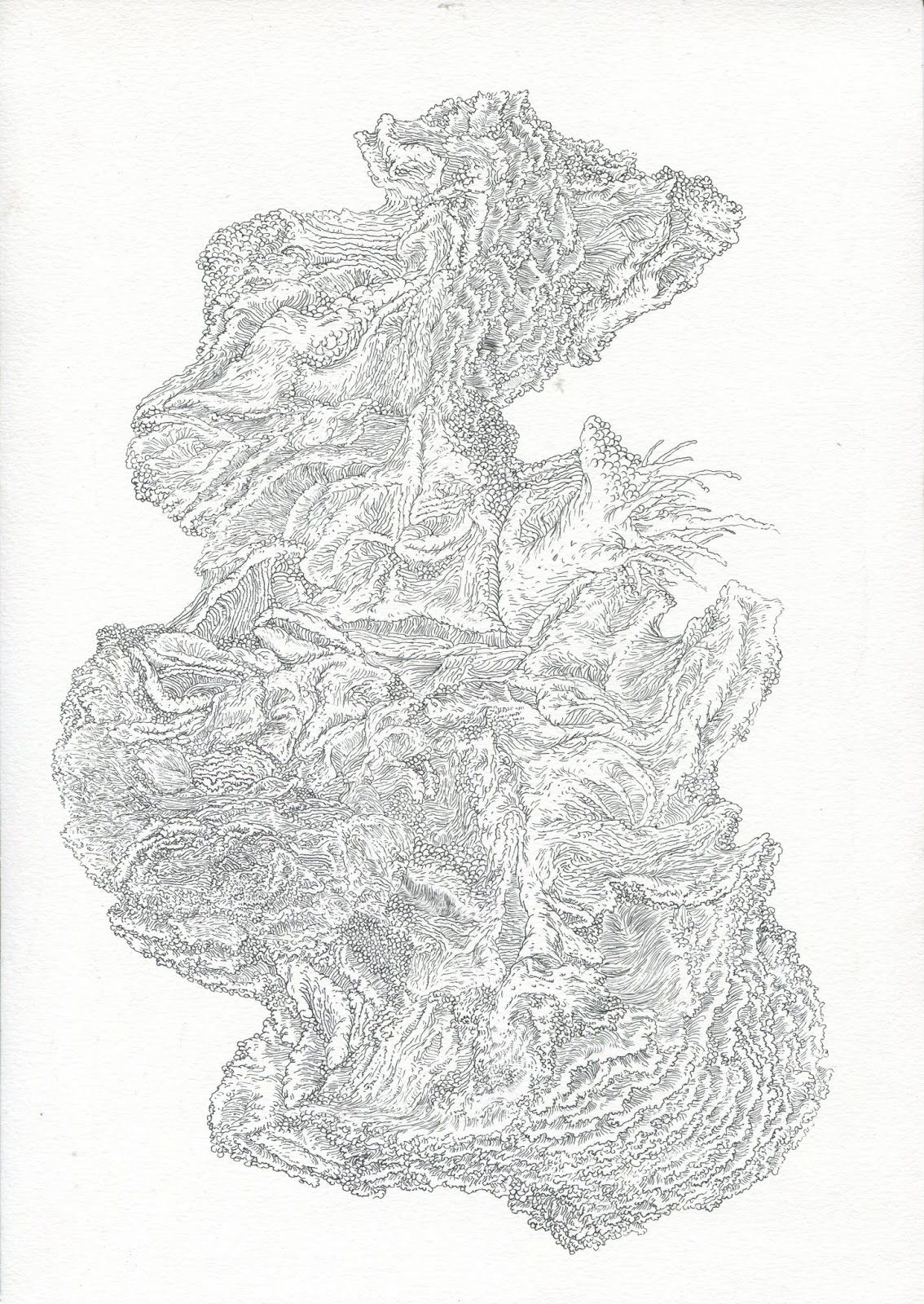
one of works spits phlegm. An one-minute video work produced in 2012 shows
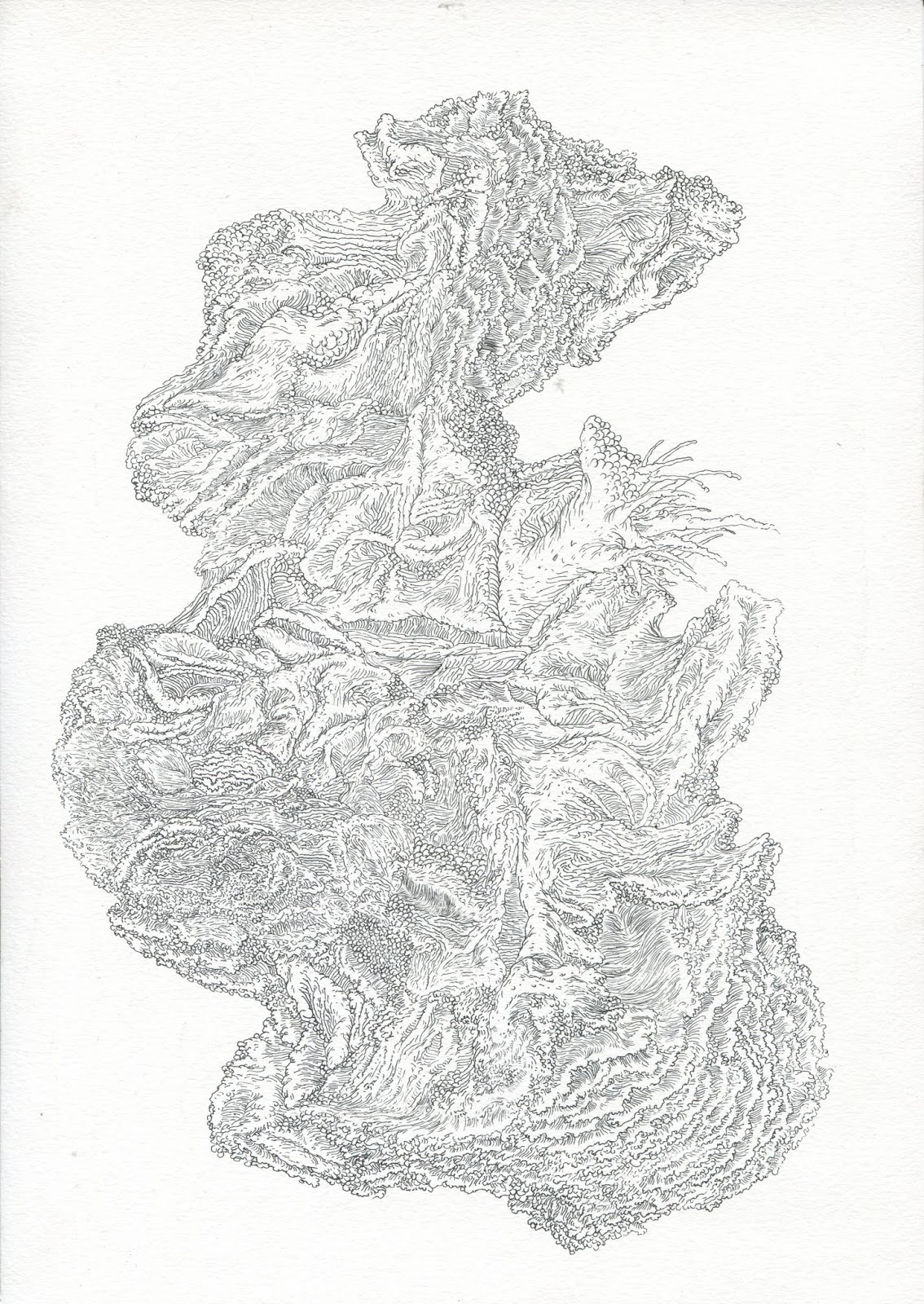
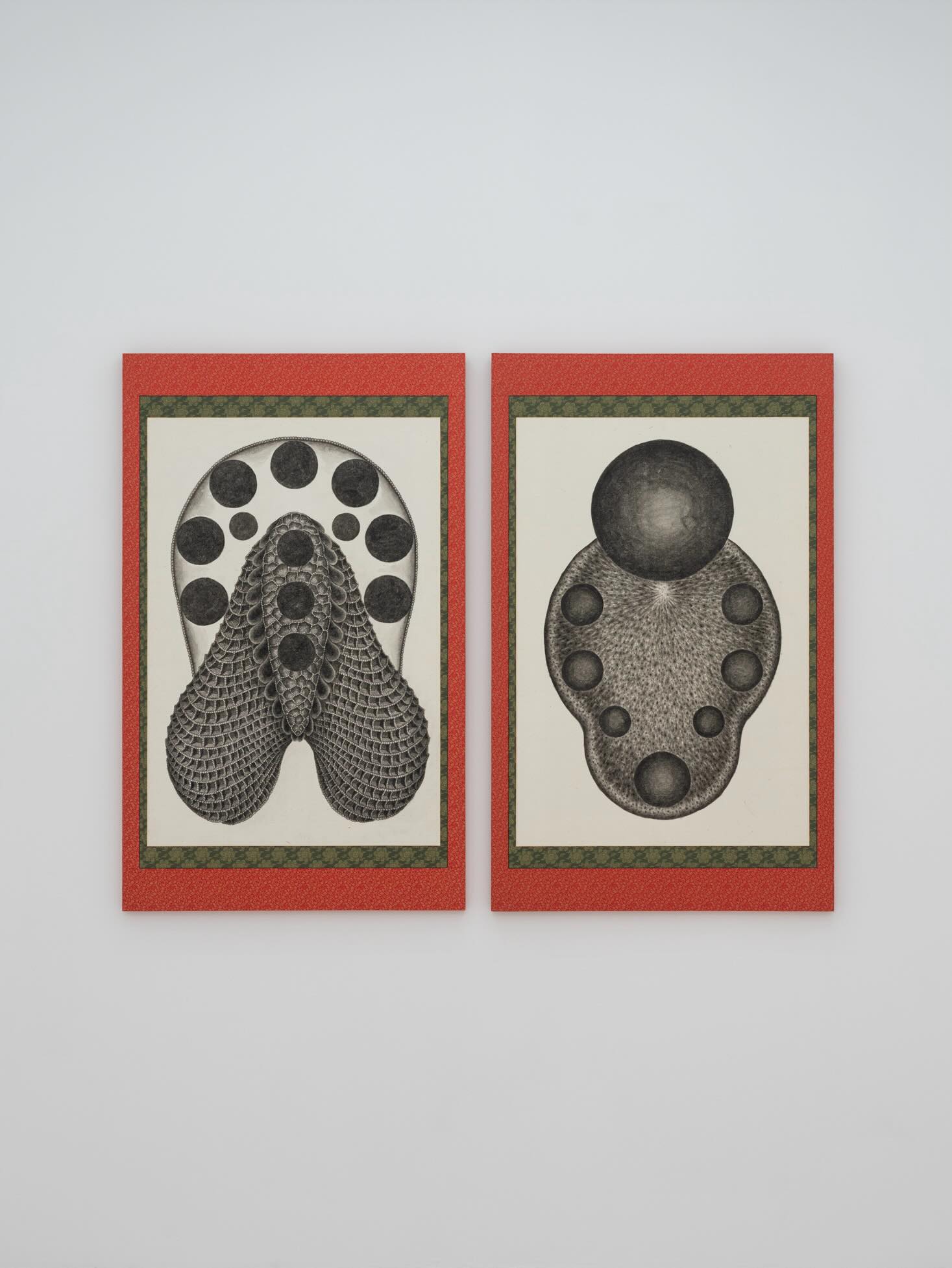
movements of phlegm-type masses. [Phlegm Drawing](2015) Series drawn on paper
with a pen looks like a map with an unknown continent of complex outline of
phlegm. Body fluids that flow out of abnormal excretory organs are considered
to be dirty. Excretion from mouth shows reversal or parallelities, bringing
animality that humans consider to overcome. Phlegm Drawing Series that began in
2012 with imagination that the body is filled with tonsillith is spitting
tonsillith from neck. That is a kind of self-hatred. But, the artist plans to
draw this dirty thing on fine silk. Things spat become a target of noble
appreciation.
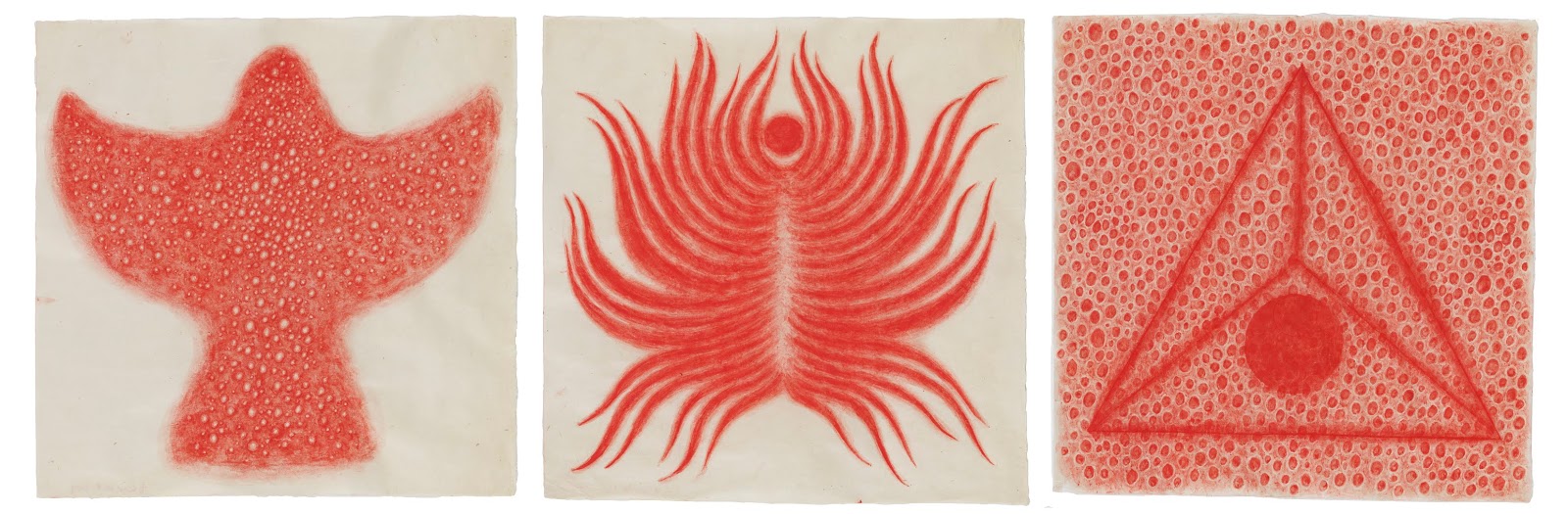
Phlegm drawing to be drawn with red Cinnabar, a symbol of driving
off evil spirits when drawing amulet is a kind of rituals that wash off dirty
thing using something dirty. Considering the young artist who just turned 30,
this ritualistic emotion and subculture emotion of the same age like Gothic or
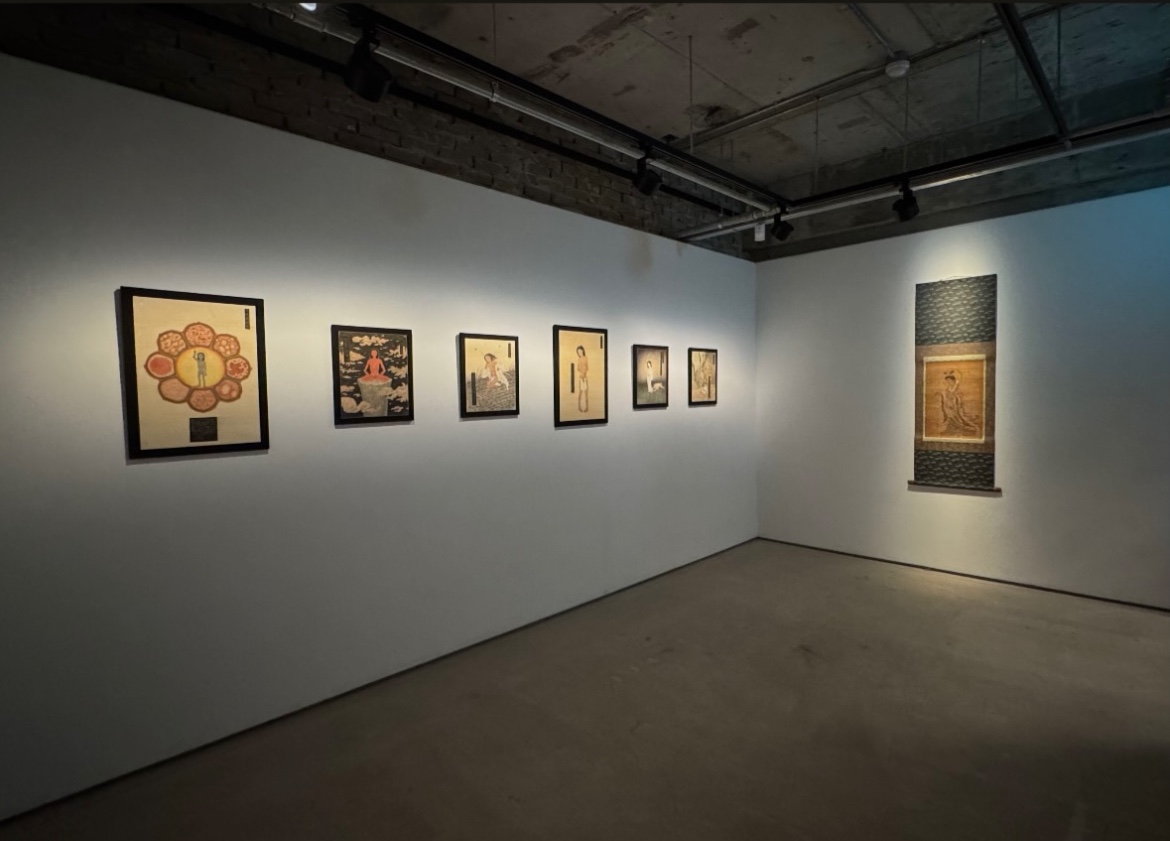
Cult cross each other. Altar portrait of Buddha or amulet is also called a
signifier rather than a deep meaning. Those are also signifiers responding to
the artist’s desire to get rid of disgust and guilty. Although his born faith
shows a clear relationship between nasal discharge and religion, Buddhism only
uses the form. The Orient is more natural-friendly than the West, so it is
distinguished from the dominant value of the western religion having original
sin consciousness, conquest, advancement and transcendence. The gap is so big
that someone contrasts vertical(the West) with horizon(the Orient). The West
preempted universality through capitalism, but a world view of vertical and
straight needs a balance weight. The artist’s major, the Oriental painting
technique will help lead to such a difference.
The video work with a theme of phlegm is expressed as the
hundred-and-eight torments of mankind after 36 frames selected from ‘video
archive’ are repeated three times. The artist considers it as ‘symbolic
phlegm’. That is ‘video amulet’ washing blood with blood and stopping phlegm
with phlegm. The video screen can be enlarged and combined with sound to make a
stronger effect. In the video work of 2014 and 2015, the scenes of a sphere
that soars, flows down, is divided and replayed are flowing with sound effect
made by the artist himself. There is a basic video pattern that moves forward
exploring its surroundings. But, it is not an empty space that often appears in
simulation games. That is like infiltrating inside not outside. It is a
representative boundary distinguishing inside from outside of the body. The
body filled with an aura of red color is a woman’s body. It is returning to the
place that it comes out of. In other words, retrogression is regarded as
regression from the perspective of society and ethics. But, this retrogression
or regression has long been used in religion and art, and it is now as well.
An eight-min single channel video work produced in 2015 presents a
monster that looks like a woman with three red heads or female genitals. Like
this, his work expresses things that are attractive but taboos. Although there
is no clear narrative, video work is flowing, following time axis connotes
narratives. The process of birth and death with motion itself is a dream
towards catharsis like Mass ceremony with an introduction, development, turn,
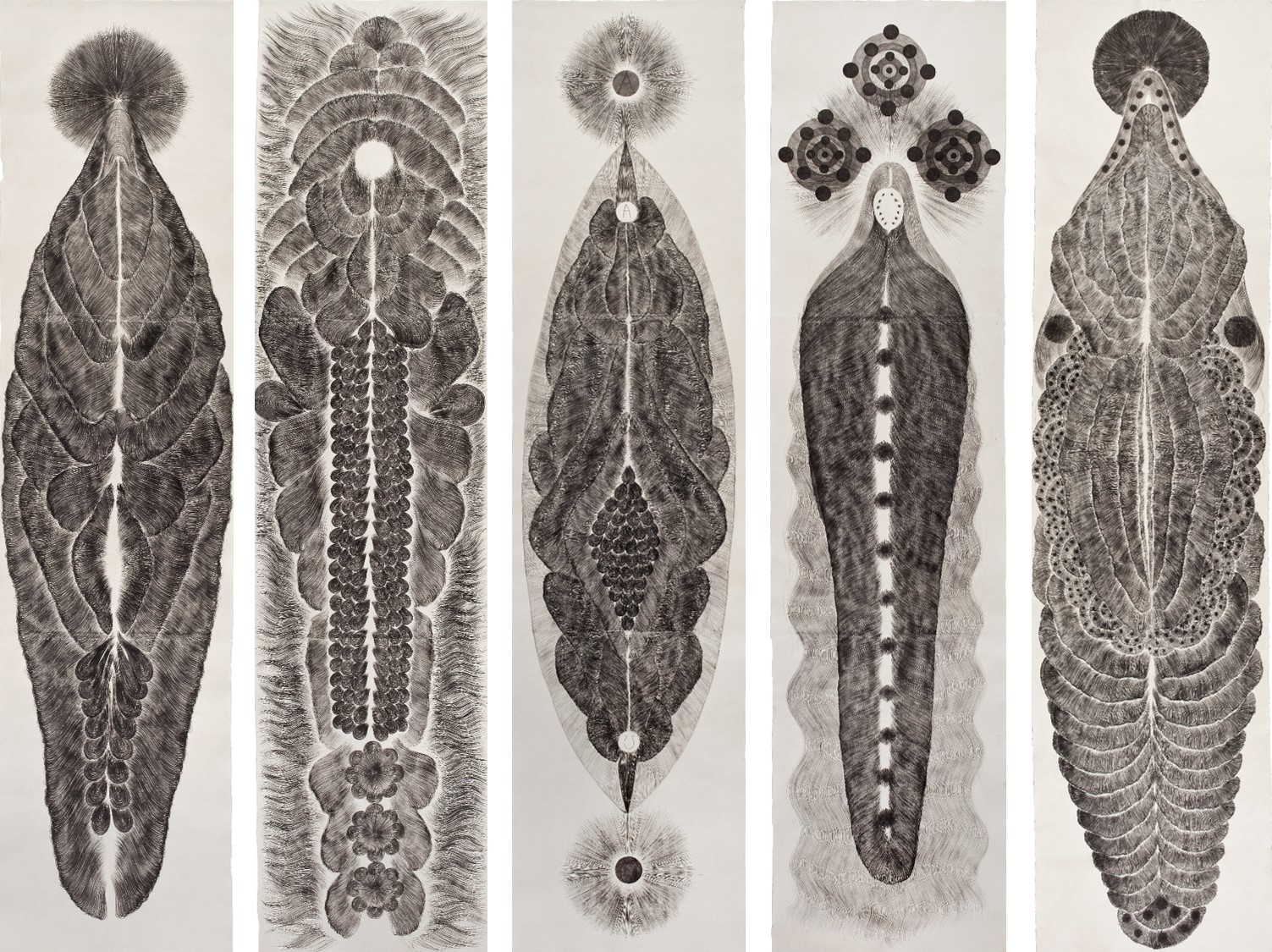
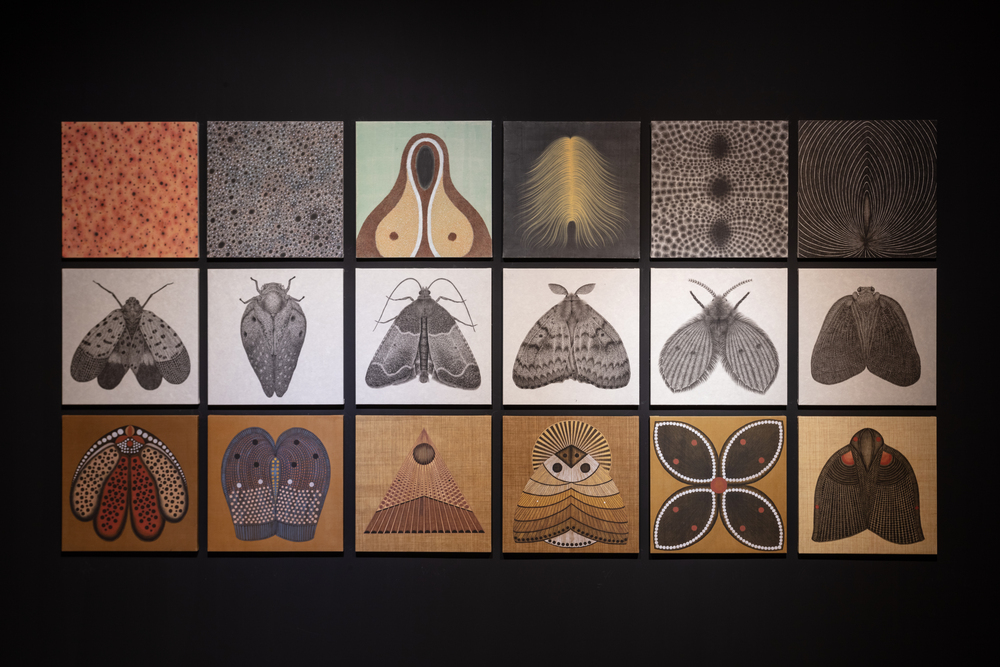
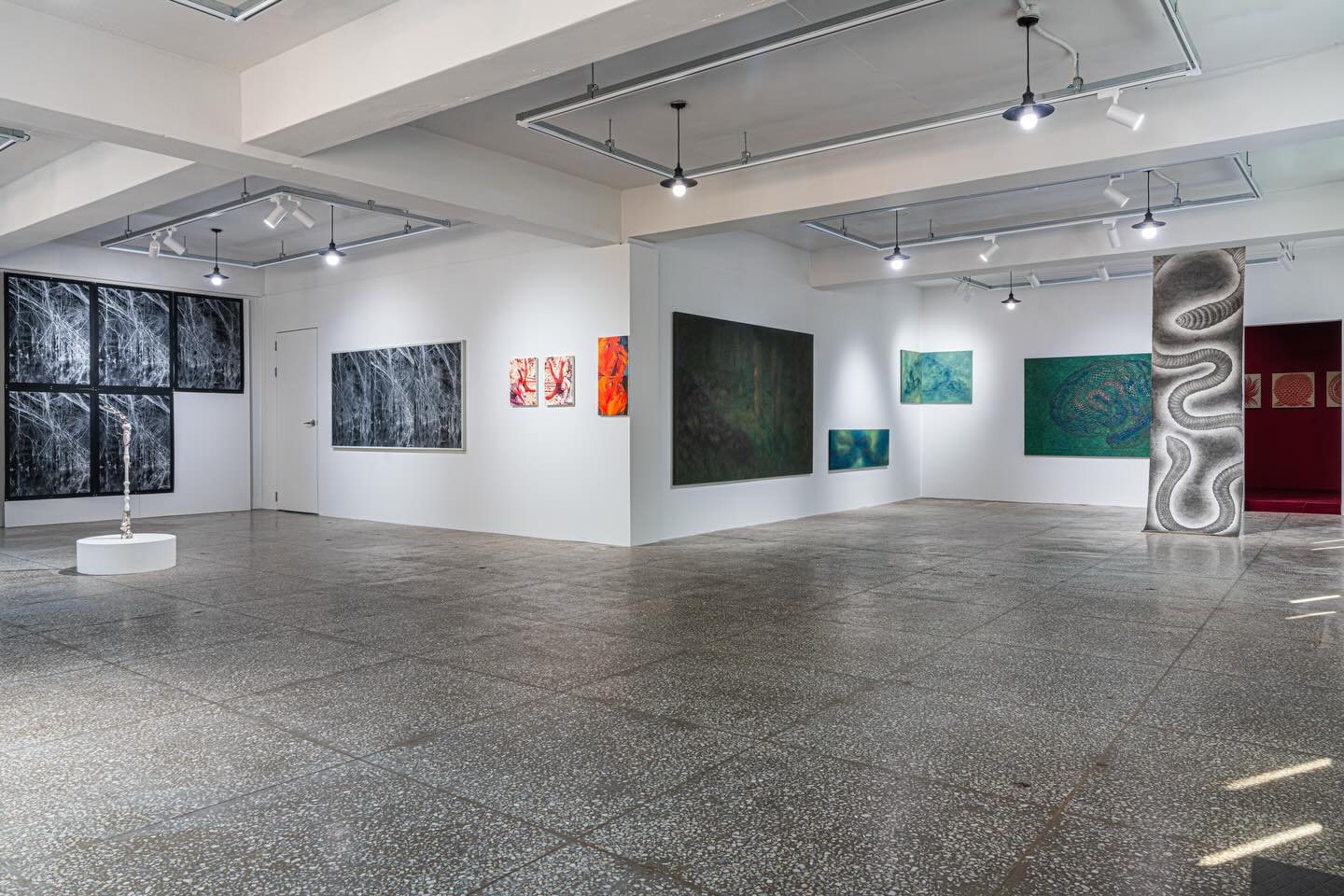
and conclusion. The installation scene in his first solo exhibition(2015)
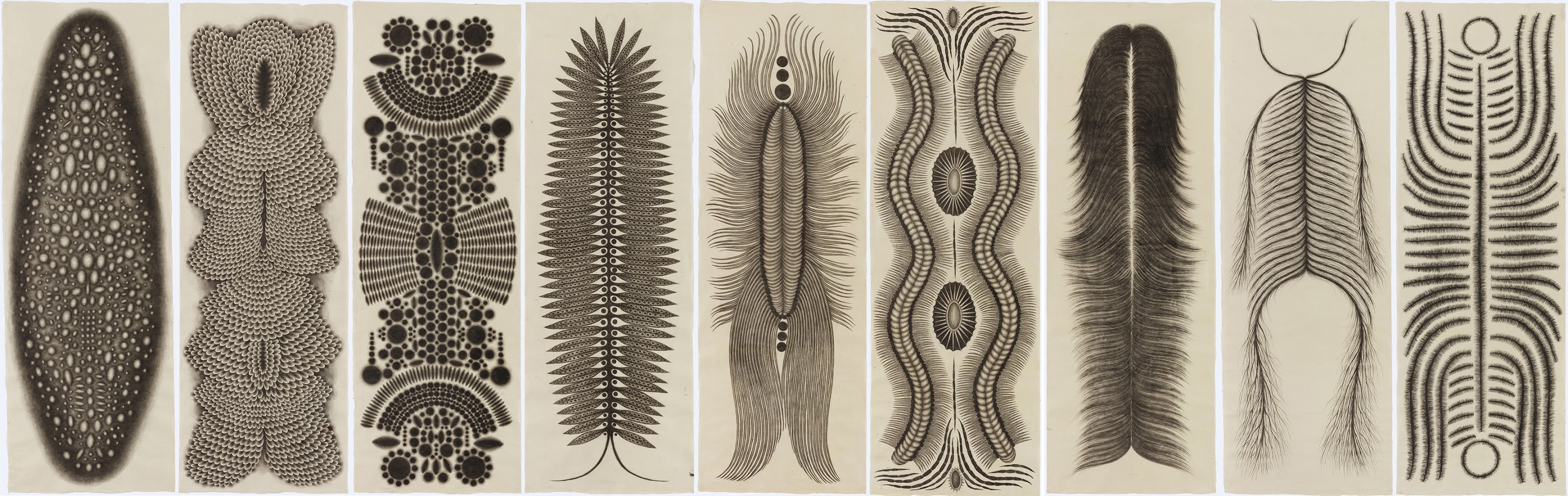
[Rebellious Agreement] uses the structure of symmetry that is often used in
religion. 410x100cm long pseudo icons where a dominant shape is strongly
position in the middle are arranged left and right. It borrows an universal
structure, but it is displayed like a person’s church that replaces all with
new contents. Images drawn on paper with ink are also symmetry like the
arrangement of the drawing. But, up and down are clearly distinguished. Lines
filled with writing in small characters inside outline give a soft feeling. If
gender is given to this abstract image that is variations with a long oval
silhouette whose middle is thinly empty, it is undoubtfully a female.
But, this excessive length trailing on the floor like a long skirt
and tight arrangement puts pressure. ‘Rebellious Agreement’ delivers the
emotion the artist felt from sacred things excessively found in his house. That
is refusing sublimation needing a proper distance. Religion needed something
that is one before sublimating, for its sublimation. Julia Kristeva’s [Pouvoirs
de l'horreur] saying ‘you would rather stop than kill’ that is explaining the
reason why the Bible increases something disgusting. According to Julia
Kristeva, the target of disgust is indeed making a response to sanctity. At the
same time, it is depletion of sanctity. Religion is gradually disappearing,
whereas ethics are only advancing, in the ideology of logic and abstract and
the law of system or judgement. Julia Kristev mentions one is struggling in
one’s entire life to become an agent of speaker or an agent of law. Then,
religion goes down again and works with the power of cracking a hardened
symbolic order, and encounters the desire of art pursuing newness and
heterogeneity. Park Wunggyu’s work emphasizes the violation at this
intersection.