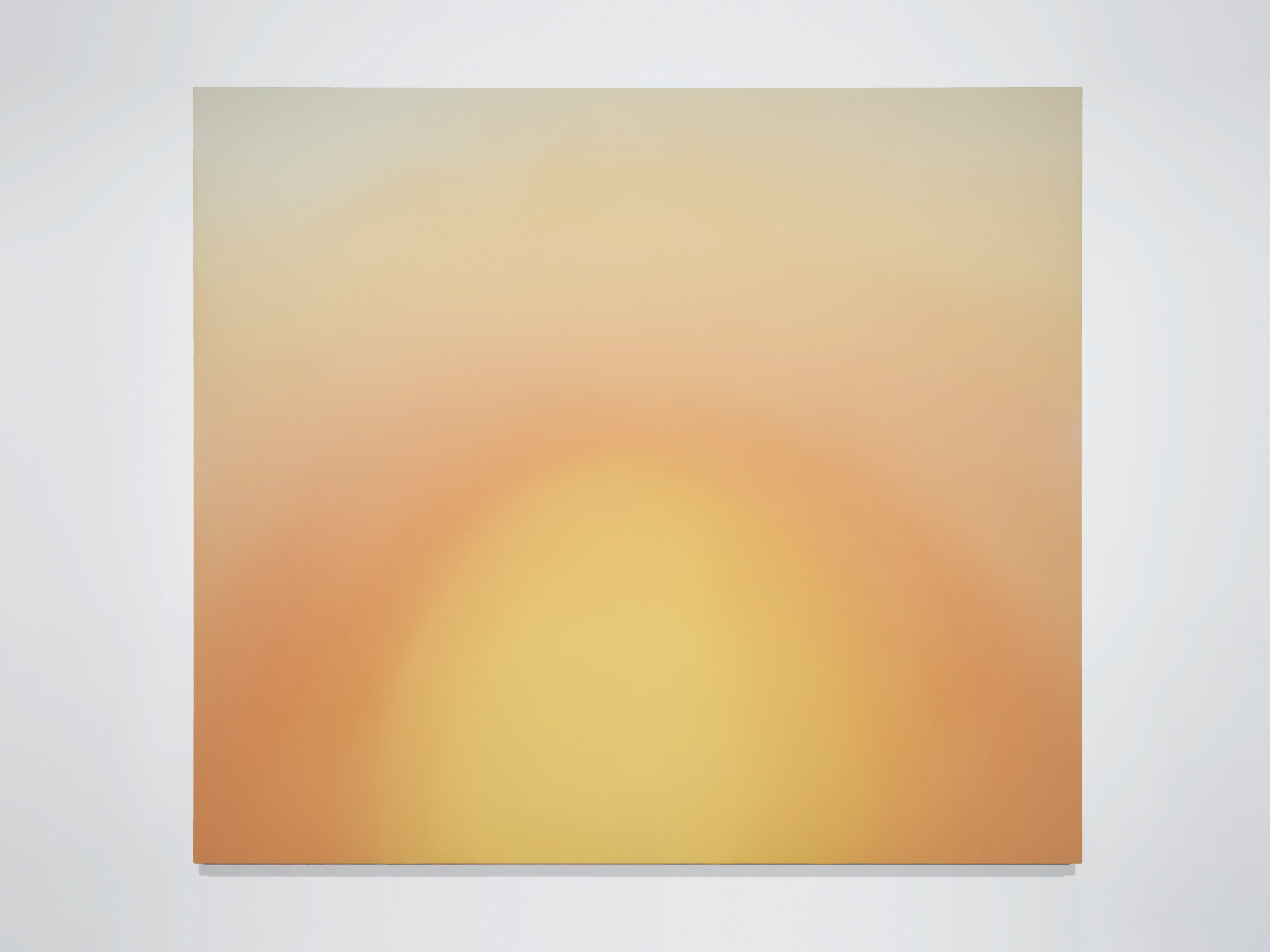
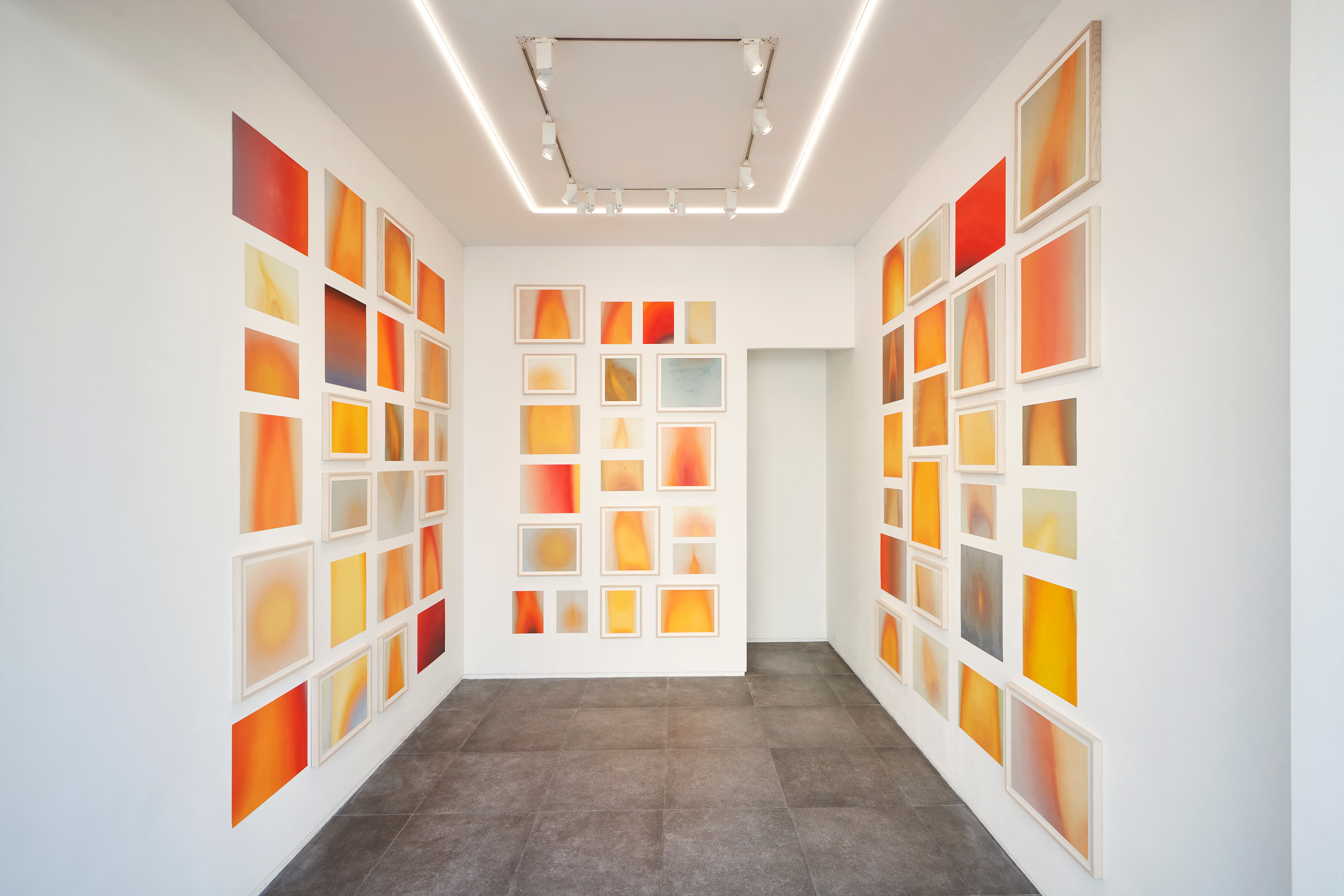
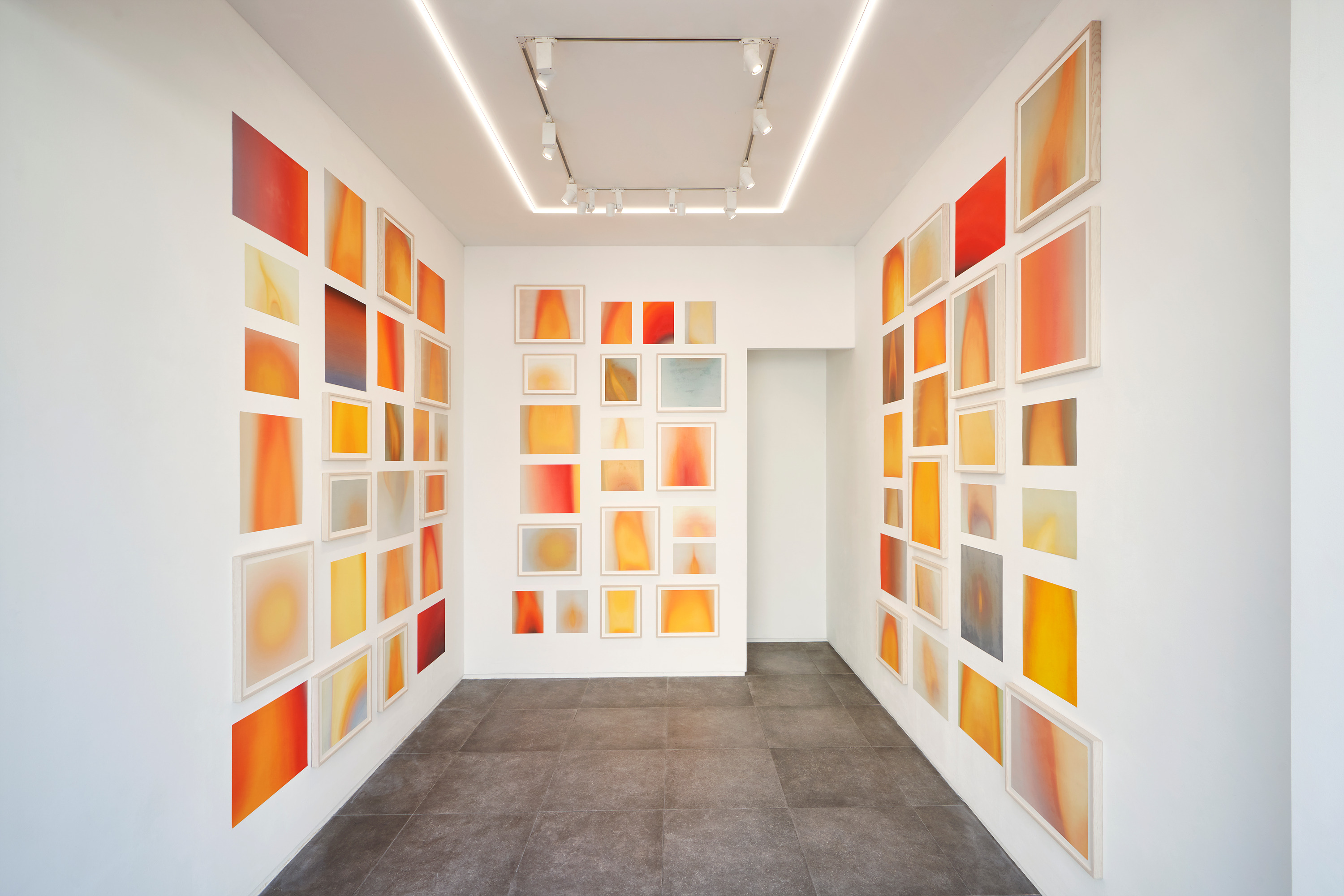
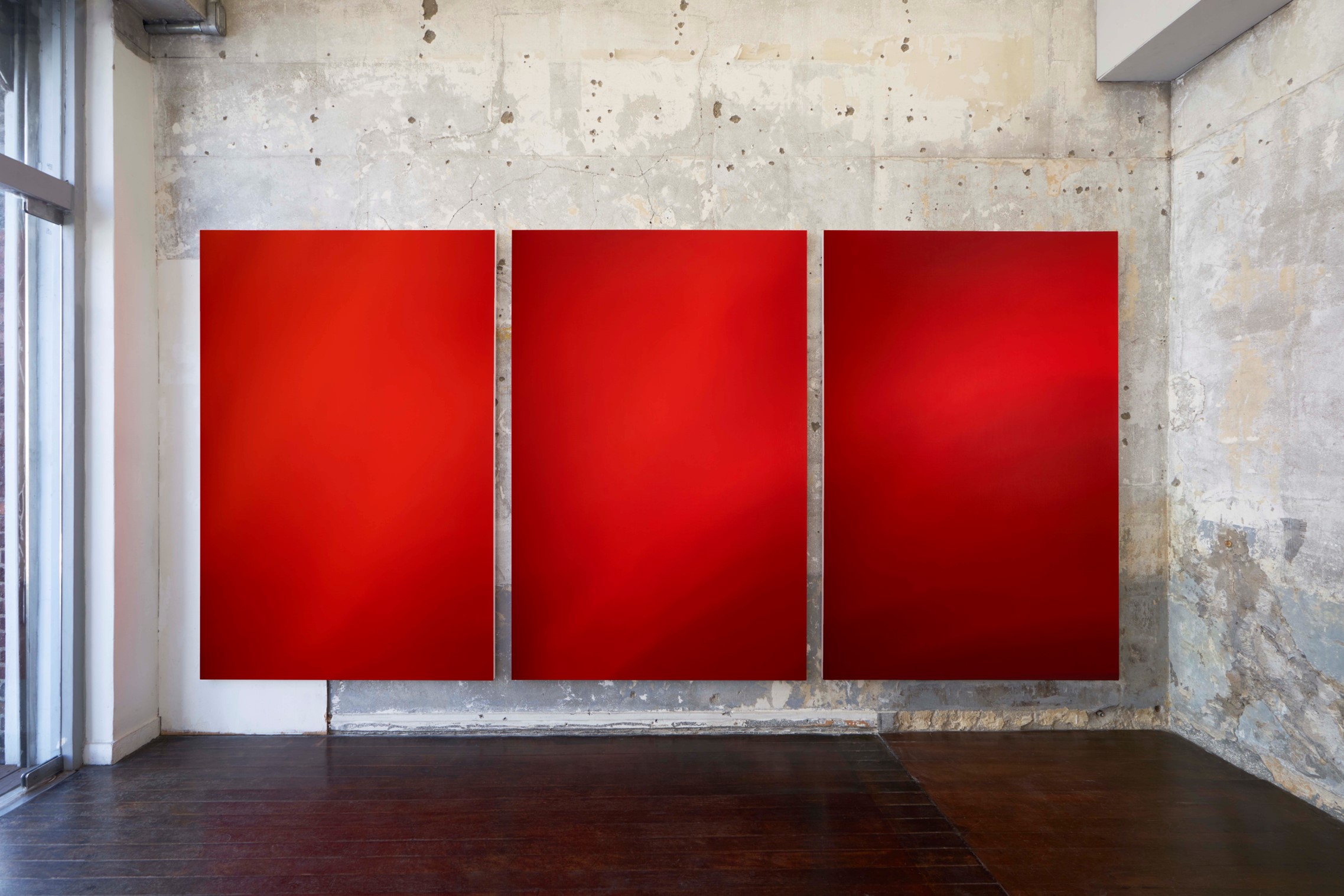
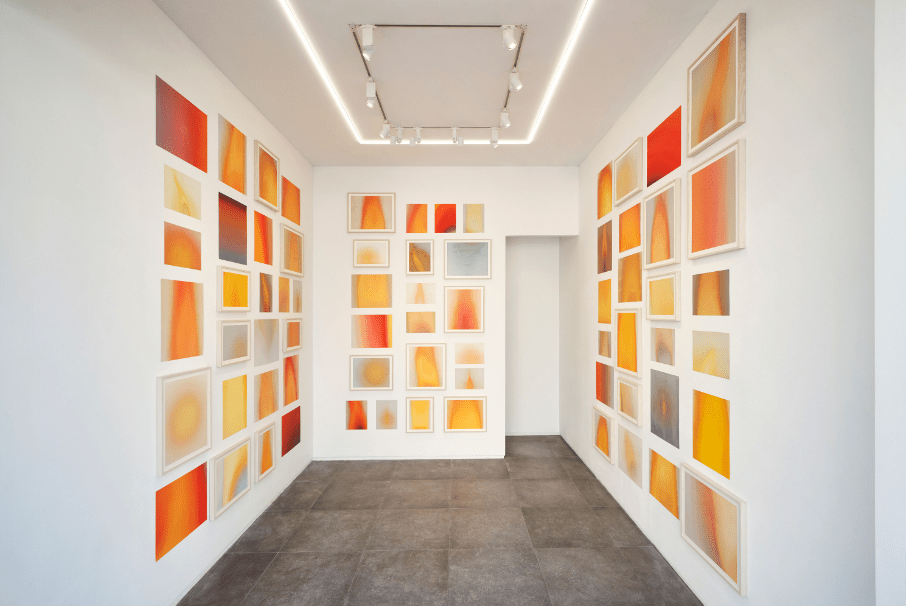
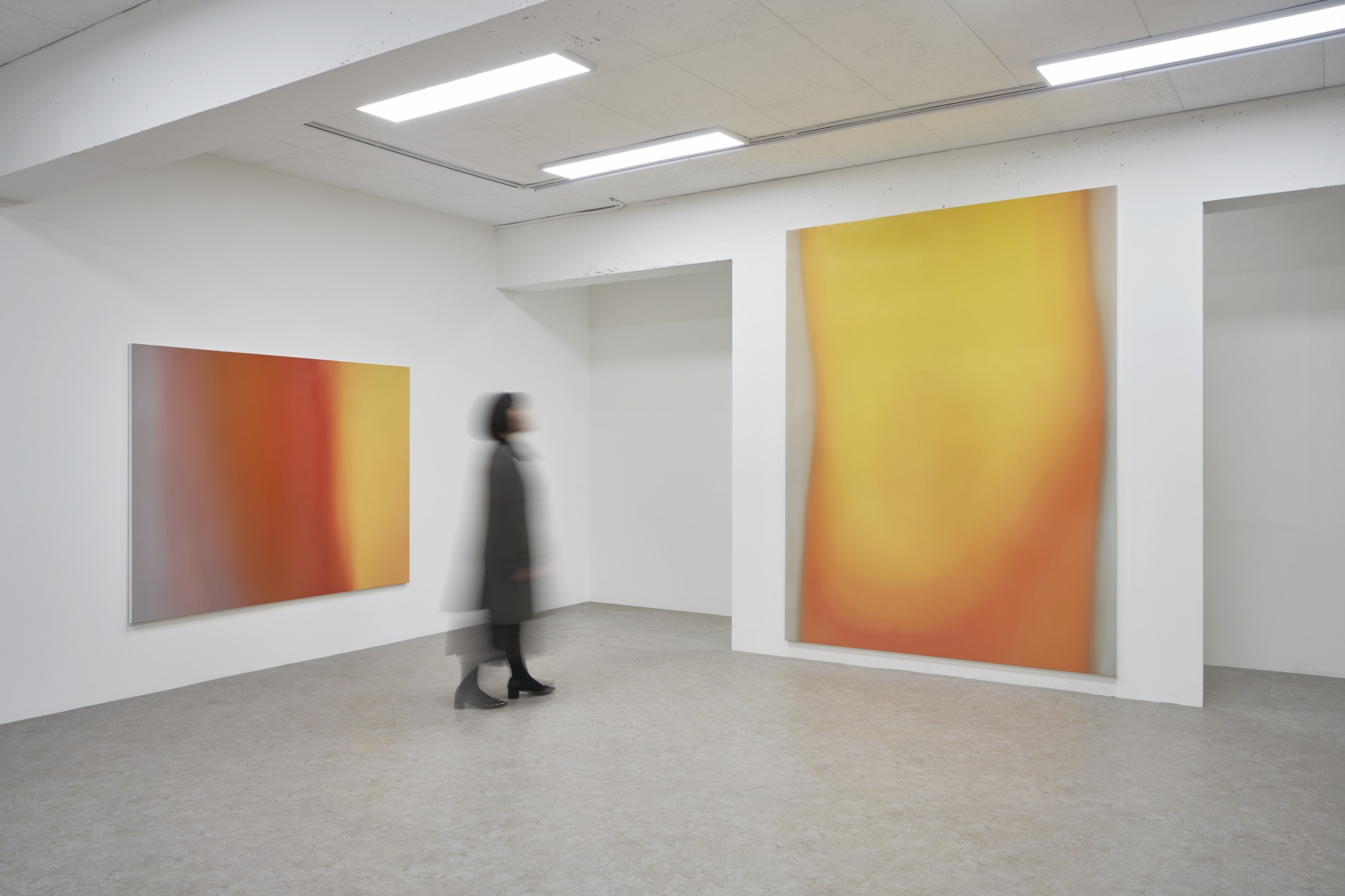
You will encounter a multi–colored spectrum that delicately
oscillates within a canvas, an image that seems to be flowing along the surface
of air or liquid. When a viewer’s shadow overcasts over the surface of the
painting that does not indicate a specific figure, the image flutters with the
shadow. As the observer converges one’s gaze and concentration into the canvas,
he/she may feel an unspecific emotional level, temperature, and touch, or the
magnetic field of the view may leave behind remnants of some sort.
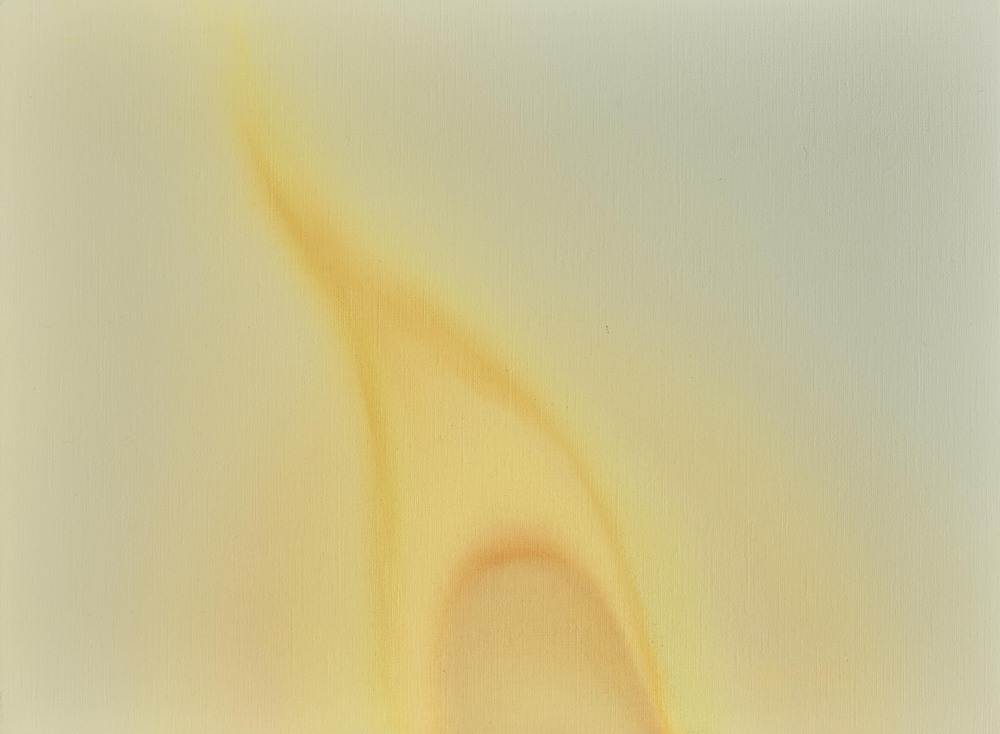
The motive for Keem Jiyoung’s recent work, Glowing
Hour, is found in a specific target called candles. However, the
series of works does not reproduce the object. They are on the same line
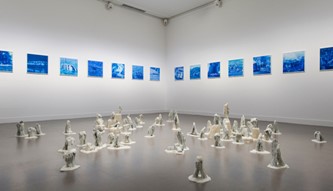
as ‘Blue’ Series (2016–2018), which specifically revealed sinking
ships or collapsing cement buildings and such, and the candle sculpture of
praying hands displaying a charred black wick, Look at This
Unbearable Darkness (2019) but are presented in a different
form. Their appearances are also distinguishable from Sleep (2015),
which attempted to recreate the motif of death and sacrifice by overlapping it
with a sleeping face. Glowing Hour does not depend on
the imitative depiction of the object. These paintings do not show what is
commonly referred to as conceptual or concrete figures. However, they manifest
the image of fire, a mere lambent of a certain state. Just as the cropped and
enlarged image of an object becomes distant and abstracted from its origin, the
painting in front of you appears as a visual image that eliminates the
explanatory elements of the object called a candle.
However, Keem’s works are often described as the logic of
reproduction. The reason may be that her works have been continuously recalling
the incident of April 16, 2014, and in the case of Glowing Hour,
it might be because they are visualization of the object, candlelight. For the
same reason, it is said that Keem’s pieces recreate something in an allusive
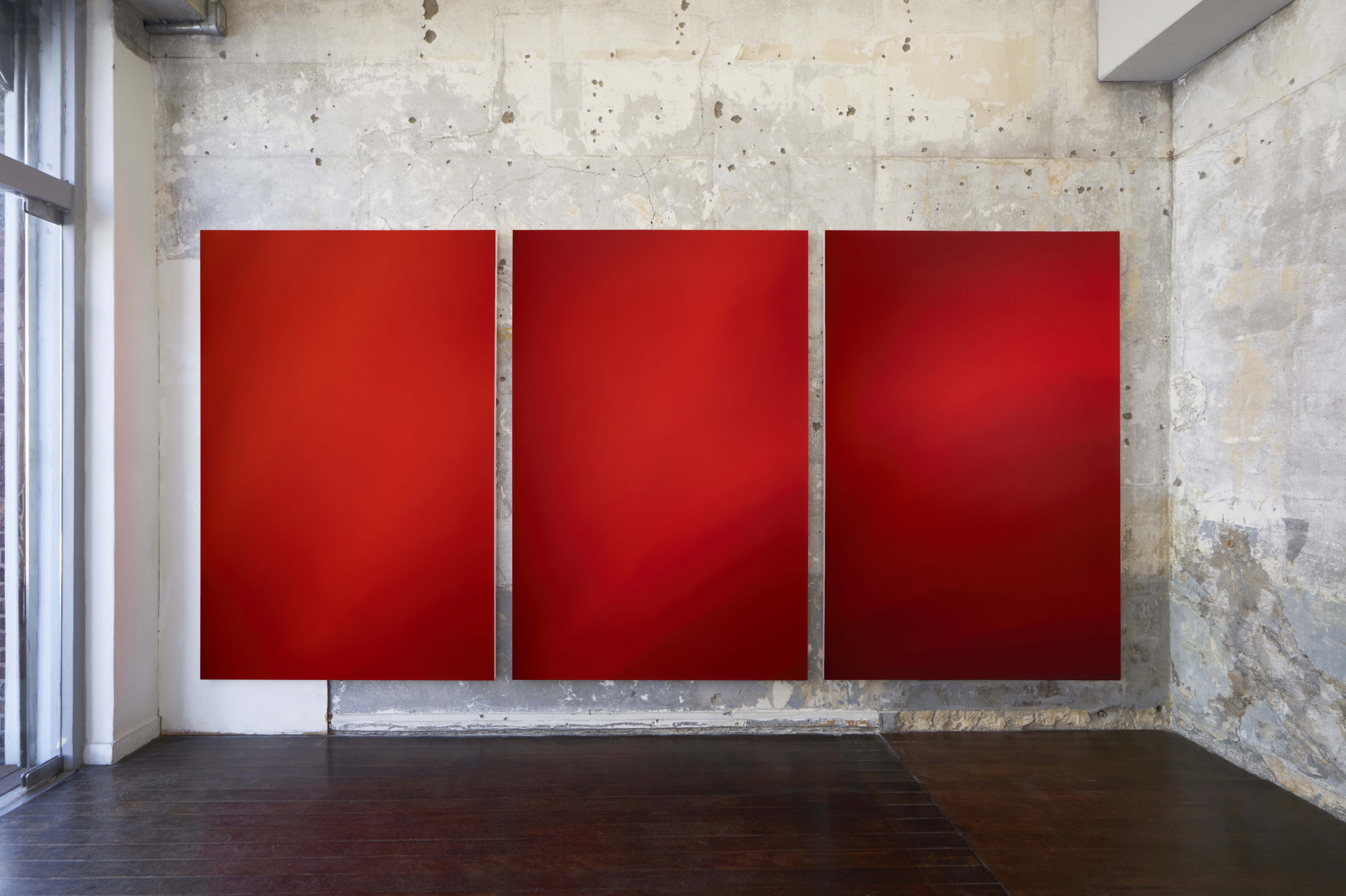
and indirect way. Is reproduction an actual method utilized for the ‘Glowing
Hour’ series? These paintings simply display large red–colored surfaces,
right? What do we see from them? They continually evoke tragedy and disaster,
but they never directly present tragic and disastrous scenes. Maybe we need to
accept the fact that these ambiguous and blurred beautiful paintings would
never take a form of recreation.
Peter Osborne reexamines the critical discussions that stirred
over Gerhard Richter’s abstract and aesthetic paintings introduced in the late
80s in his writing titled “Abstract Images: Sign, Image, and Aesthetic in
Gerhard Richter’s Painting” (1998). He explains that in Richter’s photo
paintings, photographic characteristics function as an index rather than the
figurative likeness of a certain object. Furthermore, he said that the decision
of smearing the image using a squeegee is the result of taking only the
directive function without any iconic similarity. In other words, he is saying
that they are not abstract images with iconic resemblances and that they are
simply generating symbols, meanings, and observations through directives.
Perhaps Keem’s paintings found themselves in a predicament that was not much
different from what Richter’s abstract paintings had to deal with in the 1980s.
The point is that even the remembrance of April 16, 2014, incident is
considered abstract and overly aesthetic which can be seen as formalism.
However, Keem’s recent pieces act as directive symbols that evoke meanings even
though they do not appeal to specific iconic resemblances, despite being
aesthetic and abstract. They are activated while overcoming the media conditions
of the time, including photos and videos, without prompting metaphors and
symbols.
On this premise, the relationship between the artist’s past works
and the series of ‘Glowing Hour’ can be examined. Based on her past
works, including the reproduction of visible objects, and the reproducible
functions of contemporary media, photos, videos, and text that were part of the
past works, we can infer whether the recent pieces are seeking to represent
something other than an iconic resemblance. For example, we see Paengmok Harbor
in her video work Glow Breath Warmth (2020). Since
2014, Paengmok Harbor and the nearby sea have had a special meaning for the
temporary community that can be referred to as us. It embraces the unclarified
tragedy, Sewol Ferry victims, inadequately concluded condolences, and those who
paid their condolences, and it ceaselessly calls for an ethical responsibility
to remember a certain issue. The indicative state of the video is clearly quite
influential in viewing her paintings. Nevertheless, to be exact, the abstract
paintings are drifting away from the actual tragic scene. Thus, the gap between
the indicative symbols and the physical traces, and between the expanding
meanings and the meaninglessness can be confirmed. Such opaque images continue
to create cruxes between symbols, meanings, and the possibility and impossibility
of reproduction. The images of the color surface, which their meanings cannot
be hastily anchored and only unknown and heavy emotions are presumed, are
continuously pushing us to verify something.
The Series of ‘Glowing Hour’, which would be better to be
said abstract, nevertheless engages in the tragedy of that day, forming candles
and several semantic networks surrounding them. To be exact, Keem’s paintings
are attempted in the position of those bereaved of the victims, in other words,
those grieving. Therefore, the artist, does not choose to reproduce the tragic
disaster, but the method of mourning is embodied while the indicative state is
planted inside the images. The abstract paintings in which nothing is apparent
are related to mourning, although they could be understood as evoking candles
or the sea where the tragedy transpired.
Judith Butler wrote, “I am not sure I know when mourning is
successful, or when one has fully mourned another human being.” (Butler, J.
[2006]. Precarious Life: The Powers of Mourning and Violence.
[p.20]. Verso.)
This sentence does not mean that we should continue our
condolences forever, nor that we should abandon the enigma in an enigmatic
state eternally. Instead, we need to sincerely advocate to face the state of
mysteriousness itself, which can never be successful unless we busily promise
to do so. Keem’s paintings might be taking part in this baffling state of grief
and bereavement. The images that the artist is presenting are standing where
those bereaved and those mourning are, those who can grasp the desperate
efforts and pain of the victims only in their own grief. The artist understands
the sorrow that captivates and dominates us and the opacity of unfinished
condolences as a property of an image.
As an audience, all we see are abstract paintings as simple facts,
and traces of brushwork that follow color and light. As such, the series ‘Glowing
Hour’ does not easily allow the visible image to instantly adhere to a
specific meaning. I hesitate to explain the artist’s recent pieces in any other
connotation that candles symbolically embrace or refract. The brush strokes as
traces of some sort of a mind, time, and action are significant enough without
specific declarations and instructions of figures. Keem’s paintings leave an
opacity as a purely visual state through aesthetic convention. In other words,
the emerging method of an image in a painting is to make the impossibility of
internal clarification a kind of essential condition. Keem Jiyoung’s works
embrace the inexplicable sorrow brought by the loss and embody the situation
that is incomprehensible as how it is. By doing so, they compel the tragedy to
not become something that could be simply remembered or disregarded. The
abstraction and opacity of the paintings/images make us face mourning, which
Butler says cannot be successful or be fulfilled, as something internal and
present. As such, her works tell us not to be swept away by the unclearified
ambiguous facts and sentimental metaphors but to face the loss that is already
originated in the paintings or us. Maybe we can compare all these processes to
the procedure of grieving that encounters unfathomable loss. The mourning
attempted here is to repeatedly confirm the fact that not only some entity’s life
has come to an end but also that the world and others are gone (those out there
are already within me).