A Shipwrecked Civilization and a
Cosmic Wanderer
Books stacked tightly in a
library collapse, and in the midst of the debris of books and objects pouring
out from a wrecked ship and drifting across the sea, carnivorous animals appear
and engage in a bewildering struggle with books. This highly unrealistic scene
summarizes several impressions from Jeongsu Woo’s solo exhibition 《The Grave of Books》. The collapsing library
in his paintings evokes Borges’s imagined Library of Babel.
Interestingly, the etymology of Babel in Hebrew means “chaos.” It seems that
Borges, in conceiving this library, had already predicted the future of
humanity. Humanity’s desire to be saved by the endless world of civilization
and knowledge—yet never truly attaining it—resonates with Woo’s work. The
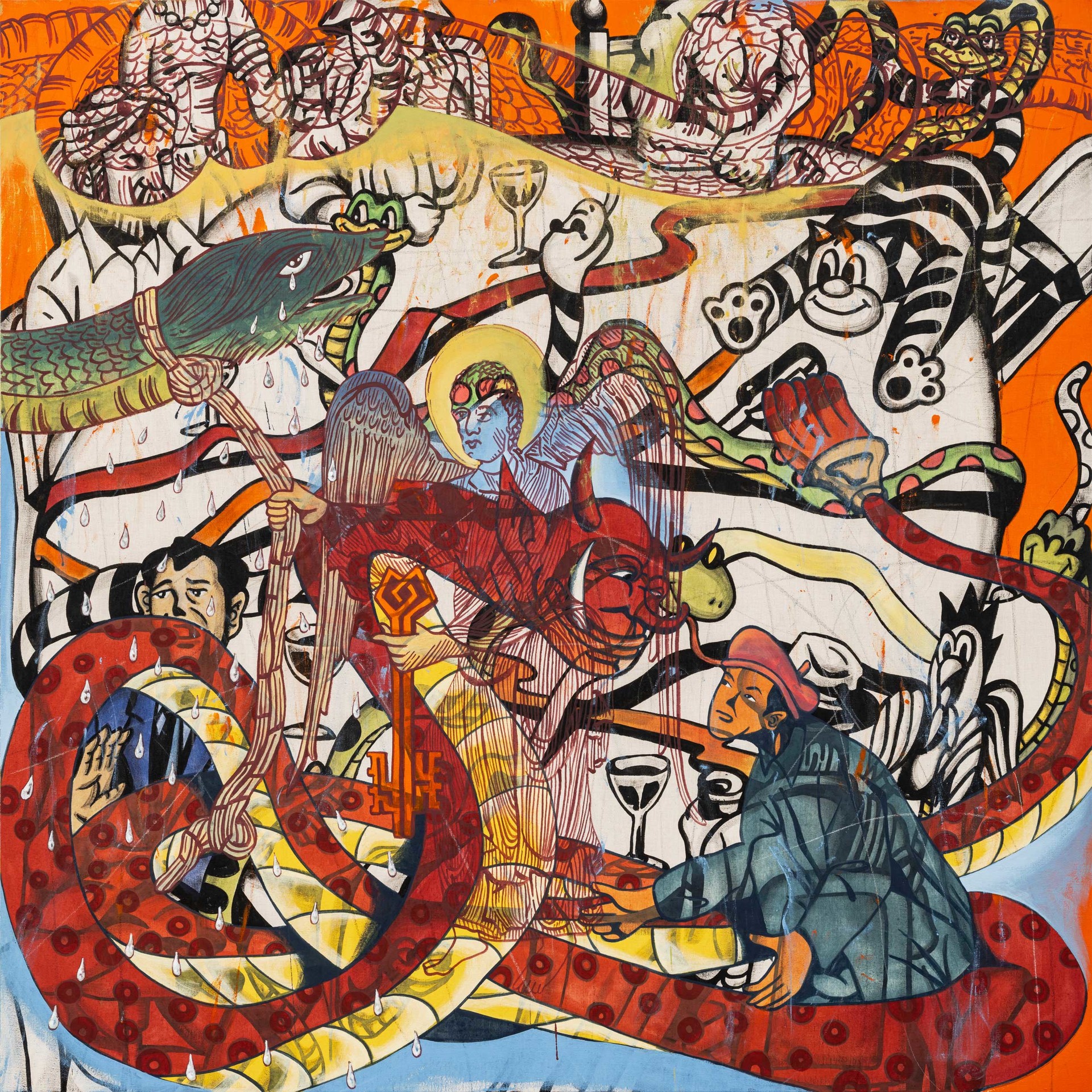
tightly packed books in his paintings metaphorically represent the culture and
civilization built by humankind, as the Library of Babel
suggests. The linear historical view that once believed in the inevitable
progress of civilization has already crumbled today. Amid global crises,
disasters, and catastrophes, there is little expectation that human knowledge
will overcome the current predicaments and lead to a radiant future. The
artist’s attitude toward this situation neither screams despair nor seeks hope.
“Neither descending nor ascending, but in an intermediate state”—this phrase
refers not only to the structure within the paintings but also to the artist’s
determination to examine the situation of individuals adrift in the chaos of
the world. This exhibition, 《The Grave of Books》, begins with a skeptical view of humanity, ominous signs from
around the globe, and above all, the existential anguish of one individual
sensing these conditions.
From One Drawing to One
The starting point of the
work lies in a shipwreck. This imaginary situation traces back to a drawing
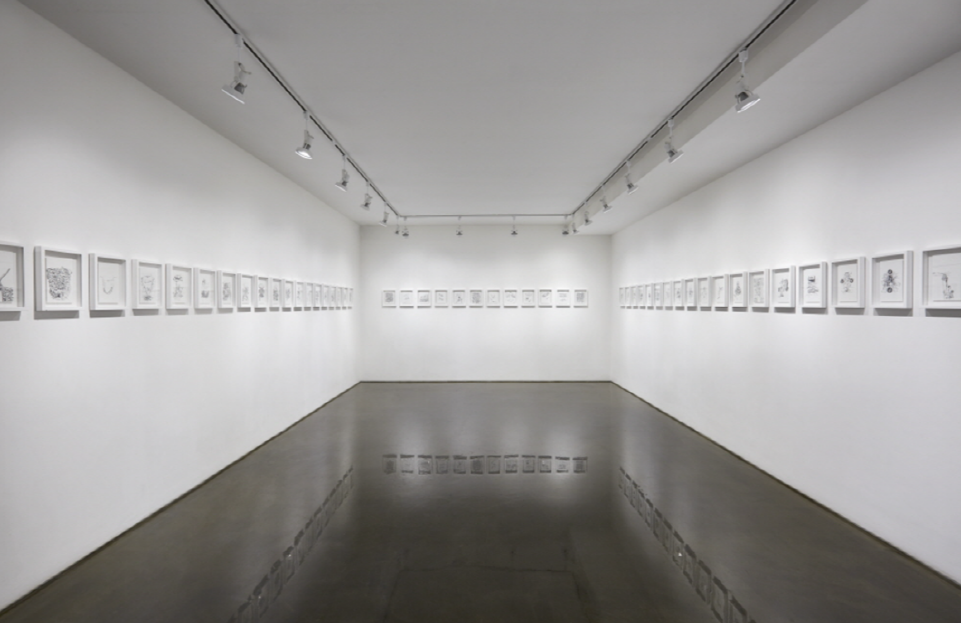
book created by the artist himself in 2010. In over a hundred drawings, which
seemed to pour out the images in his mind at the time, the artist depicted
scenes filled with contradictions and absurdities of the world—death, violence,
chaos, oppression, destruction, confinement, conflict, and more. These drawings
unfold like works of fantasy literature and were inspired by the countless
books the artist obsessively read in his attempt to understand the world. Just
as the title of his 2015 solo exhibition, 'Pictures of Rogues,' referenced
Borges’ 'A Universal History of Iniquity,' the title of the current work also
echoes many of the books he devoured: Pascal Quignard’s 'The Roving Shadows,'
Botho Strauß’s 'Time and Room,' Daijiro Morohoshi’s 'Fish of the Night,' among
others—spanning literature, comics, plays, and historical texts. It is no
surprise that books frequently appear as motifs in his work. To the artist,
books are not only the world, civilization, and a mirror of desire—they are
also the foundation of fantasy and living spirits. One of the early drawings
depicts books washed ashore from a shipwreck piled high, intermingled with
skulls, as two men armed with long poles confront each other tensely. This
drawing is what he would later call 'The Grave of Books.'
The artist’s statement that he
'wanted to show a single painting' is rooted in this small pen drawing. Having
trained in various media—pen, pencil, charcoal, oil—he has focused primarily on
ink since 2014. To this artist, who aimed to counter the weighty subjects of
the world with a light touch, ink became an intuitive tool, allowing emergent
forms to be expressed with ease. In his smaller drawing works, the force,
intensity, and feel of the hand manifest freely through the ink, producing a
satirical atmosphere that borrows from subcultures. In more recent works,
however, this spontaneous brushwork is deliberately restrained. Perhaps in
painting 'a single image,' the artist has developed a sense of patience,
balancing the sensory interplay between ink and hand. It was through this
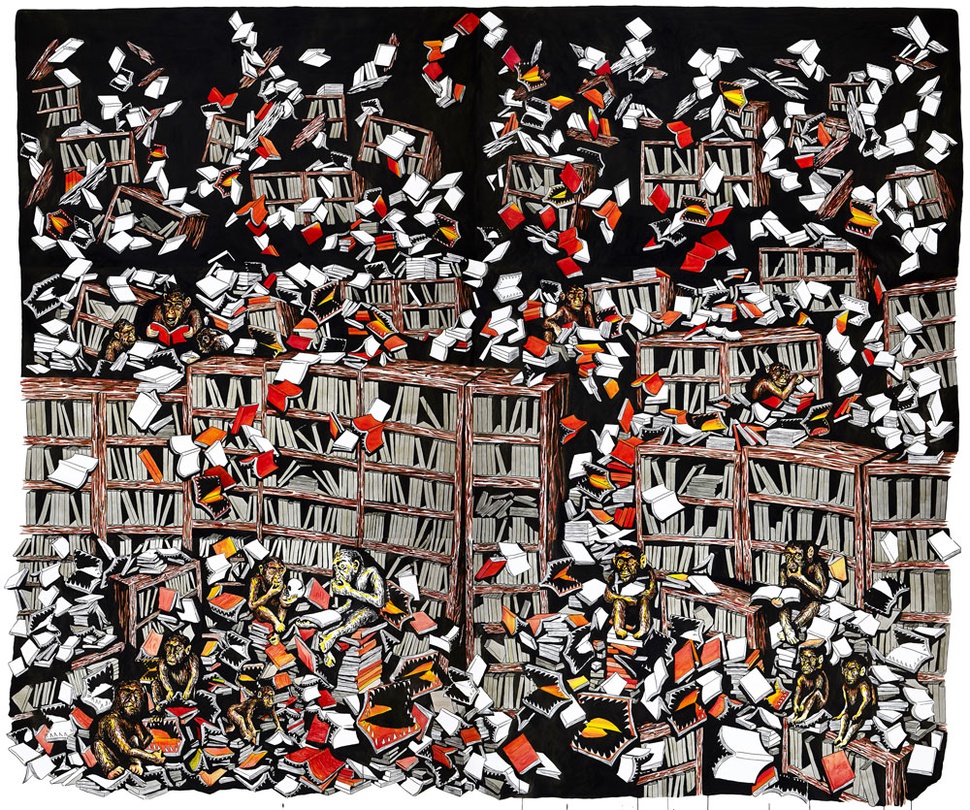
process that he completed the large-scale painting 'Monkey Library' (5 x 5 m).
Carefully regulating the weight of the black ink across the entire canvas would
not have been an easy task. Working on a narrow wall in his studio, he affixed
one sheet of paper at a time, meticulously calculating the composition between
chaos and order. This working method likely became a meditative time of
discipline, balancing between a 'sense of reality' and a 'sense of
imagination.' The exploration of duality extends not only to the materiality of
painting but also to the image-making process. 'Monkey Library' represents an
effort by the artist to suppress personal expression while experimenting with
both the 'sense of decomposition' and the 'sense of construction.' This static
yet dynamic composition is carried through not only in the painting’s visual
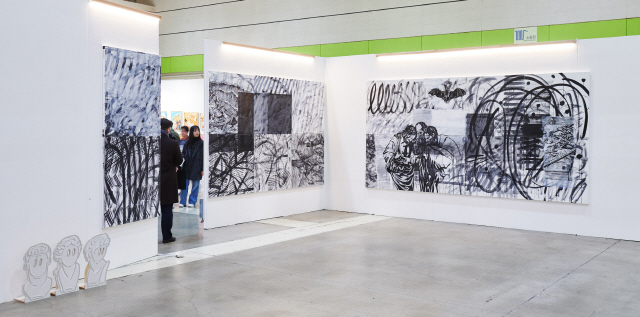
field but also in the overall exhibition design, which mixes drawing and mural
elements.
The World of Madness Emerged from
Shipwrecked Civilization
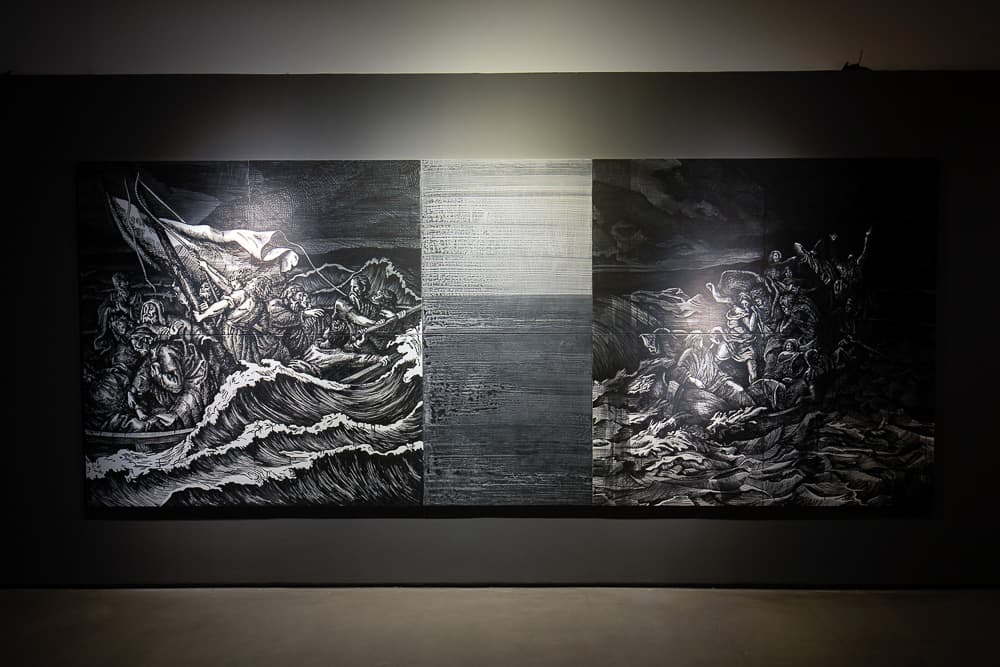
Returning to the shipwreck: in
the exhibition, 'Shipwreck G' takes its name from the fictional ship 'Glory,'
imagined by the artist. Judging by its name, the ship must have once been
splendid, but it was suddenly destroyed by catastrophe, its fragments drifting
across the sea. Statues, relics, and books—symbols of a glorious past
civilization—float among the debris. The 'glories (memories) that are sinking
and disappearing,' as expressed by the artist, do not simply end in submersion.
It is here that Jeongsu Woo’s painterly sensibility is fully revealed: the
light touch that satirizes the outbursts of violence amid despair. The sunken
ship does not sink so easily. Like many facets of our own society, tragedy only
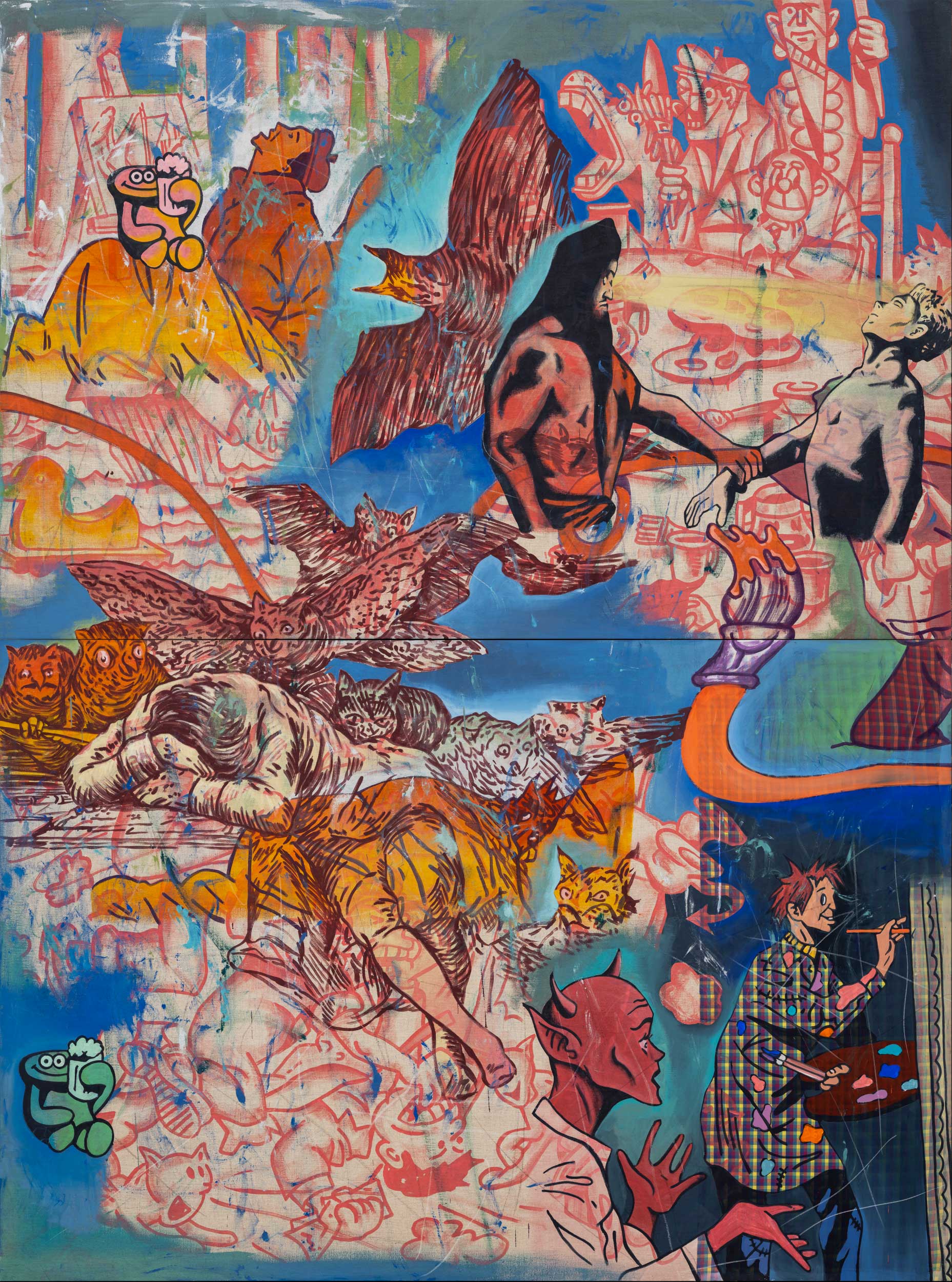
begets more tragedy, and dehumanizing horrors rise to the surface. In 'Time of
Carnivores,' a pack of crocodiles suddenly appears and attacks the books.
However, the books have sharp teeth of their own, making it impossible to
determine whether the books are devouring the crocodiles or vice versa—only an
overwhelming violence remains.
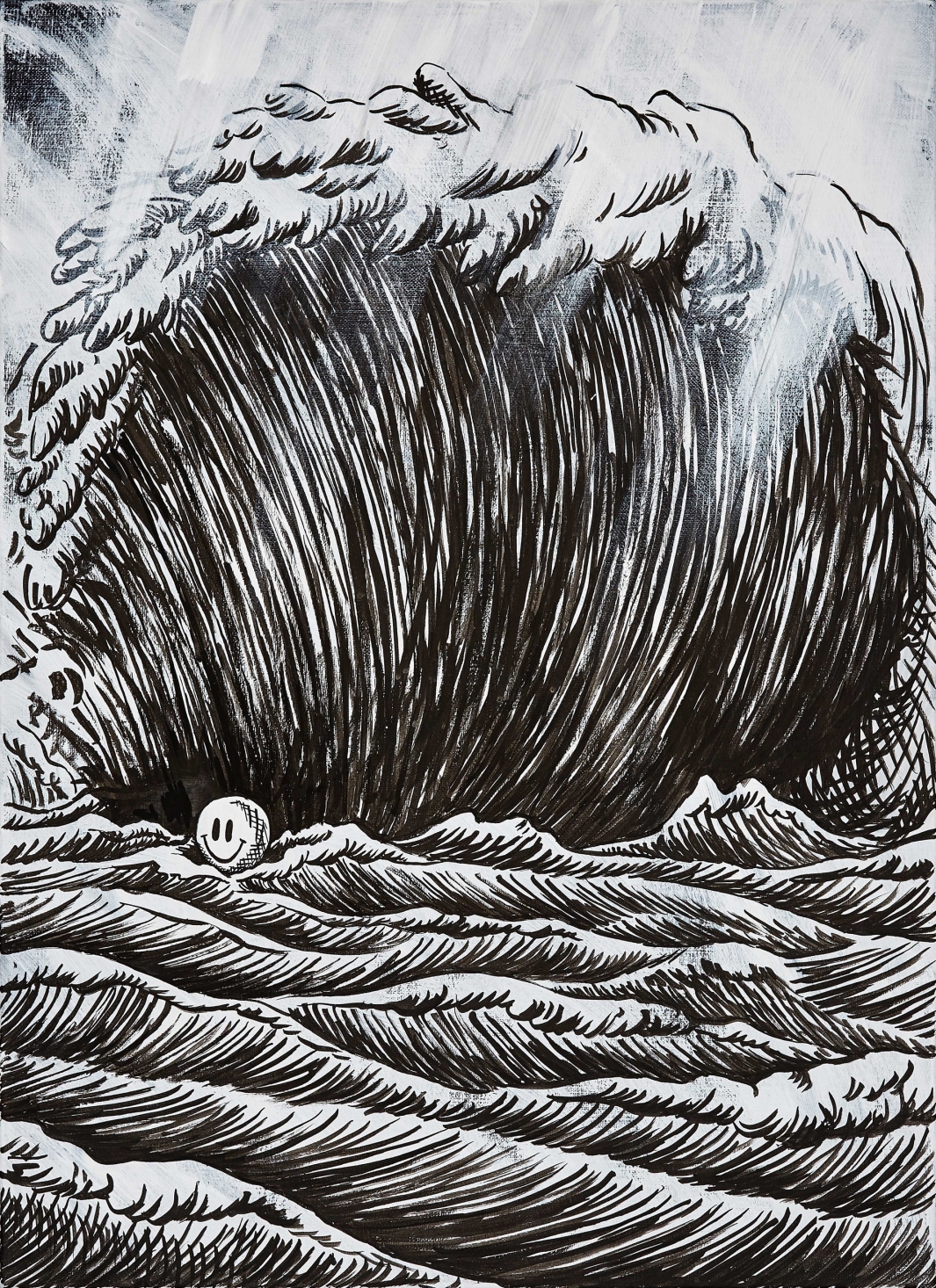
Observing this chaotic violence
is the full moon, left as an empty hole. This moonlight motif continues across
several subsequent works. Its presence foretells the onset of events (or
narratives) that follow the shipwreck. In 'The Battle of Punta del Cota,' a
giant octopus shatters the ship; in 'Time of Carnivores II,' an eagle
cannibalistically devours its kin; in 'Ghosts of Books,' phantoms overflow from
the drifting books. These grotesque and uncontrollable monsters, spirits, and
apparitions emerge as a result of a world whose order has collapsed. They push
an already chaotic situation into further disarray, consuming even the drifting
meanings. Amidst all this, in the monumental 'Monkey Library,' books quite
literally fly, fall, and float in a state of confusion. As chaos and order
clash, the monkeys, as if mocking the meticulously built human civilization,
take over. The primitive world and grotesque fantasies that emerge from the
chaos of civilization escalate into full-fledged events.
The World of Vortex and Chaosmose
The first piece viewers encounter
upon entering the exhibition is 'Night Owl,' which sits on the threshold
between before and after the unfolding events. The exhibition’s layout is
organized such that the owl separates the present and future of the wrecked
objects. The previously described works represent the present state of the
shipwreck. The owl perched atop 'The Grave of Books,' gazing at us, seems to
signal an ominous forewarning. This uneasy calm is short-lived, as the
shipwreck fragments are soon swept into a powerful vortex ('The Roving
Shadows'). Inside this whirlwind, books, statues, and relics are stripped of
all meaning or symbolism, reduced to debris caught in turbulent motion. The
swirling speed of the vortex manifests in the painting as white bands that
engulf the floating objects. From this point, the full moon is no longer
visible. Did the moon’s hollow light projector cause this spiral of beams? The
swirling white light in the darkness evokes Paul Virilio’s ideas. He once
described the image in painting as an 'aesthetic of appearance' and in film as
an 'aesthetic of disappearance.' The moon’s lens-like hole and the vortex’s
light beam—both immaterial in form—collapse the emergence of things into a
whirlpool of disappearance.
All of these stories culminate in
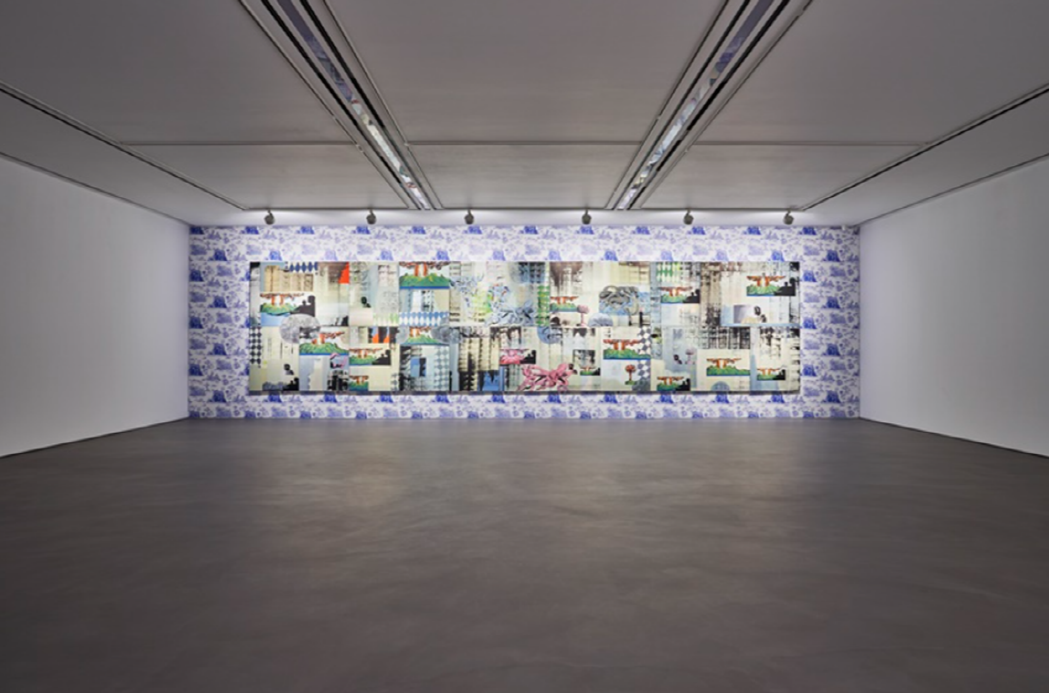
the highlight of the exhibition: the 9-meter-wide mural 'The Task of
Narrative.' Arriving at this point after passing through the vortex, this
massive wall painting takes the form of a 'world drawing'—combining five
pre-produced drawings with a mural painted on-site. 'The Task of Narrative,'
sprawling like a cosmic expanse, represents a world after chaos. The many
objects of the shipwreck now drift through the universe, beyond the open sea.
There is no center, no rising or falling—only floating. What shifts this
suspended state is the appearance of a massive meteor. Silently traversing the
chaos at light speed, the meteor draws a luminous band across the sky. This
ribbon, created by the meteor’s trajectory, imposes a new order onto the chaos,
embodying a form of 'chaosmose'—a cosmic flow that is at once disorder and
order. At this point, we begin to understand why the artist envisioned a mural
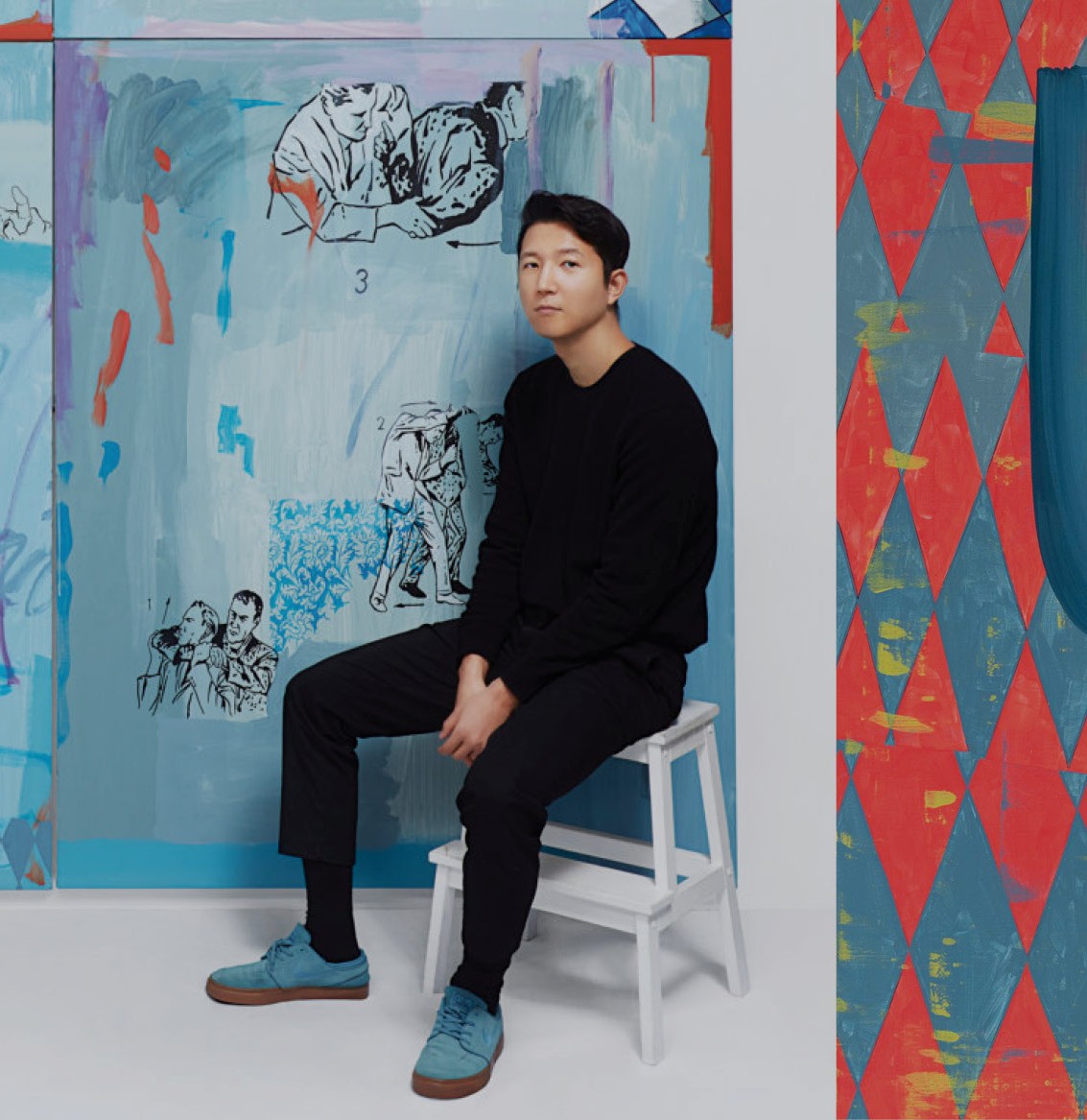
of this scale. Jeongsu Woo seeks to guide the viewer’s physical body into the situation
of the painting. As a flâneur wandering the city, he translates the world he
experienced among people into a spatial form that invites participation in the
exhibition. As the viewer walks, they enter the world of the painting and, like
the drifting objects, may become part of the luminous ribbon. Here, the
boundary between the world of representation, illusion, and the dimensional
reality begins to dissolve. Walter Benjamin once wrote of the dream-image of
the modern city, urging us to 'awaken from this dream.' In this single painting
(or exhibition) that Woo has created lies both the fantasy that dissolves the
image of the world and the fantasy that attempts to summon it into being.