Just like the snow falls all
through the night and puts footprints down on the white field that no one has
yet stepped on, the thin and fine lines deftly go across the white paper and
then black shapes fill the screen soon. Through the nib of pen, this reveals
itself on the plain surface of the paper. It repeats itself as an infinite
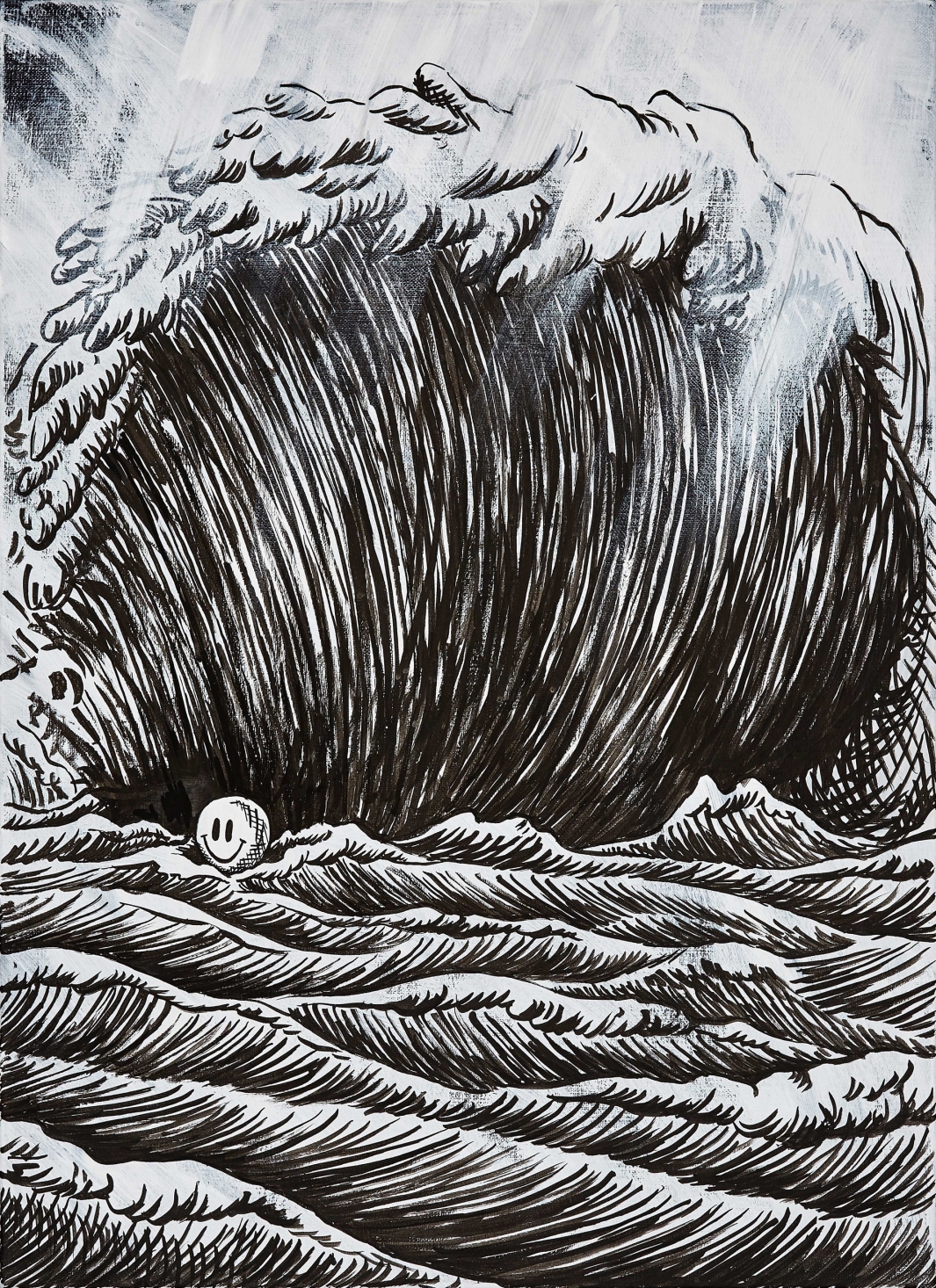
chain of unknown symbols and then disappears―sometimes in the shape of man, then as goblin, bird, sea, sometimes
forest, then goblin again, and sometimes book, monster, monkey, and the
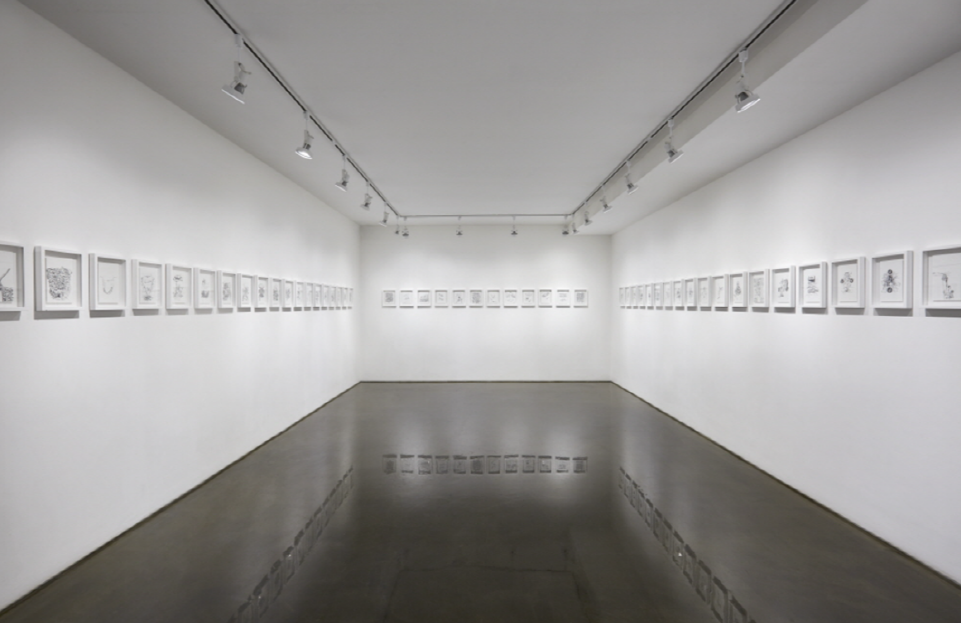
self-portrait of the painter. The innumerable drawings that fill the whole
floor of the exhibition hall convey the meaning of each one through the loose
link of a book.
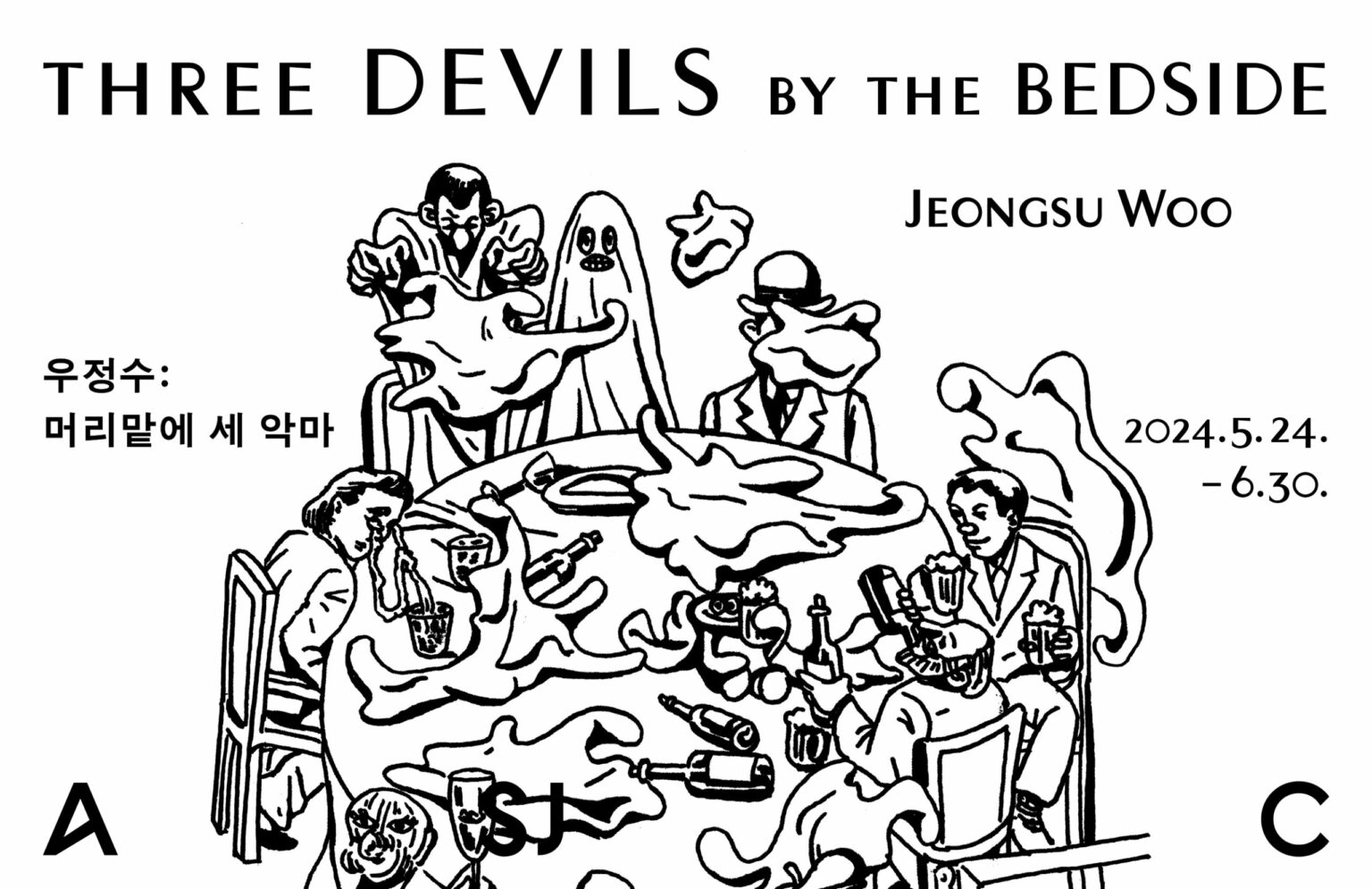
The third solo exhibition of
Jeongsu Woo titled 《Flaneur Note》 is an opportunity to meet about 170 drawings and a book of 8 small
themes that compiled the drawings―all of which records
the inside of the world that he has observed so far with interest and concern,
human nature and its limitations he witnessed there, and the traces of
psychological distresses about his role as an individual and painter. Jeongsu
Woo boldly skips the usual sketching process for full-scale painting and
directly draws shapes on the paper with a brush. At first glance this may seem
easy, but if you understand that paper and ink are sensitive materials in their
nature that do not tolerate even a single mistake, the meaning of the pen
drawings we see in this exhibition becomes clearer. He has repeatedly
introduced various icons in his drawings, and has created his own unique style
by putting them again in various situations to create diversified narrative
structures. Perhaps because he has thought a lot and gone through the process
of expressing his thought several times by drawing repeatedly, the brushwork
itself without hesitation gives strength to the figure in his picture.
More fundamentally, the
proficiency of this technique comes from the artist’s gaze and attitude toward the object. Just like the meaning of the
word ‘Flaneur’, he belongs to
the group called society of today and yet tries not to lose his independent
gaze and attitude as an individual. While completing the book that compiled the
drawings displayed in the exhibition, he quietly watched the society that had
changed over the past decade, with the eyes of an observer. And he put what he
saw into the caricatured figures of humans, animals and grotesque landscapes:
big and small events and accidents in society, actions and movements that
conform to or oppose the solid and strong social systems, as well as the
moments when human beliefs and distrust operate. While using black ink to draw
this with a fast stroke, he does not miss the delicate representation. At the
heart of this is the long training in thinking he has gone through with book
reading. He read books of diverse genres ranging from stories about myths and folk
tales, to biographies of heroes and great men, to philosophical books of
thinkers, and began to observe the ways in which the system of the real world
is constructed and operated and the human life and nature that interact within
the system. In the process, the ‘belief’ that a large amount of knowledge and information produced and
consumed toward the truth will move people's minds and change the reality exist
side by side with the ‘doubt’
that it is difficult to change the reality because of the unpredictability of
the system caused by human avarice and the various variables in society. In the
meantime, the artist naturally took great pains over what kind of attitude he
would take as an individual and a painter in a society. The results were the
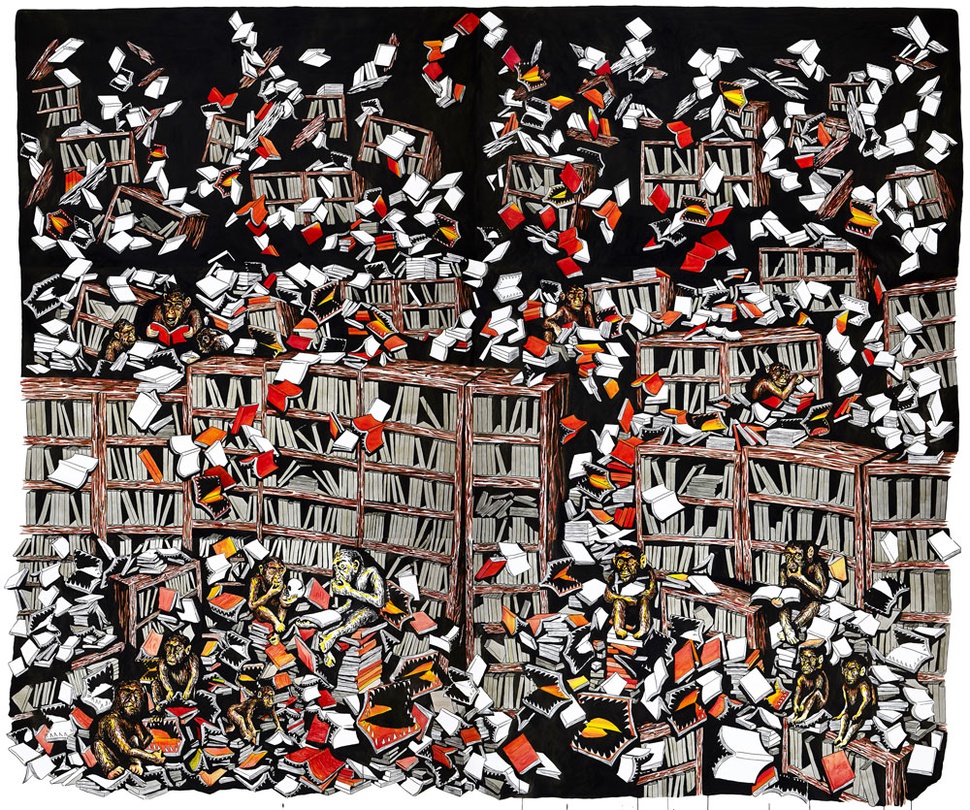
first solo exhibition titled 《The Paintings of Villain》 in 2015 and the second solo in 2016, titled 《The Grave of Books》.
The artist has doubted the
situations in which absurd things in reality are justified and construct a
society in a plausible way, and has projected himself onto the figure of the
artist who endlessly produces the images of man against the absurd reality (The
Paintings of Villain); sometimes has expressed the skeptical view that the
endless desire of man for knowledge and civilized way of life may not save this
world (The Grave of Books). Looking at his work over the years, we find that he
starts from expressing in a scathing and outright language his anger he feels
when he witnesses the reality armed with overwhelmingly powerful systems, and
observes how human beings live without seeing the limitations as finite beings,
overburdened by desires and emotions; and he finally scoffs at this by
projecting it onto a wild society or a wrecked civilization. What is important
throughout this process is that he never forgets that it is a major challenge
for his painting to always reflect on his life as a painter. Not only the
chapter entitled ‘Lousy Painter’ in the book displayed, but other chapters also have self-portraits
of the artist. They always have metaphoric representation of the painter’s attitude toward the world as well as his contemplation of the
existence of an artist in society. Through the act of ‘painting’, the painter is forced to perform his role, but he also satisfies
his personal desires through the act. When ‘flaneur’ is defined as a two-faceted being that dwells in the crowd or a
group in society, but at the same time maintains his own perspective at an
objective distance from it, it seems that in Jeongsu Woo’s painting, the ambivalent gaze of such a flaneur is effective both
for the world and for the painter himself.
This self-critical and
self-reflective attitude as a painter not only appears directly in the subject
matter of the painting but also sometimes makes small changes to the way he
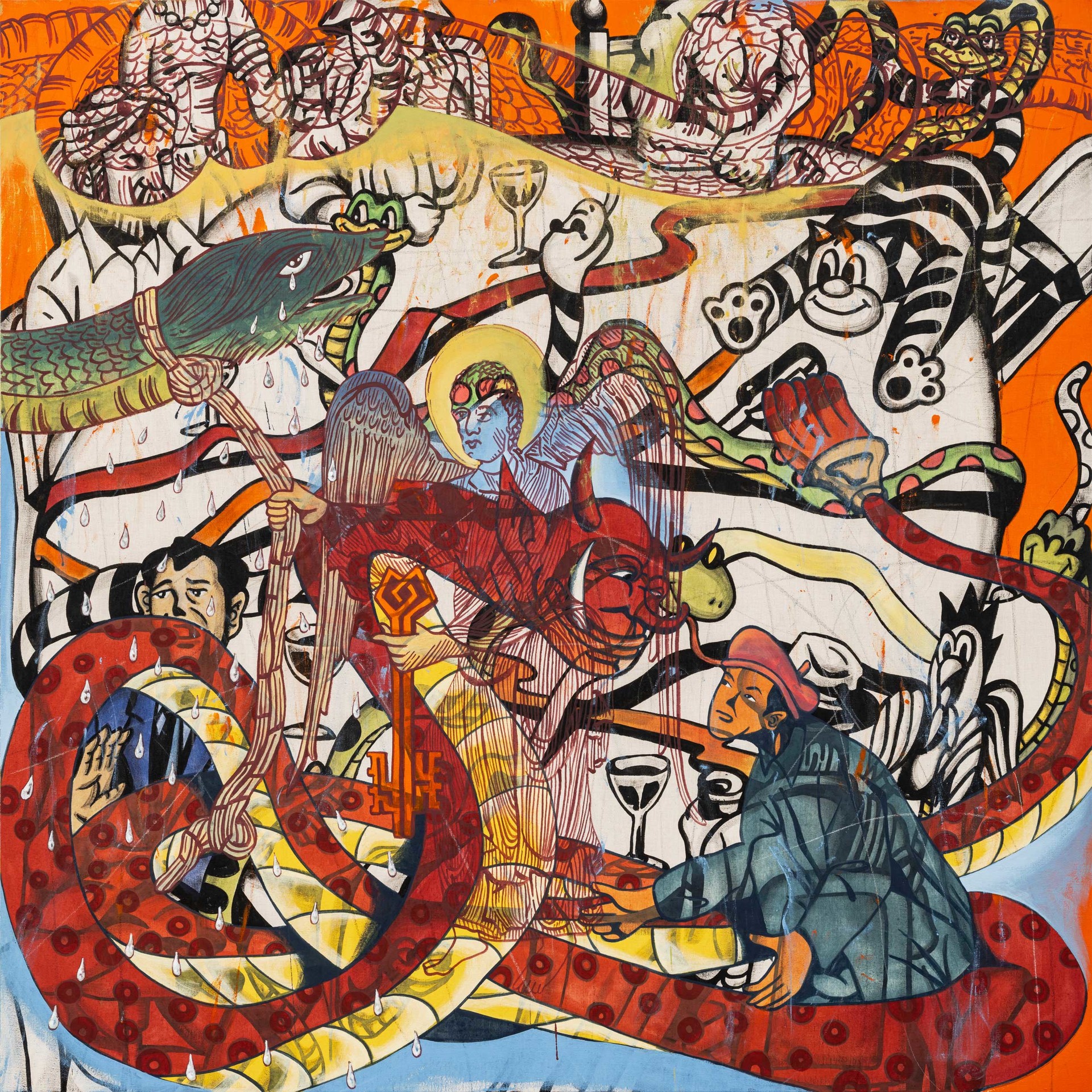
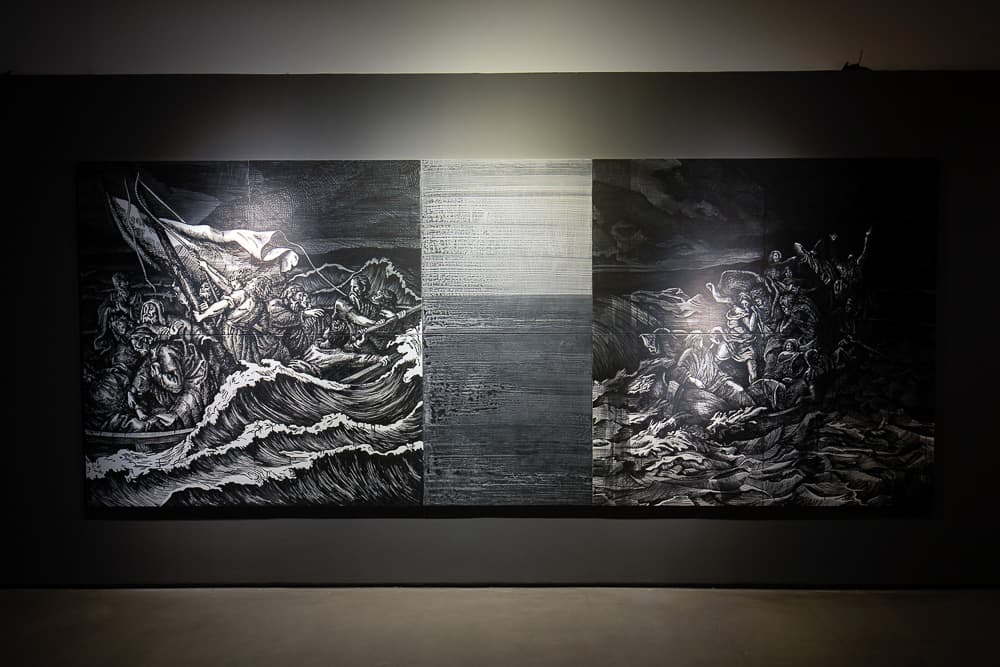
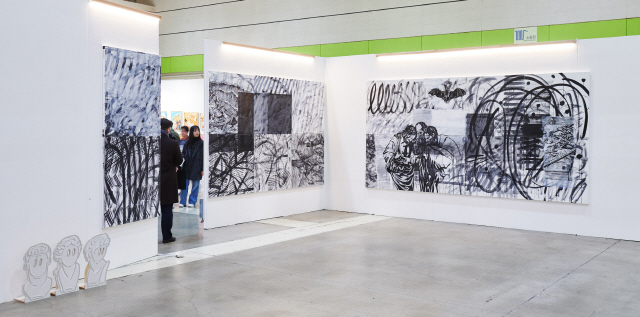
organizes the canvas that he has adhered to in his work so far. In Uroboros
# 1 (2017), the painter has presented the uroboros, an ancient
mythical symbol depicting a serpent eating its own tail, in its complete form
as an archetype. Moving a step further from there, he begins to boldly bring in
the conditions of completely different contexts while deconstructing and
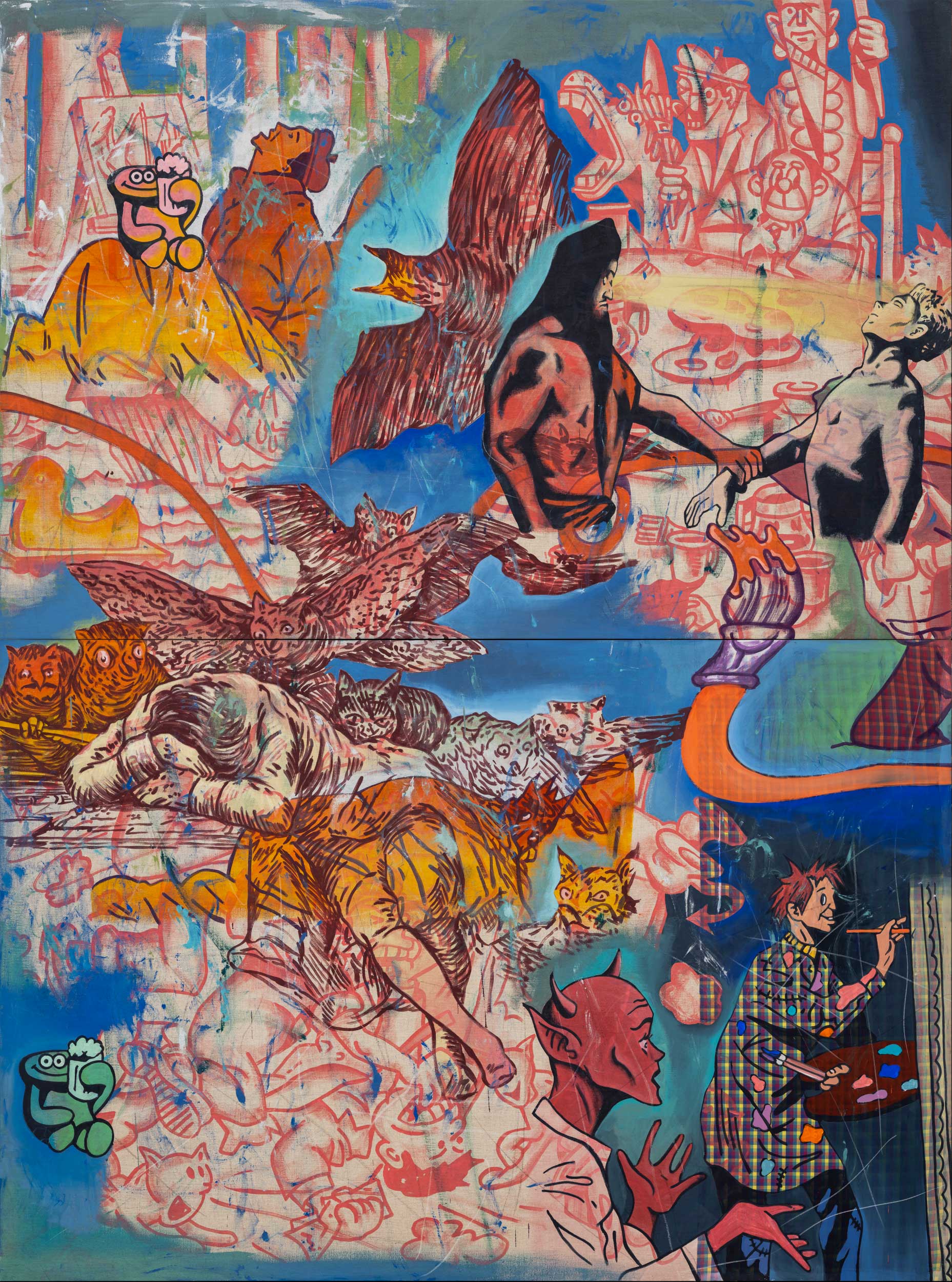
denying the wholeness and totality of the circular structure of the archetype. Uroboros
# 2 (2017), which constitutes another aspect of the exhibition, is
out of the perfect circular structure, and its body is cut off as if it were a
lost puzzle piece, and its surroundings are filled with religious icons
representing unpredictable natural energy and the transcendental world, and the
symbols of human desires to go against nature and of the cynical look at all of
this. The graceful smile of the Virgin Mary spreads beneath the fierce force of
the uroboros threatening to devour, and flowers bloom beautifully even in the
ravages of nature. This is the point that reminds us of the huge circular
structure in contrasting terms, which has been preserved/kept while the
paintings born out of the artist’s fingertips in the paintings of 《The
Paintings of Villain》 turned into masks for the
painter, or Task of Narrative (2016), a work representing
the ‘The Grave of Books’ series, put together the symbols of civilization
drifting in the whole space as if revolving there.
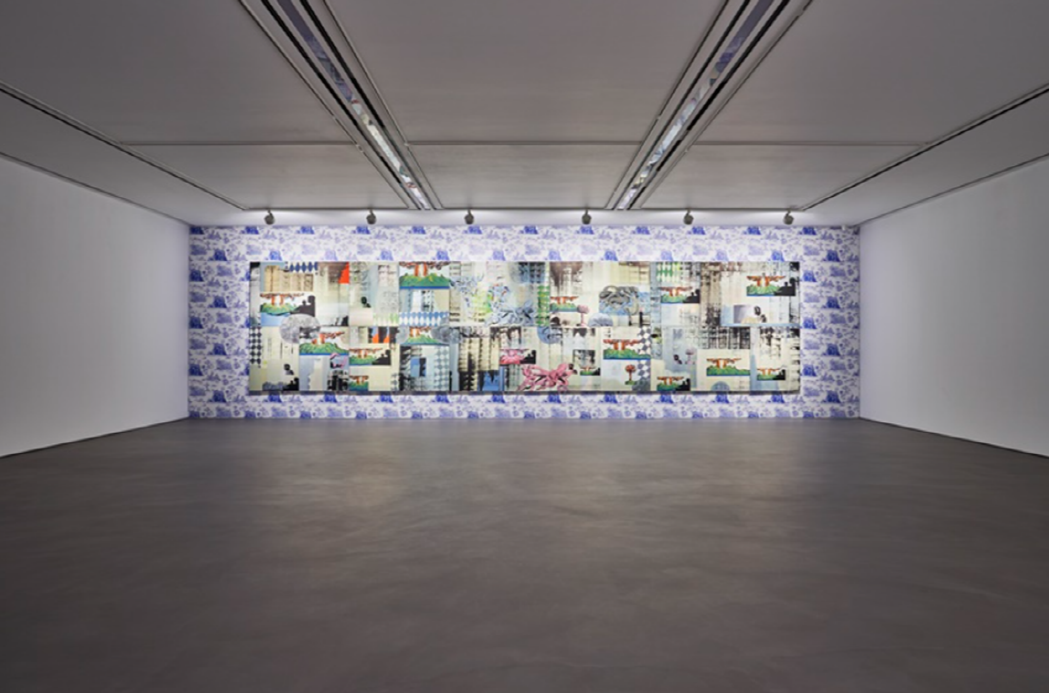
In addition, the technique made
possible by changing the medium from paper to wood panel becomes an element to
underscore this cycle. The technique, by which images were drawn on the paper
and one layer was horizontally expanded, provides the possibility of a new
interpretation in the recent works that make use of wood panels and the shading
of Chinese ink. The method of erasing or moving the first drawn images and
stacking up the layers of images thinly to reveal the relationship between the
images forms a more complex multi-layered structure. The composition segmented
by several wooden panels does not focus on the connectivity between images;
rather, it creates a situation in which the meanings of the individual picture
planes meet by chance and collide with each other horizontally and vertically,
which allows the intervention for an active appreciation and interpretation. If
previous works like Task of Narrative clearly presented the
artist’s view of the object through a complete circular
structure and solid composition created by symbolic images, Uroboros #
2 brings in the viewer’s interpretation and
experience of the object in the appreciation of the work due to the versatile
quality of the technique and composition.
To be sure, this feature has
something to do with the loose connection between the eight different
compositions in the book on display. Each of the chapters, entitled ‘The Heavy Tree’, ‘The
Crown of Fools’, ‘Strange Tales’, ‘The Grave of Books’, ‘To Be the Oriental’, ‘The Face of Ghost’, ‘Lousy Painter’,
and ‘Strolling’, is a kind of
confession in image, which metaphorically captures the traces of existential
concerns he was grappling with not to lose the role of an individual, painter,
and flaneur in the chaotic social reality. Hence, the drawings that make up
each chapter have long been archetypes of thoughts and expressions of objects,
and have also played their role as a pivot around which the overall narrative
revolves when they come out for exhibition.
The artist continues to draw
paintings as a flaneur living in in a society where the brutality of violence
and madness and at the same time the sacredness of salvation and sacrifice
exist side by side. Through 《The Grave of
Books》, he has already dealt with the endless desires
and emotions of human beings toward the reality, but the traces of the time and
agonies he had are ready to talk to the audience in the form of a book full of
pictures. As we can perceive through his gaze at the world, humans are probably
living for a fleeting moment that is just a small dot in the flow of eternal
time. But to the flaneur, who is not afraid of getting lost in the middle of
his stroll , the world must be an uncharted territory where there are plenty of
things that are yet to be discovered, as well as innumerable choices waiting
for him to make his way.