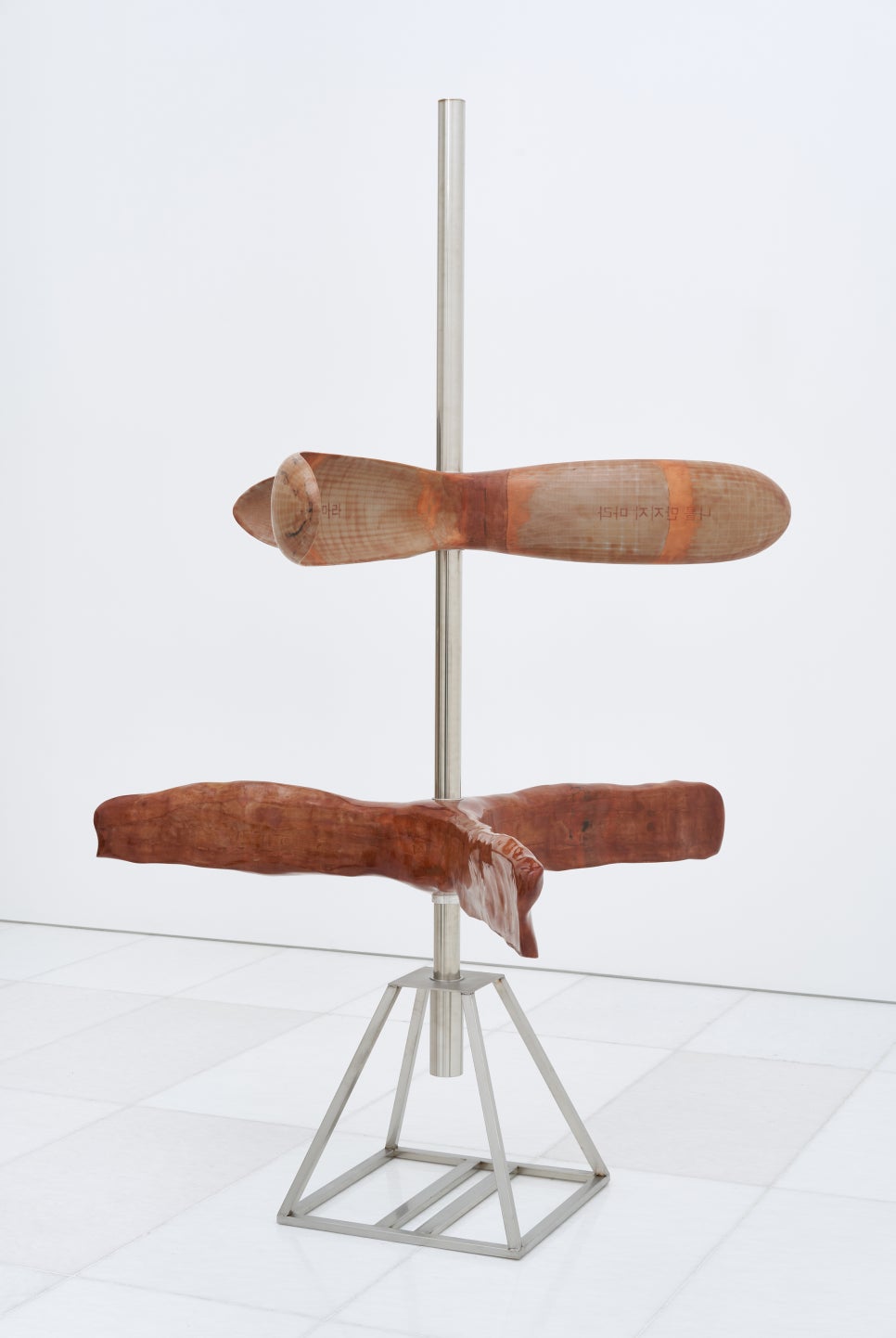
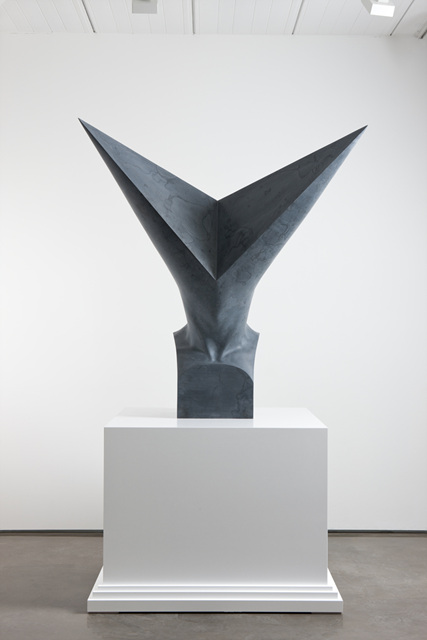
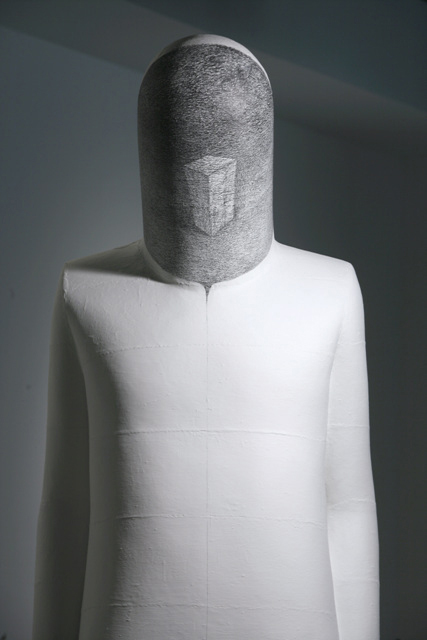
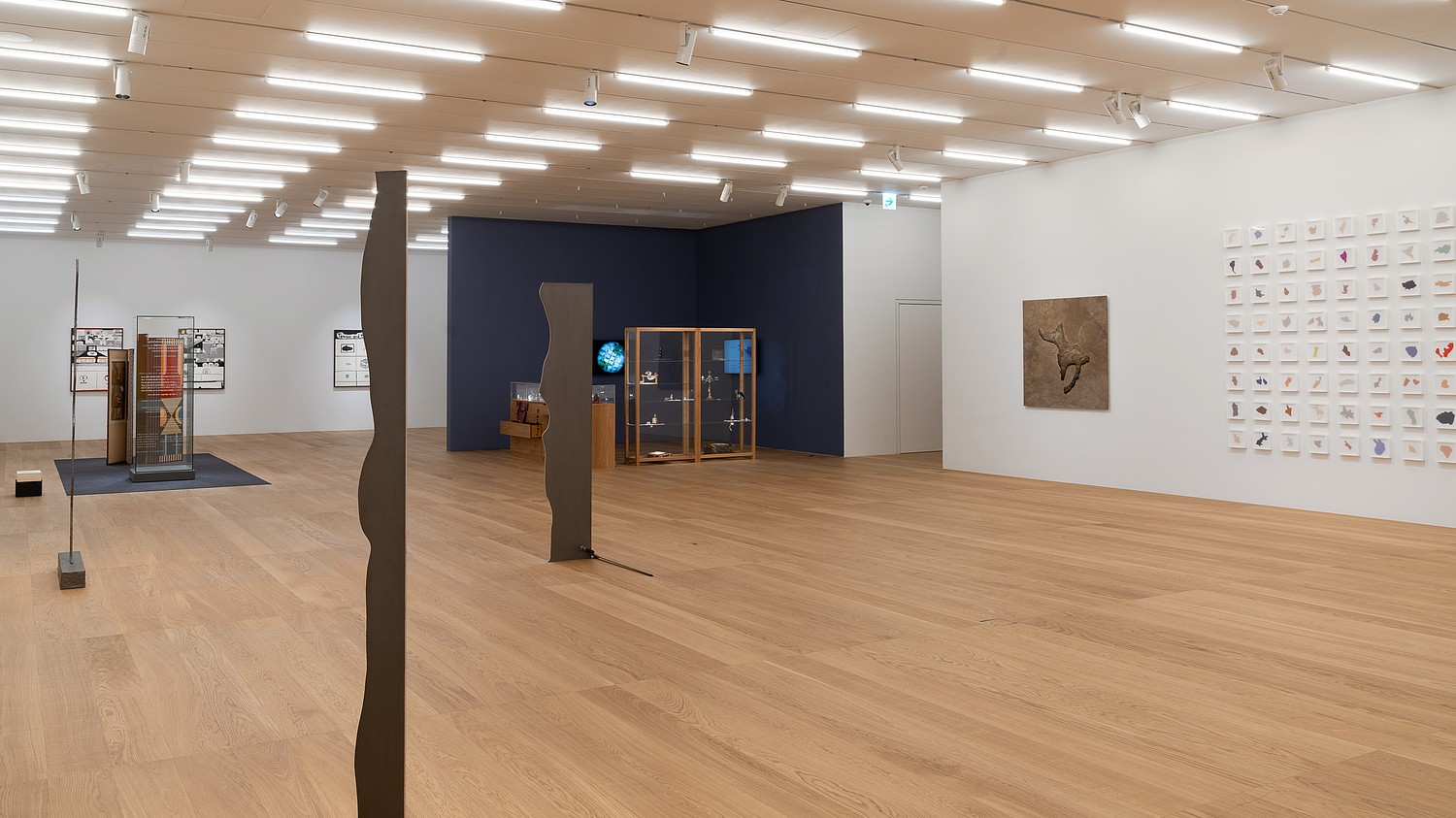
Visually, KIM Inbai's works possess highly distinct forms. Ranging from the human body to geometric shapes, lines, and planes, the subjects he creates do not, at first glance, stray far from the formal vocabulary traditionally explored within the trajectory of sculpture. The same holds true for his technical approach to materials.
His structures, which achieve volume by enduring weight, alongside their solidly finished surfaces, naturally evoke the physical properties of their constituent materials and the conditions of gravity. Consequently, his sculptures can sometimes appear almost overly resolved. Confronted with their solid exteriors and masterful formal execution, attempting to envision anything beyond the represented shapes seems almost out of reach.
However, weaving together the spatio-temporal compositions of his work reveals that his enduring inquiry lies not in the completed forms themselves, but rather in the conditions that make those forms possible.1 His focus is less on what is being given form, and more on how to activate the conditions surrounding the image—such as the image’s kinetic potential or other senses that operate beyond the realm of visuality.
In other words, his practice can be seen as an experiment: establishing specific premises prior to the outcome, mobilizing the sculptural image within given environments and conditions to stimulate empirical sensation and thought, and ultimately observing how our understanding of form is subsequently dismantled, extended, and expanded.
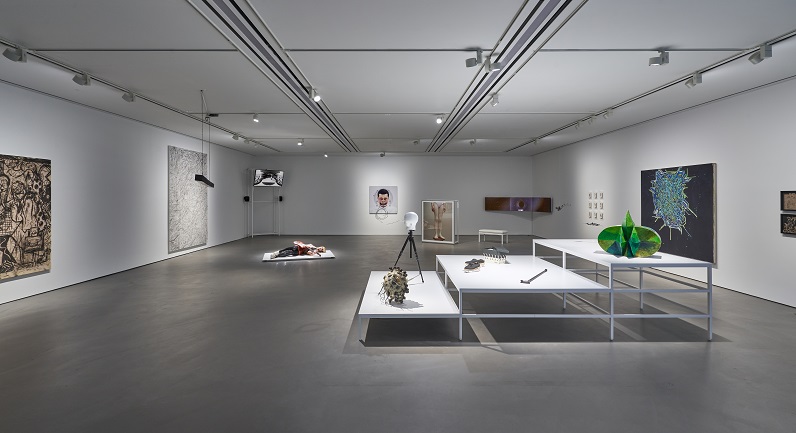
In the current exhibition, 《A Man Asleep》 (2026, ARARIO GALLERY SEOUL, Seoul), KIM imagines the act of sculpting without sight, postulates two entities simultaneously performing the same action, and translates the principles of vision into a material language confronted by the physical body.
Therefore, for KIM, the question of "how" is not exhausted merely as a physical methodology for production. Rather, it is a cognitive process inextricably linked to the form and content of his work; it is the act of using the language of sculpture to design situations that extend our gaze beyond the visuality of surface images.
This attitude connects to the issue of 'dimensions,' a subject KIM Inbai has explored for a long time. Since his early career, he has disrupted the familiar distinctions we use to perceive objects, such as two and three dimensions, front and back, and inside and outside. He has consistently orchestrated situations where the subject is discovered in varying states depending on the observer's vantage point.
In his work, the plane and the volume are not independent media. Instead, they operate more like a spatial and temporal relationship that actualizes only through the intervention of the viewer's position and movement. Therefore, his sculpture should be understood not as a fixed form already defined as a specific thing, but as an existence in process, continuously acquiring new possibilities depending on the location and movement of observation.
Reverting a finalized being back into a state of becoming, destabilizing the fixed meanings conventionally attributed to forms, and examining the latent potential that still remains, are attitudes that have long pervaded the artist's practice. In his previous solo exhibition 《Seeing What is Not There》 (2024, Primary Practice, Seoul), this concern materialized into the specific question: "How does one sculpt the invisible?"
The artist replicated spaces that exist yet evade visual capture, drew at a distance far beyond his field of vision by attaching a pencil to the end of a long pole, and fabricated molds devoid of an internal original form. In this context, 'absence' does not signify a mere lack or nonexistence. Rather, it serves as a condition for imagining a state that eludes conventional visual systems, allowing one to perceive realms that remain beyond the controlling dominance of vision.
In this exhibition as well, he continues to question the surface clarity guaranteed by visuality, attempting to reach beyond the outer shell of the represented subject. However, his inquiry unfolds in a slightly different direction than before. Moving beyond the question of how to see the invisible, he now asks what becomes possible when we assume the act of making without seeing, and how 'sameness' can be established when two individuals, unable to see each other's actions, perform the identical act.
In other words, his interest in fumbling outside the boundaries of vision circles back to the issue of the body and the movements hypothesized to perform such actions. At that moment, the issue no longer stops at merely distinguishing between what is seen and what remains unseen. It naturally gives rise to the question of whether the seeing body and the seen object, or the touching hand and the touched object, can ever be so clearly distinguished in the first place.
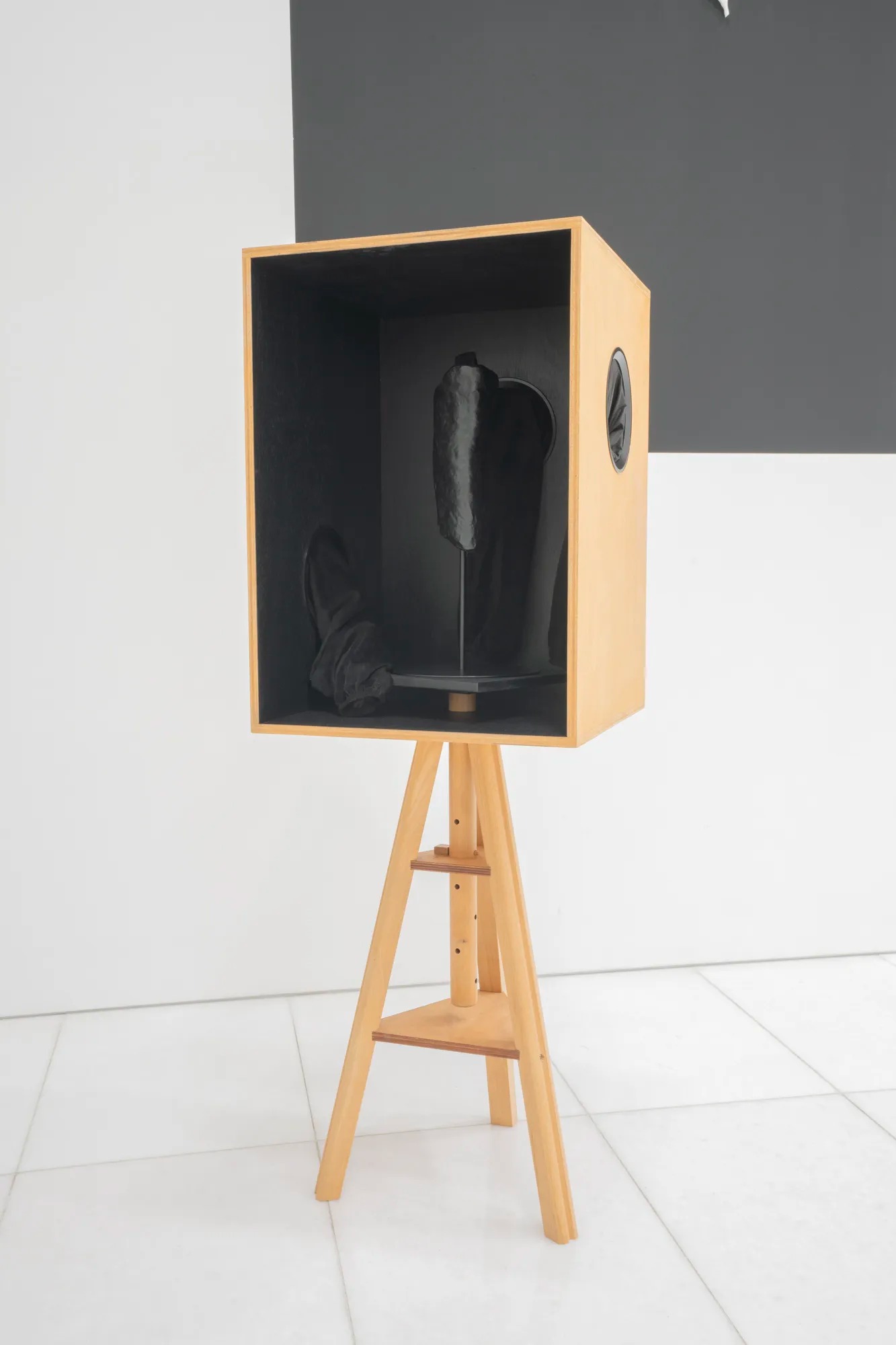
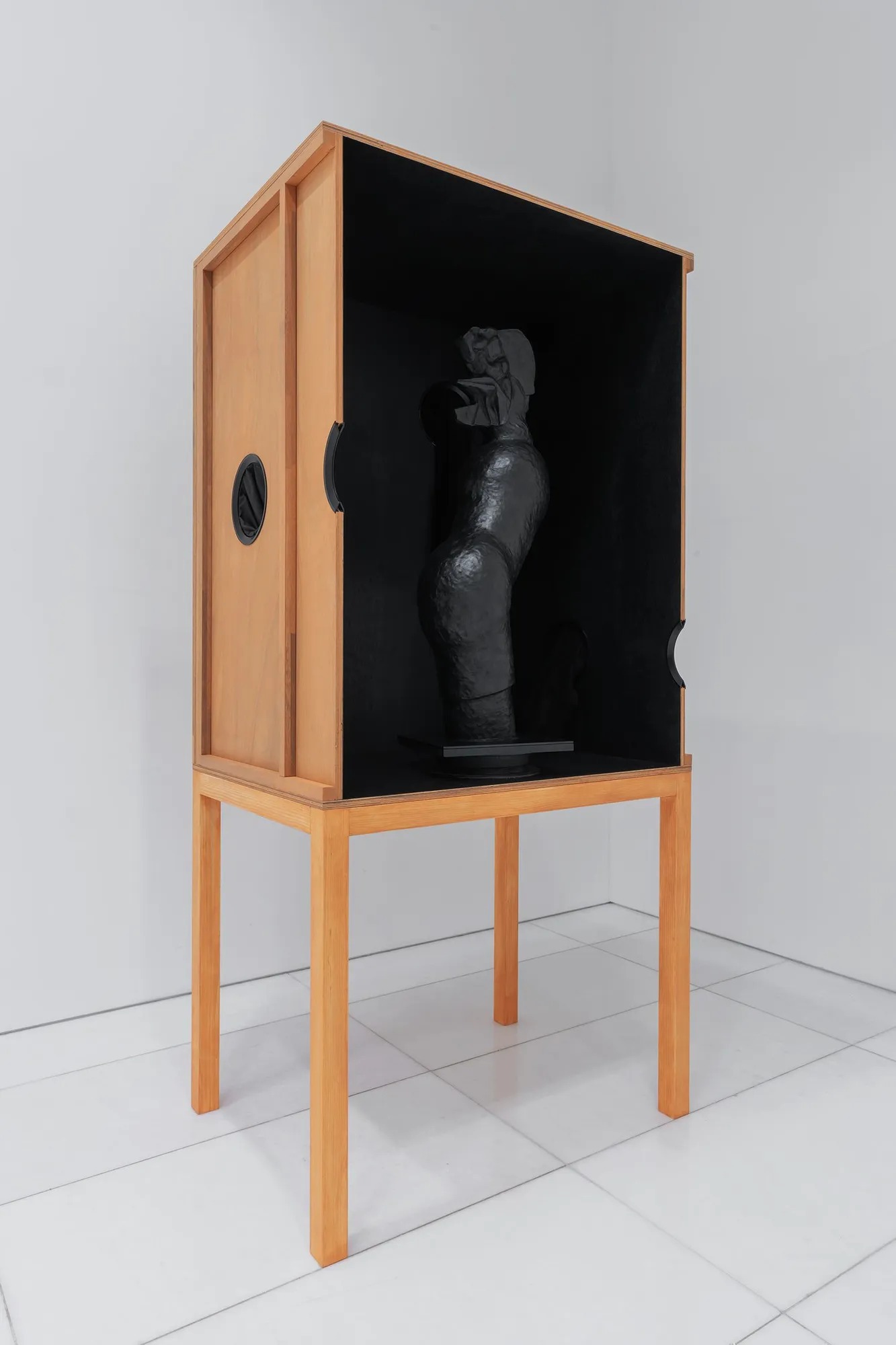
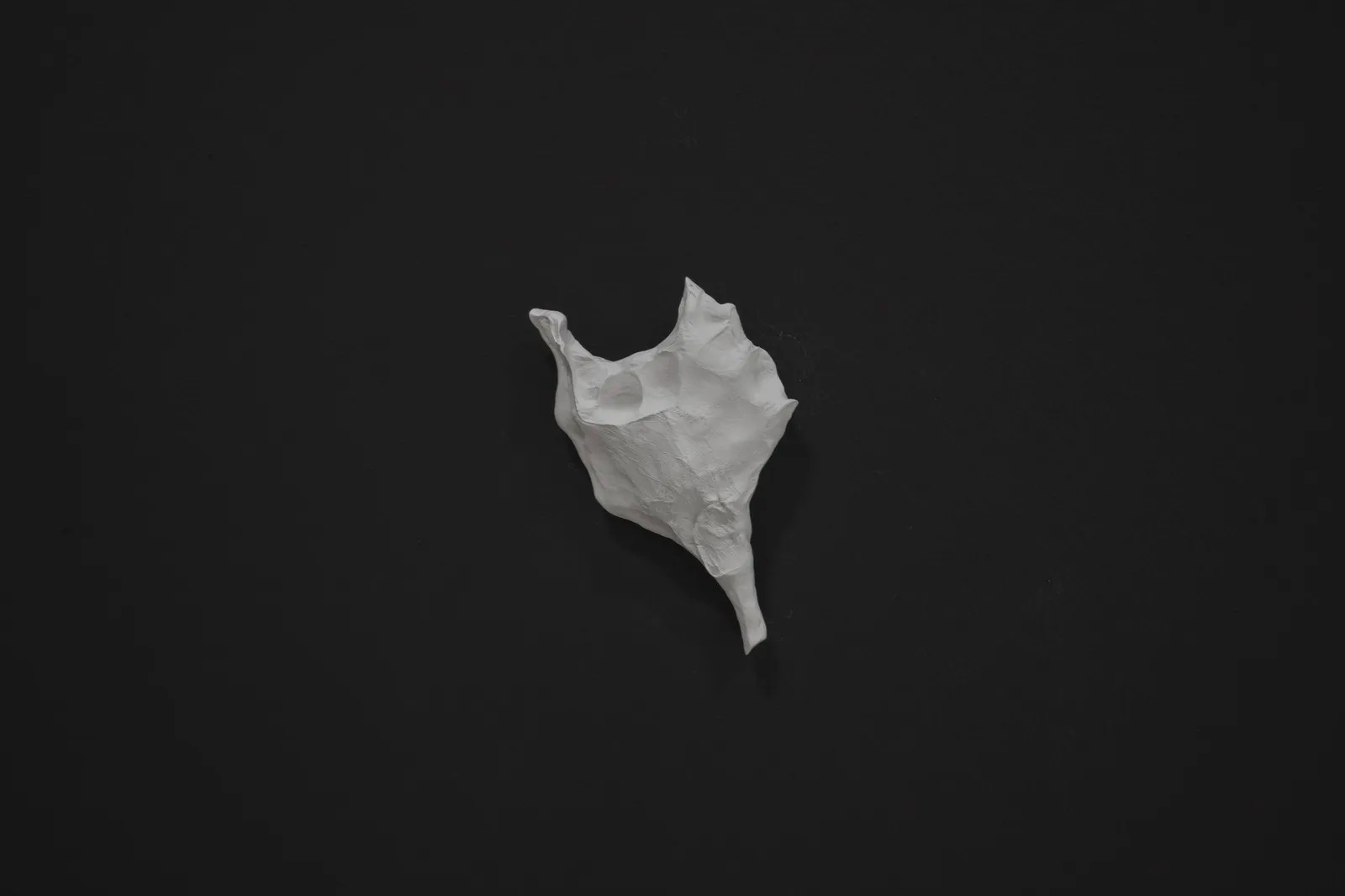
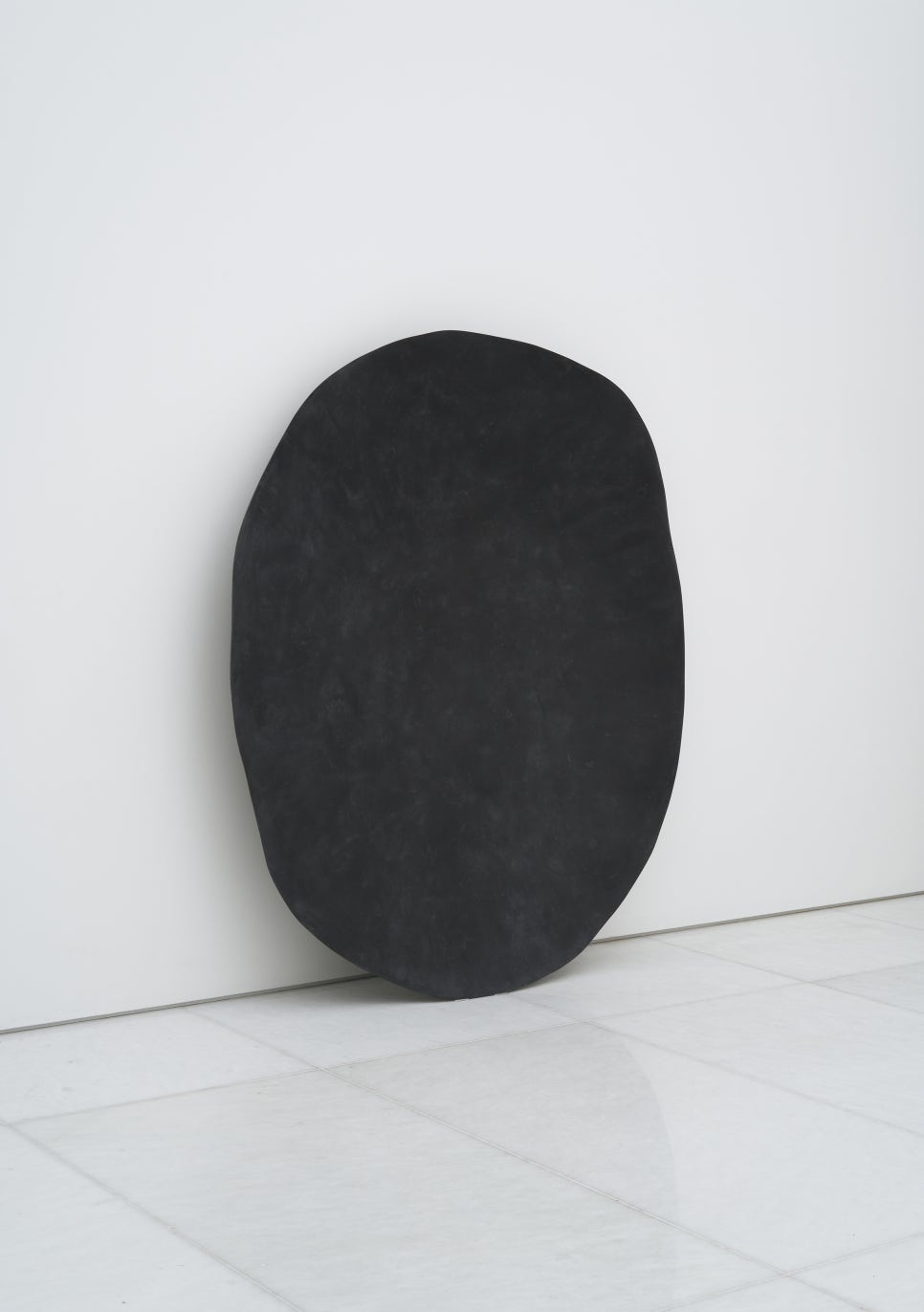
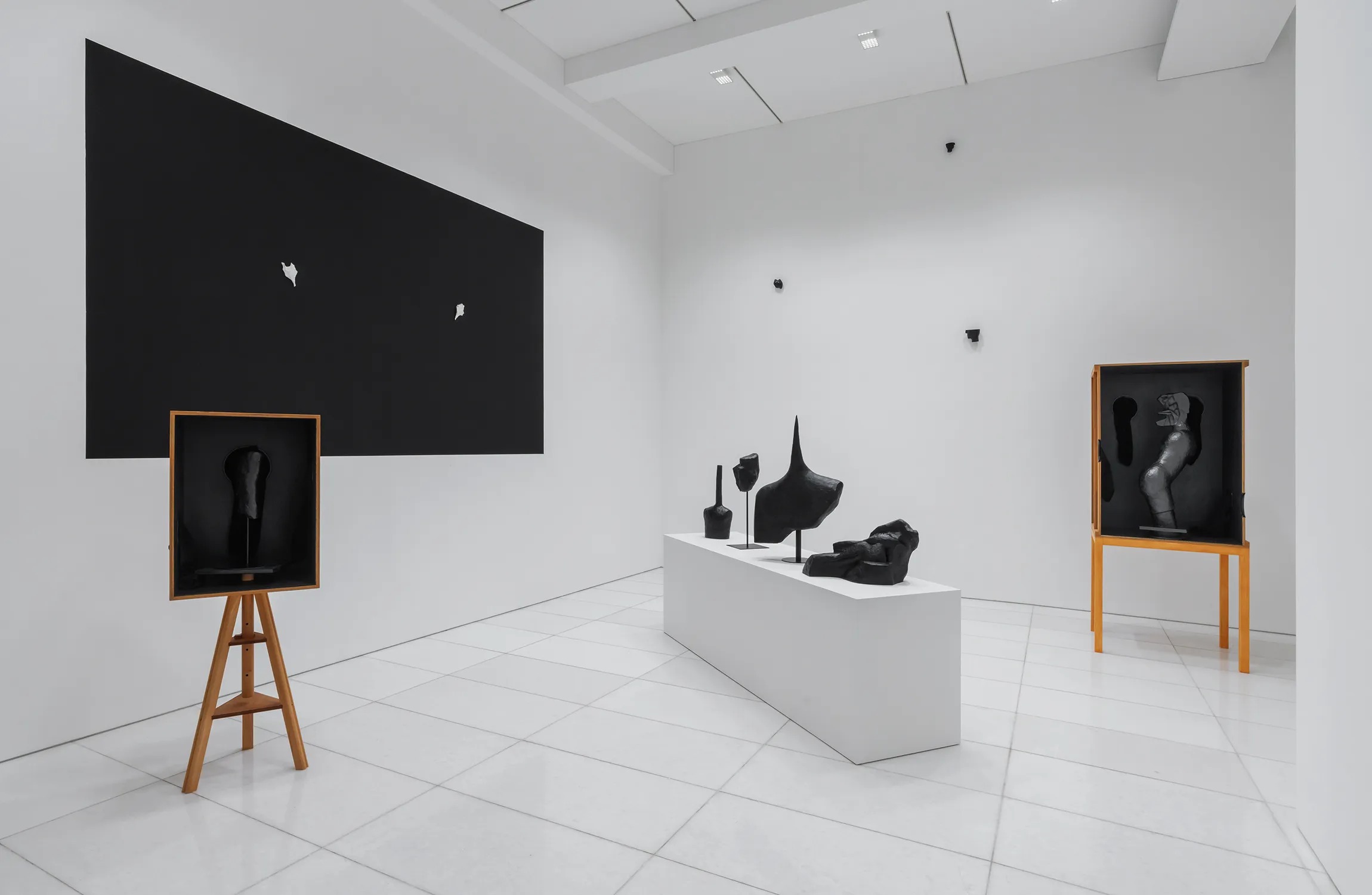
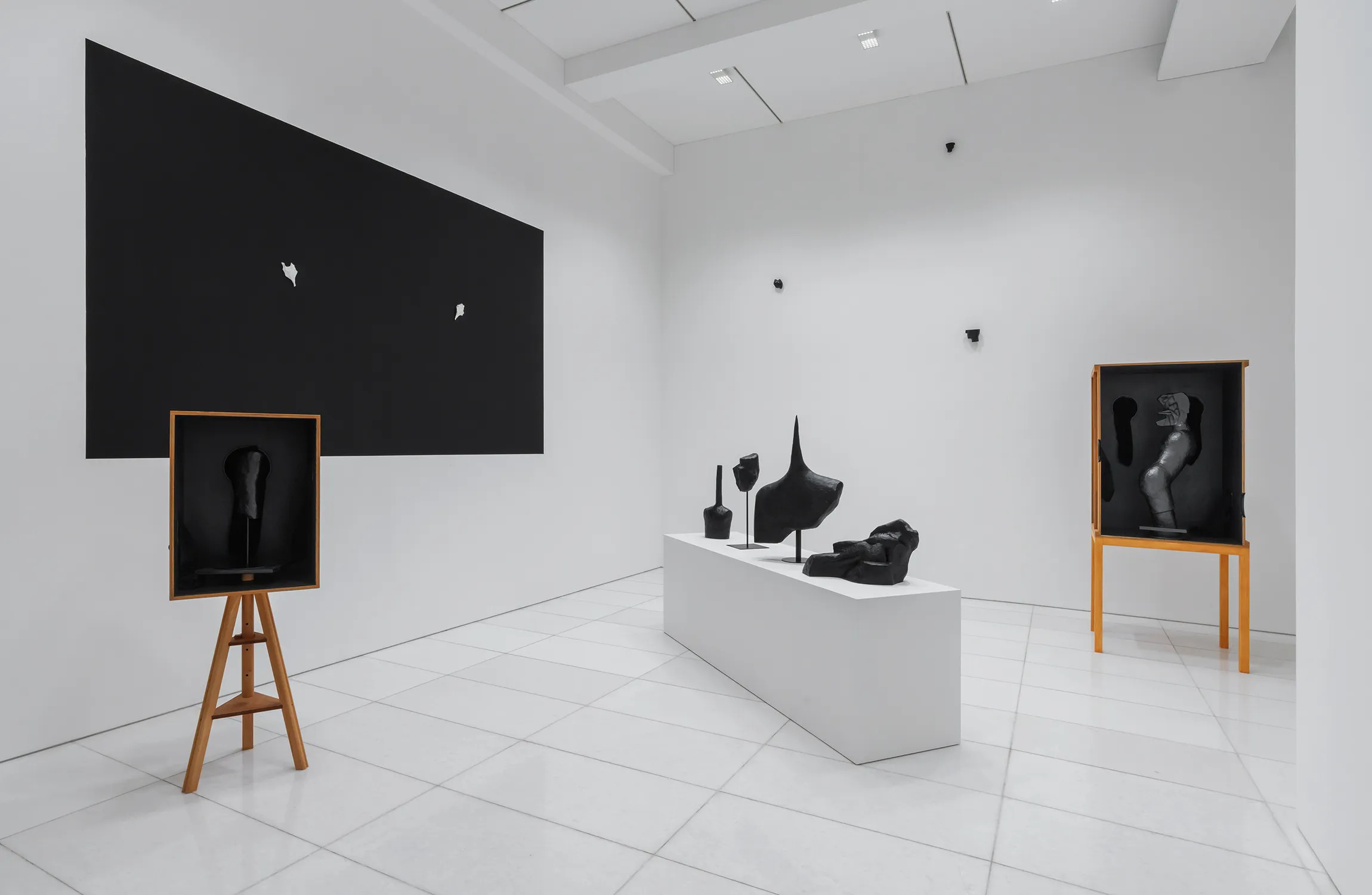
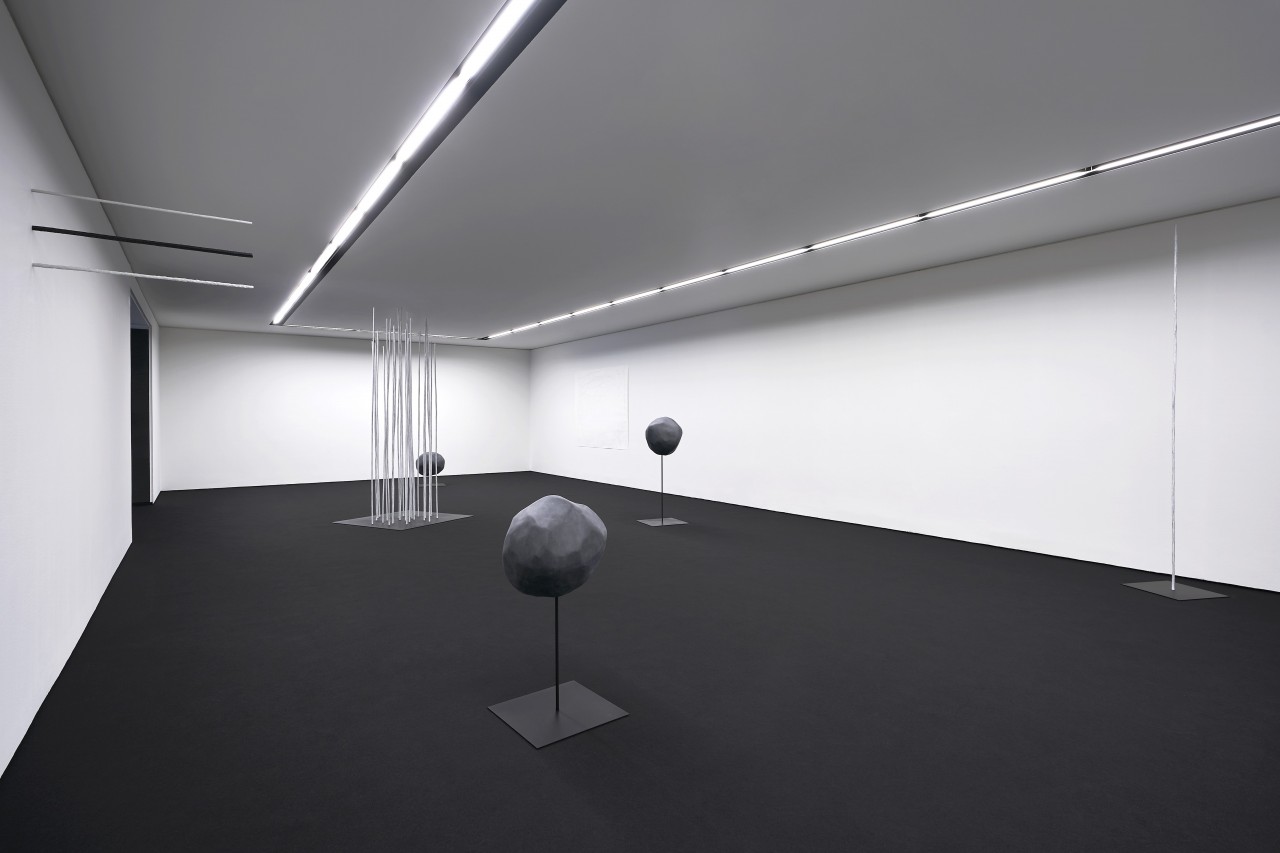
The black sculptures on the first floor serve as the primary scene that most directly brings this issue to the fore. Here, KIM postulates a situation in which he creates forms by inserting his hands into a dark box whose interior cannot be seen. What matters is not the documentation or reenactment of the actual action, but rather the establishment of the premise of 'making without seeing' prior to the actual fabrication.
Following this imaginative premise, the process of visually confirming and modifying the form is inevitably precluded from the very beginning. The tactility and resistance of the material at the fingertips, along with the bodily movements and sensations of pressing and adding, are established as crucial conditions for the modeling process.
Consequently, while the resulting forms may be incomplete, the material properties inscribed with the trajectory of the body become all the more evident. Interestingly, however, this exclusion of vision does not result in completely unfamiliar forms.
In these black masses where the front and back are ambiguous and forms appear to collapse at the very moment they are created, familiar archetypes from the history of sculpture, such as busts, heads, and reclining figures, can be faintly discerned. Despite the premise that vision has been eliminated, the audience will habitually approach these objects visually, deciphering them within the genealogy of forms they already know.
Here, despite blocking the gaze, the premise of 'making without seeing' paradoxically makes us question how heavily we rely on visual memory and conventions to perceive forms. Therefore, making without seeing does not simply mean replacing the eyes with the hands. Rather, by hypothesizing such conditions, the work prompts us to contemplate the very situation in which the hand and the material relate to each other.
If the hand presses and grasps the sculptural material, it alters the form while simultaneously having its own movements adjusted by the material's hardness, viscosity, and resistance. The making body acts as a subject that unilaterally imposes form onto an object, while at the same time becoming a body modified by the conditions of the matter it encounters.
This evokes the intertwining of the body and the world that Maurice Merleau Ponty articulated through his concept of the flesh (la chair). What is important here is the fact that sensation does not occur independently within the body, but arises between the body and the world it encounters. Within this premise, the hand is not a surrogate for the eye. The touching hand becomes simultaneously aware of its own movement through the material sensation of the matter.
The process of creating form is thus inverted into a process where the artist perceives their own physical body anew. Therefore, dividing vision and touch into two separate entities no longer seems particularly valid. The sense of form and proportion acquired through the eyes has already sedimented into the movements of the body and hands, and the act of touching in turn prepares the form that will be seen in the future.
In this respect, what KIM questions is perhaps not vision itself, but the way senses are categorized and standardized, that is, the learned cognitive system that has classified and operated the eyes and hands, vision and touch, as independent realms. In doing so, the act of sculpting a visually absent subject paradoxically visualizes the 'way of seeing' deeply rooted within the body all the more dramatically.
This critical inquiry continues with variations on other floors. On the fourth floor, the artist establishes another situation. The sound heard through headsets unfolds, in the form of a dialogue, a hypothetical performance in which two men face each other and create the "same picture." However, their respective ideas of "sameness" do not align from the start.
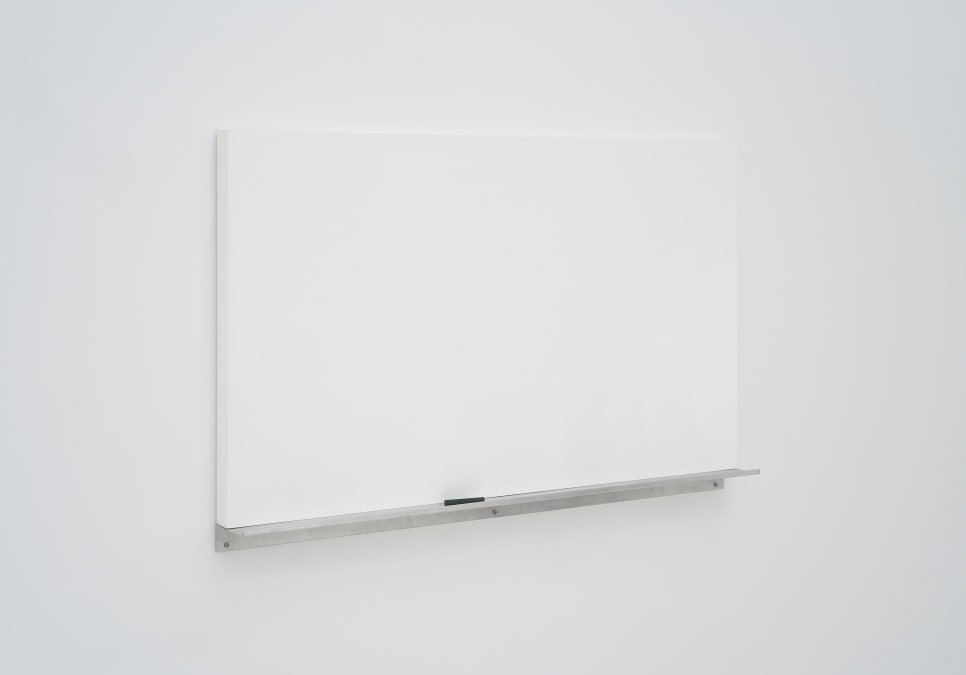
While one suggests a method where one person draws first and the other copies it, the other replies that it is "the same drawing only when drawn together at the same time." In this brief exchange, the criterion for sameness shifts from the similarity of the outcome to the simultaneity of the act. Subsequently, assuming a condition where two individuals standing on opposite sides of a single board cannot directly see each other's lines, the sound tracks through spoken language how they might approximate identical movements.
"I went about 5 centimeters," "A little slower," "I am going at a similar speed," "I am a bit slow, I will go faster." Their language does not describe the drawn image. Although the counterpart's position remains unseen, their bodies are continuously estimated and measured through the dialogue. The spoken words postulate the location of the not yet visualized counterpart, imagine their movements, and form a virtual coordinate system to align the speed and direction of the two bodies as closely as possible.
The sound materializes over time the process of adjustment, waiting, and error required when assuming that two unseen figures are performing the exact same action. The uttered voices do not merely narrate a situation; they aurally construct the distance and movement presumed to exist between the two bodies.
Here, the sensation of movement that previously occurred between an individual's body and the material expands into the question of how two different bodies share an action within a single timeframe and generate differences. Therefore, the artist's work here is not the result of a performance aimed at resolving differences, but rather operates as a translation of the time spent continuously perceiving and adjusting those differences into a singular form.
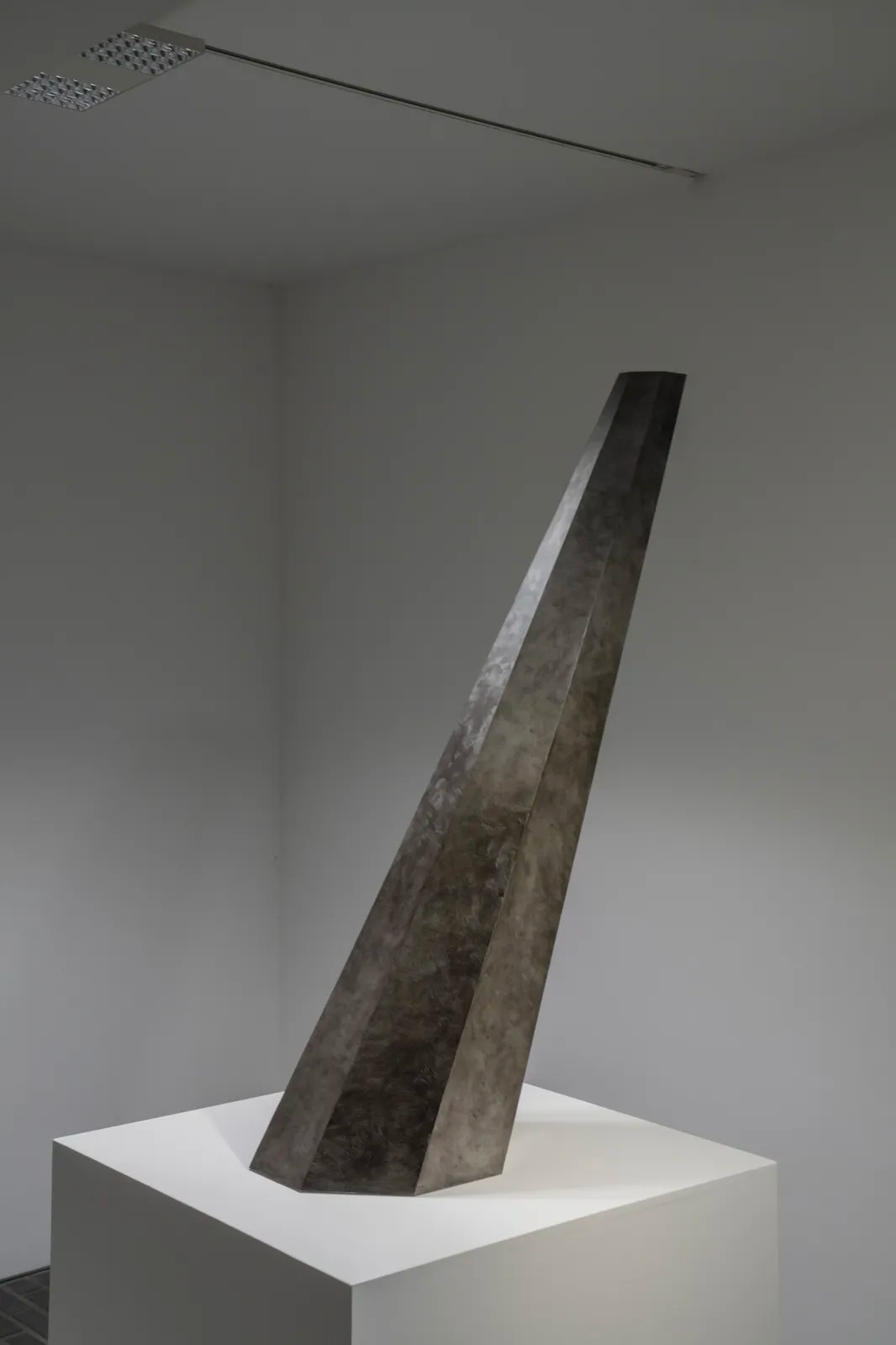
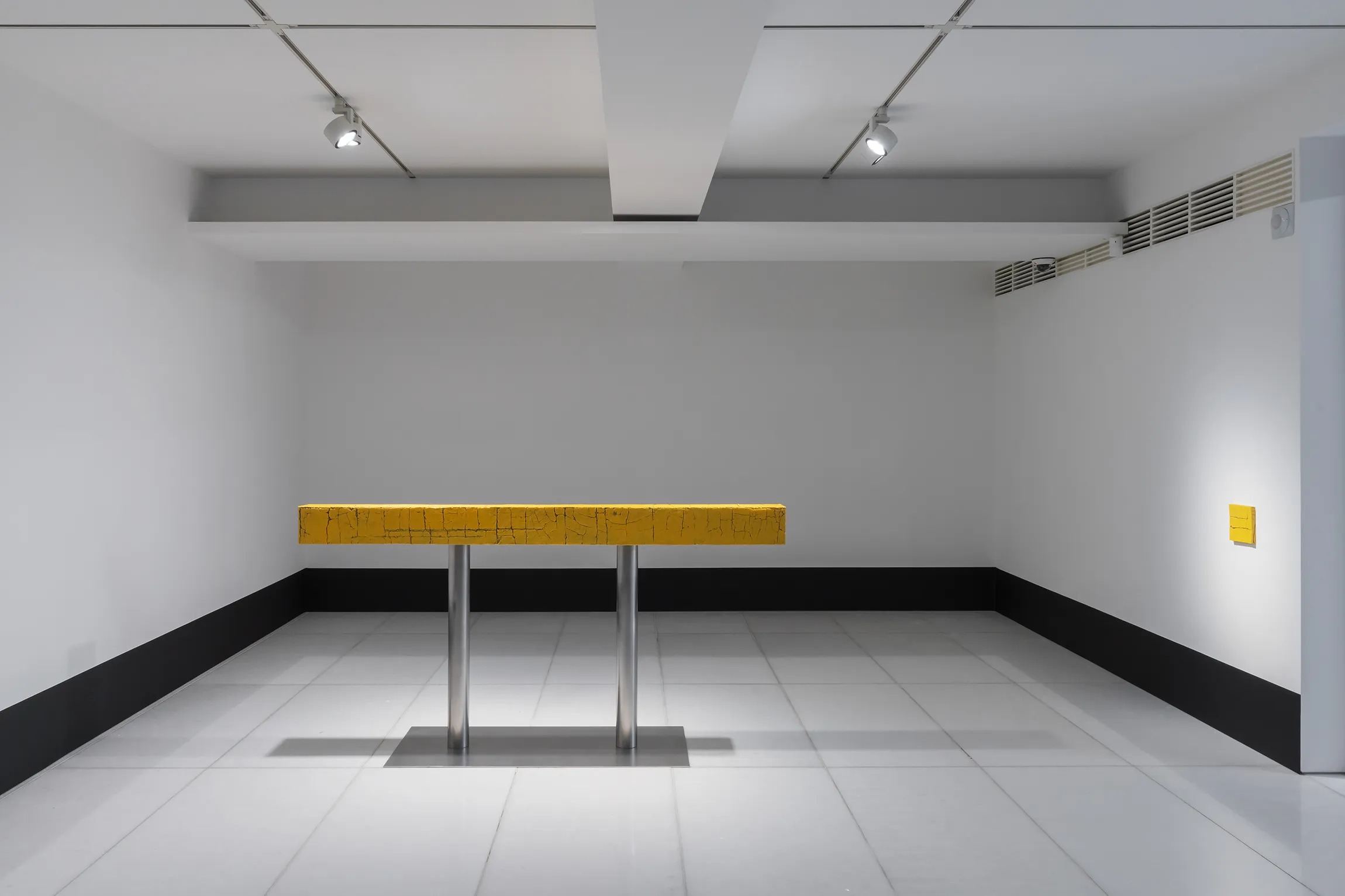
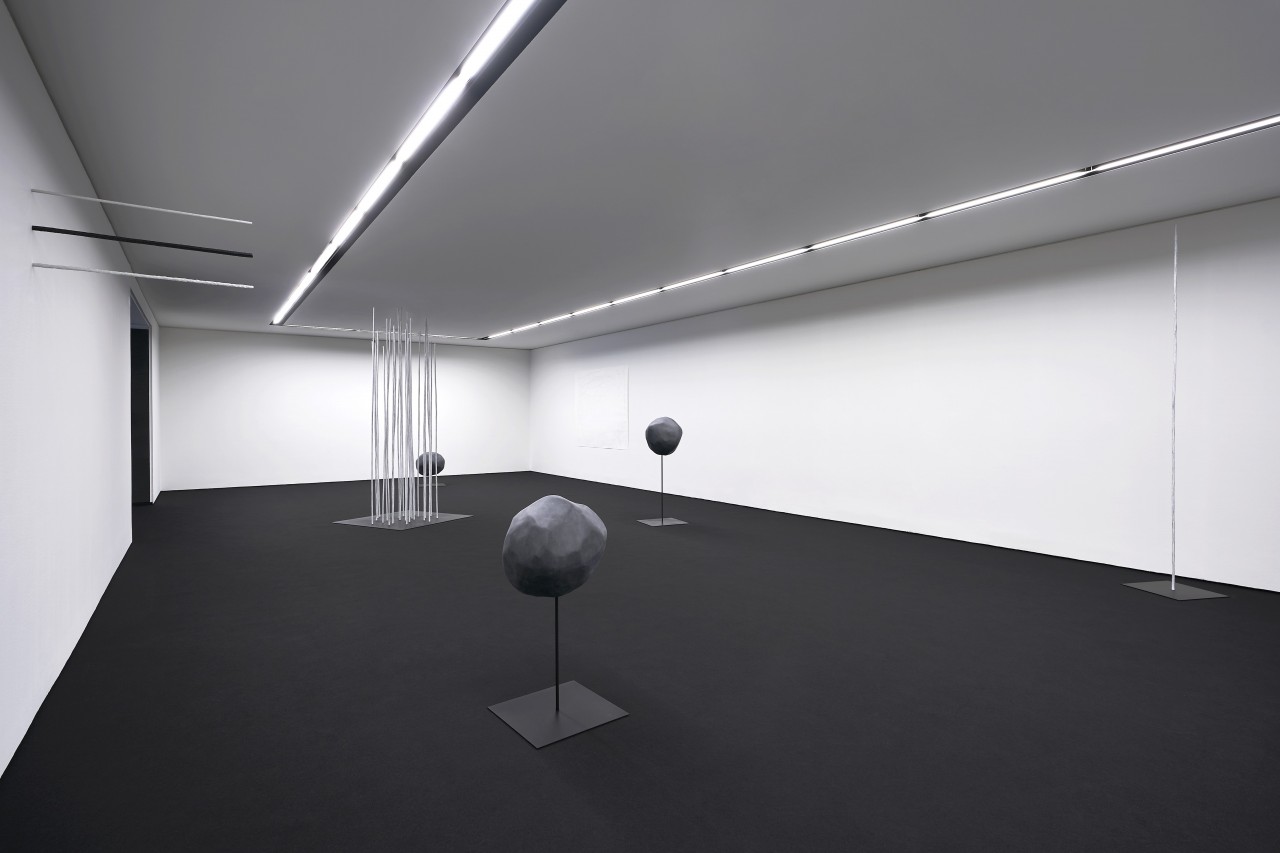
Stepping down to the third floor, one encounters modularized forms of a yellow line that appear to penetrate the space, traversing across the walls. This work, Broken Yellow Line (2026), takes its departure from the yellow dotted center line found on roads. A center line separates different realms of movement and dictates direction, while a dotted line serves as a visual signifier implying that this boundary can be crossed under certain conditions.
In other words, a single line simultaneously performs two opposing functions under a specific set of conditions. While it regulates movement and establishes a boundary, it inherently harbors the possibilities of turning and deviating within that very boundary.
KIM casts this planar line into a volumetric object measuring approximately two meters in scale and places it within the space. The signifier designed for an efficient traffic system now transforms into a physical object situated on the same dimension as the viewer's body. Having acquired volume and height, the line becomes a tangible obstacle that the viewer's physical body actually encounters within the gallery.
In this process, the line no longer remains a mere abstract image that partitions the space. Penetrating the room, the line in its dotted format dismantles the physical boundaries that structure the space, prompting the imagination of what lies beyond. It operates as a condition that forces viewers to continuously renegotiate their movement, speed, and direction.
Therefore, the line functions simultaneously as a form that divides space and as a device that reveals just how conditional and mutable the rules of that division truly are. The boundary is not a rigidly fixed plane; rather, it is closer to a provisional state where the possibilities of passage, detour, and rotation are constantly redefined in accordance with the position and movement of the body.
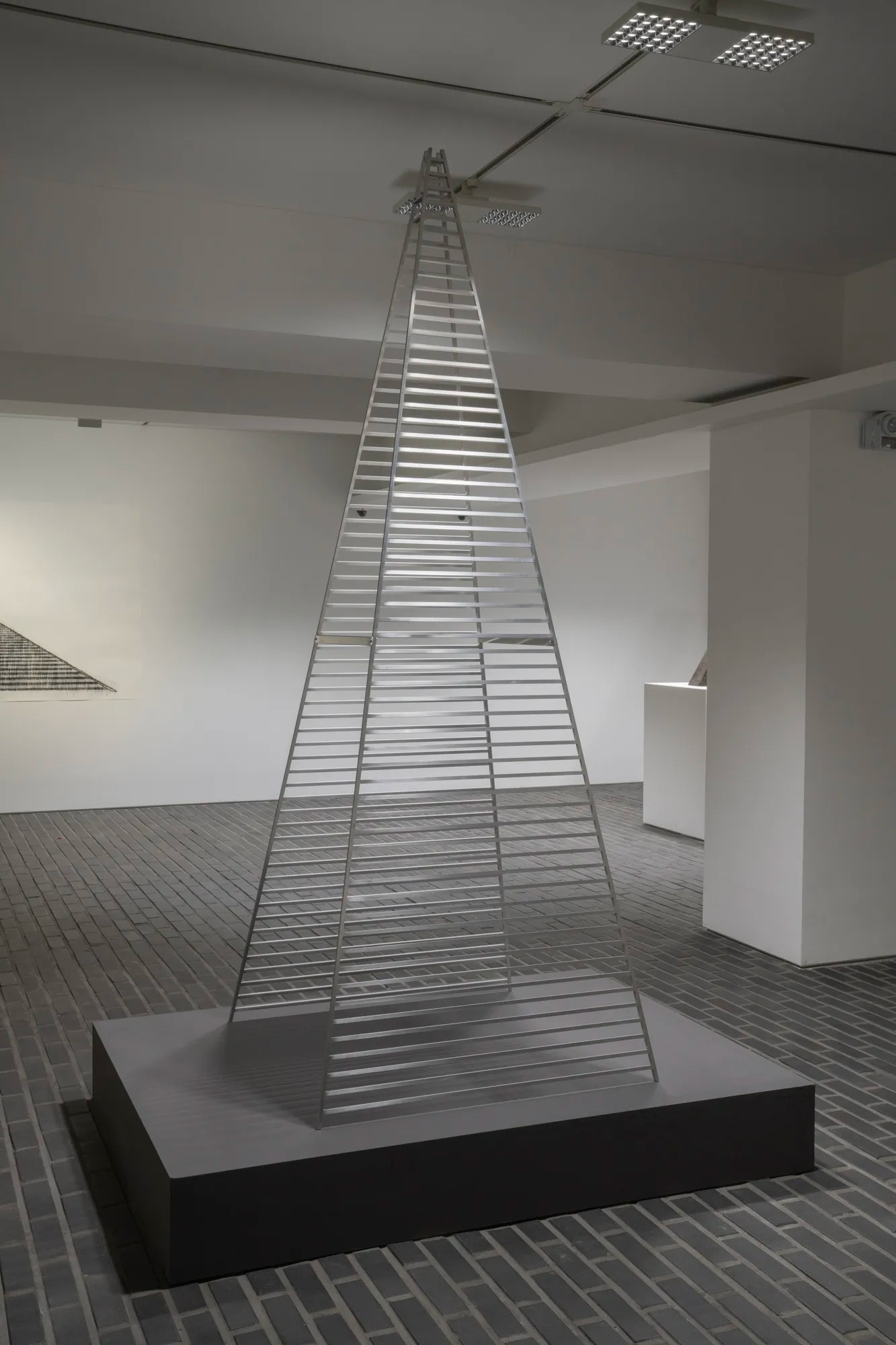
Lastly, the issues of the ladder and perspective unfolding on the basement floor also align with the preceding works. The A frame ladder, whose width narrows toward the top, naturally evokes the principles of perspective where close objects are perceived as large and distant ones as small. Using this formal similarity as a starting point, KIM sculpts a ladder, adjusts its proportions to further emphasize the perspective effect, and renders this structure through frottage.
This transformation continues in the shape of light falling from the sky, which shares a similar outline with the ladder. Light, inherently intangible, gains a physical body as a volumetric sculpture, and this resulting volume is subsequently transferred into a drawing. In the progression from light to matter and from volume to plane, a single subject is translated anew as it passes through different conditions each time, rather than being replicated in an identical form.
What KIM repeats here is not so much the representation of a specific form, but rather the act of transitioning the conditions of distance, contact, volume, and surface mobilized to perceive an object into different dimensions. In this regard, perspective serves as a crucial clue to understanding this work. Perspective is a system that arranges the distance to a subject based on a specific viewpoint and brings order to the three dimensional world upon a single two dimensional plane.
Within this system, the viewer is assigned a fixed position, and the world unfolds from that vantage point as a relationship of measurable depth and scale. However, the artist's interest does not lie in merely replicating this system of perspective within the physical space. Rather, he repeatedly experiments with how the rules of distance established in one dimension change when transferred into a different format. Actual depth is translated into differences in scale on a plane, and those differences are in turn converted back into the volume and length of a sculpture.
Therefore, in this context, the plane and the volume are not divided by a hierarchy of original and translation, or reality and image. The sculpture of the ladder is no more real than the drawing, nor does the drawing simply represent the sculpture. Rather, each time a form passes through a different medium, it organizes distance and depth in a new way.
Consequently, perspective here acts less as a principle of flawless representation and more as a grammar that transforms forms as they migrate between dimensions. By converting three dimensional depth into two dimensional relationships, and subsequently expanding that planar order back into volume and intervals, the artist examines how a single viewpoint is repeated and deformed amid varying sensory conditions.
While perspective attempts to stably control and organize the world from a single location, in KIM's work, that location undergoes continuous recalibration under different conditions. Ultimately, rather than a single viewpoint fixing the world in place, the viewpoint itself begins to continuously shift throughout the process of translation.
In KIM's work, the condition for perceiving a subject is not a faculty unilaterally exercised by a single agent; rather, it newly emerges through the process of interaction among these differing conditions. Examining the working conditions he established for this exhibition reveals that most are organized around certain rules and premises.
Making without seeing, performing the identical action while unable to verify each other's drawings, transforming a road boundary into a three dimensional volume, and exploring the structure of perspective across different media, these all appear, at first glance, to be meticulously designed experiments.
However, what is more intriguing is the fact that the more explicit these rules are, the more distinct the differences and errors arising within them become. In the forms sculpted without sight, the images already internalized within the sculptor's body are paradoxically visualized, and two bodies attempting to move identically ultimately leave behind two distinct images.
The line defining a boundary simultaneously encompasses the possibility of traversing that very boundary, and the system of perspective that frames our view of the world loses its point of reference, undergoing a continuous recalibration.
KIM Inbai's practice does not propose an exterior completely liberated from the system of visual perception. No matter how strictly vision is blocked, memories of what has already been seen remain inscribed within the body, manifesting once again through other senses, and even if one breaks away from existing rules, another set of rules inevitably emerges in their place.
Rather, his work questions which sensory conditions can be mobilized to perceive a subject within a given physical environment. It operates as the practice of a belief that one can reach beyond surface forms by concatenating sensory units that have long been considered disconnected. In this regard, his endeavor is closer to a temporary suspension of the cognitive authority monopolized by vision.
Today, visuality functions as the primary cognitive system that classifies, deciphers, and validates the world as truth. Visibility often serves as the prerequisite for confirming existence, and the fact that something is seen clearly easily translates into the conviction of fully knowing it. Therefore, that which is not captured within the field of vision is easily dismissed as nonexistent, and that which possesses an ambiguous form is often treated as not yet having acquired meaning.
For KIM, however, absence is not the antithesis of existence. Rather, it is closer to a state in which a subject has not yet been captured within a specific sensory and cognitive system, or a state that defers reduction into an already familiar form. In this sense, 'absence' is a matter of potentiality rather than deficiency, serving as a catalyst that exposes the limits of how we see and how things are seen.