Introduction — Two Lies and One Hand

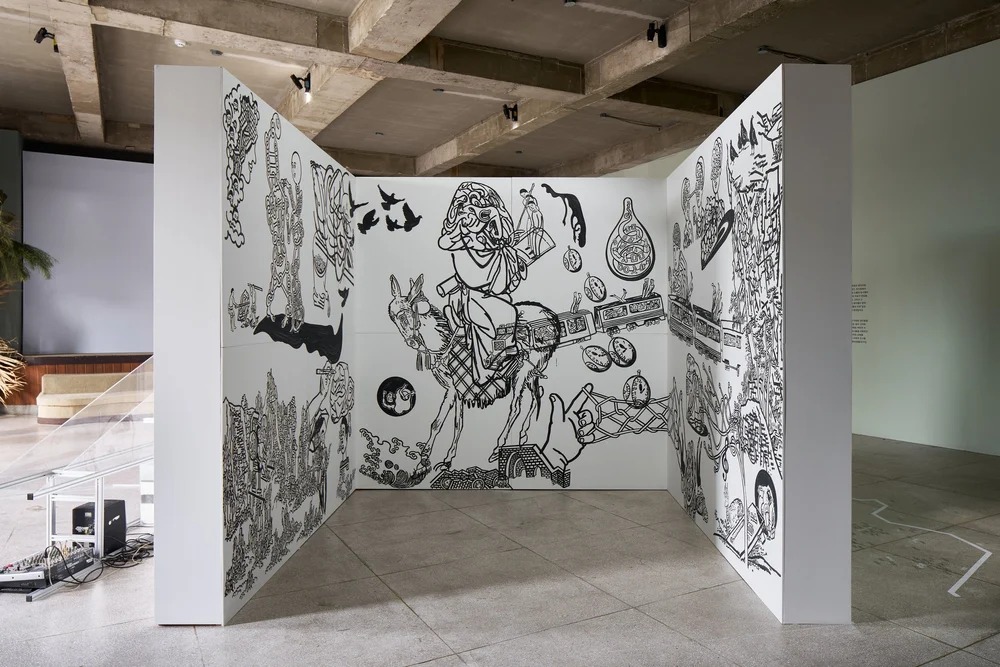
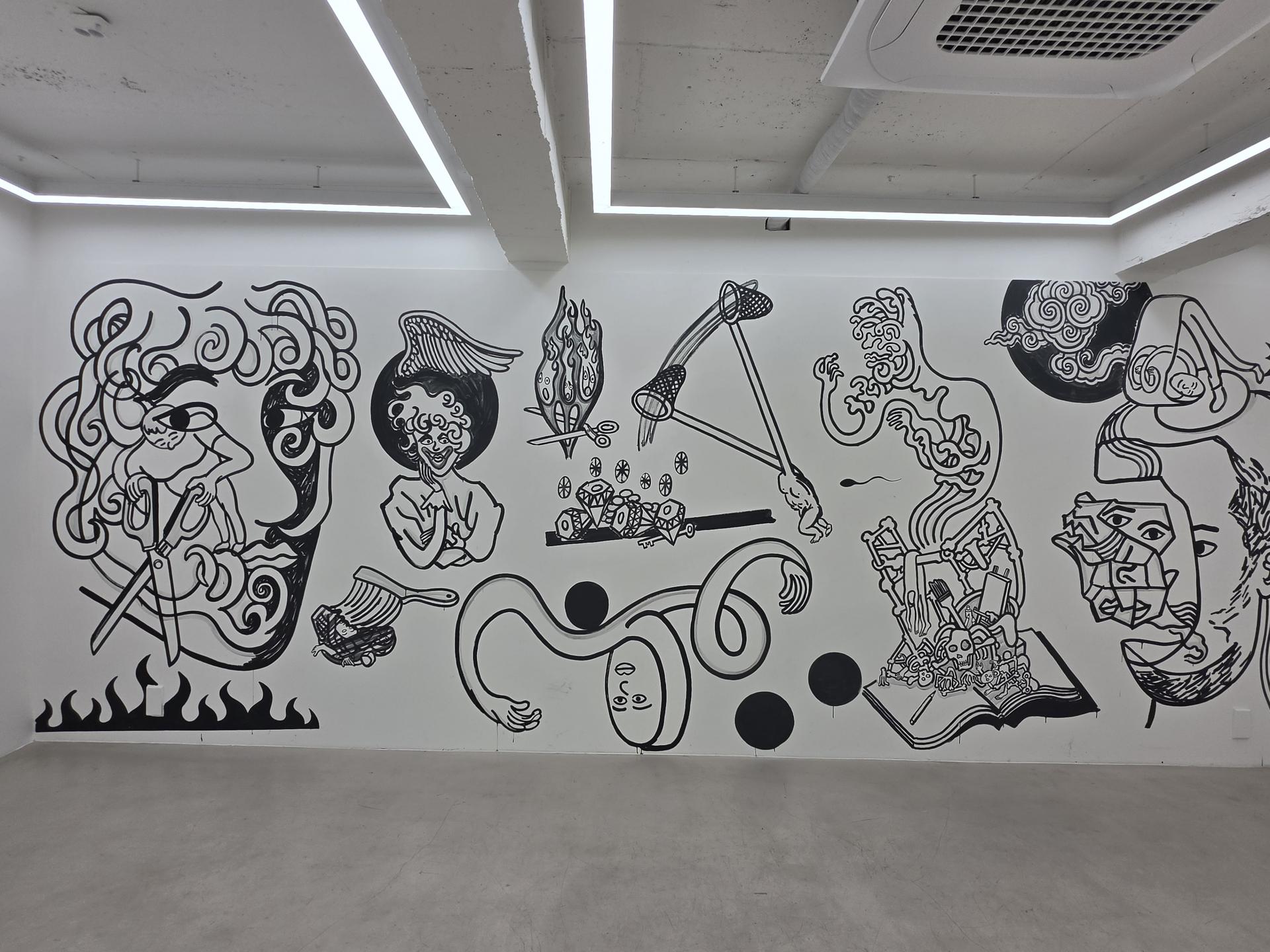
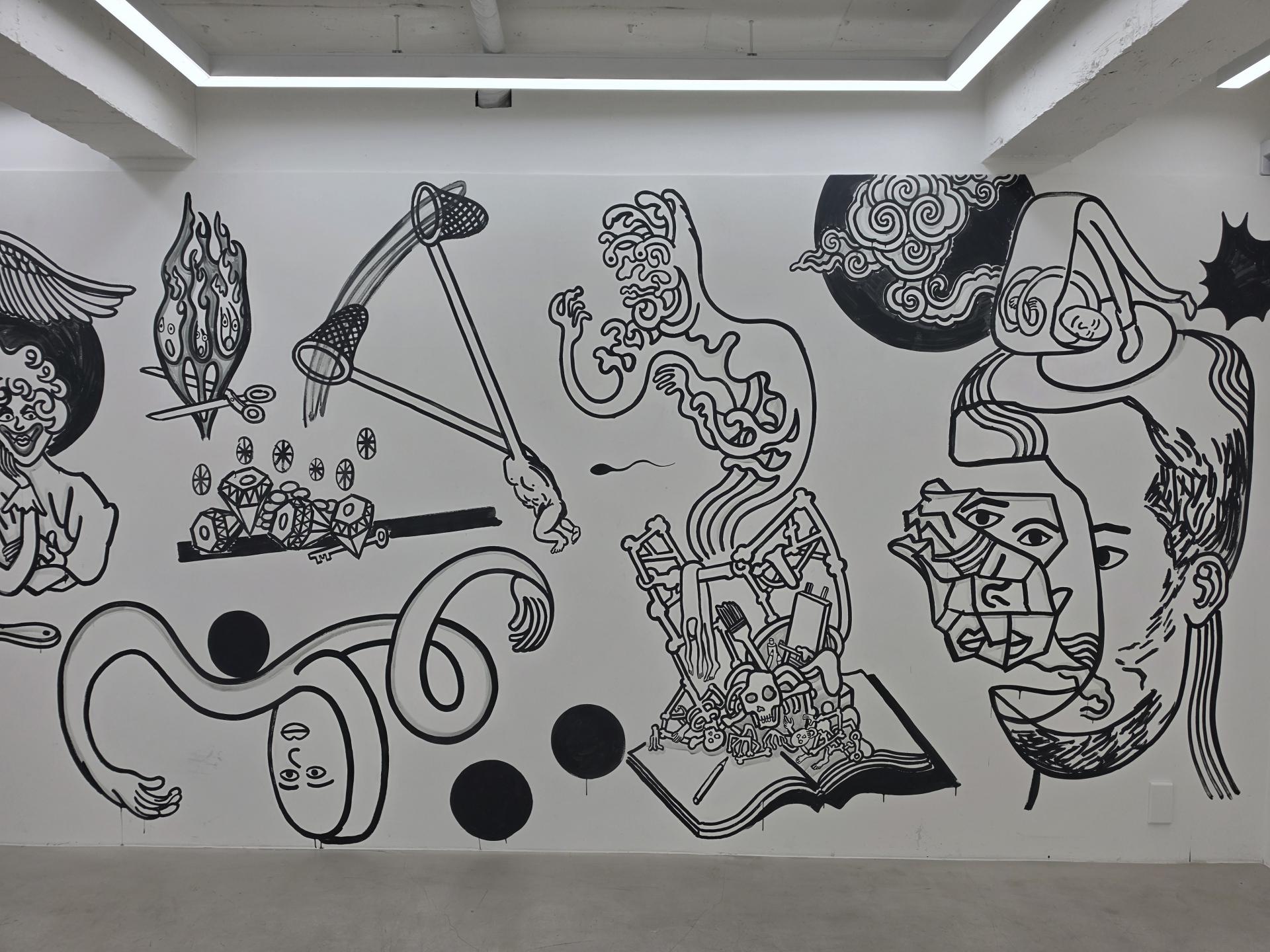
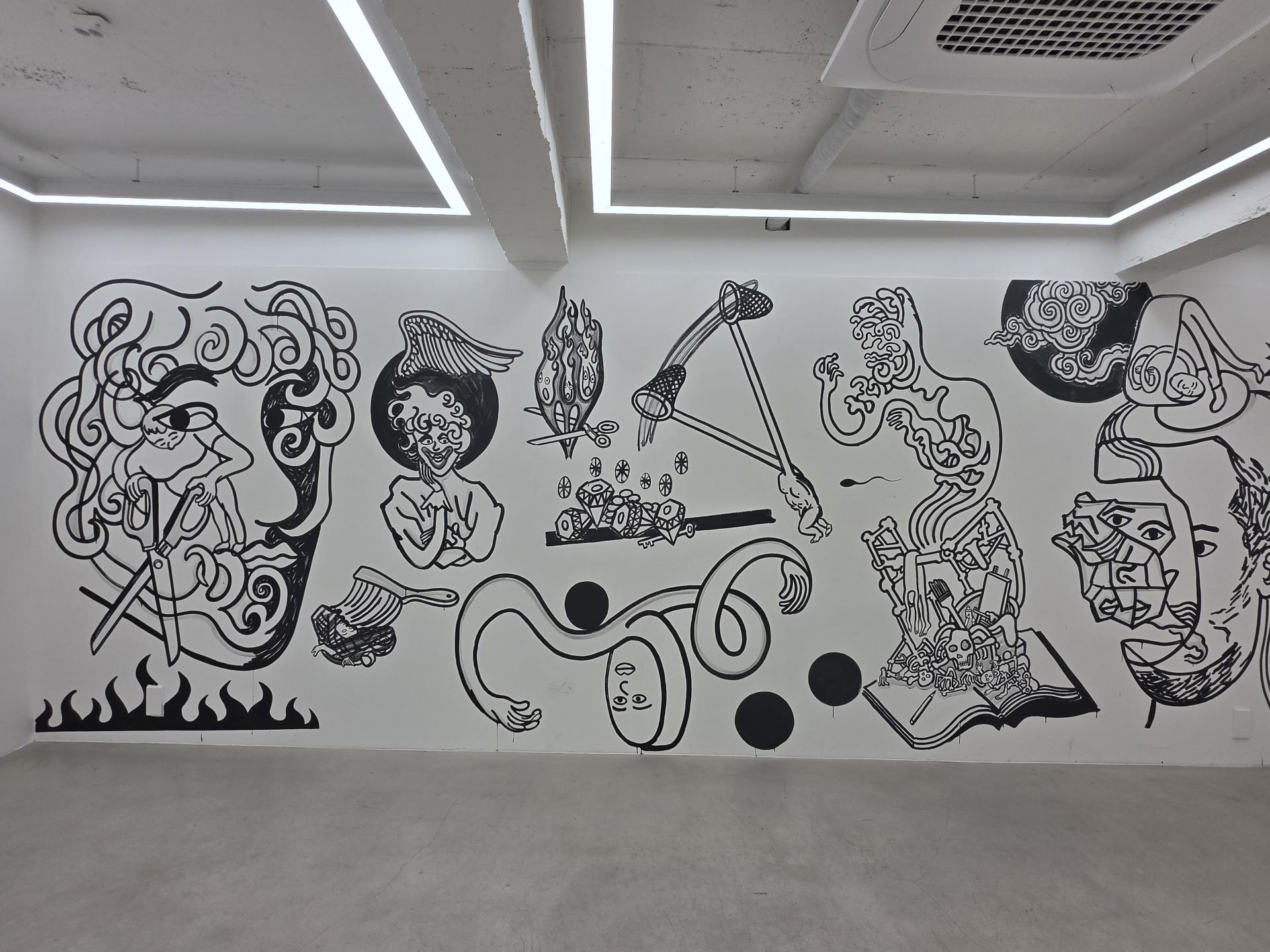
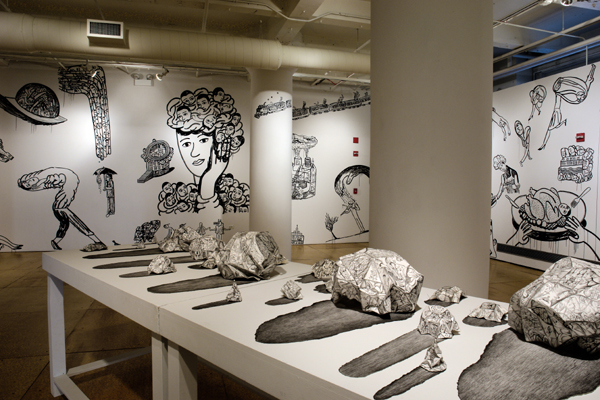
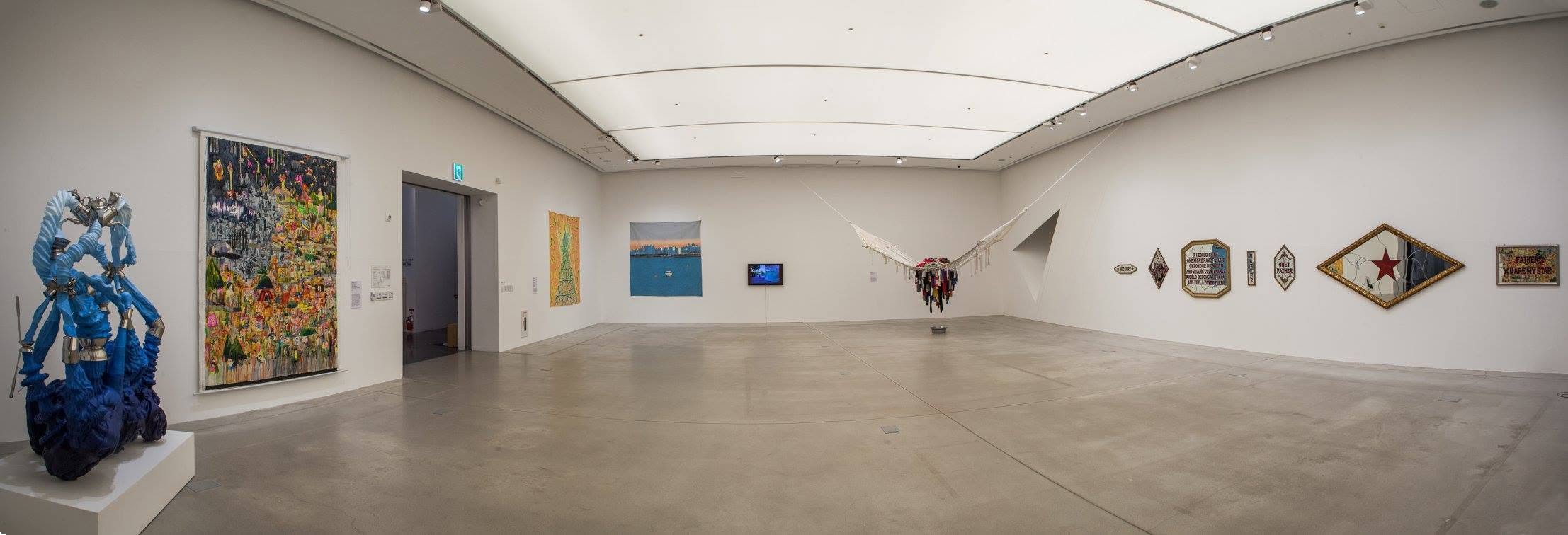
Upon entering the exhibition space, one entire wall seethes with black lines. Forms beginning with flames at the far left turn into a mass of hair, then into a figure holding scissors, before passing through a scene in which an open book spews out miscellaneous objects and through coiling spirals, finally coming to a halt at a gigantic face on the far right.

On the opposite wall is a sentence written by the artist: “Every time I blink, I arrive in a different world (…) The moments between blinks unfold like dreams / When my eyes wear away and disappear completely, I awaken.”

This exhibition stands on two lies. The first is its title. When 《해윤(解輪)의 꿈 — Haeyoon's Alibi》 is spoken aloud in Korean, “Haeyoon” becomes a person’s name, while in the English subtitle, “Haeyoon’s Alibi,” that name is transformed into an “alibi,” proof of absence from the scene. The second lie lies in its form.

Borrowing the most decorous temporal structure of the traditional East Asian scroll painting, the artist uses it to carry the most unsettling vision: cutting open his own face with scissors. The title declares that the dream will serve as an excuse to evade responsibility, while the form pretends to borrow from tradition only to betray it.

Yet what this text ultimately seeks to arrive at is not a lie, but a single hand. Until just before the exhibition opened, the artist must have been kneeling, bending his body toward the lower part of the wall as he drew his lines. Protective plastic sheeting would have covered the floor, and brushes would have rested atop a ladder.

This mural was not painted in ink on paper. It was painted directly onto the wall, and once the exhibition ends, it will be covered with white paint and disappear forever. Eunhyung Kim describes his work as “automatism and the big data of AI.” I believe that equation is wrong. And what proves it wrong is precisely that kneeling hand.


Installation view of 《Haeyoon's Alibi》 © H-flux Gallery

1. The Unwavering Line — Where the Hand Imitates the Machine

What first draws the eye is not the imagery but the line itself. Eunhyung Kim’s lines remain almost uniform in thickness. Although drawn with a brush, they suppress variations in pressure.

In East Asian calligraphy and painting, the vitality of a line lies in its tremor—the rhythm of thickness and thinness (肥瘦) created as the brush presses down and lifts, recording the breath and hesitation of the person who draws it. Kim, however, deliberately erases this tremor. What remains are smooth, homogeneous black contours that look almost like vectors produced with a pen tool.

This is the first decisive sensation. His lines are drawn by hand, yet they erase the contingencies of the hand. A hand imitating a machine. Lines that counterfeit the uniformity of digital drawing through physical labor. Here, we already encounter the artist’s central strategy: he deliberately walks the tightrope between hand and machine. While invoking automatism, he performs that very automaticity by hand.

Yet every counterfeit inevitably leaves a residue. At the far right of the mural, one enormous face is conspicuously different. Whereas the other forms are defined by smoothly flowing curves, this face is fractured into planes like a Cubist image: cheeks broken into facets, misaligned eyes, an angular mouth. Within a single pictorial field, the “flowing line” collides with the “fractured plane.”

The dream, which had been gliding smoothly along, suddenly fragments and cracks upon reaching this face. It is as though, at the end of the dream, the image can no longer slide seamlessly forward and instead breaks into angular pieces. A point just before waking, where the image loses resolution and begins to pixelate. The line that refused to tremble ultimately chooses fracture in place of tremor.


2. A Painting That Murders Emptiness — Form Speaks First

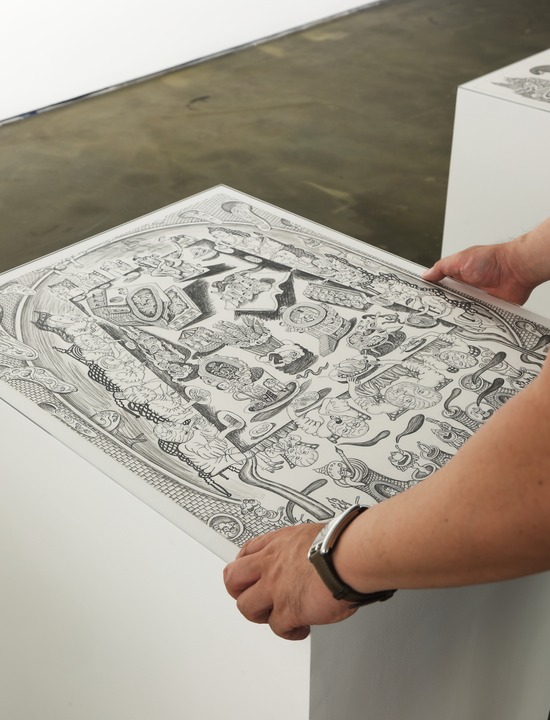
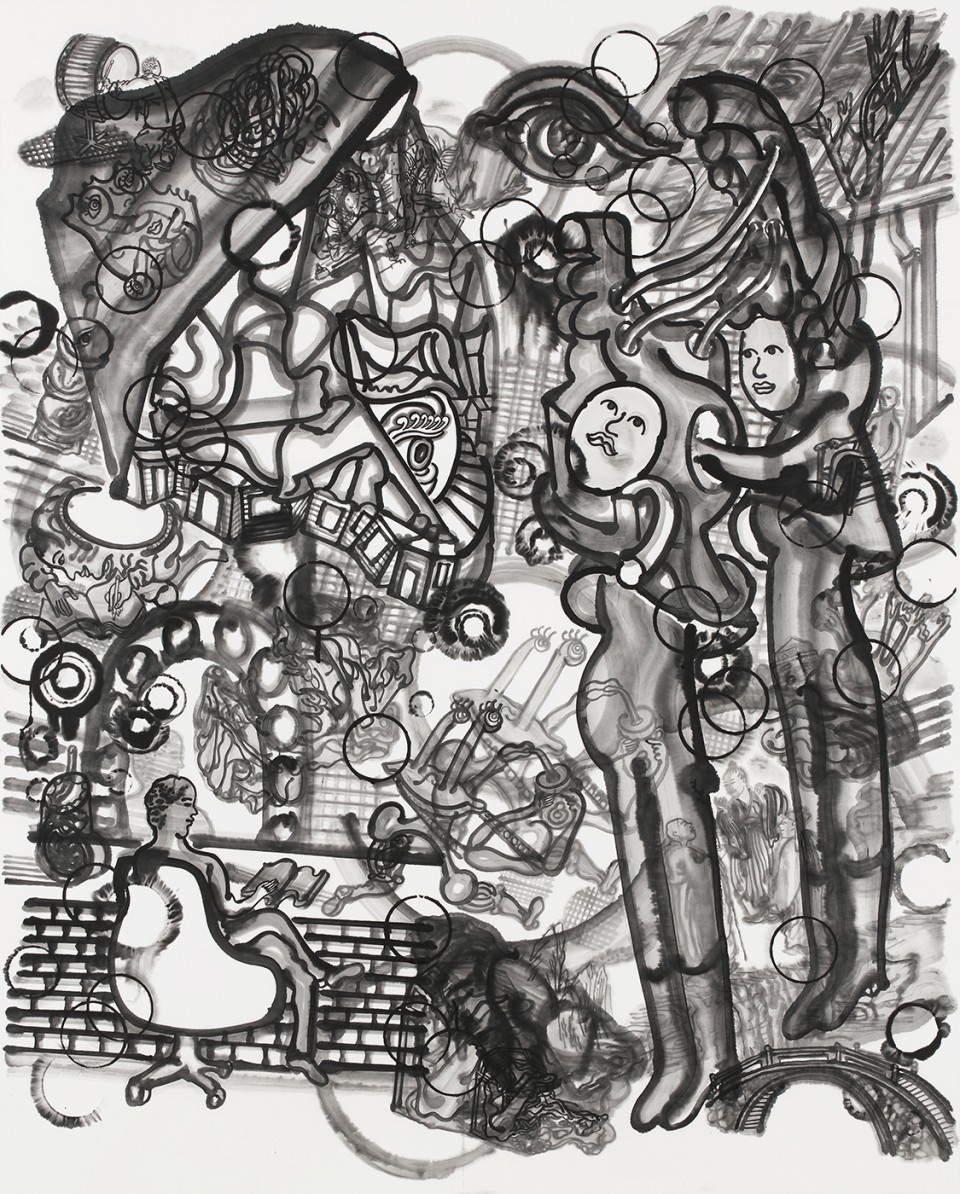
The overall impression produced by these accumulated lines is one of density. There is no empty space. Forms fill the gaps between other forms, spirals coil around spirals, and small smiling faces nestle parasitically into every fold of larger figures. No room is left for emptiness. Art history has given this impulse a name: horror vacui, the fear of empty space.
This diagnosis matters because it positions Kim as a precise antithesis to the tradition of East Asian painting. In East Asian painting, empty space is not simply vacant; it is a passage through which vital energy flows, an active site of thought in which not painting itself becomes a form of painting. The essence of that aesthetic lies in emptiness.

Yet at the very point where Kim adopts the temporal structure of East Asian painting—the scroll—and its tradition of linear brushwork, he massacres empty space. Instead of leaving room to breathe, he fills the surface with compulsive plenitude. There is neither landscape nor the vitality of qi in his painting. In their place are the grammar of comics, the density of murals, and the compulsion of graffiti.

To read him, then, as a “contemporary inheritor of tradition” is to begin from the wrong premise. He does not inherit tradition. Holding the tools of tradition in his hands, he performs everything those tools once forbade. To obsessively fill through the vocabulary of emptiness—this formal contradiction constitutes the first tension sustaining his work.


Installation view of 《Haeyoon's Alibi》 © H-flux Gallery

3. The Scroll and the Blink — Counterfeiting Time

If density is a question of space, what follows is a question of time. The mural is not a single, static scene. Its horizontal progression from left to right borrows the temporal structure of the East Asian scroll. Unlike Western painting organized around a single vanishing point, the scroll requires the viewer to move along the image and experience time through that movement. Departure and arrival coexist within a single pictorial field.

Kim uses this classical temporal form to carry something entirely different. What unfolds across his scroll is not the changing seasons of mountains and rivers, but a single blink. The artist’s text makes this explicit. In the instant of blinking, within the minute interval between one moment of consciousness and the next, an entire world unfolds and disappears.

The flame at the far left ignites that world, while the fractured face at the far right marks the awakening that arrives “when my eyes wear away and disappear completely.” The entire scroll contains what takes place during a single blink.

Here, the alibi is completed at the level of form. The classical scroll asks the viewer to savor time slowly, while Kim’s scroll insists that all of these events occurred in an instant and therefore never truly existed. An alibi of “the moments between blinks.” What happens there lies outside the responsibility of the waking world.

By borrowing the slowest temporal form—the scroll—to depict the fastest possible duration—the blink—he grants absolution to every act of violence he depicts. The fact that the mural itself is destined to be painted over and disappear after the exhibition completes the alibi: unlike a painting that preserves its evidence permanently, this work is erased at the scene itself, ultimately becoming something that “was never there.”


4. The Barber’s Scissors — Not Self-Harm, but Editing

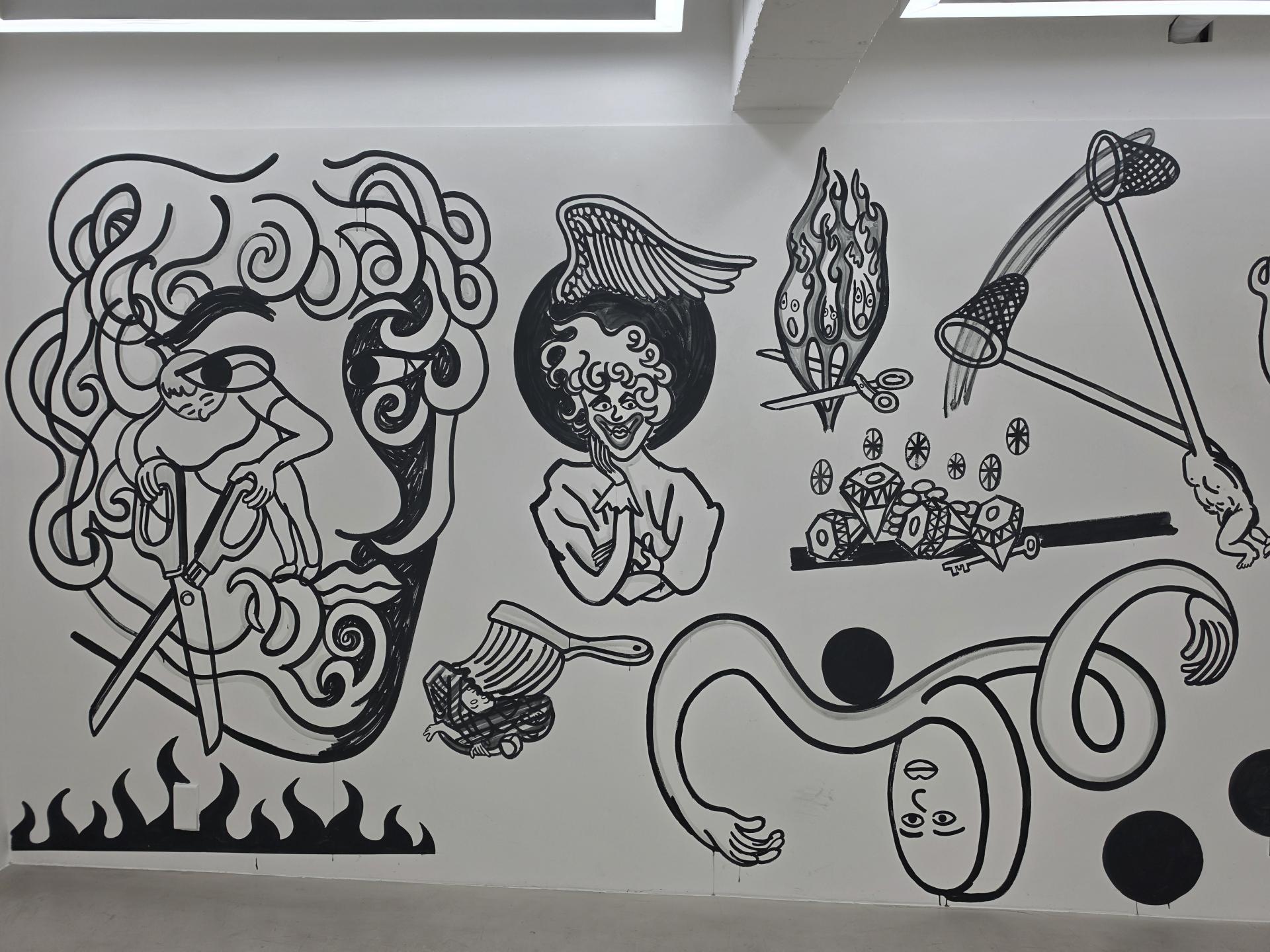
Now we arrive at the central motif. Scissors appear throughout the image. Amid masses of hair, figures cut into their own faces and necks with scissors. Combs and severed pieces of flesh are scattered around them. To read these scenes merely through the horror of self-harm is to remain at the surface.

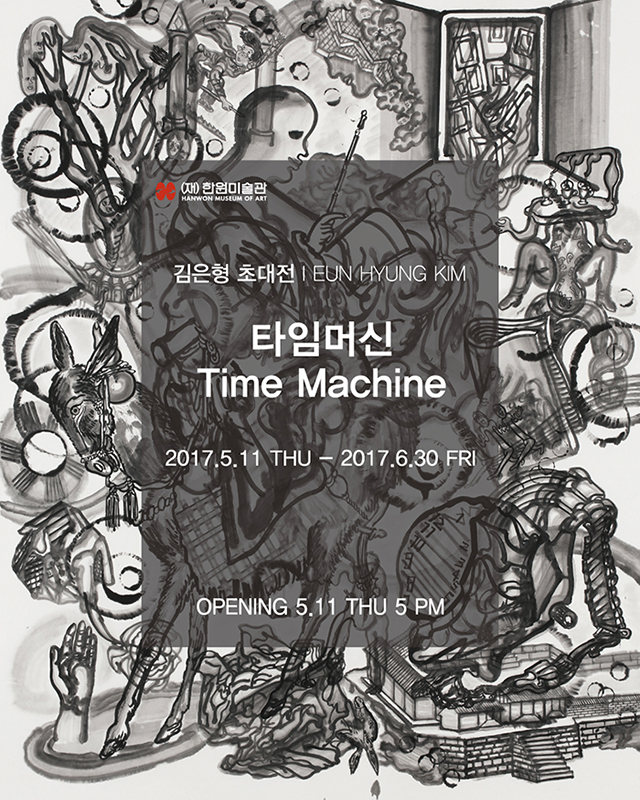
In his 2023 solo exhibition at OCI Museum of Art, 《Tales of the Barber-Curator》, Eunhyung Kim had already introduced the persona of the “barber-curator.” A barber is someone who cuts. A curator, too, is someone who cuts. Meaning is produced by selecting certain things from among countless possibilities and excluding the rest.

Barbering and curating perform the same gesture. Both remove excess in order to give form. The figure cutting into his own face with scissors, then, is not a victim but a self-portrait of the artist editing himself. It is an act of creation wearing the appearance of violence, a form of self-curation that uses the body as its medium.

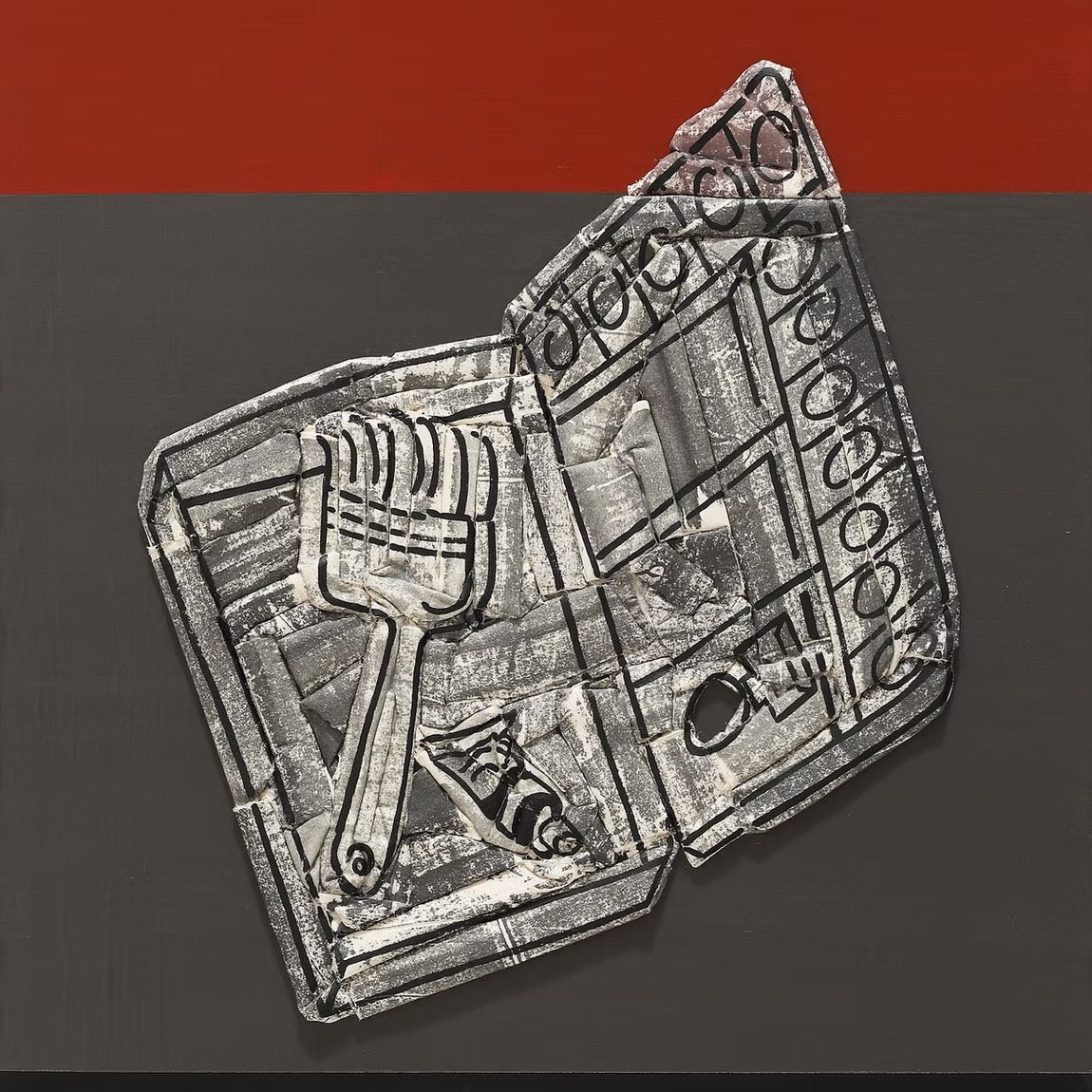
Here, meaning is produced through the movement of the hand. The trajectory of scissors cutting and the trajectory of a brush drawing a line are motions of the same hand. The cutting hand and the drawing hand overlap. But consider another recurring motif: an open book from which tools and miscellaneous objects spill out. A book ordinarily signifies ordered knowledge, yet Kim’s book vomits up objects as though spilling its entrails.

Two actions dominate the image: cutting with scissors and pouring out from the book. Editing and eruption. Subtraction and overflow. The coexistence of these contradictory gestures transforms his pictorial field from a site of simple proliferation into a “battlefield where control and runaway excess occur simultaneously.”


Installation view of 《Haeyoon's Alibi》 © H-flux Gallery

5. The Claim of Automatism, and Its Betrayal

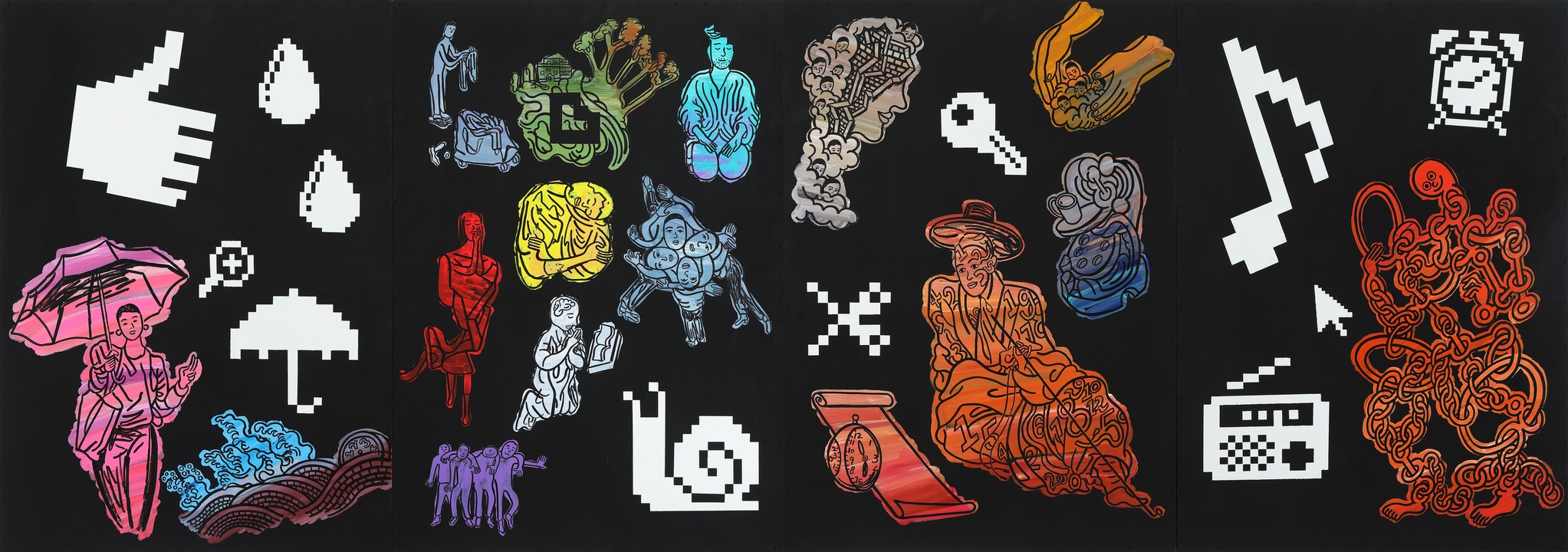
Now we confront head-on the central proposition advanced by the artist. Regarding the 'Brain-Planet (Designing Egos)' series—works in which Eunhyung Kim densely filled the folds of the brain with images under the premise that he would “draw everything he thinks”—he wrote in his artist statement: “This working method, which employs automatism, shares certain similarities with AI’s big data, algorithms, and deep learning. (…)

In the sense that an individual pours out their imagination without filtering or limitation, it takes on the qualities of big data.” Since 2023, he has in fact incorporated ChatGPT and image-generating AI into his practice.

This equation—“Surrealist automatism = AI generation”—is seductive, and it is also a fashionable analogy in contemporary international art discourse. The two certainly resemble one another. When Breton defined automatism as creation produced “in the absence of control exercised by reason, exempt from any aesthetic or moral concern,” it sounds almost uncannily prophetic of today’s generative models. What the Surrealists called the “unconscious” structurally overlaps with what AI today calls “latent space.” Both draw images from a realm beyond conscious control.

Yet art theory has repeatedly emphasized that the essence of Surrealist automatism lies not in the result but in the process. Automatism matters because a human hand moved across the paper through that person’s repression, memory, and tremor. The “automatic” in automatism is not the automation of a machine, but the automaticity of the body. AI generation, by contrast, has no body. It merely interpolates statistically across billions of images; it does not tremble, repress, or remember the experience of loss.

Eunhyung Kim’s true significance does not lie in equating the two. It lies in precisely the opposite. By transferring the visions produced by AI back into drawings made by hand, he himself betrays the equivalence he declares. The evidence is the line examined in Section 1. He erases the tremor of the line in order to imitate a machine, yet to achieve that imitation he kneels on the floor, climbs a ladder, and draws across the wall with his body, as far as his arm can reach.

To attain the uniformity of a machine, he pays the price of bodily time and fatigue that no machine ever bears. The result resembles a machine, but the process that produces it is thoroughly physical. And the Cubist fracture of the face at the far right ultimately betrays the trace of that body—no matter how smoothly the illusion is forged, the hand must break somewhere.

The artist invokes automatism, but his hand refuses to become automatic. It is precisely this disjunction between declaration and practice that decisively distinguishes his work from the commonplace celebration of automaticity in contemporary AI art.


Installation view of 《Haeyoon's Alibi》 © H-flux Gallery

6. The Crumpled Surface — The Material of the Alibi

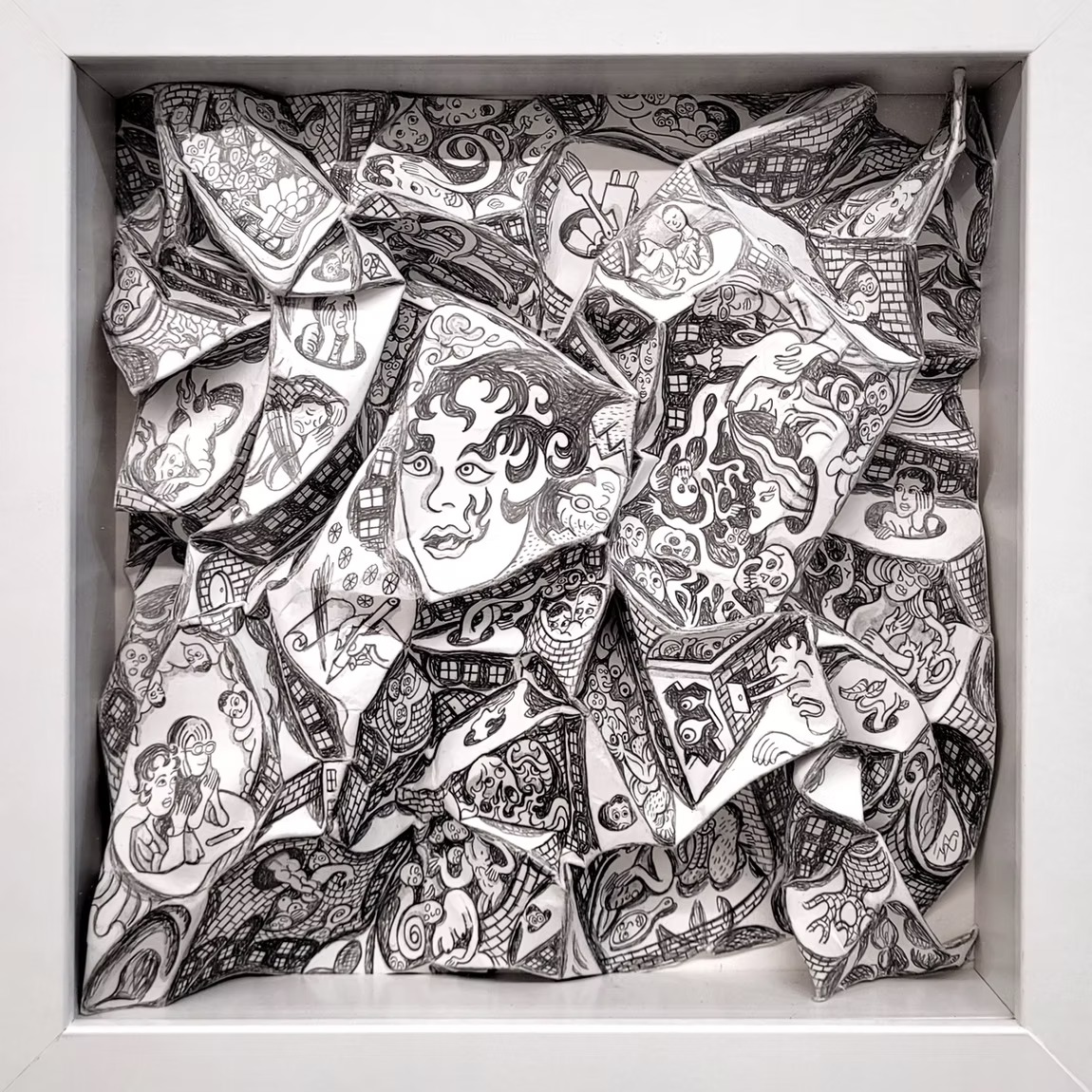
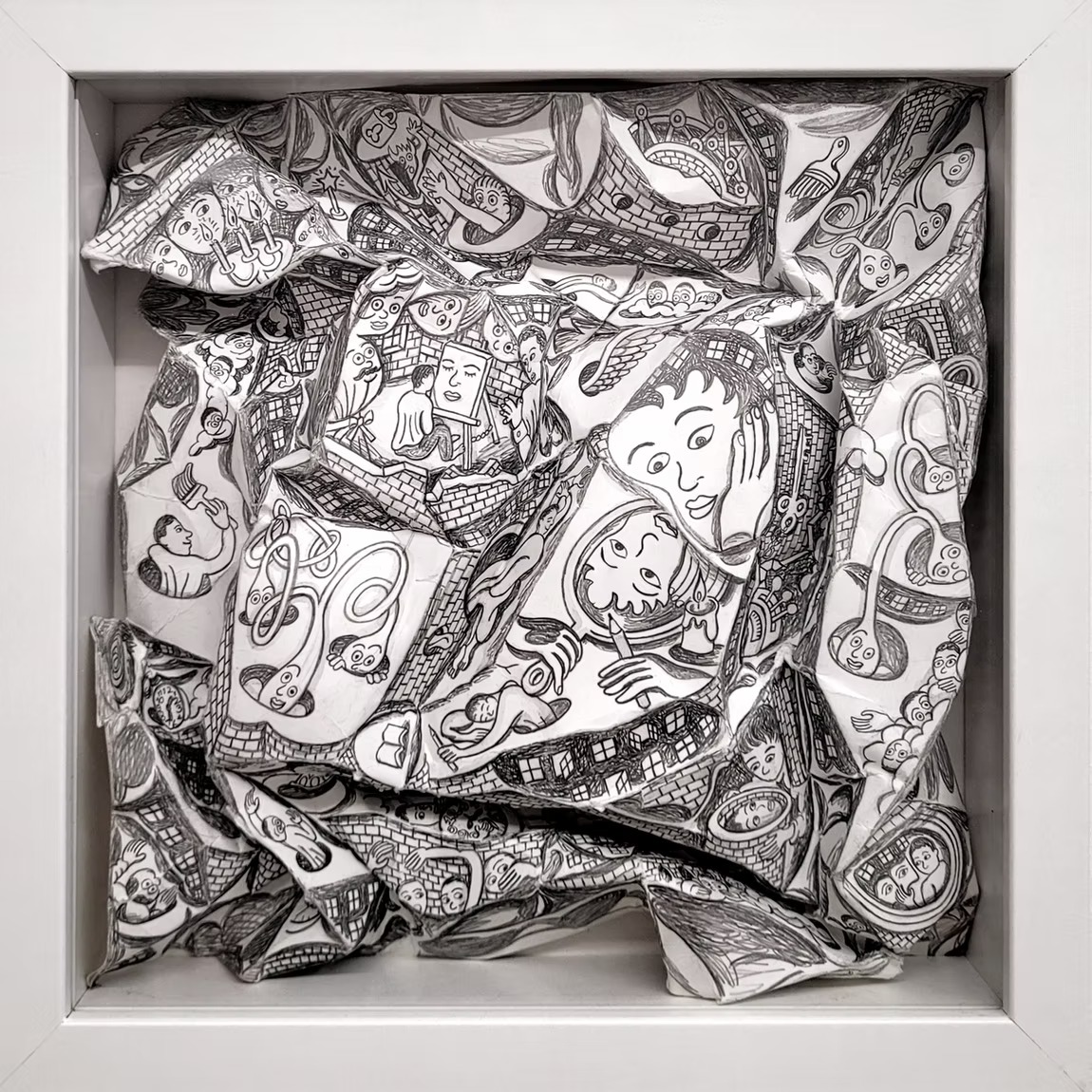
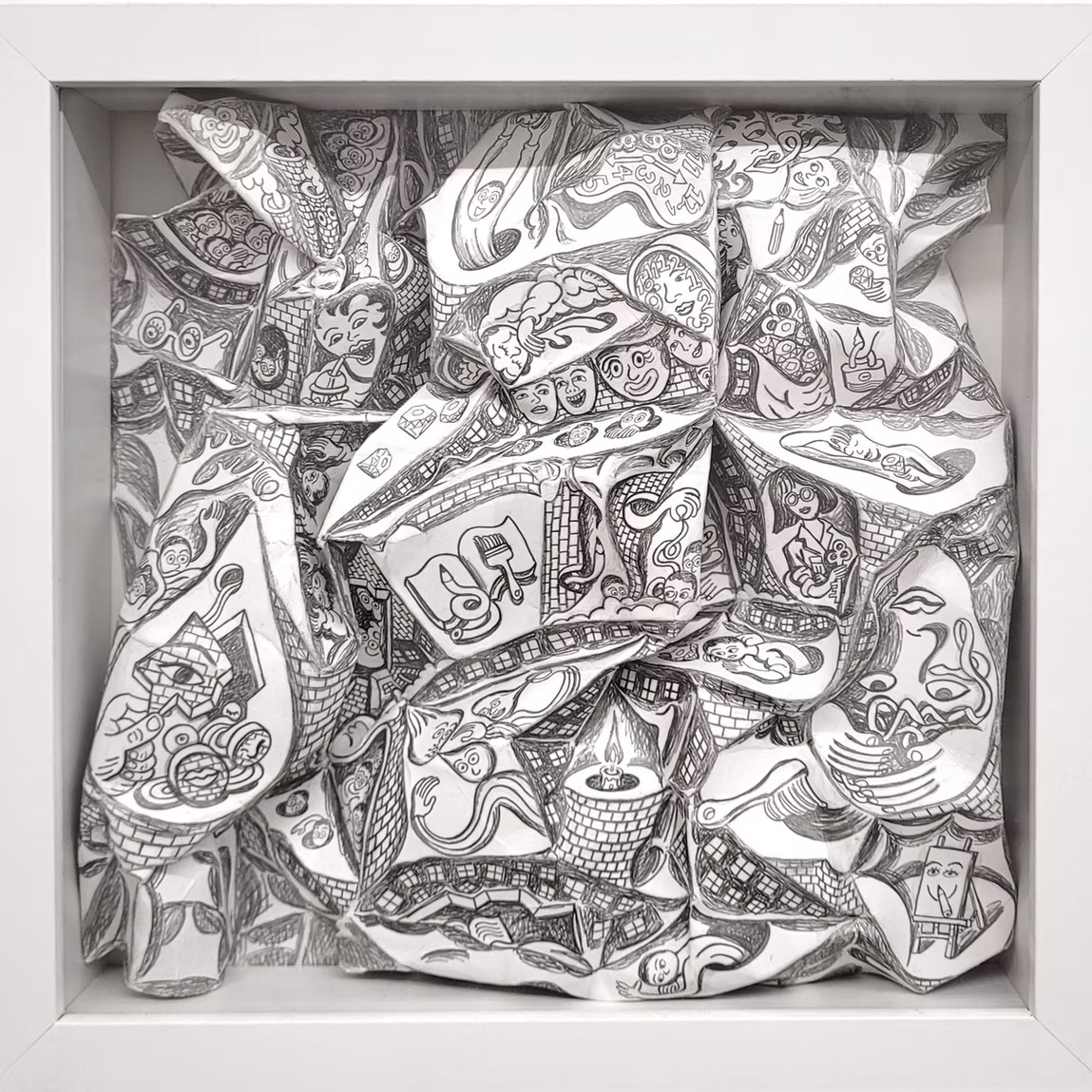
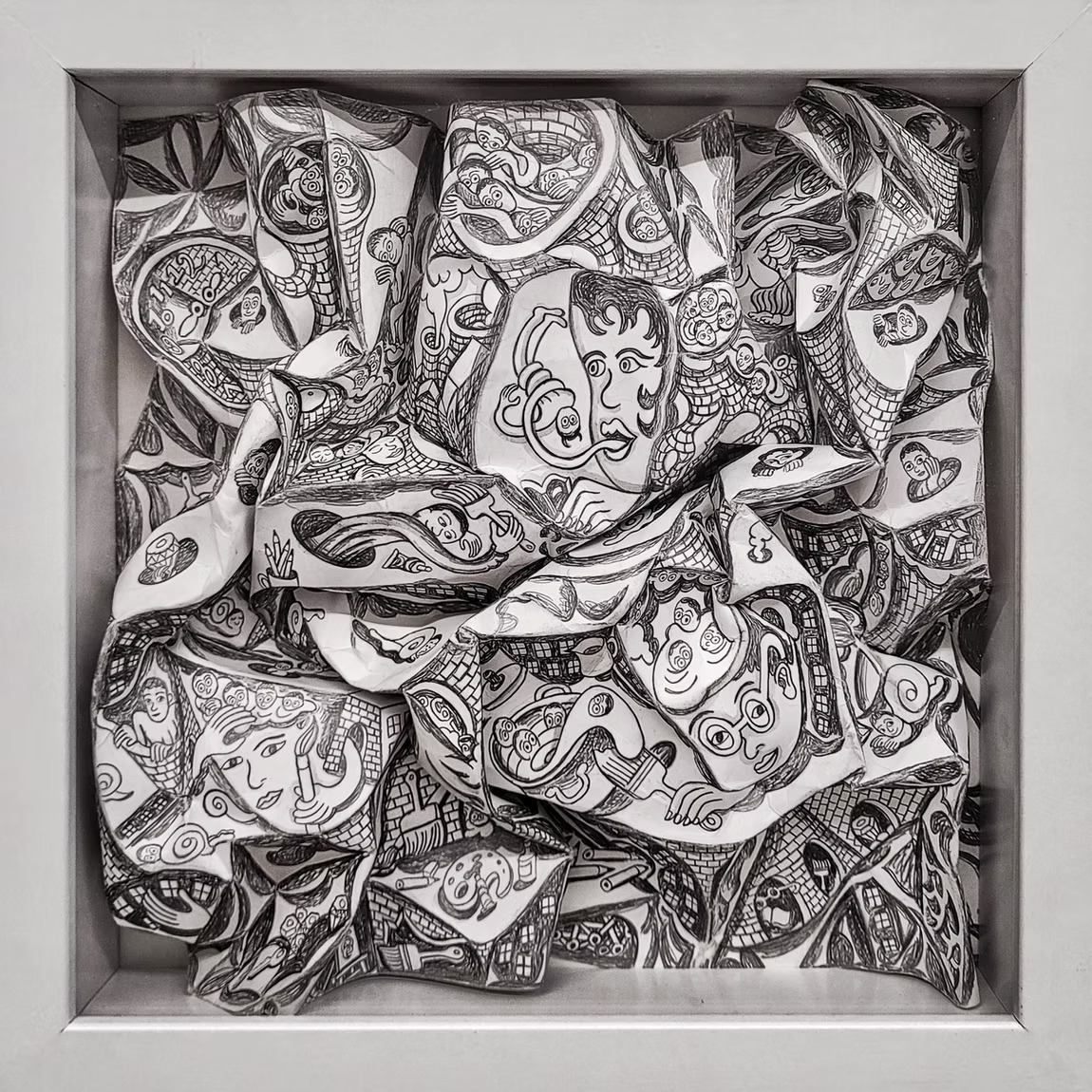
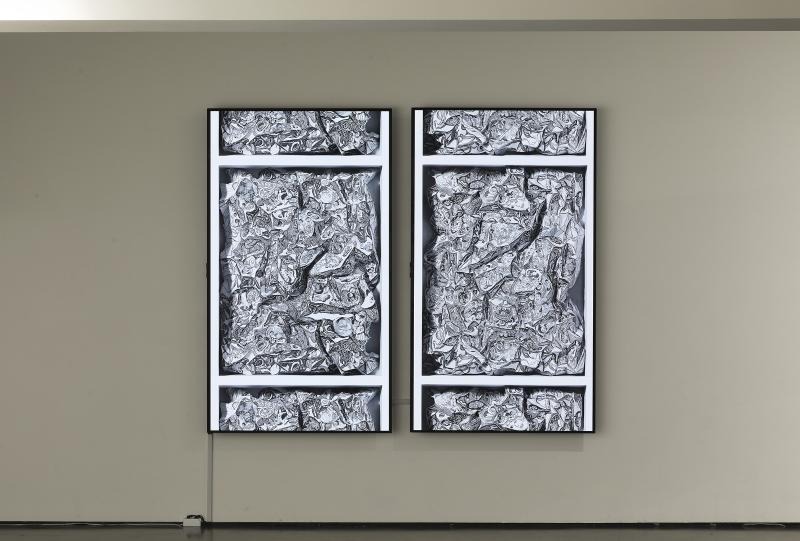
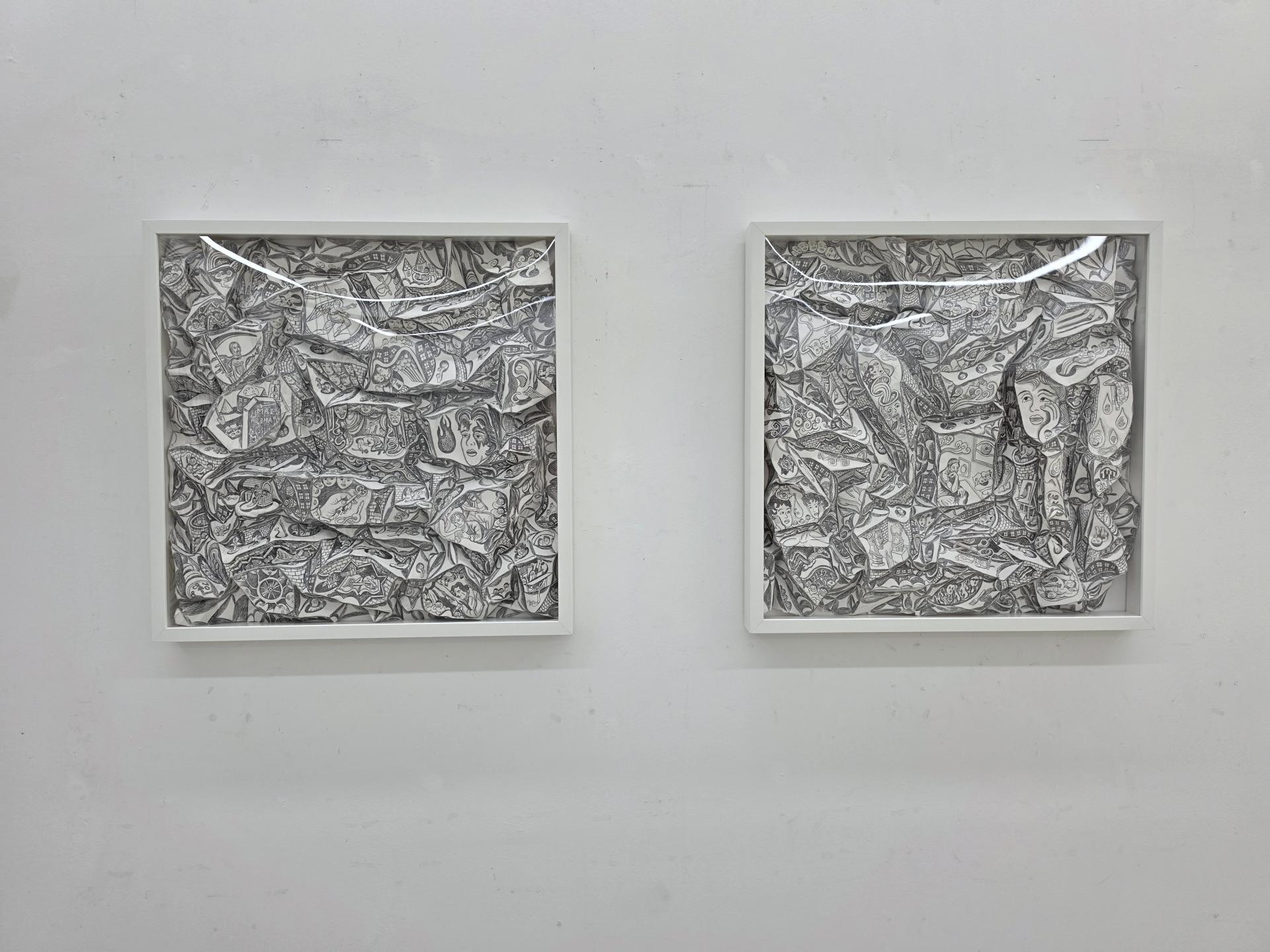
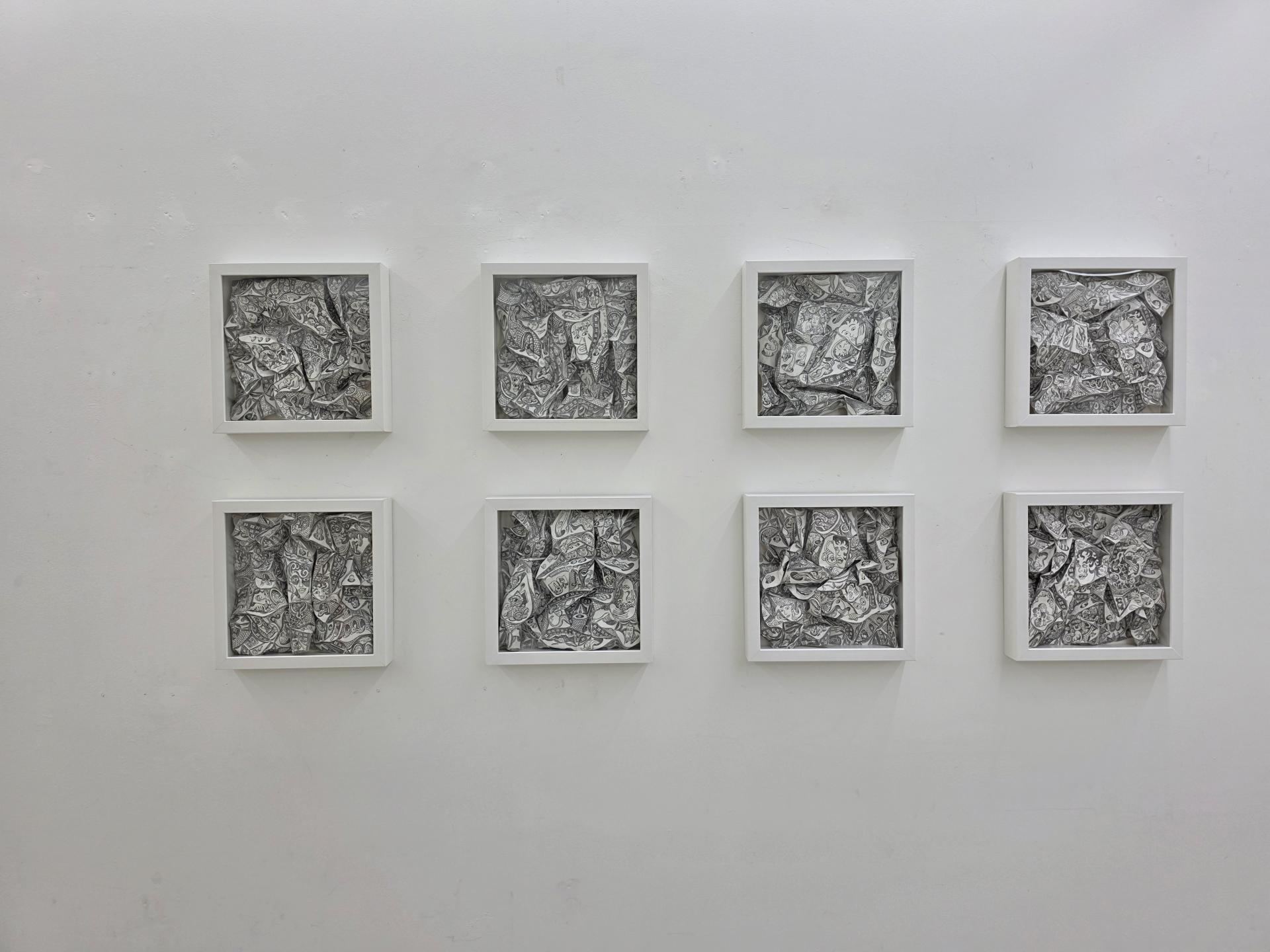
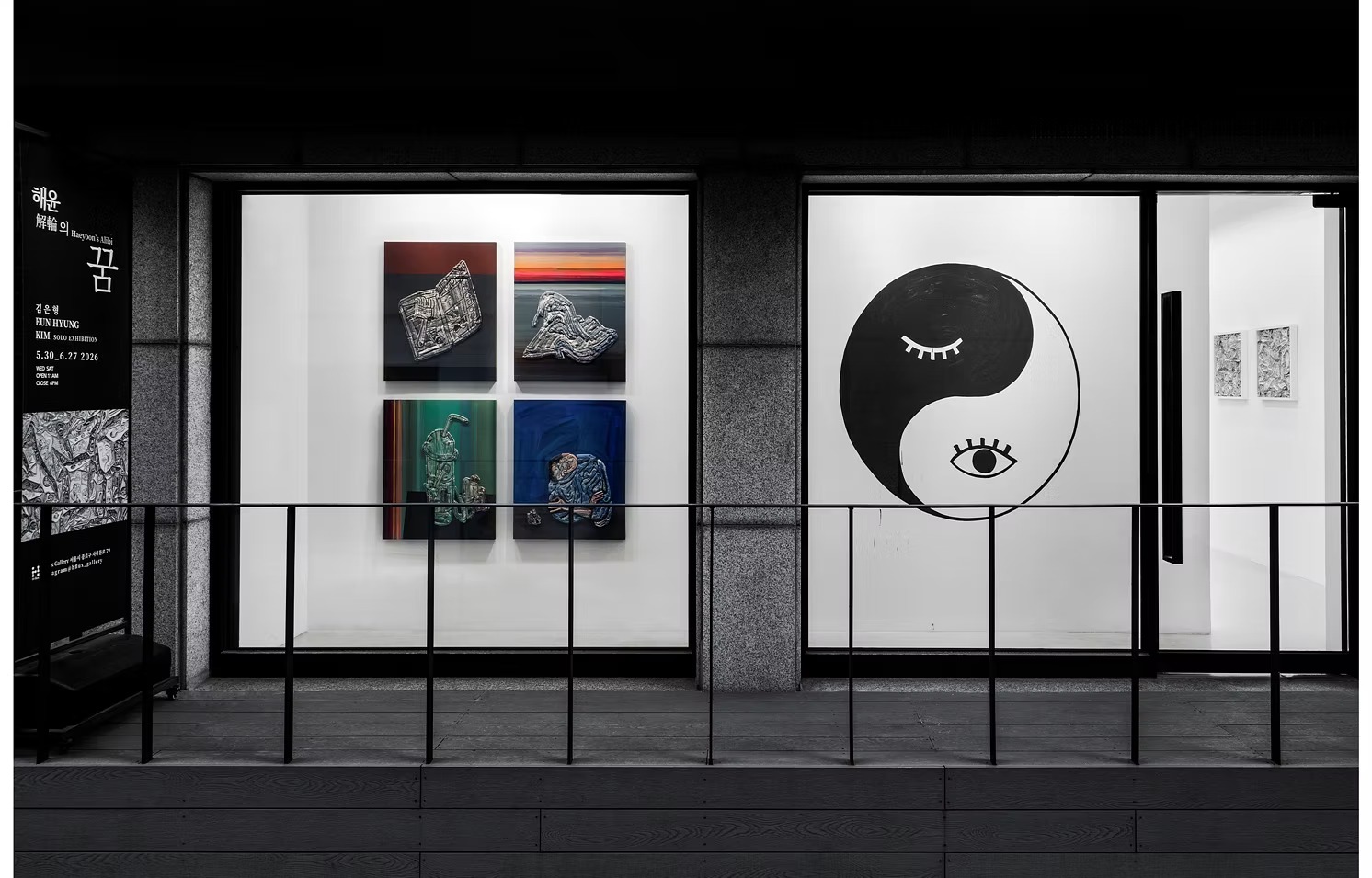
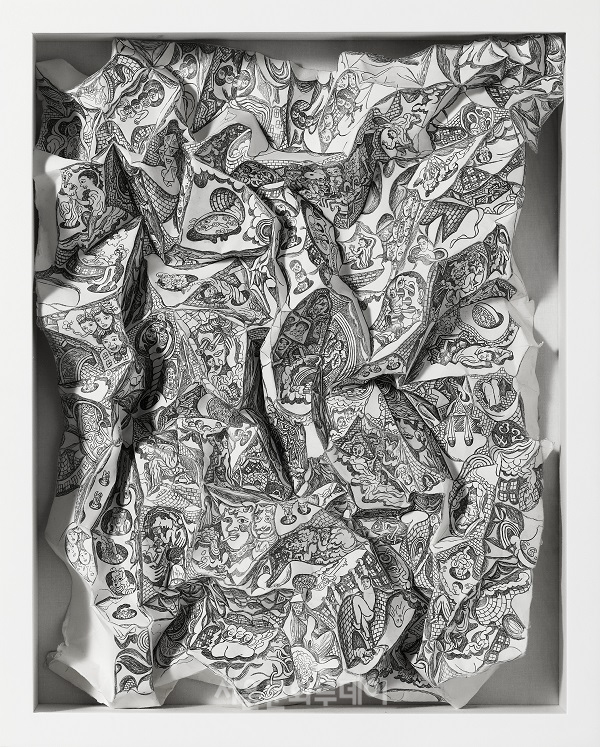
The most ingenious materialization of this residue of the hand is found in the paper drawings crumpled and sealed inside frames. Rather than displaying a sheet densely filled with imagery in its entirety, Kim crumples it and encloses it. Along the valleys and ridges of the folds, images emerge and then disappear into shadow. The viewer can never take in the whole image at a single glance.

This becomes a solution to the limit encountered by the planar ambition of ‘Brain-Planet’—the desire to draw everything contained within the mind. The mind cannot be fully contained in two dimensions. And so the paper is crumpled. The excessive density that the flat surface cannot sustain is translated into the volume of three-dimensional folds. Crumpling is not a failure, but a strategy for raising the work into another dimension.

At the same time, the crumple is the material embodiment of the alibi. An image that could be fully read if unfolded is deliberately made unreadable. It reveals while concealing, draws while sealing. Whatever the viewer sees can be excused as an accident produced by the folds rather than a meaning fixed by the artist. This sealing also becomes a powerful counter-proposition to the infinite reproducibility of the digital.

AI images can be endlessly unfolded and replicated, but this crumpled sheet exists only in the singular form produced by that one act of crumpling; once unfolded, it can never return to precisely the same configuration of folds. The residue of the hand has hardened into an irrecoverable material form.


Installation view of 《Haeyoon's Alibi》 © H-flux Gallery

Conclusion — The One Who Designs Slippage

What makes Eunhyung Kim’s work unfamiliar is not that it is difficult to understand. Quite the opposite. The imagery is as immediate as a comic, the lines are instantly recognizable, and the format is the familiar scroll. Every material he uses appears restrained and familiar. What he does with those decorous materials, however, is to cut open his own face, make books vomit up their contents, crumple and seal the contents of the mind, and drag the machine’s infinity down into the finitude of the hand.

What makes this work dangerous is not that it withholds meaning, but that it repeatedly appears to offer meaning only to slip away from it. Are the scissors instruments of self-harm or creation? Is the line produced by a machine or by a hand? Is automatism an eruption of the unconscious or an elaborate counterfeit? He confirms neither side.

At every scene of interpretation, he produces an alibi—claiming that he was never there, that it was only a dream occurring between blinks. Once the exhibition ends, the mural will disappear beneath white paint, and in a literal sense, no evidence will remain.

This is why the title Haeyoon, 解輪—literally, “unbinding the wheel”—is so precise. The wheel of reincarnation is a movement in which meaning rolls in one direction, settles, and is born again. Kim loosens that wheel. He unravels it so that meaning cannot continue forward and come to rest. Before his work, viewers repeatedly experience the moment in which, just as they believe they have grasped meaning, it slips from their hands.

Yet this slippage is not accidental. It is meticulously designed. Claiming automatism while controlling the work by hand; erasing tremor to imitate a machine while allowing fracture to betray that imitation; obsessively filling space through the vocabulary of emptiness—these contradictions are all consciously positioned traps. To set the most inescapable trap with the most decorous materials.

To design meaning so that it slips endlessly away. This is how the exhibition confines us, and in an age when AI can generate everything without limit, it is also one of the most resolute forms of resistance still available to the hand of a single human being kneeling before a wall.

References