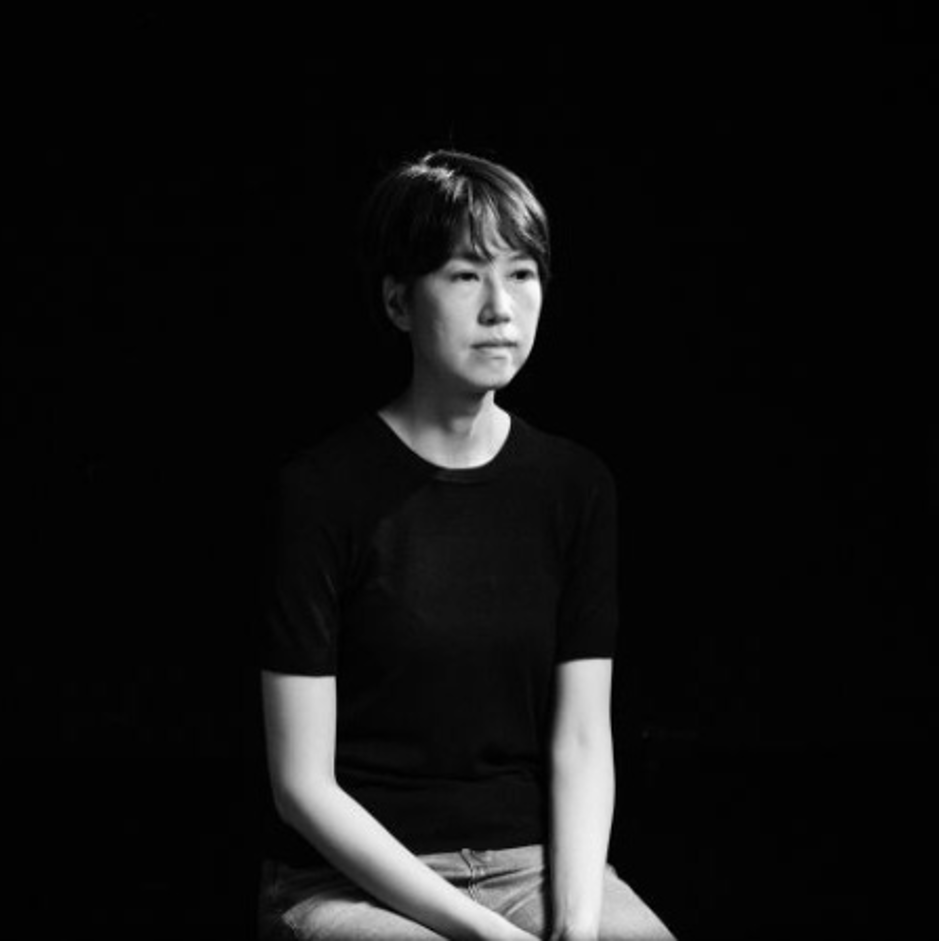
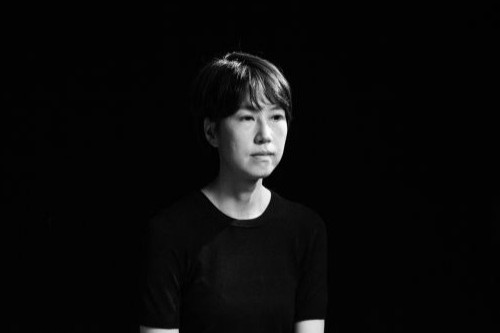
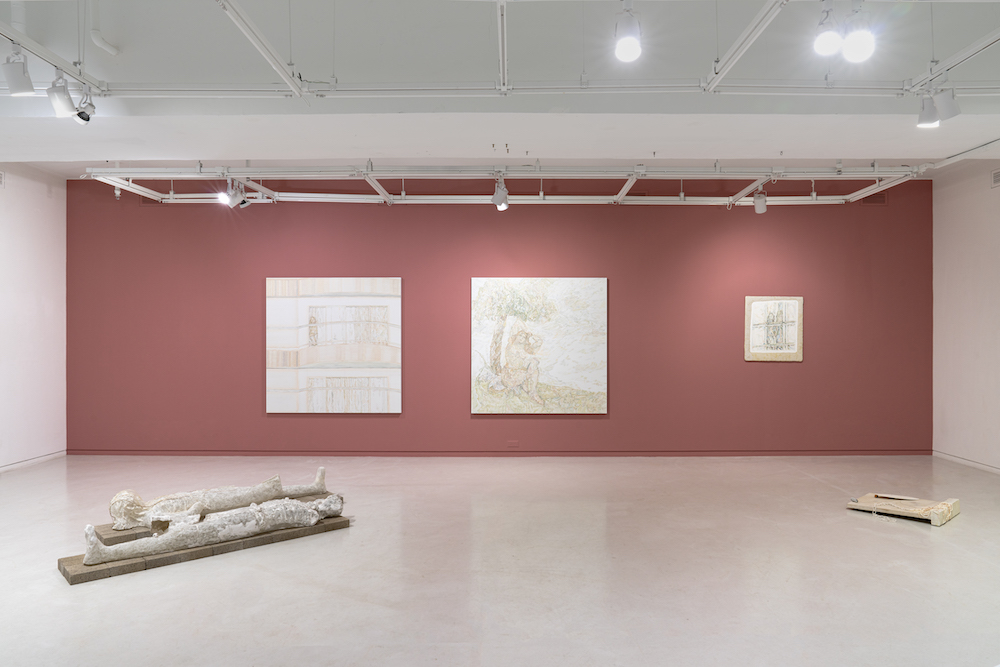
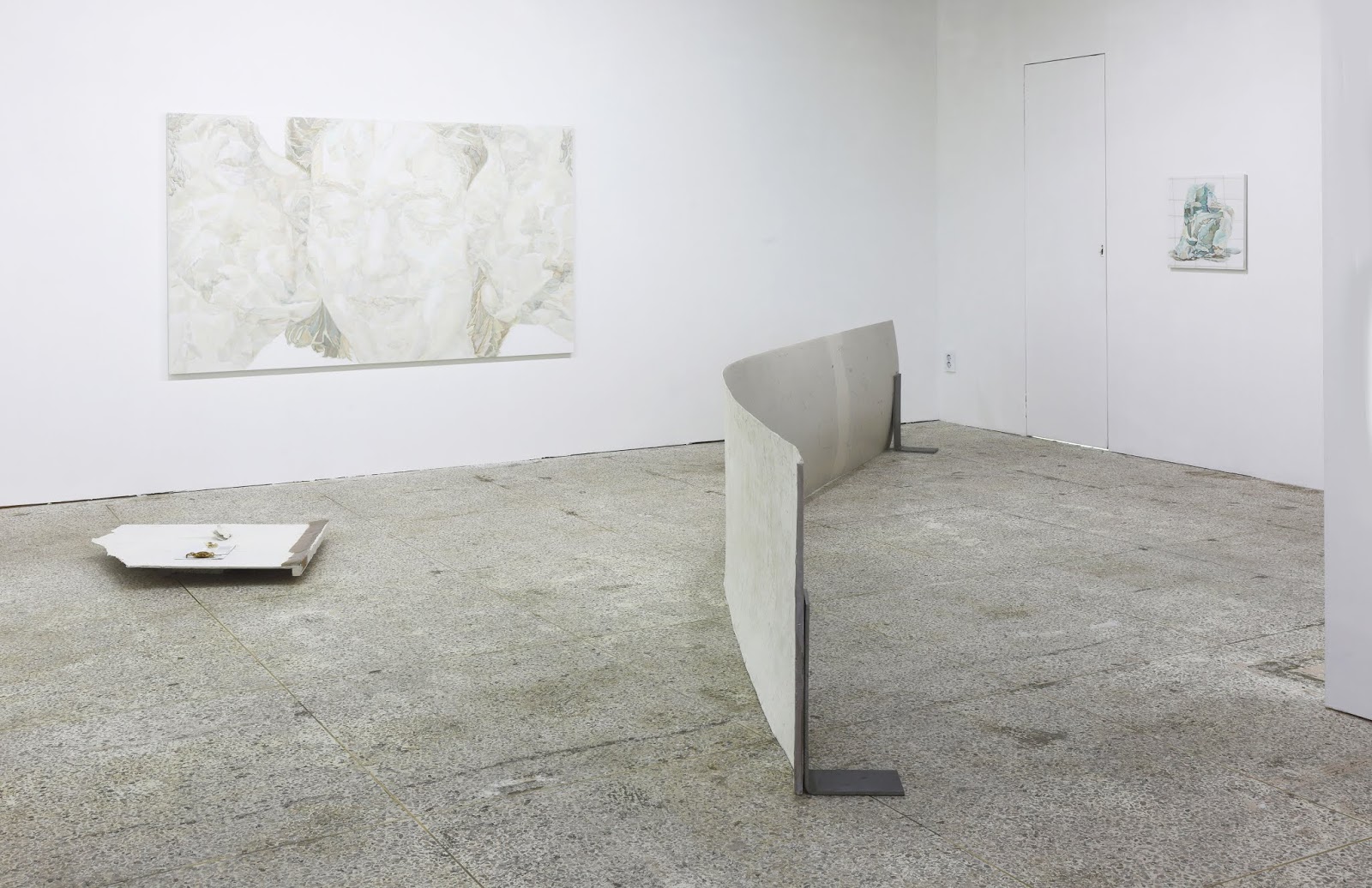
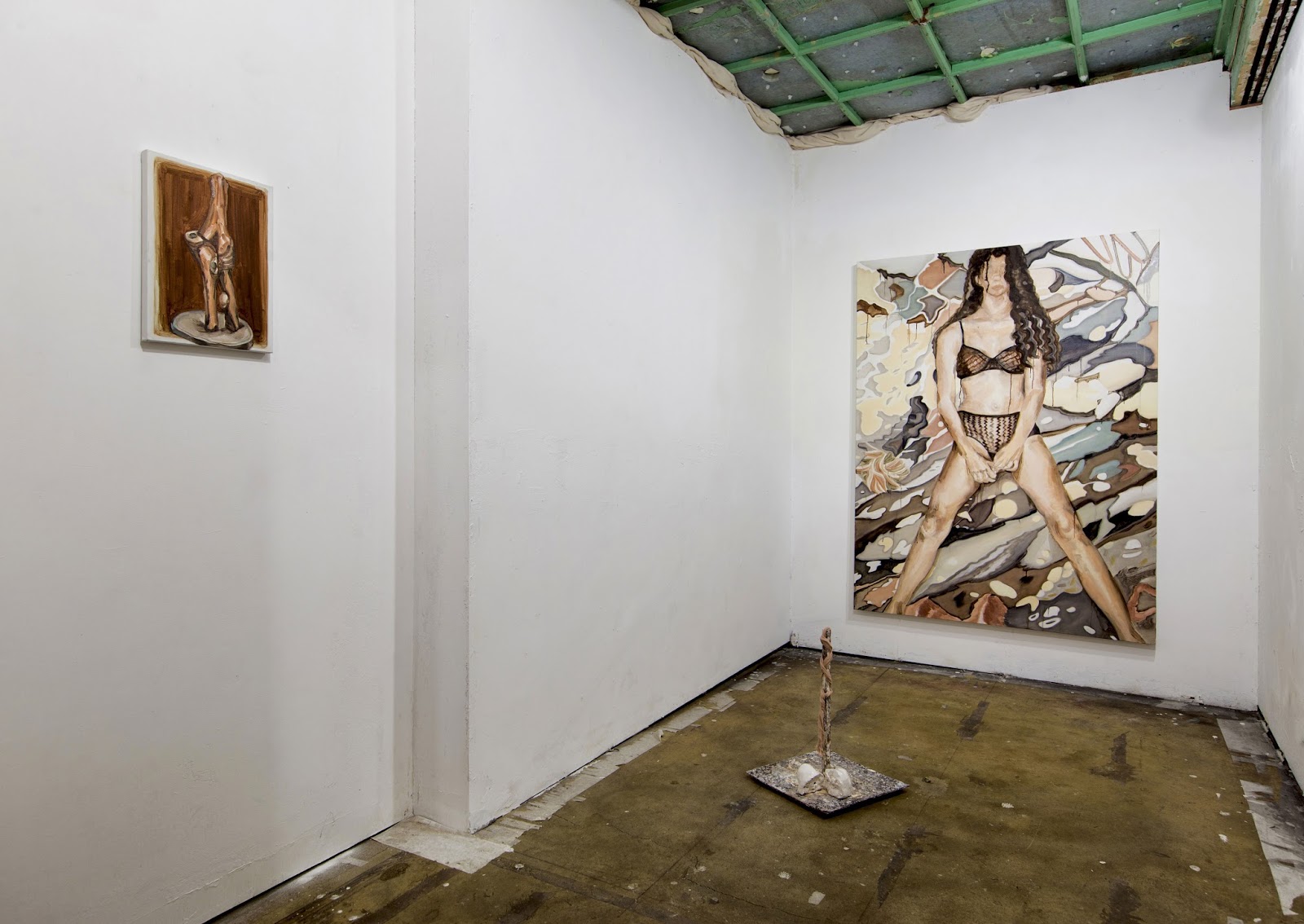
There was something GuNa said when she asked me to write this text. In an earnest and cautious tone, she said that she could finally talk about it: that her work is connected to her experience of illness, which lasted from the fourth grade of elementary school until her early twenties.
She had problems with her bones and had to live wearing a large metal brace that supported her jaw and neck. The curvature of her spine affected her neck and even her heart valve, leading her to undergo major surgery. At one point, she had to remain lying in a single position for more than a month.
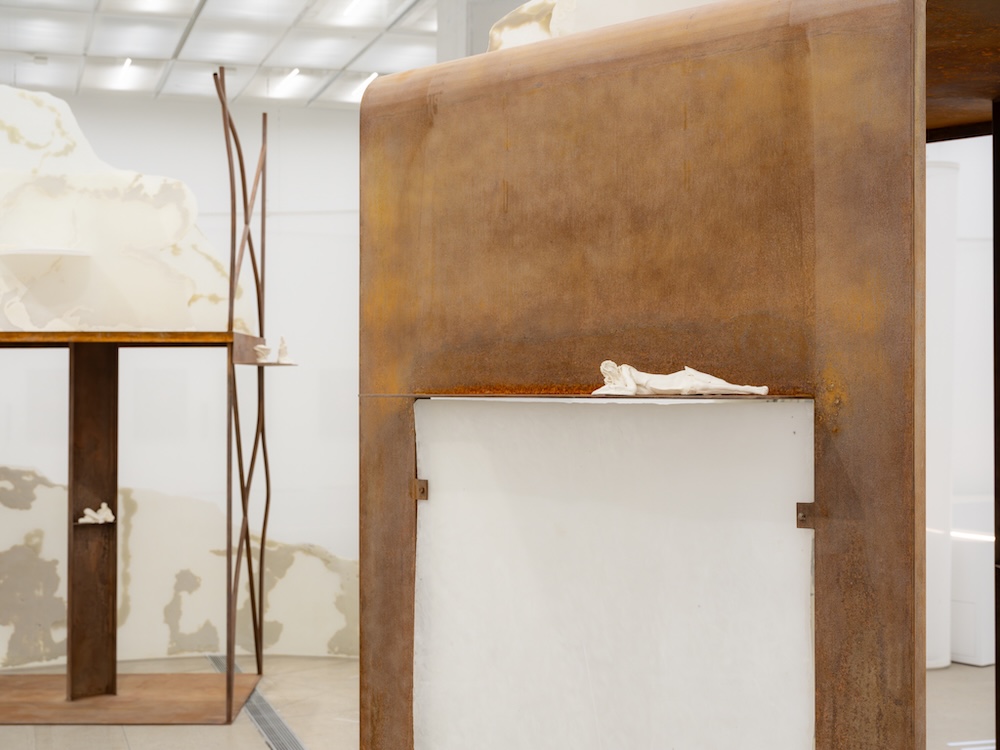
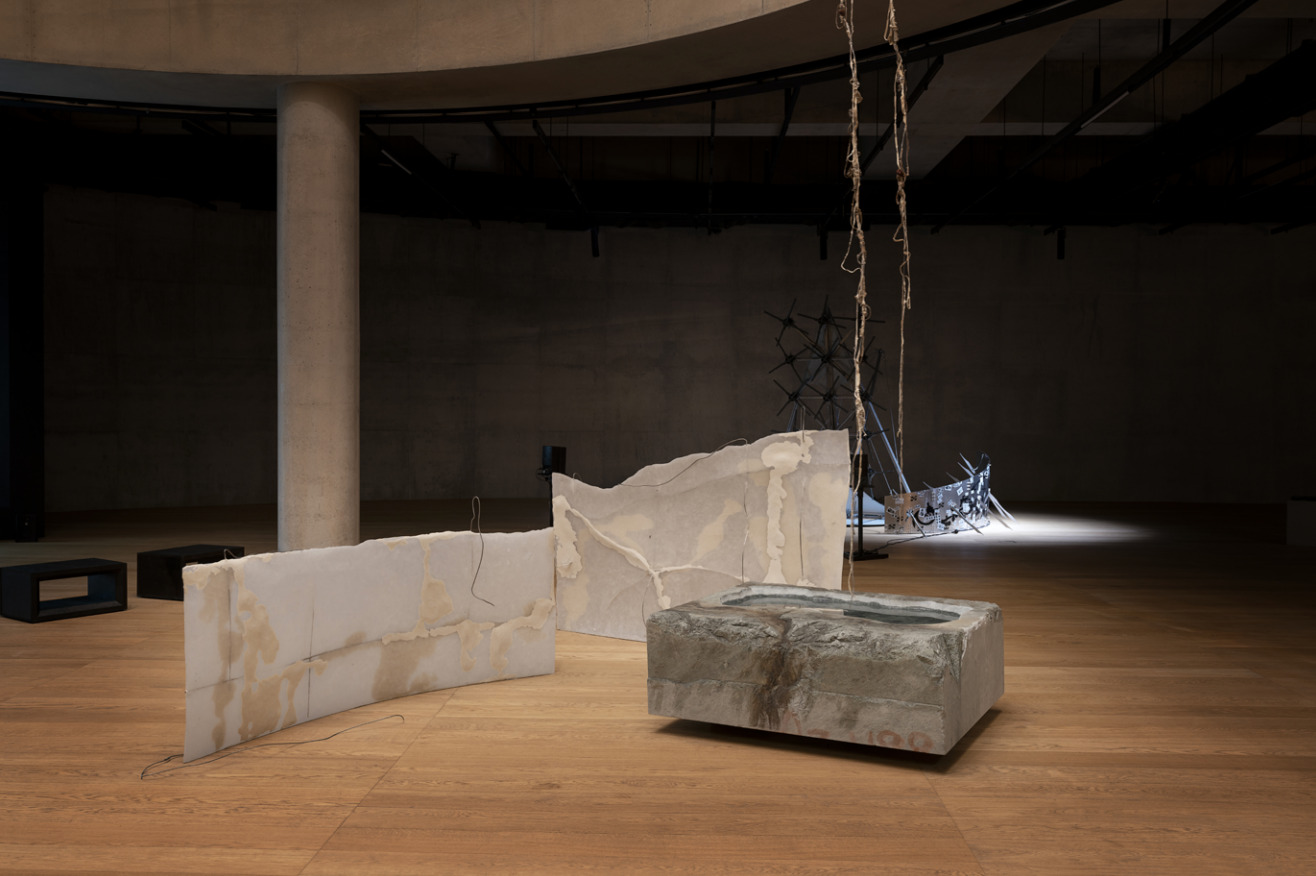
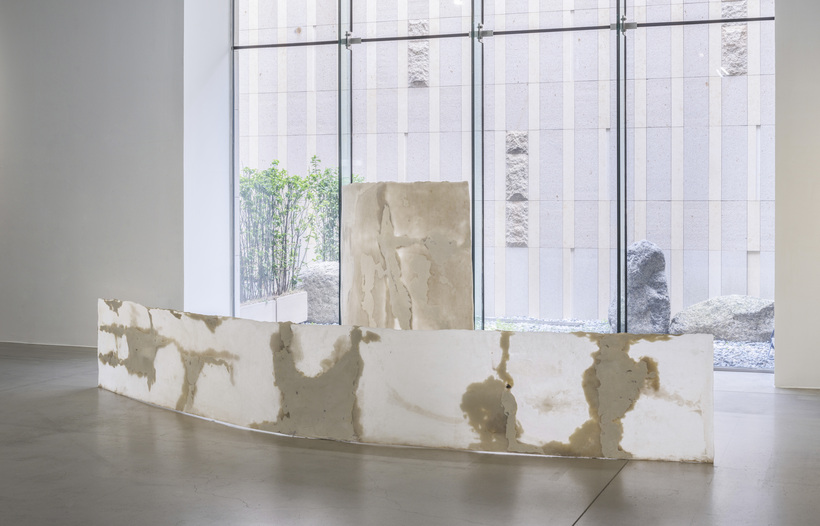
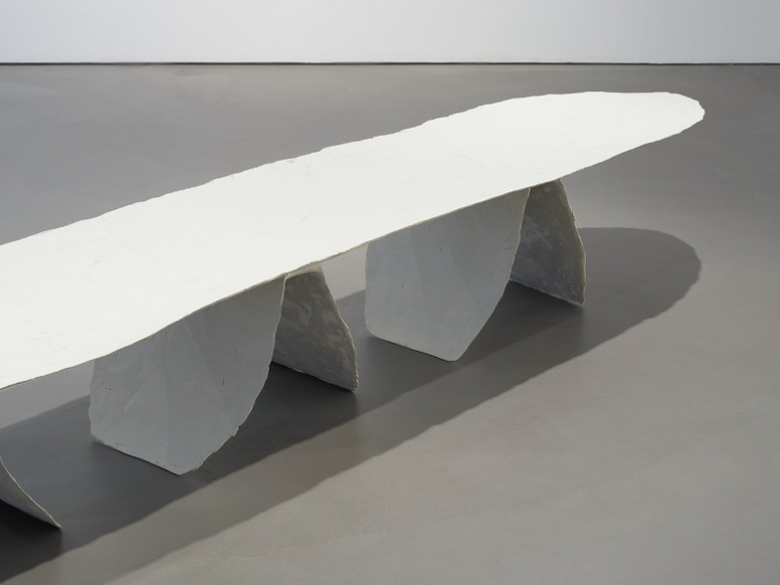
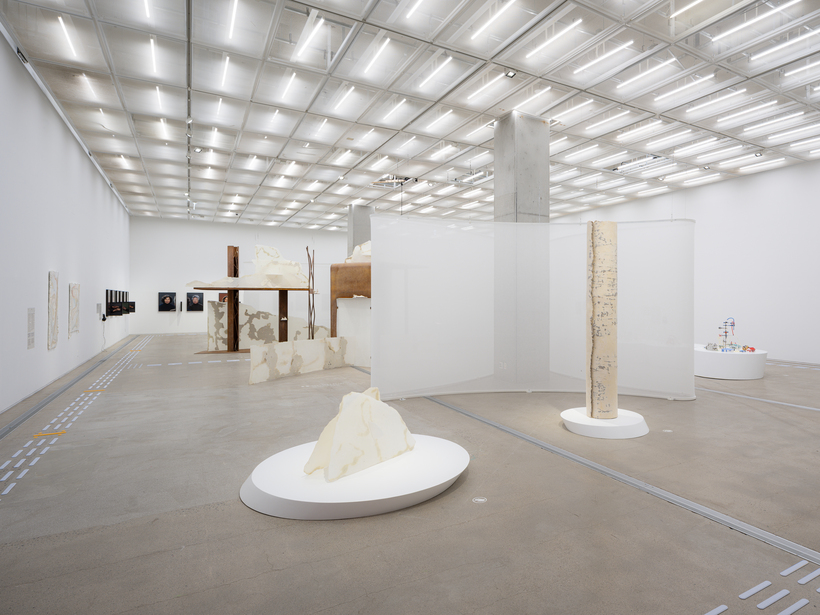
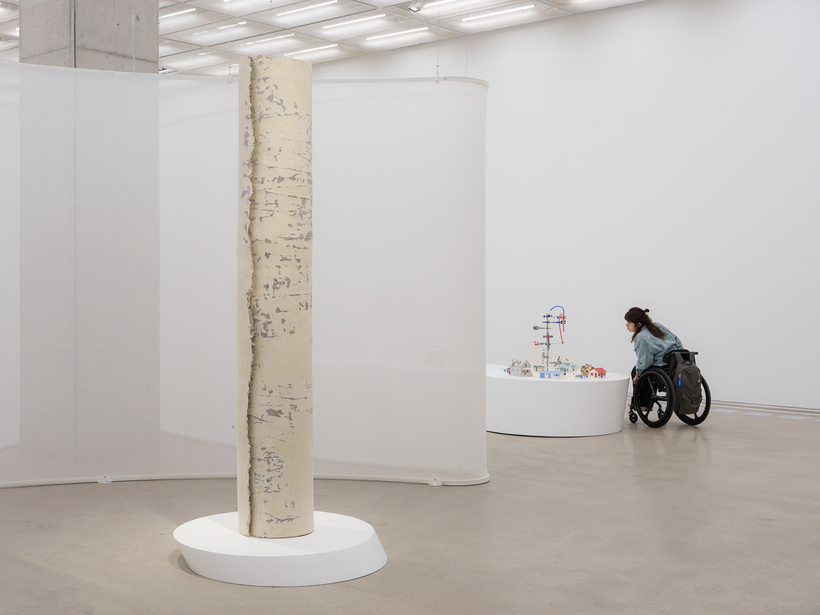
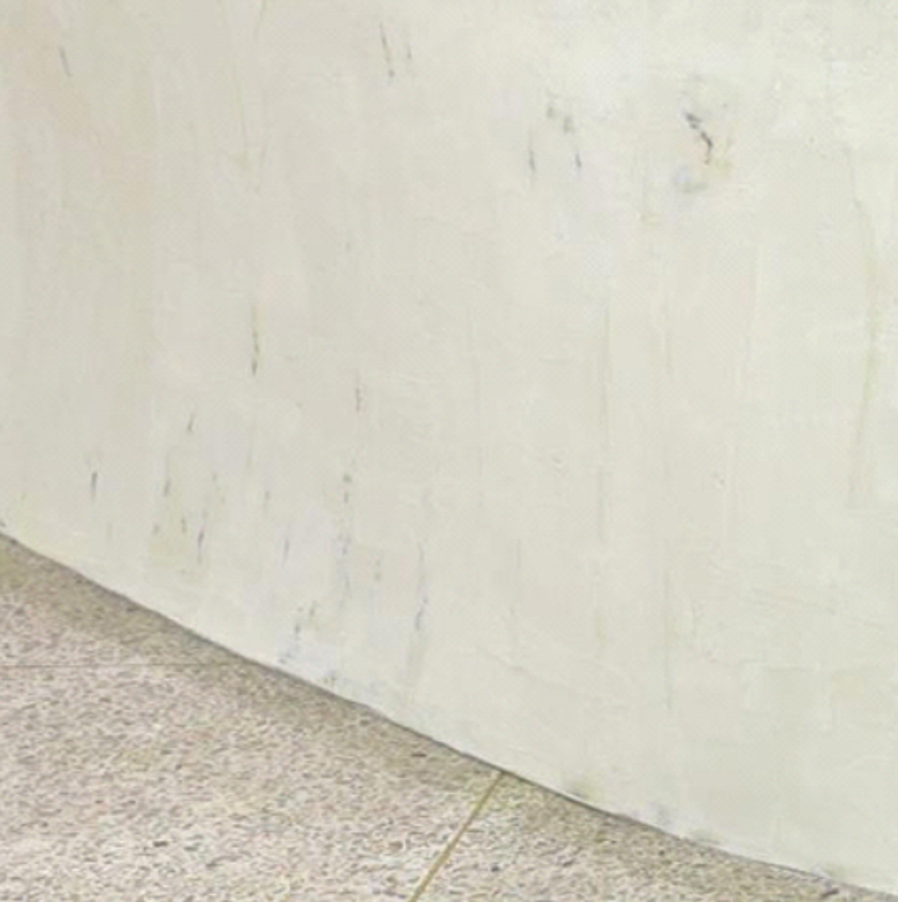
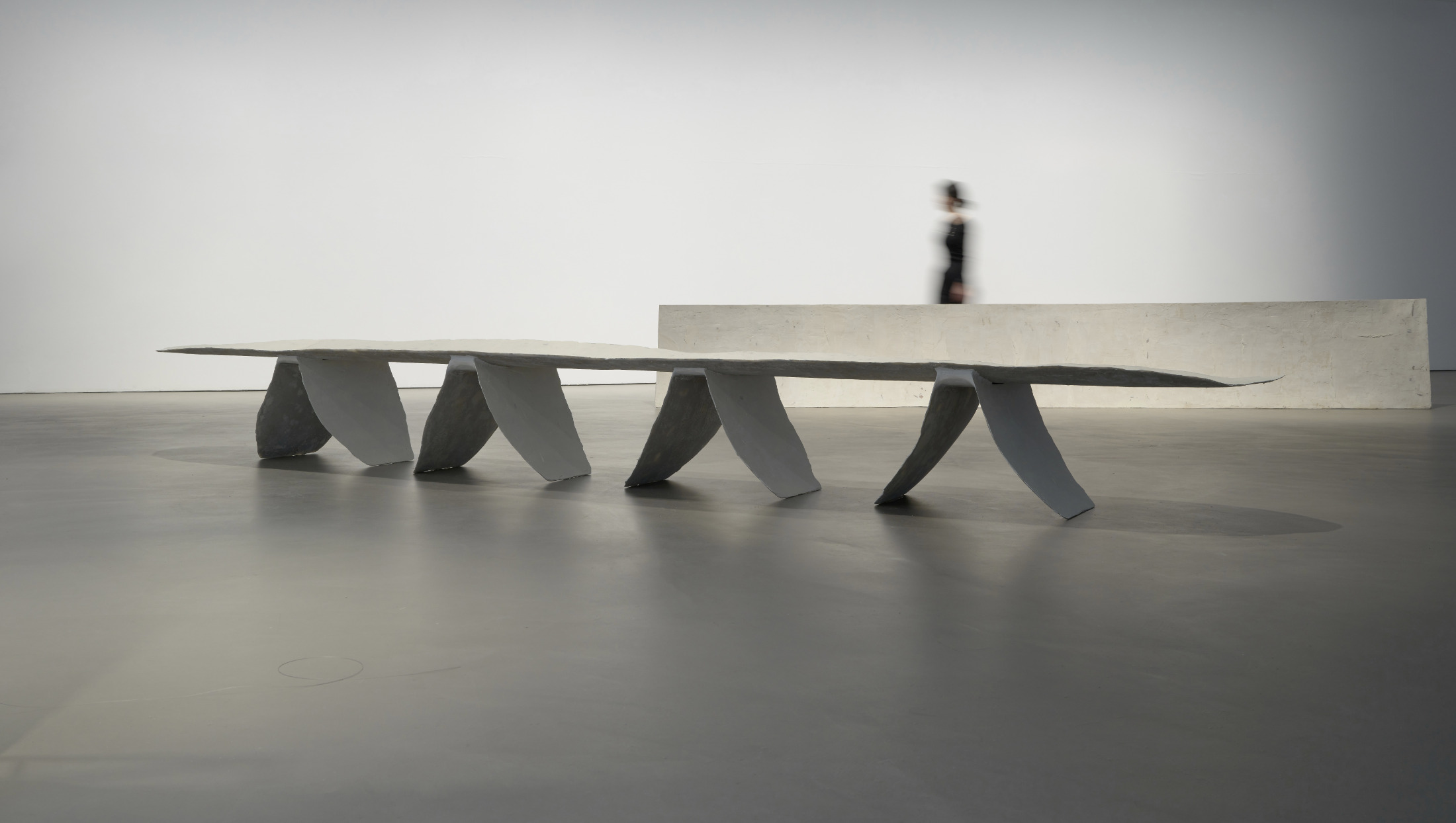
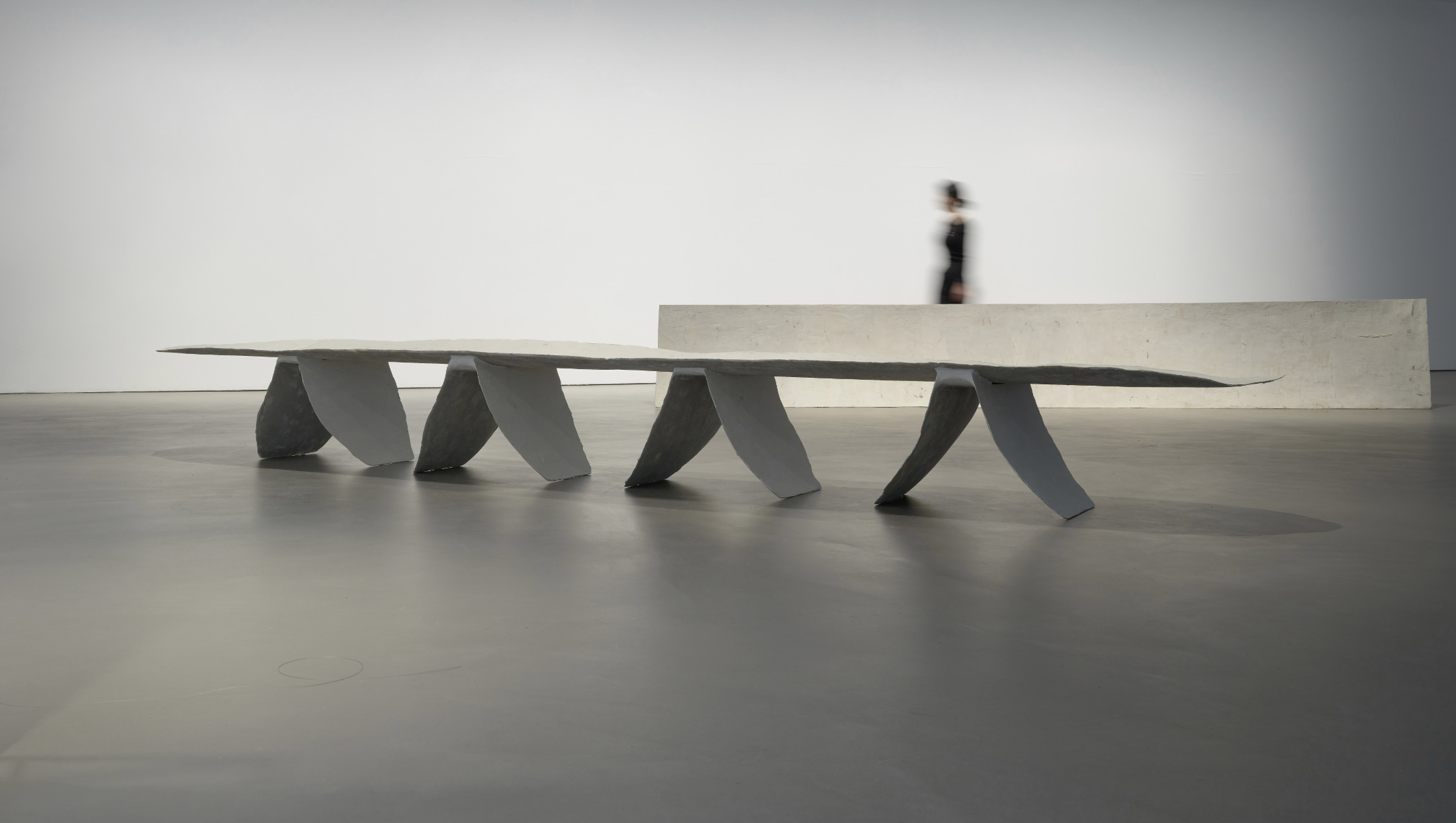
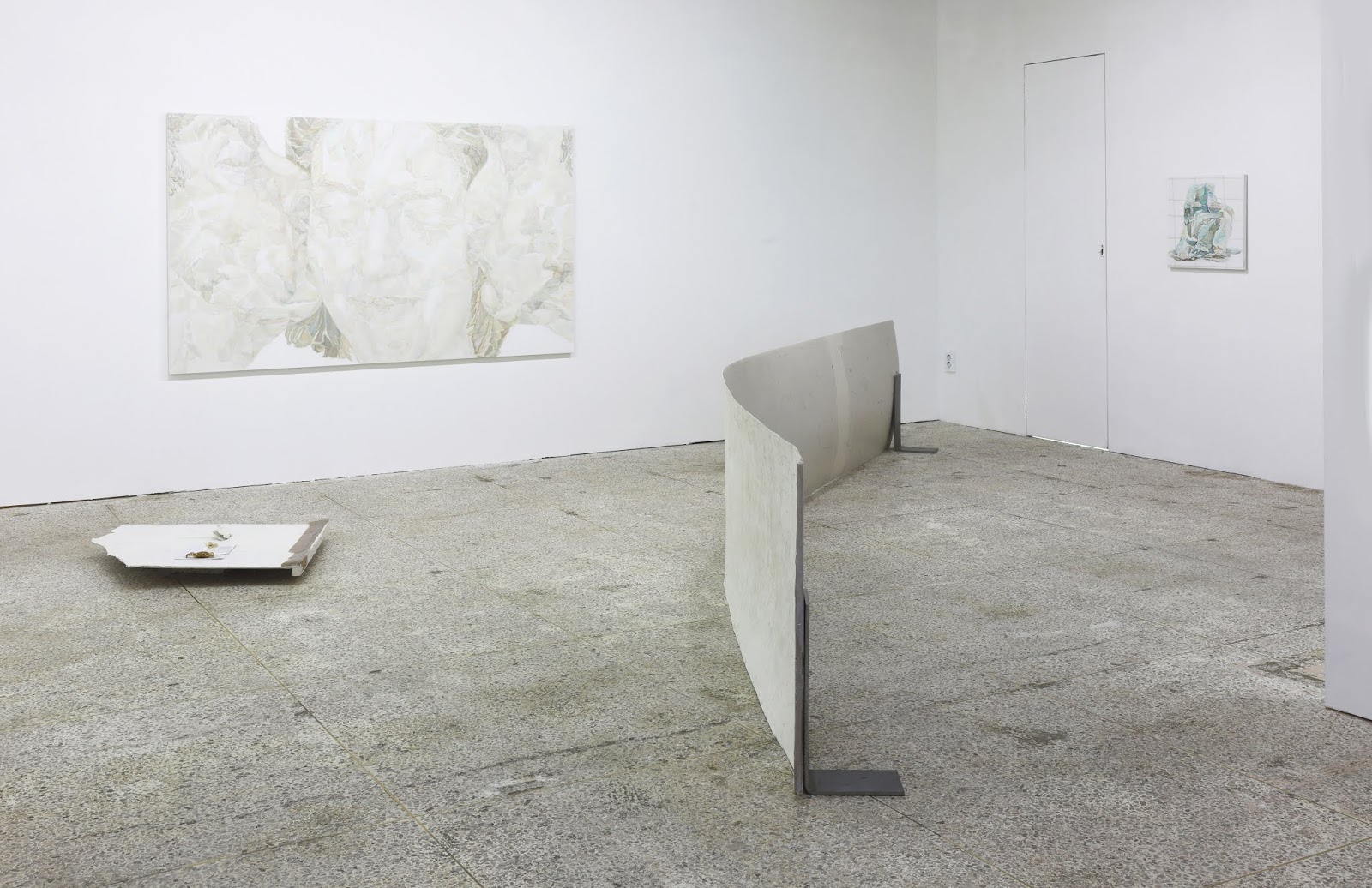
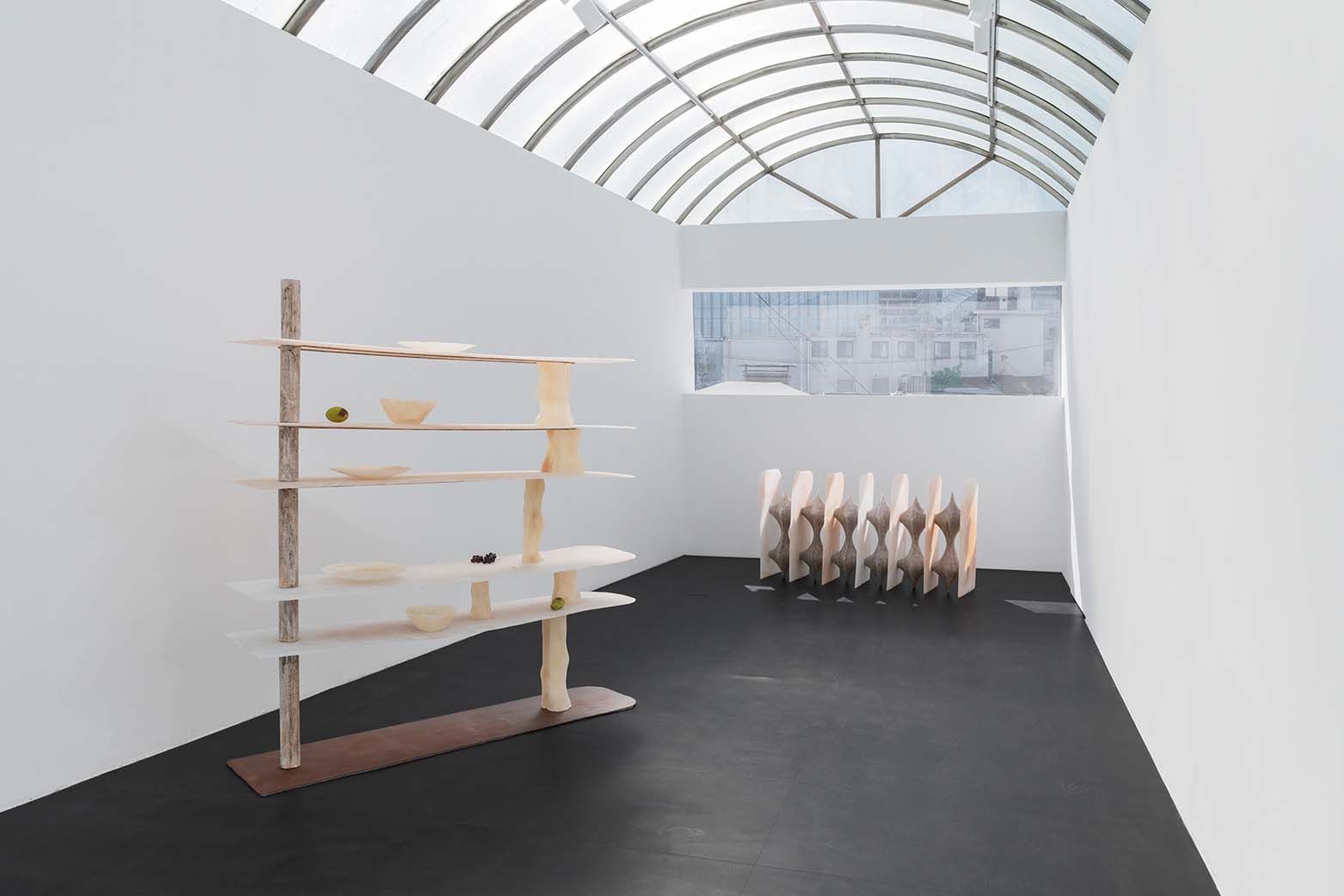
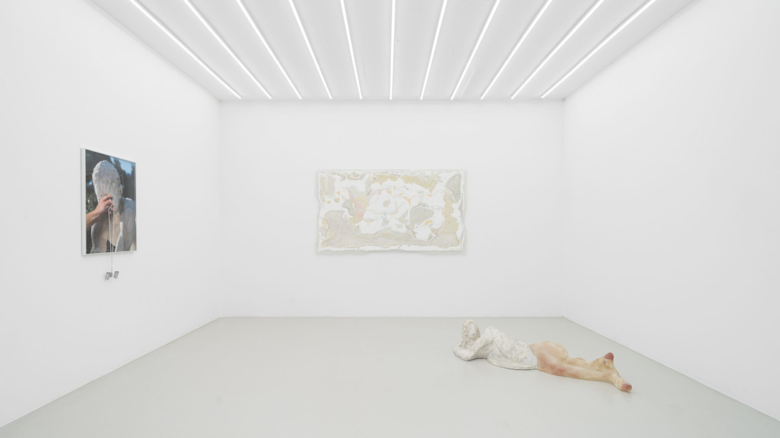
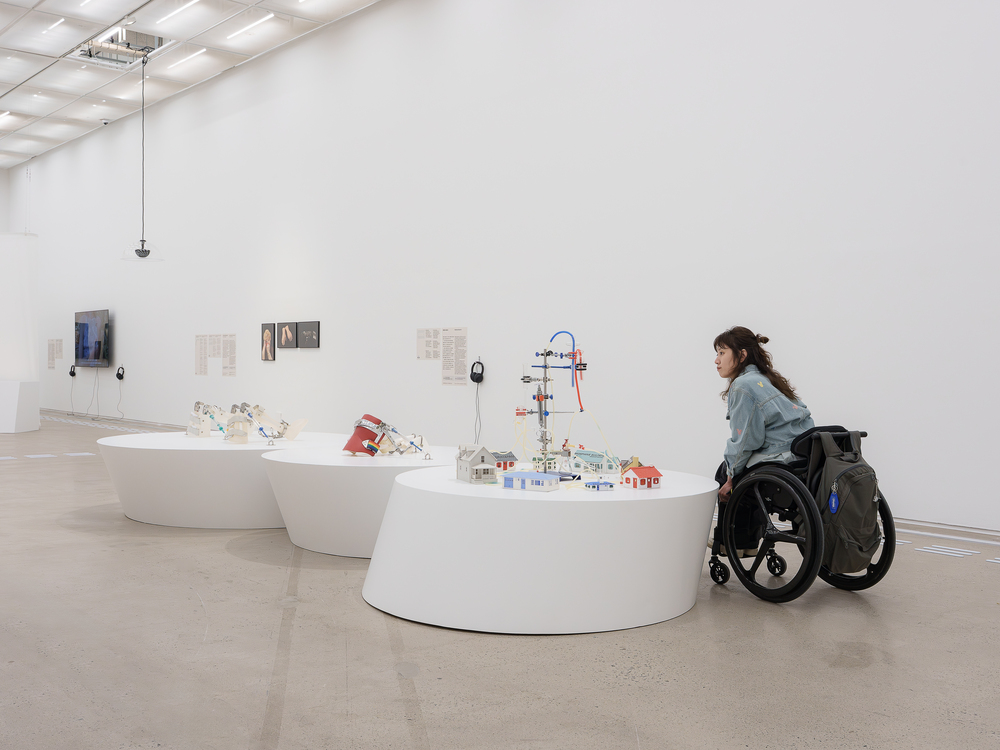
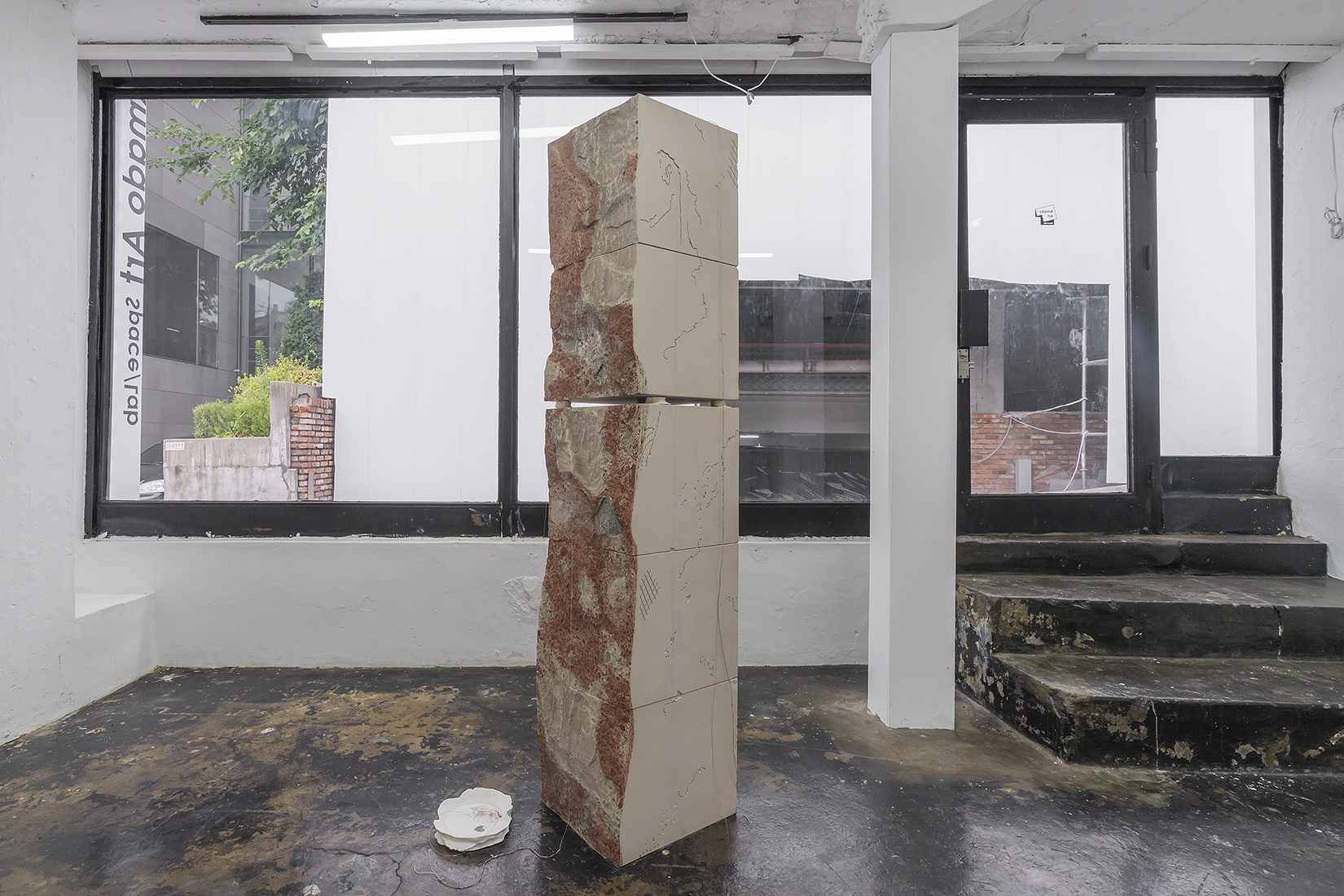
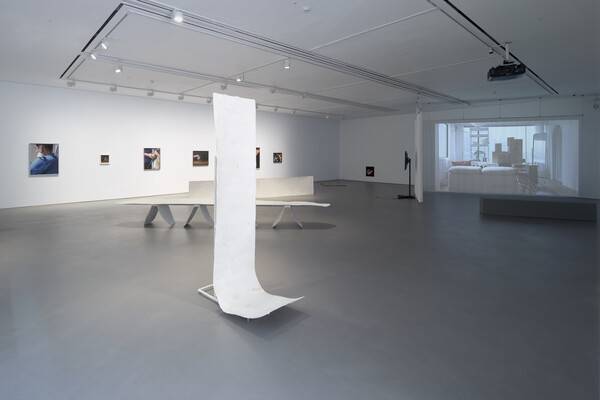
I first encountered the artist’s work in the DOOSAN Gallery group exhibition 《The Sunken Eyes Were Dim》(2023). White bone(2019–2023), which stands on its edge and presents a form lying on its side, and RidgeWaves Over IvoryHills(2023), in which a horizontally reclining plane is carefully supported and lifted by several delicate legs.
These works bend binary understandings of form—horizontal and vertical, singular and multiple, straight and curved—in ways that are concise and quiet, yet at the same time fundamental.
A body lying on its side so that its back does not touch the ground
becomes a ledge that makes us detour from the path on which we walk.
A body raised from the floor with the help of multiple legs
is a cautious will and courage to lift up and reveal what has been buried beneath the ground rather than leaving it there.
These works were about a certain flat body and about twisted bones. The artist speaks calmly about foolishness and dullness, and about her own immature disposition. She says that she now wants to reveal her dullness, her pain, and her foolishness as well. Even if she is dull and foolish, she says, this does not mean that she is without longing or feverish passion.
Faced with this confession of hers, what can I do? I will never be able to know what her illness was like as an experience. What I could do was think about my own small pains, immediately touched by her words.
The pains that each of our bodies experienced in the past, experiences now, and will experience in the future. Scratches, illness, disability, the abnormal, the condemned, tilted and bent bones. Gathering them together, and imagining a certain pile of bones made from that gathering.
1. A Certain Gait: Rheumatism and Lumbar Pain
At around the same age—twelve—when the artist was suffering from a disease of the spine, I too suffered from rheumatism. This autoimmune disease, in which the body’s immune system attacks its own joints, had no known cause, nor was there any definitive treatment at the time. It simply meant discovering, one day, pain inside finger joints that would not bend properly and in the bones of the palm, and feeling inflammation inside the bones of the soles of my feet every time I walked.
The pain, which felt like bruises being cut deep inside whenever I moved, made me shrink into myself. One characteristic of rheumatism is that, much like recovering from a cold, the body can suddenly return to a “normal” state. Living with this illness was closer to becoming aware of a capricious body and being irritated by it.
I have now improved with medication and am looking back on the memory of being in pain, but someday my joints will probably stop functioning properly again and stiffen. My body will age, and it will become increasingly difficult to stand straight and walk forward like a “cool man.” My hair will turn white with gray strands, fall out one by one, and I will become ugly. I will move further and further away from the kind of body that society welcomes: young, radiant, and capable.
Remembering the pain of rheumatism makes me think of the aging body I had tried, if only briefly, to forget; of becoming obsolete; and of the death I will someday face. Just as GuNa seeks to accept dullness and pain, will I be able to accept the body I will have in the future—old, unable to move well, and ugly? In an age of capitalism in which attractiveness and health are sold at the highest price, possessing an ugly body that fails to perform its proper functions is as grave a sin as being poor. Can I forgive an unattractive body? Can I have that kind of courage?
Among the illnesses of the bones, one I still experience is lumbar pain. Nine years ago, I injured my back while attempting to lift too much weight in a deadlift—this, too, was part of my struggle to make a “cool” body—and have lived with chronic pain ever since. Bone pain has made it difficult to stand vertically, and my spine has curved into an S-shape. If I do not keep my abdomen engaged, my stomach protrudes like a tadpole’s and looks strange. Every time, I try to walk normally, upright and straight, but I repeatedly fail.
In “Throwing Like a Girl”(1990), political theorist Iris Marion Young discusses a subject who acts while conscious of an external gaze. In her essay, boys move their bodies physically with efficiency in mind in order to throw a baseball well, whereas girls throw while simultaneously viewing “their own bodies, which cannot throw like boys,” through another external gaze. Here, the posture of throwing departs from efficient and orthodox movement and falls into an awkward disarray.
Woman as a “proxy subject,” an “in-between subject”: someone who throws an object while at the same time becoming an object observed like a thing. The thrown ball departs from the straight line, shoots off in a strange direction, and draws a tilted arc.
Alongside this feminine act of throwing, we might consider the gait of a gay man. A gait unable to walk perfectly straight like a heterosexual (straight) man. Whether it is a problem with the gluteal muscles or with the spine, it is a “gay-like” gait that cannot confidently and naturally move forward. American artist Bruce Nauman made a work about this kind of gay-like—or, in the language of insult, “girlish”—male gait.
Walking in an Exaggerated Manner Around the Perimeter of a Square(1967–68) is a work in which he obsessively repeats the act of walking along the line of a square. The score-command “align both feet along a straight line” renders “normal” walking impossible, and the body collapses into a waddling gait that emphasizes curves.
Drawing on contrapposto, the stable pose and ideal beauty of Greek sculpture, Nauman breaks the pose down, degenerates it, and comically brings it low. As this body, closer to “dirty ground” and a “reified object,” continues to walk, the metaphysical and ideal body is exhausted piece by piece until it disappears. What comes fully into view instead is the body moving compulsively before our eyes according to discipline—a body that is, in itself, pitiful and beautiful.
2. Bone and What Is Not Bone
To understand what bone is, and to find even the slightest clue to the certain kind of bone imagined by GuNa, it seems necessary to feel our way through what bone is not. What are bones for? The nerves passing through them. The flesh and muscles attached to them, the skin that protects the body from the outside, the attractive face shown to other people. A radiant image.
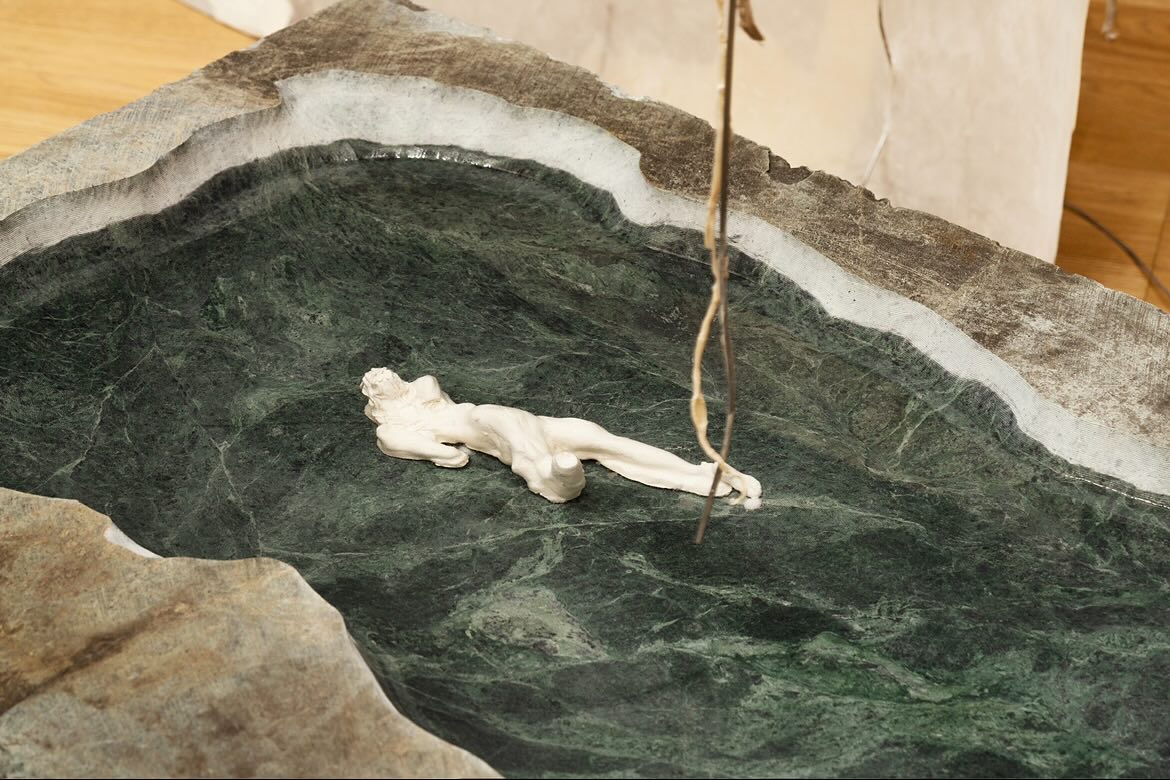
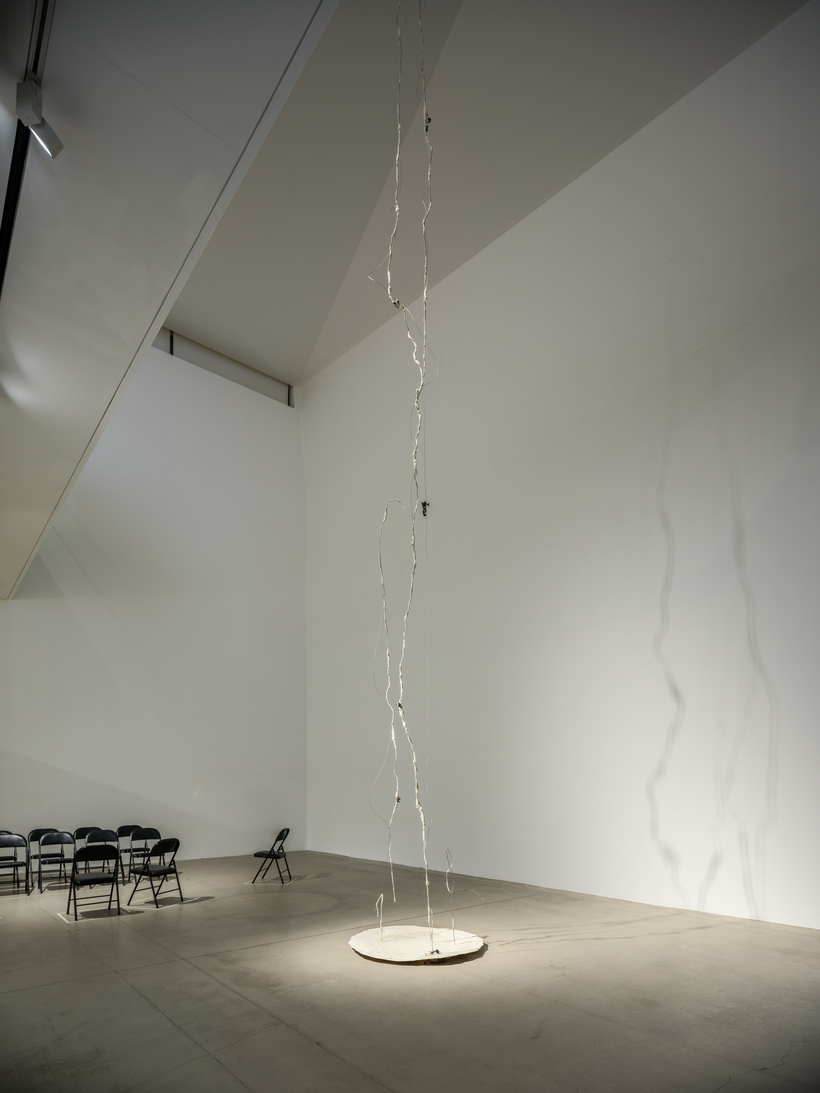
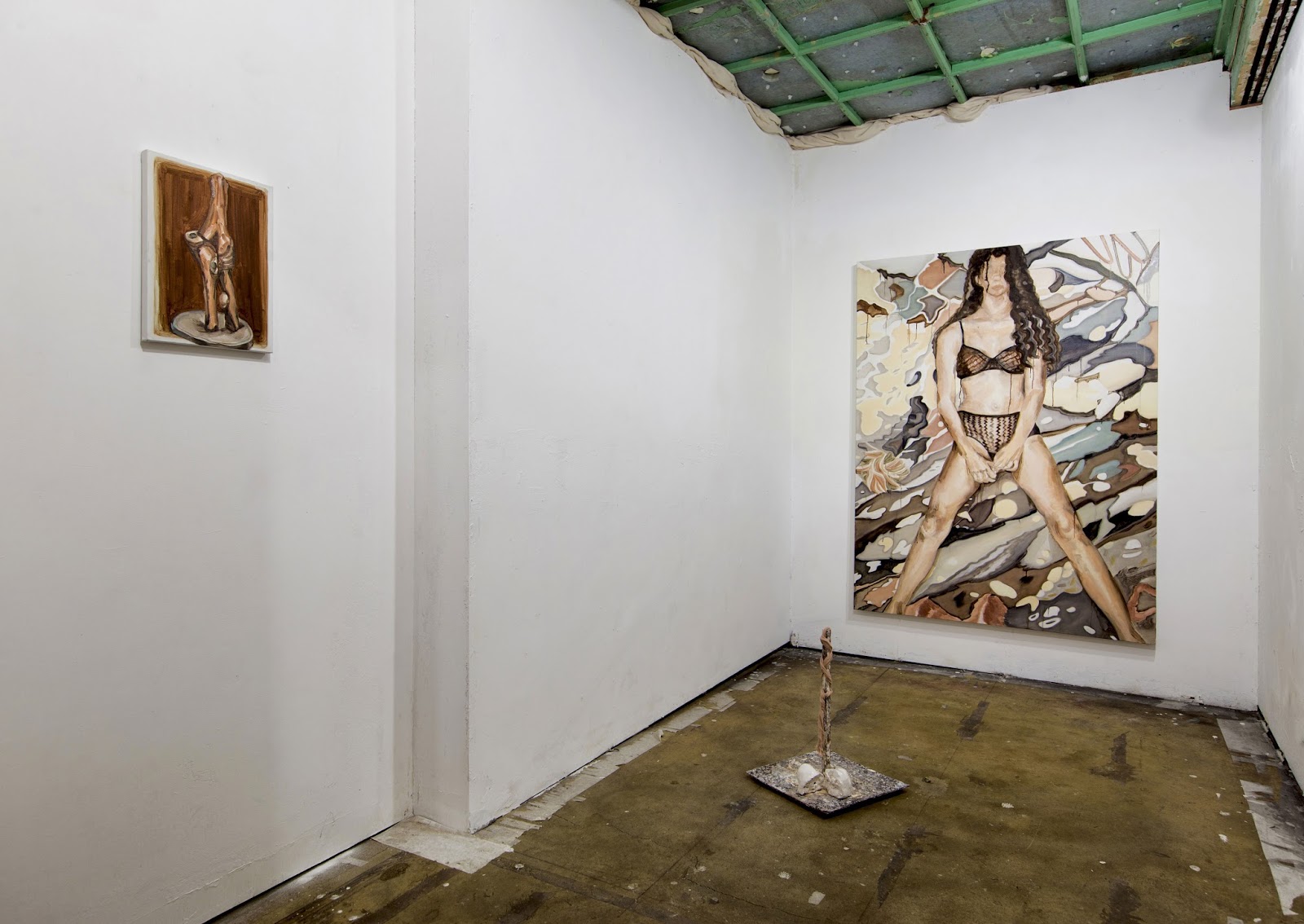
Flesh is the product of life. Countless cells teeming in a single piece of flesh, signals and hormones, movements of matter. When life goes out, the flesh sinks close to the skeleton. It sinks further and further, rots, and crumbles away. GuNa brings similarly dead, dried, and fleshless things into her work: bare grape stems left after the fruit has rotted away, dried leaves reduced to skeletons, mummies, shades of calcium. Stagnant, rotting water. She looks at these things not in the darkness of night, but in the daytime under dim, dusky light.
The image of bone exposed after all flesh has disappeared differs from the image of the face. It is what remains after retreating from the social and withdrawing far away. Something that survives long periods of weathering. Debris that remains after contemplating death and even after death itself has arrived. A hard residue.
There is resolutely no room there for conventional social images. Nor would this be a matter of presenting skin. The artist distances herself from the potential condition in which flesh meets flesh and erotic contact becomes possible. We touch only hard bones from which all life has vanished. We see, recall, retrace. Remember.
3. The Armature and What Lies Outside It: Bone as a Vanitas Object
If we understand the origin of art as beginning with a desire to remember what has disappeared, sculpture may be related to the desire to place before our eyes, as matter possessing volume, the human body that cannot last forever. Pygmalion loved an object, a certain sculpture, made by subtracting something from the living body of reality.
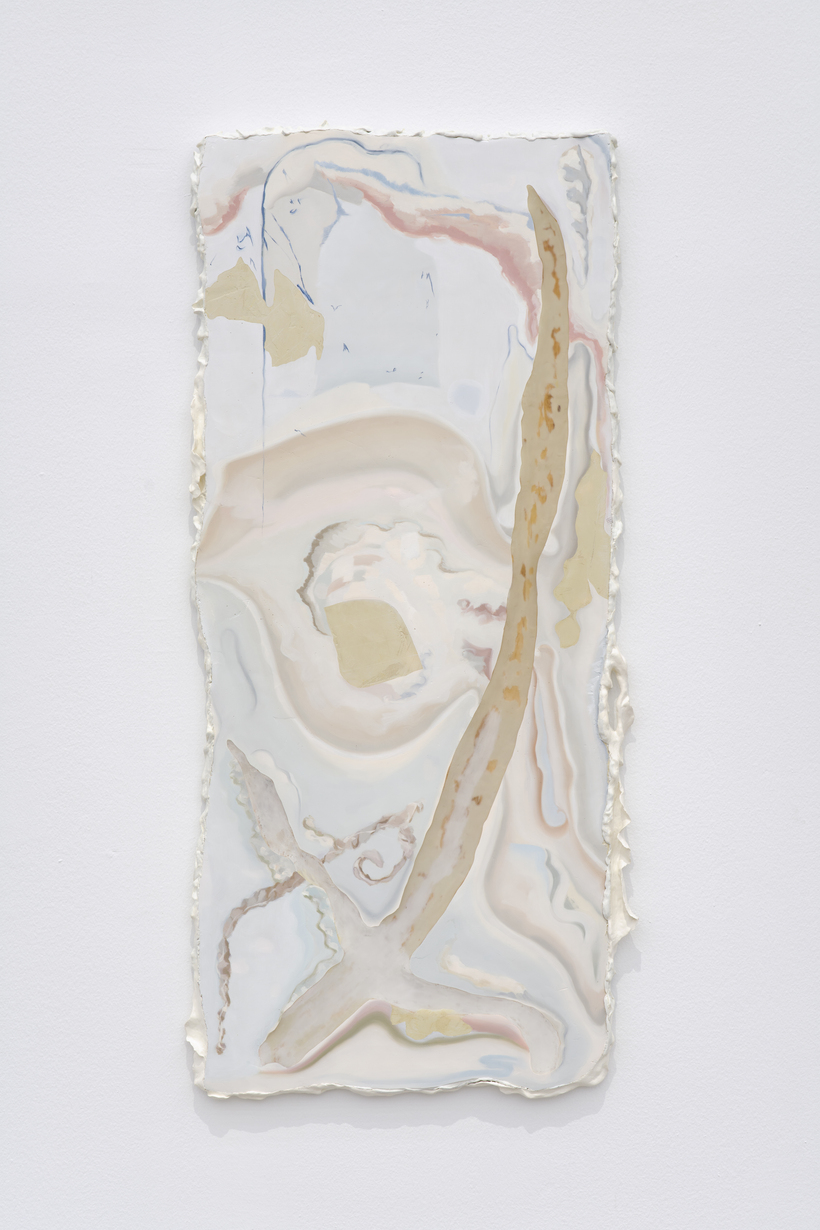
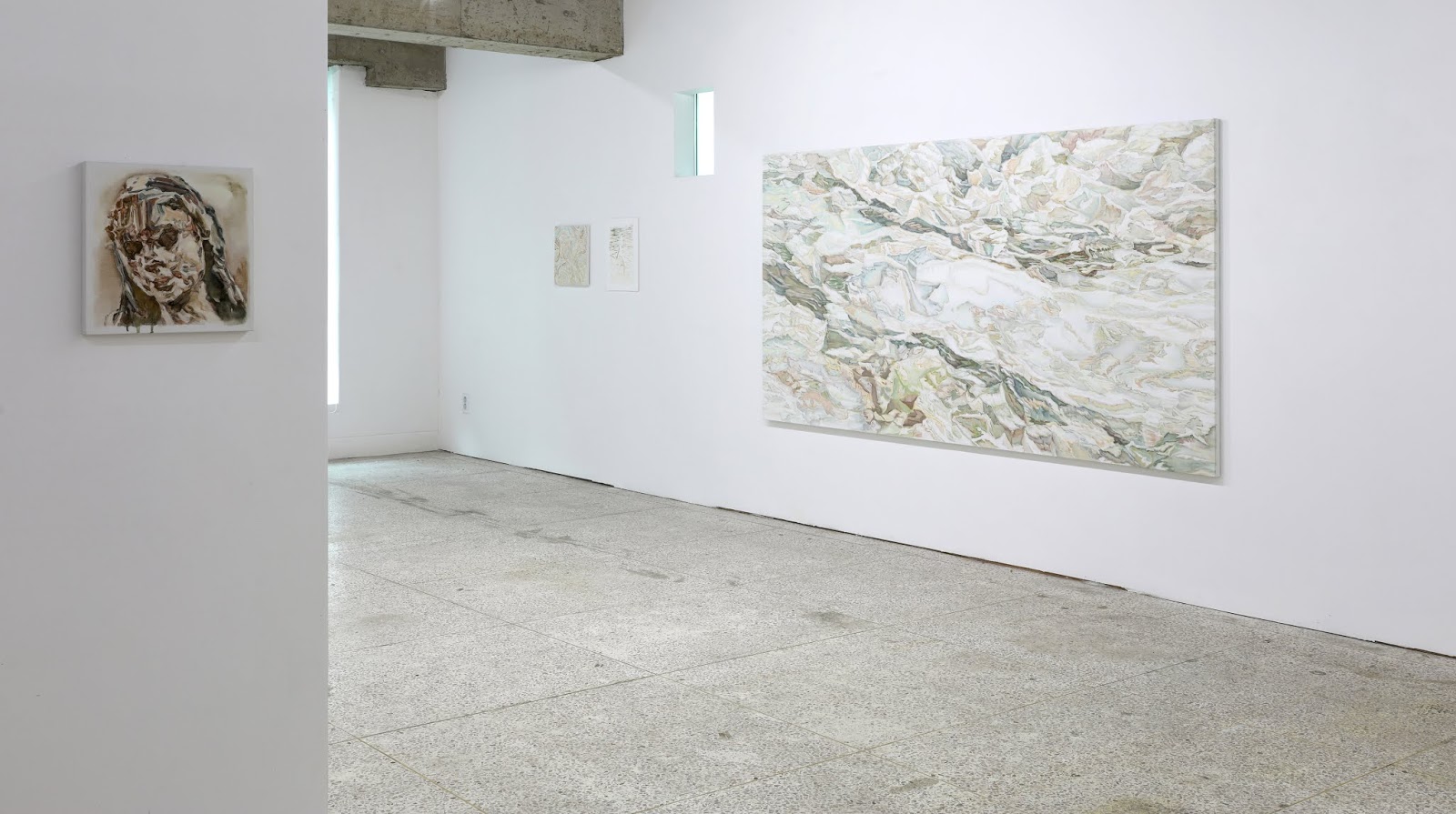
If we consider the analogous relationship between sculpture and the human body, human bones correspond to the armature of sculpture. The artist’s works either include bone itself in their titles—White bone, IvorySureAreRiverBackbone—or use pale beige tones resembling the color of human remains in both sculpture and painting. Where is this method and attitude directed, in which bone is revealed not merely as a structural element but as the total outcome of the work?
In traditional sculpture, the armature is not visible. It is a structure designed to withstand gravity and plays an extremely important role in materially realizing something, yet it remains concealed from the front. Such sculpture exhibits a form of structural conservatism in that it does not reveal the actual entities that perform the event, instead foregrounding a metaphysical image. For this reason, beginning in the early twentieth century, sculptors began to question the structure known as the armature.
Anthony Caro (b. 1924), also famous for eliminating the pedestal from sculpture, was a figure who abolished the distinctions between the armature, malleable materials such as clay attached to it, and the final image revealed externally, creating sculpture as an integrated whole. Sculptors of the period questioned the necessity of the armature itself and explored a variety of differentiated paths.
Henry Moore (b. 1898) explored ways for sculpture to stand on its own through organic forms, while David Smith (b. 1906) used welding techniques to explore methods through which the structure itself became the form. This was a movement toward structurally eliminating the armature of sculpture—the bones of the human body, the “core” that bears weight—and, at a more fundamental level, toward moving away both from forms analogous to human beings and from systems of form that could be made by the human subject.
Among the experimental works of these Minimalist sculptors is one whose form resembles GuNa’s tilted bone sculpture: Richard Serra’s Tilted Arc(1981). Commissioned by the United States government in 1981, this public sculpture was installed in front of Federal Plaza in Manhattan, New York. It measured 36 meters in length and more than 3.6 meters in height, and after meeting fierce opposition from citizens who used the plaza, it was ultimately removed in 1985.
There were many reasons for the intensity of the public opposition. It inefficiently blocked people from crossing the plaza; it occupied so much space that other activities could not take place there; it was heavy and appeared dangerous, as though it might collapse at any moment; and so on. Above all, the public seems not to have considered the sculpture “beautiful.”
Despite the visual similarities between Richard Serra’s Tilted Arc(1981) and GuNa’s White bone(2019–2023), the two sculptures differ as greatly as the roughly forty-year gap between them. Serra’s enormous sculpture, weighing 73 tons, appeared in the public plaza boldly and threateningly. GuNa, by contrast, uses transparent FRP, a material rarely employed for sculpture because of its lightness and vulnerability to deformation, and places the work before the viewer at a more intimate scale.
At 71 centimeters high, White bone occupies an ambiguous size—neither as large as a structure nor as small as an object, the kind of scale Robert Morris described as one that responds to the body. Most importantly, GuNa’s sculpture moves in precisely the opposite direction from the previously mentioned Minimalist sculptors’ “movement toward eliminating the armature.”
Her sculpture differs from the trajectory of contemporary sculpture in the 1990s, which sought to eliminate the armature and escape the analogy between sculpture and the human body that extends from bone to flesh to skin. Rather, it recalls the form of Vanitas, a genre of seventeenth-century Dutch still-life painting that presented the “emptiness of the body” through bones.
Vanitas is a genre of still life containing symbolic objects that remind viewers of the inevitable mortality of human beings and the worthlessness of material or worldly pleasures. Its name derives from the biblical verse in Ecclesiastes: “Vanity of vanities, saith the Preacher, vanity of vanities, all is vanity.”
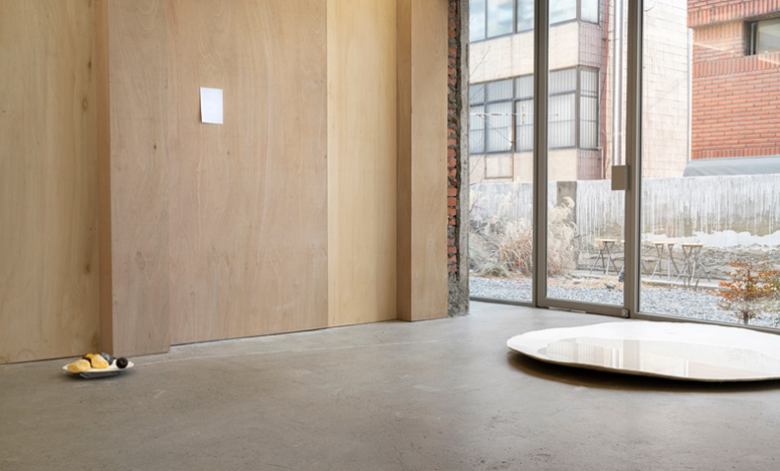
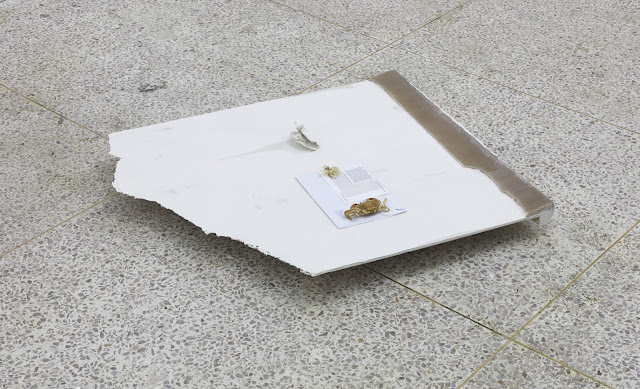
Objects frequently appearing as motifs in Vanitas—skulls, withering fruit or flowers, mayflies, bubbles—reappear through a particular vocabulary in GuNa’s sculpture and painting. Hair, oysters, dead plants, pills, and dried seeds. The artist newly draws Vanitas elements out of contemporary everyday objects.
Unlike the direction of Minimalism, which sought to move beyond the human figure, White bone presents an object that casts the shadow of the dissolution and death of the human body. It is the form of a particular bone remaining after all flesh has faded away.
What can we see before the bone presented by the artist? Some flesh and body that once filled it before disappearing? Or, as in the Vanitas paintings of the past, the realization that all life is vain? A small, tilted desire and courage to place before the viewer something weak and inefficient that dies and fades away?
“The Phenomenology of Rheumatology: Disability, Merleau-Ponty, and the Error of Maximum Grip,” Gayle Salamon, 2012, translated by Jeon Hyeeun
1)
GuNa’s transparent bone work, without a single even surface, made me think of bones that are abnormal, bent, and inflamed. I encountered this essay, translated by researcher Jeon Hyeeun, whose interests concern the agency of ill, queer, and disabled people, while I was thinking about painful bones. The essay begins by quoting Mary Felstiner’s memoir Out of Joint: A Private and Public Story of Arthritis(2007).
It tells of pressing an inflamed shoulder with a painful finger in order to show a doctor where it hurts. It is a confession that there is simply no way to explain in words the complex condition in which the act of touching in order to describe a painful place itself causes pain in the finger performing that act.
Likewise, I press GuNa’s painful body with my own painful finger. I try to point to the inflamed areas revealed in her sculpture. But this cannot be explained from a single position of writing. So I decided that I should end this essay with a quotation. Pressing one painful finger with another painful finger. I would like to conclude in the hope that some kind of sting, some fissure of meaning, might emerge between text and text, joint and joint.
2)
Mary Felstiner describes her morning routine in her memoir Out of Joint: A Private and Public Story of Arthritis. Each day, she begins by systematically and carefully moving her body, part by part. Her book begins as follows. “When I wake up in the morning I start by taking inventory of my joints. On the stairs I check my ankles, and at the kitchen counter I loosen my fingers, hoping and trying to peel an orange or open a jar before giving up.
Today they are too stiff”(Felstiner 2007). Felstiner describes the effects rheumatoid arthritis has had on her body, particularly the devastating consequence of losing her grip as the strength of her hands weakens day by day… It is an embodiment characterized by a kind of deprivation.
It is embodiment characterized by the loss of the privilege of proprioception enjoyed—or simply taken for granted—by those who are not ill or frail, and by the loss of the ability to project oneself reflexively and without thought into plans or into the world. … Hers seems to be a body whose relation to the world is characterized more by limits than by possibilities.[1]
In the waiting room of rheumatology I search my purse for paper, pull out a grocery receipt, and scribble something deeply private. I had never thought of such a thing before. It is an offering, an ode.
Stay with me
elbows
do not be afraid
in my body,
for my baby
I came this way,
a blessing
hard to sustain
without a bribe.
Elbows
hold on. (Felstiner 2007, 10)[2]
Healing through history calls for experiment. It has to do with binding together the pieces I have selected from my past, in the same way that joints connect bone to bone… [History] can heal. History can heal by placing the life you live within a broader span of time. History can establish that you are neither alone nor to blame.
History can bend the arc of your condition until someday you wake up and, although your body is the same, the place in which you awaken is somewhere new (Felstiner 2007, 202) … “Although your body is the same, the place in which you awaken is somewhere new”…
The fact that such an achievement takes place through a bent arc suggests that beyond the straight and certain confidence of maximum grip, there are other paths toward livable possibilities, other ways of binding oneself to the world. Such other paths toward livable possibilities, such curved paths, offer possibilities for sharing communion and consolation with others.[3]
[1] Female Theory, No. 49, pp. 135–138, Gayle Salamon, “The Phenomenology of Rheumatology: Disability, Merleau-Ponty, and the Error of Maximum Grip,” 2012, translated by Jeon Hyeeun
[2] Ibid., pp. 151–152
[3] Ibid., p. 153