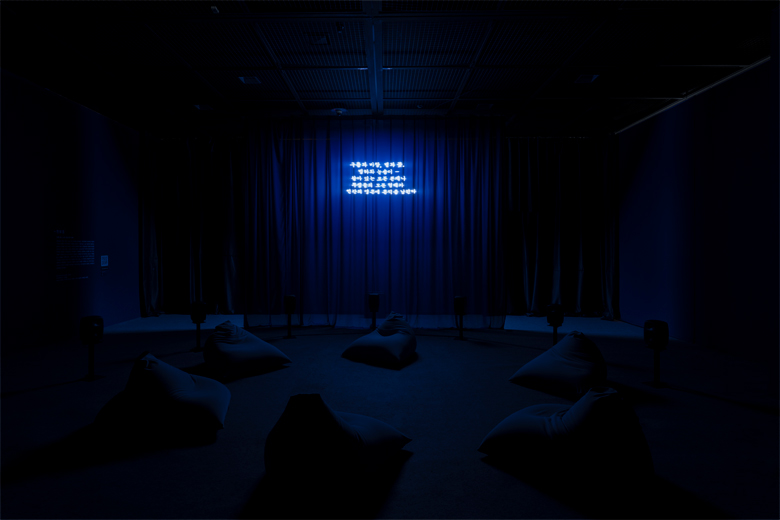
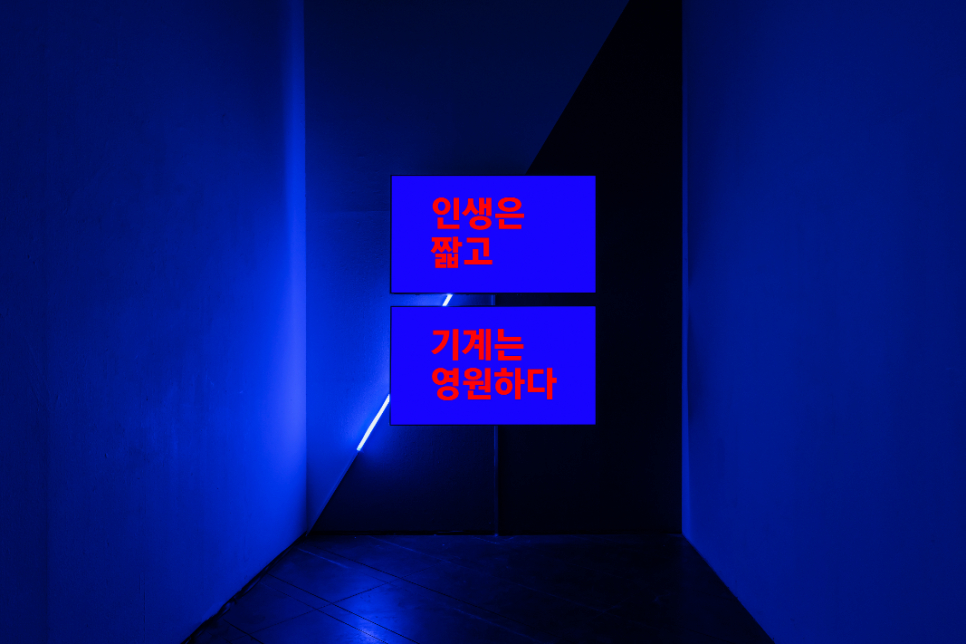
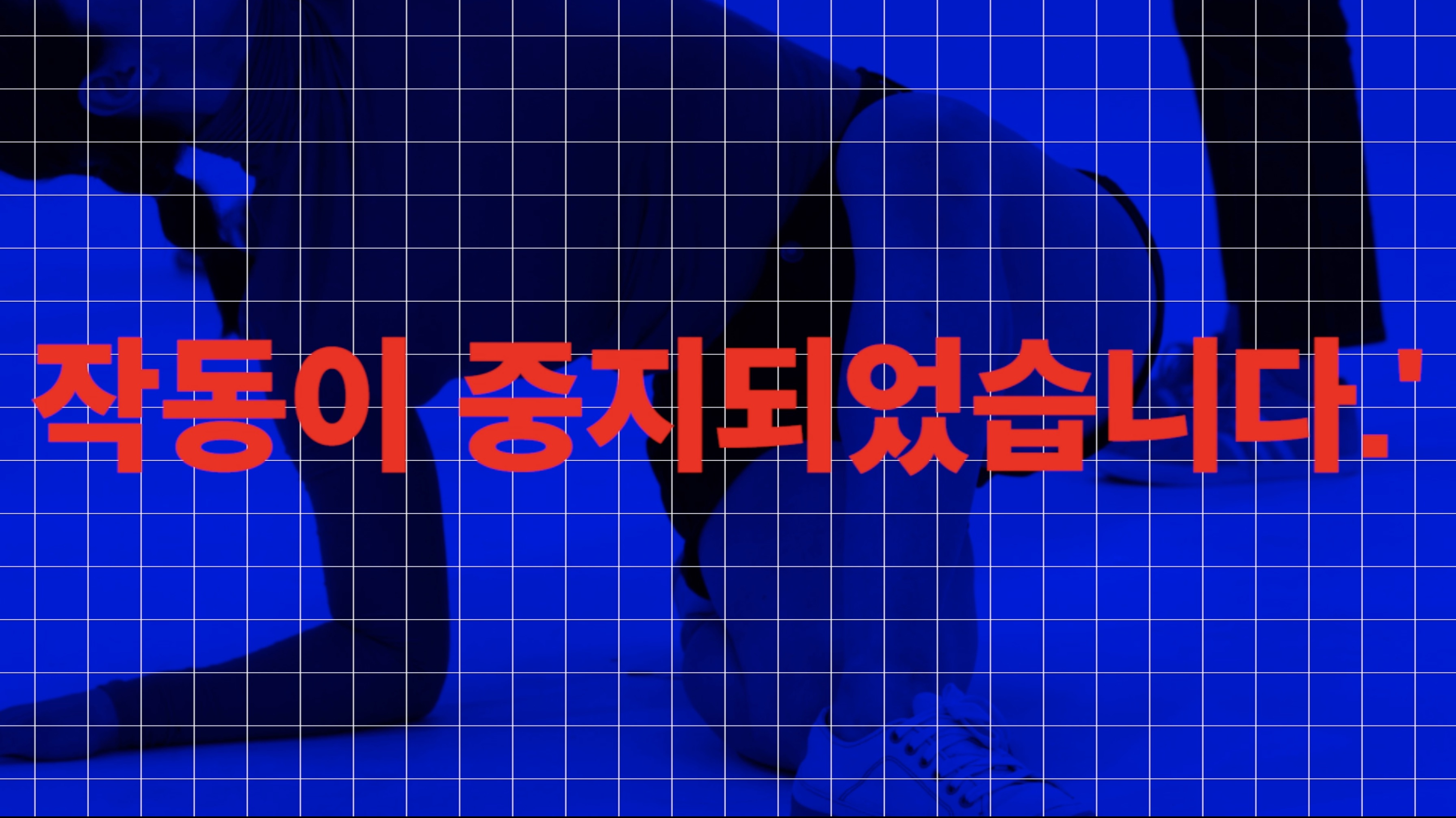
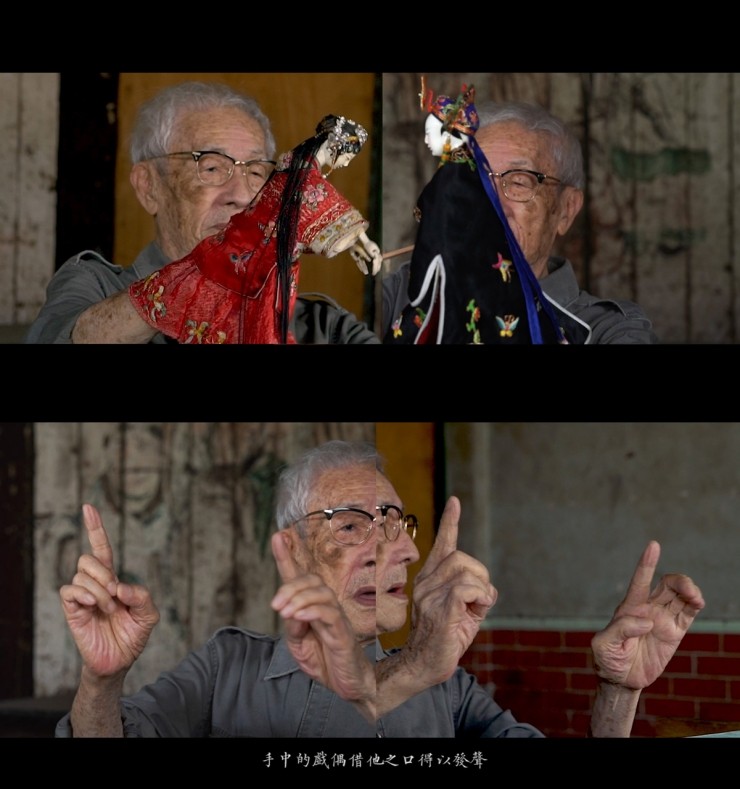
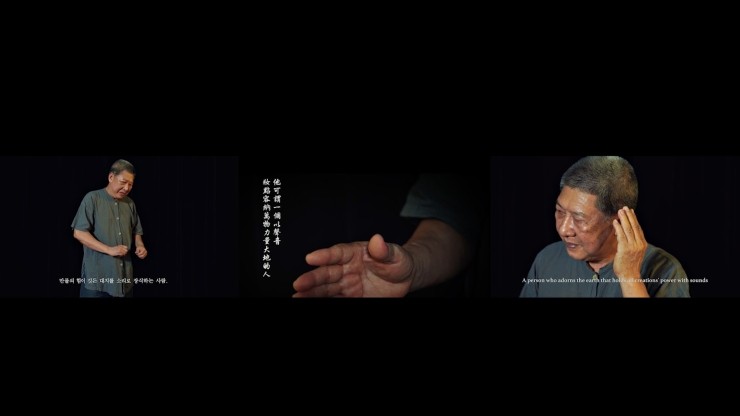
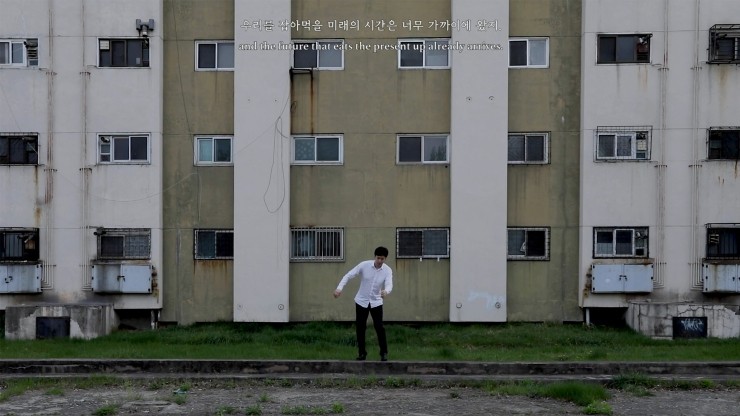
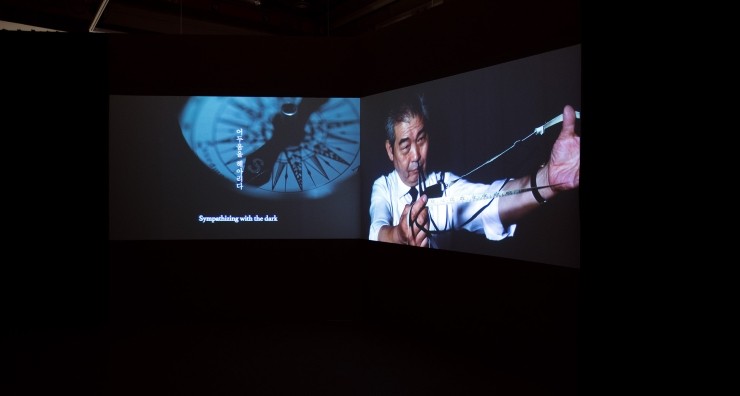
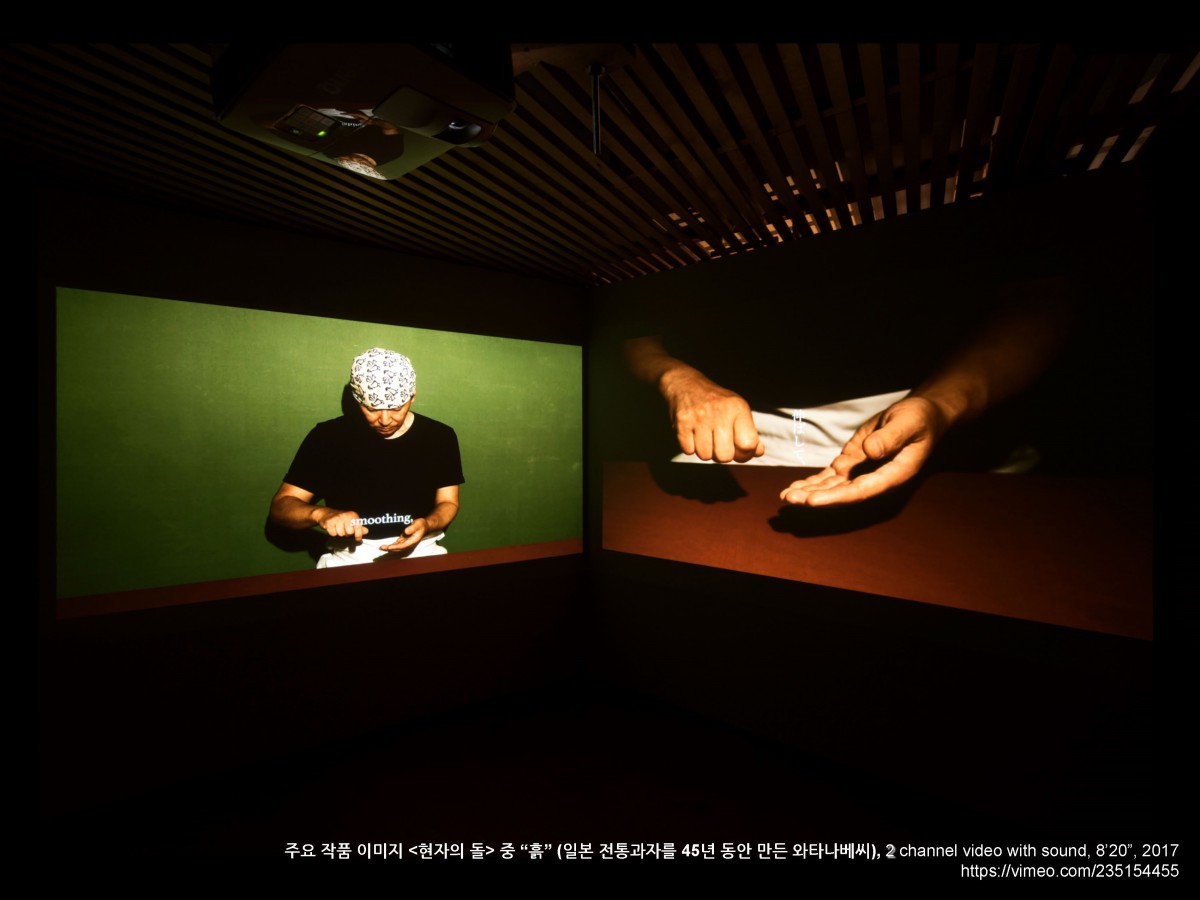
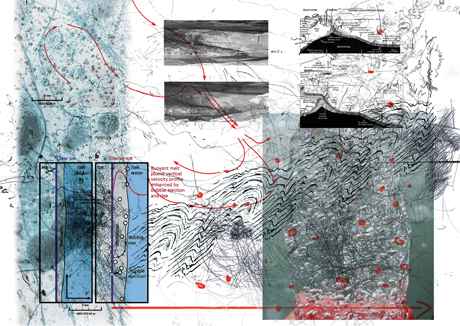
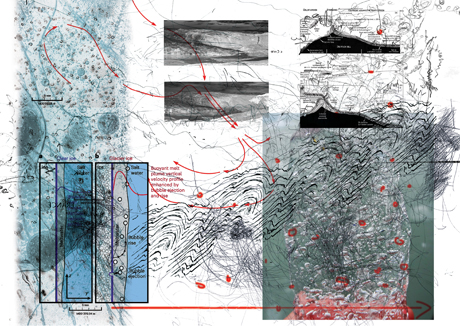
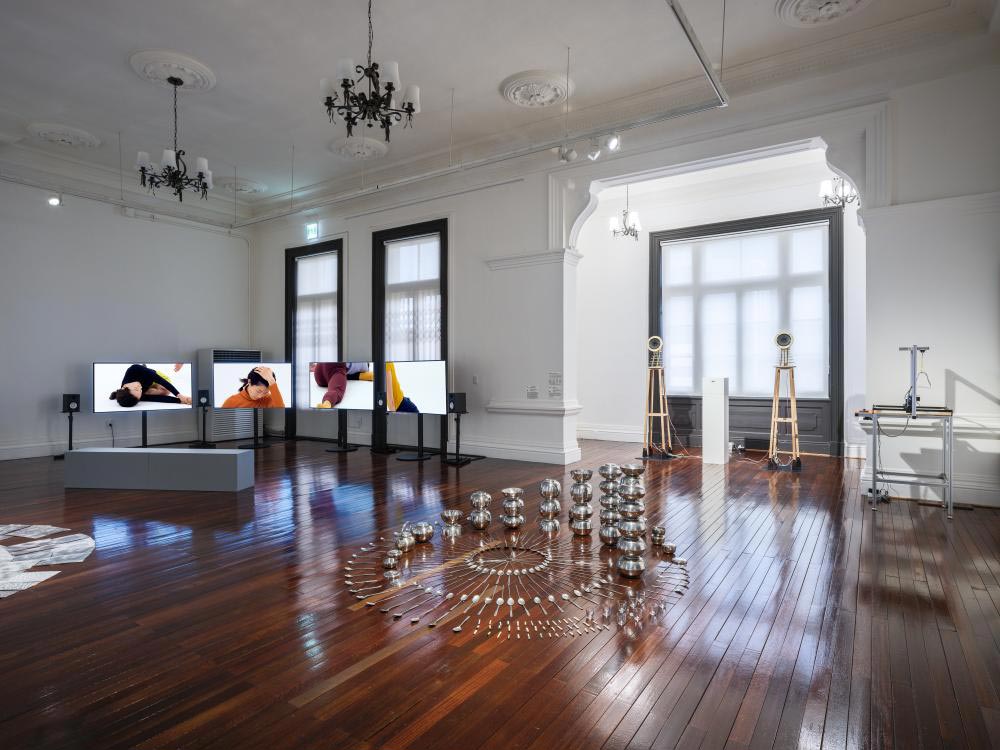
The six-part ‘Score’ series is based on the life cycle of a glacier. The first scene begins with the formation of snow crystals. Next, through interaction with its surroundings, the snow gradually compacts into a mass of ice, and after hundreds or thousands of years becomes a glacier and begins to move. Eventually there comes a moment when the glacier breaks apart; it fractures, sinks, and then rises again to the surface.
The fragments of ice and the air bubbles trapped within them, meeting the water, produce strange sounds that are difficult to describe in human language. They range from sharp, forceful cracking sounds to noises that feel almost like screams. As a researcher gathering materials, as an imagining subject, and as an artist, Jun collected, recorded, and expressed the traces of the thoughts and actions generated through this process.
Yet this was not enough to contain the glacier, which is at once a single mass and a collection of fragments, a piece-part larger than the whole. In some parts of the work, one even finds a domain that is rather directive and delimited. This is not at all to say that she dealt with a nonhuman species while making use of technology, one of the very symbols of human civilization.
Nor is it simply to invoke the more fundamental point that, because the human is the subject, there are innate limits that cannot be overcome. For example, the titles of the ‘Score’ series—“On a Six-Cornered Snowflake,” “Compression and Expansion,” “Frozen Memory,” “Song of the Glacier,” “Blue Descent,” and “Dark Bubbles”—as well as the information included in the scores and the sentences written by the artist, all have a high probability of being read explicitly.
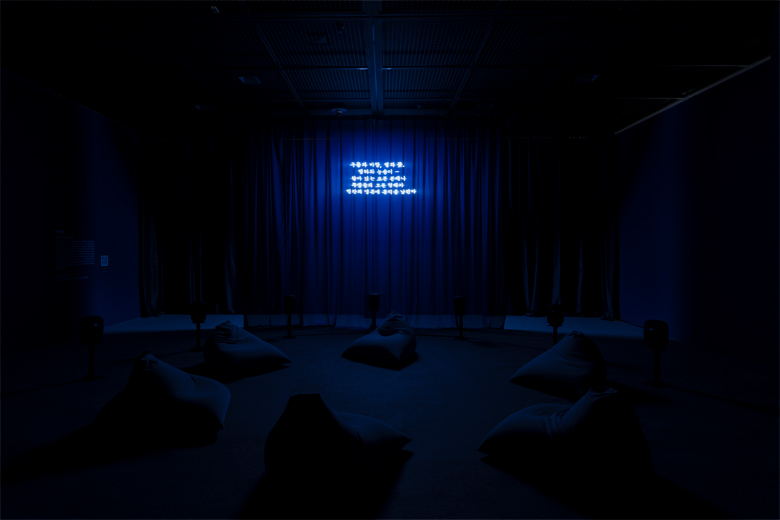
Likewise, the title angurværð (gentle sadness) and the sentence “Clouds and wind, stars and flowers, glaciers and snowflakes—all living beings and every form of the inanimate leave traces on the human soul” convey the artist’s thoughts in a generous, almost revelatory way. Perhaps narrative itself—with its suggestion of a beginning, development, turn, and conclusion—and interpretation are precisely what is human.
For this reason, the artist needed another route, one that could depart from boundaries and partitions so longstanding that they appear natural, even beyond suspicion.
Come to think of it, a single mass of glacier resembles a single world. And the whole is always smaller than the sum of its parts. This is precisely what is meant by subscendence. “Wholes subscend their parts.” Not transcendence. Something else. This implies that parts are not confined to being merely mechanical components of a whole, and that genuine wonder, novelty, and different futures are always possible.
The same is true of the human. “Humanity is ontologically smaller than the humans that compose it!” Human beings do not exist only as parts of humanity. They do many things. Among them is the forming of relationships with nonhumans. And humans, in turn, also contain nonhumans. In the end, Jun gave up the overwhelming spectacle that most people conventionally associate with glaciers.
Instead, she chose sounds that move beyond the human domain. The ‘Score’ became channels for communion—or for exchange—between artist and performer, performer and performer, human and glacier. The story of the glacier expands into the story of the world.
Jun was particularly drawn to the fact that a glacier, a vast mass of ice formed when water vapor turns directly into ice, is fundamentally based on water, which never remains fixed. A glacier, as captured by the human eye, appears to be a motionless solid, but it does not stop. Because it contains movement both inside and outside itself, it is a highly “sensitive and dynamic being.”
Through the glacier’s amorphous nature, Jun believed she could draw out a kind of thought experiment that resists and unsettles the standards and categories established and fixed by humans—standards that may themselves be violent. Of course, not only glacier-water but every being in the world is in process. Each contains and undergoes change in one way or another.
For that reason, the narrative of the glacier becomes a fitting subject, one that shares a meaningful intersection with the parts that live through the world. Jun wanted to create a landscape of “sounds disappearing because of climate change,” and did not simply wish to reproduce the sounds of nature.
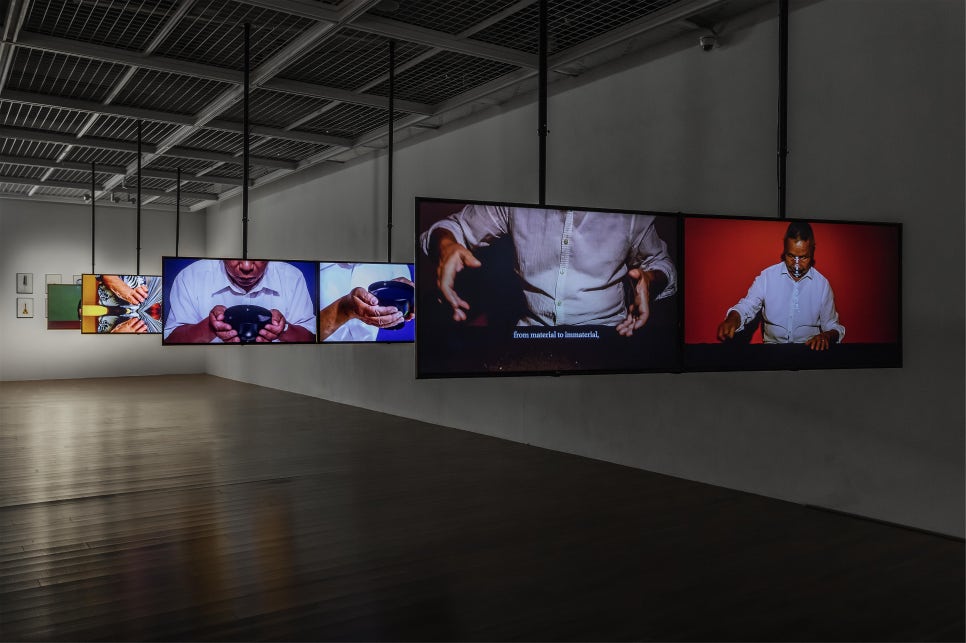
Thus, in Nameless Song: Glacier Blue (2024), she focused on “amorphousness, fluidity, process, and release from fixed definition,” exploring ways of “presenting” bodily sound that could hold as much as possible of all that she had experienced and gathered from the glacier. She understood the human body as a point of connection through which one encounters other beings.
The humans (performers) producing these bodily sounds did not merely explain or imitate the glacier from a human perspective; rather, they sought to move closer to difference itself. “Sound as vibration,” beyond human language—that is, fragmented words, friction, the tongue, the breath—“escapes from meaning” and moves toward sounds that do not become speech. Bodies depart from a motionless state of stasis and continue to generate themselves without end.