The Story of Nam
A being of extraordinary beauty who captivates anyone, regardless of age or gender, at first sight; a morally flawless figure whose immaculate beauty makes others tremble for fear that their own shameful flaws might be exposed. Mr. Nam is perfect in every respect, even the scar on his face is beautiful. No matter how accomplished an artist may be, it would be impossible to capture all of his beauty in a single work.
Even the renowned painter Han, celebrated for his exceptional powers of depiction, claimed that representing him in a painting was impossible. This is how Mr. Nam is described in Yoonah Kim’s video work The Story of Nam.
We have long encountered such idealized beings throughout Eastern and Western mythology and history. From mythological figures of absolute beauty such as Apollo, the god of the sun, and Venus, the goddess of beauty, to celebrated beauties from history such as Cleopatra, Yang Guifei, and Hwang Jini . . . as well as heroes endowed with perfect strategy and courage, including Alexander, Caesar, Napoleon, Joan of Arc, and Yi Sun-sin.
These figures are symbols and representations of absolute beauty and perfection created by humankind. They may be imaginary beings entirely different from the actual historical individuals. The artist introduces Mr. Nam as a “water ghost.” A water ghost functions as a kind of generalized excuse or pretext that conveniently explains a situation by erasing the individual stories and specific reasons behind each suicide.
In much the same way, the strange and grotesque events occurring in the village, events that are difficult to explain, are blamed on Mr. Nam. Whether or not he is actually responsible is irrelevant; the truth does not matter.
Just as Mr. Nam eventually fades from people’s memories in the video work The Story of Nam, becoming a figure of little importance, the perfect beauty, absolute ideal, or essence constructed by human beings can also prove hollow, collapsing and disappearing in an instant. An ideal or concept of beauty that once seemed eternal may likewise change and come to an end with a historical turning point.
What, then, is it that keeps us living? An unchanging and perfect ideal? Or an imperfect reality? Yoonah Kim brings us before questions of human existence. Existentialism challenged earlier modern Western philosophy, which had pursued ideals and essences, with the unprecedented proposition that “existence precedes essence,” turning attention instead toward life itself.
Even after ideals vanish into emptiness, the place where we remain rooted and continue to live is the real world, the harsh site of lived experience. Yet without ideals, could we endure the imperfections of reality? Only through the tension and variation between ideal and reality can we approach the true contours of life: dreams and hopes, despair and anger, happiness and tragedy, beauty and ugliness.
Near the end of the main section of The Story of Nam, the elderly painter Han suddenly finds the gaudy, multicolored neon signs of the nighttime street beautiful. Shuddering, he repeatedly says, “No, something this ugly cannot possibly be beautiful,” rubbing his eyes in disbelief. Having long revered ideal beauty, he finds it difficult to accept, yet this becomes the moment in which he recognizes the beauty and preciousness of imperfect reality.
In this way, through The Story of Nam, Yoonah Kim explores the relationship between “concrete, existential life in reality,” one of the central concerns of her practice, and “complete and universal ideals.”
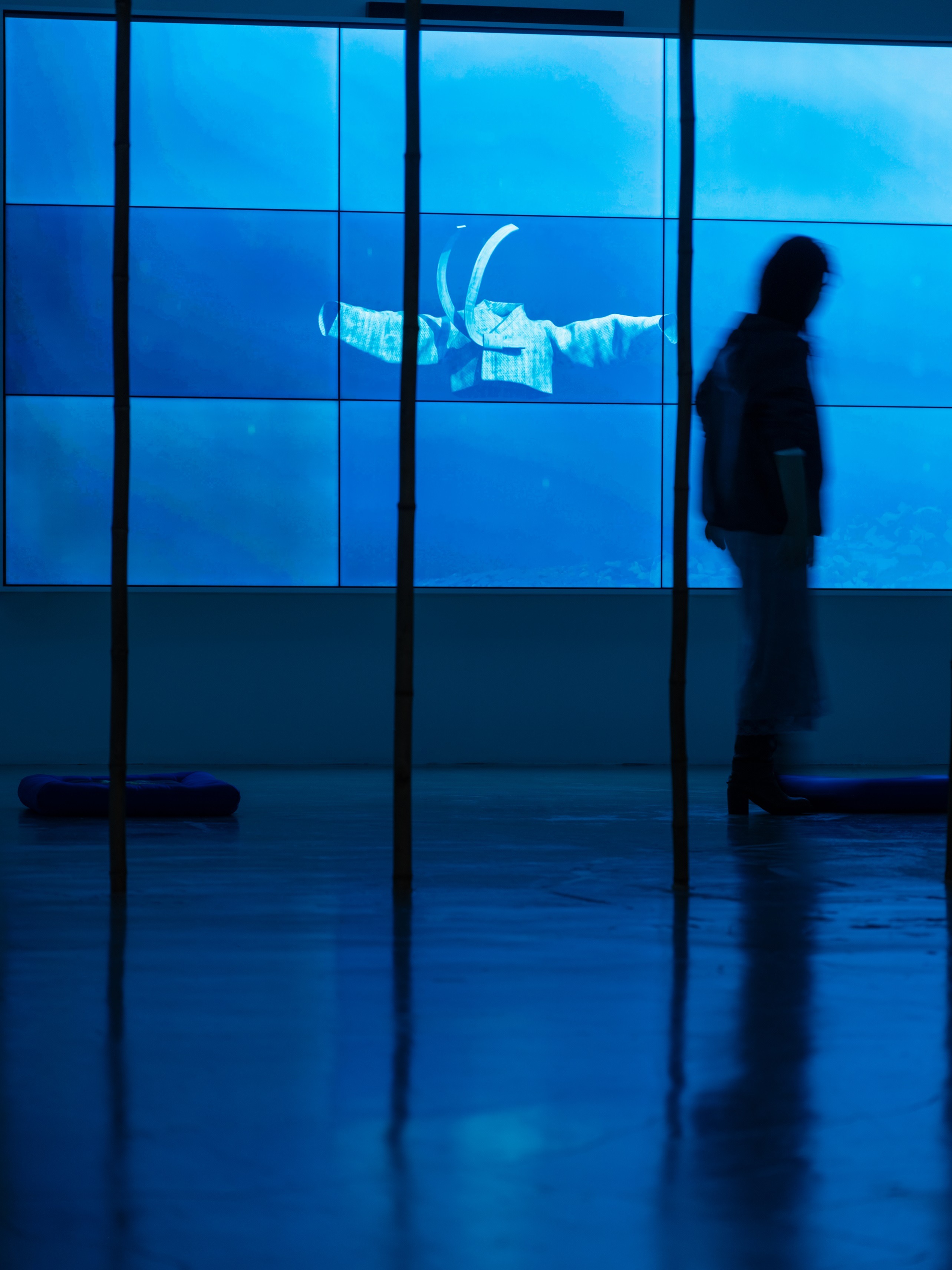
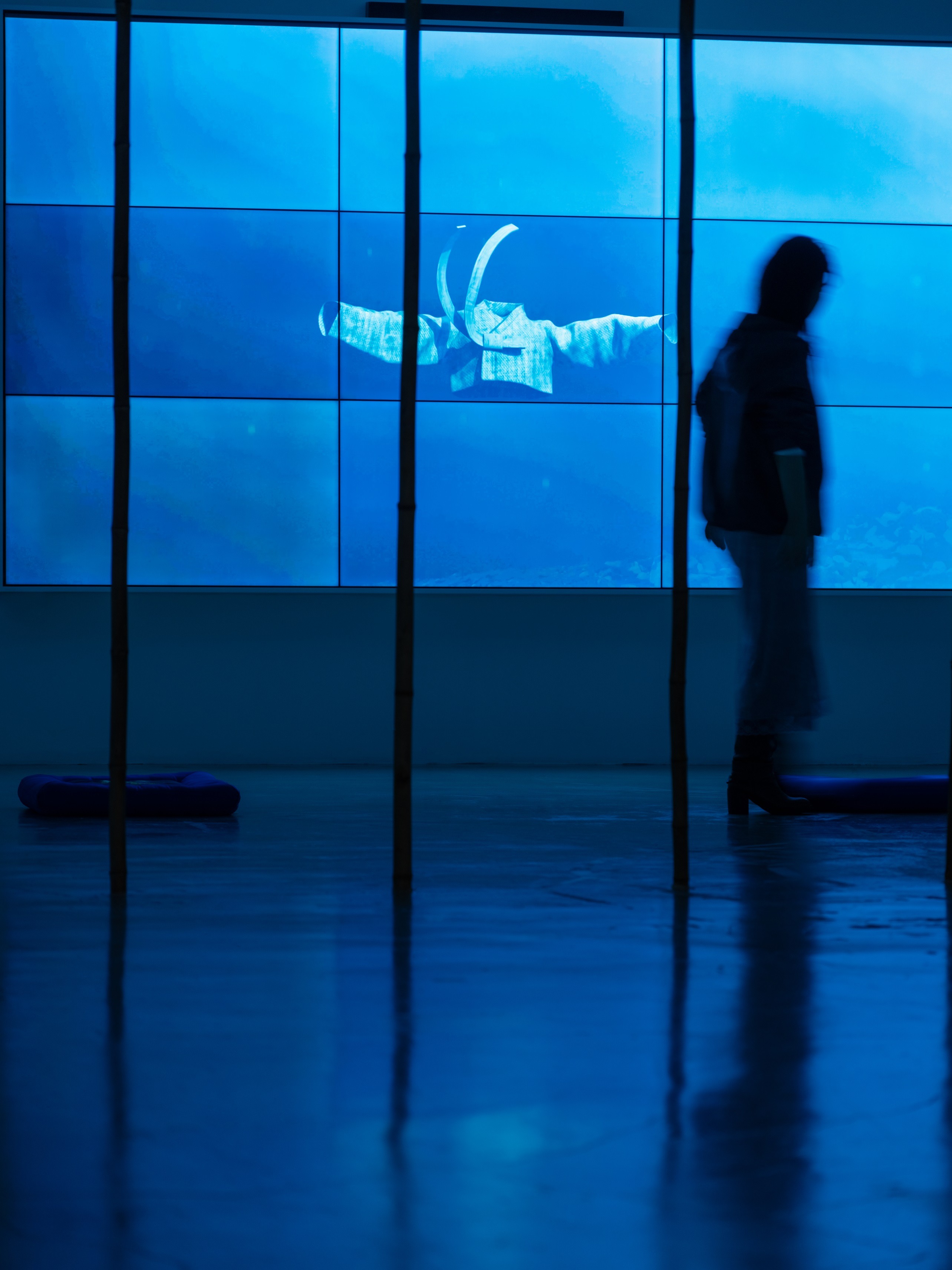
Perhaps in order to contrast an unchanging ideal with the endlessly shifting reality of existential life, the lives of the characters in The Story of Nam, conveyed through subtitles, unfold through such dramatic turns and trials that even following the text can feel breathless. By contrast, the hanbok jeogori, apparently symbolizing Mr. Nam the water ghost, remains unchanged from the beginning to the end of the video.
Within the dark blue-green water, its ribbon ties flutter as it struggles upward before sinking again, repeating the same motion consistently throughout the work’s 18-minute-and-50-second running time.
Alongside the main version of The Story of Nam, which plays continuously in the exhibition space from the opening onward, the artist adopts an intriguing format in which three spin-off texts are released sequentially during the exhibition, one at a time. These texts delve more deeply into the individual lives of the work’s principal characters: Miss Kim, the elderly couple, and Mrs. Cheongju.
Like switching between wide-angle, telephoto, and zoom lenses, the work narrows its field of vision deep into the characters’ lives before shifting again between microscopic and macroscopic perspectives, emphasizing the specificity of human existence and exposing the realities of lived experience in an unvarnished manner.
This shifting between macro and micro perspectives on the world, as well as the motif of the whole and the individual, also appears in the tent installation All of Us.