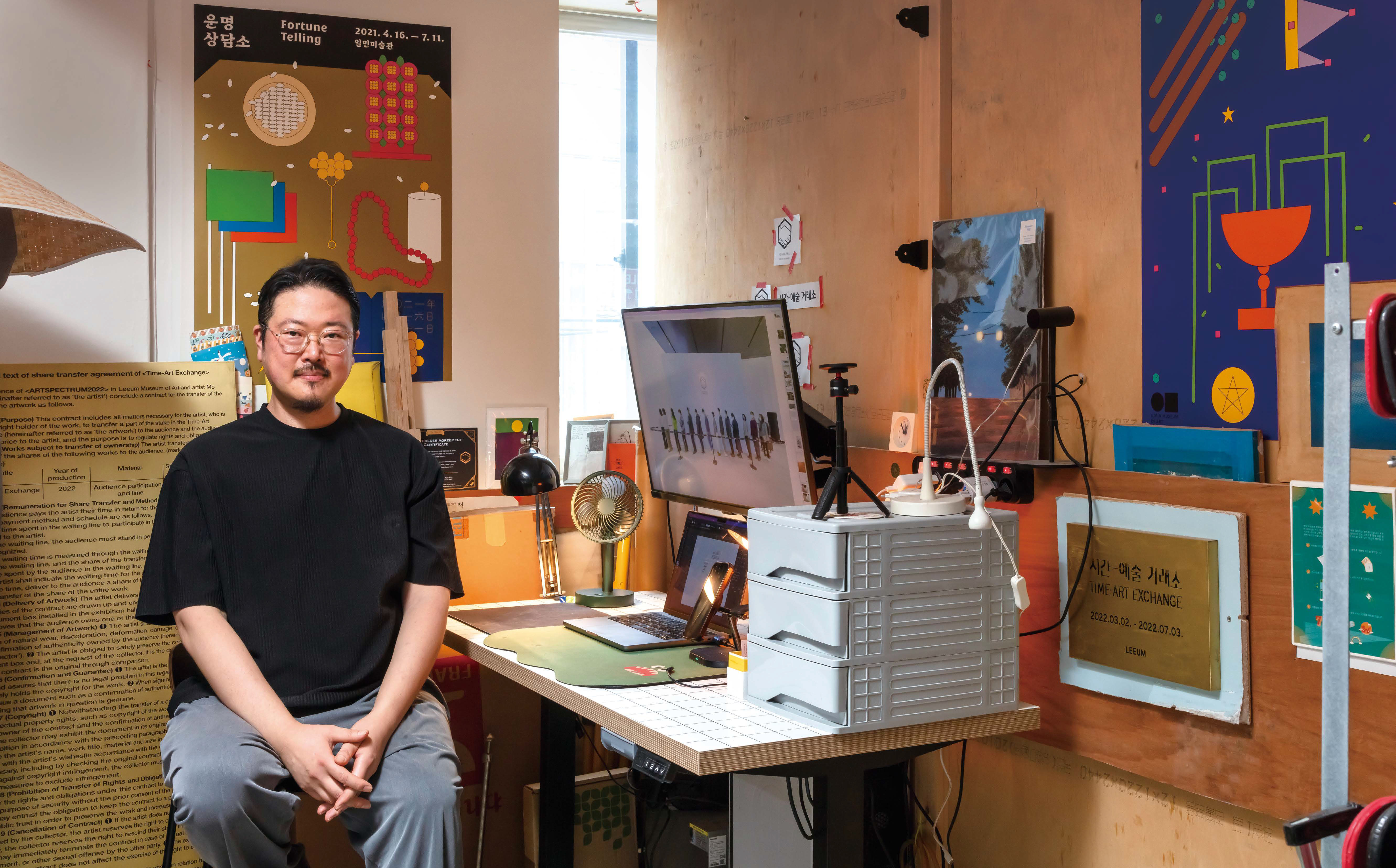
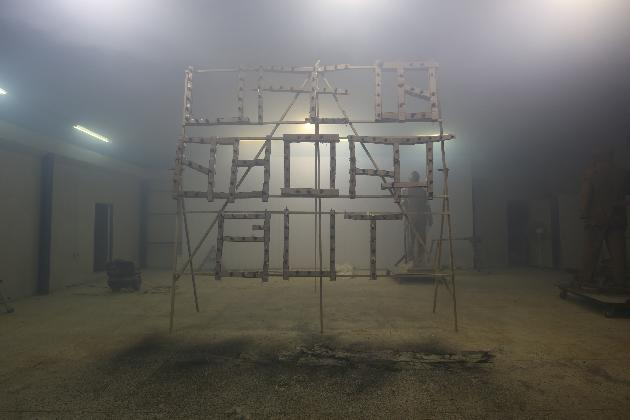
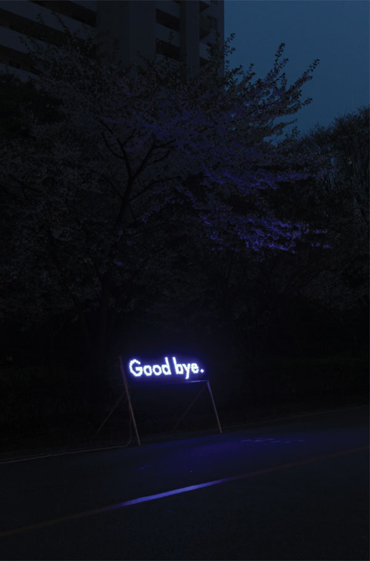
On a dark night, in an unknown place, a small fireworks display begins. The flames, romantic in their own way, seem to inscribe the present in our memory and invite us to dream of tomorrow.
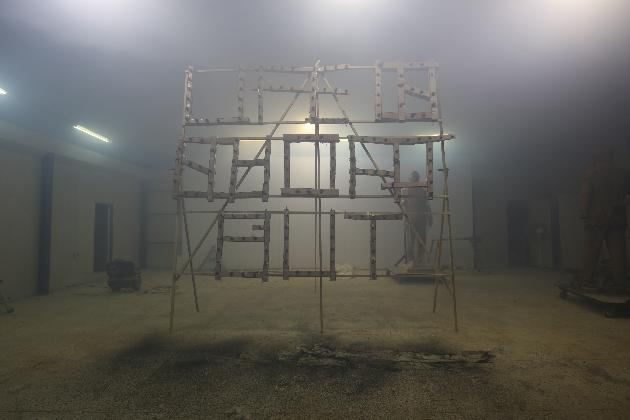
Following the trail of the fireworks, we come to realize that they form a set of letters: “LIFE IS SHORT BUT.” This was a fireworks ignition project carried out as part of Mo Kim’s 2014 work Life is Short But(Failed). When reconsidered as the artist’s work, if it were merely an episode involving a beautiful fireworks display, it would fall short as contemporary art; yet the phrase seems too weighty in what it seeks to convey to be dismissed so easily.
According to the artist, the work originated in a certain difference he perceived while working as an assistant to a sculptor: between the temporary and time-limited nature of his own work and the sculptor’s (semi-)permanent sculptures. Perhaps, despite belonging to the same category of art, he intuitively sensed the irony of “art” at the point where it divides into “monumentality” and “ephemerality.”
Arriving at the thought that life is short and that his own work is even shorter, he coined the phrase “Life is short but art is shorter,” and sought to elevate “Life is short but” into the form of an “even shorter art.” Yet when things failed to proceed as planned, he ultimately encountered failure.
Looking back at the video documenting the work, the fireworks—which are beautiful (or ought to be beautiful), and should remain all the more memorable precisely because they last only a brief moment—repeatedly go out. What remains is little more than the pitiable determination of a person, dressed in an outfit that is not particularly beautiful, struggling to keep the ceremony going with a roughly improvised pole.
What is interesting is that Kim gives this work—or, more precisely, its “failure”—a title by adding “(failed),” unlike the original phrase, and brings the gap and errors arising between planning and execution back into the very core of the work within the grammar of a happening. From the perspective of process, such errors are often converted into possibilities and understood as stages toward producing subsequent meaning.
In his work, however, this “failure,” by conclusively determining the success or failure of the action, redirects attention away from the artwork and toward the position of the creative subject—that is, toward his attitude as an artist. In other words, for him, art is less about a sleek form made of solid material than about examining a certain state that contains irony and stands just before collision.
In fact, this failure is not as tragic as the word itself might suggest. At times, it is precisely in such moments that we become aware of facts we had not known. When the artist’s action ends in failure, the concealed reality behind that failure—the conditions that made failure inevitable—is exposed. From that moment on, cracks begin to appear in the placid everyday life we thought we knew, and rules once taken for granted become ironic.
In PBC Cafe Project (2014), the artist installed a temporary shop for citizens along the Tancheon walking trail and sold them beverages while providing a place to rest briefly. Here, an intriguing situation emerged. Unauthorized commerce is usually destined to be driven away, yet ahead of a major national event, state administration temporarily came to a halt.
The artist was therefore able to conduct business until the event was eventually terminated by enforcement authorities. Taking the expenses into account, the net profit was close to zero won. The economic activity, having failed to generate profit, ultimately ended in failure, but in doing so it confronted an even larger failure: a temporary paralysis of state functions.
If PBC Cafe Project inadvertently exposed a malfunction in the consensus-rules of our society, Studio Improvement Project (2014) more actively considered the environmental conditions faced by a particular group that included the artist himself. For this project, which began with identifying problems in the studio environment assigned to him while studying in the United Kingdom and attempting to improve that space on a physical level, he first carried out several procedures.
First, he established a fictional company. This amounted to putting on an outward form that could demonstrate professionalism on a more official level, through which he could gain people’s trust. He also sought consent from the school and other users through a formally structured proposal. By going through these procedural formalities, he was able to carry out actual construction work, and this in turn produced tangible effects, causing situations that had been embedded in everyday life and passively endured as a matter of course to be recognized instead as sources of discomfort.
Here, it is necessary to look more closely at the background against which Mo Kim’s practice takes shape. This background may belong to the concrete and material dimension of reality, or it may be conceptual, as in art or language. On a macroscopic level, it may encompass an entire world(view), while at times, on a microscopic level, it may be limited to a scope representing a particular community.
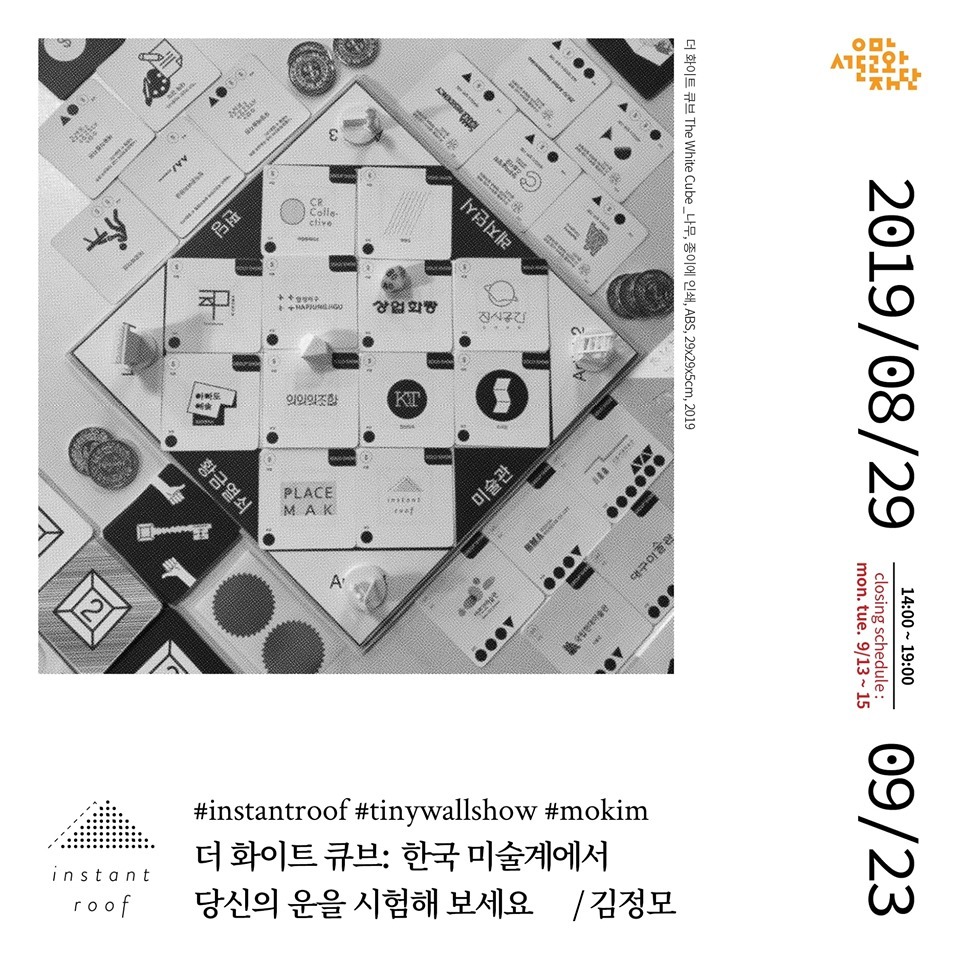
What is certain is that this background constitutes an aspect of society operating upon rules and concepts formed through collective agreement, and that the artist sometimes designs situations for new relationships upon this foundation. Take The Souvenir Store (2016), for example. At the special occasion of a graduation exhibition, Kim opened an art shop whose context was slightly out of step with the event itself.
As in the earlier Studio Improvement Project, he first sought permission to use the works of the exhibition participants. He then interpreted and reconstructed their works at his own discretion and sold them in the form of merchandise. By separating the original artists from their works, this act transforms the artworks into objects placed at a point of choice governed by superficial aesthetic taste.
What, then, do these works—stripped of the artists’ concepts and motivations and turned into objects of aesthetic play and consumption—become souvenirs of? Kim also designated the studio assigned to him within the somewhat particular setting of an artist residency as a disaster shelter and invited viewers into it.
For a young artist seeking to continue working through Disaster-Art Project (2017), reality is invariably arduous, and a residency program that seems to promise the development of artistic capacity, an expansion of one’s scope of activity, and networking may offer a place to evacuate from this reality-disaster and briefly regain one’s bearings.
In this space reorganized through the concept of a shelter, the artist invites viewers to share the disasters each of them faces in reality, testing whether aesthetic experience can be transferred into a dimension of sharing. Through this, he also seems to seek an experience of disasters that actually exist, rather than images of disaster produced by the media.
Taking this a step further, in Squatting (2018), Kim attempts to restore contexts erased from the things physically structured under the format of an exhibition. After learning that, although he had participated in the exhibition, his involvement took the form of another project within it and therefore his name could not be listed under “participating artists,” Kim planned an audience-participatory performance.
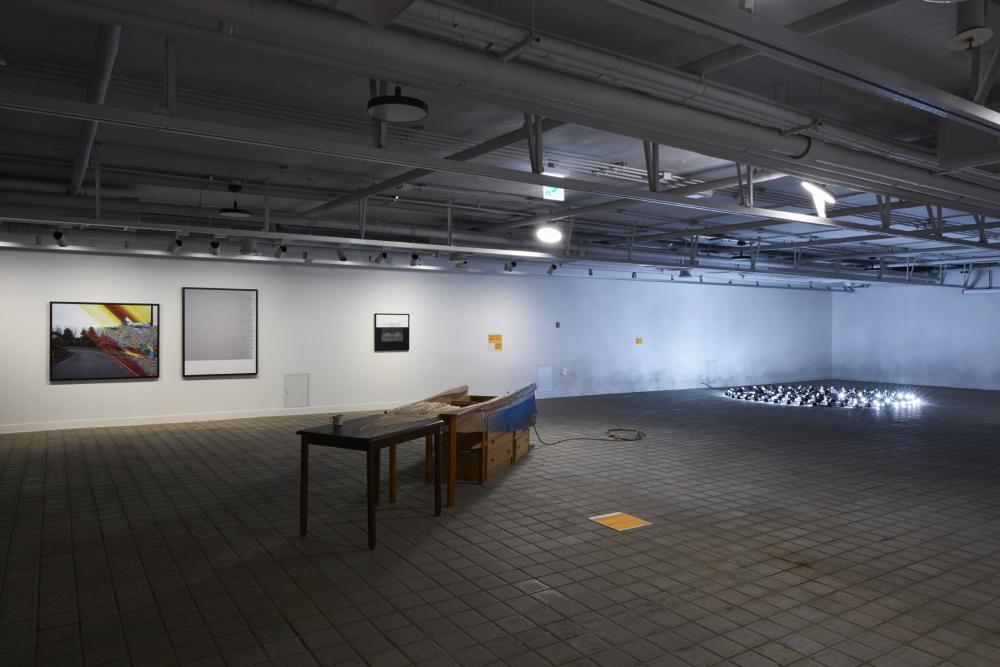
He provided viewers with tools he had prepared—such as flamboyant screens and paper tape—along with a manual for occupation, and proposed that they follow these instructions to view, or more precisely, to “occupy,” the exhibition. The resulting photographs of the exhibition captured a landscape created by these tools of occupation spreading in all directions across the gallery, seizing the space while intercepting the gaze directed toward the artworks.
This can be understood as an act of securing a new time-space within the gaps of established consensus by deviating and slipping away from the ways language binds, regulates, and frames things within an exhibition organized around an agreed-upon theme. In doing so, it also overturns and dismantles the hierarchy between the “main exhibition” and “related programs,” making visible the facts beneath the surface we receive as information.
Social environments always operate according to rules and conditions established through agreement. These regulate the dynamic moments that surge intermittently through our lives, leaving us conscious only of the calm surface of everyday life. Kim’s work can be understood as examining the substance of society flowing beneath the surface created by such agreements and proposing entirely different possibilities that could not have been anticipated within those agreements.
This is not a new and wondrous world that has never before been seen. Rather, it consists of different cross-sections that coexist within the same time and place of an otherwise placid everyday life. Like the two sides of a coin, they are attached to one another and converge into a single whole, yet face in opposite directions.
In Kim’s work, these reverse sides become visible through such things as failure, zero won, malfunction, a dysfunctional studio, and the exhibition itself; they may be understood as different pronunciations of the same word, all pointing toward the “irony” inherent in social consensus. Because his work always moves toward failure, it is able to maintain a very close proximity to irony.
At this point, failure for the artist might even be called both the goal required to reach irony and a form of success. It may be impossible to say that the irony manifested in the series of works described above was intended from the outset. Perhaps it emerged because Kim was somewhat awkward or excessively honest, or because, in the process of planning too perfectly, he did not have time to account for unexpected variables.
What matters, however, is that irony lies at the core of his practice, and that in order to make it visible, he remains wary of the attitude summed up by the saying that “if it works, it works,” while deliberately sharpening his sensitivity toward situations that others would not particularly wish to uncover.
In this way, Kim continually questions existing frameworks and the rules immediately before him, gauges direction within newly constructed situations, and uses his own failures as a route toward reaching the omitted facts on the opposite side of the agreements we have long taken for granted.