
If you believe that there are certain truths you know, they are very likely to be closer to false. People who have experienced events believe they saw everything that happened in front of them, and that they are even privy to the truths behind them. But human beings can only look in the direction they are facing. This is why so many films and novels feature stories in which a protagonist embarks on an adventure to find the truth only after being confronted with something they did not know. This familiar plot underscores how “truth” is not singular but plural.

When we are viewing an object or event, all our past experiences and knowledge are immediately marshaled. A person’s entire life is brought to bear on the place where the gaze is directed. Even when we are viewing from the same position, we cannot be said to have seen the same thing. If we stand at completely opposite sides, different memories will be left behind. Not only that, but as time passes, we will repeatedly edit and adapt things in ways that benefit ourselves, while the “truth” recedes ever further. This explains why witnesses to an event will give very different accounts of it. If two people stand at even slightly different angles, their memories after time has passed will be totally different.

Since our memories are unquestionably incomplete, we cannot avoid the pitfall of distortion. It is a mistake to regard what we saw as being the “truth,” and it is outright arrogance to believe that we understand the truth behind the world we see. Believing that we know nothing is at least a bit closer to the truth. But everyone wishes to believe they are correct, and the public prefers clear untruths over unclear truths. The misunderstandings and divisions that arise among individuals and groups begin from these misalignments. This system in relationships and history has been repeated countless times over the years.

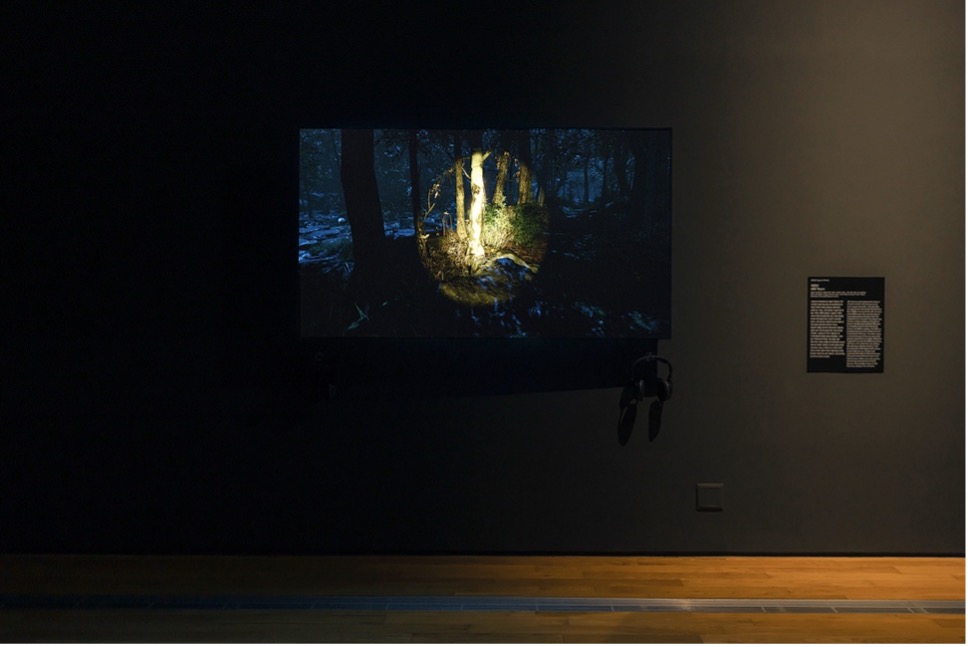
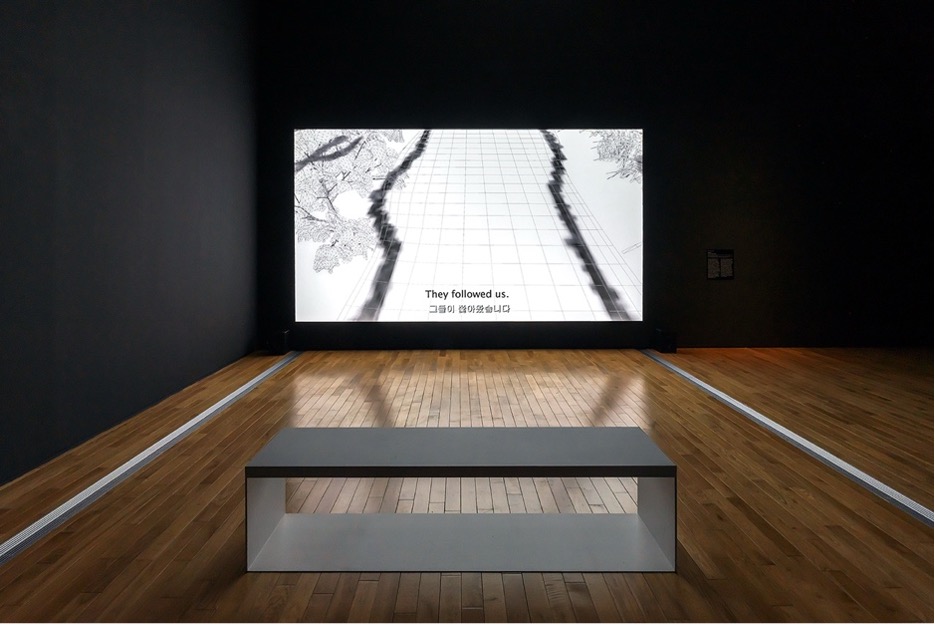
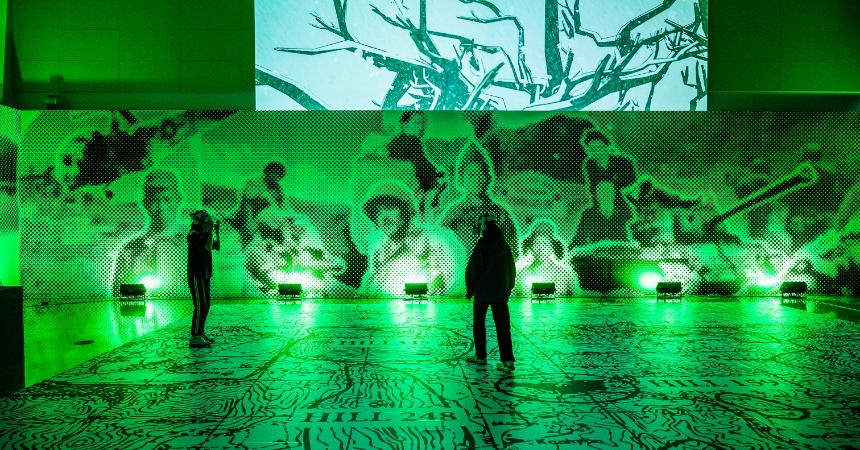
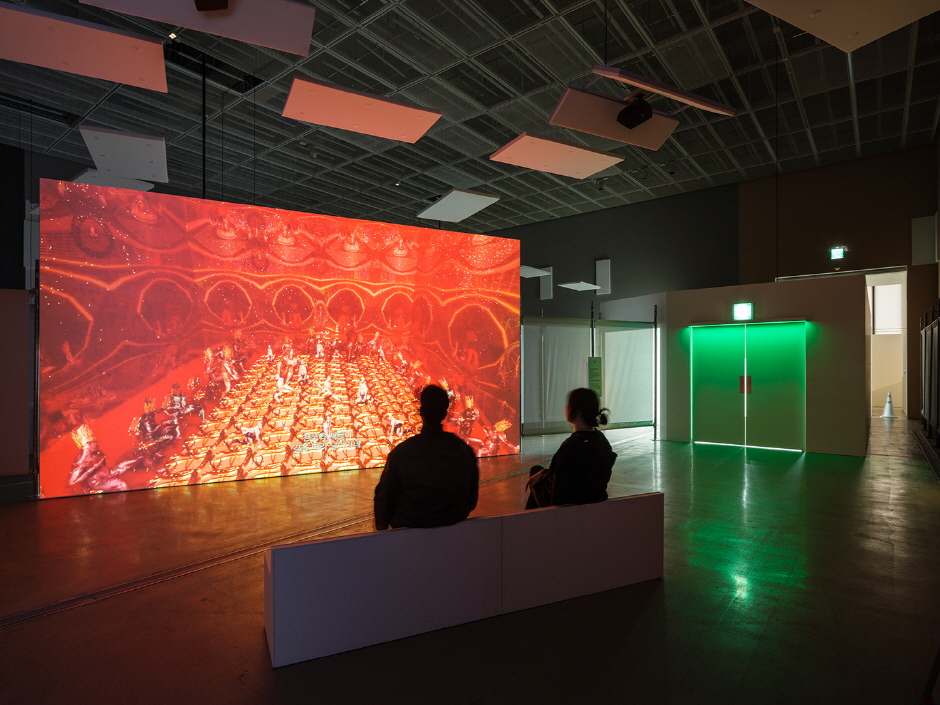
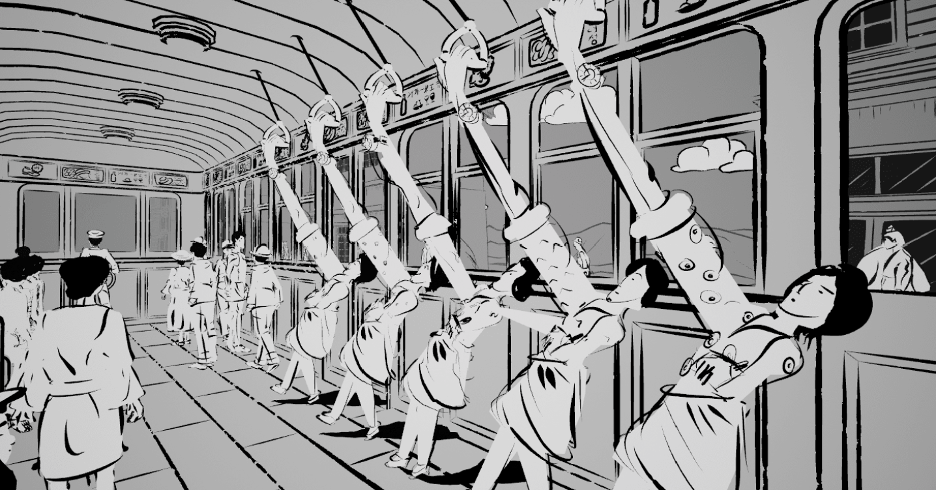
Hayoun Kwon, 489 Years, 2016, Animation, single-channel video, color, stereo sound, 11 min. 18 sec. ©Hayoun Kwon

1. The Empty Spaces Between Us

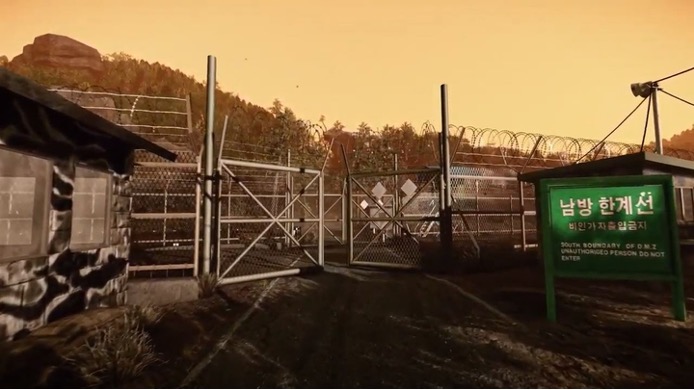
The artist Hayoun Kwon has focused on and explored these “empty spaces” that arise between the speakers and listeners in a story. The spaces examined in her work are all situated on the boundaries of truth: applicants for asylum recounting the pathways traveled in their flight across national borders (Lack of Evidence (2011)); the community of Kijong as a manufactured space created near Panmunjom for the purpose of North Korean propaganda toward the South (Model Village (2014)); the Demilitarized Zone that exists between North and South (489 Years (2016)); or the fantastical home of a woman who collects birds (The Bird Lady (2017)). Rather than presenting any judgments or conclusions, these works simply show that each person’s memories and experiences are different—and that there is no one “truth.”

These empty spaces are particularly evident in Lack of Evidence, an animated work from 2011. The protagonist of this story is Oscar, who shares his experience while applying for asylum in France. But the French government, which has the power to make the decision, does not readily believe stories when evidence is lacking. An empty space exists between the two. Oscar draws pictures to show the route he traveled in his flight, but this does not provide “clear evidence” either.

The memory of others presents no evidence. We sometimes find ourselves wishing to look inside, but that is in the realm of impossible fantasy. In place of the medium of film—which carries the limitations of live-action photography—Kwon selected 3D animation as a medium with the magical ability to represent the memories of others as something that cannot be seen with the eyes or photographed. Imagining Oscar’s travels as she listened to his account, the artist adapted them into animation, which she juxtaposed with Oscar’s own drawings. Since even the most realistic rendering can never be the reality, various empty spaces arise among Oscar, the French government, the listener who hears Oscar’s account, and the viewer of the artist’s work. Clear truths remain eternally unknowable.

Having adopted the animation medium instead of live action for the first time in Lack of Evidence to show these empty spaces, the artist proceeded to create works in a non-live action style. Model Village, which presents a distant perspective on the Potemkin village of Kijong in North Korea, was also produced by filming an artificial model. In the process, she developed an interest in the DMZ as an intermediate space, and as she was interviewing former soldiers, she met a figure surnamed Kim who would become the protagonist of 489 Years. His account—with its descriptions of the fantastical silhouettes of never-before-seen plants revealing themselves in the moonlight, along with the sensations sparked by the life-threatening possibility of landmines and the North Korean troops appearing at any moment—was so vivid that it seemed to offer an indirect experience of entering and emerging from the DMZ.

Kwon needed a different medium from the screen to convey these vivid senses to viewers. She thus adopted virtual reality as a way of sharing secret memories while offering a more up-close and personal experience of realistic spaces.

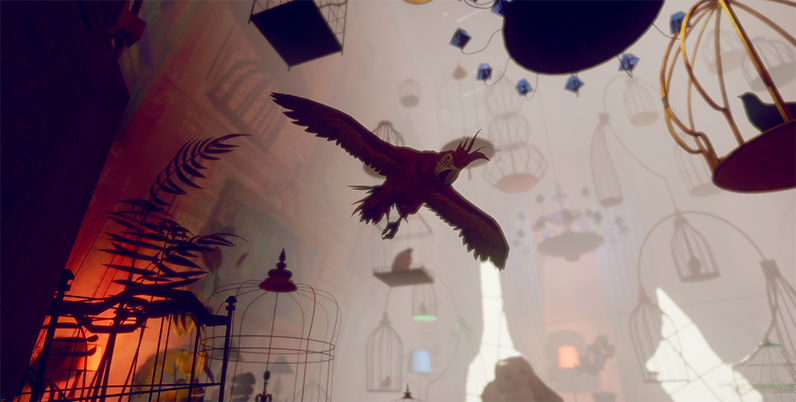
In The Bird Lady, Hayoun Kwon presents viewers with the new element of “time.” While the previous works had linear structures that followed a speaker’s story, The Bird Lady gives the viewer an opportunity to participate. The artist’s drawing teacher Daniel visits an old house to carry out building measurements and surveying. The home in question belongs to a “bird lady” known for collecting birds. In the work, the viewer assumes Daniel’s point-of-view, opening the heavy door and ascending the marble stairs. A woman opens the door to welcome him; behind her appears a startling scene filled with birds and cages.

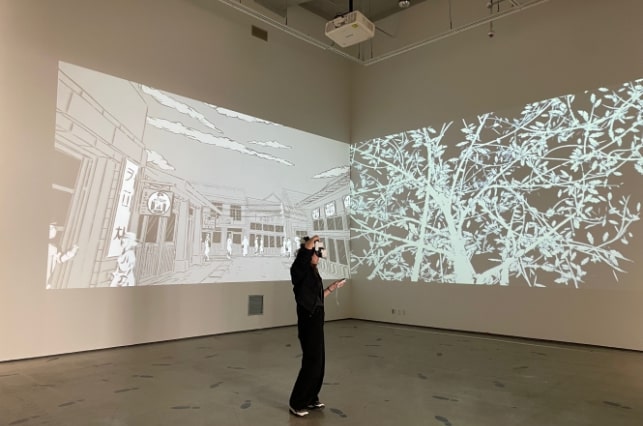
Here, we see a clear difference from Kwon’s previous works. Where 489 Years had the viewer donning a VR headset and sitting down to passively view the work, the viewer in The Bird Lady moves around while wearing the headset. The tempo of the viewer’s movements is reflected in the progression of the work, as when they walk up the stairs or stop to look around. In a sense, the viewer acquires a partial ability to control time themselves. As a result, they gain a more powerful sense of presence in virtual space, venturing more deeply into someone else’s memory.

As they move their feet, stretch out their hands, and turn their heads to look around, each viewer forms a different experience. Of course, the virtual space disappears like a mirage as soon as the headset is removed—but the powerful experience of becoming someone else is engraved in the viewer’s memory as an event. Meanwhile, the layering of the slow movements of viewers wandering through virtual space in headsets creates what appears outwardly to be a performance. By incorporating the viewer’s movements as elements, the work arrives at an intermediate place that seeks to transcend the established forms of video and VR to reach the performance realm.


2. Accessing the worlds of others

Hayoun Kwon uses VR to more concretely show the layers of truth that exist between memories and experiences. She creates her works so that the viewers passing through them gain a richer perception of reality. No matter how realistically it may present things, however, a media-based work disappears the instant the lights go off. Not only that, but the dictionary definition of “imagination” refers to “taking as true what is not true or is of unclear veracity.” How are viewers able to better see reality through a virtual experience of drifting through space without having their feet planted in the real world?

Ever since the emergence of what we refer to as “media,” many philosophers have expressed concerns over their relationship with human beings. In particular, Günther Anders warned of media’s potential to take the place of actual experience and rob human beings of their critical thinking capabilities. In his view, media that came pre-edited by others were “not a means, but something already decided”; as we experience this edited “phantom version” of the world, we find it increasingly difficult to understand the actual world.² Paul Virilio observed the hollow nature of optical media, which disappear when the light does. While they seem to realistically present a distant scene before us, it does not actually exist there. The presence of media breaks down our physical experiences and interpersonal communication.³

The common view among theorists critical of media is that media alienate human beings. Their most negative perceptions might be directed at virtual reality, a state-of-the-art optical medium presenting viewers with a new world that disappears completely the instant the device is taken away. But in contrast with television or cinema, the viewer’s body itself is implicated. Providing a one-person experience in which the viewer’s physical response is incorporated as an enemy, VR does not alienate human beings—it pulls them into the middle of the event.

In reality, our physical actions create changes as they interact with the outside world. If VR functions truly “realistically,” users acquire a sense of “psychological presence,” or the perception of being actually present somewhere else. Researchers have said that in such cases, the users’ motor nerves and cognitive systems operate similarly to the way they do in a real-world situation. After experiencing something, the body inscribes memories—which is why virtual reality may be used for various training purposes, including disaster response and driving.⁴ Taking advantage of this aspect, Hayoun Kwon ironically guides us to awareness of a different reality that we have not experienced. Rather than passively observing, the viewer actively enters the work and the intimate memories of another, making use of their motor nerves and cognitive systems. They soon become aware of a new truth: that different truths can exist depending on the direction from which an event is viewed.

Indeed, research has shown that using VR to experience things one ordinarily would not encounter helps to build “perspective-taking” skills, or the ability to understand other points of view, ways of thinking, and emotions.⁵ As the experience of viewing the work is inscribed on the body as a personal memory, it is also guiding us to transcend our own narrow, distorted perspective and access someone else’s world. Where the light remains, a small foundation is formed for rapport and solidarity.

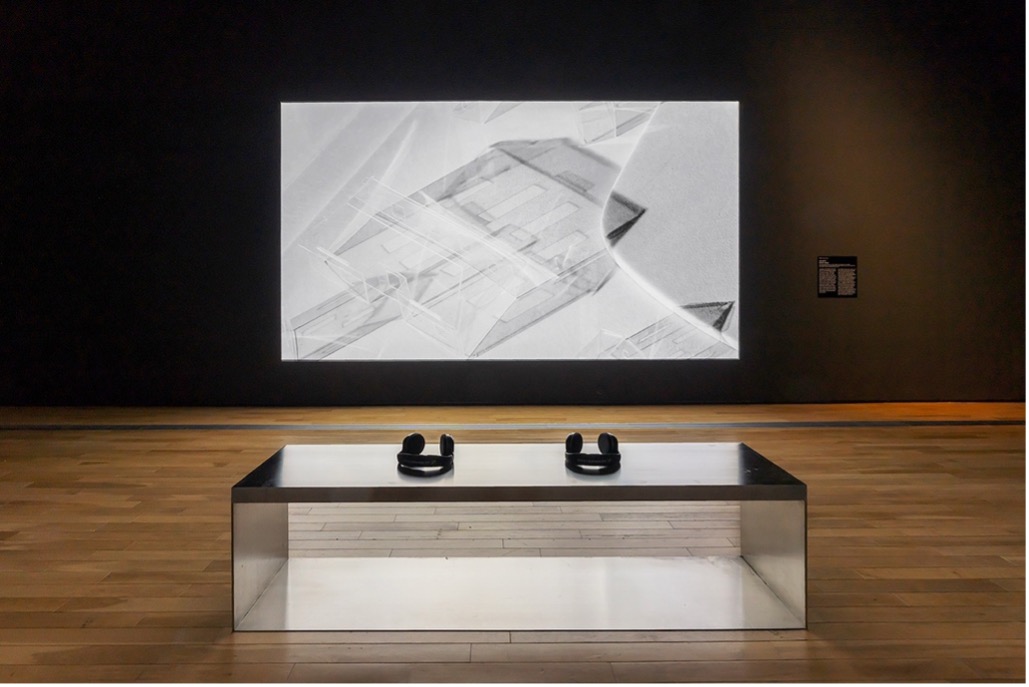
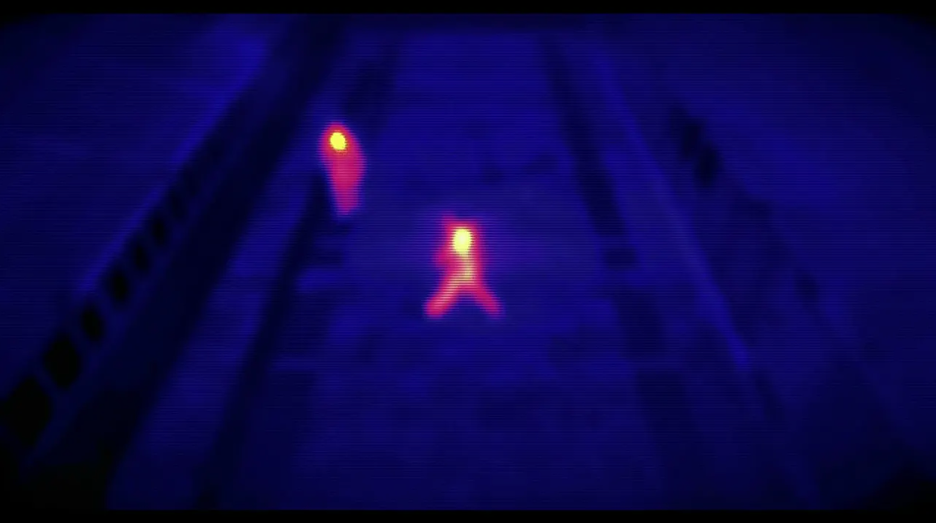
Hayoun Kwon, Model Village, 2014, Live action film of an artificial village model, single-channel video, HD, color, stereo sound, 9 min. 39 sec. Production :Filmo ©Hayoun Kwon

3. The Virtual As a Place

With her successive works 489 Years, The Bird Lady, and Peach Garden (2019), Hayoun Kwon focused on personal and private memories. Since the 2020s, she has expanded her scope once again to explore public places and histories. With Kubo, Walks the City (2021), she showed the boundary between freedom and censorship by focusing on a newspaper archive and early 20th-century landscapes in Seoul. In 2023, she presented The Forgotten War at the Asia Culture Center’s Interactive Art Lab. In it, she summoned memories of the Battle of Jipyeong-ri, which saw some of the fiercest combat in the Korean War but has been forgotten over the years.

The Battle of Jipyeong-ri is recorded in history as a victory for US forces, but as the artist examined the accounts of surviving soldiers and the archival materials preserved in France and other locations, she arrived at a different truth. The ones fighting to protect the key strategic village of Jipyeong from Chinese communist forces were American and French troops, along with a few South Korean soldiers who were included among the French forces. In her work, Kwon shows stories from the differing perspectives of war reporters and South Korean, French, and Chinese troops, guiding viewers to experience several different points of view on a single event.

The new work The Guardians of Jade Mountain (2024) is similarly based on historical stories associated with Yushan (“jade mountain”) in central Taiwan. At the time Japan invaded Taiwan, the Bunun people living on Yushan were a minority ethnic group that put up some of the strongest resistance. Obviously, the official history only recorded the conflict among states. Not only that, but Taiwan’s various minority ethnic groups had such unclearly defined cultures that even their languages have not survived today. At the time the artist first investigated the available materials, there was no way to determine whether the story of the leader of the Bunun sharing a personal friendship with visiting Japanese anthropologist Ushinosuke Mori was real or invented. Through tenacious recording, Kwon tracked down the basis behind this story and recreated it as a poetic landscape.

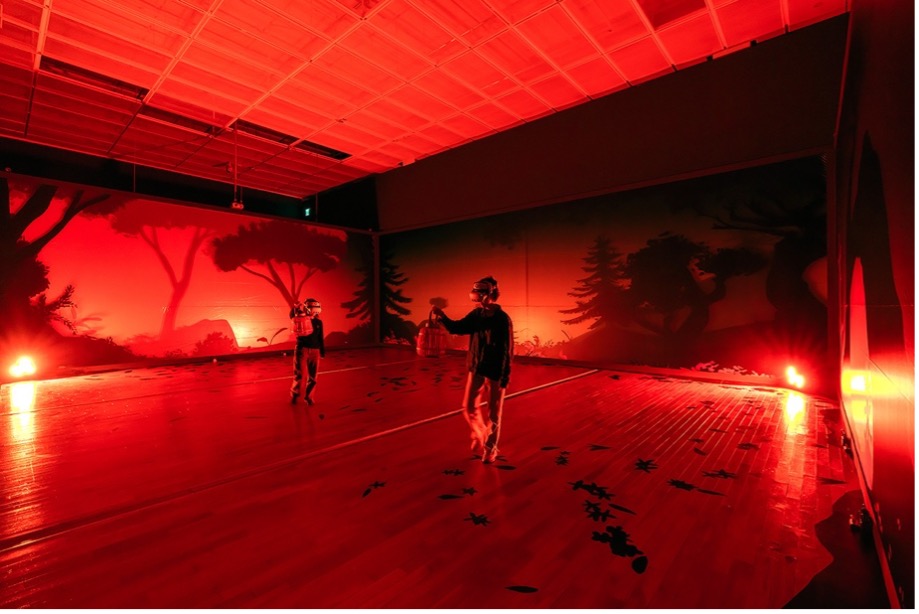
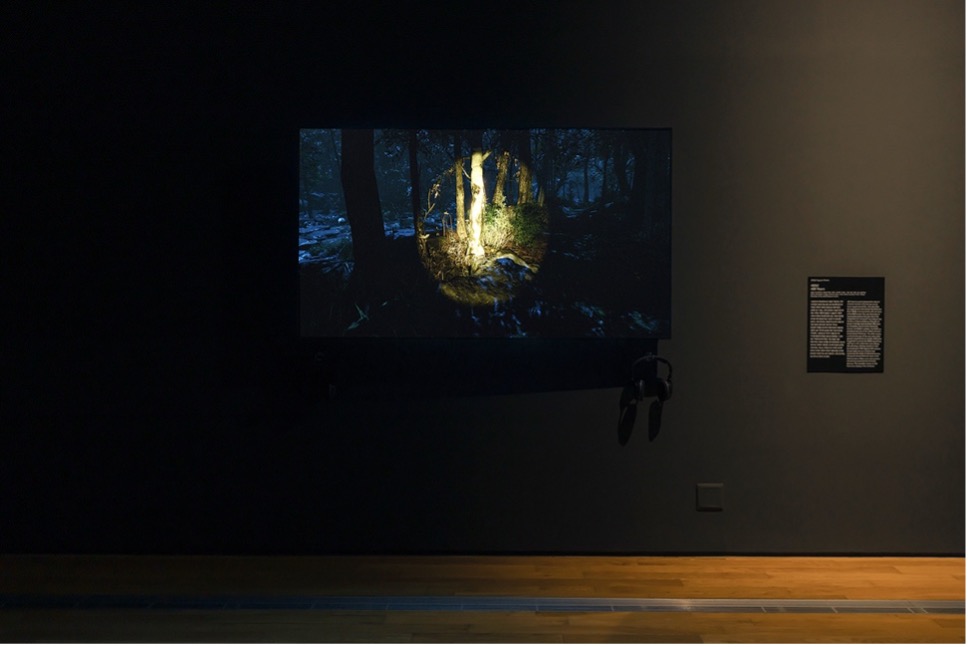
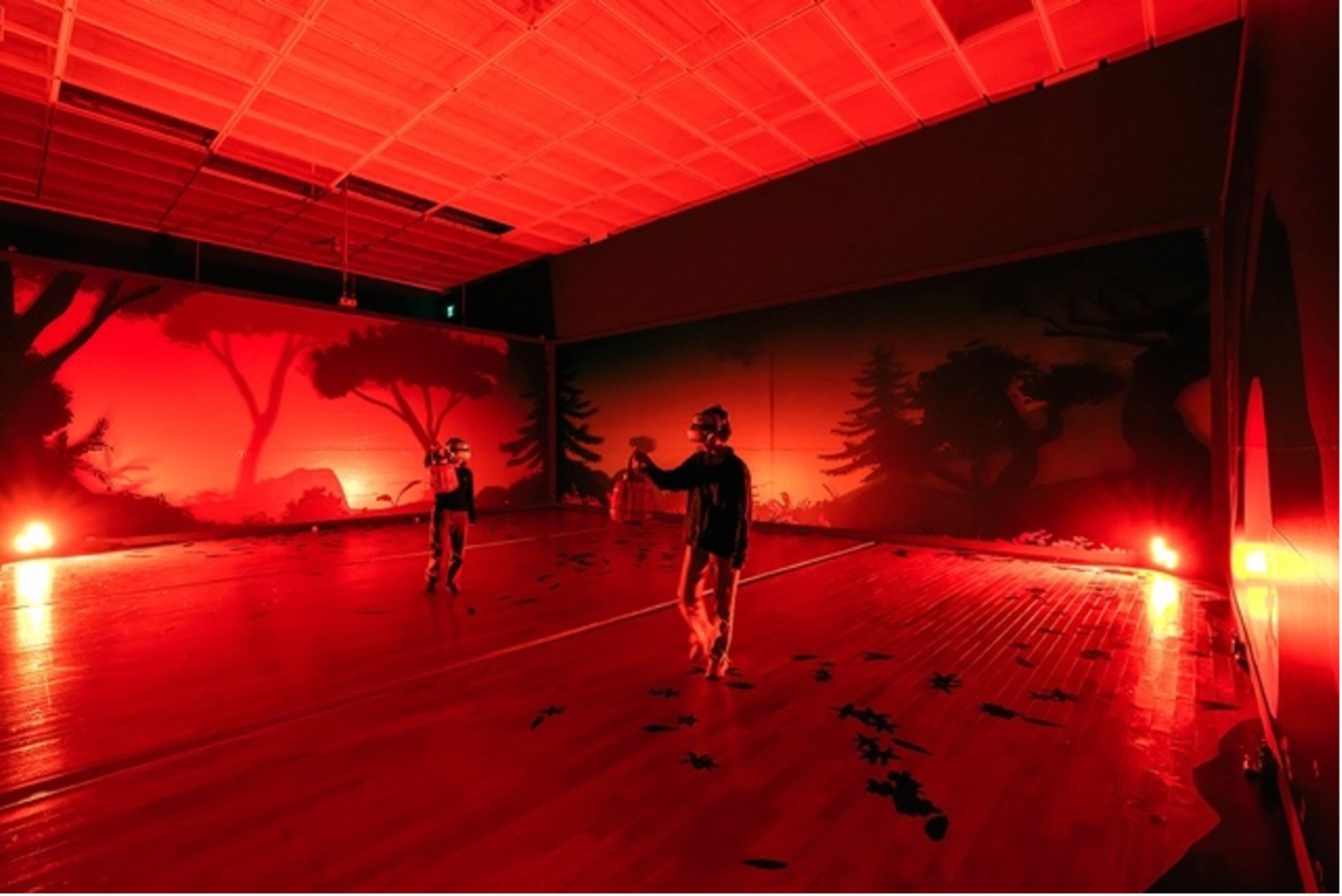
In a virtual space created with light, the viewer listens to the story of how Mori arrived in Taiwan as they slowly enter the area of Yushan. Holding a bamboo lantern in their hand, they follow Mori’s footsteps while wandering through the mountain’s foothills. They rely on the lantern’s glow as they discover never-before-seen animals and plants. Plants are often given academic names based on their discoverer, and there are said to be many plants in Taiwan that were discovered by and named after Mori. Hayoun Kwon investigates the reality by transporting the differing Yushan plant life inhabiting different altitudes into the realm of virtual reality, while naturally capturing the movements of animals living in this location.

The bamboo lantern may be the most interesting device here. Because the lantern in the virtual reality is synced to a real one that the viewer is holding, the viewer is able to gain a more realistic sense of walking through the darkened forest while illuminating it with their light. Owls fly off, spooked by the glow; the leaves change color in the light. Perhaps something similar happened with the scenes Mori witnessed while exploring Yushan. Through this correspondence between the viewer’s perceptions and the VR response, the viewer comes away with clearer memories and a stronger sense of being actually there.

Nevertheless, VR is a medium that disappears when the power is disconnected and the light goes out. In reality, the accumulation of social memory and history causes a physical “space” to become a contextualized “place,” which can continue existing even after the actual space has disappeared. But if VR does not exist as a physical reality, can it too become a place?

The media theorist Götz Großklaus has claimed that even as the emergence of cyberspace has transformed our environment from material to non-material spaces, “place” does not disappear; according to him, concrete memories and evidence play an important part in making a place.⁶ Indeed, one Korean study found that when a third party’s personal memories were experienced with a strong sense of immediacy as a virtual environment, the subjective sense for the experiencer was enough to elicit different personal memories. We tend to regard the virtual spaces created by digital media as “non-places” without memories or physical evidence, but a realistic sense of place can be created through immediacy, transfer, and connection.⁷

As she discovers the empty spaces in reality, Hayoun Kwon studies records and oral histories to create virtual spaces that bring the memories of others back to life. Those spaces are newly organized by the experiences and memories of the viewer. As these different individual memories are juxtaposed with them, Jipyeong-ri and Yushan become “places” that clearly exist, even if they are not present in reality. The artist allows us to see what we cannot actually witness, designing an alternative world that does not exist in reality but is absolutely essential. While misunderstandings and disconnections mean that the empty spaces in reality continue to grow without being bridged, Kwon’s work serves as a light illuminating that hollow darkness.⁸ Through imaginary spaces, we who exist in reality are able to grow a little closer.


4. Bodies and Layers

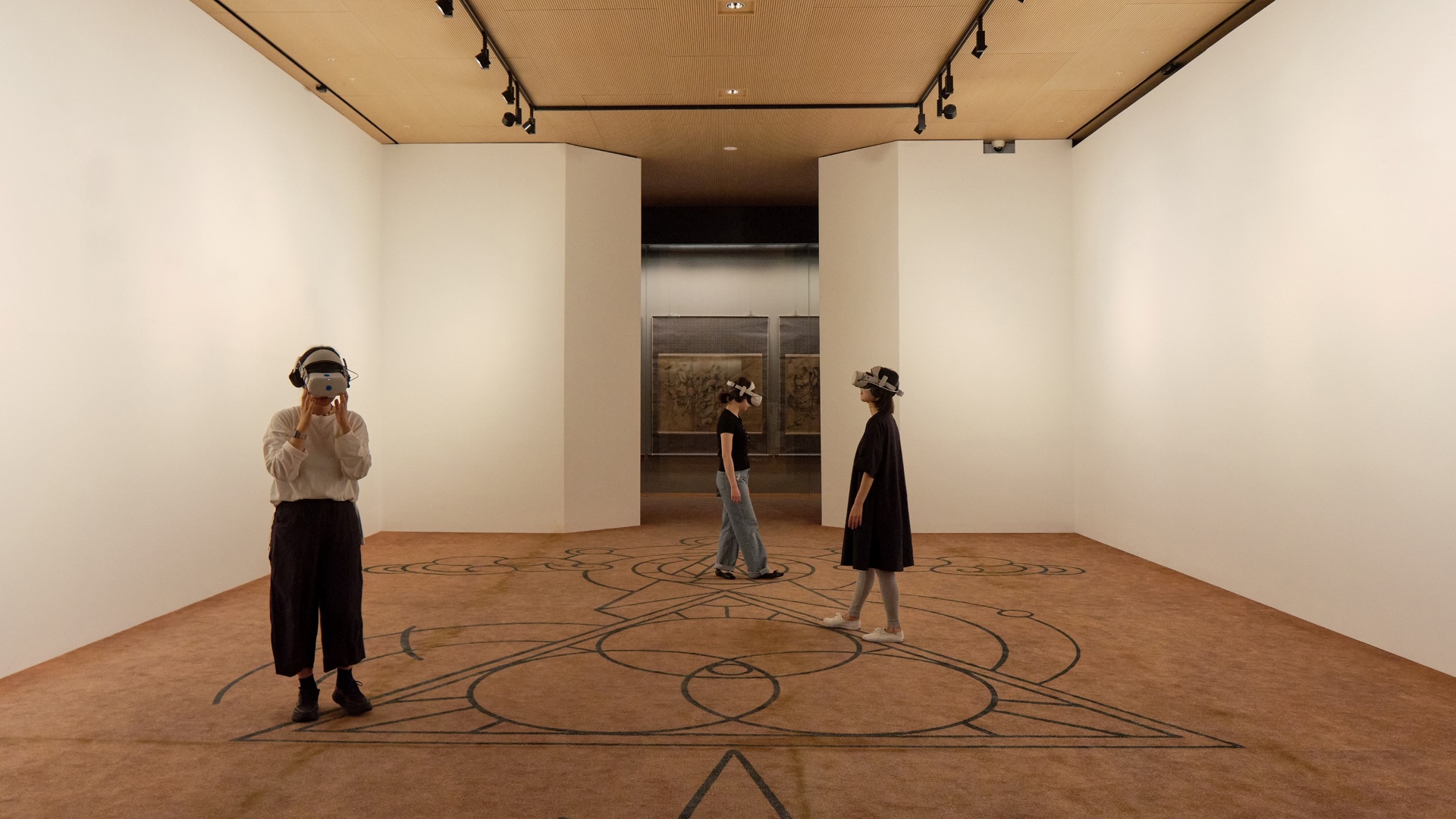
There is also another event that occurs in this place. XXth Attempt toward the Potential of Magic (2021) includes the additional external device of a performer who moves along with the viewer. The viewer wears a VR headset as they walk through an imaginary garden illuminated by fireflies. They move slowly, sometimes walking and sometimes touching things. The performer attaches to each one, copying the viewer’s movements, so that the duet of movements appears something like a dance.

Of course, the performer’s movements are not visible to the viewer wearing the headset; the device exists for the benefit of the other viewers. The structure of the work is one in which three people enter simultaneously and take turns viewing the work. The one viewing it ahead of the others effectively gives a performance before the ones who are waiting their turn. After they finish watching and return to their place, they can observe the “performance” by the next viewer. While the positions of the viewers are changing, the real world is intersecting with the virtual reality: trained performers who are always well acquainted with the content of the work serve to mediate between the inner and outer worlds, while also becoming catalysts who more clearly show the physical and performative aspects that have been added to the world.

The idea behind this experiment was taken from Peach Garden (2020). The work provides a wider space to give the viewer more physical freedom, as the artist focuses on the image of viewers moving slowly in an otherwise empty setting. Preventing the virtual space from remaining something meaningless and empty required the bridging of the gap vis-à-vis the real-world environment; the movements of the actual, present bodies are well suited to this role. There is also something highly poetic about the viewer’s slow movements while witnessing the virtual garden area in Peach Garden with their device on and the movements of their hands touching the flowers and leaves.

Physical movements are introduced in more concrete ways in The Forgotten War. As the viewer dons their VR headset and opens their eyes in the dark, different figures can be seen performing different actions. When the viewer approaches one of those figures from behind, aligns their body’s position with them, and places their hand over the figure’s hand to follow its movements, the scene shifts and the figure’s memories are played back. This is an example of the hand tracking technology used in VR.⁹ At the same time, each VR viewer performs different hand motions, and other viewers who are waiting their turn are able to view another performance.

In a sense, virtual reality may be characterized as the medium with the least amount of corporeality. By using these methods to include corporeality in her work, Kwon heightens the sense of immediacy for the viewer and layers an element of performance on the exterior of her work. Having experienced the truth in different directions in and around the work, the viewer comes to see the Battle of Jipyeong-ri in a more three-dimensional light. In this way, the layers of memory and experience that the work attempts to share internally are able to expand outward. What arises is a structure of layers between individual experiences.

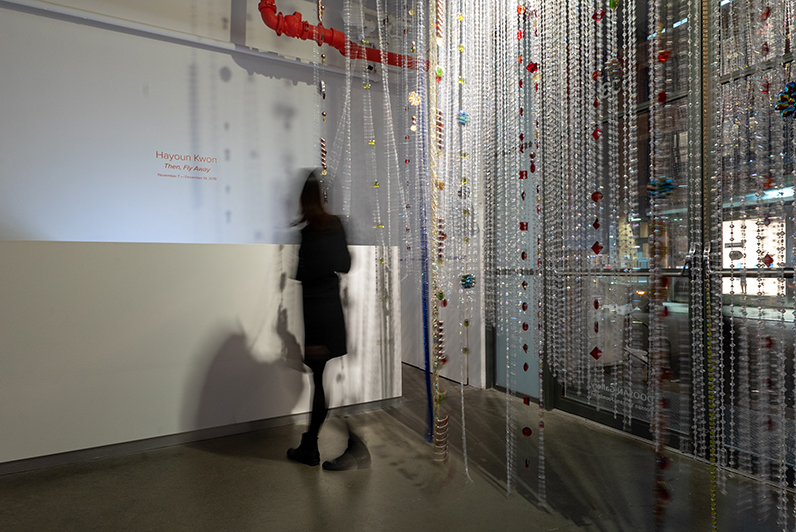
Hayoun Kwon, The Guardians of Jade Mountain, 2024, Interactive VR installation, color, sound, 3D animation, Dimensions variable ©Hayoun Kwon

5. The rebirth of the “empty space”

In Hayoun Kwon’s body of work, earlier and more recent creations exist in close causal connections, with layers forming as new elements are applied to existing structures. In the past, the artist has explored the direction of the gaze and the different layers of events while discovering their “empty spaces.” She has adopted the medium of virtual reality to show intimate personal memories and expanded the scope of her work with elements of corporeality and performance. Her new work The Guardians of Jade Mountain is a reflection of all these previous characteristics that also experiments with new elements.

Discovering the empty spaces in between Japan’s invasion of Taiwan and the resistance staged by minority ethnic groups there, Kwon shows the potential for an empty space through personal stories relating to an actual figure, namely Ushinosuke Mori. She creates a concrete space by assembling Mori’s surviving records along with information on the Bunun people’s culture and actual topographical characteristics, flora, and fauna, designing a work where viewers can connect with the memories of others through an experience with a greater “you-are-there” sense. Here, too, the movements of the viewer expand into the realm of performance—a device introduced to create a more stimulating scene. The artist also places translucent curtains outside the viewing space, printed with trees and silhouette images from the forest.

This device is taken from traditional Taiwanese shadow theater. The artist also applies the motif within her work: as they accompany Mori on his explorations through the deep forests of Yushan, the viewer follows a flock of butterflies to a broad rock, which they illuminate with the bamboo lantern in their hand. Under its glow, the shadow play begins. A scene of confrontation between the Japanese and Bunun plays out metaphorically to the rhythmic sound of drums. The image of the viewer walking through the forest and observing the shadow play appears from outside the curtain to resemble Mori exploring the deep forests of Yushan.

In XXth Attempt toward the Potential of Magic, Kwon showed her idea of incorporating the viewer’s physicality into her work through the performer’s presence. Here, she uses shadow theater in a clear declaration of incorporating performance as another layer to her work. The viewer alternates between positions inside and outside the work, both observing and being observed. In between these two places vis-à-vis the artwork, a forgotten piece of history is inscribed on each individual viewer as a new memory. A single space is pervaded by collective memories and experiences with multiple layers. At this moment, locality arises in virtual space. An “empty space” is thus reborn.


6. A World Where No One Is Alienated

While a great deal of research and meticulous technical planning go into Hayoun Kwon’s creation of her virtual reality-based work, the scenes that the viewers experience inside are simple and metaphorical. The artist does not go out of her way to provide annotations or concrete explanations. Her attitude is that the image one is beholding represents another truth. The real world consists of many different metaphors, and new truth emerges as those are understood and connected. All we can do is walk through the work and discover worlds that did not exist before.

In the face of technology and media, our reality is one in which human beings are constantly alienated. Anders had something of a point when he expressed concerns that media might take the place of our actual experience and erode our critical thinking capabilities. When an artist engages in critical thinking and expresses it through a particular medium, what arrives before us is but one opinion. Rather than speaking herself, Hayoun Kwon has the figures in her theater speak for themselves. This is an example of the poet’s mimesis as described by Aristotle. Presented with a metaphorical situation instead of a story with a defined perspective or moral, the viewer immerses themselves in the experience of another, and the key to judgment is placed in their hand. The image of a viewer who does not appear alienated in the face of the medium may represent a rebuttal to Anders’s pessimistic view seeing us as nothing more than “components” of technology.

As they break down the boundaries between virtual reality and performance, Hayoun Kwon’s works incorporate bodies—the most analog presences there are—into creations that employ state-of-the-art technology. Seeing her work’s use of a different form of language, I found myself thinking of the “new poetry” approach (sinchesi in Korean).¹⁰ When we are using the same medium, is it possible to see in it utterly new possibilities? When the virtual simply incorporates real-world spaces and single perspectives, it is nothing more than an imitation of life—but a place where memory and experience overlap can become an alternative reality even in virtual form. The stories that stand out here are the ones not visible in reality. The “light of enlightenment,”¹¹ cast by one subject upon the objects outside, loses all meaning. This place illuminated by individual beings, each bearing their own possibilities, is a world where no one is alienated.

As the truth blossoms in each empty space and the viewers’ movements are layered together, the result is a rhythm in itself. Seemingly rigid contexts of memory and experience break apart, and the layers—and spaces in between the layers—surge in richer ways. What we had believed ourselves to know is proven false. All that we can know is that we are still unaware of the truth before us. If the visible is all as Vilém Flusser suggests, then here is where we must start again. A poet once said that while poetry is read with the eyes, we read and re-read it while breathing with the body.¹² If we are able to write new poetry through the work of Hayoun Kwon, perhaps it will be poetry that is read and re-read with our whole body.


  1. National Museum of Modern and Contemporary Art, “Conversation with the Artist” (Hayoun Kwon, exhibition curator Maeng Jiyeoung, and performance studies scholar Son Okju, February 25, 2021).
  2. Sim Hyeryeon, Media Philosophy of the 20th Century (Seoul: Grinbi, 2021), pp. 109–111.
  3. Paul Virilio, Korean trans. Lee Jeongha, Art as Far as the Eye Can See (Paju: Youlhwadang, 2008), p. 27.
  4. Jeremy Bailenson, Korean trans. Baek Woojin, Experience on Demand (Seoul: Dong Asia, 2019), pp. 34–57.
  5. Jeremy Bailenson, Experience on Demand, pp. 122–139.
  6. Sim Hyeryeon, Media Philosophy of the 20th Century, pp. 312–321.
  7. Lee Hwayeong, Kim Sangyong, “Subjectivation Study for Immersing the User into the Perspective of Personal Space Represented in a VR Environment Display,” Journal of Digital Contents Society, Vol. 25, No. 1, 2024, pp. 39–48.
  8. Vilém Flusser, Korean trans. Kim Seoungjae, In Praise of Superficiality (Seoul: Communication Books, 2006), p. 304.
  9. This technology operates a computer based on detection of a user’s hand movements. As viewers of The Forgotten War follow the hand movements of the figures they meet in the virtual space while wearing their VR headset, these motions are detected and the images and sounds are transformed.
  10. This genre of poetry departs from established styles, taking on a form that is like a “new body” (sinche in Korean).
  11. Vilém Flusser, In Praise of Superficiality, p. 363.
  12. Hwang Inchan, A Person Briefly, Quietly Confessing (Paju: Nanda, 2024), pp. 32–40.
References