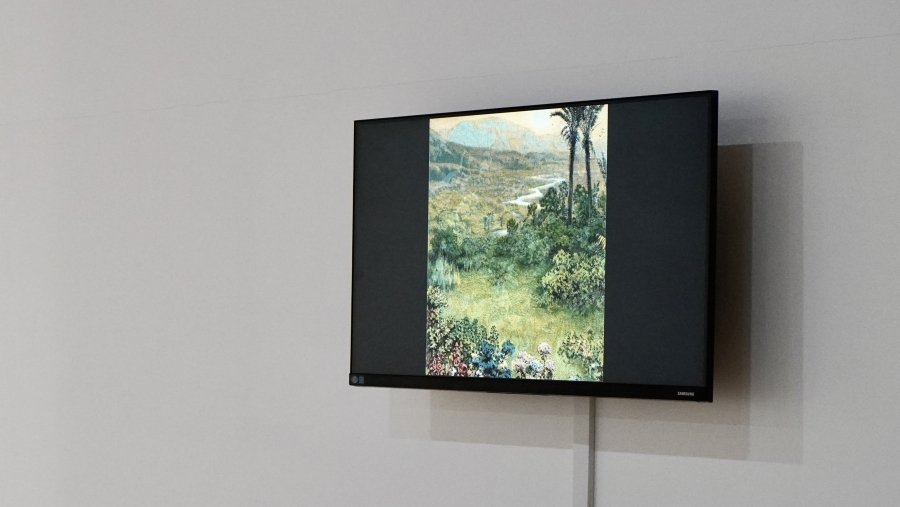
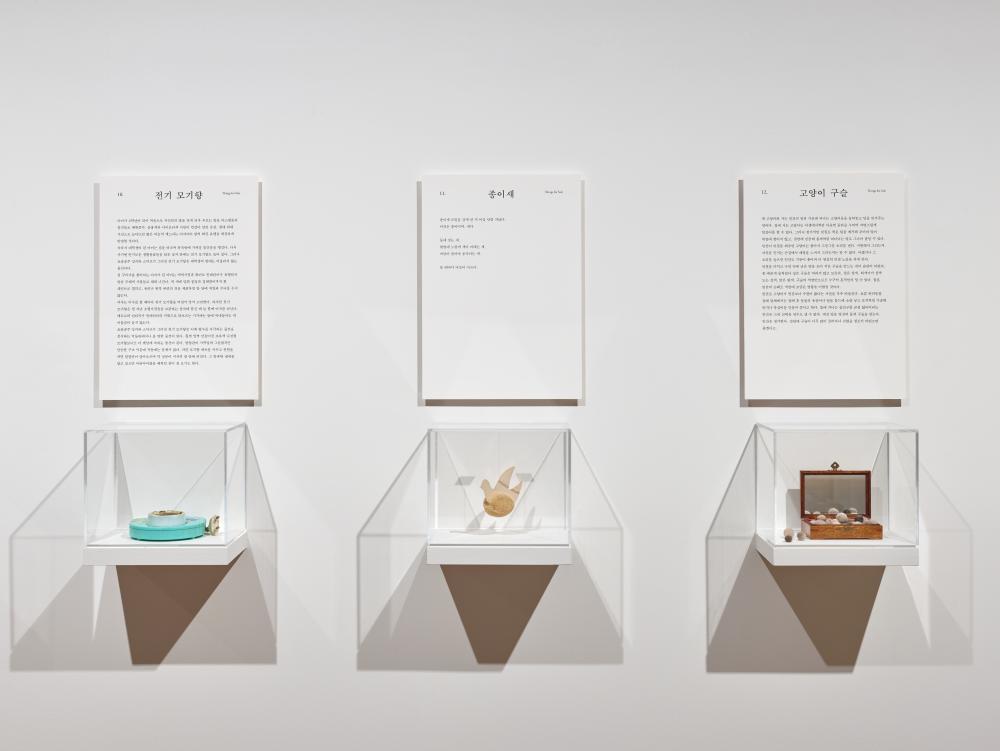
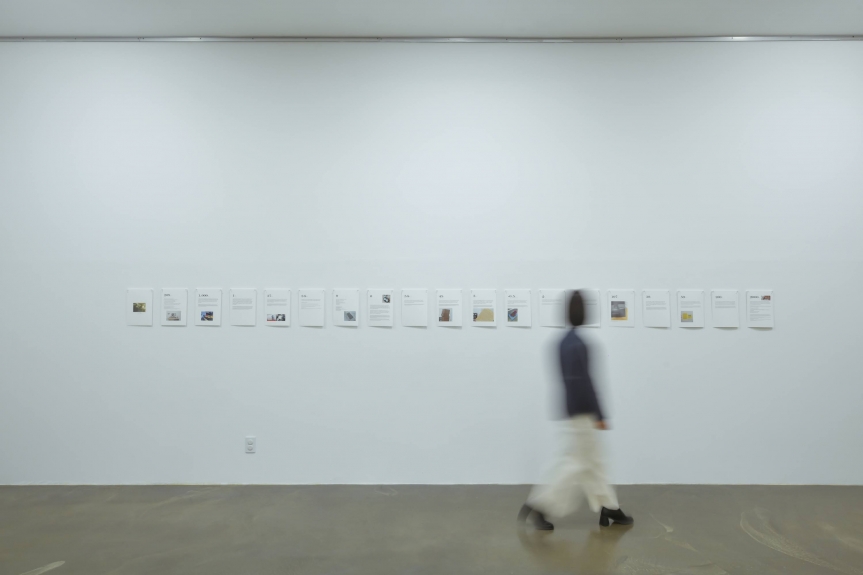
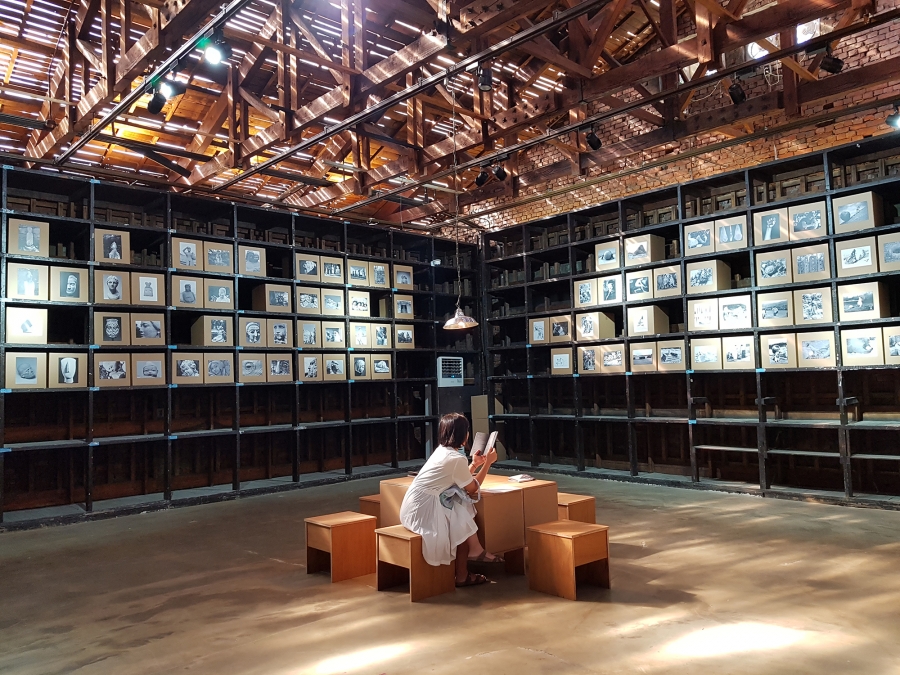
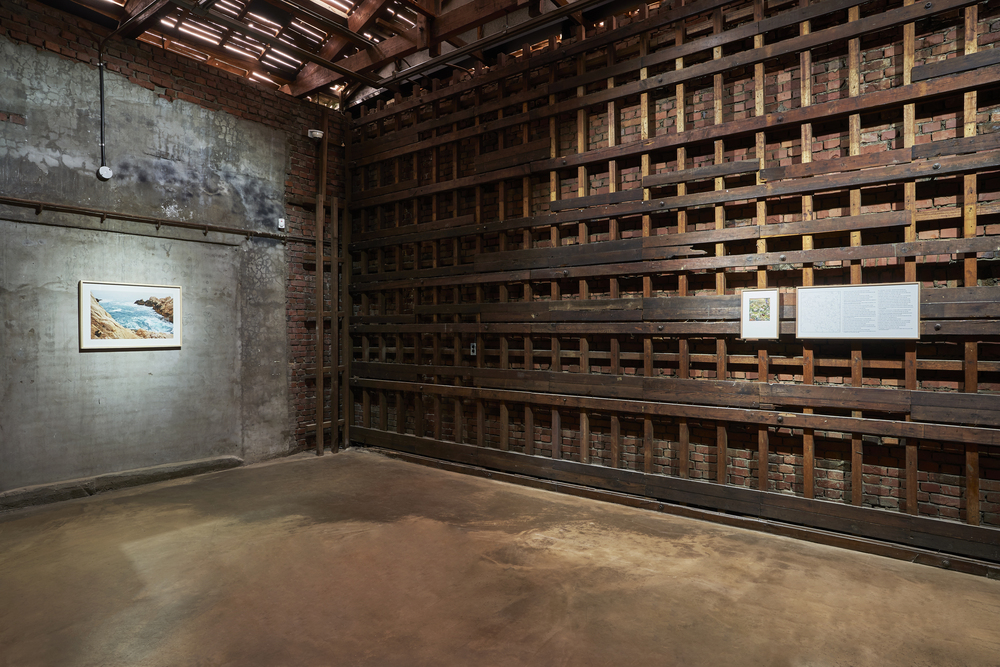
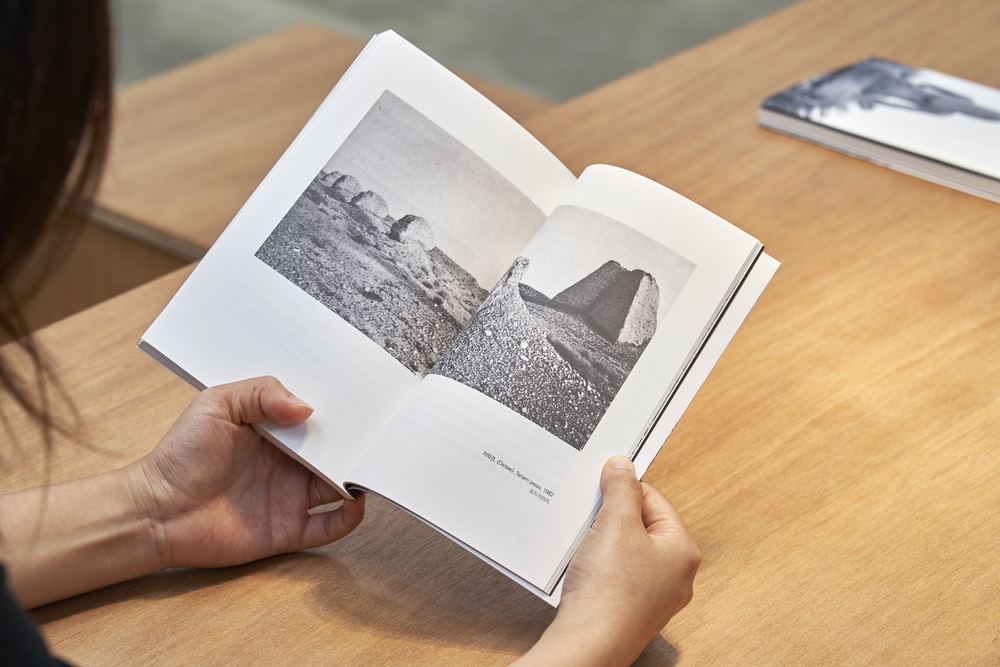
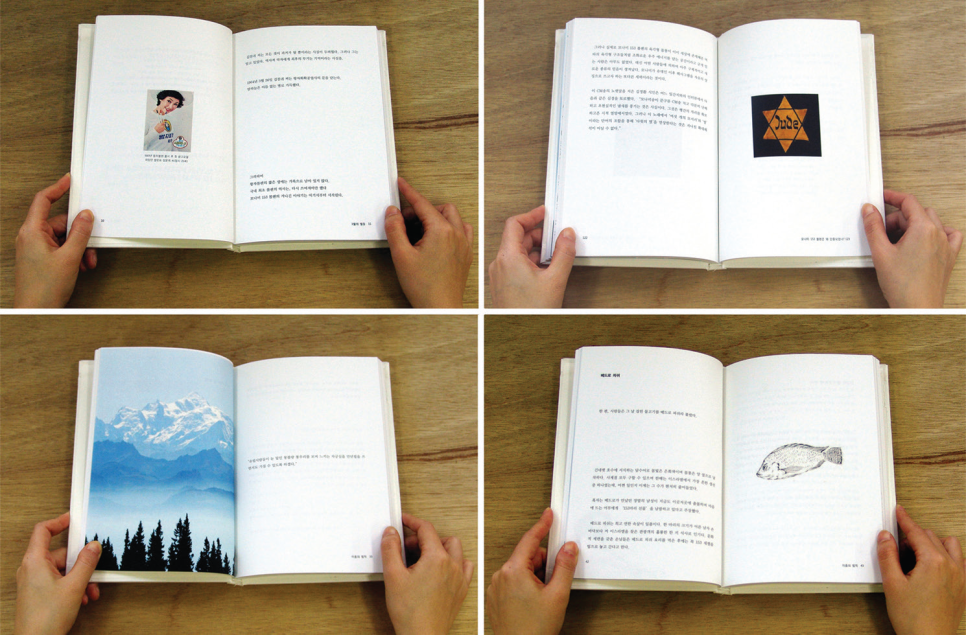
Installation view of 《Captive Stones》 © SeMA Storage

In this essay, I would like to add several meaningful speculations to Youngle Keem’s story of stones. In this exhibition, Keem constructs a rich narrative encompassing personal reflections and art criticism by surveying the cultural and artistic histories of stones across time and geography, centering on her vast collection of “stone images.”

If there remains a role for this essay to play, it may be to recall both Youngle Keem, the artist who initiated the various thoughts and acts of storytelling surrounding “stones,” and the materialist virtues of art—or artworks—that can be projected onto the “stones” captivated by Keem. Here, materialist virtues do not simply refer to artworks in their material conditions.

Rather, they may be understood as resembling art’s own internal dynamics: something assumed to be art; something that becomes art by referring to a particular subject outside art; or something that speaks of art not by presenting or recording it, but by revealing that art is no longer present or visible—that it is instead absent or concealed.

This process of thought can therefore be regarded as a method of contemporary art that enables us to perceive art through a dialectical logic concerning the relationship between what traditionally belongs to art and what does not. Art in which the object does not appear in a tangible form—in other words, artistic practice and thought in which the activity itself, rather than the result or product of creative activity in the traditional sense, constitutes art—is, in certain respects, both an act coinciding with life and a performative form of art.

This is because it reveals the process of contemplating art and the subject who undertakes that contemplation more fully than any artistic outcome. When such acts of thought or their processes appear within an exhibition space, questioning art through the means of artistic thought itself seems almost like a privilege of the contemporary artist. After all, art can emerge solely through an exploration of the assemblages of images and ideas that construct and compose objects from reality, rather than through the fine-art ideal of creating something—or some form—out of nothing.

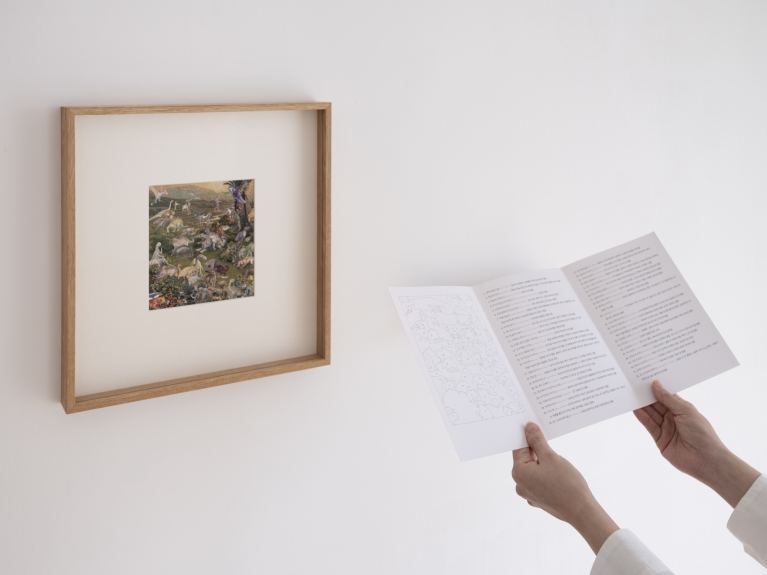
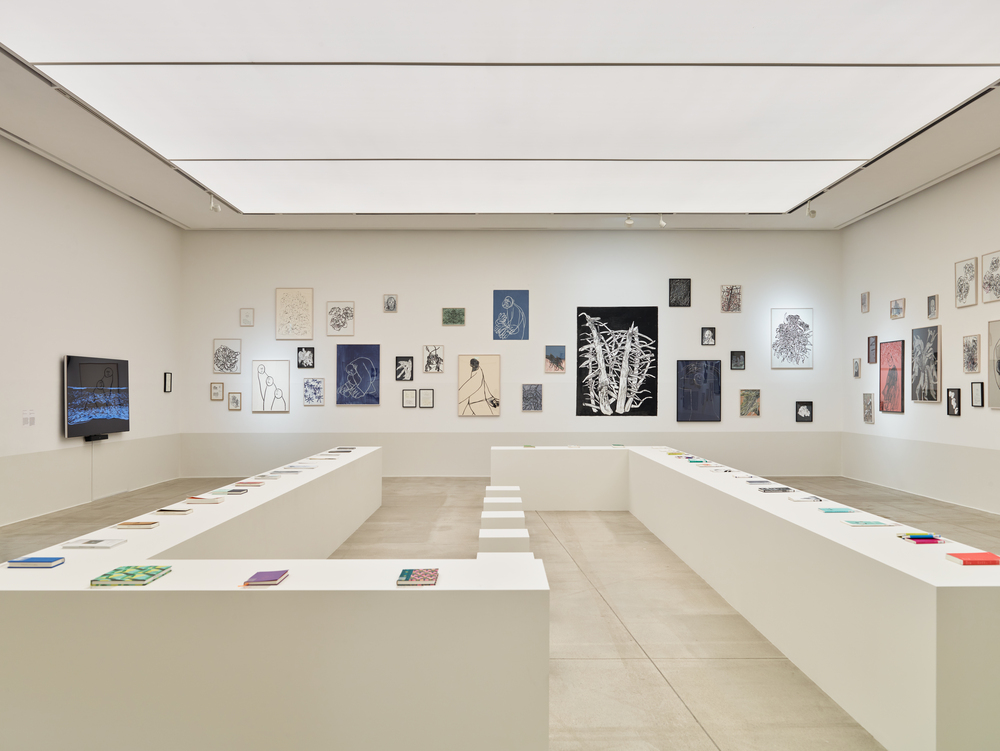
Youngle Keem’s exhibition 《Captive Stones》—or rather, her artistic storytelling—begins with Unposted Letters, a collage made from a collection of postage stamps depicting extinct species. A postage stamp is a means of communication used to send a letter and a token indicating that postage has been paid in advance, but it is also a kind of “artwork” that preserves on a small piece of paper a visual record of different eras, histories, cultures, and subjects.

The two frames that comprise Unposted Letters contain a collage bringing together extinct creatures on a single page—including the Yangtze River dolphin, giant sloth lemur, Tasmanian tiger, saber-toothed tiger, and Australopithecus—and a list of their names. The fictional image in which vanished creatures no longer in existence gather in one place appears, in a sense, to depict an ideal community, while the rare names that are difficult even to read or remember, together with the dates of their extinction, may be read as a monument to life on Earth.

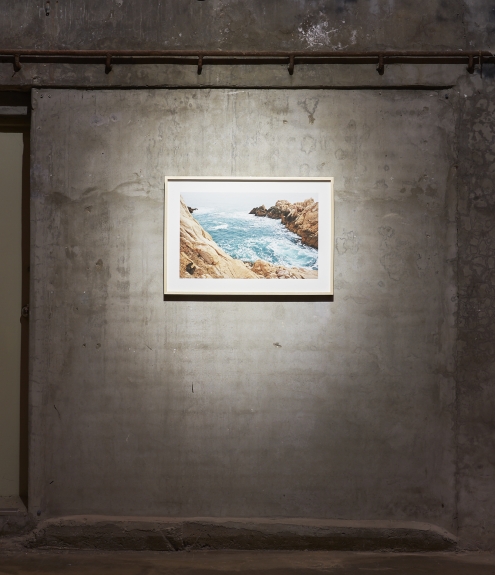
Yet this record of private collection and memory opens the exhibition’s prologue in a tone closer to a serious joke. The photograph placed next depicts a seashore with jade-colored waves rolling across it.

Taken from the viewpoint of someone looking down at the waves from the edge of a rock, the photograph’s title, Fable, seems to declare that the world of stories about to unfold will attempt to deceive you by establishing a mysterious and unreal point of view. Thus, as though descending beneath the sea to meet the Dragon King, we enter the fictional world of Captive Stones presented by Youngle Keem.

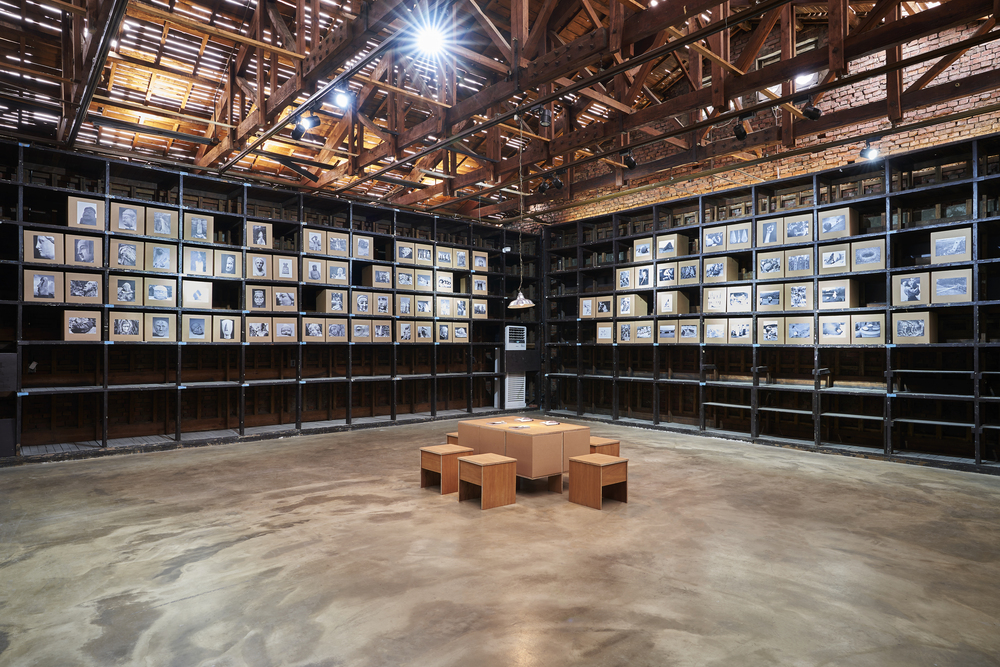
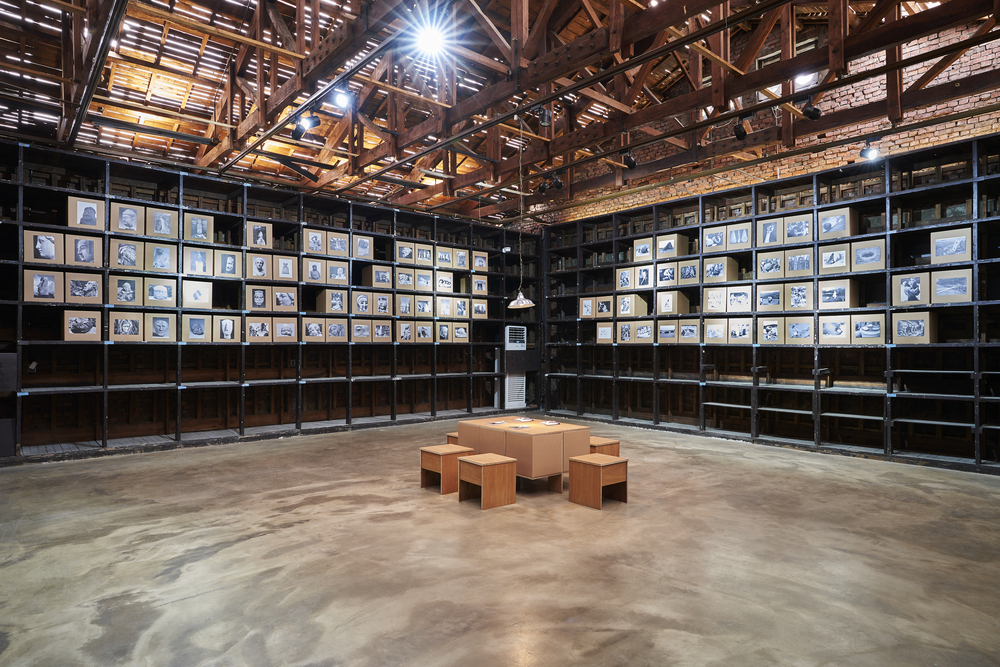
Inside the large rectangular exhibition space, various stone images collected by Keem are attached to individual faces of corrugated cardboard boxes and stacked in layers. Examining this assemblage of images, titled Stone Study, one finds that it is divided across the four walls of the rectangular gallery into four chapters: “Faces,” “And God Saw That It Was Good,” “Foundations, Handles, and Those Who Bear the Weight,” and “An Incomplete History.”

The first chapter, “Faces,” is a collection of images of faces remembered, narrated, and produced throughout the long history of humanity, including Jeju’s dol hareubang stone statues, the Statue of Liberty, Michelangelo’s David, the Sphinx, Buddhist statues, statues of Jesus and the Virgin Mary, and colossal Olmec heads from Mexico.

The second chapter, “And God Saw That It Was Good,” begins with Renaissance group paintings and stone statues of child monks before proceeding to a collection of images that includes various stone cairns, phallic stones, and vaginal stones. Its subtitle, evocative of the title of a “sacred image–fable,” may also be interpreted as an assemblage of the everyday and secular positioned in opposition to the hierophany glimpsed in “Faces.”

As in the act of stacking ordinary stones into a cairn to express a wish or desire, or the desire to believe in a transcendent being, the transition into the second chapter prompts us to contemplate the dual structure of the sacred and the profane, and to reconsider the sacred through the profane.

The third chapter is titled “Foundations, Handles, and Those Who Bear the Weight.” The Korean words teomuni and eocheoguni are rarely used on their own and are usually combined with the verb “to be absent,” forming expressions that convey bewilderment at a situation lacking reason or logic. According to their commonly cited etymologies, eocheoguni refers to the wooden handle used to turn a millstone, while teomuni refers to the patterns or traces left on a site where a house or structure once stood.

A millstone cannot be turned without its handle, and without traces of its foundation there is no way to know that a house or structure once existed. These two words therefore point to a logic in which something seems self-evident when present, yet becomes absurd when absent. Those who “bear” what cannot be absent and must necessarily exist ultimately connect to human beings and human life itself.

The final chapter, “An Incomplete History,” comprises photographs that reconsider the traces of life and expression engraved in stone, as well as the essence of stone itself as evidence of existence. A sequence of images—from Stone Age tools used for hunting, Egyptian hieroglyphs carved into stone, drawings on walls, and cave paintings in Argentina to the Earth seen from space and humanity’s first landing on the Moon—reveals the mysteries of humankind and human existence that remain absent even from recorded history.

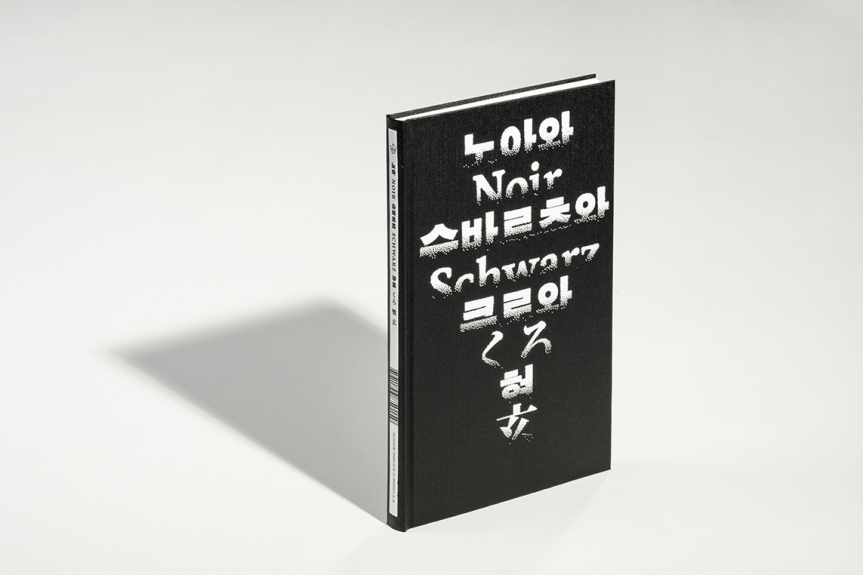
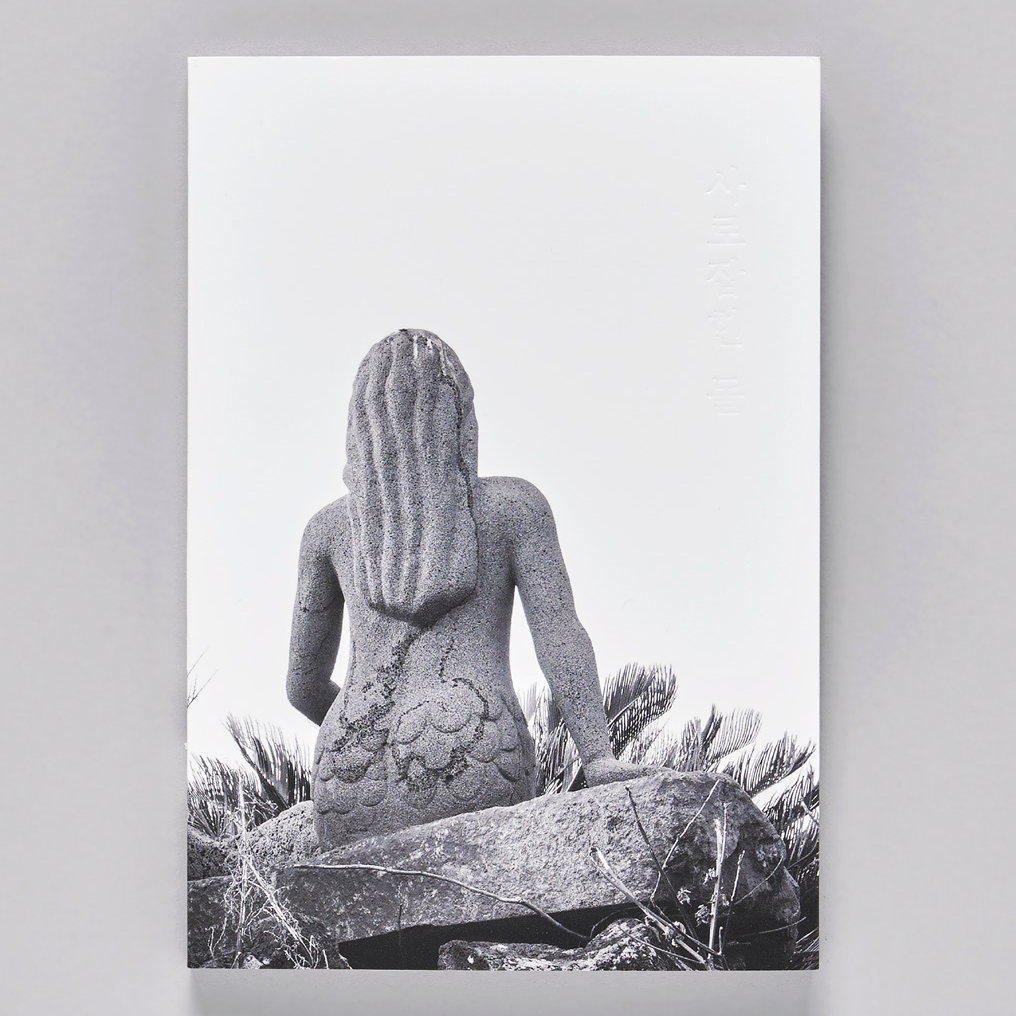
Finally, it is the book Captive Stones, placed at the center of the exhibition, that completes Keem’s fable, which uses stone as a fulcrum to explore the distance between art—or an artistic life—and reality. The stepping-stones linking one image to another across the exhibition while maintaining an appropriate distance from art itself emerge from her eloquent command of language. By this point, we begin to wonder whether it is the stones that have been captivated by Youngle Keem, or we who have been captivated while looking at the various stones and listening to her stories.



Installation view of 《Captive Stones》 © SeMA Storage

Youngle Keem has long been known to us as an artist who writes. 10 Facts about Monami 153 (2010) is a book that reconstructs the life of the inexpensive, nationally ubiquitous Monami 153 ballpoint pen from its launch to its eventual discontinuation. Organized around various images spanning the authoritarian and violence-ridden decades of the 1960s through the 1980s, the book manipulates the landscape of the era in which “Monami” was born and lived through a language of compassion and humor.
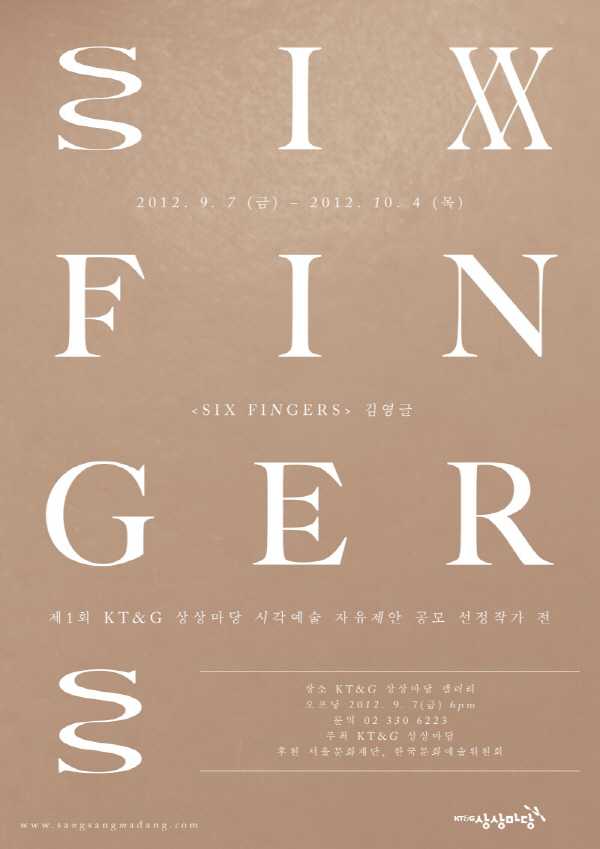
Another book work, A Wall (2011), proceeds through a wall, a tree, a bird, monsoon rain, a pair of large parentheses, a book borrowed by a secretary, fleas, an alchemist, a pebble, a jar, a potter, a peddler, a window, a bird, and finally a tree. Its central scenes consist of text pursuing objects, people, and situations as it fills and then empties the white pages.
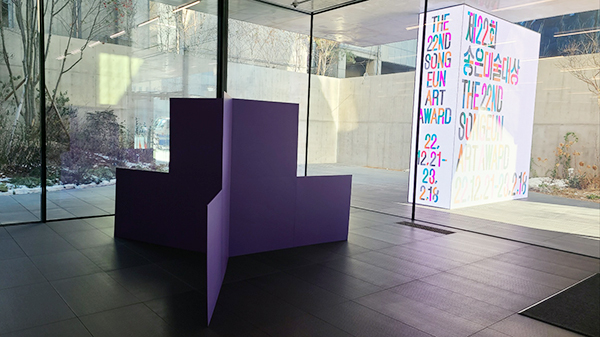
Rather than any particular narrative being important, as one follows the audiovisual procession in which one word chases another, one suddenly finds oneself transported into the time and space proposed by the pages, carried along a chain of linguistic play. The most recently presented work, Searching for Seahorse (2016), is a video work—a kind of video essay in which reflections on forgotten human histories and the properties of memory, metaphorically embodied by the “seahorse,” are arranged through images and sound.
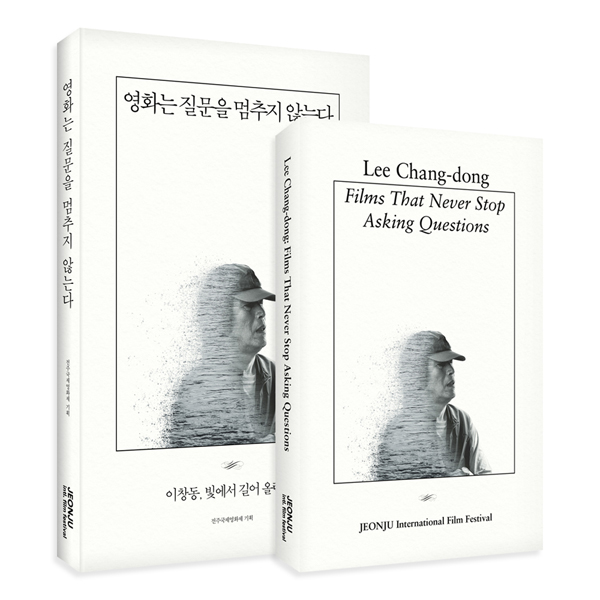
The Korean word for “seahorse” also refers to the hippocampus, the part of the brain responsible for memory, as well as to the marine animal. By juxtaposing various representations of the “seahorse,” historical documentary photographs, and the artist’s private images, the work ultimately reveals the phenomenon through which language as collective memory is forgotten.

As this body of work suggests, in Youngle Keem’s artistic world, “books” and “writing” serve as primary media for constructing particular narratives and, through those narratives, questioning our established ideas. The various images she presents in this process function as triggers that activate the narrative.

Their operation begins by unsettling the fixed assumptions through which we recognize universal and commonplace images, and by questioning the signs and meanings those images carry. Through the words she conveys, Keem enables us to see anew images we believed we already knew, thereby constructing a thoroughly manipulated structure of perception that draws us, almost without our awareness, into an unknowable narrative world.

In other words, although Keem’s storytelling unfolds as smoothly as an orally transmitted folktale, it is in fact nothing more than a “tall tale.” Just as truth emerges from behind the lies of good fiction, our role as viewers and listeners of her fabricated stories is simply to receive the newly unfolding mental images and to recognize anew how familiar images and language begin to function as different signs.

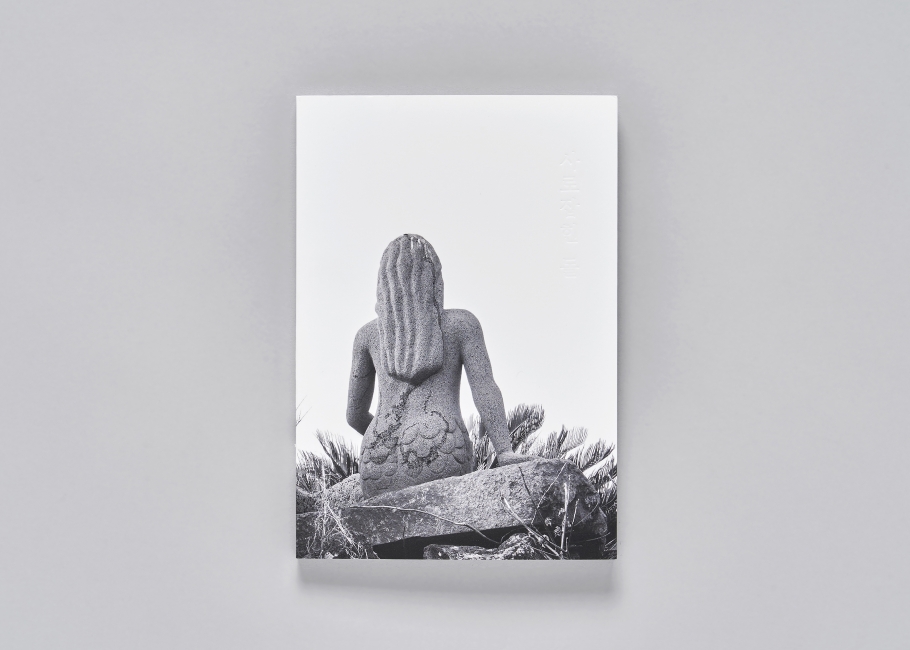
Upon entering the provisional exhibition space of SeMA Storage at the Seoul Museum of Art, one encounters the gallery surrounded by densely arranged images of stones transcending time and space, mounted on temporary photographic frames made from corrugated cardboard boxes. At the center of the exhibition stands a somewhat fragile desk and chair made from the same cardboard boxes, where we read Captive Stones, both a principal work in the exhibition and a book that simultaneously performs the function of an artist’s book.


Youngle Keem, Captive Stones, 2019, Book, 136 pages, 13 x 19 cm © Youngle Keem

In this book, works by senior artists such as Park Chan-kyong, Kim Beom, and Haegue Yang are discussed as direct references for contemplating stones as works of art. In Chapter 7, “Dreaming Stones,” Kim Beom’s The Tree That Became a Man and Found Its Own Picture in Its Dream (1998) and A Rock That Was Taught It Was a Bird (2010) employ the so-called “wordplay” of art to encompass not only a complex point of view in which the positions of speaker, viewer, and witness mutually disrupt one another, but also an “Anthropocene problem” that satirizes humanity’s arrogance. 
 
These works can be interpreted as references for one of Youngle Keem’s principal artistic methods: destabilizing systems of perception by creating a discrepancy between our fixed ideas about objects and what words purport to designate.

In Chapter 11, “A Pair of Backs,” an image from Park Chan-kyong’s Minhak_Rock Man (2010) is cross-edited with German Romantic painter Caspar David Friedrich’s Wanderer above the Sea of Fog (1818), presenting the tragicomic backs of human figures who, separated by approximately two hundred years and situated in the East and West respectively, attempt to confront the overwhelming grandeur of nature with audacity.

Among the many images of the artist available to us, the photograph of this “Rock Man” evokes the figure of the artist as an ideological Romantic whose imagination centers on a return to nature and the inner world of the human being. Moreover, this Rock Man, who climbs a rocky mountain in a suit in search of evidence for the idea of the nation, may serve as a reference for the “local artist” situated within complex temporal, spatial, and social conditions.

In Chapter 21, “Round Things,” Keem observes the progression of images in Haegue Yang’s Three Kinds in Transition (2008), in which rounded objects—including a globe, beads, and a polyhedral origami object—circulate in sequence, and is reminded of a transition between geological epochs.

Through the polyhedron presented here, the conceptual notion of “space” is apprehended as an arbitrary three-dimensional Euclidean space defined by the XYZ axes, before being connected once again to the irregular three-dimensional object of a stone, opening onto the horizons of Keem’s personal interpretation and thought.

I would like to add one more artist to this list. This artist may have little to do with “stones,” but has much to do with “words.” John Smith is a British avant-garde artist and experimental filmmaker whose works, including The Girl Chewing Gum (1976), demonstrate an experimental return to the material conditions of film itself against the backdrop of everyday life in East London.

Shot on 16mm film, the work unfolds the scenes recorded by the camera in sequence, while the artist’s presence is unexpectedly revealed and the viewer’s presence simultaneously brought into play. Put simply, in a film that initially appears merely to observe an ordinary street scene, the filmmaker suddenly enters through a voice-over.

The viewer, who had been concentrating on the visual narrative conveyed by the film, becomes aware that the landscape has been constructed by someone. The work derives its meaning from expanding the process of film production and the logic of creation in order to question the authority of images and words as signs that communicate meaning. Its entire message is that what we see and come to believe is not truth, but manipulation.

As we read and look through Captive Stones one page at a time, much as we watch John Smith’s film, we become captivated by the impression that Genesis itself must have declared stones to be the bones of the earth, and that the ideas about stones we have long seen and believed are inscribed into the stone images spread across the book.

Keem’s language, which offers multiple alternative approaches to the way we have previously viewed stones, goes beyond textual language alone to produce a language encompassing new ways in which language and cognition operate.

This becomes meaningful when we, simultaneously readers and viewers, become consumers of the meanings provided by the work and are naturally incorporated into the process of artistic production she presents. What we may respond to here is the method of manipulation—and the vitality—of an artist attempting to reveal the worlds of the visible and the invisible.

Youngle Keem’s mode of artistic production, which presents art nowhere and instead merely collects and narrates records concerning “stones”—objects that appear utterly unremarkable yet are materially fundamental—ultimately presupposes a romantic belief in and vision of art.

As Boris Groys has argued, documentation inscribes the existence of an object into history and endows that existence with life; regardless of whether the object was “originally” alive or artificially produced, documentation grants it life itself. The distinction between the living and the artificial is therefore entirely a narrative distinction. Through narrative, an object is given a genealogy and an origin, acquiring a new life and existence.

In Captive Stones, we have undertaken a rich journey of thought by following the universal aspirations and modes of expression that humanity has naturally drawn and produced over an immense span of time. Stones and images of stones, which might otherwise amount to nothing, acquire various new interpretations and signs within Keem’s narrative, achieving an expansion and appropriation of meaning.

As noted earlier, just as fiction is ultimately a lie, her narrative is also, as declared from the outset, a fable—that is, a falsehood. Yet its purpose, paradoxically, seems to lie in the honesty required to reveal truth. Questions surrounding signifiers to which value may or should be assigned remain valid only within an order in which hierarchies and positions of value themselves carry meaning.

Questions surrounding signifieds such as the meaning, authenticity, novelty, and interpretation of art can arise only when the order of signifiers is at work. By manipulating the signifier of art, Youngle Keem honestly questions anew the signified called art; she seems to ask whether art can be believed.

References