❉ If you take a few small steps
into the room, there is small blue marble that sparkles like a pupil shining in
the darkness. The blue glass marble—which is inexplicably resting at the edge
of the stairs that descend below one’s feet—appears to be suspended between the
internal force of the form and the external force that envelopes it. This blue
spot, like a “keystone,” appears to be holding up an invisible wall, and it
creates the impression that it may even be responsible for maintaining the
stability of the entire space. The marble under the feet appears again as a
spot at the very moment that the body, after descending down the stairs, turns
in a fan-shaped arc, creating a sparkling apparition in the air.
The expression “daytime moon” refers to the moon in the western
sky after sunrise. The daytime moon moves along a parabolic arc in the sky
throughout the night, and once the sun rises, it turns yellow, then white, and
then hangs in the air for a while before disappearing into the sun. Observing
the daytime moon means reawakening one’s sense of lying on the ground on the
boundary between night and day while gazing into the empty space above; the
experience is accompanied by a sensory and cerebral exploration of the
mysterious reality that exists in the space-time that occupies the liminality
between night and day. If the chain of movements that begin from the blue
marble—such as the rise and fall (of the body) and the standing-in-place and
rotating—are made to conform to the sensations under feet that are subject to
the immense power of gravity, then the appearance of a ghost-like figure will
catch the eye like a daytime moon in the space where the light entering from all directions and the
shadows cast over every corner of the space intersect.
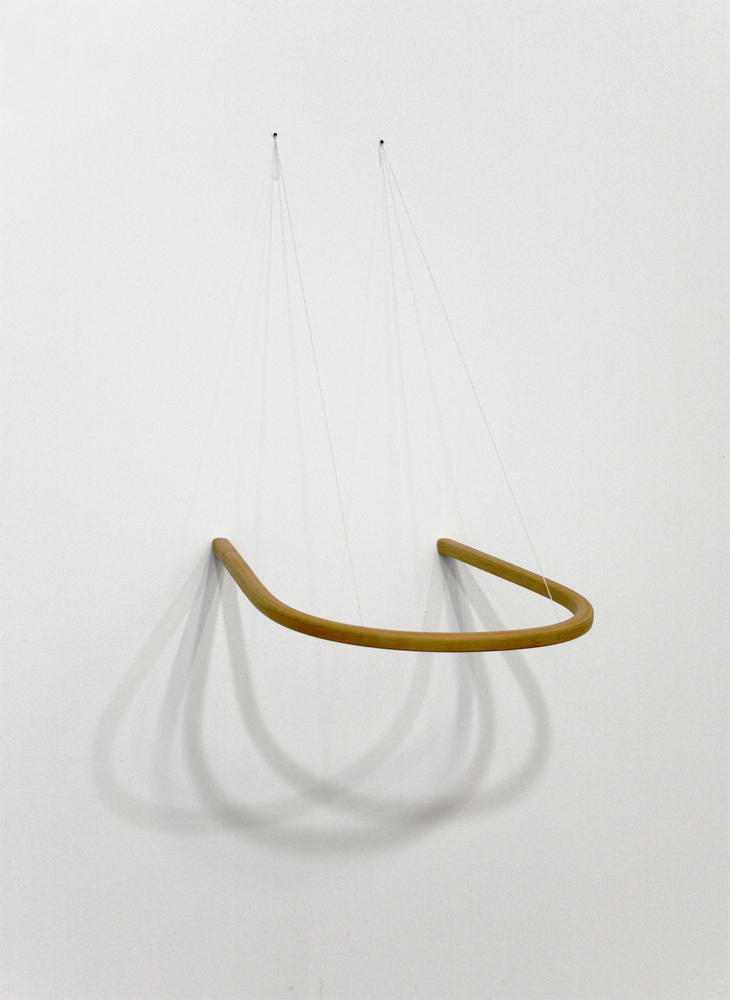
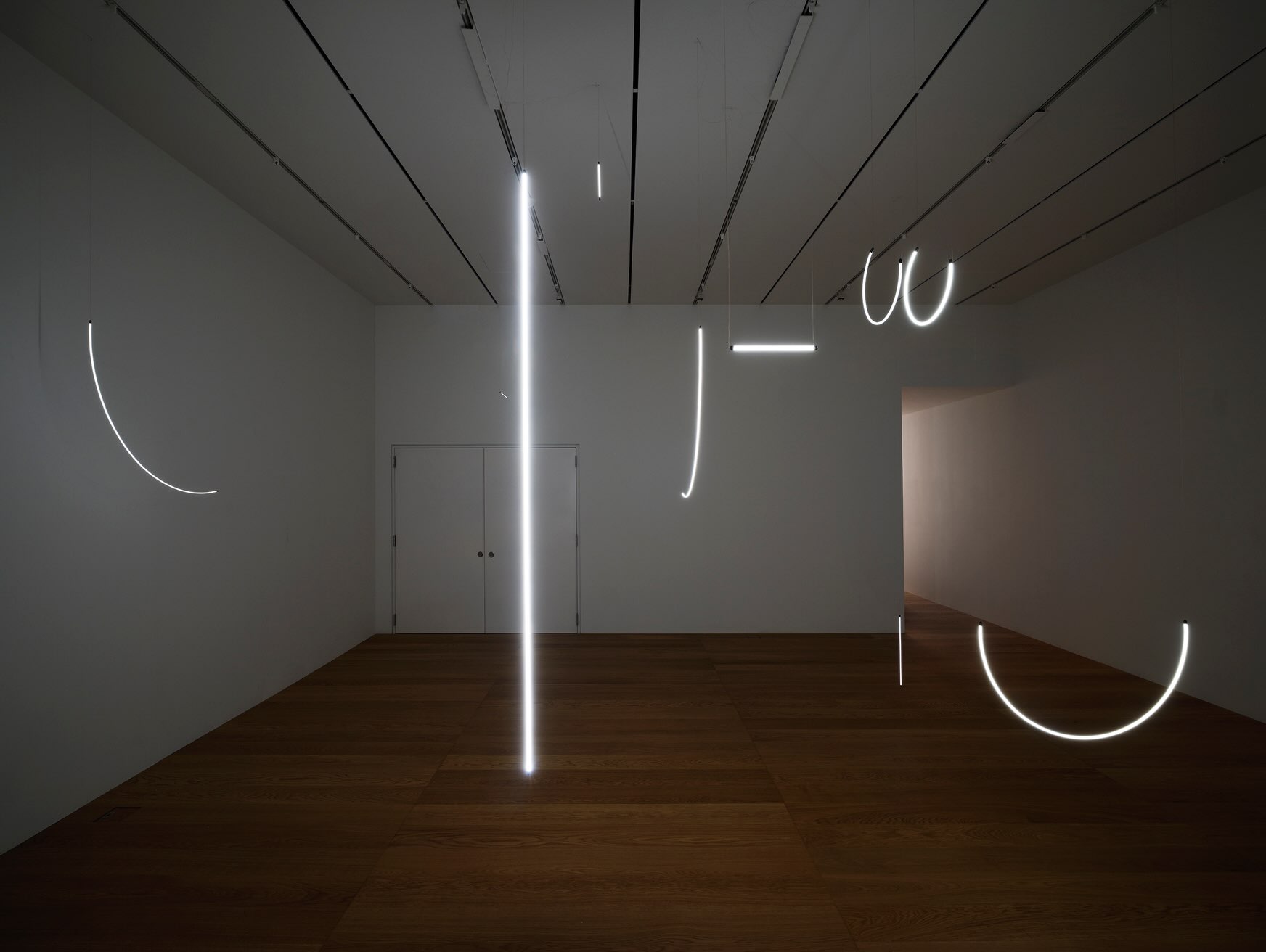
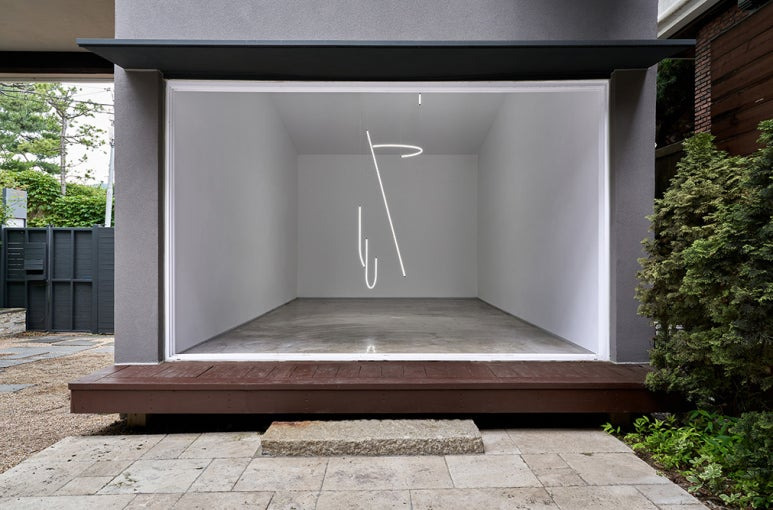
❉ The work Parallel
Drawing (semicircle, gold) #1(2022) exists in the space between the
light and shadows that penetrate the space, and like the daytime moon, it moves
back and forth across the liminal space between presence and gaze. The
semi-circular shape hanging diagonally from the ceiling by a thin gold chain
reveals itself to be magically changing its existence in response to external
conditions that penetrate into the empty space of the gallery. At first, the
geometric semicircle appears to be an imperfect object that either rises up or
collapses; however, due to the twinkling of the gold chain, it appears that no
matter where it is in reality, its shape is difficult to grasp completely. This
undefined state of being appears and then disappears within the light and
shadows—in order to exist, it demands one’s “imagination” and “perception.”
This happening may be interpreted by some as a sculptural event;
however, let’s consider the words of Herbert Read (who long ago declared
himself a friend of sculpture) on the question of “What is sculpture?” “It therefore requires an imaginative or at
least a mental effort to pass beyond the memory image and construct a
three-dimensional image. We are aided in this task by other sensations or by
the memory of such sensations—sensations of touch and weight.” (Herbert Read,
The Art of Sculpture, 1954: 27)
In the context of Read’s thoughts on sculpture, Jong Oh’s Parallel
Drawing (semicircle, gold) #1 attempts to account for all the
sensations that approach the reality of the semicircle that glitters in space.
It is as if it slowly reveals its ability to take shape in space by drawing on
a sense that goes beyond the simple perception of the daylight moon that
appears as the sun begins to rise.
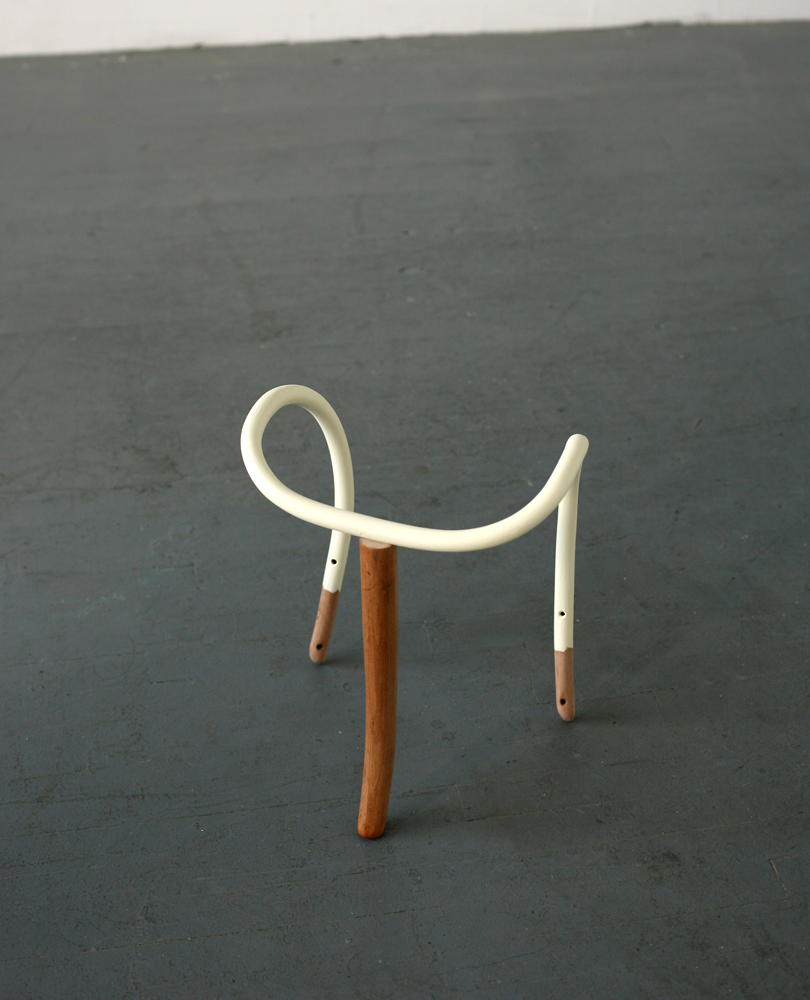
The stairs with the blue marble next to the diagonal line are
titled Line Sculpture #22 (2022). Halfway to the edge of the
staircase with the repeating right-angled structure, there is a white banister
that stretches from the basal plane of the wall and the stairs into the air,
and it functions like a single object. The softly curved edge of the railing
forms an obtuse triangle, leaving extra space for the diagonally descending
movement while connecting one point with another (invisible) point, conjuring
up the sensation of descending and rotating again. At this moment, the blue
marble, like a keystone or an enlarged pupil in the dark, perceives the
presence of “some shape” in the open air and induces the body to move toward
that dimension of reality. The subjects of perception, imagination, and
movement form a collection of “human figures” that merge the body of the artist
and observer, forming a three-dimensional sculptural experience.
Read addressed the ability of the human body to perceive
three-dimensionality; he states that through “physical sensation,” we can
“construct the body image.” Moreover, by “a means of establishing a sense of
real existence,” the experience of the three-dimensional image of another
person/thing is emphasized. That is, one’s awareness of the three-dimensional
presence of a certain shape is made concrete by reflecting and projecting one’s
bodily sensations and existential form on the object. Line Sculpture #22
is actualized through the reflection and projection of the bodily sensation
that exists at the intersection of perception and imagination. Jong Oh takes
the architectural structures of walls, stairs, and banisters as the conditions
of his artwork and then produces a series of props using linear elements. These
objects—which occupy the corner where the large wall and short stairs meet
while forming an absolute balance and supporting each other—reject a single,
complete outline while accumulating in the air the various changing sensations
created by a body in movement. As they reflect off each other, the accumulated
sensations convey a sense of ghost-like fullness that is reminiscent of a
completely filled vacuum within an empty space.
❉ As can be deduced from the
title, Jong Oh’s Line Sculpture #22 works maximize the
potential of the line as a necessary element for the sculpture to occupy the
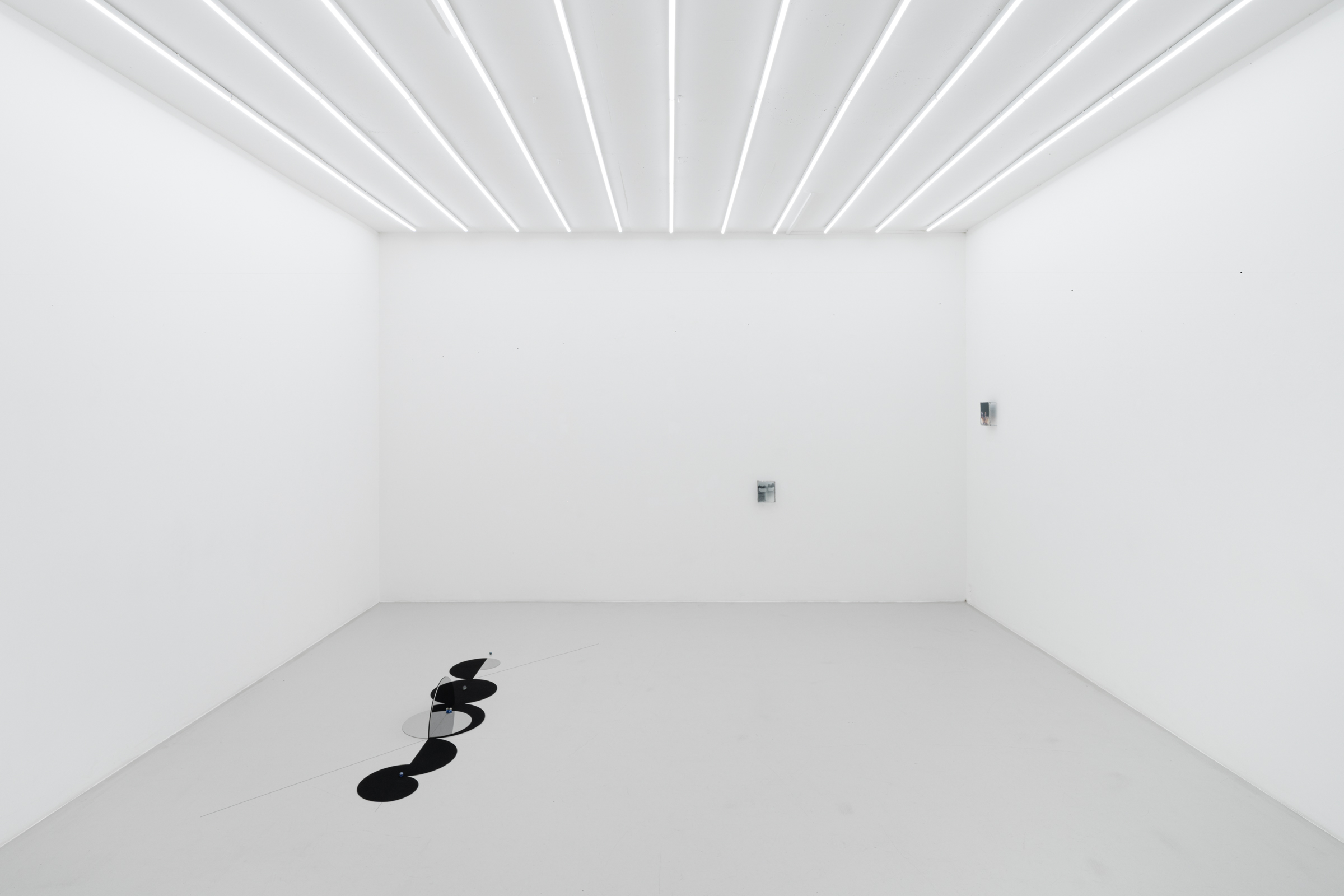
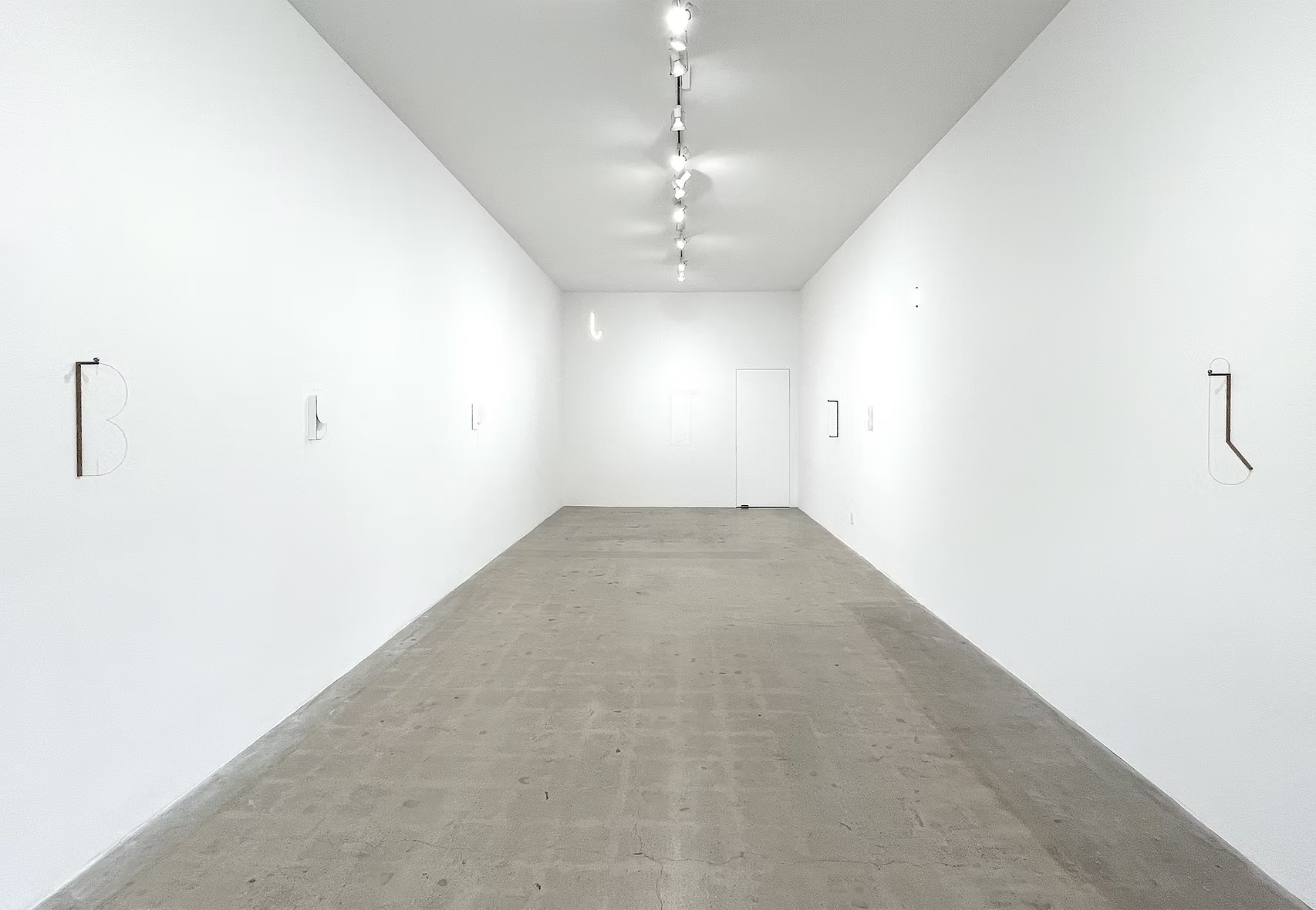
gallery space. Line Sculpture #24 (2022) is located between
the floor and the final wall that is at the bottom of the stairs that have the
blue marble. The straight lines and dots strive to reveal a series of
equilibriums to construct a three-dimensional structure, and, like standing up
bodies lying on the ground, they vaguely imply “an abstract reference to the
body” and, in turn, express a new space. The dynamics of force that raise up
and support a random shape within a space—be it balance, compression, or
friction—are reminiscent not only of human anatomy but also of the physical relationship
between bodies. This is similar to how Richard Serra drew a connection between
his own sculptural works and moments of equilibrium in the dance works of
choreographers Yvonne Rainer and Trisha Brown, which were created through the
energy that is exchanged from body to body and from body to object.
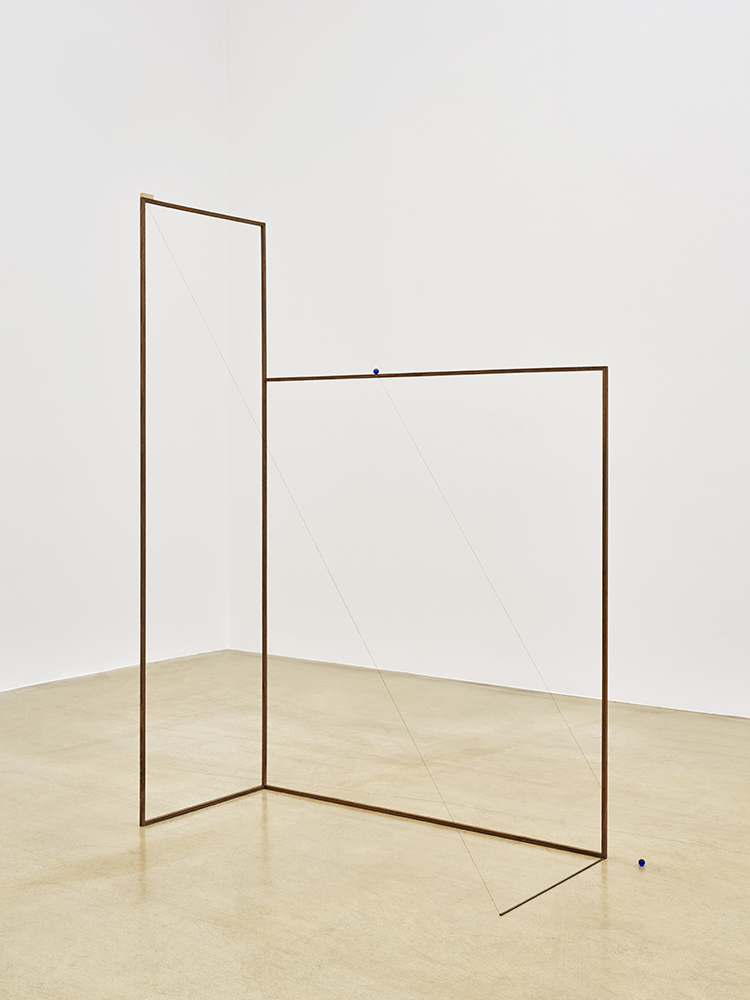
In Line Sculpture #24, lines meet at right
angles to form a transparent surface, and surfaces adjoin each other at right
angles, forming a geometric space sharing a single edge. This new space
constantly transforms the structure that encompasses the random/multiple
shapes; this is not only a reflection of the energy between the constructed
objects but also the reflection (related to perception, imagination, and
movement) of the body that mediates between constructed space and real space.
Long ago, Serra approached this problem as one of “sculpture.” His initial
works, which used metal plates made of lead and steel, are related to the body.
Serra has said that when he stands up a flat object from the floor in a certain
way, the object violates and partitions the space, giving expression to the
entire space. He claimed that a sculpture that is constructed from a flat plane
is similar to a (choreographed) body because when it is stood upright/appears
in a space, a series of spaces become open wide, and an event that gives
expression to the entire space is created.
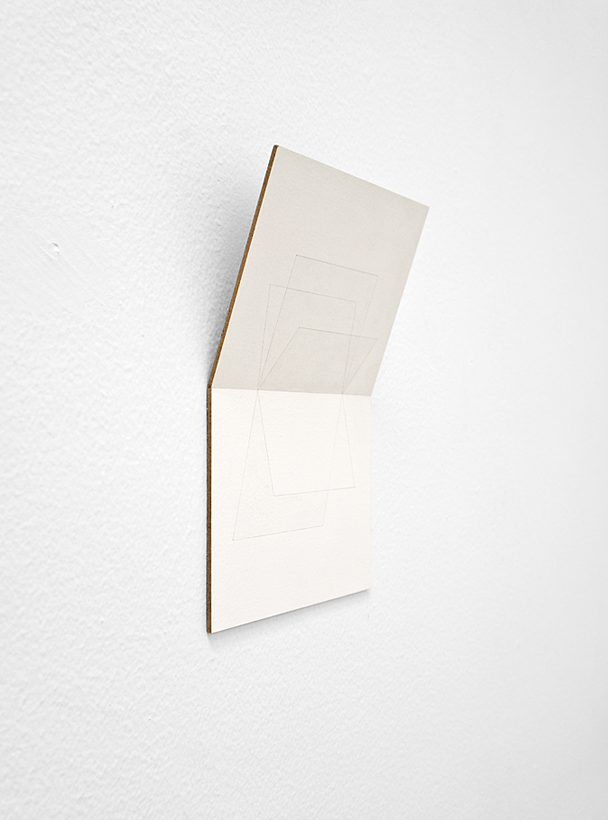
In the process of creating a series of sculptural moments that
express space through perception and imagination, Jong Oh presents the line as
an abstract component that can invade space and facilitate the exchange of body
and power. His lines are connected to the sensation of being constantly pulled,
compressed, and rotated like a beam of light or the outline of a shadow.
Sometimes these lines are made to stand upright from the pull of gravity
created by hanging stones and weights. Simultaneously, the lines that fall away
from gravity encompass space and the body, and like the optical illusion of the
daylight moon between illusion and reality, it creates the feeling of existing
far away from the ground while making large, slow rotations.
❉ At his solo exhibition 《First Echo》, Jong Oh
is clearly seeking to explore space vertically. Like a fault line in the
earth’s crust, the floors of the gallery space are of mismatched heights,
resulting in a zigzag structure to the floor—an architectural feature that Jong
Oh seizes on for his works. In this way, while windows, stairs, and edges
effectively connect the borders between spaces, the sense of a spiral
motion—which is embedded deep within the space—is activated by Jong Oh’s
drawings and sculptures. As an extremely visual sign, the title of the exhibit
itself appears to be an important clue for understanding how movement operates
within this vertical space. This
compressed phrase implies various three-dimensional sensations—such as gravity,
volume, and weight—as if it were its own center of gravity within the
space. On the bottom floor, where
gravity is strongest, heavy weights and marbles are busy striking vertical lines
in space, like the symbol of the blue marble under the feet.
Room
Drawing (light) #2 (2022) creates a state of equilibrium out of thin
chains and colored threads by using the walls and railings as its canvas in the
middle floor in a space where all the floors are misaligned. In fact, in Room
Drawing (light) #2, it is exceedingly doable to imagine the physical
limits to experiencing a three-dimensional space; this is because one can
experience the single moment of the endless reflection of the power, distance,
and gaze that exist in the space between the body (me), object (created through
lines), and light (sun rays). This can be referred to as confronting a
three-dimensional outline in front of the body (rather than being seen as an
illusion) by virtue of a kind of cosmic force in which the gravity under one’s
feet reaches the air and is converted into sunlight. What should I say about First
Echo #2(2022)? The rectangular, parallelepiped structure, which lies
horizontally in the hollow space between the ceilings, appears like a ghost,
revealing minuscule waves caused by air and small segmentations created by
light. , which instantaneously subverts a sense of space, returns the
body—which through a spiraling motion has risen upwards back to the ground. As
if standing at the bottom of a well, and with the added weight of the
possibility that the Parallel Drawing (semicircle, gold) #1 that
I saw was actually not real, but simply the illusion/shadow of the moon
reflected in the well, one person’s perception and imagination reflect off one
another and place the social experience of three-dimensionality in the space
between allusion and existence. Indeed, this is because everything that floats
sparkles.
Like the two exhibition titles of “Starting from a Low Tone” [the
Korean-language title] and “First Echo,” gravity and sunlight, earth and air,
existence and illusion, perception and imagination, like twins, explain the
sensation of the body mediating between objects and space in a
three-dimensional manner. This is the unique aesthetic approach of Jong Oh, who
has interrogated the position of “drawing” and “sculpture” within the
relationship between the most minimal objects and bodily gestures in the context
of the three-dimensional characteristics of a space.