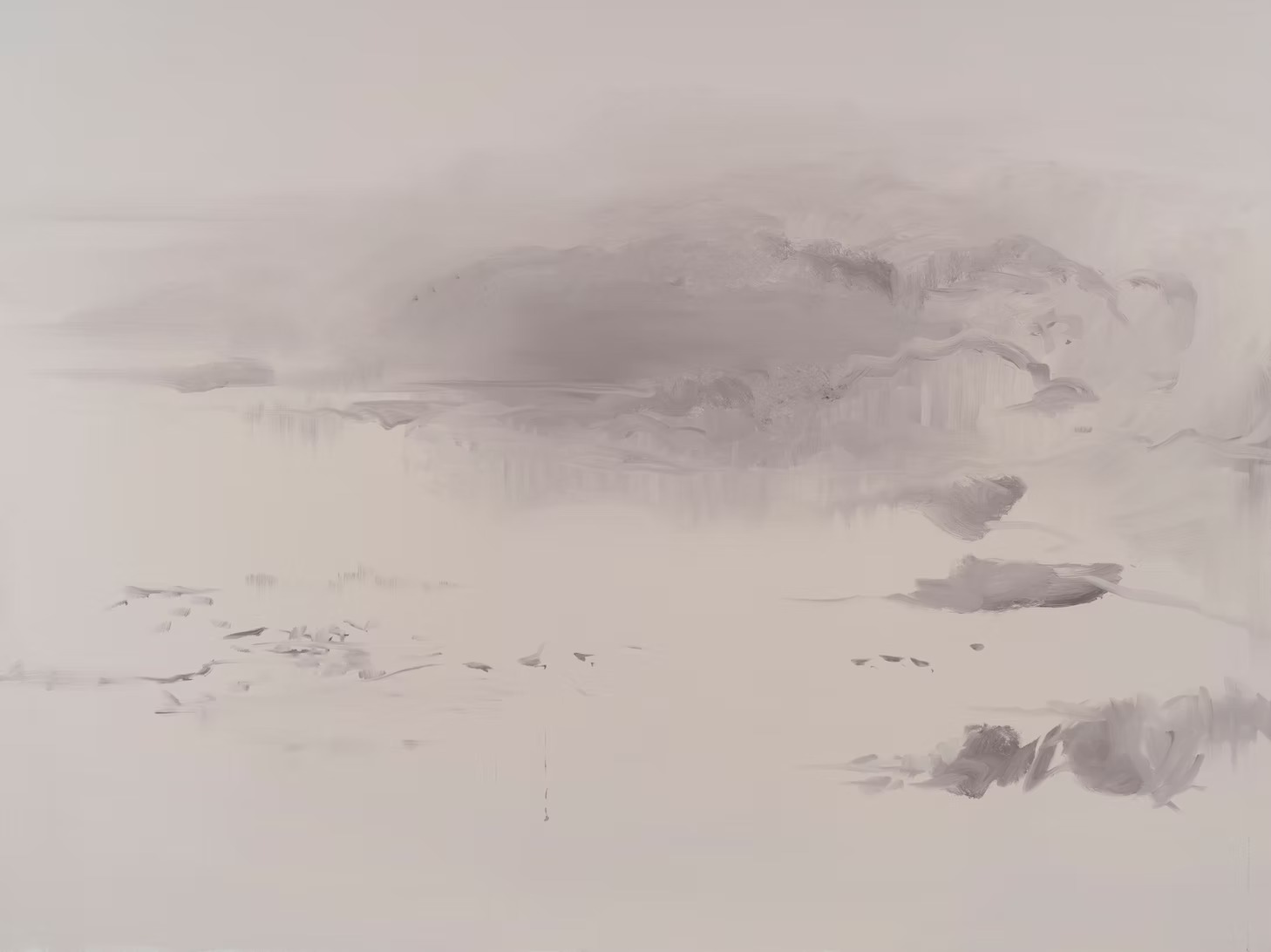
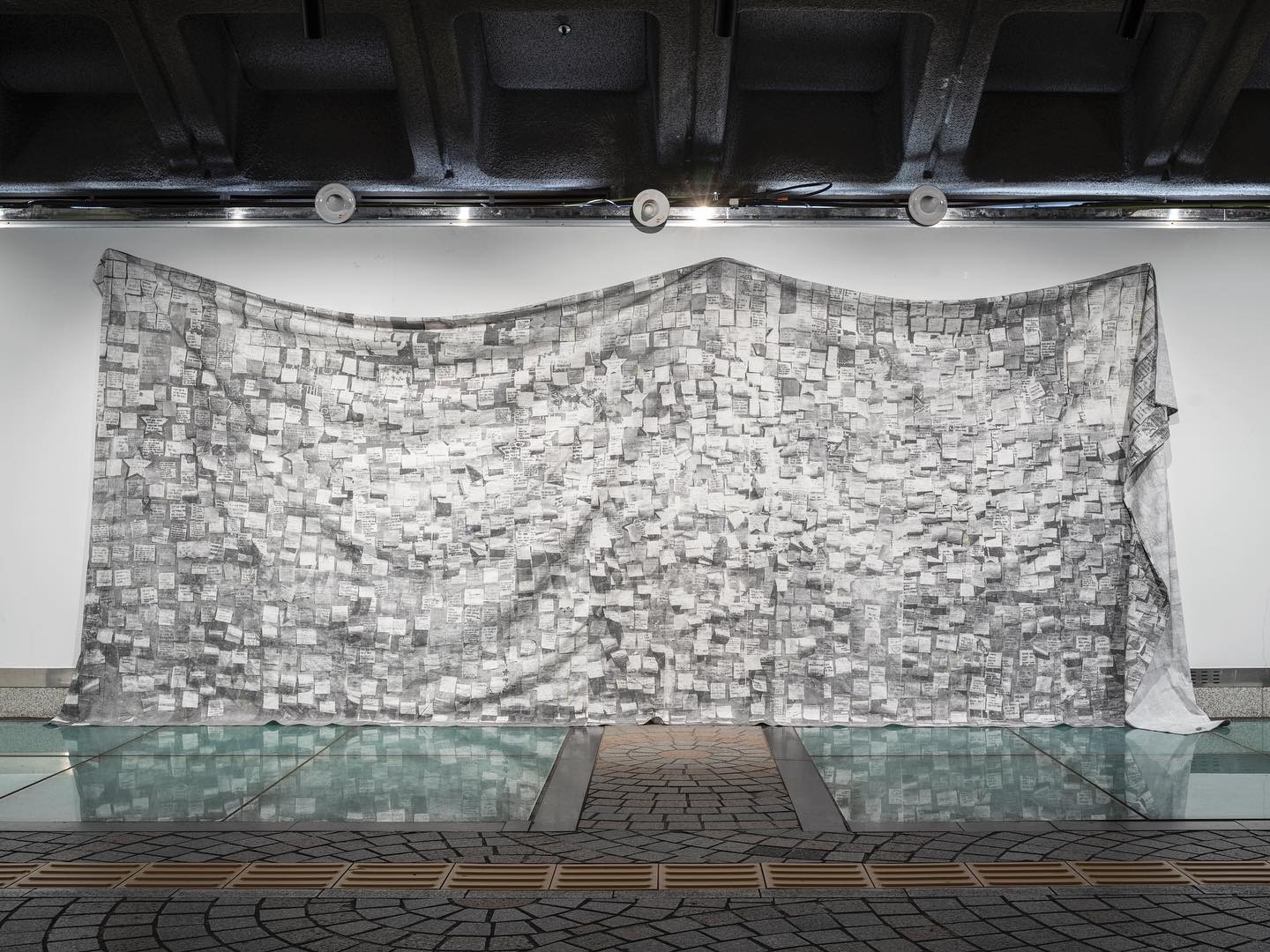
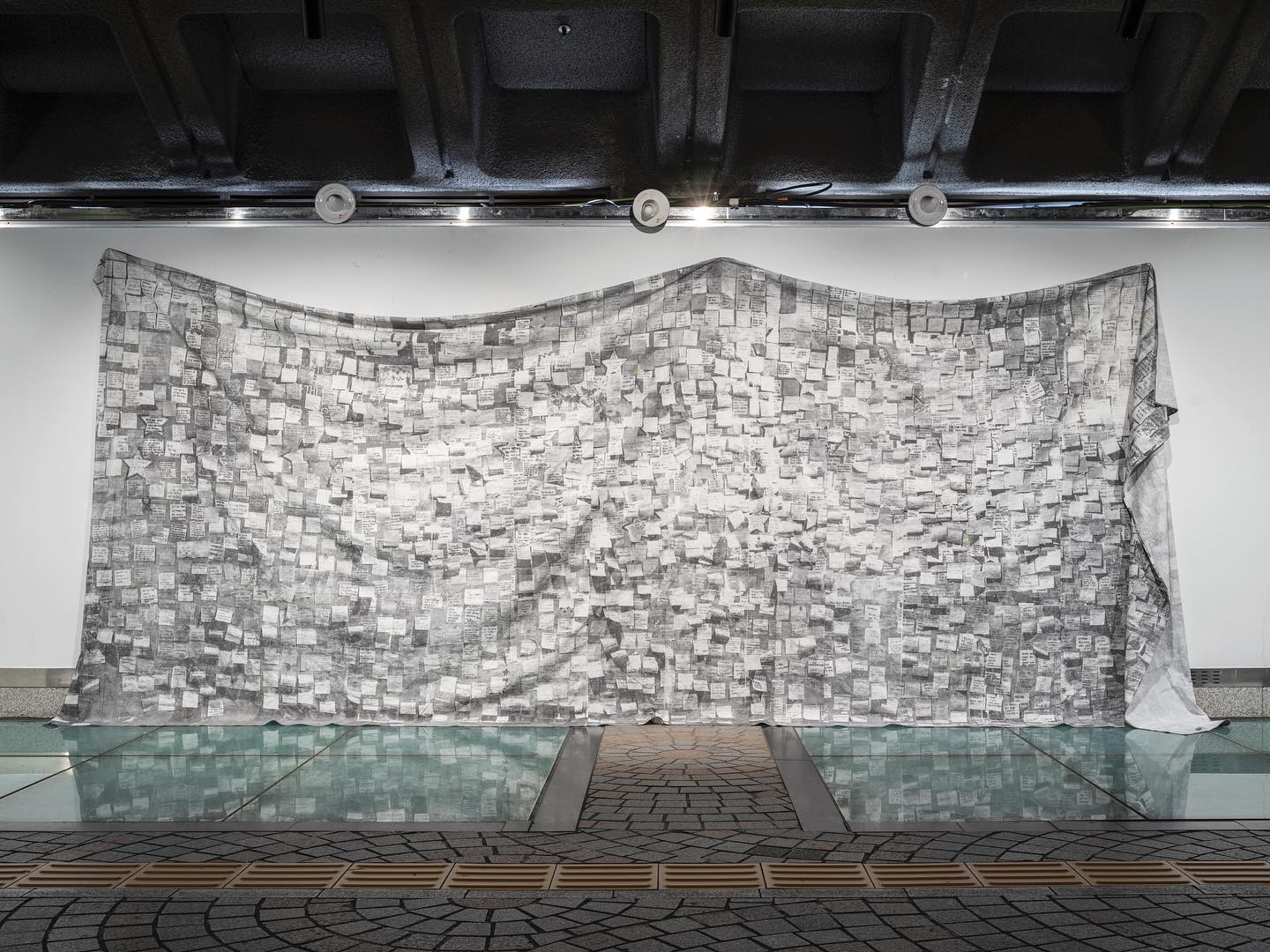
The first work to confront viewers upon entering the exhibition is River (lithograph printed on cotton fabric with mixed coloring, installed on columns, 246 × 1,866 cm, 2023). Suspended across the corridor connecting the two gallery spaces, this large-scale installation recreates a memorial site formed by waves of Post-it notes bearing messages of mourning.
In recent years, whenever Korean society has experienced social tragedies or disasters, similar commemorative spaces have emerged in public locations such as the sites of the incidents themselves or plazas in front of City Hall. Originally categorized as office or stationery supplies, Post-it notes are commonly used by students and office workers as temporary tools for remembering things, intended to remain only for a limited period of time.
Memorial spaces composed of Post-it notes—an extension of online comment culture into physical space—represent a new cultural phenomenon in which spontaneous and voluntary empathy and participation are combined with the immediacy and ritualistic character of on-site acts of remembrance.
Unlike the protest posters or banners of previous generations, today's Post-it notes function as lightweight and flexible "mobile media," becoming "ballots" from which institutional procedures have been omitted. At the same time, the countless emotional messages left by anonymous individuals wrap themselves around the collective body of society and history like a layer of skin, allowing many people to remember a particular moment in their own ways.
While the work adopts the form of preserving and enclosing the time and space once created by these accumulations of Post-it notes, the texts written on each note have become illegible, as though soaked by water and blurred away. In doing so, the work relocates itself from literal representation into the realm of mediated image.
This transformed image draws together signs that drift across multiple boundaries: between media and the analogue, past and present, presence and absence, death and life. A culture of participation born through mobile media becomes translated into physical acts performed on-site, while a temporary memorial space from the past is reconstructed as an artwork existing in the present.
Although the erased texts emphasize the absence of their original authors, the printed images of absence simultaneously become a kind of apparatus for revealing invisible death—much like the early belief that photography possessed the magical ability to capture the soul.
Nowhere in either its title or visual appearance does River explicitly refer to Itaewon. Yet our thoughts inevitably travel there, to that place and that moment.
This is likely because the Itaewon crowd crush (2022) became the event most visibly marked by the widespread use of Post-it memorials expressing mourning and consolation, while the waves of notes that once covered the walls of the narrow alley immediately beyond Exit 1 of Itaewon Station continue to resonate within the work's physical form.
Looking back at the extraordinary outpouring of words of comfort that emerged in Itaewon, one might conclude that they arose precisely because they were accompanied by an equally intense wave of condemnation and hatred. Itaewon has long been represented within Korean society as a space of "the outsider"—a district shaped by the presence of the U.S. military base, by multicultural exchange, and by queer communities and various subcultures.
The Halloween celebrations that flourished there trace their origins to ancient Celtic festivals honoring the dead and spirits. As this tradition migrated to North America, it developed its own symbols and customs before eventually arriving in Korea, where it took root as a new form of popular culture that outwardly resembled North American Halloween festivities.
At the same time, however, the celebration became entangled with generational divides, cultural gaps, and competing economic logics. On one side, Halloween in Korea has often been narrowly dismissed as either an expression of cultural imperialism or a capitalist novelty consumed by immature young people seeking mere transgression.
On the other, it has long been embraced and enjoyed as a hybrid cultural festival where everyone from elementary school students to adults participates freely. The Itaewon disaster ultimately revealed the inability of everyday society to prepare for circumstances that were already unfolding, regardless of differing understandings of this emerging cultural phenomenon.
It also exposed regressive reactions that implied hierarchies of mourning, expanding into political distortions and an immature sense of community. Most strikingly, at memorial ceremonies where death ought to have been remembered through the force of physical presence, the absence of memorial tablets or portrait photographs transformed every victim into an anonymous non-presence. Such an omission can only be understood as an attitude that renders particular deaths into the deaths of others.
In this way, the narrative of the exhibition begins from specific social events, the deaths entangled with them, and an attempt or impulse to trace the boundary between death and life. What River represents is not the political positions or interests surrounding the event, but the shared sensibility through which the emotions triggered by the event operated socially.
In Cultural Politics of Emotion (2023), affect economy scholar Sara Ahmed theorizes the ways in which emotions such as fear, pain, hatred, terror, disgust, and shame operate in relation to their linguistic articulation and the phenomena of the body. She analyzes how emotions do not remain merely as personal possessions or states, but are converted into affective value, become signs, and operate like capital.
Just as capital functions under neoliberalism, emotions responding to particular events or situations render power structures, dominant ideologies, and histories invisible, while reorganizing individuals and groups connected solely through feeling, thereby becoming central to the cultural politics that regulate citizenship.
In this process, Ahmed refers to Freud’s unconscious emotions, suggesting that what is repressed from consciousness is not a “feeling” such as an affective impulse, but a provisionally connected “thought,” and that psychoanalysis therefore implies that the movement of social emotions involves a process of association.
Thus, “feeling” moves diachronically between past and present across various processes of signification among different individuals, sliding between forms and reawakening histories of the past, while through this very sliding, a particular object comes to be accepted as the cause of an emotion. The various emotions experienced or shared through the Itaewon disaster can be considered in light of such an affective economy.
Since the cause of the disaster was clearly human negligence, and the victims were young and fragile lives, the Itaewon disaster naturally became linked to the Sewol Ferry disaster (2014). The object of emotion circulated both synchronically and diachronically, leading to the accumulation of affective value.
The emotions of those who participated in this affective economy, including through Post-it memorials, expanded into greater affective value less through the Post-it notes themselves or the messages written on them than through their circulation and movement online, drawing in the memories and provisional thoughts of many people.
Following Freud, Ahmed adds Lacan’s discussion, which posits the “subject” of emotions and thoughts as the unique site of absence and loss. In the affective economy accumulated over time, the “subject” (citizen or nation) exists less as a substantive entity than as a point of intersection, and the (common) unconscious refers to a state in which the relations among subject, object, sign, and other have not been materialized.
In this context, our emotions repeatedly materialize as the “surface” of a collective in which psyche, society, and object are not clearly separated. Statements made by particular groups participating in protests, news footage reporting those statements, and the chain reaction of illustrations and memes that satirize them in turn strengthen affective impulses while weakening thought and analysis.
In this work, then, the erased or concealed letters within the Post-it notes may be an attempt to confront the materialized surface of this affective economy, while at the same time withdrawing the common emotions without a “subject” that had operated and accumulated like capital.
The “body of emotion” represented by the work summons feelings with which we could not help but automatically empathize, yet the unreadable letters simultaneously press pause on those feelings and make us confront the material itself.
These tightly opposed ambivalent positions lead us toward the space beyond the event, the era beyond the space, and the universal human condition of death beyond the era, prompting us to consider what this means in the contemporary moment and what it means for art to address such a subject.
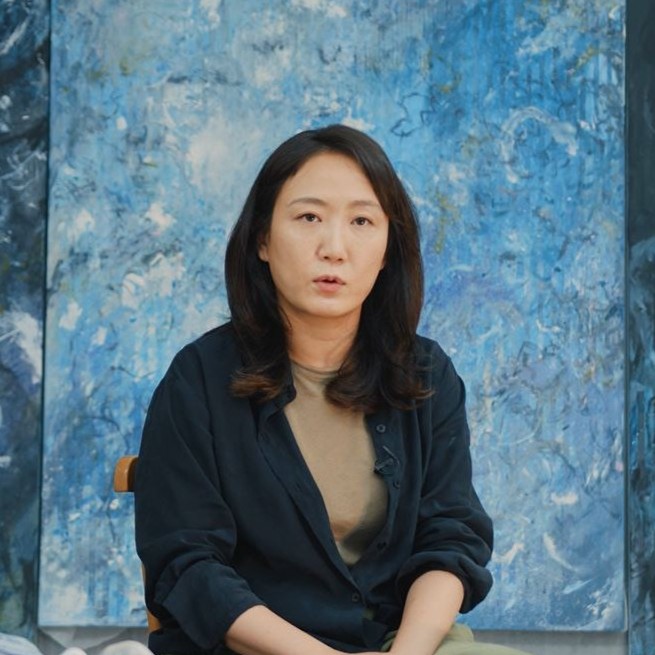
In her artist’s note, Leeje writes that she focused on “excavating and visualizing the sensations and memories that remain within the body.” For an artist who has long explored the theme of the “body,” the body encompasses multiple bodies: the body represented on the surface, the body living through an era, the body that remembers the past, and the body that performs the act of painting.
In his well-known work Phenomenology of Perception (1955), Maurice Merleau-Ponty explains experientiality connected to one’s own bodily space in opposition to Cartesian and Kantian thought, which perceive objects through the perception of space. He writes that in our experience of our own body, experience is merely an outer layer, or interface, and that through the process in which bodily “being” beneath objective space is joined together, the body comes to find primordial space.
In Leeje’s artistic world, the body, in Merleau-Ponty’s terms, concerns the “experiencing body.” Women artists within the canon of art history have commonly projected gender, sexuality, politics, and allegories of their time through the body. However, the body as an artistic image emerging from the geopolitical context of Korea is formed within a far more complex framework, and therefore inevitably demands an equally multilayered reading.
One might think, for instance, of the early performance works of the artist Lee Bul. These are critical works in which the artist’s awareness of the representation of women, the male gaze, and questions of power and ideology is realized through the performativity of performance.
Preserved only through photographs and video documentation, these works evoke memories related to violent incidents of state power within the historical context of the 1980s, stand in opposition to mythic signifiers and conventional texts of femininity, and enact a politics of the body that satirizes Korea’s modernization project, which had internalized Orientalism.
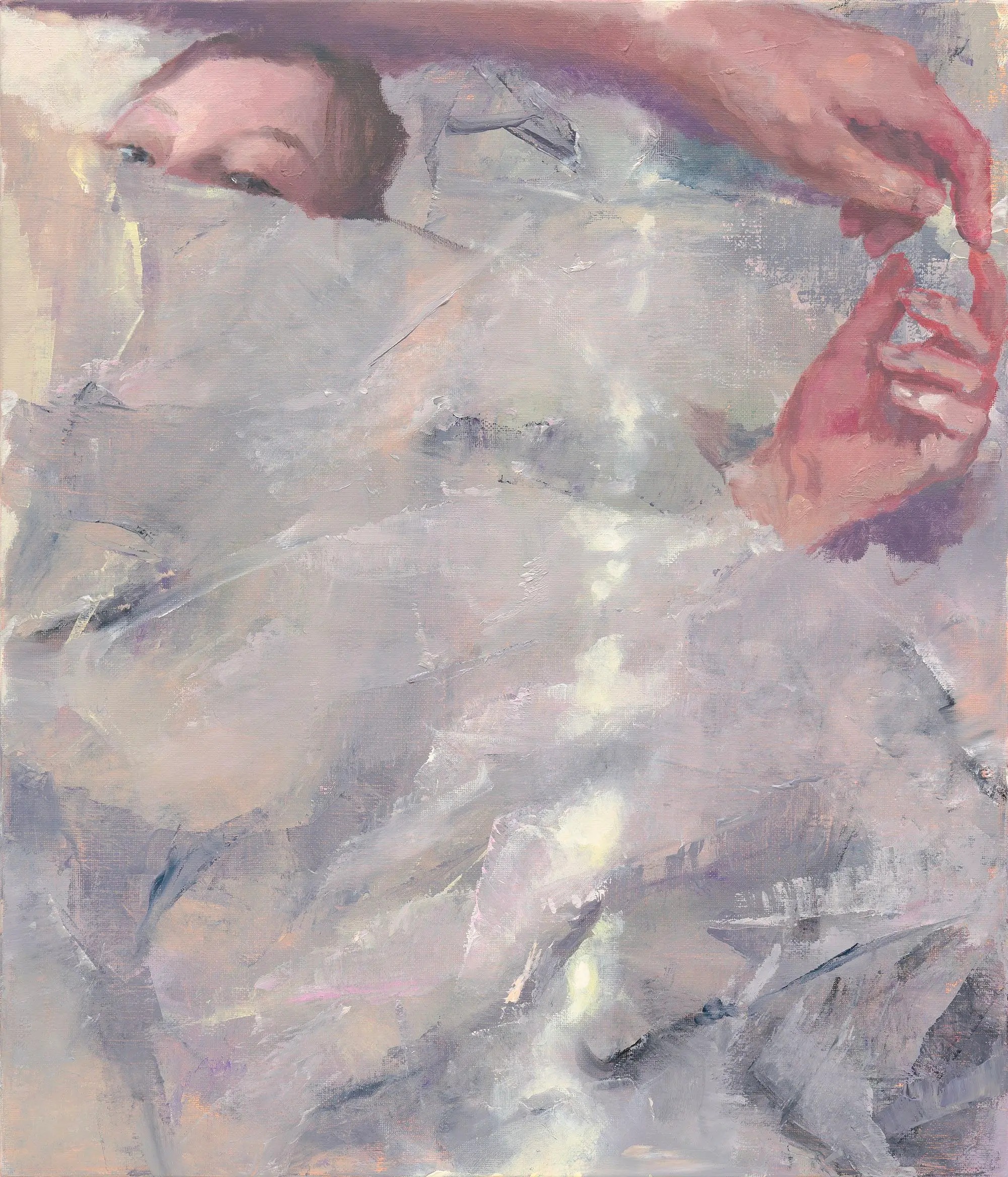
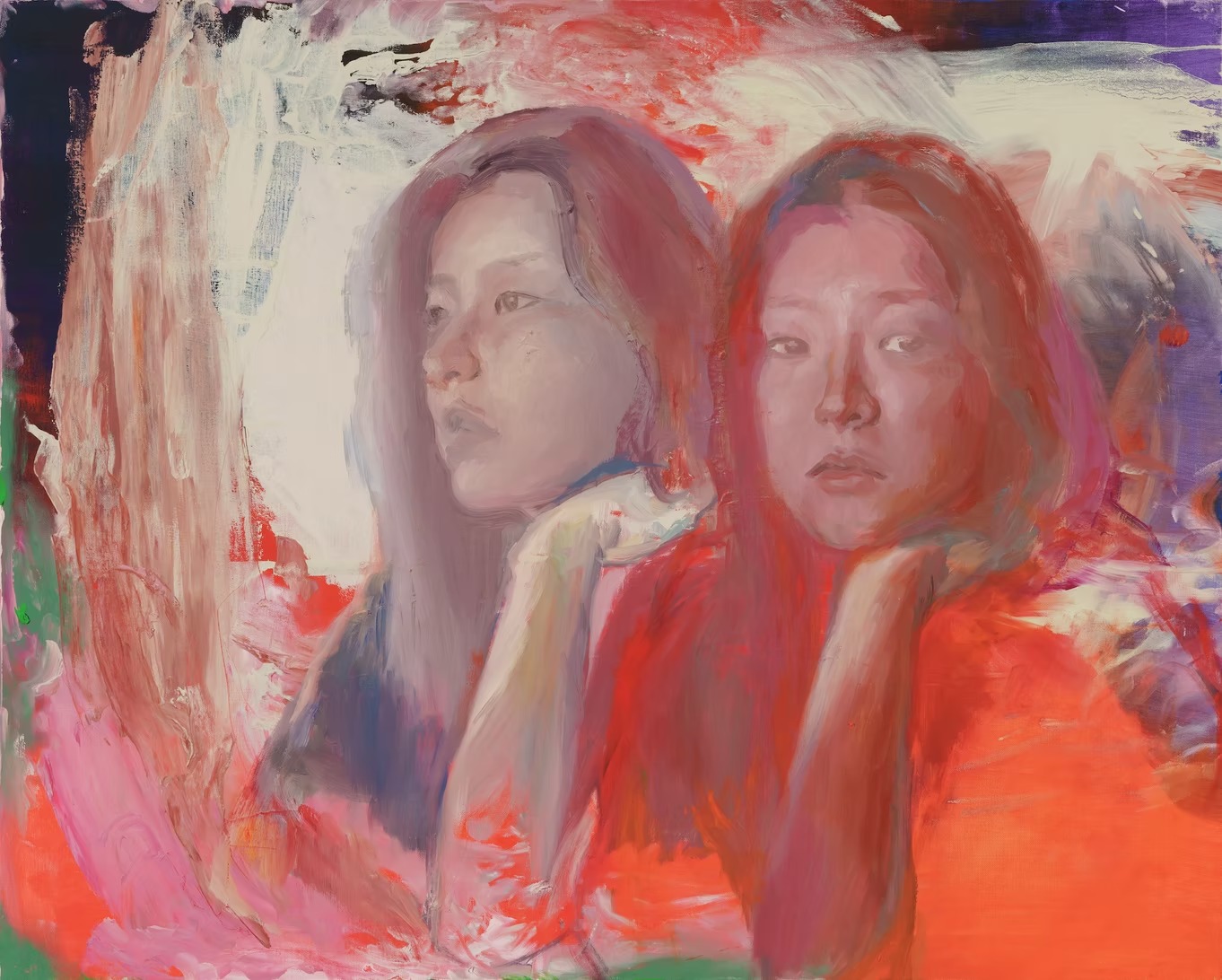
If we connect the social conditions that produced those performative bodies of the past with Leeje’s bodies, we may consider the female body as a similar political field. Of course, in this exhibition, Leeje’s body extends beyond the female body to encompass broader categories, including bodies of diverse genders and the body as a metaphor for physical and psychological trauma. Yet most of the works do not outwardly represent a complete body.
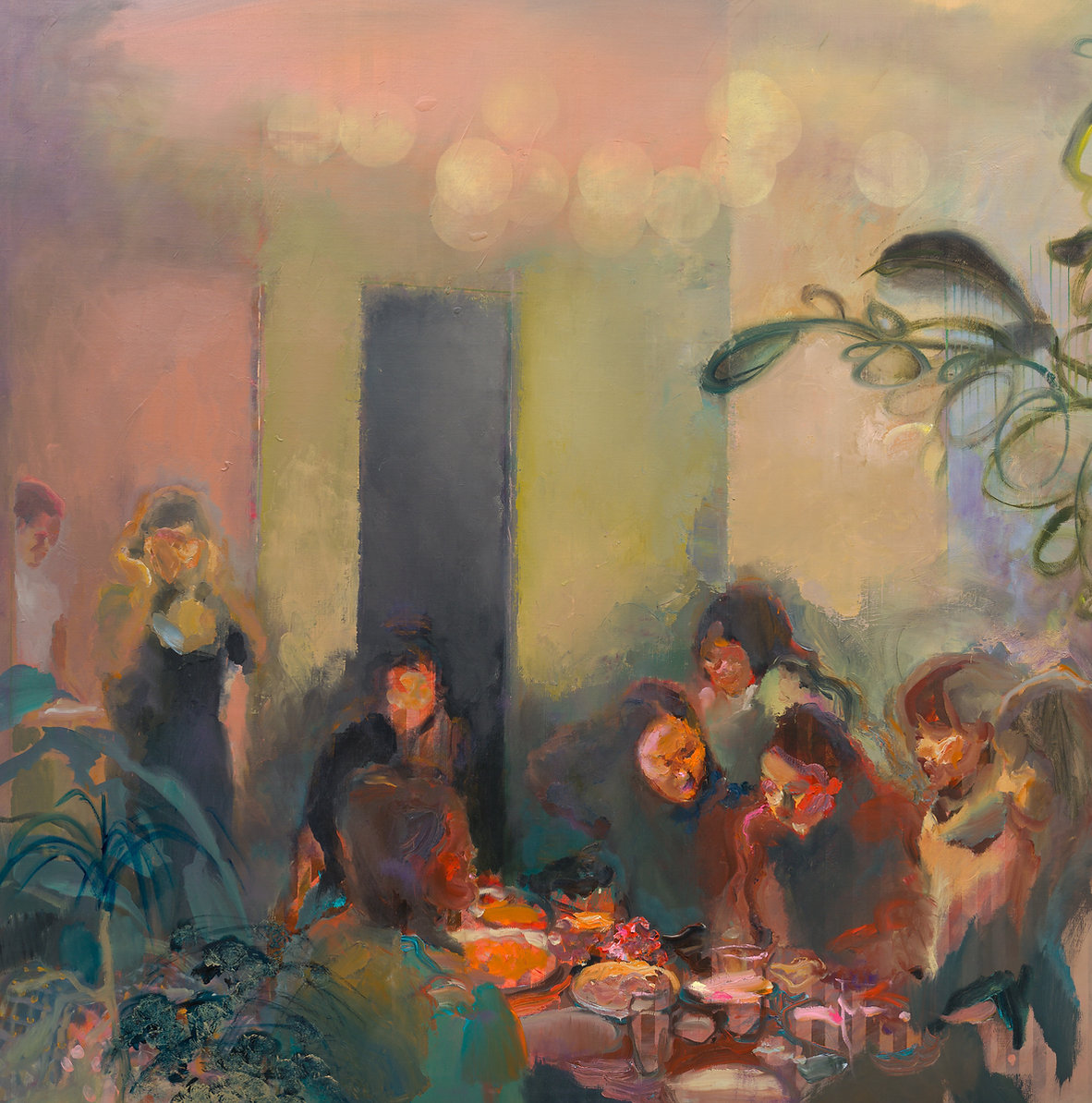
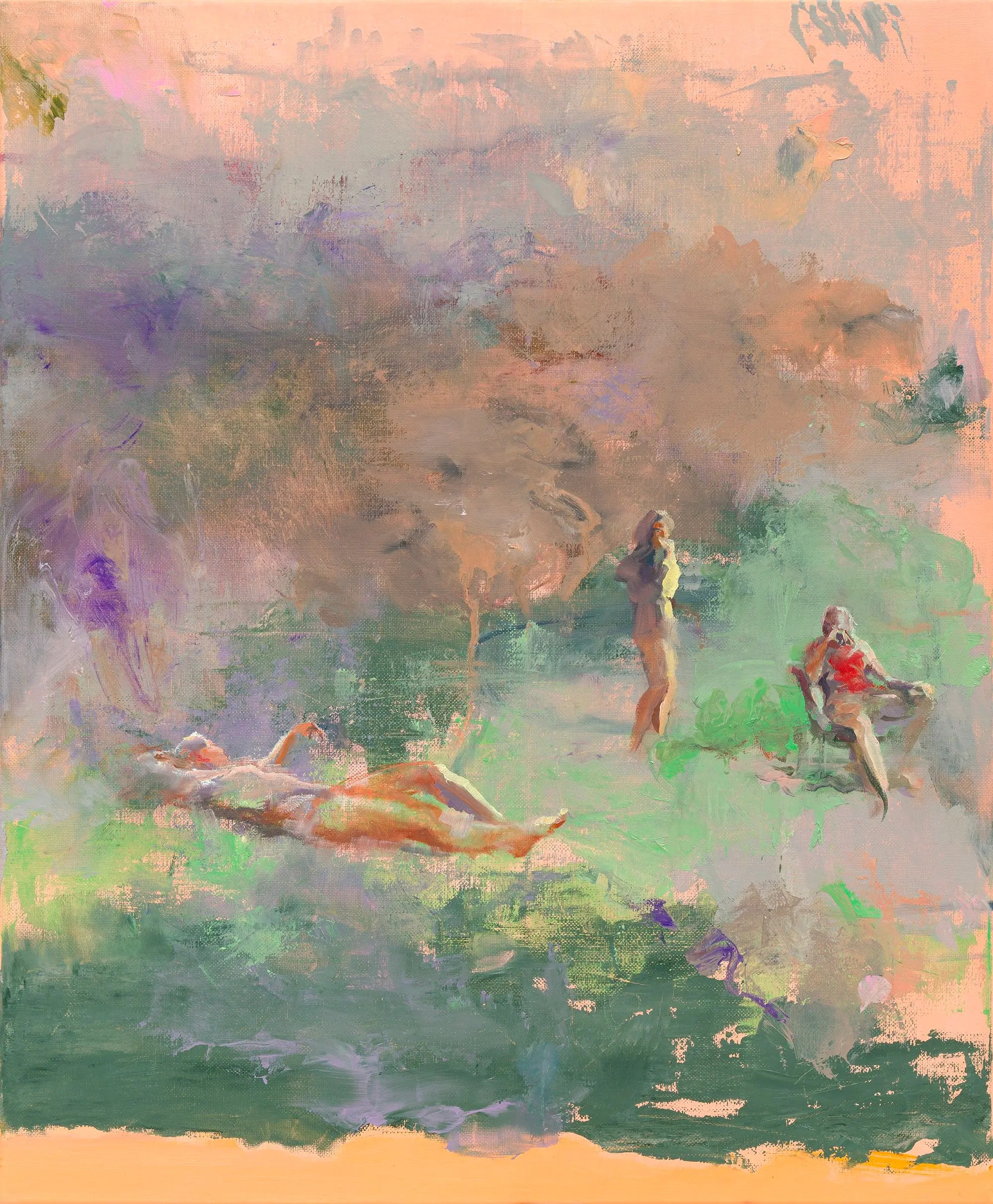
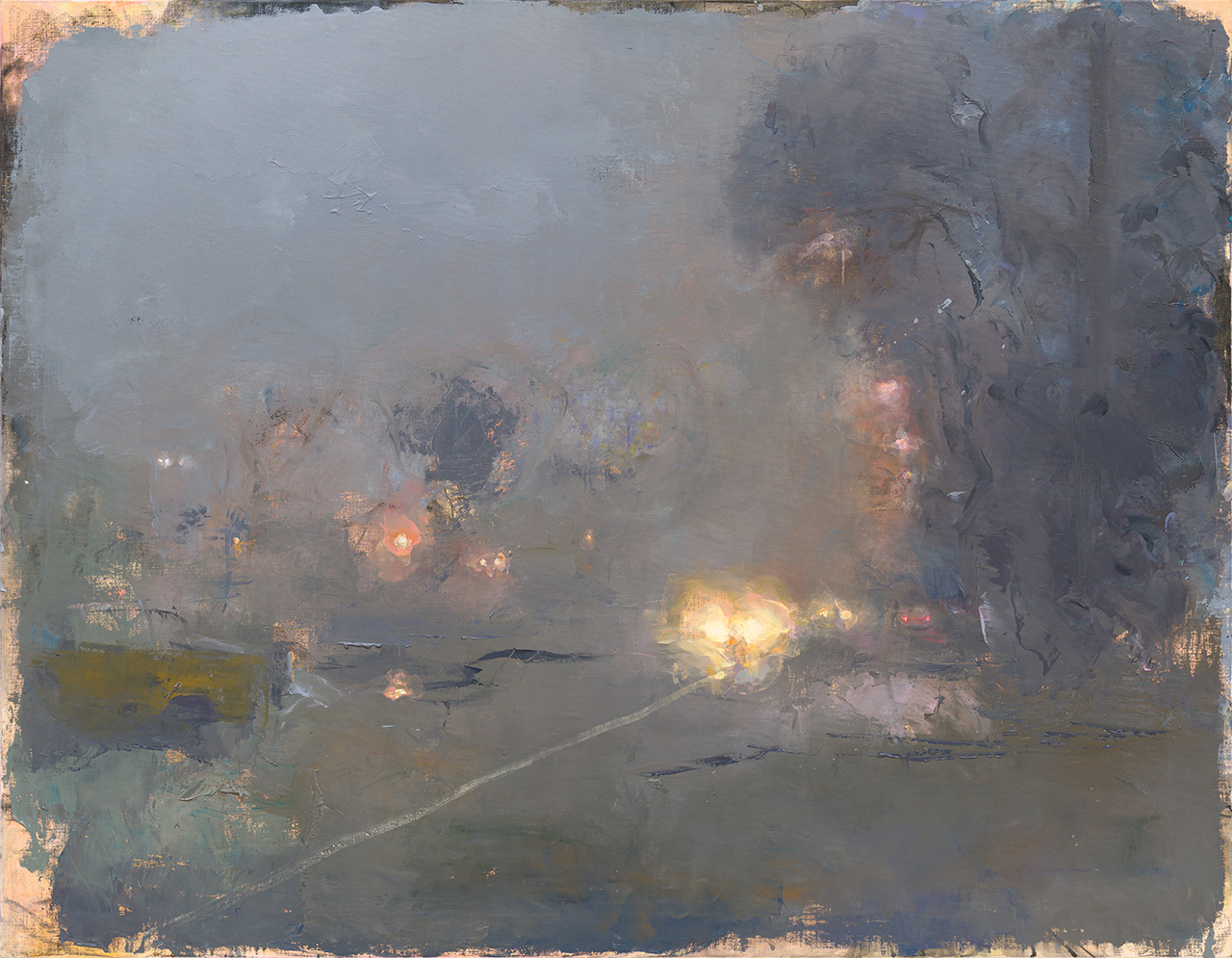
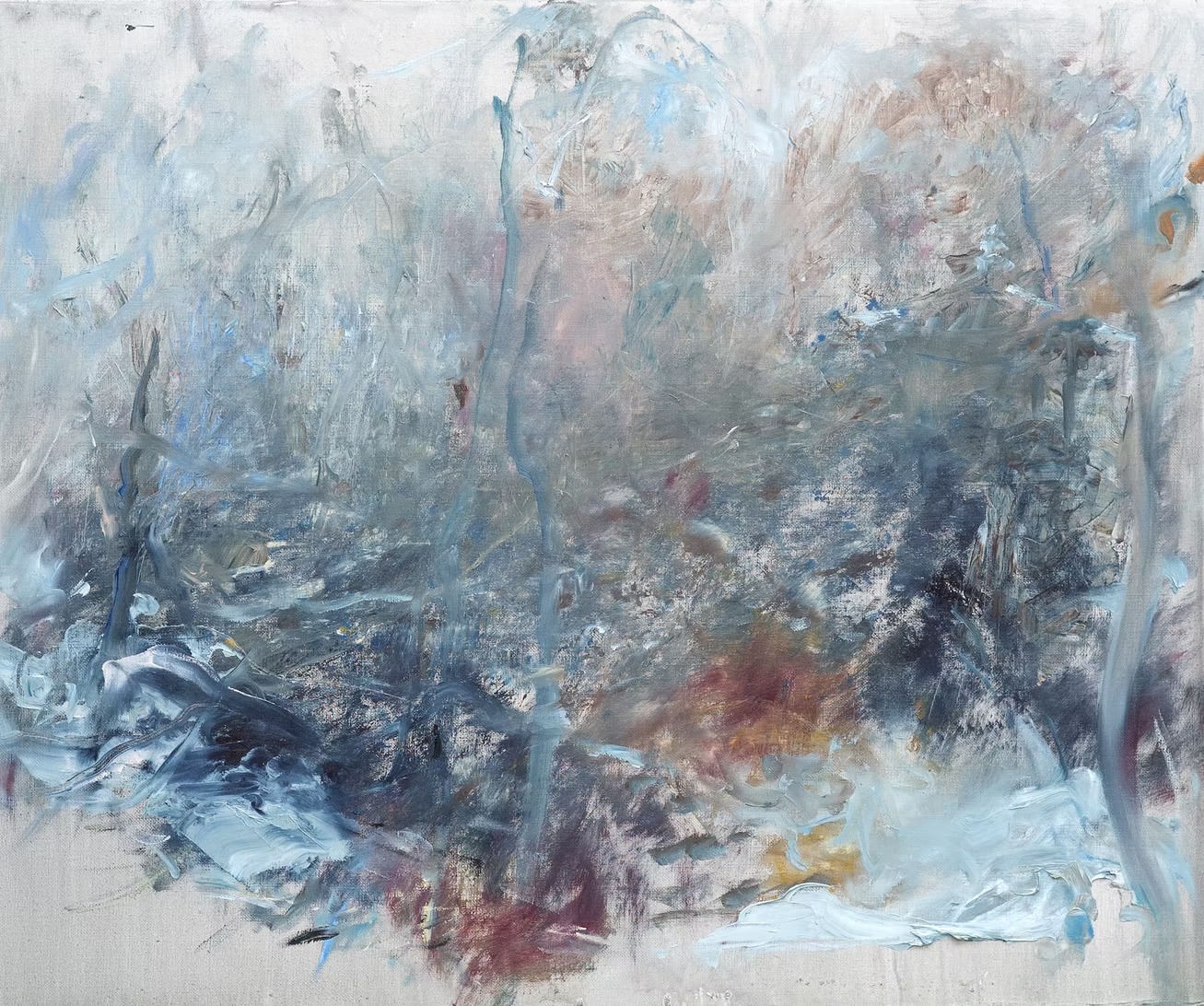
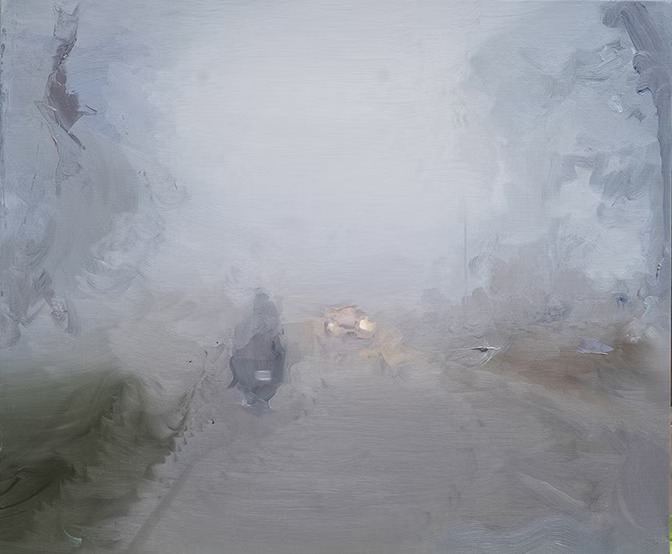
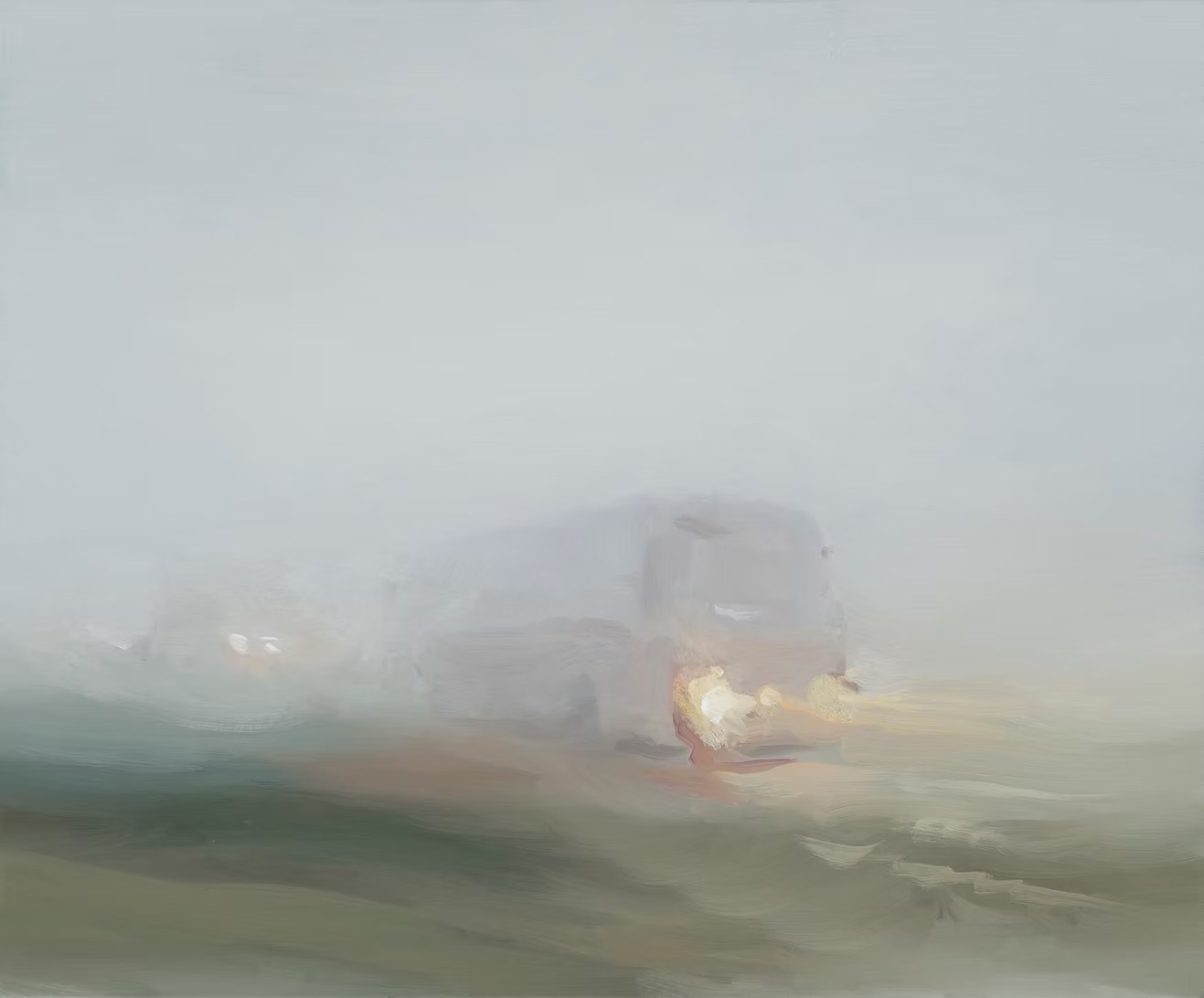
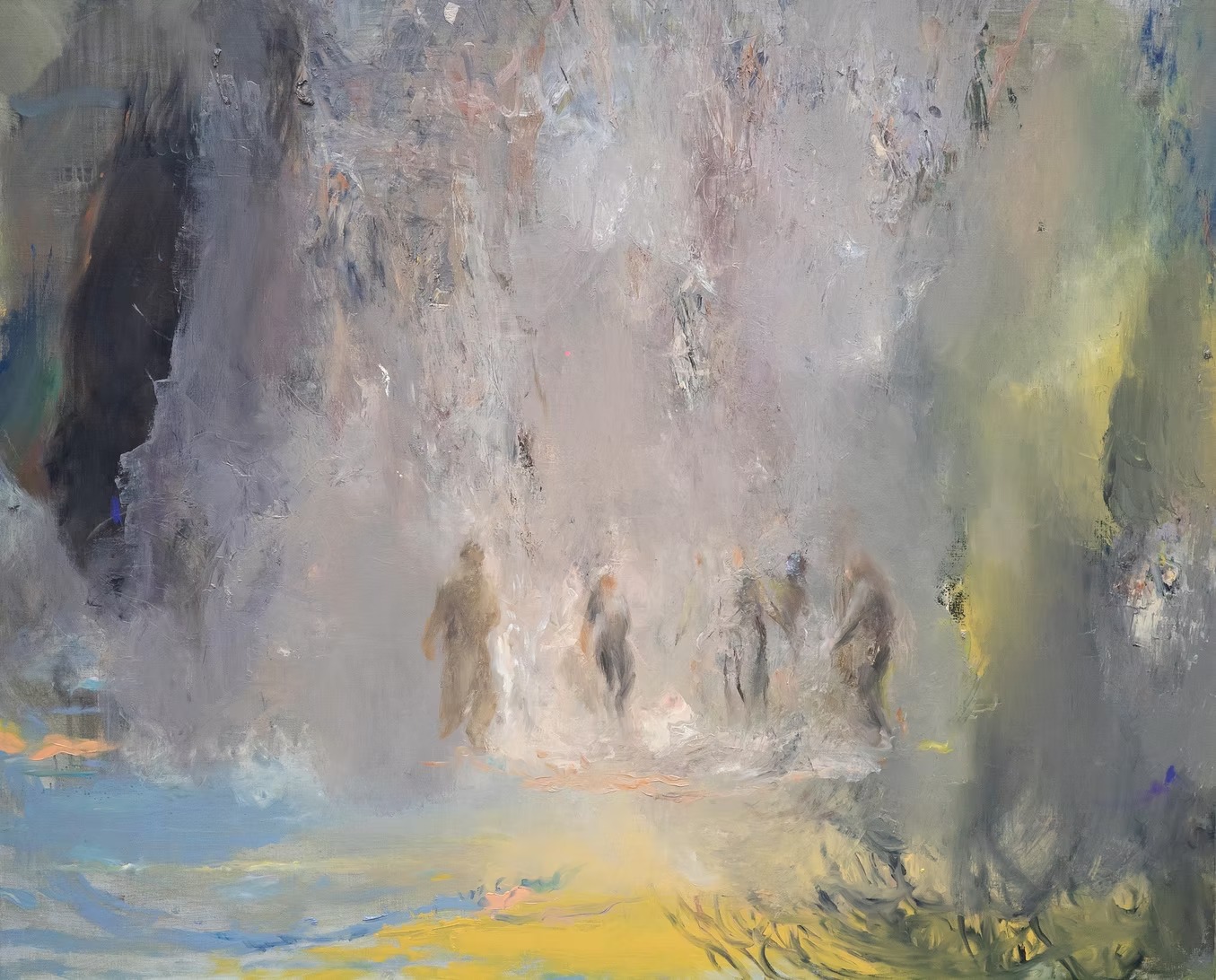
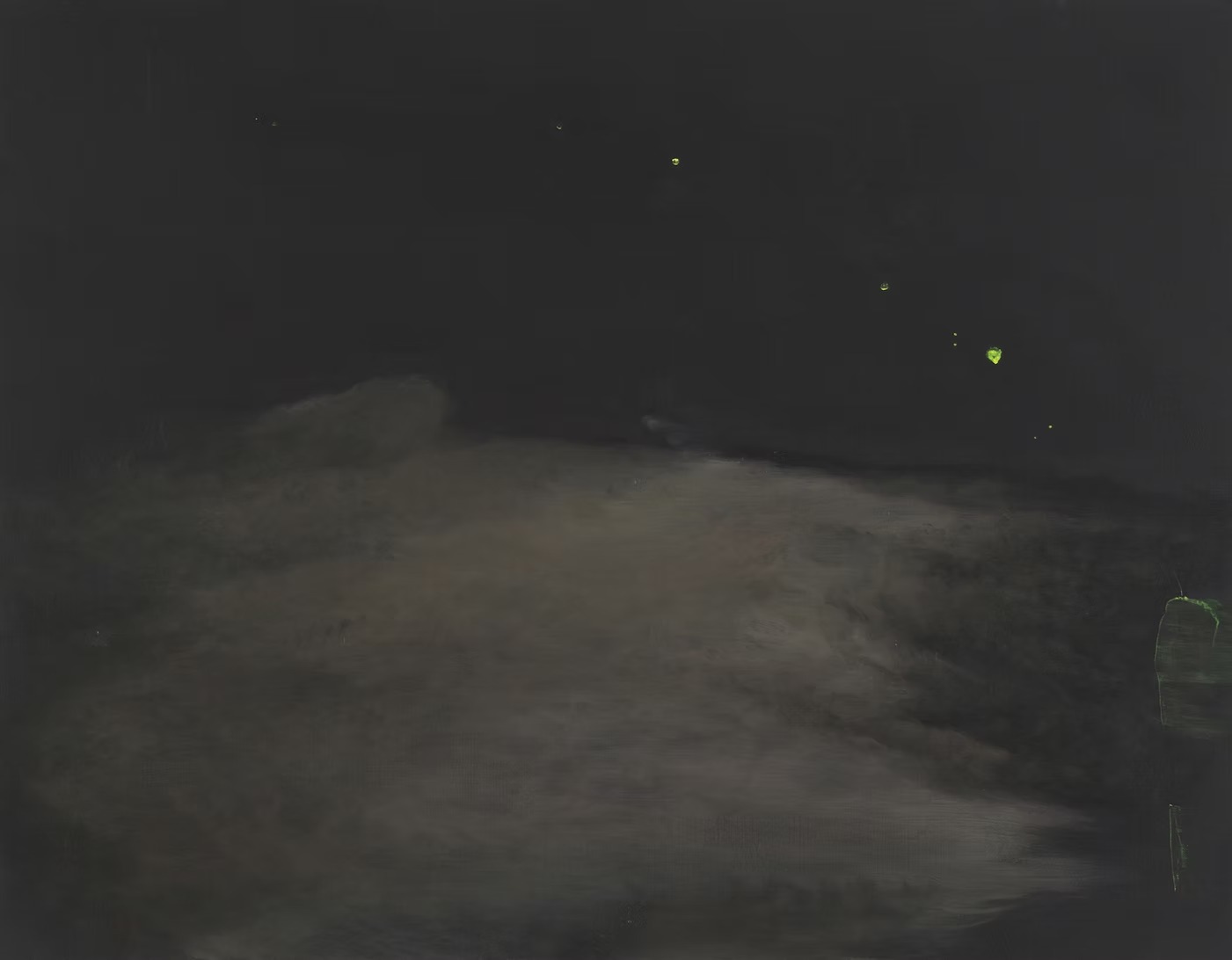
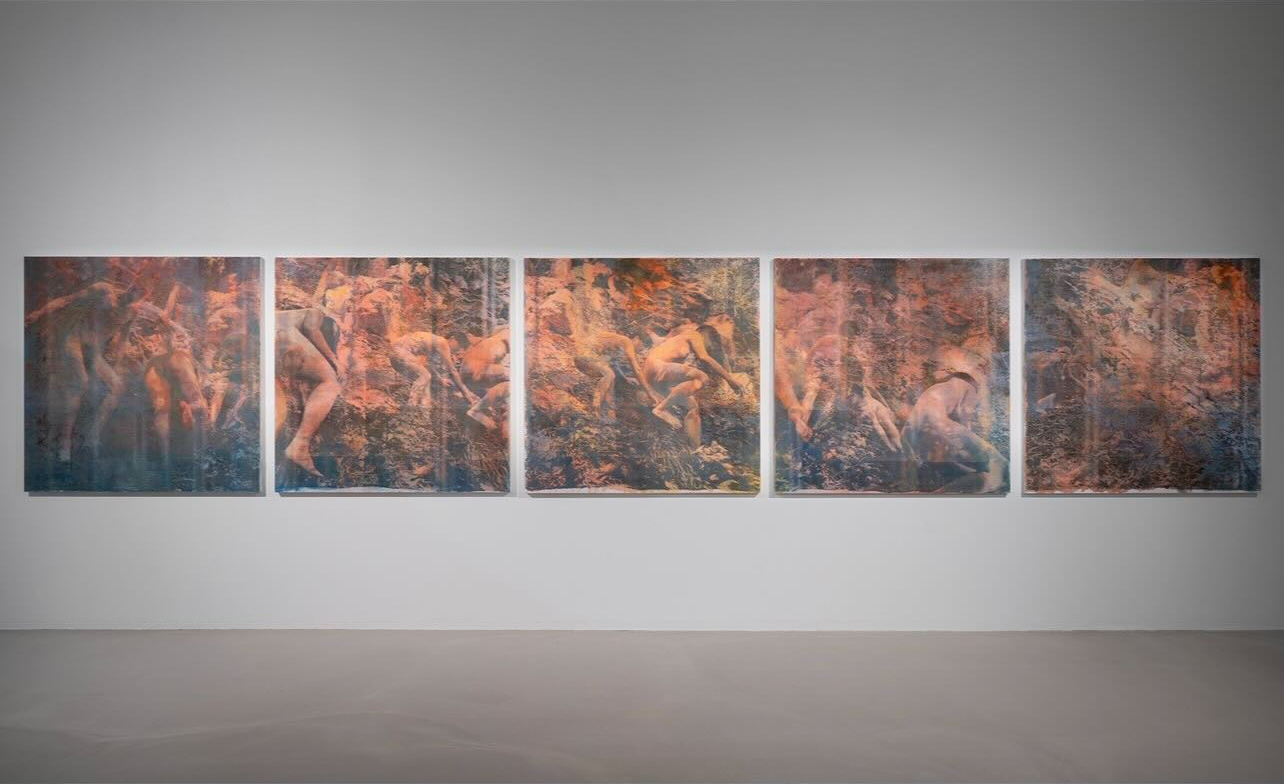
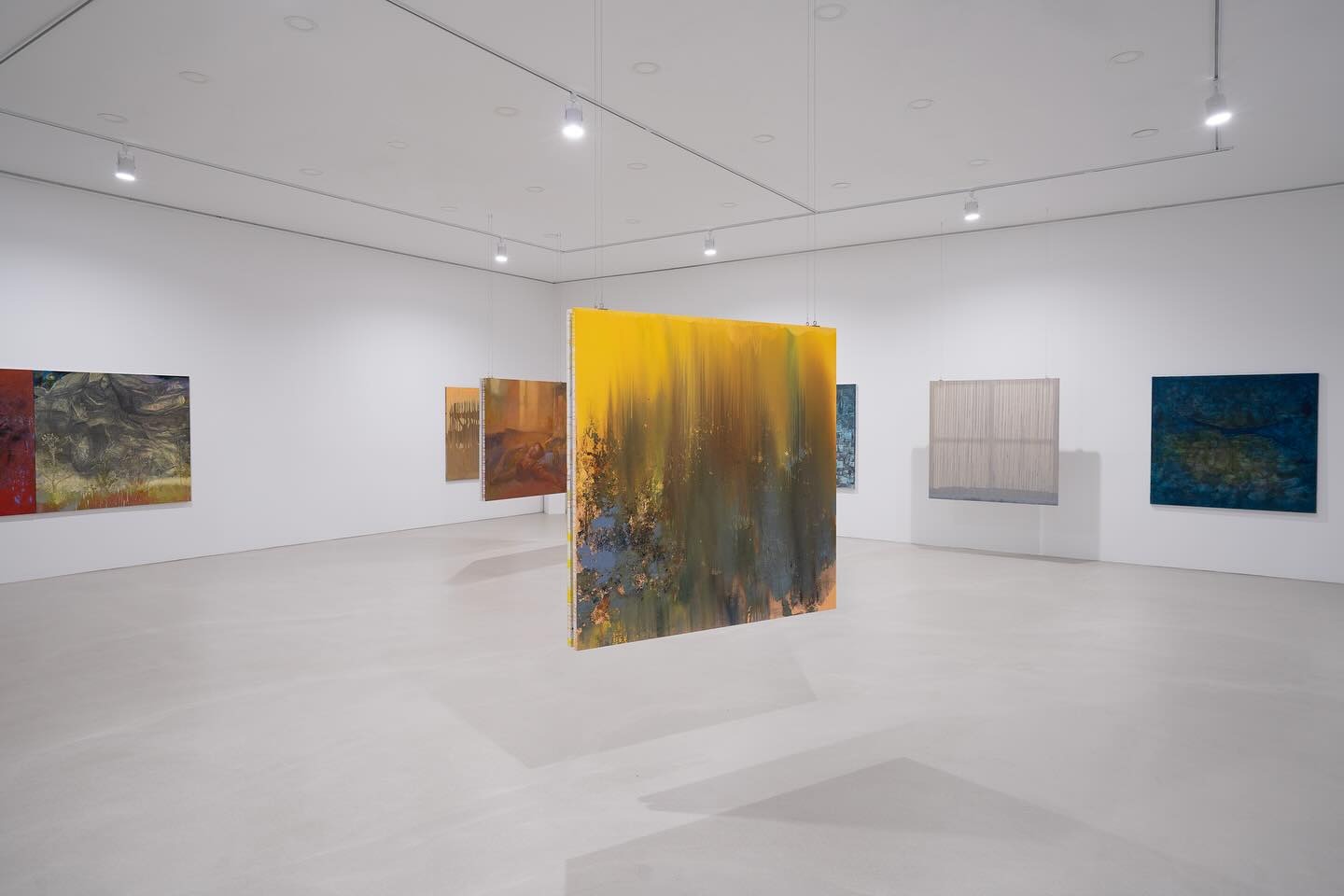
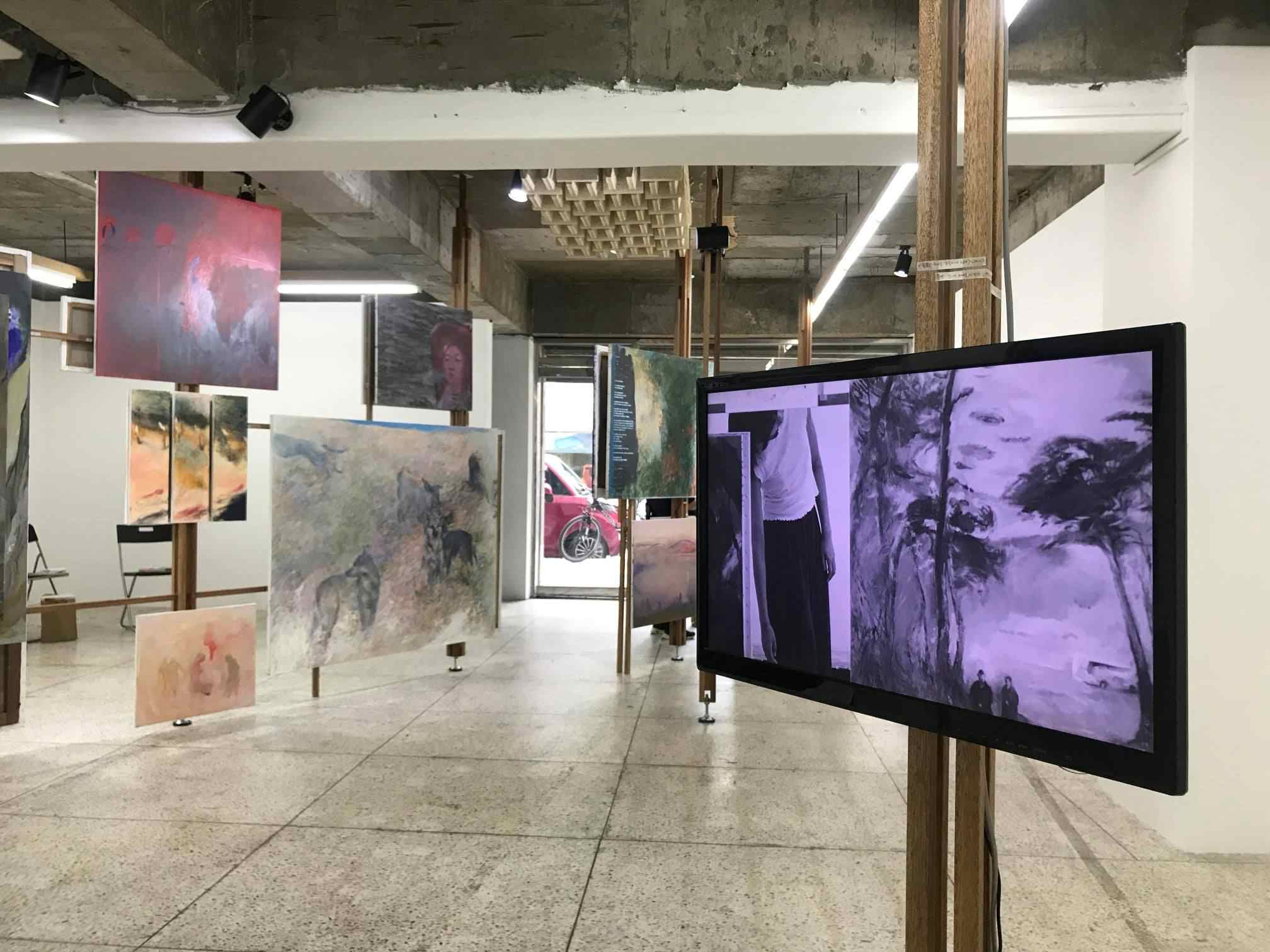
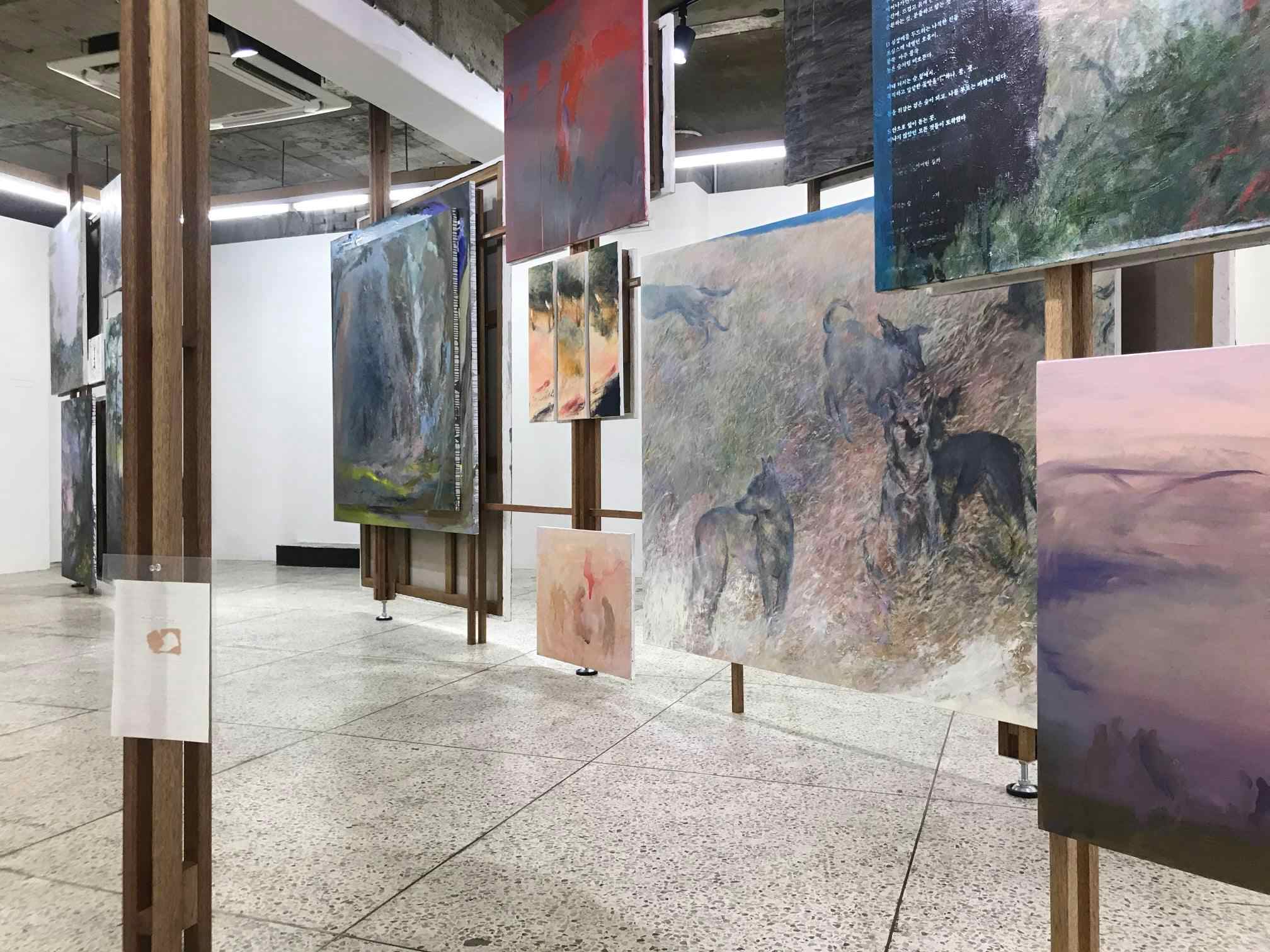
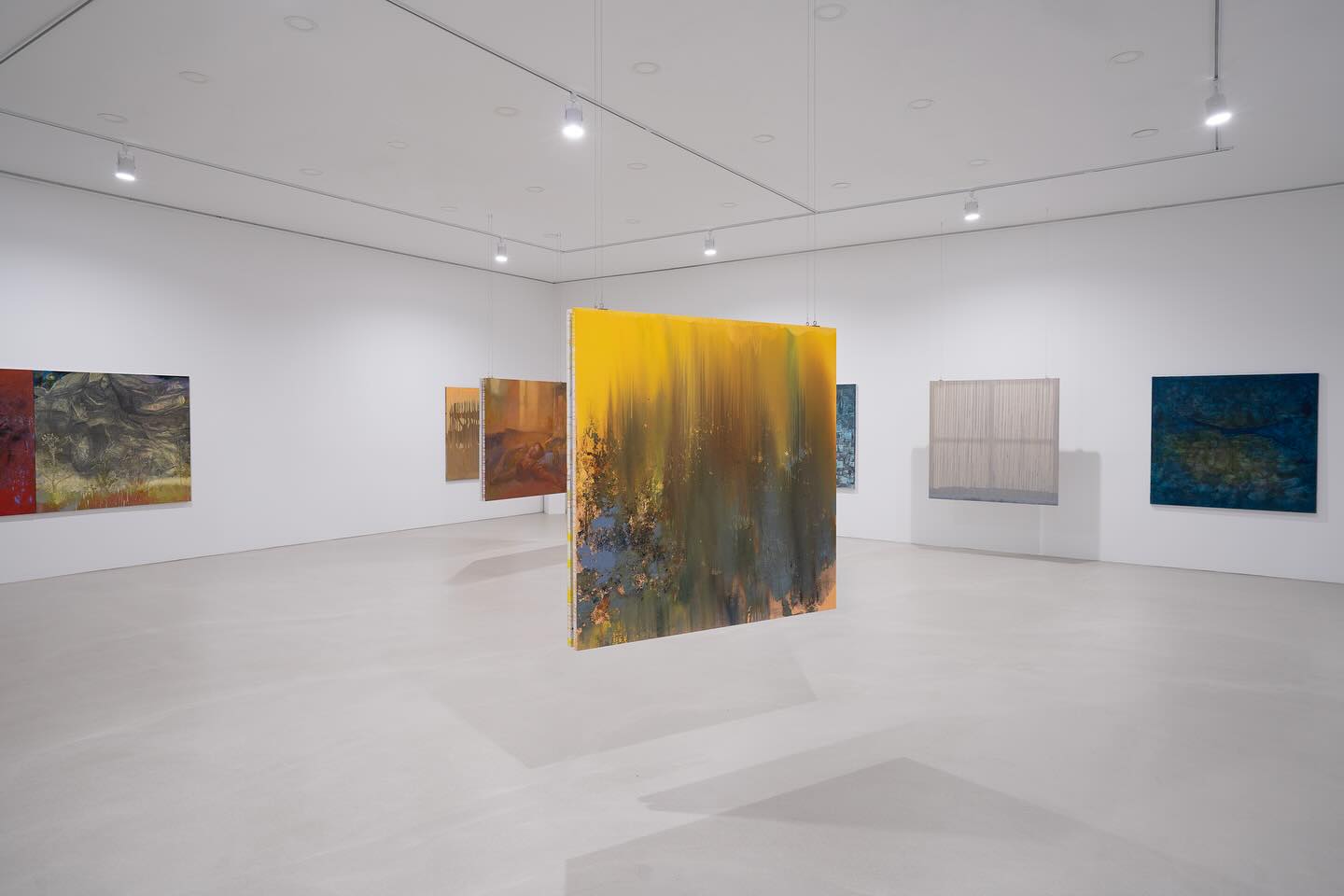
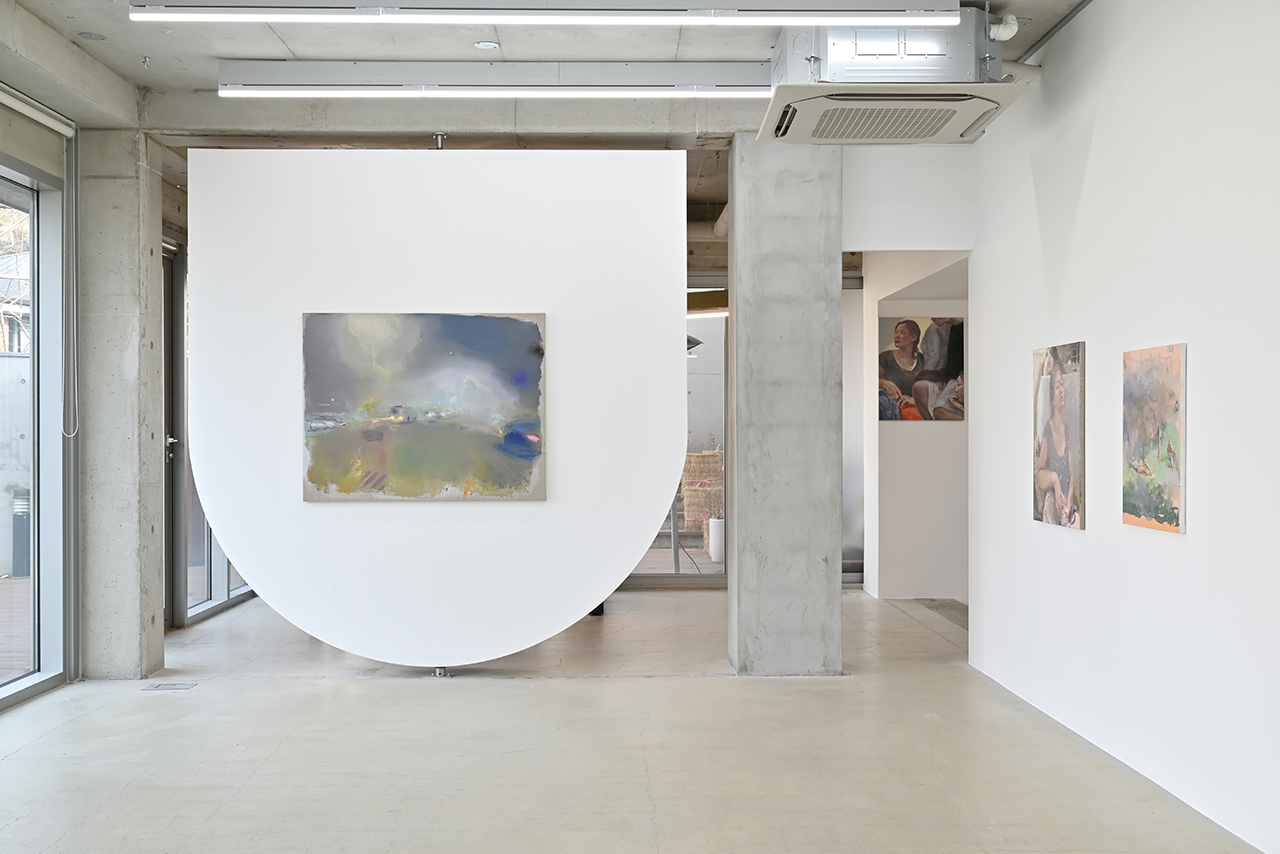
In River, as well as in the ‘The World Goes On’ series (oil on canvas with lithographic printed parts, 130 × 130 cm each, 2024), the various bodies and metaphors of the body suggest vulnerable, severed, erased bodies, or fragments thereof: a car crushed in an accident; a pile of ownerless shoes evoking the landscape of “disaster”; Limbo, in which a man and woman lie in opposite directions with only their heads touching; a woman looking out toward a moonlit riverside, which ironically also becomes a satire of the current political situation; the outline of a dining scene; a laborer obscured by bundles piled high on a handcart; the feet and ankles of women seated together; and mountain ridges roughly finished and lacking clear contours.
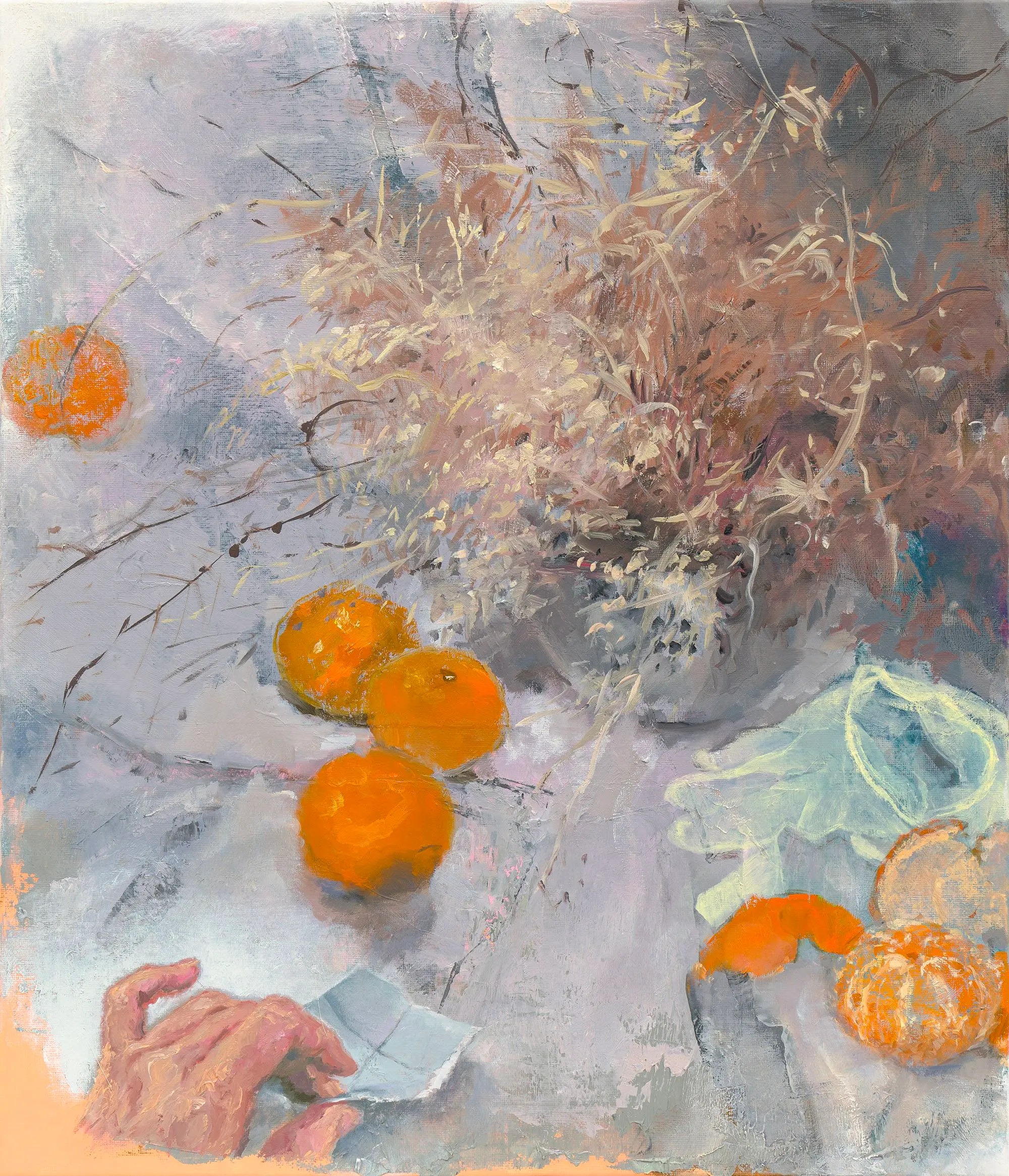
These present only parts rather than wholes. A series of “situations” from which concrete subjects have been erased reveal distinctive perspectives through omitted or absent bodies, repeatedly forming invisible connections and separations.
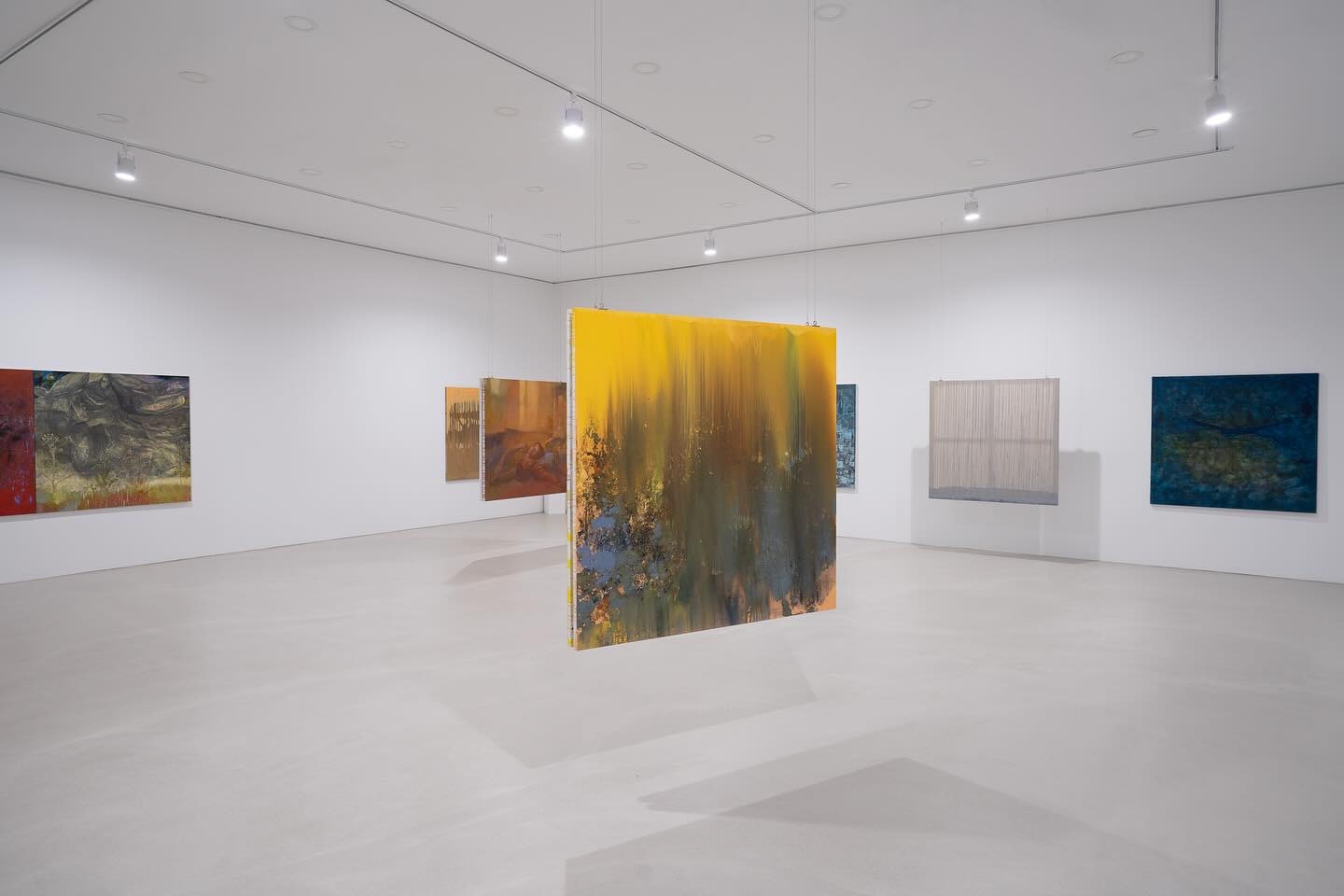
Ultimately, through the colorless image of a crushed car behind a blood-red ground, and the blue flowers blooming—or withering—in front of it, we come to understand that all of these are images of a state of so-called “shock.” Technically, the colors and combinations encountered successively in these flat works are all unfamiliar and intense.
They are far from realistic representation and seem to have been chosen primarily for the dramatic effects of light and darkness. Departing from the “intermediate colors” the artist has long used, a palette centered on primary and complementary colors fills the canvases completely through movements of symmetry and overlap.
Some images render the central subject in black and white, while filling the area around or over it with fields of color, at times making them appear like negative images from X-ray film. It is as though an X-ray were being cast over a traumatized world, allowing us to examine closely the inner circumstances invisible to the eye.