History of Modern and
Contemporary Sculpture in Korea by Choi Taeman (a rare book
worthy of that title) begins with Rainer Maria Rilke’s assertion that a sculpture is “an object
that could exist for itself alone.”1 Implying the desire for a specific yet universal type of
sculpture, born from the traditions of modern sculpture and the historical
conditions of Korea in the twentieth century, this declaration presents itself
as an axiom, commensurate with the solid status of sculpture at the turn of a
new century, when the themes that had been so eagerly explored in the expiring
century—from the identity of Korean art to the essence
of sculpture—seemed to have lost their gravitas. In
truth, however, this idea is not entirely self- evident in the way of
statements like “painting is a painting.” Whereas painting is posited as a medium in the strict sense that it
mediates between a painting hand and a seeing eye, sculpture is posited as the
perplexing task of manifesting “an object that could
exist for itself alone.” Simultaneously too vague and
too strict, this conception almost inevitably results in a self-aggrandizing
myth. Why should we strive to satisfy the questionable demand of sculpture to
this day? This problem is generally handled in one of two ways. The first way
is to make an object without calling it a sculpture. The second way is to make
objects according to your own definition of sculpture.
Minae Kim chose neither path. For
her, sculpture is like a ghost that cannot be eradicated, because it does not
exist in the first place. If sculpture is something that occupies space like
other objects but still looks distinctively self-sufficient and self-supporting,
then even a human body could qualify as sculpture. Thus, sculpture should have
a presence like humans, yet without being confused for a human. Discovering a
body that does not belong to us has been a recurring theme of sculpture.
Indeed, sculpture’s capacity for
objectifying our anxiety, illusions, curiosity, desire, and hatred for the
human body is one of the reasons that it has endured. But Minae Kim is not
stimulated by the reverberation between humans and objects, but rather by the
instability of the object itself, which loses its original identity by being
swept up in human instability. Through the idea of sculpture, ordinary objects
are suddenly seen as lacking sculptural properties, while objects claiming to
be sculpture are placed in a state of nervous judgment. What was I supposed to
be? What else could I have become? Exploring such existential questions of
things in a theatrical way, Minae Kim transforms sculptures into allegorical
objects.
Theater of Things That Seem Like
Something Else (But Are Not)
Allegories say one thing while
signifying something else, thus triggering a series of leaps with no end. When
sculpture becomes allegorical, it does not have to be taken a face value, even
when it seems to be grumbling about its own dilemma. As odd assemblages that
modulate or imitate something that already exists, most of Minae Kim’s works actively respond to the question, what else could I have
become? However, these objects do not ignore the question, what was I supposed
to be? Indeed, the latter question is directed not only at the sculptures
themselves, but also at the exhibition space and the visitors. Through the
repetition of these riddles, the entire venue of sculpture is surprisingly
transformed into a theatrical performance by a wandering troupe of objects. Not
being limited to human forms, the versatile players can easily be recast to
play any number of roles, not only as actors, but also as props or the stage
itself. However, given that they are constructed in accordance with the
specific context of the exhibition space, they must be repeatedly broken down
and rebuilt for the next performance. Thus, the objects are virtually consumed
as disposables.
The sculptural theater of Minae
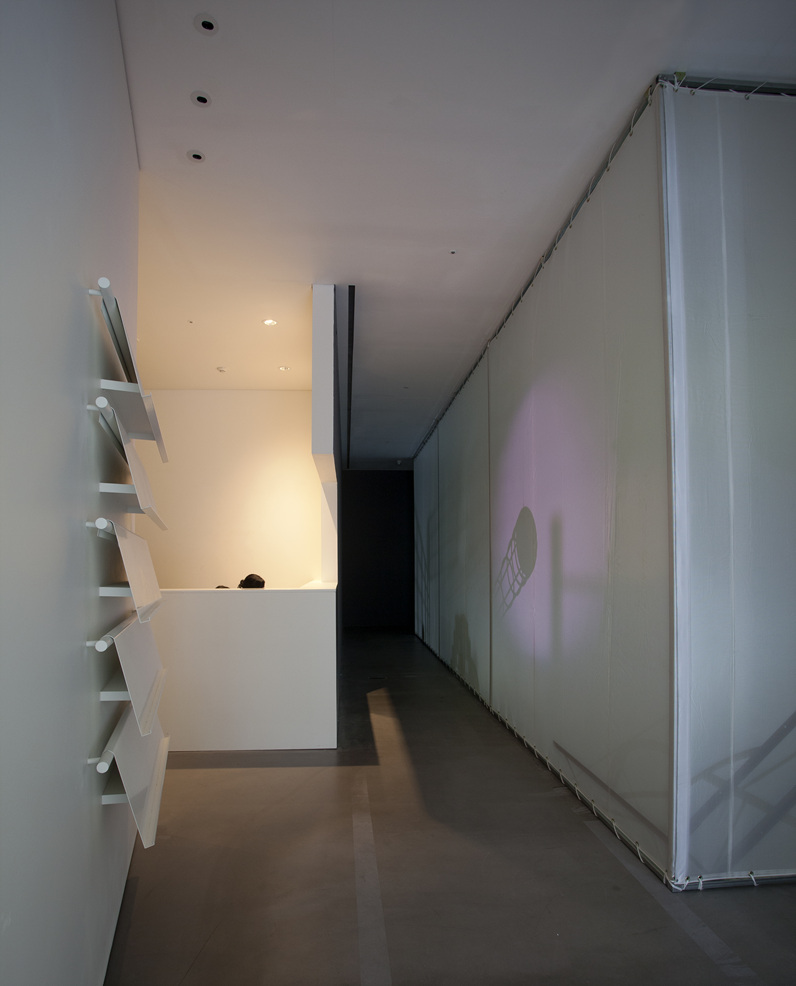
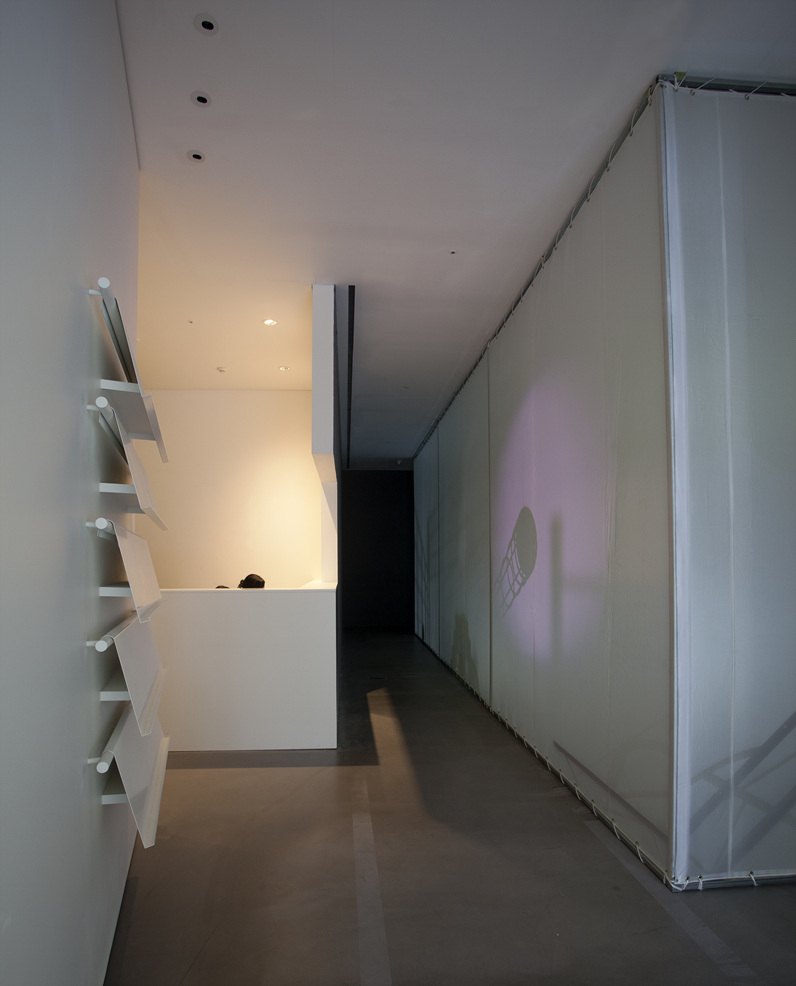
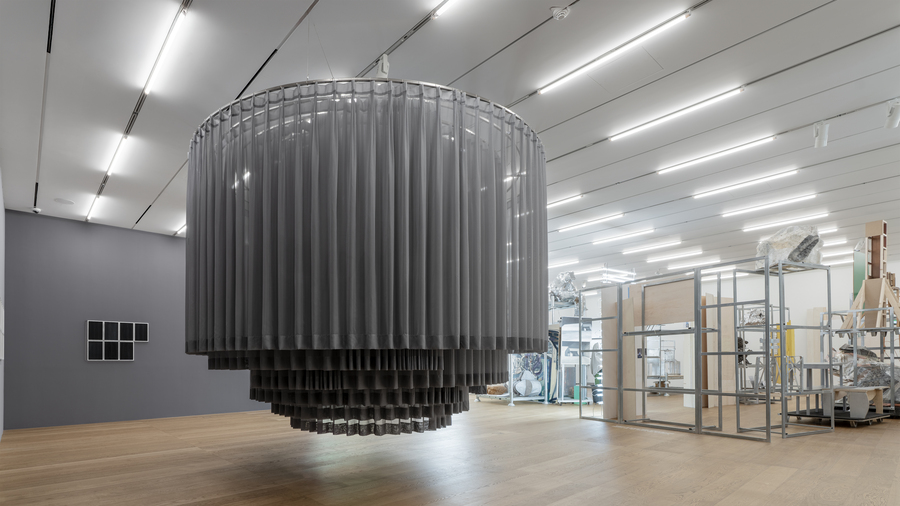
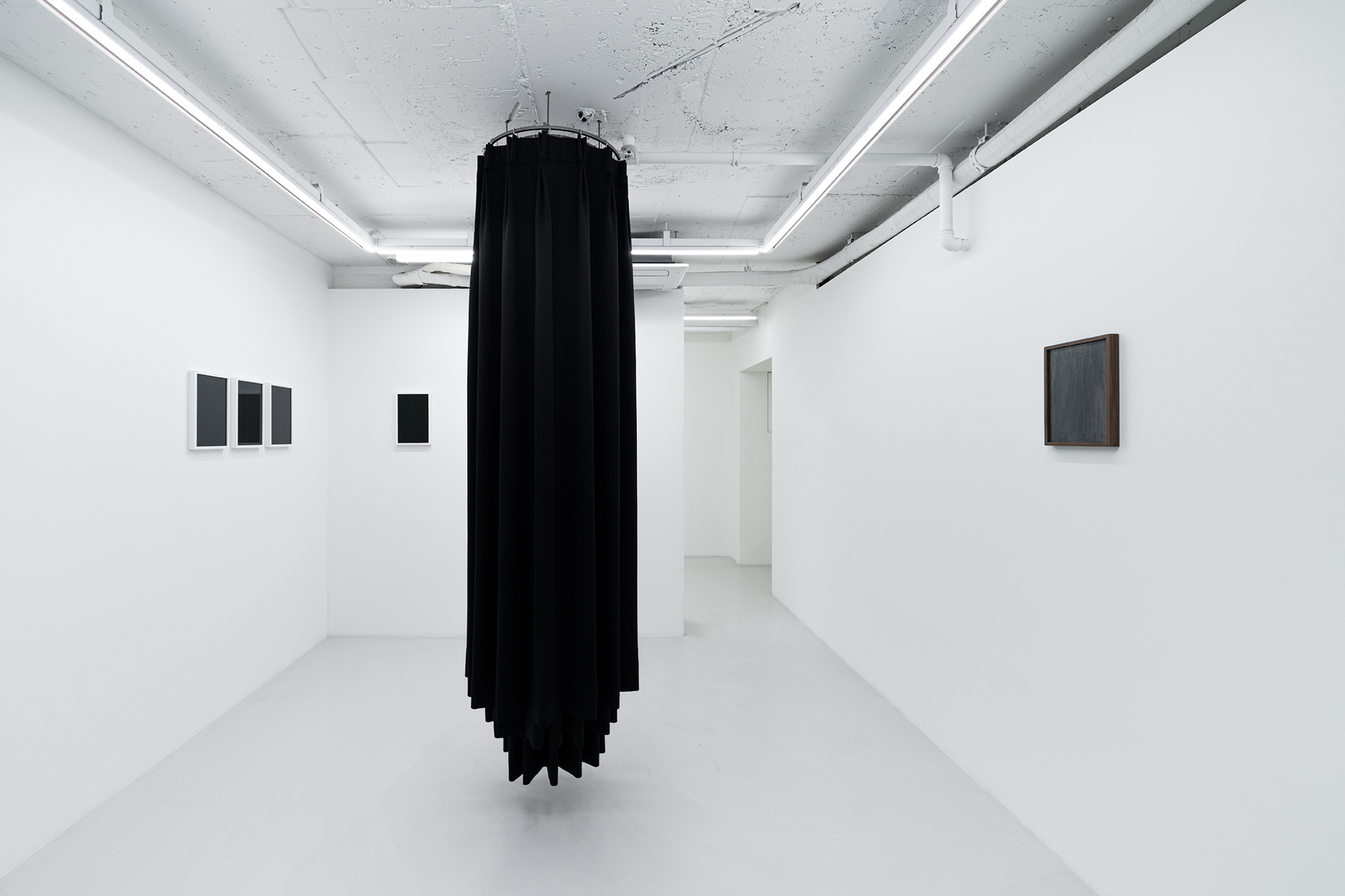
Kim is operated by the dreams and passions of these objects. In 《Black, Pink Balls 》(2014), objects that
she had used or produced for previous exhibitions were surrounded by tents,
resembling an excavation of the tomb of an elephant. Pink lights twirled around
the space like the spirits of the objects resting their heavy bodies, or the flashing
lights of guard posts keeping them from crossing the line. The pink will-o’- wisps, which simultaneously illuminated and obscured the objects,
floated indifferently across the flustered audience, who were unsure where to
put their eyes and feet in relation to the tent, which was marked with a sign
that said “DO NOT ENTER.” In
their confusion about how to respond to this instruction, however, the audience
had already become part of the theater separating the theater from the viewing
area, the tent and lighting instead created a new space beyond the mirror,
which was almost identical to an exhibition gallery, but not quite. The
exhibition was adjourned by the objects, which seemed to reject their assigned
roles and positions. As if they were not yet ready, or had been ready a long
time ago, the objects met people with disinterest, as if audience had arrived
at the wrong time.
Refusing to be passively placed
in a space to be compared to other objects, Minae Kim’s objects reject the general order both of objects and of space.
Through this shared orientation, they selectively renovate whatever space they
happen to occupy, becoming semi-architectural performers that move through the
gaps between objects and spaces, as if demonstrating the route for evacuation
or attack. In fact, the objects themselves do not actually move. The only
kinetic element is the lights, which apply silent pressure to the objects,
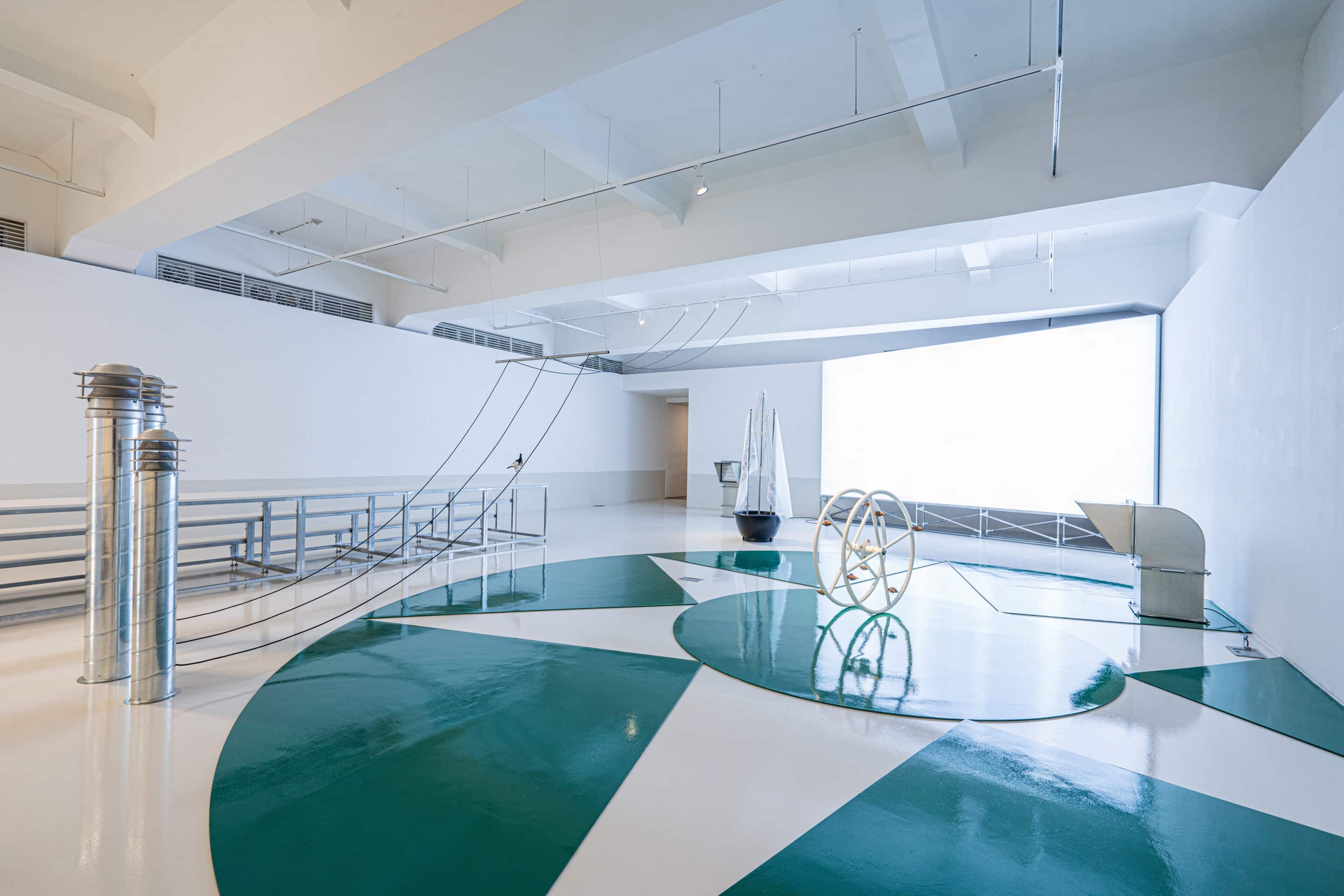
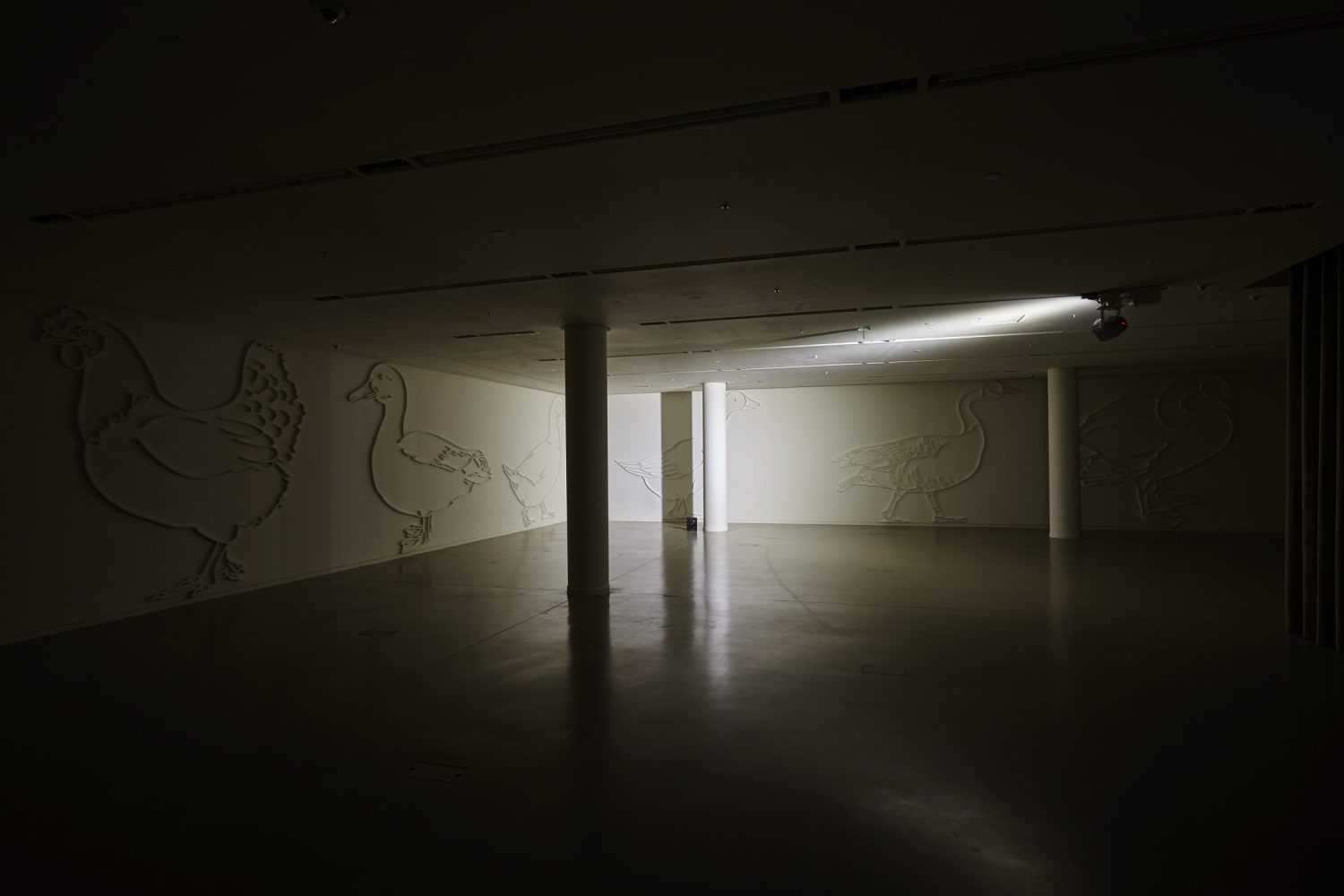
emphasizing their inactivity. In 《GIROGI 》
(2018, meaning “wild geese”), the gallery was lit by rotating lights that seemed to have caused
all of the objects to disappear, with only the sound of flapping wings
remaining. As if to commemorate the missing objects, images of plump birds
embossed on the walls seemed to move ever so slightly, although that was
obviously impossible. In such ways, Minae Kim’s theater
stages the almost hopeless dream of things that become what they are not, elevating
to a higher plane. Their arrested actions unfold like a slapstick comedy
performed with a serious expression. In trying to assume the status of art,
they continually guess wrong, like a comedian who cannot find the keyhole,
trying one spot after another, never realizing that the object in his hand is
not even a key.
Although the gestures of these
objects inevitably overlap with images of the artist who manages them, they are
not anthropomorphized. In fact, they resemble humans by deviating from the idea
of being human. What appears and disappears in the space is not a body with a
face that expresses itself, but rather a partial object that uses the space
itself as its body, like a bizarre crutch. Indeed, Minae Kim once made a wooden
structure that looked like three connected crutches, which she called Freestanding
Sculpture (2012). The crutches, which are artificial limbs that
cannot stand on their own, become a self-reliant structure, supporting one
another. Losing their original function of supporting a person’s movement, they became a dilapidated monument to themselves. In an
effort to assert their self-reliance, the crutches keep changing their
appearance, from a table to a pillar, a pedestal, and even a mop, but these
deficient attempts at rehabilitation only serve to emphasize their uselessness.
Sculpturally defective objects often get stuck while trying to figure out how
to transition to the correct state. A crutch for a wheel(rather than a foot)
might take a hilarious fall, causing laughter. But the next scene, in which the
crutch prevents another crutch from falling, is not the least bit funny.
When History Becomes Future
Where can a theater of objects
go, when the objects refuse to comply with the ethics of everyday goods,
sculptural conventions, traffic regulations, or architectural rationale? One
imminent possibility is to become history. While this might sound boring and
self-evident, the path to such a future is unexpectedly invisible. What type of
vehicle is required to protect the objects as a collection of memory as they
seek asylum in the future? Where would this lead them? One possible answer
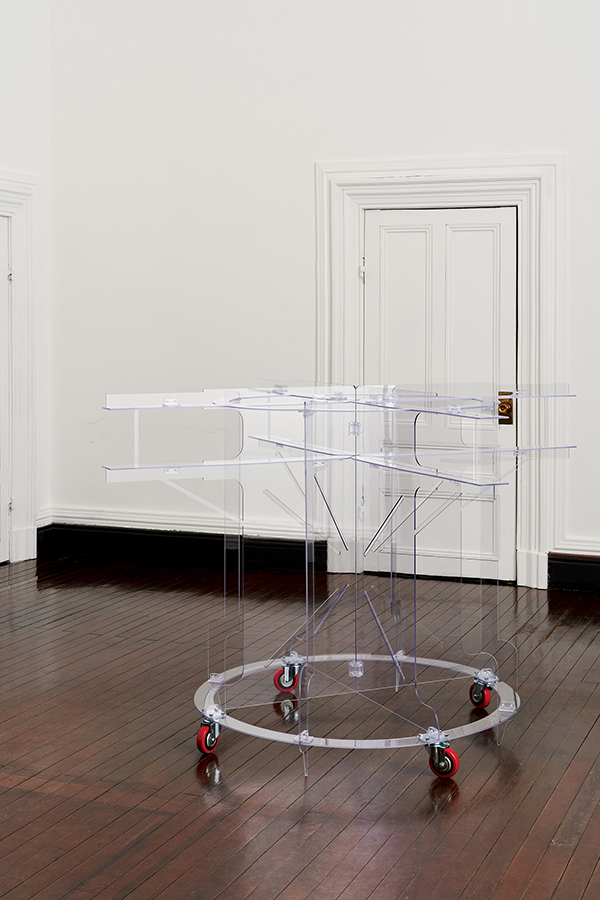
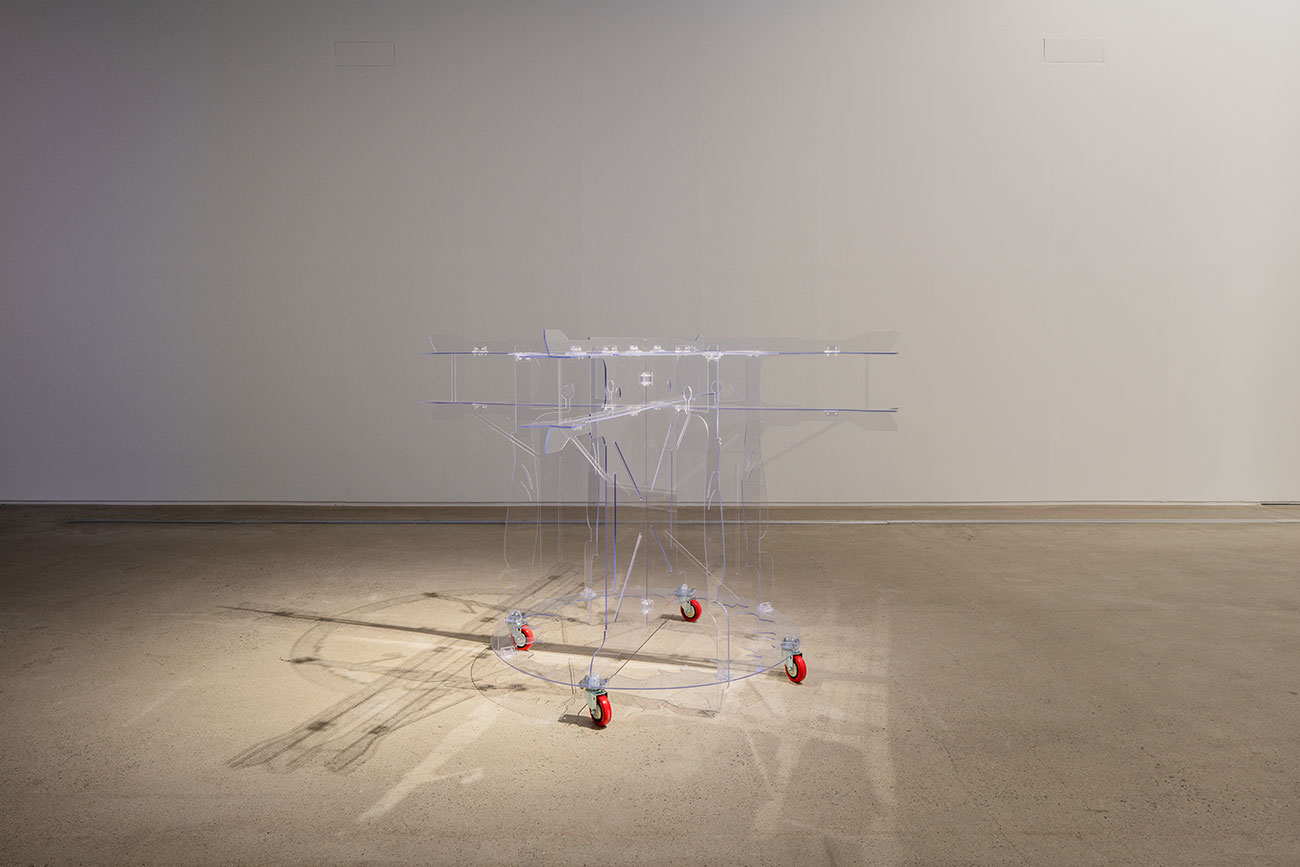
is Sculpture on Wheels (2018), another type of
self-monument that imprints objects’ irregular orbits around the idea of sculpture. Notably, this work
derived directly from Kim’s previous installation A
Set of Structures for White Cube (2012), which consisted of
wheeled crutches that could only stand by being propped up in the corners of
the gallery. For the later work, Kim created a new cross-shaped prosthetic that
enabled the imperfect single legs to lean on one another, before turning their
self-supporting assemblage into a transparent plastic sculpture. While the
original structure remained in ambiguous form, with only the red wheels
retaining their conventional function, the resulting object had a furtive
mobility, allowing it to merge with any surroundings, or even to make an
escape.
Notably, this work was produced
as part of a special program in which artists were invited to renovate and
re-install one of their previous works from the museum’s collection.2 The original work was in storage,
having already been absorbed into the government- managed history. With the
help of Minae Kim, however, it briefly escaped that history, allowing her to
make a plastic copy. But this newly materialized afterimage was quickly
ingested back into the museum system, with a new set of memories inscribed in
the meantime, like a tattoo. It is now an unnamed object that stands and
partially blocks the right entrance of Kim’s exhibition
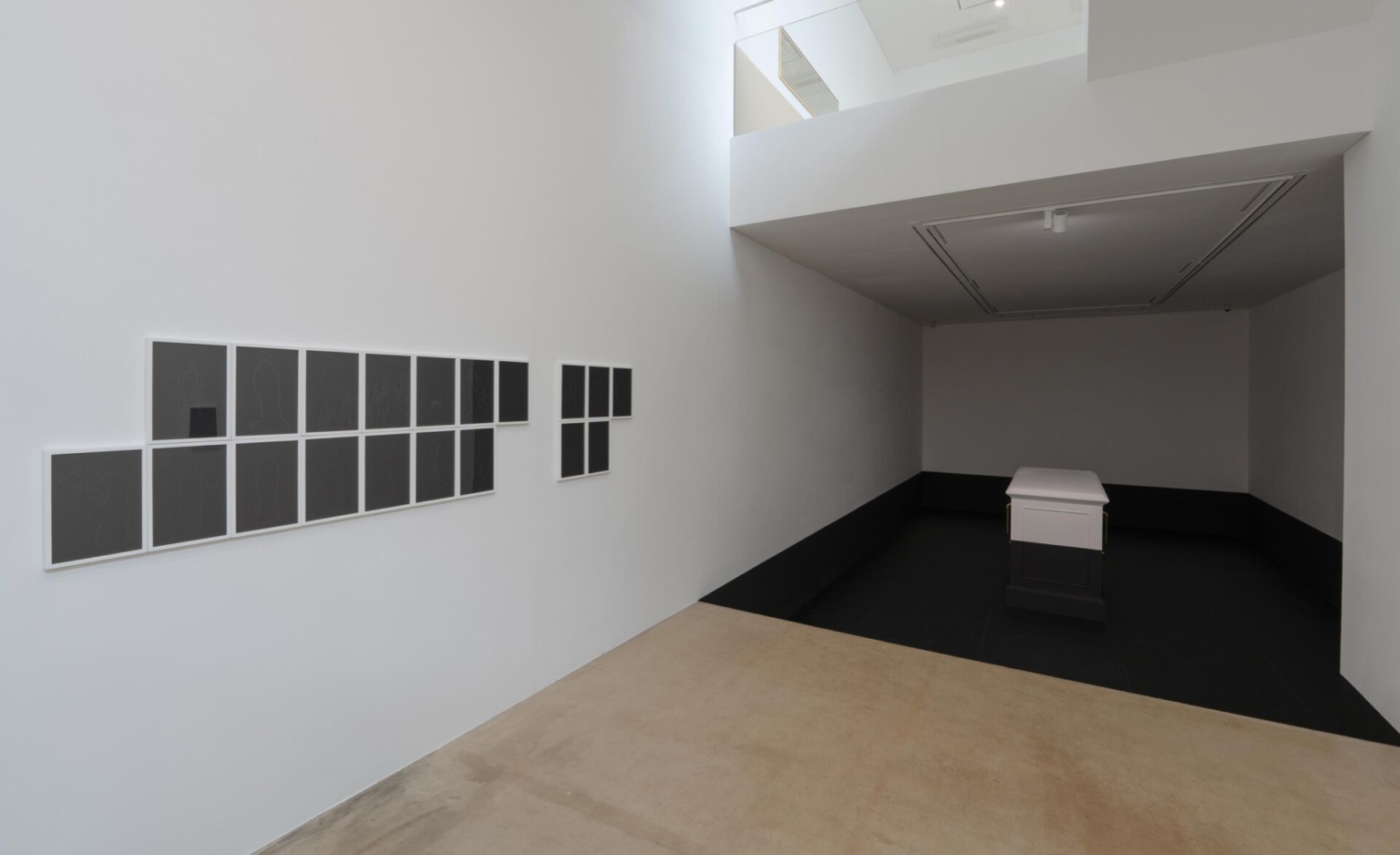
for the Korea Artist Prize. Every object in this exhibition has erased its own
name and now joins in a new chorus of greetings, like an ensemble singing in
the round. Reflecting the given space and bending one another, they oppose the
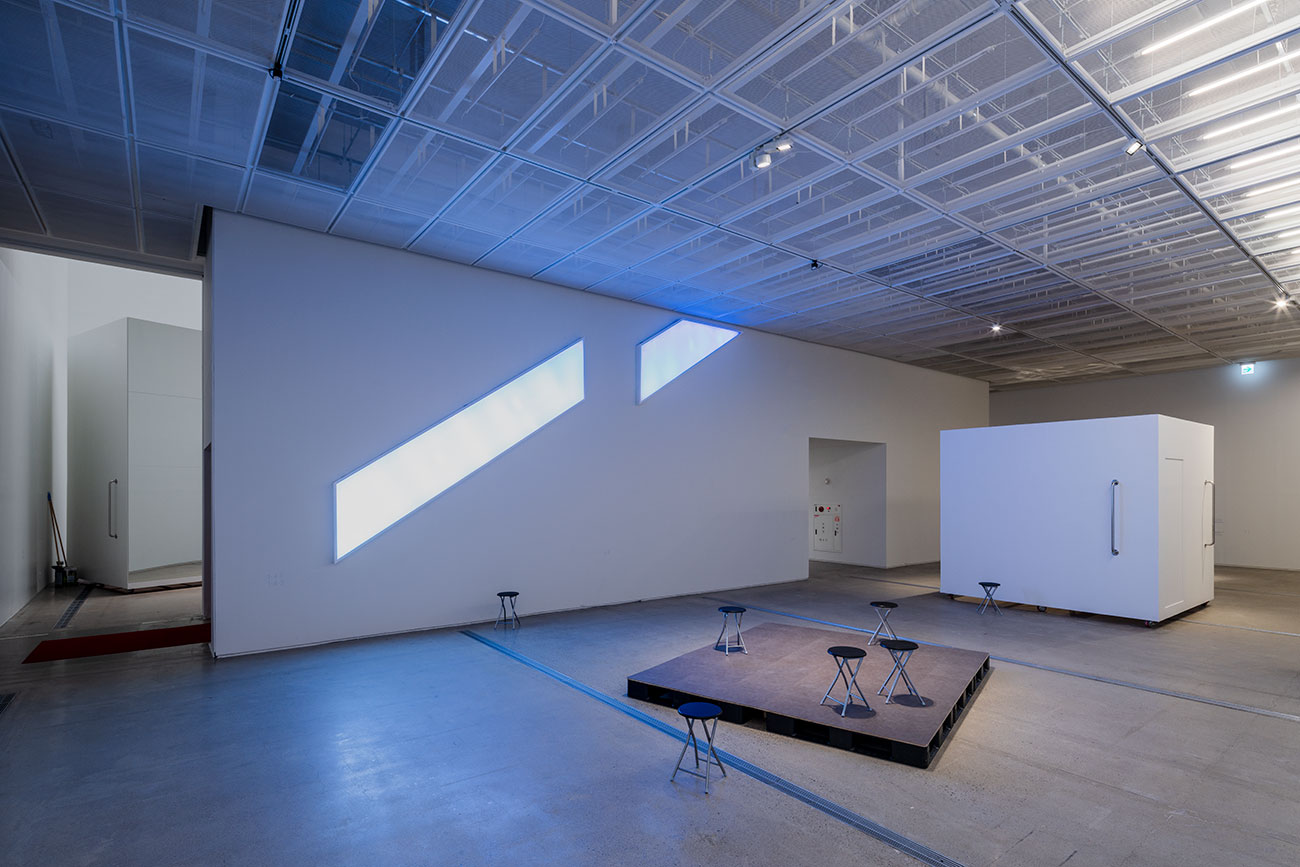
gravity of the art museum as mausoleum. The space allotted to Kim for this
exhibition included the stairwell between the ground floor and the lower level,
with traffic between the two floors being restricted so as not to disrupt the
permanent exhibition upstairs. Kim decorated the dead end of the stairway with
a red carpet cut in the middle, accompanied by an old song that sounds somewhat
sinister. In this area, where the evacuation route has been blocked, the play
of objects resumes.
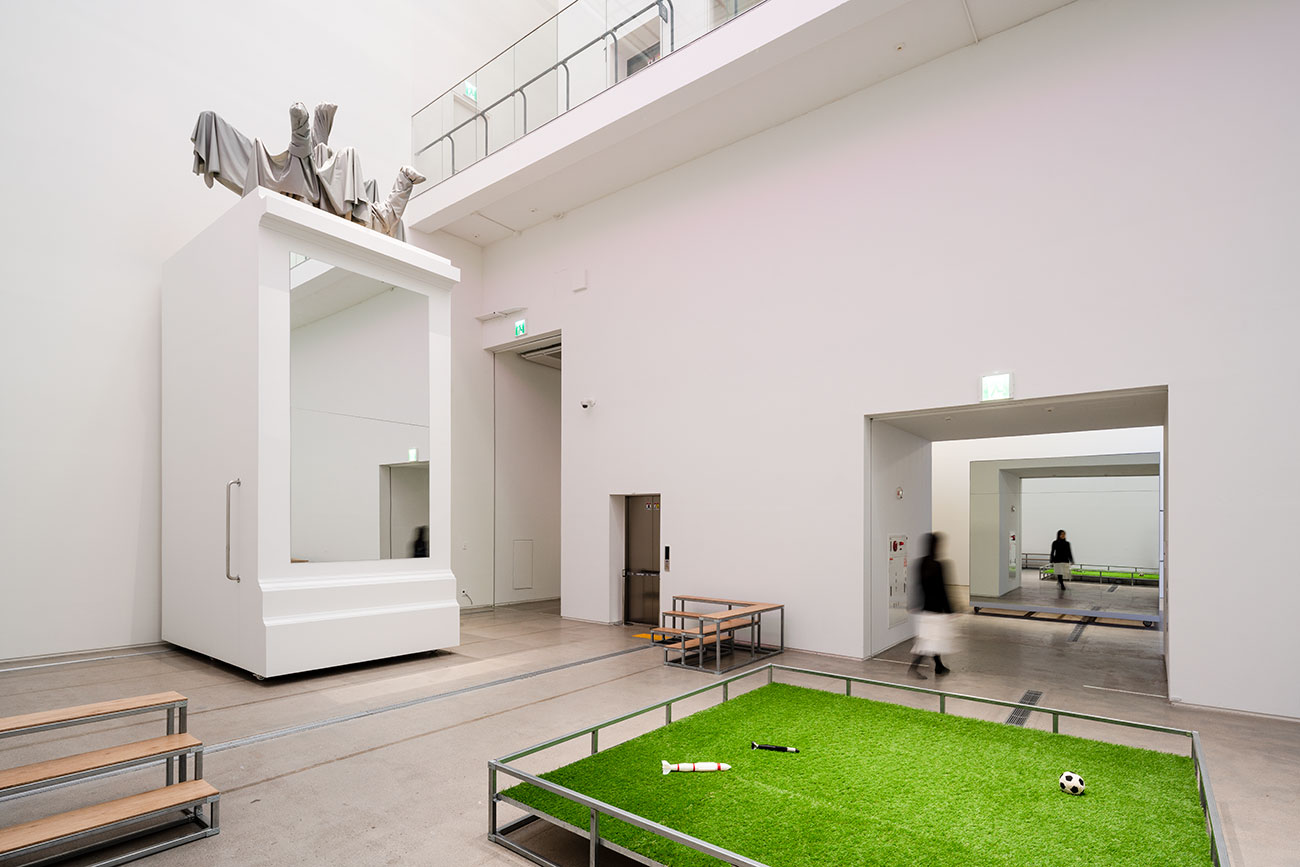
First, three cubes have broken
loose from the stairwell, which has now become useless. The cubes are modeled
after the three entrances connected to this stairwell, thus representing a
life-size sample of the architectural space of the museum and an extra
component that changes the space. Equipped with handles and wheels that are
unlikely to be actually used, these cubes claim to be mobile, but they merely
confuse the audience by obstructing or reflecting the surroundings within
mirrors or white surfaces. By disrupting the gaze and movement that the
museum naturally imposes, this sabotage temporarily neutralizes the invisible
boundaries distinguishing what should be seen from what need not be seen. In
this renovated space, other objects come in, one after another, until it
becomes difficult to tell the featured works from supplementary items either
assisting or hindering the exhibition. Some objects that take the stage
initially seem to be imitating something else, only to look clownish when the
association ultimately fails. The performance does not seem to follow any
predetermined script. Instead, each set of loosely bound objects around the
three cubes acts like the stage curtain of a play.
Like the three ghosts from A
Christmas Carol, the objects in this exhibition seem to act out
situations that either have happened in the past or could happen in the future.
In a way that diverges from the usual history of art, they represent the
fragments of collective memory shared by objects, with the museum as their
destination. Rather than certain objects going through certain situations, they
represent patterns in the lifetime of objects that were specifically made for
an art exhibition. Reenacting the collective memory, the objects examine the
conditions under which the repetitions occur, as well as irregular phenomena
that could emerge in the process. The objects ask questions, like how was I
made? What can I identify and compare myself to? What shall I become? Through
such questions, the objects transition from competitive relationships, in which
they desperately flaunt themselves, to cooperative relationships that explore
their shared destiny. If this transition ultimately leads to sculpture, it
might be valid not as an ideal to be blindly pursued or discarded, but as a
catalyst for inducing the unexpected resurrection of objects.
Reversing Hell
Through the left entrance that
leads to the stairwell, the first cube appears. A tall box is decorated with
hanging bands of gray adhesive, imitating the red carpet, and coated with a
layer of glossy paint. Near the box is a pair of open paint cans, with a brush
still inserted. Reminding us of the many objects inside a museum that are not
considered to be art, this plywood structure is built in the manner of a
freestanding display wall or pedestal, although it is too tall and thick to
serve either purpose. Interestingly, these large dimensions, which prevent the
box from serving a practical function, seem to have been made to suit the high,
wide space of the museum. It must have been constructed in this very space, and
will likely be dismantled here when the exhibition is over. Although the box
succeeds in visualizing itself as a self-monument, it ultimately fails to save
itself, and is thus relegated to become a futile memorial to the exhibition
objects that are waiting to be taken apart.
The second cube and its
derivatives are scattered near the central entrance, passing under the
stairwell. The cube is about the same size as a small studio apartment, as
suggested by the slight indentations indicating the possible positions of doors
and windows. While much larger than a person, the cube is still dwarfed by the
high ceiling of the gallery. As a conspicuous criterion showing the difference
in scale between a museum and a standard living space, this white cube reminds
us that the objects here are larger than they seem. Imagining what it could be
in reality, the cube changes its appearance to a low platform with seats and an
artificial lawn. Even so, the space is probably too small to accommodate a
group of people chatting or playing together. The relative sense of size
between art and reality continues to fluctuate. The righteous objects of the
artist are too big to enter the house, but too small to change the world. In
the end, they remain materialized signs representing something other than themselves.
Finally, in the extension of the
right entrance, there is the third cube, which is the largest and most daunting
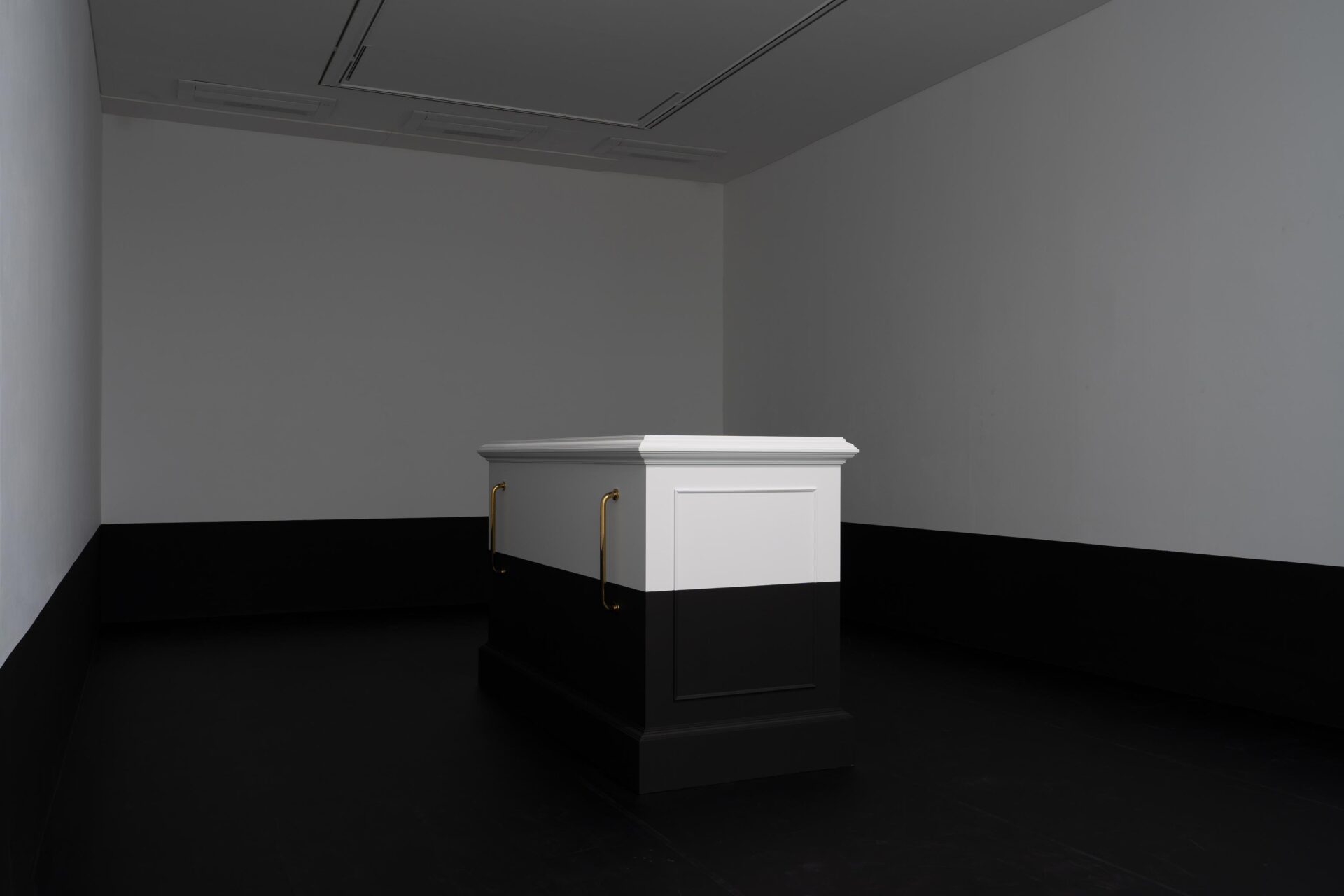
of the three. Adorned with decorative molding and bearing three shapes draped
with loose grey cloth, it looks like the pedestal of a statue prior to the
unveiling. The shapes appear to be birds that are about to take flight in three
different directions. Of course, we know that they cannot fly away, even if the
cloth is removed. As an altar for wild geese that cannot fly, it corresponds to
the transparent eagle trophy on the opposite side of the gallery, thus
repeating the symbols of art and power that are endlessly reproduced and the
self-representation of art, as shown in Musée d’Art Moderne, Département des Aigles (1968– 1972) by Marcel Broodthaers. However, when approached purely as an
image, before the symbol, the three flightless birds looking down from a high
altar recall the three spirits with their heads lowered atop Auguste Rodin’s La Porte de l’Enfer (1880–1917). They dance atop the entrance to another world, but the
entrance, which does not open or close, is not actually a door, but a cluster
of objects.
According to Alenka Zupančič, tragedy and comedy are opposing
strategies for facing the human condition; while tragedy internalizes
unresolvable intervals between the infinite and finite as painful
self-destruction, comedy extends life by externalizing the indestructible
vanity of human beings.3 What happens to those who fail to
become what they are supposed to become? They go to hell. The wild geese ask, “Is this hell?” The audience, on the other
hand, asks, are the wild geese immortalized as tragic subjects who inevitably
fail in their pursuit of their ideals? Or are they ineradicable as comic
objects that boast as if they truly exist on another level? Instead of a door
that does not open, the altar to the wild geese lights up the exhibition space
with a large mirror. The space beyond the mirror reflects a series of illogical
images derived from the artist’s previous works and
past exhibitions in that space. Fortunately, on a clear day after the pandemic
has lessened, the blue sky and people passing by could also be seen. We are
here at last.
1 Choi Taeman, History of
Modern and Contemporary Sculpture in Korea (Seoul: Art Books, 2007), 15.
Quotation taken from Rainer Maria Rilke, Auguste Rodin, trans. Jessie
Lemont and Hans Trausil(New York: Sunwise Turn Inc., 1919).
2 For the
exhibition Extended Manual (Nam-Seoul Museum of Art, 2018–2019).
3 Alenka Zupančič, The
Odd One In: On Comedy (Cambridge, London: MIT Press, 2008), 53–58.