Body as Arrangement and Function
Sculpture is tied to the body in
Yoon’s work, not in their superficial similitude but
in their functionality, like organisms. Although her objects— ranging from spherical, cubic, conic, and elongated to thorny—derive from the body in one way or the other, their association with
the body has less to do with their shape or appearance than
processual elements, such as the role of the mother mold in the casting, or
certain material properties like responsiveness to the change in temperature,
moisture level, tension, etc. Some of her sculptures are used to wrap other
objects like skin or provide support like muscle or skeleton, while others
spill out the content with which they have been filled in like digestion. Yoon’s approach to the body in her practice differs, however, from
attributing human form to abstract shapes. It is rather the case where the
association with the body is found in the moment of figuration that consists of
gesture, motionlessness, touch, and movement, in all their interconnectedness.
Yoon’s work raises the question of what the body is. According to Butler,
the individual and biological body emerges in the moment of public and
political negotiation:
…could we not argue, with Bruno Latour and
Isabelle Stengers, that negotiating the sphere of appearance is a biological
thing to do, since there is no way of navigating an environment or procuring
food without appearing bodily in the world, and there is no escape from the
vulnerability and mobility that appearing in the world implies? In other words,
is appearance not a necessarily morphological moment where the body appears,
and not only in order to speak and act, but also to suffer and to move, to engage
others bodies, to negotiate an environment on which one depends?4
The pandemic was yet another
reminder of what it meant to come in contact with and engage other bodies. At
the same time, it has also provided an opportunity for Yoon to reexamine the
boundaries and vulnerabilities of the body in her work, which has hitherto
foregrounded the structure of sacrifice and interdependence. Although the
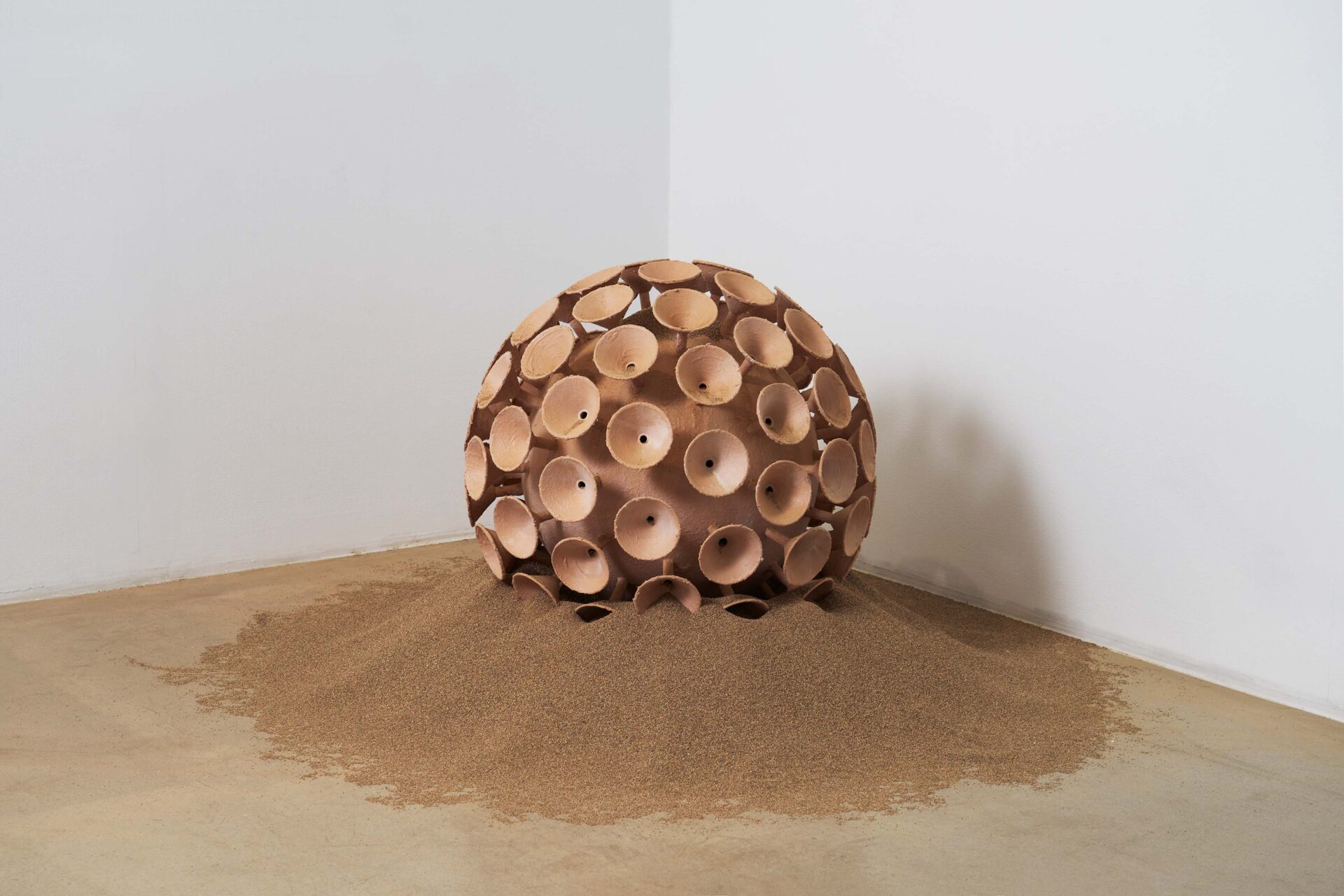
motifs of body mass and human skin have been implemented variously in That
that is is that that is not is not is that it it is (2016), No
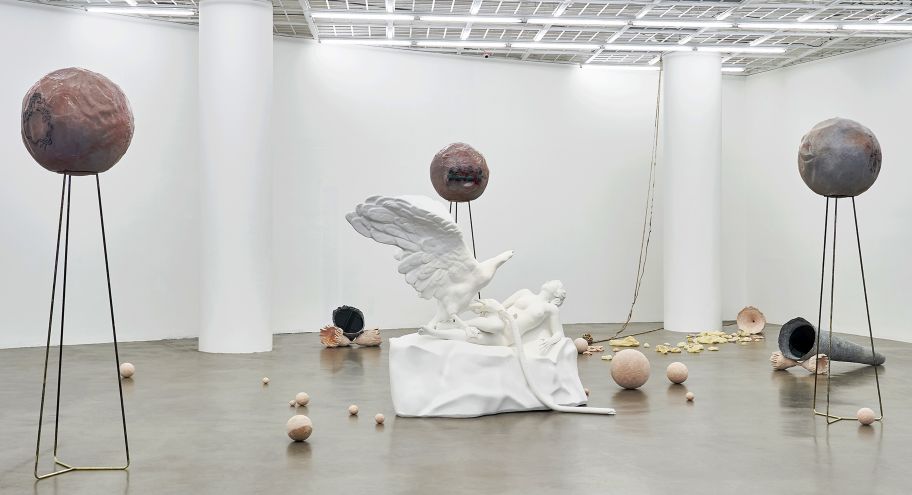
Planar Figure of Sphere_ (2018), and Leda and the
Swan (2019), it is in the ‘Yellow Blues‘ series (2021)
where the use of silicone stands out the most. An oft used material for plastic
surgery, silicone boasts likeness to the human skin. It is temperature
sensitive and, once cured, comes to possess great elasticity and resilience.
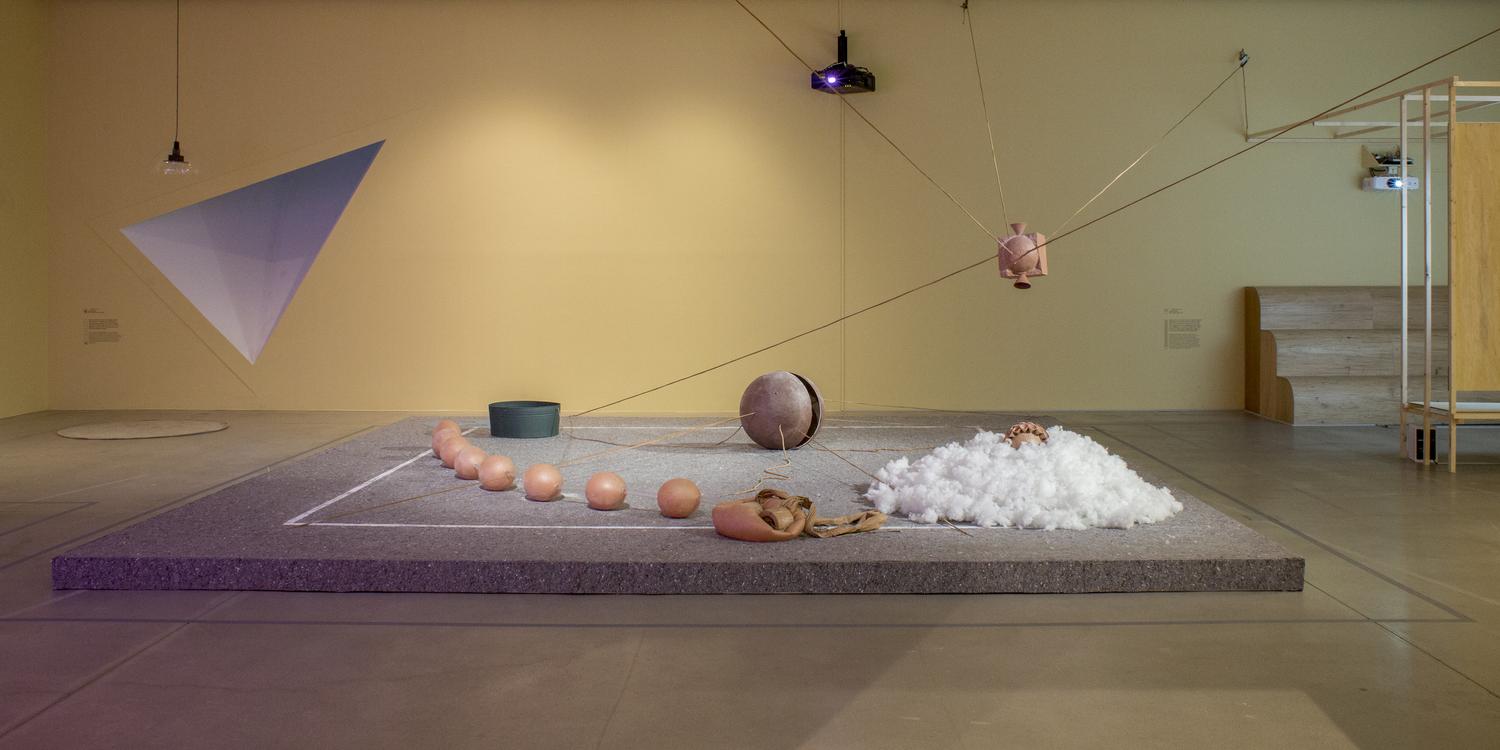
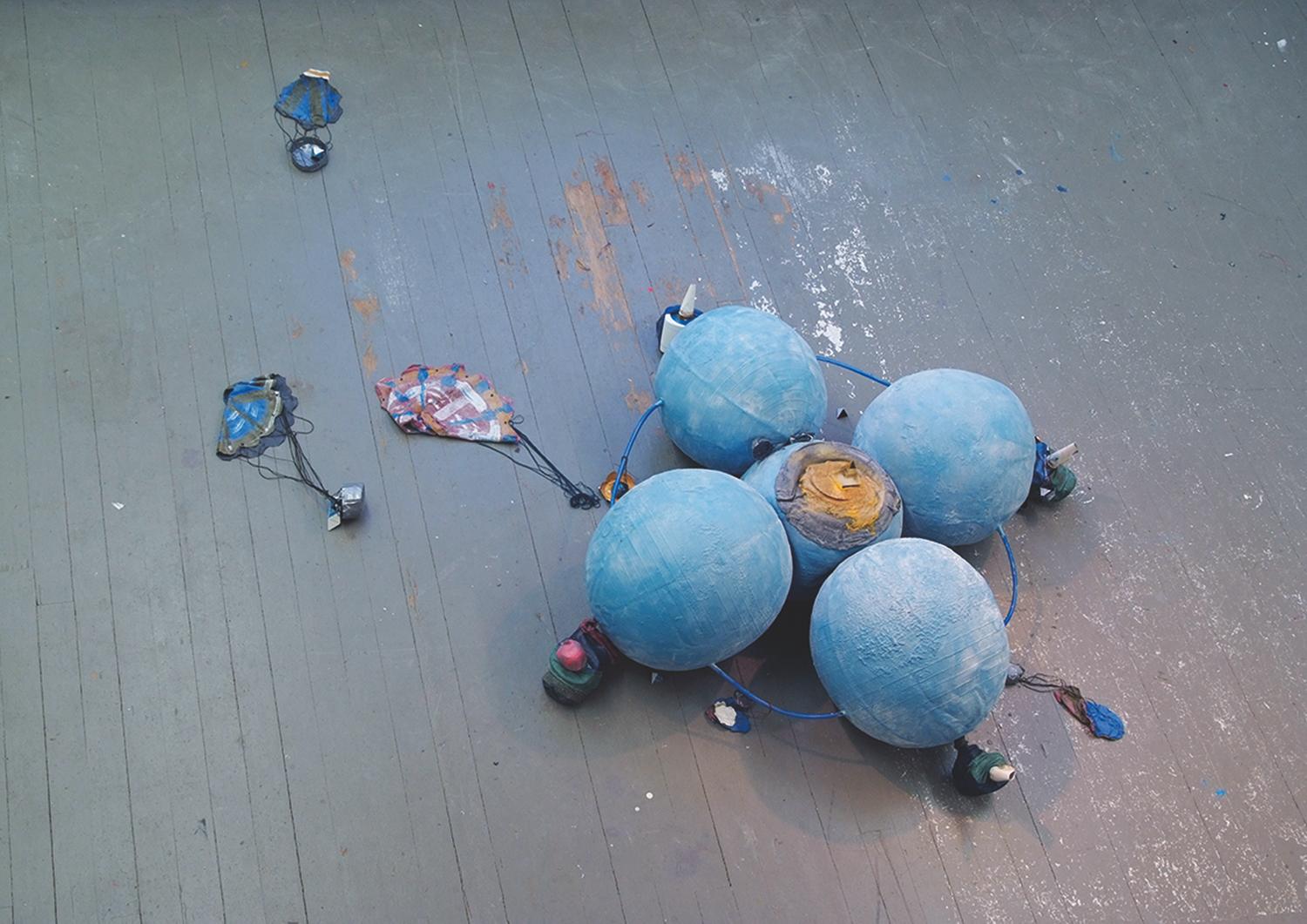
For the Young Korean Artists 2021 exhibition at the Gwacheon branch
of the National Museum of Modern and Contemporary Art, Yoon presented a number
of sculptures in the ‘Yellow Blues_’ series where the plasticity of
silicone stood out: three yellow spherical objects with varying degrees of
hardness embracing one another, yellow balls in the size of a ping-pong ball
that were stacked up like a pyramid, a large sphere bound so tightly by yellow
ropes that its surface broke off. No longer bound by wires like in the previous
work, these sculptures were placed apart from one another like an archipelago.
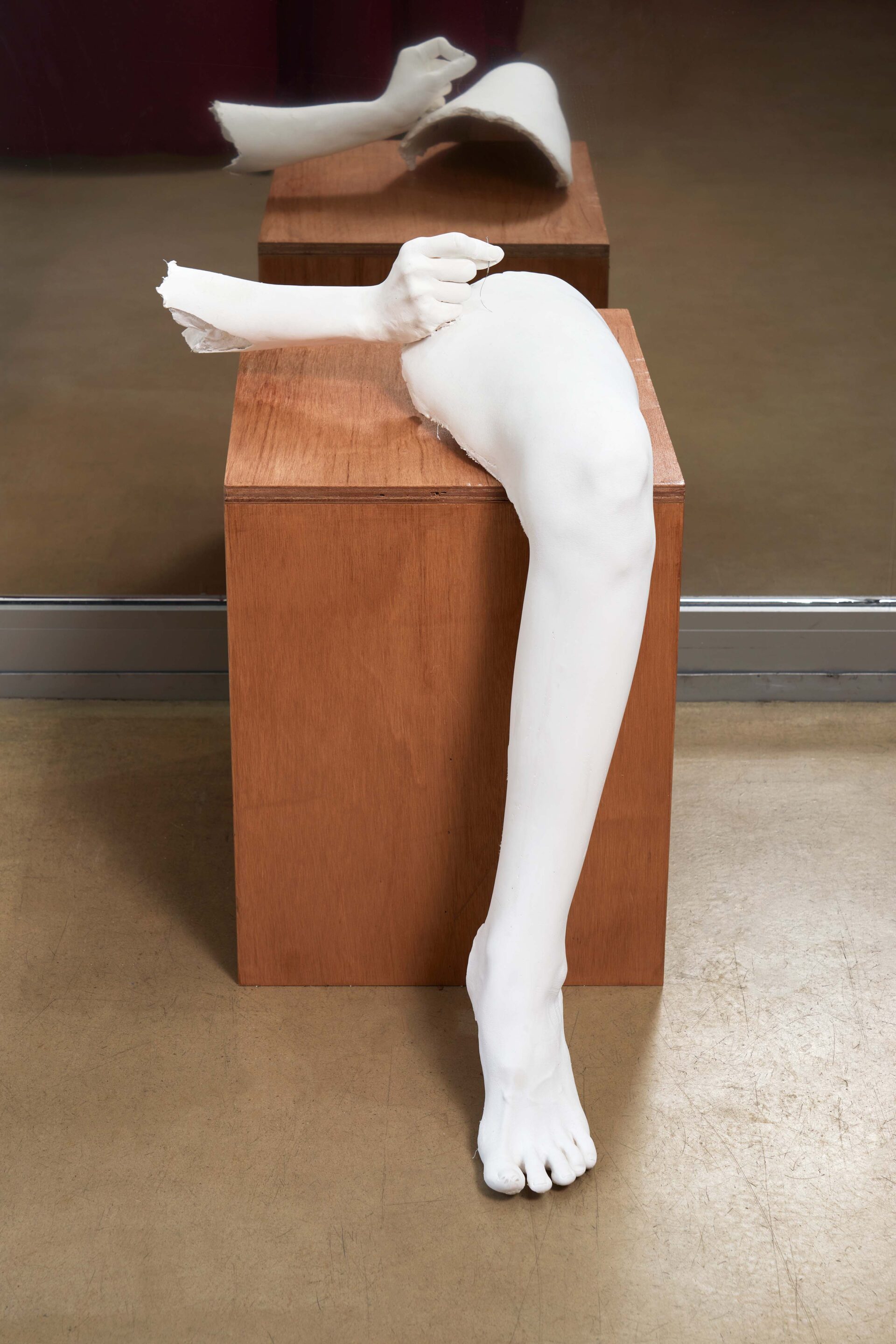
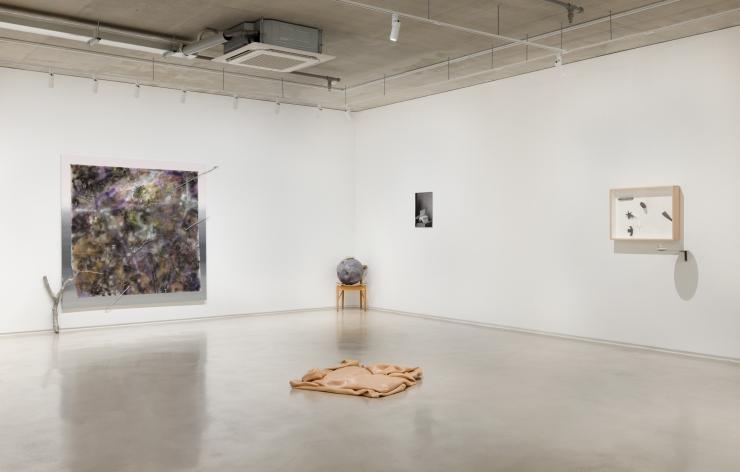
In the corner of the exhibition space lay a cast of an arm from the elbow down,
where the hand remained open as if trying to catch snow or falling leaves. A
black mirror hung in the air reflected all other sculptures in silence,
contributing to the almost lyric quality of the exhibition. Almost all of them
were titled Yellow Blues_, which echoes Yoon’s attempt to address the state of self-consciousness—partly by referring to Agatha Christie’s ‘Absent
in the Spring’—where the person chews over one’s past actions and utterances during the times of isolation prompted
by the pandemic.
Yoon presents the same set of
themes with a more theatrical quality in her solo exhibition at One and J.
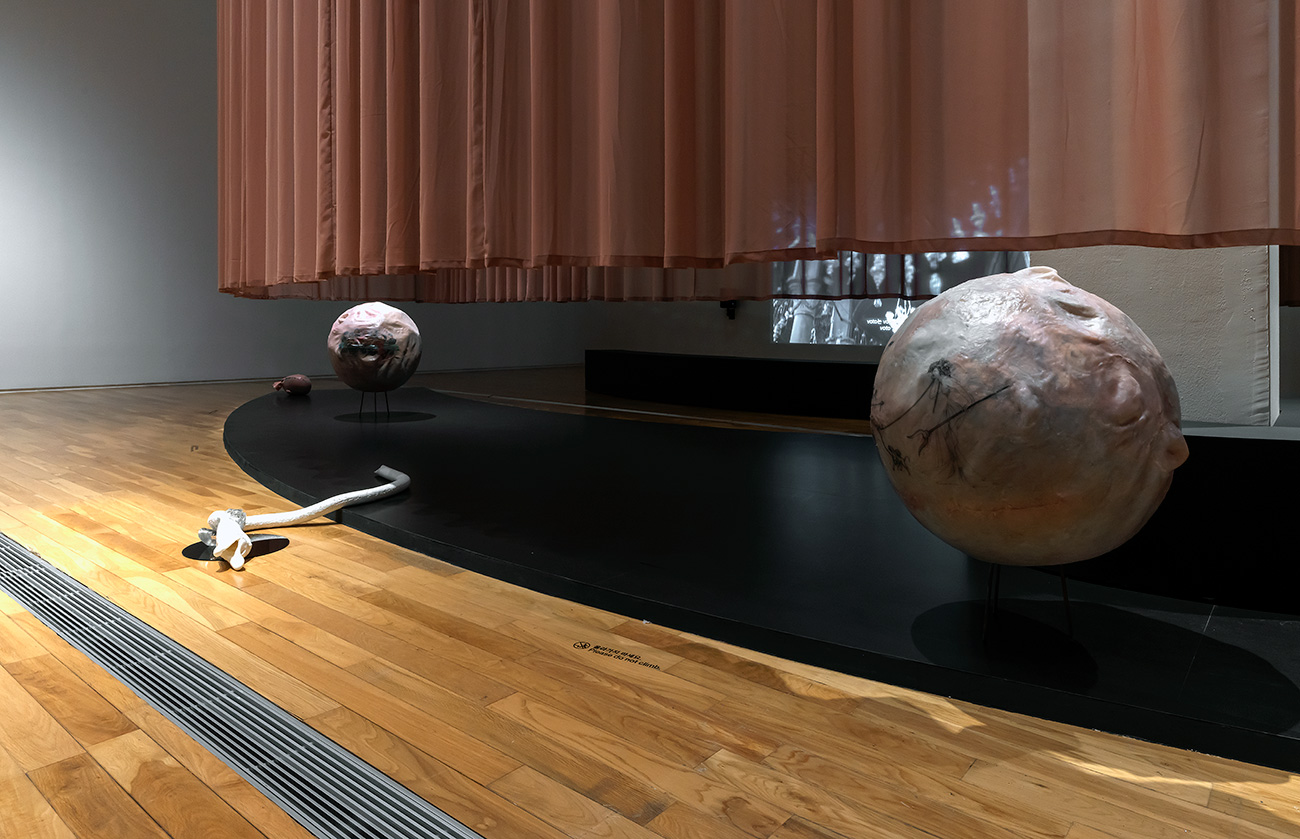
Gallery in the same year. A head swollen like a balloon, The
Absent Body: A Motherless Mold and a Face(s) is laid on the
floor, where the only trace of facial features in this sculpture is the
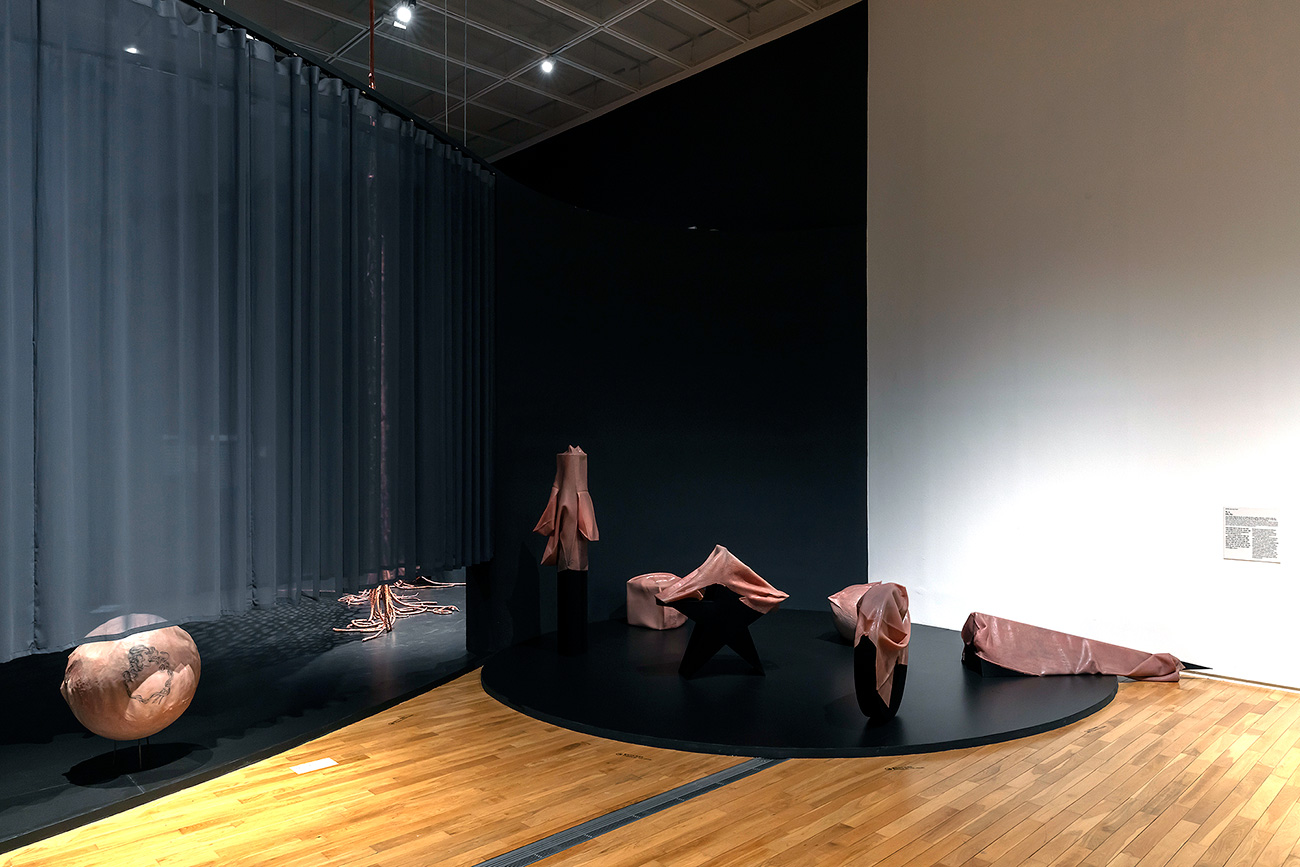
peculiar shape of the ear. Yoon works consciously with the notion of body mass
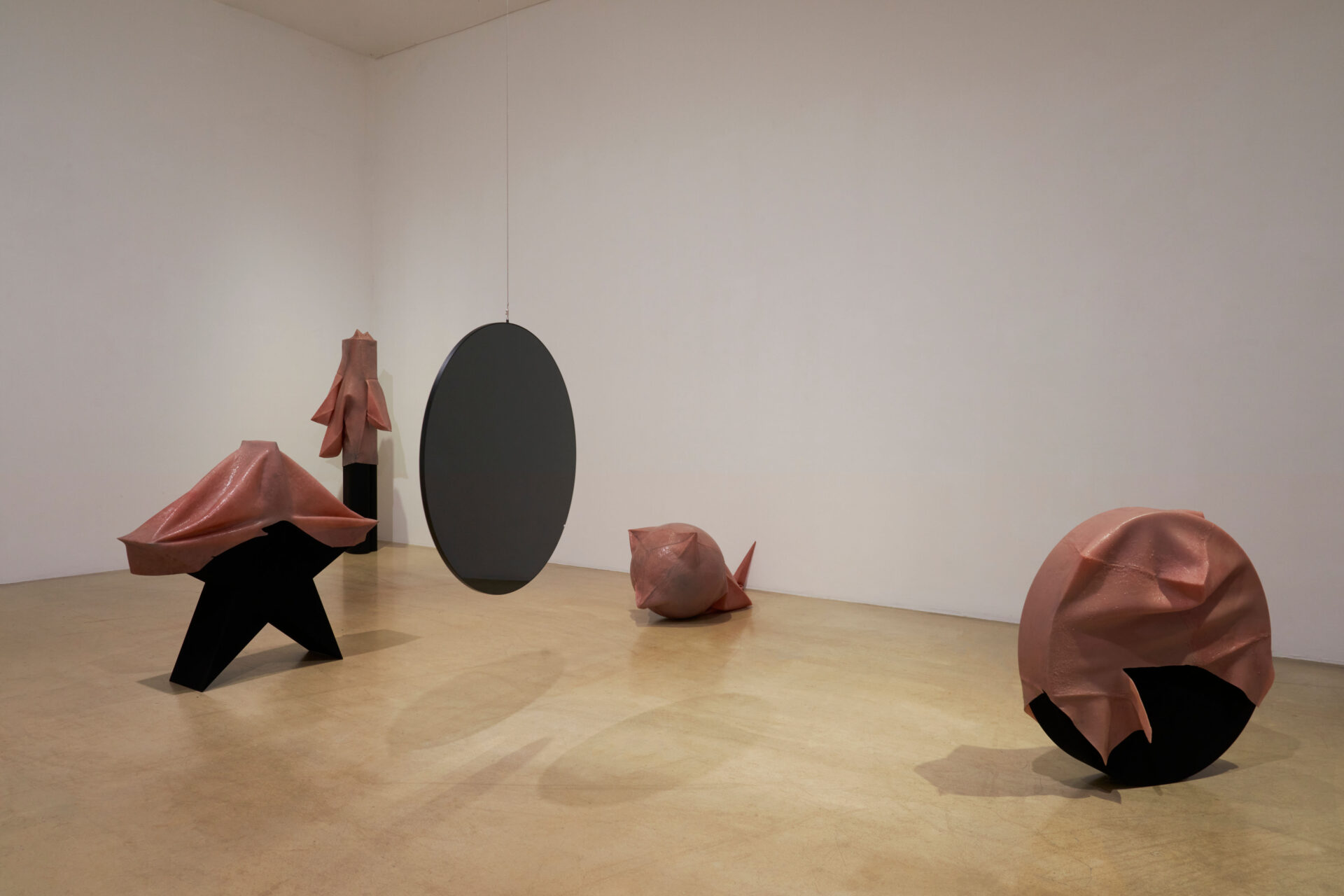
in this series: the six sculptures behind the dull apricot curtain, all of
which are painted in black, share the same volume of 65,416 cm3 , but vary in
shape, ranging from sphere, tetrahedron, cube to pentagrammic prism and
heart-shaped pillar. These metal sculptures are painted with special acrylic
pigment that absorbs 99.4% of the light, which creates a depthless void that
eliminates a sense of volume, appearing almost two-dimension.
Three-dimensionality is intimated by the silicone wrappings that have been cast
from each of the six sculptures. Their wrappings, however, are swapped: The
silicone “skin” of the pentagrammic prism is put like a cape on the heart-shaped
pillar, and the apex of the tetrahedron has pierced the skin of the
heart-shaped pillar that it is wrapped around; a sphere inside the tetrahedron
wrapping seems as if it have pinnaes. Would it be plausible to claim that they
are wearing other’s skin, which, by extension, alludes
to a process by which to attain ideal selfhood?
The plasticity of silicone in
Yoon’s work lays bare not only the border and
vulnerability of the body but also their malleability and the associated
feelings of hope, despair, and distress. Not only is the skin a volatile zone
of pain and pleasure but it also serves as a tangent of difference,
discrimination, contamination, and contempt. It is the border between self and
the outside world, a psychological wrapping that gives rise to ego through the
abundant sensorial correspondences it affords. Psychoanalyst Didier Anzieu
writes:
The skin…is superficial and profound. It is truthful and deceptive. It
regenerates, yet is always drying out. It is elastic, yet a piece of skin cut
out of the whole will shrink substantially. It provokes libidinal investments
that are as often narcissistic as sexual. It is the seat of well-being and
seduction. It provides us with pains as well as pleasures.5
Wishing You Well
As evident in the ‘Yellow
Blues_’ series where “body mass” manifests in varying geometric forms, the resemblance of the body
in Yoon’s sculptures is not restricted to that of the
morphological or the functional. She has expressed her wish to “express corporeality only with geometric forms,”6 where the body is abstracted in
terms of volume. Volume is a geometric abstraction of space taken up by an
object, and, therefore, has no form, premised on neither specificity nor
identity. Such brings to mind the American minimalist sculptors who have
produced cubes or other polyhedrons the size of the human body. When George
Didi-Huberman examines “anthropomorphism” in Tony Smith’s ‘Die’, along with
other minimalist sculptures, as a performative moment in which we are reminded
of our deep-seated anthropomorphizing impulse,7 he claims that
simple forms in the size of the human body often evoke an ancient monolith or
sarcophagus. Such an evocation has less to do with anthropomorphism than the
amorphous geometric resemblance, the silent void and the “votive quasi-portrait”8 in which we, to our own anxiety, find the resemblance to and
the absence of ourselves.
Yoon’s “quasi-portraits”
likewise carry semblance and absence, which allows serial emergence of beings
that are anonymous yet implicated in each other, more so than the dialectics of
life and death taken up by the minimalist sculptures. Her most recent
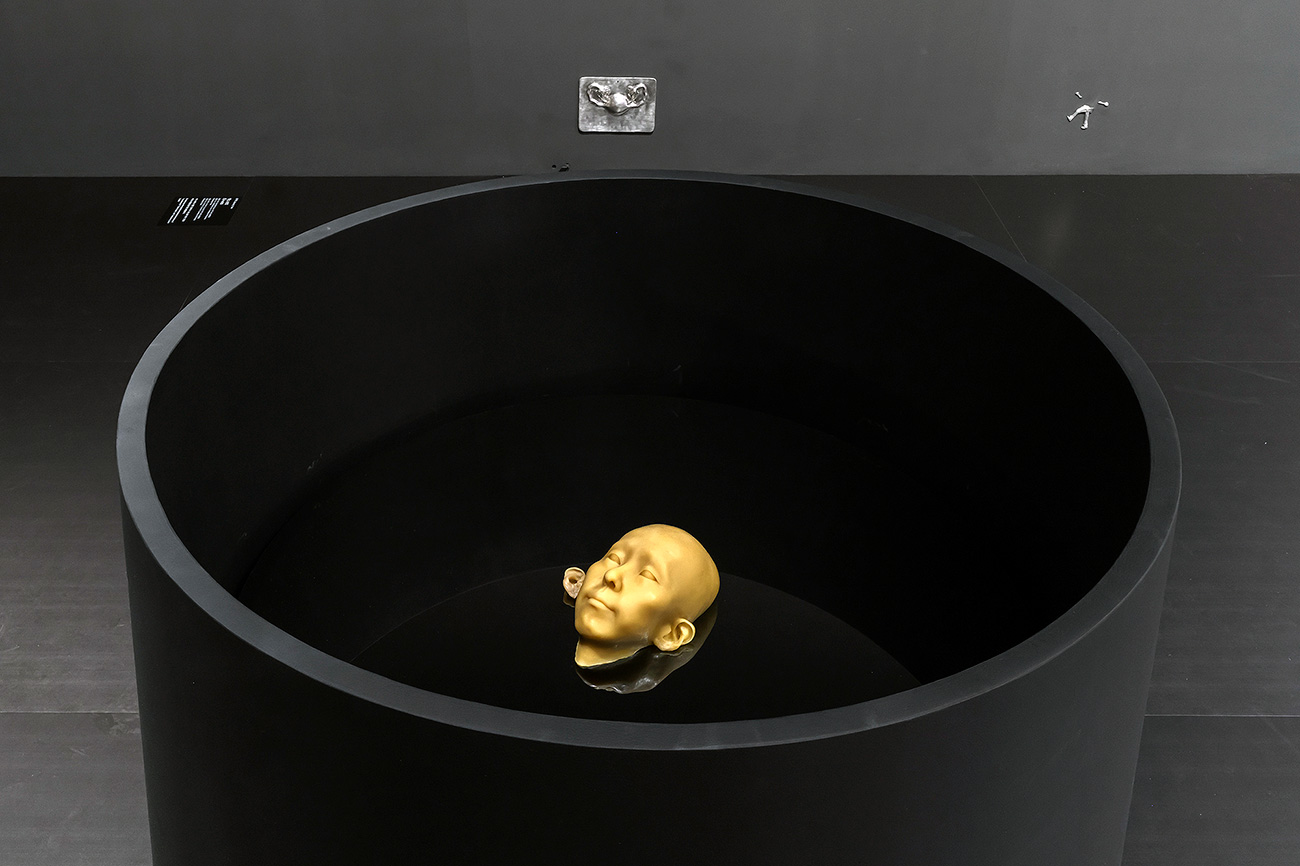
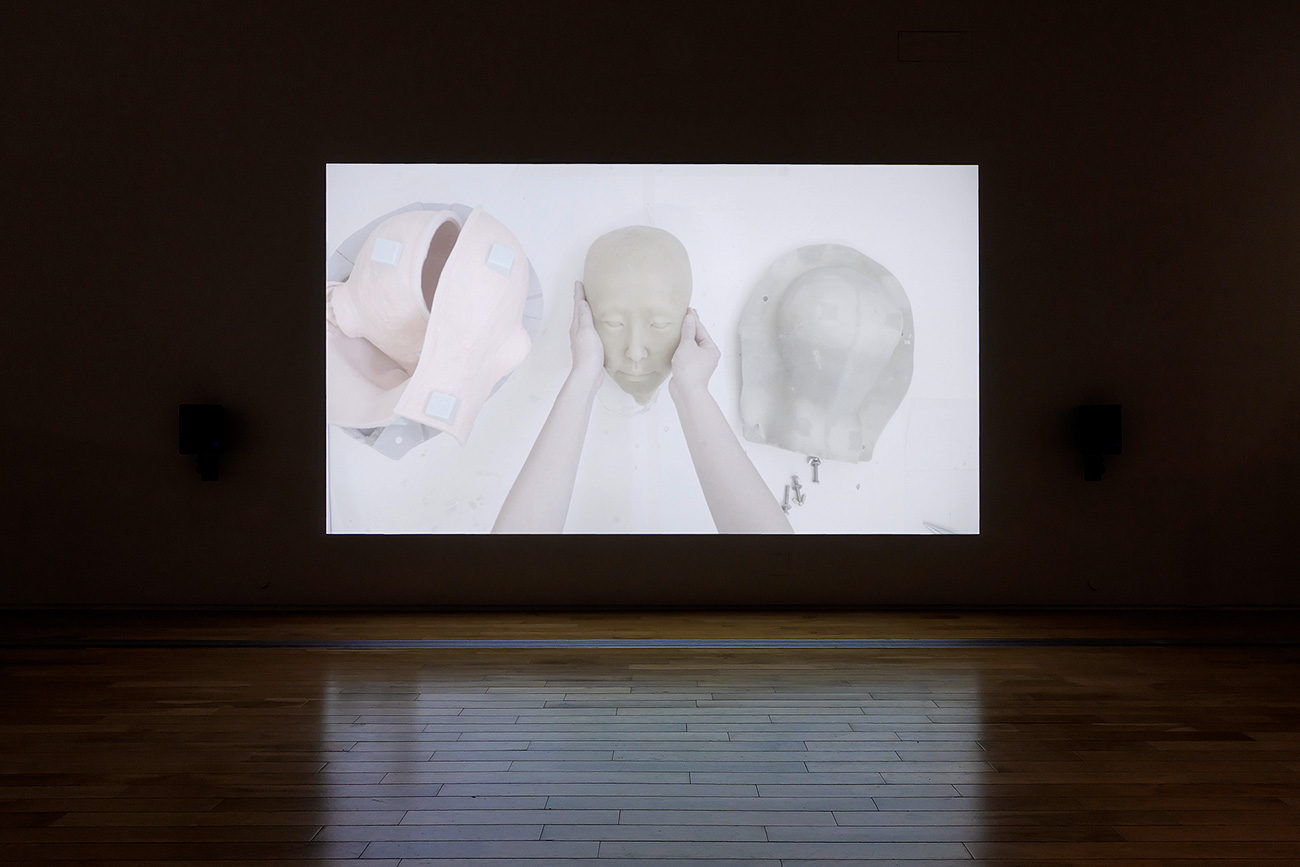
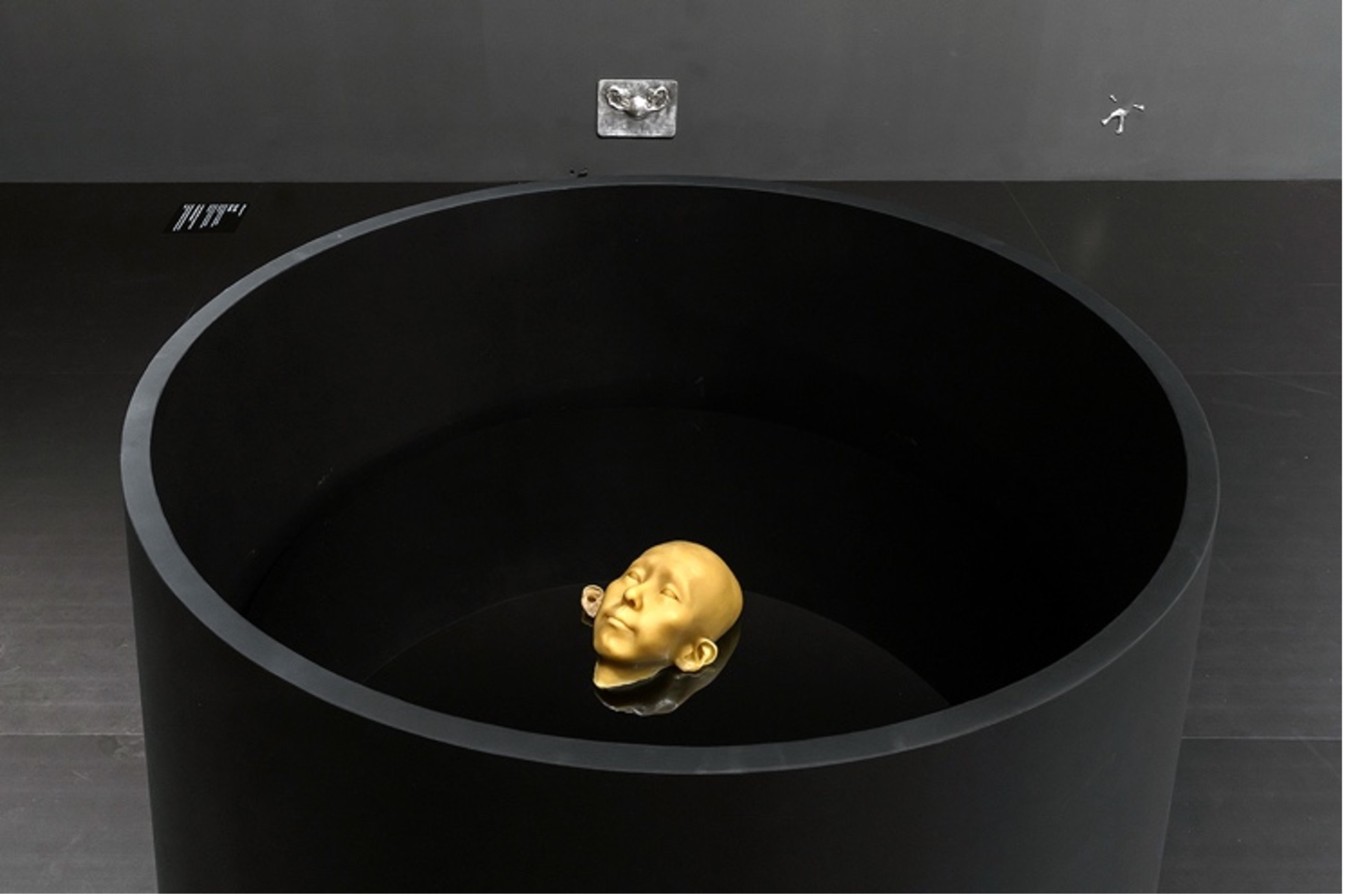
work, Just One Head (2024), is a votive offering
that embodies the well-wishes from her close friends who speak and write in
English, Spanish, French, and Greek. Yoon records their voices onto wax
cylinders with an Edison phonograph, which she then melts and recasts into her
own face. The well-wishes uttered in different languages are reified and
embodied. The phonographic recordings have been digitally converted before
(re)casting, which emanate, almost like an echo, from the altar.
The ex-votos or votive
offerings in the form of the human body have various origins, which usually lie
outside the purview of the discipline of art history. According to
Didi-Huberman, most of ex-votos in Medieval Europe were wax casts of either
body parts afflicted by illness or prosthetics associated with such illness.
While they were offered for cure or as a token of gratitude for the cure, they
were also a physical manifestation of aftereffect, a relic of an ordeal. These
artifacts, according to Didi-Huberman, pass from the magic of contagion so
frequently invoked in religious healing—as evident in Mark 5:28, “If I just touch
his clothes, I will be healed”—to the “imitative magic” that constitutes the power
of resemblance. The wax is attributed with the power to extend the time of the
wish, and changes when the wish changes. The wax serves multiple functions,
and, with even greater plasticity than silicone, constantly reappears in new
organic fixations. Wax “is charged with representing,
on one hand, and warding off, on the other”, the
symptom of illness. Seen in this light, wax is likened to our flesh, constantly
replaced and regenerated through imitation as well as contagion.
Beeswax, along with silicone, has
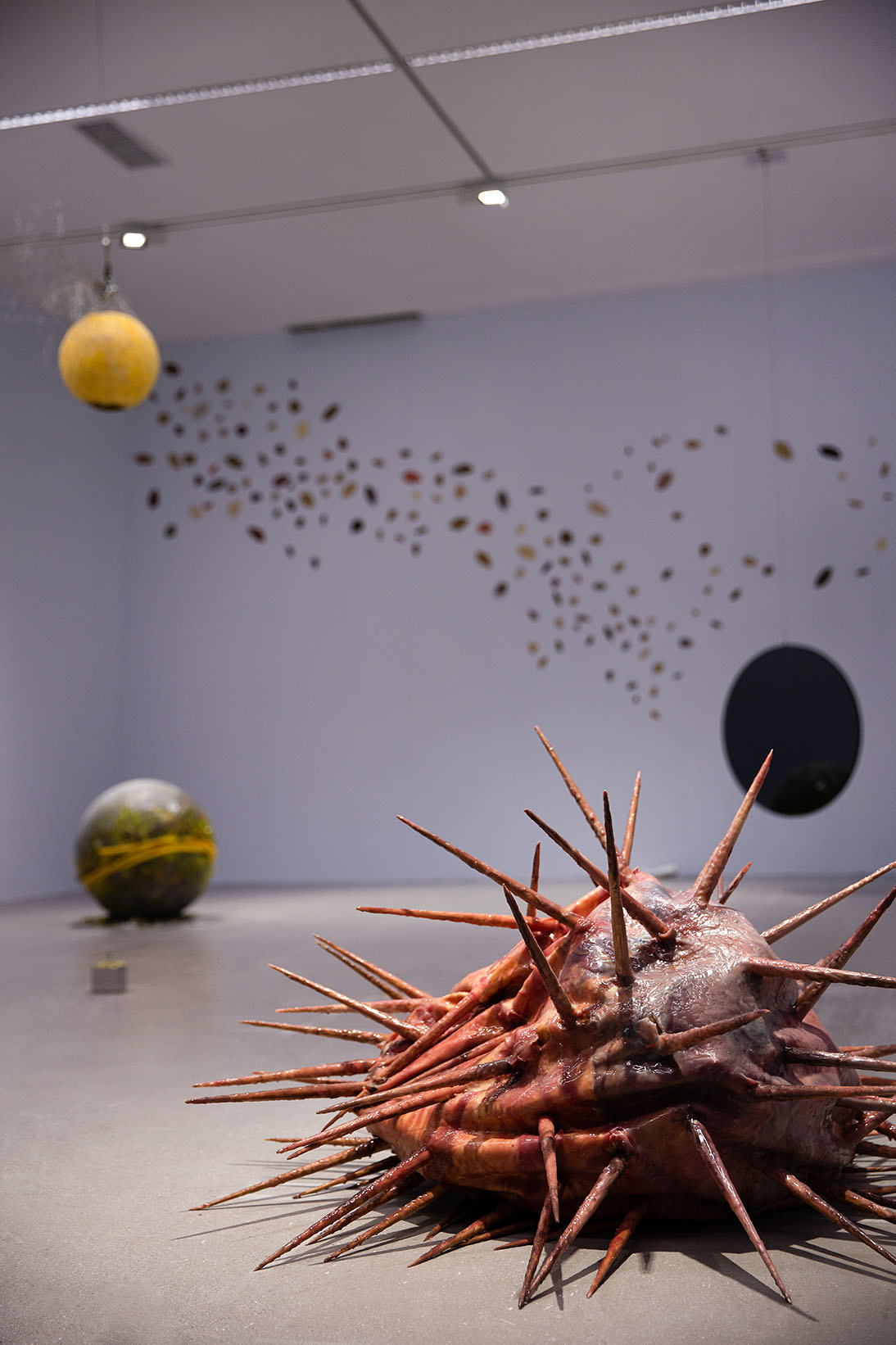
been the staple material in Yoon’s practice. In the Yellow Blues_ exhibition, a yellow sphere
wrapped in a wire mesh hangs above a candle cube placed on a black reflective
surface. The bottom of the sphere, made of beeswax, is burned and hollowed,
from which the melted wax drips, collects in the empty tin box beneath it, and
hardens into a candle. While the work also appears to be another allegory of
sacrifice, it demonstrates, above all, the malleability and organic quality of
beeswax—which issues from the bodies of bees—and therefore the workings of flesh. It represents the extension—however meager—of space and time of the wish
held within the finitude of our bodies. The gesture made here is far from that
of permanence or transcendence: There is always some loss when the wax melts
and is recast, and the yellowness of the face, a votive offering made of
beeswax, will fade over time.
The tattered fate of our bodies
and objects, which are ever-changing but ultimately finite organisms, contrasts
sharply with the celebrated permanence of today’s digital media. Yoon’s sculptures present
the fragility of flesh and finitude of life through the act of making
sculpture, including its techniques and mechanics. Above all, her work shows
the embodiment of wishes for each other’s well-being,
which renders visible the public corporeality that bears the imprint of the
pain and sufferings of life. The so-called “five
viscera and six bowels” in East Asian medicine are not
only vital internal organs of the body but they are also symbolic and
indicative sites of suffering. are imprinted. The traces of pain and suffering
accumulate in and are etched onto the body over time, unbeknownst to the afflicted
and unlike a sudden blow, in spite of which the viscera constantly bring us
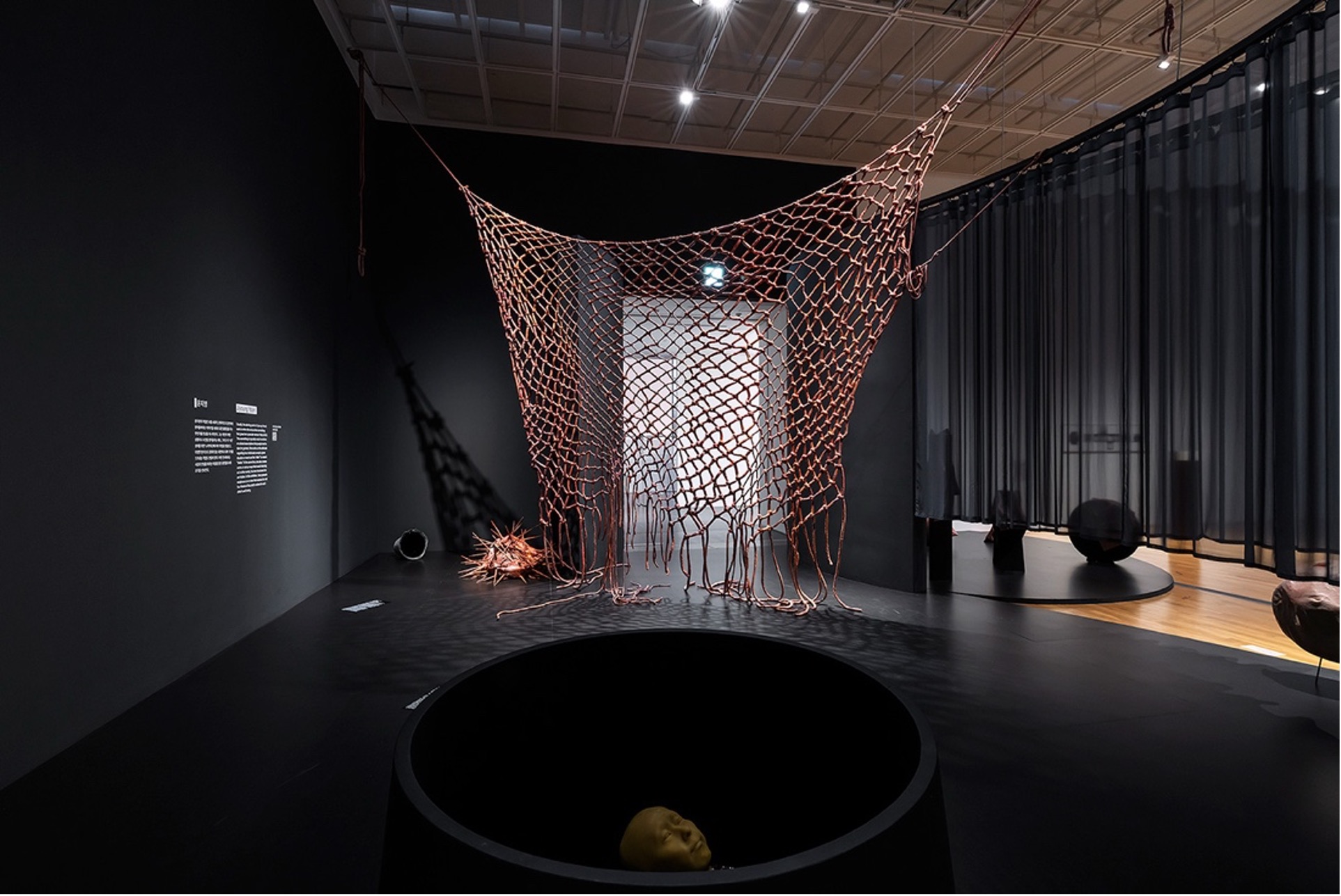
back to life. “There was a time when, not
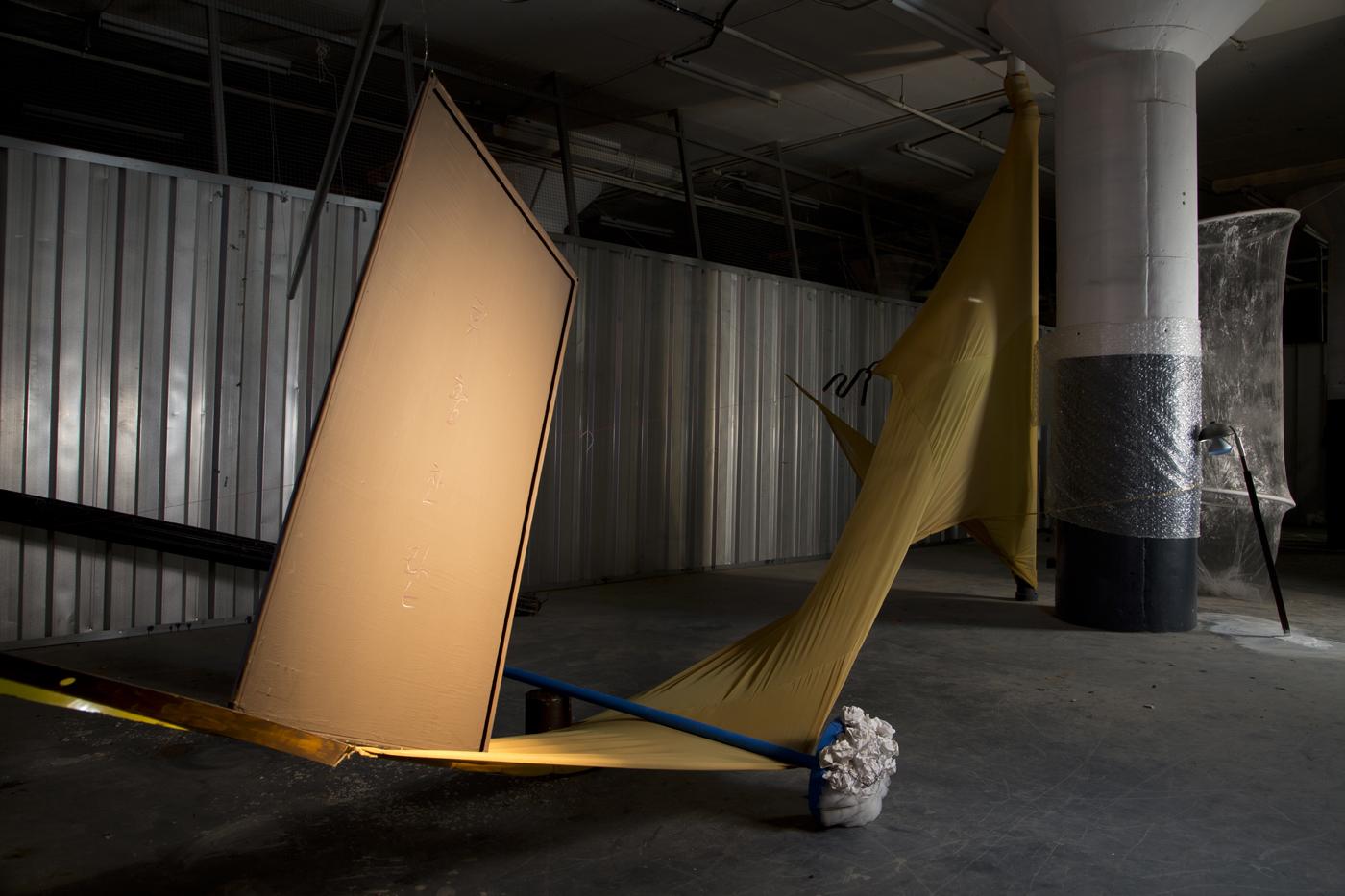
knowing how to live, I took out my entrails to make a net.” (2024) is a net of prayer, a net of consecration, which
the artist has spent a long time sewing, weaving, painting, and drying by hand
for this exhibition. It is both an artifact of an ordeal and a portrait of a
massive prayer text, tightly woven and spread out before us.
1. “Space for an ear” is a phrase taken from the
statement for Jiyoung Yoon’s work Wooden Cube,
approx.15cm in Side Length, Became a Plaster Cube in which Something’s Negatives are Hidden (2018).
2. Judith Butler, Frames of
War: When Is Life Grievable? (London, New York: Verso, 2009), p. 19.
3. Jiyoung Yoon, The artist’s note.
4. Judith Butler, “Bodies in Alliance and the Politics of the Street,” Notes Toward a Performative Theory of Assembly (Cambridge
MA: Harvard University Press, 2015), 87.
5. Didier Anzieu, The
Skin-Ego, trans. Naomi Segal (London: Karnac Books, 2016), 19.
6. Jiyoung Yoon, In a
conversation with the artist (September 2024).
7. This is explored in detail in
the following article by Nara Lee, which focuses on
Kim Minae’s sculptures. Nara Lee, “Image Anthropology and Contemporary Art: Image and Death ⓶ – Objects of Death, Places of Death: Renaissance, Minimalism, Kim
Minae,” Art World, December 2018 issue, pp.
144–149.
8. Didi-Huberman states that the
cubes, comparable in size to the human body and referred to as anthropomorphic
by Michael Fried, are images rich with formless figurative virtuality—what we might call “ancestral likeness.” According to him, this likeness, dedicated to dissimilarity,
rhythmically holds and spits out images of life and death before us. Georges
Didi-Huberman, Ce que nous voyons, ce qui nous regarde (Paris: Les
Éditions de Minuit, 1992), 94.