The child smashes. The child makes a mess. The child turns things upside down. The child lies sprawled out. The child does not observe manners. The child does not cooperate. The child approaches. The child encroaches upon the life one knew before. In this way, the child grows.
The short-legged dog looks around. The dog eats and sleeps. The dog urges walks. The dog breathes the outside air and poops. She follows the child around. She cleans up what the child has scattered. She feeds the child. She wipes up what the child has spilled.
She walks the dog. She cleans up the dog’s poop. She shakes out the fur-covered blanket. She eats in a hurry. She suffers from insomnia. When the next day comes, she repeats the actions she performed the day before.
In any case, she thinks it is fortunate that she can laugh. From the head whose lid has blown open, green matter cheerfully flies away along with hair, the child flies away, and the dog flies away. For now, she smiles broadly. ^^. 1) With bags dangling from both arms and a child hanging from the front, she tries to catch a taxi, but it does not go as expected, and it feels as if she might stand by the roadside forever.
She tries smiling as if nothing is wrong. ^∇^.2) It has already been a long time since she last slept through the night without interruption, and the phone held in her exhausted wrist falls vertically onto her face. She lets it be. ◎◎. 3)
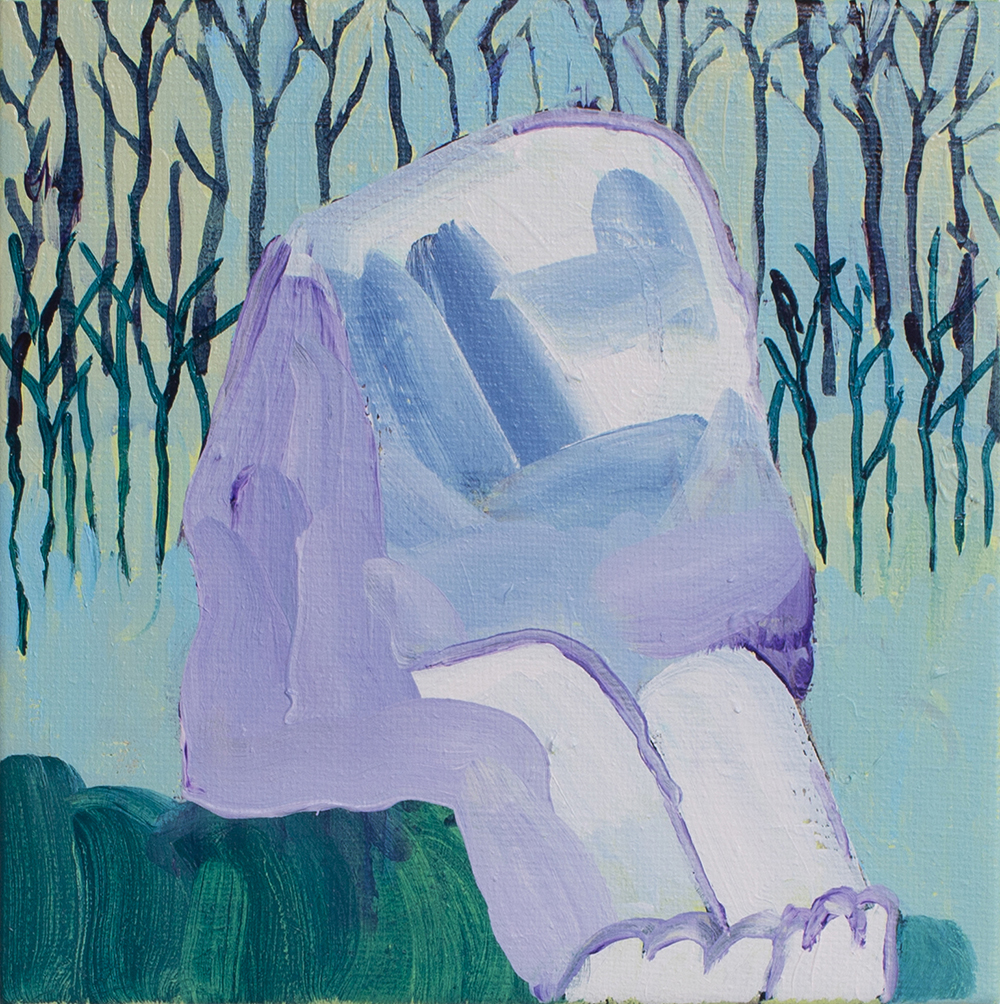
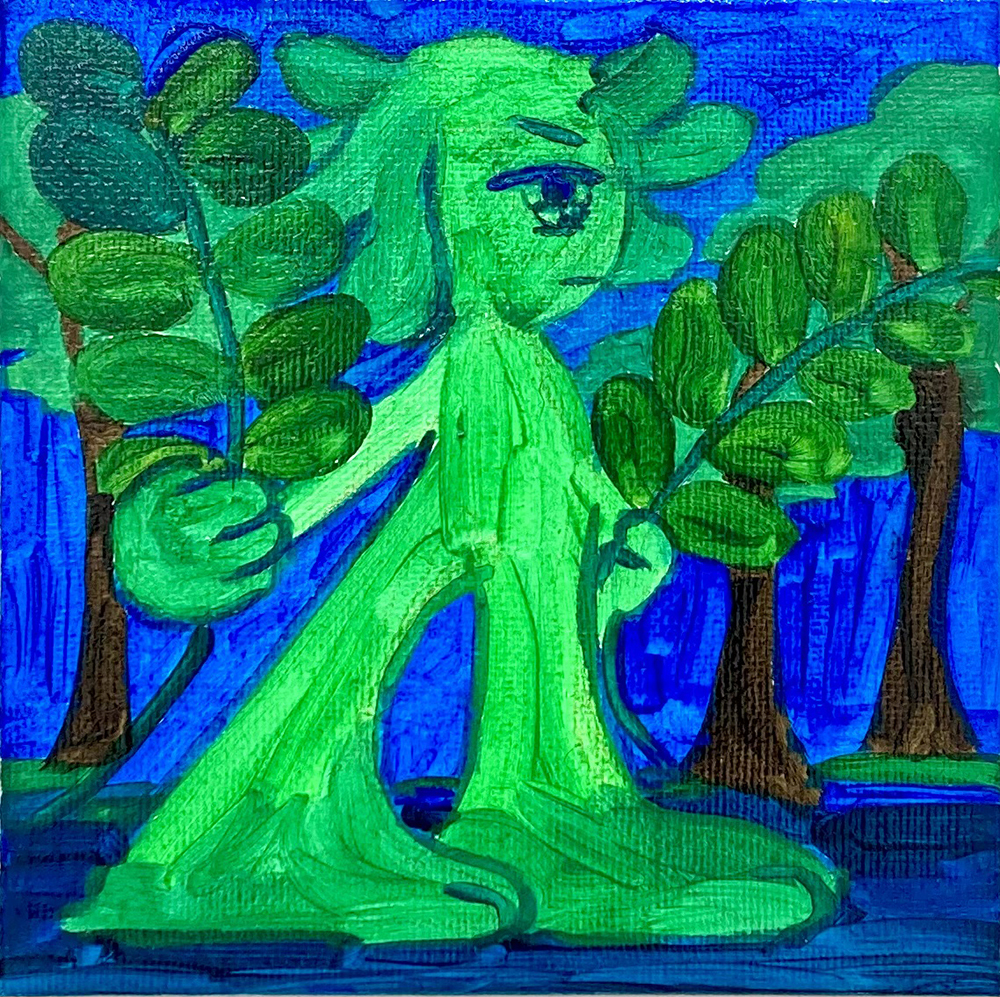
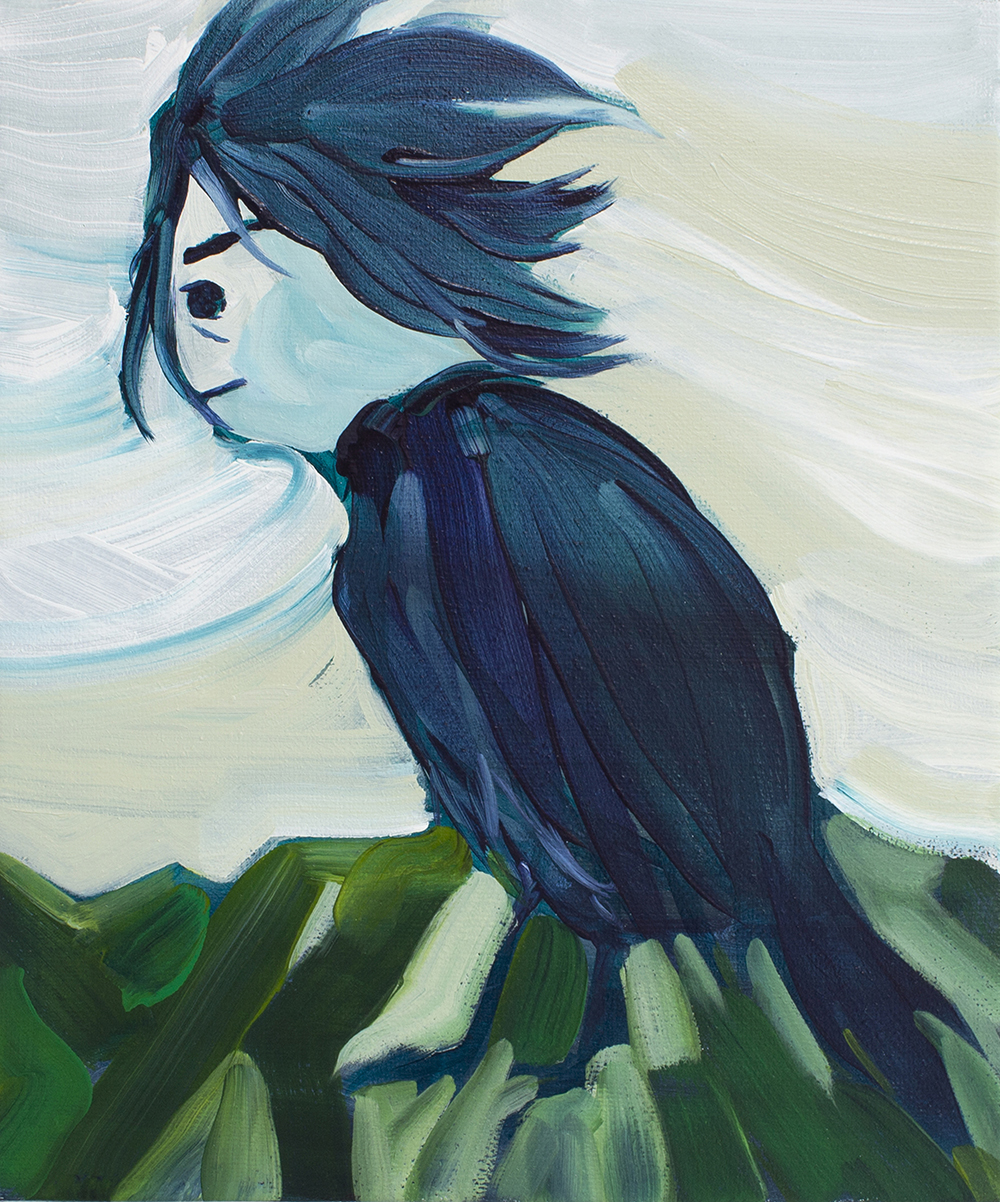
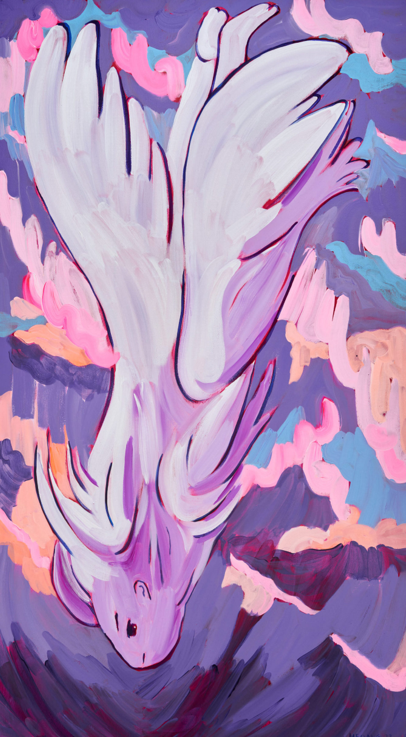
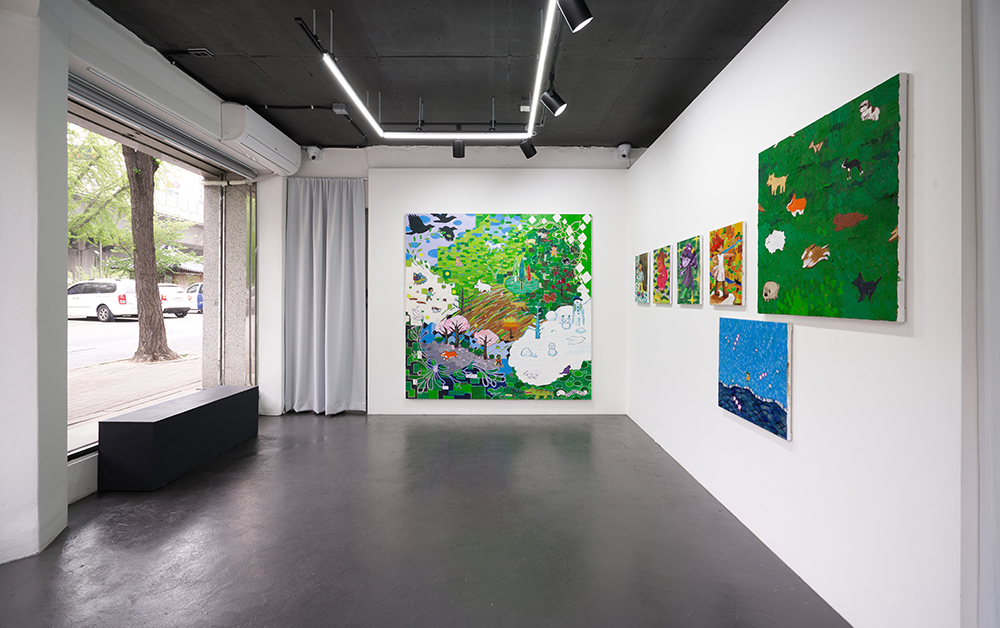
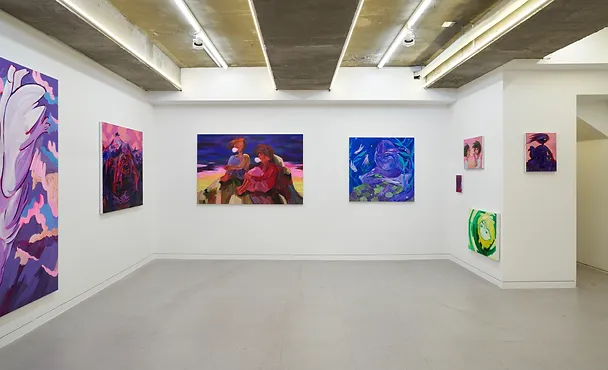
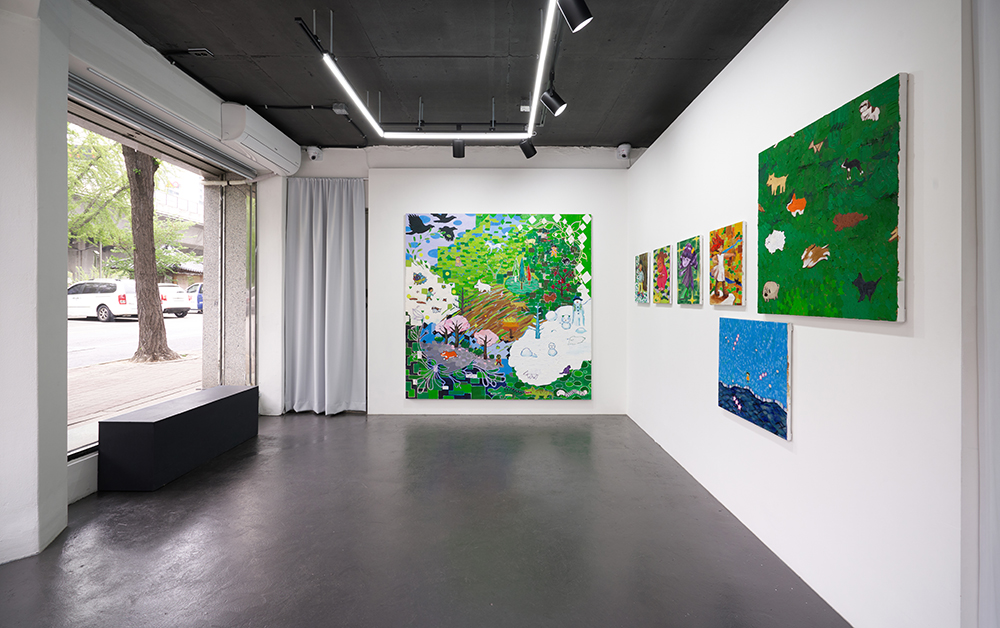
The figure usually stands before a background composed of color fields that do not resemble the complex real world, as if sound effects could almost be heard. The eternally repeated cycle of care labor unfolds on canvases composed of bright colors and shapes large and small.4)
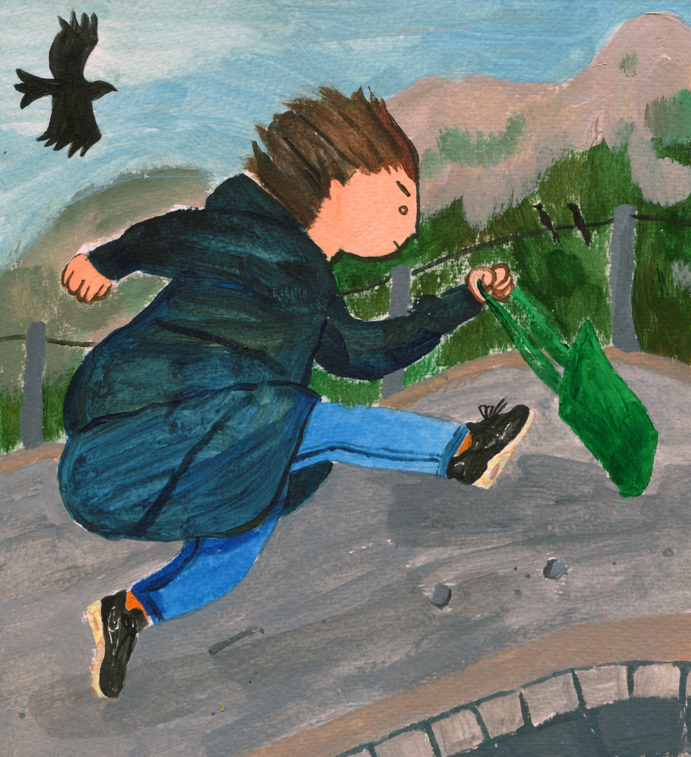
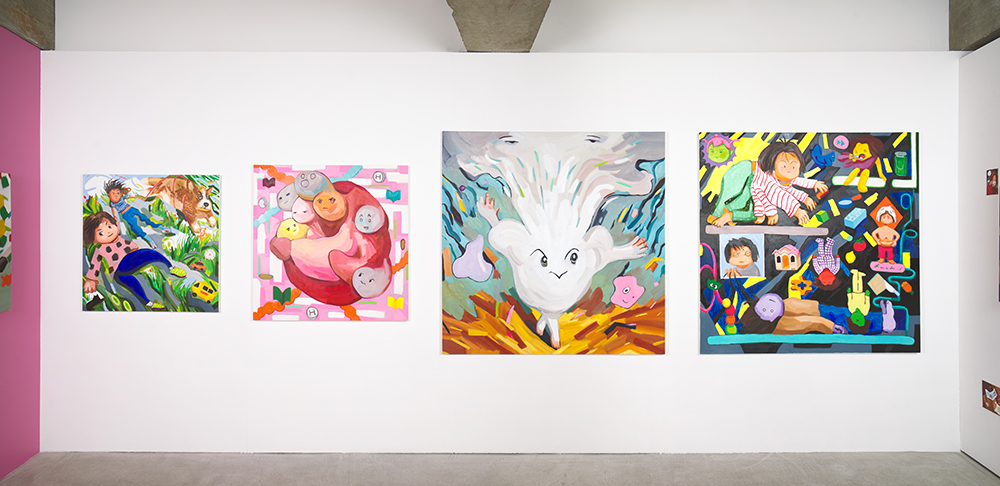
In a composition reminiscent of an old obstacle-jumping video game, the character would not have enough arms even if she had four, and shows no sign of recovering stamina, yet somehow rhythmically takes her place. Behind a pink lump melting stickily as she pushes a stroller on a hot day, pieces of confetti flutter as if celebrating this heat wave.5)
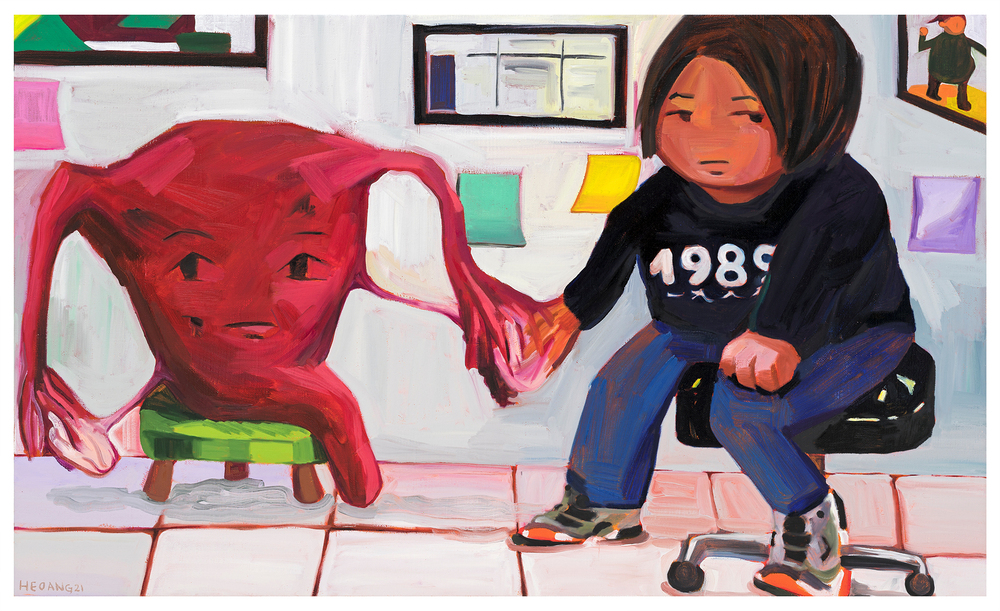
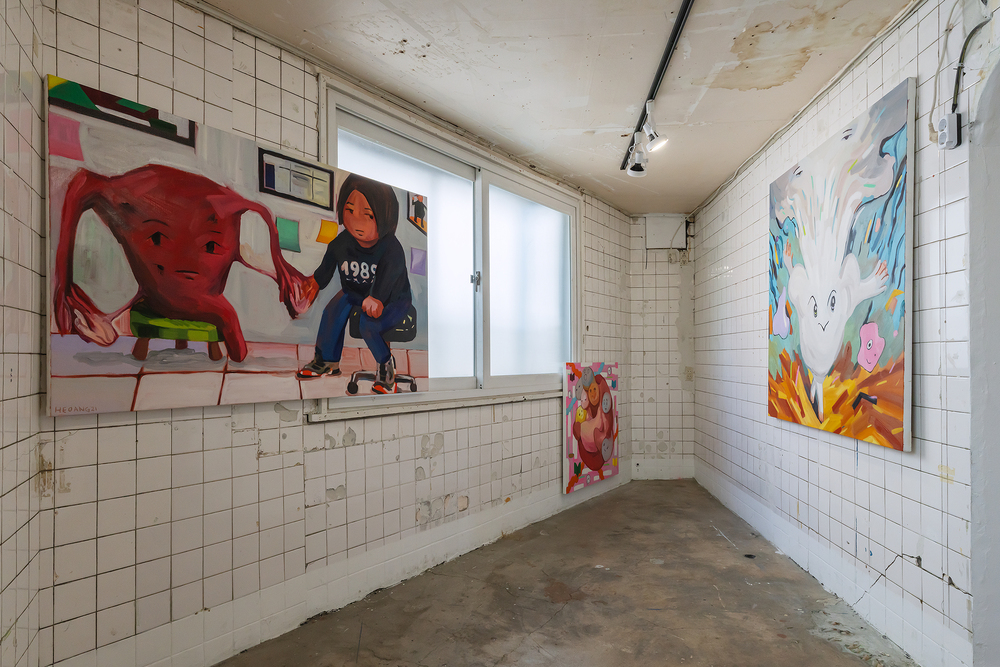
When the organs have several faces and each asserts itself, that is, even when my body does not feel like my body and is twisted this way and that, pills and books float about like items.
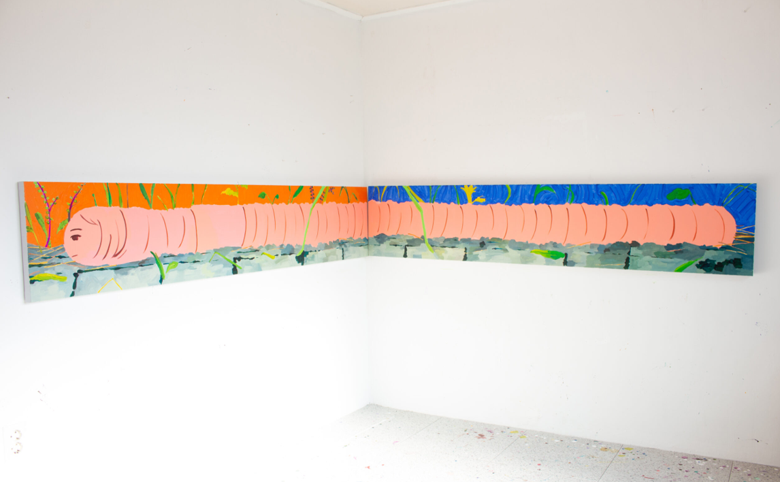
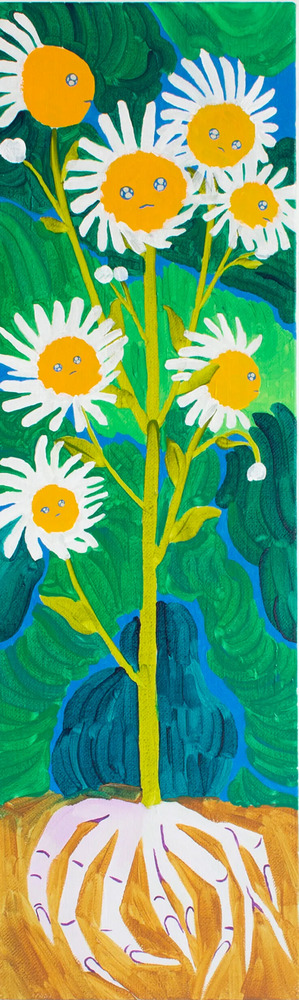
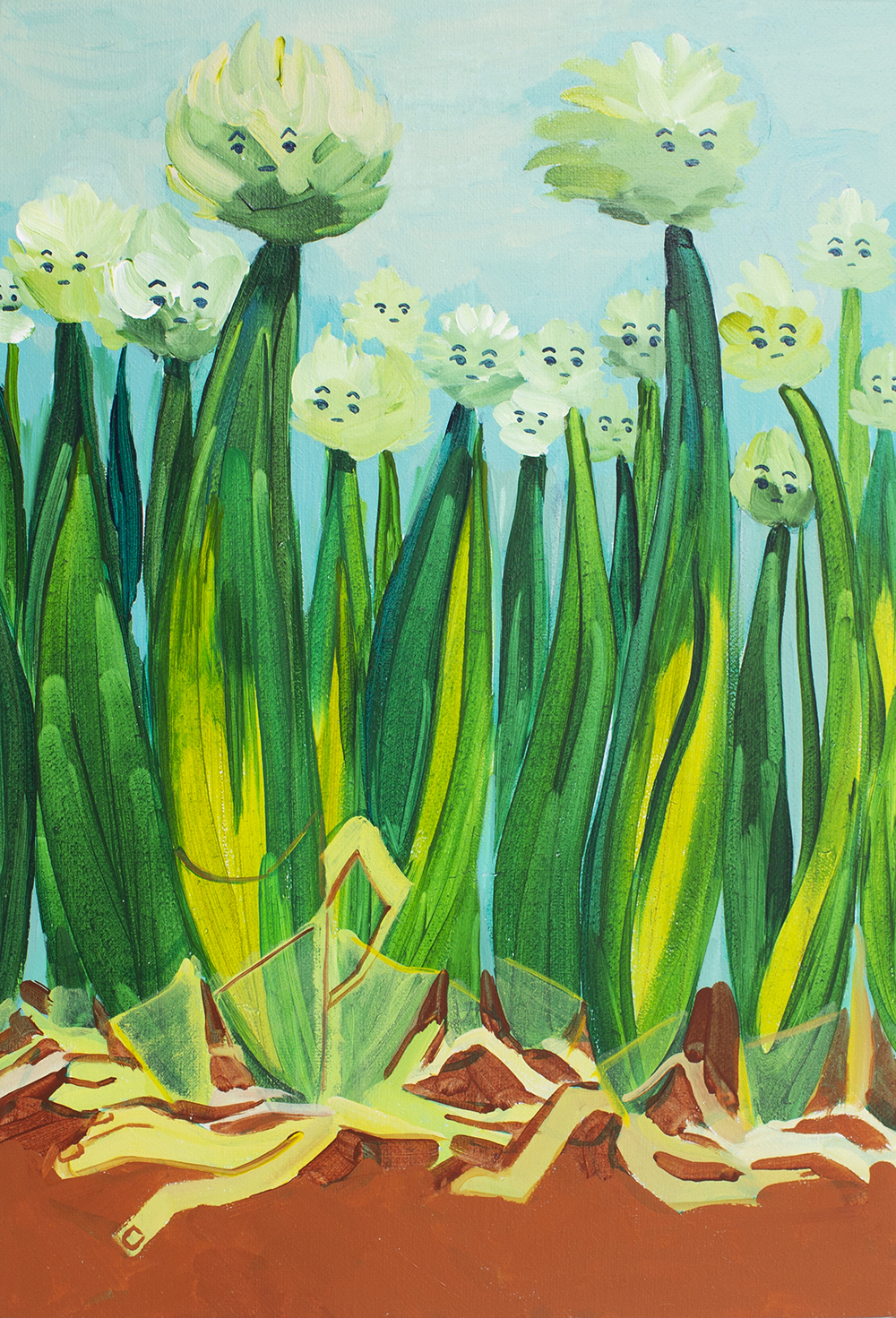
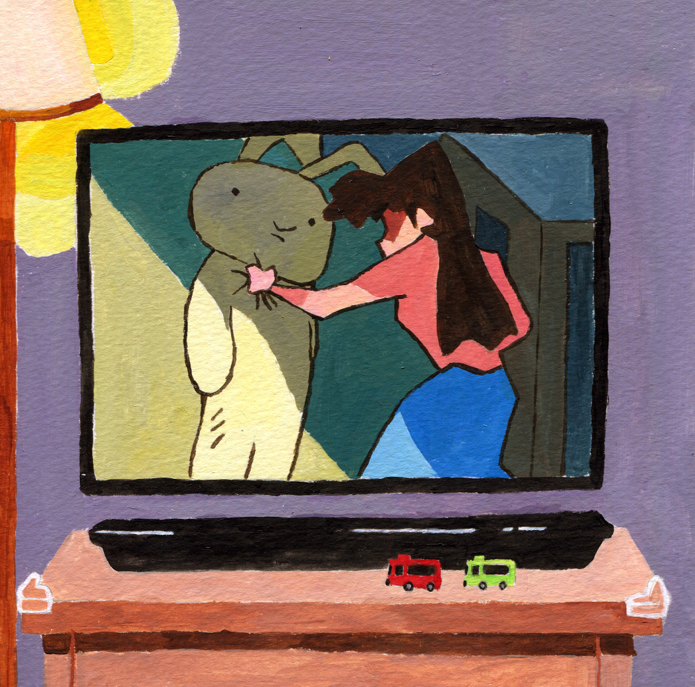
The schematic expressions and cheerful color-field backgrounds that appear in Heoang Kim’s paintings and drawings diagram the given situation as a kind of sitcom genre. A childbirth-childrearing sitcom of everyday life with nothing mysterious about it and a plot with nothing difficult to understand.
Despite repeated labor and hardship, when the protagonist shrugs her shoulders with an awkward laugh, it seems as if the studio audience will burst into laughter. This genre, composed of a kind of bundle of conventions, sends off clean signals such as, “I also think this situation is funny, so it is okay for you to laugh too,” or “What can you do, since it turned out this way anyway.”
The sidekick appropriately placed within the scene—like Pinocchio’s Jiminy Cricket, Mulan’s Mushu, or Elsa and Anna’s Olaf, and mainly seeming to be played by a corgi—reinforces an attitude of flexibly adapting to the given conflict. The conflict that gradually escalates and the tension that accumulates due to physical limits, repeated labor, and the frustration of achieving goals are dissolved by unexpected, absurd developments.
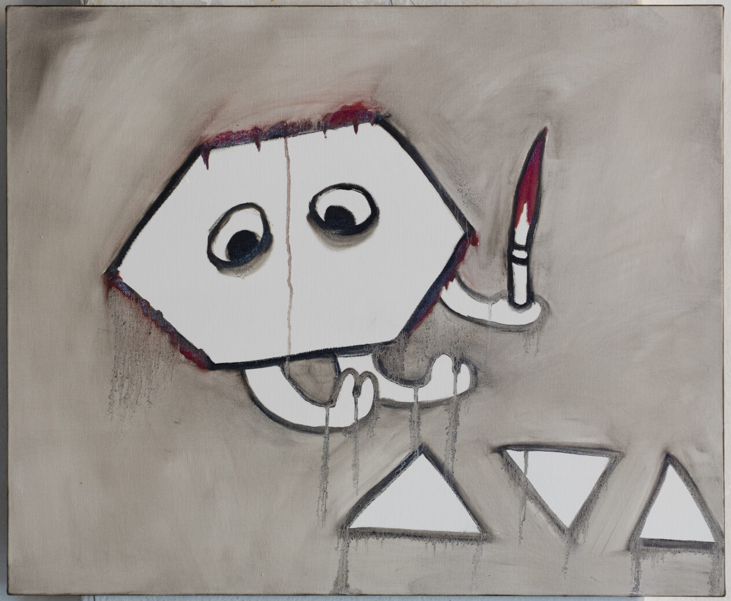
However, this positivity, as is the case with many sitcoms in reality, contains irony together with the darkness on its reverse side. This appears more directly in the schematic facial expressions that can also be found in her earlier drawing-slide works.6) “People” appear with bodies loosely expressed in outlines and with sparkling, beautiful eyes attached to them.
People wearing eyes that are nothing more than things prettily drawn and worn like lenses calmly carry knives with them and willingly execute individuals who make new attempts. The “beautiful” eyes of “bad” people, rather than doctrinally denouncing the ugly underside of the world, acknowledge that irony while also attempting to buffer it.
The shining eyes of people who can brutally punish at any moment what is “ugly/angular” are cruel, but this is not the behavior of a few atrociously wicked people; it belongs to sufficiently beautiful, ordinary people.
Everyone has a knife tucked behind their back, yet they also know how to stay with one another and sometimes perform unexpected good deeds. Madness is not something far away, but merely something discovered when a certain number of sparkling eyes gather and rise together.
Perhaps, in uncontrollable situations within an unexpectedly cruel world, the minimum dignity one can maintain lies in choosing the background, soundtrack, or genre that contains them. The sitcom “Mama do” becomes a framework that prevents everyday frustrations from sinking into permanent pain and keeps one from losing the things that make oneself oneself.
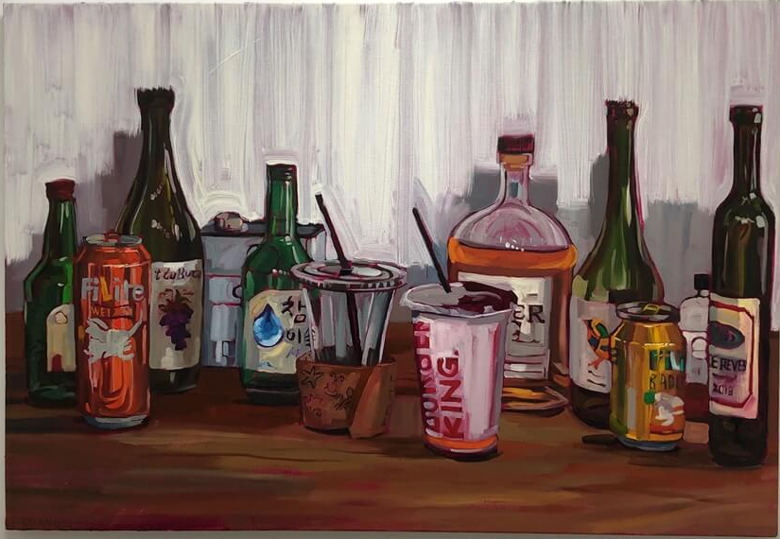
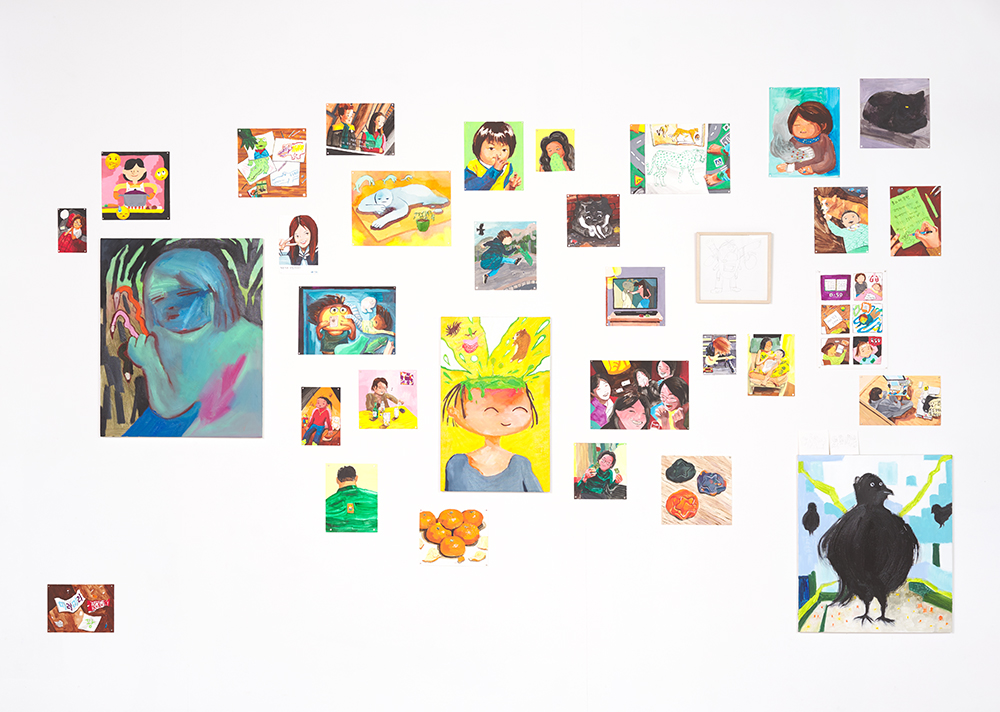
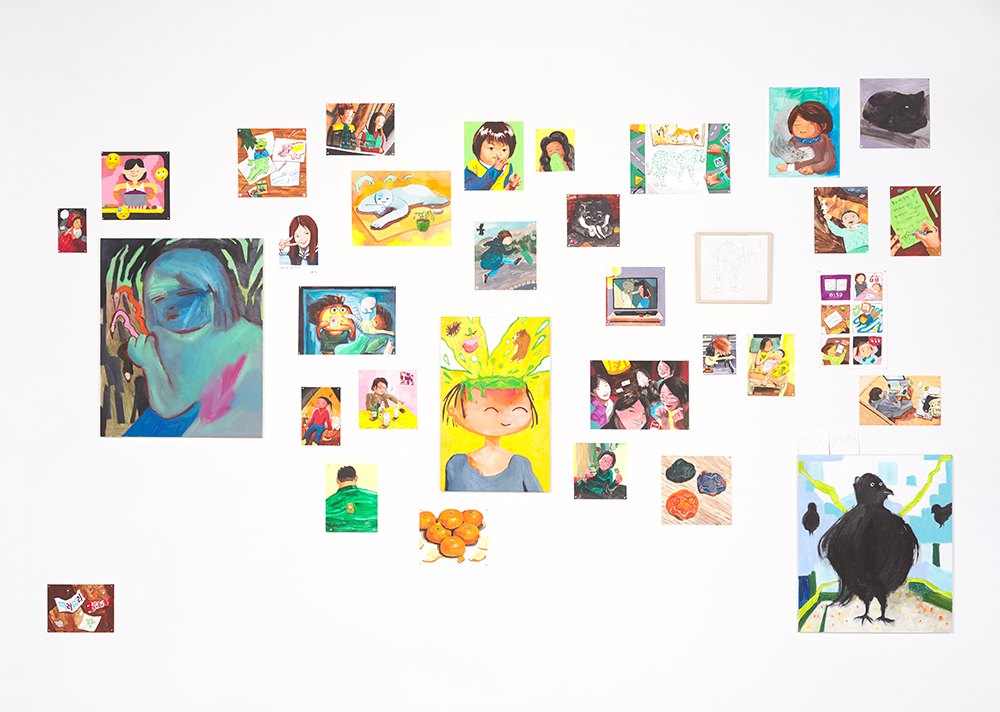
The acrylic drawings that focus on concrete scenes of daily life or the aspects of various relationships resemble everyday scenes habitually photographed with a smartphone, but through precisely such a method they show the territories of daily life that have been protected. She still shares life with friends she knew before the child appeared. A chapter of life does not get cut cleanly from one to the next.
They still appear accompanied by the drinking habits7) of the past or songs liked several years ago. The same is true of other caregivers she met through the child. Living with a child does not make the things that used to be delicious taste bitter.8) Although changes in the body may make it impossible to smoke, she still smokes in her mind. 9)
In between, a child who quietly picks their nose,10) a child who likes crocodiles and large felines11) appears. When she keeps becoming a nuisance and a person who must apologize, she makes a slightly embarrassed expression. Sometimes she laughs at something out of the blue, and regrets what she has not yet accomplished. And then she repeats another day.
The life of the past when there was no child and the life of now, places where children swarm around and places where children are not welcomed, a relatively healthy body and a body that is not what it used to be, time that belonged solely to me and time fragmented into many branches. Heoang Kim’s sitcom “mama do” does not reject these divisions, but laughs magnanimously and weaves them together this way and that.
In the meantime, the child confidently walks forward with mischievous eyes. Exerting a destructive influence, emitting the caregiver like residual gas, the child advances. The world into which the child will walk may still belong to cruel people wearing beautiful eyes, but from the position of someone disappearing into the backstreets of history, expecting something better, or perhaps something “new,” may be the task of the next season of this sitcom.
1)The Seething Head Boiled Over and Flew Off with a Bang, 5333.2cm, oil on canvas, 2019.
2)Where is My Fucking Taxi, 2021cm, pencil on paper, 2018.
3)I Can’t Sleep, 2130cm, acrylic on paper, 2019.
4)Daily Routine, 130.3130.3cm, oil on canvas, 2019.
5)A Walk in Midsummer, 72.5116.3cm, oil on canvas, 2018.
6)The World of Good People, 2013.
7)Haeeun with Green Vomit, 1312cm, acrylic on paper, 2019.
8)Sanghee Pouring Her Own Drink, 1818cm, acrylic on paper, 2019.
9)500 Cigarettes Smoked in the Mind, 2721cm, acrylic on paper, 2019
10)Picking One’s Nose Confidently, 2118cm, acrylic on paper, 2019.
11)Dad’s Art Class, 2130cm, acrylic on paper, 2019; Drawing Crocodiles for a Crocodile Mania, 21*21cm, acrylic on paper, 2019.