The true protagonist of art is courage. Courage is its real subject and its center. The courage to make a different kind of painting, the courage to withstand the judgments of others, the courage not to shrink before art itself. The soul of a work is constantly transformed through its relationship with the force that art emits. Art can be angelic, but it can also be monstrous.

Inspiration may arrive and earn one recognition as a talented artist, yet that same inspiration may evaporate without warning, revealing that what appeared to be talent was merely a disguised form of it.

One may become blinded by what one believes to be talent, or be tossed about by it, producing not one’s own art but the art that others wish to see. Art is both angel and monster. For that reason, courage is indispensable. Courage is the unseen true protagonist of art.

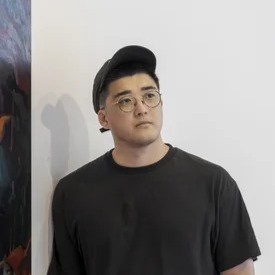
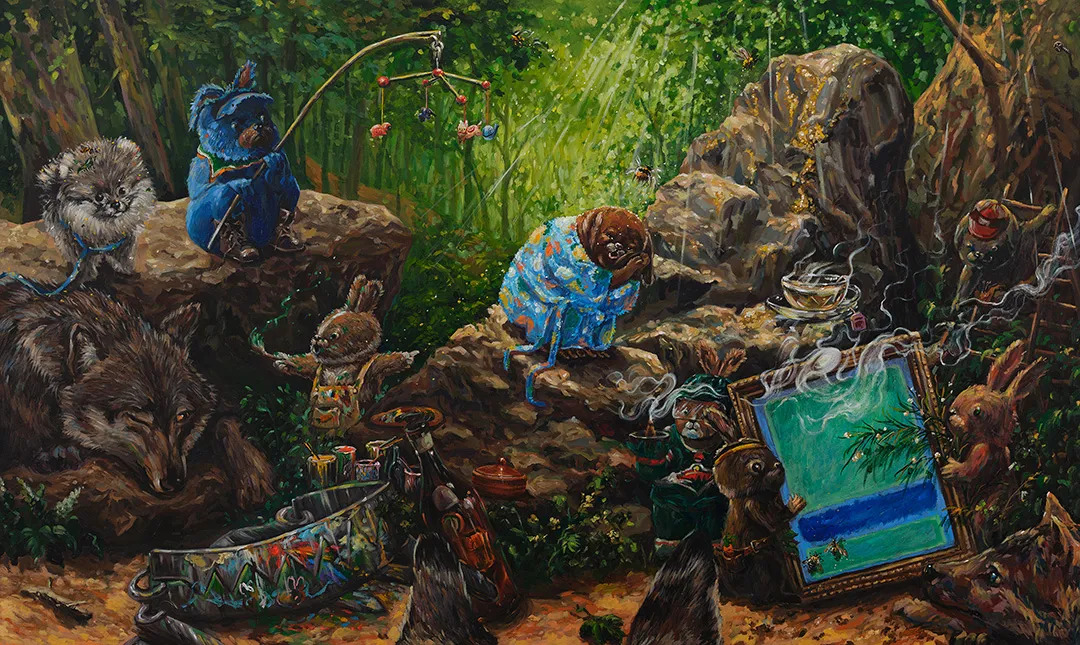
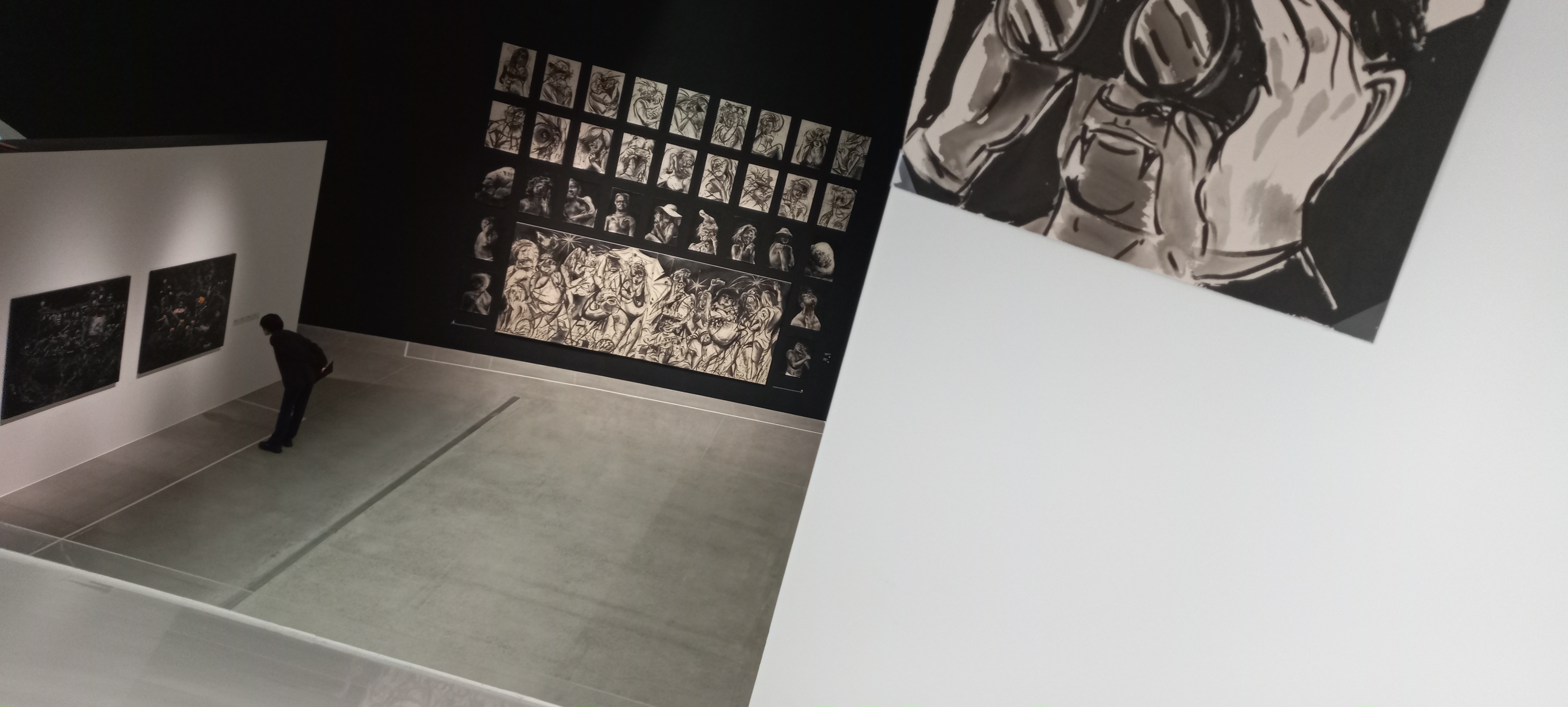
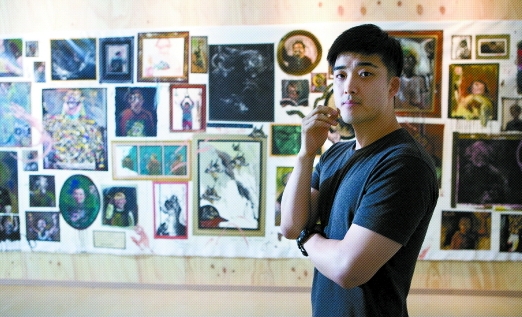
Courage resides in Bae Yoon Hwan’s work. The courage to try something new, the courage to move between painting, drawing, and video, the courage to follow curiosity and change both the subject matter and form of his art. Bae made a strong impression on the art world through monumental scenes populated by narratives so complex that it becomes difficult to determine where they begin and where they end.

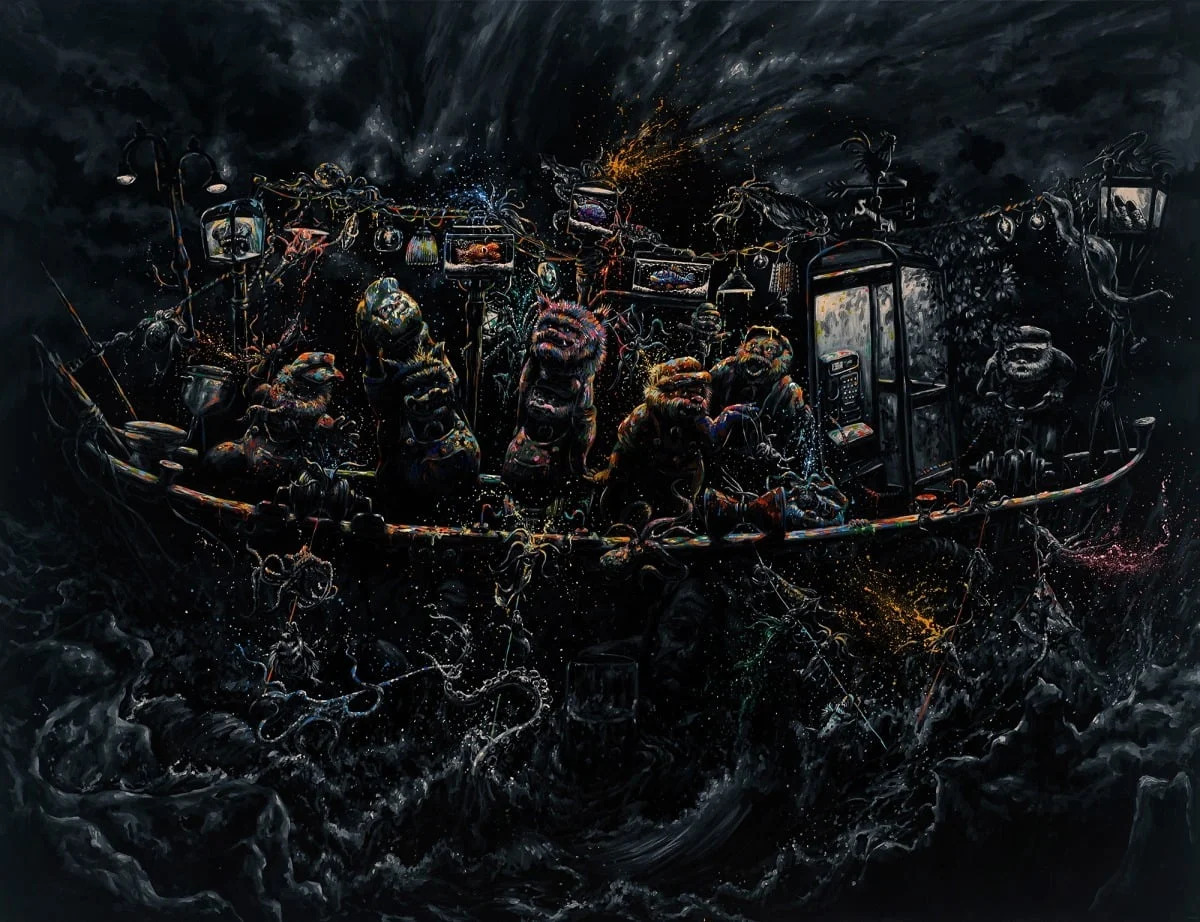
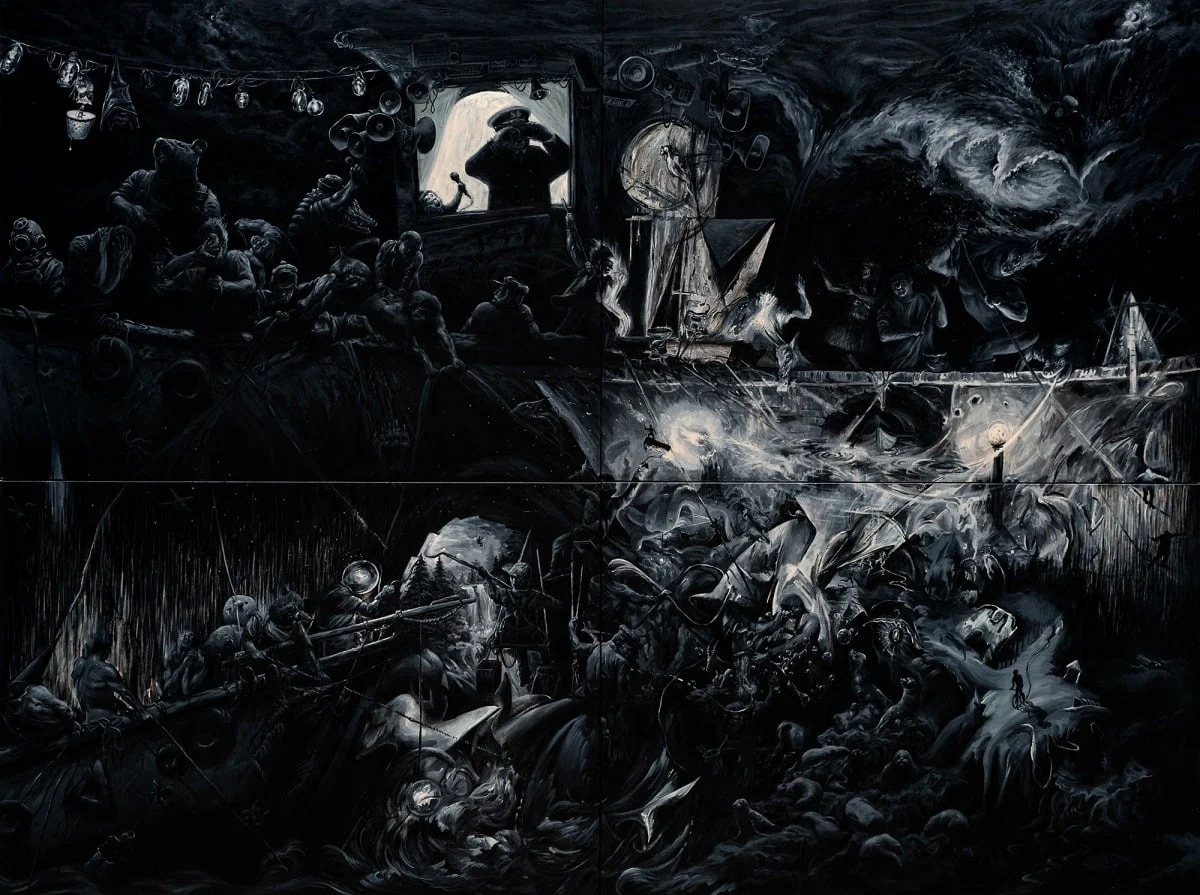
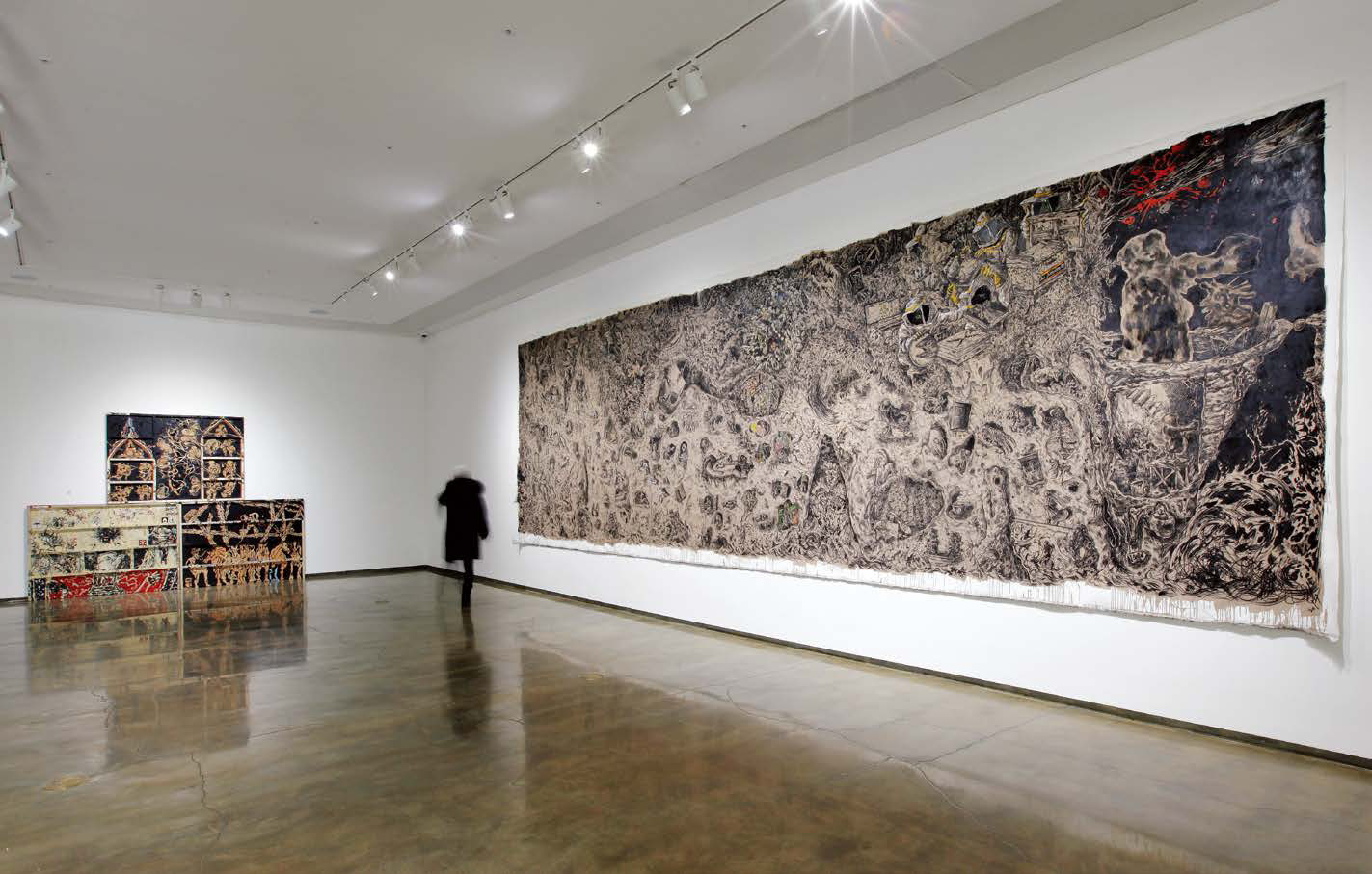
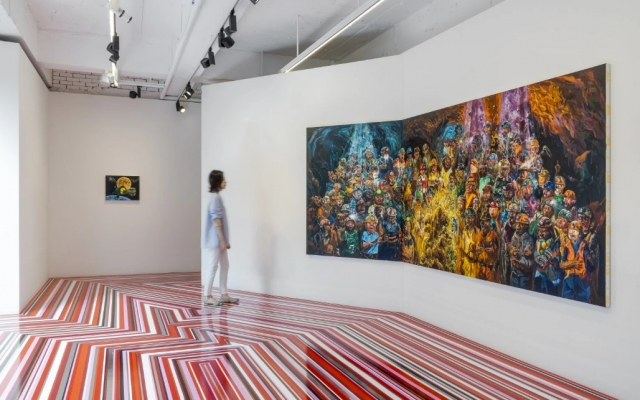
In particular, WAS IT A CAT I SAW? (2014), a monumental painting measuring 2.2 meters in height and 50 meters in length, remains one of his most frequently discussed works. Its impact was such that many later works adopted formal strategies similar to those it introduced.

Yet rather than remaining within that mode of production, Bae has recently presented video works and paintings of a scale that appears almost modest when compared to his earlier monumental projects. At the same time, he has shifted away from the somewhat somber, heavy, and dark atmosphere that characterized his previous works toward witty narratives and a lighter, brighter tone.

These changes suggest that he has not settled into the artistic achievements that first established his reputation within the art world. Instead, they demonstrate how fully his practice is infused with courage.


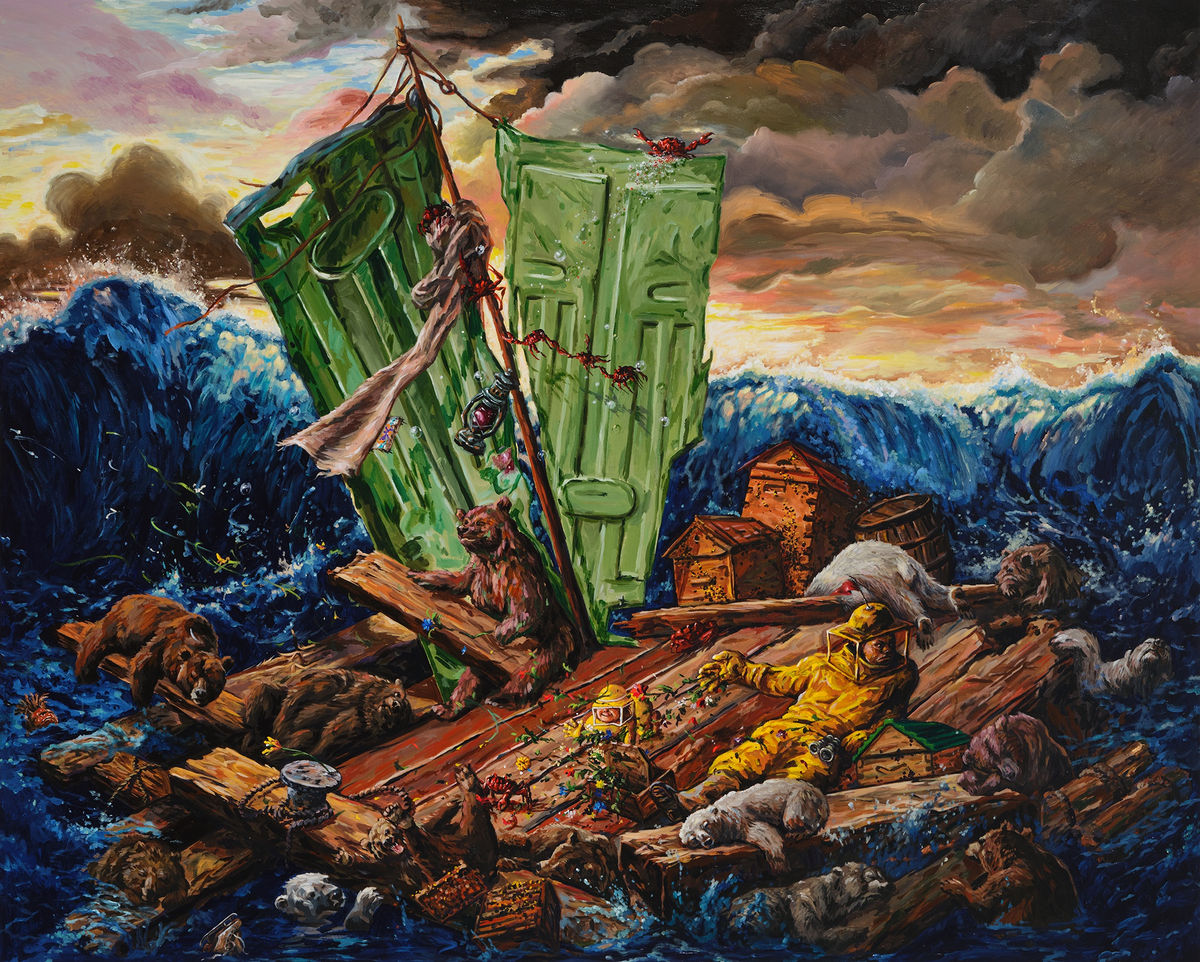
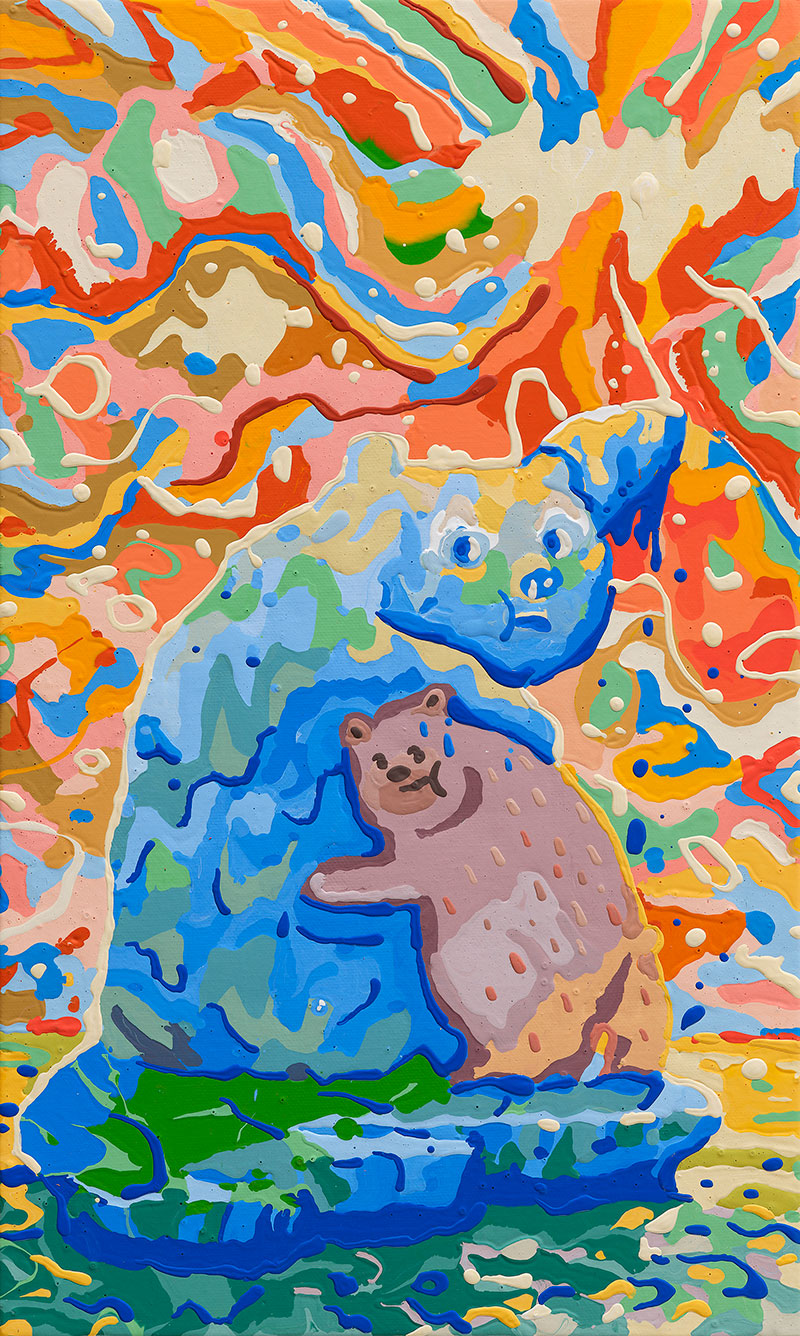
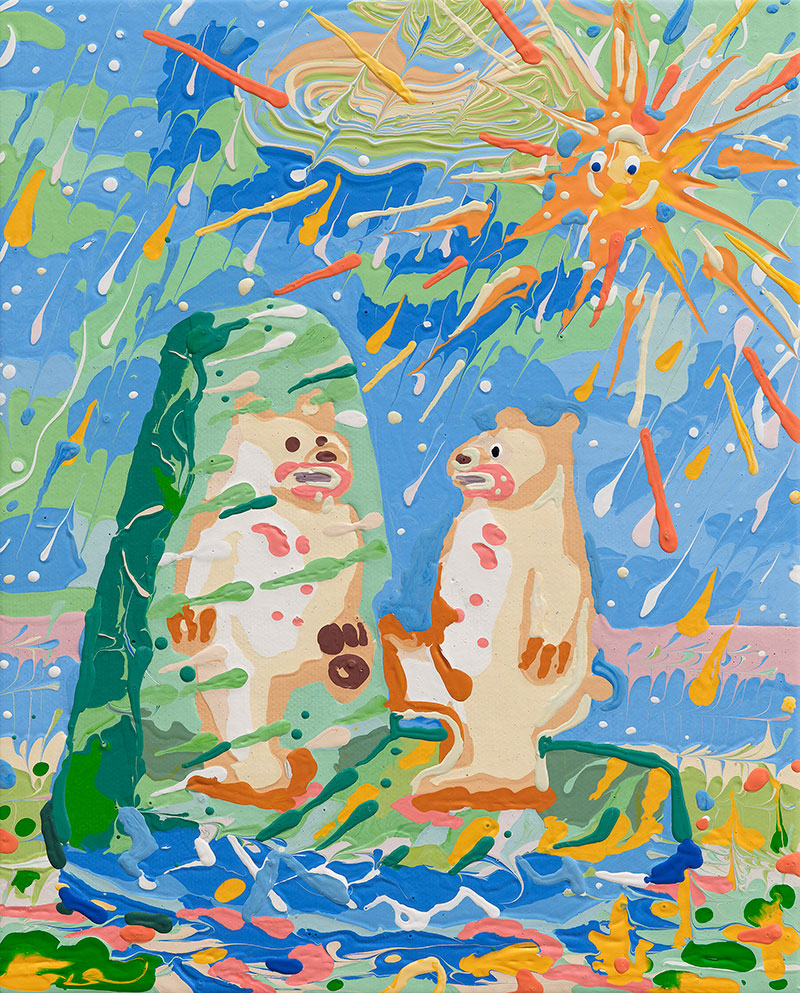
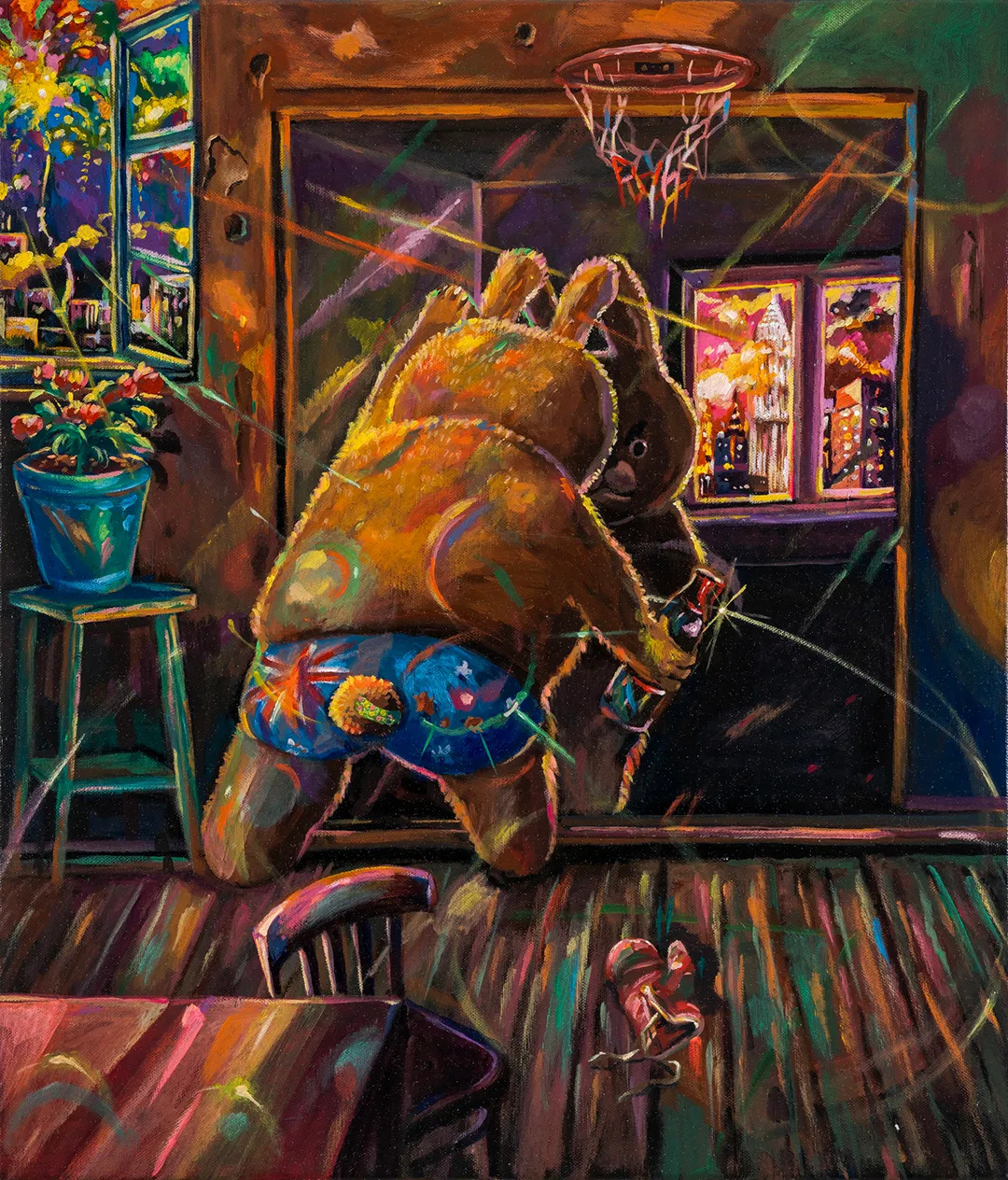
Bae Yoon Hwan, Chuckle Cracking Sea Ice, 2022, Paint on canvas, 27 x 22 cm © Bae Yoon Hwan

A Dense and Monumental Mind: Swarms of Thought

For any artist, the attempt to move beyond the work for which they have become widely recognized is an inevitable undertaking, a necessary means of avoiding mannerism. In broad terms, the changes seen in Bae Yoon Hwan’s practice can be understood within this context. To single him out as exceptional for this reason alone would be both unnecessary and somewhat misguided.

Yet if we dismiss these developments as merely another example of an artist’s natural evolution, we risk overlooking what is distinctive about Bae’s artistic practice. It is therefore important to look closely at what has changed and what has remained the same. While his work may appear transformed, its core has remained remarkably consistent.

Bae first established his artistic presence through monumental paintings. Yet in his more recent work, the overwhelmingly large-scale canvases that once defined his practice are no longer present. Why is this so? It seems that he did not create monumental paintings simply in order to construct endless and expansive narratives.

Rather, unable to organize the multitude of thoughts and emotions circulating in his mind, he turned to the large canvas as a space upon which he could map those thoughts and feelings.

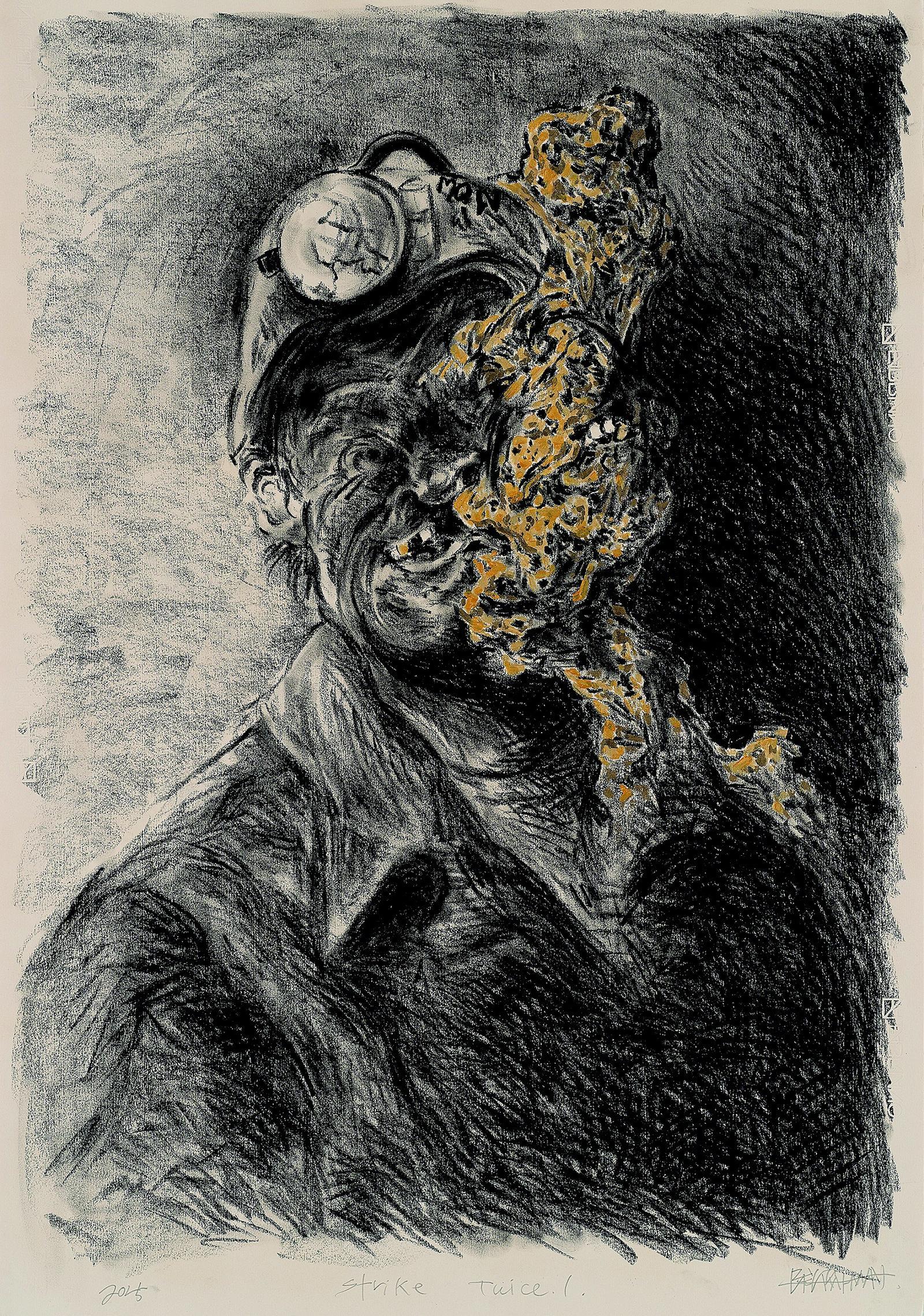
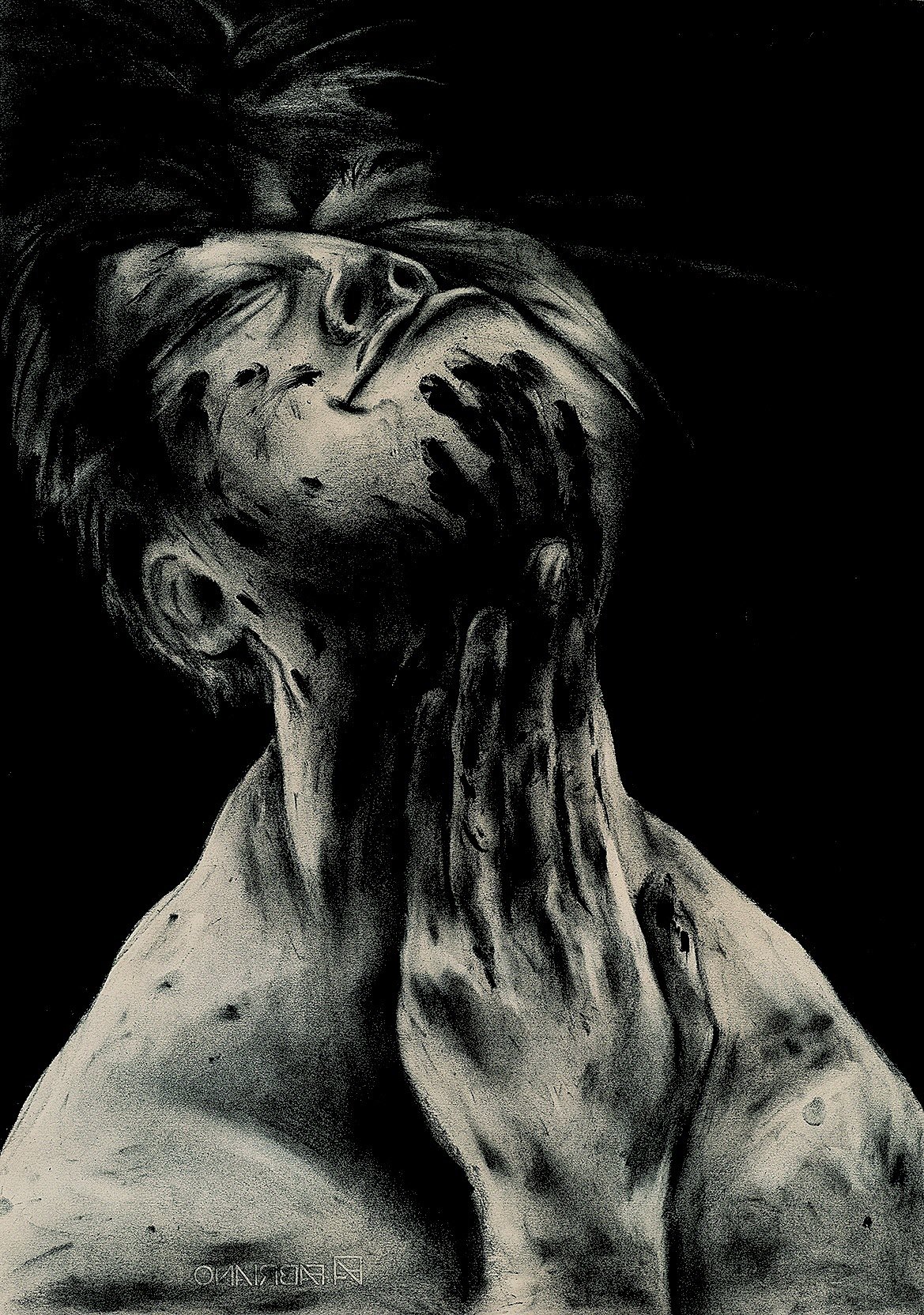
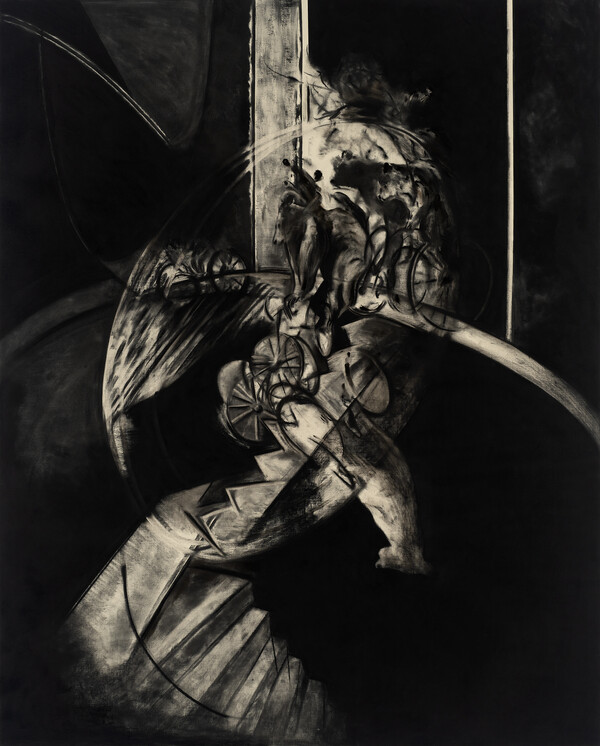
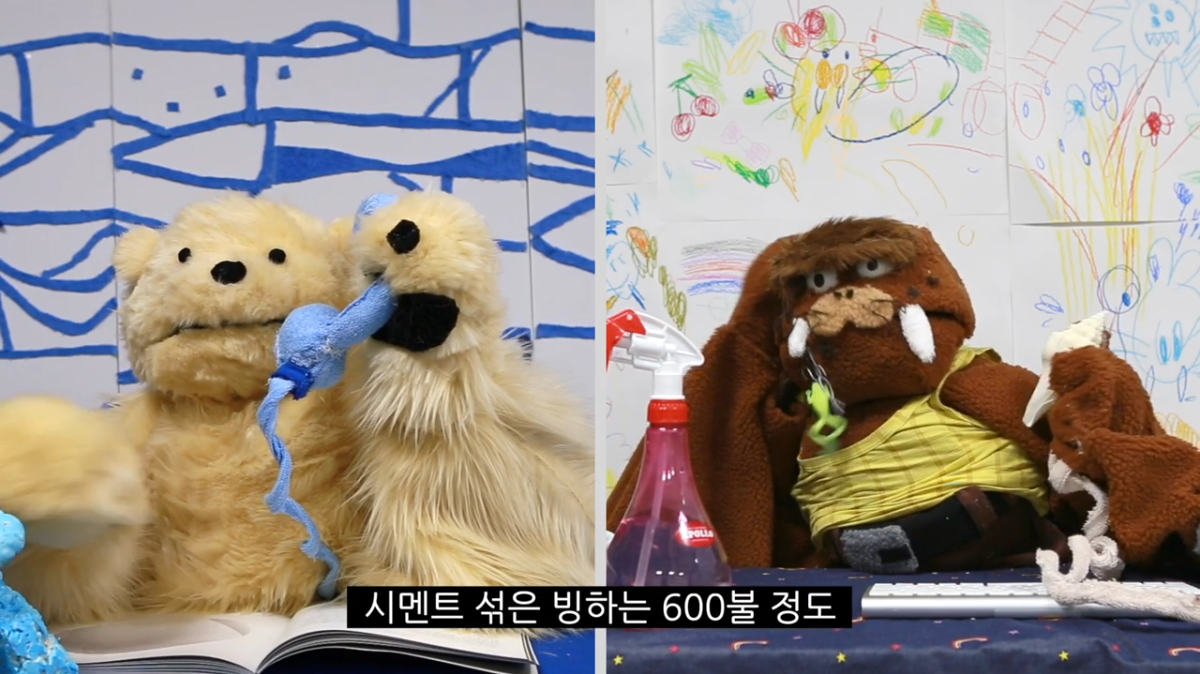
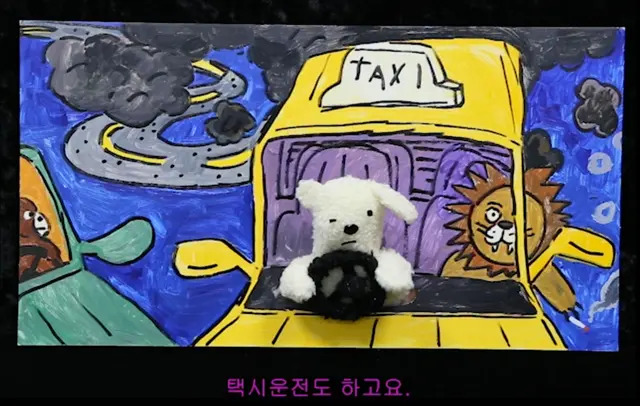
The transition from monumental paintings to the video work Road to Studio B (2018), which combines drawing, installation, and clay animation, as well as his subsequent tendency to fragment narratives into individual works, suggests that what Bae truly required was not the monumental painting itself but a space capable of containing the abundance of his thoughts and emotions.

This becomes particularly evident in his video works, in which countless drawings and sculptural transformations are photographed frame by frame, compressing innumerable thoughts and emotions into a temporal sequence.

The defining characteristic of his practice, therefore, should not be understood as a commitment to monumental scale. Rather, it lies in the way a dense and expansive mental landscape—where reality, imagination, and desire intermingle—is expressed through a process akin to automatism.

He is constantly experimenting with new image-making formats, yet the fundamental method underlying his practice remains unchanged. In 2014, curator Lee Danji described his work as one that “gathers stories lingering or accumulated in the subconscious without fixed form—urban legends, folklore, television dramas, political events, news reports, internet comments, and even spam text messages arriving in the middle of the night—and reconstructs them into metaphorical scenes resembling fantasy tales.”

This approach remains valid today. The artist himself has described the complex mixture that constitutes his work in the following terms: “My brain waves continued to issue orders for mixed thoughts, the crossbreeding of those thoughts, and their excretion.

Ants and larvae still swarmed through my mind, and rats came and went. Without any control, they were transferred into the form of artworks.” (Artist Statement, 2021) A similar sentiment can be found in a recent interview: “That ecosystem where all sorts of things coexist and bustle together—I think that is what my mind is like, and now it feels like an unchangeable part of my personality.” (Artist Interview, 2022; hereafter Interview)

While the forms and subjects of his work have changed, the artist’s fundamental impulse—to express facts and thoughts that are intricately entangled—remains the same. Herein lies the core of Bae Yoon Hwan’s practice. To visualize reality and imagination, desire and reason, thought and emotion in a non-linear manner; to transform swarming masses of thought into images—this may be understood as both the essence of his artistic nature and the source from which his work emerges.


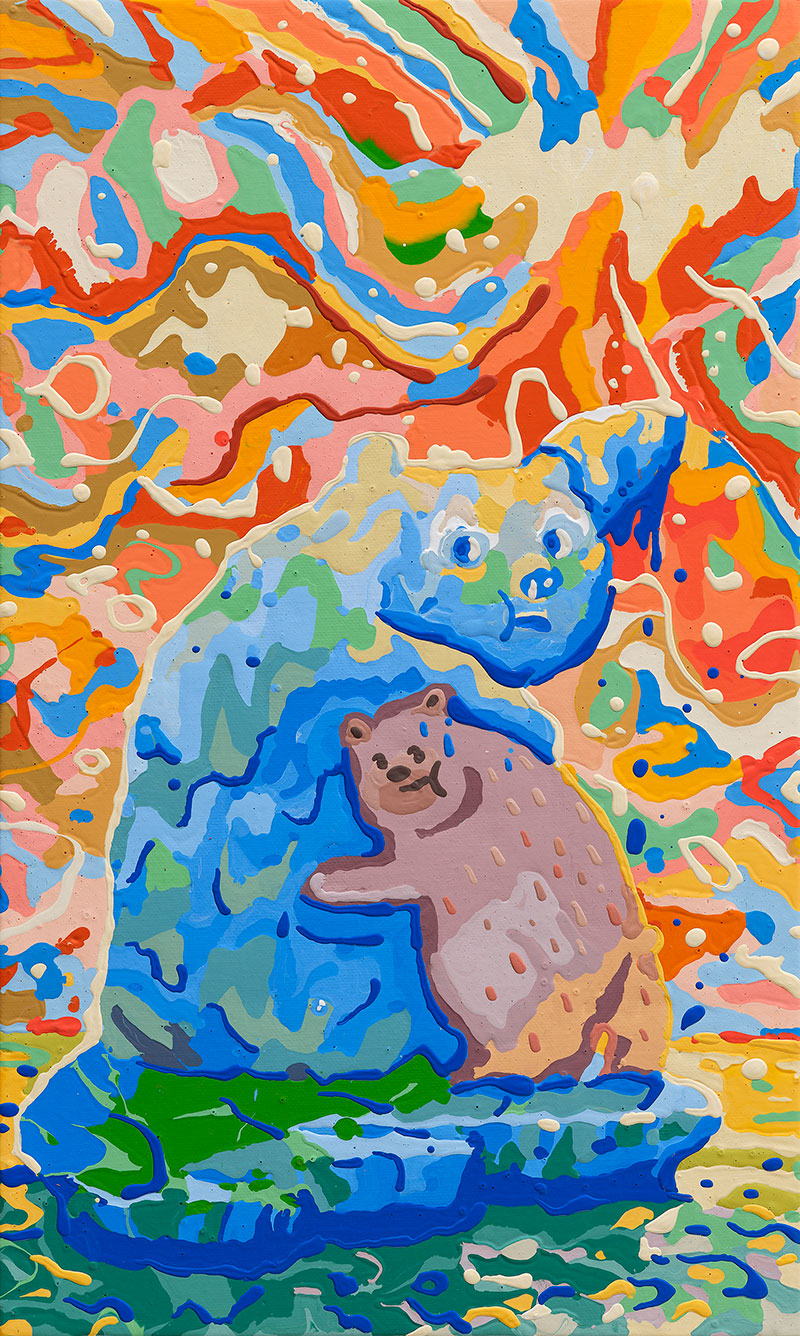
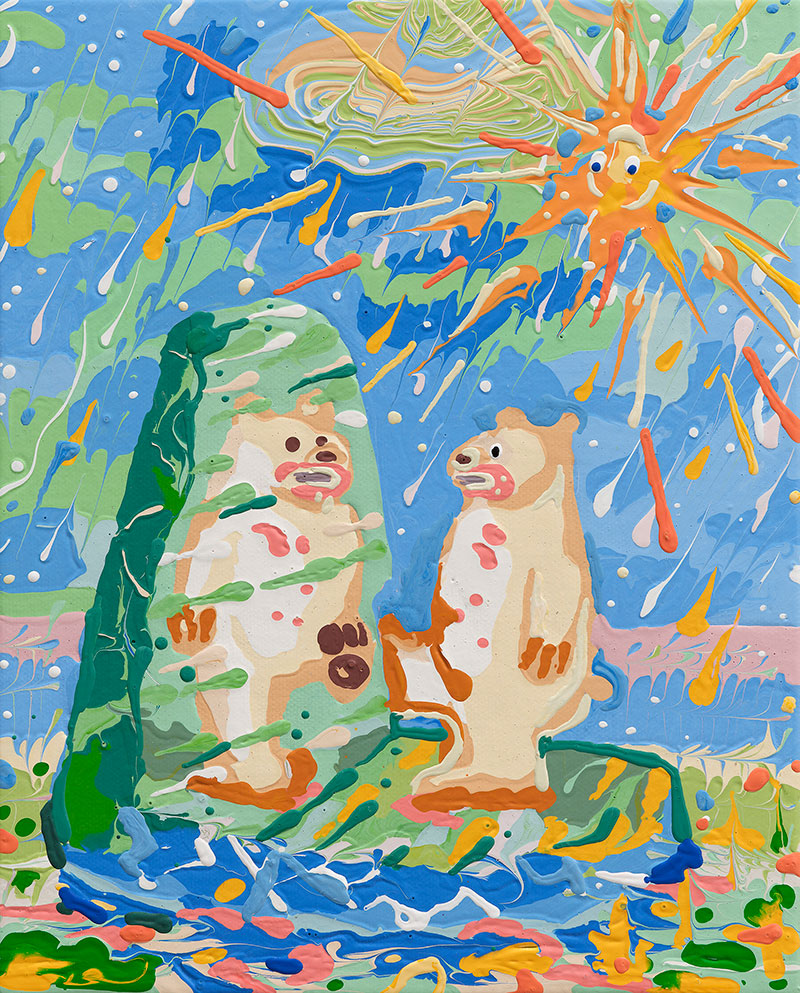
Bae Yoon Hwan, Chuckle Cracking Sea Ice 4, 2022, Paint on canvas, 45.5 x 27.5 cm © Bae Yoon Hwan

The Expansion and Implosion of Anthropomorphism

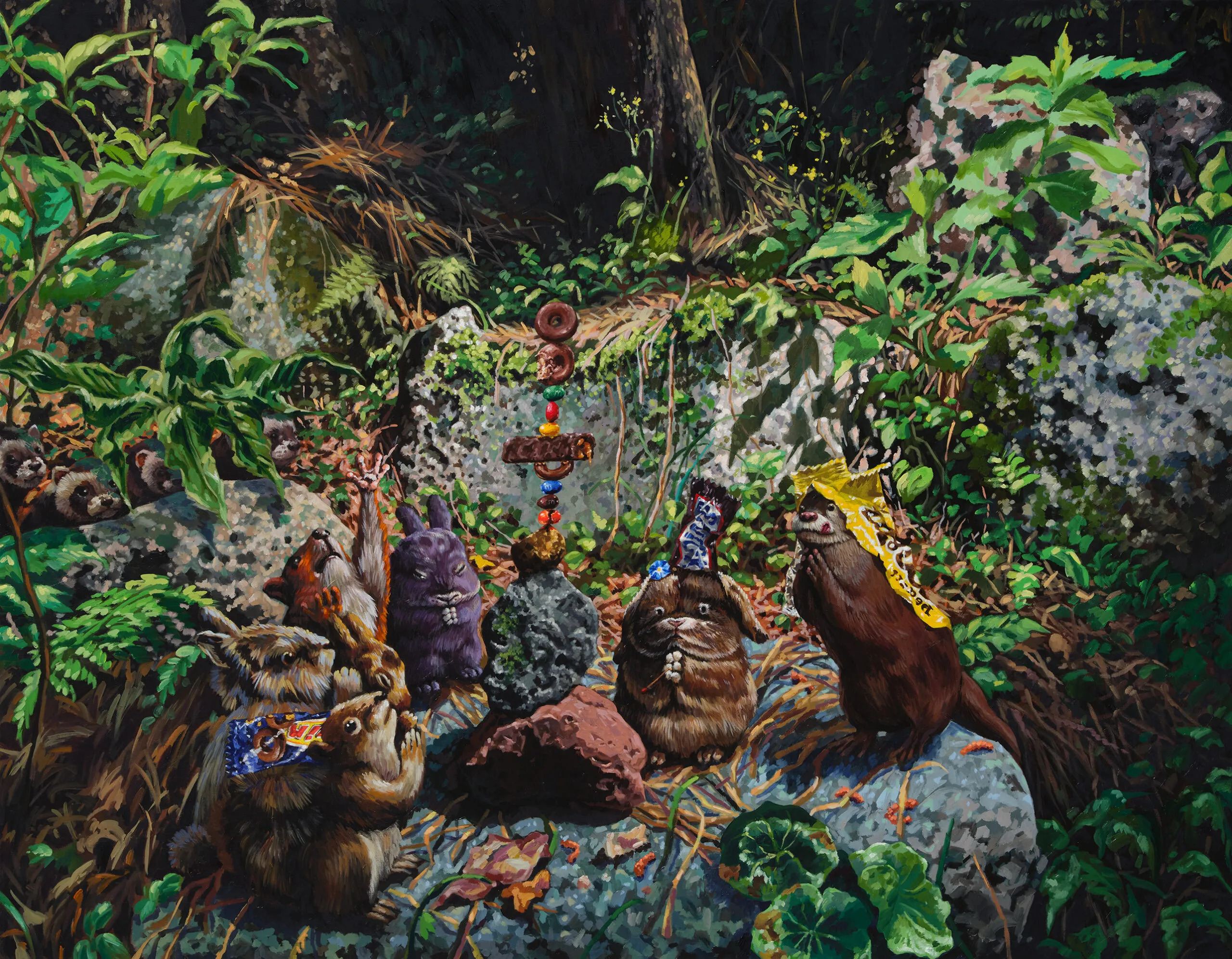
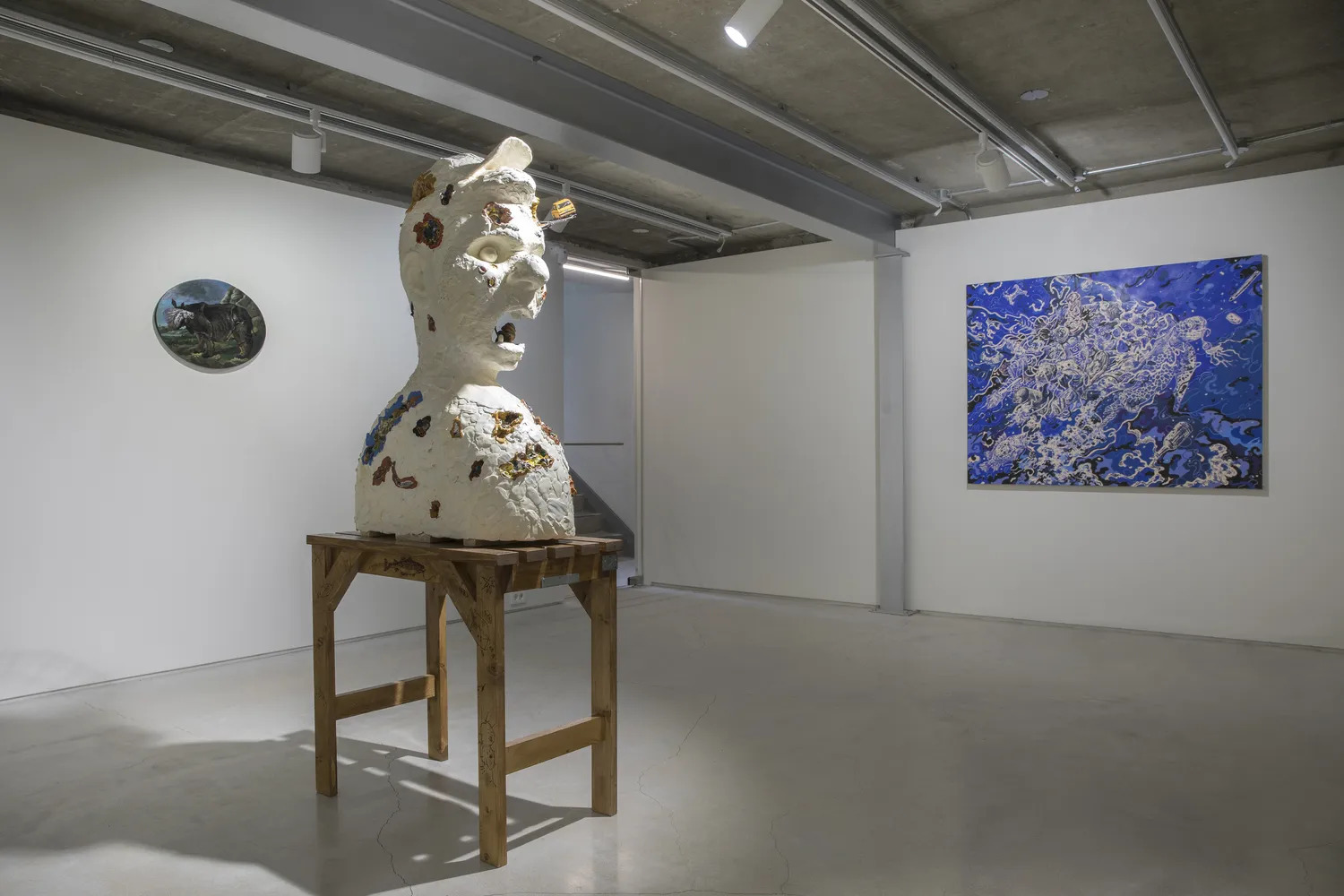
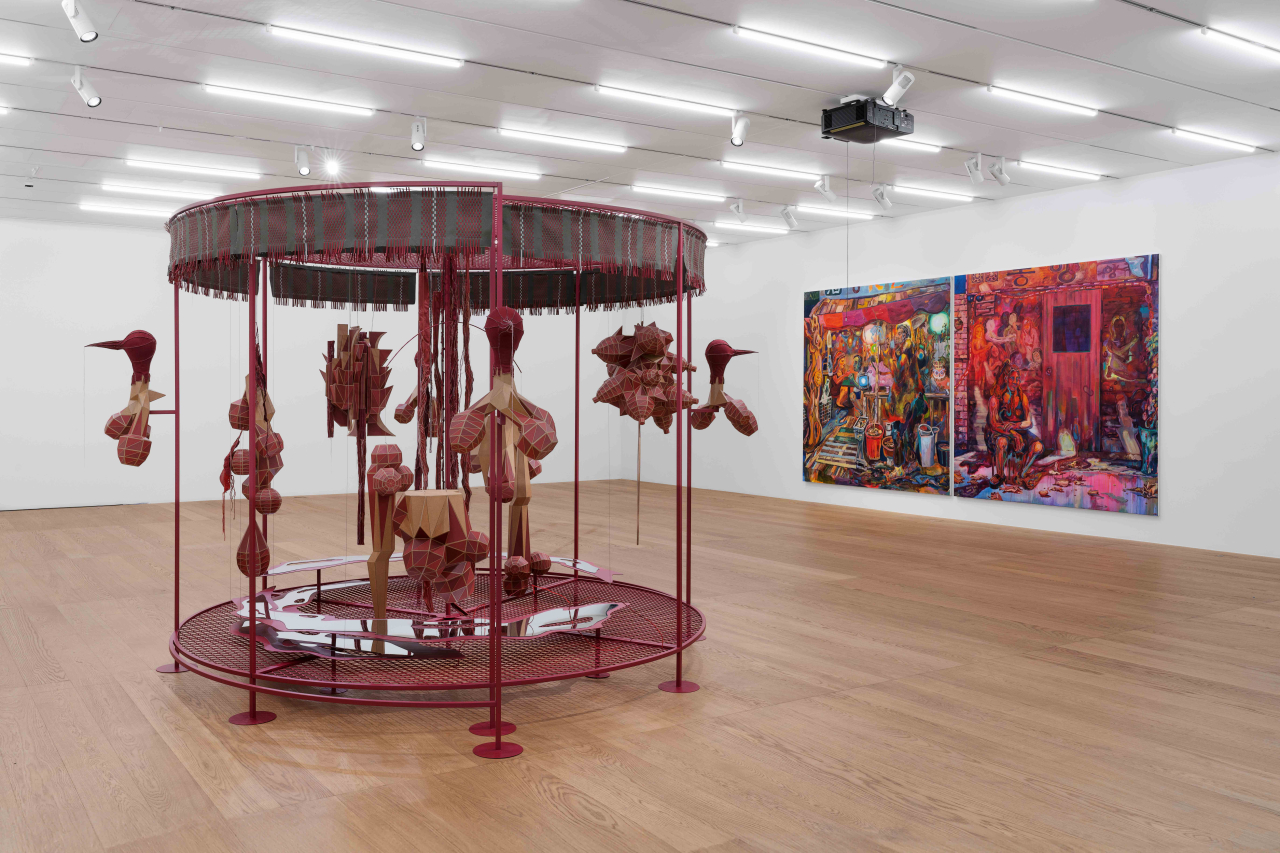
In recent years, Bae Yoon Hwan’s work has increasingly focused on nature, particularly on the anthropomorphism of animals. Whereas his earlier works selected and assembled random thoughts and emotions drifting through his mind into vast, non-linear narratives, his more recent practice tends to fragment those thoughts and emotions, allowing each fragmentary narrative to exist as an individual work.

He has now moved beyond this approach to focus more directly on nature—especially animals—and the conditions of human life. According to the artist, he has long been interested in “nature, the lives of human beings, the ways animals live, and the natural environment.” What attracts him is the diversity of living creatures, each possessing different forms, sizes, physiological characteristics, and survival strategies.

As discussed earlier, this diversity is not only a characteristic of nature but also a characteristic of the artist’s own mind and personality (“That ecosystem—that feels like my mind … it feels like my personality”) and, by extension, a defining feature of his artistic practice. In this sense, his focus on nature can be understood as a formal variation developed within the existing framework of his work.

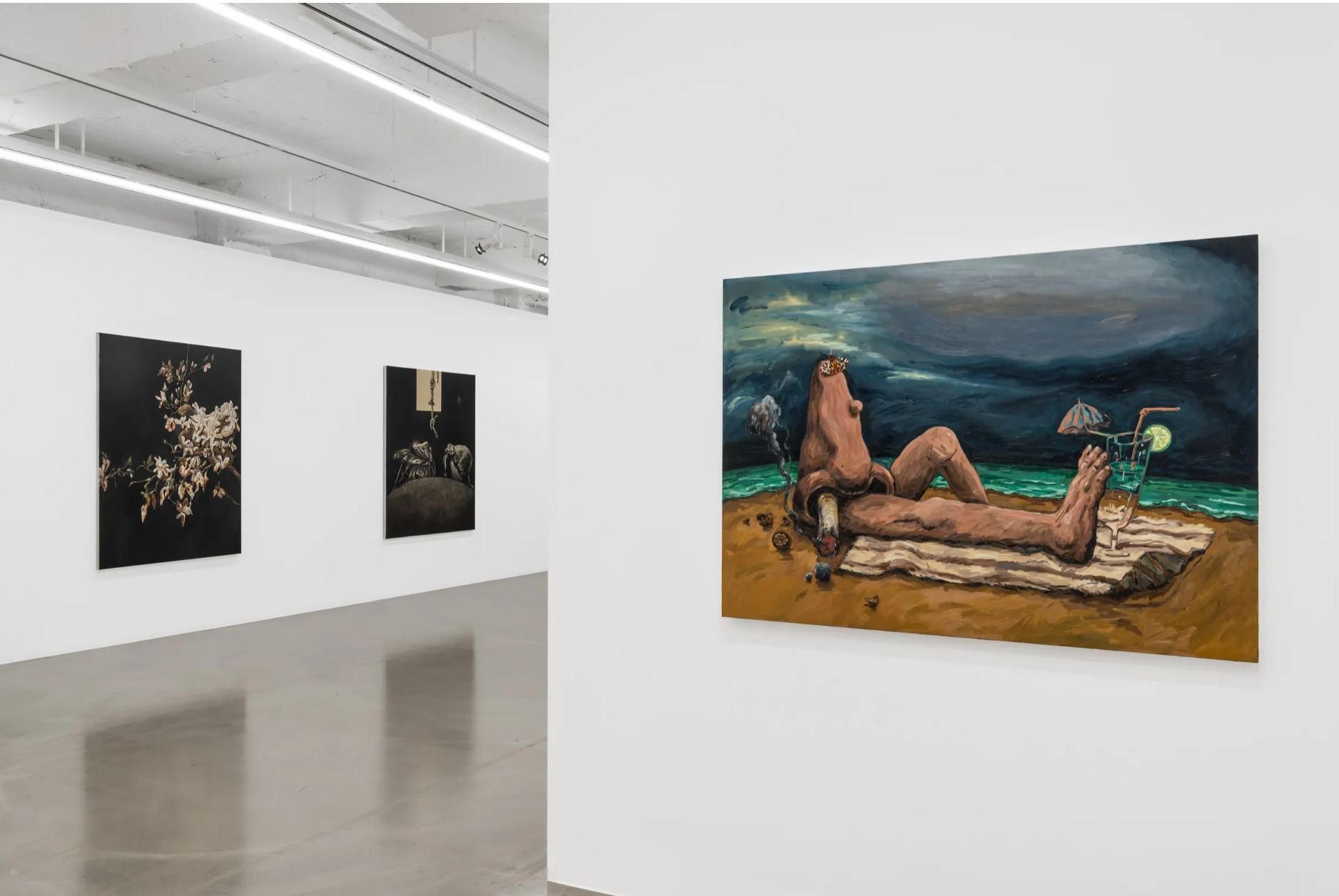
Since 2019, the artist has produced works related to animals and anthropomorphism. Until 2021, these works tended to possess a relatively serious and contemplative tone. By contrast, his recent works from 2022 approach social issues through forms of black comedy, twisting situations in witty and unexpected ways.

The artist explains that he sought “a way to make things more entertaining through familiar images that everyone recognizes,” and this pursuit ultimately led him toward satirical works marked by humor and wit (Interview).

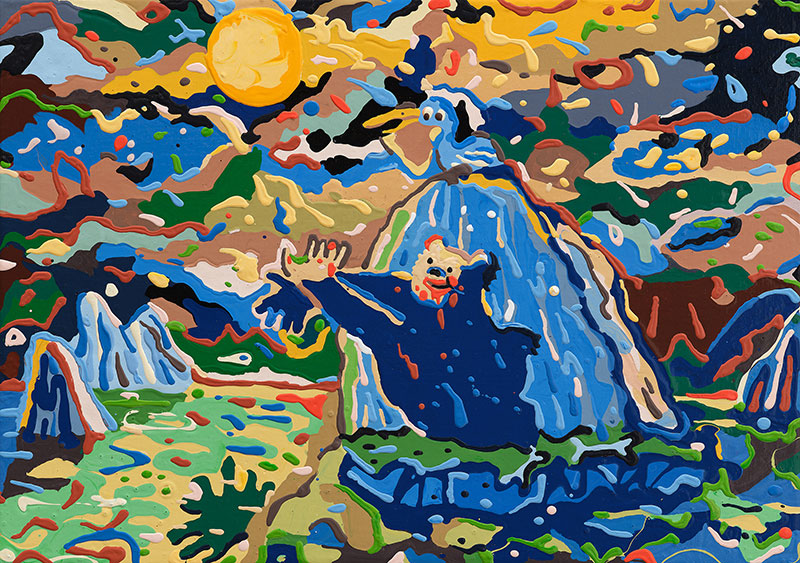
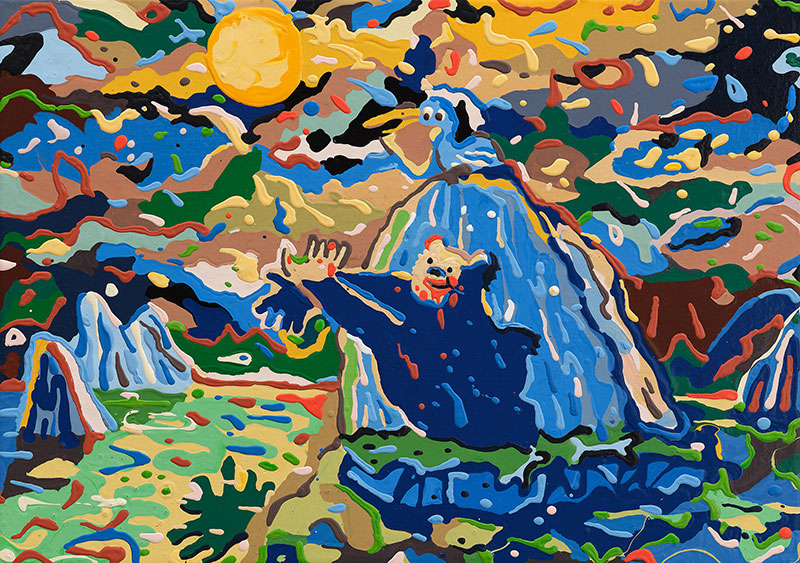
From a broader perspective, Bae’s recent works employ anthropomorphized animals as a means of critiquing the self-interested ecology of human society. The most frequently recurring subject in his 2022 works is the climate crisis, as seen in You Would Keep Some of Them Alive?, What a Relief!, 24/7 Arctic Mart is Closing Soon!, MAMA WOOOO, and the 'Chuckle Cracking Sea Ice' series.

Other works address concerns surrounding artificially constructed ecosystems, including Lullaby for Fangs and Need Some Honey?, while still others critique human habits and behaviors, as in Disco Night of Roasting Crescent, The Thrill is Gone, Rumble & Crumble, I'm Mr. Easy on the I...Ice!, and Untouchable Bonnie. There are also works inspired by celebrated achievements in art and literature, such as Lime Orange Tree in My Rye Field.

Taken together, these works can be understood as employing a strategy of mirroring, one that seeks to heighten critical awareness by objectifying human life and behavior. At the same time, unlike his earlier works, they reveal a more clearly articulated thematic consciousness. This shift may be regarded as the outcome of the artist’s years-long effort to draw forth a more refined and cohesive collective narrative.



Bae Yoon Hwan, Chuckle Cracking Sea Ice 6, 2022, Paint on canvas, 30 x 42 cm © Bae Yoon Hwan

Nevertheless, a certain unresolved ambiguity remains within these anthropomorphic animal works. It is precisely this quality that makes the artist’s practice all the more compelling. While many of his recent works present clearly defined thematic concerns, others contain multiple overlapping subjects or remain too ambiguous to converge into a single theme.

The persistence of the latter stems from the inadvertent emergence of the primal energy embedded within the artist’s fundamental working process. Such primal energy can never be fully refined or controlled. The artist has remarked, “Sometimes a work proceeds according to plan and then suddenly transforms through improvisation. ... I really enjoy spontaneity, the small thrills and moments of tension that come with it. In fact, I hope for them.” (Interview)

In other words, he actively seeks improvisation and believes that even the most carefully structured plans can accommodate it. Improvisation thus becomes one of the principal forces behind the ambiguity—or nonlinearity—that characterizes Bae Yoon Hwan’s work. It is the manifestation of primal energy. Of course, not all of his recent works rely on spontaneity. In fact, many are the result of careful planning.

This can be understood as the outcome of his efforts to construct a more refined and cohesive collective narrative. Yet no matter how thoroughly a work is planned, there are moments when improvisation unexpectedly breaks through the structure of that plan. When such moments accumulate, the resulting work may take a form quite different from what was originally intended.

A work that began as a planned endeavor ultimately exceeds its own plan. This process causes the artist’s anthropomorphism to expand while simultaneously weakening its predetermined meanings. As a result, both the purpose of anthropomorphism and the thematic message become less fixed, leaving room for alternative interpretations.

Such ambiguous works become even more distinctive—and possess an even stronger presence—when shown alongside works with clearly defined themes and carefully structured intentions. In this sense, refined works and works charged with improvisational energy generate a productive synergy. Through this dynamic, Bae’s new artistic experiments move toward unforeseen destinations in unexpected ways.

Bae Yoon Hwan continues to experiment with his modes of thinking and working, continually opening new paths. Courage resides in his practice. Yet at its core, his work remains remarkably consistent. His mind is still crowded with countless thoughts. He attempts to fragment them and shape them into refined narratives.
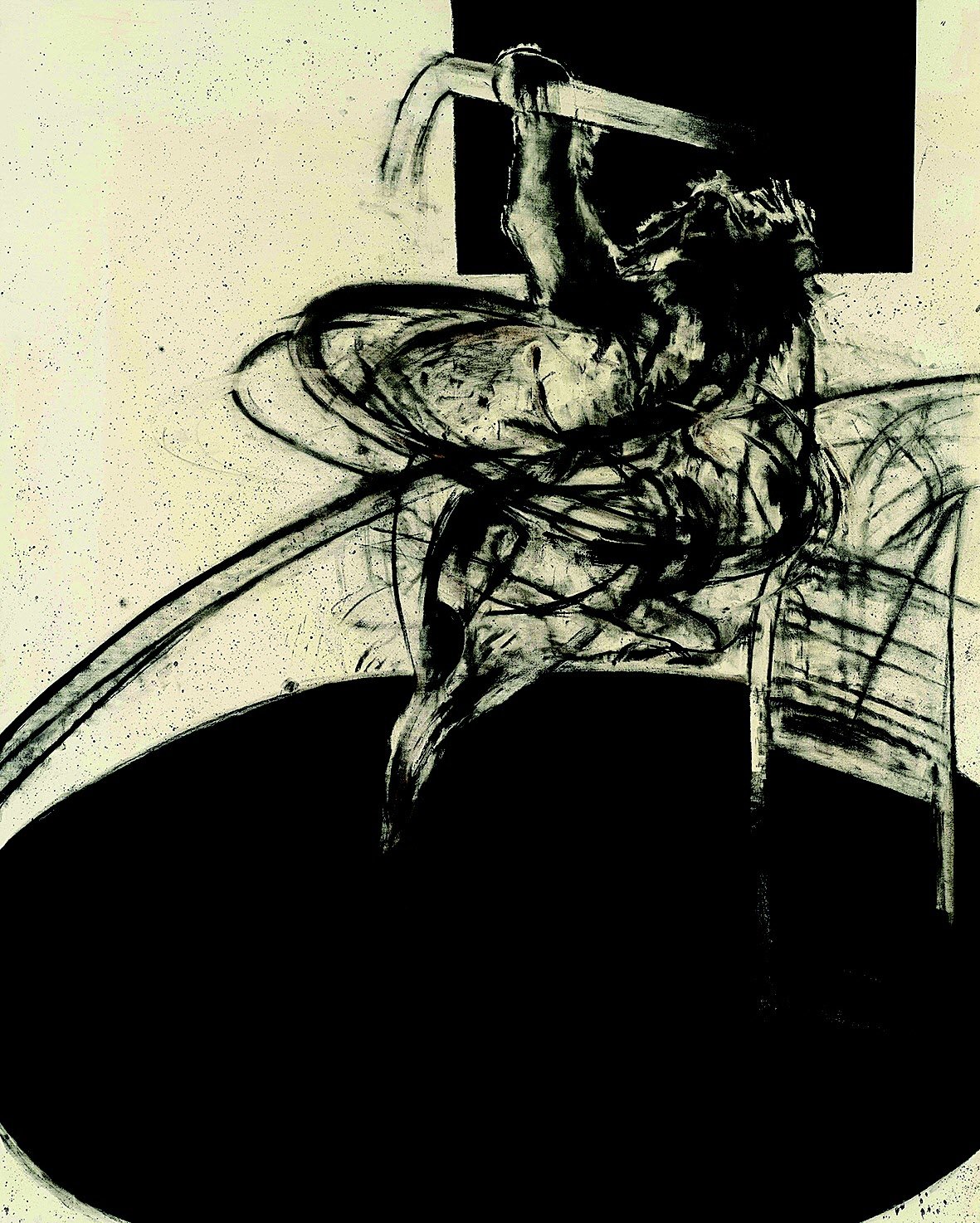
What makes his work distinctive, however, is the presence of spontaneous gestures that emerge unexpectedly alongside this process. His improvisational impulse is unlikely to cease. One hopes that his primal energy will continue to surface unexpectedly, harmonizing with his increasingly refined pictorial language in the years to come.

References