Even from a contemporary
standpoint, we can easily think of objects offered with hope, or rituals that
require such votive objects. For example, the candle offerings in Catholic
churches, the rice dedicated to Buddhists temples—the origin of these objects
would be ex-votos. Even today, the entrances of Catholic chapels in Italy,
named after saints believed to protect the living from sickness and misfortune,
are festooned with metal plates and simple objects engraved with personal or
prototypical prayers, consecrated by visitors from all over the globe. If in
the past, people sought after the experience of “an aura” within churches or
other sanctums, people of today look for “auras” inside the screens or on
stages (museums exhibiting the works of great artists may also be one such
place). The celebrities standing in the center of these places are indeed
bearers of aura, strictly retained through distance—or manifestation of an
unreachable distance (though some may seem to approach their fans if only on
stages or in cyber environments). These stars are showered with gifts, a custom
only continued in a slightly altered manner after their deaths. Around the
gravestone under which a celebrity is buried, pile up letters, flowers, and
small pendants the fans used to keep close. These objects are modern-day
ex-votos, offered with hopes and desires by fans who believe in the sanctity
and the mystical powers of their artists.
Going back to older forms of
ex-voto: most of the ex-votos found in the various sanctuaries are known to
have been primitive and common objects, far from precious, and often resemblant
of human anatomy. Oblation of commonplace or anatomical ex-votos began among
groups of pagans, even before Christian domination of the European spiritual
culture. What’s interesting is that the ex-votos from Greek, Roman, and
Etruscan Antiquity share the same qualities as the ex-votos seen in the
Christian sanctuaries of Cyprus, Bavaria, Italy, or the Iberian Peninsula: from
size and choice of material to fabrication technique and styles of figuration,
ex-votos have not evolved much. Georges Didi-Huberman, who studied
characteristics of votive objects neglected by most art historians, noted that
these objects have been assigned a position far removed from “the grand history
of style” because of their “aesthetic mediocrity, their formulaic and
stereotypical character,” explaining that the anatomical vulgarity in the objects
threaten the aesthetic model of art established by the academies and normative
criticism. But these ex-votos weren’t randomly chosen common objects; they were
mostly objects that had been touched by sovereign events or symptoms, select
objects related to experiences of calamity or miracle. If a man were healed
from a leg wound, for example, he would offer the crutch or cane used during
his recovery. In addition to crutches, all forms of primitive prosthetics used
on injured bodies immediately became objects of oblation: stretchers that
lifted the injured; planks where a cripple sat; clothes worn by the deceased;
even weapons responsible for bodily wounds. Objects that serve as the aftermath
or evidence of a bodily struggle could be formalized as ex-votos. In other
cases, people consecrated objects dear to them, just as a fan would dedicate to
a celebrity an object that holds a special memory of them. According to this
spiritual logic, medieval worshippers offered bread, live animals, valuables,
and even their own children to the church. Expressing his keen interest in
ex-votos, Didi-Huberman stresses the importance of Warburg’s claims as well as 『History of Portraiture in Wax』(1911) written
by Julius von Schlosser (1866–1938), a late-19th century Austrian art
historian. (Didi-Huberman also showed great interest in the works
of Medardo Rosso (1858–1928) who used wax as his formative medium.)
In terms of art history, Schlosser was a significant figure who helped give
name to the concept of the unconscious mind in Freudianism and also helped the
institution of photography reconsider the value of reproduction and imitation
enabled through technical developments and achievements. Schlosser was
intrigued by the history of the wax portraitures neglected by the museums on
one hand, and the history of wax ex-votos on the other. Historians confirm that
the overwhelming majority of the medieval ex-votos were in fact, wax
portraitures. Schlosser, in this sense, studied the history of wax portraitures
as the only type of sculpture dealt neither by museums nor art history, despite
their coverage of all other sculptural bases—marble, stone, wood, and
ivory—which is to say that he studied the history of wax portraitures excluded
from the category of art. His subjects were anatomical models, ex-votos, and
relics made of wax. What was it about wax as a medium that mesmerized him so?
Wax portraitures are often modeled after someone living or dead, hence there is
the element of direct contact or physical relation between the model and the
portraiture. Given such a relationship, wax portraitures, just like analog
films that embody direct evidence of the actual model, have characteristics
that serve to reinforce the purpose of an ex-voto as evidence or a relic.
Furthermore, wax is a medium endowed with plasticity, therefore a material
suited for image fabrication and reproduction. Let’s picture a scenario: a
patient, who’d been lame in one leg, is now healed and wants to offer an
ex-voto of gratitude to his god. He could offer the crutch that had supported
him through his battle with the illness, or, instead, he could have mocked up
and offered a wax leg. Whereas he can only offer his crutch as an ex-voto of
gratitude once he has healed, which is to say in the time of the satisfaction
of his vow to get well, a wax leg could serve as both an ex-voto of expectation
and gratitude, incarnating the changing conditions as the lame uses his crutch
throughout the healing process.
“Wax . . . adapts itself
plastically to misfortunes and to prayers, it can change when symptoms and
desires change. If the lame find themselves healed in the leg but succumb to a
bad dose of pneumonia, they can always melt down their wax leg and use the recovered
material to make a beautiful pair of votive lungs. . . . Wax, as the material
of all manner of plasticities, lends itself perfectly to all the labilities of
the symptom that the votive object tires magically to involute, to heal, to
transfigure. Wax . . . is polyvalent, reproducible, and metamorphic, exactly
like the symptoms it is charged with representing, on one hand, and warding
off, on the other. . . . One might say it permits a gain of flesh.” —Georges
Didi-Huberman, “Ex-Voto: Image, Organ, Time”
On another note, Schlosser
asserted that wax sculptures contributed largely to the advent of realist
portraitures reflective of scientific observation and proportions, and that in
dealing with the emergence of “autonomous portraits,” Giorgio Vasari neglected
the influence of wax portraitures therefore distorting the history. Schlosser
goes on to describe the emergence of realistic wax portraitures, which Vasari
had failed to notice, though there are certain aspects he too overlooks in
eager attempt to rectify the evolutionary schema of portraitures. Didi-Huberman
concludes that, in discussing wax ex-votos, Schlosser may have magnified the
importance of wax portraitures, saying that, in regards to the 1630s for
example, the importance of wax effigies has to be relativized: as opposed to
some 600 wax effigies, there were around 22,000 anatomical ex-votos modeled
after human organs or body parts in Florence. Who is to say that these
anatomical ex-votos unaccounted for in Schlosser’s studies—the isolated ears,
tracheas, limbs, hearts, and even life-size testicles—aren’t as representative
of their consecrators as their portraits? Didi-Huberman goes on to pose
interesting questions and hypotheses about these crude, almost repugnant
imitations of body parts offered to God and their relationships with their
consecrators. Simply put, these anatomical ex-votos do represent their
consecrators. They represent not through realistic description of their
external appearance, but rather, through description of their symptoms, prayers,
the moments of experienced by their flesh. It can be said that what the
consecrators sought to replicate through wax was their state of pain, their
desire for transformation, their hope to reclaim peace and wholeness, their
yearning to change. As can be seen through some of the hypertrophic body parts,
perhaps the characteristics of the consecrators’ misfortune individualizes them
as much as their facial features. But then we encounter yet another skepticism:
how can “loaves” or “raw and vulgar masses” of wax and wax portraitures carved
with finesse hold the same amount of aesthetic value and importance? Wax
sculptures are inherently products of contact (with the model), which makes
them “indicative” according to Charles Sanders Peirce, and owing to the
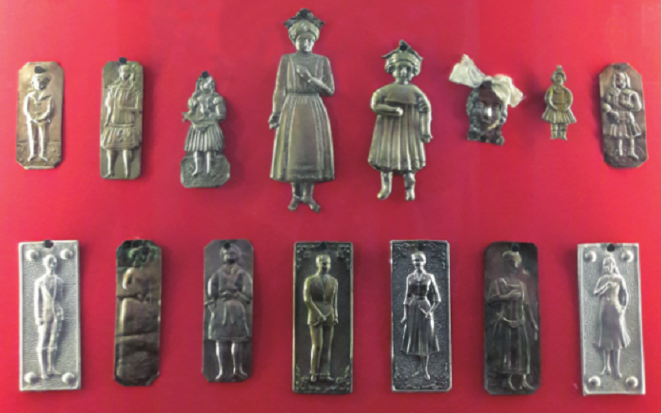
plasticity of the medium, they embody the potential for resemblance. (Aside
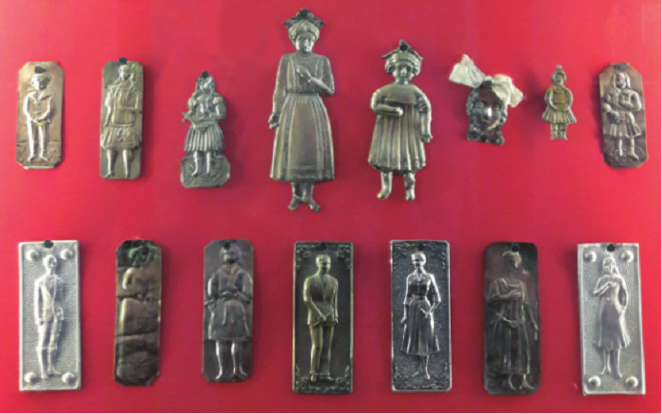
from wax, ex-votos in the form of thin metal plates or paper—also materials
with plasticity—were also common.) Based on the belief that the almost
non-figurative lumps of wax represent the consecrators’ characteristics, we can
infer the definition of “resemblance” prevalent at the time. Didi-Huberman
refers to the medieval ritual that still exists in the Mediterranean basin of
weighing sick children in hopes to save them from their illness: the child is
placed on one side of the scales and wax is piled up on the other side until it
reaches the exact weight of the sick child. In this case, the weight of the wax
becomes the basis of their resemblance. Aside from this ritual, there have been
countless cases in which ex-votos were selected based on their materialistic
resemblance to the consecrator’s “organic weight . . . encumbrance . . . [and]
suffocating presence.” And here lies the paradox that the most organic and
symptomatic qualities are often manifested through the most physical of
properties.