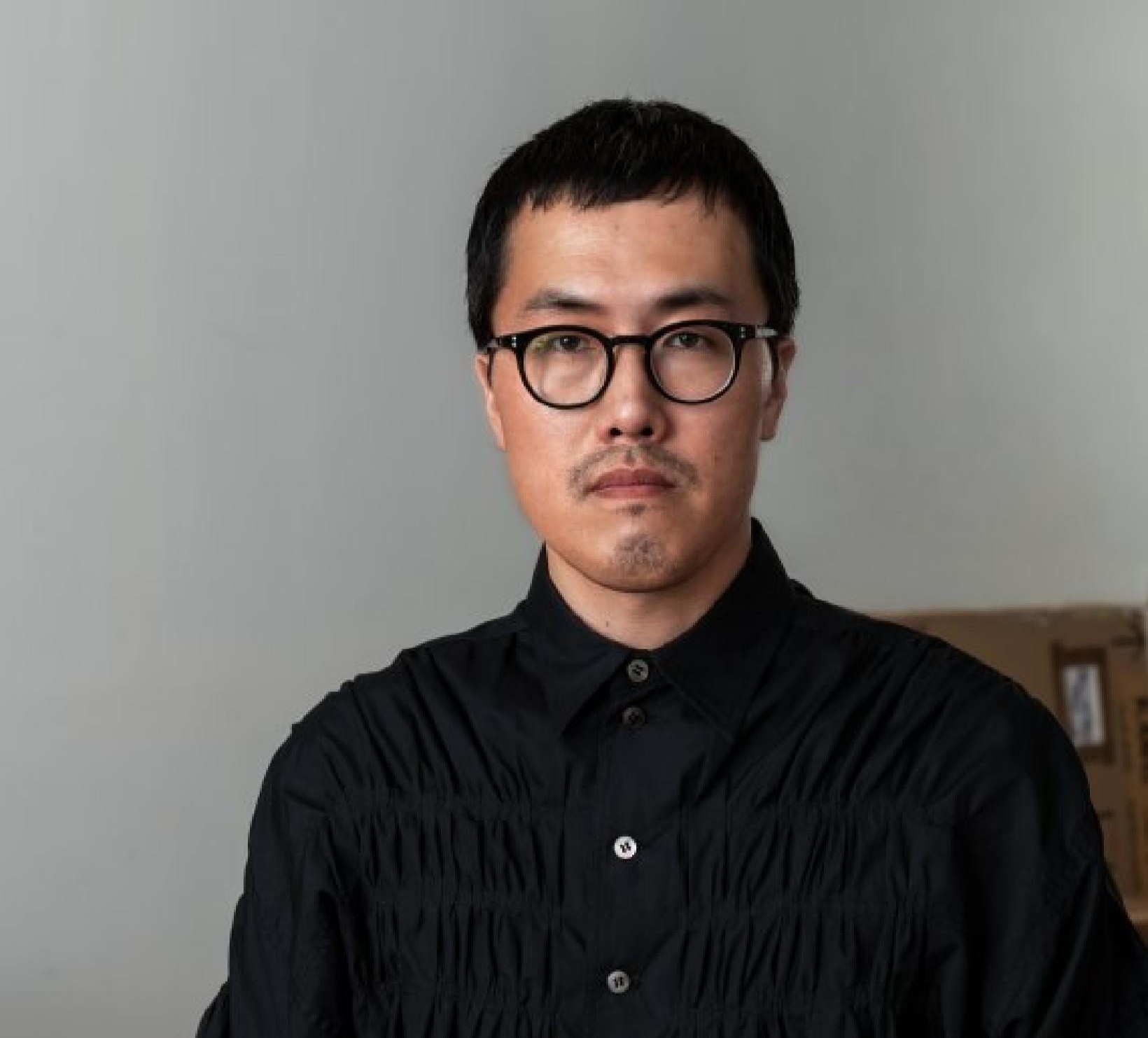
Community, collaboration, and
continual transformation have been central to the works of South Korea–born, Los Angeles–based artist Kang Seung
Lee. For over ten years, he has developed a research-based practice that mines
public and private archives to revitalize the works and legacies of queer
artists, writers, dancers, and gay and trans rights activists who have passed
away. Some of these transnational historical figures have remained well-known
in the present-day, whereas others have fallen into relative obscurity. To
create his works, he has engaged closely with caretakers of these archives and
with those still living who were involved in the histories contained therein.
Lee has employed a range of materials and techniques in his works, including
graphite drawing on paper, embroidery on sambe cloth, collaging found objects,
among others. He has also collaborated with artists and other cultural
producers in his queer community to create ongoing, open-ended art projects,
group exhibitions, and videos.
Community and collaboration have
structured Lee’s practice since his
earliest exhibited works, such as his Untitled (Artspeak?) (2014–ongoing). Billed as a “common-sense guide,” Artspeak: A Guide to Contemporary Ideas, Movements, and
Buzzwords, 1945 to the Present is a reference book that defines a number
of art movements and terms used in contemporary art; it also features a
timeline that lists, year by year, events categorized as “world history” or “art
history.” To make this work, Lee invited around twenty
people in his social circles in Los Angeles and Cal Arts (where he received his
MFA) to collaborate; each person was asked to “edit” an enlarged, hand-drawn copy of the timeline page in Artspeak that
shows their year of birth. The group of people that Lee invited were diverse in
terms of their age, gender, race, sexual orientation, and cultural backgrounds.1 In
the wide blank margins that Lee used to frame each book page, the participants
added their own annotations, anecdotes, events, and drawings of artworks,
musicians, filmmakers, and others left out by Artspeak. The edits
collectively undermine the implicit masculinist, heterosexual, and colonialist
point of view in Artspeak’s version of history by
introducing multiple historical narratives, ones reflective of the varied
interests and personal backgrounds of Lee’s
international, intergenerational community at the time.2
In recent years, Lee’s communal approach has become more dynamic and open-ended, as
evident in his so-called Harvey project, begun around 2019. This project has
its origins in a work titled Archive in Dirt (2019–ongoing) by fellow artist and friend Julie Tolentino. Archive
in Dirt consists of a potted Christmas cactus plant that Tolentino grew
from a small cutting; this cutting was taken from a “mother” plant that had belonged to San Francisco Supervisor Harvey Milk
(1930–1978), one of the first openly gay elected
officials in the U.S. who was tragically assassinated less than a year after
taking office. Tolentino received the cactus cutting—which
arrived very limp—in a mailed envelope alongside print
ephemera from a queer activist and archivist friend, who had in turn received
cuttings from one of Milk’s former roommates (who had
been giving cuttings to various friends over the years).3 When
Lee encountered Tolentino’s work, he was touched by how
generations of people had taken care of and propagated Milk’s plant during the four decades since his death.4 Since
2019, Lee has helped Tolentino propagate the “Harvey” cactus and has created his own artworks in response to the growing
number of plants, which have been entrusted to others in their network of queer
friends. The “Harvey” project
generates acts of caring and gifting that have enlivened a sense of community
around a shared desire to keep Milk’s memory alive and
present.
Continual transformation is
integral to the “Harvey” project—which literally changes form as new
generations of cuttings and owners come into being—as
well as Lee’s larger artistic practice. In his works,
Lee doesn’t claim to use original subject matter, but
rather he sees his mode of making in terms of “appropriation.”5 From archives, books, and
particular locations, he collects found images, objects, organic matter, and
other materials with specific histories and symbolic resonances. These source
materials are recontextualized and often translated into other mediums—especially drawing, embroidery, collage, and video, as I discuss in
this essay—in ways that transform their original
meanings. In this way, his works look backward and forward in time, functioning
as spaces for remembrance as well as opening up new possibilities.
Drawing: Presence and Absence
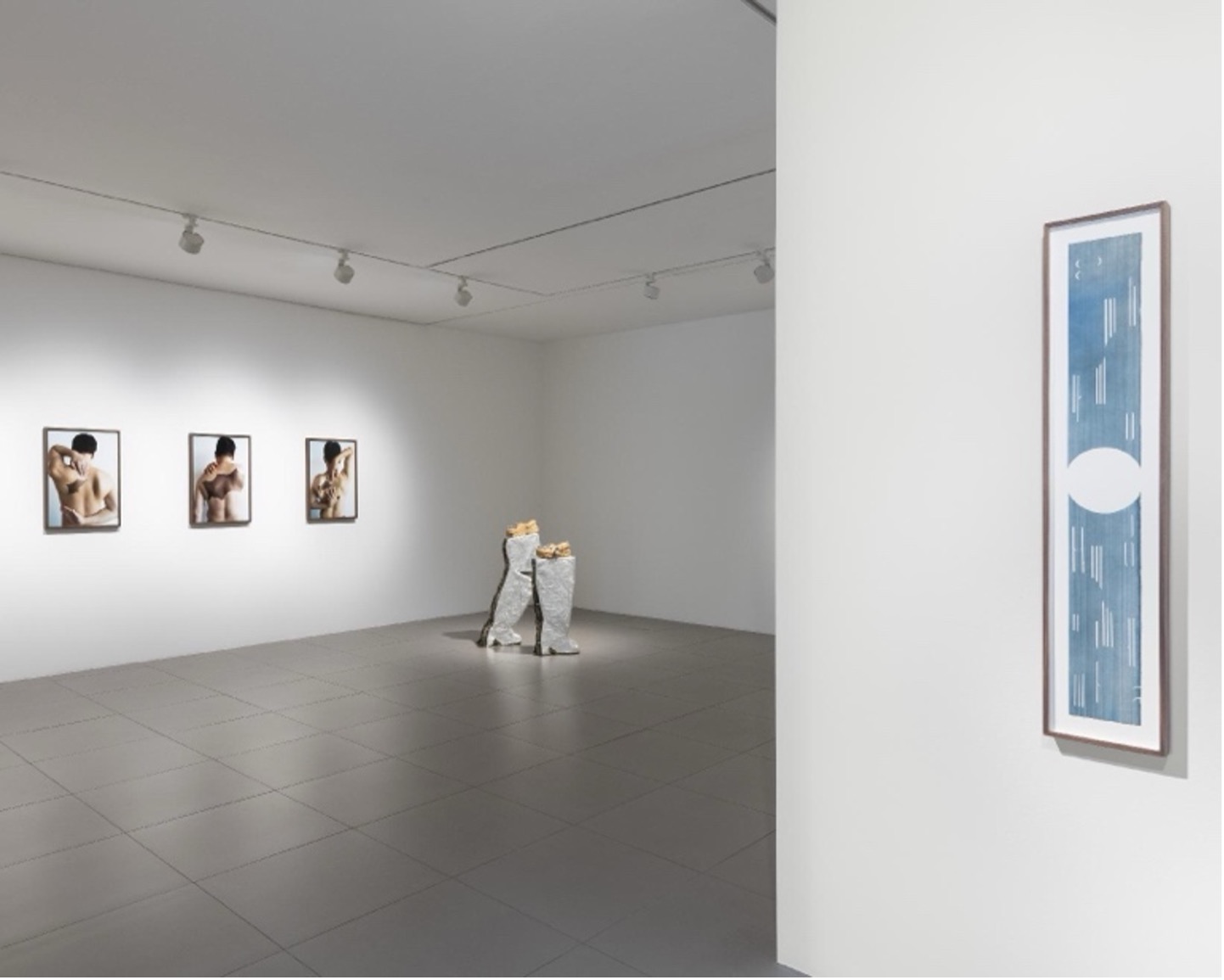
A number of Lee’s graphite drawings memorialize queer lives that have been cut
short, such as those presented in his exhibition Absence without
Leave (2016–2017) at Commonwealth and Council, in
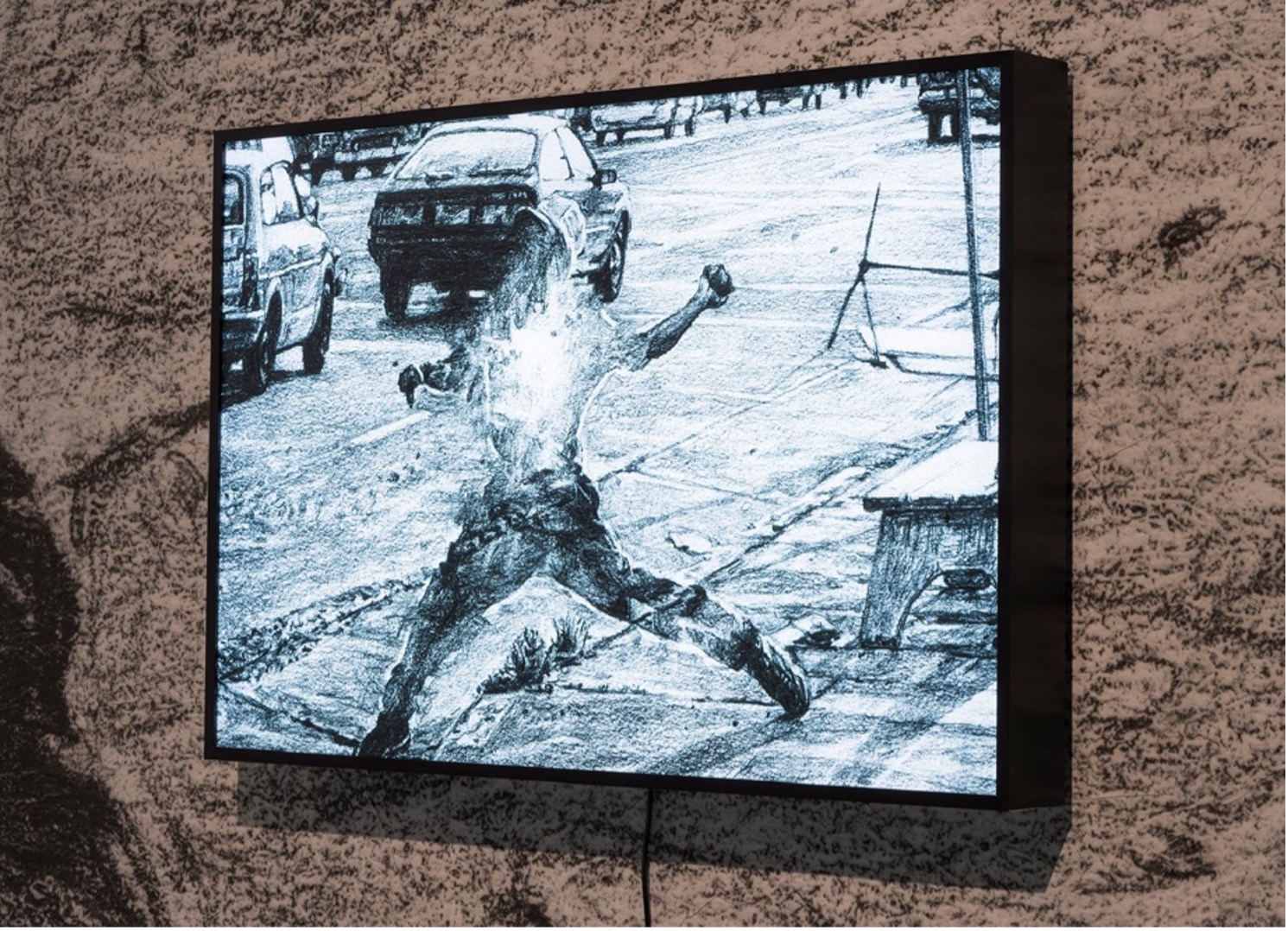
Los Angeles. For this show, he presented meticulous graphite drawings of
photographs that capture the milieu of gay life in the 1970s and 80s,
particularly in New York.6 Source photographs for this series
include a self-portrait by Robert Mapplethorpe, a portrait of David Wojnarowicz
by Peter Hujar, a portrait of Martin Wong by Peter Bellamy, scenes of gay
cruising at the Hudson River piers taken by Alvin Baltrop and Leonard Fink,
among others. Lee’s drawings faithfully reproduce the
photographs save for one part: the human figures are blurred, rendered
unrecognizable, made to appear as if they are disappearing into a cloud of
smoke. On the one hand, the figures’ erasure alludes to
the traumatic devastation wrought by AIDS in queer communities in New York and
other cities around the world, as well as how politicians and governments
initially refused to recognize the epidemic. In the U.S. alone, hundreds of
thousands of people died from AIDS or AIDS-related complications by the end of
the 1990s, including Mapplethorpe, Wojnarowicz, Hujar, Wong, and Fink. Thus,
the drawings can be read as grieving loss, as art historian Jung Joon Lee has
argued.7 On the other hand, the figures’ erasure also indicates Lee’s artistic
intervention into these images, a conceptual prompt that can be read as an
opening dialogue between Lee and these artists of a previous generation. Lee
has stated: “I would like my work to question the
erasure of others who came before and remain unseen, to generate conversations
about the space that holds intergenerational connections and care, and to be an
invitation to reimagine invisibility as potentiality.”8 In this way, the drawings can
also be read as affirmations of presence.
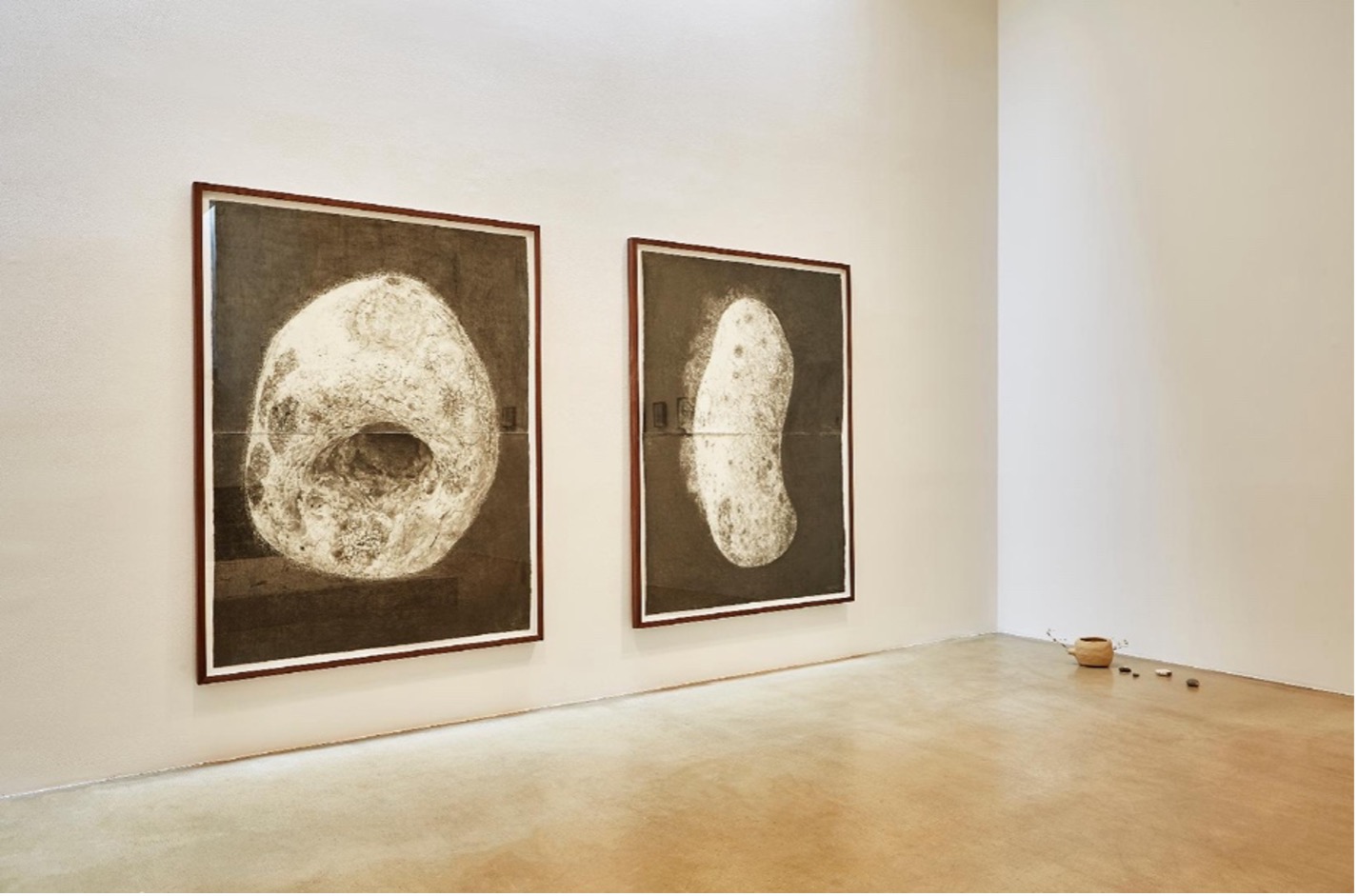
The laborious, time-consuming
nature of Lee’s method of drawing
encourages viewers to linger and slow down their perception of his works. This
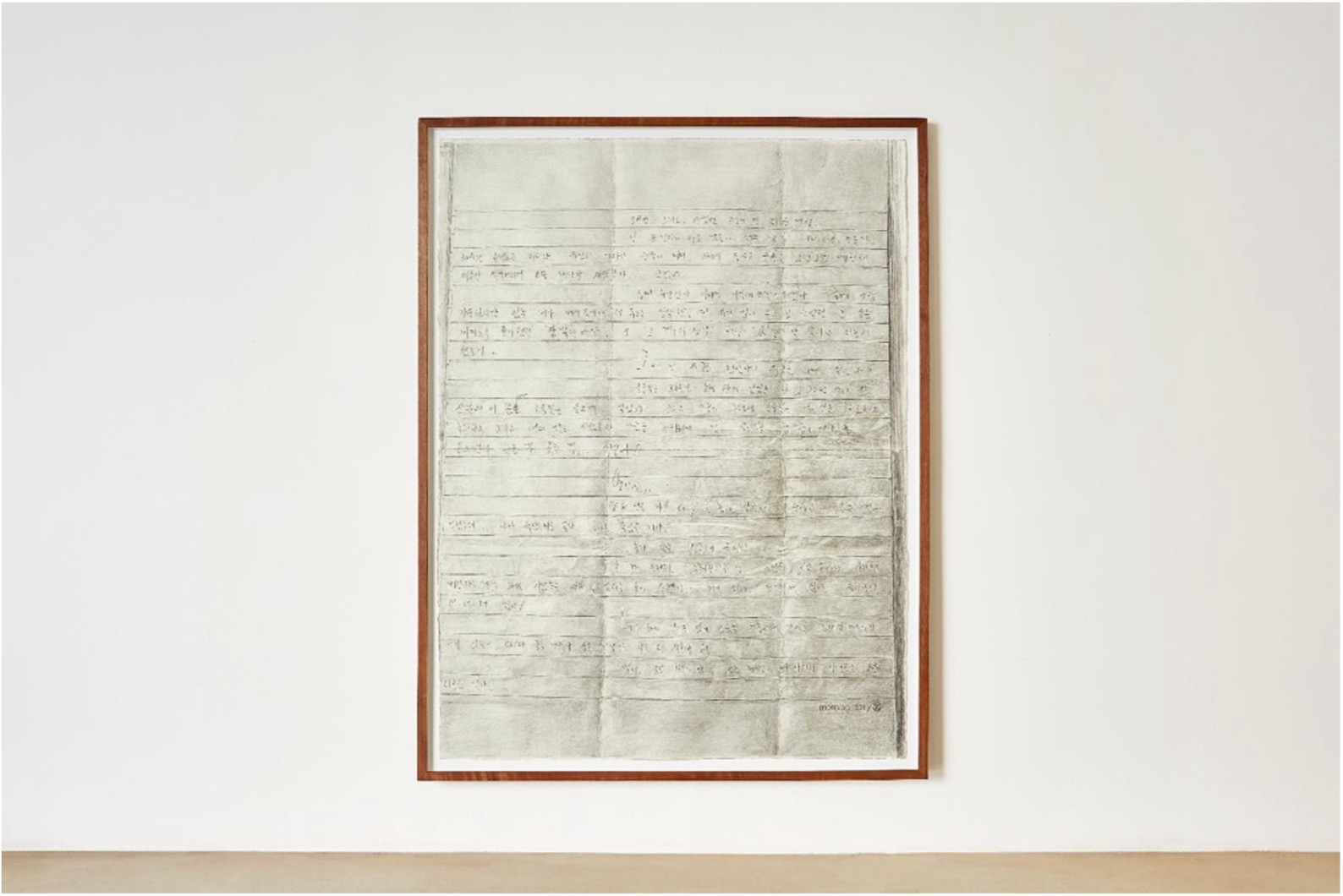
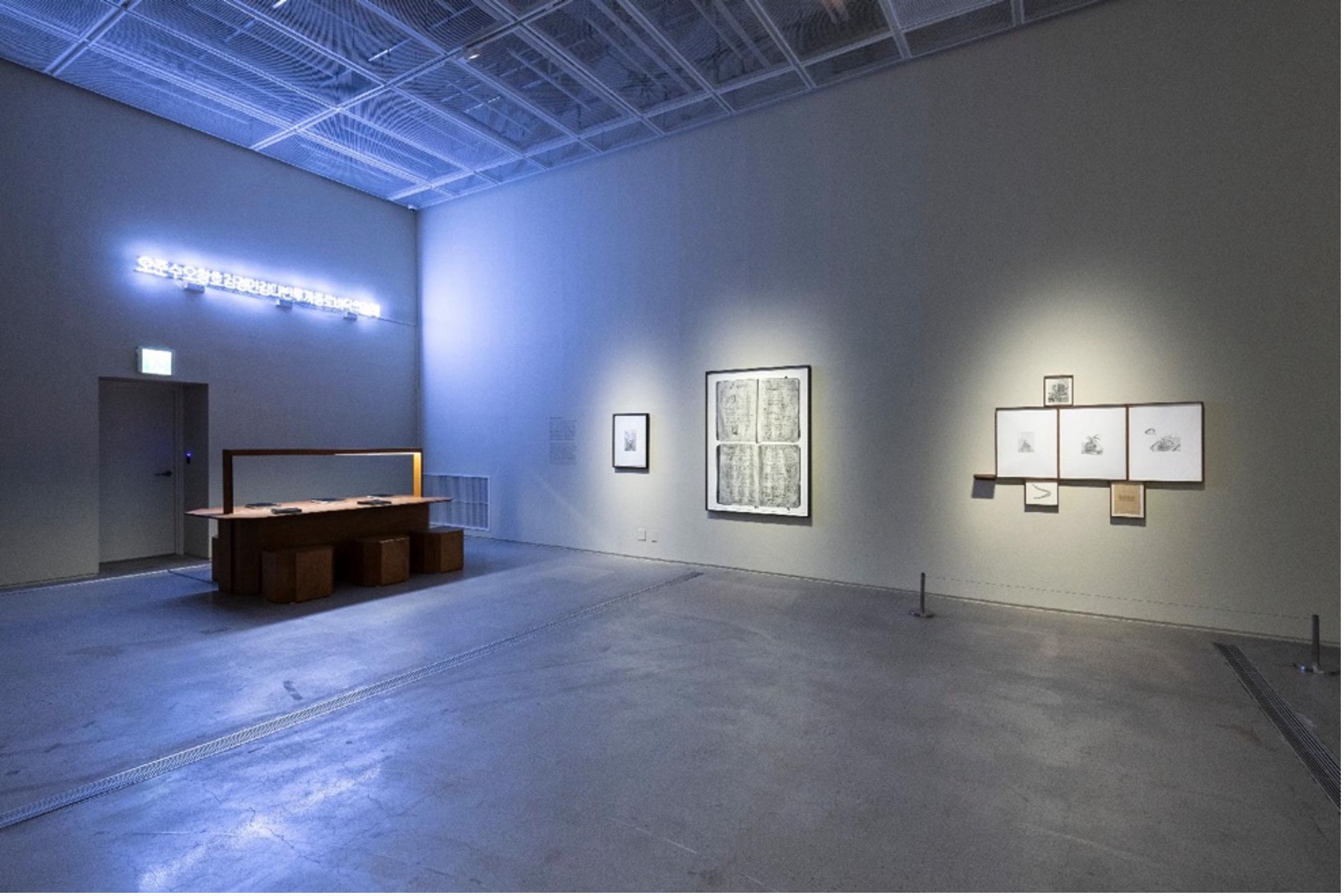
is particularly the case with his larger-scale drawings, such as Untitled
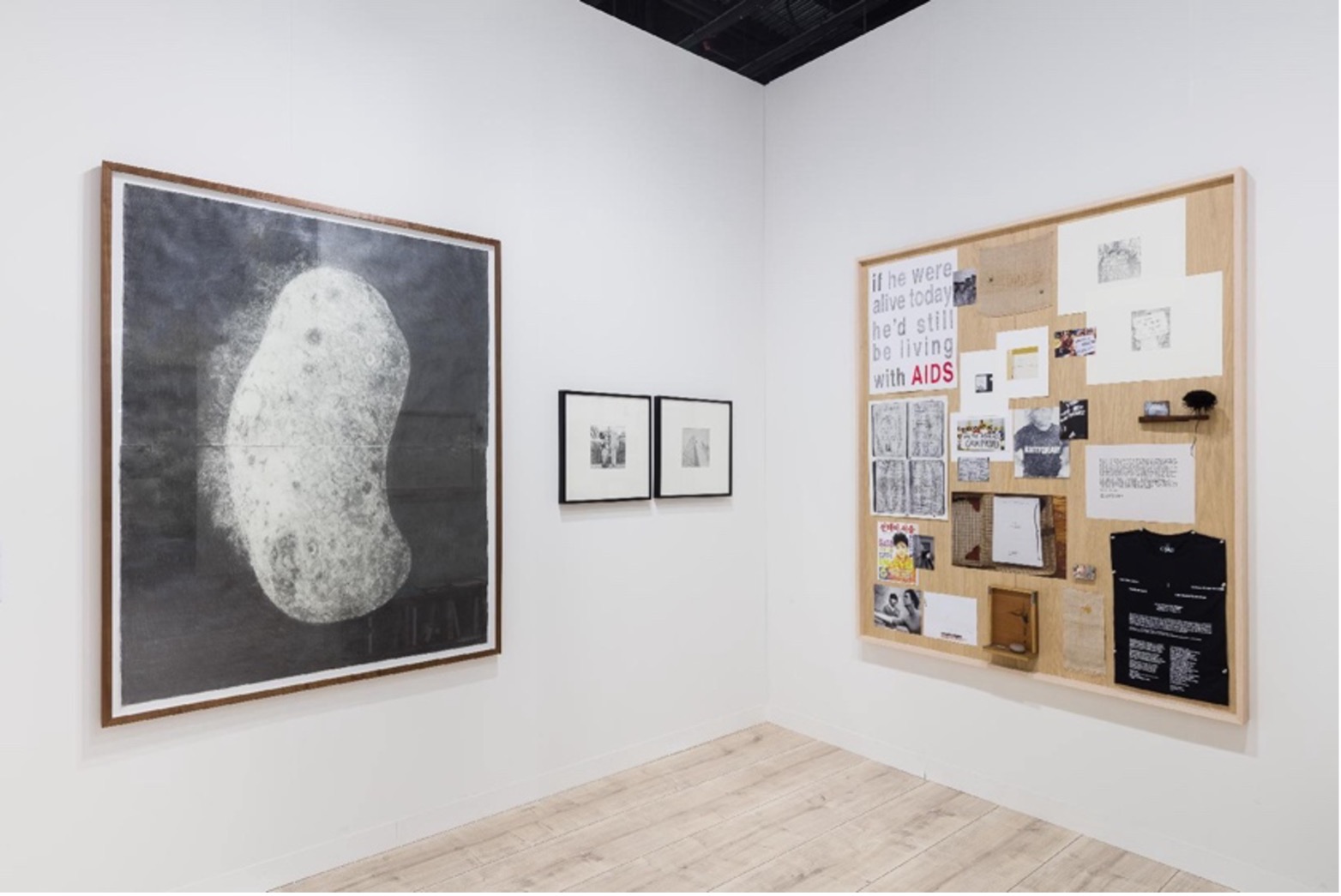
(Joon-soo Oh’s letter) (2018). Whereas many of Lee’s drawings of photographs, such as from his Absence without
Leave series, are intimately sized at around 32 x 28 cm, Untitled
(Joon-soo Oh’s letter) is about five times as
large, measuring 160 x 120 cm. The enlarged scale allows one to read easily the
content of the letter by Korean writer and poet Joon-soo Oh (1964–1998). It is a searing account of his feelings of loneliness as he
listens to music by popular singer Yong Pil Cho and imagines himself
contracting AIDS and dying from it. He expresses his deeply rooted fear of
being forgotten, as if his life had not mattered. Oh was one of the first gay
men in South Korea to publicly disclose that he was HIV positive. He published
a memoir of his experiences as an AIDS patient under a pseudonym9 (he
would die from complications of the disease) and worked with the gay rights
group Chingusai, which he helped to found, for the remainder of his life. In
Lee’s drawing, representations of the letter’s physical qualities stand out, from its uneven tones indicating the
paper’s texture to its carefully rendered creases. The
letter was once folded and sent by Oh to a close friend. The drawing’s large scale monumentalizes the letter’s
intensely personal subject matter as well as the friendship such correspondence
represents. When displayed, its monumental scale allows the work to address
multiple viewers at once—a public—helping to ensure that Oh’s life and work
will in fact not be forgotten.
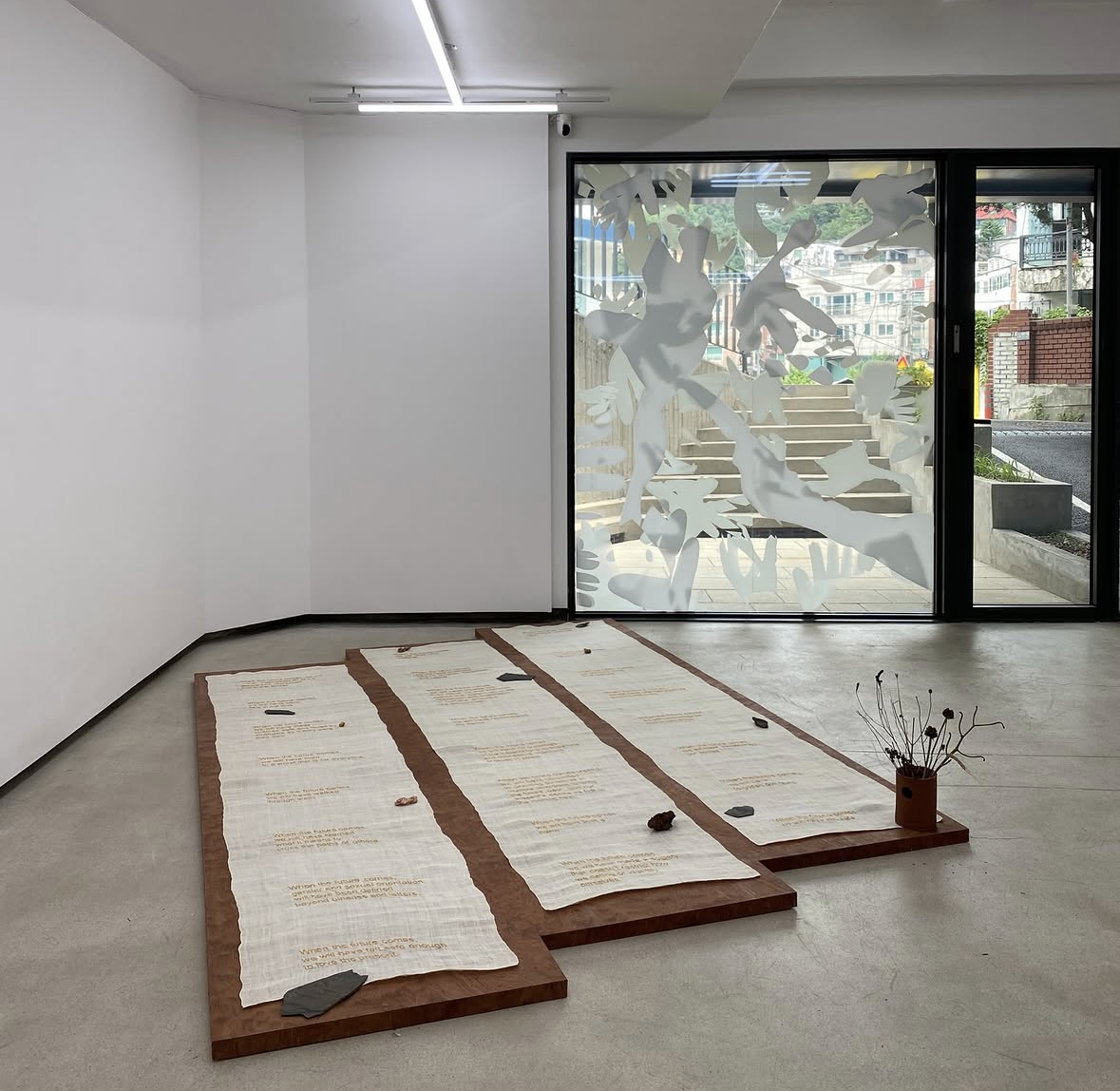
Gold Embroidery on Sambe: Death
and Eternity
Since 2017, Lee has been making
gold embroidery works on handwoven Korean sambe that evoke notions of mourning
and transience. Sambe, a cloth made from hemp, is associated with funerals and
death in Korean culture. Before the 1950s, sambe was widely used to make summer
clothing for farmers and middle-class families as well as funerary clothing for
mourners and the deceased. Since the 1950s, however, as Western-style clothes
became more popular after the Korean War, sambe has now been used primarily for
burial practices. Sambe is considered appropriate for burial clothing since it
is thought to decay more quickly than other fabrics, such as cotton or silk.10 A
labor-intensive and highly skilled process, handmade sambe in South Korea is
now largely made by a generation of elderly women in rural areas. As more young
women from agricultural regions seek higher education and employment in cities,
and as the ubiquity of imported, mass-produced sambe makes Korean sambe
prohibitively more expensive, the future for Korean-produced sambe seems
increasingly unviable.
Like Korean sambe, the gold
threads in Lee’s embroidery works connote
obsolescence. Lee uses 24 karat gold thread that was produced in the 1910s and
early 1920s in Kyoto’s Nishijin district, long renowned
for its high-quality textiles. To make this material, strips of pure gold leaf
were wrapped around silk thread, a technique that fell into disuse and is now
obsolete. There is a limited quantity left in the world of this specific type
of Nishijin gold thread. Unlike Korean-produced sambe which is still being
produced, though at dwindling rates, at some point the supply of this
historical thread will run out.
While a sense of loss—and the anticipation of loss—underlies Lee’s gold embroidery works on sambe, they are also imbued with a sense
of veneration. Gold has traditionally been used to signify holiness or purity
(among other meanings) in religions such as Christianity and Buddhism.11 In
Lee’s hands, the gold thread makes iconic what is
embroidered, as in his Untitled (Cover) (2018). The source image
for Untitled (Cover) is the cover of a memorial booklet for Oh. In
this image, we see a line drawing of two clean-cut men in suits, looking in the
same direction. One man places his hand familiarly on the shoulder of another
man and seems to move one leg forward to touch the other’s leg. When viewed on the booklet’s cover,
next to the title “In memory of Oh Joon-soo,” the image appears to represent Oh and his close involvement with
Chingusai, which literally translates to “Between
Friends.” In Lee’s embroidery,
though, there is no caption to direct a specific interpretation of the image.
It becomes more free-floating, a charged image of a gesture of affection
between two men, one that oscillates between reading as homosocial and
homosexual. Materially recontextualized in gold thread and sambe, the ambiguous
image of male intimacy traced in shimmering gold becomes timeless, while its
organic hemp support threatens to disintegrate if not cared for under the right
conditions.
Collage: Connecting and Reframing
In many of Lee’s works, collage is used to make unexpected connections between
disparate figures, places, and histories, relating what is recognizable to what
has been obscured to extend visibility to all. A powerful example of his
approach to collage can be seen in his pivotal
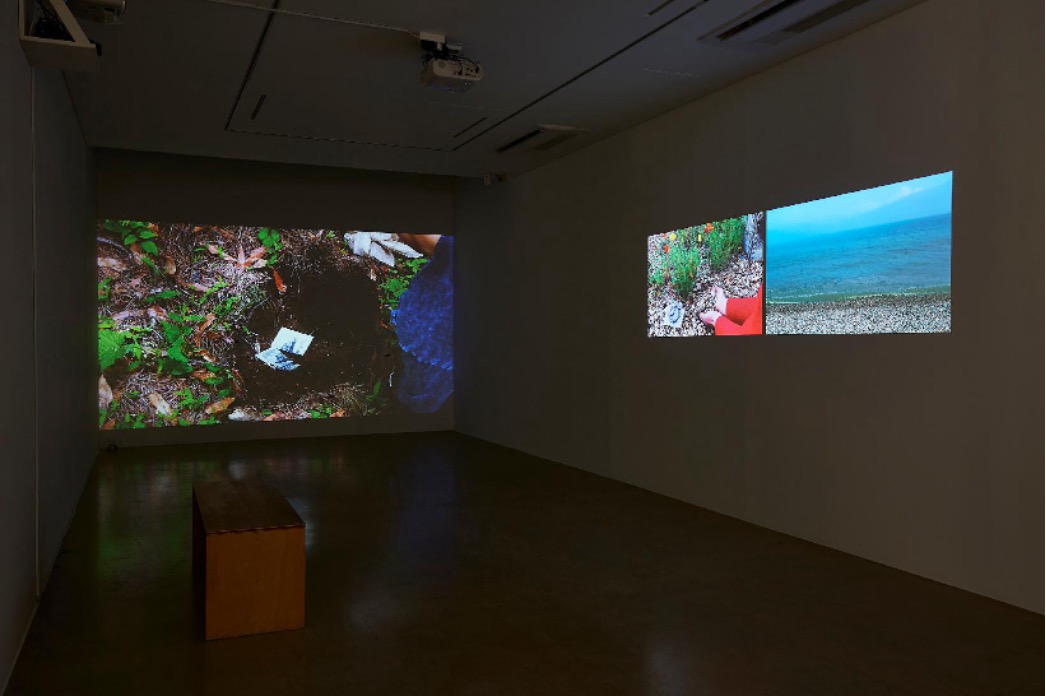
exhibition Garden (2018) at One and J. Gallery, in Seoul.12 The
exhibition brought together images and objects associated with two figures who
had never met, Joon-soo Oh and British artist and filmmaker Derek Jarman (1942–1994).13 After coming out as HIV positive, Oh faced
immense social stigma and died relatively unknown; many of his essays and poems
were published posthumously through the efforts of his friends and colleagues.
In contrast, Jarman’s avant-garde cinema, which
combines representations of queer sexuality with a punk sensibility, were
critically well-received during his lifetime and after. Both were committed gay
rights activists and died within a few years of each other from AIDS-related
illnesses. To create his works for Garden, Lee went to Dungeness in Kent,
England, to visit Jarman’s final home and garden, a
place dubbed Prospect Cottage. The filmmaker found and purchased this site
shortly after learning he was HIV positive; he found deep solace in working on
his garden during the last years of his life.14 In Seoul, Lee
conducted research into Oh’s life and work at the Korea
Queer Archive and spoke with Oh’s friends and
colleagues from his time at Chingusai. Throughout Garden, Lee’s arrangements of publications, photographs, personal items,
flowers, stones, and soils, collected in two different parts of the world,
weave together Jarman’s and Oh’s
uneven legacies in a layered remembrance of their parallel struggles and acts
of creation and resistance.
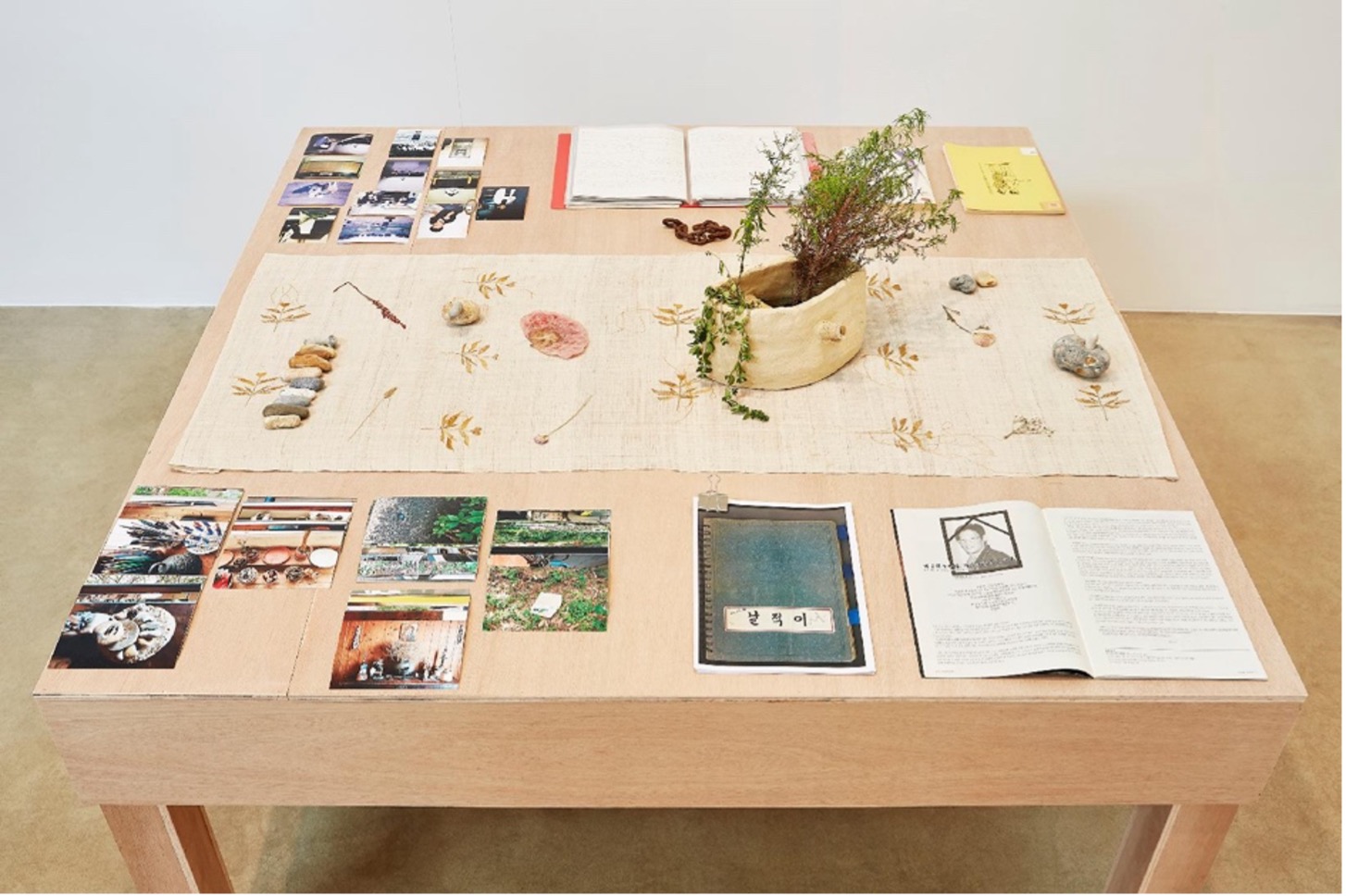
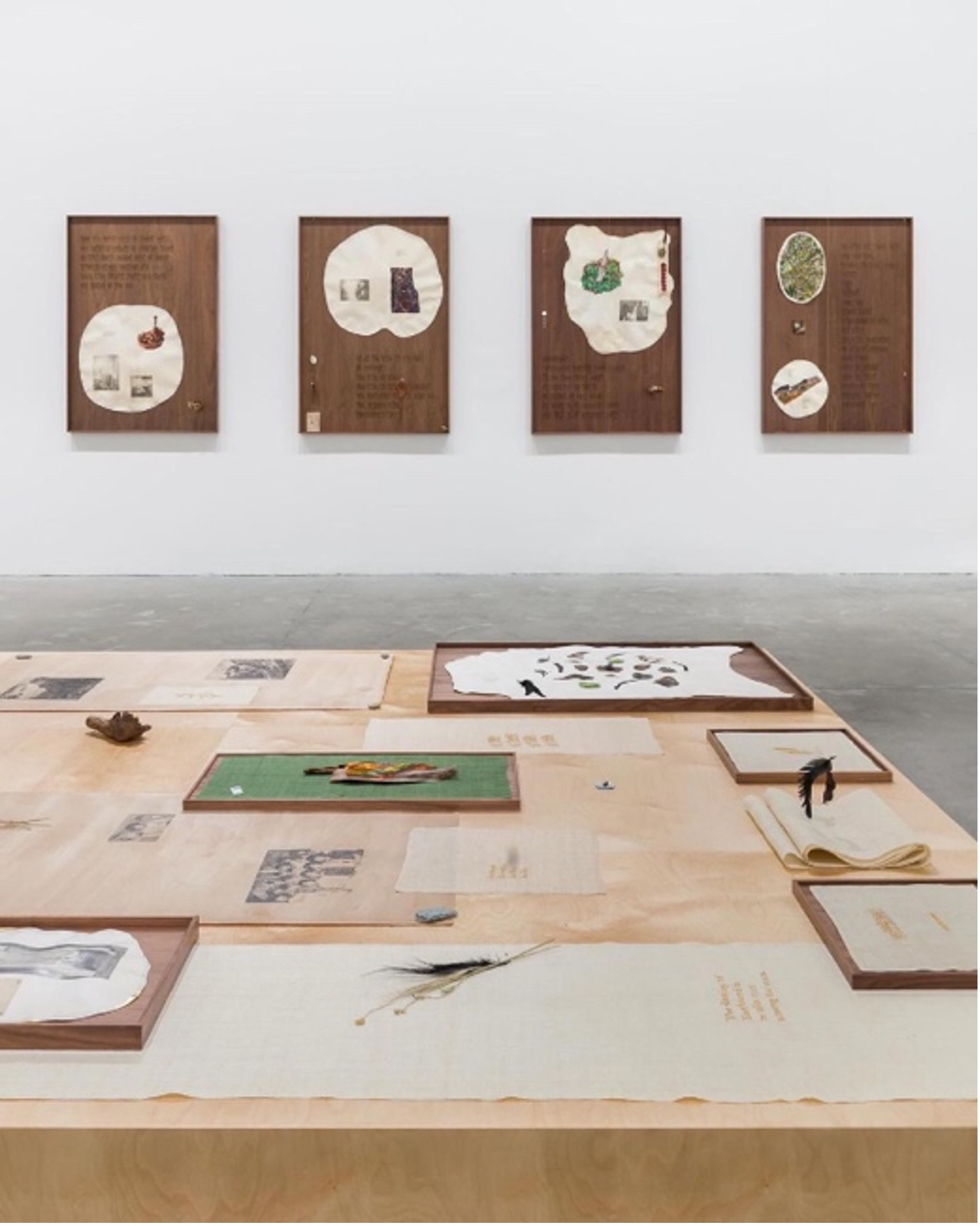
Although Lee’s Garden exhibition as a whole could be viewed through the lens of
collage, his work Untitled (Table) (2018), presented near its start, can be
seen as representative of the show’s premise and his
use of the medium. On opposite sides of a square wooden table top, we see an
array of objects, including stacked photos of Prospect Cottage and places in
Seoul tied to the history of its gay community; a stack of facsimiles of Oh’s daily memos; an issue of Buddy, one of the first gay and
lesbian magazines in South Korea, opened to a spread featuring Oh’s obituary; snapshots of Oh in daily life as well as his funeral
service; a folder of writings by Oh, opened to two pages of a letter; a copy of
Oh’s memoir (under a pen name); and a copy of Oh’s memorial booklet. Down the middle we see a table runner made of
sambe, embroidered in gold thread with the repeating motif of a leaf sprig with
a heart on top. (The motif derives from a curtain Lee saw at Prospect Cottage,
pictured in his print Untitled (Curtain at Prospect Cottage) (2018),
included elsewhere in Garden.) On top of and adjacent to the sambe runner,
we see rusted chain links from Jarman’s garden and
small stones lying in pairs or side-by-side in a group—metaphorical
images of the intimate bond between two entities, or a group of entities. An
unglazed ceramic work made from California clay mixed with soils from Dungeness
and Seoul’s Tapgol and Namsan Parks—storied gay cruising sites that Oh mentions in his writings—sits near the table’s middle, a vessel meant
to be filled with a fresh offering of plants when on view. Above the table,
suspended on a piece of gold thread is Oh’s gold rosary
ring. (Oh, like Jarman, was raised Catholic.)
The emotional gut punch of the
installation derives from Oh’s two-page
letter on display (one page of which Lee drew for his
aforementioned Untitled [Joon-soo Oh’s letter]),
in which he speaks of his aching loneliness in relation to his sadness at not
having experienced profound romantic love and his fear of not having mattered
to anyone. Lee has spoken about using Jarman’s story as
a way to introduce larger audiences to Oh’s story,15 though
his Garden works, such as Untitled (Table), also bring the two
stories together to reframe Oh’s legacy: instead of
considering Oh as someone who was largely forgotten, Untitled
(Table) shows Oh’s historical significance and how
he has continued to matter to people, as evidenced by the publications,
memorabilia, and other objects saved by members in his community that were
loaned for the show. Just as Jarman coaxed a thriving garden into existence
from a rugged landscape, so Lee’s Garden works help to
nurture Oh’s own growing legacy.16
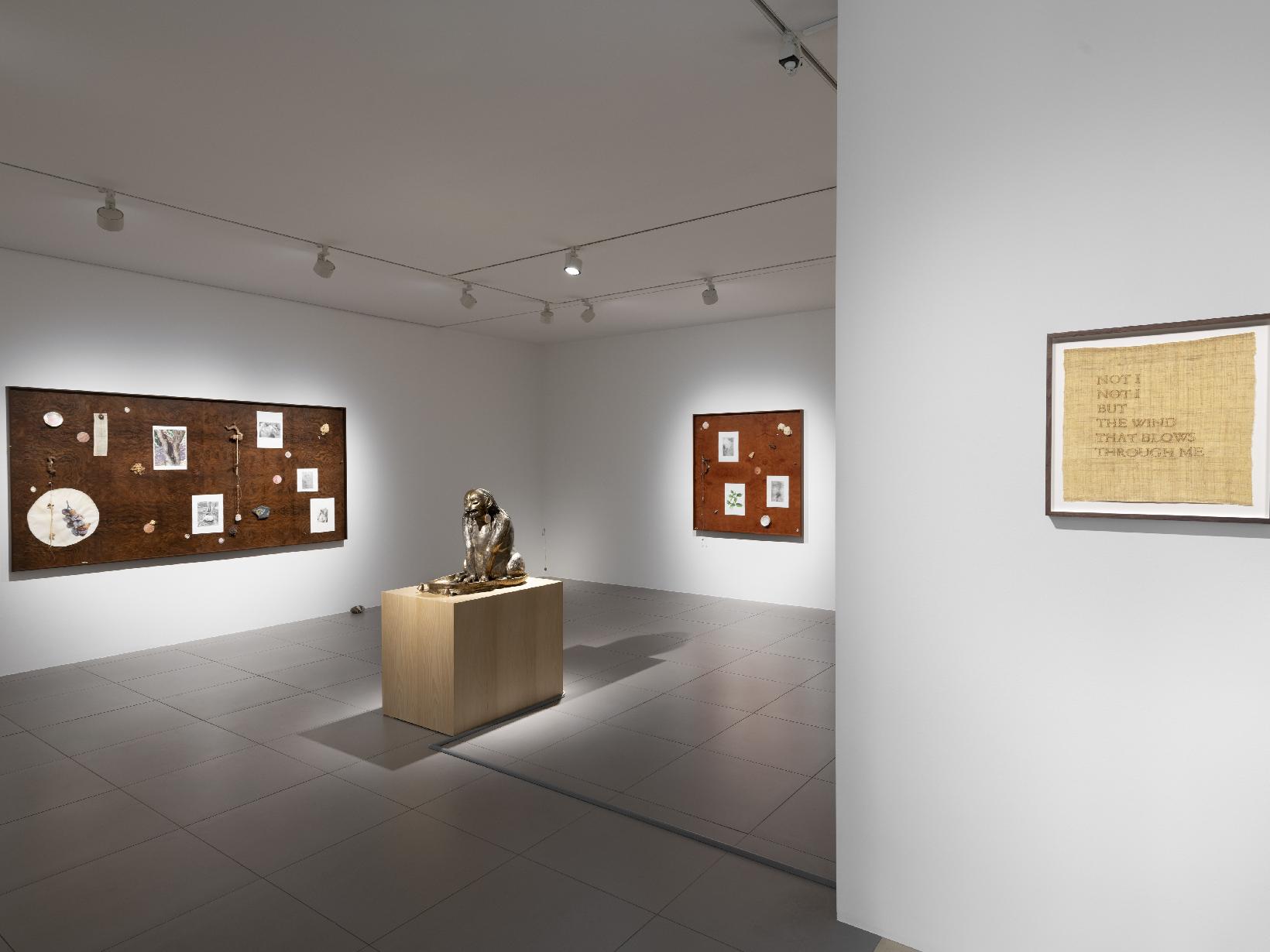
If Untitled
(Table) brings together objects to connect the legacies of two gay figures,
Lee’s Untitled 1, 2, and 3 series
(2021) from his exhibition Briefly Gorgeous (2021) at Gallery
Hyundai, in Seoul, collages together a more expansive and sprawling history of
queer desire and its manifold manifestations, one that spans the past century
to the present day. A heterogenous set of images and objects were assembled
onto the surfaces of three large wooden panels. They include a photograph of
Jarman’s Prospect Cottage; a still from Lee’s three-channel video Garden (2018); a graphite drawing of
Andy Warhol’s Hands with Flowers (1957),
tonally reversed; a photograph of the Transgender Memorial Garden in St. Louis,
Missouri; a graphite drawing of Jean Cocteau’s
illustration for Jean Genet’s Querelle de
Brest (1947); a photograph of a group of men standing in front of a large
banner that reads “WE’RE ASIANS
/ GAY & PROUD”; a graphite and watercolor drawing
of a work from the series For the Records (2013–ongoing) by the New York–based queer women
collective called fierce pussy; a graphite drawing of a photograph of James
Baldwin; feathers dating from the 1850s; pearls; stones; among many other
objects. Taken together, these elements represent the aesthetic discourse of
numerous generations of queer cultural producers, tragic consequences of trans-
and homophobic violence, as well as grassroots organizing of different groups
of queer activists. The insertion of Lee’s graphite
drawings of other artists’ works and small prints of
his own works into this series indicates the subtle integration of his own
presence within this cultural and historical microcosm. If conventionally we
are taught to separate “art history” from “world history” as represented by mainstream publications like Artspeak, Lee’s collage series Untitled 1, 2, and 3 tears down such
a construct by instantiating that art history is world history.
Video: Desire and Release
Desire, tinged with loss,
longing, and eroticism, courses throughout Lee’s most recent series The Heart of A Hand (2023), which is
based on the life and works of Singapore-born dancer and choreographer Goh Choo
San (1948–1987). Goh trained in ballet starting at
young age,17 and upon finishing university, he moved to dance
with the Dutch National Ballet. While in the Netherlands, he choreographed a
few ballets, which led to a position of resident choreographer and later
associate director of the Washington Ballet in Washington D.C. An outside
commission by Mikhail Baryshnikov for the American Ballet Theatre resulted in
the critically acclaimed ballet Configurations (1981), which led to
commissions from other renown dance companies around the world. Although Goh
was recognized for his artistic achievements during his lifetime, his sexuality
was not publicly mentioned. His longtime partner H. Robert Magee traveled
extensively with Goh and was introduced to Goh’s family
as his business manager, but their romantic partnership was never discussed. At
the height of his career, Goh died from an AIDS-related illness, as had Magee
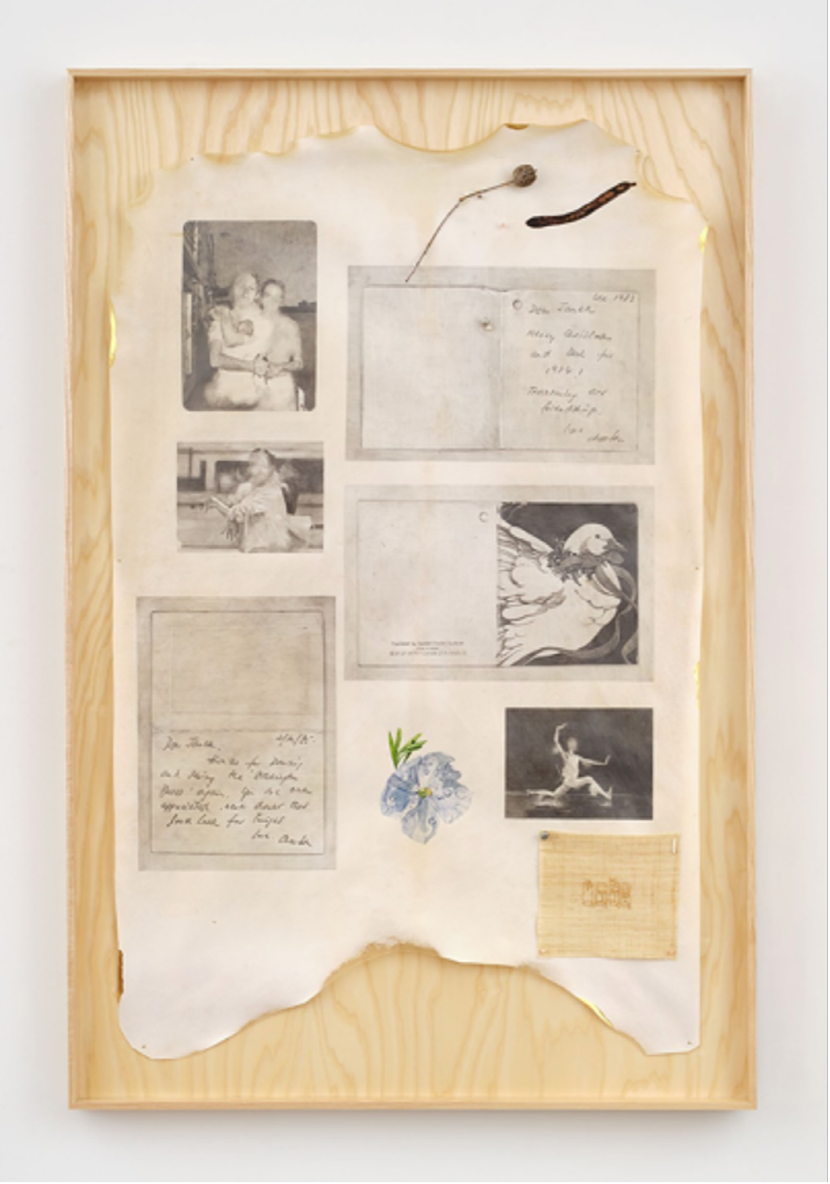
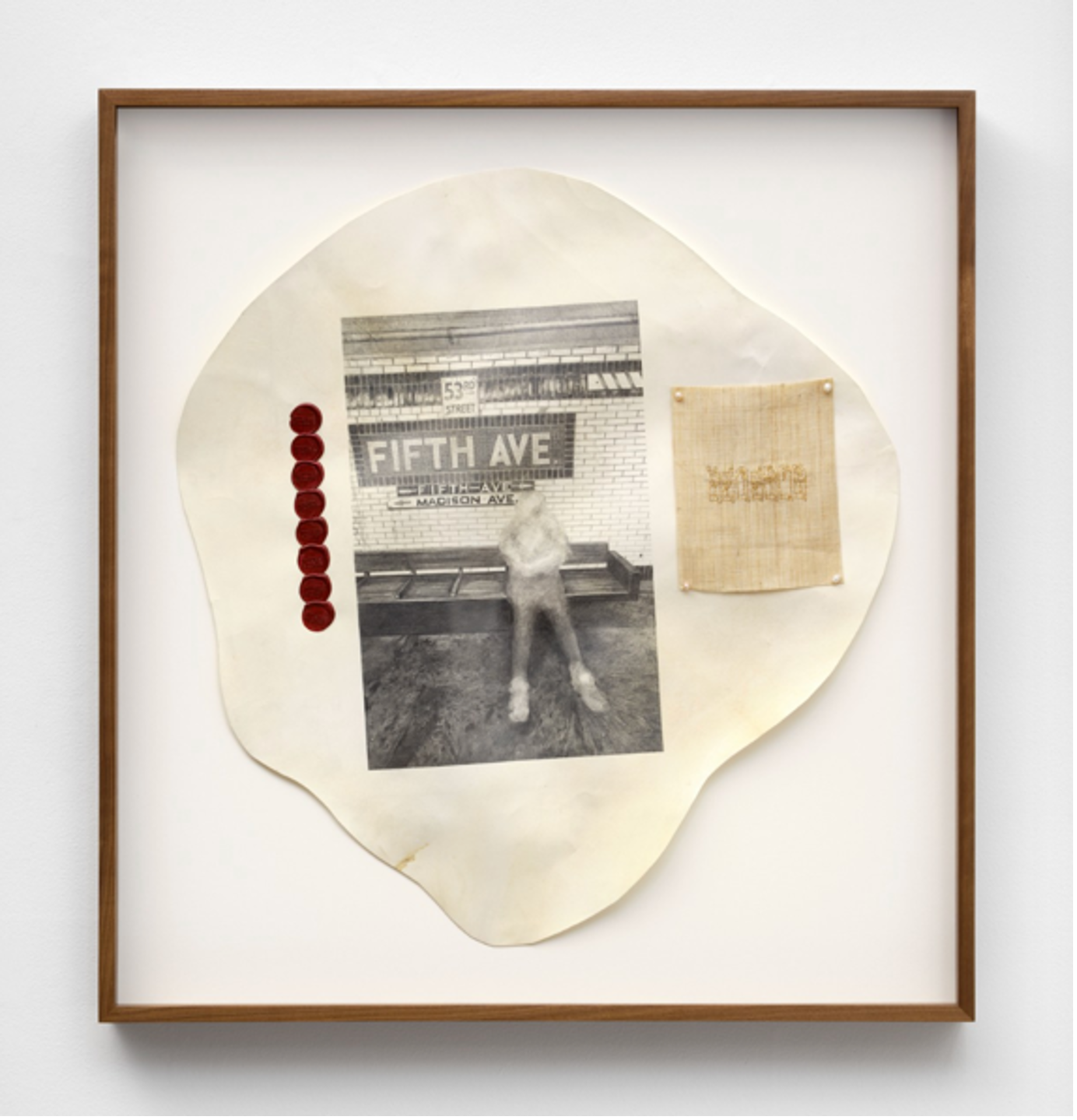
some months before. Lee’s mixed media on goatskin
parchment works for this series seem to reference the silence around this core
part of Goh’s identity through the blurring out of Goh
and other figures, including Magee, in his otherwise precise drawings of
archival photos. Coded representations of gay desire appear discreetly on the
parchment surfaces: pieces of oak gall from Elysian Park, a gay cruising site
in Los Angeles; pearls that evoke drops of semen; watercolor drawings of stones
from Prospect Cottage and gay cruising sites in Seoul and Singapore; fragments
from poems about desire by gay poets, including Xavier Villaurrutia (1903–1950), Donald Woods (1958–1992), and Samuel
Rodríguez (dates unknown),18 some translated into an American
Sign Language (ASL) font designed by the gay New York–based
artist Martin Wong (who also died of an AIDS-related illness in 1999).
If desire only subtly appears in
Lee’s collaged, mixed media works for The Heart
of A Hand, it undeniably takes center stage in his video works for the series.
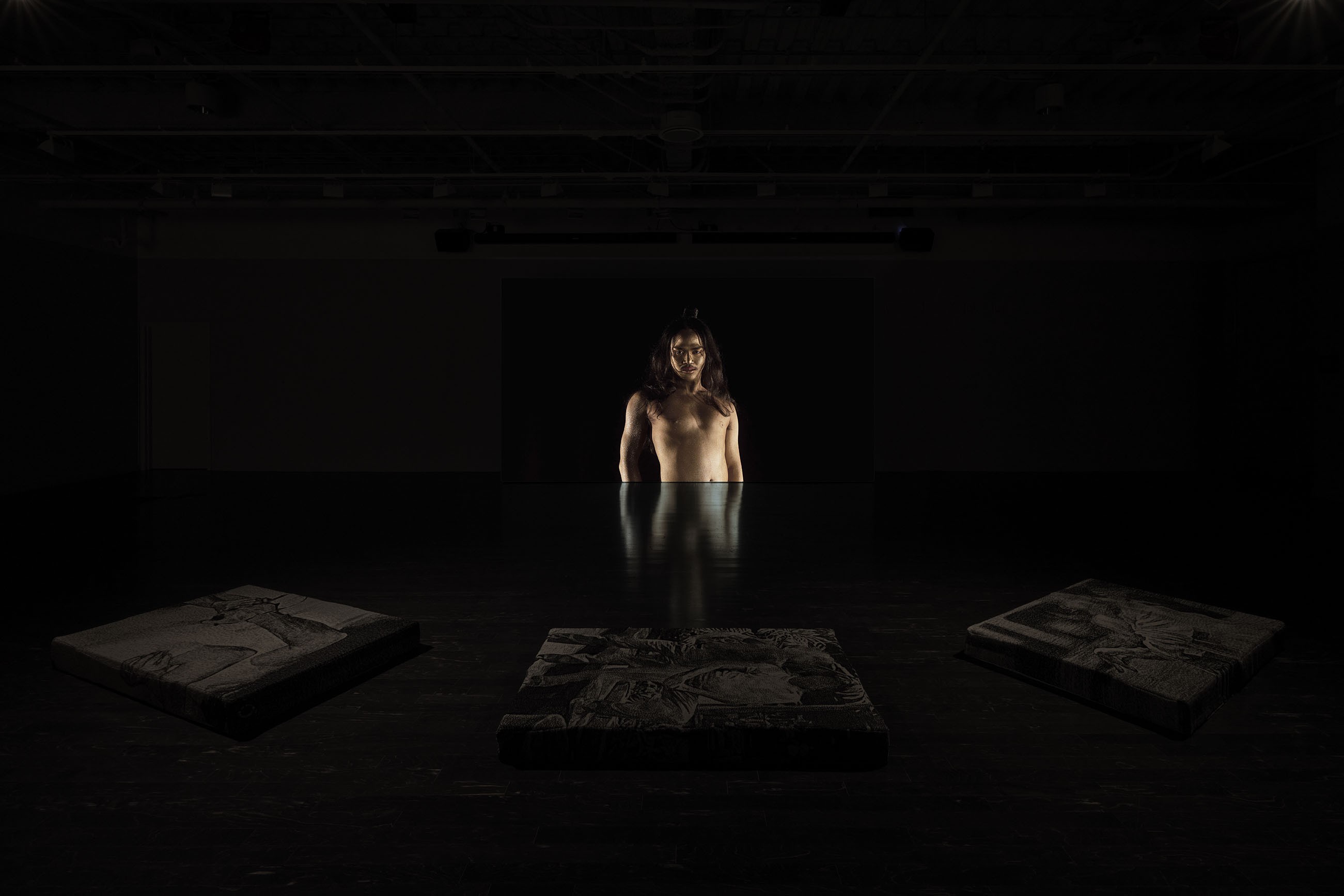
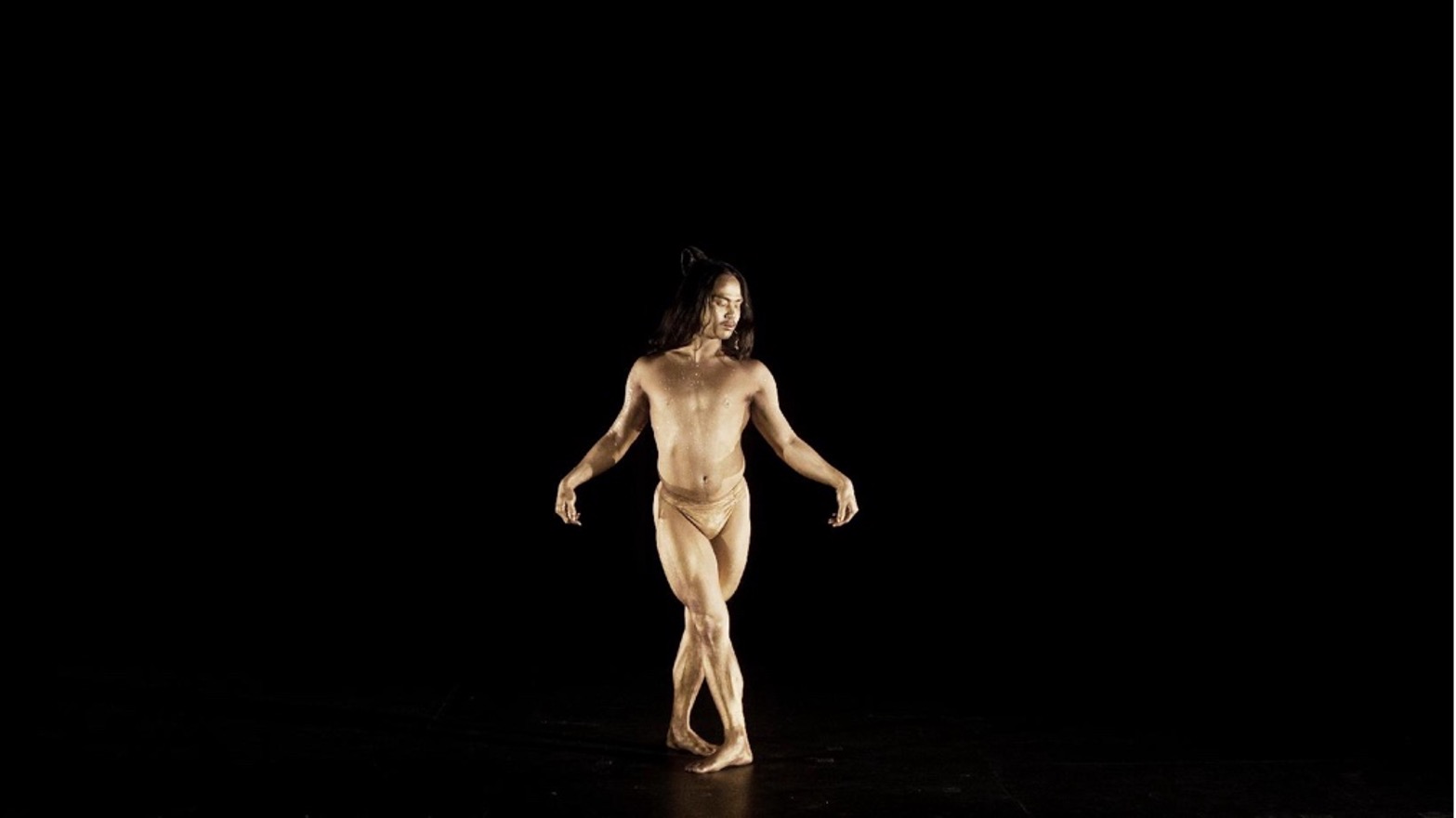
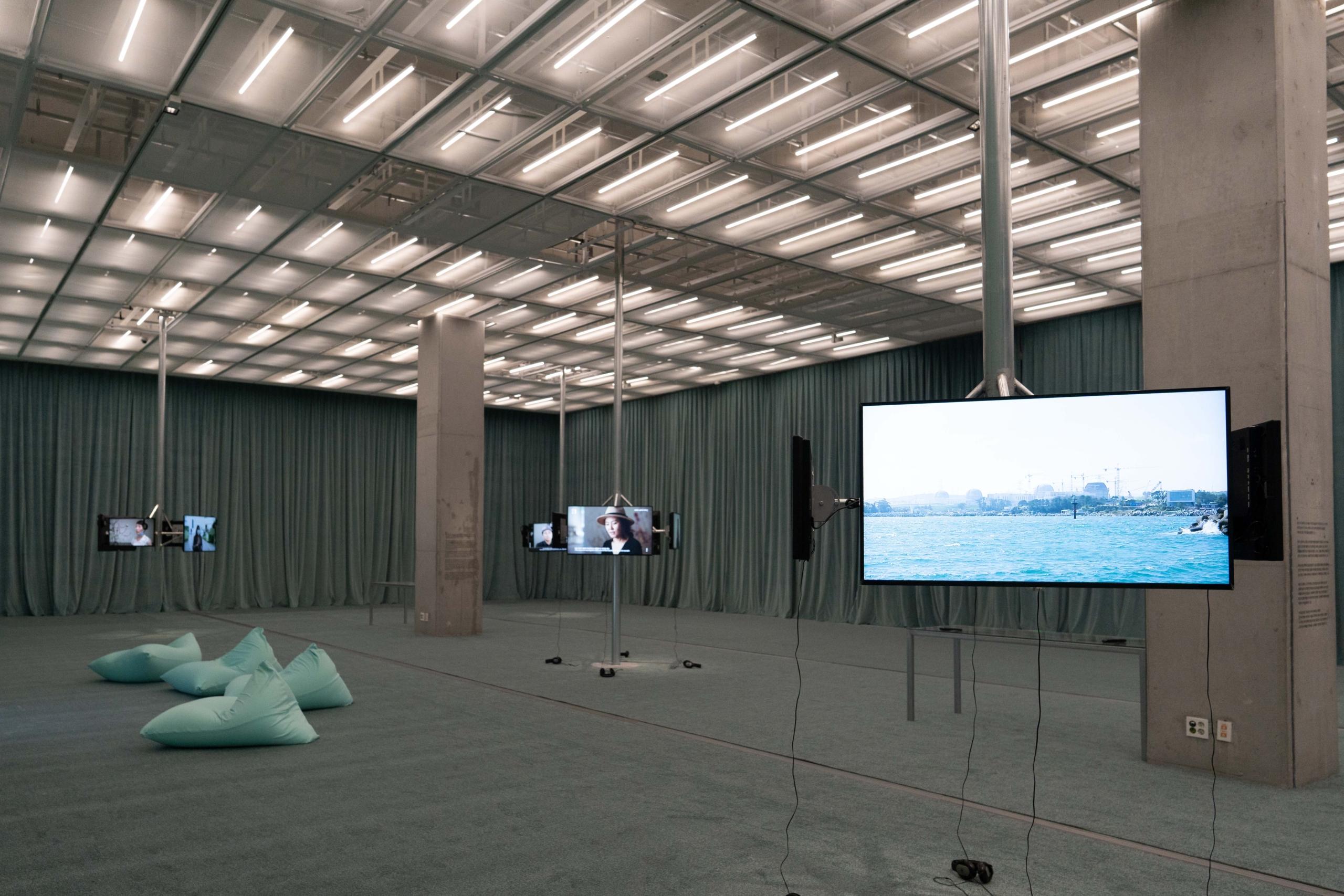
The video The Heart of A Hand was made in collaboration with members
in Lee’s queer community, including Brussels-based
non-binary dancer and choreographer Joshua Serafin, Los Angeles–based director of photography and film editor Nathan Mercury Kim,
and Seoul-based transgender composer KIRARA. The video begins with floating
hands in the Wong-designed ASL font forming lines from Villaurrutia’s poem “Nocturne”
(1938) that speak of a rush of sexual desire brought on by the darkness of
night. The rest of the video shows a masterful solo performance by Serafin, lit
in dramatic chiaroscuro. Serafin dances using an amalgamation of classical
ballet, modern dance, and dance moves that one might see at a night club. The
music pulses with the intensity of an EDM track. The source material for this
performance—Goh’s choreography
for Configurations, set to Samuel Barber’s Concerto for
Piano and Orchestra, Op. 38 (1962)—seems faraway.
Towards the middle of the performance, Serafin falls to the floor and a light
bulb drops down. The music slows down as their body twitches. Then, after a
burst of ecstatic dance, the final movement begins: Serafin’s body, now covered in gold paint and glitter, dances languidly and
sensuously. They slowly unspool a length of gold thread from their mouth. The
video ends with them looking straight into the camera with a smile, and then
laughing softly as they walk away. Through its imagery, sequence of movements,
and pulsating soundtrack, Lee’s The Heart of A Hand
video counters the prim classicism of ballet and the repression of Goh’s homosexuality with an aesthetic vision of struggle, seduction, and
release, such as the kind of liberation that one might feel while out dancing
in an underground club.
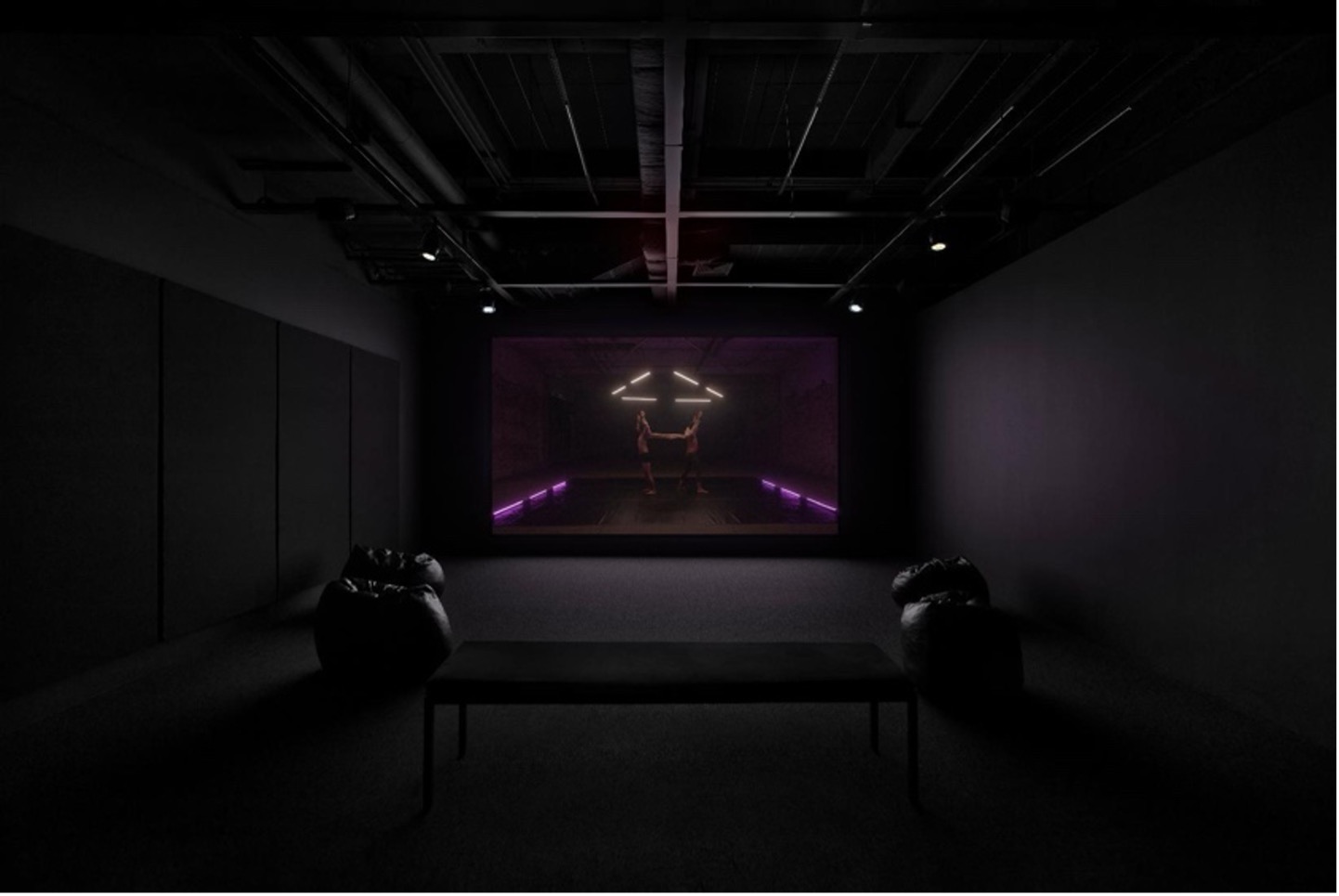
Whereas Lee’s The Heart of A Hand video centers on the narrative
journey of a single dancer, his Lazarus video (2023) focuses on the
intimacy created through interactions between two bodies. The source materials
for this work include Goh’s ballet Unknown
Territory (1986) and Brazilian artist José Leonilson (1957–1993)’s Lazaro (1993), a sculpture
consisting of two men’s dress shirts sewn together,
made shortly before the gay artist passed away from AIDS-related complications.
The video begins with floating hands in Wong’s ASL font
that spell out lines from Samuel Rodríguez’s poem “Your Denim Shirt” (1998). The poem’s narrator is speaking to a dead lover (“Mi
Amor”) who has died of a virus; he is throwing away his
lover’s belongings fearing that they might spread the
virus, but he is still in love. The music is pensive, paced at a moderate
tempo. Then we see a sequence of movements between two men, from close-up shots
of their hands touching to different configurations of their bodies rolling,
resting, and curling into each other on the floor in a large room. The room is
lit by florescent lights in a triangular shape, recalling the triangle in the
iconic “Silence=Death” poster
(1987) distributed to raise AIDS awareness. About halfway through, we see Lee’s remake of Leonilson’s Lazaro sculpture
in sambe on a hanger. The two men don the double-ended sambe shirt and the
lighting changes from cool to warm. The music turns more dramatic as the two
dance, moving away and towards each other repeatedly, in various configurations,
within the physical constraints set up by their shared shirt. At the end, the
two take off the shirt and set it respectfully on the ground as the lighting
turns cool again. One man places his arm around the shoulders of the other man
and together they walk away as the camera fades. The tone of Lazarus is
multivalent: while the work mourns loss, especially in connection to AIDS, it
also explores the emotional complexity and ambivalence of moving on from such
loss. Notably, Lazarus’s narrative is left
open-ended, with the suggestion that the Lazaro shirt can be
reactivated and thus re-signified, perhaps indefinitely.
Coda
Lee’s artistic practice illuminates networks of care, nurturing them in
the production of his series of works. His artworks help to raise the visibility
of queer figures and histories that have been overlooked or under-explored. He
operates from a place of abundance.19 Images, texts, and
objects collected from archives, libraries, collections, historically specific
locations, and more, are reproduced and reconfigured into new constellations.
Forms regenerate, taking on new lives in new contexts and assemblages. Communities
lead to new collaborations, as collaborations lead to new communities. His
works set things in motion.
Notes
The author would like to give
warm thanks to Kang Seung Lee, Sooyon Lee, Young Chung, and Uday Ram for their
generosity in exchanging thoughts about Lee’s works and related matters. She is also grateful to her mother Eun
Hee Moon for her translation help and insights into Lee’s works and their Korean cultural context.
1 Two books document this
project: the first edition of Lee’s Untitled (Artspeak?) was published for an exhibition at
the California Institute of the Arts; the second edition of Untitled
(Artspeak?) was published for an exhibition at Pitzer College Art
Galleries, Pitzer College, CA.
2 Lee used the 1997 version of
Artspeak. The latest version of Artspeak (2013) attempts to be more
international and inclusive, though its timeline still separates events into “world history” and “art
history.”
3 Tolentino’s Archive in Dirt was produced for the
exhibition Altered After (2019), curated by Conrad Ventur for Visual
AIDS, to which Lee also contributed an artwork. For more on this work, see
Tolentino’s catalog text in Altered
After (New York: Visual AIDS, 2019).
4 Lee writes about his reaction
to seeing Tolentino’s Archive
in Dirt (2019) in his and Jin Kwon’s essay “QueerArch” for Apexart. Kang Seung Lee and
Jin Kwon, “QueerArch,” Apexart,
https://apexart.org/QueerArch_E.php#secondPage.
5 Lee mentions the term “appropriation” in “Behind
the Beauty – An Interview with Kang Seung Lee.” The Artro, “Behind the Beauty – An Interview with Kang Seung Lee,” The
Artro, January 20, 2023,
https://www.theartro.kr/eng/features/features_view.asp?idx=5530&b_code=10&page=1&searchColumn=&searchKeyword=&b_ex2=.
6 Other drawings in Lee’s Absence without Leave series reference gay communities
in cities such as Seoul and Sydney, though the majority of the works relate to
New York.
7 Jung Joon Lee, “Drawing on repair: Kang Seung Lee and Ibanjiha’s transpacific queer of color critique,” Burlington
Contemporary, June 2023,
https://contemporary.burlington.org.uk/journal/journal/drawing-on-repair-kang-seung-lee-and-ibanjihas-transpacific-queer-of-colour-critique#fnref:6.
8 Kang Seung Lee, “Kang Seung Lee on Tseng Kwong Chi,” in
Denise Tsui, ed., Collected Writings by Artists on Artists, vol. 2 (Hong
Kong: CoBo Social, 2021), 96–103.
9 Even the Winter Scarecrow
Needs to Practice How to Live (Sungrim Publisher, 1993).
10 For an overview on the history
of sambe and how it has been made in South Korea, see Bu-ja Koh, “Sambe: Korean Hemp Fabrics,”
in Material Choices: Refashioning Bast and Leaf Fibers in Asia and the
Pacific, ed. Roy Hamilton and B. Lynne Milgram (Los Angeles: Fowler Museum
at UCLA, 2007), 79–91.
11 See Lee’s analysis of gold in relation to the theme “Madonna and Child” in his
exhibition and Child (2016) at Commonwealth and Council in Los
Angeles: https://kanglee.net/section/431813-and%20Child%20%282016%29.html.
12 For more on this exhibition,
see Jin Kwon’s essay in Garden:
Kang Seung Lee (Seoul: One and J. Gallery, 2018) and Doris Chon’s article “Generative Absence: Kang Seung
Lee’s Practice of Archival Resuscitation” in Kang Seung Lee (Seoul: Gallery Hyundai, 2023).
13 Lee’s Untitled (Joon-soo Oh’s letter) and
Untitled (Cover), which I discuss earlier in this essay, were originally
created for Garden.
14 On Jarman’s idea of how Prospect Cottage should be inherited through a lineage
of queer relations, see Leslie Dick, “Porous Bodies,” X-TRA, Summer 2020,
https://www.x-traonline.org/article/porous-bodies.
15 Park Han-sol, “Artist Lee Kang-seung’s mission to unearth
forgotten queer narratives,” The Korea Times,
November 9, 2023, https://www.koreatimes.co.kr/www/art/2023/11/398_362871.html.
16 To get a sense of how rugged
Dungeness is, see Howard Sooley, “Derek Jarman’s Hideaway,” The Guardian, February 17, 2008,
https://www.theguardian.com/lifeandstyle/2008/feb/17/gardens.
17 The youngest of nine children,
Goh had three siblings—Goh Soo Nee,
Goh Choo Chiat, and Goh Soo Khim—who also trained in
ballet and became prominent figures in the field.
18 Samuel Rodríguez’s poem “Your Denim Shirt” appears in the introduction of Robb Hernández’s book Archiving an Epidemic: Art, AIDS, and the Queer Chicanx
Avant-Garde (New York: New York University Press, 2019). This is where Lee
found the poem but no other information about the poem or the poet seems to be
publicly available.
19 Joan Kee made this perceptive
comment in her Zoom conversation with Lee on the occasion of his
exhibition Permanent Visitor (2021) at Commonwealth and Council:
https://commonwealthandcouncil.com/together. This also resonates with the
principles of “The Revolution” as conceptualized by artist Jennifer Moon, a friend of Lee who has
collaborated with him on multiple projects. The first principle of “The Revolution” is “1)
Always operate from a place of abundance.” More on “The Revolution” can be found here: .
Jennifer Moon, “About the Revolution,” The Revolution, http://www.therevolution.jmoon.net/About/