Watching the act of turning dried flowers into pieces on the table, I thought of a novel by Annie Ernaux. I picked up one of Ernaux’s books from my bookshelf and opened the first page. As I recall, she talked about the event in the beginning part of the book without any explanation.
“Once an hour I do exercises, pedaling, scissors, sit-ups with my feet against the wall. To hurry things up. Suddenly, a strange hot sensation opens out like a flower in the lower part of my stomach. Purple-tinged, rotten. Not a pain, but heralding the pain to come, a wave that comes from all sides to crash against your hips and die down at the top of the thighs. Almost pleasurable.”
- Annie Ernaux, Les Armoires Vides, 1974 (1984BOOKS, 2020)
What reminded me of the complicated scenes created by the words in the novel when seeing the video with a cynical title, A way to deal with the dried flowers (2021)? The words “violet and rotten”? The phrases as vivid as a diary of Denise Lesur, who entrusted herself to the hands of an “old woman,” lying on the operating table.
❉
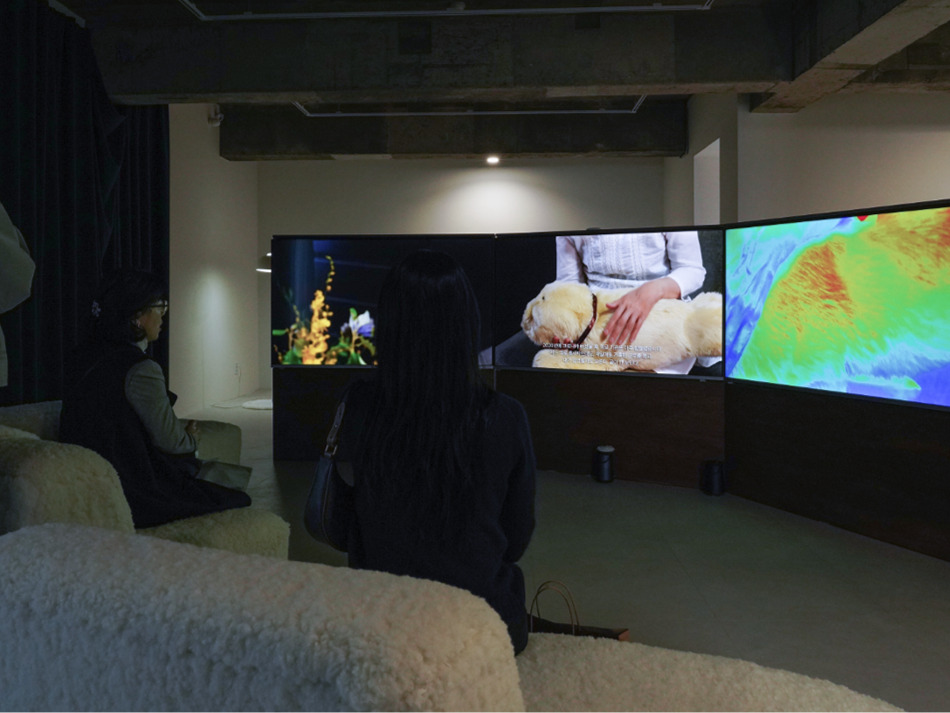
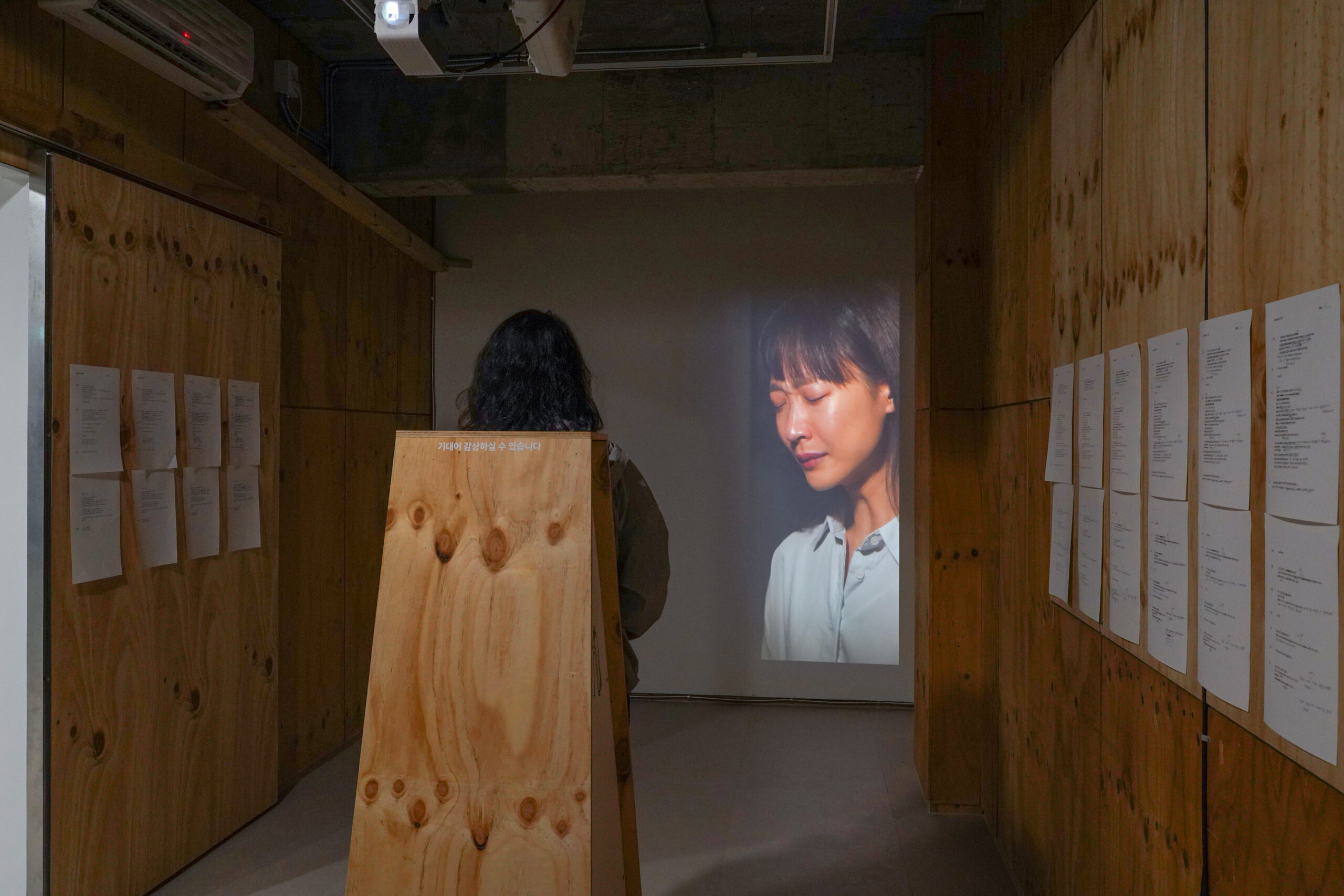
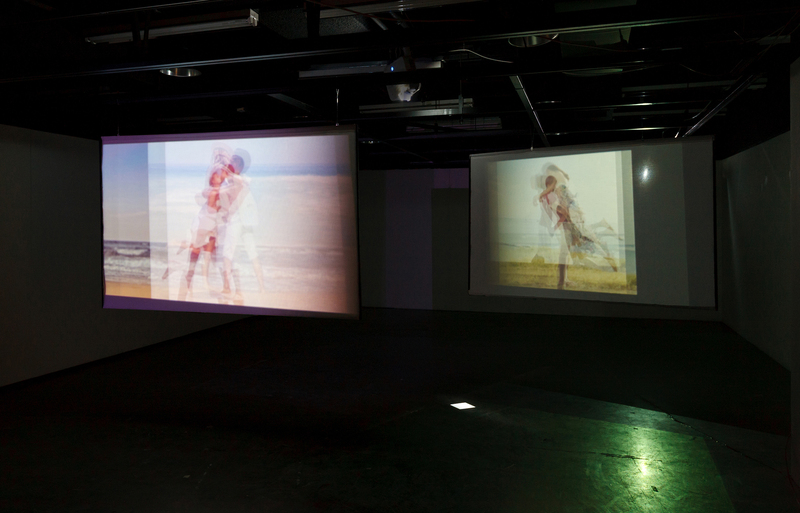
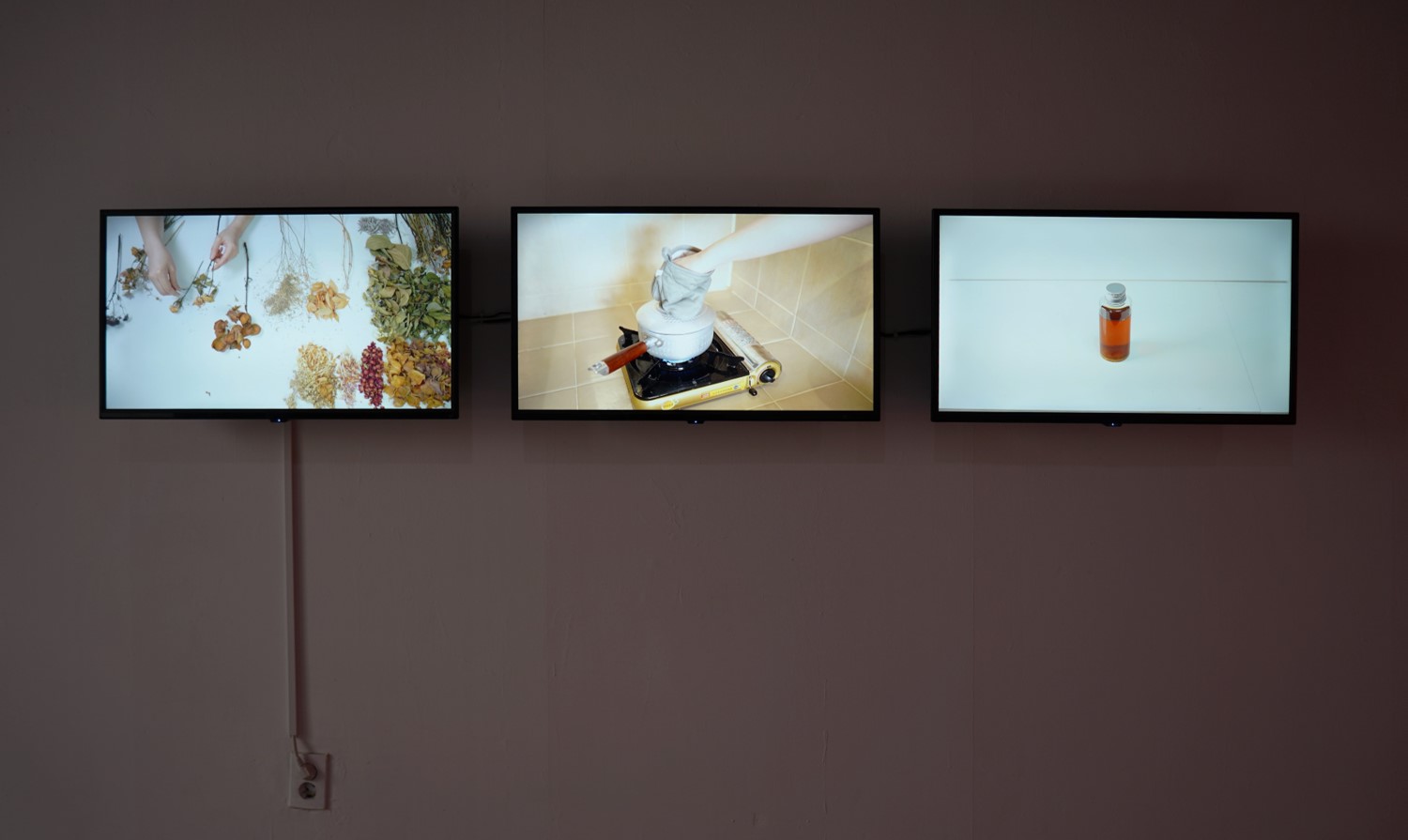
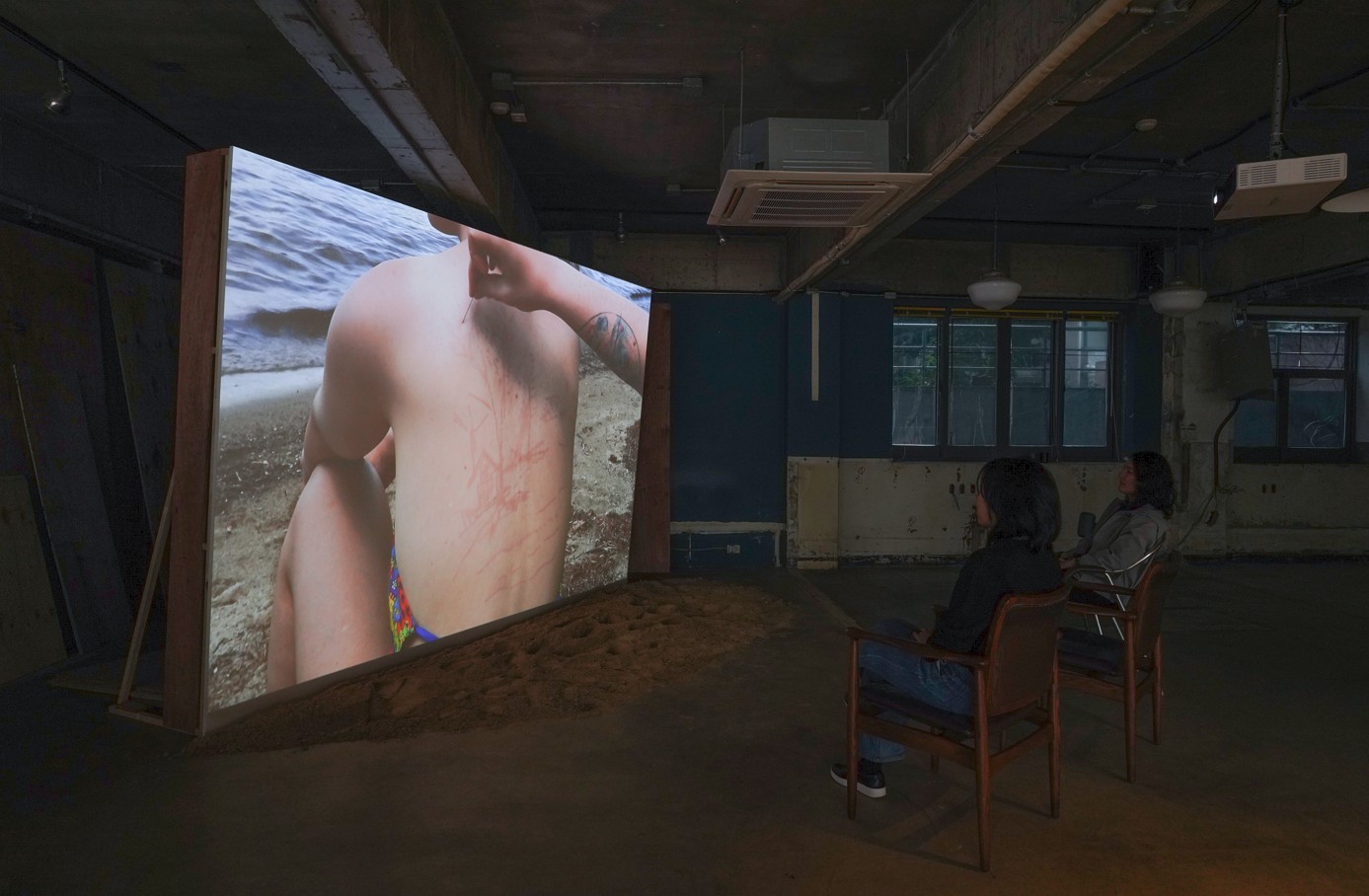
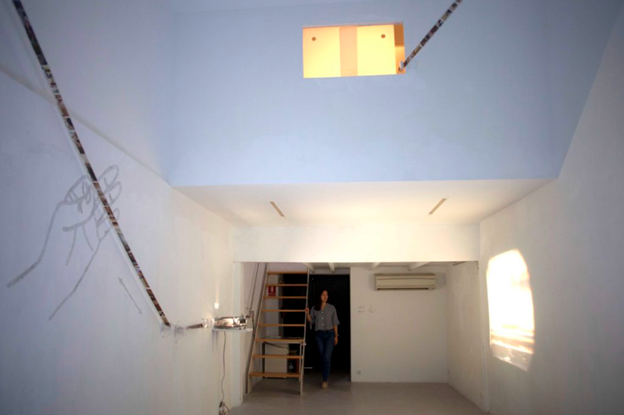
A way to deal with the dried flowers (2021) is a 3-channel video. One screen shows somebody working with a bunch of flowers, first separating them into individual flowers, then breaking each piece down further into petals and stems, classifying them one by one. On the other two screens, a series of processes and changes in which the flower pieces are soaked in water and heated to extract ink.
And there is a 4th untitled screen slightly above the three screens placed alongside each other revealing a performance that mediates a radical transformation between A way to deal with the dried flowers and Redefining (2021). According to the artist, A way to deal with the dried flowers is “an attempt to explore what a better romance is,” and instantly leads to Redefining as if set on fire, resonating with the phrase, “Romantic love was invented to manipulate women.” And a video with no title stands in between the two.
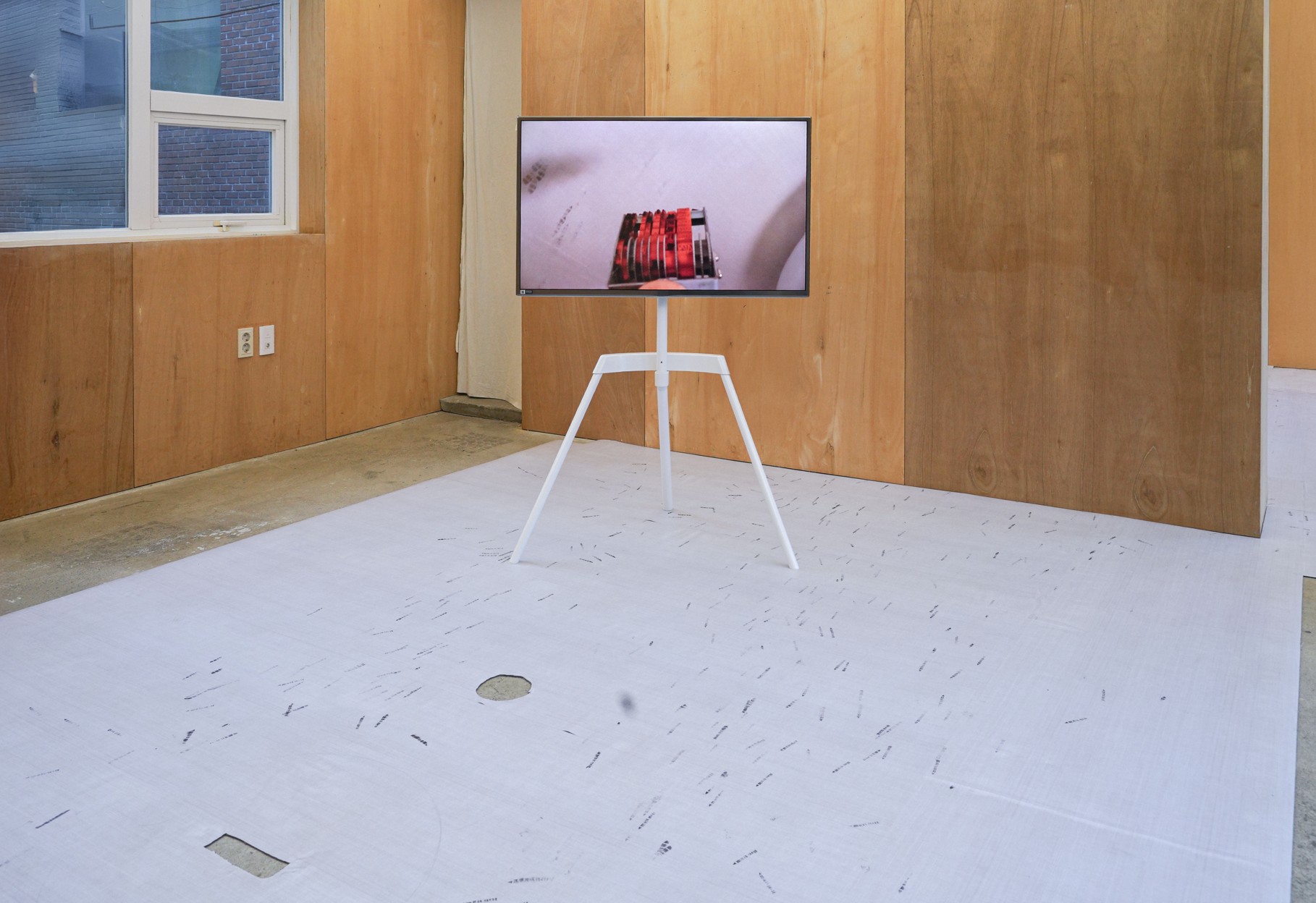
Solin Yoon presents a chain of autobiographical experiences, physical performances and linguistic utterances (speaking/writing), weaving a relationship between these three elements. In the untitled video, a person skilled in silk-screening uses the ink extracted from the dried flowers, which was an act of mediating between experience and utterance. The process of lining the exhibition space with slogans triggers a “transformation,” which finally makes an event happen following the resolute act in A way to deal with the dried flowers.
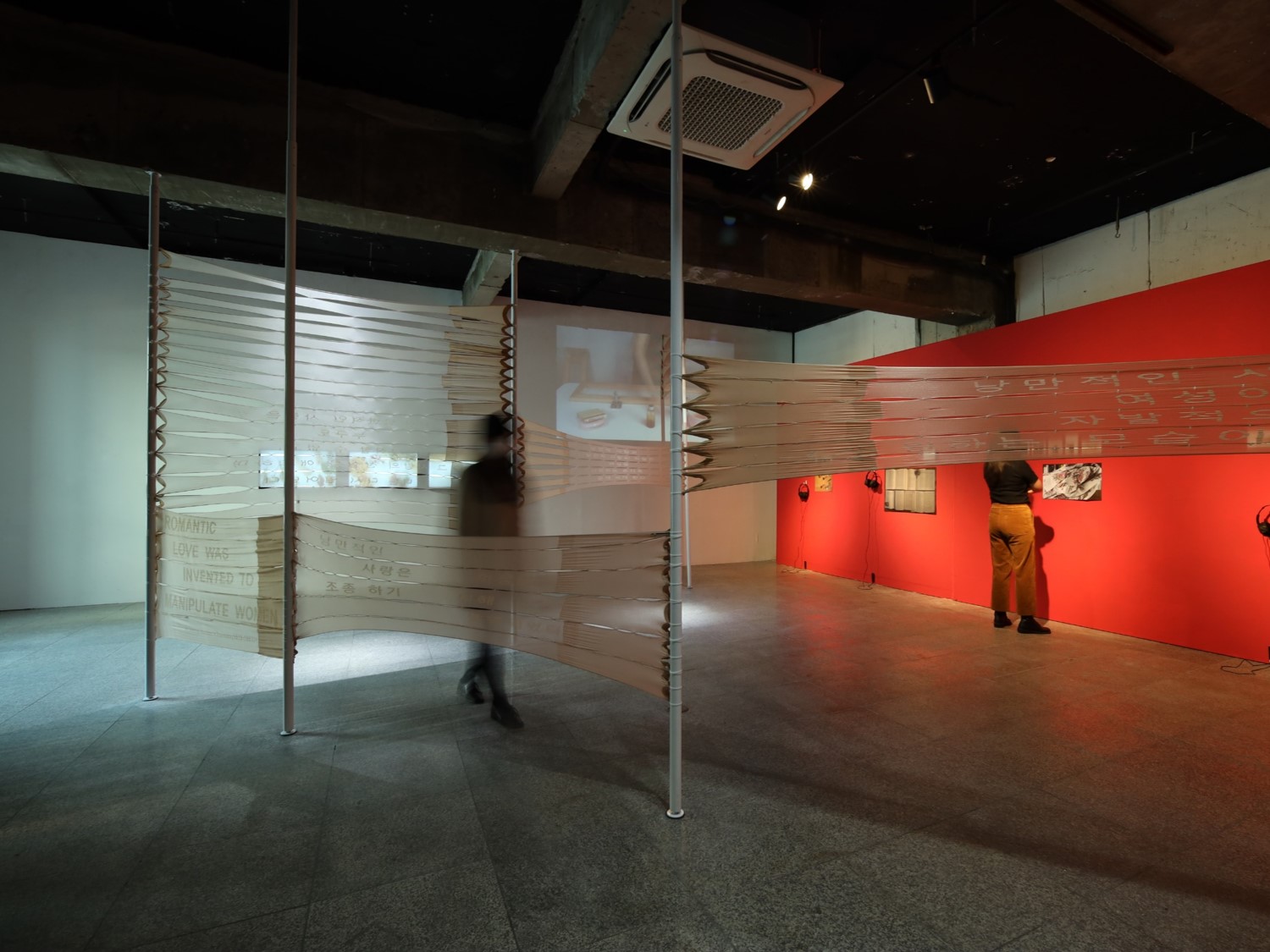
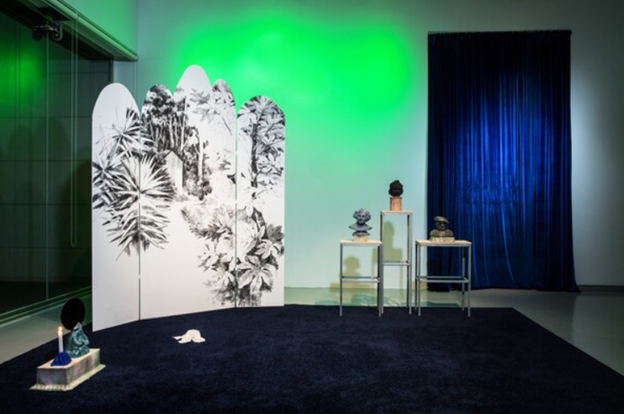
In other words, the artist invites viewers to reflect on romantic love by setting a stage for the “here and now” of utterance and solidarity through a random creative act as “a way to deal with the dried flowers.” In Redefining, which includes slogans printed in silkscreen using stockings and the ink extracted from the dried flowers, Yoon translates them into a spatial installation where visual and physical flows are closely woven. When you realize you are standing in this place, you may think a(n) (incomplete) reflection on “romantic love” may be continued or delayed as the relationship between the three keeps going back to the beginning.
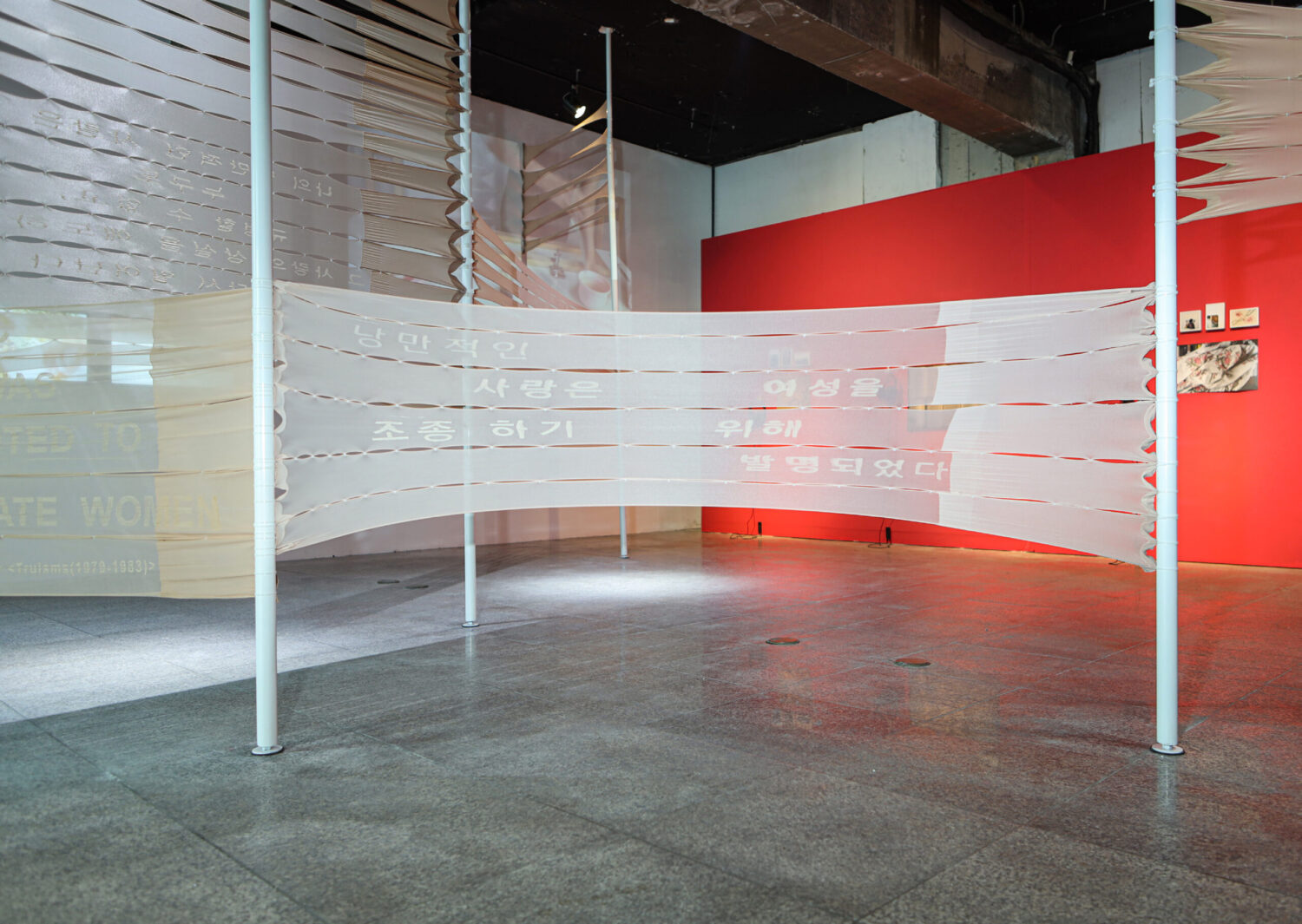
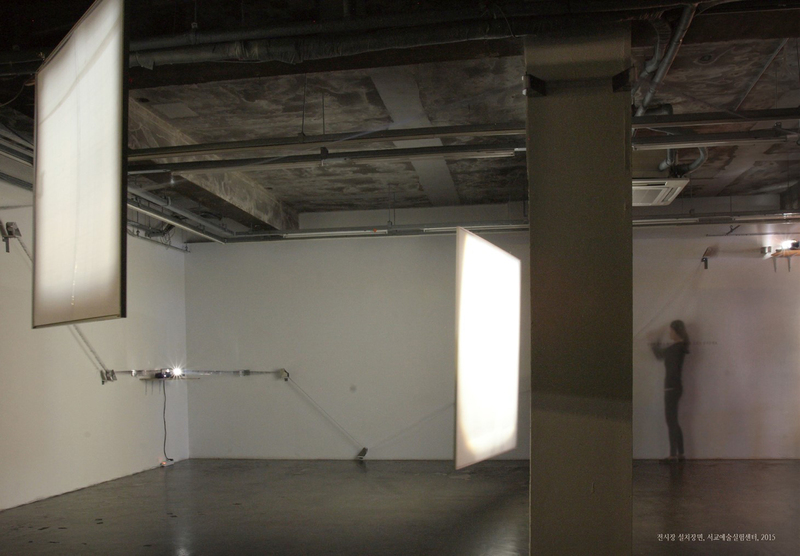
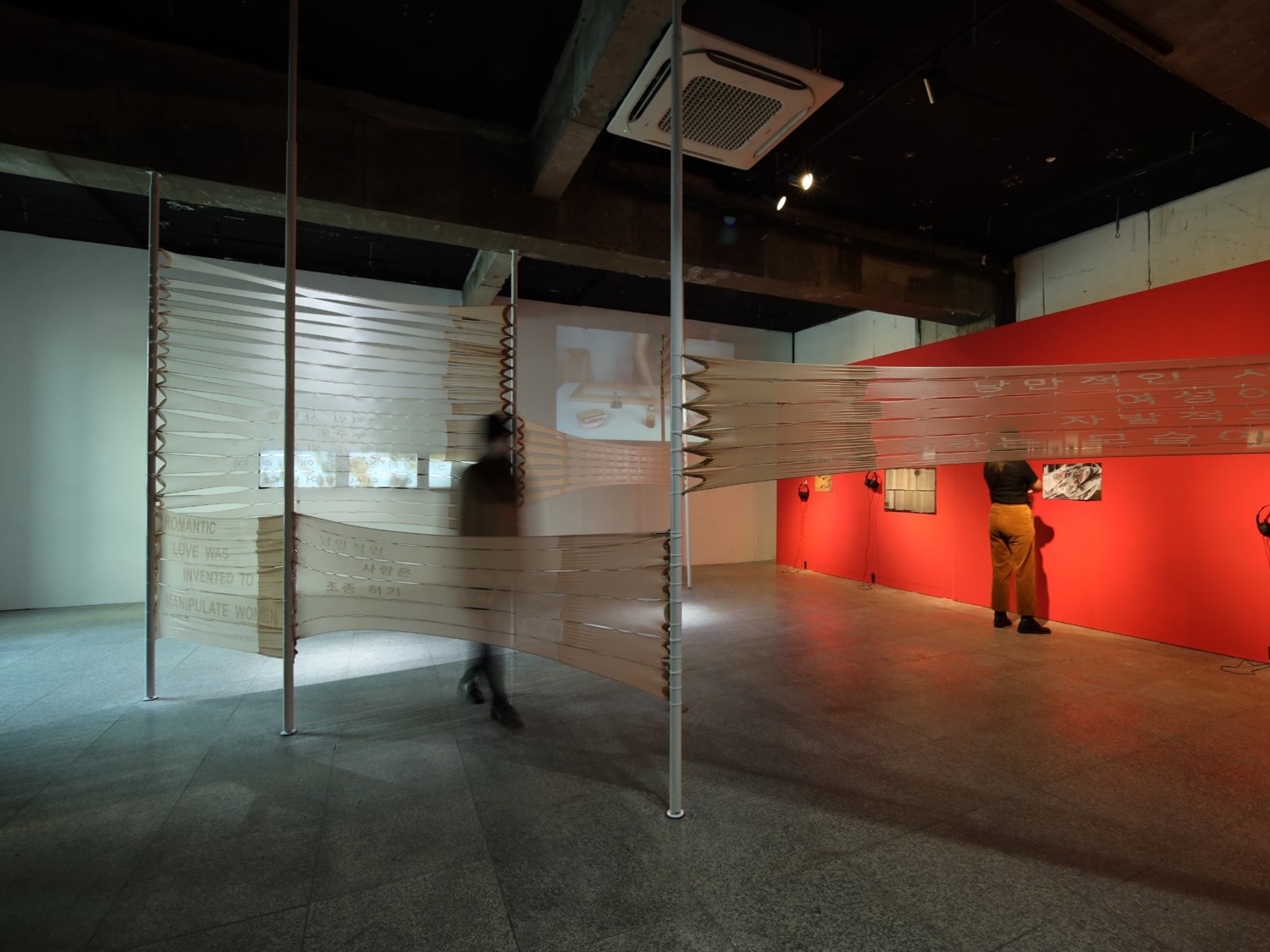
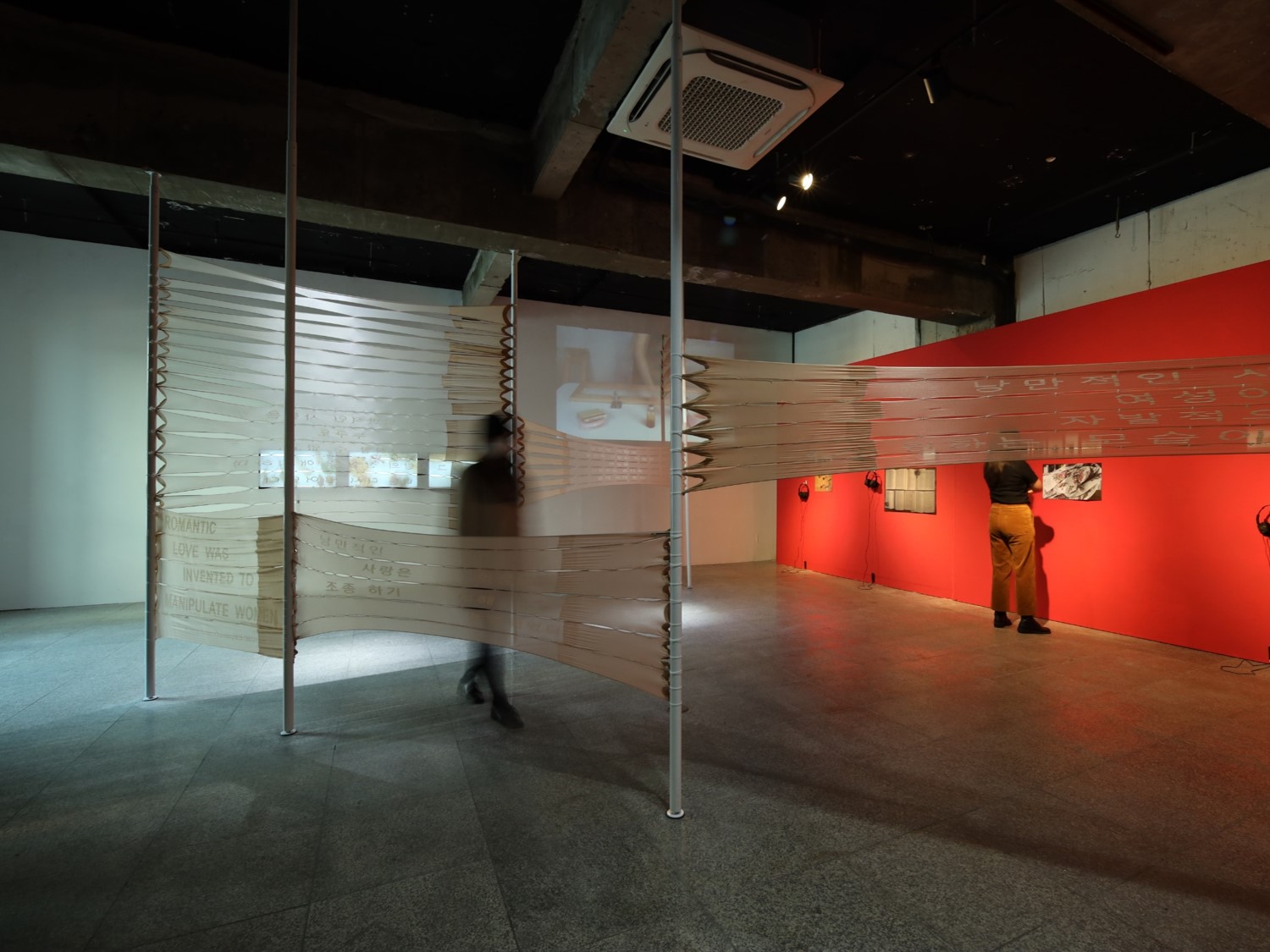
Quoting Jenny Holzer’s phrase, “Romantic love was invented to manipulate women,” Yoon intended to “redefine” it by putting it down on stocking and linking it with her(their) own radical slogans. The stockings, hung from white poles standing perpendicular to the ceiling and the floor and engraved with a few sentences printed in silkscreen technique, show a maximization of surface area, almost forgetting their original form. “My romantic love cannot be defined by anyone.
I get back up again, mourning the loss of the love.” “Romantic love and the frustration that it brings makes women stand firm as beings who love.” These slogans redefine the radicality of love accompanied by “loss” and “frustration,” moving away from skepticism and the negation of romantic love.
❉
Yoon sought a kind of revival after the deconstruction so that the act of tearing dried flowers into pieces does not end in itself. Taking the motif from flowers whose beauty attracts our gaze, the artist came up with a new performativity with the medium of flowers through a radical gaze. She extracted abstract “colors” from the remains of completely dried petals and used the ink to write phrases of declaration.
It is as if after a random material goes through an exceptional transformation, a performative power in this event leaves a strong stain in the void of reality, rather than pursuing the romantic authority of language created by letters and paper. The phrases are associated with uncertain images and scenes like crushed language, broken down by temperature and humidity. But the afterimage of this experience is as impressive as the memories of the body of an unfamiliar stimulus, like a cold object touching the body.
- Romantic love was invented to disguise the real attraction.
- Romantic love makes women voluntarily want to become the person they want to be.
- My romantic love cannot be defined by anyone. I get back up again, mourning the loss of the love.
- Love affairs are not devised from the perspective of men, but are newly invented within a personal relationship only between “you” and “I.”
Being tied up to the wooden frames and stretched tightly, the stockings looking more transparent become the supporting material of language, like paper. Phrases are engraved by applying ink with a knife and rolling it forcefully onto the stockings. The slogans appearing on the stockings, which are irreversibly stretched out, transparently divide the space that anonymous bodies move around while fixing their gazes on the slogans, reading between the lines.
It seemed that the hands of the young woman destroying the forms of the dried, hard flowers in A way to deal with the dried flowers and those of an “old woman” described in the novel of Ernaux share a subjective communion that stands on the border between the pain and achievement of dealing with the remains of romantic love.
In Redefining, walking by the slogans standing high as an entity that cannot be explained in any words, I could see a desire for authentic writing to describe the event of romantic love. Writing is a metaphor for reflection. Therefore, authentic writing refers to a new narrative about a suspended event, like a radical change of dried flowers, and testifies the traces of senses of authentic experiences hidden behind rhetorical language.
Based on Jenny Holzer’s phrase that Yoon adopted for her work, she had talks with a few women about their experiences of love. Some of the lines from their conversation became the slogans included in the work Redefining. The sentences were engraved on the material stretched out like skin using ink obtained from dried flowers. Welcoming many anonymous bodies into the gallery, the phrases reveal testimonies to an event that they will come to know, stopping at certain moments to look at beauty, and walking again while making a detour through the overlapping passage.
❉
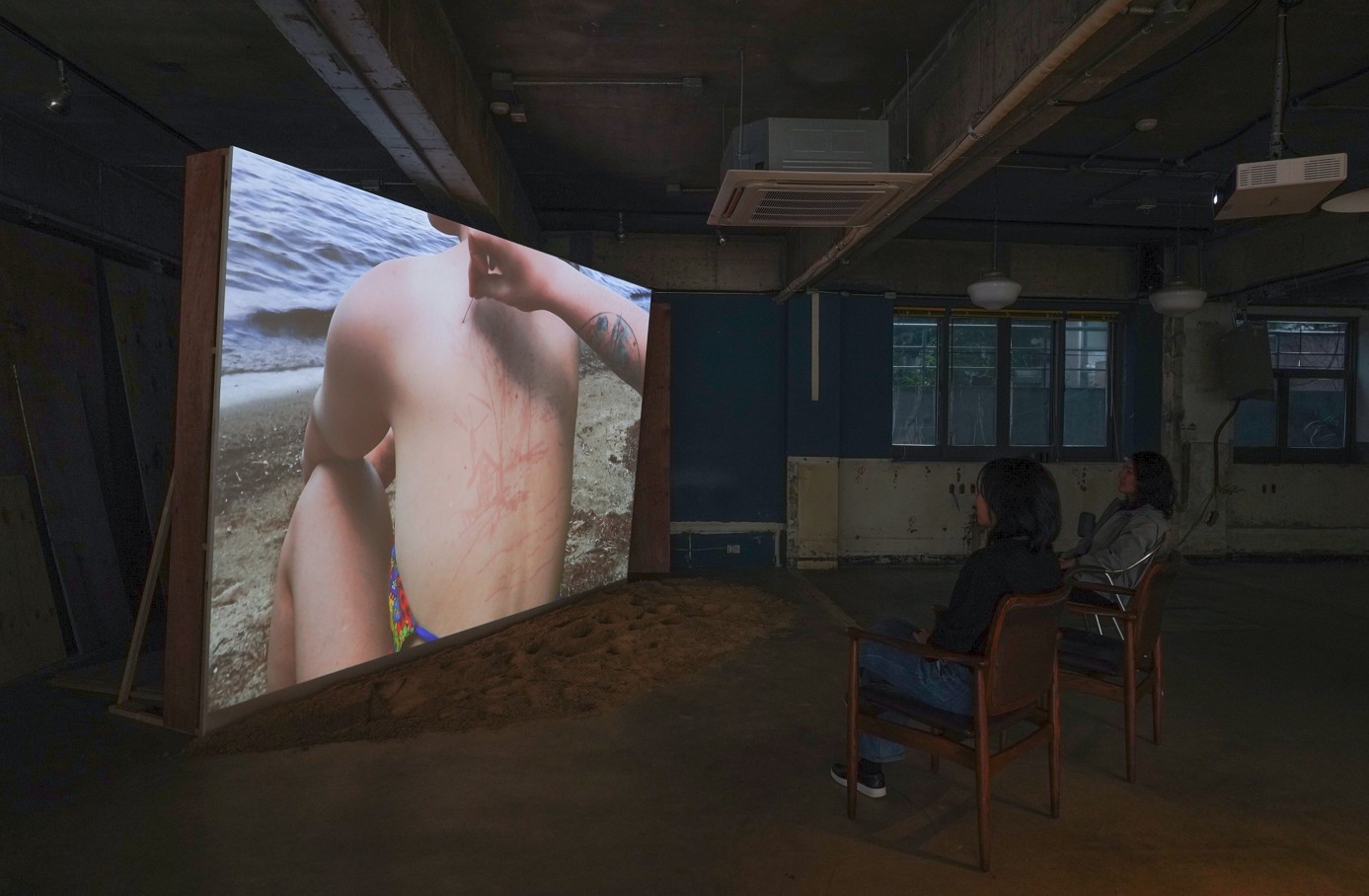
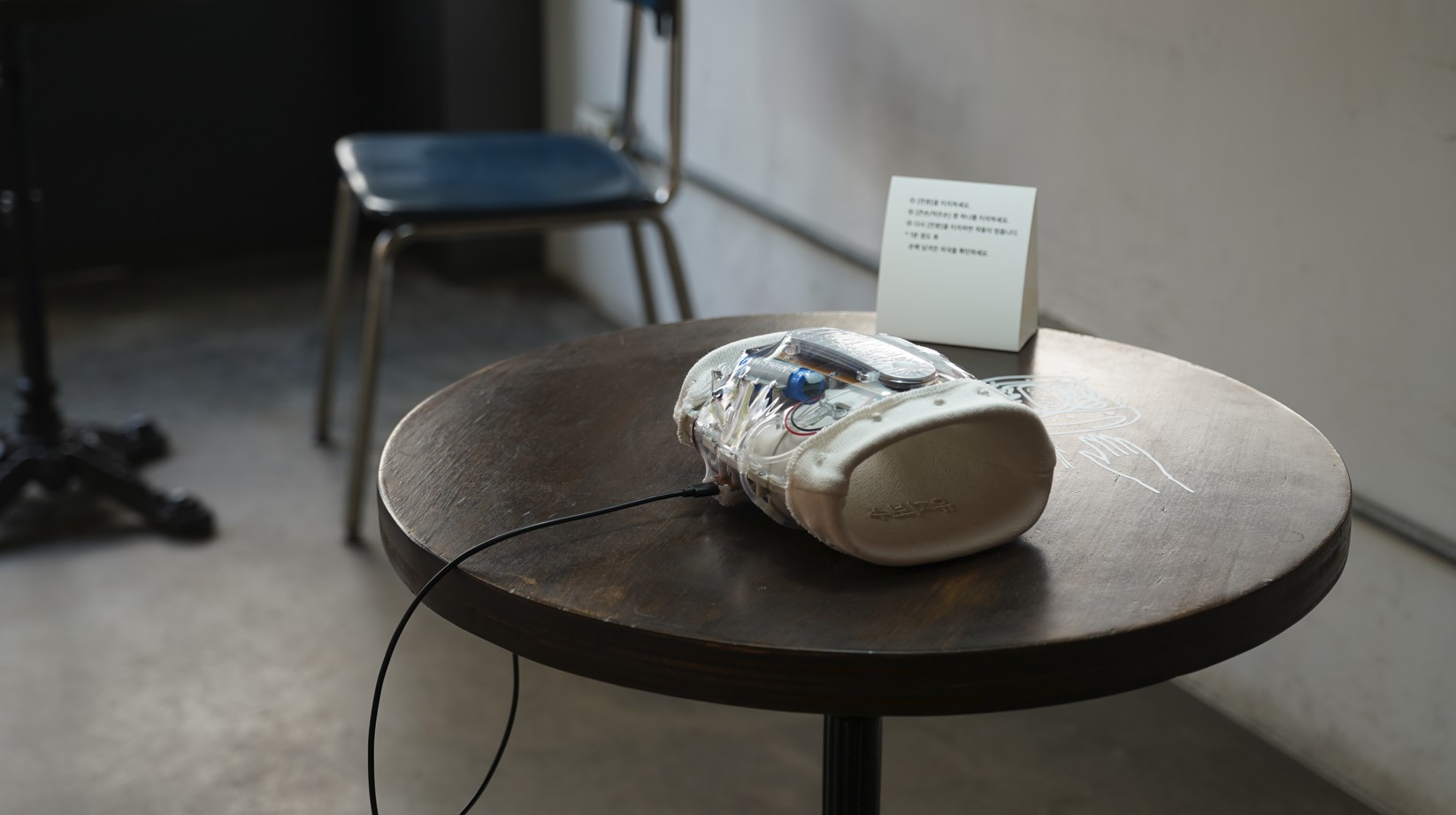
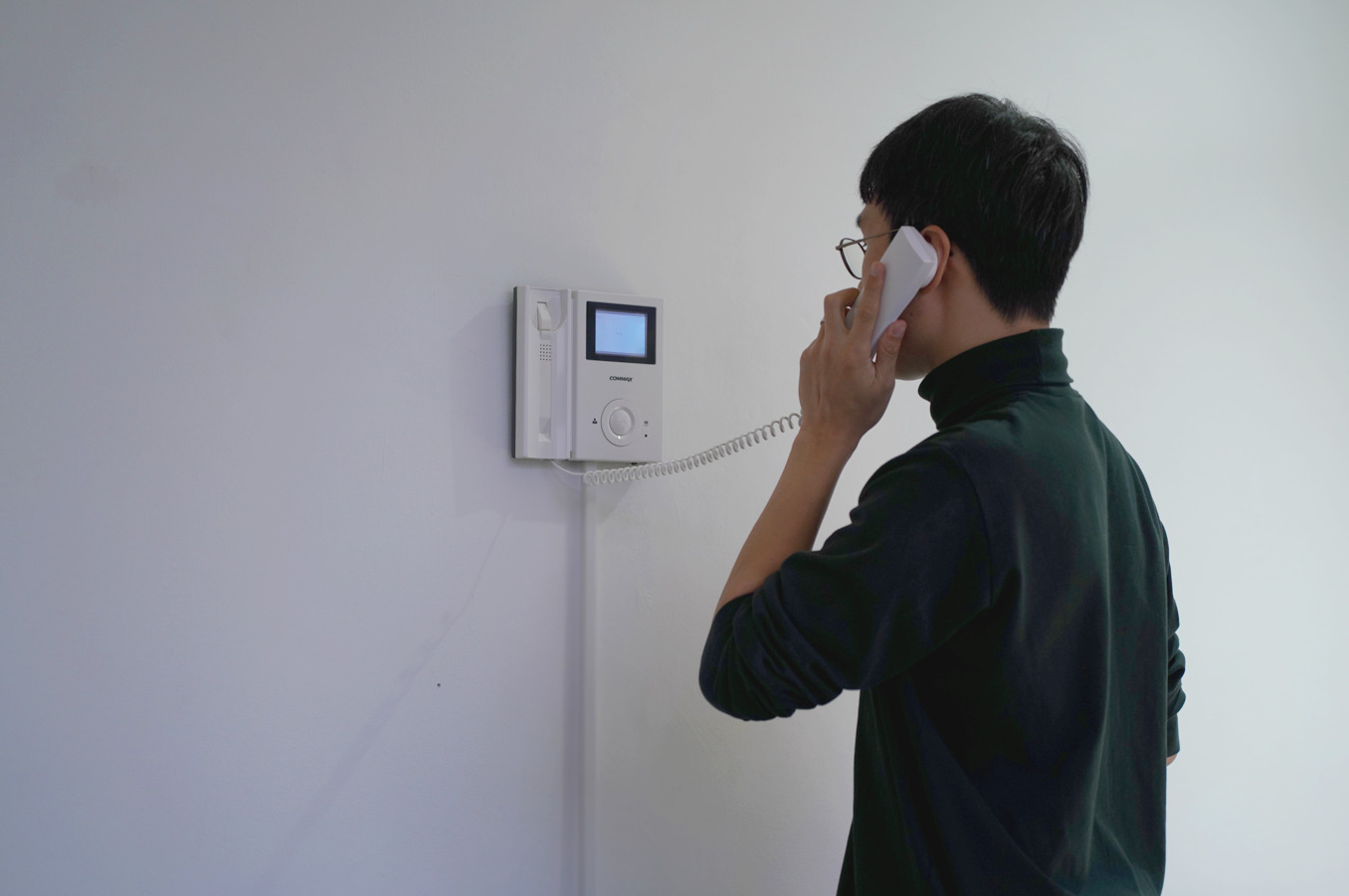
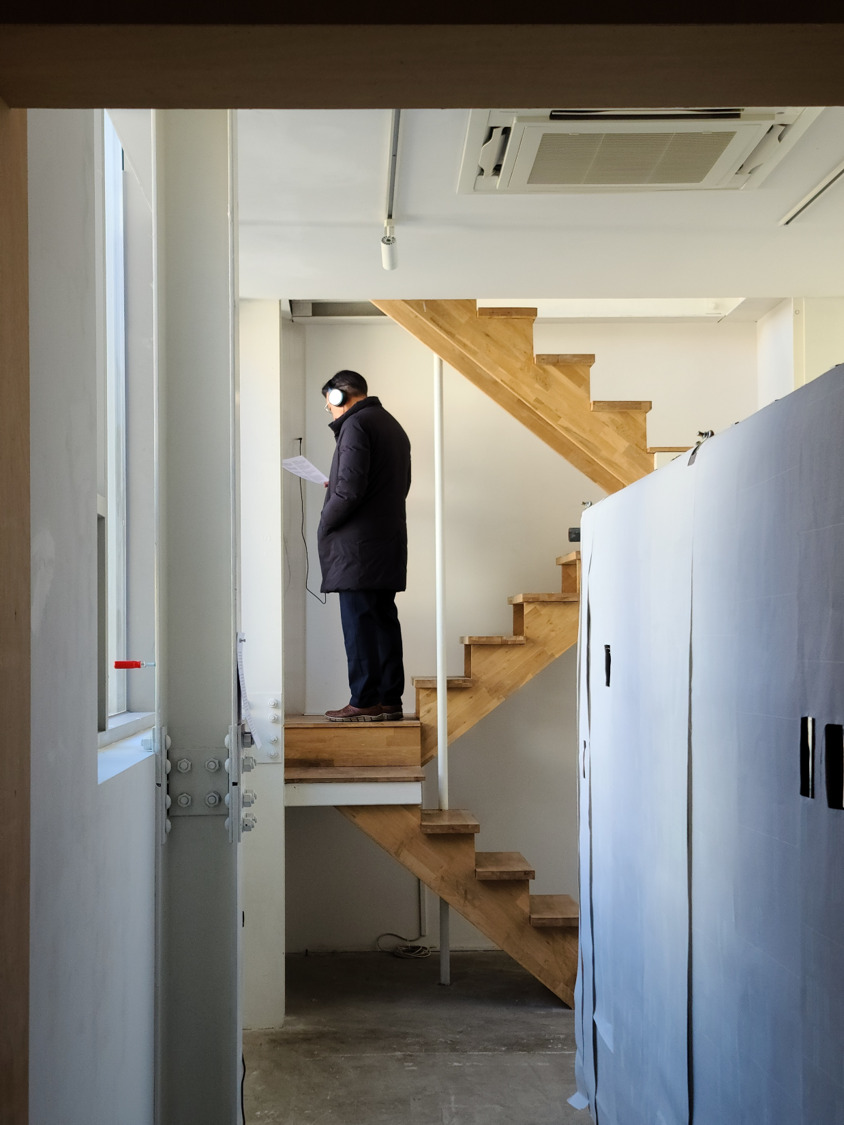
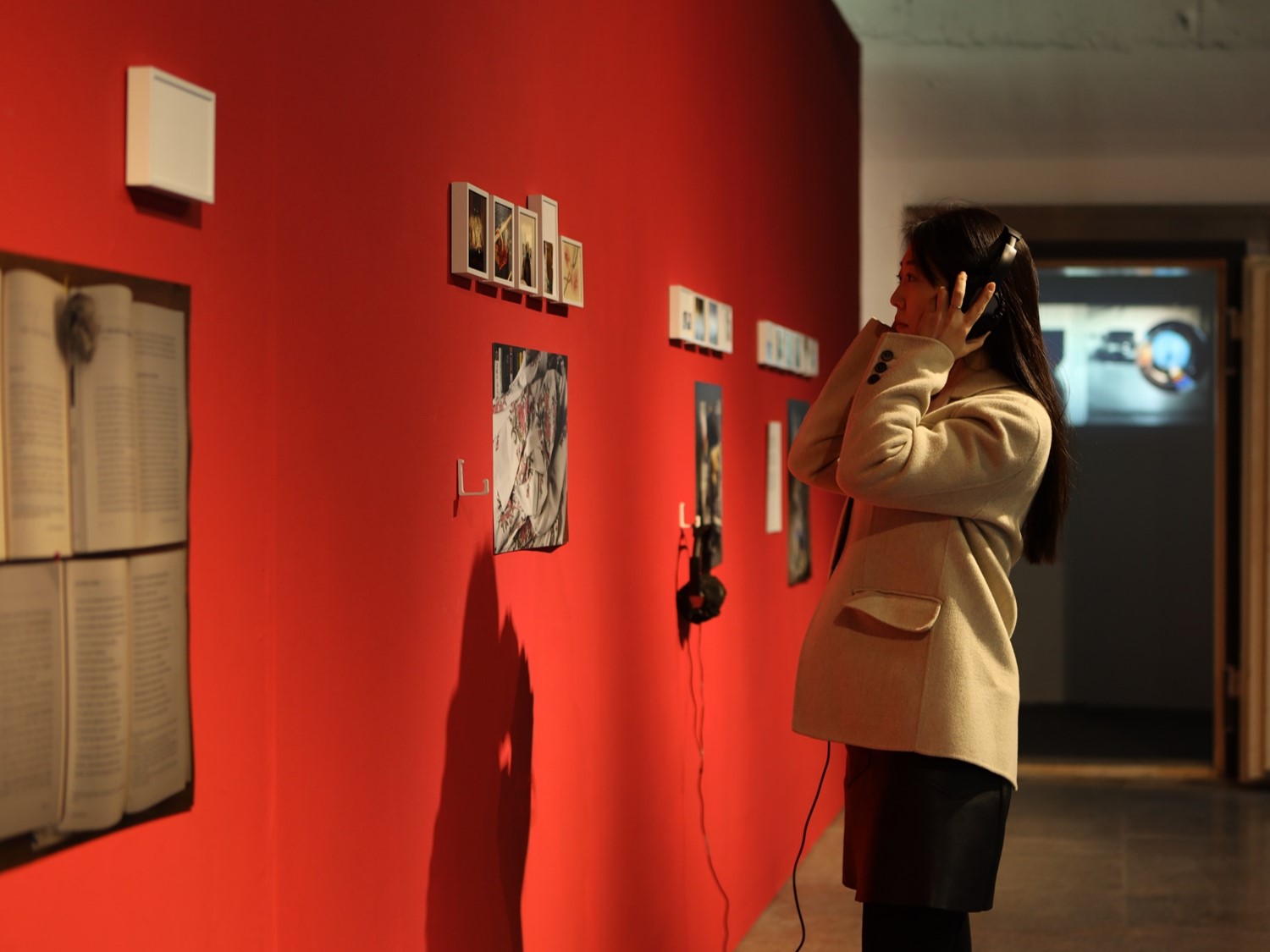
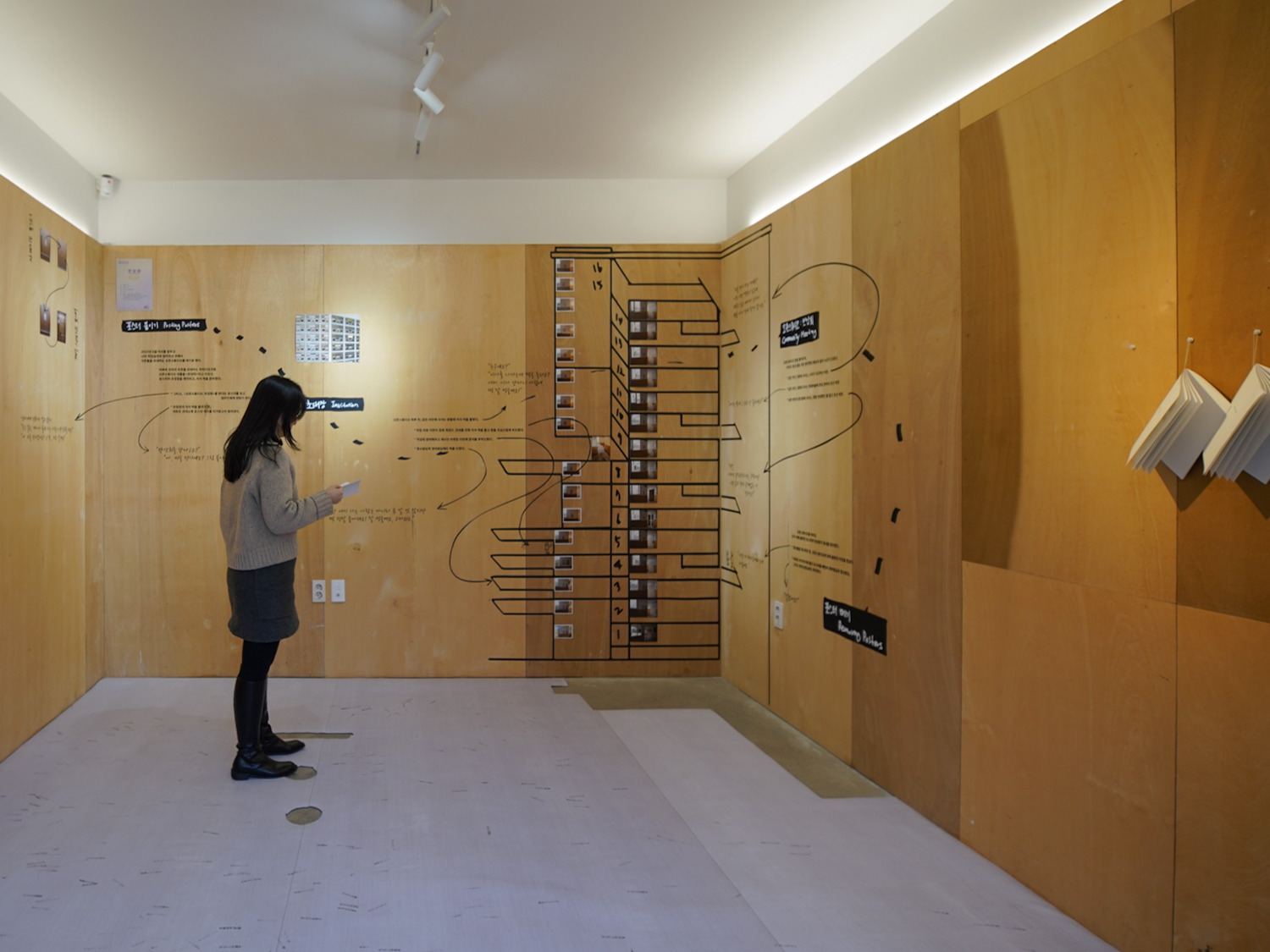
Exposure (2021) consists of photography and verbal or written text. “It is a record of the heterosexual love of women who support feminism,” said Solin Yoon. Among the love stories of five people, four are verbal records and the fifth is a written record. The female voices that are heard in the headphones and the text, including three paragraphs on white paper, deliver the participants’ autobiographical experience to others: romantic love between a woman and a man that became an event.
As anonymous observers, we look at the true experiences veiled across the traces of faded love like dried flowers, as if we are secret witnesses or hidden conspirators, considering each photo as evidence left at the moment of the conversation between Yoon and the participants.
Ernaux’s Les Armoires Vides, mentioned at the beginning of this text, is a novel portraying romantic love based on the author’s experience. Undergoing an “event that cannot be refined” – Ernaux “successfully” completed an illegal abortion on herself as a twenty-year-old university student of literature – she threw her own body, rather her language into the performance of writing. Suffering the pain of scattering the traces of romantic love left in her body to such an extent that the boiled metal instruments still felt cold, she began to write about the “event” instead of a novel she had been previously working on.
Ernaux wrote about this incident in detail in another novel, L’événement (2000). She wrote about a real event, which had never been recorded in language in any tragic piece of literature. To write about the event, Ernaux recalls her parents, neighbors, friends and her childhood “again” through Denise Lesur, the first-person narrator in the novel. In the journey of “rewriting” (the experience) about her own self, Ernaux/Lesur redefines “physical senses” or “senses of the body” that have been formed in relationships with those she loves/loved.
Exposure by Solin Yoon deals with “the event” (that nobody may know like childhood memories). In this exhibition, 《Over You》(2022), she says she “aimed to find out what a better romance is,” turning the tensions and conflicts that she encountered when loving a man as a feminist as well as mental oscillations generated during the process of self-division into power.” The women who talked about their past love stories, sitting face-to-face with Yoon, share their experience as a subject neglected behind superficial narratives of romantic love while going through both “the joy of love” and the “confusion of inner division.”
Their conversation reflects a fundamental contradiction, the gap occurring between the exterior and interior of the subject of “romantic love,” as if a person’s body undergoes numerous divisions between things that are publicly defined and those that are sealed inside. Therefore, the gesture of this radical “exposure,” as its title indicates, refers to the “events” as a turning point of love that women as a subject are supposed to experience, as in Ernaux’s autobiography. And it attempts to revise and rewrite (the narrative of) (old-fashioned) love through the medium of these events.
Through a close performative process of deconstruction and division, reestablishment and redefining as well as rewriting, A way to deal with the dried flowers, Redefining and Exposure resonate with the question regarding “a better romance” that Yoon poses throughout the exhibition.
❉
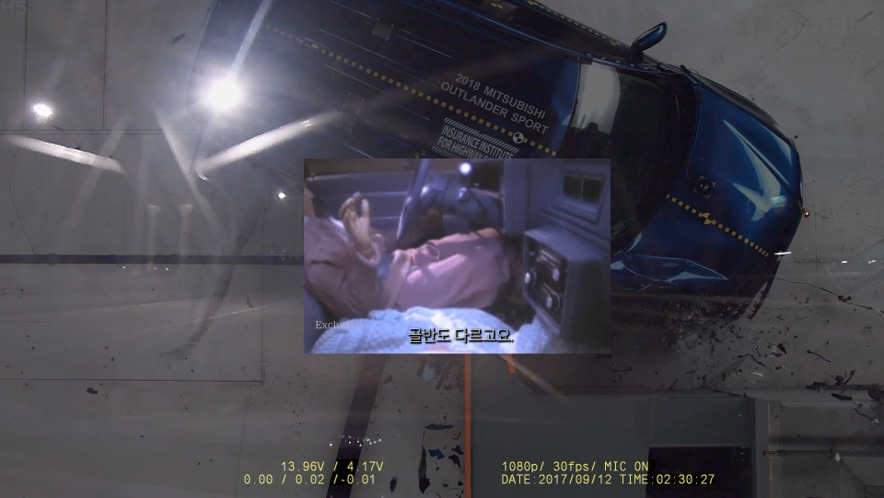
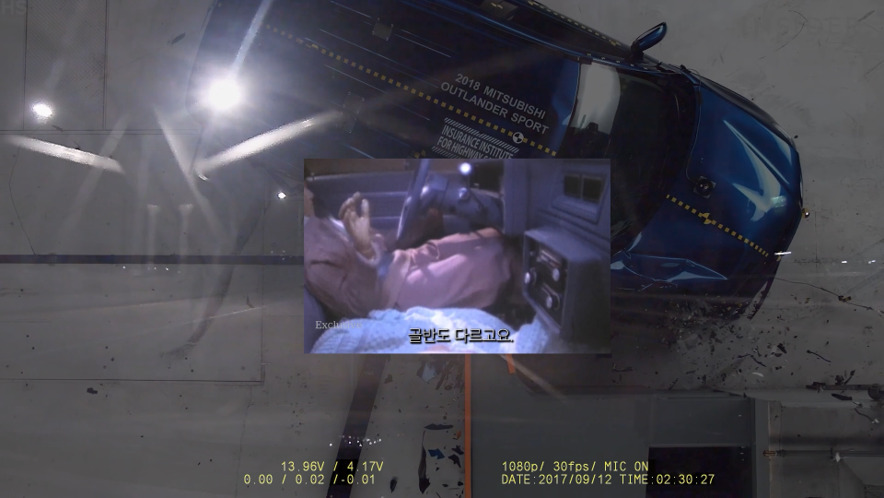
Safe Search (2021) feels like an illusion of romantic love. This video of about 4 minutes shows tension and anxiety that a woman driver has when an anti-collision sensor is triggered while driving at night. It asks a question about how a female body (image) feels anxiety and constantly renews a physical experience within a romantic illusion of stability established in this world through a safety testing device. Indistinguishable Performance (2021) seeks a justification for the presence of “distinguished women” as a parallel with Safe Search.
Imitation and tameness in an attempt to become “distinguished” evoke the events of conflict and division occurring in romantic love, asking us to reconsider and reflect on what kind of distinguished features we need for a stable life.
What implications do these expressions – “a distinguished woman” and “a better romance” – have? From the perspective of Solin Yoon, the expressions establish a way of life that performs the rewriting of themselves (their experience) amid constantly repeated tension, conflict and division. It is just like Annie Ernaux, who attempted to explore the possibility of unending romantic love and the resulting tension and conflict on her own and further turn them into a driving force to create text and image in L'Usage de la Photo (2005), while continuing to write autobiographical narratives.