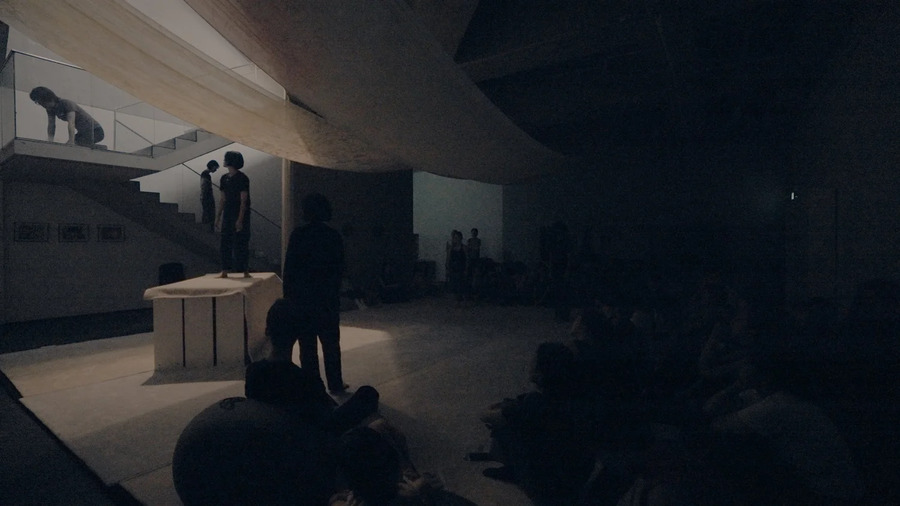
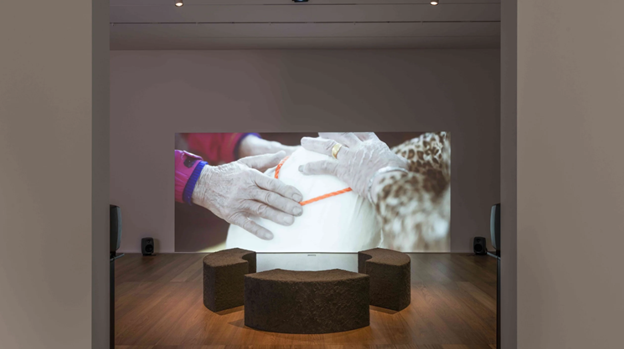
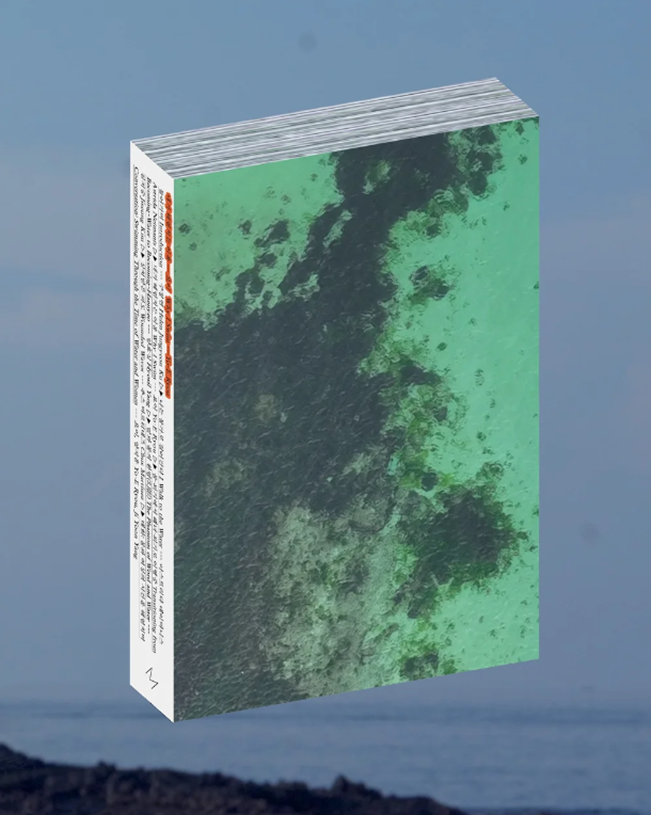
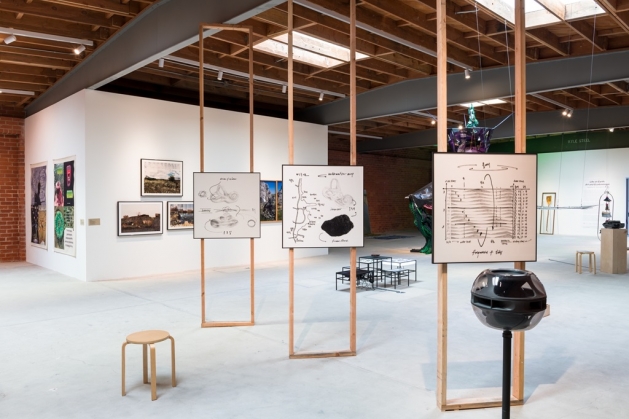
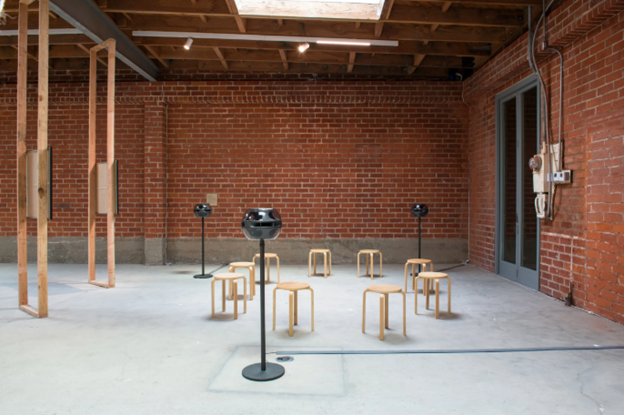
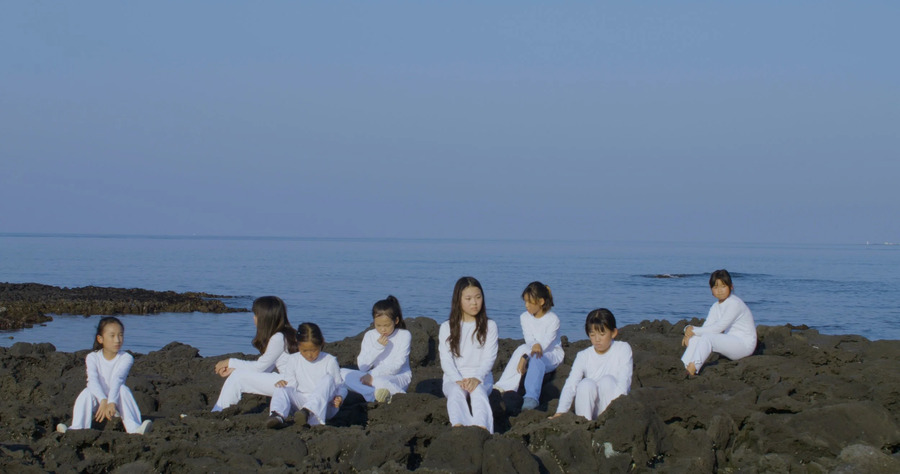
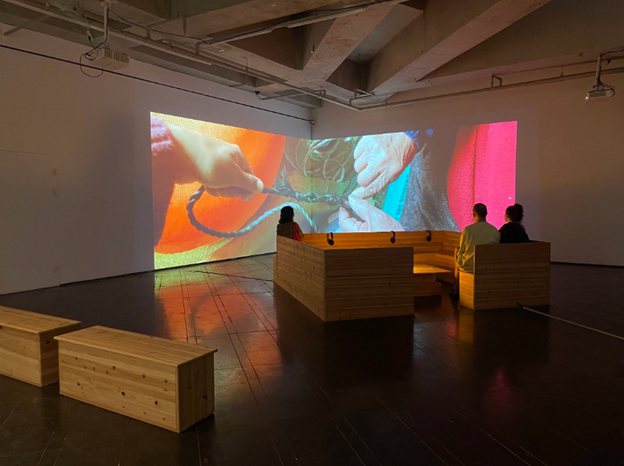
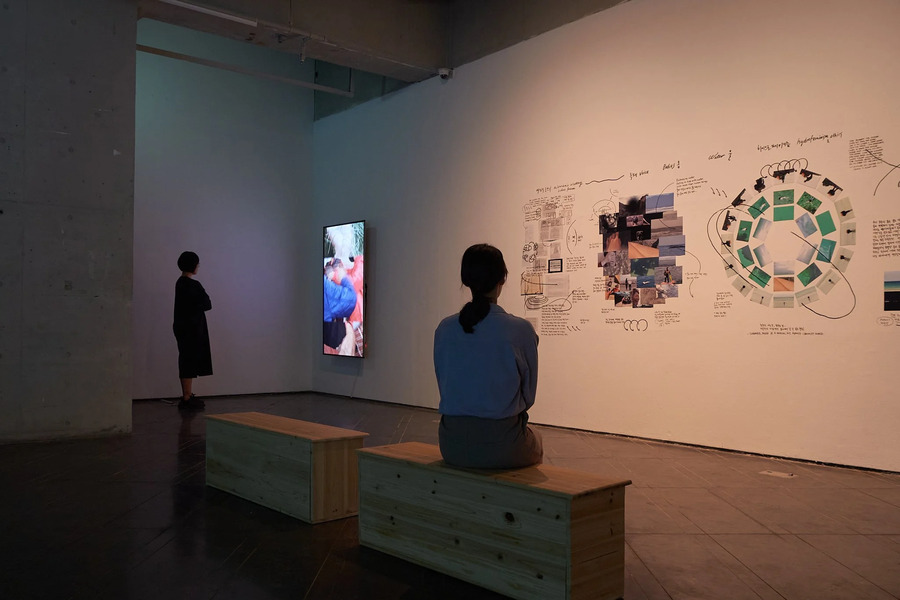
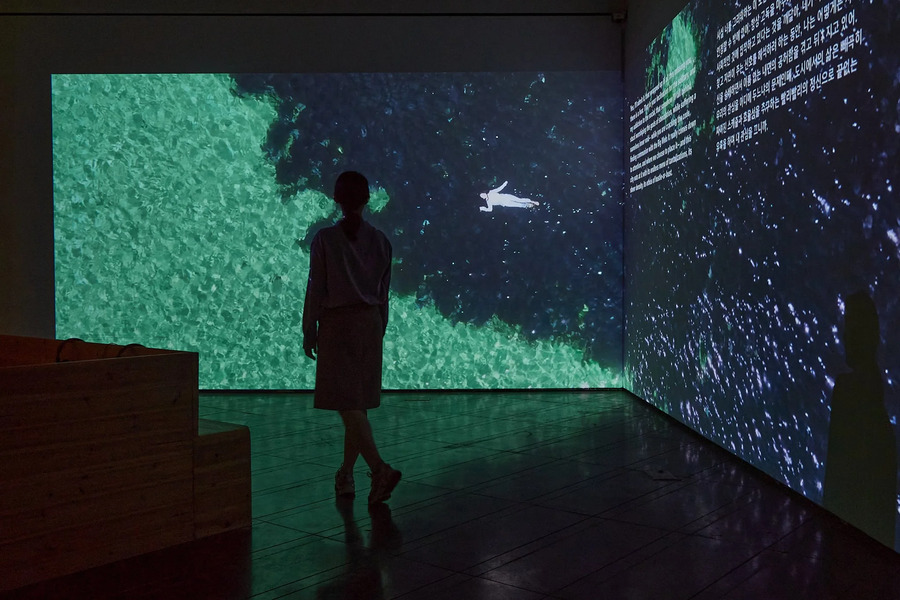
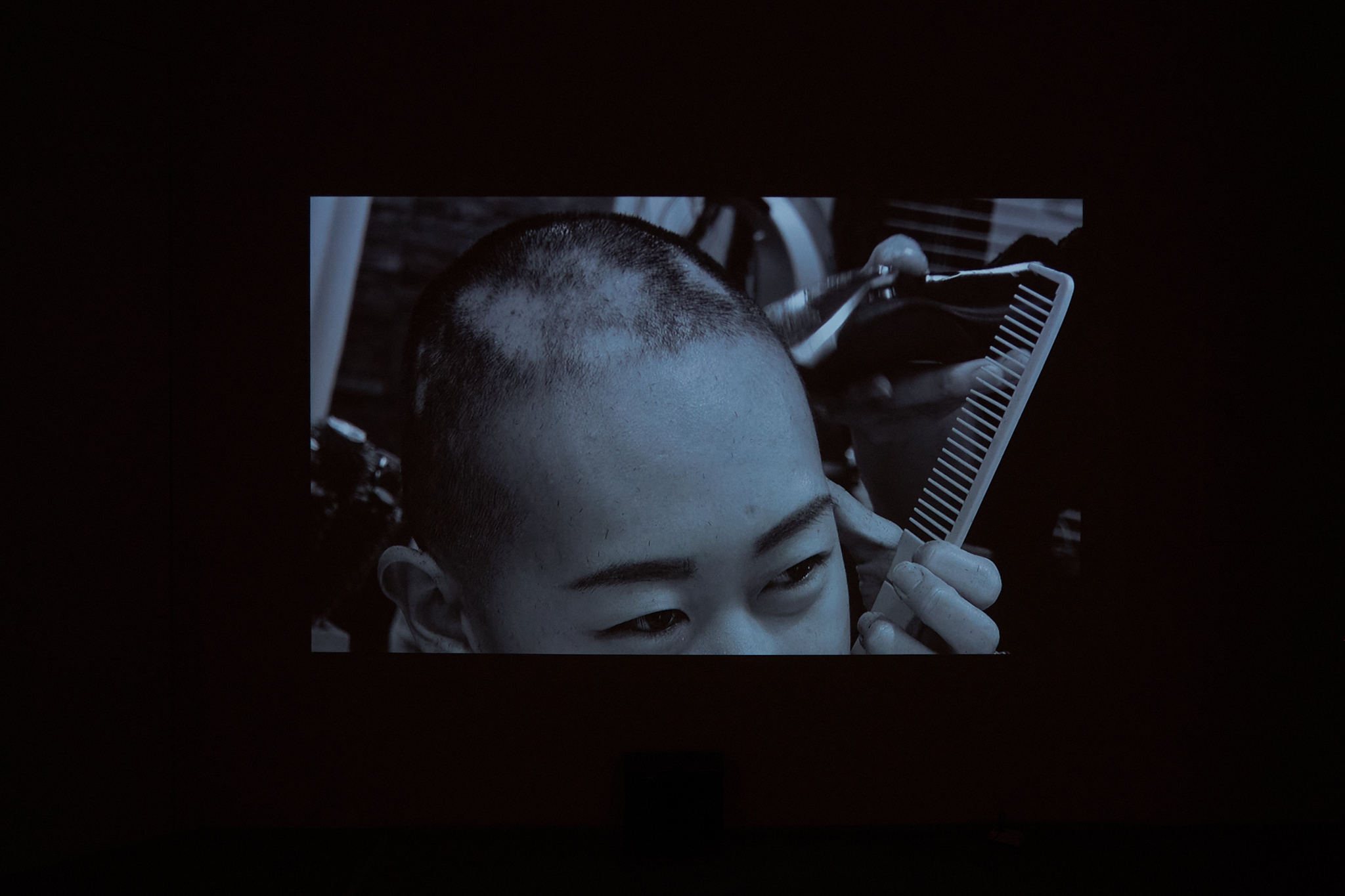
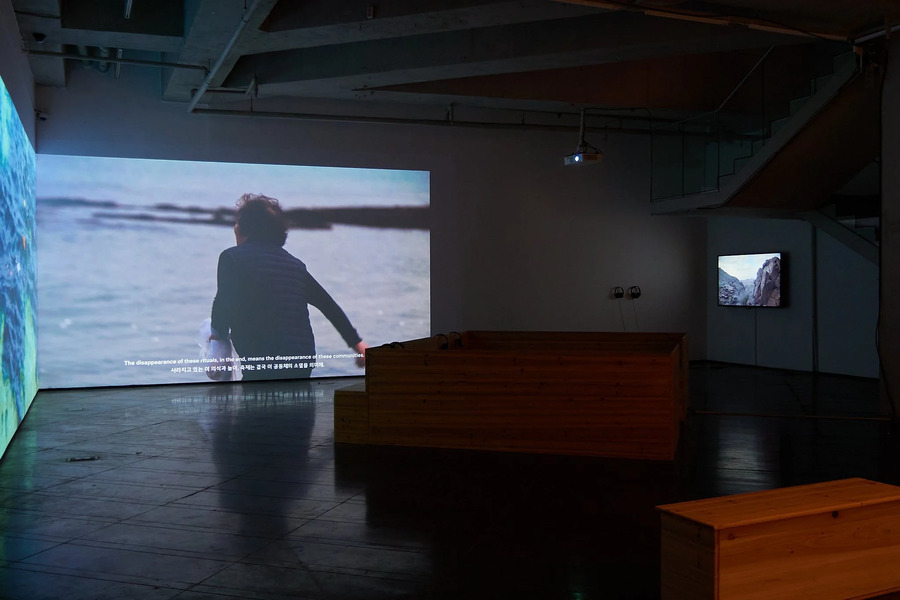
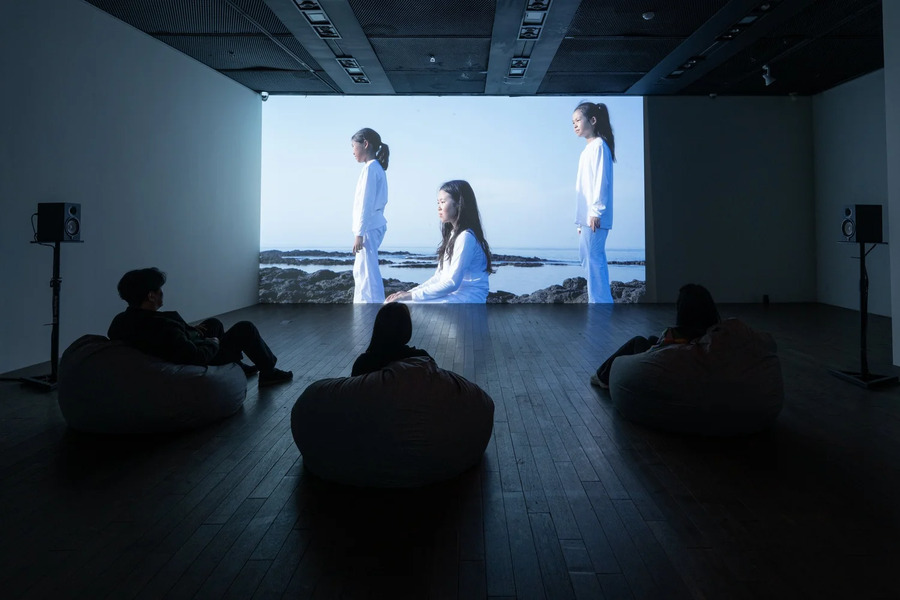
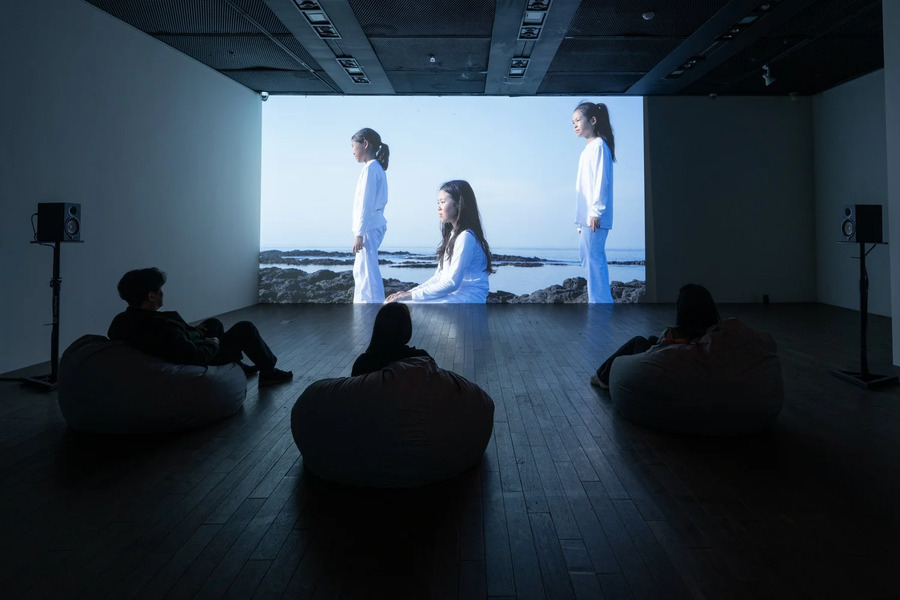
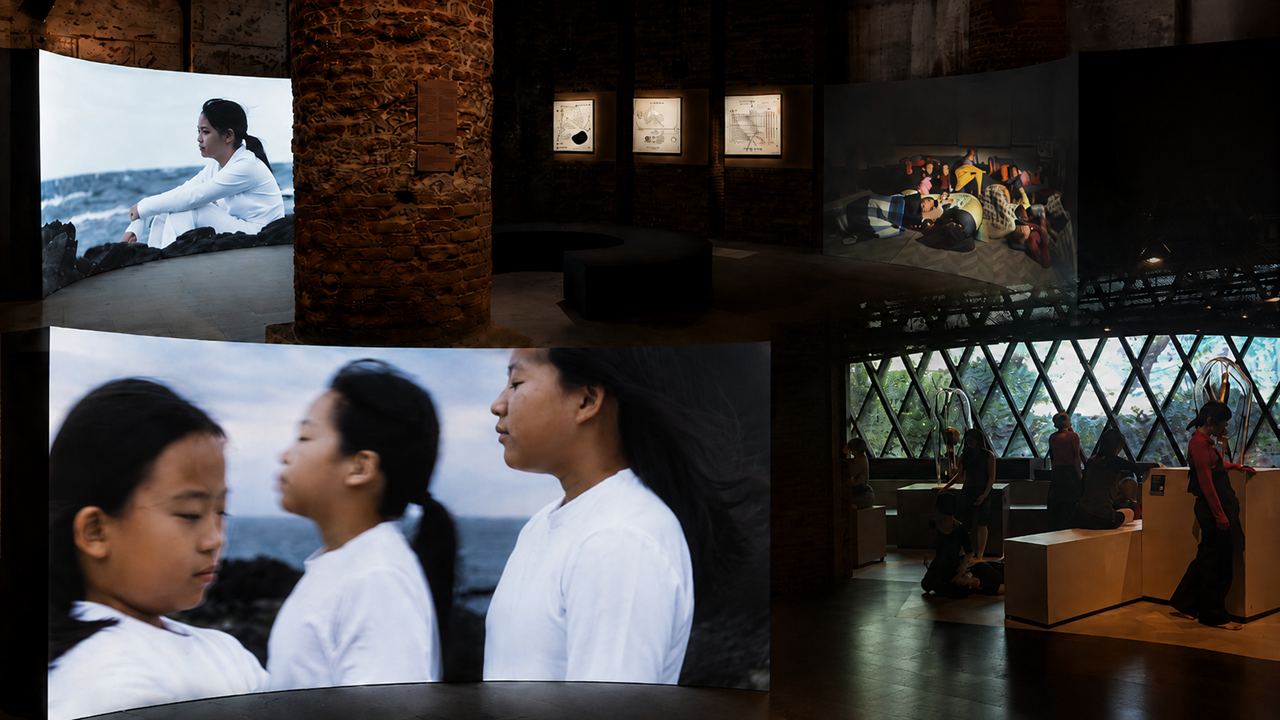
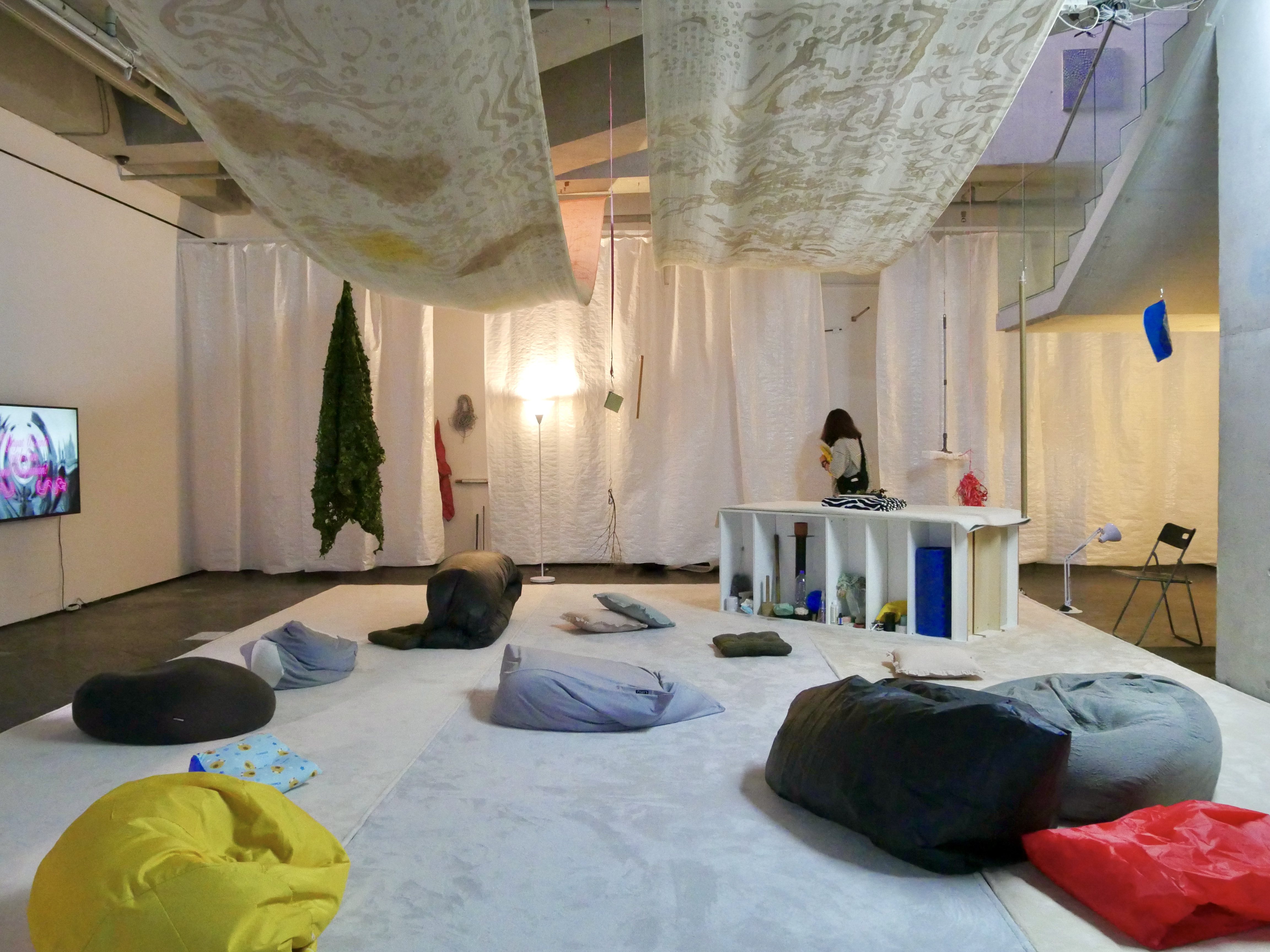
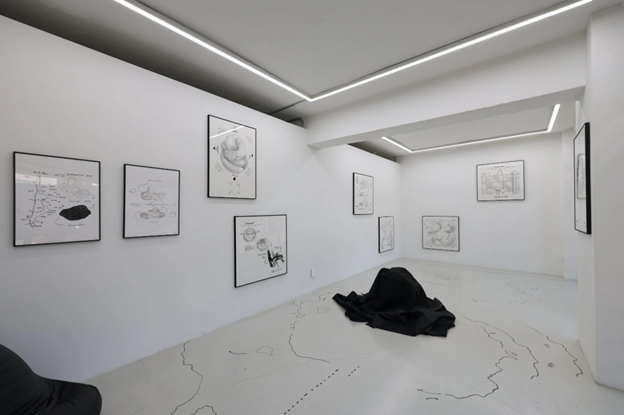
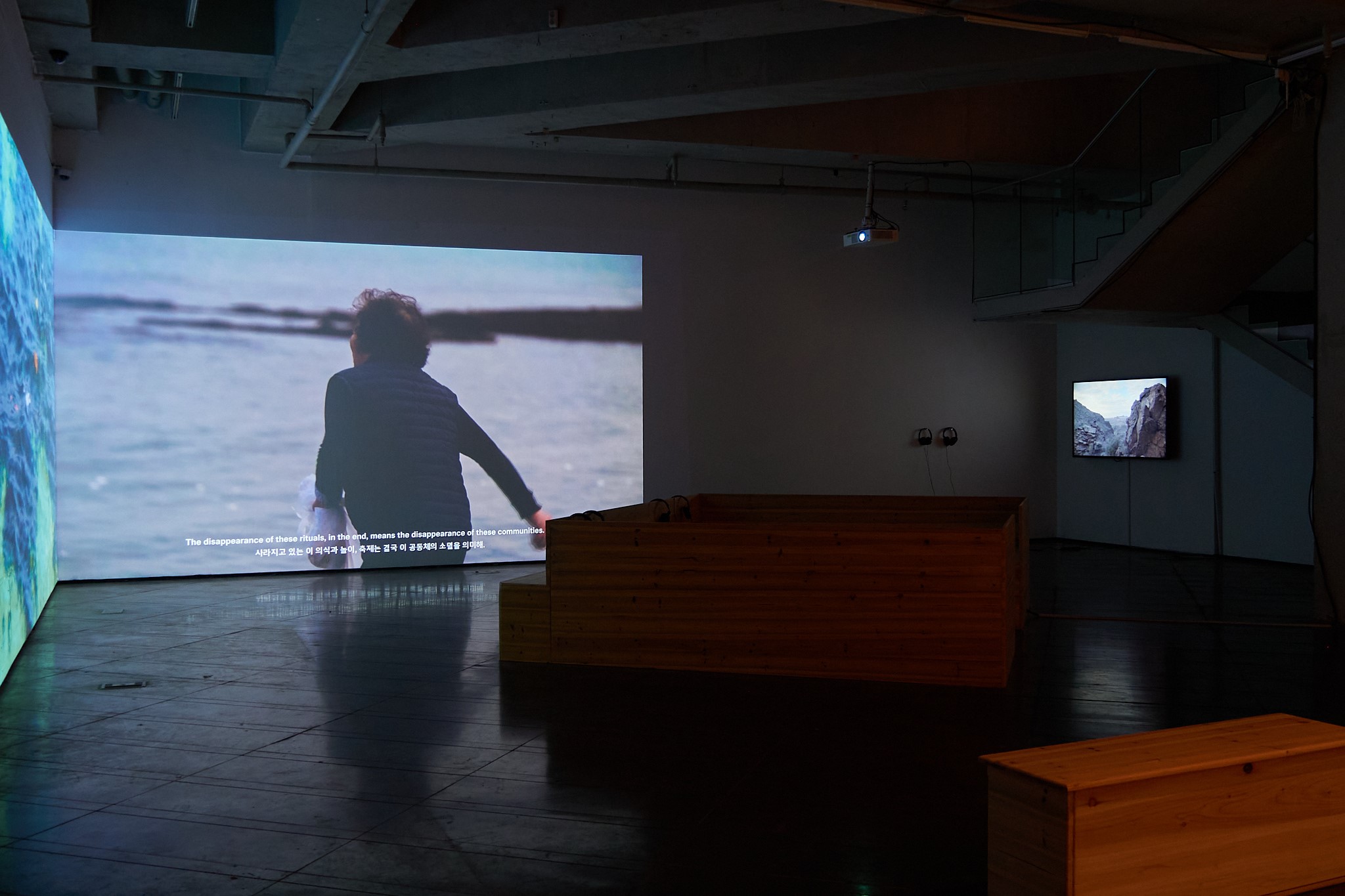
Yo-E Ryou, Breath Orchestra Act 1-2, 2024. Installation view of 《Boundless: Language of the Soul》 (Jeju Gallery, 2024) © Yo-E Ryou

“Listening in wild places, we are audience to conversations in a language not our own."
— Robin Wall Kimmerer, Braiding Sweetgrass

A circle of young girls dressed in white are sitting on black rocks that lead into the deep blue sea. Consciously breathing with a sound of sseup—, they inhale deep into their bodies and hold their breath. After a moment of stillness, they exhale with a resonant sound, oompa—. Accompanied by sounds—haa—, hoo—, whee—, pah—, they expand their chest, close their eyes, and purse or relax their lips.

When holding their breath, the silence reigns, but the fierce negotiation with breath connected to life is palpable. As the breath taken inside their lungs cannot be contained forever, they soon exhale deeply, releasing it back out. Each girl breathes in and out in her own rhythm. Although their eyes are closed, they listen to the breathing of the friends beside them, sensing each other's presence.

The sound of another’s breathing becomes a sign, translating to “I am here,” “I am alive,” “I am okay.” They may not breathe in or out at the same time, but safety still depends on breathing together. They, thus, traverse the path that leads to the sea, walking in and out together. The girls’ ritualistic breathing on the rocks echoes the practices of Jeju Haenyeo, women divers who labor in the sea. In this oceanic realm, the haenyeo also swim and hold their breath. The undulating movements of the seawater and seaweed resemble the gestures of the haenyeo. Just as the tides shift the boundaries between sea and land, the haenyeo’s swimming and breathing blur the lines between inside and outside the water.

The bodies of the haenyeo become bodies of water. The sounds of the haenyeo’s swimming merge with those of the girls’ breathing. Their gestures create sound, forming a tactile and resonant dialogue. The girls’ breathing becomes a way of preparing to enter the world of water, just like the haenyeo. The present of the Haenyeo and the future of the girls are connected through the act of breathing. 

The space where humans, like other mammals, can breathe is a world filled with air. In this world, we can breathe without conscious effort, even when we are asleep or unconscious. So why are these girls practicing breathing on the rocks? They are learning how to breathe and exist in a new world—the world of water. Humans without gills cannot breathe in a world filled with water, but haenyeo can breathe while navigating the boundary between land and sea.

Without relying on the scientific technologies revered by anthropocentric modern societies, the haenyeo know how to align their breath with life underwater. Their breath, nevertheless, hovers precariously between life and death, thus, the haenyeo practice must be mastered and embodied with their entire being. These girls are learning the breathing of the Haenyeo. 


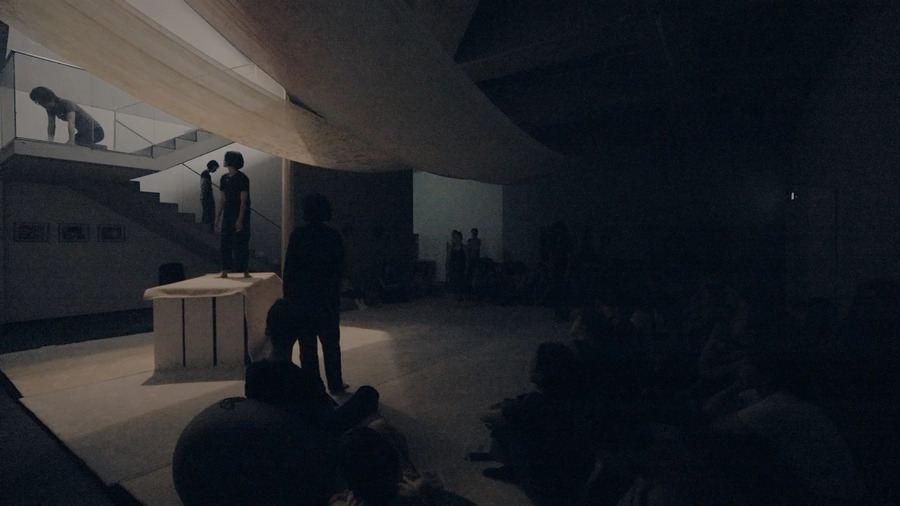
Yo-E Ryou, Breath Orchestra Act 4, 2025. Performance view of 《Touchy-Felly》 (Alternative Space LOOP, 2025) © Yo-E Ryou

Breath Orchestra is a sequel to Yo-E Ryou's earlier work, Why I Swim. In Why I Swim, the artist sought, in her own words, to "unlearn" the act of swimming—a process aimed at sensing anew how to exist within the space of water. This "unlearning" of swimming naturally led to the "unlearning" of breathing, which brought forth this series of works, Breath Orchestra. It is because the gestures of swimming are rooted in the act of breathing inside and outside water. At the heart of both works lies a fundamental question of boundaries.

How can bodies belonging to different worlds transcend those boundaries to communicate with one another? Yet, a deeper question emerges: are we humans even wiling to communicate with the bodies from other worlds?

Our society seems to lack ethical consideration for the haeneyo, just as it does for nonhuman beings. While the haenyeo culture is officially celebrated as a UNESCO Intangible Cultural Heritage of Humanity that must be preserved, our society paradoxically prioritizes economic development that devastates the marine ecosystems, which is the foundation of haenyeo’s livelihood. This contradiction mirrors policies that actively exterminate endangered species of flora and fauna under the justification that they cause economic loss, even though human industrial activities have already propelled the Earth into the sixth mass extinction era due to climate change.

In these works, the artist deliberately avoids directly portraying the haenyeo, rejecting the objectification of haenyeo as pre-modern relics or their commodification as tourist attractions/commodities. Instead, the artist captures other bodies—her own and those of young girls—learning and embodying the gestures of haenyeo as a language of water. These gestures serve as a way to learn from and document the ecological and embodied practices of the haenyeo without exploiting their image.

After living abroad for over a decade, the artist settled in a small village on Jeju Island during the COVID-19 pandemic by chance, and there, she learned how to swim and breathe from the haenyeo. This way of moving through water was entirely different from the swimming techniques the artist had tried to learn—or failed to learn—while living on the mainland, particularly in urban environments. The haenyeo, who were deprived of any opportunity for formal education because they were daughters, were forced to earn a living by diving.

They were not taught standardized swimming methods; instead, each haenyeo developed her own ways of swimming, diving, and breathing, or inherited techniques passed down from her mother and other senior haenyeo. Just as their bodies vary, so do their diving practices, yet none have been officially documented. Unlike most certified sports, which are systematized and standardized around Westernized adult male bodies, haenyeo techniques remain unique, diverse, and deeply personal.

Through her time with her haenyeo neighbors, the artist came to understand the vast gap between herself and the haenyeo, as if they inhabited entirely different worlds, although they existed in the same time and space. The world of standardized English and Korean language versus the world of Jeju Island language; the world of formal education versus the world of self-taught knowledge from nature; the world of those who breathe only on land versus those who breathe and communicate across the boundaries between water and land. Having spent a lifetime diving in the sea, the haenyeo have embodied the essence of water, mastering its breath and its language.

The artist comes to realize their breathing sounds not merely as physiological phenomena but as “a language that carries the rhythm of life passed down through generations.” Living alongside the haenyeo, she is drawn to interpret the breaths they inhale and exhale to understand this language of breath experienced with the entire body soaked in the sea. To do so, she must cross the boundary that divides the two worlds.

Learning the art of muljil from the Haenyeo, the artist breaks away from the unconscious breathing patterns of modern urban life and explores a new way of breathing that bridges the worlds of water and land. This new understanding is documented within her own body and those of the young girls with whom she shares it.


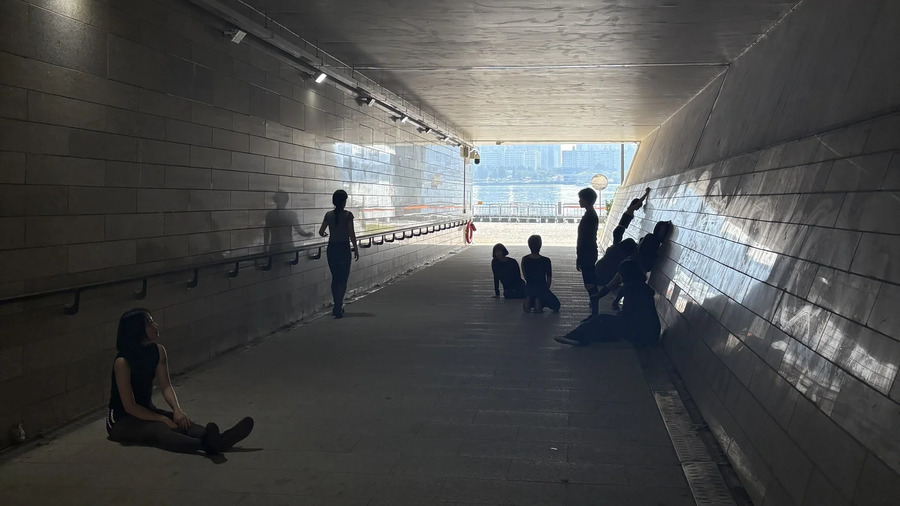
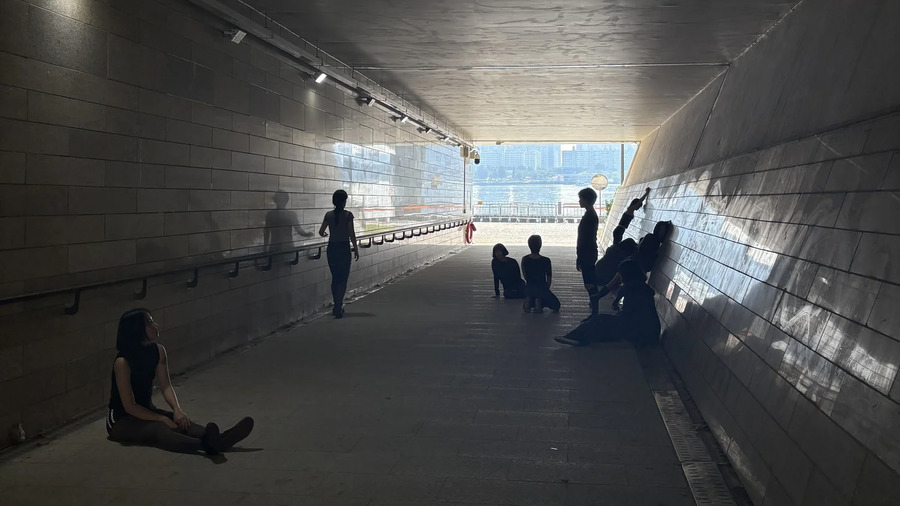
Yo-E Ryou, Breath Orchestra Act 5, 2025. Performance view at Han River Tunnel, Seoul © Yo-E Ryou

Anthropologist Eduardo Kohn considers the gestures, sounds, and physical appearances of all living beings as signs—their language. Kohn argues that language is not limited to human language which mainly uses symbolic representation that sounds and meanings are arbitrarily connected, but also includes “iconic” signs that share likenesses of sounds and motions with what they represent and “indexical” signs that are in a relation with what they represent.

All living beings evolve by interpreting and responding to one another’s signs—a process that is not merely biological but one of thought and communication. For Kohn, this sign process is what constitutes life itself. He writes, “because life is semiotic and semiosis is alive, it makes sense to treat both lives and thoughts as ‘living thoughts’”(How Forests Think, p. 78).

The haenyeo’s breaths can be understood as iconic signs that represent their bodies moving across the boundaries in and out of the water, as well as an embodied language that is felt, expressed, and interpreted through the senses. Unlike human language, breathing enables interspecies communication. Because most living beings on Earth breathe, this unspoken language becomes a universal medium to share thoughts without the need for translation. Just as the sound of a nearby companion’s breath provides reassurance, breath acts as a sign that brings affective understanding and mutual recognition. 

Breathing, then, is fundamentally about relationships. If Why I Swim explored the body’s entanglement with the sea, Breath Orchestra expands this exploration to the relationships with beings who breathe inside as well as outside water. Breath, entering and exiting countless earthly beings, forms a shared materiality in diverse bodies. Feminist literary scholar Stacy Alaimo theorizes this interconnected embodiment as “transcorporeality.” When we inhale, oxygen from the air is absorbed into our bodies through the lungs.

When we exhale, carbon dioxide produced within our bodies is released. unbeknownst to us, the carbon dioxide we exhale enters the breaths of trees, mosses, phytoplankton, and seaweed, becoming part of their bodies, while the oxygen they release flows into the bodies of animals like us. Through breath, we are intrinsicably connected to the diverse life forms of forests and oceans. The breath that sustains and animates our bodies also sustains theirs, weaving our bodies into the same web of materials, allowing us to think through this shared process of exchange.

We once breathed in the world of water. But upon leaving the amniotic fluid of our mother’s womb and entering the world outside of the water, we had to forget how to breathe underwater and learn to breathe in the air. For most, this transition between the old and new ways of breathing happens almost intuitively. Some newborns may need a helping hand, but many accomplish this "unlearning" and "learning" on their own.

Yet, this doesn’t mean that we have completely forgotten how to breathe in water. Newborns and infants often feel comfortable in water and can swim instinctively. The artist points out that human lungs were once as large and developed as those of whales but diminished in function after humans moved out of the water, and the organs of Haenyeo who dive extensively may expand up to three times the size of the average human’s, partially regaining this lost lung capacity.

As the audience watches the girls breathe in this art work, they too begin to inhale, hold, and exhale, tracing the rhythm in their own cycle. The rhythm of breath—the language of water—passes from the haenyeo to the girls and from the girls to the audience. By meeting the body of water, the Haenyeo, the girls, and the audience learn to connect, interact, and communicate with water. They learn to breathe. They begin to understand the thoughts of the whales. Together, they together inhale with the sound of sseup—, and then pause. They exhale with resonant sounds of oompa—. Their breaths vibrate with sounds like haa—, hoo—, whee—, pah—.

References