Even in the era when people declared that an age had come to an end, painters continued to work. The world had changed, yet destiny kept whispering that one must live for the sake of the new. But we all already knew this: the supposedly blank white surface was already filled with images we recognized, and whatever emerged from it would only be something formulaic. The subjects to be painted had been exhausted and replaced by methods of painting themselves. We attached things to paintings, mixed everything together, yet what ultimately remained was the question: “What is this painting saying?” Even the long struggle of the painter becomes, before the viewer, nothing more than language in the end.
Let us return again to the surface of the painting. History already exists within it, and latent surrounding images are already present there. The methods for drawing them, too, have histories of their own. Familiar colors, refined tones, brushstrokes that provoke emotional turbulence—if all these elements were categorized and displayed, they would rival a Homeplus supermarket. What once would have been called the achievements of the old masters of the art world has now become the brand names of supermarkets.
Push the cart, choose the ingredients carefully, and even a simple recipe can produce what is called a “good artwork.” Art-making has now become cooking, perfectly aligned with the consumerist logic of satisfying desire through things that are “delicious” and “easy,” and therefore “good.” If genius once sustained art through devotion to religion and power, and if novelty later enabled art to survive as an autonomous domain, art now survives as a form centered on consumption. Ah—but this is not actually what I intended to talk about.
The problem lies in the blank white surface. For some, the blank canvas is the presence of the image itself; for others, it is a hidden existence that can never fully appear, the final stronghold of resistance against the content of painting. By the time a painter begins to sketch, at least two of these three conditions have already been accepted as givens. Since creation begins from what has already existed, novelty has become a matter of style. The problem of sketching boundaries, the layered textures of paint that produce luxurious surfaces, the intensity of brushstrokes that stir emotion—all of these accumulate upon the white canvas and, through the painter’s dazzling technique, gradually become a world.
Unless one struggles against these default conditions, painting can only repeat what is already familiar. Yet, connected to broader critiques of the world, we are still left with three silk pouches—though it cannot always be said that they have succeeded. Within these silk pouches remain the elegant conceptual techniques of “concealment” and “unconcealment.” Even when only the pitch changes, a new singer can transform a song into something new. Sharp and refined critiques related to the world become new works through variations of concealment and unconcealment within content and form. Styles that are endlessly mixed will remain forever new. Of course, one must also participate in remaining silent about the things everyone must keep silent about.
The questions “Is novelty found in not repeating what has already existed?” and “Is novelty found in repeating well what has already existed?” eventually transform, for the painter, into the question of whether painting must truly be new at all. The notion of novelty is too linear. In truth, the painter is the point at which the infinite forces of the past and the future collide. The ongoing arguments of painting inherited from the past rattle within the present figure of the painter toward the possibilities of the future. This is why one cannot simply condemn a painter working within given conditions as merely the possessor of clever techniques: the painter is a point of collision. Hannah Arendt referred to this as the “diagonal force.”
Though we do not know where the infinite force of the past and the infinite force of the future originate, their destination is the point of collision. The diagonal force begins precisely there. Its origin may be limited, but its destination is infinite. The painter rattles in an attempt to shift direction away from the straight line of novelty toward a diagonal line reaching into infinity. As a point of collision, the artist performs acts of delay for the sake of this diagonal force striving toward the infinite. Arendt described such a diagonal force as the perfect metaphor for the activity of thought, yet it may in fact be the perfect metaphor for the activity of artistic production itself. This is the second silk pouch.
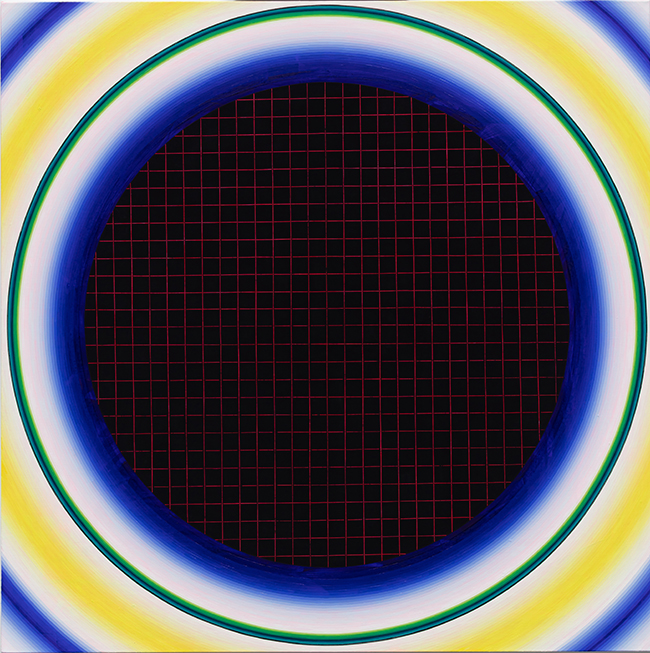
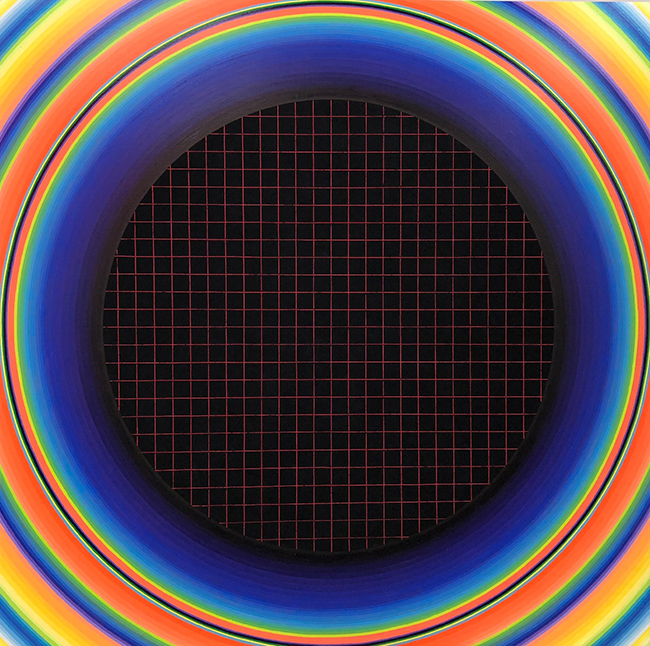
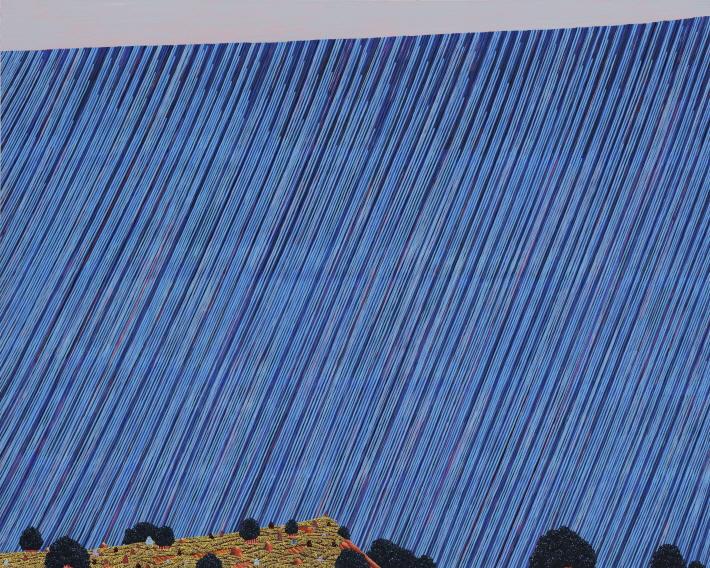
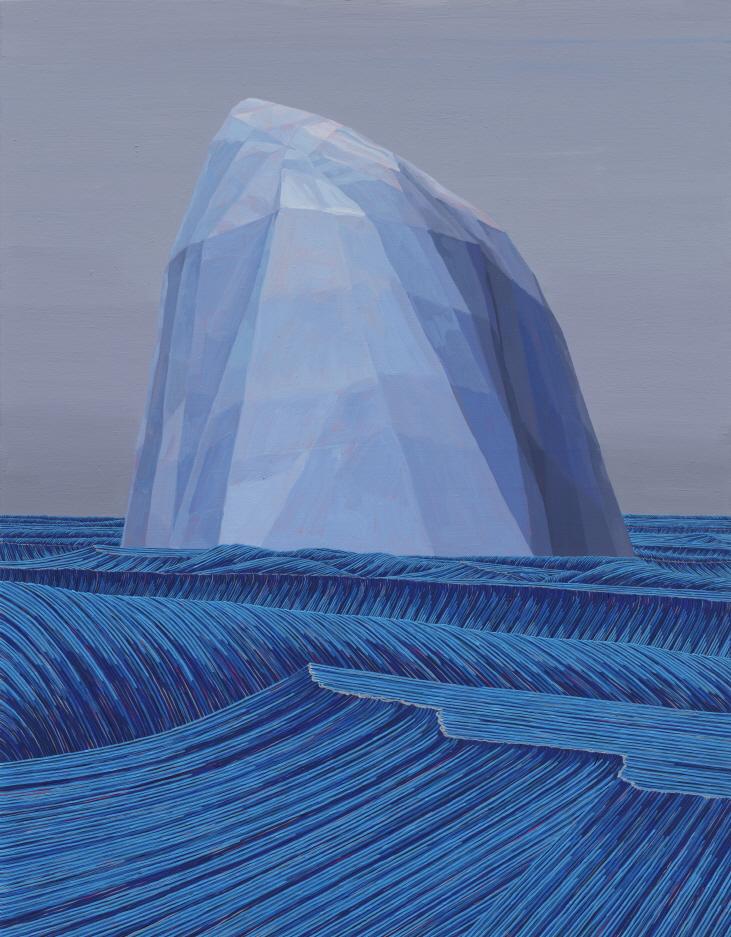
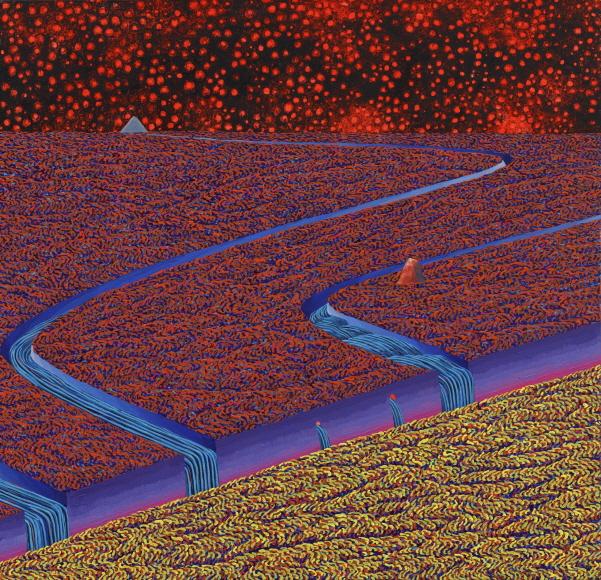
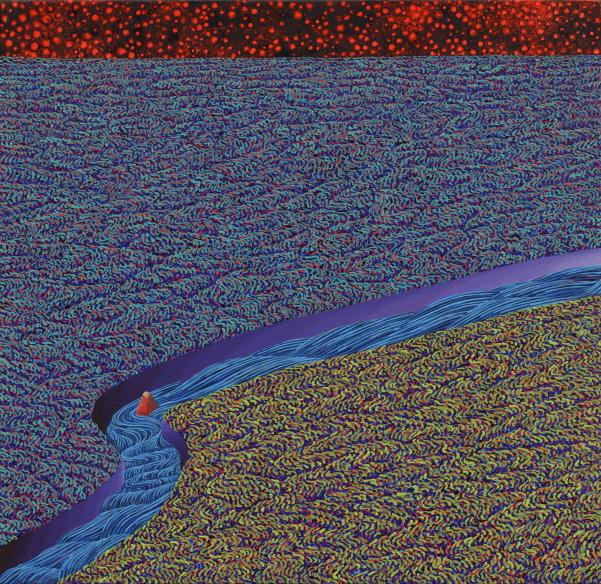
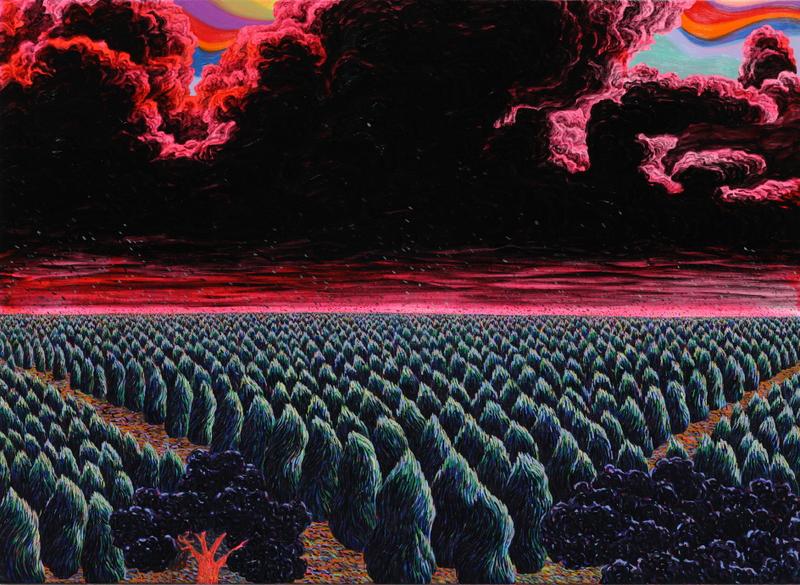
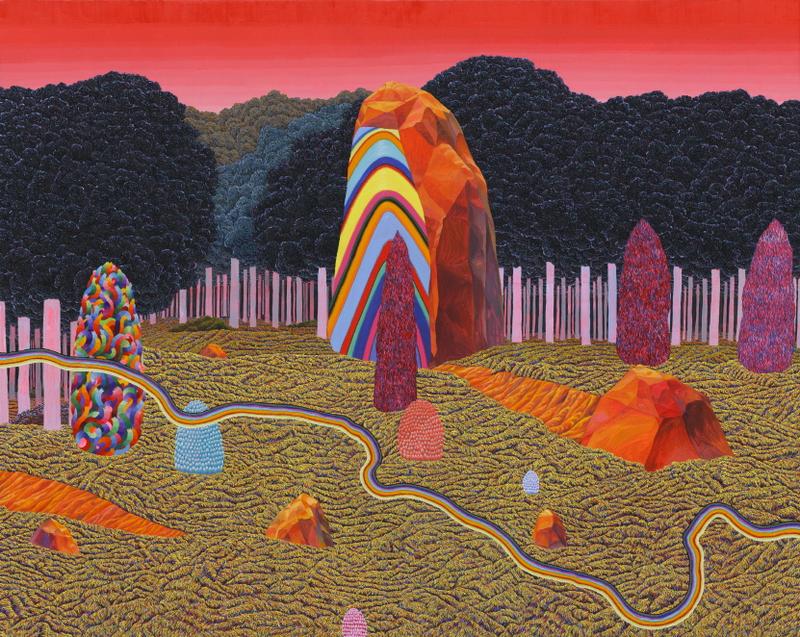
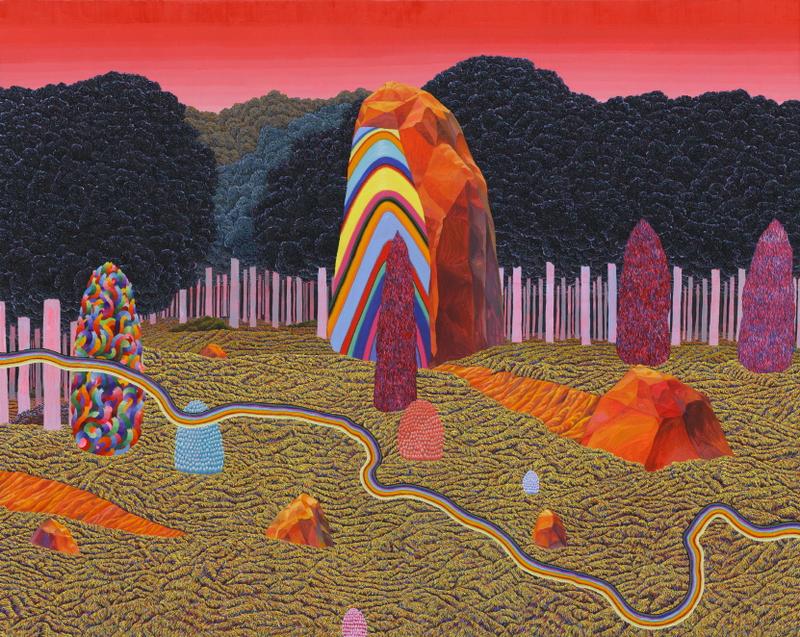
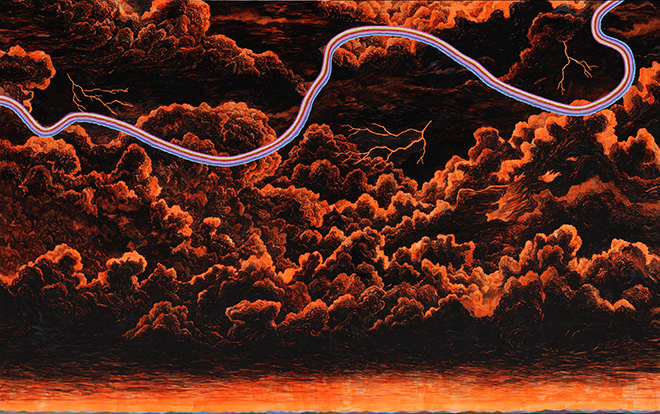
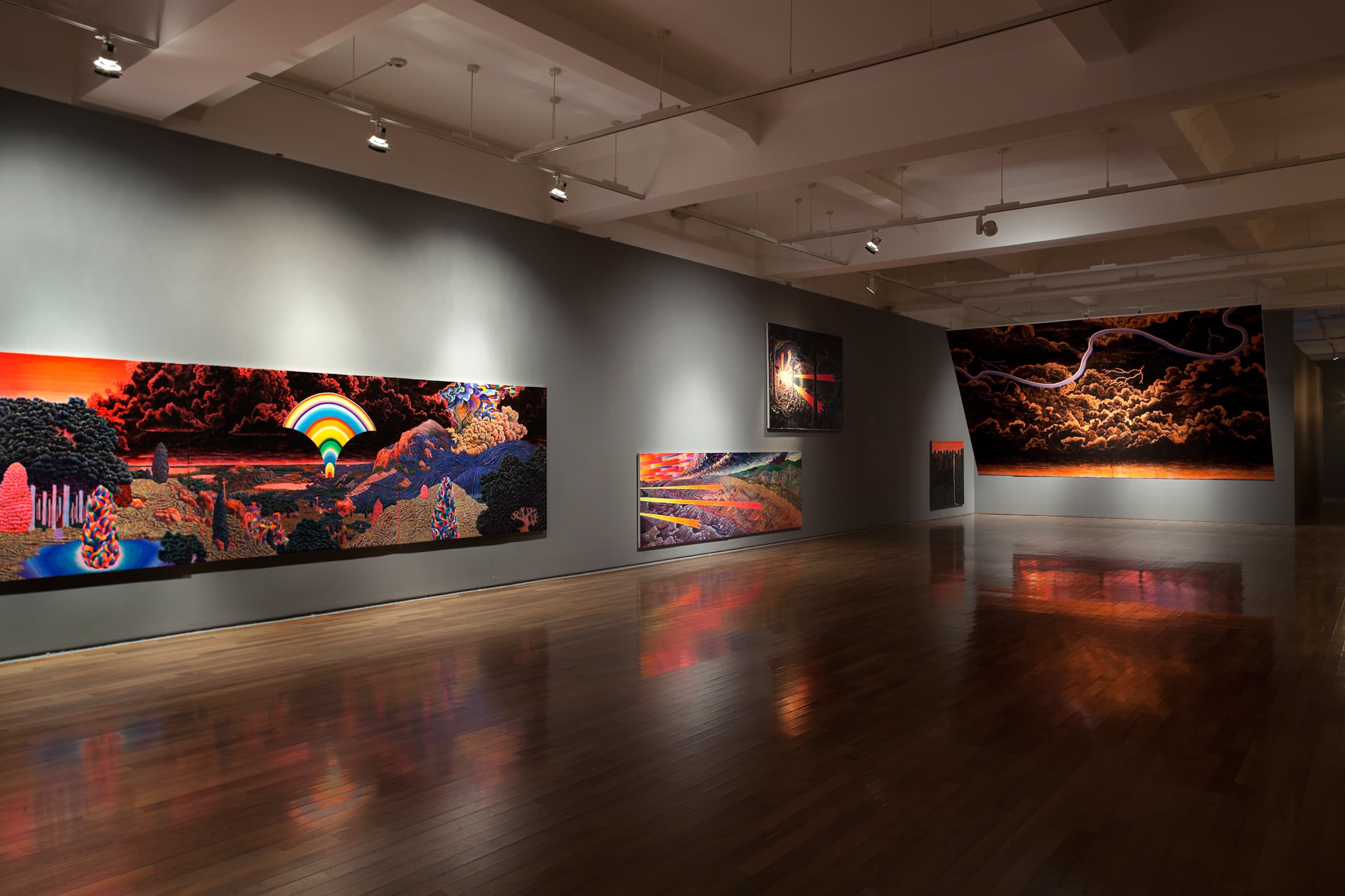
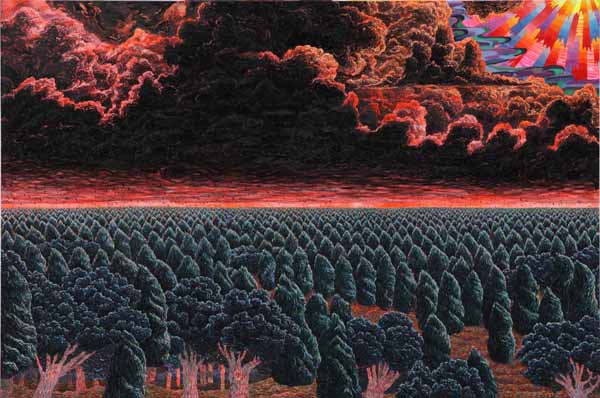
I shift this point of collision from the artist himself onto the surface of the painting. Imaquarks—the smallest units of image—cannot exist upon a blank white surface. Their origins lie in rupture from the past, and thus their beginnings are remote and indeterminate. Moreover, because imaquarks continuously generate collisions through materiality, on a blank white surface they produce only endless amplification of energy. Therefore, a surface through which the diagonal force can pass is required: a point of collision possessing both a limited past and an infinite force. Only such a surface can find balance in symmetry with the ever-amplifying materiality of imaquarks. This is the fluorescent surface. The fluorescent surface has neither above nor below, neither height nor depth. It contains only a vast and dazzling brilliance, and it is temporary. Colors become distorted, and original colors are swallowed up.
Standing before the fluorescent surface, the painter hastily transfers paint, preoccupied with covering it over. If the painter, as a point of collision, performs acts of delay in order to redirect force, then before the fluorescent surface of collision he becomes restless and unsettled. Faced with the event of collision between the fluorescent surface and materiality, the painter is driven to the point of removing his shoes. Upon the fluorescent surface, paint as material slips and slides, and by the time one regains composure, what emerges upon the now-quiet fluorescent plane are masses formed by paint as material itself.
The dizziness produced by brilliance is inversely proportional to the intervals between the masses of paint. Within this bewildered mental state, paint becomes both action and the trace of process. Georges Didi-Huberman argues that images possess their own intrinsic movement, and perhaps actions performed within such bewilderment are themselves pure movements toward the image. Everything moves, and everything that moves leaves traces behind. In the language of physics, even the forces that bind particles together possess mediating particles; borrowing Kant’s terms, this would correspond to the movement (or agitation) of the mind produced by the feeling of the sublime—that is, displeasure.
From a physical perspective, there is something that runs through both the relationship between imaquarks and paint, and the relationship between the fluorescent surface as a point of collision and the feeling of the sublime. Materiality and sublimity coexist through movement (force). Paint moves across the fluorescent surface. Then what does the painter do? Before judgment can even occur, movement—painting—has already begun. What remains is only painting in a state stripped of judgment, painting as it is. Painting without an object, painting without purpose, painting without a subject: this is a suspended state of painting (pause), accompanied only by traces preceding the act of painting itself.
Painting, repeating movement and stillness, progression and pause, flickers continuously and produces rhythm. As this rhythm accumulates, painting itself—movement itself—begins to chase after it. By the time the fluorescent surface disappears, the painter’s bewildered state subsides, and pain emerges in the hands and shoulders, folds of accumulated masses begin to appear across the surface. In the end, the painter is merely a pitiful laborer transferring paint, and such painting is painting without an owner.
And yet—what became of the third silk pouch?