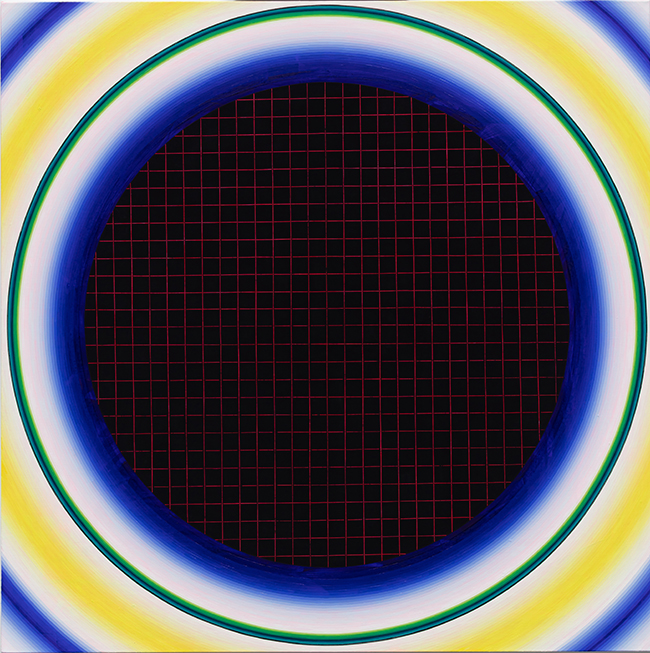
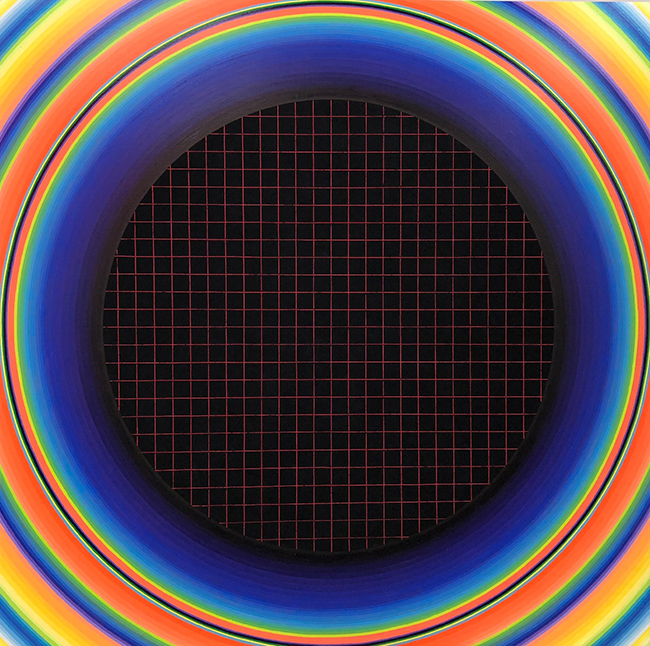
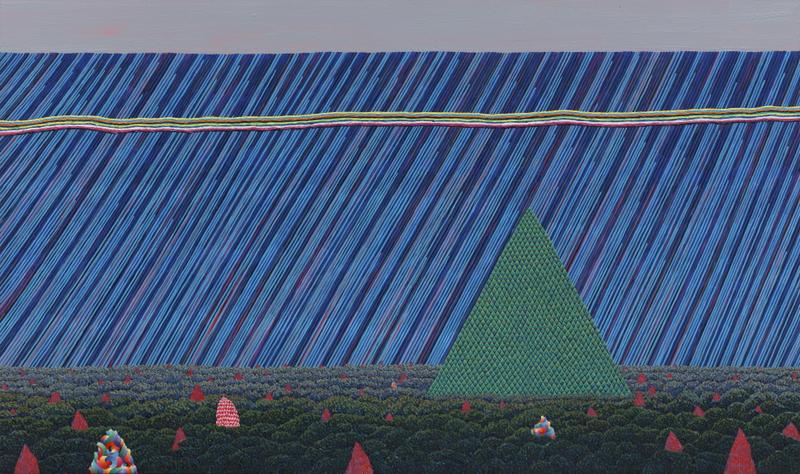
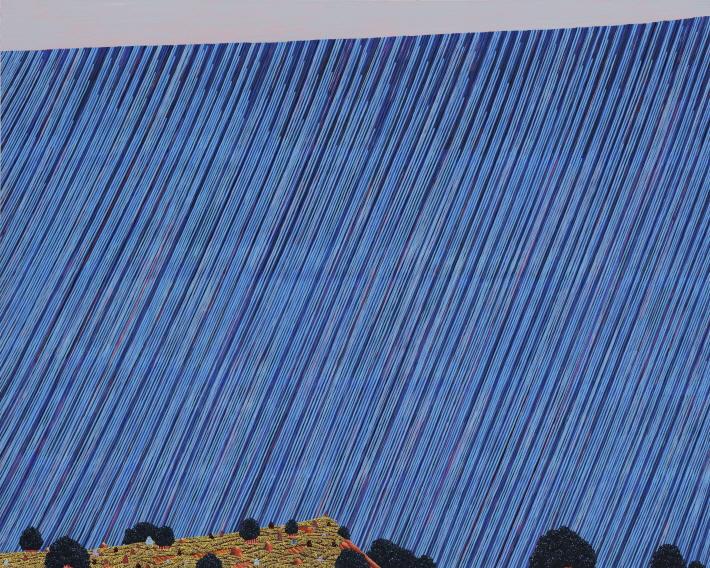
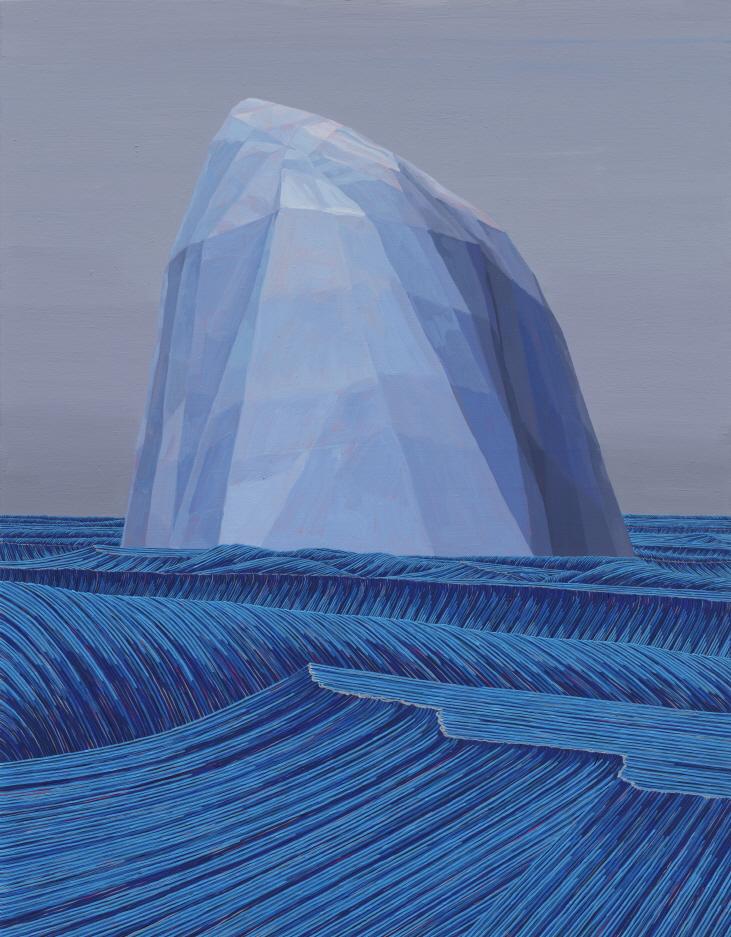
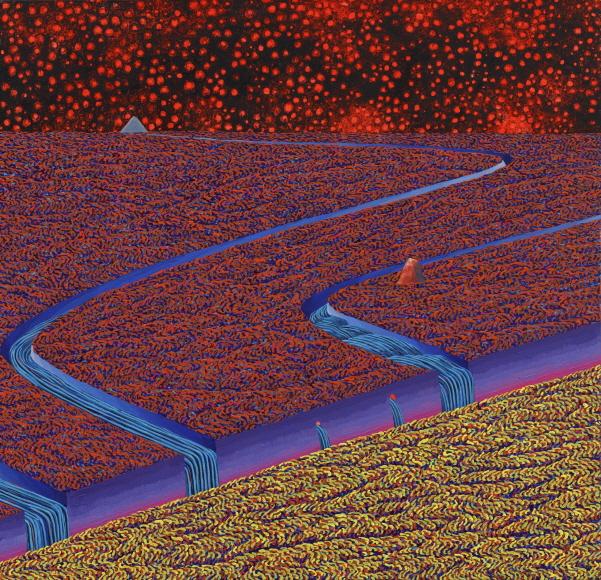
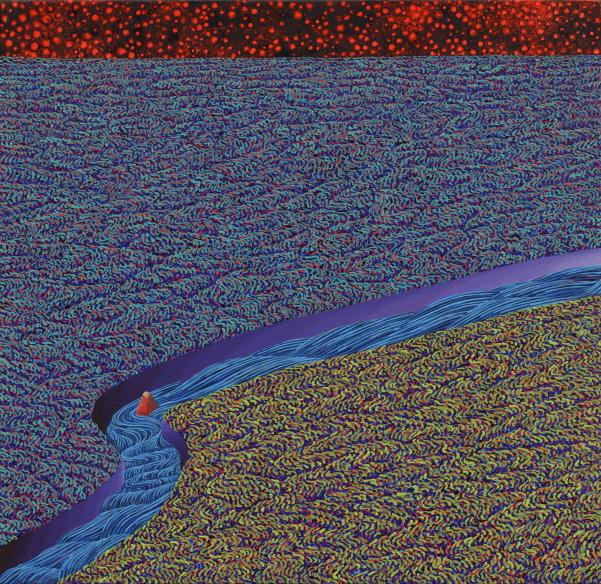
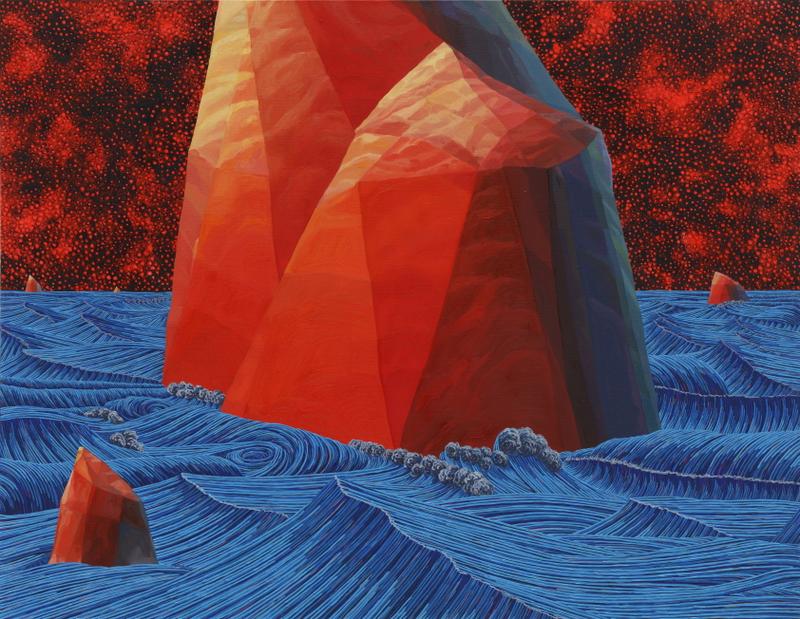
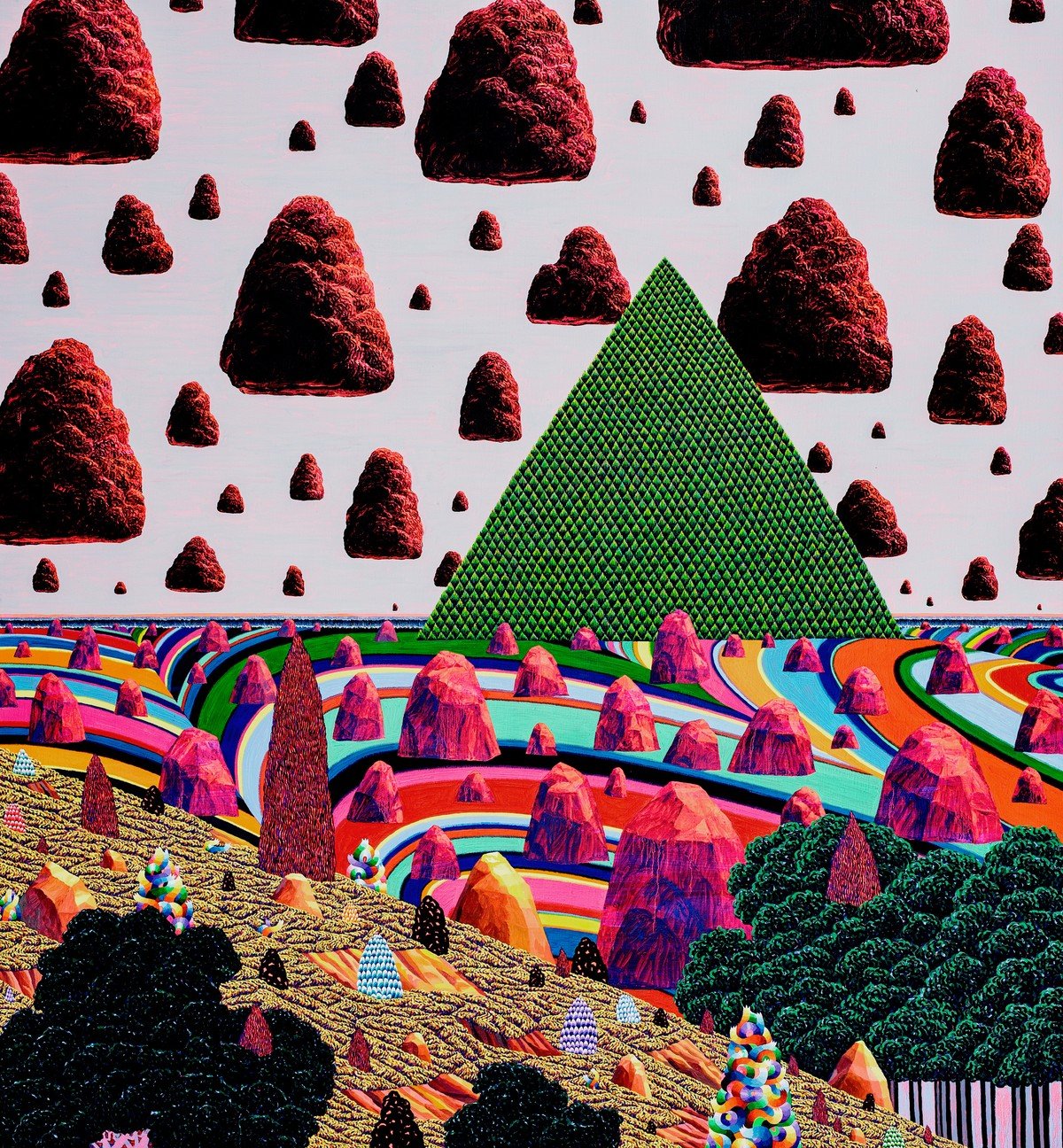
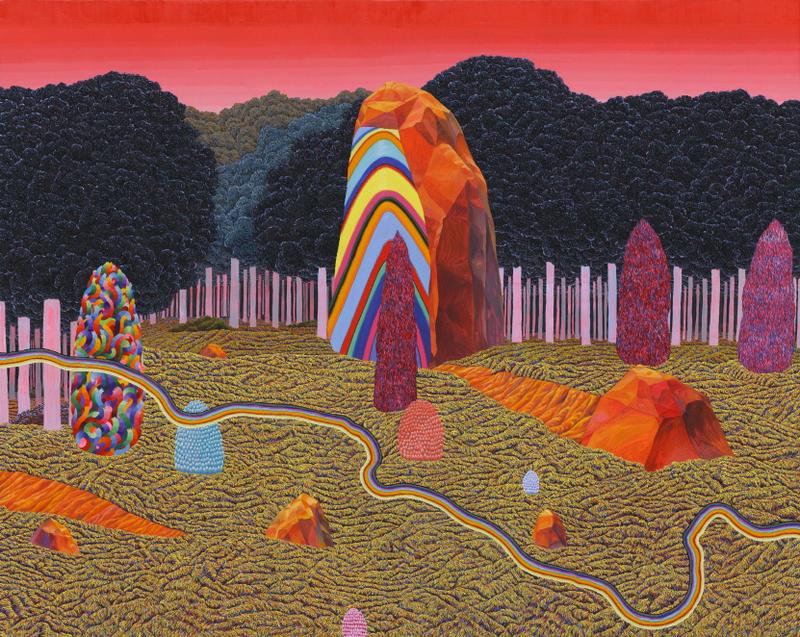
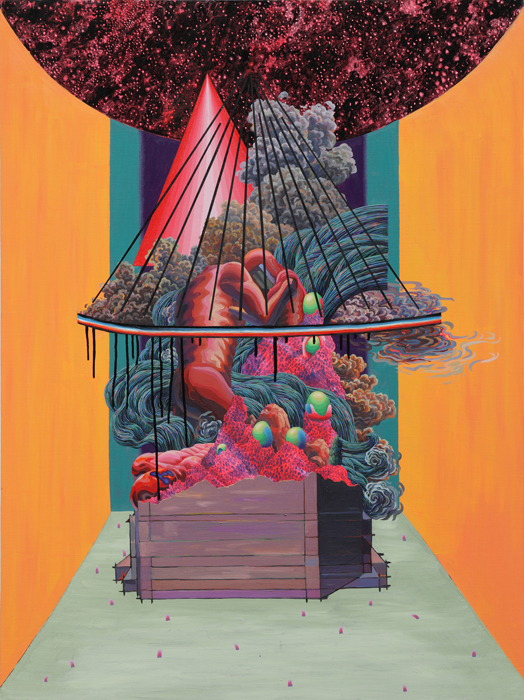
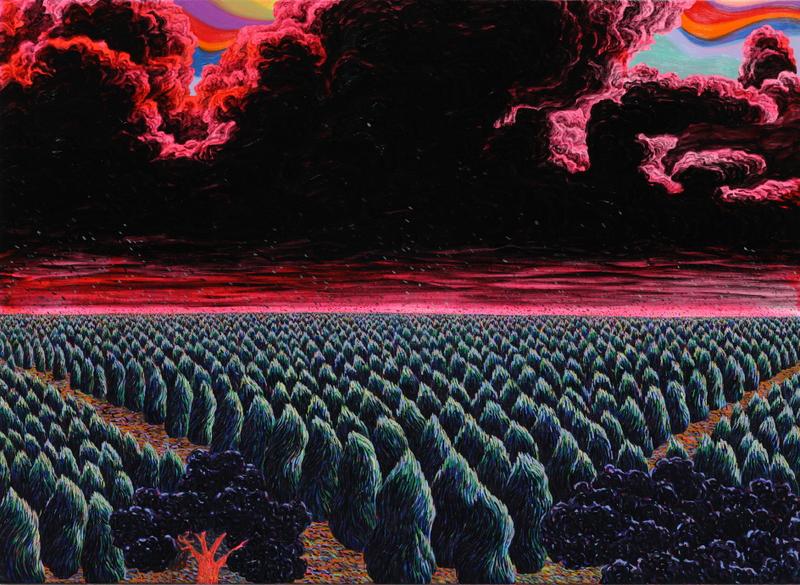
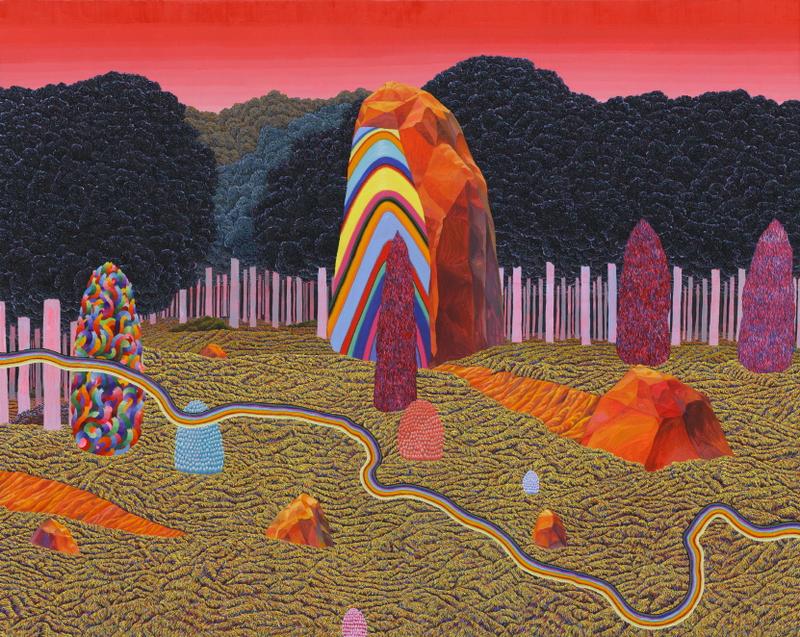
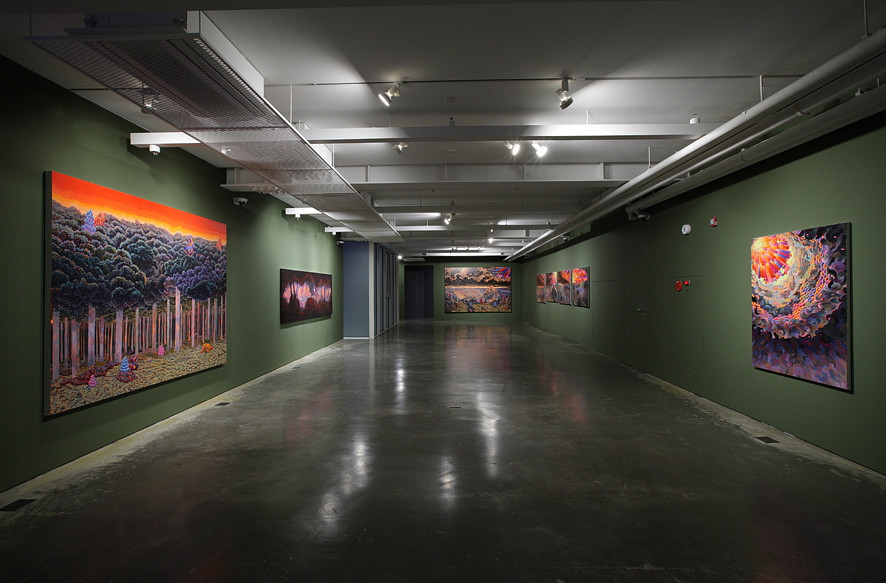
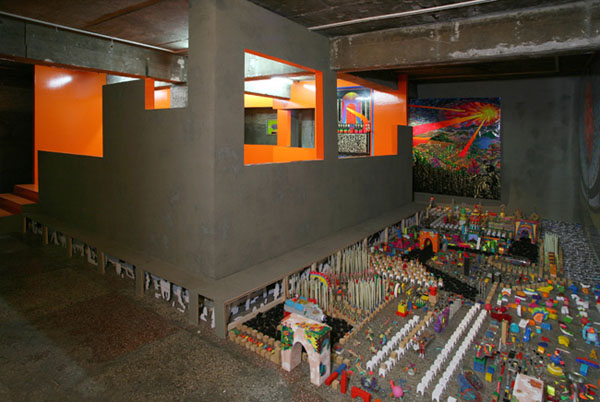
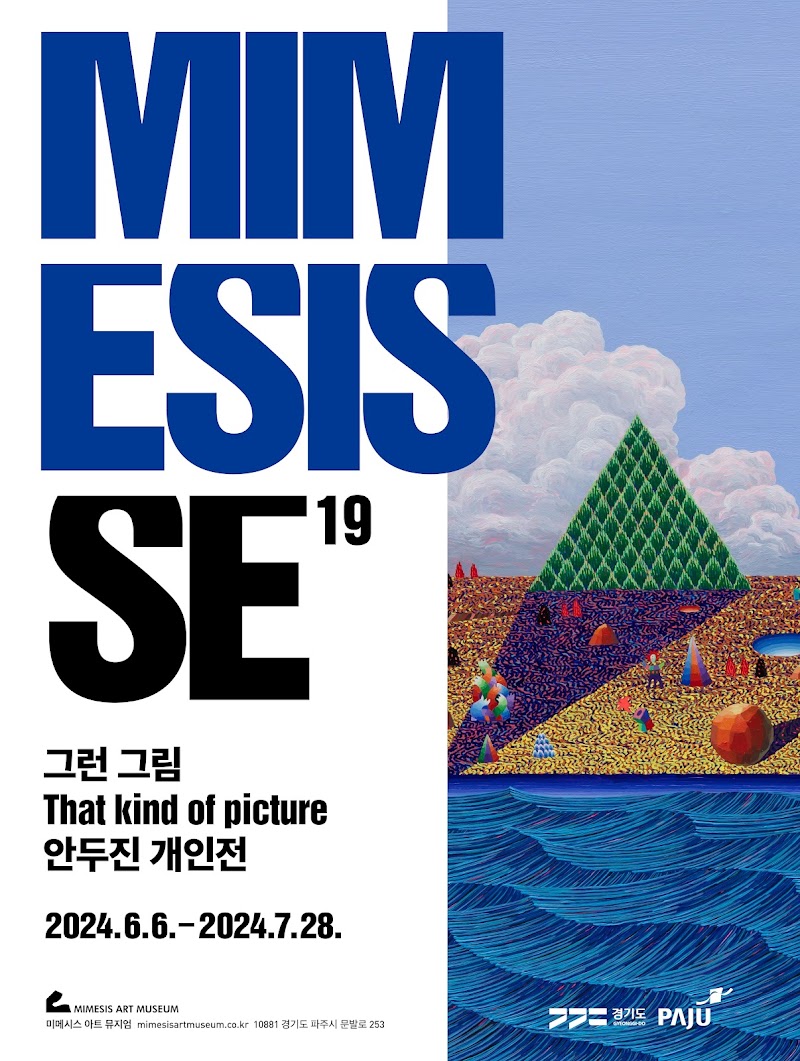
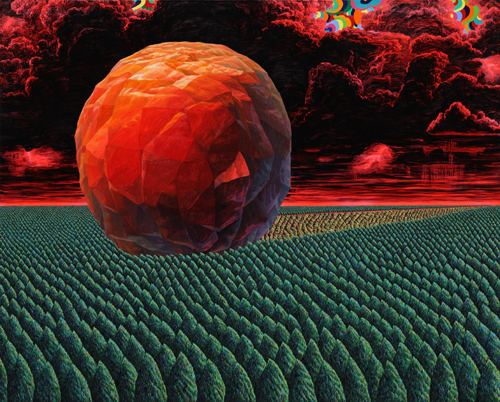
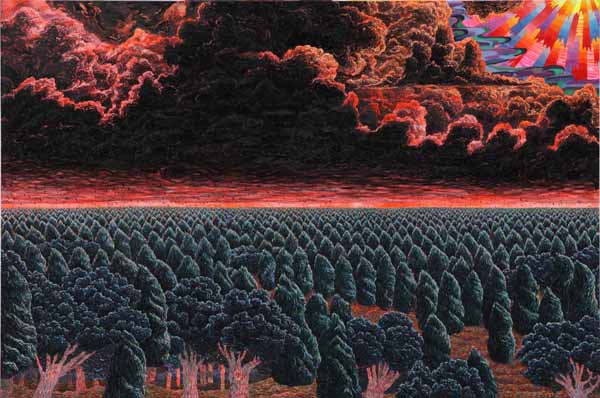
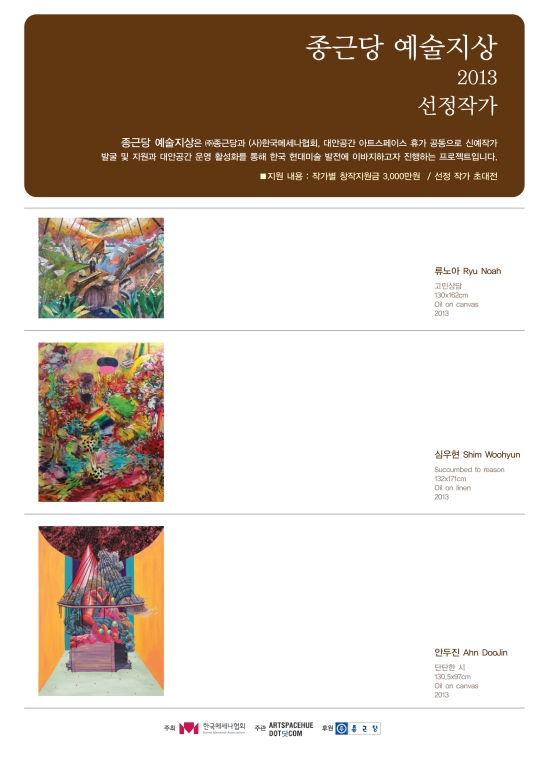
Ahn Doojin’s “That kind of picture” is this kind of painting. At first glance, the forms resembling trees, rocks, and the sea appear familiar, yet their unprecedented colors and gravity-defying shapes evoke unfamiliar sensations. Though confined within the rectangular frame of the canvas, the contrast between the small human figures and the vast cosmic landscapes unfolding across the surface invites viewers to imagine an expanse extending beyond the frame.
The fluorescent surfaces densely filling the canvas reveal meticulousness, while at the same time the cracks in the paint and the loose brushstrokes convey a sense of generosity. Difficult even to infer what exactly is being depicted, these paintings are described by the artist as both the process and result of “painting without an owner,” from which intention and subjectivity have been excluded. By imitating the way nature composes matter, the work fulfills its role not by indicating or explaining something, but simply by existing.
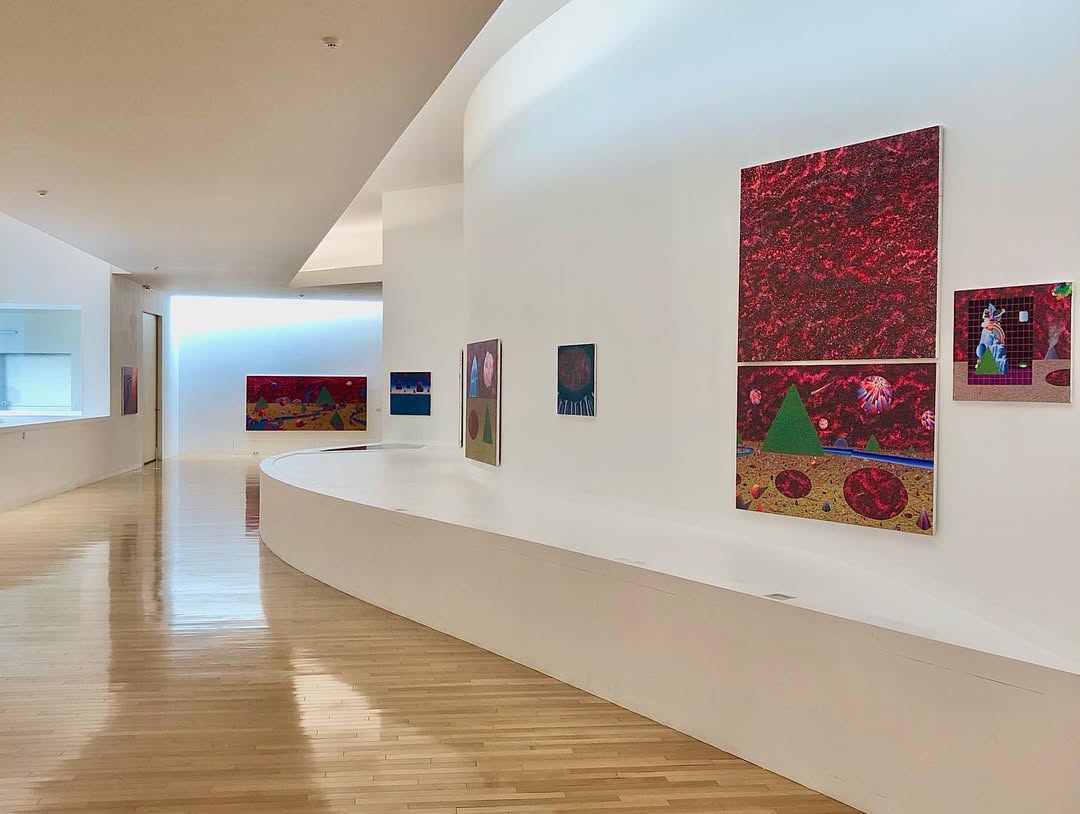
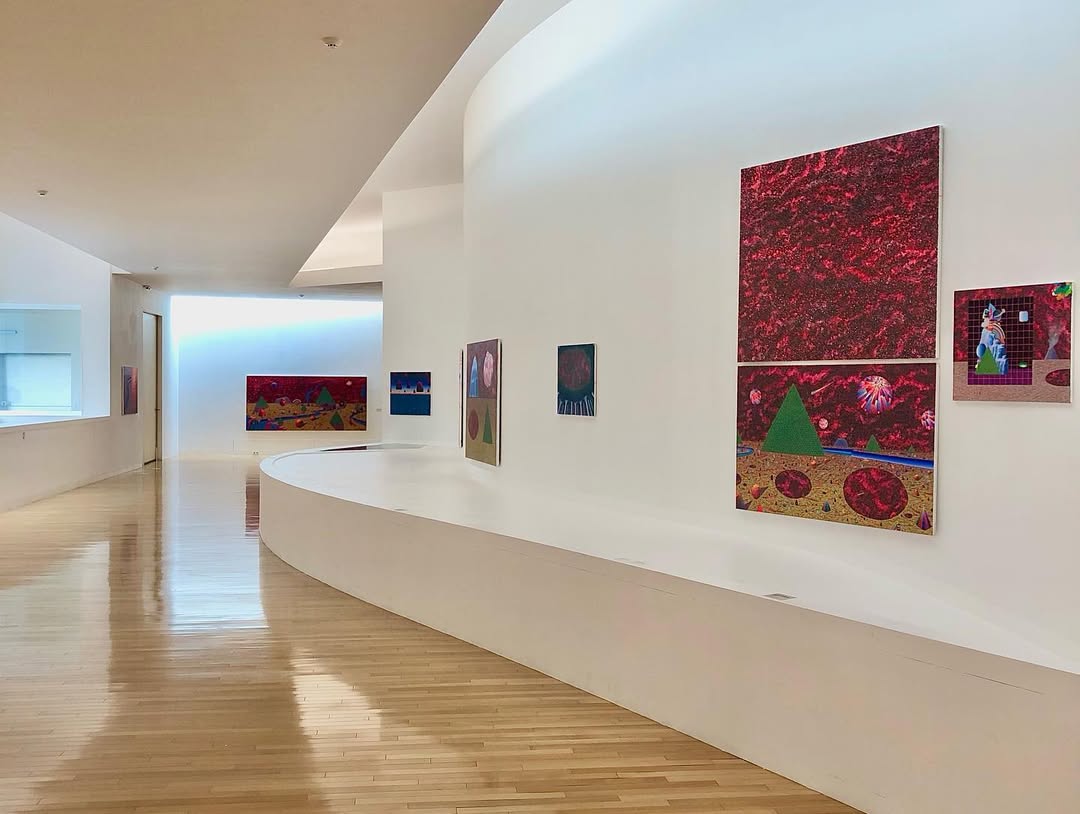
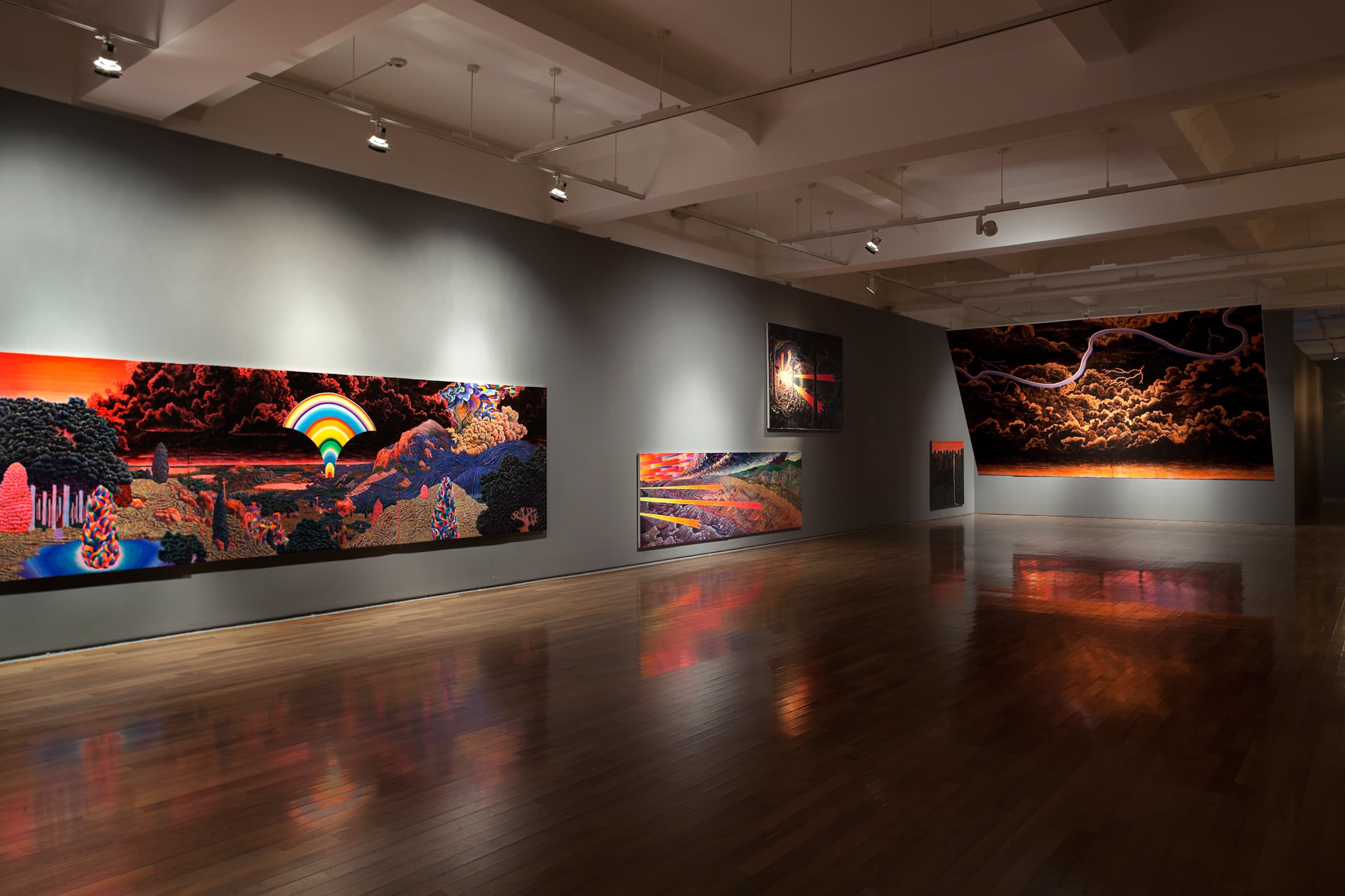
However, contrary to Ahn Doojin’s attitude of minimizing the artist’s intervention, the manner in which the works are installed gives the impression that the force of the artist (or curator) has been excessively imposed. Silence (2010) is one such example. Greeting viewers at the entrance to the third-floor gallery, the work is hung far above eye level and, with its brilliant colors, evokes the stained glass of a cathedral, creating a sacred atmosphere. In this situation, painting appears to imitate a concrete object in precisely the manner the artist had so carefully sought to avoid.
If Ahn Doojin sought to demonstrate that “painting possesses possibilities in and of itself,” while minimizing the intervention of the creator, why then did he adopt such an overtly intentional—or seemingly intentional—arrangement? Is this perhaps an intentional “mistake,” an exception to “painting without an owner” deliberately introduced by the artist himself?
Such an arrangement, which could easily be read as a flaw, paradoxically emphasizes that neither the painter nor the painting is subordinate to any single authority, but instead exists independently. It also makes us recognize that each contributes to the “moment,” “composition,” and “assemblage” called painting—or the artwork itself. Consider the placement of Silence and the experience that follows from it. Because the work is hung so high, viewers must tilt their heads upward toward the upper reaches of the gallery in order to see it. This imposed posture reinforces the internal logic of the painting, which generates—or seeks to generate—a sense of the sublime.
Conversely, the sublime produced within the canvas by the images depicted there compels us to accept the installation’s demand for a particular gesture of viewing. In this way, while persuading viewers of the mysterious and sacred atmosphere created by the unreachable placement of the work, the artist foregrounds the sheer “existence” of the elements themselves and extends the domain of painting beyond the canvas.
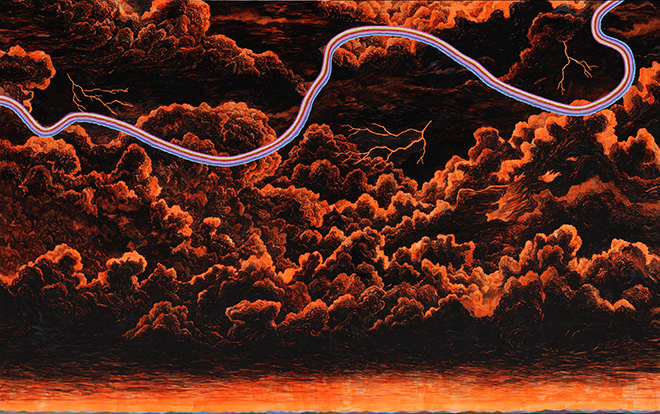
Facing these works are Point and Spot (2013), Twins of Nature and Figures (2019), (Kung! Screech)–(Movement and Black Square)–( ) (2022), the series ‘(Chwarak)–(Landscape upon Landscape)–( )’ (2022), installed in a straight line near the end of the exhibition yet hung at varying intervals, as well as Gabriel (no.1)–Black Circle and Black Square (2022) and Gabriel (no.2)–Black Circle and Black Square (2022), all of which share black skies punctuated by occasional red dots.
These works are products of a curatorial approach based less on chronology than on visual resemblance, allowing viewers to discover connections and rhythms between one work and another. Those connections and rhythms, in turn, become visible rationales for the repetitions and differences among the paintings—the visible necessity of colors, forms, and materialities governed by natural laws that precede the rectangular frame itself.
Levi R. Bryant argues that all objects are equal because they exist independently. This does not mean that all objects should be valued equally, but rather that no object can be constituted by another object. In the examples above, the artist assumes the role of a catalyst through which elements both inside and outside the canvas—color, form, atmosphere, materiality, the position of the canvas, and even the viewer—may encounter one another. At the same time, by making us aware that the boundaries between these elements remain distinct, he emphasizes himself as yet another independent factor provoking their tensions and interactions.
In other words, he introduces installation as a strategy to clarify that painting consists of countless elements existing independently of Ahn Doojin himself, and that these elements collide and move against one another. Thus, after the “death of the author,” the anxiety surrounding the existence of the painter is overcome through becoming equal to everything else. To prevent this equality from being distorted into erasure or zeroing-out, he continues his experiments without cease.
Ahn Doojin has stated that “what matters is not becoming something, but allowing all elements participating in the process, including the creator, to become equal elements.” Here, “equality” should be understood not in terms of importance or degree of contribution, but as existence itself. To emphasize once again: Ahn Doojin’s paintings are just paintings. They are not possessions that exclusively embody the artist’s intentions, but simply paintings that exist there—sometimes distant from him, sometimes close to him—without requiring any supplementary explanation for their presence.