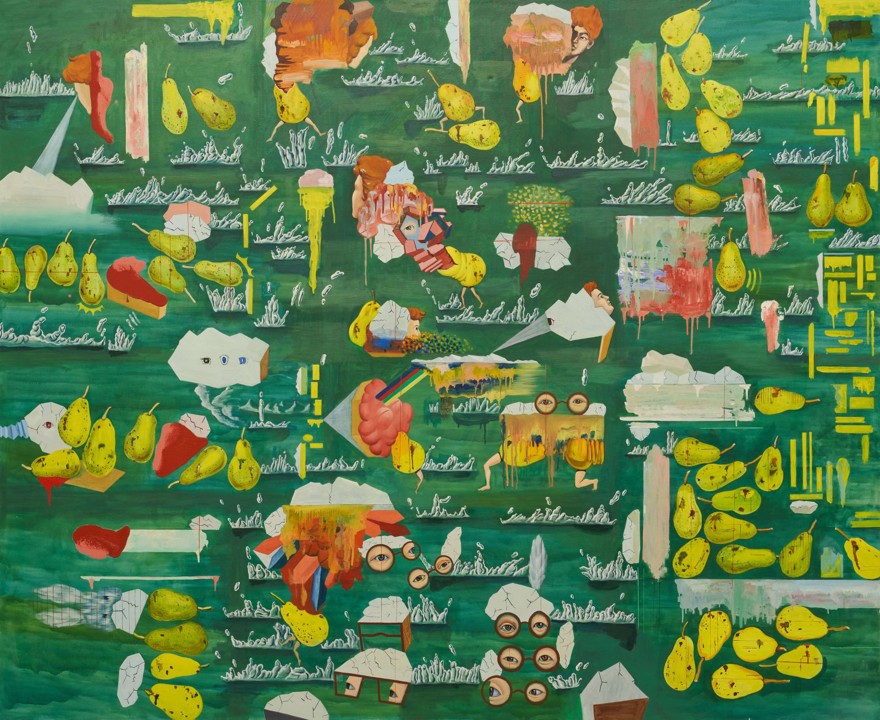
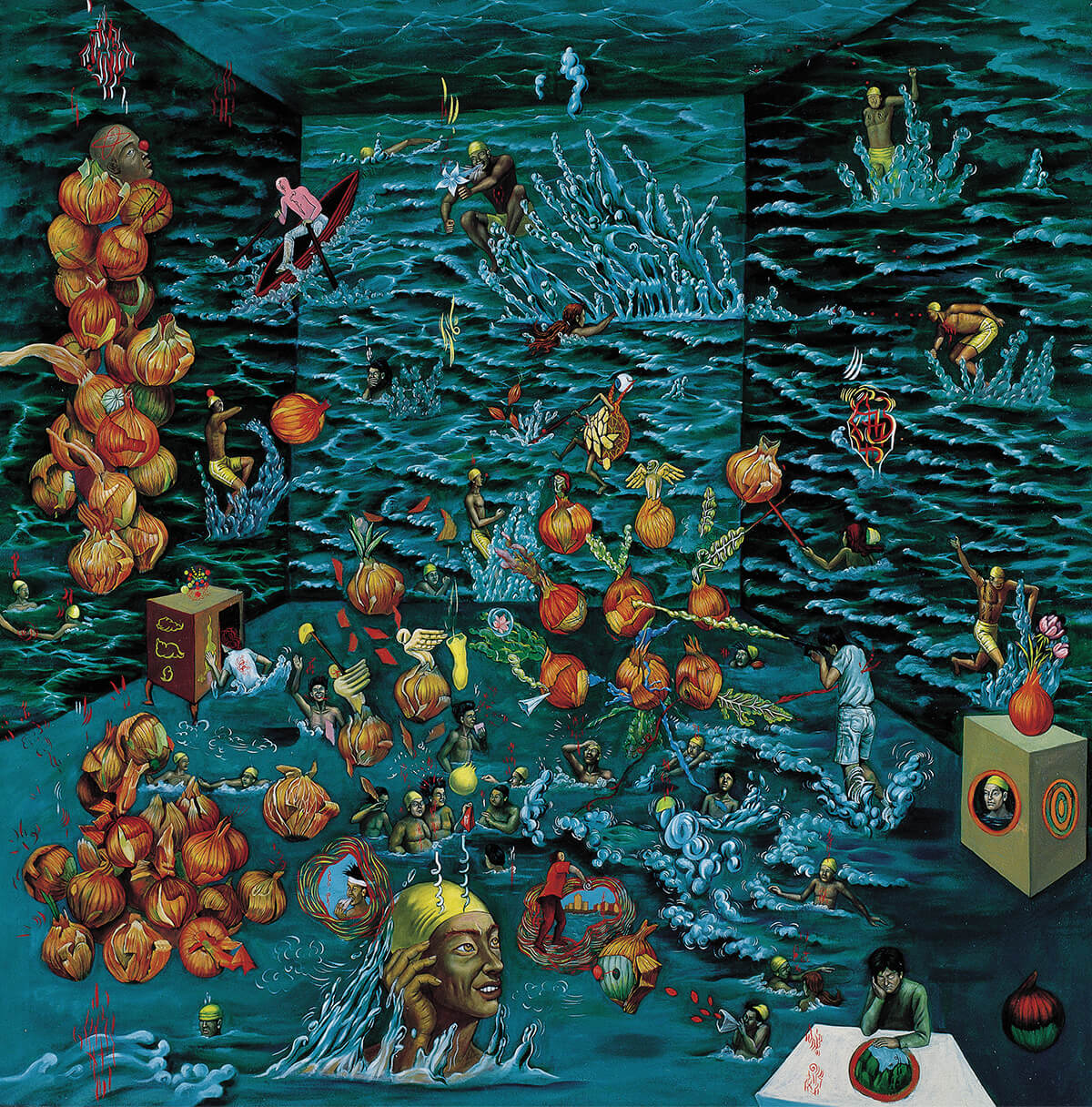
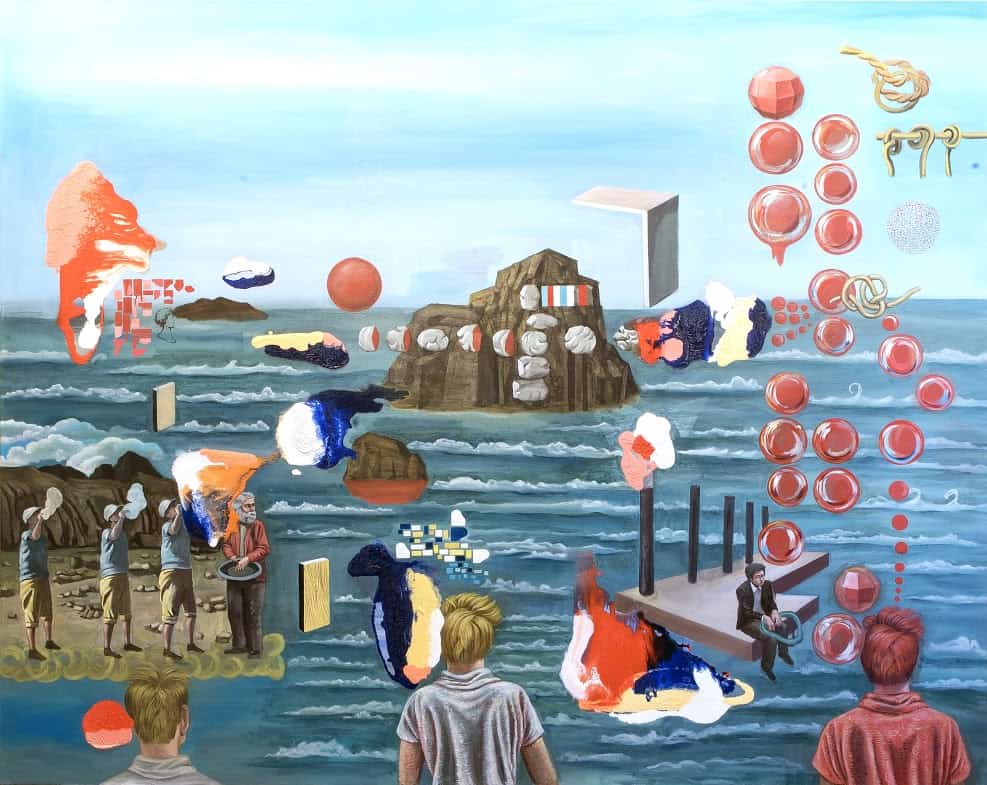
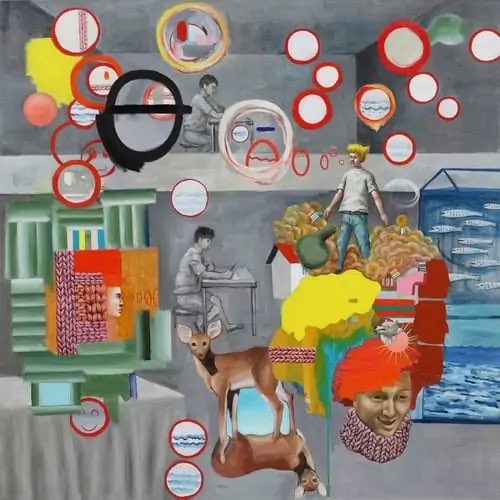
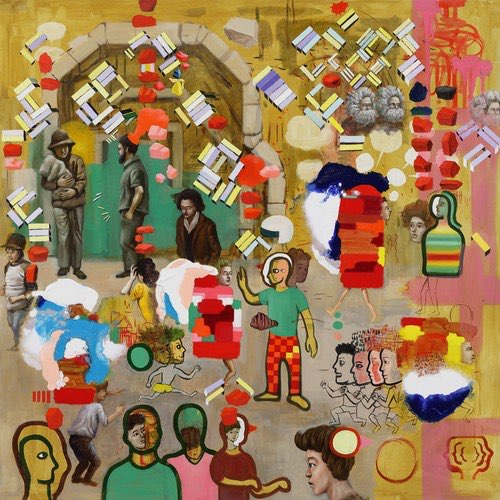
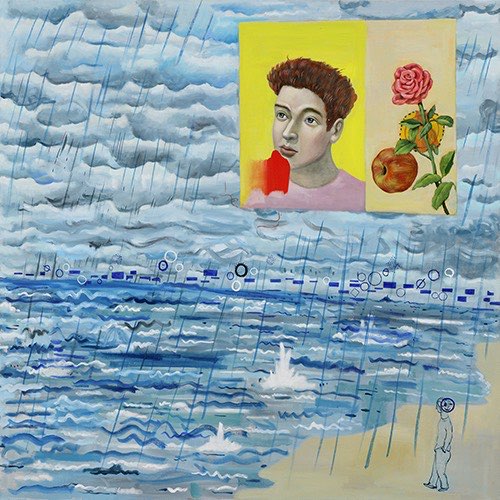
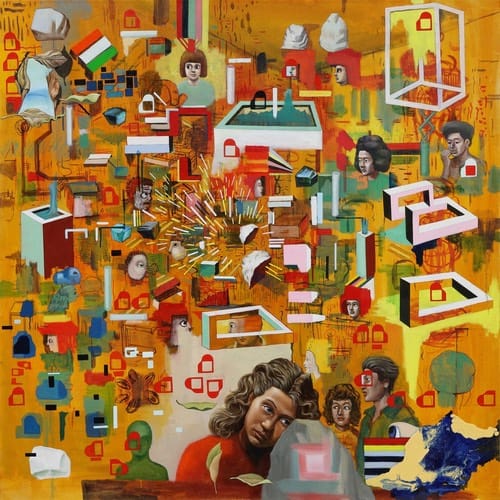
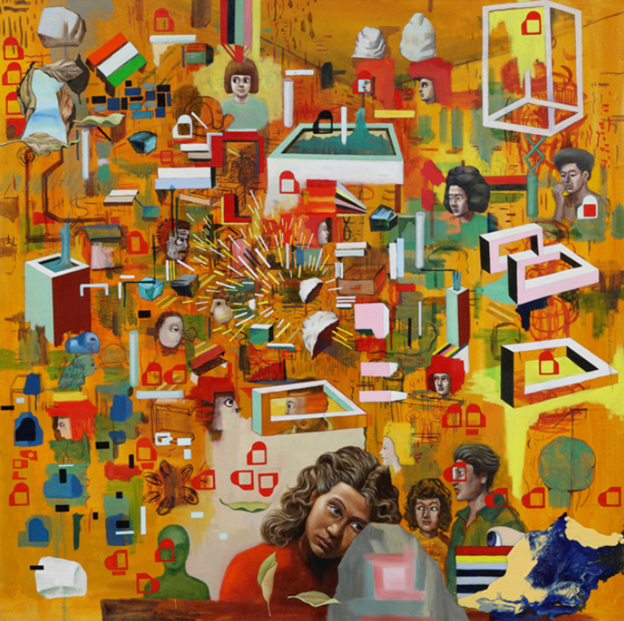
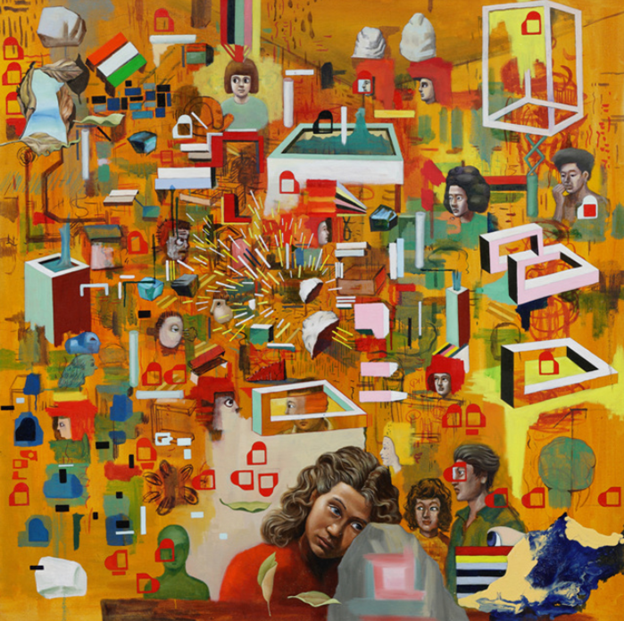
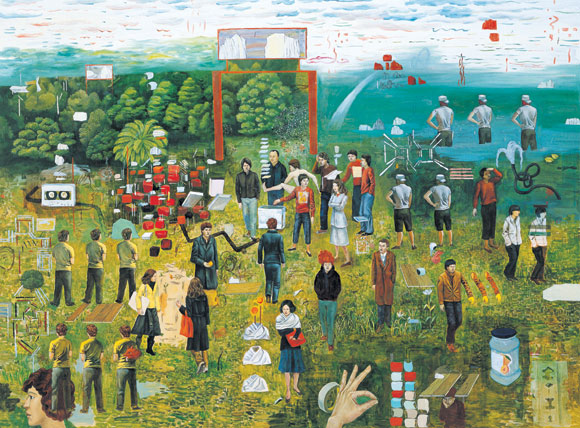
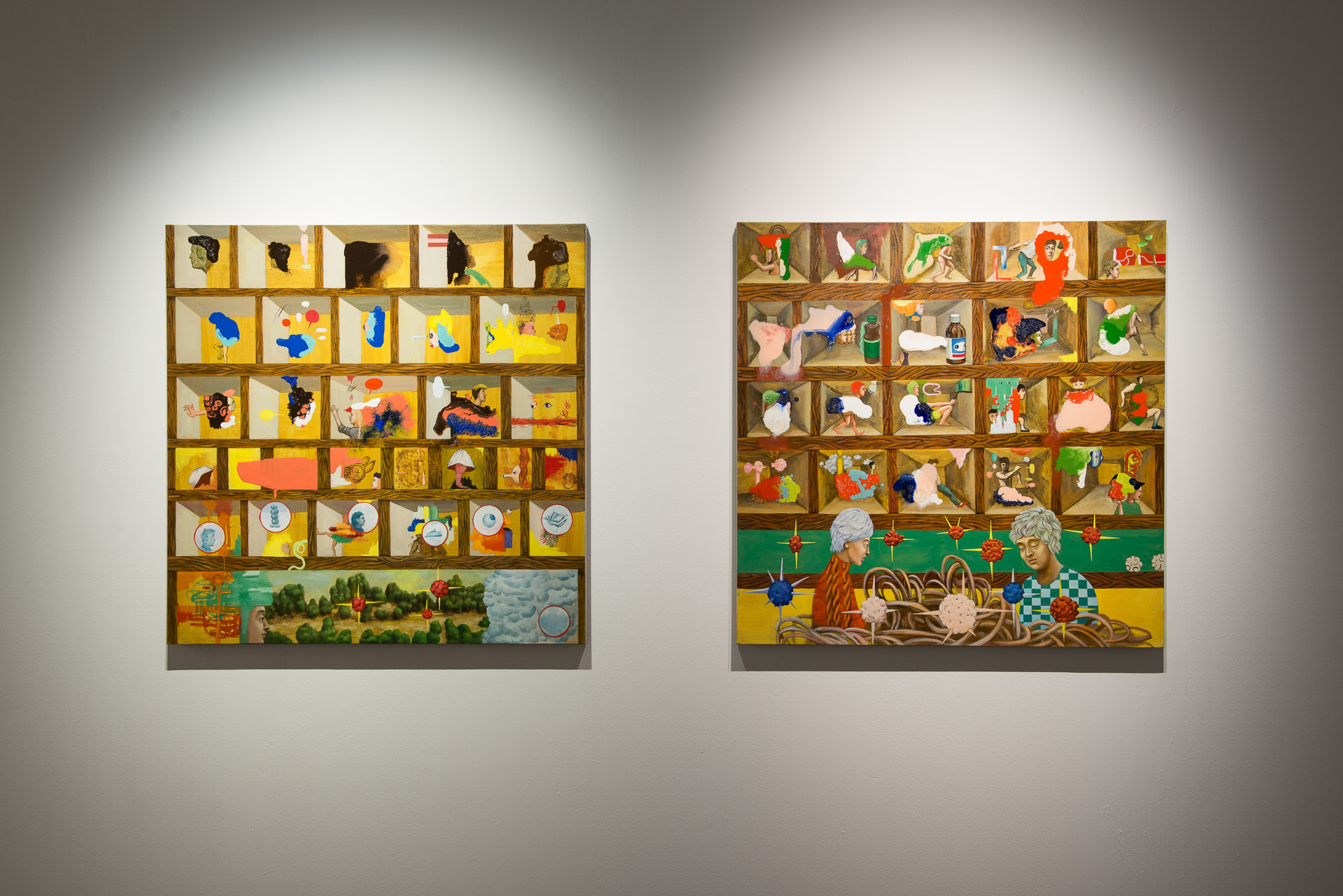
Suejin Chung, A Representation of a Real Situation with a Variable Indexical–Narrative Structure, Embodied by the Face of a Girl from Page 14 of National Geographic, January 2002, and the Various Inner Sensations Surrounding It, 2013-2014, Oil on canvas, 100x100cm © Suejin Chung

Before Suejin Chung, square canvases—rarely used in painting—began to appear frequently. Measuring 50x50 cm or 100x100 cm, these square formats evoke geometry rather than a pictorial “window,” providing a certain unity to whatever they contain. Rather than functioning as a window to look into something, they resemble a chessboard or Go board—a strictly bounded field in which a visual grammar is generated and transformed along invisible vertical and horizontal axes.

In Chung’s work, like the relationship between necessity and chance, there exists a paradoxical logic of freedom within strict structure—an alien logic that generates diversity. As in her exhibition 《Brain Ocean》(2000) at Sarubia Dabang, which I first saw, there is an ocean-like reality contained within a small space like a walnut (the brain). What is called “free art” does not mean that art is free in reality, but rather that within a limited time and space, like a game, it allows for an infinite number of moves. Art is free within a confined spatiotemporal frame, yet it can expand into another dimension through analogy.
 
The artist is the one who must play skillfully within that space—so much so that viewers might want to join in. Since 《Brain Ocean》, Chung’s ever-flowing magical playground has been nothing short of astonishing. In the Korean art scene, particularly among young artists absorbed in their “personal worlds,” there are many paintings filled with swarming motifs and fragmented, disjointed narratives. While Chung can be seen as a pioneer of this tendency, the difference between her and others is significant.

Ultimately, the distinction lies between a dissolution into repetitive, accidental particles and a powerful form of chance that interacts with necessity. For the “emergence of multidimensional beings” (the exhibition subtitle) to occur, intermittent chance alone is insufficient—it must be supported by strong necessity. This requires an affinity for more universal grammars such as mathematics, geometry, or linguistics. For the artist, necessity arises from relentless study of painting and the act of painting itself. The relationship between necessity and chance is akin to that between consciousness and the unconscious.
 
For example, the artist finds it awkward to directly equate the unconscious with chaos. According to Chung’s observation, “the unconscious possesses a sophisticated logical system and operates according to that system,” but consciousness mistakes it for chaos because it cannot comprehend this logic. Just as the unconscious interacts with consciousness, the artist has diligently woven a network of necessity in pursuit of sensory and intellectual pleasure and insight.

As seen in her book [Budo Theory: A New Visual Theory for Reading Multidimensional Consciousness], published alongside the exhibition, Chung is a highly logical artist. Budo theory is described as “a theory for visually perceiving logical systems of thought,” and its distinctive feature is that it does not develop logic based on judgments of right and wrong, but rather on sameness and difference. Here, “logic” does not refer to dogmatic assertions or loosely assembled knowledge, but rather to a genuinely original theory of visual perception.
 
What Chung calls “Budo” appears to be a kind of graphical symbol representing multidimensional forms, and her paintings may be understood as the products of this unique system of notation. Beyond the familiar three-dimensional world lies a virtual dimension, and like a geometer, the painter explores infinitely expanding patterns and polyhedra. The accompanying text related to her paintings demonstrates how information can be transformed from one form into another.

A meticulous researcher with a mathematical mind might be able to analyze Chung’s complex paintings into their basic components and convert them into simple visual codes or diagrams. One might even trace a hidden path through which dimensions multiply. In both her paintings and writings, one finds a coherence within a structured system reminiscent of those who are obsessively immersed in a particular worldview. Beyond the question of belief, every system of belief possesses its own internal logic and consistency, much like scientific paradigms of a given era.


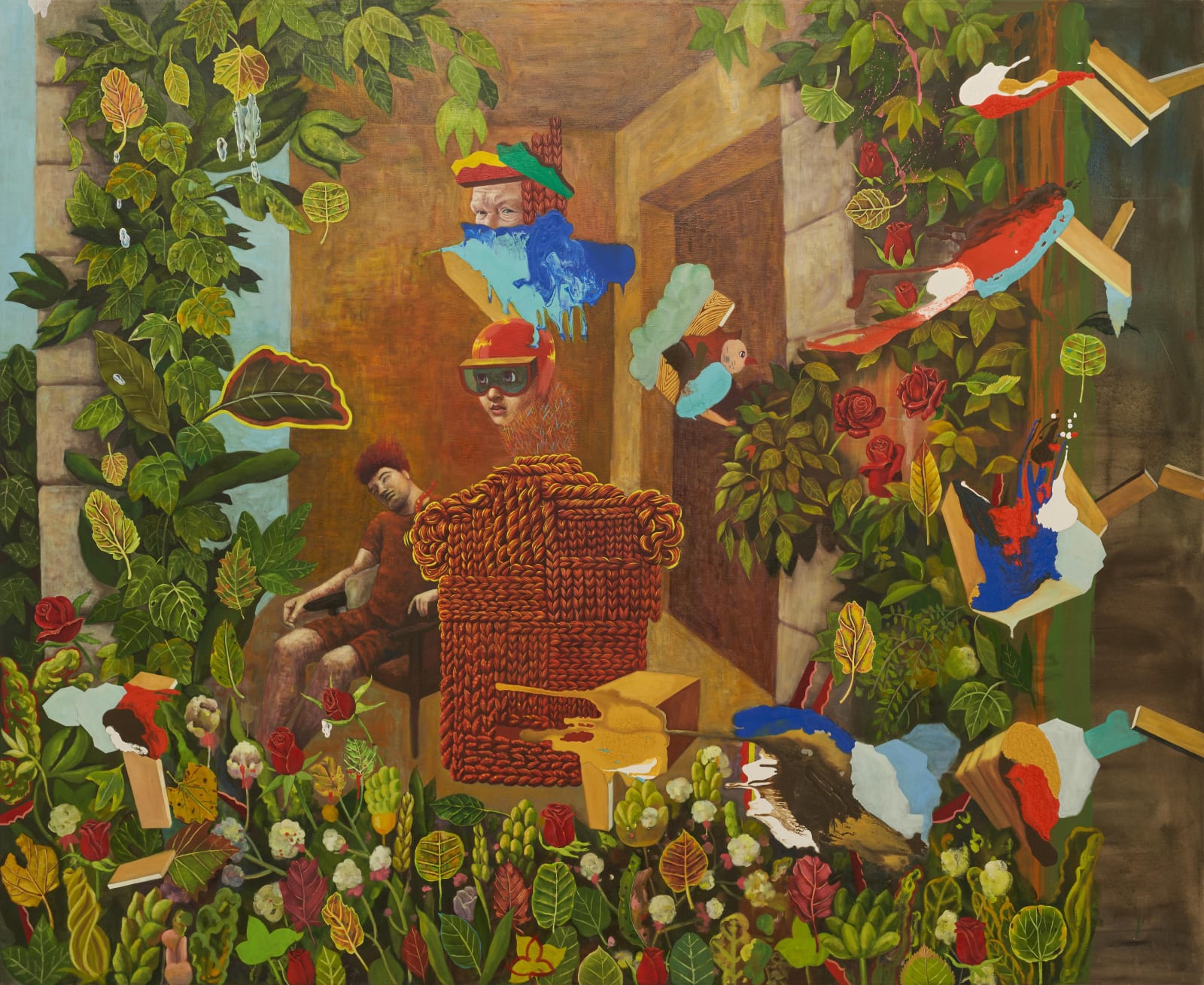
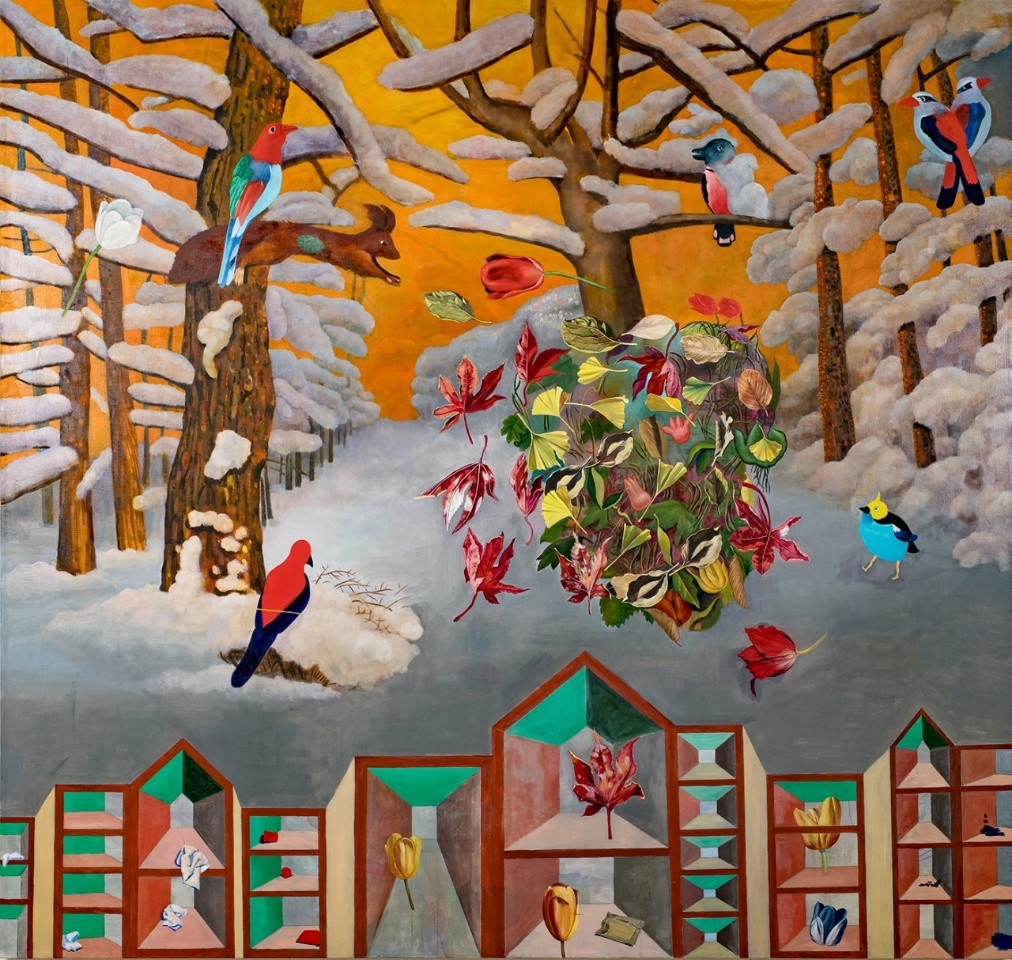
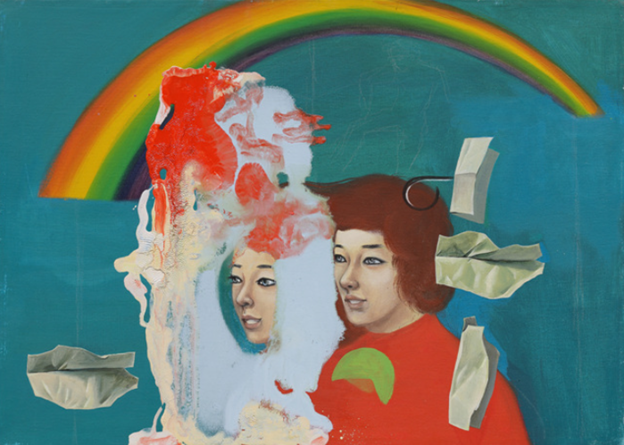
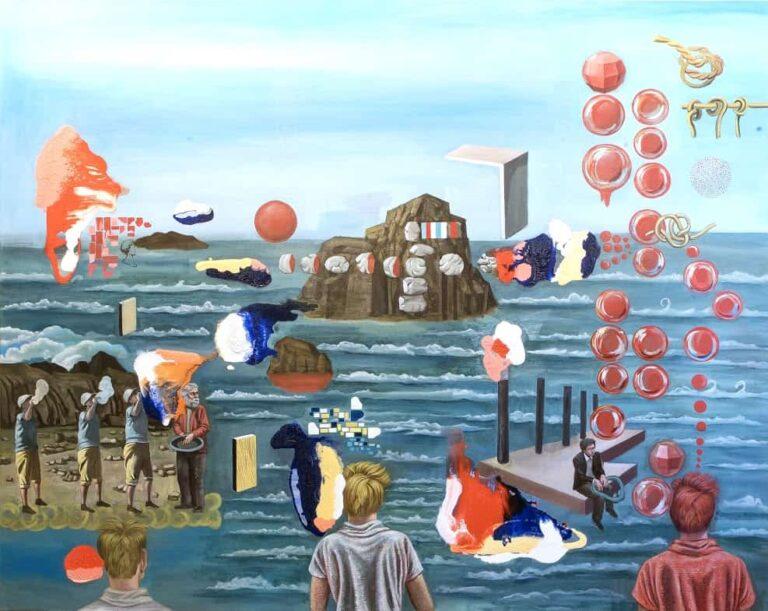
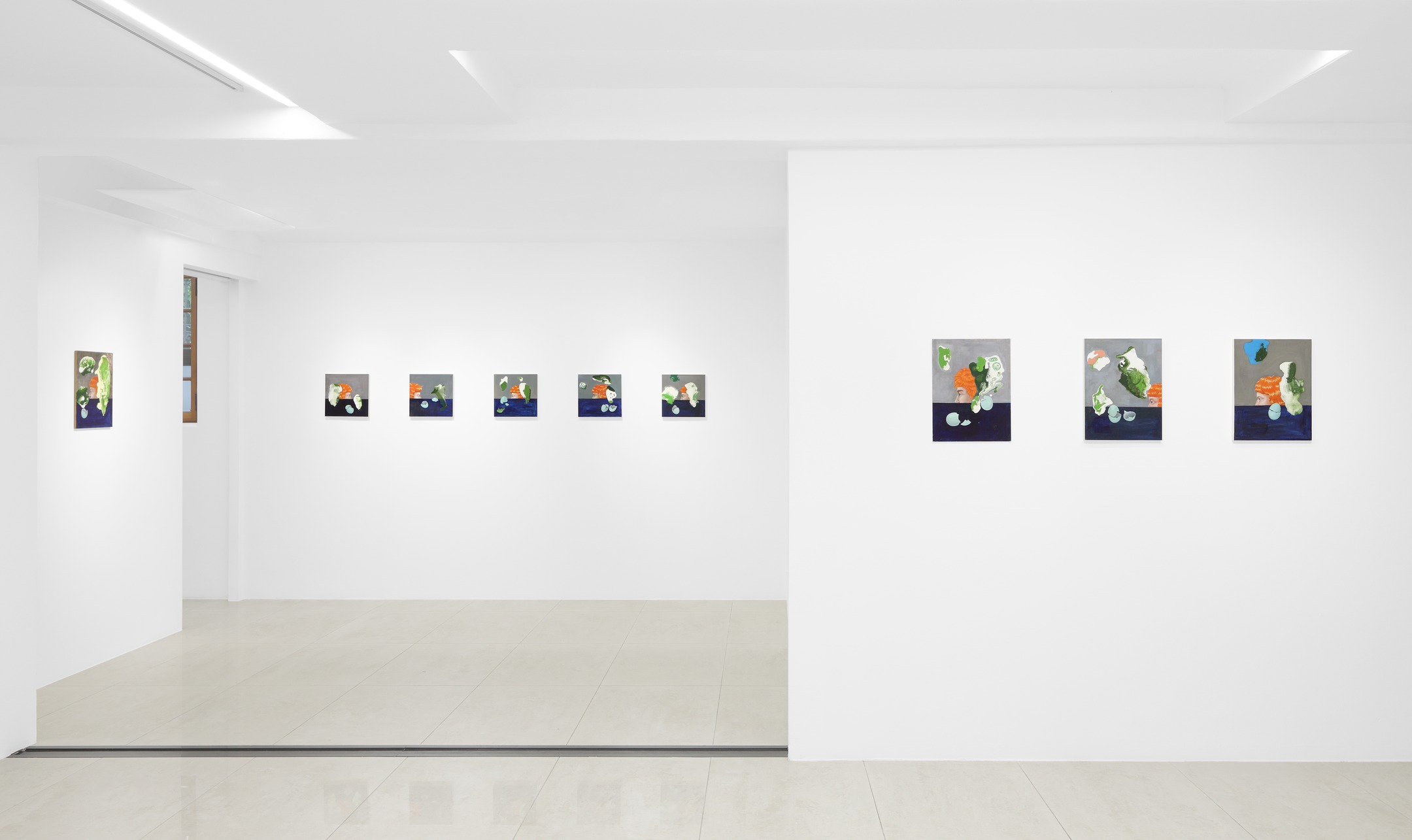
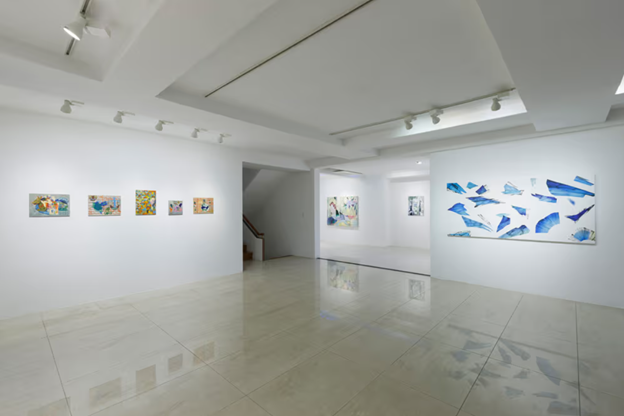
Suejin Chung, Untitled, 2011-2012, Oil on canvas, 30x42cm © Suejin Chung

However, it is not necessary for viewers to read such a complex book in order to understand her paintings. One cannot become Suejin Chung to understand her visual logic. Viewers must approach the work from what is externally visible. While there are works such as Surprised by the Definitive Regulation of a Real Situation, the artist’s expression moves outward from within, whereas viewers move inward from the outside.

It is uncertain where these two directions will meet. Interestingly, although the book is presented as an explanation of her paintings, it contains not a single image. It appears less like a guidebook and more like another artwork written in text. Visual logic and painting activate each other, but they do not correspond one-to-one. There is a cluster of logic there and a cluster of images here. Visual logic, like criticism, does not reproduce or translate a given object into another language.
 
If it did, it would merely be tautology, rendering one side unnecessary or incomplete. The two exist in parallel, in a relationship of resonance rather than transcription. Like the relationship between words and things, the mind and the hand can never fully become one. Reducing painting either to abstract concepts or to mechanical labor devoid of thought is equally meaningless. What interests us is that both the logic and the painting originate from a single individual.

One might even suspect that the book serves as a defense against the tiresome question of what her paintings mean—“It’s all written there.” Of course, this does not mean the book contains no answers. It points clearly to where answers may lie, but determining meaning is no easier than reading the paintings themselves. Chung clearly indicates what is unclear. Her paintings present concrete forms, yet resist narrative interpretation; like the coexistence of detailed motifs and amorphous stains, both her work and logic form a stage of paradox.
 
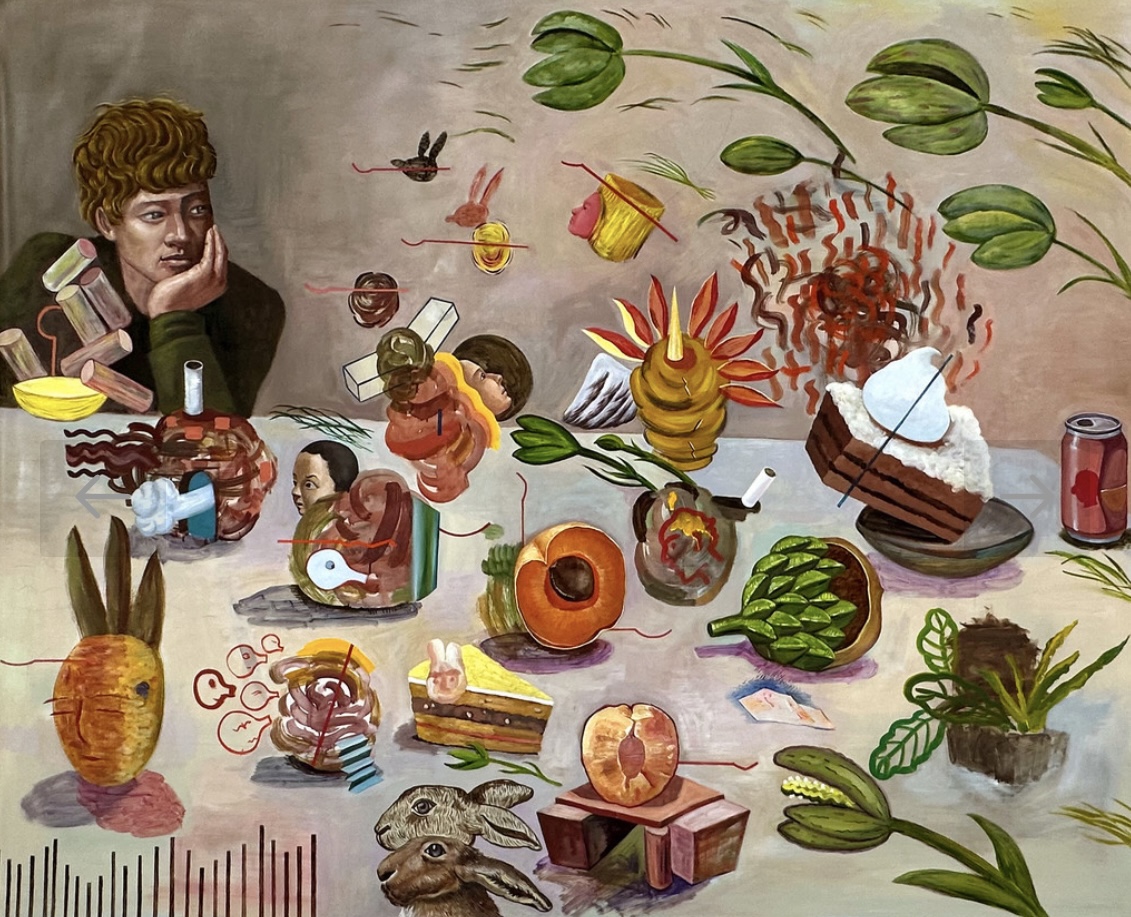
Consider the title of one of the exhibited works: A Representation of a Real Situation with a Variable Indexical–Narrative Structure, Embodied by the Face of a Girl from Page 14 of National Geographic, January 2002, and the Various Inner Sensations Surrounding It,. Although it appears highly “specific,” it does not guarantee meaning any more clearly than the previously favored title Untitled—in this exhibition, only one work bore that title, depicting a mask identical to the face behind it floating in front.

The titles are so long that they provoke laughter, yet even adding more lines would not change the situation. The title contains both definite meanings such as “indexical–narrative structure” and “representations,” as well as uncertain or variable elements like “variable,” “situation,” and “various inner sensations.” The artist states that her work consists of “64 formal units and 64 conceptual units.” If there are that many, they can hardly remain elemental.
 
Systematizing these formal and conceptual units through group theory resembles the methods of biologists, chemists, or mathematicians who classify and quantify existence itself. The combinations of dozens of such units would generate an enormous number of possibilities. Since the work is not purely abstract, the method of combination is difficult to gauge. It would be far more complex than the compositions of Mondrian, for example, which were based on vertical/horizontal lines and primary colors.

The word most frequently encountered in her texts—whether in book titles, exhibition titles, or artwork titles—is “multidimensional.” Paintings featuring the “emergence of multidimensional beings” are forms of “multidimensional geometry.” This multidimensionality provides a logical reason for continuing to paint even in the age of computers. In the era of the information revolution, painters must have their own answer to why they paint, and that answer must possess universality. The “self,” which many painters rely upon, is not sufficient. Nor is “painting for painting’s sake.” The subject and painting are not at the beginning of artistic pursuit but at its end.
 
Chung compares humans to computers. While similar, they are also fundamentally different. Painting is an open system carried out by humans—more intuitive than computers, which operate as mechanical algorithms governed by closed forms. Multidimensionality is reborn as rich intuitive imagery. The concept of “manifold,” introduced by mathematician Riemann, turns “the diverse” into a concrete entity determined by multiple factors. The amorphous stains and traces appearing in Chung’s work in recent years suggest that such manifolds are not only geometric but also related to complex flows like turbulence.

The geometric metaphors implied by “multidimensionality” are abundant. Impossible forms and organisms appear, and polyhedra are animated with lifelike qualities. The brain, often symbolized by walnuts in her paintings, evokes the unseen world and dimensions. Like the onion in earlier works—symbolizing an endless hermeneutic loop—the brain, folding infinite layers within a finite space, becomes a powerful metaphor for painting itself.
 
As Hamlet famously states, “I could be bounded in a nutshell and count myself a king of infinite space,” a metaphor often associated with the brain’s capacity for spatial imagination. In Chung’s work, geometry is flexible enough to appear in cartoon characters or holes in bread. The stains and traces that disrupt otherwise ordered compositions evoke sequences, proliferation, and the processes of emergence and disappearance. For change to occur, as ancient atomists argued, the concept of the void is essential.

Many of her works reference “emptiness (空),” such as The Emergence of a Face Produced by the Conceptual Definition of Emptiness. In works like An Analytical Dialogue on the Void Occurring in a Multidimensional Poetic-Pictorial Space, holes appear in the canvas, revealing blank white spaces behind. Emptiness here signifies not mere absence, but the potential for transformation.


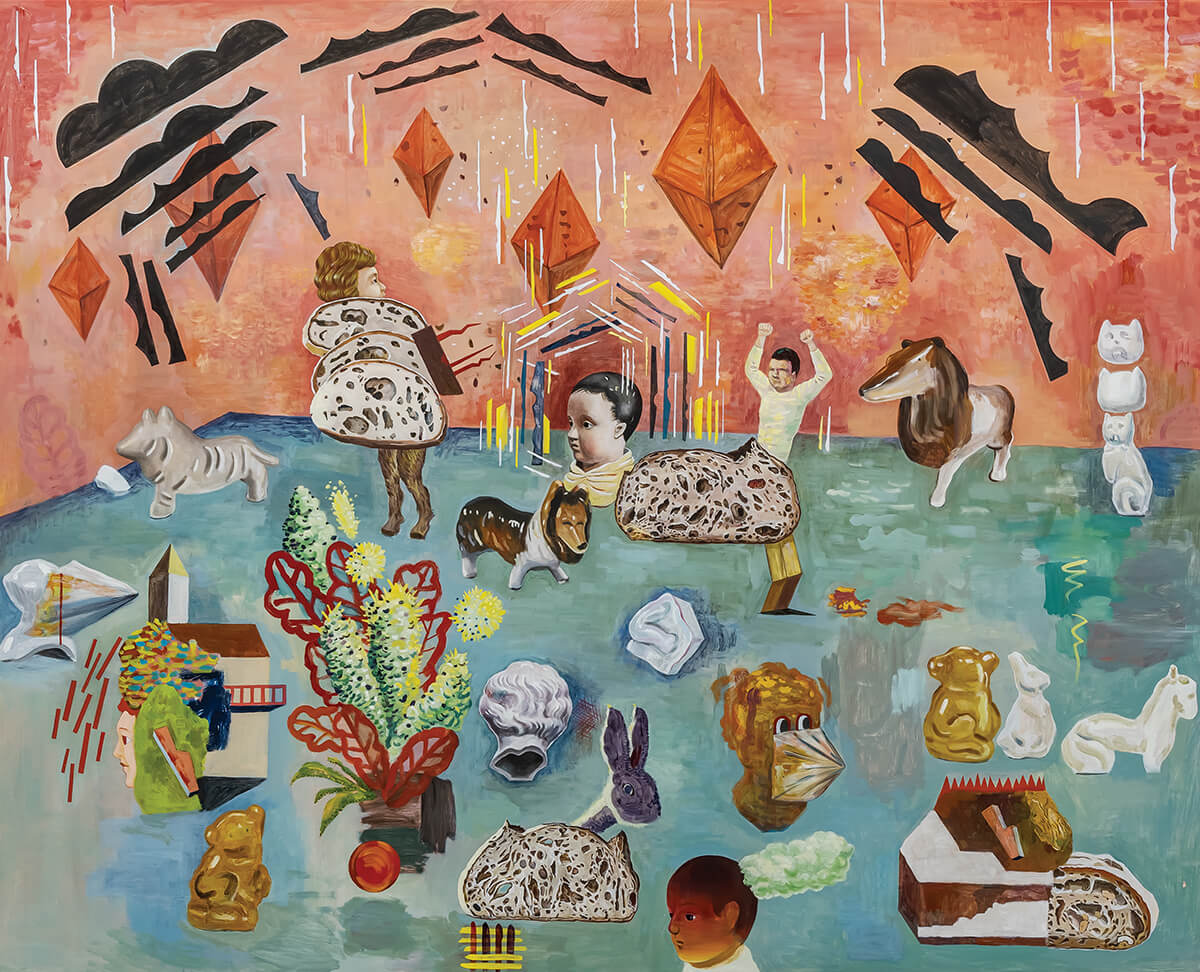
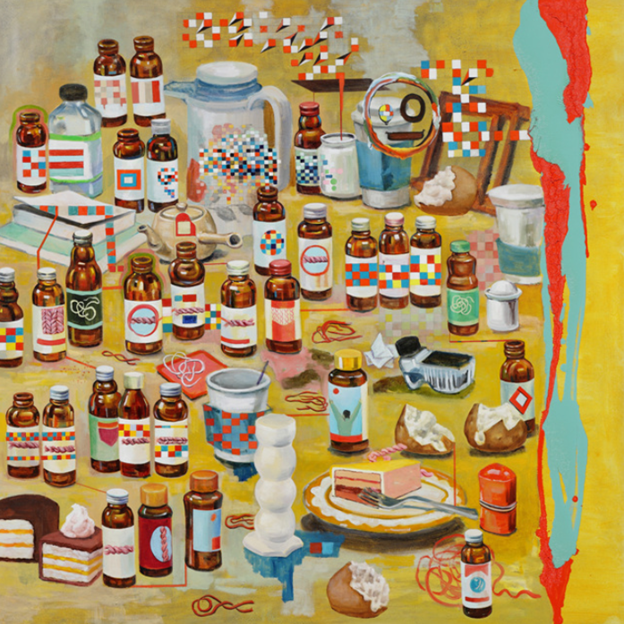
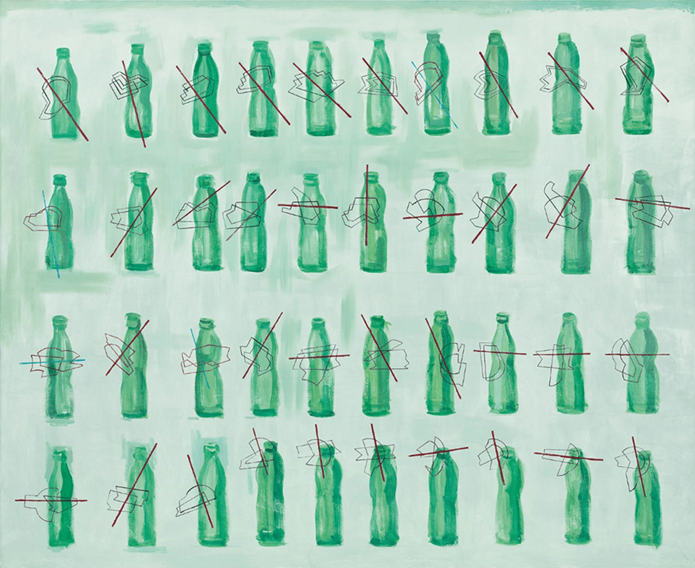
Suejin Chung, Pure Beverages That Convey the Concept of Emptiness (空) , 2013-2014, Oil on canvas, 100x100cm © Suejin Chung

When combined with figures such as thinkers or heads, this emptiness appears as an ever-changing (un)conscious flow emanating from within the figure. It introduces latent movement into the static medium of painting. Works that involve repetition or self-referential structures demonstrate that multidimensional painting is unrelated to representation. Like mathematics, painting is produced through internal logic as an abstract and symbolic structure.
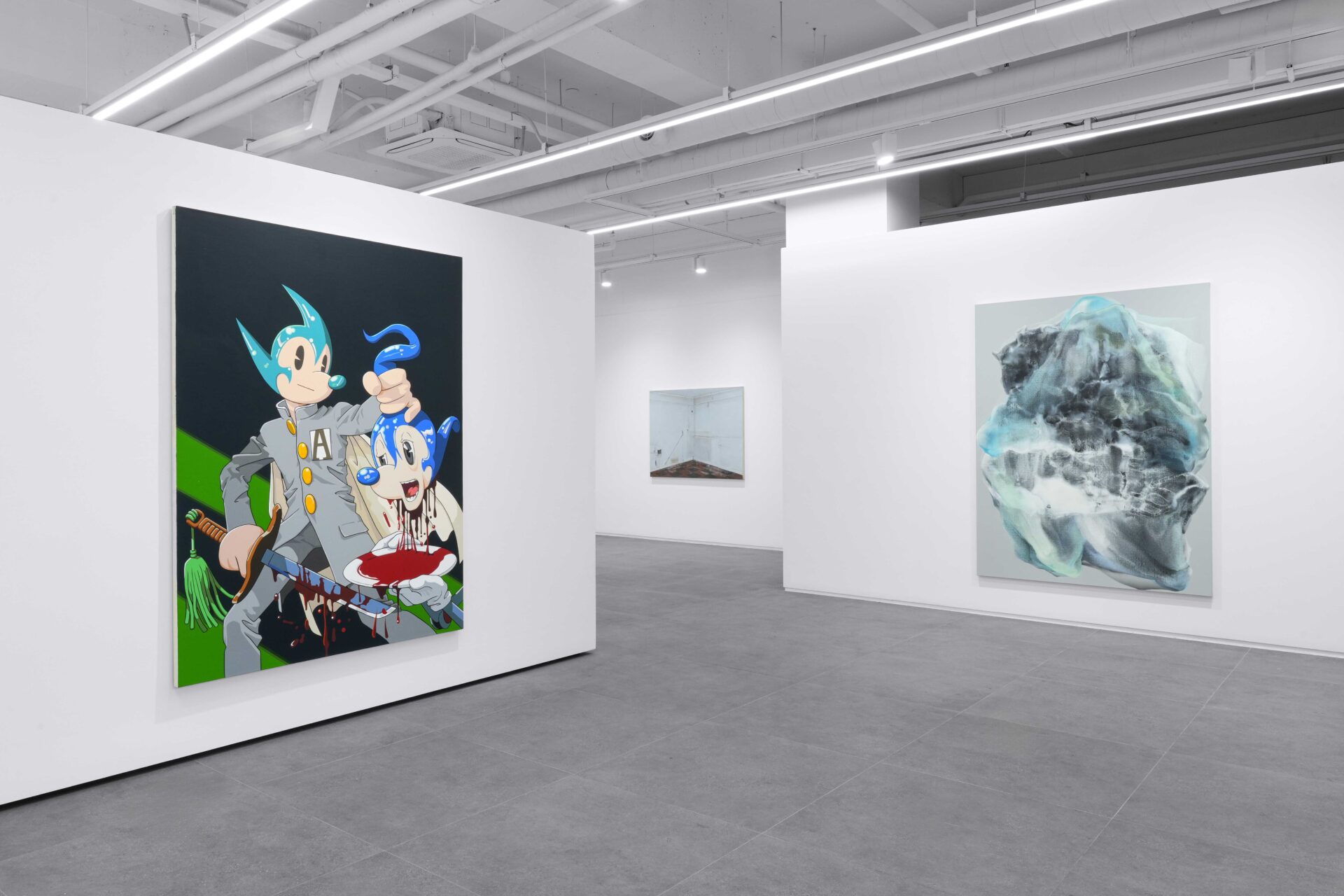
Structure is often regarded as reality. Painting and imagination refuse to remain mere intellectual play. Multidimensionality in art can be linked to experimentation. James Joyce, frequently referenced in her titles, is known for connecting stream of consciousness with linguistic experimentation. Works with “multidimensional” in the title often feature strange, human-like forms composed of geometric patterns, along with discontinuous compositions suggesting portals to other dimensions.
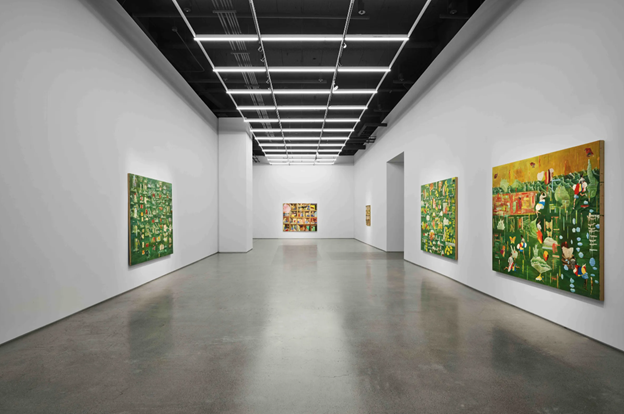
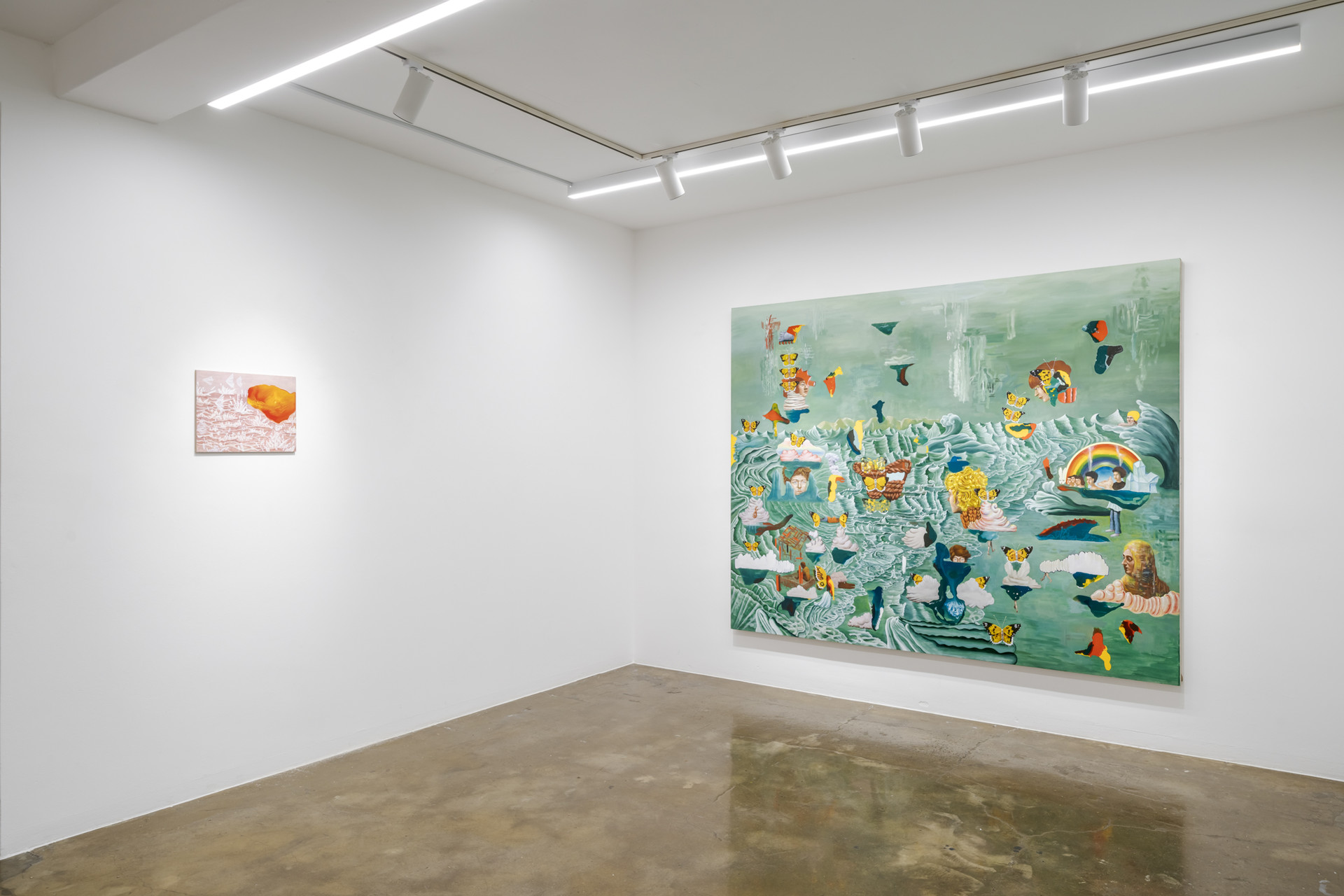
 
Each dimension contains different forms of existence, yet they coexist without contradiction on a single canvas. Chung’s work does not rely on a single geometry but multiple geometries, each following its own logic. As Siobhan Roberts notes in [King of Infinite Space], “there are many geometries, each describing a different world like those in fairy tales or utopias.” These are “places radically different from the world we inhabit.”

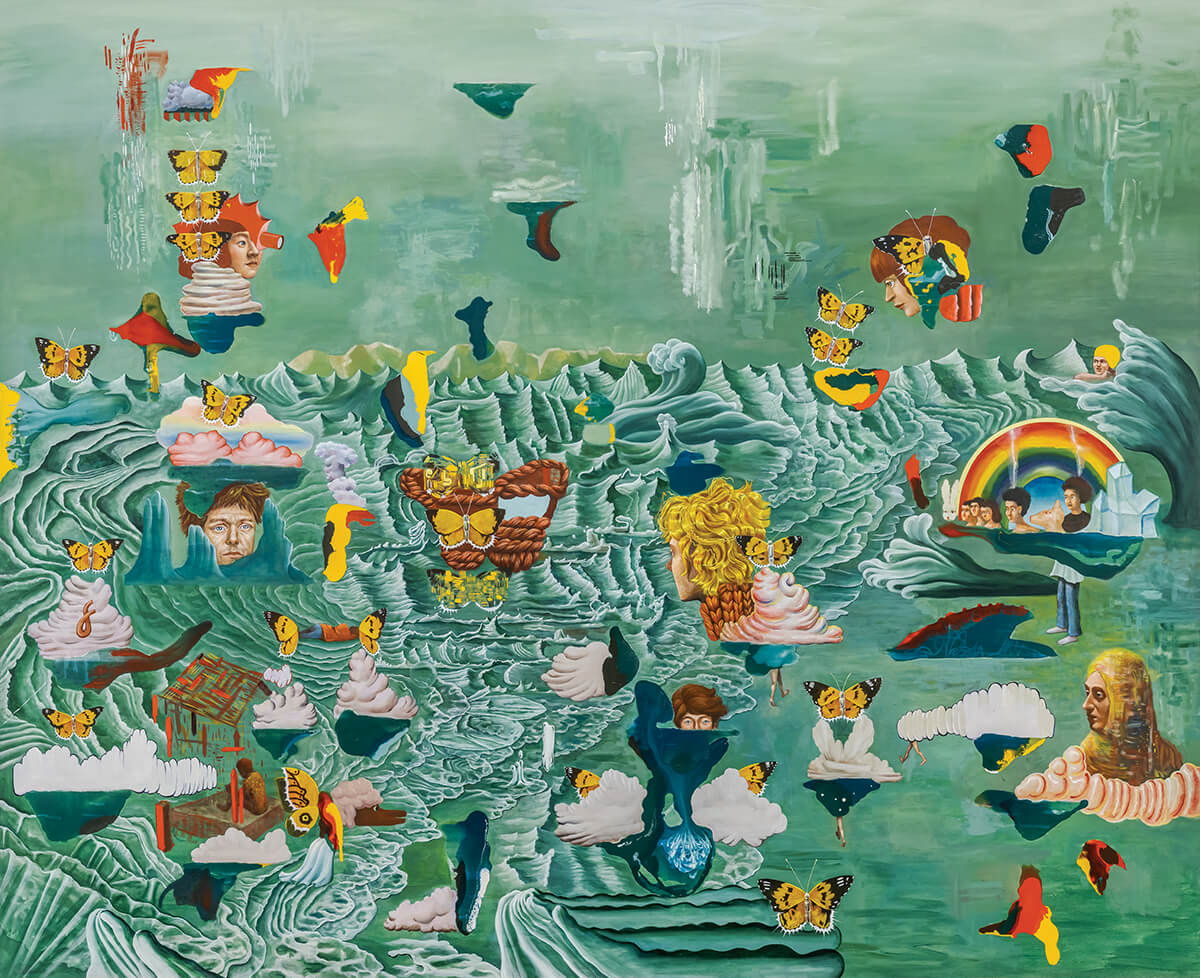
In Chung’s work, strange transformations and proliferations unfold in series, as seen in Pure Beverages That Convey the Concept of Emptiness. Like topologists, her work suggests forms that retain their properties despite stretching, twisting, or compressing. Polyhedra appear in topologically equivalent relationships, like cubes and spheres. Rather than expressing this through equations, her work manifests as rich intuitive imagery.
 
Chung’s work can be seen as an extensive metaphor for a world different from the present one. Such “multidimensionality” extends beyond the domain of geometers. Like Coxeter, who emphasized that mathematics should be learned like swimming or cycling, her work suggests a similar experiential approach.

Even simple elements such as breakfast toast or a skipping girl contain multidimensional geometry. Like Kepler or Newton, who sought to understand the structure of the universe, Chung explores painting with a quasi-scientific passion. While her work studies form like geometry, it does not simply translate geometry into images. Painting becomes a field for dimensional analogy.
 
The word “emergence” in her exhibition subtitle introduces time as a fourth dimension into ordinary coordinates. In dealing with higher-dimensional spaces, spatial metaphors are crucial. As noted in [King of Infinite Space], higher dimensions can represent any measurable characteristic—temperature, wind direction, interest rates, age, and so on. These attributes can be endlessly extended. But to what end? Coxeter suggests that the goal remains aesthetic, much like the Pythagoreans’ search for cosmic harmony.
 
Coxeter stated, “The mathematician, like the painter or poet, is a maker of patterns. The mathematician’s patterns must be beautiful, like those of the artist or poet.” Beauty is the primary criterion. Ugly mathematics has no place in the world. Some devote themselves to such pursuits without immediate utility.

Painters belong to this group. Their journey toward beauty transcends social or material concerns. They are, as Roberts describes, “recluses inhabiting their own minds.” The worlds they explore are filled with delightful enigmas distinct from chaotic reality. This is why Suejin Chung’s complexity is, in fact, joyful.

 
Source: MMCA Webzine ART;MU

References