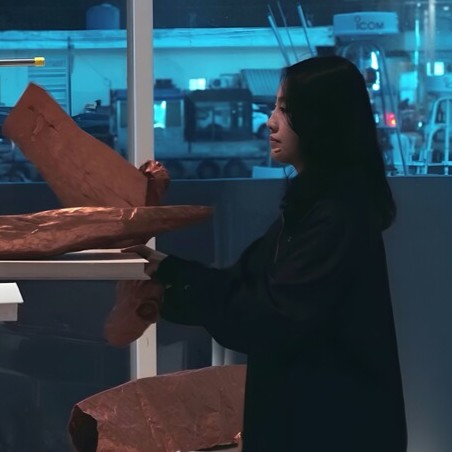
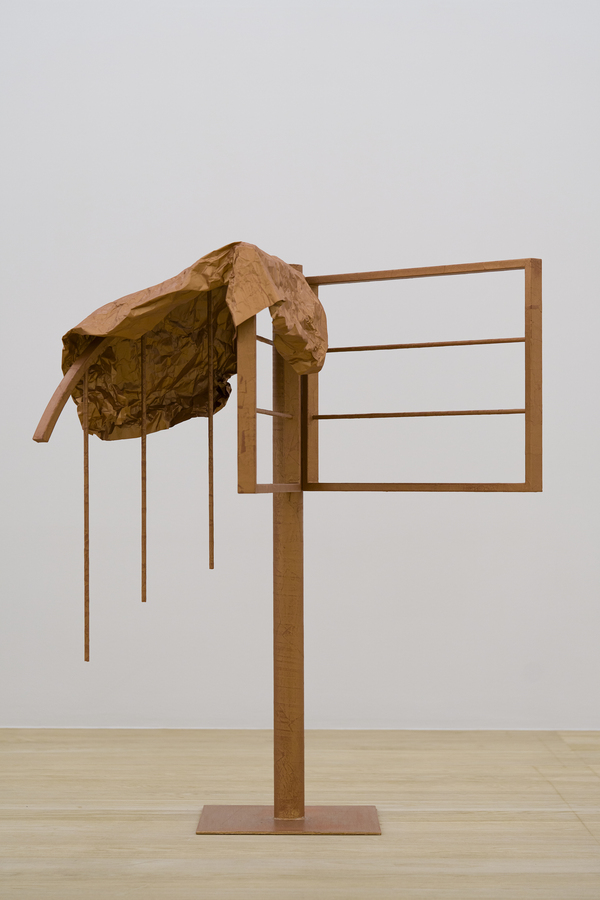
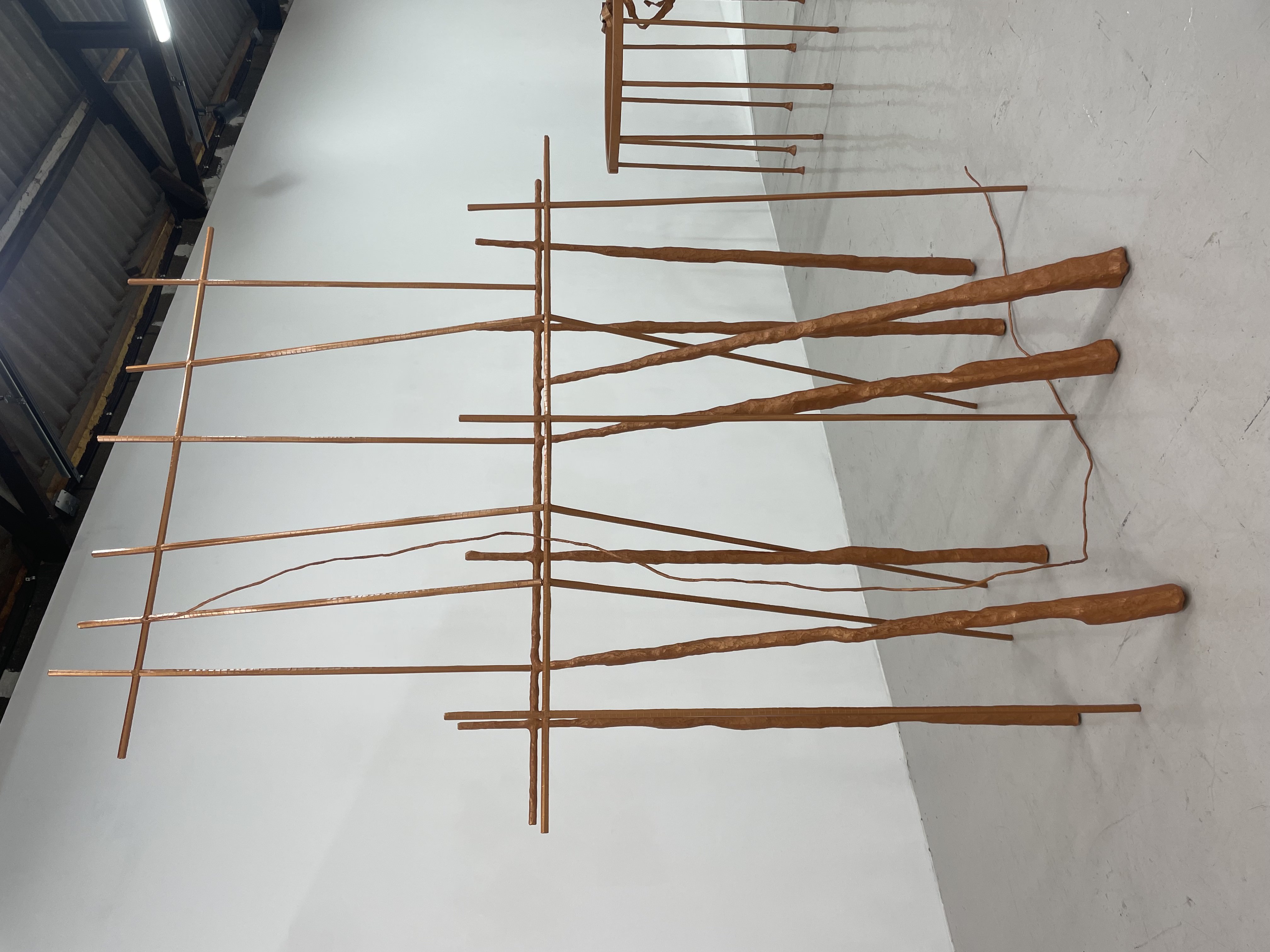
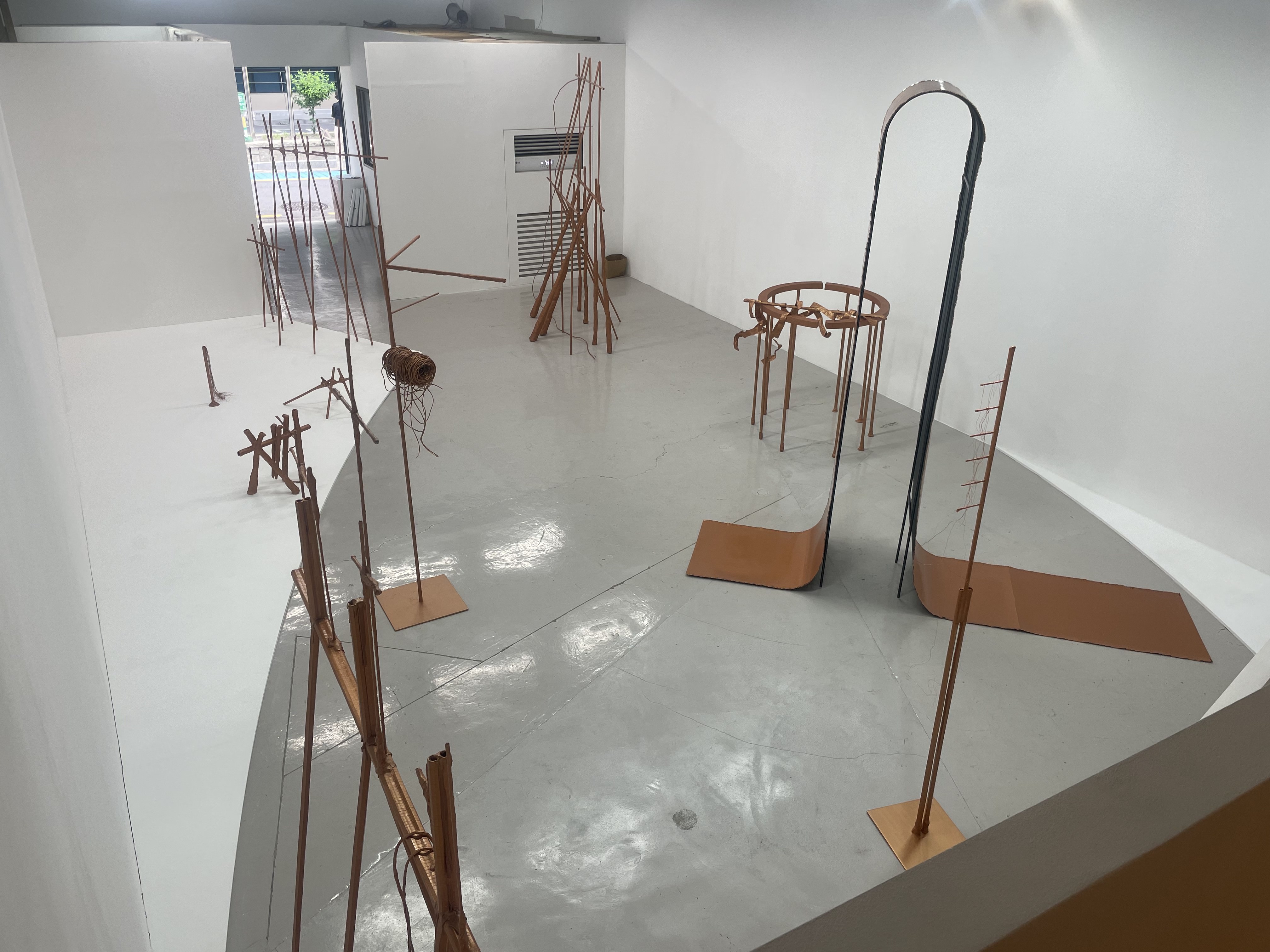
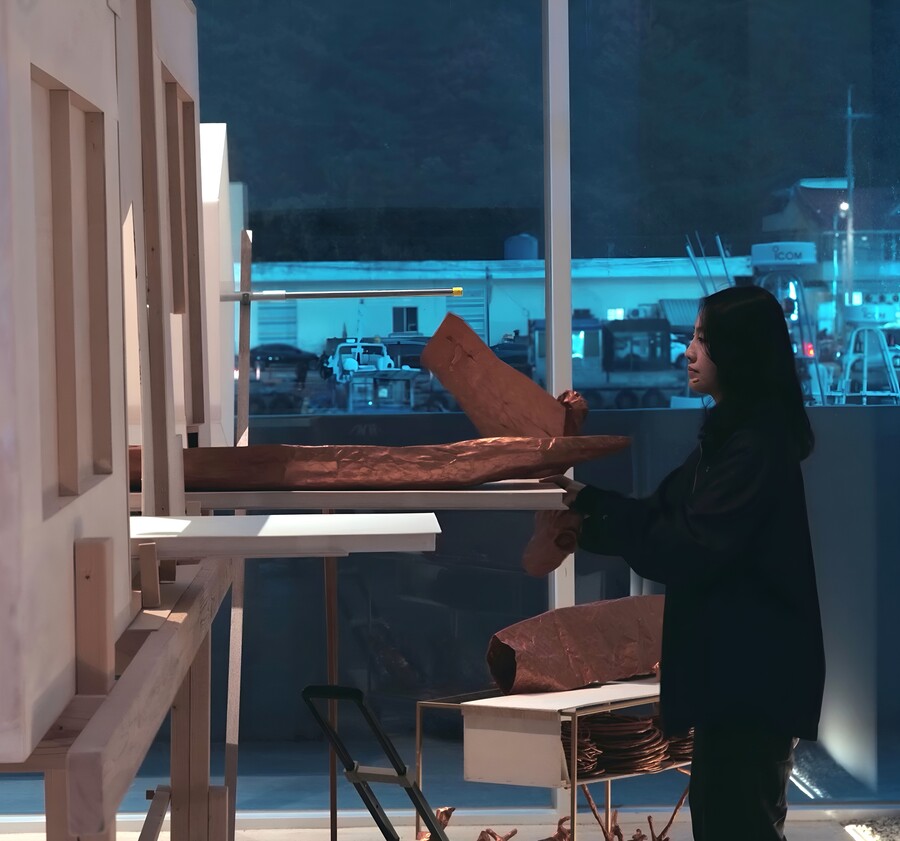
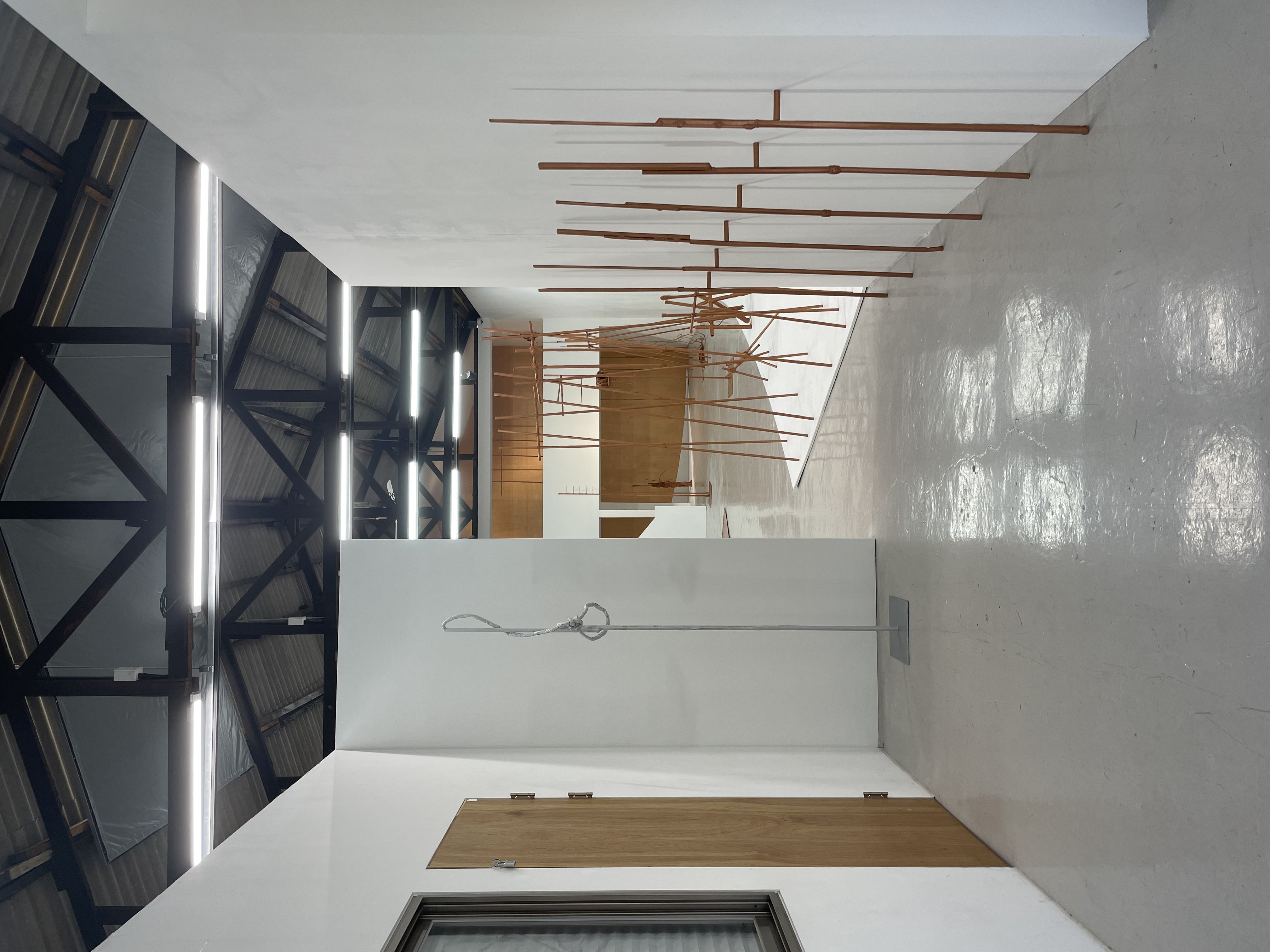
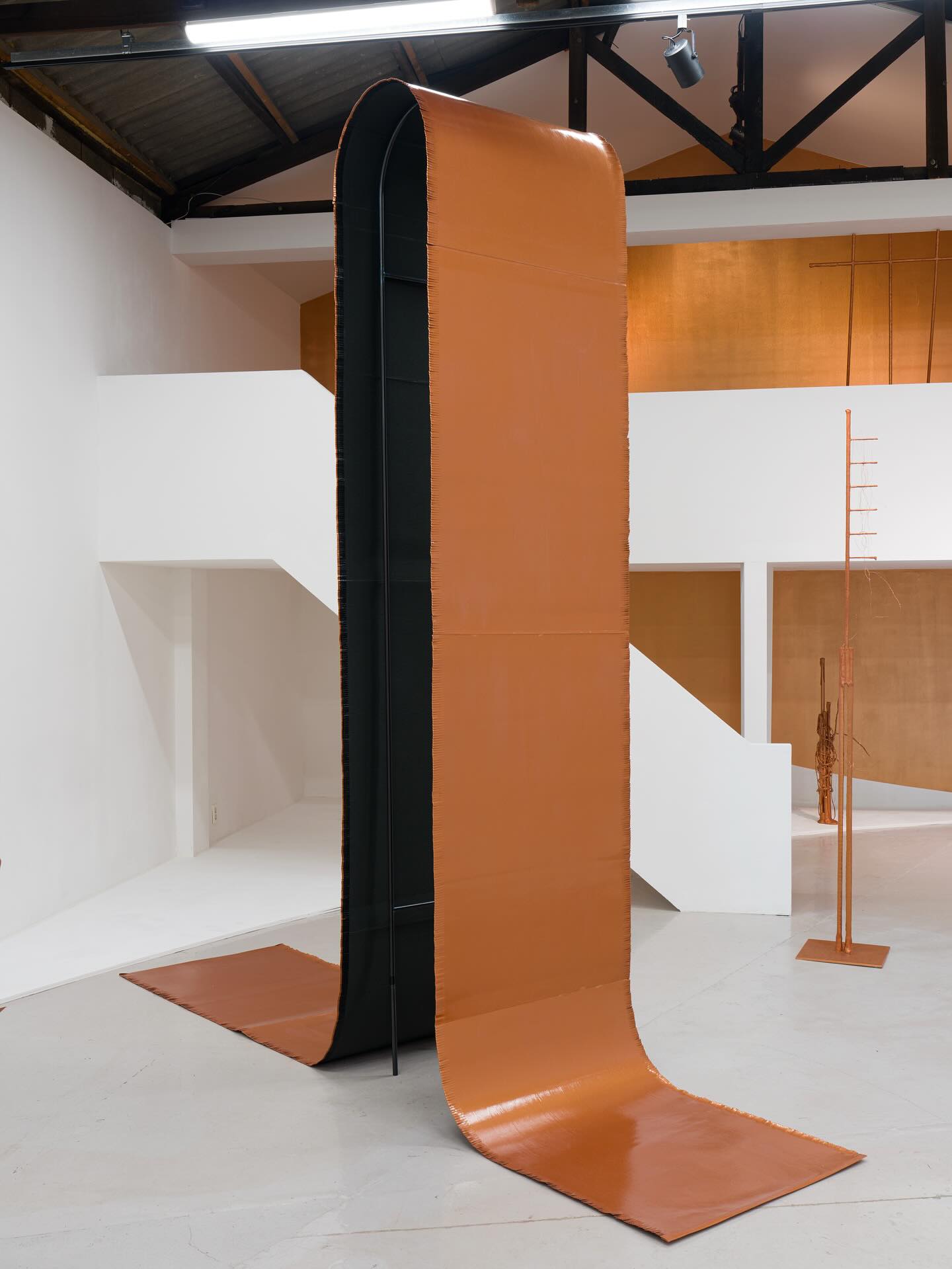
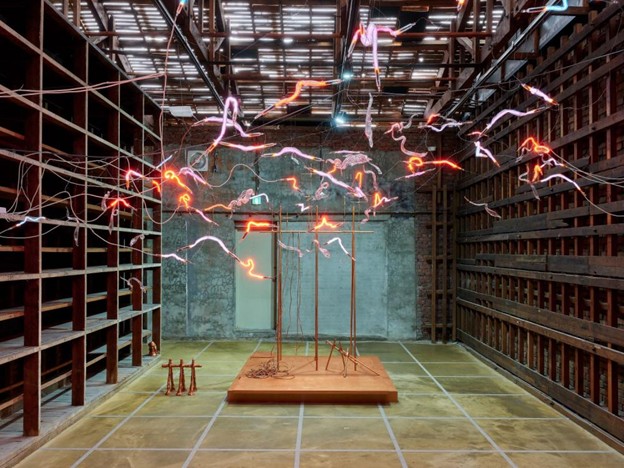
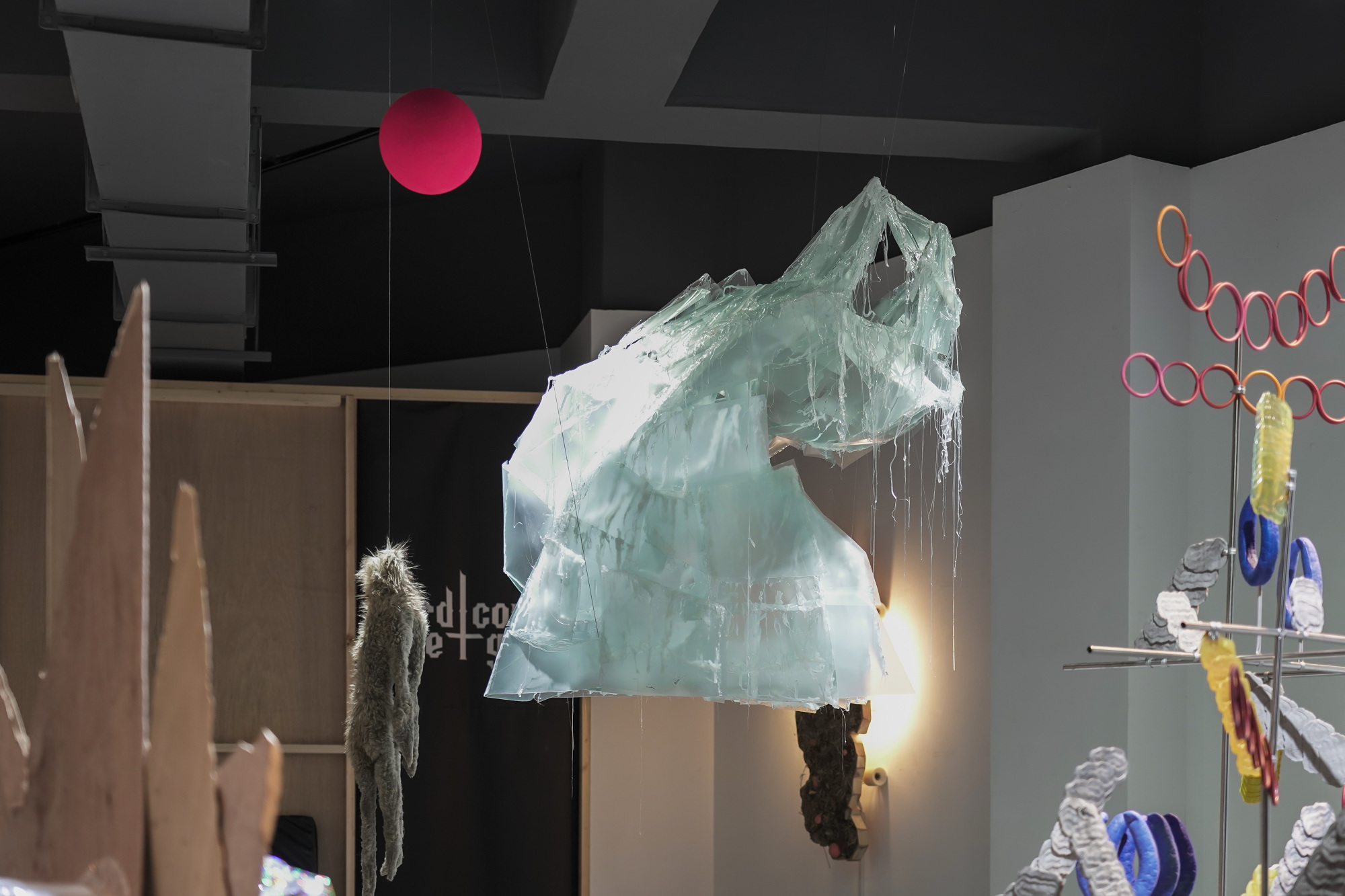
Installation view of 《Fence-go-round》 (Hall 1, 2025) © Hall 1

《Fence-go-round》(Hall 1, 2025) is the first solo exhibition by artist Ria Choi, presenting her paper fence sculptures that she has been developing since 2021. The works that constitute the exhibition are centered on custom-made paper, combined with various material elements such as tubes of different materials, branches, wires, and adhesives. In 《Fence-go-round》, these masses, under the artist’s direction, move fluidly between bent paper and fence-like structures. They also precariously traverse the boundary between sculpture and installation as mediums.

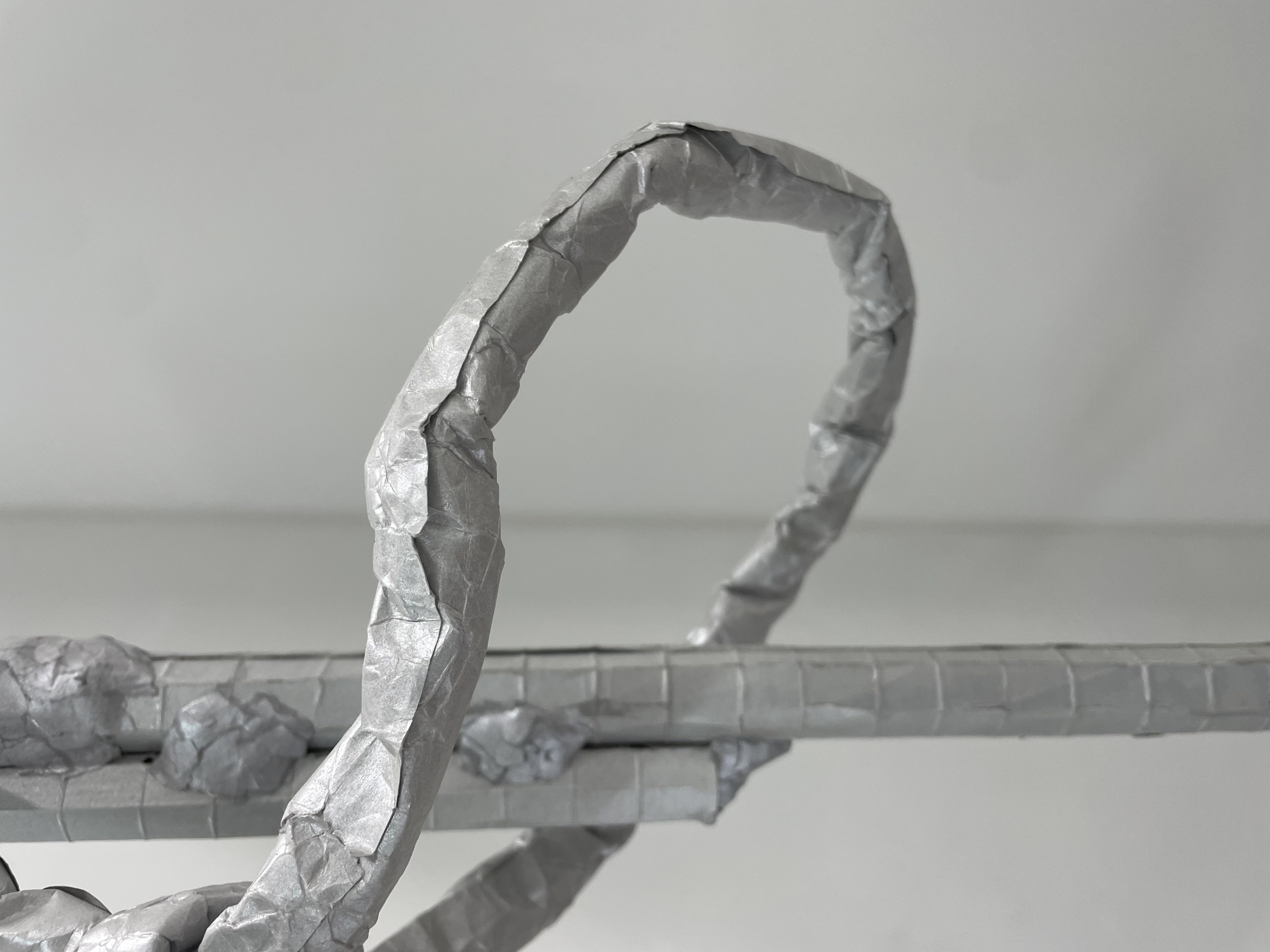
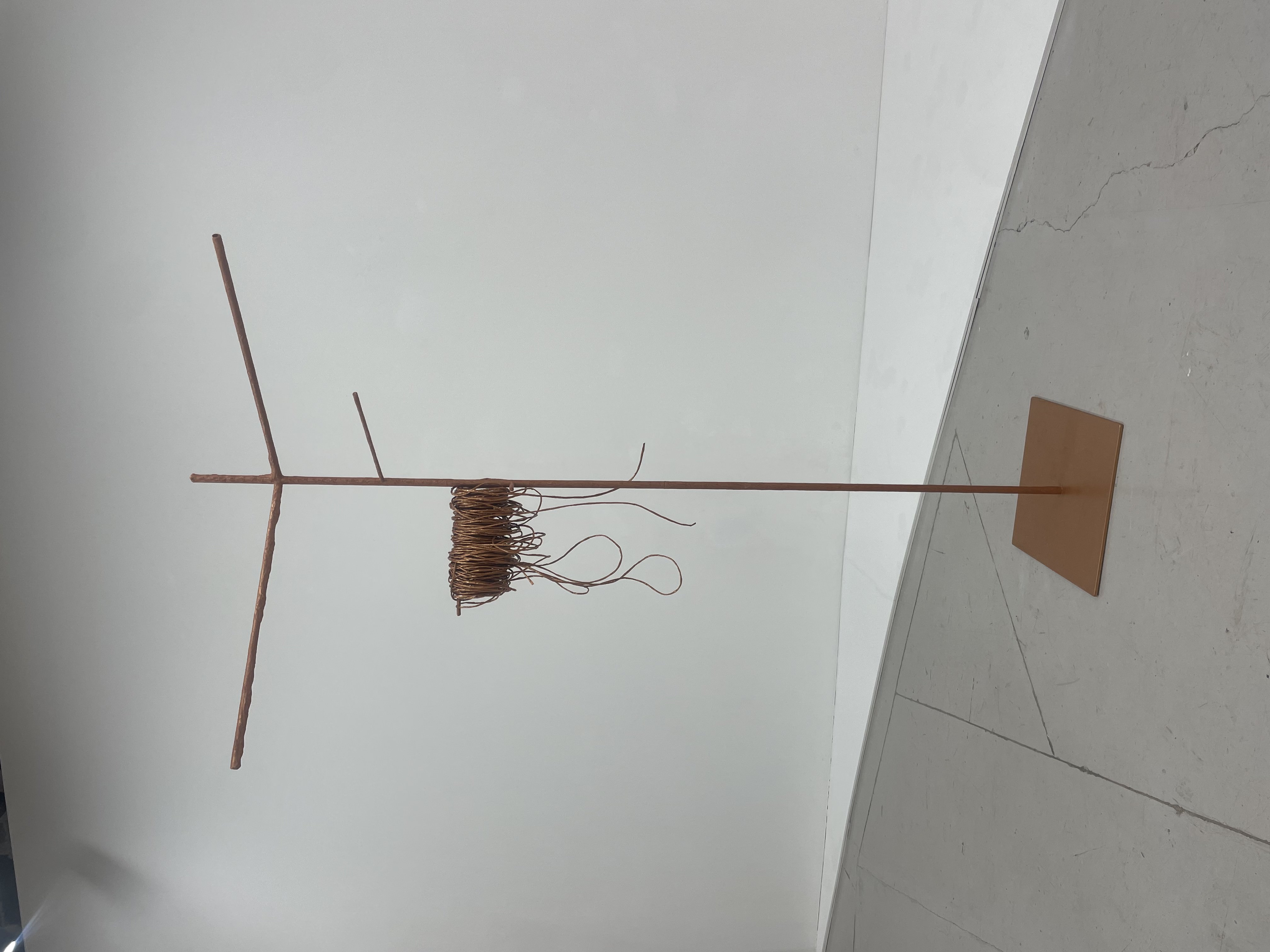
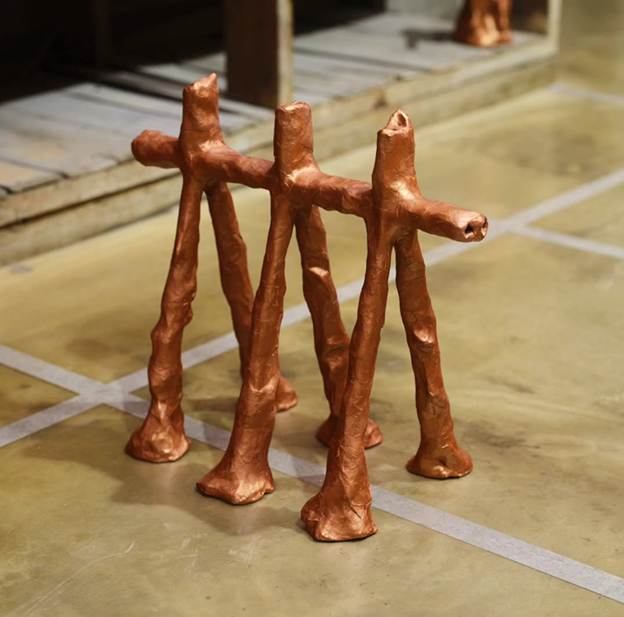
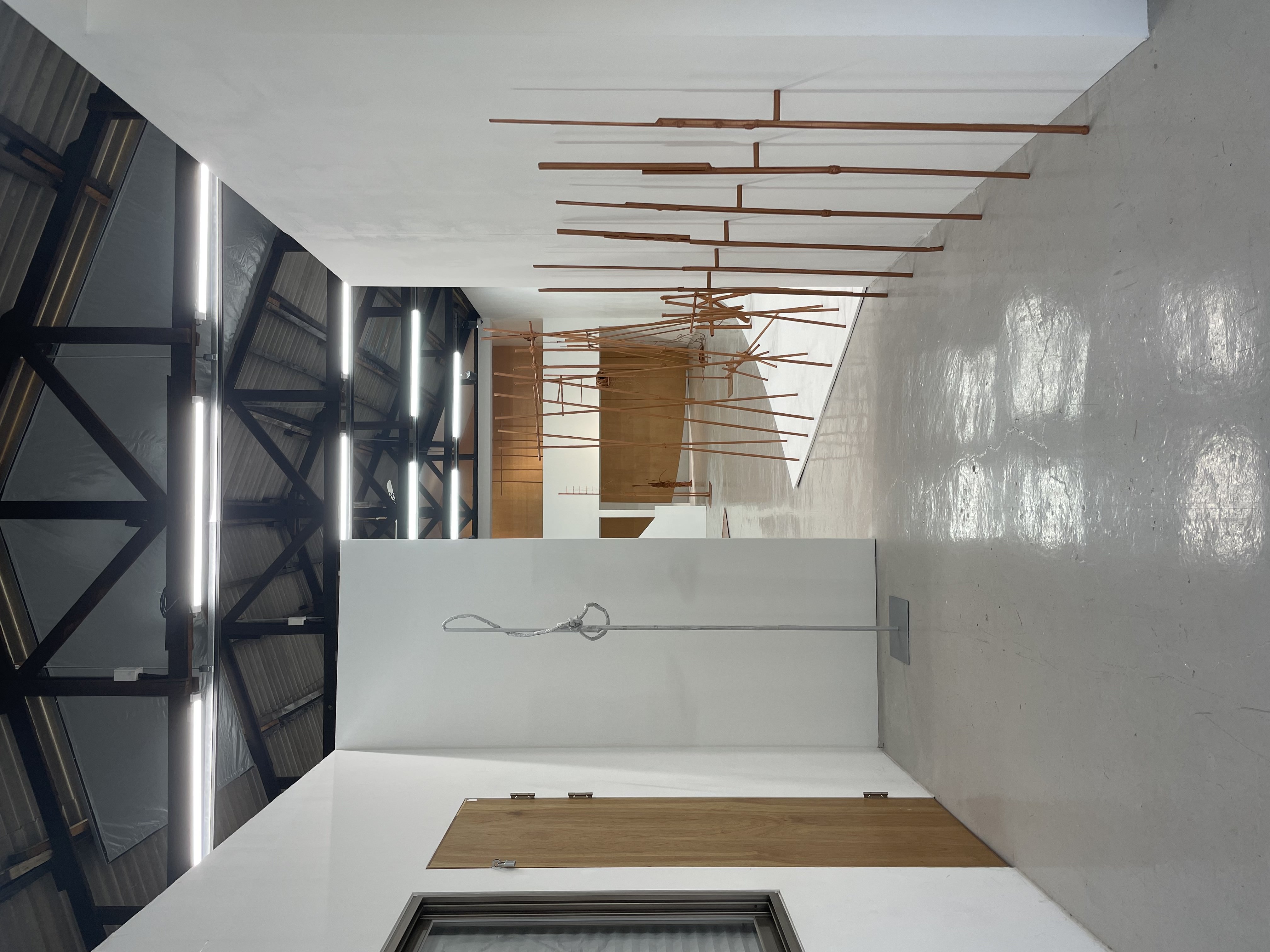
At the entrance of the exhibition, six copper-colored linear structures are leaned against the wall on the right, while a single silver structure stands on a square pedestal on the left. Although the group and the single structure do not appear to differ significantly in their fabrication process—from the minimal unit of custom-made paper to their current forms—the six works on the right, Fence Unit, are assigned the role of installation, while the work on the left, Knot(2025), is assigned the role of sculpture.

Knot is positioned as both a point of comparison and a reference for all the works presented in 《Fence-go-round》. Let us imagine a situation in which we are all making soup together in a kitchen. Even if all ingredients are added, when the soup tastes bland, adding salt enhances the overall flavor.

Likewise, unlike the other copper-colored works, the solitary silver-toned Knot refreshes the viewer’s perception at the moment when the eye begins to acclimate to copper, sharpening the perception of color and opening up another branch of imagination at the exhibition’s entrance. (If all the works in this exhibition were made in silver rather than copper, would not the content and sensibility of the reality that 《Fence-go-round》 gives rise to be entirely different from what it is now?)


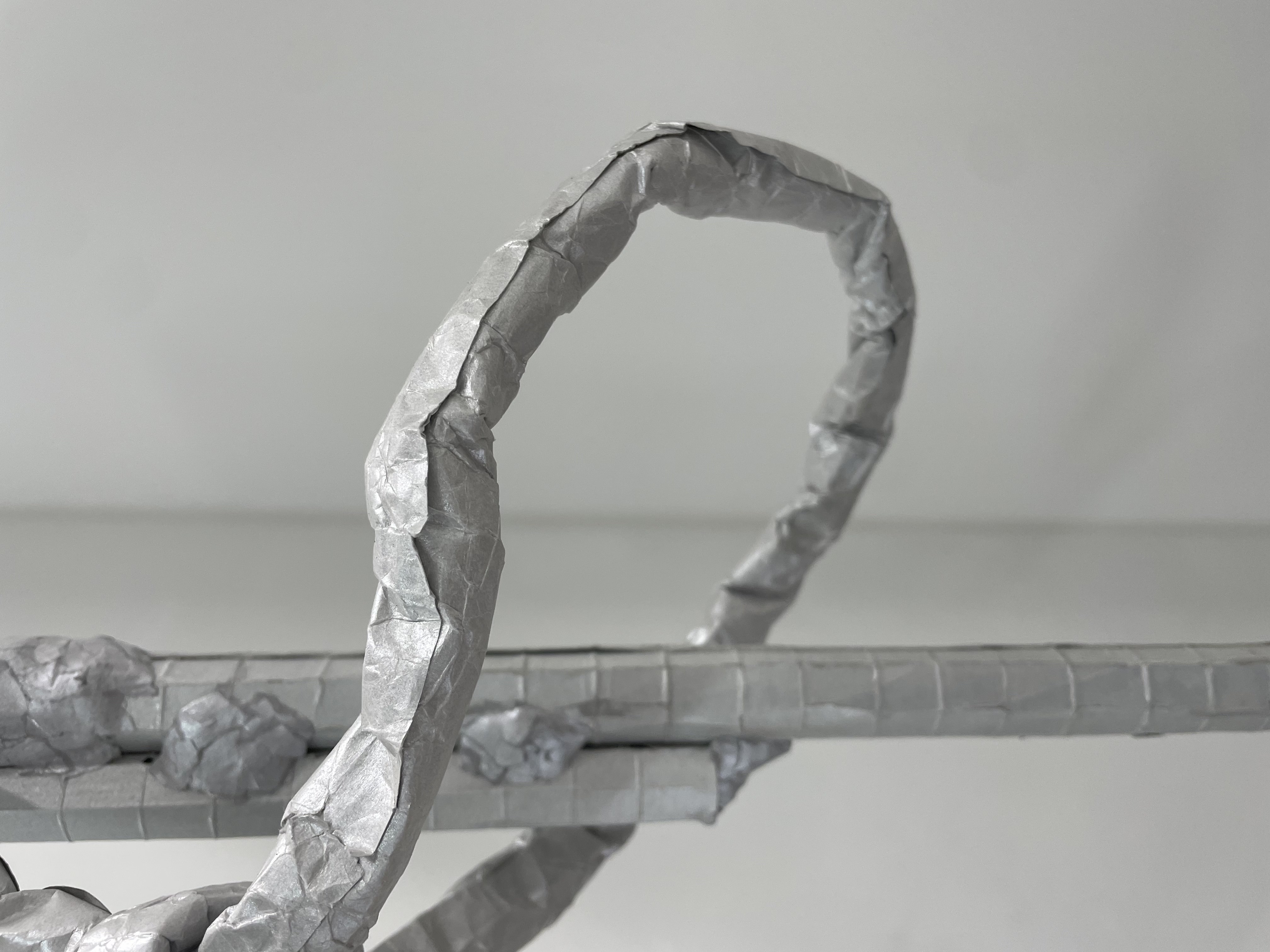
Ria Choi, Knot, 2025, Custom-made paper, paper tubes, and steel pipes. Photo: Jeongkyun Goh. © Ria Choi

One more point. When encountering works that achieve a fantastical effect through the gap between an object’s outward appearance and its method of construction (“paper fences mimic rigid metal fences in comically exaggerated poses.”1), one notable artistic decision lies in how and when this open secret is revealed within the timeline of the exhibition experience. From this perspective, Knot shows no intention of concealing the fact that it is a line material wrapped in paper. The artist does not tightly glue down the ends of the paper or attempt to hide the paper lines with adhesive (“glue”); instead, she exposes the secret of the paper fence sculpture as material from the very beginning, opening the exhibition.

Additionally, by installing a white partition wall behind it, the artist attempts to secure the presence of Knot against the floor color, which is not significantly different from silver. (Considering that the role of a pedestal is to support a sculpture so that it can be viewed from all sides, would it be an exaggeration to regard this partition wall as a kind of pedestal?)

The partition wall placed behind Knot also reduces the size of the entrance leading into the main exhibition space. In doing so, it seems to regulate the viewer’s movement while emphasizing that the path beyond splits into two directions. Similarly, another element that guides the viewer’s movement in 《Fence-go-round》 is the circular platform composed of two corners of the exhibition space and a single arc. When I first saw this white panel placed on the floor, I assumed it was part of the installation and thought it was acceptable to step on it. However, once I entered the space, the artist suddenly appeared and advised that the white panel on the floor was a pedestal for displaying sculptures and that I should not step onto it.

This was the lowest pedestal I had ever seen in my life. However, upon revisiting the leaflet based on the pedestal as a reference, I noticed that the works considered “installation,” such as Fence Unit and Pillar, were placed outside the pedestal, while the eight works placed on the pedestal each had their own titles.

Within the order of 《Fence-go-round》, as the artist’s grammar—“pieces on the pedestal are considered sculptures”—became apparent, I began to wonder by what criteria Ria Choi distinguishes between sculpture and installation. For instance, the difference between Fences and Fence Unit did not seem significant enough to divide them into separate mediums. (Fences appeared to be constructed by crossing four Fence Unit elements to stabilize the center and fixing them horizontally with shorter linear materials.)

With a sense of uncertainty, I continued to view the exhibition.


Installation view of 《Fence-go-round》 (Hall 1, 2025) © Hall 1

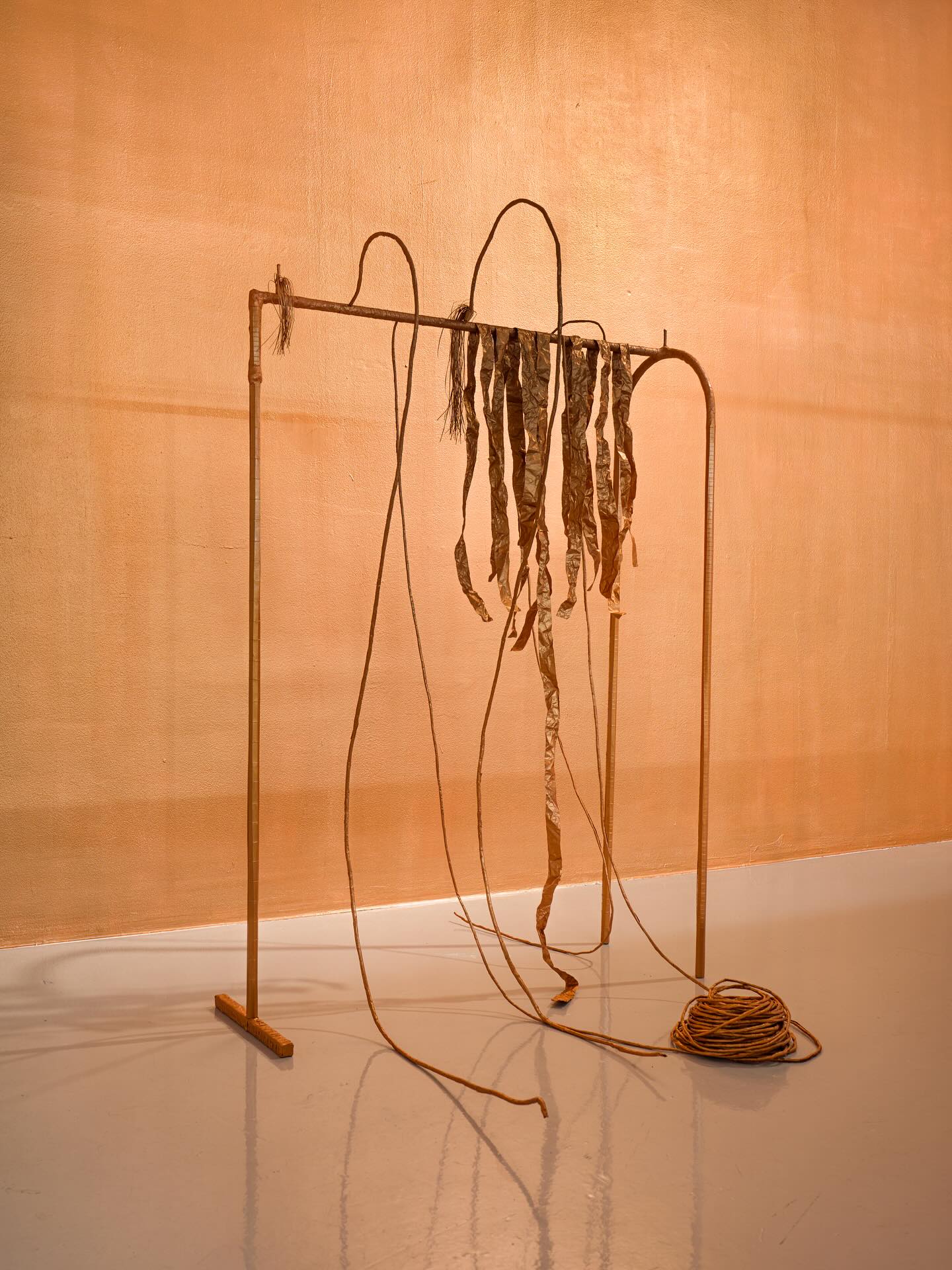
As an exhibition introducing “paper fence sculptures,” about 16 out of the total 27 works took on fence-like forms. (Why is it written as “fence” instead of the Korean word “울타리”?) Centering on the image of a fence, the works explore variations such as stacking it in layers (Double Fence), altering the structural rules that support the body of the sculpture (Rule), or depicting a form as if collapsed by the wind (Fence-Leaning). As a viewer, I also engaged with the works through this mental image of fences, but when I encountered Fence-Bent on the second floor, I felt a significant shift in the accumulated image of fences I had formed.

It was at the moment I discovered the hollow interior of the fence unit cutting across Fence-Bent. The realization that “these are all completely empty inside” extended to the assumption that all the works seen across both floors were hollow, leading to a perceptual shift in which the weight of the entire exhibition suddenly felt much lighter. This could easily be interpreted as a didactic reflection on how the boundaries that structure our surroundings may be somewhat illusory. This is also evident in the three works titled Pillar, which, despite their name, lack the structural durability to support the weight of the second floor.

There were also several works that seemed to take forms other than fences as their starting point. While the works in this exhibition are based on the form of fences, they also function as points of divergence that allow us to imagine how the material of “custom-made paper” might take shape when based on entirely different forms.

Among them, Bound stands out as the only work whose title consists solely of an adjective, and unlike other works, it does not anchor itself to a specific form. However, it offers a richness of detail, employing all the materials the artist has used so far—tubes, branches, rope, wire, paper, and glue. It appears almost as if the artist set herself the task of asking, “How dense can a single work become?” and proceeded to resolve it. If this level of density could be maintained while increasing its scale, what kind of result would emerge? (It would be great if someone commissioned it.)

Another memorable work is Guardrail 1. A guardrail is an object installed along roads to restrict the movement of vehicles, personal transport devices, and pedestrians. The Guardrail 1 created by Ria Choi is so narrow that a person standing inside cannot even turn around once in place. Recalling the phrase, “As one repeatedly circles the fence and gradually becomes accustomed to the interior space, the perimeter of the fence becomes the size and volume of one’s world,”2 it is unclear what exactly it was designed to separate and protect, but to me, its interior seemed narrower than a single-person cell.

Just as in human relationships—where there are good times, conflicts, and moments when one becomes intensely emotional alone—the artist’s sustained engagement with her materials over four years becomes visible in the diverse forms of the works. It reminded me once again that art is a field that values the voice of material as a mediator of the artist’s reality, and it also leaves me curious as to how the material intelligence glimpsed in this exhibition might unfold in future works.



Installation view of 《Fence-go-round》 (Hall 1, 2025) © Hall 1

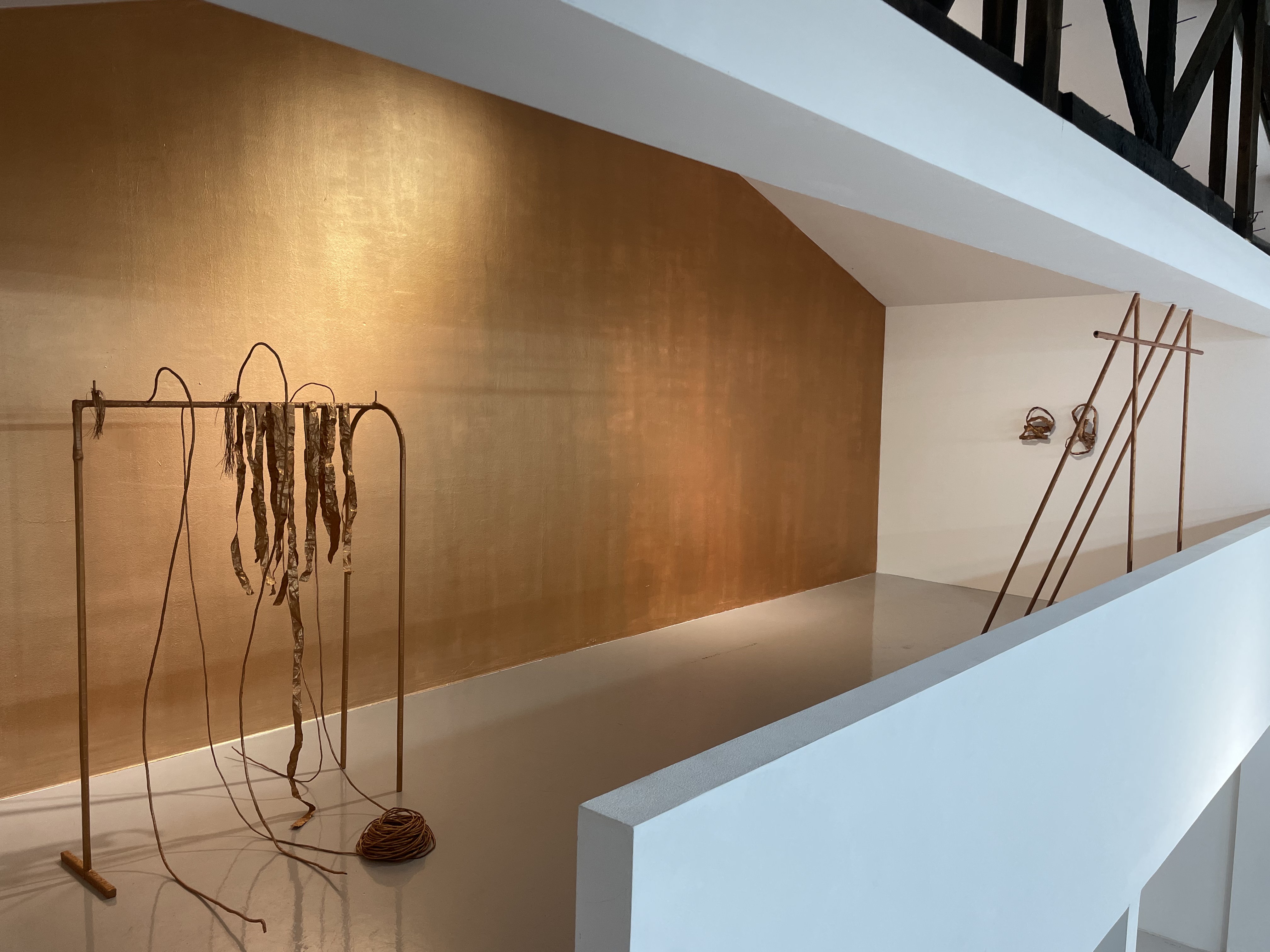
The “paper fence sculpture” originates from the circular paddock used to train horses. A circular paddock is a type of racetrack space designed for horse racing or riding training, where the circular structure is an optimized revision for achieving its purpose most efficiently. (The easiest way to accommodate the running distance of a continuously moving horse → limit the horse’s direction from linear movement to circular motion.) To reduce the distance between Hall 1—a large rectangular space—and the paper fence sculptures, the design elements adopted by spatial designer Inuri and artist Ria Choi are primarily twofold: a copper-colored wall facing the entrance and a circular platform with a height of 18mm.

The curve of the circular platform cuts into the viewer’s path on the first floor.
The viewer’s movement is restricted, like a racehorse endlessly circling a paddock.


The exhibition space, resembling a bronze amusement park, becomes a concealed prison through its copper sheen.

The second-floor exhibition space, above the stairs, offers a vantage point from which to observe the structure of this prison.
At the same time, it produces an optical illusion in which the work Hanger appears to overlap with the copper-colored wall.


Power in contemporary times does not manifest as a visible form. In an era where (unequal) exchanges through platforms have become a new form of violence internalized within individuals,3 Ria Choi materializes the raw texture of power embedded in objects—turned inside out—through copper-colored paper. Just as beneath the dark, rough bark of a tree lies an entirely different, peach-toned, moist inner flesh, when the amusement park as metaphor collapses and the objects that constitute that space are turned inside out, the reality that unfolds before us would resemble 《Fence-go-round》.

As long as an external will intervenes between action and its result, between effort and its outcome, humans are slaves.
This applies to both slaves and masters today. Humans never directly confront the conditions of their own actions. Society acts as a veil separating nature and humanity.


– Simone Weil, Gravity and Grace


1. Sanghyun Ha, Preface, 《Fence-go-round》 leaflet
2. Sanghyun Ha, Preface, 《Fence-go-round》 leaflet
3. Artist’s statement 

References