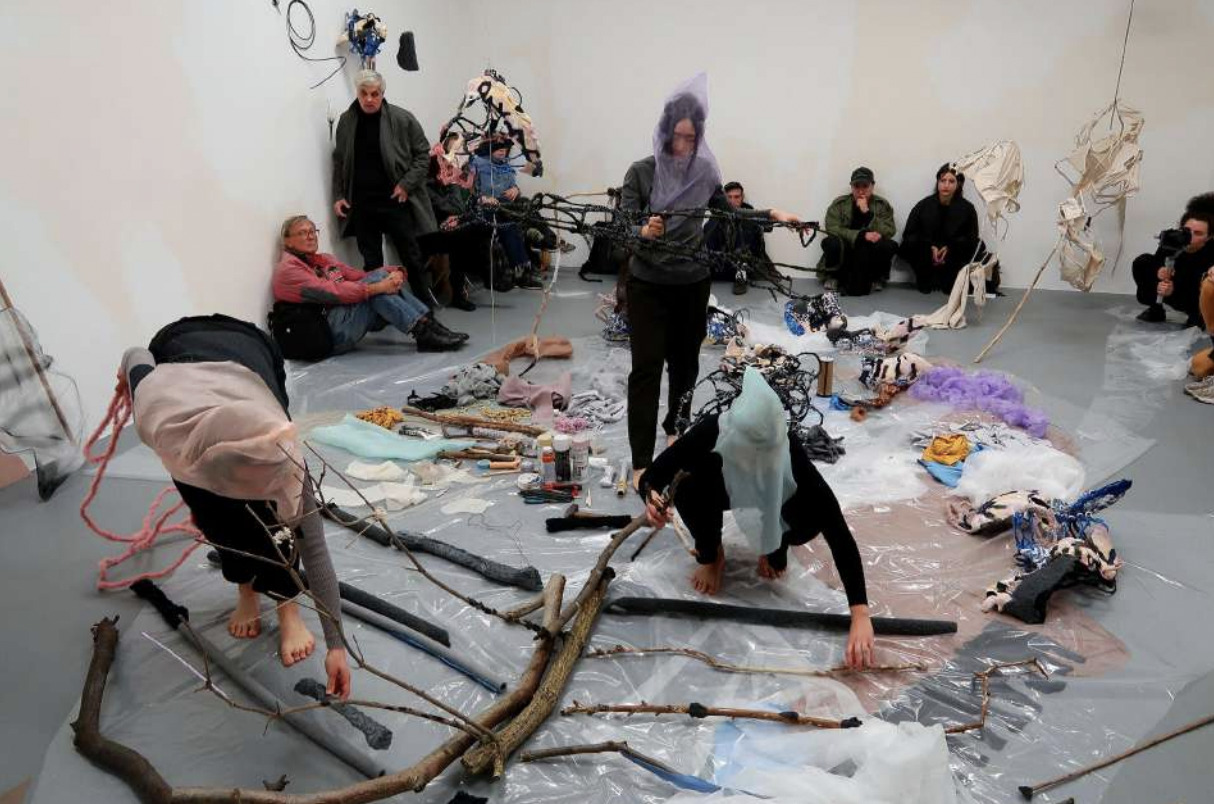
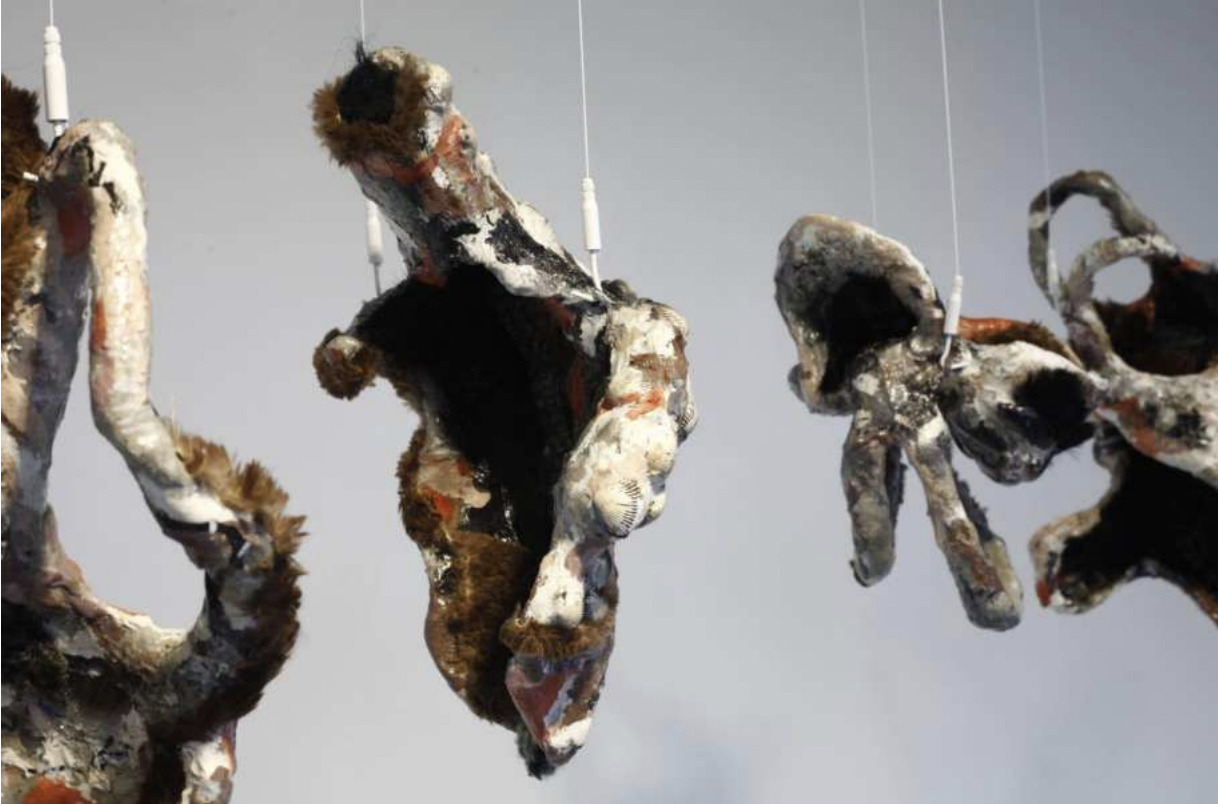
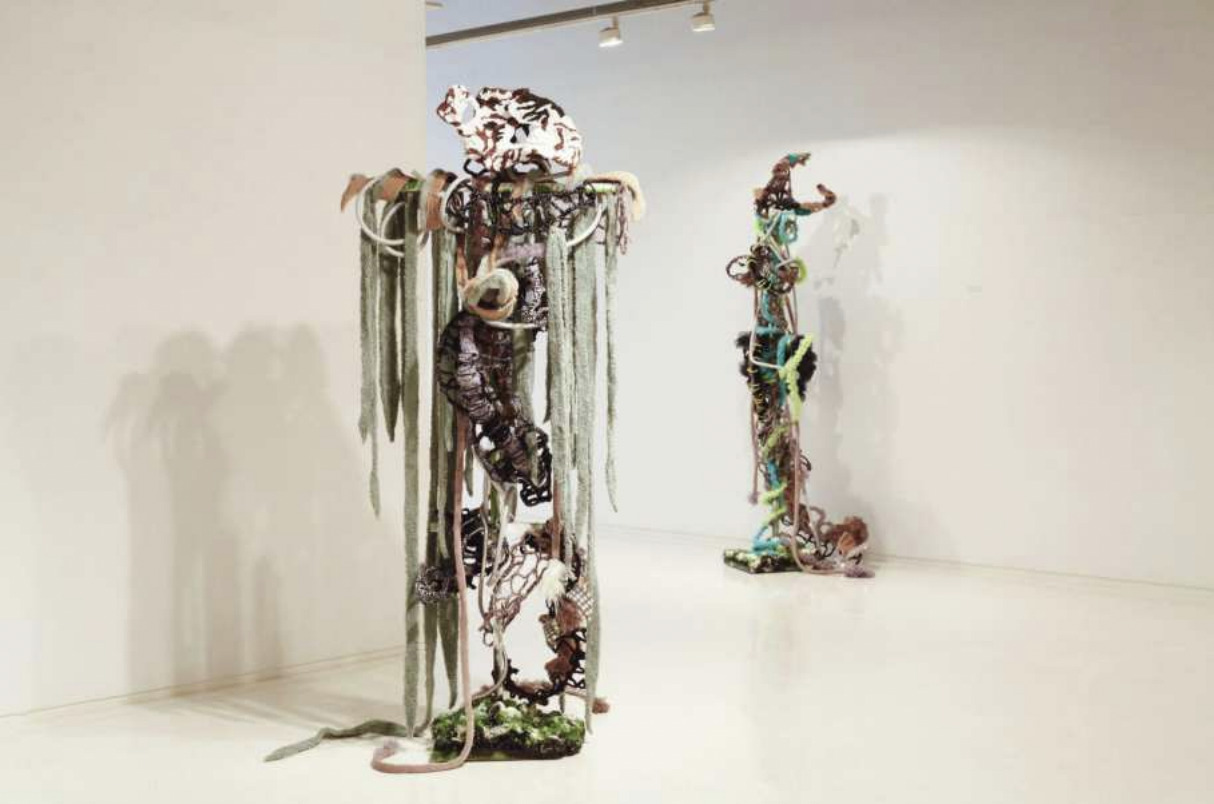
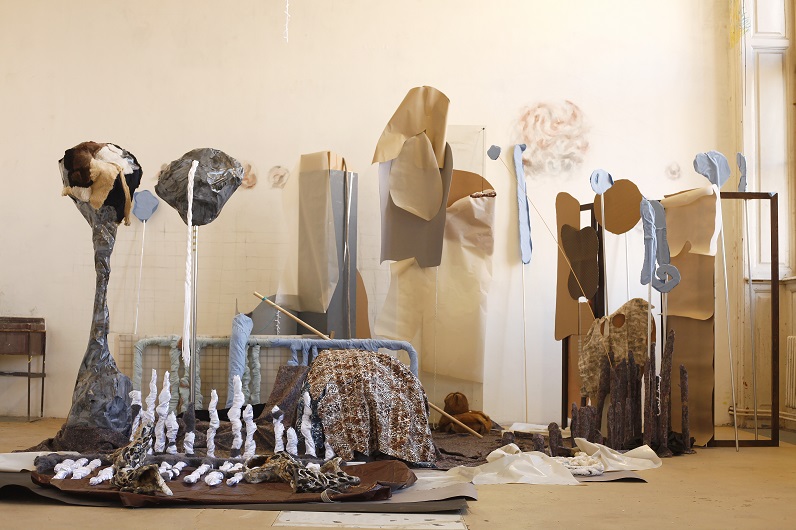
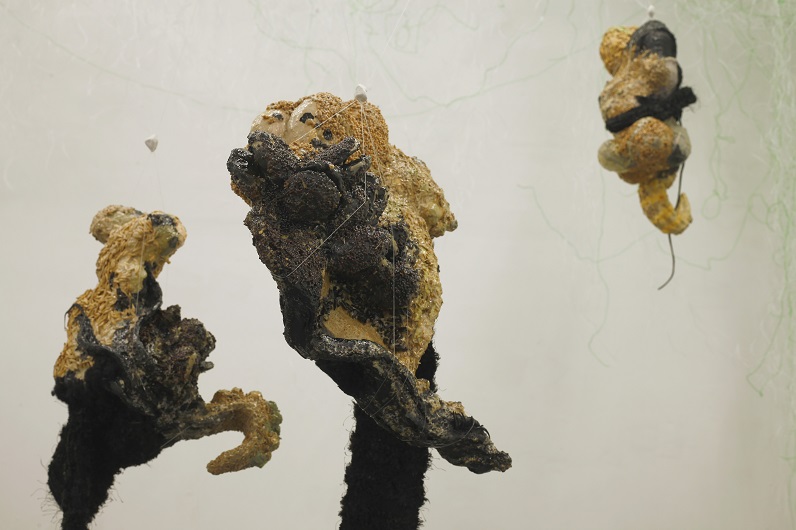
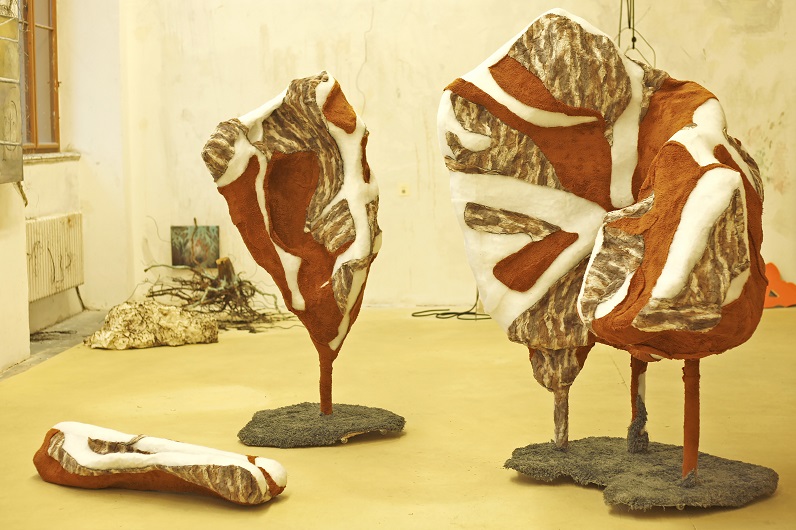
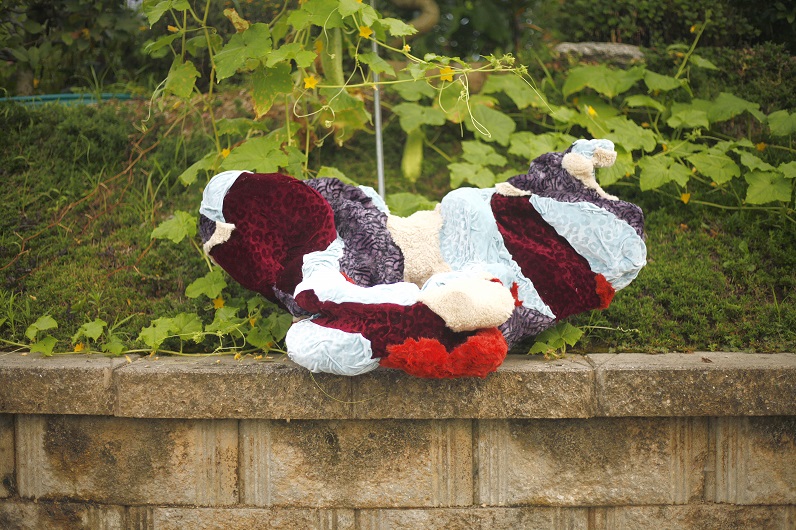
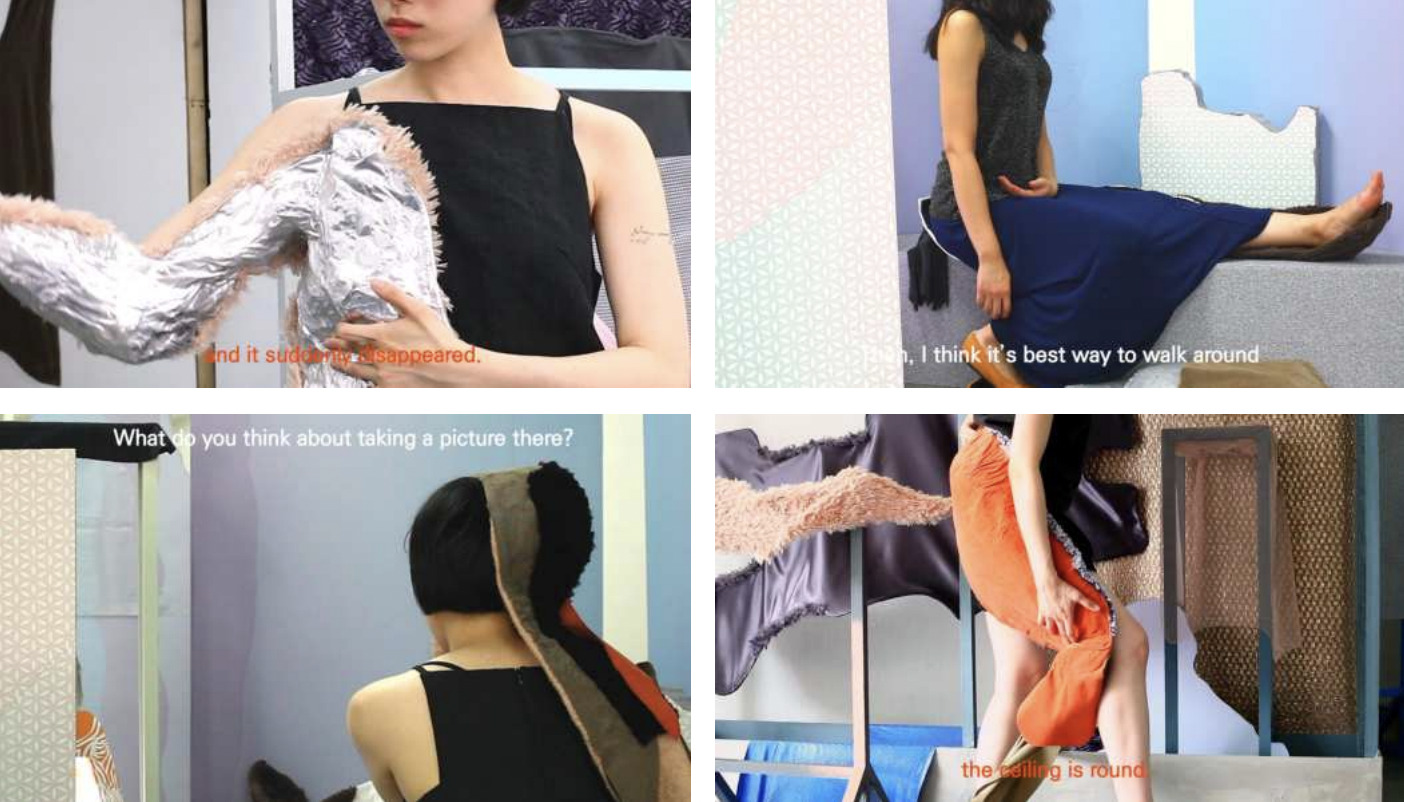
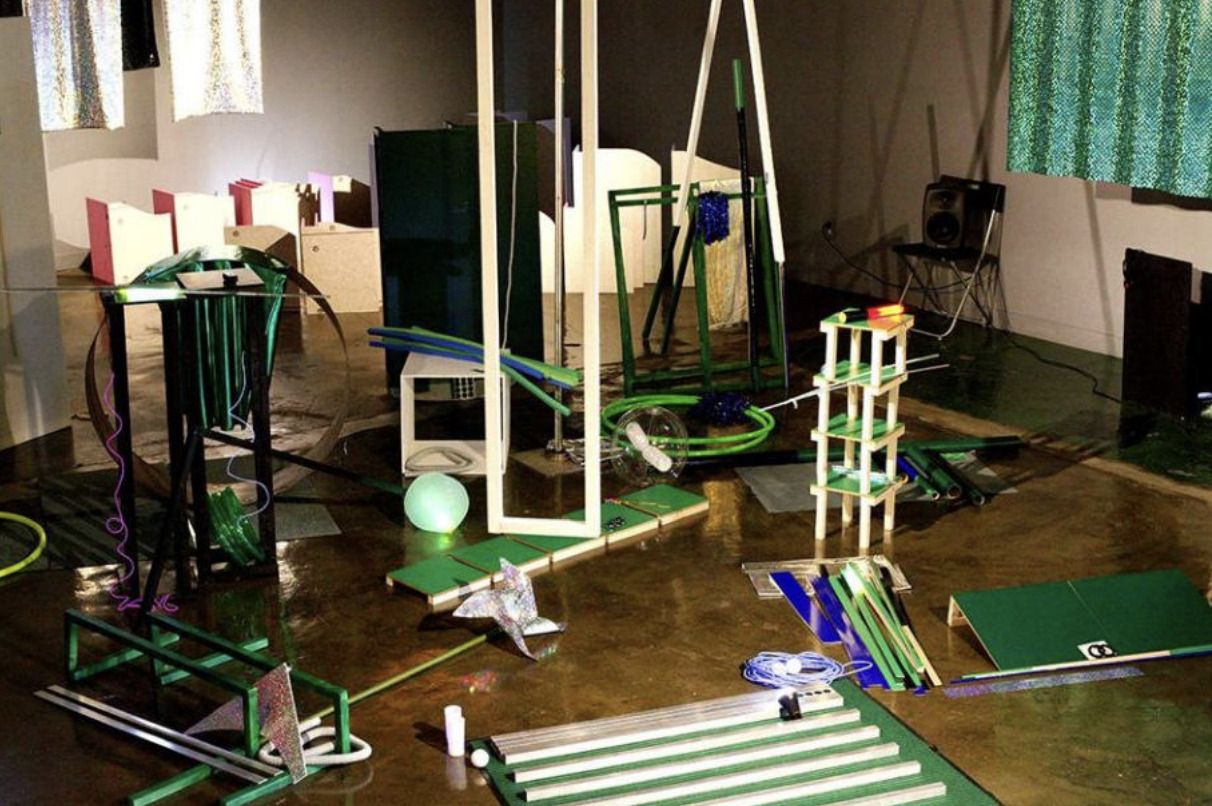
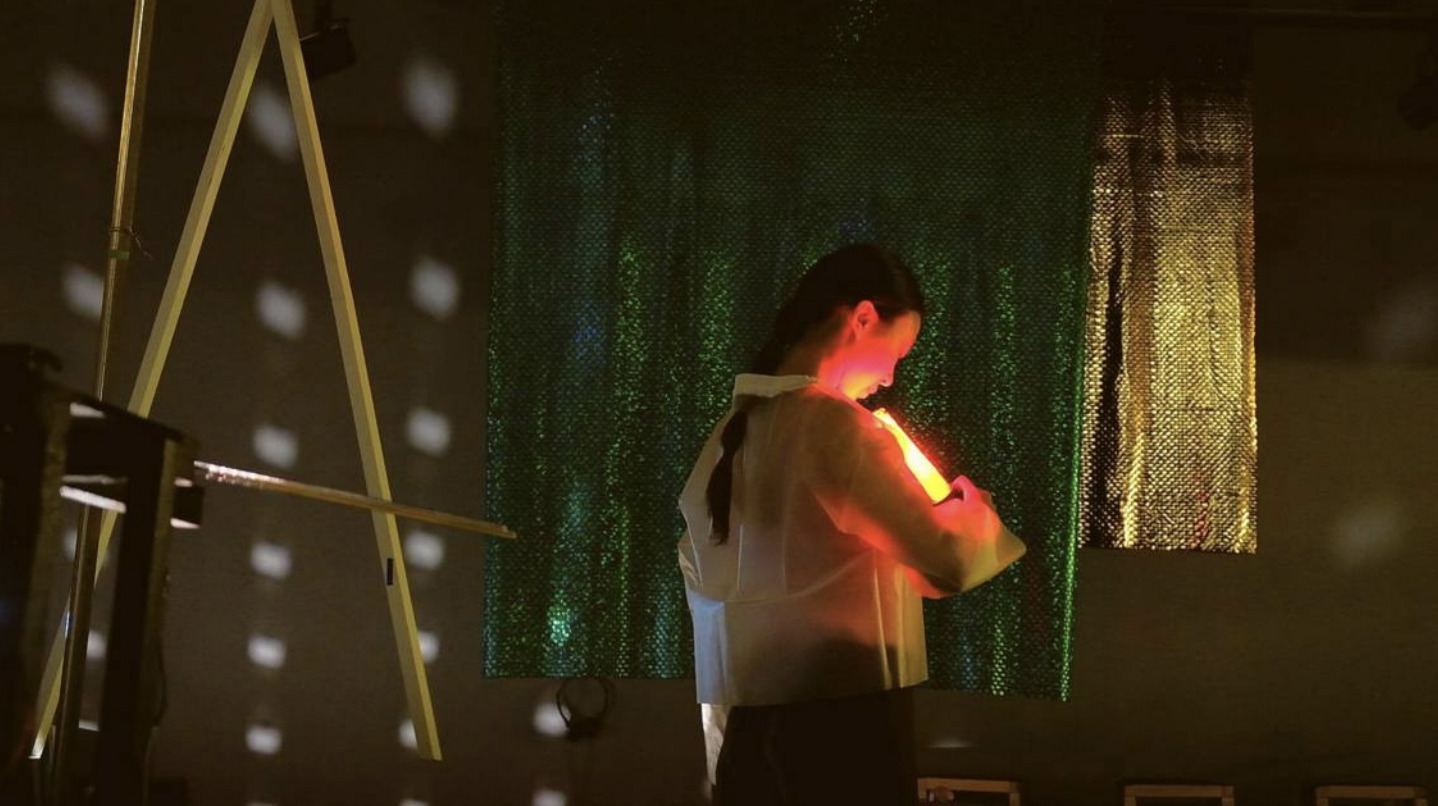
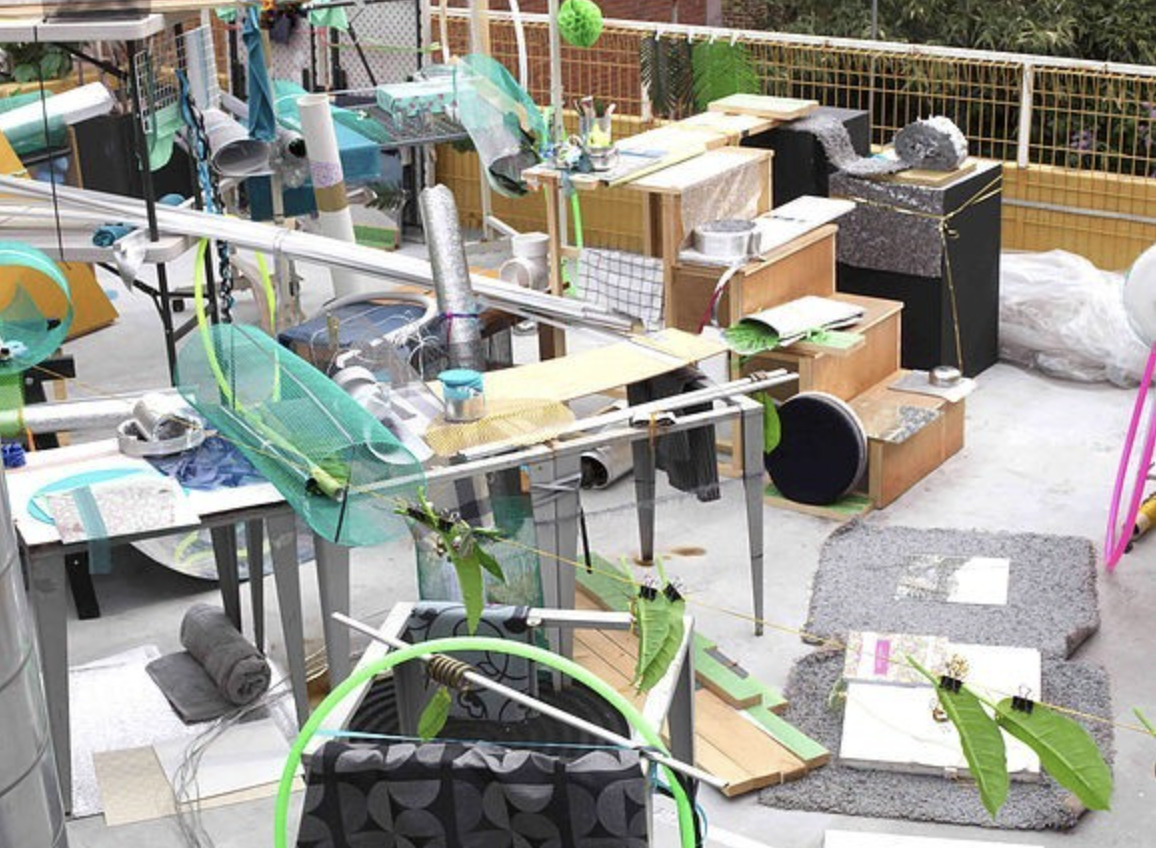
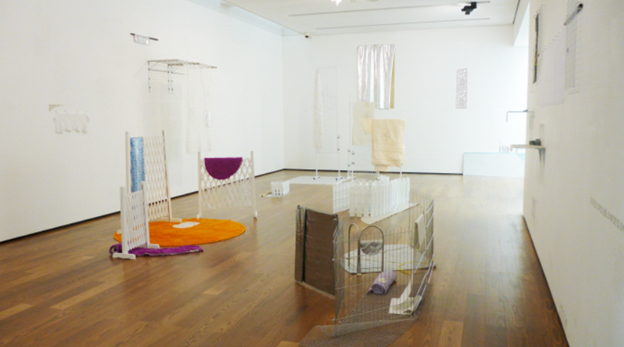
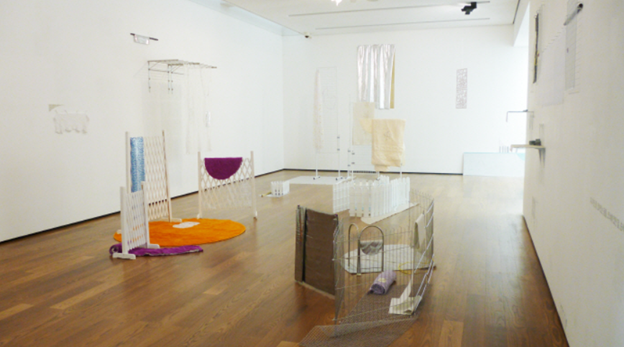
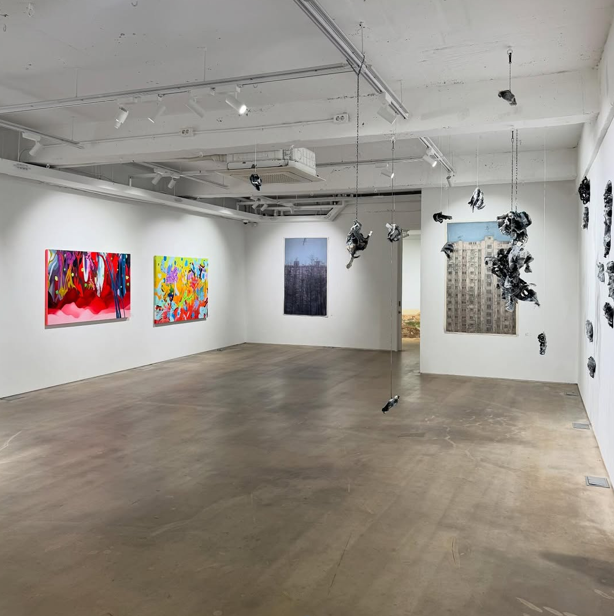
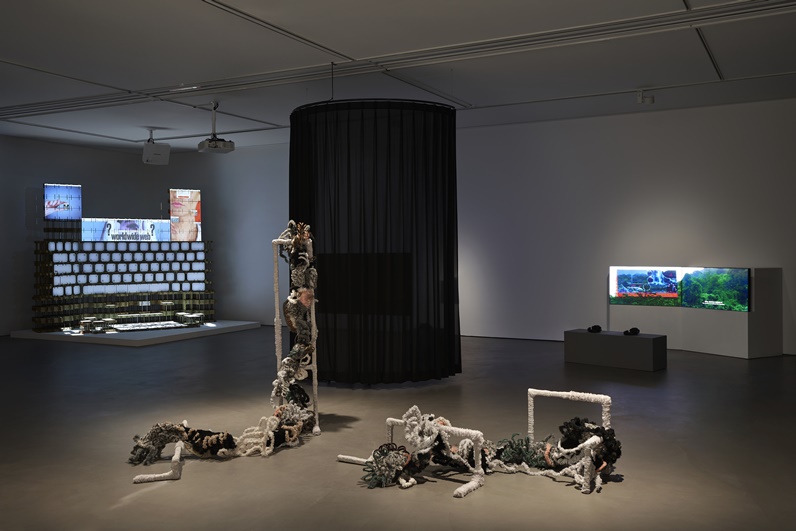
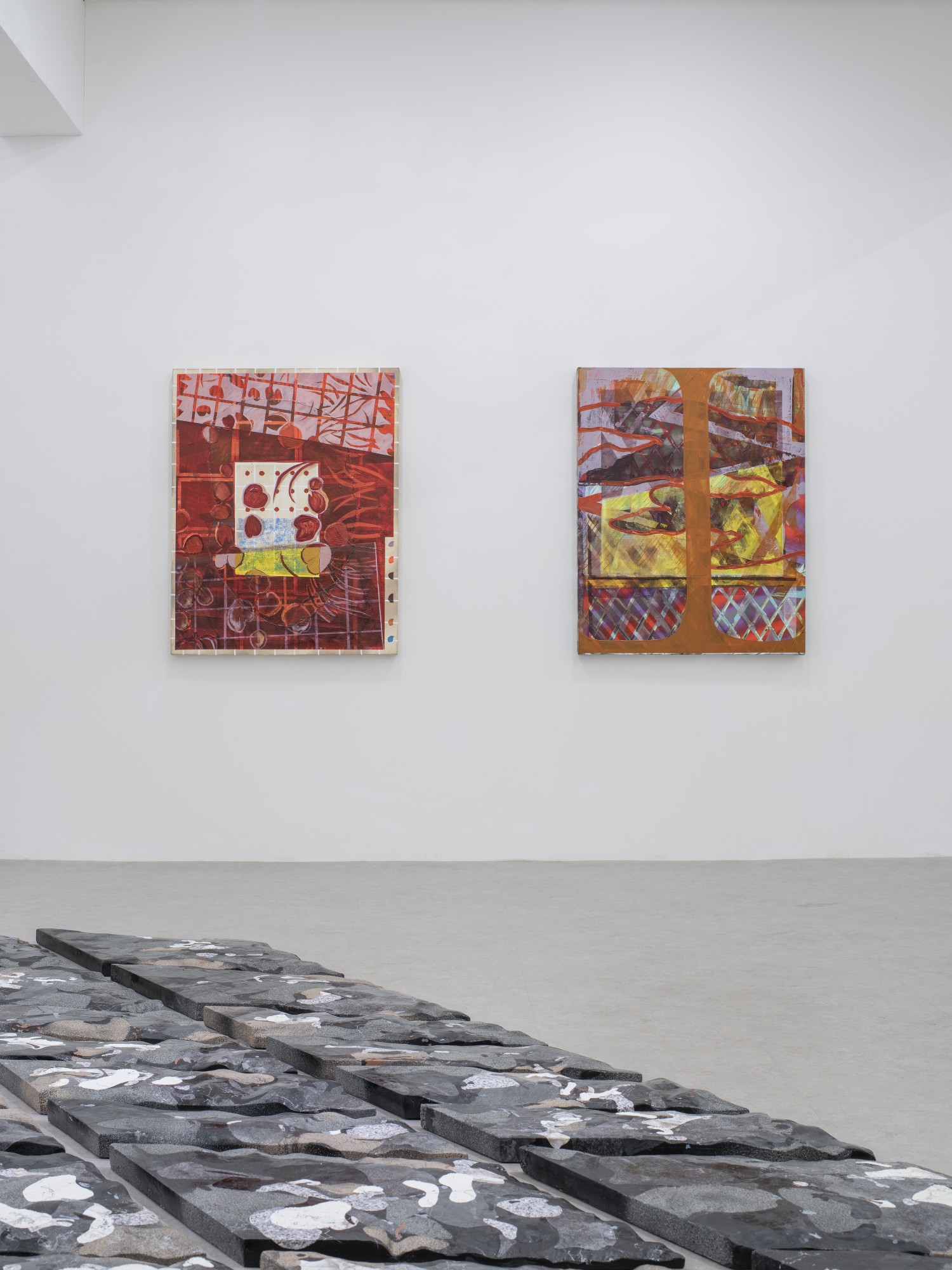
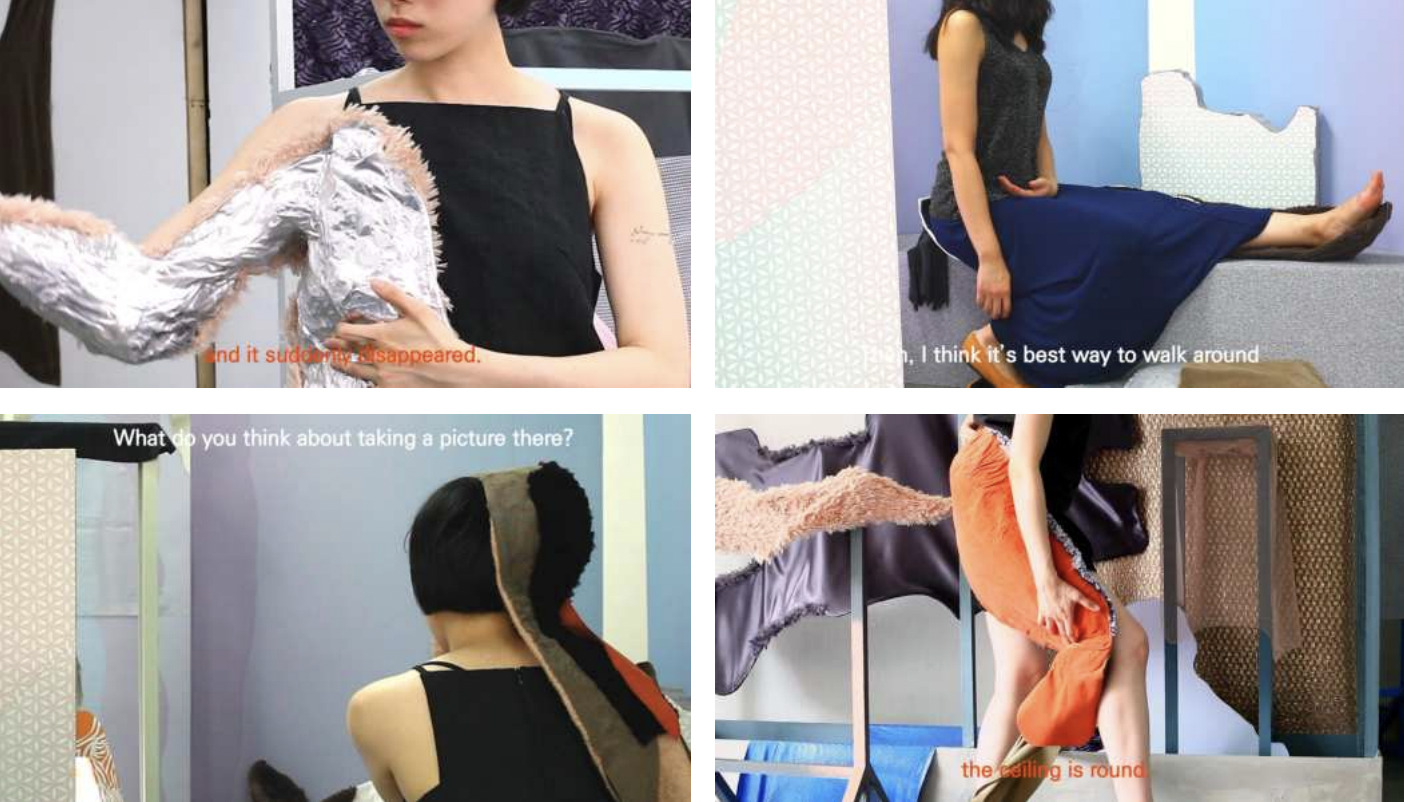
Various kinds of fences, drying racks, blankets, quilt covers, floor mats, scarves, lace, wrapping paper, and so on are gathered in groups across the walls, floor, and ceiling of the exhibition space. However, it does not feel as though these are randomly scattered throughout the space. Various everyday objects are placed in the exhibition space in specific ways, forming diverse groupings. Since there are no captions for each group, viewers cannot infer what kind of work it is simply by looking at the displayed groupings.
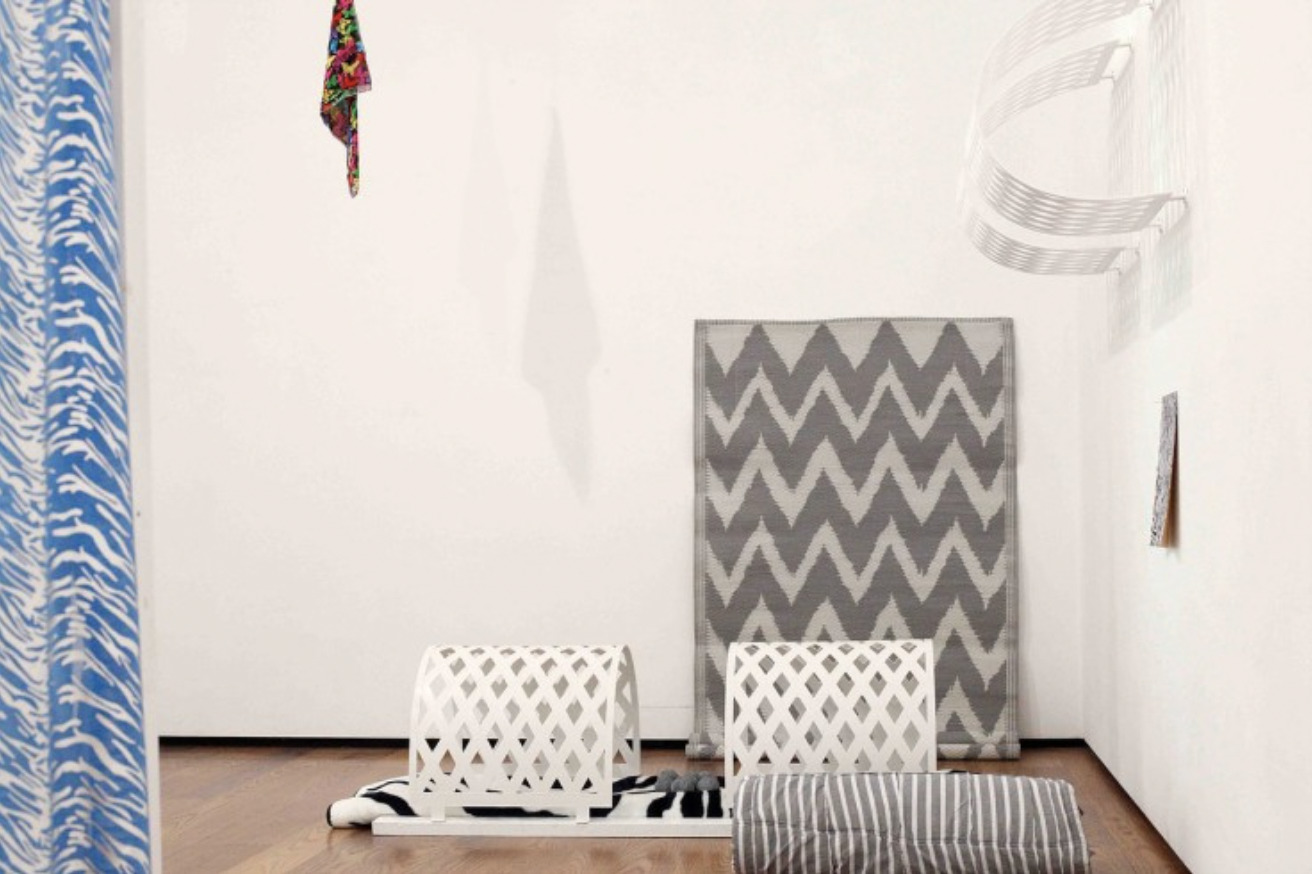
At the entrance of the exhibition space, a layout map of each work is provided. On the layout map, the titles of the works are written. Each work’s title is a noun, such as butterfly, animal, sun, star, tree, cloud, grass, droplet, moon, or flower. On the walls of the exhibition space, the titles of each work are written side by side with modifiers. “Passing grass, sitting animal, moon in the corner, clouds in order, facing trees, dear sun dear sun, flowers lining up, dried stars spread stars, scattered droplets, trembling butterfly”—these seem to describe the state or situation of each work. For example, the work Butterfly features a scarf printed with a butterfly hanging on the wall, swaying in the wind.
The work Tree consists of vertically standing drying racks arranged side by side. The work Star presents star-shaped objects that appear to be made of cement, spread on the floor inside a small fence, with transparent wrapping paper printed with star patterns placed on top. The work Animal is similar. A plastic fence is bent into a semicircular shape and fixed, and inside it is a neatly folded blanket printed with a zebra-like pattern. When observing the exhibited works alongside their titles and the wall text, the combinations of various objects appear to represent the entities indicated by the titles. However, in some cases, such as “passing grass,” the relationship between modifier and modified word feels absurd. Presenting such works, Lim Jeong Soo titled the exhibition 《Wall, Ground, Side》. Likewise, it consists of three juxtaposed nouns.
Looking at the works Lim Jeong Soo has presented so far, one can identify two common elements: “object” and “installation.” Since M. Duchamp presented ready-made works and the first installation works utilizing exhibition space a century ago, and through Pop Art and Minimalist artists, “object” and “space” have played a role as key themes of avant-garde art, contributing to the expansion of the horizon of 20th-century Western art. As a result, it is no longer unfamiliar to encounter installation works using various objects in exhibition spaces. A common characteristic among Duchamp and artists who have engaged in such practices is what can be called an “anti-aesthetic tendency.” Anti-aesthetic works focused on formalistic reflection. Conceptual art is what reaches the extreme of such reflection.
Although agnosticism exists, philosophy is still something that can pursue thought to its limits through reflection. The medium of philosophy is language. Ultimately, conceptual art resulted in the side effect(?) of visual art becoming linguistic. Then, perhaps Lim Jeong Soo’s recent work can also be examined to some extent within this context. First of all, let us look at the exhibition title 《Wall, Ground, Side》. It consists of three nouns. “Wall” is something artificially installed; that is, an artificial object. A wall partitions space through a fence. A fence is a boundary that implies limitation or exclusion. “Ground,” in contrast to “wall,” can be said to refer to nature.
The ground is the surface of the Earth on which all living beings stand. However, humans classify the ground according to their own standards based on surface and form. “Side” indicates position. It is relative positional information. It also contains information about distance. It signifies the distance at which one being can perceive another. From the title 《Wall, Ground, Side》, it seems that she is questioning “the human-centered way of defining objects.” It is not an easy subject. Then, what exactly is she skeptical about?
When looking at Lim Jeong Soo’s works, it is not difficult to identify the components of each work. However, it is not easy to interpret their meaning. The reason lies in the fact that the materials of the works are everyday objects. Because they are so familiar, their conventional uses leave little room for the viewer’s thinking. As seen earlier, she gives titles such as butterfly, animal, cloud, sun, moon, star, tree, and flower to unfamiliar combinations. She wants viewers to project these titles onto the combinations of everyday objects she presents.
It can be said that she represents each object in her own way. She does not represent the form of a specific object in the traditional manner. Instead, she combines direct and indirect elements that can evoke a particular object and presents them to the viewer. She asks viewers to actively keep the titles in mind and assemble these fragments themselves. This seems to be “Lim Jeong Soo’s method of making works.” In any case, she has represented objects in a unique way. It is necessary to pay attention to this uniqueness.
First, let us examine the everyday objects Lim Jeong Soo selected. The exhibited objects can be divided into two categories. One consists of linear and vertical elements such as fences and drying racks, and the other consists of planar materials such as blankets, wrapping paper, floor mats, and scarves that can be folded and cut. These two categories share the common feature of having flat, decorative patterns. When considered in relation to the exhibition title, fences and drying racks can be associated with “wall,” while blankets, wrapping paper, floor mats, and scarves may be related to “ground.” These elements are placed “side by side” to represent a single object. Why did she choose such everyday objects to represent specific things? The clue may be found in the anti-aesthetic tendency discussed earlier.
Since the works in this exhibition reconstruct objects three-dimensionally using everyday items, it would not be unreasonable to consider them as sculptural works. Then perhaps what she seeks to examine through this exhibition is something she has been contemplating regarding traditional sculpture. The everyday objects she selected share the characteristic of having decorative patterns. Another common point is that the planar materials she chose conceal the substance of objects and exist as new surfaces.
From this, two key terms can be extracted: “decoration” and “surface.” Although the primary impression when encountering a work originates from surface and decoration, in traditional sculpture these two elements have been treated as non-essential compared to “mass” and “materiality.” Her skepticism begins precisely at this point.
Only by seeing the familiar in an unfamiliar way can new possibilities be explored. This is the tradition of Western modernist art, and through such skepticism, the horizon of art has continuously expanded. Even now, that tradition must continue. Unfortunately, this is something lacking in the Korean art scene. Lim Jeong Soo acknowledges the importance of vision in art, but defines art as “more of an art of air or touch than of vision.” She also stated that she “hopes her work is not art solely for vision.” By touch, she refers to “the energy emitted from the work being sensorially received through the viewer’s skin.” Meanwhile, she believes that “museum spaces are structured around vision rather than the body.”
She wants viewers to actively experience the exhibition space and sensorially engage with the works. Through her skepticism, one is reminded of Duchamp’s pursuit of “anti-retinal art” and the installation works of Minimalists influenced by phenomenology. All of them expanded the horizon of art through diachronic reflection. She, too, is working within this context. Her skepticism stands out even more in an era dominated by market-oriented art.