Regarding the work Extremely Personal(2016), in which floating feet are wrapped in flesh-colored fibrous material, the artist states that it represents “self-isolation and the wrapping of the personal.” Another work depicting humans entangled like corpses wrapped in spider webs evokes the “cocoon tribe,” who retreat into a state of suspended animation to block potentially harmful external stimuli. Healthy or normal social relationships should be interactions between autonomous individuals.
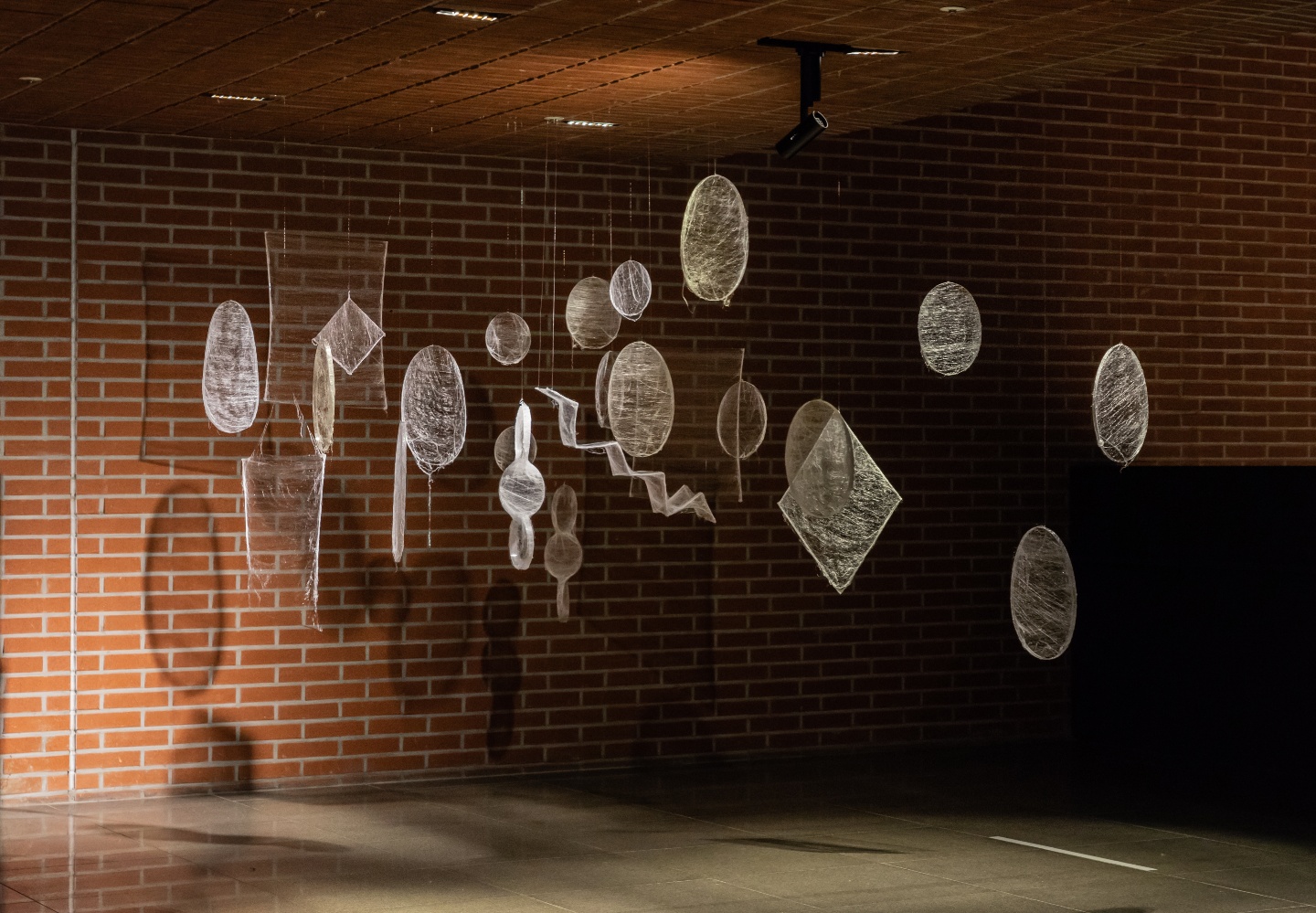
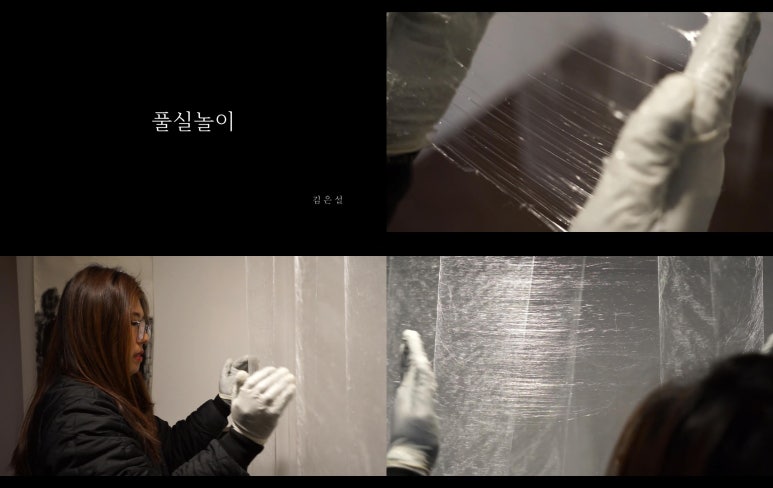
However, for regressive entities wrapped in their own secretions, relationships are merely extensions or variations of narcissism. The desire to be obsessively validated by others becomes a central motive of superficial communication. Kim Eunseol’s works, which symbolize relationships from the individual to society, suggest that individuals suffocate not only within social relationships but already within their relationship with themselves. Unable to exist independently, glue-thread structures formed through repetitive actions are fragile from the outset and become even more fragile over time.
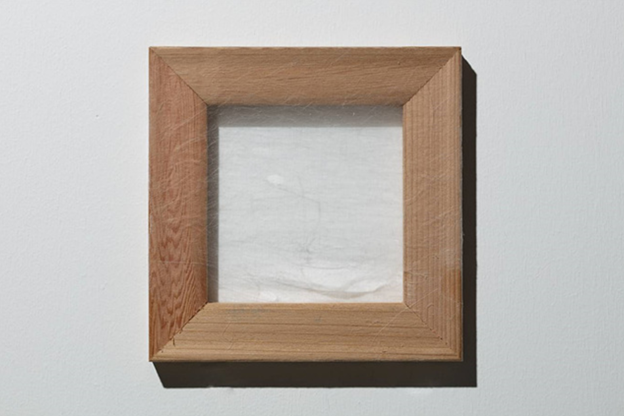
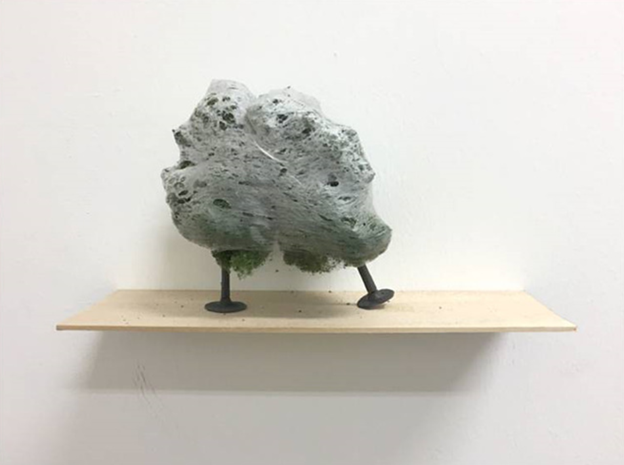
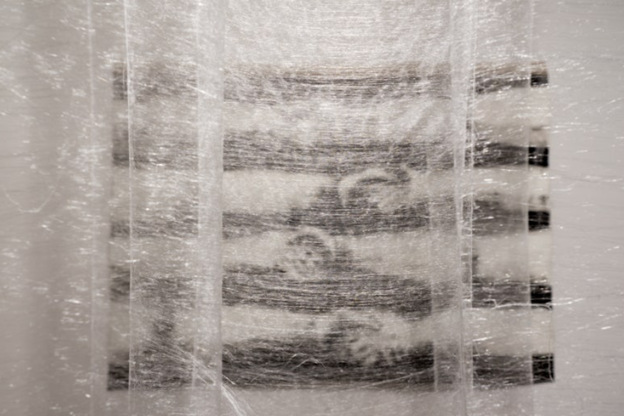
The work Portrait(2017), in which two small wooden sculptures are covered with glue threads, gradually accumulates dust and insect remains, eventually developing cracks. The relationships between humans, and between humans and their environment, are subject to the test of time. Initial bonds loosen and ultimately dissolve under the passage of time. Like objects worn down over time, the figures in the work—neither male nor female, neither child nor adult—are blurred, as the artist describes, like a “long-exposure photograph.” Whether individual or society, the structures in Kim Eunseol’s work are products of systems.
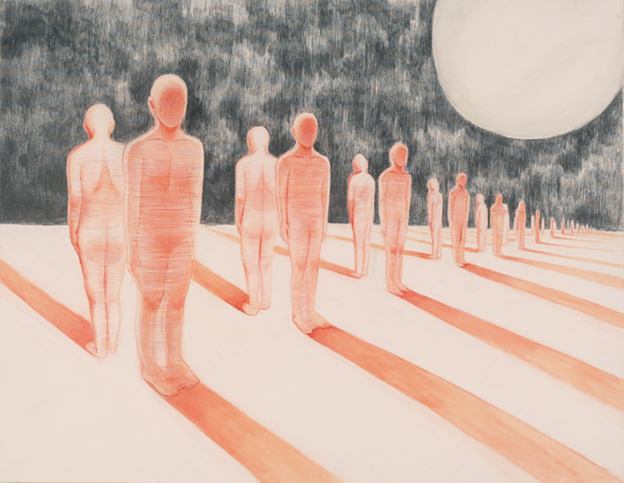
As psychologists and linguists argue, the unconscious and language that constitute individuals and societies are also structural. In her work, the color of the unconscious and language is black. It contains everything, yet remains opaque. Pencil lines drawn vertically across the acrylic-painted skin-toned bodies create tension. In Sculpture(2018), the rigid posture of figures standing like objects and the vertically drawn pencil lines form an isomorphic structure.
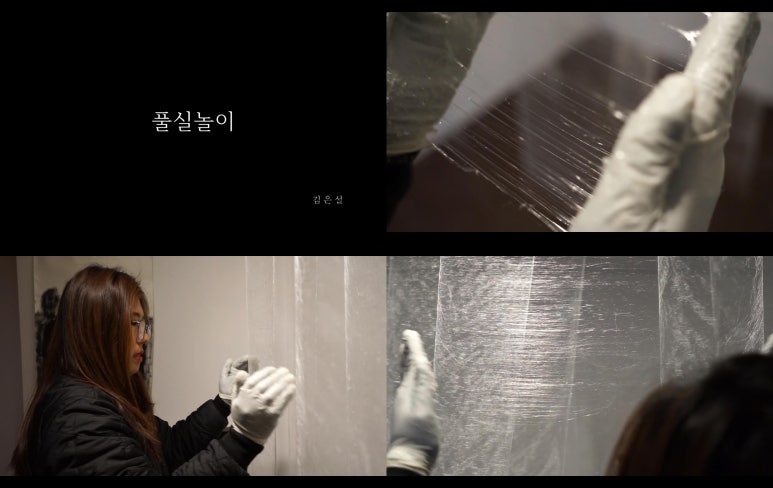
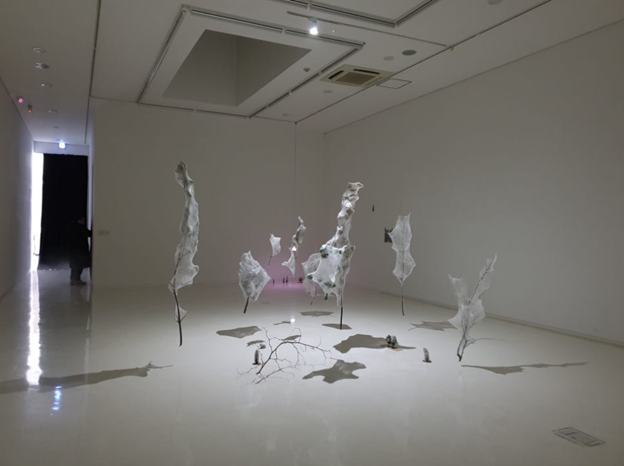
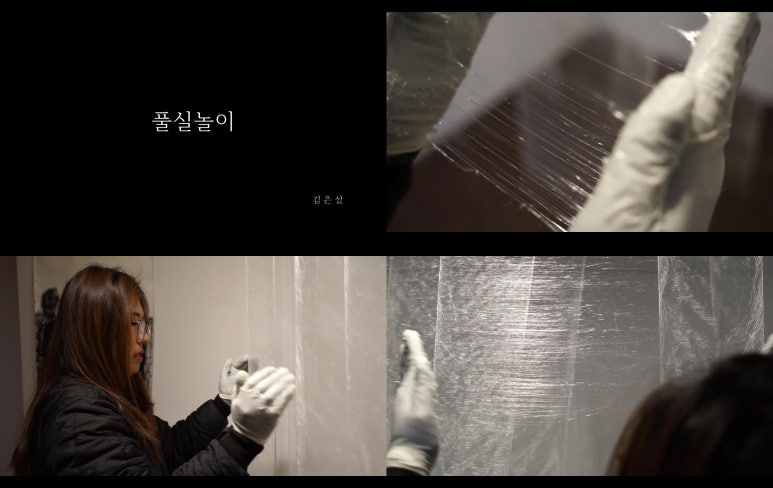
Drawing, like Glue Play, is the result of repeated execution. The background and the human figures are rendered in the same way. The characteristic of being alive is standing out from the surroundings. However, in Kim Eunseol’s work, the mutual permeation between figure and environment evokes a sense of death. Although each work presents a different situation, they generally converge as metaphors for immobility. Some works liken humans to plants, unable to move.
In the ‘Black Drawing’ series, individuals in antagonistic or indifferent relationships are rendered in black. In Kim Eunseol’s work, humans are interchangeable, homogeneous beings—shadow-like entities without a solid sense of presence. The pencil lines coexisting with skin tones penetrate the body and structure it according to social relationships. The pencil, an analog tool associated with childhood learning, evokes nostalgia. Yet it also seems to represent indirect forms of communication such as those mediated by social media.
The countless messages typed and sent are less genuine interactions than variations of monologue. Despite having one of the world’s most advanced information infrastructures, human relationships are not correspondingly substantive. On the contrary, they are the opposite, as people believe social media has replaced communication. The degree of isolation among the anonymous masses in Kim Eunseol’s work—who gather together yet never form close relationships—is remarkably high.
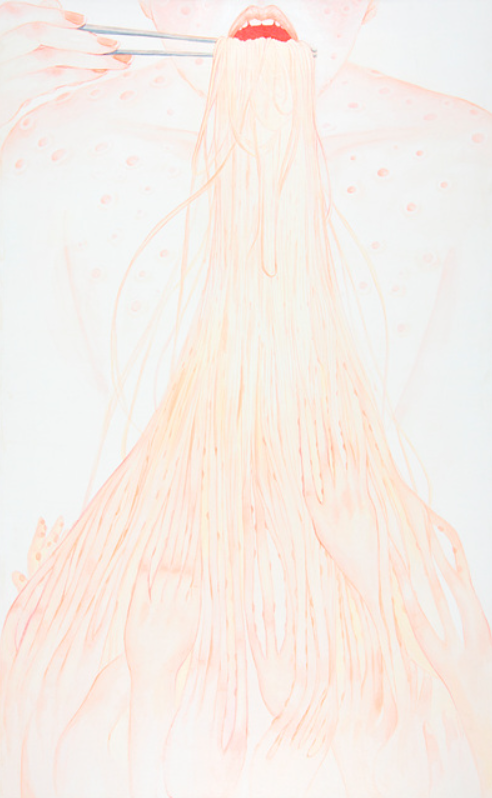
Contemporary individuals even appear as though they are already lying in their own coffins. Invisible systems suspend or arrange human beings. Humans do not create their own positions but merely exist within abstract coordinates. Their organs for interacting actively with the environment are bound. They are tightly wrapped and unable to move freely. The artist attempts to materialize a system that places individuals, including herself, into states of suffering. Images such as fibers emerging from feet gathered into someone’s hands, or mouths devouring others’ hands like noodles, are both amusing and unsettling.
As seen in works such as Bite You(2012), Fast Food(2014), and A Kind of System(2014), the relationship with others that structures individual identity is explored down to the primal instinct of consumption—whether one eats or is eaten. In Influence(2015), two figures appear stretched together like sticky rice cakes melted and fused in a microwave. Only the silhouettes of ears and the tops of heads indicate that they are human. As seen in Aftereffect Series: Unintentionally Stuck(2013), the phenomenon of sticking occurs not only between individuals but also within the self.
Yet rather than creating density, it produces Self Prison(2016). Kim Eunseol’s work simultaneously reveals anxieties about separation and anxieties about influence. Psychologists suggest that the primordial relationship with the other begins in the womb, and that birth itself—the separation from the mother—is a trauma. Even after overcoming wounds and becoming autonomous individuals, the problem is not resolved.
This is because humans remain within networks of influence until death. In The Anxiety of Influence, Harold Bloom notes that the term “influence,” which originally meant “to have power over another” in the scholastic Latin of Aquinas, has retained its etymological sense of influx and its fundamental meaning as a force emanating from the stars.
According to Bloom, to be influenced once meant receiving an ether-like fluid flowing into a person from the stars, affecting their character and destiny, and altering all things on earth. This force—once understood as divine and moral, later simply as mysterious—was exerted regardless of individual will. Although this interpretation is rooted in the imagination of ancient people living in a symbolic universe, modern humans also continue to inhabit another symbolic universe. All humans who learn language from others and become speaking subjects are members of the symbolic order.
The astronomical distance once implied in the term “influence” has gradually diminished, becoming as intimate as seen in contemporary works. This has become possible because humans discovered natural laws and reproduced them socially. Potential becomes actualized and amplified, driving both progress and destruction. While the universe, once filled with spiritual energy in primitive, ancient, and medieval times, briefly became an “empty box” (Newton) in the modern era, it is now being filled again.
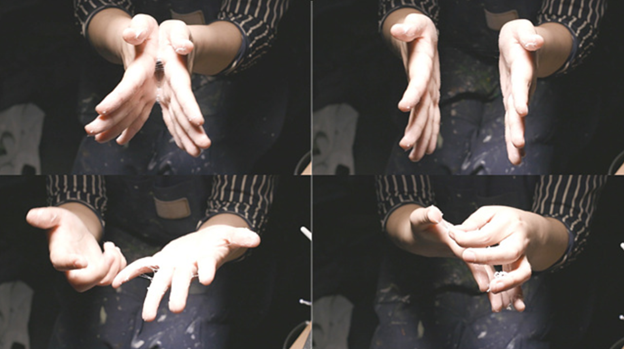
The most dominant element is information. The situation of being wrapped in self-secreted material, pushing and pulling, becomes a metaphor for individuals who react almost like single-celled organisms within an overwhelming flood of information. In such conditions, influence takes on a “non-intentional and almost unconscious tendency” (Harold Bloom). Influence operates through both misunderstanding and understanding. Artists, in particular, are under immense pressure to create something new within these networks of influence. For them, the “anxiety of influence” is layered and complex. One way to overcome this anxiety is through “repetition as neutralization” (Freud). Kim Eunseol’s Glue Play emerges as a simultaneous response to the anxieties of life and art.
Source: Cheongju Art Studio